ASML Holding N.V.: The Machine No One Else Can Build
I. The €350 Million Machine
The most advanced printing machine ever built does not arrive at its customer in one piece. When ASML sent its first High-NA extreme ultraviolet scanner from Veldhoven in the southern Netherlands to Intel's research fab near Hillsboro, Oregon, the system travelled in 13 large containers and 250 crates.1 Estimates of what one of these tools costs run from about $300 million to $400 million, and a German trade outlet put the figure at around €350 million.1 That is the price of a fleet of wide-body jets, paid for a single machine that spends its working life in a cleanroom, firing pulses of light at silicon wafers to draw circuit lines thinner than a virus.
Then the machine has to be rebuilt. Engineers from the supplier and the customer reassemble it on the fab floor, recalibrate it, and coax it into printing patterns that will eventually become the processors running artificial-intelligence models, smartphones and data-center servers. Until it does that reliably, all day, every day, the €350 million is a promise, not a product.
That gap between a technical marvel and a commercially useful tool is the thread running through this whole story, because it is also the gap investors are being asked to price today. ASML has rarely looked more like a winner. In the third quarter of 2026, it reported record sales of €11.7 billion and net income of €5.0 billion, and management raised its forecast for the full year to between €44 billion and €45 billion.[^2] For a company that sold €32.7 billion of systems and services in all of 2025, that forecast implies growth of roughly a third in a single year.2 On the call, management said customers had signalled interest in placing orders for 2029 and 2030, and that it was assessing capacity expansion beyond the roughly 30% increase it had previously planned for 2028.3
And yet the same company had, a little more than a year earlier, told investors it could not confirm it would grow at all in 2026.4 Semiconductor equipment is one of the most cyclical corners of the technology economy. Chipmakers build fabs in waves, and when a wave crests they stop ordering tools with startling speed. ASML's customers are also very few and very large. In 2025, four customers each bought more than a tenth of its sales, and together they accounted for 61.2% of revenue; the biggest alone was almost a quarter.2 A business that sells to four buyers lives on those buyers' capital-spending plans, however indispensable its product.
So the questions are sharper than "is ASML a great company?" What actually keeps customers buying from ASML, rather than from Nikon or Canon or some technology no one has commercialised yet? What could make them wait, or switch, or squeeze the price? How much of today's earnings and cash flow is repeatable, and how much reflects an investment cycle, a one-off accounting gain, or customers paying early? And how much of ASML's famous advantage actually belongs to ASML, rather than to the German optics maker that supplies the heart of every EUV machine?
One boundary first. ASML Holding N.V. is the listed Dutch parent of the ASML group, trading in Amsterdam and on Nasdaq, and the numbers in this story describe the consolidated business.2 ASML reports a single operating segment, which means it does not tell investors how profitable its EUV machines are compared with its older deep-ultraviolet tools, its inspection equipment, or its service business.2 It has no controlling shareholder. Carl Zeiss SMT, its sole supplier of optical columns, is a 24.9%-owned associate, not a parent; and Mistral AI, the French AI developer in which ASML holds a minority stake, is an investment, not an operating business.2
The verdict this story will test is simple to say and hard to prove. ASML holds an extraordinary position in a costly, cyclical supply chain. Whether that position keeps earning its price depends on whether the next generation of machines becomes as indispensable in production as the last one did. To see why that is not a foregone conclusion, it helps to go back to a time when ASML was nobody's idea of a monopoly.
 Subscribe on LinkedIn
II. The Philips Spinout That Had to Catch Up
On April 1, 1984, a new company called ASM Lithography opened for business in a building on the Philips campus at Strijp in Eindhoven that its own employees came to call the "leaky shed."5 The name was not a metaphor. The wooden barracks really did let in the rain. Its parents were an odd couple. Philips, the Dutch electronics giant, had spent years developing a wafer stepper in its research labs and wanted someone to commercialise it. ASM International, a much smaller Dutch semiconductor-equipment company led by the entrepreneur Arthur del Prado, wanted a lithography business.5 Philips executives reportedly regarded ASM as an upstart and had preferred a bigger American partner, Perkin-Elmer, before settling on the joint venture.5
The mandate was to sell the PAS 2000, the stepper Philips had developed. It was not a hit.5 To understand why that mattered, and why a scrappy Dutch spinout faced such long odds, it helps to understand what a lithography machine does.
A chip is built in layers, like a city drawn floor by floor. On each layer, a wafer coated with a light-sensitive chemical is exposed to light shone through a stencil, called a mask or reticle. Where the light lands, the chemical changes, and later steps etch or deposit material along the pattern. Repeat that dozens of times, with each layer aligned to the one beneath it within a few nanometres, and you have a processor. The lithography tool is the projector at the centre of this process. Its job is to print the smallest possible features, place them exactly where they belong, and do it on as many wafers per hour as possible, because every hour a several-hundred-million-dollar fab spends waiting is money burning.
In the 1980s, the masters of this craft were Japanese. Nikon and Canon dominated wafer steppers, backed by deep optical expertise and close relationships with Japan's then-mighty memory makers. ASML was, in its own later telling, a distant third behind those two giants.6 It survived its early years on support from its parents, and on a decision that would turn into a habit: it bet heavily on the next platform rather than trying to win the current one.
That platform was the PAS 5500, launched in 1991. It was modular, which meant customers could upgrade lenses and stages without replacing the entire tool, and it gave ASML its first real foothold with major chipmakers.6 The company listed its shares in Amsterdam and New York in 1995, giving it access to capital it would need again and again.7 But the more important change was in the industry's demands. As chip designs became denser, each generation needed shorter wavelengths of light, better lenses and tighter overlay accuracy, and every improvement had to come without slowing the factory down. Better resolution was worth nothing if the tool printed fewer wafers.
That practical constraint produced the invention that changed ASML's position. In December 2000, the company announced dual wafer stage technology on its new TWINSCAN platform for 300-millimetre wafers, with first shipments planned for the middle of 2001.8 The idea was elegant. A conventional scanner had one wafer stage: it measured the wafer's surface and alignment marks, then exposed it, and while it measured, it was not printing. TWINSCAN gave the machine two stages. While one wafer was being exposed, a second was being mapped and aligned on the other stage, and then the two swapped. It is the difference between a restaurant with one table that has to be cleared and reset between diners and one with two tables, where the next party is seated while the first one finishes.
ASML later described TWINSCAN as the platform that would carry its products for more than two decades.9 But the technical feature only became a customer advantage because it showed up in the numbers chipmakers cared about. Measuring a wafer in parallel allowed more careful measurement without stealing exposure time, which helped overlay and yield; and the swap kept the light source busy, which raised throughput. A fab manager buying a tool does not care about the elegance of an architecture. They care about good wafers per hour per euro of capital, about uptime, and about whether the tool behaves the same way on Monday morning as it did on Friday night. TWINSCAN had to prove itself on that scoreboard, on the fab floor, against Nikon tools that were also improving.
It did. By 2006, ASML said TWINSCAN had become the industry standard for 300-millimetre lithography and had helped it hold the leading market share for several years.10 The company had come from third place to first not through a single breakthrough but through a sequence of platform bets, each one tested in customers' factories. Immersion lithography, which placed a film of water between the lens and the wafer to sharpen the image, extended the life of deep-ultraviolet light further in the 2000s, and ASML's dual-stage machines were well suited to it.
The point for investors is that ASML's lead was earned, and earned slowly. It was built through decades of engineering, customer collaboration and capital commitment, not secured at the outset by some patent or government favour. That matters because it suggests the lead could, in principle, be lost the same way: a rival making the better platform bet while ASML optimised the old one.
And by the 2000s, the next bet was already obvious and frighteningly hard. Water and clever optics could squeeze deep-ultraviolet light only so far. To keep shrinking chips economically, the industry needed light with a wavelength more than ten times shorter, light so energetic that air absorbs it and ordinary lenses cannot focus it. ASML could improve scanners. It did not yet know how to produce that light economically, and neither did anyone else.
III. Customers Put Money Behind EUV
On July 9, 2012, ASML announced an unusual deal: its customers would pay it to build its own future.11 Intel, and then TSMC and Samsung, agreed to take minority stakes in the company and to fund its research into next-generation lithography. The equity side was large. The three customers together bought a 23% stake for €3.85 billion in cash, with Intel taking 15%, TSMC 5% and Samsung 3%.12 Separately, they committed €1.38 billion to ASML's research and development over five years, aimed at extreme ultraviolet lithography and at tools for larger 450-millimetre wafers.11 Samsung, the last to join, signed on at the end of August, committing €276 million to research and €503 million for its shares, and ASML said its arrival completed the programme.[^14] Existing shareholders voted their approval that September.11
Why would the world's largest chipmakers write cheques to a supplier, knowing that if the technology worked it might leave them dependent on a single company? The answer starts with what EUV promised and what it demanded.
Extreme ultraviolet light has a wavelength of 13.5 nanometres, against 193 nanometres for the deep-ultraviolet light the industry was using. A shorter wavelength can draw finer lines in a single exposure. By the early 2010s, chipmakers were reaching small dimensions with DUV only by tricks: exposing the same layer two, three or four times with shifted patterns, a process called multi-patterning. Each extra exposure added cost, cycle time and opportunities for defects. EUV promised to collapse several of those steps into one.
But EUV light is miserable to work with. Air absorbs it, so the whole optical path has to sit in a vacuum. Glass absorbs it, so the machine cannot use lenses and must instead bounce the light off a series of mirrors coated with dozens of alternating layers of exotic materials, each polished to near-atomic smoothness. Masks need entirely new designs. The light-sensitive chemicals, the resists, had to be reformulated. And there is no natural, convenient source of EUV light. The approach the industry settled on involves hitting tiny droplets of molten tin with a powerful laser, tens of thousands of times a second, so that each droplet flashes into a plasma that emits the right wavelength. Every part of that system was a research project.
ASML had been working on EUV since the late 1990s and shipped early development tools years before the co-investment deal; but in 2012 the machines were far from production-worthy, mainly because the source could not deliver enough power to expose wafers quickly.7 An EUV tool that prints a handful of wafers an hour is a laboratory instrument. Fabs needed well over a hundred.
So the co-investment is best understood as a risk-sharing arrangement among parties with overlapping fears. The chipmakers feared that without EUV, the cost of each new generation of chips would rise so steeply that Moore's Law would stall. They also feared that ASML alone could not afford the bet fast enough. ASML feared spending billions on a technology customers might not adopt. Putting customer money into the programme aligned incentives on both sides: it gave ASML funding and commitment, and it gave the chipmakers research rights, influence over the roadmap and a financial stake in ASML's success.
There is an often-overlooked detail that makes the deal more subtle than a simple cash infusion. The €3.85 billion equity was largely handed back. ASML ran a "synthetic" share buyback in November 2012, returning capital to its other shareholders so that the share issue did not dilute earnings per share.12 The participants' shares were held through foundations with limited voting rights.12 In other words, the equity piece was mostly about alignment, a way for customers to own a slice of the upside if EUV succeeded, while the research funding was the money that actually helped pay engineers. Customers were buying a seat at the table, not merely financing a balance sheet.
The programme also carries a quiet warning about customer-funded roadmaps. Part of the research money was aimed at tools for 450-millimetre wafers, a move to larger wafers that the industry discussed for years and never adopted in volume. Customers can fund a technology and still decide, later, that they do not want it. EUV was the half of the bet that paid off; the other half is a reminder that co-investment signals intent, not demand.
That distinction shapes the relationship to this day. The customers who funded EUV did not, in the process, give up their leverage. Intel, TSMC and Samsung remain among ASML's largest buyers, and the concentration that made co-investment possible, a handful of companies able to fund leading-edge chips, still shapes ASML's customer base today, a fact that matters for any test of the moat.2 The decision to invest was a bet on the technology, not a vow to stop negotiating.
The co-investment was evidence of commitment. It was not proof that EUV would succeed. In 2012 and 2013, the source remained the bottleneck, and the money could buy time, engineers and customer patience. It could not by itself make tin droplets glow brightly enough to run a factory. For that, ASML decided it needed to own the light.
IV. Buying the Missing Pieces
In October 2012, only months after signing its customers into the co-investment programme, ASML agreed to buy the company that made the light: Cymer, of San Diego. Cymer was ASML's long-standing supplier of the lasers used in deep-ultraviolet scanners, and it was the company working on the EUV source.[^15] The deal closed on May 30, 2013, after approvals from the US Department of Justice, the Committee on Foreign Investment in the United States and regulators in Taiwan, Germany and Israel.[^15] Cymer shareholders received $20 in cash plus 1.1502 ASML shares for each Cymer share.[^15] ASML's annual report for 2013 put the total consideration at about €3.1 billion, slightly above some earlier estimates of around €2.9 billion, because the share component was valued at closing.13
The logic was not subtle. The source was the single biggest obstacle to economically viable EUV, and ASML did not want the fate of its largest bet to depend on a supplier's priorities, capital budget and pace. By buying Cymer, ASML could integrate source development with scanner design, put its own engineering management and money directly behind the problem, and capture whatever value the light source ultimately created. ASML said the combination would bring Cymer's light-source expertise together with its own lithography system know-how.13
It is fair to ask whether that worked. The honest answer is that it took years more. Source power climbed in stages through the rest of the decade, and EUV did not reach high-volume manufacturing until 2019, six years after the deal closed. But that is also the strongest evidence that the problem genuinely needed direct ownership. A supplier with Cymer's size and alternative businesses could reasonably have slowed spending when progress stalled. Inside ASML, the source programme was the company's future.
The second large purchase came three years later and was less obviously necessary. In 2016, ASML acquired Hermes Microvision, a Taiwanese maker of electron-beam inspection tools, known as HMI, for consideration of about €3.0 billion. Of that, €2.12 billion was allocated to goodwill, meaning that most of the price was paid for things not recorded as separate identifiable assets: expected synergies, the team, the technology roadmap and future growth.14 HMI's machines scan wafers with electron beams to find defects too small to see with light-based inspection. ASML's strategic idea was to combine measurement and inspection data with its scanners so that customers could find and correct errors faster, an approach it called holistic lithography.
That same year, ASML also agreed to buy a 24.9% stake in Carl Zeiss SMT for €1 billion and to support Zeiss's research and capital spending on the next generation of EUV optics.14 That was not an acquisition of control; Zeiss remained majority-owned by its German parent. But it turned a supplier relationship into a financial partnership, and its consequences sit at the centre of the moat question.
Did ASML overpay? For Cymer, the strategic payoff is visible: ASML is the only commercial supplier of EUV scanners, and the source is part of every one. For HMI, the case is murkier. ASML does not disclose HMI's sales or profits separately, so investors cannot calculate a return on that €3 billion.2 Because goodwill is tested against the whole company's earnings power, the lithography engine easily covers it; that tells investors little about whether HMI on its own earned its price. The fairest verdict is that Cymer addressed a critical bottleneck and HMI broadened ASML's inspection capability, with an unprovable return.
Keep the record in proportion, too. ASML did not turn into a conglomerate. Its inspection and metrology products remain a small part of a business whose economic engine is lithography systems and the installed base of those systems that need service and upgrades. The acquisitions bought control of the pieces that mattered most to the core.
But ownership of the pieces could not answer the question that mattered most. Could ASML take a system built around tin plasma, vacuum chambers and mirror stacks and turn it into a tool customers would trust with their highest-volume, highest-margin production? That would take until the end of the decade.
V. The EUV Bet Finally Reaches the Fab
In 2019, after what ASML itself called a twenty-year development journey, EUV moved into high-volume chip manufacturing at customer sites.[^18] TSMC began volume production on its N7+ process in the second quarter of that year, using EUV on a handful of critical layers and running on ASML's NXE:3400B scanners; Samsung began using EUV for its own 7-nanometre production the same year.15 There was no single launch moment, no ribbon to cut. The proof arrived quietly, as wafers came off the line with yields that matched the older process and chips began appearing in phones.
Even then, the commercial ramp showed how much was still being worked out. ASML planned to ship about 30 EUV scanners in 2019, received orders for 23 in the third quarter alone, and still had to push four system shipments into early 2020 because of temporary supply constraints.15 Its next model, the NXE:3400C, was rated at 170 wafers per hour against 125 for its predecessor, a 35% jump in productivity.15 That last number is the quiet hero of the EUV story. The physics had been demonstrated years earlier; what turned EUV into a business was making it fast enough, and available enough of the time, that a fab's spreadsheet came out in its favour.
To see why, picture where a scanner sits in a fab. A modern leading-edge chip passes through well over a thousand process steps across months. Lithography is the step that defines the pattern on each critical layer, and every other tool in the line, the etchers, the deposition chambers, the cleaning and inspection systems, works around the pattern the scanner prints. If the scanner is down, wafers queue. If its overlay drifts, the defect shows up weeks later, after expensive processing has been spent on a wafer that will be scrapped. That is why chipmakers care about a lithography tool's uptime and consistency as much as its resolution, and why a new tool has to be integrated into a recipe that the customer's engineers have spent years tuning.
EUV's economic value lies in what it removes. Where a DUV process might need three or four exposures, with all their etch and deposition steps in between, to define one dense layer, EUV can often do it in one. Fewer steps mean shorter cycle time, fewer chances for defects, and less floor space and equipment around each layer. Against that, the tool itself is extraordinarily expensive, it draws large amounts of power, and it needs a demanding operating environment and constant service. EUV only wins where layers are so dense that multi-patterning becomes punishing, which is exactly why it rode the leading-edge logic and, later, memory transitions.
The financial consequences took a few years to show, and when they did, they transformed ASML. In 2014, the company reported record sales of €5.86 billion.[^20] By 2025, sales were €32.7 billion, a growth rate of about 17% a year over the decade, while net profit compounded faster, at around 21% a year, because each euro of sales came with more profit.2 Operating margin rose from about a fifth of sales to more than a third over the same period.2 That margin expansion is the clearest financial evidence that EUV did more than add volume: it gave ASML a product nobody else sold.
The 2025 sales mix shows where the money comes from today. Of the €32.7 billion, logic chipmakers, the foundries and processor makers such as TSMC and Intel, bought about €16.1 billion of systems. Memory makers bought about €8.4 billion. And roughly €8.2 billion came from the installed base: service, upgrades and what ASML calls field options.2 That last line, about a quarter of revenue, rose 26% in 2025 and grew from 23% of sales to 25%.2
The installed base deserves a careful description, because it is easy to oversell. Every scanner ASML has shipped needs maintenance, spare parts, software and periodic upgrades for decades, so the more tools are in the field, the larger the service pool. That makes the installed base a second, steadier engine alongside system sales. But it is not a subscription business. ASML does not disclose a standard contract term, a minimum commitment, or a single recurring-revenue percentage, and upgrades in particular depend on customers wanting more productivity from their existing tools.2 When fabs run flat out, customers buy upgrades to squeeze out more wafers. When they idle tools, they defer them. The service line cushions the cycle; it does not cancel it.
Nor do system orders flow in a straight line. Contracts for systems require written authorisation and typically include cancellation penalties, and ASML ended 2025 with a backlog of €38.8 billion, more than a year of revenue.2 Backlog is not revenue, though. Customers can, and do, ask to push deliveries out when a fab is delayed, utilisation falls or a technology node slips. The best recent illustration is 2024, when ASML's sales grew only about 2.6% as several large customers slowed their spending, after growth of 30% the year before.2 The company's prospects had not changed in a year. Its customers' timing had.
It is also worth remembering that EUV did not replace the older machines. Deep-ultraviolet immersion scanners still print most of the layers on even the most advanced chips, because only the densest layers justify EUV's cost, and mature-node fabs for cars, industrial equipment and power chips run almost entirely on DUV. That gives ASML a broad base of less glamorous sales, but it is also the part of the business where Nikon and Canon compete and where Chinese demand has been concentrated. EUV is the reason ASML is singular; DUV is a large part of the reason it is big.
Management laid out its long-term ambitions at its investor day in November 2024, describing an opportunity for 2030 sales of roughly €44 billion to €60 billion, with gross margins of about 56% to 60%.[^21] Those scenarios looked bold at the time. Two years later, the 2026 forecast of €44–45 billion already sits at the bottom of that 2030 range.[^2] Read one way, demand is running ahead of plan. Read another way, the AI build-out is pulling forward purchases that would otherwise have been spread over several years, which is precisely what happens at the top of an equipment cycle. The data cannot yet tell those two stories apart.
What it can show is that the EUV bet changed ASML's strategic position decisively in one sense, and not at all in another. It made ASML the only company that can supply the most critical layers of the most advanced chips. It did not make those chips' production schedule ASML's to control. And the roadmap has already moved on. The current EUV machines have a numerical aperture, a measure of how wide a cone of light the optics can gather and focus, of 0.33; the new High-NA systems raise it to 0.55, which lets them print finer features in a single exposure. That is the High-NA machine ASML sent to Intel.1 It may preserve ASML's lead for another decade. But customers still have to justify its cost per wafer, and that brings the story to the heart of the matter: why customers keep buying from ASML at all.
VI. A Moat That Depends on the Whole Fab
Imagine the planning meeting at a large chipmaker as it lays out its next leading-edge fab. The building alone will take years. The line will need hundreds of tools from dozens of suppliers. Its process engineers have spent years developing recipes on ASML's EUV scanners, its operators are trained on them, and ASML field engineers are already stationed in its existing fabs. The question on the table is not really "ASML or someone else?" for EUV. There is no someone else. The questions are how many tools to buy, which generation, when to take delivery, and how hard to negotiate the price.
The European Commission put the industry structure in stark numbers in a 2026 assessment of the semiconductor equipment sector: ASML held about 92% of lithography sales in 2023, and 100% of EUV.16 Few industrial markets anywhere look like that. To understand why, and what could change it, it helps to walk through the forces acting on the business one by one.
Start with rivals. In EUV there are none commercially. In DUV, the older but still enormous market for less critical layers and mature chips, Nikon and Canon compete, and DUV pricing reflects real competition.16 So the clean statement is narrower than "ASML is a monopoly": it is a monopolist in EUV and a leader in a contested DUV market.
The threat of new entrants is low for a reason that goes beyond patents. An EUV scanner combines a tin-plasma light source, multilayer mirror optics, vacuum systems, wafer stages moving at high speed with nanometre precision, and software that ties them together. ASML spent about €4.7 billion on research and development in 2025, around 14% of sales, and has been spending at similar intensity for years.2 A newcomer would have to match not just that spending but the decades of customer feedback embedded in the product, and build its own supplier network. China has strong political reasons to try, and Canon has promoted nanoimprint lithography, which stamps patterns physically rather than projecting them with light, as a cheaper route for some applications. Neither has shown it can match EUV's cost and yield in leading-edge high-volume manufacturing. Both are alternatives to monitor rather than proven replacements.
Substitutes inside the fab are more real than they look. Multi-patterning with DUV is a substitute for EUV on some layers; it costs more and yields less, but a customer that cannot get EUV tools, or that finds EUV too expensive for a given layer, can fall back on it. That ceiling on EUV's value matters for High-NA in particular. If customers can achieve the required features by double-exposing with today's EUV machines at an acceptable cost, the €350 million machine has to compete with ASML's own installed fleet.
Then there are the buyers, and this is where the moat story gets more complicated. In 2025, ASML's largest customer accounted for 23.9% of sales and the top two for 38.0%; four customers together made up 61.2%.2 A year earlier, the largest customer was 16.6%.2 This is a market with a handful of enormously sophisticated buyers, each spending tens of billions on capital equipment, each with engineering teams who understand ASML's technology intimately. They cannot easily walk away from EUV, but they can delay orders, change the mix between generations, negotiate hard, and choose which tools to put in which fabs. ASML itself warns that the loss of, or delay in orders from, a key customer could materially affect its results.2 The power is mutual, which is a very different thing from ASML having all of it.
Finally, the suppliers, and one in particular. Carl Zeiss SMT is ASML's sole supplier of the optical columns at the heart of every EUV and DUV scanner.2 In 2025, ASML bought €4.4 billion of goods and services from Zeiss and its subsidiaries, equal to roughly 13.5% of ASML's sales and almost 29% of its cost of sales.2 The relationship is unusually intertwined. ASML owns 24.9% of Zeiss SMT, and at the end of 2025 it had about €1.9 billion of loans outstanding to the Zeiss entities and about €1.2 billion of advance payments, several of the loans interest-free or low-interest and guaranteed by the parent, Carl Zeiss AG.2 The pricing model between the two varies with the annual financial performance of both businesses in lithography.2
That is a strategic alliance, and it is also a concentrated counterparty exposure. Zeiss cannot sell EUV optics to anyone else in volume, because there is no one else to sell them to; ASML cannot buy them from anyone else, because no one else makes them. Each depends on the other's capacity and competence. The arrangement has worked well for decades. But it means that a meaningful part of the "ASML moat" is a Zeiss moat, shared through contract, ownership and cash. If Zeiss struggled to scale its High-NA mirror production, ASML could not substitute.
Put the forces together and the advantage looks like this. The strongest evidence of the moat is EUV's sole-source position, the depth of process integration inside each customer's fab, and the specialised supplier ecosystem that ASML orchestrates. The switching cost is real but it is not mainly a contractual or technical lock: it is that the customer's production recipes, qualification data, trained staff, installed tools and service relationships are all built around ASML systems, and moving a single critical layer to a different tool would mean requalifying a process that took years to perfect. ASML's long history of customer co-development deepens that effect, because the next tool is designed with the customer's next process in mind.
How would the moat break? Not through a single event, most likely. It would show up first as customers succeeding in multi-sourcing a layer, a rival technology meeting the cost and yield needed in volume production, or ASML failing to realise its price on the next generation. That is why High-NA is the test to watch. The milestone that matters is not a certification or a research tool installed in a lab. It is customers running production wafers, accepting tools, and placing follow-on orders. If they do, ASML's position extends into the 2030s. If they prefer to stretch the current generation, the moat survives but the price ASML can charge for its newest machine narrows.
There is one more way to tell whether a moat is real, and it is the least glamorous: follow the cash.
VII. The Cash Behind the Machine
Here is a puzzle buried in ASML's annual reports. Add up the twelve years from 2014 through 2025, and the company reported about €51.4 billion of net profit but generated about €66.1 billion of cash from its operations, almost 30% more than it earned.2 For a manufacturer that holds months of inventory and builds machines that take well over a year to make, that is a striking result. Most capital-goods companies struggle to turn profit into cash at all during growth spurts, because inventory and unpaid invoices swallow it. So how did ASML do it?
Part of the answer is ordinary. Depreciation and amortisation are charges against profit that do not consume cash in the year they are recorded, so operating cash flow naturally runs above net income for an asset-heavy business. The rest is about who finances whom. ASML's most powerful working-capital tool is its customers. Because demand for its systems often exceeds its ability to produce them, customers pay down payments long before delivery, and those advances appear on ASML's balance sheet as contract liabilities: cash in hand for work not yet done. In effect, customers help fund ASML's production of their own machines.
That works beautifully on the way up and less well on the way down. When orders slow, advances shrink, while inventory already committed keeps arriving from suppliers. That is why ASML's yearly cash flow can swing violently even when profits look steady. In 2021, operating cash flow was far above earnings as customers rushed to secure tools; in 2023, it fell well below, and the ratio of operating cash flow to EBITDA dropped to roughly half.2 Over a long span, the effects average out. In any one year, they can dominate.
The 2023 dip is the strongest counterevidence in ASML's own record to any claim that its monopoly makes its cash flows smooth. That year, sales rose by about 30% and net profit by more, yet operating cash flow fell by about a third.2 The swing came from working capital, as inventory built up for machines still to ship and the flood of advance payments from the 2021–2022 ordering rush ebbed. Nothing was wrong with the franchise. The cash simply arrived on the customers' schedule rather than ASML's. A monopoly on the tool is not a monopoly on the timing of payment.
Which brings us to 2025, a year when the cash looked excellent and needs a closer look. ASML reported operating cash flow of €12.7 billion against net income of €9.6 billion.2 But during the year it also sold €6.2 billion of receivables to banks through factoring, up from about €2.0 billion the year before.2 Factoring means the company hands an invoice to a financial institution in exchange for cash now, rather than waiting for the customer to pay. It is legal, common and disclosed. It is also a choice about timing. Of the €6.2 billion, about €3.5 billion related to unconditional customer down-payment receivables for systems due to ship in 2026 or later.2 In plain terms, ASML had billed customers for down payments on future machines, and rather than wait for those customers to pay, it collected the cash from banks.
That does not make the cash fake. The customers' obligations were unconditional, and the money is real. But it does mean that some of 2025's cash arrived earlier than it otherwise would have, and that a future year will not see that cash arrive again. An investor who looks at 2025 operating cash flow and assumes it is the run rate is, in part, capitalising a timing decision.
The receivables numbers reinforce the point. Trade receivables fell from about €4.5 billion at the end of 2024 to about €3.0 billion at the end of 2025, with no allowance for credit losses.2 Measured as days of sales, receivables dropped from a peak of 121 days in 2022 to just 47 in 2025, the lowest in more than a decade.2 Some of that improvement reflects collections and mix; some of it reflects factoring. The quality of ASML's customers is not in question: they are among the most creditworthy industrial companies in the world, and the share of receivables owed by the three largest customers fell to about 35% from 54% a year earlier.2 But ASML does not publish a receivables ageing table, so outsiders cannot see how much of the improvement would have occurred without the banks.2
The other side of working capital is inventory, and there ASML looks like what it is: a manufacturer of fantastically complex machines. Inventory has stood at the equivalent of well over 200 days of cost of sales for most of the past decade, and around 270 days in 2025.2 That stock of mirrors, stages, sources and part-built systems is the cash price of being able to ship on time.
So where did all the free cash go? Over the twelve years, free cash flow, operating cash minus capital spending, totalled about €54.0 billion.2 Of that, about €15.8 billion went out as dividends, and the company's pile of cash and short-term investments rose from about €3.0 billion at the end of 2013 to €13.3 billion at the end of 2025.2 The remainder, more than €25 billion, went mainly to share buybacks and to strategic deployments such as HMI and the Zeiss stake. That split is a useful lens for the buyback debate that comes next: ASML has returned a great deal of cash, while keeping a cushion large enough to ride out a downturn.
The long-run verdict is strong. ASML converts profits to cash better than most capital-goods companies, because its customers prepay and its product commands the terms. The 2025 figure needs an asterisk for factoring, and the forward question is sharper. Management is now considering capacity beyond its previous plan, and Zeiss and other suppliers will need money and commitments to keep pace. Will that expansion consume cash faster than the installed base and new system sales replenish it? The person who has to answer is a physicist from Grenoble who became chief executive in 2024.
VIII. The CEO's Guidepost Meets the Cycle
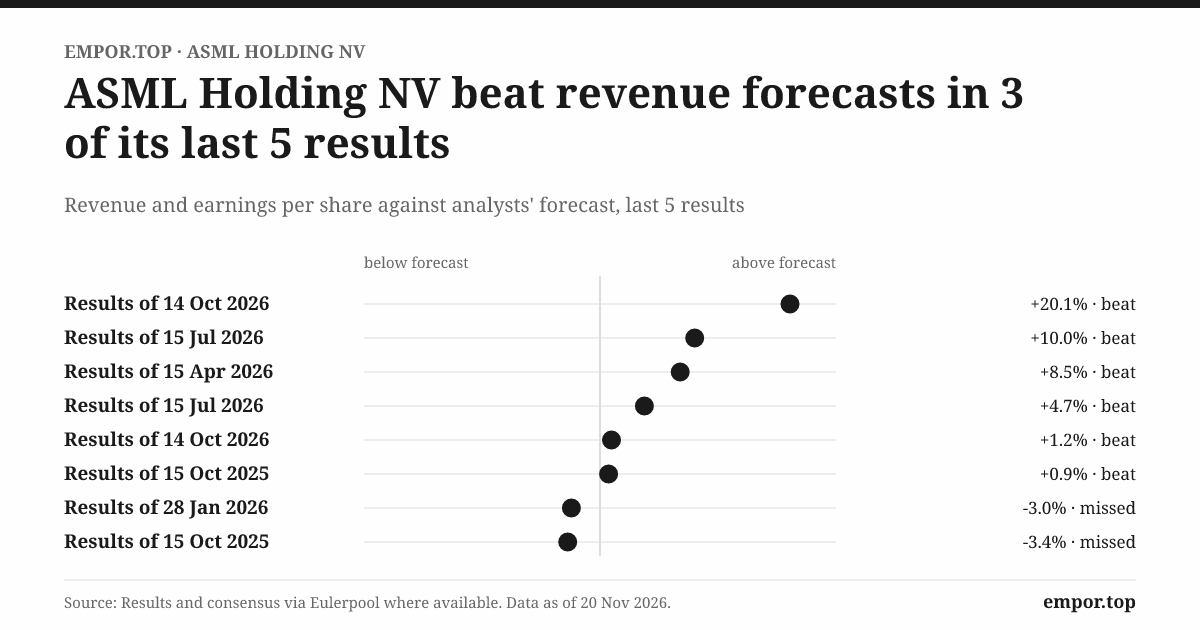
On July 16, 2025, ASML reported a second quarter that beat expectations. Net bookings, the value of new orders, came in at about €5.5 billion, well ahead of what analysts had pencilled in.4 Then Christophe Fouquet added a sentence that wiped tens of billions of euros off the company's market value in a day: "While we still prepare for growth in 2026, we cannot confirm it at this stage."4 The shares fell by more than 10%.4 On the call, chief financial officer Roger Dassen explained that uncertainty over US tariffs was leading some customers building fabs in America to delay finalising investments.17
Three months later, the message shifted. On the October 2025 call, management said it did not expect 2026 sales to be below 2025, while warning that demand from Chinese customers would decline significantly in 2026 after several unusually strong years.18[^25] And a year after that, in October 2026, ASML was guiding to €44–45 billion of 2026 sales, roughly a third more than 2025.[^2] In fifteen months, the outlook for the same year had gone from "we cannot confirm growth" to one of the largest annual increases in the company's history.
How should an investor read that path? The tempting conclusion is that management misjudged the year. A fairer one is that ASML's visibility is genuinely limited, and that management said so. In July 2025, it did not cut guidance; it declined to promise growth it could not yet see. Its explanations at each step were specific: tariff-related hesitation in the US, a normalisation of Chinese demand, and then a surge of AI-related capacity plans at its largest customers. Each was a claim that later results could check, and the later results did not contradict them. The sharp swing is evidence of how quickly the order book can move in this industry, which deserves scrutiny in its own right. It is not by itself evidence of poor credibility.
The man setting those expectations had spent his whole career on the customer side of lithography. Fouquet holds a master's degree in physics from the Institut Polytechnique de Grenoble and worked at Applied Materials and KLA-Tencor before joining ASML in 2008 in marketing and product management.19 He ran ASML's applications business, joined the Board of Management in 2018 to lead the EUV business through its commercial ramp, became chief business officer in 2022, and took over as president and chief executive in April 2024, succeeding the long-time partnership of Peter Wennink and Martin van den Brink.19 He is, in other words, an insider who rose with EUV. Investors are betting that someone who managed the last technology transition from inside the customer relationships can manage the next one.
Dassen, the CFO, is a former Deloitte executive who has held the role since 2018, and the Board of Management had five members in 2025, with a chief technology officer joining at the 2026 annual meeting.2 Oversight comes from a nine-member Supervisory Board chaired by Nils Andersen.2 Those are the people responsible for today's growth and capacity decisions.
Their incentives are mostly variable. Fouquet's reported remuneration rose from about €5.4 million in 2024 to about €7.0 million in 2025, as net income rose from €7.6 billion to €9.6 billion, and about 80% of the 2025 total was variable pay linked to short- and long-term targets.2 That is modest by the standards of American technology chief executives running companies of similar value. Shareholders approved the amended management remuneration policy at the 2025 annual meeting with about 91% support, a comfortable majority that still left almost a tenth of votes against.20 What the board does not have is meaningful personal ownership: the members of the Board of Management and the Supervisory Board together held about 0.01% of the shares at the end of 2025.2 Alignment at ASML runs through pay plans, not through founders' or executives' stakes.
One capital decision from 2025 shows how the new team thinks, and why it deserves scrutiny. ASML took a minority stake in Mistral AI, the French developer of large language models, an unusual move for a company whose business is building machines.2 Management presented it as a strategic partnership to bring AI into ASML's own products and operations. The investment has already been marked up: the third quarter of 2026 included a valuation gain of roughly €0.5 billion on the stake.3 That gain flatters reported earnings without telling investors anything about the core business, and the stake itself is the kind of adjacent bet an activist would question at a company whose real constraints are capacity and suppliers. It is small next to ASML's cash flows, which keeps it from being a material risk. It is still worth watching as a signal of how far management is willing to range from lithography.
The sharpest test of management is how it spends the cash. In 2025, ASML bought back €5.95 billion of its own shares and cancelled about 5.7 million of them.2 The previous programme, which covered 2022 to 2025, returned €7.6 billion of a €12 billion authorisation, a reminder that these authorisations are ceilings, not commitments.2 In January 2026, ASML announced a new programme of up to €12 billion through 2028, with most repurchased shares to be cancelled.[^28] Alongside that sits the dividend, which has taken around a quarter to a third of profit in most years.2
A sceptical investor would ask whether those buybacks compete with things that matter more. ASML is weighing capacity expansion beyond the 30% increase it had planned for 2028.3 It has €12.7 billion of purchase obligations to suppliers, and its most critical supplier, Zeiss, depends on its loans and advances to scale.2 Buying back shares at more than fifty times earnings is a bet that the company's long-run cash flows justify that price. If the cycle turned while ASML was spending heavily on capacity, supplier support and repurchases at the same time, the buybacks would look, in hindsight, like a poor use of the cushion.
That cushion is thick for now. At the end of 2025, ASML held €13.3 billion of cash and short-term investments against €3.4 billion of borrowings; it had not drawn on a €1.5 billion committed credit line, and it faced no covenant or refinancing pressure.2 Its history includes no recent rights issue; the main structural feature for shareholders to note is an independent preference-share foundation whose option, if exercised, could halve ordinary shareholders' voting power, a classic Dutch defence against hostile takeovers.2 The balance sheet allows management to keep investing through a downturn. What it cannot do is guarantee that capacity added at the peak gets used.
And capacity is only valuable if ASML is allowed to ship what it builds. For one large customer region, that decision now rests partly in The Hague and Washington.
IX. When Politics Reaches the Shipping Dock
On September 6, 2024, ASML issued a short statement that changed who decides where some of its machines can go. From the next day, shipments of its TWINSCAN NXT:1970i and NXT:1980i deep-ultraviolet immersion systems would need an export licence from the Dutch government rather than from the United States.[^29] Washington had restricted those tools since late 2023, arguing they contained American components; the Netherlands now took that licensing authority for itself.[^29] ASML called the move a technical change and said it did not expect it to affect its 2024 outlook or long-term scenarios.[^29]
The legal detail mattered less than the principle. A commercial shipment from a Dutch factory to a willing customer now depended explicitly on a political decision, and the tools in question were not even ASML's most advanced. EUV systems have never been shipped to China. These were the workhorse DUV immersion scanners that Chinese chipmakers had been buying in large numbers to build fabs for mature and mid-range chips.
Export controls work on ASML through several channels at once. A licence can be refused for a specific system, so the sale never happens. It can be limited to certain customers or sites, so ASML cannot sell to the buyers most eager to buy. And restrictions can extend beyond new machines to spare parts, software updates and field service, which goes straight to the service business that grows with every tool shipped, because a tool that cannot be serviced eventually becomes a tool that cannot run. In December 2024, after a further round of US rules, ASML said it expected the impact of the updated restrictions to fall within its outlook for 2025.[^30]
The awkward fact is how much recent revenue China has supplied. In 2025, customers in China accounted for 29.1% of ASML's sales.2 Some of that demand likely reflected buying ahead of tighter controls, and some a genuine domestic build-out of capacity for mature chips. Management itself expected Chinese demand in 2026 to be significantly lower than in 2024 and 2025.18 That is two different forces acting in the same direction, and an investor needs to keep them apart. Ordinary customer-cycle weakness, a buyer pausing after over-ordering, reverses when the buyer needs tools again. A licence restriction does not reverse with the cycle; it reverses only with politics.
China sharpens a risk that runs through the whole story: concentration. ASML's sales rest on four huge customers, its optics on one German partner, its access to a large market on two governments' policies. Each concentration is understandable. Together they mean that the company's outcomes depend heavily on decisions outside its control.
The other risks are real but proportional. Currency is largely managed: ASML reports in euros, sells partly in dollars and Asian currencies, hedges material forecast exposures with forward contracts, and at the end of 2025 estimated that a 10% move in foreign currencies against the euro would have barely touched net income.2 Litigation is routine for a company of its kind; management reported no material contingencies considered probable or reasonably possible at the end of 2025, while noting patent claims that could require it to indemnify customers.2 PwC gave an unqualified audit opinion, and flagged revenue recognition on volume purchase agreements, where discounts and credits are spread across multiple systems, as a critical audit matter, an area of genuine accounting judgement.2 The binding constraints on ASML are not financial. They are capacity, scarce components, hiring skilled engineers, customer readiness, and what governments allow.
The credit agencies see it the same way. In July 2026, Moody's affirmed ASML's A1 rating with a positive outlook, citing its lithography leadership, AI-related growth prospects, innovation, a growing installed base, flexible costs and prudent financial policy.[^31] Its listed constraints were volatile demand, export restrictions, customer and supplier concentration, and the need to expand capacity.[^31] Fitch rates the company A+ with a stable outlook.[^28] When the bond analysts' worry list matches the equity analysts' worry list, the risks are probably the right ones.
The tension that remains is unusual. For most companies, demand is the constraint. For ASML, in part of the world, the sales opportunity may exist where the company cannot legally serve it. That shapes the final question: what, exactly, is the market paying for?
X. Analysis & Bear vs. Bull Case
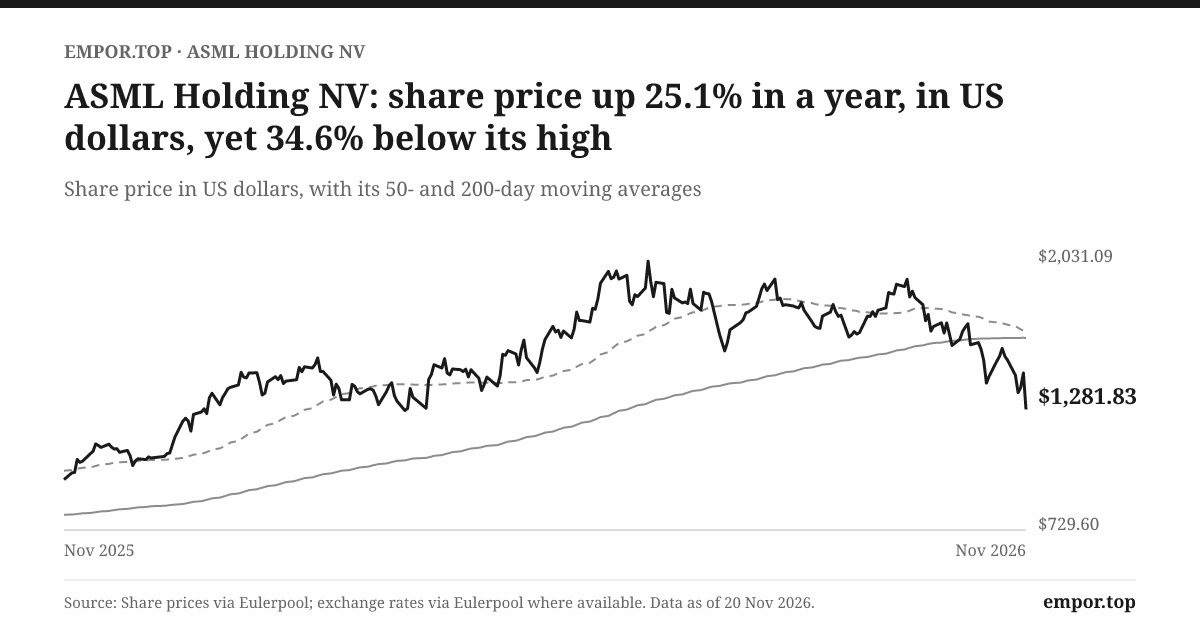
On November 20, 2026, ASML's shares closed at €1,168, giving the company a market value of about €519 billion.[^32] That price was 32.1% below the 52-week high of about €1,721 and well above the low of €834.[^32] At that price, investors were paying about 54 times the last twelve months' earnings, about 31 times EBITDA, and a little over 13 times sales; the dividend yield was 0.7% and the free-cash-flow yield 2.1%.[^32] In plain English, an investor buying the whole company would receive about two euros of free cash a year for every hundred paid, and would be relying on that figure growing quickly for a long time.
Two things about that price are worth holding together. The first is that the stock had fallen by about a third from its peak during a year in which the business was posting record results, which says something about how volatile the expectations are. Over the past five years, the share price at one point fell by almost half from its high, and its one-year volatility is above 45%.[^32] Investors in ASML have had to sit through drawdowns that would be extreme for most large companies. The second is that, even after that fall, the valuation still assumes a great deal. A five-year median earnings multiple and a consistent like-for-like snapshot of peers are not available on the same basis, so the cleanest comparison is with ASML's own operating record.
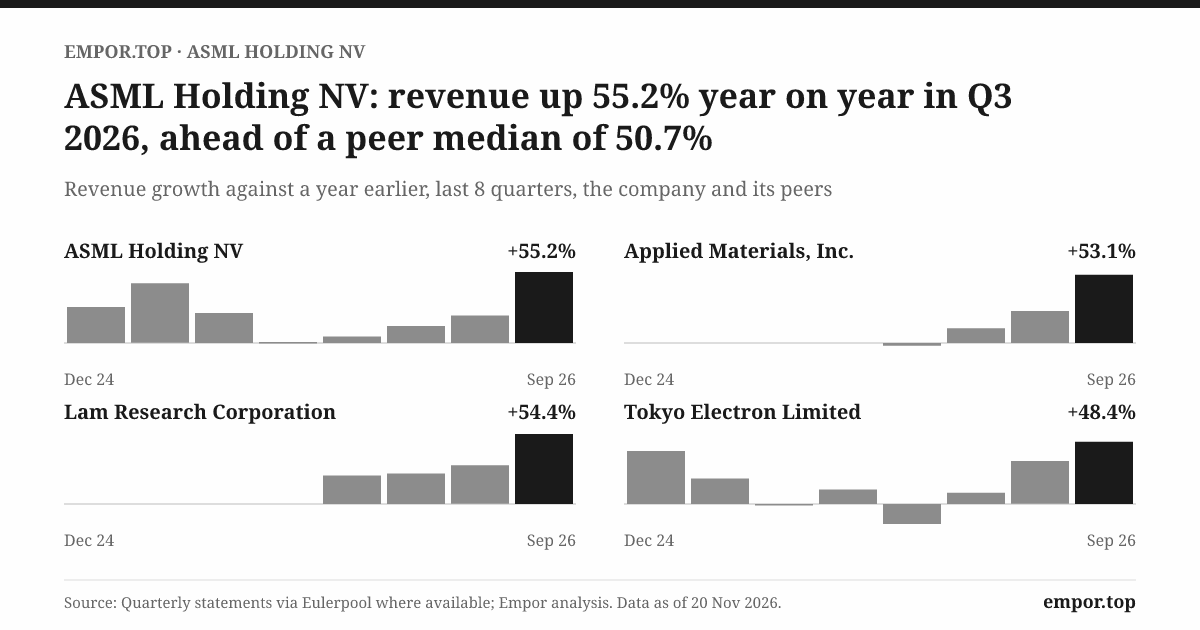
That record sets the bar. Over the decade to 2025, sales grew almost 18% a year and net profit around 21% a year.2 The 2025 year came in a little below that base rate, with sales growth of about 15.6%.2 Then 2026 accelerated sharply: third-quarter revenue rose about 55% from a year earlier.[^2] One quarter is not a trend, and the right way to read the acceleration is as the steep part of an investment cycle. If the market's multiple implies that ASML can sustain something like its historical growth through the next decade, the question is whether AI-driven demand extends the upswing or simply concentrates it in fewer, bigger years.
The third-quarter profit also needs one adjustment before it is used as a base. Net income of €5.0 billion included a valuation gain of roughly €0.5 billion on ASML's stake in Mistral AI.3 That is an investment mark, not operating profit, and it says nothing about a new business line. Strip it out and the quarter was still a record, but the run rate is smaller than the headline.
The case for the machine
The bull case starts in that chipmaker's planning meeting, where for EUV there is no one else to call. ASML is the only commercial supplier of EUV scanners and holds the overwhelming majority of the lithography market.16 Hamilton Helmer's 7 Powers framework helps explain why that position is durable, and also where it is narrower than it looks.
ASML has a version of what Helmer calls a cornered resource: the accumulated know-how, supplier network and co-developed Zeiss optics that no rival can hire or buy, built over the decades since the leaky shed. It enjoys scale economies in research: spending about €4.7 billion a year on R&D, spread across the entire world's leading-edge lithography demand, a rival would need to spend similar sums for a fraction of the sales.2 It has switching costs rooted in process integration, the years of recipes, qualification data and field-service relationships that make moving a critical layer off ASML's tools a multi-year project. And it has a kind of process power: the tacit ability to build, ship and support machines of this complexity at volume, which competitors who have tried EUV research have not converted into a product. What ASML does not have, in Helmer's terms, are network effects or a consumer brand; its power is industrial, embedded in physics, supply chains and customer engineering teams.
Add the economics. Returns on invested capital have been extraordinary in recent years, partly because customer prepayments mean ASML's operations require little net capital.[^32] The installed base adds a steadier stream of service and upgrade revenue that rises with every tool shipped. Net cash and investment-grade ratings allow continued investment through a downturn.[^31] And the demand signal is strong: customers discussing orders for 2029 and 2030 suggests that the AI build-out is being planned over years, not quarters.3
The case against the price
The bear case does not dispute that ASML is exceptional. It argues that exceptional businesses in cyclical industries can still disappoint at high multiples. Chipmakers' capital spending is cyclical, and the 2024 pause, when sales growth slowed almost to zero after a 30% year, is recent evidence of how quickly orders can stall.2 Customer concentration is high and rising; the largest customer's share grew from about a sixth to almost a quarter in a year, which makes ASML more exposed to that customer's plans.2 China, a large source of recent revenue, is guided to fall, and export restrictions can constrain both shipments and service.18 Capacity expansion is an execution risk in itself: adding capacity late in an upswing has historically been the classic way for equipment makers to end up with idle factories. And the valuation leaves little room for error.
Weighing the two, the history narrows the bull case rather than rejecting it. The moat in EUV has survived every test the record offers, including the long years before EUV worked and the export restrictions that removed part of the Chinese market. What the record does not support is the idea that the moat smooths the cycle: in 2023, 2024 and the first half of 2025, ASML's monopoly coexisted with stalled growth, weak cash conversion and guidance it could not confirm. The revised claim is that ASML owns the bottleneck but rents the timing from its customers.
Three measures will show which way that claim bends. The first is how orders convert into shipped and accepted systems; backlog ended 2025 at €38.8 billion, and the test is whether it turns into revenue on schedule rather than being pushed out.2 The second is the share of sales from the installed base, about a quarter in 2025 and rising, which indicates how much of the business is cushioned from new-tool cycles.2 The third is operating cash flow adjusted for factoring and swings in customer advances; 2025's reported €12.7 billion included €6.2 billion of receivables sold to banks, so the cleaner measure is what customers pay on their own schedules.2
High-NA is the growth vector that most needs testing against the record. ASML's history shows that technical milestones can take years to become revenue: EUV went from early tools to high-volume manufacturing only after more than a decade. High-NA has already crossed the first threshold, a tool installed at a customer.1 The milestones that matter now are production wafers, customer acceptance, and repeat orders at prices that preserve margins. Announcements of technical records are not those milestones.
The activist's question is about the combination of commitments. If buybacks, supplier financing and capacity investment all rise together, does the return on each additional euro justify the cash? ASML has the balance sheet to do all three for now. The record from the prior buyback programme, which returned well under its authorisation, shows management is willing to slow repurchases when conditions change.2 Whether it will slow them at the right moment, before rather than after a downturn, is not knowable in advance.
What would change the view? Repeated customer adoption of High-NA in production, continued growth in the installed base, and strong cash conversion without factoring would support the growth case. Tool delays, persistent cash conversion weakness, or reduced commitment from one of the four big customers would weaken it.
XI. Playbook: Business & Investing Lessons
ASML's story contains moments that a founder or investor could pin above a desk, and they belong to this company in particular.
The EUV bet took years to pay off, from work beginning in the late 1990s to high-volume production in 2019.7[^18] For most of those years, sceptics had good reasons to doubt the bet would ever work. The lesson is that a breakthrough is a process, not a launch. A technology becomes a moat only when it is fast enough, reliable enough and cheap enough to run in a customer's factory, and the years spent closing that gap are where competitors give up. For investors, it means that the most valuable phase of a technology bet can look, from outside, like a string of delays.
The second lesson comes from the day Intel, TSMC and Samsung wrote their cheques. Their co-investment helped ASML build the roadmap, but those same customers still decide when to buy.212 The customer can fund your future and still hold the leverage. A company that depends on a few giant buyers can be indispensable to them and still dependent on them; both things are true at once.
The third lesson lives in the field-service teams stationed in customers' fabs around the world. The installed base cushions downturns, but it does not abolish the cycle.2 Investors who treat recurring service as if it were a subscription will be surprised by the next pause.
The fourth lesson is about the price on the screen. A great moat can still be an expensive stock.[^32] The quality of the business and the return on buying it are separate questions.
There is a fifth moment worth keeping, too: the September day in 2024 when a licensing decision moved from Washington to The Hague. The decision showed that ASML's moat offers no protection from governments, and investors who price the first should remember the second.
Underneath all of these is a discipline that the ASML story teaches better than almost any other: separate the technical achievement, the commercial adoption, and the cash returns. ASML got the first right decades ago. It took years to get the second. Investors are paid only on the third.
XII. Epilogue
Tonight, ASML stands at an unusual point: its 2026 forecast is higher, its latest quarter was a record, and customers are talking about orders years out.[^2]3 It has not yet given a 2027 sales outlook.
The next few events will do much of the settling. The first is how much of the planned 2027–2028 capacity expansion management actually commits to, and whether Zeiss and the rest of the supply chain keep pace. If ASML commits to more capacity and its suppliers scale with it, the company will be positioned for a long upswing; if suppliers lag, the backlog will stretch and customers will wait. Either way, the pace of capacity commitment will reveal how confident management is in demand that extends beyond the current AI surge.
The second is whether customers accept High-NA for production and place follow-on orders; delays or continued use of today's EUV tools with extra exposures would weaken the case.
Zeiss sits quietly behind both of those tests. The High-NA mirrors are larger and more demanding than anything the German partner has made before, and ASML's loans and advances to Zeiss are, in effect, a bet that its supplier can scale on time. If ASML's next annual reports show those advances growing much faster than its purchases, that would signal that ASML is carrying more of its supplier's capacity risk. If they shrink relative to purchases, the alliance is becoming more self-financing. Either way, the health of a company in Oberkochen will say as much about ASML's next five years as anything announced in Veldhoven.
The third is the gap between guidance and outcomes as Chinese demand falls and AI-related investment broadens. The test is not whether 2026 hits the forecast; it is whether 2027 revenue, margins and cash conversion continue to grow once one-off gains, factoring and China's decline are accounted for.
The fourth is the balance between buybacks, capital spending and supplier commitments through the buildout. A company that keeps returning cash while expanding capacity and funding suppliers is either very confident or very exposed, and the answer will only be clear when the cycle turns.
The thesis, in the end, will be settled by observable events: tools accepted, revenue recognised, cash collected. Management's demand forecasts and AI enthusiasm will not settle it. The tension that remains is that ASML holds the bottleneck to the world's most advanced chips, and its customers still decide when to open it.
XIII. Outro
Go back to Hillsboro, Oregon, and the 250 crates. Inside them was a machine assembled from tin droplets and German mirrors, Dutch stages and American lasers, software and vacuum chambers, the output of an international chain of specialised engineering that no single country could replicate alone.1 It had to be rebuilt on the fab floor and integrated into a customer's most sensitive production process before it was worth anything at all.
That is ASML in one image: a singular position. Its value depends on turning that technical control into customer productivity, shipments and cash, year after year, through the cycle.
ASML does not make the chips. It makes the step in chipmaking the rest of the industry cannot yet do without.
References
-
ASML ships groundbreaking new chipmaking tool to Intel: High-NA lithography tool needed for next-gen process nodes could cost $400 million — Tom's Hardware, 2023-12 ↩↩↩↩↩
-
ASML 2025 Annual Report Based on US GAAP — ASML, 2026-02-25 ↩↩↩↩↩↩↩↩↩↩↩↩↩↩↩↩↩↩↩↩↩↩↩↩↩↩↩↩↩↩↩↩↩↩↩↩↩↩↩↩↩↩↩↩↩↩↩↩↩↩↩↩↩↩↩↩↩↩↩↩↩
-
ASML Q3 2026 earnings call transcript — Stock Analysis, 2026-10-14 ↩↩↩↩↩↩
-
ASML cannot confirm growth in 2026, wiping out $30 billion — Fortune, 2025-07-16 ↩↩↩↩
-
ASML's founding story: our roots in the semiconductor industry — ASML, 2024 ↩↩↩↩
-
ASML introduces dual wafer stage technology on its TWINSCAN 300mm lithography platform — ASML, 2000-12 ↩
-
ASML shareholders approve Customer Co-Investment Program — ASML, 2012 ↩↩↩
-
ASML Holding NV Form 20-F for fiscal year 2012 — SEC, 2013 ↩↩↩↩
-
ASML Holding NV Form 20-F for fiscal year 2013 — SEC, 2014 ↩↩
-
ASML to Ship 30 EUV Scanners in 2019: Faster EUV Tools Coming — AnandTech, 2019 ↩↩↩
-
EU semiconductor industry impact assessment — European Commission, 2026 ↩↩↩
-
ASML Q2 2025 earnings call transcript — Stock Analysis, 2025-07-16 ↩
-
ASML Q3 2025 earnings call transcript — Motley Fool, 2025-10-15 ↩↩↩
-
Introducing Christophe Fouquet, ASML's new CEO — ASML, 2024 ↩↩
 LinkedIn
 WhatsApp
 Reddit
 Hacker News
 Email
 Kindle
 RSS Feed
 Spotify
 Apple Podcasts
 Amazon Music
 Audible
 YouTube