 Chat with
this content: Summary, Analysis, News...
Chat with
this content: Summary, Analysis, News...
 Subscribe on LinkedIn


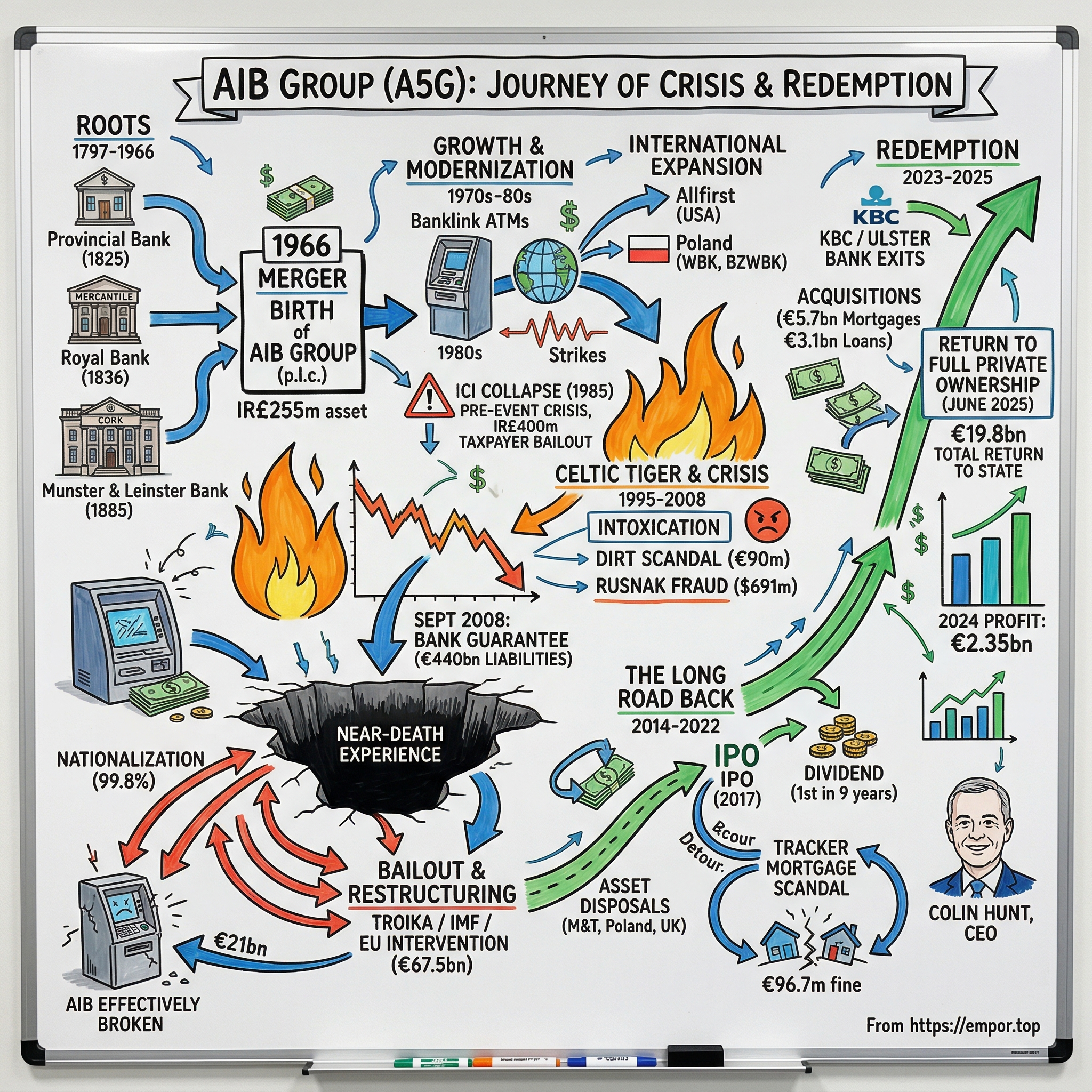
AIB Group: From Colonial Banking to Modern Financial Giant—A Story of Crisis, Bailout, and Redemption
Introduction: The Impossible Comeback
On a grey Tuesday morning in June 2025, Finance Minister Paschal Donohoe pressed the button that would end one of the most remarkable chapters in Irish financial history. The Irish government sold its remaining 2.06% stake in AIB Group, marking the end of state ownership that began 15 years earlier during one of the eurozone's largest banking bailouts. The shares were sold at €6.94 per share, generating €305 million upon settlement.
The transaction represented far more than a routine share sale. With this final sale, the total amount returned to the Irish state from its investment in AIB reached €19.8 billion. The bank that had once been "effectively broken"—financially and spiritually, in the words of current CEO Colin Hunt—had returned to full private ownership.
Consider the dramatic arc: In 2010, Allied Irish Banks was on the verge of collapse. Its share price had plummeted to 0.32 euros—down from almost 24 euros in 2007—and at the end of the year the bank recorded a loss of more than 10 billion euros. "The bank was effectively broken," AIB's current CEO Colin Hunt told American Banker. "I'd describe it as being broken financially and spiritually. Its confidence was absolutely shot."
Fast forward to 2024, and AIB delivered a profit after tax of €2.35 billion, a 26.7% return on tangible equity, and total distributions to shareholders of €2.6 billion. The transformation is nothing short of extraordinary—and yet the story of how Ireland's largest bank arrived at this point involves colonial-era origins, multiple near-death experiences, taxpayer rescues measured in the tens of billions, and a systematic rebuilding that took the better part of two decades.
This is the story of AIB Group: a bank formed from a 1966 merger of three Victorian-era institutions that would come to dominate Irish banking, nearly collapse the Irish state, consume €21 billion in taxpayer bailouts, and ultimately stage one of the most improbable comebacks in European banking history.
The Roots of Irish Banking (1797–1966): Three Tributaries, One River
Banking Under the Crown
To understand AIB, one must first understand the three rivers that would eventually converge to form it. Each of the constituent banks served distinct constituencies in a country shaped by colonialism, famine, and the slow emergence of an independent economic identity.
In 1825, Provincial Bank commenced operations, pioneering joint stock branch banking in Ireland. It also established a branch in London. This was revolutionary for its time—a bank designed not to serve the landed gentry of Dublin but to bring modern banking to provincial Ireland. Picture the bank managers arriving in market towns across Munster and Connacht, setting up shop in buildings that would have seemed impossibly modern to farmers still recovering from the economic disruptions of the Napoleonic Wars.
The Royal Bank of Ireland began operations in 1836 with a capitalisation of £1,500,000, floated to take over the business of Shaw's private bank (founded 1797), becoming known for its mercantile links. Where Provincial Bank focused on rural Ireland, Royal Bank carved out a niche serving Dublin's merchant class—the traders, importers, and wholesalers who formed the backbone of Ireland's commercial economy under British rule.
The third piece of the puzzle was the Munster & Leinster Bank, established in 1885—the largest of the three banks that would eventually merge. Based in Cork, it represented the growing economic confidence of Ireland's second city and served a customer base that spanned from wealthy farmers to the emerging Catholic professional class.
The Logic of Consolidation
By the mid-1960s, the rationale for merger had become overwhelming. Many industries in the British Isles faced consolidation during the 1960s; for the Irish banking industry, this reduction in numbers first affected the numerous private banks. Earlier in 1966, the Bank of Ireland had bought the Irish interests of the National Bank. In the mid-1960s, The Economist reported the island had a thousand branch offices to serve less than five million people; it was felt that fewer, larger banks would be able to provide more modern and efficient service. Both Allied Irish Banks and its slightly larger rival, the Bank of Ireland, entered this phase of consolidation under pressure from North American competitors, which first entered the Irish market in 1965, beginning with First National City Bank.
The arrival of Citibank on Irish shores concentrated minds wonderfully. Irish bankers looked across the Atlantic and saw the future: large, efficient, technologically advanced institutions that could dwarf Ireland's fragmented banking sector. The choice was stark—consolidate or be conquered.
The 1966 Merger: Birth of a National Champion (1966–1990)
Creating Allied Irish Banks
The AIB parent company, Allied Irish Banks, p.l.c., originally named Allied Irish Banks Limited, was incorporated in Ireland in September 1966 as a result of the amalgamation of three long established banks: the Munster and Leinster Bank Limited (established 1885), the Provincial Bank of Ireland Limited (established 1825) and the Royal Bank of Ireland Limited (established 1836).
The scale of the transformation was significant. In 1966, AIB's aggregate assets were IR£255 million (€323.8 million)—as at 31 December 2005, the AIB Group had assets of €133 billion. Over four decades, the bank would grow more than 400-fold in nominal terms.
But growth did not come without growing pains. Wages accounted for three-fourths of a bank's costs; in the 1970s, bank employees, among the most highly paid workers in the country, lobbied for increases in salaries. The Irish Bank Officials Association, spurred by staff alienation after the merger, called a devastating, eight-month strike in 1970, which sent customers scrambling to the smaller, nonassociated banks. Two other strikes were called during the decade.
Technological Modernization
In the 1980s AIB introduced their Automatic Teller Machine Network called Banklink just shortly after the Bank of Ireland Pass. ATMs were only available in cities and major towns in the 1980s but arrived into smaller and medium towns during the 1990s.
The ATM rollout was more than a technological upgrade—it was a statement of intent. AIB was positioning itself as a modern, customer-focused institution that would bring Irish banking into the international mainstream. The Banklink network became a point of pride, a visible symbol of the bank's commitment to innovation.
The ICI Collapse: A Dress Rehearsal for Disaster
The first major test of AIB's resilience came in 1985, and it would prove eerily prophetic of what was to come two decades later.
The Insurance Corporation of Ireland (ICI) was a wholly owned subsidiary of AIB when it collapsed in 1985 with losses of over IR£200 million. The crisis unfolded with sickening speed. In March 1985, the Government was forced to take over the Insurance Corporation of Ireland, a subsidiary of AIB, and bail out the bank after the insurer started incurring substantial losses on high-risk insurance policies. The bank had spent £86 million in both buying the insurer outright in 1983 and investing in the business in the face of spiralling losses and massive unknown liabilities. The bank told the Garret FitzGerald-led government on March 8th that it could not afford to keep pumping money into ICI. The government was advised by the Central Bank and senior civil servants that future liabilities and claims on ICI's insurance policies could bankrupt AIB, destroy international confidence in Irish banking and damage the country's economic fabric.
This collapse occurred at a time of deep economic recession in Ireland. The level of Government debt at that time was 116% of GDP. But the Irish taxpayer bailed ICI out of its difficulties. The Irish Government did so to ensure a continuation of the insurance business and to protect policyholders.
The parallels to 2008 are striking. A major financial institution discovers it cannot meet its obligations. The government faces a choice between letting a systemically important bank fail or socializing its losses. The taxpayer foots the bill. The investment of £85 million by AIB in ICI was written off and the cost to the Irish taxpayer was £400 million.
For investors, the ICI episode should have served as a warning: AIB's risk management capabilities were not what they appeared to be, and when trouble arrived, the government would be expected to step in.
International Expansion & The Celtic Tiger (1983–2007)
The American Dream: From First Maryland to Allfirst
AIB's ambitions extended far beyond the shores of Ireland. In 1983, AIB acquired 43% of the outstanding shares of First Maryland Bancorp, and completed the acquisition of 100% of the outstanding shares in 1989. Additional 'bolt-on' acquisitions were completed during the 1990s including Dauphin Deposit Bank and Trust Company and subsequently, all banking operations were merged into Allfirst. In 2003, Allfirst was integrated with M&T Bank Corporation.
The U.S. expansion represented a bold strategic bet. AIB was betting that its management expertise could add value to a mid-tier American regional bank, and that the diversification benefits would justify the capital deployment. For a time, the bet appeared to pay off—First Maryland and later Allfirst provided AIB with exposure to the world's largest economy.
Polish Ambitions
In 1995, AIB acquired a non-controlling interest in Polish bank Wielkopolski Bank Kredytowy S.A. ("WBK"). In 1999 AIB acquired an 80% shareholding in Bank Zachodni S.A. from the Polish State Treasury. In June 2001, WBK merged with Bank Zachodni to form BZWBK, following which the Group held a 70.5% interest in the newly-merged entity.
The Polish investment was prescient. As a country emerging from communism and preparing for EU membership, Poland offered enormous growth potential. AIB positioned itself as a sophisticated Western partner that could bring modern banking practices to an eager market.
UK Footprint
AIB entered the UK market in 1989 by acquiring TSB Northern Ireland, which was rebranded as AIB Group (UK) plc. In 1996, AIB's retail operations in the United Kingdom were integrated and the enlarged entity was renamed AIB Group (UK) p.l.c. with two distinct trading names, First Trust Bank in Northern Ireland and Allied Irish Bank (GB) in Great Britain.
The Celtic Tiger: Intoxication and Excess
The transformation of the Irish economy during the Celtic Tiger years was nothing short of astonishing. During the second half of the 1995–2007 'Celtic Tiger' period of growth, the international bond borrowings of the six main Irish banks—Bank of Ireland, Allied Irish Banks, Anglo Irish Bank, Irish Life & Permanent, Irish Nationwide Building Society and Educational Building Society—grew from less than €16 billion in 2003 to approximately €100 billion (well over half of Ireland's GDP) by 2007.
AIB's mortgage lending portfolio expanded significantly alongside this boom, with the overall Irish mortgage market growing from approximately €20 billion in outstanding loans in 2000 to over €120 billion by 2007.
The numbers were staggering, and in retrospect, obviously unsustainable. But in the moment, Irish banks—and particularly AIB—convinced themselves that they had discovered a new paradigm of growth. Property was the surest of investments. Ireland had "arrived" as a modern European economy. The good times would never end.
Scandals Before the Storm: DIRT & Rusnak (1999–2003)
Before the global financial crisis delivered the knockout blow, AIB endured two major scandals that should have served as warnings about deeper governance failures.
The DIRT Tax Evasion Scandal
The €90 million settlement that AIB reached with the Revenue Commissioners in respect of Deposit Interest Retention Tax evasion in 2000 was the highest tax settlement in the history of Ireland. The bank's internal auditor, Tony Spollen, highlighted a potential DIRT liability of IR£100 million for the period 1986–1991, but Gerry Scanlon, the group chief executive at that time rubbished this estimate, describing it as "infantile". The Oireachtas Sub-Committee Inquiry concluded that it was "extraordinary" when Scanlon told the Inquiry that he was unaware of the scale of the DIRT issue.
The DIRT scandal revealed a culture of willful blindness at the highest levels of AIB management. When an internal auditor raised concerns, he was dismissed as "infantile." When the truth finally emerged, it was through external investigation rather than internal accountability.
John Rusnak: The $691 Million Man
The Allfirst scandal was worse. John Rusnak is a former currency trader at Allfirst bank, then part of AIB Group, in Baltimore, Maryland, United States. He is known for committing one of the largest ever cases of bank fraud, where he lost his company US$691 million after a series of bad bets. On January 17, 2003 Rusnak was sentenced to 7+1⁄2 years in prison for hiding US$691 million in losses at the bank in 2002, after bad bets snowballed in one of the largest ever cases of bank fraud.
John Rusnak racked up losses of almost US$700 million during Michael Buckley's tenure as group chief executive. It was Ireland's biggest banking scandal and the fourth-biggest banking scandal in the world when it came to light on 4 February 2002.
The mechanism of the fraud was elegant in its simplicity. AIB had been under pressure to sell Allfirst following the $691.2 million fraud. An investigation showed the fraud had been perpetrated over five years and had not been detected because of a combination of lax management, weak controls and poor communications between AIB and its Baltimore bank.
Three years prior to the discovery of the Allfirst scandal, officials at the AIB subsidiary were tipped off about Rusnak. Colleagues of Rusnak warned in a memo written in 1999 that he was gambling too much of his bank's money and exceeding risk limits. The memo also said Rusnak was routinely overstepping his credit limit. It said Rusnak was exceeding the limits on his deals and putting $2-3m of the bank's money at risk each day.
The warnings were ignored. He cost a whole tier of senior managers at Allfirst their jobs but famously not AIB's then chief executive Michael Buckley whose offer to resign was rejected by his board.
Following the scandal, AIB sold Allfirst to M&T Bank of Buffalo, New York, in July 2003. AIB retained 23% of M&T stock. Although the news media blamed the scandal, the merger talks actually began prior to the revelation of the losses. In the banking environment at that time the merger was inevitable.
The Rusnak affair and DIRT scandal shared a common thread: AIB's governance structures were fundamentally broken. Whistleblowers were ignored. Internal controls were bypassed. Senior management remained insulated from accountability. These were not isolated failures—they were symptoms of a corporate culture that prioritized growth and profit over prudent risk management.
The Great Financial Crisis & Near-Death Experience (2008–2011)
September 2008: The Night That Changed Everything
Through the night of Monday, September 29th, 2008, and into the early hours of Tuesday, September 30th, crisis-management talks took place, involving the Taoiseach, Brian Cowen, and the Minister for Finance, Brian Lenihan. Their purpose was to prevent the collapse of Anglo Irish Bank later that day—and possibly other banks later that week. The country's four most senior bankers, at the two largest financial institutions, Allied Irish Banks and Bank of Ireland, were so alarmed by the events of that Monday that they sought an urgent meeting with Cowen and Lenihan to stress that the banking system was on the brink. After hours of deliberation, the Government chose the guarantee from a range of options. The catch-all solution was unparalleled in its scale and in the risk that the State took on, guaranteeing liabilities amounting to 10 times the national debt and more than twice the value of the economy.
On 30 September 2008 the Government guarantees €440bn worth of liabilities for six Irish financial institutions. The then Minister for Finance Brian Lenihan later says the bailout is the cheapest in the world so far.
The Government statement was issued stating that the Bank Guarantee would extend for two years and cover "all deposits (retail, commercial, institutional and interbank), covered bonds, senior debt and dated subordinated debt (lower tier II)." The Government decided to put in place with immediate effect a guarantee arrangement to safeguard all deposits with the following banks: Allied Irish Bank, Bank of Ireland, Anglo Irish Bank, Irish Life and Permanent, Irish Nationwide Building Society and the Educational Building Society.
The Bailout Cascade
Having guaranteed the six main Irish banks in September 2008, the Minister for Finance, Brian Lenihan announced on 21 December 2008 that he would seek to recapitalise Ireland's three main banks, Allied Irish Bank, Bank of Ireland and Anglo Irish Bank. Under the plan the Government would take €2 billion in preference shares in each of Bank of Ireland and Allied Irish Bank and €1.5 billion in preference shares in Anglo Irish Bank. On 11 February 2009, Lenihan announced the provision of two €3.5 billion bailouts to AIB and BoI as part of his government's recapitalisation scheme.
The Nationalization
November 2010: AIB reveals its reliance on emergency Central Bank funding has tripled in five months to €27 billion as companies and customers pull money amid worsening crisis. The Government agrees to €67.5 billion international bailout as soaring cost of rescuing the banks become too much for State to handle. December 2010: State takes control of AIB two days before Christmas after receiving court approval to pump €3.7 billion into the company. AIB, which first listed in 1967, is relegated to junior stock market in Dublin as only 0.2 per cent of stock remains in private hands.
In December 2010 the Irish government took a majority stake in the bank, which eventually grew to 99.8%.
The Final Cost
Government ownership for the Irish domestic bank sector reached a high under the guarantee, with Anglo Irish nationalised early in 2009, and Allied Irish Banks nationalised at the end of the guarantee. These proved in the long run to be the two most expensive banks to recapitalise, with Anglo accounting for €34.7 billion and AIB €20.7 billion of the bank bailout total of €62.8 billion (55% and 33% respectively).
Ireland pumped 64 billion euros or almost 40% of its then annual economic output, into the country's banks after a huge property crash in the late 2000s. Two banks that swallowed up more than half of the capital still failed. Most of the remaining funds—21 billion euros—went into AIB.
IMF/EU Intervention
In November 2010 the government had to seek a €67.5 billion "bailout" from the EU, other European countries and the IMF as part of an €85 billion 'programme'. On 28 November 2010, the European Troika agreed with the Irish government in a three-year financial aid programme on the condition of far-reaching austerity measures. The agreements were signed on 16 December 2010. The Irish State assigned €17.5 billion to this 'bailout'.
The human cost was enormous. Ireland entered a period of austerity that would define a generation. Emigration surged. Unemployment soared. A nation that had believed it had finally escaped its history of poverty found itself humbled, its banks in ruins, its sovereignty constrained by the demands of the Troika.
The Long Road to Recovery (2011–2017)
Restructuring & Asset Disposals
With the government now controlling 99.8% of the bank, AIB embarked on a systematic dismantling of its international empire.
January 2011: AIB sold Goodbody Stockbrokers to Kerry-based financial services group Fexco for €24 million. March 2011: AIB records €12.1 billion pretax loss for 2010 and is ordered to raise €14.8 billion after round of banking stress tests ordered by the bailout troika.
In November 2010, AIB sold its 22.5% stake (26.7 million shares) in M&T. The shares were sold at US$77.50 per share and generated $2.1 billion.
The Polish operations, once the crown jewel of AIB's international strategy, were sold to Santander. The Baltic stakes were sold at a loss to Swedbank in 2012.
New Leadership
In order to raise desperately needed capital, the bank was forced to relinquish most of its global footprint. AIB sold its Polish business and the M&T stock by the end of 2010, and eventually all that was left were its operations in Ireland, Great Britain and a small presence in the United States. This proved to be just the beginning of a yearslong streamlining process.
Return to Profitability & IPO
December 2015: AIB begins to repay its bailout, redeeming €1.7 billion of preference shares issued to the State during the crisis. July 2016: AIB repays a further €1.6 billion to State, redeeming so-called contingent convertible notes.
March 2017: AIB pays State almost €280 million in first dividend in almost nine years, after posting €1.7 billion pretax profit for 2016. May 2017: State announces intention to sell initial 25 per cent stake in AIB, which may raise up to €3 billion.
In June 2017, the Irish government completed an IPO of Allied Irish Banks.
The Tracker Mortgage Scandal (2012–2022)
Just as AIB was emerging from the shadow of the financial crisis, another scandal erupted—one that would prove the bank's governance reforms were still incomplete.
The Scale of Wrongdoing
The Central Bank said its investigation found that AIB failed in its obligations towards its customers under the Code of Practice for Credit Institutions and Consumer Protection Codes. AIB's failings caused unacceptable harm and loss to those affected customers over the course of nearly 18 years. AIB tracker mortgage customers, holding 10,015 mortgage accounts, were affected by the issues between August 2004 and March 2022. "Thousands of customers were overcharged and, at the worst end of the scale, customers lost 53 properties, 13 of which were family homes."
AIB's Specific Failures
A fine of €83.3m was imposed on AIB, while EBS, which is now owned by AIB, was fined €13.4m for consumer protection breaches relating to tracker mortgages. Today's Central Bank fines bring the total sanctions imposed on lenders for tracker mortgage failings to €174m, on top of €737m paid to customers in redress and compensation under its Tracker Mortgage Examination.
A year before that, AIB was hit with a record fine of €83.3m for its role in the tracker mortgage scandal, having admitted to 57 separate regulatory breaches. The fine was separate from the more than €125m that AIB has been required to pay to date in redress, compensation and account balance adjustments to impacted customers.
The group required a €20.8 billion taxpayer bailout. Almost 13,000 customers of the two lenders were affected by the tracker issue.
The tracker scandal was particularly painful because it occurred while the bank was still under majority government ownership. The message was clear: even with the state as its largest shareholder, AIB struggled to put customers first.
Market Consolidation: Ulster Bank & KBC Exit (2021–2023)
The Seismic Shift
In 2021, the Irish banking landscape was transformed forever. NatWest confirmed what had been an open secret for months: that it was winding down its Ulster Bank unit in the Republic. "In a seismic shift, literally in a matter of weeks, we are now down to just three 'main' banks and a host of smaller non-bank players," said Eamonn Hughes, an analyst with Goodbody Stockbrokers.
In April 2021 KBC, after operating in Ireland for over 40 years, announced its intentions to leave Ireland also. Bank of Scotland/Hallifax, Danske Bank (formerly National Irish Bank) and Rabobank (which owned ACC) have all pulled out of the Irish market over the past decade or so. No player as big as Ulster Bank has ever left, and definitely not two banks at the same time.
AIB's Acquisitions
In January 2023, AIB was cleared to acquire a portfolio of performing tracker mortgages from Ulster Bank worth €5.7bn.
AIB acquired a total portfolio of c. EUR 3.1 billion of corporates and commercial loans and c. EUR 5 billion of tracker mortgages from Ulster Bank, following its exit from the Irish banking sector. The full business portfolio and 80% of the mortgage portfolio were incorporated into the Bank's balance sheet by end-September 2023.
The Duopoly Question
The increase leaves Ireland's two largest banks, AIB and Bank of Ireland with more than a three-quarters share of the new mortgage market.
The Tánaiste says the Government "don't have an answer" on how to stop a banking duopoly between AIB and Bank of Ireland. Speaking to a private conference held by Goodbody Stockbrokers, Tánaiste Leo Varadkar said although they had discussed the issue at Government, they haven't found a solution. KBC is the second major bank this year to announce it is leaving Ireland after Ulster Bank owners NatWest said last month they will be closing up shop too. The upheaval in the sector has led to repeated calls from politicians for a solution to take on AIB and Bank of Ireland in the interest of competition. "That's a good question and we have those conversations in Government as well, but we don't have an answer to that yet."
That leaves a duopoly in commercial banking (Bank of Ireland and AIB) and an oligopoly in mortgage banking (PTSB is the third player). This has resulted in reduced competition on loans and deposits.
For investors, the consolidation represents a double-edged sword. On one hand, reduced competition means pricing power and more stable margins. On the other, regulatory scrutiny is likely to intensify, and political pressure to improve customer outcomes could translate into constraints on profitability.
Return to Private Ownership (2022–2025)
The Privatization Journey
"We have made significant progress in reducing the State's shareholding in AIB from c. 71% at the beginning of 2022 to c. 12.5% today," said Minister for Finance Paschal Donohoe. "It is now a realistic target that the State could exit its position in AIB later this year should market conditions allow."
The Irish government raised about €652 million through the sale of a 5% stake in AIB Group Plc in January 2025, the latest step toward the privatization of the lender. Ireland sold about 116 million shares at €5.60 apiece to increase the amount returned from the government's investment in AIB to about €17.9 billion.
The Final Sale
Minister for Finance Paschal Donohoe moved in June 2025 to sell taxpayers' remaining stake of about 2 per cent in AIB as the Government seeks to draw a line under the biggest bailout of an Irish bank that managed to survive the financial crisis. The sale, being carried out by way of a placing among institutional investors, is expected to raise about €310 million. "This is an important milestone in delivering on the Government's policy of returning the banking sector to private ownership," said Mr Donohoe. The move takes advantage of how AIB's shares have risen more than 31 per cent this year.
On June 17, 2025, AIB Group announced the Statement on Return to Full Private Ownership.
AIB received the lion's share of the remaining bailout funds, amounting to €21bn, and as of last month, the state's return from the bank stood at €19.2bn.
While Dublin is unlikely to fully recoup the cost of bailing out AIB, Donohoe said last month the state was at that point 300 million euros above break-even on its €29.4 billion investment in the three banks, mainly thanks to recovering 6.7 billion euros from the 4.7 billion it pumped into Bank of Ireland.
Leadership: Colin Hunt's AIB
Colin Hunt studied Economics and Commerce at UCC and always wanted to be an Economist. In 1994, he joined NatWest in London and trained as an Economist, after which he joined Bank of Ireland Group Treasury. From there, he went to Goodbody where he spent six years, initially as Chief Economist before being appointed Research Director in 2000. In 2004, he took a career diversion and served as special adviser in two government departments. In 2007, he joined Macquarie Capital and was responsible for setting up their operations in Ireland. He returned to AIB in 2016 as Managing Director of Corporate, Institutional and Business banking. Hunt spent two happy summers working as a teller in AIB in Waterford when he was in college. "When I was standing behind that counter in a very different banking environment in 1990 and 1991, I did not for one moment think it was possible that I would ultimately end up in the office that I now occupy."
"I never set out to be CEO: it wasn't part of my career plan or career trajectory. It's almost through a series of events that I found myself in this position. I genuinely did not expect, ever, to be CEO of the country's largest bank."
Hunt has said: "There's one quality that very little attention is paid to that I think is a key differentiator amongst great leaders—and that is resilience. I think it's critically important. If you're talking about being a CEO, it's a very demanding position. It is almost all-consuming and you need to be personally very resilient in my view. There is an organisation with millions of customers, shareholders, thousands of staff who are dependent on you, ultimately. And you need to be able to take the knocks, dust yourself off, get up again and go at it."
Ibec announced the appointment of Dr Colin Hunt, CEO of AIB, as its new President for 2025 to 2026. "It is a great honour to serve as Ibec President and to represent the business community in Ireland, both at home and abroad."
The Investment Case: Bull, Bear, and Competitive Dynamics
AIB Today: By the Numbers
Total new lending increased by 17% to €14.5bn in 2024 with positive trends across mortgages, renewable energy and corporate lending. The mortgage market in Ireland performed strongly in 2024 with growth driven by first-time buyer activity. AIB's new mortgage lending in Ireland was up 14% to €4.5bn and reflected a mortgage market share of 36%. Personal lending was up 7% to €1.3bn reflecting the enlarged customer base, an increase in consumer credit demand and the market-leading digital proposition with 87% of personal loan applications completed online. New lending to SMEs in Ireland remained relatively stable at €1.6bn.
AIB Group delivered another strong performance with a profit after tax of €927 million for the first half of 2025.
New lending was up €600 million to €6.9 billion in H1 2025, due to growth in mortgages, corporate and personal lending. Return on tangible equity was 21.4% and with a robust capital position, the bank announced an interim ordinary dividend payment of €263m. June 2025 marked the milestone of AIB returning to full private ownership.
Bull Case
The Dominant Position AIB and Bank of Ireland now operate in what is effectively a duopoly. The big two Irish lenders profited from acquiring billions of euro in deposits and performing loan books following the exits of Ulster Bank and KBC Bank. The European and US banking market crises could in the end favour AIB and Bank of Ireland, but at the expense of customers paying more for their mortgages and business loans.
Irish Economic Fundamentals "Our starting point is still in a much better place than most of the other European countries, not just with respect to growth but also the government's fiscal position," AIB's CFO Donal Galvin noted.
Capital Generation The CET1 ratio in June 2025 was 16.4%, up from 15.1% in December 2024 primarily due to the implementation of Basel IV. Profits in the first half generated c. 150bps of CET1. Strong organic capital generation supports the interim dividend and capacity for further distributions.
Shareholder Returns The removal of the €500,000 pay cap following full privatization could help AIB attract and retain talent. The removal of the State from the shareholder register will likely lead to a lifting of the €500,000 pay cap at AIB.
Bear Case
Interest Rate Sensitivity The Dublin-based lender now expects 2025 net interest income of above €3.7 billion, its outlook raised from above €3.6 billion. Net interest income in 2024 totalled €4.13 billion. In the nine months to September 30, net interest income declined 10% on-year primarily as a result of lower interest rates.
Regulatory Risk The tracker mortgage scandal and subsequent €96.7 million fine demonstrate that regulatory scrutiny remains intense. As a "Significant Institution" under European banking supervision, AIB faces direct oversight from the European Central Bank.
Competition May Return Spanish bank Bankinter's decision to move into the Republic's banking market by converting its Avant Money unit into a fully-fledged banking branch signals that the competitive environment may not remain static forever.
Economic Concentration Risk Ireland's economy, while strong, is heavily concentrated in multinational-dependent sectors. Colin Hunt highlighted Ireland's pharmaceutical and tech sectors as being especially exposed to the introduction of any tariffs.
Porter's Five Forces Analysis
Threat of New Entrants: LOW Potential entrants have to deal with a near-duopoly in a market of less than 4.5 million people, about the size of greater Manchester. "Why would you commit to an economy that is no bigger than the third-biggest city in your own jurisdiction?"
Bargaining Power of Suppliers: LOW Banks fund themselves primarily through deposits, and with low interest rates on savings, the cost of funds remains manageable.
Bargaining Power of Buyers: MODERATE While borrowers have limited choice, regulatory pressure and public scrutiny constrain the banks' ability to extract maximum rents.
Threat of Substitutes: MODERATE to HIGH Digital banks like Revolut are gaining traction. In Ireland, the biggest fintech player remains Revolut. More than a million Irish people now have a Revolut account but many use it primarily for sending or receiving payments. However, the company is now deemed to offer a full service current account offering, after it was regulated as a bank in Lithuania.
Competitive Rivalry: LOW With Ulster Bank and KBC gone, the remaining players have little incentive to compete aggressively on price.
Hamilton Helmer's 7 Powers Analysis
Economies of Scale: STRONG As Ireland's largest bank, AIB benefits from scale economies in technology, compliance, and branch infrastructure that smaller competitors cannot match.
Network Effects: MODERATE Banking has modest network effects—more customers mean more ATMs, more merchant acceptance, and more payment utility.
Counter-Positioning: WEAK AIB's traditional banking model could be disrupted by digital-first competitors, though regulatory barriers provide some protection.
Switching Costs: STRONG Mortgage relationships, direct debits, and banking history create substantial switching costs for retail and business customers alike.
Branding: MODERATE AIB is a known and trusted brand in Ireland, though the crisis-era reputation damage has not been entirely repaired.
Cornered Resource: MODERATE The branch network and customer relationships represent assets that new entrants cannot easily replicate.
Process Power: MODERATE Decades of operating in the Irish market have created institutional knowledge and processes that competitors would struggle to develop.
Key Metrics to Watch
For investors tracking AIB's ongoing performance, three KPIs stand out as most critical:
-
Net Interest Margin (NIM): This metric captures AIB's ability to earn a spread between what it pays for deposits and what it charges for loans. With ECB rate cuts anticipated, NIM compression is the primary near-term risk to earnings.
-
Cost of Risk (CoR): Given AIB's history of catastrophic loan losses, the cost of risk metric—loan impairment charges as a percentage of gross loans—provides essential insight into asset quality trends.
-
Return on Tangible Equity (ROTE): As a measure of profitability relative to the capital required to generate it, ROTE captures the fundamental economics of the business and enables comparison with European peers.
Conclusion: Lessons from the Phoenix
AIB's journey from Victorian-era banking through Celtic Tiger excess, taxpayer rescue, and improbable resurrection contains lessons that extend far beyond Irish banking.
First, governance matters. The ICI collapse, DIRT scandal, and Rusnak fraud all shared a common thread: internal warnings were ignored, and accountability was diffuse. The tracker mortgage scandal showed these patterns persisted even after the crisis. Banks are only as strong as their cultures of risk management and customer focus.
Second, "too big to fail" is real—and the costs are staggering. When AIB teetered on the brink in 2010, the Irish government faced a choice between letting a systemically important institution collapse or socializing tens of billions in losses. There was really no choice at all. The guarantee of September 2008 committed Ireland to a path dependency that would constrain its fiscal sovereignty for a generation.
Third, recovery is possible, but it takes time. AIB's return to full private ownership took 15 years—far longer than the U.S. bank bailouts. The Irish government proved to be a patient owner, allowing the bank to rebuild gradually rather than forcing a premature exit.
Fourth, market structure shapes outcomes. The exit of Ulster Bank and KBC has left Ireland with an effective banking duopoly. For AIB shareholders, this represents a structural competitive advantage. For Irish consumers and businesses, it means less competition and potentially higher costs.
Almost 13 years after taking control—and 16 years after its initial rescue—AIB returned to full private ownership as the Government sold its final 2 per cent stake to market investors, at a share price almost 60 per cent above what it was when it carried out an initial public offering of shares on the stock market eight years ago.
The question now is whether AIB can sustain its transformation. The bank that Colin Hunt described as "broken financially and spiritually" in 2010 is today Ireland's #1 retail bank, with leading market shares across mortgages, business banking, and credit cards. But the scars of the crisis—both for the institution and for Irish society—have not fully healed.
For long-term investors, AIB represents a classic turnaround story that has largely played out, leaving a dominant franchise in a small but wealthy market. The risks are concentration in Ireland, interest rate sensitivity, and regulatory scrutiny. The rewards are scale advantages, capital return capacity, and a customer base that has few alternatives.
The ultimate lesson of AIB's story may be the oldest one in banking: what seems too good to be true usually is, and what seems irreparably broken can sometimes be rebuilt. The phoenix has risen from the ashes. The question is whether it can stay aloft.


 RSS Feed
 Spotify
 Apple Podcasts
 Amazon Music
 Audible
 YouTube