Wolverine World Wide: The Brands It Kept
I. The Company That Sold Its Way Back
On the first Sunday of August 2023, the board of a footwear company from Rockford, Michigan, fired its chief executive. Brendan Hoffman left without a dispute on the record and without a long farewell. The directors handed the job, the same day, to the man who had been running the company's biggest brands, Christopher Hufnagel.1 The company was Wolverine World Wide. It had just lived through a year in which it lost about $208 million at the operating line, owed well over a billion dollars and was sitting on a warehouse full of shoes that consumers had stopped buying at full price.2
What Hufnagel did next looked, at first, like retreat. In the months that followed, Wolverine sold Keds, the canvas sneaker that generations of American children had worn to school. It sold the leather tanning business that went back to the company's earliest years. It sold Sperry, the boat shoe that once defined a preppy summer. It handed its Chinese Merrell and Saucony joint ventures over to a distribution partner and moved Hush Puppies in North America onto a licensing model.3 Wolverine was more than 140 years old and had spent much of the previous decade trying to get bigger, and here it was, getting deliberately smaller.
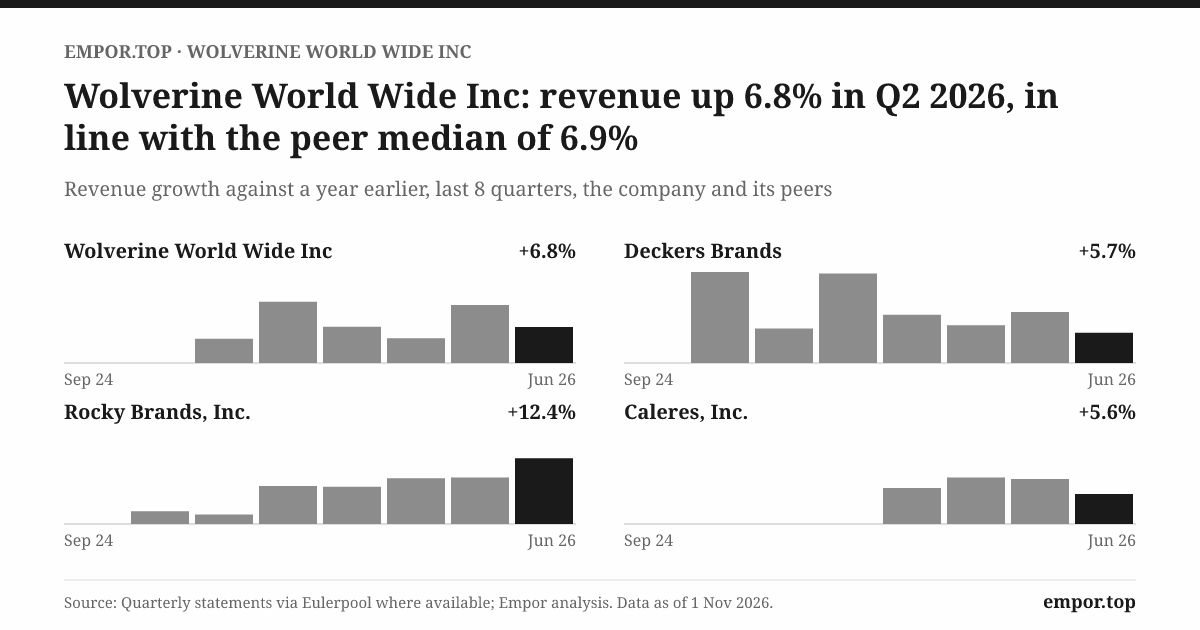
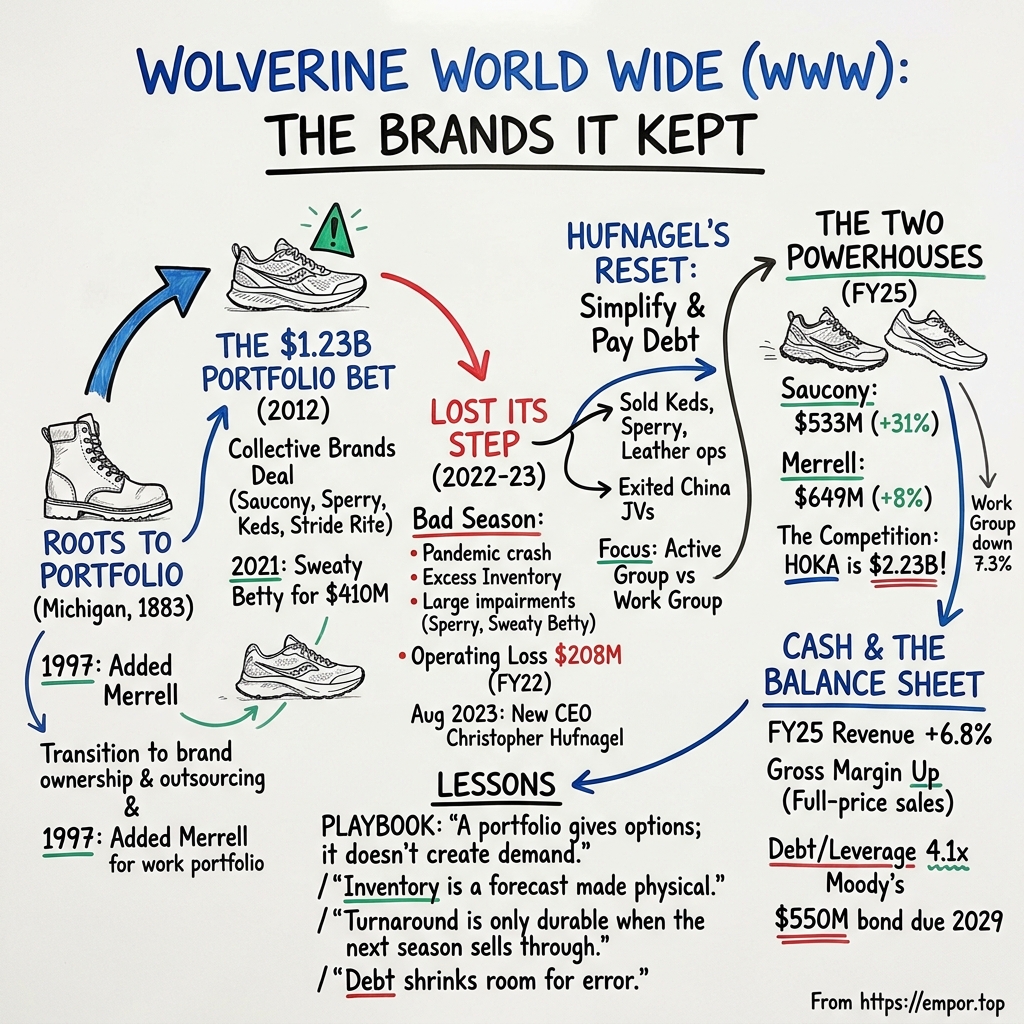
Then something interesting happened. The shrunken company started to grow again. In its 2025 fiscal year, Wolverine's revenue rose 6.8% to about $1.87 billion.4 Saucony, the Massachusetts running brand that came to Wolverine almost as part of a package deal in 2012, grew 31% to $533 million. Merrell, the hiking-boot brand bought in 1997, grew 8% to $649 million.4 Operating profit rose more than 50%, and the stock, which had lost about four-fifths of its value from its five-year peak at its worst, recovered toward the top of its 52-week range by the autumn of 2026.
That is the version of the story that a turnaround investor likes to tell, and much of it is true. But it sits next to a less flattering fact. Over the ten years to fiscal 2025, Wolverine's revenue shrank by about 3.6% a year. The company was a $2.7 billion business in 2015 and a $1.9 billion business a decade later, and its net profit in 2025 was still below what it earned in 2015.5 Part of that shrinkage was the deliberate pruning. Part of it was a long fade that began well before anyone said the word "turnaround."
And the recovery is lopsided. In fiscal 2025, the Active Group, which holds Merrell, Saucony, Sweaty Betty and Chaco, grew its sales about 13%, while the Work Group, home of the Wolverine boot that gave the company its name, saw sales fall 7.3%.5 A company with two reportable segments had one that was sprinting and one that was walking backwards.
So this story is not really about whether Wolverine recovered. It did. It is about what kind of recovery it was. Did the company find a durable growth engine in two brands that consumers genuinely want, or did it simply shrink to fit a market cycle that happened to turn in its favour? Three questions run through everything that follows. Can Merrell and Saucony keep winning shelf space against some of the best-funded brands in sport? Can Hufnagel turn a reset into earnings that arrive as cash, year after year, and not just in a good season? And can Wolverine keep paying down debt without starving those two brands of the marketing and product money they need to stay ahead?
The shape of the company today is easy to state. Wolverine is a listed U.S. brand owner that designs, markets and distributes footwear, apparel and accessories but makes none of them; every pair of shoes comes from third-party factories, mostly in the Asia-Pacific region.5 It employed about 3,050 people at the start of 2026.5 It sells to department stores, specialty running and outdoor shops, and sporting-goods chains, and directly to consumers through its own websites and stores. Roughly three of every four dollars of revenue come from the Active Group.
That last fact is the hinge. For most of its history, Wolverine's identity was diversification: a family of brands spread across work, outdoor, casual, children's and fashion, so that no single trend could sink the ship. The company that emerged from the 2023 sales is something else, a business whose fortunes rest mostly on two labels. To understand why that is both the opportunity and the risk, the story has to go back to Michigan, and to a pair of leather work shoes.
 Subscribe on LinkedIn
II. From Michigan Boots to a Portfolio of Brands
In 1883, G.A. Krause and Fredrick Hirth set up a business in Grand Rapids, Michigan, to trade in hides and leather goods.6 It was the kind of company the upper Midwest produced by the hundreds in that era: close to farms and forests, close to working men who needed sturdy shoes. Krause had broader ambitions than trading. Around the turn of the century he expanded an electric light company that brought power to the small town of Rockford, north of Grand Rapids, and in 1903 the company opened its first shoe factory there.6 A few years later it set up its own tannery. In 1914, the "Wolverine" brand of work footwear made its debut.6
For the next half century, this was a vertically integrated Michigan manufacturer. It tanned its own leather from pigskin and cowhide, cut and stitched its own boots, and sold them to farmers, factory workers and tradesmen. In 1928 it introduced employee stock ownership, an early sign of the paternal, small-town culture that marked the company for decades.6 The tannery mattered more than anyone then understood. Decades later, waste from that Rockford tannery became the source of the company's largest legal liability.
The first great reinvention came in 1958, when the company launched Hush Puppies, a casual suede shoe made from the same pigskin its tannery processed.6 Hush Puppies, with its droopy-eyed basset hound mascot, became a mid-century American phenomenon and later an international licensing business. It taught Wolverine a lesson that shaped the rest of its life: a brand could travel much farther than a factory. In 1964 the company renamed itself Wolverine World Wide, and in 1965 it listed its shares on the New York Stock Exchange, where it has traded ever since.6
The second reinvention began in the 1990s. In 1994 Wolverine introduced Cat Footwear, built under licence from the equipment maker Caterpillar.6 Then, in 1997, it bought Merrell, a maker of hiking boots that had become a respected name in outdoor footwear.6 Merrell was the first sign that Wolverine wanted to be something more than a work-and-casual shoe company. Hiking and trail footwear sat close to the company's rugged roots, but the customer was different: weekend adventurers and, increasingly, people who simply liked the look and comfort of outdoor shoes in town.
Over the following years, factory ownership gave way to the model Wolverine runs today.5 The company's own work is the part a shopper never sees: deciding what the next trail shoe or running shoe should be, designing it, testing it, ordering it from a contract factory, shipping it across the ocean, persuading retailers to stock it and persuading consumers to want it. Capital spending in 2025 was about $14.5 million, under 1% of revenue, which is the profile of a company that owns ideas and relationships rather than machines.5
That model carries its own economics, and they are worth making concrete. Picture a buyer at a big outdoor retailer in the spring, looking at Merrell's samples for the following season. The buyer places an order. Wolverine then commits to a factory in Vietnam or Cambodia for the shoes. But that order is not a contract in the way a software subscription is. Wolverine's major wholesale customers can change delivery schedules or cancel orders without penalty.5 If the shoes arrive and do not sell, the retailer marks them down, orders fewer next season, or sends them back into a clearance channel. If they sell out, the retailer wants more, faster. Every season, in other words, is a fresh vote.
The company recognizes wholesale revenue when goods ship or are delivered, retail revenue at the point of sale, and online revenue when goods ship.5 It earns some royalties from licensing its brands to other manufacturers. It does not disclose a figure for recurring revenue, a typical length for wholesale relationships or any minimum purchase commitments from retailers, because in this business those things largely do not exist.5 The revenue rests on sell-through: the consumer at the shelf deciding to buy.
There is a defensive strength in this structure. No single customer accounted for 10% or more of Wolverine's revenue in any recent year.5 A retailer bankruptcy or a lost account would hurt, but it would not be fatal. There is also a cost. Because Wolverine makes nothing itself, it controls neither its factories' wages nor the tariffs levied on their output, nor the freight rates on the ships that carry the boxes. And because it sells mostly through retailers who stock many competing brands, it has to win the same argument over and over: why this shoe, and not the one beside it?
By fiscal 2025, the portfolio that answered that question looked very different from the one Wolverine had built over the previous decades. The Active Group generated about $1.41 billion of the company's $1.87 billion in revenue. The Work Group, built around the Wolverine boot, generated about $422 million.5 The brand that gave the company its name now produced less than a quarter of the money.
The deeper logic of a brand portfolio is the same logic as a stock portfolio. If one brand falls out of fashion, another may be rising, and the owner can shift investment between them. The flaw in that logic is that brands are not stocks. Each one needs its own designers, its own marketing, its own retailer relationships and its own sense of identity, and a corporate parent can easily become the place where those things get diluted rather than multiplied. Wolverine tested that flaw at scale. In 2012 it made the biggest bet in its history on the idea that more brands meant more strength.
III. The $1.23 Billion Bet on More Brands
On May 1, 2012, Wolverine announced that it would buy the Performance + Lifestyle Group of Collective Brands, the company best known for owning the discount chain Payless ShoeSource.7 The group held four names: Sperry Top-Sider, Saucony, Stride Rite and Keds. Together, they had generated more than $1 billion of revenue in the previous fiscal year.7 Wolverine would pay about $1.23 billion for them, a figure the company described as ten times the group's projected 2012 earnings before interest, tax, depreciation and amortisation.7
The structure was a three-way partnership. Wolverine teamed up with two private-equity firms, Blum Capital Partners and Golden Gate Capital, to buy all of Collective Brands. The investors kept Payless and the licensing business; Wolverine took the four brands.8 When the deal closed on October 9, 2012, the whole of Collective Brands changed hands at $21.75 a share, about $2 billion including assumed debt, and the Performance + Lifestyle Group became part of Wolverine while continuing to operate out of Lexington, Massachusetts.8
Blake Krueger, Wolverine's chairman and chief executive at the time, was not modest about it. He called them "four iconic brands" joining a "proven global platform."7 The company described the combination as a $2.5 billion "global footwear and lifestyle brand powerhouse" and told investors the deal would add 25 to 40 cents to earnings per share in 2013 and 50 to 70 cents in 2014, before one-time costs.7 The chief financial officer promised to "aggressively reduce debt" over the next few years, because the deal was paid for largely with borrowed money arranged by J.P. Morgan and Wells Fargo.7
It is easy, with hindsight, to call this the moment Wolverine overreached. That would be too quick. Ten times projected EBITDA was a figure management chose to publish as a reference point, and it is useful for that purpose. But the group was a bundle of four businesses with very different prospects, and the price bought an operating group, not a single brand with a comparable public multiple. There is no clean comparable transaction from 2012 that shows whether ten times was cheap or rich for that mix. The better way to judge the deal is to follow each of the four brands through the next thirteen years and see what became of them.
Start with the one that matters most today. Saucony was a running brand with a long history, respected by serious runners but small next to the giants of the category. Inside Wolverine it was, for years, a steady performer rather than a star. Then, in the 2020s, running became one of the most dynamic categories in footwear, driven by new foam technologies, a boom in road and trail racing, and a fashion moment for retro running silhouettes. By fiscal 2025, Saucony's sales had reached about $533 million, up 31% in a year.4 That year, Saucony brought in roughly half of what the entire Performance + Lifestyle Group had generated in 2011.
Stride Rite, the children's shoe brand, changed shape over the years as Wolverine reworked it into a licensing-heavy, much smaller business; it is no longer a material reporting line. Keds, the canvas sneaker, was sold in February 2023.3 Sperry, the boat shoe, was the biggest of the four at the time of the deal and the brand most associated with the deal's promise. It suffered impairment charges in 2022 and again in 2023, as its relevance and profitability faded, and was sold in January 2024.23
So the scorecard for the 2012 bet is mixed in a very particular way. One of the four brands became the company's fastest-growing business. Two were sold after long declines, one of them after repeated write-downs. One faded into a smaller licensing arrangement. The deal did not fail, because Saucony alone is now worth having, but it did not produce the "powerhouse" of four strong brands that management had described. It produced one great brand and a lot of work.
Nine years later, Wolverine made the second big purchase of the modern era. On August 2, 2021, it closed the acquisition of Sweaty Betty, a London-born women's activewear brand, in an all-cash deal valued at about $410 million.9 Sweaty Betty had been founded in 1998 by Tamara and Simon Hill-Norton, and by the time of the deal more than 80% of its revenue came directly from consumers, through its own shops and website.9 The seller group included the private-equity firm L Catterton. Krueger said the deal gave Wolverine "a leadership position in the growing women's activewear category," and the brand reported to Brendan Hoffman, then Wolverine's president.9 The announcement promised that Sweaty Betty would add to earnings in its first year. It gave no revenue figure.9
The timing was unlucky in a way that should have been foreseeable. Sweaty Betty was bought near the top of the pandemic boom in athleisure, when people working from home were buying leggings and hoodies at a pace no one could sustain. Within about a year, Wolverine recorded a $189 million impairment on the Sweaty Betty trade name and a $48 million goodwill impairment in 2022.2 In 2024 it wrote down another $48 million of goodwill.5 Put the write-downs side by side with the purchase price, and well over half of what Wolverine paid for the brand had been written off within three years. The auditors still treat the valuation of what remains as a critical audit matter, a sign that the numbers depend on judgments about future growth.5
Set these two deals next to each other and the capital-allocation lesson becomes clear. The 2012 purchase worked because it happened to include a brand that later caught a powerful category wave and was run well enough to ride it. The 2021 purchase struggled because it bought a brand at a cyclical peak, at a price that assumed growth would continue. In both cases, Wolverine was buying names, and in both cases the name alone did not decide the outcome. Saucony's later run was not bought in 2012; it was earned in the 2020s. Sperry's decline and Sweaty Betty's write-downs show the other side: a famous label can lose its hold on the consumer faster than a balance sheet can absorb the cost.
That pattern matters for anyone weighing what Wolverine might do next with its money. A company that has written off large parts of its two most visible recent acquisitions has a record that argues against the next deal, not for it. And as the 2020s began, the bigger problem was not yet the deals themselves. It was that the whole portfolio was about to lose its footing at once.
IV. When the Portfolio Lost Its Step
In the spring of 2020, shoe stores across America went dark. Wolverine's revenue fell about 21% that year, to $1.8 billion, and it posted an operating loss.5 Then the world reopened, and demand came back in a rush that surprised almost everyone in the industry. People who had spent a year indoors wanted hiking boots, trail runners and comfortable shoes for long walks. Stimulus cheques and savings put money in their pockets. In 2021 Wolverine's revenue jumped about 35%, and in 2022 it rose another 11% to about $2.7 billion, its highest level in years.2
The trouble with a boom is that everyone orders for it at the same time. Retailers who had been caught short in 2021 placed big orders for 2022. Brands, fearing that clogged ports and shipping delays would leave them without product, ordered early and heavily from their factories. Then, as the boxes finally arrived, consumer demand cooled. Inflation squeezed household budgets, people went back to spending on travel and restaurants, and the pandemic surge in outdoor and casual footwear faded.
For Wolverine, the result showed up in the warehouse. Measured against its cost of goods, the company's inventory swelled to about 168 days at the end of 2022, close to double the level of a normal year.2 Inventory is a forecast made physical. Every one of those unsold shoes represented a bet that consumers would want it at full price, and many of those bets had gone wrong. Cash from operations, which is normally the steady heartbeat of a branded footwear company, went negative to the tune of about $178 million in 2022, because so much money had been tied up in product sitting on shelves.2 Borrowings climbed to about $1.4 billion.
The income statement told the same story in a harsher way. In 2022, Wolverine recorded an operating loss of about $208 million and a net loss of about $188 million.2 Much of that loss came from the impairments: the large write-downs on Sweaty Betty, together with an impairment of Sperry.2 In 2023, revenue fell 16.5% to about $2.24 billion, the operating loss narrowed to about $68 million, and Sperry was written down again.3 Gross margin, the share of each sales dollar left after paying for the product, slipped to about 39%, a weak level for a company that wanted to be seen as a premium brand owner.3
The comforting explanation for all of this is the cycle: everyone in footwear had a bad 2022 and 2023, so Wolverine's pain was simply the industry's pain. The record does not fully support that version. Some competitors in the same years were growing rapidly; Deckers, the owner of HOKA and UGG, kept expanding through the period.10 The deeper problem at Wolverine was that too many of its brands had lost momentum at the same time. Sperry had faded. Sweaty Betty had been bought at the top. The Wolverine work boot was losing ground. Even Merrell, the company's biggest brand, saw sales fall about 12% in 2023.3 The cycle exposed the weakness; it did not create it.
Inside the boardroom, the patience ran out in the summer of 2023. Brendan Hoffman had come to Wolverine as president and had risen to become chief executive, the leader who had championed the Sweaty Betty deal and a growth plan built around a broader portfolio and stronger direct-to-consumer sales.9 On August 6, 2023, the board terminated his employment as chief executive without cause, and he left the board the same day. The company said his departure was not the result of a dispute or disagreement.1
His replacement was an insider, and the choice said something about what the board thought had gone wrong. Christopher Hufnagel was 51 years old and had been at Wolverine since 2008.16 He had run the direct-to-consumer business from 2008 to 2013, headed corporate strategy for five years after that, and then run Cat Footwear before becoming president of Merrell in September 2019. In November 2022 he took charge of the whole Active Group, and in June 2023 he became the company's president.1 Before Wolverine, he had worked at Under Armour, Gap and Abercrombie & Fitch, and he had studied political science and history at Alma College, a small school in Michigan.6 He was, in other words, a retailer and a brand operator rather than a dealmaker, and he had spent the four years before his promotion running the brands that were supposed to carry the company.
The board's message, read through that appointment, was that Wolverine needed fewer brands run better, not more brands run from the top.
How did management describe the trouble while it was happening? By February 2024, when Hufnagel reported the company's 2023 results, his first as chief executive, the language had turned to housekeeping. The company said it had finished 2023 with revenue and earnings in line with guidance and with "inventory and debt levels better than expected."3 Inventory at the end of 2023 was down about $372 million, roughly half, from a year earlier, and net debt had fallen about $285 million to $740 million.3 Those were real achievements, but they were the achievements of a company cleaning up, and much of the inventory reduction had come at the cost of markdowns and lower margins.
Management also set out a specific plan for 2024. It expected revenue of about $1.70 billion to $1.75 billion for the ongoing business, a gross margin of about 44.5%, adjusted earnings of 65 to 85 cents per share, about $140 million of incremental cost savings and net debt of about $575 million by year-end.3 Those numbers matter, because they are the clearest promise against which to test the new regime. When the results came in, revenue for 2024 was about $1.76 billion, at the top of the range; adjusted earnings were 88 cents a share, above it; and net debt had fallen to roughly $496 million, well below the target.4 Gross margin, at about 44.3%, landed a touch short.4 On the measurable promises of its first year, the new management mostly delivered and in some cases beat.
There is a catch in reading those numbers, and it is an important one for anyone looking at Wolverine's growth rates. Reported revenue fell 21.7% in 2024, but most of that decline came from the brands and businesses the company had sold or restructured: Keds, the leather operations, the China joint ventures, Sperry.5 Some of the following year's growth, in turn, reflects comparisons against a smaller base. Saucony's growth, for instance, came partly after the brand's own reset of its distribution in China, where the joint venture had been converted to a licence and distribution model in 2024.5 Reported growth rates in this period always need to be read beside the continuing-business figures, because the company that reports in 2025 is not the same company that reported in 2022.
By early 2024, then, the cycle had turned and the clean-up was well underway. What Hufnagel had not yet shown was what he would build.
V. Hufnagel's Reset: Sell, Restructure, Pay Down Debt
A new chief executive inheriting a struggling company usually faces a choice between two stories. One is the growth story: new products, new markets, a bold vision. The other is the repair story: cut costs, sell what does not fit, pay the bank. Hufnagel told the second story first, and he told it with actions rather than slogans.
The sequence is easy to follow. Keds had already gone in February 2023, while Hufnagel was president. In August 2023 the company sold its U.S. leather business, and in December the non-U.S. leather operations, ending a link that ran back to the 1908 tannery.36 Hush Puppies in North America moved to a licensing model in the second half of 2023. Sperry was sold in January 2024. The China joint ventures for Merrell and Saucony were converted into a licence and distribution arrangement in 2024.35 Asset sales brought in about $189 million of cash in 2023 alone, and the company's investing cash flows were positive in both 2023 and 2024, an unusual sign for an operating business and a clear marker of a company liquidating parts of itself.35
Alongside the sales came a reorganization. Wolverine stopped presenting itself as a collection of loosely managed labels and regrouped around two operating groups: Active, built around Merrell, Saucony, Sweaty Betty and Chaco, and Work, built around the Wolverine boot and related labels.5 The idea was to share design, sourcing, marketing and back-office functions within each group, so that the corporate overhead of a dozen brands no longer sat on top of a much smaller company. Management targeted large cost savings and, as the 2024 figures showed, gross margin jumped by several percentage points as the company stopped dumping excess inventory and sold more at full price.4
Where did the money go? Mostly to the bank. Borrowings, including leases, fell from about $1.4 billion at the end of 2022 to about $760 million at the end of 2025, and debt excluding leases stood at about $622 million.5 That was the right priority for a company whose interest bill had become a serious drag on earnings. But the uses of capital were not single-minded. Wolverine kept paying its dividend through the losses, about $33 million a year, and in fiscal 2025 it bought back about 900,000 shares for $14.5 million, mostly in the fourth quarter, with about $135 million still left on its repurchase authorization.54
A skeptical shareholder would ask a pointed question here. With leverage still high by any rating agency's standard, why buy back stock at all? The company's answer is implicit rather than stated: the buyback was small, partly offset dilution from stock options, which brought in about $12 million in 2025, and signalled confidence.5 The counterargument is that every dollar spent on shares is a dollar not used to retire the 2029 bonds. The amounts were modest, and in the first half of 2026 the cash flow statement showed no repurchases at all.11 But the existence of a large remaining authorization is worth watching, because a company that has written down large parts of its last two acquisitions should be held to a high bar before it starts spending on anything other than its brands and its debt.
The incentives behind these decisions are a fair subject for scrutiny. Hufnagel's reported total compensation was about $3.2 million in fiscal 2023, his partial first year as chief executive, $9.4 million in 2024 and $10.85 million in 2025.12 The 2025 package included about $5.8 million in stock awards and $2.66 million of incentive pay tied to annual performance. It also included a $1.13 million increase in the value of his pension, which is an accounting measure rather than cash paid and which can move with interest rates.12 He held 328,715 shares or share-equivalents according to the 2026 proxy.12
That pay is high relative to a company with a market value of about $1.7 billion and net profit of roughly $95 million.5 It is also heavily tied to equity and performance, so it rises when the business improves and the stock goes up, which is what happened in 2024 and 2025. Shareholders have accepted the arrangement. About 92% of votes cast supported the 2025 say-on-pay proposal, and at the May 2026 meeting the vote again passed comfortably, with about 69 million shares for and 2.4 million against.1213 There are no reportable related-party transactions and no controlling shareholder; the largest owners are index and active fund giants, FMR at about 15%, BlackRock at about 14% and Vanguard at about 11%.12 This is a company governed by its board and its institutional holders, not by a founding family or a sponsor.
The more useful test of management is whether its promises matched its delivery. The first year, as the 2024 results showed, mostly did. The second year tells a similar story. When Wolverine reported fiscal 2025 in February 2026, revenue had grown 6.8%, gross margin had risen about three percentage points to about 47.3%, adjusted earnings per share had grown more than 50% to $1.35, and net debt was down another $81 million to about $415 million.4 Revenue, margins, inventory and debt all moved in the direction management had said they would.
Where the record is weaker is in the parts of the portfolio that did not respond. The Wolverine boot brand fell about 9% in 2025, to roughly $176 million.4 Sweaty Betty's sales slipped about 3%, to roughly $193 million, and the company wrote down more of its goodwill in 2024.45 Management's language on these brands, across the reset, has tended toward the general: "recalibration," "reset," "progress."14 On the second-quarter 2026 call, Hufnagel described the Wolverine brand as "the number one work boot brand in the U.S." and said it had gained market share for a third consecutive quarter. Taryn Miller, the chief financial officer who joined in 2024, said the Work Group's 2% revenue decline was "modestly ahead of expectations," while Hufnagel acknowledged that the recalibration of the work-boot marketplace "is still ongoing."14 For Sweaty Betty, Miller described a "planned and ongoing reset" of the U.S. business and guided to a low-single-digit decline for the year.14
Those are not empty statements. Share gains in a shrinking market are a real signal, and a planned reset is better than an unplanned collapse. But they are claims, not yet results, and the company has not published a dated milestone by which the Work Group or Sweaty Betty should return to growth. By contrast, the guidance for Merrell and Saucony is specific and has been raised. Investors therefore have two very different levels of evidence inside the same company.
The verdict on Hufnagel's first three years is that he has delivered a measurable operating recovery and a simpler, less indebted company, and that his promises have mostly been kept. The record is still short, and his pay has risen faster than the company's long-term returns to shareholders. The harder test is ahead: whether he can keep funding the two growth brands while reducing leverage, and whether he can resist the temptation that has caught every previous Wolverine leader, the urge to make the company bigger by buying something. For now, the company's future rests on the brands he kept, and those brands have to win on a retailer's shelf.
VI. Merrell and Saucony Have to Win Their Shelves
Imagine a buyer at a specialty running store in the autumn, planning the wall for next spring. The wall is finite. The store can stock perhaps a dozen brands and a few dozen models, and every slot has to earn its keep in sales per square foot. On one side are the incumbents with enormous marketing budgets: Nike, Adidas, ASICS, Brooks. On another are the insurgents of the last decade, HOKA and On, whose chunky soles and premium prices remade the category. Somewhere in the middle sits Saucony, asking for more space than it had last year.
The buyer's decision is not sentimental. It depends on how quickly last season's Saucony shoes sold, how often they had to be discounted, how many customers asked for them by name, and whether the new models look like they will do the same. That decision, repeated across thousands of stores and websites in dozens of countries, is what Wolverine's recovery is made of.
In fiscal 2025, Saucony won a lot of those arguments. Its sales grew about 31% to roughly $533 million, a record for the brand.4 The momentum continued into 2026. In the first quarter, sales grew 15% to another first-quarter record, and Miller described the growth as "broad-based across channels and regions."15 In the second quarter, against what management had warned would be the toughest comparison of the year, Saucony grew about 10%, led by international markets with continued gains in the United States.1114 Hufnagel said the brand was growing in "both performance and lifestyle," particularly in Europe, and Miller said both wholesale and direct-to-consumer sales had grown.14 The company raised Saucony's full-year outlook to "mid-teens growth," from "low to mid-teens."14
The international expansion is the part of the Saucony story that deserves the most attention, because it is where the brand's growth is least dependent on a single fashion moment in America. Management has described a key-city strategy, concentrating marketing and distribution in cities such as London, Berlin, Paris and Hong Kong, with plans for Istanbul and Bangkok.14 In Asia-Pacific, where Saucony moved from a joint venture to a distribution model in 2024, the brand now relies on partners to build its presence.5 On the second-quarter call, when an analyst at Baird asked whether the brand's expected second-half acceleration was simply about easier comparisons, Hufnagel conceded that the comparison would be "a little bit easier" but insisted that the growth was not just an American story.14 When an analyst at Seaport asked about Saucony's share of the U.S. running market, Hufnagel said the brand had gained share in the second quarter, an improvement over the first.14
That last exchange is revealing. Saucony's U.S. running share apparently did not grow in the first quarter, even as the brand's total sales rose 15%. Much of the recent strength has come from Europe and from lifestyle demand, where retro running shoes are worn as everyday fashion. Lifestyle demand is real money, but it is also the most fickle kind of demand in footwear. A shoe that is fashionable this year can look dated in two, and the brands that ride lifestyle waves have to keep finding new ones.
Merrell is a different kind of brand with a different kind of challenge. It is bigger, with about $649 million of sales in 2025, up about 8%.4 Its core is hiking and trail footwear, a category in which it has been a leader for decades. Its growth in 2025 came largely from its "Speed" franchises, lighter and faster trail shoes that pull Merrell toward the running-influenced end of the outdoor market, and from lifestyle products that take its outdoor designs into everyday wear.4 In the second quarter of 2026, Merrell grew about 11% with growth in all regions, and Hufnagel said three Merrell styles ranked in the top ten of the U.S. hike category, with share gains of more than one percentage point.1114 He also pointed to the Wrapt franchise, a lifestyle shoe whose U.S. retail sales had more than doubled from a year earlier.14
Here too, the Q&A drew out the limits of the evidence. Asked how large Merrell's lifestyle business was, Hufnagel would say only that it remained "a smaller portion" of the brand than performance outdoor, and he gave no percentage.14 Asked about a pullback in Merrell's direct-to-consumer sales, he described a deliberate shift of marketing money toward brand-building rather than quantifying the trade-off; Miller had said the channel declined because of that shift.14 Management's full-year outlook for Merrell stayed at mid-single-digit growth.14 Merrell, then, is growing, gaining some share in its core and finding a lifestyle audience, but its company-guided growth rate for 2026 is roughly half Saucony's.
How strong are these brands, really? The honest answer starts with what the evidence shows and what it does not. The evidence shows that both brands have grown sales for several consecutive quarters, that the company has raised prices while also selling more at full price, and that gross margin has improved substantially.411 Those are consistent with genuine brand momentum. A company that was pushing product through discount channels would see sales rise and margins fall; Wolverine saw both rise in 2025.
What the evidence does not show is a durable advantage of the kind that stops competitors from taking that momentum away. Wolverine does not publish market share figures by brand, repeat-purchase rates, pricing power by brand or margins by product.5 The share-gain claims come from management on calls, not from audited data. And the structure of the business works against lock-in. A runner who loves Saucony this year faces no cost in switching to ASICS next year. A retailer can give Saucony's slot to On with a single purchase order; wholesale orders remain cancellable without penalty.5 Yet retailers that stock many brands retain buying power and allocate space according to sell-through.
The scale of the competition puts this in perspective. In its fiscal year ended March 2025, Deckers' HOKA brand alone sold about $2.23 billion of shoes, up about 24%.10 That is more than Wolverine's entire company and roughly four times Saucony. HOKA's scale is not a measure of market share, because the brands overlap only partly, but it shows how much marketing firepower, athlete sponsorship and retail presence a leading running brand can now command. Saucony's rise is happening in the same arena as HOKA's, Brooks', On's and Nike's attempts to win back runners. In outdoor, Merrell faces Salomon, a brand that has ridden its own trail-to-fashion wave, along with Columbia and a range of specialists.
Where could Wolverine win? Its brands have long heritage in their categories, which matters to specialty retailers who value consistency. Its focus on a few product franchises, such as Merrell's Speed franchises and Saucony's core running shoes, lets it concentrate design and marketing money. Its international distribution gives it markets where the brands are still underpenetrated. And its rising share of full-price sales suggests that consumers are willing to pay for the product rather than wait for markdowns.
Where could it lose? Competitors can copy a successful silhouette within a season or two. Wholesale demand can reverse quickly, as the 2022 inventory bust showed. And outsourced production leaves the company exposed to tariffs and supply disruptions that it does not control. A brand moat in footwear is built product by product, and it can erode product by product.
The rest of the portfolio has to be sized accordingly. The Wolverine boot brand, which management says is gaining share in a weak work-boot market, grew about 7% in the second quarter of 2026, but the whole Work Group still declined slightly and is expected to be roughly flat for the year.1114 Sweaty Betty, at around $190 million of annual sales, is smaller than either growth brand, still shrinking in total, and carries the memory of the impairments that followed its purchase.4 It may recover, and management points to growth in the U.K. and in international wholesale, but it is an option on a turnaround, not yet a third engine.1415
Merrell and Saucony have credible momentum, and the evidence for it is real. The evidence for a moat is not. What Wolverine has is a set of brands that are winning right now because their products are right for the moment, and the durability of that position depends on continuing to get the next product right. The question for investors is whether that momentum is translating into something more tangible than sales growth: profit that turns into cash.
VII. The Turnaround Has to Show Up in Cash
Close the books on fiscal 2025, and the headline numbers look like a company that has turned the corner. Revenue rose 6.8%. Operating profit rose about 54%, to roughly $150 million.5 Within that, the Active Group's operating profit rose 37% to about $253 million, while the Work Group earned about $73 million.5 The difference between those segment profits and the company's consolidated figure is the cost of running the corporate centre, and it is large enough to remind investors that a portfolio company always pays an overhead that individual brands do not see.
The interesting part of 2025 is not that profit rose but why it rose faster than sales. The answer is in the gross margin. For each $100 of shoes and apparel Wolverine sold, it kept about $47 after paying for the product in 2025, up from about $39 in 2023.43 That is a big change in a business where a single point of gross margin on $1.9 billion of sales is worth roughly $19 million of profit.
Three forces drove the improvement. The first was product cost. The company says it renegotiated with its factories and redesigned products to cost less to make, savings that flowed straight to the margin.5 The second was mix: a higher share of sales at full price, which reflects both the clean-up of excess inventory and stronger consumer demand for the growth brands. When a company is no longer clearing old stock at a discount, every pair it sells earns more. The third was price. Wolverine raised prices on some products, and the fact that sales volumes held up suggests that consumers accepted them.5 Against those gains stood tariffs on goods imported into the United States, which rose sharply during 2025 and cut into margins.5
The tariff effect is worth dwelling on, because it shows how exposed the model is to decisions made far from Rockford. In the second quarter of 2026, Wolverine's gross margin was 46.5%, down from 47.2% a year earlier.11 Miller said the quarter carried an unmitigated tariff headwind of about 3.1 percentage points, which price increases and other measures had largely offset.14 Management estimated the full-year 2026 tariff cost at about $50 million before mitigation, and it had paid about $36 million in tariffs under emergency powers that might later be refunded, though it excluded any refund from its guidance.1514 In other words, Wolverine's margin story in 2026 is partly a story about how much of a government's trade policy it can pass on to shoppers without losing them.
Operating expenses, meanwhile, grew more slowly than gross profit. Selling, general and administrative costs rose about 6% in 2025, while gross profit rose about 14%.5 That gap is the operating leverage that turns a modest revenue increase into a large profit increase, and it is the reason the reset's cost savings matter. But it also means that the profit growth of 2025 is unlikely to repeat at the same rate. Once the excess inventory is gone and the cost savings are banked, further margin gains have to come from growth itself.
Now set profit beside cash. Over the twelve years from 2014 to 2025, Wolverine reported about $517 million of cumulative net profit and generated about $2.0 billion of cash from operations.5 It is tempting to read that as a company that converts profit into cash at almost four times the rate. It is not. The gap reflects years of large non-cash charges, the impairments on Sweaty Betty and Sperry, depreciation, stock compensation, restructuring costs, which reduced reported profit without consuming cash. It also reflects working-capital swings, which can run in either direction. The cumulative figure is a reminder that Wolverine's accounting losses overstated its economic losses. It is not a recurring conversion rate.
The best illustration of the swing is 2022. That year, the company burned about $178 million of operating cash, because so much money was trapped in unsold inventory.2 Then, as inventory was cleared in 2023 and 2024, the money came back out, and operating cash flow ran well above profit. A company that releases working capital while shrinking can look like a cash machine; the test is whether it can generate cash while growing, when inventory and receivables have to rise with sales.
Fiscal 2025 was a partial answer. Operating cash flow was about $140 million against net earnings of about $101 million.5 Depreciation added about $26 million and stock compensation about $24 million, both non-cash charges. Working capital supplied about $9 million overall, chiefly because receivables fell by about $54 million, partly offset by more inventory and lower payables.5 Inventory rose about 11% to $274 million at year-end, as the company stocked up for growth.4 So the cash in 2025 came from real earnings, with a modest assist from collecting receivables faster.
The receivables picture deserves a closer look, because it is one of the places where a turnaround can flatter itself. Trade receivables fell from about $209 million at the end of 2024 to about $162 million at the end of 2025, and the number of days of sales tied up in receivables fell from about 44 to about 32.5 That is a fast improvement. Part of it may reflect the timing of the 53-week fiscal year and the mix of sales between wholesale and direct channels. At the same time, the allowance for credit losses rose during the year.5 Wolverine does not publish an ageing table showing how much of its receivables is overdue, so it is not possible to test the quality of the collections in detail. The improvement is encouraging, but a skeptic would want to see it hold through a full year of growth.
The 2026 numbers so far point in a good direction. Inventory at the end of the second quarter was about $269 million, down 17% from a year earlier, even as sales rose.11 Net debt was down about 22% year on year to $443 million.11 And management raised its full-year operating free cash flow guidance to $115 million to $130 million, from $105 million to $120 million.14 If delivered, that would be the second consecutive year in which Wolverine generated healthy cash while growing, and it would be stronger evidence than any margin figure that the reset has created a durable business.
The KPIs that matter most here are simple. Watch the constant-currency growth of Merrell and Saucony, because that is where the revenue comes from. Watch the Active Group's operating margin, because that shows whether growth is profitable. And watch operating cash flow after working-capital investment, because that is what pays the bondholders. The verdict for now: the turnaround has a real operating basis in better gross margin, lower costs and Active Group growth. The cash proof is building but has not yet run long enough to call it settled. And the reason cash matters so much at Wolverine is that a large part of it is already spoken for.
VIII. Can the Balance Sheet Carry Another Bad Season?
Somewhere in the files of Wolverine's treasury department sits a document that defines the next three years more than any product launch: the indenture for $550 million of senior notes, carrying a 4% coupon and maturing in August 2029.5 Those bonds were issued in a world of low interest rates. When they come due, Wolverine will need either the cash to repay them or the credit standing to refinance them, almost certainly at a higher rate. Between now and then, the recovery has to keep paying.
The debt structure is straightforward. Beside the notes, the company has a $600 million revolving credit facility maturing in September 2030, a corporate credit line it draws on to fund inventory and seasonal needs.5 At the end of fiscal 2025, total debt was about $622 million, made up of the notes and about $75 million drawn on the revolver, with about $510 million of the facility still available.54 Cash was about $206 million, most of it held outside the United States.5 Lease obligations for stores, offices and warehouses, about $140 million, are a separate liability and should not be confused with borrowings, although they are real commitments.5
By the middle of 2026, the picture had improved further. At July 4, 2026, revolver borrowings were down to $54 million, long-term debt stood at about $547 million and cash was about $159 million, with no debt maturing in the next twelve months.16 Net debt had fallen further.11
The rating agencies noticed. In late 2025, S&P affirmed Wolverine's B rating with a stable outlook and raised its rating on the revolver, citing debt reduction and strong recovery prospects from the brand portfolio.17 In 2026, Moody's upgraded the company's corporate family rating to B1 from B2, its senior unsecured notes to B2 from B3, and its liquidity rating to SGL-2, with a stable outlook.18 Moody's said its measure of debt to EBITDA had fallen to 4.1 times as of April 4, 2026, from 5.3 times in June 2025, and interest coverage had improved. It credited the turnaround at Merrell and Saucony, which together make up almost two-thirds of revenue, and projected free cash flow of $60 million to $80 million a year and leverage in the mid-3 times range over the following year to eighteen months.18
Those upgrades matter, but it is worth being precise about what they mean. A B1 rating is still well inside speculative grade, sometimes called "junk." Moody's itself pointed to weak spots: Sweaty Betty only "stabilizing" in the U.K., the Wolverine brand "continuing to decline," and continuing exposure to environmental litigation.18 The agencies are saying that the company is less fragile than it was, not that it is robust. Their forecasts assume the recovery continues.
The equity measure tells the same story from another angle. Counting leases, Wolverine's debt at the end of 2025 was almost twice its shareholders' equity, a ratio of about 1.9, down from more than 4 at the end of 2022.5 Equity is thin because years of losses and impairments ate into it. That is why the company's return on equity, above 20% in 2025, looks better than its underlying returns on capital, which were in the low teens: a small equity base flatters the ratio.
The exposure to the outside world runs in two directions. On the supply side, every product comes from third-party factories, primarily in Asia-Pacific, so tariffs, freight costs and factory disruptions land directly on Wolverine's margin.5 On the demand side, foreign sales were about $978 million, or about 52% of revenue in 2025, so a strong dollar reduces the value of overseas earnings and a weak one inflates them.5 The company hedges much of its currency exposure with forward contracts, about $248 million of them outstanding at the start of 2026, but hedges smooth the timing rather than eliminate the risk.5
Then there is the liability that comes from the company's own history. The Rockford tannery, the one opened in the early twentieth century, left behind a legacy of PFAS, the persistent "forever chemicals," in groundwater around the former tannery and the sites where its waste was disposed.5 Under a 2020 consent decree, Wolverine agreed to pay for extending municipal water to affected homes, with costs capped at about $69.5 million.5 At the end of fiscal 2025, its environmental remediation reserve was about $26.5 million, down from about $39.7 million a year earlier, with $12 million expected to be paid within a year and the rest over as long as 25 years.5 A lawsuit involving landfills remained pending and stayed, and two landfill owners filed a new suit in December 2025. The company says it cannot estimate possible losses above its reserves for ongoing sites.5
In proportion, the PFAS matter is not the central risk to Wolverine's balance sheet today. The reserve is small relative to the company's cash flow, and many individual claims have settled. But it is a long-dated uncertainty with no ceiling disclosed, and environmental litigation has a way of producing large numbers late. For an investor, it is a tail risk that the market tends to forget until a court ruling reminds it.
The real downside mechanism is simpler and more likely. Suppose sell-through softens next year, because a running trend cools or consumers cut back. Retailers would order less and ask for discounts. Wolverine's inventory would build. Margins would fall as it cleared stock. Cash flow would weaken just as the company needed it to pay down the revolver and prepare for the 2029 maturity. Each of those effects would amplify the others, exactly as they did in 2022. The balance sheet today could absorb a mild version of that. Whether it could absorb a severe one depends on how much more debt is retired before the next bad season arrives.
So the balance sheet has improved enough to give the recovery room, but not enough to make it indifferent to execution. That brings the story to the question every investor ultimately has to answer: at today's price, what is the market assuming?
IX. Analysis & Bear vs. Bull Case
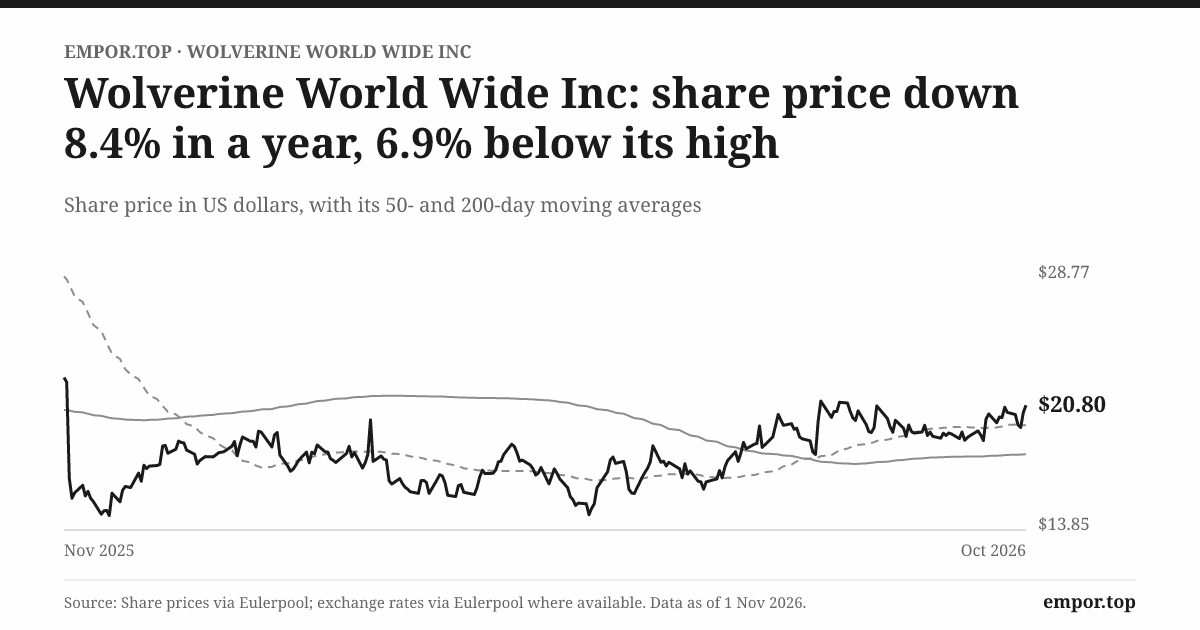
On November 1, 2026, Wolverine's shares traded at about $20.80, within 7% of their 52-week high of about $22.34 and well above the low of about $14.65. The company's market value was about $1.7 billion and its enterprise value, including net debt, about $2.3 billion. On trailing figures, that was about 17.9 times earnings, 12.7 times EBITDA and 1.2 times sales. The stock's one-year volatility was above 50%, a reminder of how violently the market has repriced this company in both directions.
Those multiples can be read two ways. Against trailing earnings that still reflect the recovery, they look full. Against management's raised 2026 guidance of $1.55 to $1.65 of adjusted earnings per share, the stock traded at roughly 13 times the midpoint.11 The market, in other words, is paying for a continuation of the recovery, not a reversal.
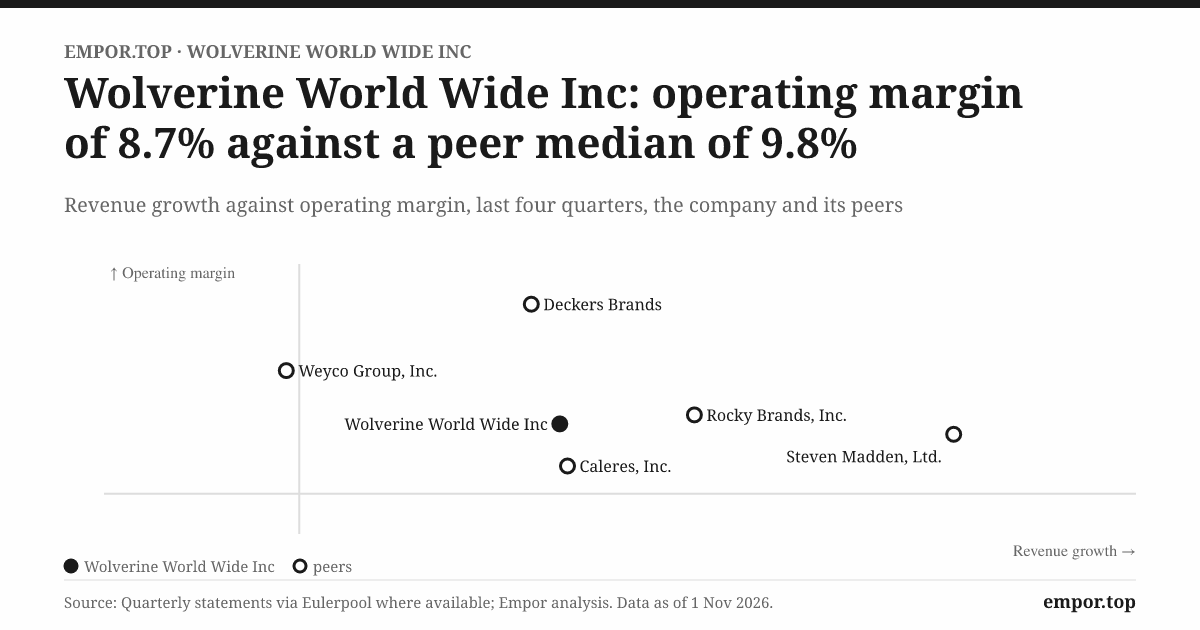
Peer comparisons are imperfect but informative. Third-party snapshots around the autumn of 2026 showed Deckers at roughly 10 times EBITDA and 12 times earnings, Crocs at about 9 times EBITDA and 10 times earnings, and Columbia Sportswear at about 14 times earnings.1920 On those measures, Wolverine traded at a premium to faster-growing, more profitable peers. The premium probably reflects the market's view that Wolverine's earnings are still recovering toward a higher normal level, while some peers were seen as past their peak. Scale offers another reality check: Deckers' HOKA brand alone generated more sales in its last fiscal year than all of Wolverine, so the premium is not a reward for size.10 Those snapshots come from different dates and use different trailing periods, so they are context rather than a valuation anchor. Wolverine's own five-year median P/E is not available in a meaningful form, because the company lost money in several of those years.
To weigh what that price assumes, it helps to test Wolverine's competitive position with two classic frameworks.
Michael Porter's five forces start with the threat of substitutes and new entrants, and in footwear both are high. Consumers have enormous choice, a new brand can reach them through social media and online retail, and On and HOKA showed in the last decade that newcomers can take share from incumbents quickly. Buyer power is meaningful because retailers stock many brands and allocate space by sell-through.5 Wolverine's lack of customer concentration limits its dependence on any single retailer but does not change the fact that retailers as a group hold the shelf. Supplier power is moderate: Wolverine sources from many third-party factories, but those factories are concentrated in a few Asian countries, which exposes the company to regional disruption and to tariffs.5 Rivalry is intense, with giant competitors spending heavily on marketing and athlete endorsements. Put together, the five forces describe an industry where returns depend on continuous brand investment and product success, not on structural protection.
Hamilton Helmer's seven powers framework asks which, if any, durable advantages a company has. For Wolverine, the plausible candidate is branding: the ability to charge more for an identical product because of the brand's reputation. The evidence is the improved full-price mix and the growth of Merrell and Saucony while prices rose.4 But branding power in footwear is real and fragile at once; it has to be renewed with each product cycle, and Wolverine's own history shows how quickly it can fade, at Sperry and at Keds. Scale economies are not evident: Wolverine is much smaller than Nike, Adidas or Deckers, and its sourcing and marketing budgets are correspondingly smaller. Network effects, switching costs, counter-positioning, cornered resources and process power are not demonstrated by the available evidence. The honest conclusion is that Wolverine has brand power in two franchises that is currently strong, and no proven structural moat beyond it.
The bull case rests on the operating recovery already described: growth at Merrell and Saucony, higher margins, lower debt, rating upgrades and management's record of delivery.3418 If Saucony can keep growing in the mid-teens and Merrell in the mid-single digits, while the Work Group stabilizes and Sweaty Betty returns to growth, Wolverine could generate rising earnings and cash for several years and refinance its 2029 notes comfortably. In that world, the current valuation would look reasonable or even cheap in hindsight.
The bear case rests on history. Wolverine's revenue has contracted over the past decade, and its 2025 net profit was still below its 2015 level.5 The recovery depends on two brands, one of which is benefiting partly from a lifestyle trend in retro running that could fade. The Work Group is still shrinking, and Sweaty Betty has not yet shown it can grow in total. Leverage remains in speculative-grade territory, and the company has a record of buying brands near cyclical peaks and later writing them down. In that world, a slowdown in running or outdoor demand would hit sales, margins and cash at the same time, and today's multiple would compress.
A skeptical shareholder, or an activist, would press management on a few specific points. What is the plan for the 2029 notes, and how much debt does the company intend to retire before it considers further buybacks? What operating proof would justify spending on acquisitions again, given that large parts of the last two major acquisitions were written off? Why should Sweaty Betty and the Work Group remain in the portfolio if they cannot show growth within a defined period, and what would management do if they cannot? And how is executive pay tied to cash generation and debt reduction, rather than to adjusted earnings and share price alone?
The bull and bear cases are not mutually exclusive. The recovery is real, but it has not yet made growth broad across segments, and the 2025 growth rate is well above the company's long-term trend. The history narrows the bull case rather than rejecting it: Wolverine has shown it can run two brands well in a favourable market, but it has not yet shown that it can sustain that through a downturn or extend it beyond those two brands. At this valuation, the market is pricing continued execution, not a deep-value turnaround. Three numbers will tell whether that assumption holds: constant-currency growth at Merrell and Saucony, operating profit at the Active and Work groups, and operating cash flow after working-capital investment.
X. Playbook: Business & Investing Lessons
Every long-lived company leaves behind a set of lessons that its later managers learn the hard way. Wolverine's are unusually clear, because the company has tested both sides of most of them within a single decade.
The first lesson is that a portfolio gives you options; it does not create demand. The fate of Wolverine's 2012 acquisitions made the point: Saucony thrived, while Keds and Sperry were sold after long declines.743 The portfolio did give Wolverine a ticket to the running boom when it arrived. But the boom was not created by the portfolio; it was a category wave that Saucony's designers and marketers managed to catch. For founders and investors, the point is that owning a collection of brands is not the same as owning their future relevance, which has to be earned separately by each one.
The second lesson is that inventory is a forecast made physical. Wolverine's 2022 inventory bust cost about $178 million in operating cash.2 Every pair of shoes ordered from a factory is a bet on what consumers will want six to nine months later. When those bets go wrong at scale, the cost shows up in markdowns, margins and borrowing, all at once. Investors in consumer brands should read inventory as an early-warning signal: when it grows faster than sales, the next year's results are at risk.
The third lesson is that a turnaround is only durable when the next season sells through. Wolverine's margin gains in 2024 and 2025 show the point.4 That kind of margin gain is real, but it happens once. Repeating it requires consumers to keep buying the new products at full price, season after season. The proof of a turnaround is not the year in which margins jump; it is the second and third years, when the comparisons get harder and growth has to come from demand rather than from the absence of a clean-up.
The fourth lesson is that debt shrinks the room for error. Wolverine's 2012 deal was largely debt-financed.7 The later inventory bust showed how little room the company had for error. The 2029 bond still limits its room to invest, buy back shares or absorb a bad season.5 A brand owner with low capital needs should be able to carry little debt; Wolverine's history shows the cost of forgetting that.
Taken together, these lessons describe a company whose value has always depended on its brands' relevance, and whose mistakes have mostly come from treating brand names as interchangeable assets that could be bought, combined and financed like any other. The next chapter depends on earning relevance product by product.
XI. Epilogue
As autumn 2026 turns toward winter, Wolverine stands on firmer ground than at any point in the past five years. In the second quarter, revenue grew 6.8% to about $506 million, the Active Group grew about 9% and the Work Group declined about 2%.11 Management raised its full-year guidance in August, to revenue of $1.98 billion to $2.0 billion and adjusted earnings per share of $1.55 to $1.65.11 Saucony and Merrell are still growing. The Work Group is not yet carrying its share.
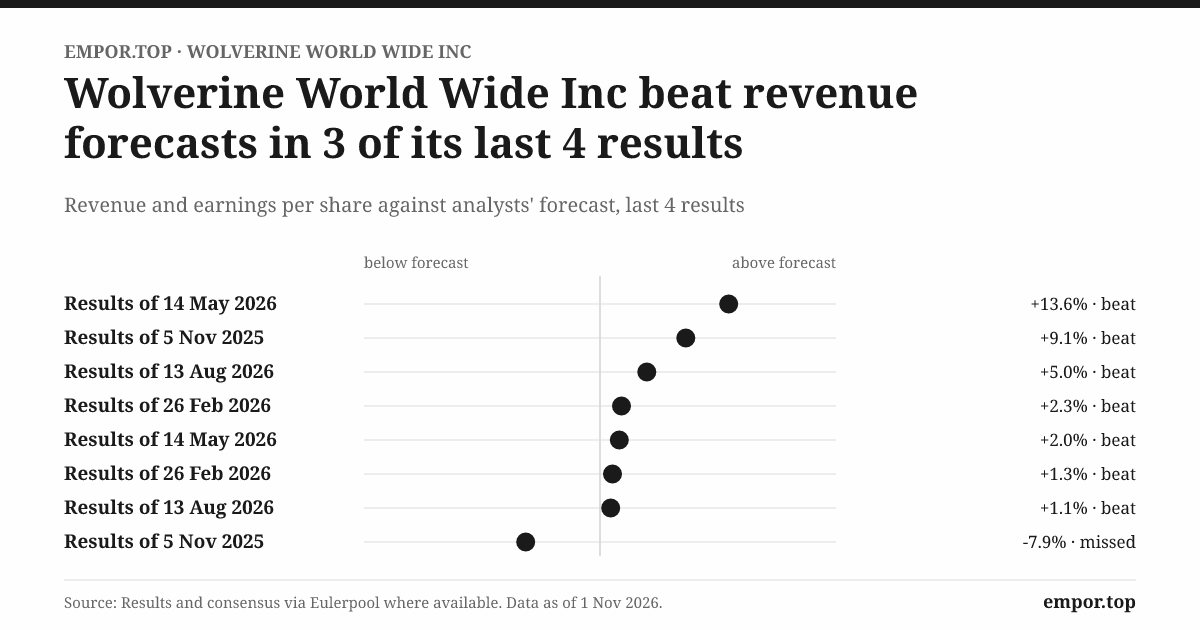
The guidance trail tells a story of its own. When the company reported fiscal 2025 in February 2026, it guided to adjusted earnings of $1.35 to $1.50 a share. In May, after a first quarter in which revenue grew 11%, it raised that range to $1.43 to $1.58, citing lower expected tariff costs and stronger demand.15 In August, it raised it again, to $1.55 to $1.65, with Miller attributing most of the improvement to "structural changes" and "more full price sales," and only a small part to a lower tariff assumption.14 Two raises in two quarters suggest that the business is outperforming management's own conservative expectations, and that the margin gains are at least partly structural rather than a gift of trade policy. But it is also worth remembering that guidance raised against an easy starting point is not the same as guidance met against a hard one.
The next results will begin to answer the questions that matter most. The first is breadth. Will Saucony's growth continue across products, regions and channels, or will it narrow to a few hot lifestyle styles in Europe? Will Merrell's lifestyle push become a durable source of growth, or a temporary boost on top of a mature hiking business? Management's raise of Saucony's outlook to mid-teens growth, and its decision to keep Merrell at mid-single digits, sets a clear benchmark for both.14
The second question is whether the rest of the portfolio can stop subtracting. The Work Group is guided to be roughly flat for 2026.14 If it returns to growth in 2027, the company's growth becomes broader and less dependent on two brands. If it keeps shrinking, investors will reasonably ask whether it belongs in the portfolio at all. Sweaty Betty faces the same test: management describes a planned reset in the U.S. and growth in the U.K., but the brand must show that it can grow in total without another write-down.14
The third question is cash. The company has guided to $115 million to $130 million of operating free cash flow for 2026.14 If that holds, and if net debt continues to fall, Wolverine will enter 2027 with far more flexibility to refinance its 2029 notes. If cash disappoints, because inventory builds or receivables stretch, the balance sheet will tighten again just as the refinancing window approaches.
Each of these outcomes maps onto the central questions of the story. If growth broadens and cash holds, Wolverine will have shown that its recovery is a durable business rather than a cyclical rebound. If growth narrows and cash weakens, the market will be reminded that the company's longer history is one of decline, and that two strong brands may not be enough to change it. The next results will not settle the question. But they will move it.
XII. Outro
Go back to that August Sunday in 2023, when Wolverine's board handed the company to a man who had spent his career selling shoes rather than buying brands. His answer was to shrink the company and give the remaining brands a chance to run.
The bet has paid off so far. But the story is not finished. What will decide it is a buyer at a running store or an outdoor shop, looking at next season's samples and deciding how much space to give a Saucony or a Merrell. Those decisions will say more about whether Wolverine has rebuilt a durable company than any promise to build brands.
References
-
CEO Transition Form 8-K — Wolverine World Wide via SEC, 2023-08-10 ↩↩↩↩
-
Wolverine Worldwide Reports Fourth Quarter and Full-Year 2023 Results and Provides Outlook for 2024 — Wolverine World Wide, 2024-02-21 ↩↩↩↩↩↩↩↩↩↩↩↩↩↩↩
-
Wolverine Worldwide Reports Fourth Quarter and Full-Year 2025 Results — Wolverine World Wide, 2026-02-26 ↩↩↩↩↩↩↩↩↩↩↩↩↩↩↩↩↩↩↩↩↩↩
-
2025 Annual Report and Form 10-K — Wolverine World Wide via SEC, 2026-02-27 ↩↩↩↩↩↩↩↩↩↩↩↩↩↩↩↩↩↩↩↩↩↩↩↩↩↩↩↩↩↩↩↩↩↩↩↩↩↩↩↩↩↩↩↩↩↩↩↩↩↩↩↩↩↩↩
-
About Us: Company History — Wolverine World Wide ↩↩↩↩↩↩↩↩↩↩↩
-
Wolverine Worldwide to Acquire Collective Brands' Performance + Lifestyle Group — Wolverine World Wide via SEC, 2012-05-01 ↩↩↩↩↩↩↩↩
-
Completion of Collective Brands Acquisition — Wolverine World Wide, Golden Gate Capital and Blum Capital Partners via SEC, 2012-10-09 ↩↩
-
Wolverine Worldwide Acquires Women's Activewear Brand Sweaty Betty — Wolverine World Wide, 2021-08-03 ↩↩↩↩↩
-
Deckers Brands Reports Fourth Quarter and Fiscal Year 2025 Results — Deckers Brands via SEC, 2025-05-22 ↩↩↩
-
Wolverine Worldwide Reports Second Quarter 2026 Results — Wolverine World Wide, 2026-08-13 ↩↩↩↩↩↩↩↩↩↩↩↩
-
2026 Proxy Statement — Wolverine World Wide, 2026-03-25 ↩↩↩↩↩
-
2026 Annual Meeting Voting Results, Form 8-K — StockTitan, 2026-05-13 ↩
-
Wolverine World Wide Q2 2026 Earnings Call Transcript — StockAnalysis, 2026-08-13 ↩↩↩↩↩↩↩↩↩↩↩↩↩↩↩↩↩↩↩↩↩↩↩↩
-
Wolverine World Wide Q1 2026 Earnings Call Transcript — The Motley Fool, 2026-05-14 ↩↩↩↩
-
Q2 2026 Form 10-Q — Wolverine World Wide via SEC, 2026-08-13 ↩
-
Wolverine World Wide's revolver rating raised to BB- by S&P — Investing.com, 2025 ↩
-
Wolverine upgraded by Moody's on improved performance — Investing.com, 2026-05-27 ↩↩↩↩
-
Wolverine World Wide valuation and peer comparison — MarketScreener, accessed 2026-10-26 ↩
 LinkedIn
 WhatsApp
 Reddit
 Hacker News
 Email
 Kindle
 RSS Feed
 Spotify
 Apple Podcasts
 Amazon Music
 Audible
 YouTube