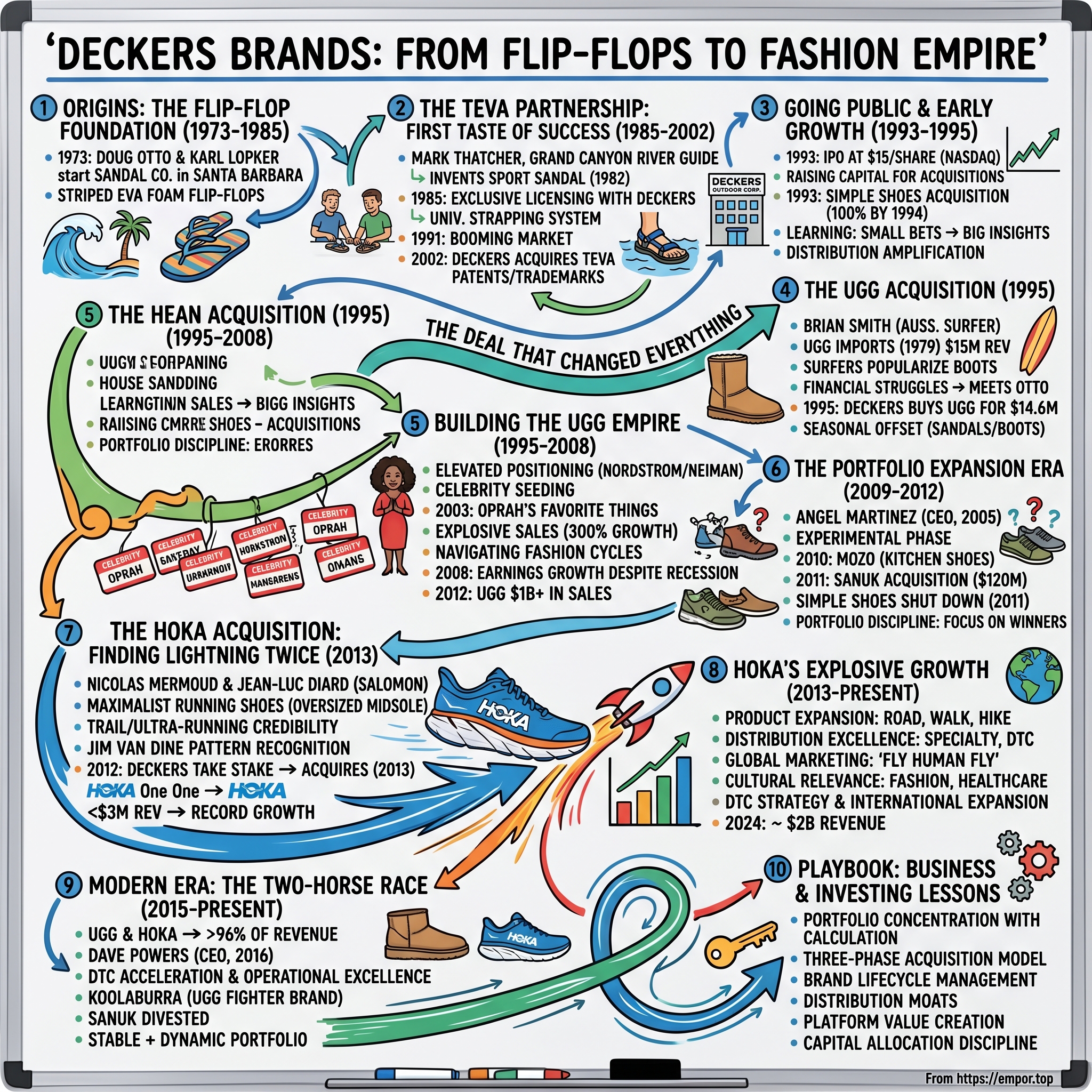
Deckers Outdoor Corporation: The Two-Brand Machine
I. Introduction & Episode Roadmap
Drive north out of Santa Barbara along the 101, past the eucalyptus windbreaks and the lemon groves, and you arrive at Goleta — a place that looks less like the headquarters of a global footwear company than like the campus of a mid-sized state university. At 250 Coromar Drive sits Deckers Outdoor Corporation, a business that in the fiscal year ended March 31, 2026 sold $5.47 billion of footwear and generated $1.02 billion of net income, with an operating margin of 23.1% and diluted earnings per share of $7.02.1 Those are not the numbers of a beach-town sandal maker. They are the numbers of one of the most profitable footwear businesses on earth.
And yet, on the September 8, 2026 close, the stock changed hands at $83.38, against a fifty-two-week high of $122.29 set back in February. The market capitalization sat near $11.4 billion. Nineteen months earlier, on January 30, 2025, the shares had closed at $223.11. Something has come undone in the story the market was telling itself about this company, and the whole point of this episode is to figure out what.
Here is the hook. Deckers began in 1973 as a flip-flop operation founded by two freshly graduated UC Santa Barbara students who wanted a professional excuse to spend more time at the beach.6 It has since become, functionally, a holding company for two acquired brands that nobody wanted at the time of purchase: sheepskin boots that fashion critics spent a decade calling ugly, and thick-soled running shoes that looked, when they first appeared, like orthopedic clown footwear. In fiscal 2026 the HOKA brand generated $2.587 billion of revenue and the UGG brand generated $2.739 billion. Together they were roughly 97% of the company. Everything else — Teva and the residue of wound-down labels — totaled $146.2 million, and shrank 33.9% year over year.1
That concentration is the central tension of this story. Two-brand dependence can be read two ways. In the bull reading, it is focus: Deckers has stopped diluting management attention across seven mediocre labels and now pours capital into the two that actually compound. In the bear reading, it is fragility: a company with no third leg, whose largest brand is a fashion object subject to the whims of teenagers, and whose fastest-growing brand competes in the single most contested category in athletic footwear. The market has been actively repricing that question since October 2025, when a single earnings call knocked roughly 15% off the stock in a day.4
There is a third reading worth holding in mind from the outset, because it complicates both: almost every premium footwear stock has been savaged over the past year. On the same September day, On Holding traded at a market capitalization near $9.1 billion against a fifty-two-week high price of $51.08 versus $27.25; Birkenstock sat near $6.1 billion; Nike had fallen to roughly $56.5 billion from a fifty-two-week high price of $76.97; Crocs had lost roughly a fifth of its value from its own high. Whatever is being repriced here is not purely a Deckers problem, and a serious analysis has to separate the company-specific signal from the sector-wide derating.
The road ahead: a compressed tour of the origin story and the licensing lesson that shaped every deal since; the two acquisitions — UGG in 1995 and HOKA in 2012 — that are the hinge points of the entire capital-allocation record; the segment economics as they actually stand today; the first CEO transition in more than a decade; the tariff shock and guidance whiplash of fiscal 2026; the acquisitions that failed, which matter more than the ones that worked; the buyback that has become the company's only form of capital return; and a structural analysis of whether the two-brand machine can keep running.
Start with the part almost everyone skips: how a company that spent nearly thirty years going essentially nowhere learned the one lesson that made everything afterward possible.
 Subscribe on LinkedIn
II. Origins & the Licensing Lesson (1973–2002)
In 1973, Doug Otto and his UCSB classmate Karl Lopker started stacking layers of rubber into durable flip-flops in Santa Barbara. One was a surfer, the other a beach volleyball player. The product was first called Driftwood Dans; the company name arrived after Otto heard Hawaiians in 1975 refer to the sandals as "deckas," a nod to skateboard deck planks.6 The corporate entity, incorporated in California in 1973 and reincorporated in Delaware in 1993, took the business public on NASDAQ that same year.56
The transformative moment came in 1985, and it did not involve a product Deckers invented. A Colorado river guide named Mark Thatcher had solved a specific and unglamorous problem: how to keep a sandal on your foot while wading through whitewater. His answer was a nylon strapping system, and the resulting sport sandal — the first of its kind — was called Teva. Thatcher licensed it to Deckers in 1985, and for the next seventeen years Deckers built, marketed, and distributed a product it did not own.6
The economics of that arrangement look fine until you examine the volatility underneath. In 1995, Teva wholesale revenue was $55.9 million and represented 54.7% of Deckers' total net sales. In 1996 it fell to $43.9 million — a drop of more than a fifth in a single year — and then rebounded to $61.9 million in 1997.5 This is a detail worth sitting with, because it is the earliest hard evidence in the company's own filings that a Deckers brand can be culturally hot one year and cold the next. Long before anyone worried about UGG going out of fashion or HOKA losing shelf space, the crown jewel of the portfolio proved that footwear demand is not an annuity.
By 1999, Deckers had negotiated an option to buy the Teva rights outright from Thatcher, renegotiated in 2001, and on November 25, 2002 it exercised.7 The price was approximately $62.3 million, and the structure tells you everything about how strained the balance sheet was. Deckers paid $43.0 million in cash, issued Thatcher $13.0 million of subordinated notes carrying 7% cash interest plus another 2% accrued to a 2008 maturity, issued $5.5 million of preferred stock that came with the right to designate a board member, and threw in 100,000 shares of common and options on another 100,000.7 It also signed Thatcher to an employment agreement running through November 2007.
To understand how audacious this was, look at the market's opinion of Deckers at the time. As of June 30, 2002, the aggregate market value of Deckers common stock held by non-affiliates was $23,873,217.7 The company paid roughly two and a half times its entire public float to buy a trademark. In 2002 it sold about 4.1 million pairs of footwear and generated roughly $99 million of net sales — meaning that seven years after acquiring UGG, revenue was actually slightly below where it had been in the mid-1990s.57 Nearly three decades in, Deckers was a $100 million company that had gone nowhere.
The conventional lesson drawn from this episode — own the intellectual property, don't rent it — is true but incomplete, and worth stating precisely because it gets repeated as gospel. Deckers did not get the option because it was a brilliant negotiator; it got the option because it had operated the brand for fourteen years and was the only credible buyer. It did not pay a bargain price; it paid a price that consumed its balance sheet and required issuing paper to the seller. And the payoff was not immediate: Teva is today the largest surviving piece of a residual "Other brands" bucket that is shrinking at a double-digit rate and rounds to nothing against HOKA and UGG.1
What the Teva purchase really established was a template for how Deckers thinks about brands: it prefers full ownership, it is willing to stretch financially to get it, and it will hold a brand for a very long time. Two of those instincts would prove extraordinarily valuable. One would prove expensive. The company's entire subsequent history is the working out of which is which — and it starts with a deal signed seven years before the Teva buyout, for a brand that Deckers itself admitted, in writing, was in bad shape when it bought it.
III. The UGG Acquisition: Betting on Seasonal Complementarity (1995)
The founding legend of UGG is the kind of story that gets told at business schools. Brian Smith, an Australian who arrived in California in 1978 at age 28, imported sheepskin boots from home on the theory that a country full of surfers would eventually want something warm to put on cold feet after a session. He sold them out of a van, in surf shops, in ski towns, and slowly built a real if unglamorous business over sixteen years.8
In August 1995, Smith sold UGG Holdings to Deckers, at a price widely reported at approximately $14.6 million.9 The pitch, in Smith's telling, leaned on calendar arithmetic: Deckers' business was overwhelmingly a summer business built on sandals, and UGG was overwhelmingly a winter business built on boots. Bolt them together and you smooth the year.
Here is where the standard narrative needs a correction, delivered by Deckers itself. In its own annual report three years after the deal, the company wrote that "prior to and shortly after the Company's 1995 acquisition of Ugg Holdings, Inc., the Ugg product was in need of updates and became subject to low cost imitations."5 That is a remarkable admission to find in a 10-K. Deckers bought a tired brand with a counterfeiting problem, and then spent years fixing outsoles, adding waterproof leathers, and building out a Town Collection to make the boots functional in weather rather than merely fashionable at the beach. The acquisition was not lightning in a bottle. It was eight years of unglamorous product work before anything happened.
Then something happened. In 2003 Oprah Winfrey gave away 350 pairs of UGGs on her "Favorite Things" segment, and the boots became a cultural object.8 Paris Hilton and Sarah Jessica Parker wore them. Waiting lists formed. By 2006 UGG had opened a flagship store in New York's SoHo, selling a boot that had begun life as surf-shop apparel at roughly $175 a pair.8 Deckers had executed the trick that is genuinely hard in footwear: it moved a product up-market without losing the authenticity that made it desirable in the first place.
The decade that the bull case forgets
And then the trick stopped working, which is the part of the UGG story that belongs right here rather than quarantined in a risk section — because it is the closest thing the record offers to a test of the claim that UGG's cultural relevance is durable.
UGG's wholesale revenue peaked at $915.2 million in calendar 2011 and fell to $819.3 million in 2012, a drop of more than 10% in a single year.13 The brand recovered, then rolled over again: UGG wholesale revenue of $918.1 million in the fiscal year ended March 2016 fell to $826.4 million in fiscal 2017.10 Meanwhile UGG became, in the vocabulary of the internet, "basic" — a meme rather than a status object.8
The financial consequences were not cosmetic. In fiscal 2017 Deckers reported an operating loss of $1.9 million and net income of just $5.7 million on $1.79 billion of revenue, against net income of $122.3 million the prior year.10 The company closed twenty-five retail stores across fiscal 2016 and 2017, took restructuring charges of roughly $24.8 million and $29.1 million in those two years, shut down its Ahnu operations in Richmond, California, and moved Sanuk's operations from Irvine into headquarters.10 Management pointed, correctly, at the weather: as the fiscal 2017 filing put it, "extended periods of unseasonably warm weather during the fall or winter months may significantly reduce demand for our UGG products."10 Layered on top was a raw-material problem that has no obvious solution — Deckers depends on two tanneries for the twinface sheepskin used in many UGG products, and sheepskin supply is a by-product of the food industry, subject to disease, weather, and whether shepherds decide to shear rather than harvest.13
Deckers' response was to de-seasonalize: push UGG into slides, sandals, sneakers, and year-round silhouettes so that the brand did not live or die on December temperatures. It worked. UGG came back, powered by the Tasman, the Ultra Mini, and a wave of designer collaborations.8
Which is precisely why the current version of the same claim deserves scrutiny rather than applause. On the July 2026 call, CEO Stefano Caroti described a UGG that is "more versatile, diversified and balanced than ever before," running through the Lowmel family, the Golden collection, the Otzo Clog, a spring apparel line, and men's product, and said flatly that the brand is "less depending on a cold winter than ever before."27 Men's, he noted, is 15% of UGG revenue with a goal of 20% or higher.27
Every word of that is plausible. It is also almost exactly what Deckers said a decade ago, and the decade-old version of the strategy did not prevent an earnings wipeout. So what does the history actually establish? It does not reject the de-seasonalization claim — the record shows Deckers has executed it once, successfully, over roughly five years. But it narrows the claim considerably: the previous cycle demonstrated that de-seasonalizing UGG is possible but slow, expensive, and reactive rather than preventive. It was undertaken after the decline, not instead of it.
The KPI that would confirm or falsify the current version is specific and observable: the growth rate of UGG revenue in the off-season quarters relative to the December quarter. Today the concentration remains extreme. In the December 2025 quarter UGG generated $1.305 billion of revenue; in the June 2026 quarter it generated $278 million.163 Roughly half of UGG's annual revenue still lands in a single three-month window. Until the off-season quarters grow materially faster than the holiday quarter for several years running, "UGG is no longer a boot company" remains a direction of travel, not an accomplished fact.
The trademark that is genuinely a moat
One asset here is real and legally tested. Australian Leather Pty Ltd argued in US federal court that "ugg" was a generic Australian term for sheepskin boots and therefore could not function as a trademark — invoking the doctrine of foreign equivalents and pointing to a possible circuit split. The district court found Australian Leather liable for willful infringement in July 2020, the Federal Circuit affirmed, and a petition for Supreme Court review was filed in October 2021.11 The dispute has been contentious enough, and freighted enough with national feeling, to draw sustained mainstream coverage.12
The practical result is a bifurcated world: in Australia the term is treated as generic and local makers use it freely, while in the United States — Deckers' most important market by far — the UGG mark has survived a determined, well-funded challenge. That is a genuine, litigated barrier around the single most valuable word in the portfolio. It does not protect against a shift in taste. It does protect against the cheapest form of competition, which is imitation with the same name. Seventeen years after buying UGG, Deckers would find a second brand that needed no such protection because nobody else wanted it.
IV. The HOKA Acquisition: Lightning Struck Twice (2012–2013)
Picture the running-shoe aisle in 2010. The dominant idea in the sport was minimalism: barefoot-style shoes, thin soles, the notion that cushioning had made runners weak. Into that consensus walked two French trail runners, Nicolas Mermoud and Jean-Luc Diard, who had founded a company in 2009 with a name drawn from Māori — Hoka One One, rendered as "to fly over the earth" — and whose founding product idea was the exact opposite of the prevailing wisdom.14
Their reasoning was specific and physical. Trail runners lose enormous time on descents because pounding downhill on rocky ground beats up the legs. What if a shoe had so much foam underfoot, shaped with a rocker geometry like the curve of a rocking chair, that a runner could roll down a mountain rather than brake down it? The first shoe, the Mafate, arrived in 2010 with a thick midsole and that distinctive rocker profile.14 It looked absurd. Serious runners mocked it. It also worked, and a small cult of ultramarathoners began wearing nothing else.
Deckers, then run by Chairman and CEO Angel R. Martinez, moved in two steps. In May 2012 it purchased a noncontrolling interest in Hoka, accounted for as an equity-method investment. In September 2012 it acquired the remaining ownership.13 The filings do not disclose a purchase price, because there was nothing to disclose: Deckers stated plainly that "the acquisition of Hoka was not material to the Company's consolidated financial statements."13 The only number the company put on paper was the earnout — contingent consideration tied to Hoka's net sales from 2013 through 2017, with a total maximum payout of $2.0 million, of which roughly $1.8 million was accrued by the end of 2013.13
Two million dollars, capped.
For context on what that turned into: HOKA's wholesale segment revenue was $185.1 million in fiscal 2019, $628.7 million in fiscal 2022, and $1.398 billion in fiscal 2025, at which point Deckers changed its segment presentation to report the brand on a total basis — $2.233 billion in fiscal 2025 and $2.587 billion in fiscal 2026.13151 A brand acquired for an amount too small to be material now generates more revenue than the entire company did as recently as fiscal 2021.
The comparison that makes the magnitude legible is the public market. On Holding — the Swiss running brand that is HOKA's closest analogue in positioning, vintage, and growth trajectory — carried a market capitalization near $9.1 billion on September 8, 2026. Birkenstock, another premium single-brand footwear company, sat near $6.1 billion. Whatever HOKA is worth today, it is plausibly worth more than either of those entire companies, and Deckers acquired it for a sum it declined to quantify.
Why it worked, and what that does and does not prove
The instinct to canonize this deal should be resisted long enough to ask what actually drove the outcome. Three things are visible in the record.
First, patience. Deckers did not buy Hoka and immediately pour marketing dollars into it. It let the brand stay small and stay credible with the ultra-running community for years before pushing it into broader distribution. That credibility is not decorative — it is the entire basis of the brand's permission to charge premium prices. As recently as the June 2026 quarter, Deckers was still cultivating it: a Deckers senior manager of product engineering, Vincent Bouillard, set a course record winning the Western States Endurance Run in a custom Tecton prototype he helped design, and the triathlete Sam Laidlow set a world best at Challenge Roth in the Rocket X 3.27 Employee-athletes winning the world's oldest 100-mile trail race is not a marketing budget; it is a culture, and it is genuinely hard to buy.
Second, the product architecture kept evolving. What began as one weird trail shoe became a franchise system — Clifton, Bondi, Speedgoat, Mach, Mafate, Arahi — and by 2026 management was formalizing it into named technology platforms, splitting the line into a cushioned "Glide" collection and a responsive "Fly" collection with the launch of the Clifton Pro and its PROGLIDE+ supercritical foam midsole.27 In plain terms: supercritical foam is made by injecting gas into polymer under pressure, which produces a lighter, springier material that returns more energy per stride. It is the same physics arms race that produced carbon-plated marathon shoes, and it is the reason product cycles in running are now measured in seasons.
Third — and this is the uncomfortable part — Deckers got lucky on category timing. Maximalism went from ridiculous to default. Every major brand now sells a max-cushion shoe. The contrarian insight that made HOKA cheap in 2012 has been fully absorbed by the industry, which means the thing that generated the return is no longer available as a source of advantage.
At some point the brand quietly dropped the "One One" from its name; Deckers' filings referred to "Hoka One One®" as a trademark in the 2014 annual report and to "HOKA" thereafter.131 The simplification signals the ambition: not a specialist ultra-running label, but a mainstream global performance brand.
Whether that ambition is being realized is the question the numbers now have to answer — and the numbers, as of September 2026, are more ambiguous than the story.
V. Segment Economics Today: Who Actually Drives the Value
Strip away the history and look at the machine as it runs today. Fiscal 2026 revenue of $5.472 billion broke down into HOKA at $2.587 billion, growing 15.9%; UGG at $2.739 billion, growing 8.2%; and the remainder at $146.2 million, shrinking by a third as Deckers wound down Koolaburra and folded the leftovers into a bucket that is primarily Teva.12 Wholesale revenue of $3.208 billion grew 12.3% while direct-to-consumer revenue of $2.264 billion grew 6.3%, with DTC comparable sales up 4.6% in constant currency.1
The first thing to notice is that the segment disclosure itself changed. Through fiscal 2025 Deckers reported wholesale segments by brand plus a separate direct-to-consumer segment — HOKA wholesale of $1.398 billion, UGG wholesale of $1.282 billion, and DTC of $2.130 billion.15 From fiscal 2026 the company reports three brand-level segments: HOKA, UGG, and Other.2 The new presentation is more intuitive and matches how the business is run. It also makes multi-year channel comparisons harder to construct from the segment note alone, which is worth flagging as a modest reduction in disclosure granularity at exactly the moment channel mix became the most contested variable in the story.
The deceleration, stated plainly
In the June 2026 quarter, Deckers crossed $1 billion of revenue in a first fiscal quarter for the first time — $1.020 billion, up 5.7%. HOKA contributed $703.5 million, up 7.7%. UGG contributed $278.0 million, up 4.9%. Direct-to-consumer revenue grew 13.0% while wholesale grew only 2.2%, and international revenue of $502.1 million grew 8.4% against domestic revenue of $517.4 million growing 3.2%.3
Set that against the trajectory. HOKA grew 23.6% in fiscal 2025 and 15.9% in fiscal 2026, and management guides to low-double-digit growth for fiscal 2027 and again for fiscal 2028 through 2030 under the multi-year framework introduced in May 2026.151 In other words, management's own long-range plan embeds a HOKA that never again grows at twenty percent. That is not a bear-case assertion; it is the company's stated framework, and it belongs directly alongside any claim that HOKA is a hypergrowth asset.
Management's explanation for the soft first quarter was operational rather than demand-driven. CFO Steve Fasching told analysts the year-over-year wholesale comparison was distorted by logistics: a new European warehouse coming online a year earlier had pulled shipments forward into the first half of fiscal 2026, and this year's cadence normalizes, which pushes growth into the back half. "The growth that you're seeing this year is really a change in logistics," he said. "It's not any change in assumption in demand."27 That is a falsifiable claim with a near-term test attached — Deckers guided the second quarter of fiscal 2027 to roughly 5% consolidated growth with HOKA up high single digits, and told investors growth accelerates in the second half.27 If the back half does not accelerate, the logistics explanation fails on its own terms.
HOKA's industry structure: the credibility channel is going the wrong way
Here is the single most uncomfortable data point in this story, and it deserves to sit right next to the growth claims rather than in a risk appendix.
At The Running Event industry conference on December 2, 2025, the consultancy Karnan Associates presented US run-specialty channel data for the trailing twelve months through September. The channel overall grew 3.1% in dollars and just 0.3% in units. Within it, Hoka's dollar sales fell 7.4%, holding the number-two position; category leader Brooks fell 6.8%; New Balance fell 4.6%; Asics fell 2.1%; and On fell 19.7%, sliding to number six. The brands that grew were Nike, up 35.4% and climbing from ninth to eighth, and Topo, up 30.9%.19
Run specialty is a narrow channel — a few thousand independent running stores — but it is the channel that confers technical credibility. It is where serious runners get gait-analyzed and where brand reputations are made. HOKA's dollars going backwards there while a resurgent Nike posts the strongest growth in the channel is a meaningful early signal, not noise.
Now hold that next to what Deckers reported for the same period. In the December 2025 quarter HOKA grew 18.5% globally to $628.9 million, its largest quarter to that point.16 Both things are true, and reconciling them is the analytical work. HOKA's growth is coming from international markets and from its own direct channel, not from the American specialty stores that built it. Management's own regional commentary supports this: it cited top brand share in US performance road and trail footwear above $140 and top-three positions in France, Italy, and the UK per Circana, alongside share gains in China.23 In the December quarter, international revenue grew 15.0% against domestic growth of 2.7%.16
So the mechanism that would break the HOKA thesis is visible and already operating at the margin: the brand is maturing in its home market and in its credibility channel while growth migrates to geographies where it is still new. That is a normal brand life cycle, not a catastrophe. But it means the runway is a geographic runway, not a structural one, and geographic runways have ends.
Broader market data cuts the other way and should be given its due. Transaction-level analysis published in April 2026 found running footwear growing 8.9% year over year while lifestyle footwear declined slightly, with Hoka, On, New Balance, and Adidas all participating in gains as Nike's overall share declined across channels.20 The same analysis noted a customer-retention hierarchy in which Nike led on repurchase rates, with On, Adidas, and New Balance following, and Hoka, Brooks, and Asics trailing.20 Lower repeat-purchase rates than the leaders is exactly the kind of unglamorous operating fact that a brand-strength narrative tends to omit, and it argues that HOKA's position rests more on winning new customers than on locking in old ones.
Deckers' counter is distribution discipline. On the July 2026 call Caroti described a deliberately segmented marketplace — the Clifton Pro released into selective wholesale while the Clifton 11 goes broad, a Cielo 70 aimed at lifestyle and department stores, a Mach Pro for athletic specialty, a Fly Pace for sporting goods — and repeatedly emphasized a "pull model" in which the company enforces scarcity so consumers buy at full price.27 Inventory of $807.6 million at June 30, 2026 was down 5% year over year while revenue grew, which is consistent with that claim rather than merely asserting it.3
UGG's industry structure: a fashion cycle wearing a company's clothes
UGG's competitive problem is different in kind. There is no Brooks-versus-Hoka share table for cultural relevance. Birkenstock competes for a similar comfort-premium consumer, and any number of fashion-adjacent sneaker brands compete for the same closet space and the same social-media oxygen, but the real variable is whether the brand stays interesting.
What is measurable is channel behavior, and one quarter in fiscal 2026 is instructive. In the September 2025 quarter, UGG wholesale revenue grew 17% while UGG direct-to-consumer revenue fell 10%.18 Fasching attributed the DTC weakness to wholesale partners being better stocked, following earlier allocations, and to consumers shifting toward multi-brand in-store shopping.18 That is a coherent explanation. It is also, mechanically, a quarter in which the company shipped a great deal of product into the channel while its own stores and website sold less — the classic setup for a sell-in versus sell-through problem.
To Deckers' credit, the subsequent quarter validated the shipment: UGG delivered a record $1.305 billion in the December quarter with DTC inflecting back to growth, and retailers cleared the goods.1617 The episode is best read not as a red flag but as a demonstration of how quickly UGG's reported numbers can diverge from underlying consumer demand across a single quarter, which is why annual rather than quarterly readings matter for this brand.
The KPIs that matter
Three metrics carry most of the information in this business, and everything else is commentary.
The first is HOKA's revenue growth rate, decomposed between direct-to-consumer and wholesale. It is the single number that determines whether Deckers is a growth company or a mature one, and the DTC/wholesale split reveals whether growth is being pulled by consumers or pushed into retailers.
The second is UGG's off-season revenue growth — the June and September quarters — measured against holiday-quarter growth. This is the only clean test of whether the 365-day strategy is working, and it is the metric that would have flagged the 2012 problem in advance.
The third is gross margin. Fiscal 2026 came in at 57.7%, down just 20 basis points from the prior year's 57.9%, with tariffs costing roughly 80 basis points and underlying mix and freight improvements offsetting roughly 60.23 Gross margin is where pricing power, promotional discipline, channel mix, and tariff pass-through all land at once. Watch it and you are watching almost everything.
Those numbers are now the responsibility of a management team that took over less than three years ago — and whose first real test arrived faster than anyone expected.
VI. The New CEO Era: Stefano Caroti and What Changed
In early February 2024, Deckers announced that Dave Powers would retire as President and CEO effective August 1, 2024, after more than a decade at the company and years running it through the HOKA scale-up. He would remain on the board through the 2025 annual meeting. His successor was Stefano Caroti, then the Chief Commercial Officer.22
This was, by every visible marker, an orderly handoff rather than a defenestration: announced six months in advance, with the outgoing CEO staying on as a director and, in Caroti's own framing at the time, as a mentor through the transition.22 It was also the first genuine leadership change at Deckers in over a decade, which makes it a live test rather than a formality.
Caroti's résumé is unusual for an internal promotion in that most of it happened elsewhere. Educated at Middlebury College, he spent more than three decades in footwear and apparel, including senior roles at Nike — vice president of EMEA commerce, vice president of EMEA footwear, and general manager for Germany and Italy — followed by a stint at PUMA as chief commercial officer and managing director. He joined Deckers in 2015 as President of Omni-Channel, spent nearly eight years in that role, became Chief Commercial Officer in April 2023, served as interim President of HOKA, and was appointed CEO in August 2024 and elected to the board the following month.2221
That background matters for a specific reason: Caroti is a distribution executive, not a product designer or a finance operator. Nearly everything he emphasizes on calls is marketplace architecture — which retailer gets which model, how scarcity is enforced, how doors are added selectively rather than broadly. When he told an analyst in July 2026 that Deckers had cut off some smaller US accounts while feeding others, his answer was that the goal is "to continue to build a premium marketplace" with retailers who "champion the brand year-round," and that this strategy has been in place for five or six years.27 Read charitably, that is continuity. Read skeptically, it is a CEO whose principal lever is who gets to sell the shoes — a powerful lever in a scarcity model, and a limited one if demand itself softens.
CFO Steve Fasching, in the role since July 2018, has been the more consequential voice through the last two years, because he has owned the tariff numbers.21
What the pay package reveals
The proxy filed ahead of the September 14, 2026 annual meeting puts hard numbers on incentives. Caroti's fiscal 2026 total compensation was $11,904,992 — salary of $1,236,538, stock awards of $6,999,947, a non-equity incentive payout of $3,607,915, and $60,592 of other compensation. That was up from $10,051,429 in fiscal 2025 and $4,724,554 in fiscal 2024, the year he was elevated. Fasching earned $4,757,173 in fiscal 2026.21 The CEO pay ratio was approximately 231 to 1 against a median employee total of $51,638.21
The structure is where the analytical content lives. Roughly 60% of equity value is granted as long-term performance stock units and roughly 40% as time-vesting restricted stock. The performance units vest half on annual pre-tax income targets and half on annual consolidated revenue targets, measured in fiscal 2026, 2027, and 2028 with goals set at the start of the period, subject to a relative total-shareholder-return modifier designed to move payouts within a band of plus or minus 25%.21
That design explains something that would otherwise look like a governance failure. In a fiscal year during which the shares fell sharply, the CEO's cash incentive paid out at roughly three times his salary — because the plan pays on revenue and pre-tax income, both of which Deckers delivered, and share price enters only as a modifier on one component of equity. Whether that is right or wrong is a matter of philosophy. What is not debatable is that pay here is anchored to operating results rather than to shareholder outcomes, and investors should read the compensation report as a scorecard on execution, not on value creation.
Shareholder support has been solid without being emphatic: 92.7% of votes cast supported the executive compensation program at the 2025 annual meeting and 92.3% at the 2024 meeting.21 Those are comfortable majorities but not the 97%-plus that signals unqualified endorsement, and the fiscal 2026 say-on-pay vote had not yet been held as of this writing — it is scheduled for the September 14, 2026 meeting, making it one of the nearer-term governance datapoints available. Deckers says it contacted holders of approximately 41% of outstanding shares during fiscal 2026 as part of its outreach program.21
Ownership is where the alignment case is weakest. As of June 30, 2026, Caroti beneficially owned 187,984 shares and Fasching 92,847, with all sixteen directors and executive officers together holding 549,704 shares — about 0.4% of the 136,725,491 shares outstanding.21 BlackRock held 10.5% and Vanguard 7.8%.21 This is a professionally managed company with index funds as its largest owners and a management team whose wealth comes primarily from annual grants rather than accumulated ownership.
On recent insider behavior, a bounded observation: across the Form 4 filings from May through early September 2026, the reported transactions were equity awards and shares withheld in kind for taxes rather than open-market sales. On August 17, 2026, Caroti received 109,912 long-term incentive performance stock units and 37,731 shares of time-based stock; Fasching received 29,740 performance units and 10,209 shares.28 Grants made after a large share-price decline carry more upside leverage than the same dollar value granted at the peak — a mechanical fact worth noting, not an accusation.
The credibility test
The outline question for this section was whether management explained the October 2025 guidance reduction in specific, falsifiable terms or retreated into macro vagueness. The answer, tested across four consecutive calls, is that they were specific — and, more interestingly, that they revised their own numbers in the direction that made them look worse before it made them look better.
In May 2025 Deckers declined to give full-year guidance at all, citing trade-policy uncertainty, and quantified the tariff exposure at up to $150 million of incremental cost of goods sold, with Fasching telling an analyst it was a gross figure against which the company might "recapture maybe up to half."24 In October 2025 it reinstated guidance, held the $150 million gross estimate, and put mitigation at $75 million to $95 million.18 In January 2026 it cut the unmitigated estimate to approximately $110 million and the net impact to approximately $25 million.17 In May 2026 it reported an actual fiscal 2026 gross margin of 57.7% against tariff drag of roughly 80 basis points.23
That is a consistent, quantified narrative that moved with the facts. It is a mark in management's favor. It also sets up the central irony of the past twelve months, which is that the disclosure that cost shareholders the most money turned out to be too pessimistic.
VII. The FY2026 Guidance Shock: Tariffs Meet Deceleration
The call began at 4:30 p.m. Eastern on October 23, 2025. The quarter itself had been strong: revenue of $1.43 billion, up 9%, with HOKA up 11% and UGG up 10%, gross margin of 56.2%, and diluted earnings per share of $1.82 against $1.59 a year earlier — growth of 14%.18 Deckers shares had closed that day at $102.54.
Then Fasching gave the outlook. Full-year revenue of approximately $5.35 billion, with HOKA growing at a low-teens rate and UGG in a low-to-mid single-digit range, gross margin of approximately 56%, and earnings per share of $6.30 to $6.39.18 He said the quiet part aloud: "we do know that the revenue is below where the consensus was."18
The next day the stock closed at $86.94, a decline of roughly 15%.4
What made it hurt was the contrast. HOKA had grown 23.6% and UGG 13.1% in fiscal 2025.15 Guiding HOKA to low teens and UGG to low-to-mid single digits was not a rounding adjustment; it was the company telling the market that both engines were downshifting simultaneously. Caroti's answer, when UBS analyst Jay Sole's colleague Laurent Vasilescu pressed on whether this was conservatism, leaned on brand health and long-termism: "we don't manage our business month-to-month and quarter-to-quarter. We build brands for long-term profitable, sustainable growth."18 Fasching was more concrete: "We know domestically that the U.S. consumer is a little bit more pressured. So we're reflecting that in our outlook for the next 6 months."18
The tariff mechanics, and the irony underneath them
The proximate cause was trade policy, and the transmission mechanism was Deckers' supply chain — specifically, a supply chain that had already been de-risked once, in a way that created the new risk.
Deckers does not own factories. It sources from independent manufacturers, and by fiscal 2026 production of finished goods came "predominantly from Vietnam and Indonesia, while less than 5% was from China or any other individual country."2 On the May 2025 call management put it in the same terms: less than five percent from China, "the remainder of our production comes from Southeast Asian countries, primarily Vietnam."24
That configuration was the result of a deliberate multi-year migration out of China, undertaken for cost and geopolitical reasons, and for most of the past decade it looked prescient. Then the 2025 tariff regime landed hardest on exactly where Deckers had moved. By the January 2026 call, management was modeling "the full 20% burden" in the fourth quarter.17 A de-risking decision became the source of the risk — which is a useful reminder that supply-chain diversification reduces idiosyncratic exposure while doing nothing about policy exposure, and that concentration in any single jurisdiction is concentration regardless of the flag.
Deckers' mitigation was threefold: selective and staggered US price increases implemented at the beginning of July 2025, cost-sharing negotiated with factory partners, and absorbing the rest.1824 Caroti's defense of the pricing was that "premium brands have more elasticity than other brands," and that sell-through on key styles held.18 The gross margin data supports him: fiscal 2026 finished at 57.7%, essentially flat, rather than at the roughly 56% guided in October.2318
Then the law changed
On February 20, 2026, the Supreme Court ruled 6-3 that the International Emergency Economic Powers Act does not authorize the President to impose tariffs. Chief Justice Roberts, joined by Justices Gorsuch and Barrett, applied the major questions doctrine; Justices Kagan, Sotomayor, and Jackson reached the same result through the statutory text, holding that the power to regulate importation is not the power to tax.25 The ruling left the administration five alternative statutory authorities — Sections 232, 122, 201, 301, and 338 — and left refund procedures for duties already collected unresolved, with disputes expected over whether importers of record or downstream parties are entitled to recovery.25
Deckers' handling of this is worth studying as a disclosure practice. It has recorded nothing. On the July 2026 call Fasching said the company continues to pursue refunds but has assumed none in guidance, expects any recovery to arrive over time rather than as a lump sum, and — notably — said Deckers "will work with our partners who shared in some of that and return some of those funds to our partners," with tax owed on the remainder and the balance split between reinvestment and shareholder returns.27 In the same breath he raised the go-forward tariff rate assumption from 10% to 12.5% and still improved the gross margin outlook.27
Refusing to book a contingent gain while raising the cost assumption is conservative accounting behavior. It also means there is an unquantified, unrecognized asset sitting outside the reported numbers, whose size Deckers has not disclosed and whose ultimate recipient is legally unsettled.
Guidance whiplash, and what it actually proves
The sequence from October 2025 forward is a study in a bar being reset and then cleared.
In January 2026 Deckers reported record third-quarter results — revenue of $1.958 billion, HOKA up 18.5%, UGG up 4.9% to a record $1.305 billion, gross margin of 59.8%, and diluted earnings per share of $3.33, up 11% — and raised full-year revenue guidance to $5.400–$5.425 billion with earnings per share of $6.80 to $6.85.16 The shares closed at $99.90 on January 29 and at $119.34 on January 30, a gain of roughly 19% in a session. In May 2026 the company reported actual full-year revenue of $5.472 billion and earnings per share of $7.02 — above even the raised guidance — and introduced a fiscal 2028–2030 framework of high-single-digit revenue growth, HOKA at low double digits, UGG at mid single digits, operating margin in the low twenties, and low-double-digit earnings-per-share growth, alongside a new $3.5 billion buyback authorization.123 In July 2026 it beat the first quarter by seven cents, raised full-year earnings guidance to $7.35–$7.50, and nudged the gross margin outlook up to slightly better than 56.5%.3
So: was the October guidance a genuine warning, or an over-correction?
The evidence points to over-correction, with an important caveat. Deckers guided fiscal 2026 revenue to approximately $5.35 billion and delivered $5.472 billion. It guided gross margin to approximately 56% and delivered 57.7%. It guided earnings per share to $6.30–$6.39 and delivered $7.02 — a beat of more than 10% against a guide issued with five months of the year remaining.181 Management's tariff estimate proved roughly a third too high on the gross number and dramatically too high on the net.
The caveat is that a company which resets expectations low and then beats them is doing something reasonable, and Fasching was candid about the quality of the beats. On the July 2026 call he volunteered that roughly 60 basis points of first-quarter gross margin benefit came from better management of product closeouts, that this was "unique to that quarter," and that the rest of the year would look more like prior years.27 Flagging your own one-timer before an analyst finds it is a real credibility marker.
And yet the stock has kept falling. Shares traded above $114 in mid-June 2026 and closed at $83.38 on September 8 — below where they sat immediately after the October 2025 shock. That is the fact that matters most for framing everything that follows: the market is no longer arguing about tariffs. It has moved on to arguing about the growth algorithm and the multiple, and no amount of tariff good news has arrested the decline.
Before assessing whether that repricing is justified, there is a chapter of the capital-allocation record that the HOKA story tends to crowd out.
VIII. Portfolio Discipline: The Acquisitions That Didn't Work
On July 1, 2011, Deckers completed the purchase of Sanuk, a Southern California surf-culture brand whose signature products were a yoga-mat-soled sandal and a slip-on called the Sidewalk Surfer. The seller was Sanuk USA LLC together with C&C Partners and their equity holders, and the deal was structured with an earnout that reads, in hindsight, like a confession of how confident everyone was.13
The contingent consideration had no maximum. Deckers agreed to pay 36.0% of Sanuk's gross profit in 2013 and 40.0% of its gross profit in 2015, uncapped.13 The 2013 payment alone came to roughly $18.6 million, and the estimated remaining liability sat at approximately $70.4 million at the end of 2012 and $46.2 million at the end of 2013.13 Whatever the headline number was, the true cost of Sanuk was the headline plus tens of millions of earnout — a structure that only makes sense if the buyer is certain the brand is about to inflect.
It did not inflect. In the third quarter of fiscal 2017, as part of its annual goodwill assessment, Deckers determined that the Sanuk wholesale segment's goodwill was impaired and recorded a non-cash charge of $113.944 million, plus a further $4.086 million writing off Sanuk's amortizable patent entirely. The stated reasons were "lower-than-forecasted sales for the Sanuk brand wholesale reportable segment, lower market multiples for non-athletic footwear and apparel, and a more limited view of international and domestic expansion opportunities for the brand given the changing retail environment."10
Read that list again. Not one of those three reasons is a surprise that could not have been contemplated at underwriting. Sales came in below forecast, comparable-company multiples compressed, and the addressable opportunity turned out smaller than assumed. That is a description of an overpaid acquisition, written by the acquirer.
The brand then spent seven years dying slowly in public. Sanuk wholesale revenue was $90.7 million in fiscal 2016, $69.8 million in fiscal 2019, $27.7 million in fiscal 2023, and $17.2 million in fiscal 2024.1015 On August 15, 2024, Deckers sold Sanuk to Lolë Brands; terms were not disclosed. In its final reported quarter under Deckers ownership, Sanuk generated $6.9 million of net sales, down 28.4% year over year.26
Sanuk was not alone. Ahnu, an outdoor and hiking label, had its Richmond, California operations closed in fiscal 2016, and during calendar 2017 Deckers began folding elements of the Ahnu line under the Teva umbrella rather than running it as a brand.10 Mozo, a culinary-footwear brand aimed at restaurant kitchens, was still being described in the 2014 annual report as heading for national retail distribution; it does not appear in the current portfolio.13 Koolaburra, a lower-priced sheepskin label whose assets Deckers acquired in April 2015,10 was wound down during fiscal 2026 — visible in the collapse of the "Other brands" line, down 55.5% in the December quarter and guided down roughly 50% again in the September 2026 quarter.16272
What the failures actually teach
The temptation is to file this under "everyone makes mistakes" and move on. That would waste the most useful information in the entire record, because Sanuk is the direct counter-evidence to the claim that Deckers has a repeatable skill at buying brands.
Set the four deals side by side and a pattern emerges that is narrower and more useful than "Deckers is good at M&A."
UGG and HOKA were both bought cheap, from founders, in categories adjacent to something Deckers already understood — comfort-casual in one case, technical outdoor performance in the other. Neither had an aggressive earnout. Both were then left alone for the better part of a decade before Deckers pushed distribution. Sanuk was bought expensively, with an uncapped earnout tied to near-term gross profit, and carried an explicit growth expectation from day one. Ahnu and Mozo were small bets outside the core that never got the patient incubation HOKA received.
The honest formulation of Deckers' capability is therefore something like: the company has demonstrated skill at acquiring under-managed brands cheaply in adjacent categories and incubating them for very long periods, and it has demonstrated no particular skill at paying up for growth. That is a real competence, but it is a specific one, and it has not been exercised in over a decade — the portfolio has only shrunk since Koolaburra, with three brands divested or wound down and none added.
The forward-looking implication is concrete. Deckers ended the June 2026 quarter with $1.603 billion of cash and no debt.3 That is acquisition capacity. If management were to announce a diversifying acquisition — apparel at scale, a category outside footwear and comfort-lifestyle, or a "hot" brand purchased at a growth multiple with an earnout attached — the Sanuk record says the base rate for that shape of deal at this company is poor. Conversely, a small, cheap purchase of an under-managed niche brand that Deckers then sits on for five years would fit the pattern that has actually worked.
For now, management has chosen a different use for the cash entirely — one that is both simpler and, on the evidence of the past two years, considerably more expensive than it looks.
IX. Capital Returns & Balance Sheet: The Buyback Bet
Deckers has never paid a dividend. Every dollar it returns to shareholders goes out through the share repurchase program, and over the past two fiscal years the program has become the dominant fact of the company's financial policy.
The escalation happened in two steps. Alongside fiscal 2025 results in May 2025, the board approved an increase of $2.25 billion to the repurchase authorization, bringing the total outstanding authorization to approximately $2.5 billion.15 A year later, alongside fiscal 2026 results on May 21, 2026, the board approved a further $3.5 billion, taking the total available to roughly $5 billion.1 At June 30, 2026 approximately $4.7 billion remained authorized.3
Against a market capitalization near $11.4 billion, an authorization of $5 billion is not a signal of confidence. It is a statement that management believes the company could buy roughly two-fifths of itself. Caroti framed the May 2026 increase as demonstrating "the Board's confidence in our multiyear framework."23
The execution, marked to market
Here is where the discipline claim has to meet the tape, and it does not entirely survive.
In fiscal 2025, Deckers repurchased 3.8 million shares for approximately $567 million at a weighted average price of $149.21, including roughly $266 million in the fourth quarter at $149.62.24 In fiscal 2026 it repurchased 10.5 million shares for $1.075 billion at a weighted average of $102.43 — including $282 million at $109.31 in the September quarter, $349 million at $92.36 in the December quarter, and $262 million at $105.61 in the March quarter.1181723 In the June 2026 quarter it spent a further $338.2 million at $103.79.3
That is roughly $1.98 billion deployed across nine quarters at a blended average somewhere near $110 a share. The stock closed at $83.38 on September 8, 2026. The fiscal 2025 tranche is around 44% underwater. The fiscal 2026 tranche is around 19% underwater. The most recent quarter's purchases are roughly 20% underwater.
There is a defensible response, and it should be stated fairly. Buybacks funded from free cash flow are not the same as buybacks funded with debt: Deckers has now delivered three consecutive fiscal years of free cash flow above $900 million and generated more than $1 billion in fiscal 2026, ended March 2026 with $1.907 billion of cash and no borrowings, and has produced return on invested capital above 35% for three straight years.123 The share count reduction is real and mechanically accretive — weighted diluted shares fell from 152.7 million in fiscal 2025 to 145.8 million in fiscal 2026, and 136.7 million shares were outstanding at June 30, 2026, a reduction of roughly a tenth in fifteen months.121 Fasching quantified the fiscal 2026 buyback as contributing more than $0.20 of earnings per share.17 And within fiscal 2026 the company did lean in as the price fell, spending its largest quarterly amount at its lowest average price.17
But the policy has also become formulaic. Deckers has guided to repurchasing an amount equivalent to roughly 80% of projected free cash flow in fiscal 2027, and embedded that assumption in its earnings-per-share guidance.323 A fixed percentage of cash flow is a capital-return policy, not a valuation judgment. It removes the option value of buying more when the stock is cheap and less when it is expensive — which is precisely the discretion that would have saved shareholders money in fiscal 2025.
The calibrated conclusion: the balance-sheet strength is unambiguous and has never been tested by leverage, so the "financial flexibility" claim stands. The "capital allocation discipline" claim is narrower than management's framing implies — the buyback has been large, consistent, self-funded, and price-insensitive. Whether that is a virtue depends entirely on where the shares go from here, and the evidence to date is that management's timing has been no better than average.
The activist's angle
A skeptical investor looking at this balance sheet would push on four things, and they are worth naming because they are the arguments that would be made.
First, the idle cash. Roughly $1.6 billion sits on the balance sheet earning interest income while the equity trades at a low-double-digit multiple of earnings. Either the shares are cheap, in which case buy them faster, or they are not, in which case explain the strategic purpose of the cash.
Second, the expense trajectory. Selling, general and administrative expense rose 11% in fiscal 2026 to $1.895 billion, or 34.6% of revenue, and is guided to approximately 35% of revenue in fiscal 2027 — with operating leverage promised to begin only in fiscal 2028.233 Deckers has told investors that this year's spending on marketing, headcount, technology and HOKA retail is an investment that pays off later. That is a promise, not a delivery, and the fiscal 2028 operating margin is where it gets graded.
Third, disclosure. The segment presentation changed in a year when channel mix was the contested variable, and Deckers does not disclose brand-level operating profit in a way that lets outsiders see whether HOKA or UGG carries the margin.
Fourth, accountability. The compensation plan pays on revenue and pre-tax income, both of which the company hit, in a year the equity lost roughly a third of its value.
On the other side of the ledger, one thing an activist would not find is executives selling into the story. As noted, recent Form 4 activity has consisted of awards and in-kind tax withholding rather than open-market disposals.28 For a company whose shares have fallen this far, the absence of insider selling in the most recent filings is at least mildly reassuring, and the fresh performance-unit grants tie a meaningful portion of executive wealth to a recovery.
Whether that recovery comes depends less on financial policy than on whether the two brands can keep winning — which requires looking hard at the competitive terrain.
X. Competitive & Structural Analysis
War-game this business and the first thing that becomes obvious is that Deckers has almost no structural protection. What it has instead is two brands people currently want, and a set of operating disciplines that convert that want into unusually high margins. That is a real business. It is not a fortress.
Five forces, honestly applied
Buyer power — meaning consumers — is high, and the reason is that switching costs are zero. Nothing binds a runner to HOKA or a teenager to UGG. There is no installed base, no subscription, no data lock-in, no ecosystem. A consumer's next purchase is a fresh decision every time. This is the single most important structural fact about Deckers, and it applies with equal force to Nike, Adidas, and every peer.
Retailer power is more nuanced and cuts both ways. Deckers has spent years cultivating what it calls a pull model — deliberately under-supplying the market so that partners compete for allocation rather than the reverse. When it works, the company controls its own distribution destiny; Caroti's account of pruning smaller US accounts while feeding committed ones is the mechanism in action.27 When demand softens, the same concentration means a handful of large retail decisions move the quarter. The September 2025 quarter, when UGG shipped heavily into wholesale while its own DTC declined, showed how that dynamic looks from the outside.18
Supplier power in footwear is ordinarily low — Deckers owns no factories and can move production between independent manufacturers. But tariff policy has functioned as an exogenous supplier-power shock, imposing a cost the company cannot negotiate away and can only partly pass through or share with factory partners. Freight is a second channel: management cited rising transportation costs and shipping disruption related to the Middle East conflict as a fiscal 2027 gross margin headwind.23
Rivalry is intense and asymmetric between the two brands. In performance running, HOKA competes head-on with Brooks, Nike, Asics, New Balance, On, Saucony, Mizuno, Adidas, and a long tail of insurgents like Topo — with a product cycle that turns over every season and a channel where, as the run-specialty data showed, rankings move fast.19 In comfort-fashion, UGG's rivalry is diffuse: nobody is trying to out-sheepskin UGG, but everyone is competing for the same cultural attention.
Threat of substitutes and new entrants is where footwear differs from most industries. Capital requirements are trivial — HOKA itself was two men in Annecy with a foam idea. The barrier is not capital or manufacturing; it is distribution access and brand meaning, both of which take years to build and can be lost faster than they were built.
Seven Powers, and which ones actually apply
Under Hamilton Helmer's framework, the honest inventory is short.
UGG has branding power in the strict sense: a durable attribution of higher value to an objectively similar good, reinforced here by a trademark that has survived a determined generic-term challenge in the US courts.11 This is Deckers' only power that a court has effectively certified. Its limit is that branding power in fashion is not permanent — Helmer's own framing requires that the affective valuation persist, and UGG's fiscal 2017 results are the company's own evidence that it can lapse.10
HOKA's advantage is closer to process power — an accumulated capability in maximalist midsole geometry, foam chemistry, and franchise management that competitors can copy but only over time. The evidence that it is imitable is that it has been imitated: max-cushion platforms are now standard across the category. What is harder to copy is cadence — the ability to ship a Speedgoat 7, a Clifton 11, a Clifton Pro, a Mach Pro, and a Cielo 70 into differentiated channels within a few seasons without cannibalizing or discounting.27 Cadence is a capability, and capabilities decay if the people who hold them leave.
There is a modest scale economies argument in shared services. Deckers runs two multi-billion-dollar brands off one supply chain, one distribution infrastructure, and one corporate overhead, and management explicitly cites "shared service synergies across brands" as a margin driver, noting it held unallocated enterprise expenses roughly flat in fiscal 2026 while funding brand investment.1723 That is likely a genuine contributor to the 23.1% operating margin, which is high for the industry.
What Deckers does not have: no network effects, no switching costs, no cornered resource beyond the trademark, no counter-positioning that competitors are structurally unable to match.
Testing "why Deckers wins" against evidence
The claim that Deckers has pricing power is the best-supported one in the file. Price increases were implemented in July 2025 across both brands, sell-through on key styles held, and gross margin ended fiscal 2026 essentially flat despite absorbing tariffs.1823 In the June 2026 quarter both brands ran high full-price selling with inventory down 5%.3 Premium positioning that survives a price increase during a pressured consumer environment is the cleanest evidence of brand strength available.
The claim that international expansion diversifies the risk is partly supported and partly overstated. International revenue grew 15.0% against 2.7% domestic in the December 2025 quarter and 8.4% against 3.2% in the June 2026 quarter.163 But international was already 49% of revenue in that June quarter — this is not an untapped frontier, it is roughly half the business.3 It diversifies fashion-cycle and consumer risk meaningfully; it does not diversify tariff risk at all, since the tariff applies to goods entering the United States.
The claim that most deserves skepticism is that HOKA's advantage is durable rather than cyclical. The affirmative evidence — share leadership in premium US road and trail, top-three positions in three large European markets, share gains in China — is real and sourced to third-party measurement.23 The disconfirming evidence — declining dollars in US run specialty, a resurgent Nike growing 35.4% in that channel, below-leader repurchase rates — is also real.1920 The two are not contradictory; they describe a brand that is winning globally while its founding channel matures. What would settle it is whether HOKA's US direct-to-consumer growth holds when the international comparisons get harder.
The peer context matters for one final reason. Deckers' derating over the past year has been severe, but On, Birkenstock, Nike, and Crocs have all been marked down hard over the same period. A meaningful share of what has happened to Deckers' multiple is a category-wide reassessment of premium footwear, not a verdict on this company's execution — which, on the reported numbers, has been better than the share price implies.
XI. Playbook: Business & Investing Lessons
Fifty-three years of corporate history produce a handful of transferable ideas. Deckers' are unusually clean, partly because the company has repeated them and partly because it has violated them and paid for it.
Own the asset, and understand what ownership costs. The Teva purchase is the founding lesson, but the useful version is not "licensing is bad." It is that a licensee builds an asset it does not control, and the moment of purchase arrives on the licensor's terms, not the buyer's. Deckers waited seventeen years, then paid roughly two and a half times its public float, funded partly with subordinated notes and preferred stock issued to the seller.7 Every subsequent Deckers deal has been an outright purchase of full ownership. That consistency is real. So is the fact that the lesson was expensive to learn.
Incubate small; scale only after the brand has meaning. This is the HOKA template and it is the most valuable idea in the file. Deckers bought a brand too small to be material, kept it deliberately narrow among ultra-runners for years, and only pushed distribution once the credibility was unarguable.13 The contrast with Sanuk is instructive precisely because both decisions were made by the same management apparatus within roughly a year of each other: one deal was cheap, patient, and uncapped on the upside; the other was expensive, impatient, and uncapped on the payout.13 Same company, same era, opposite outcomes — which is why "Deckers is good at acquisitions" is the wrong lesson and "Deckers is good at a specific kind of acquisition" is the right one.
Prune, but count what pruning costs. Deckers has shown genuine willingness to take the write-down and move on: the Sanuk goodwill impairment, the store closures, the Ahnu wind-down, the Koolaburra exit.102 Portfolio hygiene of this kind is rarer than it should be among consumer companies, where zombie brands linger for decades. It is worth crediting. It is also worth remembering that pruning is a remedy, not a strategy — the fiscal 2017 income statement, with an operating loss and net income of $5.7 million, is what the remedy looks like when it arrives.10
Seasonal complementarity works until it doesn't. The original logic of the UGG acquisition — winter boots to offset summer sandals — was sound and it functioned for years. It has now largely dissolved. HOKA and UGG do not offset each other; both skew to the second half. The December 2025 quarter alone produced $1.958 billion of the year's $5.472 billion, more than a third of annual revenue in three months.161 The company that bought UGG to smooth its calendar is more calendar-concentrated today than it was then. Diversification benefits from the original thesis have been traded away for scale in two brands, and investors should price the business as the concentrated seasonal enterprise it now is.
The limit of the whole playbook. Deckers is not a diversified footwear conglomerate. It is a two-brand company where the third-largest asset generates less than 3% of revenue and is shrinking.1 Owning the stock is not owning a portfolio of consumer brands; it is owning HOKA and UGG, with a management team, a supply chain, and a buyback attached. Every valuation argument reduces to a view on those two labels.
Which brings the story to the argument the market is currently having.
XII. Analysis & Bear vs. Bull Case
At $83.38, Deckers traded at roughly 11.9 times fiscal 2026 diluted earnings per share of $7.02, and roughly 11 times the midpoint of the $7.35–$7.50 guided for fiscal 2027.13 A debt-free business earning a 23.1% operating margin and a return on invested capital above 35% is being priced as though its growth is nearly over.123 The bull and bear cases are, at bottom, an argument about whether that pricing is right.
The bull case
Two brands at real scale with distinct sources of relevance. HOKA's permission to charge premium prices comes from measurable athletic performance; UGG's comes from cultural desirability. These are different failure modes, which means they are unlikely to break simultaneously for the same reason. Both cleared $2.5 billion of annual revenue in fiscal 2026.1
Financial structure that removes the tail risk. No debt, $1.6 billion of cash, three consecutive years of free cash flow above $900 million, and a repurchase authorization approaching half the market capitalization.3231 Whatever happens to the multiple, there is no refinancing risk, no covenant risk, and no dilution risk. Deckers has never had to come back to equity markets to fund itself in the modern era, and the buyback shrinks the share count roughly 5–7% a year at current prices.
The tariff scare looks, in retrospect, like peak fear. The company guided fiscal 2026 down in October 2025 and then beat the reset guidance on revenue, gross margin, and earnings, while its own tariff estimate fell from $150 million gross to $110 million gross and $25 million net.18171 The Supreme Court's February 2026 ruling created an unquantified refund claim that appears nowhere in guidance or the financial statements.2527
Pricing power that has been tested rather than asserted. July 2025 price increases across both brands did not visibly damage sell-through, and gross margin ended the year essentially flat while absorbing tariff costs.1823
The bear case
Concentration without a third leg. Roughly 97% of revenue comes from two brands, and the "Other" segment shrank 33.9% in fiscal 2026 as Deckers deliberately dismantled it.1 There is no incubating third brand of consequence, no acquisition in more than a decade, and no announced plan to create one.
Growth is decelerating on management's own numbers. HOKA went from 23.6% in fiscal 2025 to 15.9% in fiscal 2026, is guided to low double digits for fiscal 2027, and is framed at low double digits again for fiscal 2028 through 2030.151 Consolidated growth is guided to high single digits for the rest of the decade. This is not an outside estimate — it is the company's own long-range plan, and it caps the upside case at a mid-teens earnings compounder before multiple change.
The credibility channel is contracting. HOKA's dollar sales in US run specialty fell 7.4% over the twelve months through September 2025 while Nike surged 35.4% in that channel.19 Independent transaction data shows Hoka trailing Nike, On, Adidas, and New Balance on repurchase rates.20 Both signals point the same direction: HOKA acquires customers well and retains them less well than the leaders.
UGG's fashion risk is demonstrated, not hypothetical. The 2012–2017 episode is in the company's own filings — a double-digit wholesale decline, an operating loss, twenty-five store closures, and two years of restructuring charges.1310 Roughly half of UGG's revenue still lands in the December quarter, and warm weather remains an acknowledged material risk.1610
Supply-chain concentration is structural. Production is predominantly Vietnam and Indonesia, and the migration out of China that de-risked one exposure created another.224 The go-forward tariff assumption has already been raised from 10% to 12.5% in a single quarter, and the legal basis for US tariffs is unsettled after the IEEPA ruling.2725
Capital allocation history is genuinely mixed. Sanuk was near-total destruction of an expensive purchase.10 And the buyback, the company's sole capital-return channel, has deployed roughly $2 billion over nine quarters at a blended price well above today's, with a policy that now targets a fixed share of free cash flow rather than exercising valuation judgment.2413
Where the evidence lands
Weighing these, three calibrated conclusions seem defensible.
On the moat question, the history narrows rather than rejects the claim. UGG's branding power is real and legally defended but has lapsed once before within the memory of current filings; HOKA's process power is real but has already been imitated across the category. Neither is a structural moat in the Porter sense. What Deckers has is two currently strong brands plus operating discipline — which produces excellent economics for as long as it lasts and provides little protection when it doesn't.
On management, the record over the last two years supports competence and candor without supporting exceptionalism. Guidance was specific, quantified, revised transparently in both directions, and beaten. Management flagged its own one-time gross margin benefit unprompted.27 Against that: pay is structured to reward operating results irrespective of shareholder outcomes, insider ownership is thin, and the operating-leverage promise for fiscal 2028 is still a promise.2123
On capital allocation, the honest verdict is that the balance sheet is a genuine strength and the deployment record is unremarkable. Self-funded, price-insensitive buybacks that reduce the share count are not value-destructive, but they are not the disciplined opportunism the size of the authorization implies.
The single event that would most cleanly confirm or falsify the bull case is the second half of fiscal 2027. Management has said explicitly that growth accelerates in the back half, driven by HOKA and international wholesale, and that the first-half softness was logistics rather than demand.27 If the December 2026 and March 2027 quarters deliver that acceleration, the deceleration narrative loses its strongest evidence. If they do not, the logistics explanation collapses and the market's current pricing looks prescient rather than pessimistic.
XIII. Epilogue & What to Watch
The Goleta campus in September 2026 belongs to a company that has, by almost every operating measure, just had the best year in its history — record revenue, record earnings per share, an industry-leading operating margin, a fortress balance sheet — and whose owners have lost roughly a third of their money over twelve months. That gap between operating performance and market verdict is the whole story, and it will close in one of two directions.
Five things will determine which.
Whether HOKA's growth rate stabilizes or keeps sliding. The company has framed low double digits as the new normal through fiscal 2030.23 The watch item is not the headline growth rate but its composition: direct-to-consumer versus wholesale, and US versus international. Growth that is increasingly international and increasingly direct is growth borrowed from a maturing home market, and it eventually runs out.
Whether UGG genuinely becomes a year-round brand this time. The company is running the same de-seasonalization playbook it ran after 2016, now branded as the 365 strategy and extended into men's, apparel, sneakers, and warm-weather silhouettes.27 The test is arithmetic, not rhetoric: off-season quarterly growth outpacing holiday-quarter growth, sustained over several years. On the July 2026 call Caroti reported no cancellations in the fall order book despite warm-weather concerns, which is a useful early signal but not proof.27
Whether tariffs prove temporary or permanent. Deckers currently assumes a 12.5% go-forward rate and books no refund from the IEEPA ruling.27 Two things could move: the administration's use of alternative statutory authorities to rebuild tariffs the Supreme Court struck down, and the eventual resolution of who is entitled to refunds on duties already paid.25 Neither is in the company's control, and neither is in its numbers.
Whether the company does a deal, and what shape it takes. With $1.6 billion of cash and no debt, Deckers has optionality it has not used since 2015. The record argues that a cheap, small, adjacent purchase left alone for years is the pattern that works, and that paying up for growth with an earnout attached is the pattern that does not.1310 A diversifying acquisition outside footwear and comfort-lifestyle would warrant scrutiny against that history rather than benefit of the doubt.
Whether the promised operating leverage arrives. Fiscal 2027 is a deliberate investment year — selling, general and administrative expense at roughly 35% of revenue, with leverage explicitly deferred to fiscal 2028 and beyond.323 That is the clearest management commitment on the table with a date attached, and fiscal 2028 is when it gets marked.
One nearer-term item sits on the calendar: the annual meeting on September 14, 2026, where shareholders vote on executive compensation for a fiscal year in which the company hit its operating targets and the stock fell hard.21 Support has run in the low nineties in each of the past two years. A material drop would be the first quantitative evidence that large institutional holders have lost patience with the way this board measures success.
Everything else reduces to the question posed at the start. Deckers built a machine that takes two acquired brands nobody wanted and converts them into more than a billion dollars of annual free cash flow. The machine still works. The argument is about how long the two brands stay wanted — and on that question, the company's own fifty-three-year record offers evidence for both sides, which is precisely why the stock is where it is.
References
-
Deckers Brands Reports Fourth Quarter and Full Fiscal Year 2026 Financial Results — Deckers Brands Investor Relations, 2026-05-21 ↩↩↩↩↩↩↩↩↩↩↩↩↩↩↩↩↩↩↩↩↩↩↩↩
-
Deckers Outdoor Corporation Annual Report on Form 10-K for the fiscal year ended March 31, 2026 — U.S. Securities and Exchange Commission, 2026-05-22 ↩↩↩↩↩↩
-
Deckers Brands Reports First Quarter Fiscal Year 2027 Financial Results — Deckers Brands Investor Relations, 2026-07-23 ↩↩↩↩↩↩↩↩↩↩↩↩↩↩↩↩
-
Deckers Brands stock sinks 15% after soft outlook raises concerns about Hoka, Ugg growth — CNBC, 2025-10-24 ↩↩
-
Deckers Outdoor Corporation Annual Report on Form 10-K for the fiscal year ended December 31, 1997 — U.S. Securities and Exchange Commission, 1998-03-31 ↩↩↩↩
-
Diamonds on the Soles of Their Shoes — The Santa Barbara Independent, 2011-12-08 ↩↩↩↩
-
Deckers Outdoor Corporation Annual Report on Form 10-K for the fiscal year ended December 31, 2002 — U.S. Securities and Exchange Commission, 2003-03-31 ↩↩↩↩↩
-
From UGG-ly to UGG-xcellence: A Timeline of the UGG Boot — Highsnobiety ↩↩↩↩↩
-
Deckers Outdoor Corporation Annual Report on Form 10-K for the fiscal year ended March 31, 2017 — U.S. Securities and Exchange Commission, 2017-05-30 ↩↩↩↩↩↩↩↩↩↩↩↩↩↩↩
-
Federal Circuit Boots Potential Circuit Split in Trademark Case That Turns UGG-ly for Australian Company — The National Law Review ↩↩
-
Deckers Outdoor Corporation Annual Report on Form 10-K for the year ended December 31, 2013 — U.S. Securities and Exchange Commission, 2014-03-03 ↩↩↩↩↩↩↩↩↩↩↩↩↩↩↩
-
Deckers Brands Reports Fourth Quarter and Full Fiscal Year 2025 Financial Results — Deckers Brands Investor Relations, 2025-05-22 ↩↩↩↩↩↩↩
-
Deckers Brands Reports Third Quarter Fiscal Year 2026 Financial Results — Deckers Brands Investor Relations, 2026-01-29 ↩↩↩↩↩↩↩↩↩
-
Deckers (DECK) Q3 2026 Earnings Call Transcript — The Motley Fool, 2026-01-29 ↩↩↩↩↩↩↩↩
-
Deckers (DECK) Q2 2026 Earnings Call Transcript — The Motley Fool, 2025-10-24 ↩↩↩↩↩↩↩↩↩↩↩↩↩↩↩↩↩
-
TRE Session: Hoka Sales Fall at Run Specialty as Nike Rebounds and Topo Surges — SGB Media, 2025-12 ↩↩↩↩
-
Footwear Market Trends 2026: Running Shoes Drive Growth as Brand Share Shifts — YipitData, 2026-04 ↩↩↩↩
-
Deckers Outdoor Corporation Definitive Proxy Statement on Schedule 14A for the 2026 Annual Meeting of Stockholders — U.S. Securities and Exchange Commission, 2026-07-24 ↩↩↩↩↩↩↩↩↩↩↩↩
-
Deckers Brands Announces CEO Succession Plan — PR Newswire, 2024-02 ↩↩↩
-
Earnings call transcript: Deckers Outdoor beats Q4 2026 EPS forecast — Investing.com, 2026-05-21 ↩↩↩↩↩↩↩↩↩↩↩↩↩↩↩↩↩↩↩↩
-
Earnings call transcript: Deckers Outdoor Q4 2025 beats EPS forecast, stock dips — Investing.com, 2025-05-22 ↩↩↩↩↩↩
-
The Supreme Court Ends IEEPA Tariffs, Bringing Fresh Uncertainty for Companies — Skadden, Arps, Slate, Meagher & Flom LLP, 2026-02 ↩↩↩↩↩
-
Deckers sells Sanuk to Lolë Brands — Fashion Dive, 2024-08 ↩
-
Transcript: Deckers Outdoor Corporation, Q1 2027 Earnings Call, Jul 23, 2026 — MarketScreener, 2026-07-23 ↩↩↩↩↩↩↩↩↩↩↩↩↩↩↩↩↩↩↩↩↩
-
Deckers Outdoor Corporation — Form 4, Stefano Caroti, transaction date 2026-08-17 — U.S. Securities and Exchange Commission, 2026-08-19 ↩↩
 LinkedIn
 WhatsApp
 Reddit
 Hacker News
 Email
Email Kindle
 RSS Feed
 Spotify
 Apple Podcasts
 Amazon Music
 Audible
 YouTube