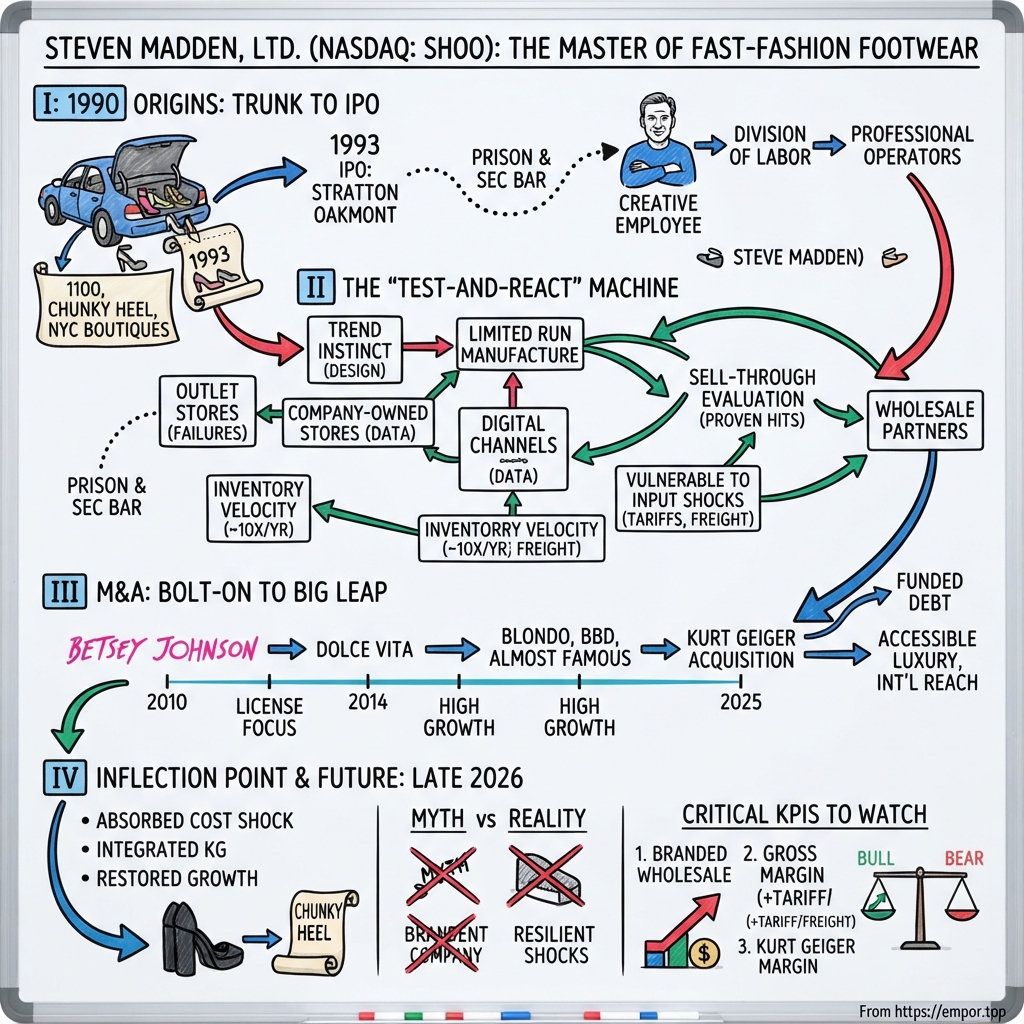
Steven Madden, Ltd. (NASDAQ: SHOO): The Master of Fast-Fashion Footwear
I. Prologue & Episode Roadmap
In the spring of 1990, a thirty-two-year-old college dropout was driving around Lower Manhattan with five hundred pairs of shoes in his trunk. He had about $1,100 to his name, a design concept that established American footwear houses had dismissed, and a sales strategy that came down to double-parking outside SoHo boutiques and asking shop owners to inspect what was in the back of his car.
Thirty-six years later, that founder's name fronts an enterprise that generated $2.52 billion of revenue in fiscal 2025.1 In the intervening decades, he served thirty-one months in federal prison for securities fraud tied to Stratton Oakmont, the notorious Wall Street boiler room, received a permanent Securities and Exchange Commission bar prohibiting him from serving as an officer or director of a public company, and returned to his namesake business purely as a creative employee.
That division of labor became the defining governance structure of Steven Madden, Ltd. A regulatory sanction designed as a punishment inadvertently produced an enduring operating setup in consumer retail: a visionary founder confined to design while disciplined professional operators control the balance sheet. Whether that outcome owes more to structural design or survival instincts is an open question tested across the company's operating record.
The core thesis, stated plainly. Steve Madden is not fundamentally a design house; it is a rapid-response logistics machine that owns consumer brands. Its engine is a "test-and-react" model: manufacture a fresh silhouette in limited runs, test it immediately across company-owned stores and digital channels, evaluate sell-through data over days rather than months, and commit volume manufacturing capital only to proven hits. Where traditional wholesale peers lock in seasonal orders nine to twelve months ahead of consumer delivery, Madden compresses that feedback loop into weeks. During the second quarter of fiscal 2026, management told analysts that major wholesale partners were deliberately holding open purchasing budgets to chase trending styles mid-season, positioning Madden's lead-time advantage as the primary vehicle to capture that reorder demand.[^2]
Testing that competitive claim requires examining how the model performs through economic cycles, including a severe recent margin contraction.
The current inflection point. Three structural shifts converged by September 2026:
First, the company completed the largest acquisition in its history: Kurt Geiger, the British accessible-luxury footwear and accessories brand, acquired from private equity firm Cinven for an enterprise value of £289 million. Announced in February 2025 and closed on May 6, 2025,2[^4] the transaction ended Madden's multi-decade stance of operating with zero funded debt.
Second, the tariff adjustments of 2025 placed severe pressure on the business. Because Madden operates with heavy exposure to landed import costs and turns wholesale inventory rapidly, higher customs duties flowed into the income statement almost immediately. For fiscal 2025, adjusted diluted earnings per share fell roughly 36% to $1.70 from $2.67 in the prior year, even as consolidated revenue grew 11%.[^5] On a GAAP basis, the contraction was steeper: operating income dropped from $224.9 million to $68.9 million, and reported net income fell to $44.7 million.1
Third, fiscal 2026 brought a measurable operational recovery. Second-quarter revenue grew 19.1% year-over-year to $665.9 million, gross margin expanded 460 basis points to 46.5%, and diluted EPS more than doubled to $0.44.[^2] Management subsequently lifted full-year guidance to 11% to 13% revenue growth and projected diluted EPS between $2.05 and $2.15.[^2]
By late 2026, Madden has absorbed an import cost shock, integrated a major cross-border brand, and restored sales growth. Yet it also carries net balance-sheet debt for the first time in modern history while navigating secular declines across legacy wholesale department stores.
Myth versus reality, up front. Three common narratives about the business require critical examination:
The myth that Madden is a brand company. Madden is primarily an agile sourcing and distribution operation with consumer labels attached. While its brands hold commercial value, management's decision to acquire Kurt Geiger to reach premium tiers highlights the inherent pricing ceiling of the core Steven Madden trademark.
The myth that the test-and-react model makes Madden resilient. Quick-turn inventory insulates the business against fashion miscalculations, but leaves it vulnerable to input cost spikes. Turning wholesale inventory roughly ten times a year means duty hikes hit gross margins almost immediately, leaving no cushion of low-cost inventory to soften the blow.[^7] The fiscal 2025 results illustrated this operational exposure.
The myth that Madden abandoned its China exit in defeat. Management reduced its China sourcing exposure from roughly 71% to about 30% for fall 2025 over two quarters, then allowed production to settle back into the low-40% range as global tariff rate differentials stabilized.[^7][^5] That movement reflected dynamic cost balancing rather than strategic retreat, though it confirms that Madden's lead times remain dependent on mature East Asian industrial ecosystems.
Episode roadmap. The trunk and the platform shoe. The Stratton Oakmont underwriting, the criminal indictment, and how the business survived its founder's incarceration. The Edward Rosenfeld era and the scaling of rapid replenishment. The acquisition record, evaluated on capital allocation and returns. Segment economics and where cash profit genuinely concentrates. The durability of the competitive moat under real-world stress. Executive incentives judged against operational outcomes. And finally, the bull and bear arguments, along with the core financial metrics that will determine the outcome.
 Subscribe on LinkedIn
II. Origins: The Trunk, The Chunky Heel, & Cultural Timing (1990–1993)
Steve Madden grew up on Long Island and dropped out of college. Before founding the business, he completed an unconventional retail apprenticeship: years spent on the sales floors of shoe stores in Cedarhurst and Greenwich Village, followed by work as a wholesale sales representative for footwear maker L.J. Simone. That background proved far more valuable than formal design training. Retail floor work taught him what a teenage customer actually picked up and turned over in her hands. Wholesale representation showed him how department store buyers evaluated merchandise, what payment terms they demanded, and how slowly their purchasing bureaucracies operated.
Madden's founding insight was not aesthetic; it was about latency. In the late 1980s, the American footwear establishment — brands like Nine West, Kenneth Cole, and Brown Shoe Company (later renamed Caleres) — operated on a rigid catalog calendar. Buyers from Macy's and Dillard's previewed lines, placed seasonal orders, and waited for factories to manufacture and deliver those goods nine months later. The system optimized for production efficiency and buyer convenience at the direct expense of fashion velocity.
Teenage taste did not move on a nine-month planning cycle. It moved on the rhythm of music television, dance clubs, and peer influence in high school hallways. A supplier capable of delivering current silhouettes at prices accessible to part-time wages could capture a market segment that established footwear houses were structurally unequipped to serve.
Operating with that initial $1,100, Madden designed styles himself, contracted sample batches to small local factories in New York, and sold them directly out of the trunk of his car. His initial focal point was the platform shoe — a chunky, heavy silhouette borrowed from 1970s glam rock and adapted for the emerging grunge and alternative-rock aesthetic. The breakout style, a block-heeled Mary Jane, gained traction across New York schools and campuses through organic peer observation rather than commercial advertising.
In its early form, the business possessed no proprietary moat. A platform silhouette could be copied by any manufacturer. Madden's true operational advantage was a network of independent boutiques that revealed within days whether a design resonated, coupled with a cost structure light enough that inventory mistakes were inexpensive to absorb. That dynamic established the operational prototype for what became the company's test-and-react model. Decades later, Steven Madden, Ltd. would invest hundreds of millions of dollars to institutionalize at global scale what its founder had initiated with a trunk of samples: gathering rapid consumer data before committing production capital.
Why the incumbents could not respond. The structural constraints binding established footwear competitors explain how an undercapitalized startup could capture market share from enterprises generating hundreds of millions of dollars in revenue. By 1992, large footwear wholesalers had locked in annual volume commitments with Asian production facilities, organized sales teams around semiannual market calendars, and built enterprise forecasting systems dependent on extended lead times. Each policy represented a genuine operational efficiency, yet together they precluded agility. Responding to Madden's cadence would have required incumbents to accept smaller production runs, higher per-unit manufacturing costs, underutilized forecasting tools, and shorter order commitments from department store buyers who relied on long-range scheduling. It was a classic incumbent dilemma: operational optimization became an organizational barrier to change.
The price point was part of the design. Madden kept retail price points below $100 at a time when fashion-forward European footwear commanded several multiples of that figure. The value proposition to a young consumer was immediacy rather than longevity: she could purchase the current trend immediately and discard it when fashion shifted. This explicitly short-lifecycle positioning enabled rapid inventory turnover, but it also limited brand equity. Madden never developed the heritage pricing power of luxury European houses like Salvatore Ferragamo or Church's, trading material durability for trend velocity. Thirty-six years later, that structural trade-off remains evident on the income statement: the core Steven Madden brand confronts a retail ceiling around $120, a reality that ultimately prompted management's expansion into London-based accessible luxury via Kurt Geiger.
The limiting factor was working capital. Rapidly expanding a wholesale footwear operation ties up substantial cash, as factories require payment well before retail partners remit receivables. By 1993, Madden required outside funding. That capital search led the company into a financial partnership that would alter its trajectory for the next fifteen years.
A note on the counterfactual. Hindsight tempts observers to view the success of 1990 through 1993 as inevitable. It was not. Numerous contemporary designers identified identical fashion currents in New York during the same period and disappeared from the market. Madden stood apart because he unified design, wholesale sales, and inventory feedback within a single decision-maker who tracked boutique reorders in real time. The subsequent history of Steven Madden, Ltd. became an effort to recreate that unified feedback loop institutionally, at scale, after the founder who originated it was removed from executive management.
III. The Wolf in the Machine: Stratton Oakmont, The Prison Sentence, & Governance (1993–2005)
Steve Madden's childhood friend from Long Island was Danny Porush. By 1993, Porush was operating an over-the-counter brokerage in Lake Success, New York, alongside Jordan Belfort: Stratton Oakmont.
In December 1993, Stratton Oakmont underwrote the initial public offering of Steven Madden, Ltd. The capital raise was modest—a few million dollars—and to outside observers appeared to be a conventional micro-cap public offering for an emerging regional footwear label. In reality, Stratton Oakmont operated a market manipulation scheme: controlling the public float of client companies through nominee accounts, artificially inflating share prices via high-pressure retail brokerage sales, and dumping proprietary holdings into the manipulated market. The underwriting was not a standard financing engagement; it served as raw material for securities fraud.
Madden was an active participant rather than a passive observer. In 2001, federal prosecutors and the Securities and Exchange Commission filed criminal and civil charges. The SEC's civil action alleged that Madden had acted as a nominee purchaser in Stratton Oakmont and Monroe Parker underwritings, buying blocks of stock in other issuers' IPOs at the brokers' direction and flipping them back into the manipulated aftermarket for profit.3 He pleaded guilty to securities fraud and money laundering, resigned as chief executive officer and chairman, and served roughly thirty-one months in federal prison before his release in 2005.
For public market investors, the critical question was not the mechanics of the wrongdoing, but why the operating business survived a scandal that would have dismantled most consumer enterprises.
Brand equity was decoupled from the capital markets scandal. The core lesson of the episode highlights a fundamental dynamic in consumer discretionary equities. The retail customer purchasing a $79 platform boot was a teenage shopper who did not follow securities litigation or boiler-room prosecutions. Reputational damage fell almost entirely on the company's publicly traded equity rather than its retail merchandise. In contrast to professional services or financial institutions—where integrity is the core product and criminal indictments prove terminal—Madden sold trend-driven footwear. Consumer demand remained insulated from boardroom conduct.
The board made a controversial bet to preserve continuity. Rather than cutting ties with the founder, the board of directors retained Madden under a creative consulting agreement while he served his prison sentence. To stabilize the enterprise, directors appointed interim executive leadership—installing Jamieson Karson as chief executive officer and Charles Koppelman as chairman—to steady commercial operations and reassure department store accounts. The strategy succeeded: retail buyers at Macy's and Nordstrom continued purchasing inventory, keeping wholesale distribution intact. Paying a convicted felon a seven-figure annual salary to provide design direction from a federal prison facility violated standard corporate governance practices. Yet severing the primary aesthetic decision-maker behind seasonal product lines would have threatened the core business. The board prioritized commercial survival over governance orthodoxy.
Financial penalties were absorbed, but a valuation discount lingered. Madden paid millions of dollars in civil fines, disgorgement, and restitution. While operating cash flows absorbed the direct penalties, the company bore an enduring governance stigma. For years, institutional funds bound by strict governance mandates excluded the stock from consideration. That institutional discount persisted across multiple market cycles: Steven Madden, Ltd. historically struggled to secure a premium valuation multiple, weighed down by founder history and ongoing governance skepticism.
The episode also posed a deeper structural question. The manipulation was not an isolated aberration; the capital that financed the company's initial expansion was generated through the very offering at the center of the fraud. Steven Madden, Ltd. addressed the issue not through public commitments to corporate ethics, but by structurally redesigning executive authority. Going forward, creative talent was systematically separated from financial controls and capital deployment.
The sanction became the architecture. When Madden was released from prison in April 2005, the permanent SEC bar legally prohibited him from serving as an officer or director of a public company. He returned to the company strictly as Creative and Design Chief, overseeing product design, merchandising trends, and consumer marketing. Authority over the balance sheet, capital allocation, mergers and acquisitions, and board governance remained under independent executive oversight.
While some analysts later interpreted this division of labor as ingenious corporate governance, it originated as a regulatory penalty that imposed a necessary constraint. Founder-led consumer brands frequently struggle when an entrepreneur's creative instincts are assumed to confer equal competence in financial risk management. Madden's legal disqualification precluded that overreach. The regulatory sanction forced the enterprise to recruit professional executive operators, establishing the institutional foundation that shaped the company's next phase of growth.
IV. The Architect Arrives: Ed Rosenfeld & The Institutionalization of "Test-and-React" (2005–2018)
Edward R. Rosenfeld emerged from an investment banking background rather than the footwear trade. He spent his early career in the mergers and restructuring practice at Peter J. Solomon Company, a boutique advisory firm with deep retail expertise, where he had advised Steven Madden, Ltd. He joined the company in 2005 as vice president of strategic planning, advanced to chief financial officer in 2006, and became chief executive officer in 2008 at thirty-two years of age—assuming leadership just as the global financial crisis gathered momentum.
The executive partnership that developed between Madden and Rosenfeld established a durable corporate division of labor.
Steve Madden represents the demand-side instinct. His mandate is aesthetic foresight: anticipating what young adult consumers will buy four months ahead, season after season. It is an intuitive skill set resistant to standardized corporate succession planning. When the business outperforms, management attributes results directly to that aesthetic engine; Rosenfeld in February 2026 told analysts flatly that "the greatest driver of our financial performance is the strength of our product."[^5]
Rosenfeld supplies capital discipline and supply-chain precision. His operational playbook across eighteen years has remained consistent: maintain lean inventories, keep balance-sheet leverage low, acquire niche brands with cash, return surplus capital through share repurchases, and prevent seasonal fashion volatility from escalating into balance-sheet risk.
What "test-and-react" actually is, mechanically. Traditional footwear wholesalers operate as forecasting businesses: buyers forecast consumer demand nine months in advance, commit production capital, and absorb the resulting inventory markdowns if tastes change. Rosenfeld institutionalized Madden as a measurement business. Rather than making speculative volume bets, the company manufactures unproven silhouettes in limited trial runs. These sample lots are dispatched directly to company-owned retail storefronts and e-commerce platforms—channels where point-of-sale data reveals daily sell-through velocities. If a style generates rapid full-price turnover, volume production orders are initiated to supply department store partners like Nordstrom, Macy's, and Dillard's. If an item underperforms, remaining units are diverted to outlet stores, capping downside risk at nominal sample manufacturing costs.
The operational dynamic mirrors a restaurant testing new recipes as daily specials before updating its printed menu. The capital cost of running a limited test is modest; the cost of skipping the test—committing production runs to an unproven silhouette—frequently causes margin-destroying inventory write-downs.
Two structural consequences follow, forming the core of the operating thesis.
The first is inventory velocity. Rosenfeld told analysts in July 2025 that the wholesale business turns its inventory "in and around 10 times a year."[^7] That inventory velocity is exceptionally high for wholesale footwear, sharply insulating Madden from carrying obsolete stock compared to peers committed to long-range seasonal purchasing orders. Yet that velocity carries an inherent trade-off: when customs duties or freight rates rise, the company experiences cost inflation almost immediately because it lacks a cushion of legacy, lower-cost inventory to absorb the shock. Rosenfeld acknowledged this structural dynamic on the same call, noting that "we do feel these impacts from tariffs when they're implemented earlier than others because we're bringing goods in and shipping them right out."[^7]
The second consequence concerns physical stores. Madden's direct-to-consumer store network does not operate solely to generate retail revenue; it functions as a diagnostic instrument panel. Evaluated purely as a distribution channel, maintaining commercial leases across hundreds of brick-and-mortar storefronts carries substantial fixed overhead. Yet when evaluated as a real-time data collection network that de-risks over a billion dollars in annual wholesale manufacturing commitments, the store fleet provides a crucial analytical return on invested capital.
The structural limits of the model. The test-and-react apparatus does not generate creative concepts; it merely measures commercial reception quickly and cheaply. If the design organization misinterprets fashion trends, the testing network simply verifies that consumer demand has cooled. That vulnerability surfaced across the core Steve Madden brand during the first half of 2025, when the brand posted revenue declines in the second and third quarters before returning to growth in the fourth.[^5] A measurement framework depends entirely on the commercial quality of its inputs—illustrating why the founder's creative direction remains an operational necessity rather than a ceremonial arrangement.
Nor does the model eliminate markdown exposure; it relocates it. Styles that fail initial retail testing are liquidated through the company's factory outlet stores. Consequently, outlet gross margins serve as a direct barometer of aggregate product miscalculations. That operational dynamic explains why factory outlets were the persistent laggard through the 2025 downturn and the last channel to recover in 2026.[^5][^2]
Rosenfeld's operating signature. Rosenfeld's public disclosures reflect his corporate finance background. He focuses discussions on inventory management rather than abstract brand marketing, routinely providing granular variance analysis on earnings calls. While declining to forecast outcomes beyond operational control, he regularly provides exact attribution for measurable drivers: isolating 110 basis points of comparable-store sales drag to an enterprise systems migration, calculating 230 basis points of net tariff headwinds after vendor concessions, and attributing 95% of a wholesale shortfall attributable to two channels.[^7] This communication posture provides investors visibility into operational mechanics, avoiding the high-level generalizations common among retail management teams.
The crisis that established the playbook. Rosenfeld assumed the chief executive role just as the 2008–2009 recession weakened mall-based apparel retail. Incumbent competitors struggled under debt-heavy capital structures; Nine West, once the dominant domestic women's footwear label, was encumbered with private equity debt and eventually filed for bankruptcy. Madden entered that downturn with zero funded debt and positive net cash. That balance-sheet flexibility enabled the company to maintain wholesale shipments, secure retail shelf space vacated by distressed rivals, and acquire smaller footwear labels out of cash flow without seeking lender concessions.
That experience hardened into corporate policy: avoid funded balance-sheet debt, finance acquisitions entirely with cash, and return surplus operating capital through share buybacks. That conservative capital allocation model persisted for sixteen years—until the Kurt Geiger acquisition in 2025.
V. The M&A Machine: Category Expansion & The Kurt Geiger Leap (2010–2025)
Under Rosenfeld, Madden’s acquisition strategy followed a consistent operational template: avoid buying scale for its own sake. Instead, target brands with genuine consumer affinity that were distressed, founder-constrained, or lacked the volume to support an efficient supply chain, and then integrate them into Madden's manufacturing network, wholesale relationships, and logistics infrastructure. The acquired label secured lower production costs and expanded retail distribution; Madden gained access to new consumer demographics without the expense of building brands from scratch.
Betsey Johnson (2010). Madden acquired the debt of the distressed Betsey Johnson business during its restructuring, eventually securing ownership of the intellectual property. Frequently cited as evidence of opportunistic dealmaking, the transaction also challenged assumptions of flawless execution. Madden initially attempted to operate the brand's standalone retail storefronts. The initiative failed. In 2012, the Betsey Johnson retail subsidiary filed for Chapter 11 bankruptcy and liquidated its store network.4 Only after that restructuring was the brand repositioned exclusively as a higher-margin wholesale and licensing property. That asset-light model proved durable: during the second quarter of fiscal 2025, when nearly every other label in the portfolio contracted, Rosenfeld highlighted Betsey Johnson as one of the few businesses that generated sales growth.[^7]
The operational takeaway appeared straightforward: acquire intellectual property rather than brick-and-mortar retail overhead. That discipline governed corporate development for more than a decade—until the acquisition of Kurt Geiger, predominantly a retail boutique and department-store concession business, deliberately departed from it.
This programmatic playbook explains both the operating logic and the valuation multiple public markets historically assigned to the company. Functionally, Steven Madden operates as a consumer distribution platform: sourcing networks, logistics, wholesale distribution channels, retail testing storefronts, and a trend-responsive design organization. Brands serve as the commercial content distributed across that infrastructure. An emerging founder-led label constrained by factory minimums and limited commercial reach gains immediate operating leverage upon plugging into Madden’s production base and shelf space at department stores like Nordstrom and Macy's. Madden captures the economic spread created by that transition. While this programmatic bolt-on playbook generated steady incremental value, its capacity was inherently self-limiting; deploying hundreds of millions of dollars annually into small niche labels proved impossible. Resolving that scale constraint was the central rationale behind acquiring Kurt Geiger.
Dolce Vita (August 2014). Acquired for $60.3 million in cash, Dolce Vita provided an elevated contemporary footwear label capable of reaching premium wholesale accounts where the core Steve Madden brand had limited penetration.[^9] Over a decade later, it represents the most successful transaction in the company’s history. Dolce Vita surpassed $240 million in annual revenue in 2025, maintained its position as the fastest-growing brand in the portfolio following the pandemic, and by 2026 continued expanding at a high-single to low-double-digit pace while broadening into handbags and international markets.[^5][^2] Generating that scale from an initial $60.3 million outlay with minimal incremental capital expenditure validated management's thesis on bolt-on acquisitions.
Subsequent transactions delivered more uneven results. Blondo (2015) added waterproof leather footwear, establishing a counter-seasonal hedge against unseasonably warm autumn weather. In contrast, Schwartz & Benjamin (2017) added a licensed footwear sourcing business whose terminal value depended on intellectual property Madden did not own. When the lucrative Kate Spade footwear license reverted to its brand owner, the underlying revenue stream disappeared. The transaction highlighted the inherent risk of acquiring licensed operations: cash flows tethered to third-party agreements represent finite contracts rather than permanent enterprise assets.
BB Dakota (2019) and Almost Famous (October 2023) marked an expansion into apparel. Almost Famous, acquired for $52 million in cash plus earn-outs, represented the larger commitment: an entry-price apparel vendor with mass-merchant distribution, including the Madden NYC licensed business at Walmart.5 The transaction contributed to immediate top-line expansion, lifting consolidated fiscal 2024 revenue by 15.2% to $2,282.9 million with Almost Famous included for the full year.6
Yet the revenue growth altered the company's margin profile. Consolidated gross margin in fiscal 2024 fell roughly 100 basis points to 41.0%.6 Junior apparel distributed through mass-market channels generates lower gross margins than branded wholesale footwear, and acquiring volume that dilutes portfolio profitability carries strategic trade-offs. Furthermore, that mass-channel exposure left the business vulnerable when import duties escalated in 2025, as price-sensitive consumers proved least able to absorb retail price increases.
The apparel transactions also underscored an operating limitation. Both acquisitions pushed the company into product categories where it lacked proprietary design heritage and historical supply-chain leverage. Apparel manufacturing ecosystems differ fundamentally from footwear production, and Madden’s rapid replenishment apparatus had been engineered around shoe tooling and lead times. Management maintained the initiative, and by early 2026 pointed to measurable progress: sweaters became the largest apparel category, outerwear showed strength, distribution expanded across additional doors at Dillard's and Macy's in sportswear and dresses, and experienced senior apparel merchants joined the company.[^5] While demonstrating operational persistence, the category expansion entered its seventh year as a relatively modest profit contributor given the executive focus and balance-sheet resources allocated to it.
Kurt Geiger (announced February 2025, closed May 6, 2025). The acquisition of Kurt Geiger fundamentally transformed Steven Madden's financial profile.
Madden acquired the London-based accessible-luxury house from private equity sponsor Cinven for an enterprise value of £289 million in cash.27 Kurt Geiger had generated approximately £372.8 million of revenue and record EBITDA of about £43.2 million in its fiscal year ended February 1, 2025, establishing an acquisition multiple of roughly 6.7 times EBITDA.2 Compared to accessible-luxury brand transactions over the preceding decade, which regularly traded at high-single to mid-teens multiples, the valuation represented disciplined capital deployment. The cash outflow for acquisitions in fiscal 2025 totaled $371.6 million.1
The strategic rationale aligned across three dimensions: - Geography: Madden's business had historically concentrated in North America, whereas Kurt Geiger provided an established retail footprint across the United Kingdom and continental Europe. - Category and pricing: Kurt Geiger London’s quilted leather handbags—distinguished by crystal eagle hardware—sell at price points well above the core Steve Madden brand, helping bypass the roughly $120 retail ceiling of the flagship label. - Distribution channel: The transaction added company-owned boutiques and European department-store concessions, increasing the proportion of direct-to-consumer revenue.
Financing the acquisition required a departure from long-standing balance-sheet conservatism. Madden assumed funded debt for the first time in modern operating history, carrying $293.5 million of debt against $111.9 million of cash by June 30, 2025.[^7] Taking on balance-sheet leverage coincided directly with the tariff shocks of fiscal 2025, compounding operational volatility.
The integration, judged on evidence rather than intent. Initial operational data provides an early assessment of the integration. Pro forma revenue for Kurt Geiger London grew 11% in 2025—navigating an ownership transition and macroeconomic headwinds—with management guiding toward comparable growth for fiscal 2026.[^5] Large consumer brand integrations typically falter first in sales momentum; Kurt Geiger preserved its top line while Madden began applying its traditional working-capital disciplines.
Cross-brand commercial synergies, however, remain unevenly demonstrated. Management initially outlined reciprocal distribution benefits: expanding Kurt Geiger internationally across Madden’s wholesale accounts while scaling Steve Madden in the United Kingdom through Kurt Geiger’s store and concession platform.[^7] By mid-2026, observable execution occurred primarily in one direction: Kurt Geiger opened new U.S. stores, bought out its regional distributor in Spain and Portugal, and advanced talks with international partners.[^2] Evidence of the reverse scenario—Steve Madden gaining measurable British distribution through Kurt Geiger's retail infrastructure—remained undisclosed in public reporting.
Weighing the capital allocation record. Evaluated across fifteen years, Steven Madden's corporate development record reveals a nuanced balance sheet: - Dolce Vita delivered substantial organic expansion and exceptional capital returns. - Betsey Johnson became a high-margin licensing asset only after an avoidable retail bankruptcy. - Schwartz & Benjamin demonstrated that acquired licensed cash flows terminate when underlying brand contracts expire. - Almost Famous expanded consolidated top-line scale at the cost of gross margin dilution and heightened exposure to mass-retail demand cycles. - Kurt Geiger was secured at an attractive entry valuation, but generated an operating margin of approximately 6.8% during Madden's period of ownership in 2025—well short of management's stated target of initial low-double-digit margins progressing to mid-teens over the medium term.[^5]
That margin trajectory represents the central benchmark for the Kurt Geiger investment. Management has articulated a clear, quantifiable operational path. Reaching those profitability targets will serve as the primary test of whether Steven Madden can enhance operating returns on a major international retail acquisition, rather than simply acquire scale at a low multiple.
VI. Dissecting the Machine: Segment Economics, Business Model, & Channel Dynamics
On the design floor in Long Island City, the operational loop moves in days: a silhouette dispatched to a dozen retail stores and the website can sell through its initial batch at full price within a week and a half, triggering a scaled factory order for tens of thousands of pairs for a style uncommitted two weeks prior. Translating that speed into corporate reporting requires examining how capital and margins flow across the company's operating segments.
The four segments. Madden reports operating results across four distinct segments, each characterized by starkly different margin and capital profiles.
Wholesale footwear remains the historic engine, housing the flagship Steve Madden brand alongside Dolce Vita, Blondo, Betsey Johnson, and private-label production. In the second quarter of 2026, the division generated $240.0 million in revenue.[^2] Overall wholesale gross margin reached 35.2% during the period, recovering from 30.9% in the prior-year quarter.[^2] It functions as a volume-driven, working-capital-intensive operation structurally exposed to the purchasing power of major retail accounts.
Wholesale accessories and apparel—spanning handbags, belts, cold-weather items, and apparel labels—generated $167.5 million in the second quarter of 2026, up 19.2% year-over-year.[^2] While expanding faster than core footwear wholesale, it carries lower gross margins.
Direct-to-consumer delivered $255.4 million in revenue in the second quarter of 2026, advancing 30.6% on a reported basis with Kurt Geiger and 11.1% organically.[^2] Direct-to-consumer gross margin reached 64.0%.[^2] The company closed the period operating 382 brick-and-mortar stores, including 92 outlet locations, alongside eight e-commerce sites and 164 international retail concessions.[^2]
Licensing contributes a modest top line—generating $3.0 million in royalty revenue for the quarter—but delivers high-margin cash flow with virtually no capital employed, monetizing the Steve Madden and Dolce Vita trademarks across eyewear, luggage, fragrance, and related merchandise.[^2]
An important accounting nuance in private label. A substantial portion of the mass-channel private-label footwear business operates on a first-cost, or free-on-board (FOB), basis: the retail client assumes title at the overseas port and serves as the official importer of record. That contractual distinction proved critical during the trade tensions of 2025. Because the retail partner bore direct customs liabilities, unexpected duty spikes—such as when tariff rates on Chinese imports briefly touched 145%—prompted retail accounts to cancel purchasing orders outright, as Rosenfeld detailed to analysts.[^7] Consequently, Madden's trade policy exposure operates through two distinct mechanisms: direct landed costs on proprietary inventory imported under wholesale or retail, and the willingness of mass-merchant partners to absorb customs risk on goods they import directly. In 2025, the second dynamic inflicted the more severe commercial damage.
What the segment structure actually reveals. Direct-to-consumer gross margins exceed wholesale margins by more than 28 percentage points. That premium explains why revenue mix shift exerts an outsized influence on operating earnings, and why leadership continues allocating expansion capital to retail stores and digital storefronts despite widespread skepticism surrounding physical retail. Yet that gross margin spread obscures substantial downstream costs: commercial lease obligations, retail store payroll, logistics fulfillment, and digital customer acquisition all concentrate in operating expenses. During the fourth-quarter 2025 earnings call, Chief Financial Officer Zine Mazouzi outlined these exact pressures, pointing to elevated warehouse occupancy costs following two major lease renewals, distribution labor shortages and inefficiencies in California, and climbing fulfillment expenses as direct-to-consumer volume expanded.[^5] Expanding direct-to-consumer channels does not generate automatic operating leverage; it trades product-level gross margin for fixed operational overhead.
The private-label vulnerability. The least recognized structural drag across the business model sits within private-label manufacturing.
Madden maintains a substantial private-label operation for mass merchants, designing and sourcing footwear bearing retail client trademarks rather than proprietary labels. In fiscal 2024, private label generated approximately $415 million in revenue.[^5] By fiscal 2025, that volume declined to roughly $355 million, with management initially guiding fiscal 2026 toward an additional drop approaching $70 million, or nearly 20%.[^5] By the second quarter of 2026, the company projected full-year private-label revenue to contract in the mid-to-high teens, citing the division as the primary headwind holding total wholesale growth ex-Kurt Geiger to low single digits while branded wholesale advanced at high single digits.[^2]
Rosenfeld attributed the contraction directly to tariff sensitivity: private-label merchandise occupies the most price-sensitive retail tier, where the absence of brand equity denies Madden pricing power to pass through customs duties. Correcting an analyst's assumption, Rosenfeld characterized an eventual recovery as an informed expectation rather than a certainty, citing cyclical precedent—"we've seen this movie before"—in which mass-retail management teams attempt direct sourcing, encounter trend missteps, and subsequently return to established design vendors.[^5]
While that historical vendor cycle has repeated in prior decades, the division highlights an operational vulnerability: private label represents the one segment where retail partners have demonstrated that Madden can be substituted. This performance offers tangible evidence regarding the defensibility of the company's speed advantage. If private label stabilizes and recovers into 2027, management's thesis that mass merchants rely on Madden's design execution will be confirmed. If the decline persists, it suggests that approximately one-sixth of the 2024 revenue base functioned primarily as low-switching-cost sourcing volume that enterprise retailers can replicate internally, pointing to a narrower competitive moat than brand narratives suggest.
Channel interdependence and sampling bias. Stripped of corporate diagrams, Madden's operating cycle relies on a self-reinforcing channel dynamic: identifying an emerging trend, producing a limited run, distributing it across company-owned stores and digital channels, evaluating sell-through data within days, committing scaled production capital for high-velocity styles, and routing underperforming lots to factory outlets. Wholesale volume provides the aggregate scale needed to secure factory priority and unit cost efficiencies; direct-to-consumer channels supply the real-time point-of-sale data that de-risks wholesale inventory commitments. Neither model functions as effectively in isolation: a pure direct-to-consumer brand lacks the purchasing volume to command immediate overseas manufacturing capacity, while a traditional wholesaler relies on speculative demand forecasts.
The structural limitation of this closed loop lies in sampling bias. The testing network presumes that company-owned storefronts and digital shoppers represent a dependable proxy for the broader retail footwear market. In practice, direct-to-consumer channels skew toward urban, highly engaged shoppers purchasing current trends at full price. A silhouette that performs briskly in a SoHo flagship or on the core e-commerce site may fail to resonate with suburban department-store shoppers at Dillard's in the Sunbelt or across off-price racks. Steven Madden does not disclose metrics on the predictive accuracy of its retail testing, and outsiders have no mechanism to evaluate how frequently test-market successes fail in broader distribution. While systematically superior to long-range forecasting, the true hit rate of the testing engine remains an internal metric.
Working capital discipline as the operational anchor. Working capital management provides the clearest gauge of operational health across market cycles. At the close of the second quarter of 2026, total inventory stood at $377.2 million, down 13.7% year-over-year, which included a 30% reduction in Kurt Geiger's inventory holdings.[^2] Lowering an acquired brand's inventory levels by nearly a third within approximately twelve months—while sustaining top-line expansion—offers tangible evidence that management is transplanting its disciplined inventory controls into Kurt Geiger rather than merely absorbing its financial statements.
Even in fiscal 2025, the most challenging operating year for earnings in more than a decade, free cash flow totaled $119.5 million on operating cash flow of $162.2 million.1 That cash conversion illustrates the defensive value of Madden's asset-light posture: because the enterprise owns no manufacturing facilities, capital expenditures totaled just $42.6 million for the year, ensuring that an acute gross margin contraction did not precipitate a liquidity strain.[^5]1
VII. The Strategy & Moat Stress-Test: Hamilton Helmer's 7 Powers & Porter's 5 Forces
Now the hard part: does any of this constitute a durable competitive advantage, or is Madden simply a well-run company in a structurally bad industry?
Applying Helmer's 7 Powers.
Process power is the strongest candidate and the only one that plausibly qualifies. The test-and-react system is not a single trick; it is a bundle of capabilities — a design organization that can generate volume, factory relationships willing to accept tiny runs, a retail fleet used as instrumentation, and a merchandising culture that trusts a seven-day sell-through number over a buyer's opinion. Bundles like that are hard to copy because you have to build all of it, and the value only appears when the last piece is in place. Critically, the power extends to Madden's customers: a department store buyer allocates shelf space to Madden partly because Madden arrives with evidence about what is already selling. Madden de-risks the buyer's own decision.
Branding is moderate and bounded. Madden has genuine cultural presence — global online searches for the brand rose 71% year over year in Q2 2026, on the back of a summer campaign and strong product.[^2] But brand affinity in fashion is rented, not owned, and Madden's brand has repeatedly failed to support pricing above roughly $120. The company's own response to that ceiling was to spend £289 million buying a brand that does price higher. That purchase is management's own admission of where its branding power stops.
Scale economies are moderate — real purchasing leverage on components and freight, but nothing that a Chinese contract manufacturer's other clients don't also enjoy.
Counter-positioning was decisive in 1995 and is largely spent today. Madden counter-positioned against incumbents who could not abandon the nine-month catalog without cannibalizing their own economics. That asymmetry is gone. Shein and Temu are faster than Madden, not slower.
Switching costs and network effects are essentially absent. A consumer switches to Zara, Aldo, Sam Edelman, or Target at zero cost.
Cornered resource is the uncomfortable one: Steve Madden himself. The company's own earnings calls attribute performance to his design judgment. He is in his late sixties. There is no publicly disclosed succession plan for the creative chief role. This is a genuine, unhedged key-person dependency, and investors should treat management's silence on it as an open item rather than a non-issue.
It is worth dwelling on why process power is the only one that qualifies, because consumer companies are routinely credited with moats they do not have. Madden has no proprietary technology, no patent estate, no regulatory licence, no switching cost, and no network. What it has is an organizational capability — the ability to do a specific sequence of things faster and cheaper than rivals. Capabilities of that kind are real, and they are also perishable in a way that a patent or a regulated licence is not. They degrade if key people leave, if the supplier ecosystem shifts, or if a competitor simply decides to build the same thing. The correct frame is not "Madden has a moat" but "Madden has a lead," and leads require maintenance spending forever.
Porter's five forces, briefly. Buyer power is high and concentrated — the private label episode is a live demonstration. Supplier power is moderate; Madden owns no factories, but rapid-prototype capability is not evenly distributed across geographies. Substitute threat is extremely high, with ultra-fast-fashion platforms producing trend dupes at a fraction of Madden's price. Barriers to entry are low at the brand level and meaningful at the scaled-wholesale level. Rivalry is fierce and permanent.
The net is that Madden operates in a structurally unattractive industry and has built one real, narrow advantage inside it. That advantage is operational rather than positional — which means it must be re-earned continuously and can be degraded by external shocks. Which brings us to 2025.
Historical falsification: the sourcing shock. This deserves careful handling because the popular version of the story is wrong.
Entering 2025, Madden sourced roughly 71% of its U.S. imports from China.[^7] When tariffs on Chinese goods briefly spiked to 145%, management moved hard and fast. By the July 2025 call, Rosenfeld said the company expected to source approximately 30% of U.S. imports from China for fall 2025 — a shift of forty points of a multi-billion-dollar supply chain inside roughly two quarters.[^7] Cambodia was the first diversification target, then Vietnam, with Mexico and Brazil for specific brands.[^5]
The cost of that speed was severe, and management said so plainly. Wholesale customers cancelled orders and cut open-to-buy. Shipments were delayed, causing outright lost sales. Tariffs net of supplier discounts cost 230 basis points of gross margin in Q2 2025 alone.[^7] Roughly 95% of the organic wholesale revenue shortfall came from the off-price and mass channels.[^7] Operating income fell to 4.0% of revenue from 10.4% a year earlier.[^7] The company suspended earnings guidance entirely.
Then something happened that is often misread as a retreat. Madden moved some production back to China. Rosenfeld explained it precisely: where the company "felt it would be difficult to ensure on-time delivery, appropriate product quality and/or reasonable pricing in an alternative country," and after the U.S.–China tariff was temporarily cut from 145% to 30%, production went back.[^7] By the February 2026 call, China had finished 2025 in the high thirties as a share of sourcing and had drifted back into the low forties in early 2026 — because, as Rosenfeld put it, China had come "essentially into parity with many of the other countries that we are sourcing from in terms of the tariff."[^5]
The accurate conclusion is not that nearshoring failed catastrophically and Madden crawled back to China. It is narrower and more useful: Madden demonstrated it can move a supply chain very fast, and it demonstrated that doing so costs real money in defect rates, delivery misses, and customer cancellations. Once the tariff differential that justified the move disappeared, the rational answer was to optimize on cost and reliability rather than on geography. That is not a broken thesis; it is a bounded one. Madden's speed advantage is partly a function of where the industrial cluster is, and that cluster is in southern China, where tanneries, heel molders, component fabricators and sample workshops sit within a short drive of one another. Speed is a capability, but it is not fully portable.
What genuinely was falsified is the implicit claim that the test-and-react model insulates Madden from supply shocks. It does the opposite. Ten inventory turns a year means near-zero lag between a cost shock and the income statement. The model is superbly adapted to demand volatility and poorly adapted to input-cost volatility.
A useful comparison. Peers in American footwear wholesale generally run slower inventory and carry more of it. Caleres and Wolverine World Wide operate on turn profiles materially below Madden's, which means they absorb cost shocks with more lag and fashion misses with more pain. In 2025 that lag was an advantage for them and a liability for Madden. Over a full cycle it has been the reverse — Madden's structurally lower obsolescence risk is precisely why it navigated the 2008–2009 and 2020 demand collapses without the write-downs and balance-sheet stress that hit leveraged peers. The model is not better in all states of the world. It is better in the states of the world that occur more often.
And the shock is not over. On the Q2 2026 call, CFO Mazouzi laid out an unusually granular tariff picture: new Section 301 tariffs tied to forced-labor findings raising rates from 10% to 12.5% effective July 24, 2026; Brazil measures effective July 22; and a decision to build 15% into fourth-quarter assumptions — deliberately above announced rates — because two further investigations were pending, one on structural excess capacity covering roughly sixteen countries including five or six Madden sources, and one on intellectual property targeting Vietnam.[^2] Separately, the company absorbed $0.06 of additional freight pressure from a Middle East conflict extending longer than modeled, driven largely by air freight used to chase best sellers.[^2]
That is management guiding conservatively above the known policy — a defensible posture, and one that is consistent with how they handled 2025. It is also a reminder that for this business, trade policy is not background noise. It is a primary earnings variable.
VIII. Management, Governance, & Capital Allocation Scorecard
The most revealing management moment of the past two years came not from an earnings beat, but from a deliberate refusal to forecast.
On February 25, 2026, during the full-year 2025 earnings call, Madden declined to provide earnings guidance for fiscal 2026. When analyst Paul Lejuez asked directly whether leadership had intended to guide before a Supreme Court decision and subsequent executive branch trade actions disrupted the outlook, Rosenfeld confirmed that management had initially planned to issue projections. He then added: "we view guidance as a commitment to the investment community, and we only want to provide it when we have the information clarity necessary to stand behind it, and at this moment, we just do not have that."[^5] Management still provided top-line guidance—pointing to clear order visibility across wholesale and retail channels—while withholding diluted EPS targets, where shifting customs duties remained the dominant variable.
That decision reflected guidance discipline rather than an operational retreat. It was also the second time in twelve months management had taken that step, having previously suspended earnings guidance in July 2025.[^7] By May 2026, leadership reinstated full-year earnings guidance, and by July lifted the target range to $2.05 to $2.15 per share.[^2] The pattern illustrates an operating philosophy: withdraw targets when exogenous trade policy overwhelms forecasting models, and restore them once input parameters stabilize.
Other operational and credibility indicators warrant evaluation:
Voluntary variance decomposition. When second-quarter 2026 earnings exceeded consensus expectations, Rosenfeld immediately noted that the headline beat appeared larger than it was because internal modeling had phased quarterly shipments differently from Wall Street estimates—acknowledging that "while we did have a beat versus Q2, I think it was more like $0.07"—and highlighted that the full-year guidance increase was partially offset by $0.06 per share of unexpected freight costs.[^2] Management teams prioritizing promotional headlines rarely volunteer that degree of downward attribution.
Executive compensation adjustments. Full-year 2026 corporate overhead includes an estimated headwind of 14 to 15 cents per share attributable to restoring senior executive salaries and normalizing annual incentive pools following sharp reductions during 2025.[^5] Reducing executive cash compensation during an earnings contraction demonstrates tangible balance-sheet alignment rather than symbolic messaging.
Leadership and governance structure. Rosenfeld serves as both chairman and chief executive officer—a combined mandate that institutional governance advocates routinely challenge, particularly at an enterprise managing an atypical founder relationship. Zine Mazouzi serves as chief financial officer and executive vice president of operations, a dual role consolidating supply-chain execution and financial reporting under a single operator. Executive incentive compensation remains weighted toward performance-based equity linked to operating income and returns on invested capital, as detailed in the company's proxy filings.8
The capital allocation shift. For most of Rosenfeld's tenure, capital allocation followed a predictable framework: acquire niche brands out of operating cash flow, execute consistent share repurchases, maintain a steady dividend, and carry zero funded debt. In fiscal 2024, the enterprise repurchased $98.4 million of common stock and distributed $61.0 million in dividends.[^14]
That repurchase program paused abruptly with the Kurt Geiger acquisition and the 2025 tariff shock. Madden executed no open-market share buybacks in 2025, and made zero repurchases during the second quarter of 2026.[^5][^2] The board maintained the quarterly dividend at $0.21 per share throughout the disruption.[^5][^2] Meanwhile, capital was redirected toward balance-sheet repair: net debt fell from $181.6 million at June 30, 2025, to $121.7 million by year-end 2025, and dropped to $30.1 million by June 30, 2026—aided substantially by $92.1 million in tariff refunds received in the second quarter of 2026 following the reversal of International Emergency Economic Powers Act (IEEPA) duties, which management deployed directly to repay borrowings.[^7][^5][^2]
The activist critique is straightforward: an enterprise that spent over a decade returning surplus capital halted buybacks for six consecutive quarters while its valuation was depressed and its operating earnings were cyclically compressed, immediately after levering up for its largest acquisition. Whether that capital allocation represents prudent risk management amidst trade-policy volatility or poor counter-cyclical market timing remains an active debate among institutional investors. Conversely, management brought net debt back toward zero within fourteen months of a $371.6 million cash outlay—a rapid balance-sheet recovery, though one accelerated by a one-time regulatory refund rather than organic operational cash flow alone.1[^2]
The activist's other targets. A skeptical institutional investor would point to three additional governance and disclosure vulnerabilities:
Portfolio complexity. Steven Madden now operates wholesale footwear, accessories, mass apparel, private-label sourcing, brand licensing, and a European accessible-luxury house across two continents—all under a combined chairman and chief executive without a prominently visible lead independent director in primary communications.
Disclosure granularity. Reporting results across four broad segments while discussing individual brands qualitatively prevents external analysts from independently modeling the margins of specific businesses like apparel or private label. Outside assessments must rely almost entirely on management's verbal commentary because granular financial breakdowns are withheld.
Accountability for the apparel expansion. Seven years and two acquisitions after entering apparel, the standalone profitability and capital returns of the category remain undisclosed.
These issues do not indicate operational failure; rather, they mark areas where corporate complexity has outpaced financial reporting transparency.
Finally, the fundamental governance question remains unresolved: the business has yet to articulate a publicly visible succession plan for its primary creative driver. Every operating quarter where outperformance is attributed to "Steve and his design team" reinforces the scale of that unhedged key-person dependency.[^2]
IX. Bull vs. Bear Case & The 3 Critical KPIs
Why this company wins from here.
The first pillar of the bull thesis is that the 2025 earnings collapse represented an external supply shock to an intact operating model rather than a loss of brand relevance, an interpretation supported by results through mid-2026. Consolidated gross margin recovered to 46.5% in the second quarter of 2026 from 41.9% in the prior-year period, driven by margin expansion across wholesale and direct-to-consumer channels.[^2] Global comparable-store sales for the flagship Steve Madden brand climbed 9%, led by a 17% increase in the United States.[^2] Domestically, full-price retail stores grew 16% and e-commerce revenue expanded 20%, while factory outlets—the persistent laggard throughout the downturn—swung from a 1% decline in the first quarter to a 12% gain in the second.[^2] Handbags, previously a soft category across retail accounts, returned to positive territory as Steve Madden handbag sales grew approximately 30% across distribution channels.[^2] Branded wholesale revenue advanced 20%.[^2] Together, the figures indicate a broad-based recovery in consumer sell-through rather than an isolated lift in a single product line.
The second argument rests on demonstrated pricing discipline. Madden implemented price increases of approximately 10% on like-for-like merchandise in response to higher customs duties and successfully preserved transaction volume. Direct-to-consumer average unit retail rose 17% to 18% in early 2026, reflecting roughly ten percentage points of pure price realization alongside a favorable mix shift toward premium materials and reduced promotional discounting.[^5] Rosenfeld attributed the durability of those price increases to resonant fashion design and tangible product quality upgrades—suggesting that the brand retains the capacity to pass through higher input costs when merchandise connects with consumers.
The third growth driver is Kurt Geiger's international expansion. By mid-2026, Kurt Geiger operated seven standalone full-price boutiques in the United States following two store openings during the quarter, generating 12% comparable-store sales growth alongside solid store-level profitability.[^2] An in-store customization service, allowing shoppers to design a personalized Kensington bag on-site within minutes, accounted for 17% of handbag revenue across participating locations.[^2] Internationally, Madden reacquired its regional distribution rights across Spain and Portugal to operate those markets directly, while advancing discussions regarding additional overseas retail partnerships.[^2] Pro forma revenue for Kurt Geiger London grew 11% in fiscal 2025, with management guiding toward comparable growth for fiscal 2026 and reiterating a long-term commercial trajectory toward $1 billion in annual brand sales.[^5][^7]
What could break the case.
Trade policy remains an ongoing operational headwind rather than a resolved shock. The second-quarter 2026 disclosure of pending Section 301 trade investigations, management's decision to model fourth-quarter tariffs at 15%—deliberately above announced duty levels—and Mazouzi's acknowledgment that protracted maritime disruptions in the Middle East added $0.06 per share of unexpected freight expense all demonstrate that input cost inflation persists.[^2] Operating with wholesale inventory turning ten times a year eliminates the balance-sheet buffer that slower competitors use to smooth cost spikes.
Private-label manufacturing faces structural disintermediation. A cumulative revenue contraction of roughly $130 million across fiscal 2025 and 2026 represents a material business impairment, and management's expectation that mass merchants will return after unsuccessful direct-sourcing attempts remains an unverified hypothesis rather than established fact.[^5]
Balance-sheet leverage constrains capital allocation optionality. While net debt has fallen sharply, share repurchases have remained paused since 2024. Halting buybacks eliminates the company's primary historical lever for taking advantage of cyclical valuation discounts.
Ultra-fast-fashion platforms compress lead times and pricing. Competitors like Shein and Temu operate with design-to-doorstep cadences faster than Madden's production cycle, at price points Madden cannot replicate. Management has responded by elevating product aesthetics, raising average unit retail prices, and acquiring brands positioned above mass-market competition. While strategically logical, that upward migration has not yet proven defensible over an extended retail cycle.
Wholesale customer concentration endures. Reliance on a concentrated group of department store wholesale accounts remains an enduring structural exposure disclosed in regulatory filings.6 While premium wholesale accounts expanded in 2026, those same retail partners executed abrupt purchasing cancellations during the trade disruptions of 2025.
Calibrated verdict. The case for a durable competitive advantage survives, but in a circumscribed form. Madden's rapid-response testing model is genuine, remains highly valued by branded wholesale accounts, and delivered clear operating leverage once fashion momentum returned in late 2025 and 2026. Rosenfeld's observation that department store buyers deliberately preserve open-to-buy budgets mid-season to chase trending inventory—and that Madden's short lead times position it to capture those replenishment orders—articulates the company's core commercial advantage.[^5] Yet the operating record demonstrates that this advantage does not extend to price-sensitive private-label accounts, fails to insulate gross margins from acute tariff shocks, and relies on industrial supply clusters anchored in East Asia. It constitutes an operational lead in trend-responsive branded footwear, not an insurmountable moat across all consumer categories.
The three KPIs that actually matter.
1. Branded wholesale revenue growth excluding private label. This metric isolates whether Madden's design and replenishment engine is capturing wholesale shelf space, stripped of distortions from price-sensitive mass-merchant contracts. Management reports this figure directly, providing clean quarter-to-quarter visibility.
2. Consolidated gross margin, monitored alongside disclosed tariff and freight impacts. Gross margin reveals where exogenous supply shocks immediately register and demonstrates whether pricing power holds. Because management quantifies tariff and freight headwinds in basis points on quarterly earnings calls, the operational mechanism remains directly measurable.
3. Kurt Geiger operating margin measured against management's stated low-double-digit and mid-teens targets. Kurt Geiger generated an operating margin of approximately 6.8% during the stub period of ownership in 2025. Tracking its expansion toward double digits serves as the primary benchmark for whether Madden can successfully integrate and scale a major cross-border retail enterprise.
The activist long/short framing. A short seller evaluating the company in late 2026 would argue that the operational recovery represents a comparison artifact against a tariff-depressed 2025; that average unit retail gains are beginning to lap and will moderate, an outcome management has acknowledged;[^5] that gross margin expansion will decelerate in the second half of fiscal 2026 as Kurt Geiger mix benefits anniversary, retail price increases normalize, and supplier freight costs persist—a deceleration built directly into guidance;[^2] that private label reflects structural disintermediation rather than cyclical softness; and that Madden is now an acquisitive business operating in apparel and footwear categories exposed to persistent price deflation from ultra-fast-fashion rivals.
A long investor would counter that the underlying demand indicators transcend easy year-over-year comparisons: a 17% domestic comparable-store sales increase, 20% domestic e-commerce growth, 20% branded wholesale expansion, and a 71% surge in brand search traffic reflect genuine consumer pull;[^2] net debt dropped near zero within fourteen months of completing a $371.6 million cash acquisition; and the company demonstrated its cash-generative resilience by producing $119.5 million of free cash flow during the most challenging operating year of the cycle.1
Both perspectives draw upon disclosed financial facts. The ultimate investment resolution depends on whether private-label demand stabilizes and whether branded fashion momentum carries past favorable prior-year comparisons into 2027—making the performance of those key operational indicators decisive.
X. Playbook: Business & Investing Lessons
Structure beats charisma—but only if the structure is enforced. The operating partnership between Steve Madden and Ed Rosenfeld functions because a federal regulatory bar made their division of authority non-negotiable. Founder aesthetic intuition is an exceptionally valuable commercial asset, but an inherently hazardous governance input—and consumer brands rarely discover a durable mechanism to decouple product direction from the balance sheet. For public market investors evaluating founder-led retail enterprises, the critical diligence question is what concrete structural mechanism prevents an entrepreneur's creative instincts from dictating capital allocation. Across most public companies, that barrier does not exist.
Regulatory punishment can produce accidental governance. No board of directors would voluntarily engineer a governance framework in which a namesake founder is permanently barred from serving as an officer or director. Yet over eighteen years, that legally mandated separation of powers proved far more effective than conventional founder-succession plans designed deliberately in boardroom committees. The broader investing principle is not to seek out legal sanctions, but to recognize that an enforceable, structural demarcation of authority provides far greater protection than corporate bylaws that separate executive titles while leaving the founder in effective control.
Speed is a real moat, and it is partly a postcode. The 2025 sourcing shock offers an essential lesson in modern supply-chain economics. Madden demonstrated that an agile management team could relocate forty percentage points of wholesale sourcing across two quarters—and simultaneously demonstrated that doing so incurs steep penalties in defect rates, shipment delays, and wholesale order cancellations. Once global tariff differentials stabilized, management rationally routed production back to China based on cost and manufacturing precision rather than geographic dogma. Agility is not merely an internal corporate competence; it depends fundamentally on mature regional industrial clusters where material suppliers, toolmakers, and sample facilities operate in close physical proximity.
Fast inventory cuts both ways. Turning wholesale inventory roughly ten times a year provides an exceptional hedge against fashion obsolescence, but virtually zero insulation against sudden input-cost inflation. When landed import duties or freight rates spike, higher unit costs flow directly into cost of goods sold with almost no lag, leaving no low-cost inventory buffer to soften the impact. Any operating architecture aggressively optimized along one operational dimension creates an unavoidable vulnerability on another. Investors must identify that countervailing exposure before underwriting the model.
Stores can be instruments. Evaluated strictly as standalone retail distribution units, maintaining hundreds of brick-and-mortar storefronts carries heavy fixed overhead in commercial leases and retail store payroll. Yet when operated as a real-time measurement network, those storefronts generate point-of-sale data that de-risks hundreds of millions of dollars in subsequent wholesale production orders. The broader capital allocation lesson: when an operating line item appears irrationally expensive on a standalone basis, investors must evaluate whether its primary return on capital is generated in another segment of the business.
Bolt-on discipline is a habit, and habits get tested by big deals. Fifteen years of disciplined, cash-financed acquisitions generated one standout compounder in Dolce Vita, a licensing asset salvaged from a retail bankruptcy in Betsey Johnson, an acquisition whose cash flows expired alongside its underlying licensing contract in Schwartz & Benjamin, and a mass-market apparel vendor that diluted gross margins in Almost Famous. Kurt Geiger was purchased at an attractive valuation multiple and is undergoing aggressive inventory rationalization under Madden's operating playbook. Yet it remains a retail boutique and department-store concession enterprise in an overseas market, financed with funded balance-sheet debt, managed by an executive team whose only prior experience running an acquired store fleet ended in Chapter 11 liquidation. Entry-price discipline is an essential starting point, but it cannot substitute for operational execution in an unfamiliar retail channel.
XI. Epilogue: What to Watch from Here
The company entering late 2026 looks fundamentally different from the one that began 2025. It carries balance-sheet debt, though net borrowings have been pared down to nominal levels. It generates a substantial share of its revenue outside North America. It sells handbags at price points the flagship label could never reach. And it has absorbed the sharpest cost shock in its modern history without a solvency scare, a debt covenant renegotiation, or a dividend cut.
What remains unproven is whether this expanded footprint can deliver durable operating leverage at scale. Four key dynamics will settle that question:
Kurt Geiger's margin trajectory. Management targeted an initial low-double-digit operating margin progressing toward the mid-teens over the medium term. The starting baseline was roughly 6.8% in 2025. Each subsequent quarter of U.S. boutique openings, international distribution buyouts, and department-store concession performance will reveal whether Madden can structurally lift profitability across an acquired foreign retail network, or merely added top-line scale at a low entry multiple.
Whether private-label demand stabilizes. Sourcing footwear under mass-merchant trademarks is the cleanest operational test of whether Madden's design and speed advantage is an irreplaceable service or outsourced volume that retail accounts had not bothered to bring in-house until trade friction forced the calculation. If mass merchants return to Madden after direct-sourcing missteps, management's design defensibility thesis will be validated. If the volume loss proves permanent, it confirms that a meaningful slice of the company's historical revenue base possessed minimal switching costs.
The creative succession question absent from earnings calls. Across conference transcripts and investor presentations, questions regarding creative succession remain virtually nonexistent. Management routinely attributes operational outperformance to the founder's aesthetic instincts and design direction, while Wall Street analysts focus narrowly on quarterly gross margin cadence. That collective silence is itself a signal. For an enterprise whose primary performance driver is tied to the intuition of a founder in his late sixties, the lack of a public succession framework represents the most significant unhedged operational risk in the business.
Whether capital returns resume. Pausing open-market share buybacks for six consecutive quarters—at an enterprise that steadily repurchased stock for over a decade—marked a significant departure from historical capital allocation. With net debt reduced to $30.1 million by mid-2026, balance-sheet constraints have largely receded. How executive leadership deploys surplus cash going forward—resuming repurchases at cyclically depressed valuations, pursuing another brand acquisition, or preserving liquidity against trade policy volatility—will offer a more dependable indicator of internal business confidence than any prepared conference-call commentary.
Steve Madden's founding insight in 1990 was that fashion victory does not belong to the enterprise that forecasts what consumers will wear nine months down the line. It belongs to the operation that can manufacture and deliver what they are wearing this weekend. Thirty-six years later, the corporate machine constructed around that operational feedback loop remains intact—narrower and more exposed to cost shocks than its mythology claims, but exceptionally disciplined within its core domain. Yet as the enterprise looks past 2026, it confronts a new set of strategic challenges—integrating an overseas luxury acquisition, navigating structural trade volatility, and managing an inevitable creative succession—that inventory velocity alone cannot solve.
References
-
Steven Madden, Ltd. Form 10-K for the Fiscal Year Ended December 31, 2024 — U.S. Securities and Exchange Commission, 2025-03-03 ↩↩↩↩↩↩↩
-
Steven Madden, Ltd. Form 8-K Current Report: Acquisition of Kurt Geiger — U.S. Securities and Exchange Commission, 2025-02-13 ↩↩↩
-
SEC Litigation Release No. 17296: Securities and Exchange Commission v. Steven Madden — U.S. Securities and Exchange Commission, 2001-05-23 ↩
-
Betsey Johnson Files for Bankruptcy, to Liquidate Retail Stores — The Wall Street Journal, 2012-04-26 ↩
-
Steven Madden, Ltd. Form 8-K Current Report: Acquisition of Almost Famous — U.S. Securities and Exchange Commission, 2023-10-23 ↩
-
Steven Madden, Ltd. Form 10-K for the Fiscal Year Ended December 31, 2023 — U.S. Securities and Exchange Commission, 2024-02-28 ↩↩↩
-
Kurt Geiger Owner Sells Brand to Steve Madden in £289M Deal — The Guardian, 2025-02-13 ↩
-
Steven Madden, Ltd. Definitive Proxy Statement (Schedule 14A) — U.S. Securities and Exchange Commission, 2025-04-07 ↩
 LinkedIn
 WhatsApp
 Reddit
 Hacker News
 Email
Email Kindle
 RSS Feed
 Spotify
 Apple Podcasts
 Amazon Music
 Audible
 YouTube