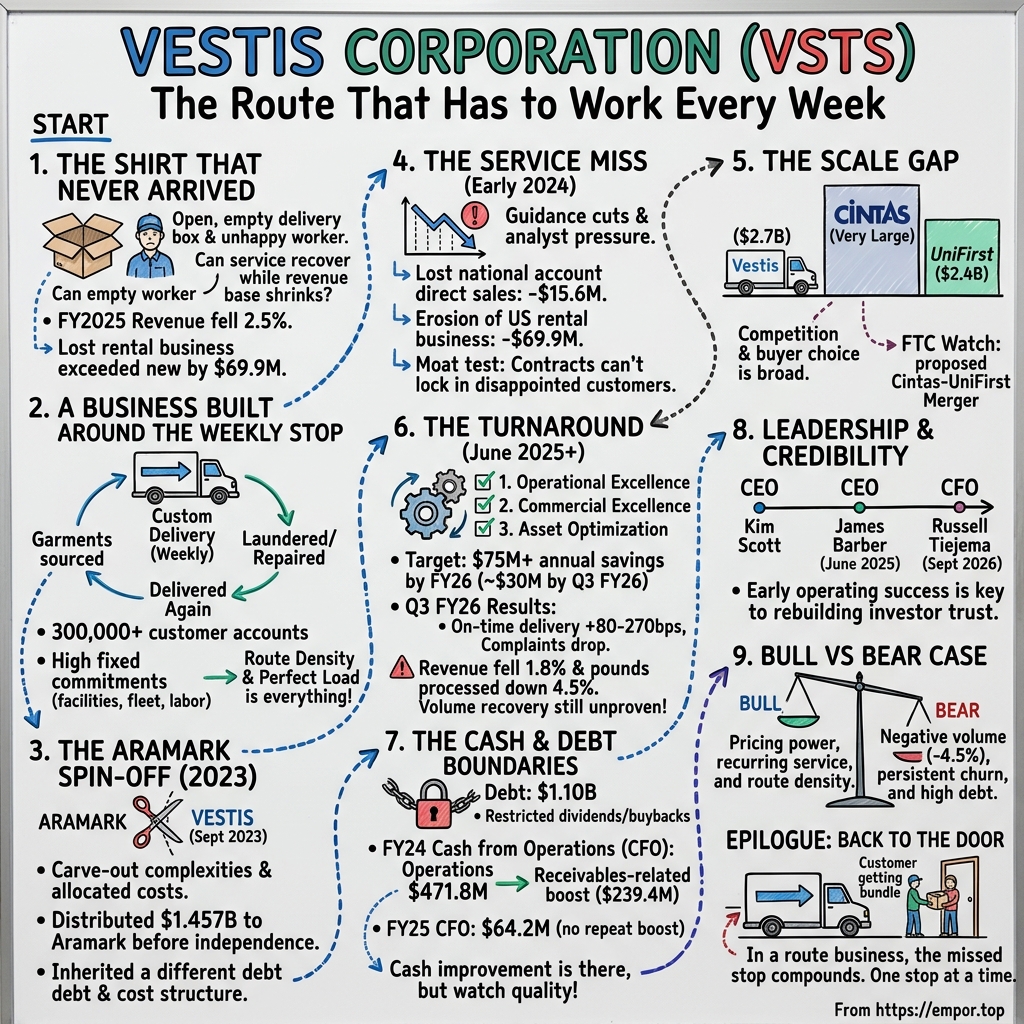
Vestis Corporation: The Route That Has to Work Every Week
I. The Shirt That Never Arrived
Picture a Monday morning at the back door of a mid-sized food plant. The night crew is leaving, the day crew is changing, and a supervisor is unzipping a bundle of freshly laundered work shirts that came off a truck an hour earlier. The count is wrong. Two people on the line have no clean shirt, the hand-towel cabinet is half full, and the mat by the loading dock has been left behind in the same muddy state it was in last week. Nobody gets hurt and nothing catches fire. But a small promise has been broken, and the supervisor makes a mental note that becomes, over a few more Mondays, a phone call to a competitor.
That is the whole business of Vestis Corporation in a single scene. The company rents, cleans and delivers workwear, and it stocks the unglamorous supplies that keep a workplace running: mats, towels, restroom products, first-aid kits, linens.1 The promise could hardly be simpler. Clean clothes, the right count, on the right day, every week. And yet the story of Vestis since it became a public company in the autumn of 2023 is largely the story of what happens when that simple promise is not kept often enough.
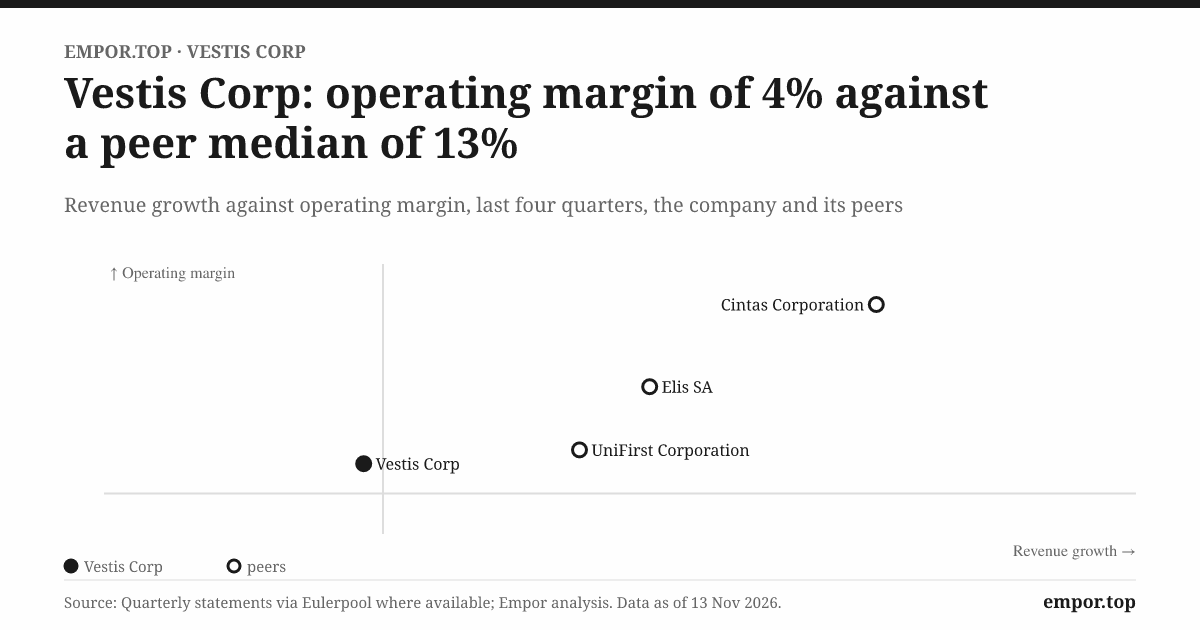
The stakes are not small. Vestis took in about $2.7 billion of revenue in its 2025 fiscal year, which ended in early October 2025.1 For a company of that size, the year was a bruising one. Revenue fell 2.5%, and it ended with a net loss of $40.2 million.1 Its operating margin, the share of each sales dollar left after running the plants, trucks and offices, was about 2.4%.1 Put plainly, out of every $100 a customer paid, less than two and a half dollars survived as operating profit, and once interest on the company's debt was paid there was nothing left at all.
The most telling number of that year was not a margin, though. It was the gap between customers walking out the door and customers walking in. In the United States, rental business lost to departing or shrinking accounts exceeded new business won by enough to cut rental revenue by $69.9 million.1 A route business can survive a bad quarter, a fuel spike or a wage increase. What it struggles to survive is a sustained period in which it is losing more stops than it adds, because every lost stop leaves a truck, a plant shift and a pile of garments that still have to be paid for.
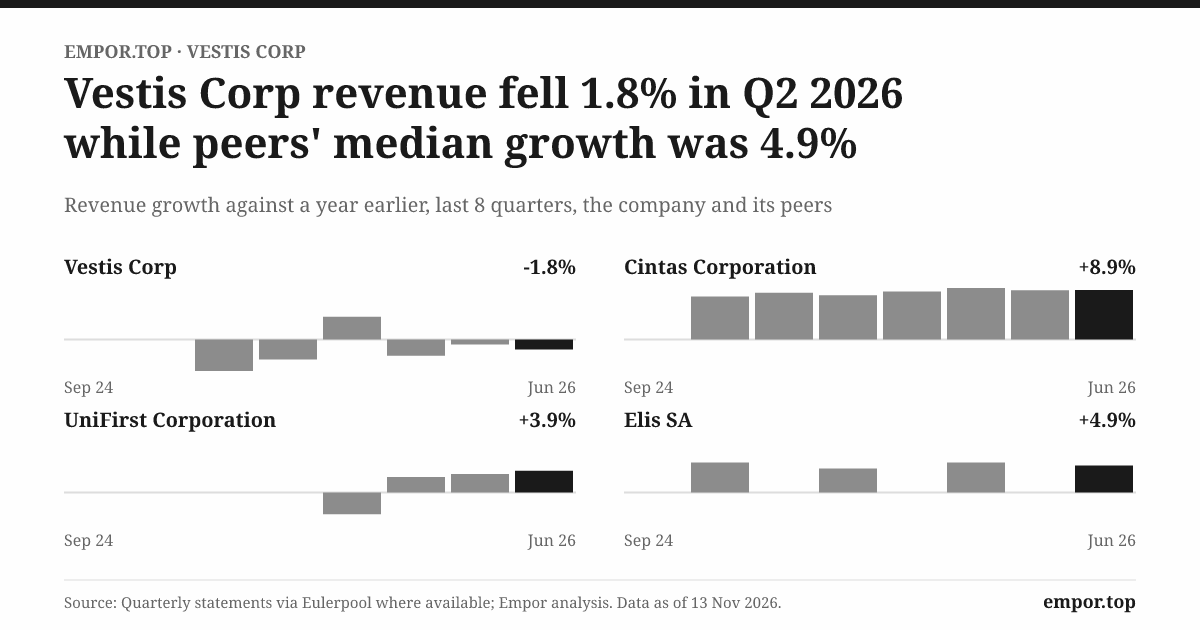
Then the story began to change, at least on the income statement. In the quarter that ended July 3, 2026, the third of the 2026 fiscal year, Vestis reported operating income of $37.2 million, up 49.2% from $25.0 million a year earlier.2 Operating margin climbed to about 5.6%.2 Management raised its outlook for the full year.2 Read only the headline, and it looked like a turnaround was well under way.
Read one line further, and the picture becomes harder. Revenue in that same quarter still fell 1.8%, and the number of pounds of laundry the company processed fell 4.5%.2 Vestis was making more money from a smaller amount of work. That is not nothing; it is often how turnarounds begin. But it raises the question at the heart of this story. Is the improvement in earnings a service-led recovery, the sign of a company that has fixed its routes and is now being rewarded by customers? Or is it cost cutting and price increases papering over a customer base that is still quietly shrinking?
Two further tests sit alongside that central one. The first concerns cash. Vestis has reported operating cash flows that, in some years, dwarfed its profits, and part of the reason is a facility that turns customer invoices into cash before customers pay them. Whether the company's cash generation is repeatable once that effect is stripped out is a question an investor has to answer before trusting any of the other numbers. The second concerns people. The company went through three chief executives in its 2025 fiscal year alone and a parade of finance chiefs after that.3 The current team, led by a former UPS operations chief, has early numbers to point to. It also has to prove that it can cut costs without weakening the very network that customers are paying for.
The verdict, as of mid-November 2026, is that the recovery is real in margins and pricing but not yet in volume or customer growth. To see why that distinction matters so much, it helps to start where Vestis's money is actually made: at the weekly stop.
 Subscribe on LinkedIn
II. A Business Built Around the Weekly Stop
Before dawn in an industrial plant somewhere in the American Midwest, carts of soiled garments roll off the trucks that arrived the night before. Workers sort them by fabric and soil level, because a mechanic's coveralls and a hotel cook's jacket do not belong in the same wash. Tunnel washers churn through the loads, dryers and steam tunnels finish them, and on the other side people inspect each shirt, replace a broken snap, sew on a missing name patch, and pull anything too worn to send back out. By the afternoon the garments are hung, bundled and staged by route and by customer, ready for the trucks to leave again. A few hours later a route driver backs up to a loading dock, swaps a bag of dirty uniforms for clean ones, restocks the towel dispensers, rolls out a fresh entrance mat, and is gone within minutes to the next stop.
This loop is the whole machine. Vestis sources garments and customizes them with logos and names, delivers them, typically every week, then collects them, cleans them, repairs or replaces them, and sends them out again.1 Workplace supplies ride the same truck: restroom and cleaning products, mats, towels, linens, first-aid and safety products.1 In fiscal 2025, Vestis served more than 300,000 customer accounts from more than 325 locations and employed roughly 18,150 people.1 The accounts range from auto repair shops and food processors to hospitals, hotels and restaurants, so demand is spread widely across the economy.
Most of the money comes from rental service. Customers pay contractual rates for the service performed, and Vestis recognizes the revenue over time, generally matching the monthly invoice periods.1 The company describes its contracts as primarily multi-year, though it does not publish the average contract length, the share of revenue under minimum commitments, or how much of its revenue it considers recurring.1 Alongside rental, Vestis sells uniforms outright, often through agreements with large regional or national companies.1 Those direct sales can bring in big orders, but they come and go in lumps, and as the company learned in its 2025 fiscal year, a single national account can take a meaningful bite out of revenue when it leaves.
The genius of the route, when it works, is density. Think of a route truck as a bus with fixed costs: the vehicle, the fuel, the driver's day. Every additional stop on the same street costs only a few extra minutes, so the more customers a route serves in a tight area, the cheaper each delivery becomes. The plant works the same way. Its washers, dryers, buildings and staff are largely fixed commitments, so the more pounds of laundry flow through it, the lower the cost of each pound. Inventory is a fixed commitment too: the company owns a vast stock of garments in circulation, and every shirt that sits idle in a closet is capital earning nothing. That is why the industry measures itself in pounds processed and revenue per pound. More pounds through a dense network spread the fixed costs; higher revenue per pound means each unit of work earns more.
The variable costs are not trivial either, and several of them sit outside management's control. Fuel is burned on every route, and Vestis had no fuel hedging contracts outstanding at the end of fiscal 2025, so a spike at the pump flows straight into route costs.1 Labor is the largest single input, from plant workers to drivers, and wage pressure hits a business that cannot automate the doorstep. Even accidents are a line item: a company with thousands of trucks on the road and heavy machinery in its plants carries much of its own insurance risk, and its reserve for self-insured liabilities stood at about $53.0 million at the end of fiscal 2025.1 Each of these costs grows with the size of the network rather than with the number of customers on it, which is another way of saying that a half-full route is expensive.
The leverage cuts both ways. When a customer leaves, the route does not shrink neatly by one stop. The truck still drives most of the same miles; the plant still runs its shifts; the garments made for that customer, embroidered with its name, may be useless to anyone else. A route business with falling volume can see profits drop much faster than revenue, which is roughly what happened to Vestis between its 2023 and 2025 fiscal years.
The customer base itself is a strength in one specific way. No single customer accounted for more than 10% of revenue in any of the last three fiscal years, and the ten largest customers together produced less than 10% of revenue in fiscal 2025.1 Vestis is not hostage to any one buyer. But diversification protects against one dramatic loss, not against hundreds of small ones. A business with 300,000 accounts can bleed slowly, a few dozen stops at a time, without any single departure making headlines.
That is where contracts are supposed to help. Multi-year agreements and early-termination fees make switching providers inconvenient, and in principle they give the incumbent time to fix problems before a customer can leave.1 In practice, the record shows that these terms do not lock customers in. A frustrated plant manager can wait out a contract, negotiate an exit, pay a fee, or simply buy uniforms and run them through an in-house or local laundry. The contract slows the door; it does not lock it.
The break point, then, is service. Late deliveries, short counts, garments that come back still stained or not repaired: each one is a small failure, and each can turn a recurring relationship into a customer-loss pipeline. In a business where the product is literally the same shirt coming back every week, the customer's entire experience of the company is whether the truck shows up with the right things on it.
So the question Vestis inherited when it became a standalone company was not whether the model works. Cintas, the industry leader, has shown for decades that it can. The question was whether Vestis received a well-run route network or a business whose service problems were already accumulating out of sight.
III. The Aramark Business Becomes Vestis
On September 30, 2023, Aramark shareholders woke up owning something new. For every two Aramark shares they held, they received one share of Vestis, about 131.2 million shares in all.1 Two days later, on October 2, the stock began regular trading on the New York Stock Exchange under the ticker VSTS.1 A division that had spent decades inside one of America's largest food-service and facilities companies was now a company in its own right, with its own board, its own chief executive and its own debt.
The history before that day matters only insofar as it explains the present. Vestis was Aramark's uniform and workplace-supplies operation, and on spin-off day it took with it the same plants, the same trucks and routes, the same garments in circulation and the same customer contracts.1 What it did not take was Aramark's broader scale. Aramark's food service, stadium concessions and facilities businesses were never Vestis revenue or Vestis assets, and the group's corporate functions, from treasury to information technology, had to be rebuilt or bought back under transition agreements. An investor comparing Vestis today with its pre-spin self is comparing the same operating business with very different corporate scaffolding around it.
That is why the early numbers need care. The financial statements through fiscal 2022 describe the uniform business as a piece of Aramark. Fiscal 2023 is a carve-out year: combined statements in which Aramark allocated corporate costs to the uniform business, about $24.4 million of them, and managed its cash centrally.1 Only from fiscal 2024 onward does Vestis report as a fully standalone listed company. A baseline built from these years mixes three different kinds of accounts.
Some of the relationship with the former parent was commercial. In fiscal 2023, Vestis supplied uniforms to Aramark contracts and booked $54.6 million of revenue from them, roughly 1.9% of the total, against $49.7 million of related costs.1 The company described those terms as fair market value. That was modest, and it did not turn into a lasting dependency: transition services between the two companies ended on or before September 27, 2024, and none were performed in fiscal 2025.1 No ongoing Aramark royalty or brand fee appears in the latest annual filing.1 Whatever went wrong at Vestis after the spin, it was not that the former parent was siphoning value through related-party contracts.
The money moved in a different way. In its fiscal 2023 cash flows, Vestis recorded a distribution of about $1.457 billion to Aramark.1 In plain terms, the new company borrowed and sent the proceeds to its parent on the way out the door, a common feature of spin-offs. Shareholders received shares in a new company, but its balance sheet carried well over a billion dollars of debt, while the uniform business inside Aramark had shown only modest borrowings of its own. Shareholders' equity, which stood around $2.3 billion in the pre-spin presentation, was about $866 million at the end of fiscal 2025.1 The operating business had not shrunk by that much. The capital structure around it had been rearranged.
The long-run growth record, meanwhile, was unremarkable. From fiscal 2020 to fiscal 2025, revenue grew at about 1.3% a year, and over the last three of those years at about 0.6% a year.1 Fiscal 2023's earnings also flattered the starting point: they included a $51.8 million gain from selling equity investments, about a fifth of that year's pre-tax income.1 Operating margin that year was about 7.7%, a high-water mark that investors at the spin might reasonably have treated as normal.1 It turned out to be the peak.
Independence also brought a long list of chores that never appear in a pitch for a spin-off. A company that had relied on its parent for payroll systems, information technology, procurement, treasury and investor relations had to build or buy each of them while still running thousands of routes every week. Vestis leaned on transition services from Aramark for roughly its first year as a listed company, and the last of them ended in September 2024.1 Every hour senior managers spent standing up a corporate office was an hour not spent in the plants, at precisely the moment, it would turn out, when the plants needed attention most.
So Vestis began its independent life with a new debt load, new corporate costs, a flattering recent profit base and very little time to establish its own operating record. The listing gave investors a pure-play uniform company. It did not give them a clean slate, and within months they would discover just how much of the inherited business needed fixing.
IV. The Service Miss That Changed the Story
The first sign came quickly. On February 8, 2024, barely four months after its listing, Vestis held one of its early earnings calls as a public company, and the questions from analysts kept circling back to the same subject: why were customers leaving, and what was the company doing about it?4 A newly listed company usually spends its first year building credibility, delivering on the numbers it set out at the spin. Vestis found itself explaining retention instead.
By the next call, on May 2, 2024, the explanations had become more specific. Management, then led by chief executive Kim Scott, cut its expectation for the fiscal year to revenue somewhere between down 1% and flat.5 Adjusted EBITDA margin, a profit measure before interest, tax, depreciation and some one-off items, had fallen 90 basis points from the prior year to about 12.4% in the quarter.5 In the Q&A, an analyst asked whether service-quality problems, using the industry's shorthand of the "perfect load," meaning the delivery that arrives complete, correct and on time, were new or longstanding. Scott's answer was candid: the service issues were longstanding, tied to on-time delivery and shortages in loads, and not caused by recent rerouting or by the spin itself.5 She linked them directly to customer departures, and said fixing them was the path to restoring pricing over time.5
That answer deserves to be weighed carefully, because it is the closest thing in the record to an admission of root cause. On one side, it was honest. Management did not blame the economy or a weak hiring market; it said the business had been failing at the basic task of the weekly delivery. On the other, it raised an uncomfortable question about the spin itself. If the service problems were longstanding, they existed before investors were asked to value the new company, and the guidance set at the spin had not reflected them. Fiscal 2024 ended with revenue down about 0.7% and net profit down roughly 90%.1
The longer consequence showed up in fiscal 2025. In the United States, lost business exceeded new business by enough to reduce rental revenue by $69.9 million.1 Separately, the loss of a national account cut direct-sales revenue by $15.6 million.1 The company has not named that customer. Put those two figures beside the year's total revenue decline and the shape of the problem is plain: Vestis was losing customers faster than its salespeople could replace them, and the losses were large enough to overwhelm whatever price increases it managed to push through on the customers who stayed.
It would be unfair to pin every lost dollar on service. Fiscal 2025 had one extra operating week, which flattered the reported revenue decline; excluding that week, the decline was about 4.1% rather than 2.5%.1 Customer volumes also move with employment levels, business closures and the mix of industries a route serves. A restaurant that cuts staff rents fewer uniforms even if it loves its service. But these are reasons revenue might wobble, not reasons it would keep falling year after year. An extra week cannot explain a persistent net loss of rental business. Nor can a soft labor market, given that the same market was available to every other provider.
One more detail reveals how customer exits echo through the accounts. When a customer leaves a rental program, it is usually charged for the garments made specifically for it, the ones with its logo and employees' names that cannot be rented to anyone else. In fiscal 2025, revenue from these inventory recovery charges was $13.2 million lower than the year before.1 That is a curious signal. It could mean fewer departures were triggering charges, or that the company was waiving them to ease negotiations, or simply that the mix of exits changed. The company does not break this down. What is certain is that exits leave merchandise and costs behind long after the last delivery.
The stumbles also brought lawyers. Shareholders filed securities class actions and derivative suits alleging that the company and its leaders made misleading statements about its business and failed in their governance duties; as of the latest annual filing, the outcomes and any damages remained unresolved.1 These are allegations, not findings. They matter as a measure of how far trust fell, and as a potential future cost. But the stronger evidence for the business story is the operating record itself and management's own explanations on those 2024 calls.
By the time the 2025 fiscal year closed, the distinction the turnaround would have to prove was already clear. Fixing the cost base can lift profit, and quickly. Fixing service is slower, and it shows up somewhere else entirely: in retention, and in a sales team that finally wins more stops than it loses. Before judging which of those two things is happening now, it is worth asking a prior question. Even if Vestis gets its service right, how strong is its position against the rivals waiting for its customers?
V. The Scale Gap—and the Service Test
Follow a Vestis truck into almost any American metro area and it will pass a Cintas truck before it reaches its first stop. Cintas, based in Ohio, is the industry's giant, several times Vestis's size, with a long record of growing revenue and expanding margins. UniFirst, from Massachusetts, reported about $2.4 billion of revenue in its 2025 fiscal year, close to Vestis in scale.[^6] Alsco, a family-owned linen and uniform company, competes nationally too, and in every region there are local laundries that know their customers by first name and will bid aggressively for a single profitable route.1 Beyond all of them sit two quieter alternatives: customers can buy uniforms outright and wash them themselves, or run an in-house laundry.
Vestis describes itself as the second-largest provider of these services in the United States and Canada, based on public company revenue, employee and facility data.1 That claim is plausible but narrow. Second-largest in a market where the leader is several times bigger is a long way from second-equal. And the market is local in execution even though it is national in branding. A customer in Phoenix does not care how many plants Vestis runs in Ohio; it cares whether the Phoenix route shows up on Tuesday with the right shirts.
Geography inside Vestis tells a similar story. The company reports two segments, the United States and Canada, selling the same kinds of service.1 The United States is much larger, with about 9% of fiscal 2025 revenue coming from foreign currencies, principally the Canadian dollar, and it drove most of the fiscal 2025 decline.1 Canada is smaller, and in the third quarter of fiscal 2026 it grew revenue year on year.6 That Canadian growth is welcome, but it is too small to move the whole company; the American routes are where the turnaround is won or lost.
Direct sales are a different battlefield. When a national retailer or a hospital network buys uniforms outright, it typically runs a formal bidding process, compares several suppliers on price and fulfilment, and signs an agreement that can be re-tendered when it expires. Scale helps win those contracts, but it does not keep them. The national account that walked away in fiscal 2025, taking $15.6 million of direct-sales revenue with it, was a reminder that the largest customers are also the ones best equipped to shop around.1
Now apply the classic test of competitive forces to the evidence. Start with buyers. Customers have broad choice: a national leader, a near-equal national rival, regional players and the option to do it themselves. Competition includes price, especially when contracts come up for renewal. Vestis's diversification, more than 300,000 accounts with no customer above 10% of revenue, means no single buyer can squeeze it.1 Collectively, though, buyers hold real power, because each can switch, and the fiscal 2025 loss of rental business shows many did.
Switching costs come next, and they are the heart of any claim that this is a moat business. In theory they are meaningful. Changing providers means re-measuring employees, waiting for new embroidered garments, paying an early-termination fee and taking a risk on a new route. Those frictions give the incumbent a grace period. But the record shows the grace period is finite. When service disappointed through 2024 and 2025, customers left anyway, in numbers large enough to take nearly $70 million out of rental revenue in a single year.1 The history narrows the switching-cost claim to a smaller version: contracts buy time, not loyalty.
Scale is the third test, and the one that should favor Vestis most. A larger network can buy garments and chemicals more cheaply, keep plants fuller, run denser routes and sell more products to each stop. Vestis has real scale in absolute terms. But the shrinking pound volume and the margin collapse between fiscal 2023 and fiscal 2025 show that it has not consistently converted that network into strong economics.1 Scale only becomes an advantage when it is used; idle plant capacity and thinning routes are scale working in reverse.
The most recent operating data captures the tension precisely. In the third quarter of fiscal 2026, revenue per pound processed rose about 3% to roughly $1.42, while pounds processed fell about 4.5%.2 Vestis was charging more for each unit of work and doing less work. Some of that is deliberate: management has said it is walking away from unprofitable contracts and repricing others. Some of it may be the continued loss of customers it would rather have kept. The company does not separate the two in a way an outsider can verify.
There is also a new force reshaping the battlefield. Cintas agreed to acquire UniFirst in a deal valued at about $5.5 billion, combining the industry leader with the third national player.7 As of Cintas's October 2026 filing, regulatory review by the Federal Trade Commission remained active.7 This is not Vestis's deal; it is a competitive inflection happening around it. If it closes, Vestis will face a single rival far larger than itself, with even greater route density. It may also gain opportunities, if customers who prefer not to depend on one dominant supplier go looking for an alternative, or if regulators require divestitures. Neither outcome is knowable yet, and the honest stance is to watch the FTC decision and then watch Vestis's bidding and pricing behavior in the quarters after it.
One thing Vestis itself has not done is buy its way to scale. No material acquisition by Vestis since the spin appears in its filings.1 Its capital story is the spin-off distribution, debt service, investment in its plants and fleet, and the sale of assets such as its Japanese equity stake, which brought in $36.8 million in fiscal 2025.1 That at least removes one common source of value destruction from the analysis: there is no overpriced acquisition to write down.
The verdict on competition is calibrated. Vestis has meaningful route, facility and account scale, but the current evidence does not establish a strong moat. Its most credible edge is the ability to deliver reliable service across a broad network, and that edge has to be proved, not asserted, through retention, route density and price realization. Which brings the story to the man hired to prove it.
VI. The Turnaround's First Numbers
James Barber started his working life at UPS as a delivery driver.8 Over 35 years he climbed through the company, running its European operations, then UPS International, and finally serving as chief operating officer from 2018 until his retirement at the start of 2020.8 He knew, in other words, the economics of a truck that has to make every stop on time, and the cost of a network that does not. When Vestis announced on May 6, 2025 that he would become president and chief executive, effective June 2, the choice was its own message: the board wanted an operator, not a strategist.8
On December 1, 2025, with the fiscal 2025 loss on the books, Barber laid out his plan.9 It had three parts, which management called operational excellence, commercial excellence, and asset and network optimization.9 Strip away the labels and they amount to three sets of operating choices. First, make the plants and routes work better: process more pounds per labor hour and get trucks to customers on time with complete orders. Second, price more carefully: look customer by customer and product by product at what actually earns money, raise prices where the service justifies it, and stop serving accounts that lose money. Third, right-size the physical network: consolidate capacity, optimize routes and sell or close assets that are not earning their keep. The plan targets at least $75 million of annual operating savings by fiscal 2026, with restructuring, including workforce reductions, expected to run substantially through fiscal 2027.1
It is worth pausing on what a UPS operator brings to a laundry route, because the overlap is closer than it sounds. Parcel delivery is a business obsessed with measuring the stop: was the package on the truck, was the truck on time, did the driver take the shortest path? A uniform route asks the same questions about a different cargo. Barber's team reported measurable service indicators, on-time delivery and complaint counts, alongside the financial results, putting the doorstep on the same page as the margin.10 That ordering is sensible. It also sets up a clear test of his own making: if the service indicators improve and customers still leave, the diagnosis was wrong.
The early operating evidence was encouraging. In the second quarter of fiscal 2026, plant productivity improved about 11%, on-time delivery improved by 270 basis points, and customer complaints fell about 4%.10 In the third quarter, plant productivity improved about 9%, on-time delivery rose a further 80 basis points and complaints fell 74 basis points.2 These are the right kinds of measures. Unlike a margin, which can rise for many reasons, on-time delivery and complaints are direct readings of whether the weekly promise is being kept. They are also company-defined and unaudited, and Vestis does not publish the absolute level of on-time delivery, so an outsider can see the direction but not how far the network still is from where it should be.
The financial evidence moved in the same direction. The quarter's financial improvement extended beyond operating income, with adjusted EBITDA margin at about 12.2%.2 Operating expenses fell about 3.8% year on year.6 A rough decomposition helps. Revenue fell by about $12 million from the prior-year quarter, yet operating income rose by about $12 million. The difference came from costs: the company spent roughly $24 million less to run the business than a year earlier, which is the transformation savings showing up on the income statement.
What has not turned is just as clear. The volume picture remained weak.2 For nine months, revenue was down about 1.9%.6 Price and mix can bridge a volume gap for a while; a company can earn more per pound on fewer pounds for several quarters. But price cannot by itself demonstrate customer recovery, and it carries a risk of its own. Raising prices on customers who were recently frustrated by service is a delicate move, and if service has not improved enough, the price increase becomes one more reason to leave.
Measured against its own schedule, the cost plan is roughly on track. Management estimated about $50 million of in-year benefit for fiscal 2026 and had realized roughly $30 million through the third quarter.11 That leaves a sizable portion of the year's expected savings to land in the fourth quarter, and the full $75 million annual run-rate still to be demonstrated.
On the third-quarter call in August 2026, analysts pressed on exactly the right seam.11 Management described some of the volume decline as the deliberate exit of lower-quality contracts, accounts that consumed route time and plant capacity without earning their keep. That is a legitimate strategy; many good route businesses prune unprofitable stops. But it is also, conveniently, an explanation that turns a shrinking customer base into a virtue. The test is whether the exits are concentrated in genuinely unprofitable accounts and whether the remaining base begins to grow. Comparing the second- and third-quarter calls, the language has been consistent: pricing discipline, productivity, service metrics, revenue quality.1211 What has not yet appeared is a quarter in which management can point to net customer wins.
There is a harder question beneath all this: are the cuts improving operations or risking them? A plant and workforce transformation is credible only if cost per pound falls while on-time deliveries, complaints and retention all improve. So far the first two service measures are moving the right way. Retention has not yet visibly followed. If the savings come from fewer drivers on longer routes or fewer workers inspecting garments, the improvement could reverse once the slack is gone.
The falsifier is simple to state. Two consecutive quarters of positive organic volume and improving customer retention, reported alongside margin gains, would materially strengthen the recovery case. Until then, the improvement is real but incomplete. And there is another number that looked much better than the profit line in the meantime: cash.
VII. The Cash That Came From Receivables
Look at Vestis's cash-flow statement over six years and something seems too good to be true. From fiscal 2020 through fiscal 2025, the business reported about $519 million of net profit, yet generated about $1.5 billion of cash from operations, nearly three times as much.1 In a capital-heavy route business, some gap is normal, because depreciation on plants, trucks and garments is a non-cash charge. But a ratio that wide demands an explanation. The explanation turns out to be a single year, and a single financial arrangement.
In fiscal 2024, Vestis's operating cash flow jumped to $471.8 million, almost double its usual level.1 The reason was not a sudden improvement in the business, which was losing customers and profit that year. The biggest single contributor was a $239.4 million cash inflow from receivables, mostly attributable to a receivables facility the company began using in August 2024.1 Changes in payables, accrued expenses and other liabilities supplied a good deal more.1
The facility is worth explaining plainly, because it shapes how every cash number should be read. When Vestis delivers clean uniforms, it sends an invoice and waits, typically several weeks, for the customer to pay. Under the facility, Vestis sells a pool of those unpaid invoices to a financing vehicle and receives cash now, minus a fee. Because the invoices are sold rather than borrowed against, they are removed from the balance sheet, and the cash shows up in operating cash flow rather than as borrowing.1 Think of it as being paid early by a third party for work customers will pay for later. It is a perfectly legal and common tool. It also means that the first year of using it produces a one-time surge of cash, because the company collects several weeks of revenue early, and that surge does not repeat. By July 3, 2026, about $212.3 million of receivables had been sold and derecognized under the facility.6
Fiscal 2025 showed what happens when the surge passes. Operating cash flow fell to $64.2 million.1 The receivables boost did not recur, cash inflows from payables and accruals were about $114.9 million lower than the year before, and the company posted a net loss.1 After capital spending, free cash flow was a little under $6 million.1 The two years together tell the real story. Averaged out, Vestis was generating roughly $270 million a year of operating cash, but the timing of when it arrived had been reshaped by financing. The fees on the facility, meanwhile, became the main component of other expense in fiscal 2025.1
There has been genuine improvement since. For the nine months to July 2026, operating cash flow was $160.9 million, compared with $33.3 million in the same period a year earlier.6 Better collections helped, and the company has emphasized collecting what it is owed more promptly.6 That is real progress. But the facility remains part of the picture, so an investor has to check whether the facility's balance rose or fell during the year before giving operations full credit.
The record of capital returns adds a sobering footnote. Over the six years from fiscal 2020, dividends paid totaled about $2.0 billion, against roughly $1.1 billion of free cash flow.1 That looks reckless until one notices that about $1.7 billion of it was recorded in fiscal 2023, around the spin-off, and represents the transfer of value to Aramark rather than an ordinary dividend to Vestis shareholders.1 As a standalone company, Vestis paid a modest dividend of about $13.8 million in each of fiscal 2024 and fiscal 2025.1 Then, in May 2025, its debt amendment restricted dividends and buybacks until it meets specified leverage and covenant conditions.13 Shareholders will not be receiving cash returns until the balance sheet heals.
Receivable quality is the last thing to watch, and here a common metric can mislead. Measured as days of revenue tied up in receivables, Vestis's figure fell from about 50 in fiscal 2022 to about 22 in fiscal 2025.1 On its face, that is a dramatic improvement in collections. In reality, much of it reflects invoices sold under the facility, which are no longer counted. Meanwhile the allowance for doubtful accounts, the company's own estimate of what customers will never pay, rose from $32.7 million at the end of fiscal 2025 to $35.5 million by July 2026, even as net receivables fell from $162.3 million to $143.0 million.6 In fiscal 2025, Vestis charged $56.9 million to income for bad-debt allowances and wrote off $44.0 million, attributing the increase mainly to a $15 million updated estimate of collectability.1 The company does not publish an ageing table showing how overdue its receivables are. Collection is improving at the margin; collection quality remains a watch item.
A smaller wrinkle sits in the Canadian business. About 9% of fiscal 2025 revenue was earned in foreign currencies, mainly Canadian dollars, and Vestis does not use financial instruments to hedge the translation of those earnings back into US dollars.1 The swings have been small, gains of a few million dollars a year in other comprehensive income, and they do not touch operating cash in any meaningful way.1 It is a modest, unhedged exposure rather than a hidden risk, but it means a weaker Canadian dollar can trim reported results even when the Canadian routes are growing.
The cash test, then, is precise. When the full fiscal 2026 results arrive, an investor should reconcile operating cash flow to net income and working-capital movements, and separate out how much came from the receivables facility. If the cash still looks strong after that, the improvement is genuine. If it does not, the cash story is a timing story. And cash matters more at Vestis than at most companies, because of who has the first claim on it: the people running the business, and the lenders behind them.
VIII. The New Team's Credibility Test
Within the space of a single fiscal year, Vestis had three chief executives. Kim Scott, who had led the uniform business through the spin and the difficult first year, departed in March 2025.3 Phillip Holloman, the board's chairman and a former president and chief operating officer of Cintas, stepped in as interim chief executive from March 18.38 Then, on June 2, James Barber took over, and Holloman returned to the chairman's role.8 It was the kind of sequence that tells outsiders a board has lost patience, and tells employees that the plan they were working to may not survive the next quarter.
The finance function churned even faster. Rick Dillon and Kelly Janzen both served as chief financial officer; Adam Bowen became interim CFO in December 2025; and Russell Tiejema took the permanent role effective September 28, 2026.314 Vestis reiterated its full-year outlook in the same announcement, a pointed signal that the new CFO was not arriving to deliver bad news.14 In June 2026, the company had also appointed Steve Cochran as Chief Commercial & Supply Chain Officer, consolidating the selling and sourcing sides of the turnaround under one executive.11 Then, on November 4, 2026, chief accounting officer John Laveck gave notice that he would leave on December 11.15 One departure does not make a crisis, but for a company whose credibility problem was rooted partly in turnover, another senior handoff in finance arrived at an awkward moment.
There is an irony in the board's composition worth noticing. The chairman who held the company together during the gap between chief executives spent his own executive career running operations at Cintas, the rival that sets the standard Vestis is measured against.3 Few boards have a director who knows from the inside what a best-in-class route network looks like. That knowledge cuts two ways: it should make the board a demanding judge of operating claims, and it makes the length of time the service problems persisted harder to explain.
The current story belongs to Barber and his team. His pay package, set out in the 2026 proxy, shows how the board has tried to tie him to results. His base salary is $950,000, with a target annual bonus of 125% of salary beginning in fiscal 2026, tied to the management incentive plan's goals and paid in shares.3 He has a target annual long-term equity award of about $4 million and received an initial grant of restricted stock units worth $3 million that vests in 2028.3 For his partial fiscal 2025, his reported compensation was about $3.29 million, mostly in stock.3 Holloman, for his interim stint, received about $1.43 million, including a one-time $675,000 stock award.3 Heavily equity-weighted pay gives Barber real exposure to the share price over time. Vestis did not identify Barber as a large personal shareholder in the proxy, so "alignment" here means incentive design rather than owner-operator stakes.
The most significant outside shareholder sits on the board. Corvex Management, the fund run by Keith Meister, held about 15.0% of Vestis as of the proxy's snapshot, up from 12.6% in May 2024.316 In May 2025, the company raised the cap on Corvex's permitted ownership from 15% to 20%, while keeping standstill terms that limit what the fund can do.13 Meister is a seasoned activist investor, and his presence means the board has a large, engaged holder with every reason to demand results. That is an investor stake, not management ownership. The institutional register behind it has been shifting too: BlackRock, listed at 12.5% in the proxy, filed an amended ownership report in October 2026 reporting no person holding more than 5% on its behalf.317
Credibility, though, is best read as behavior over time. Guidance was cut in Vestis's first year as a public company. In May 2025, when Moody's downgraded the company's credit rating, it cited missed guidance, service problems and leadership turnover among its reasons.18 The transformation plan, and the raises to the fiscal 2026 outlook after the second and third quarters, are a course correction.102 Delivering against those raised numbers for the full year, and then setting fiscal 2027 targets that are met rather than revised, is the next proof. Raising guidance mid-year is a statement of confidence; meeting it is evidence.
Governance pressure has been visible but proportionate. At the February 2026 annual meeting, about 2.65 million votes were cast against the company's executive pay proposal and about 2.29 million against the re-election of director Ena Williams.19 The pay proposal passed, and those votes represent a small minority of shares outstanding, so this was a message, not a revolt.
The most revealing comparison is between what management said about customer losses in 2024 and what it says now. In May 2024, the explanation was operational and humbling: service had been failing for a long time, and customers left because of it.5 In 2026, the explanation has shifted toward choice: Vestis is exiting unprofitable contracts and focusing on revenue quality.11 Both may be true. A company can lose good customers through bad service and then deliberately shed bad customers through better pricing. But investors are entitled to ask what changed, how much of the past loss was controllable, and which metric should move first if the strategy is working. Management's own framing implies that retention of profitable customers should improve before total volume does. That is a testable claim, and it ties directly to the question of how much financial room the new team has to keep investing while it proves it.
IX. The Debt That Sets the Boundaries
In the third quarter of fiscal 2026, Vestis did something it had struggled to do for two years: it generated enough free cash flow to pay down debt from operations rather than asset sales. It used about $30 million of that quarter's free cash flow to repay principal.2 It is a small number against the size of the debt, but it marks a change of direction. A company that can steadily repay borrowings out of its own operations gains a little more freedom each quarter.
The debt itself was inherited at separation. Its borrowings now consist of term loans due in September 2028 and February 2031, plus a revolving credit line due September 2028.6 At July 3, 2026, principal debt was about $1.10 billion, down from about $1.17 billion at the end of fiscal 2025.6 Cash was $57.7 million, with $294.2 million available under the $300 million revolver.6 Those figures exclude the company's lease liabilities. Operating leases cover buildings and equipment; finance leases cover much of the truck fleet. They are not borrowings in the usual sense, but the credit agreement counts finance leases as debt when lenders calculate covenants.1 An investor tallying leverage should do the same.
The trade-off is constant. Every dollar of cash can go to plants, technology and fleet, which the service recovery needs, or to repaying debt, which lowers interest costs and covenant pressure. In the third quarter, capital investment included about $18 million of cash spending on plants and technology, plus $5.1 million of new vehicles added through finance leases.11 Annual capital spending has been running at roughly 2% to 3% of revenue, down from about $78 million in fiscal 2023 and fiscal 2024 to about $58.5 million in fiscal 2025.1 That decline is a reasonable response to cash pressure. It is also a quiet risk, because a route business that underinvests in trucks and washers eventually pays for it in breakdowns and late deliveries.
The lenders set the boundaries. The May 2025 amendment to the credit agreement restricted dividends and share repurchases until specified leverage and covenant conditions are met, required minimum interest coverage of 2.00 times, and extended a step-down schedule for the maximum allowed net leverage.13 The company also faces mandatory term-loan amortization and must use part of any excess cash flow to prepay debt.1 Because the term loans carry variable interest rates, a move in benchmark rates feeds directly into the interest bill. In effect, the lenders have first call on the cash that the turnaround generates, and shareholders stand behind them.
Moody's May 2025 downgrade offers a dated stress test. The agency lowered Vestis's corporate family rating to B2 from Ba3, firmly in speculative-grade territory, with a stable outlook.18 It cited net customer losses, service-quality problems, pricing pressure, leverage of about six times debt to EBITDA at the end of March 2025, and concerns about management credibility.18 It also credited good liquidity and the possibility that revenue declines would ease.18 Its stated conditions for an upgrade included sustained leverage below five times and an EBITA margin around 6%; downgrade risks included leverage above 6.5 times and continuing declines.18 That view is now about eighteen months old. It is not evidence that those thresholds have since been crossed in either direction, and the company gave no updated agency rationale in its July 2026 filing.6
There is also a quieter balance-sheet judgment that the debt story makes more important. Much of Vestis's asset base is goodwill, the accounting residue of the acquisitions Aramark made over decades to build the uniform business. In the fiscal 2025 audit, the auditor flagged goodwill valuation as a critical audit matter, the label auditors use for the areas of greatest judgment.1 The company's impairment test found no write-down was needed, despite declining performance and a sustained fall in the share price, but the result depended on forecasts of margins and EBITDA, including the benefits of the restructuring plan.1 That is not a warning of a coming write-off. It is a reminder that the book value supporting the company's equity rests on the turnaround succeeding roughly as planned, and that a failed recovery would show up first in cash flow and later, as a charge, in the balance sheet.
The investment question, then, is concrete. Liquidity is available and debt is coming down, but leverage, variable rates and covenants constrain capital returns and investment choices. Can Vestis keep funding the service recovery, meet its debt obligations and avoid a renewed slide in operating cash flow, all at once? That question frames the case for and against the company as it stands today.
X. The Case for Vestis—and the Case Against It
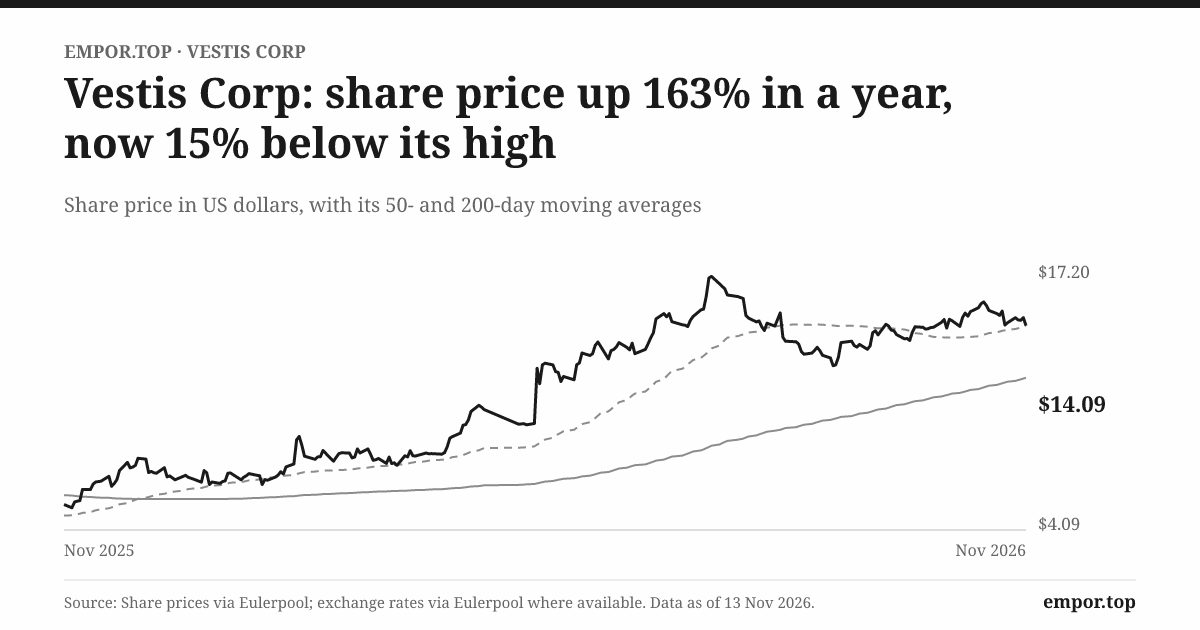
On November 13, 2026, Vestis shares closed at $14.09.20 That price sat about 14.6% below the 52-week high of $16.50, and nearly three times the 52-week low of $5.18.20 Somewhere in the last year the market went from pricing a company in danger of breaking its covenants to pricing a company in the middle of a recovery. The stock's one-year volatility was about 55%, and over five years it had at one point fallen about 61% from a prior peak.20 These are the price movements of a stock on which investors profoundly disagree.
The valuation reflects that disagreement. At a market value of about $1.9 billion and an enterprise value, including debt, of about $3.1 billion, Vestis traded at roughly 16.4 times EBITDA and about 48.7 times operating profit.20 Earnings per share over the last full fiscal year were negative, about minus 30 cents, so a conventional price-to-earnings ratio is unavailable.1 The gap between those two multiples is itself a clue. Depreciation of plants, trucks and garments takes a large bite out of EBITDA before it becomes operating profit, and operating profit is currently depressed. A buyer at this price is paying for a recovery in operating margin, not for today's earnings. Peer multiples for a like-for-like comparison are not part of this story, so the price is best read as a snapshot of expectations, not as cheap or dear.
One more market figure shows the shape of the bet. The stock's free-cash-flow yield, cash generated after capital spending as a share of market value, was about 7.3%.20 On its face that is generous for a recurring-service business. But it is measured on a cash base shaped by collection timing and the receivables facility, and the lenders, not shareholders, have first claim on that cash. The yield is a measure of what the business might return to owners once the balance sheet is repaired, not what it returns today.
The bull case, stated without management's language, runs as follows. Vestis has a diversified base of more than 300,000 accounts, multi-year relationships, a national network of plants and routes, and a recurring weekly service that customers need regardless of fashion or technology.1 Artificial intelligence is not about to wash a coverall or drive it to a loading dock, though technology can sharpen routing and labor scheduling. If service reliability keeps improving and route density recovers, the operating leverage that hurt Vestis on the way down will help it on the way up: each additional pound through a fixed plant is high-margin, and each additional stop on an existing route is nearly free. The third-quarter jump in operating income on falling revenue hints at what that leverage could do in reverse.
The bear case deserves equal force. Revenue has barely grown in five years, at about 1.3% a year.1 Operating margin fell from about 7.7% in fiscal 2023 to about 2.4% in fiscal 2025.1 Fiscal 2025 net business was still negative, and pounds were still falling in the third quarter of fiscal 2026.12 The largest competitor is several times bigger and may soon absorb the third. A business that improves profit mainly through cuts and price increases while its volume shrinks can look healthy for several quarters and then run out of levers.
Now the moat, argued once and in full. Consider the competitive forces in turn. The threat of new entrants is moderate: starting a national network is costly, but a local laundry with a few trucks can win individual routes. Supplier power appears limited; the company does not disclose concentration in garment or chemical suppliers, though fuel and labor costs bite directly.1 The threat of substitutes is real, because customers can buy uniforms outright or launder in-house. Buyer power is significant in aggregate, as the record of lost business shows. Rivalry is intense, led by Cintas, with UniFirst, Alsco and regional players pricing for share.
Through the lens of Hamilton Helmer's seven sources of lasting advantage, the picture is similar. Scale economies exist in route density and plant utilization, but they belong most fully to the largest player, and Vestis's falling volume has eroded them. Switching costs exist but have proved finite. There is no network effect, in the sense of each customer making the service more valuable to the next. Brand matters little to a plant manager compared with whether the truck arrives on time. There is no cornered resource and no meaningful counter-positioning. That leaves process power, the possibility that a company becomes durably better at running the same operation than its rivals. That is precisely the claim the transformation is trying to establish, and it is the hardest to prove because it reveals itself only over years of consistent service.
The history therefore narrows the moat claim. Scale and contract recurrence are useful, but the clearest customer proof, retention, on-time delivery, complaints and net business, was weak through 2024 and 2025. The second- and third-quarter service measures in fiscal 2026 are encouraging, but they are not yet evidence of sustained share gain. The edge is intact as a possibility and unproven as a fact.
Two measures can settle the case more than any others. The first is volume, measured as pounds processed alongside net business won or lost; it last read down about 4.5% year on year.2 The second is revenue per pound, the measure of pricing and mix, which last read up about 3%.2 Watching them together matters more than either alone. Rising price with falling volume describes a company harvesting its base. Rising price with stable or rising volume describes a franchise being repaired. Behind both sits free cash flow after the receivables effect, the final check on whether margin gains are real.
A skeptical investor, the kind who would sell this stock short or push for change from the boardroom, would put three questions to management. If the network is valuable, why did service failures persist long enough to drive away tens of millions of dollars of rental revenue? Why did customers leave despite contracts and exit fees? And why should higher prices now lead to better retention rather than more departures? Those questions require operating answers, measured in stops kept and stops won, not savings targets. Until they are answered, the story's most important lessons are already visible in what has happened so far.
XI. Lessons from the Route
Imagine the accounting life of a lost customer. In the month it leaves, its rental revenue stops. Its embroidered garments sit on a shelf, perhaps recovered through a charge, perhaps not. The route truck still passes the empty loading dock on its way to the next stop. The plant still runs its washers, now a little less full. The cost of losing that customer does not appear in a single line; it is spread through fuel, labor, depreciation and idle inventory for months. That is why the first lesson of Vestis is this: in a route business, the missed stop compounds.1 For founders of any service network, the point is that quality is not a cost center. It is the mechanism that keeps the fixed costs paid.
The third-quarter figures yield a line worth remembering: price can repair a quarter; retention repairs the franchise.2 A company that raises prices on customers who are not yet sure it has fixed its service is borrowing against their patience. The repair is complete only when customers stay at the new price.
Vestis's fiscal 2024 cash flow offers the third lesson: cash is not a single number when receivables can be sold.1 For investors in any company with a facility like this, the discipline is to reconcile operating cash with earnings and working capital every year, and to ask how much of the cash came from customers paying and how much from someone else paying early.
Vestis's spin-off is the fourth lesson: it gave the company a ticker, not a clean slate. It began with carve-out accounts, debt and service problems that, by management's own later admission, had been building for years.15 Spin-offs are often pitched as liberation: a focused company, freed from a distracted parent. Sometimes they are. They are also the moment when a parent hands over a business with the debt attached, and the new owners discover what the old one did not fix.
Vestis's leadership churn offers the fifth lesson.314 A route network runs on routines: the same driver, the same stop, the same count, every week. Leadership that changes as often as the weather makes those routines hard to enforce, because every new boss arrives with a new plan, and every plan resets what the plant manager is measured on. The line to remember is simple: you cannot run a weekly promise with a quarterly management team. Stability in the corner office is not a governance nicety here; it is an operating input, as real as fuel or detergent.
What remains is the test still ahead. Restructuring savings are vivid while they are new; each quarter's report can point to costs that have fallen. The real proof comes later, on the day the savings stop being new and the comparison is against a leaner prior year. Vestis has to show that its operational improvement survives that day.
XII. Epilogue: The Next Route
Tonight, Vestis stands at the end of its first full fiscal year under Barber, with the results still to be reported. A new chief financial officer has been in place for about seven weeks. The chief accounting officer leaves in less than a month. A multi-year transformation is halfway through its schedule. And somewhere in Washington, the Federal Trade Commission is deciding whether the largest company in Vestis's industry can buy the third-largest.
The first moment that will matter is the fiscal 2026 report. If Vestis delivers the outlook it raised twice and reiterated when Tiejema arrived, it will have done something it failed to do in its first public year: set a target and hit it.14 If the fourth quarter delivers the remaining savings management expected, that will strengthen the case that the run-rate is real.11 A miss, or another revision, would revive every question Moody's raised about credibility.
The second moment will come quietly, quarter by quarter, in a single line: pounds processed. If volume stops falling and begins to grow, while revenue per pound holds, the story becomes one of a franchise repaired. If revenue per pound keeps rising while pounds keep falling, the company is harvesting a shrinking base, and the margin gains will eventually hit a ceiling.
The third moment is the cash. Investors will want to see full-year free cash flow with a clear bridge from net income, working capital and the receivables facility. Steady debt paydown and a widening cushion against covenants would gradually loosen the lenders' grip and, eventually, reopen the possibility of returning cash to shareholders.
A useful marker for that cushion is covenant-defined net leverage sustained below roughly 4.5 times, with interest expense falling and no renewed decline in operating cash flow. Progress toward that level would eventually return choices to shareholders under the May 2025 restrictions on dividends and buybacks.13 Fail to approach it and the business will spend another year working for its lenders. It is also the moment at which a rating agency would have reason to revisit the B2 view it took in 2025, in either direction.18
The fourth moment belongs to someone else. The FTC's decision on Cintas and UniFirst will shape Vestis's competitive field, whether the deal closes, is blocked or requires divestitures.
Through all of it, one question remains genuinely unanswered because the evidence does not yet exist: whether higher reliability converts into net customer wins. The trucks are arriving more often on time. Complaints are falling. Whether customers have noticed, and whether they will stay and bring their neighbors with them, is the one thing the next year will reveal.
XIII. Outro: Back at the Door
Go back to that loading dock on a Monday morning. The truck pulls in, the driver drops the bundle, and the supervisor counts the shirts. This time the count is right. The towel cabinet is full. The mat by the door is clean. Nobody notices, because when this business works, nobody is supposed to.
That is what makes Vestis different from a standard cost-cutting turnaround. Its margins matter, its debt matters, its cash matters. But every one of those numbers depends on something entirely ordinary: a garment arriving clean, complete and on time, so that the customer is still there next week. Vestis's recovery depends on making an ordinary service feel dependable again, one stop at a time.
References
-
Vestis 2025 Form 10-K — SEC, 2025-12-02 ↩↩↩↩↩↩↩↩↩↩↩↩↩↩↩↩↩↩↩↩↩↩↩↩↩↩↩↩↩↩↩↩↩↩↩↩↩↩↩↩↩↩↩↩↩↩↩↩↩↩↩↩↩↩↩↩↩↩↩↩↩↩↩↩↩↩↩↩↩↩↩↩↩↩↩
-
Vestis Reports Third Quarter 2026 Results and Increases Full Year 2026 Outlook — Vestis, 2026-08-11 ↩↩↩↩↩↩↩↩↩↩↩↩↩↩
-
Vestis 2026 Proxy Statement — Vestis, 2026-01-08 ↩↩↩↩↩↩↩↩↩↩↩↩
-
Vestis Q1 FY2024 Earnings Call Transcript — ROIC AI, 2024-02-08 ↩
-
Vestis Corporation (VSTS) Q2 2024 Earnings Call Transcript — Seeking Alpha, 2024-05-02 ↩↩↩↩↩↩
-
Vestis Appoints Jim Barber as President and Chief Executive Officer — Vestis, 2025-05-06 ↩↩↩↩↩
-
Vestis FY2025 Results and Transformation Announcement — Vestis, 2025-12-01 ↩↩
-
Vestis Reports Second Quarter 2026 Results and Increases Full Year 2026 Outlook — Vestis, 2026-05-12 ↩↩↩
-
Vestis Q3 FY2026 Earnings Call Transcript — The Motley Fool, 2026-08-18 ↩↩↩↩↩↩↩
-
Vestis Q2 FY2026 Earnings Call Transcript — The Motley Fool, 2026-05-12 ↩
-
Vestis Form 8-K: Credit Agreement Amendment and Corvex Ownership Limit — SEC, 2025-05-06 ↩↩↩↩
-
Vestis Appoints Russell Tiejema as Chief Financial Officer and Reiterates Fiscal Full Year 2026 Financial Outlook — Vestis, 2026-09-28 ↩↩↩↩
-
Vestis Form 8-K: Chief Accounting Officer Resignation — SEC, 2026-11-09 ↩
-
Moody's Lowers Vestis Corporate Family Rating to B2, Maintains Stable Outlook — Investing.com, 2025-05-14 ↩↩↩↩↩↩
-
Vestis 2026 Annual Meeting Voting Results — SEC, 2026-02-24 ↩
 LinkedIn
 WhatsApp
 Reddit
 Hacker News
 Email
 Kindle
 RSS Feed
 Spotify
 Apple Podcasts
 Amazon Music
 Audible
 YouTube