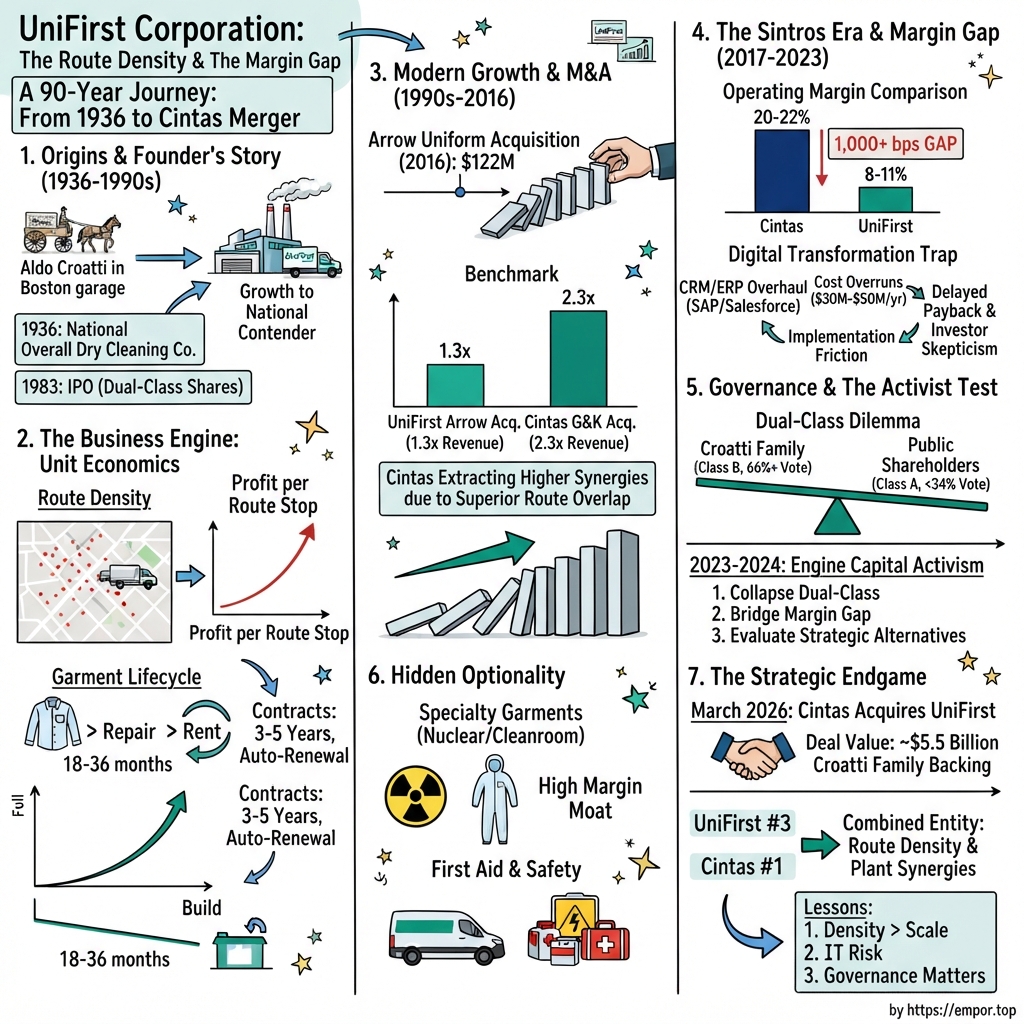
UniFirst Corporation: The Route Density Engine and the Margin Gap
I. Introduction & Episode Roadmap
On the morning of March 11, 2026, a ninety-year-old family business headquartered in a low-slung office park in Wilmington, Massachusetts announced that it had agreed to sell itself to the company it had spent four decades chasing. The buyer was Cintas Corporation. The price was roughly $5.5 billion. And the sellers — the Croatti family, grandchildren and widow of an Italian immigrant's son who had started washing factory coveralls in a converted Boston horse barn during the Great Depression — had signed a voting agreement locking in the outcome before the market opened.1
What makes the UniFirst story worth two hours of anyone's attention is not the ending. Uniform companies get bought. What makes it worth the time is the fourteen-month sequence that produced the ending: three rejected takeover offers, a French bidder turned away, a proxy fight in which the company's own founding family split down the middle, a governance structure that let 19.6% of the economics outvote 80.4% of it, and — underneath all of it — a stubborn, quantifiable operating gap between UniFirst and its larger rival that the company spent nearly a decade and hundreds of millions of dollars failing to close.2
The setup
UniFirst Corporation (NYSE: UNF) has been the number three player in North American uniform rental and workplace services. In fiscal 2025, which ended August 30, 2025, the company generated $2.43 billion of revenue.3 It operates more than 270 service locations, serves over 300,000 customer locations across the United States, Canada and Europe, employs more than 16,000 people it calls "Team Partners," and outfits more than two million workers every day.4 It owns or leases 281 facilities totalling roughly 8.3 million square feet and runs a fleet of about 4,813 delivery vehicles.3 It manufactures roughly 62% of the garments it puts into service, at plants in San Luis Potosí, Mexico and Managua, Nicaragua, and it makes about 99% of its own floor mats at a plant in Cave City, Arkansas.3
The core thesis
Uniform rental is one of the great compounding business models in industrial history — recurring weekly revenue, contractual lock-in, high switching friction, and a cost structure where the marginal customer is dramatically more profitable than the average one. UniFirst has all of that. And yet in fiscal 2025 it converted $2.43 billion of revenue into just $184.5 million of operating income, a margin of 7.6%.3 In the fiscal year ended May 31, 2026, Cintas converted $11.26 billion of revenue into $2.61 billion of operating income, a margin of 23.1%.5 Same industry. Same customers. Same trucks, same wash formulas, same weekly stop. A gap of more than 1,500 basis points.
That gap is the analytical spine of this story. It is not a rounding error or an accounting artifact. It is the reason UniFirst's shares went essentially nowhere for eight years while Cintas compounded, the reason an activist fund with a 3.2% stake could recruit a Croatti to run against the Croattis, and ultimately the reason the family sold.6
The roadmap
Here is the route we will take. First, the origin — a Depression-era laundry that stumbled into a business model built on geographic density rather than product differentiation. Second, the engine itself: what actually makes a uniform route profitable, why the tenth customer on a street is worth several times the first, and why customers so rarely leave. Third, the consolidation of the industry into a three-player oligopoly and what UniFirst's acquisition record reveals about its structural position within it. Fourth, the Steven Sintros era: a sudden succession, a written-off software project, a multi-year enterprise systems rebuild, and the widening margin gap that ran alongside it. Fifth, the parts of the company almost nobody talks about — nuclear decontamination and cleanroom garment processing, and a first aid business growing at double digits while earning almost nothing. Sixth, the governance structure that made all of this possible and the activist campaign that finally broke it. Then the playbook, the frameworks, the risks, and the endgame — including the part that is still unresolved as of this writing, because the U.S. Federal Trade Commission issued a Second Request on June 11, 2026 and the deal has not yet closed.4
It is a story about a very good business run at something well short of its potential, and about what happens when the people who control a company and the people who own it stop wanting the same thing.
 Subscribe on LinkedIn
II. Origins & Founder's Story: From One Wagon to Industrial Giant (1936–1990s)
Boston, 1936. The unemployment rate nationally was still north of 16%, and the factories that were running were running dirty — machine shops, foundries, garages, tanneries. Their workers wore coveralls that came home caked in grease, and their wives washed them by hand.
Aldo Croatti, the son of Carlo and Emilia Croatti, who had emigrated from Rimini, Italy in 1909, saw a business in that grease. He opened the National Overall Dry Cleaning Company in a converted horse barn with one washing machine and one delivery truck.7 The proposition was simple: give us your filthy overalls, we will clean them better and cheaper than you can, and we will bring them back.
The genuinely important idea arrived a year later, in 1937, and it was not about cleaning at all. It was about ownership. Instead of laundering garments the customer owned, National Overall began renting them.7 This inverted the economics of the entire enterprise. A laundry that merely washes clothes sells a commodity service, priced per pound, competing with every other laundry on the block. A laundry that owns the garments sells a program: it buys textiles in bulk at industrial prices, standardizes them, embroiders the customer's name and logo onto them, amortizes them over years of service life, and bills weekly for as long as the relationship lasts. The customer stops thinking about laundry as a purchase and starts thinking about it as a utility bill.
By 1940 Aldo was general manager, and annual revenues had reached roughly $250,000.7 The late 1940s brought the standardized rental package — Eisenhower jackets, matching shirts and pants, cleaning and delivery included — which the rest of the industry promptly copied.7 In 1951 came the first acquisition, Springfield's Interstate Uniform Service Company, and through the 1950s and 1960s the company opened roughly a dozen branches across New England and Pennsylvania.7
Two decisions from that era matter enormously to the modern story. The first was the buildout of a hub-and-spoke physical network: large centralized industrial laundries feeding smaller depots feeding delivery routes. This is the architecture that determines everything about profitability in this business, and we will return to it. The second was a bet almost nobody else was making. In the same window, UniFirst opened nuclear decontamination plants in Santa Fe and Pleasanton, California, becoming the first private industrial launderer licensed by the Nuclear Regulatory Commission.7 In 1977 it opened its first dedicated cleanroom facility in Nashua, New Hampshire.7 Those two moves seeded a business that, half a century later, would still be quietly earning some of the highest margins in the company.
Along the way there were the small operational innovations that separate a good route business from a mediocre one. In 1961 UniFirst became the first company in the industry to deliver uniforms on hangers rather than folded — a change that sounds trivial and is not, because a hung garment arrives pressed, is faster to sort in the plant, is faster to hand to a worker at the stop, and looks better on the floor of the customer's business.7 Small per-garment efficiencies, multiplied across millions of garments a week, are the substance of margin in this industry.
Going public without letting go
The public listing came in 1983, when Interstate Uniform Service Corporation completed an IPO on the New York Stock Exchange under the symbol IUS; the name changed to UniFirst Corporation, and the ticker to UNF, the following year.7 Crucially, the family went public without giving up control. The company issued two classes of stock: Common Stock, freely transferable, one vote per share, entitled to a cash dividend equal to 125% of whatever the other class received; and Class B Common Stock, ten votes per share, not freely transferable, convertible into Common on a one-for-one basis.3 The Croattis kept the Class B.
Read the terms carefully and the trade is explicit: public investors got the economics, plus a 25% dividend premium as compensation for their weaker votes; the family got the votes, and accepted a permanently lower dividend on its own shares in exchange. That was an entirely conventional arrangement for a founder-controlled company in 1983, and for the next three decades essentially nobody complained about it, because the person holding the votes was also the person running the routes. Four decades later it would become the single most contested fact about the business.
The Ron Croatti era
What followed the IPO was a straightforward land grab. Between 1984 and 1992 UniFirst acquired twelve competitors and pushed west.7 It expanded the nuclear franchise internationally, entering Europe in 1994 through Euro Nuclear Services in the Netherlands, and in 1997 through 1999 it built a centralized distribution center in Owensboro, Kentucky — still, at 325,000 square feet, the backbone of the company's garment logistics — and acquired Green Guard First Aid and Safety, seeding the second of the two extension businesses that Section VI examines.73
Ronald Croatti — Aldo's son, born in Boston in April 1943 — became chief operating officer in 1986 and chief executive in 1991.78
Ron Croatti is the human center of this story, and it is worth pausing on him, because the company's later drift is only legible against what he was. He took over a business doing roughly $100 million a year and grew it past $1.5 billion.7 He was an operator's operator, obsessed with retention — he launched a "Customers for Life" program and created an internal award, named for his father, for the location with the best customer retention.7 Aldo had written the company's three core values: Customer Focus, Respect for Others, Commitment to Quality.7 Ron ran the place by them, and by a kind of frugal, hands-in-the-lint-trap management style. In 2011 he appeared on the CBS program Undercover Boss, working alongside his own route drivers and plant staff.7 Under his tenure UniFirst crossed $1 billion in revenue in 2008 and, in 2014, passed Aramark to become the industry's number two uniform rental provider.7
He died on May 23, 2017, of complications from pneumonia, after twenty-six years as CEO.8 He was 74.
Aldo had died in 2001, at 83.7 With Ron's death, the last operator-founder was gone, and a company whose culture, capital allocation and competitive intensity had been carried in one man's head had to find out whether any of it had been institutionalized. The honest answer, as the next decade would show, was: partially. And the gap between the family's control rights and the family's operating involvement — a gap that did not exist while Ron was alive — opened up on the day of his funeral.
III. The Business Engine: Unit Economics of Uniform Rental & Facility Services
Picture a Tuesday morning delivery route in suburban Cleveland. A UniFirst driver — in this business the route driver is the account manager, the salesperson and the customer-service department all at once — pulls up outside a machine shop with forty employees. He walks in with clean, pressed, individually name-tagged uniforms for every one of those forty workers, restocks the shop's floor mats, swaps out the restroom paper and soap, checks the first aid cabinet, collects last week's soiled garments, and drives 400 yards to the next stop.
Everything that matters about this business is contained in those 400 yards.
The revenue model
UniFirst serves customers under written service contracts that typically run three to five years.3 The company designs, manufactures, purchases, personalizes, rents, cleans, repairs, delivers and sells the garments — shirts, pants, jackets, coveralls, lab coats, smocks, aprons, and specialized flame-resistant and high-visibility protective wear — plus a widening basket of non-garment items: industrial wiping products, floor mats, dry and wet mops, restroom and cleaning supplies.3 In fiscal 2025 this Uniform & Facility Service Solutions segment produced $2.219 billion of revenue, roughly 91.2% of the company total.3 The customer pays weekly, effectively forever, and no individual customer in that segment accounted for more than 10% of total revenue in any of the last three fiscal years.3 That is about as diversified and as recurring as revenue gets in an industrial business.
Why density is everything
Here is the mechanic that outsiders consistently underestimate. The dominant costs in a uniform route are not the garments — they are the truck, the fuel, the driver's time and the plant capacity behind him. Those costs are essentially fixed against the route, not against the stop. When a route already passes a street, adding one more customer on that street costs almost nothing incremental: a few extra minutes, a marginally heavier load, some additional wash volume in a plant that is already heated and running. The revenue, however, is fully incremental.
The consequence is that profit per route scales super-linearly with the number of customers per square mile. Two competitors with identical national revenue can have wildly different margins if one is concentrated and the other is spread thin. This is the same physics that governs waste hauling, linen supply, pest control and beverage distribution: local share, not national share, determines unit economics. A company with 40% of one metropolitan area will out-earn a company with 15% share spread across the same metros, every time — because the first company's trucks are full and its drivers are stopping every few hundred yards, while the second company's trucks are driving between customers.
Hold that thought. It explains, more than any other single factor, the margin gap we come to in Section V, and it is also the entire logic of the acquisition that ends this story.
Garment lifecycle management
The second profit lever is the least glamorous and one of the most consequential: how long a garment lasts. UniFirst capitalizes rental merchandise and amortizes it on a straight-line basis over estimated service lives ranging from six to thirty-six months.3 That amortization runs through cost of revenue, which absorbed 63.4% of revenue in fiscal 2025.3 Extending average garment life by even a few months across millions of items in service moves the margin line materially. This is why the wash chemistry matters, why repair capability matters, and — critically — why the ability to reuse garments matters. On the January 2026 earnings call, Sintros described one of the largest untapped opportunities in the company as "global inventory sharing" across the used-garment portfolio: today, he said, UniFirst does not meaningfully share used garments across different facilities.9 Read that again. A company running 281 facilities has been unable to move a lightly-used size-large work shirt from a plant that has a surplus to a plant that needs one. Each location has effectively been buying new. That is a systems problem, and it goes directly to the technology story.
The vertical integration lever
There is a third structural feature that distinguishes UniFirst from a pure service company: it makes a great deal of what it rents. Roughly 62% of the garments placed into service in fiscal 2025 were manufactured in-house, primarily work pants and shirts produced at two plants in San Luis Potosí, Mexico and one in Managua, Nicaragua, supplemented by subcontract manufacturers used to balance demand and optimize cost.3 The company also makes about 99% of its own floor mats at Cave City, Arkansas.3
The strategic argument for owning the factory is threefold: it allows custom garment programs for larger customers, it widens the standard design range, and it gives the company direct control over quality, price and speed.3 The economic argument is that manufacturing margin that would otherwise leak to an apparel vendor stays inside the system, and — because the garment is then amortized over its rental life rather than resold — that margin is captured repeatedly. The cost is inflexibility. A company that owns plants in Mexico and Nicaragua is a company with a fixed manufacturing footprint and a live exposure to trade policy, which is precisely why tariffs surfaced as a named margin headwind in fiscal 2026 guidance.10
Why customers don't leave
Switching uniform providers is far more painful than it sounds. The incumbent's garments belong to the incumbent, so every garment must be collected from every employee. Lockers and delivery infrastructure change. New garments must be sized, fitted and embroidered for every worker, which takes weeks. Every employee has an opinion about fit and fabric. And the whole exercise generates zero visible benefit to anyone in the building except the purchasing manager who negotiated a slightly lower weekly rate. The result is high structural retention — but "high" is not "total," and retention is a live, moving number that management has repeatedly flagged. UniFirst acknowledged two consecutive years of elevated lost business before reporting improvement in fiscal 2025, and in the first quarter of fiscal 2026 said retention had logged a second consecutive year of sequential improvement.109 Retention is the metric that most directly converts into organic growth in this model, and it had been going the wrong way.
Pricing, energy and the third growth lever
The weekly invoice bundles garment rental, cleaning, repair, loss-and-damage provisions and facility items. Growth therefore comes from four places, and management is explicit about this framing: new account sales, customer retention, selling additional products into existing customers, and price. Energy — natural gas to heat wash water, diesel to move trucks — ran at 4.0% of revenues in fiscal 2025's fourth quarter and was guided to remain at 4.0% in fiscal 2026, a level the company has managed with reasonable stability through a volatile decade.10
But there is a fifth variable that management does not control at all, and it has been the quiet drag on the whole model: wearer count. UniFirst bills per garment per worker. If a customer's headcount falls, revenue falls even though the account is retained and the price is unchanged. Sintros has been candid about this. Through fiscal 2025 and into fiscal 2026, net wearer adds versus reductions were negative because of soft hiring across the industrial customer base, and on the January 2026 call he characterized the drag as having become "incrementally more impactful."9 Analyst Tim Mulrooney pressed the point directly: if new account sales are strong and retention is improving, but organic growth is still low single digits, something is offsetting it. That something is employment.
This is the honest picture of the engine: a genuinely excellent recurring-revenue machine, with real switching costs and real density economics, whose top line is nonetheless tethered to blue-collar payrolls, and whose largest internal efficiency opportunities had — by management's own account — not yet been captured. To understand why not, you have to understand who UniFirst was competing against, and how the industry around it consolidated.
IV. Modern Growth Phase & Strategic M&A (1990s–2016)
By the turn of the millennium, the North American uniform rental industry had settled into the shape it holds today: a national oligopoly sitting on top of a long tail of regional independents. UniFirst's own annual report names the principal rental competitors plainly — Cintas Corporation, Alsco, and Vestis Corporation — while noting that the company also competes with a highly fragmented direct-sales market of national, regional and local providers, and with the perennial alternative of customers simply doing it themselves.3
The relative scale of those three is the whole story. Cintas ended its fiscal 2026 with $11.26 billion of revenue.5 Vestis — the uniform business spun out of Aramark — reported roughly $2.7 billion of revenue in fiscal 2025 and a net loss of $40.2 million, alongside a multi-year restructuring plan involving workforce reductions and network optimization.11 UniFirst sat between them on quality and below both on scale relative to Cintas.
This is not a market where anyone wins on product. Every player washes shirts. The competitive variable is geographic density, and the only fast way to buy density is to buy a competitor.
The Vestis warning
It is worth dwelling briefly on Vestis, because it is the closest thing this industry has to a controlled experiment in what happens when a subscale route business loses its way. Spun out of Aramark as a standalone public company, Vestis saw segment operating income margin fall from 10.4% in fiscal 2024 to roughly 6.2% in fiscal 2025, posted a net loss, and announced a multi-year restructuring involving workforce reductions, network optimization and tighter cost management — all while carrying significant indebtedness with financial covenants.11 UniFirst's debt-free balance sheet looks conservative until you place it next to a peer trying to execute an operational turnaround with leverage on top. The comparison cuts in UniFirst's favour on financial risk and against it on urgency: Vestis at least had creditors forcing the issue.
The Arrow Uniform deal
In September 2016, UniFirst made what remains its most instructive acquisition. It bought Arrow Uniform, a family-controlled uniform and facility services provider headquartered in Taylor, Michigan, for approximately $122 million in cash, structured as an asset purchase in which UniFirst took essentially all of Arrow's assets and virtually none of its liabilities.12 Arrow operated twelve locations across five Midwestern states and employed nearly 700 people, and UniFirst told investors the business would add roughly $62 million to $65 million to fiscal 2017 revenues.12
Strategically it was exactly the right kind of deal: bolt-on density in the industrial heartland — Michigan, Ohio and the surrounding manufacturing corridor — where UniFirst already had plants and routes that could absorb Arrow's stops. Financially, at roughly two times acquired revenue, it was a full but not reckless price for a business whose routes would fold into existing infrastructure.
The asymmetry problem
Here is where the analysis gets uncomfortable for UniFirst, and where a subtle structural disadvantage becomes visible. In a density-driven business, the acquirer with the densest existing network can always extract the most synergy from any given target — because it can eliminate more redundant routes, close more overlapping plants, and consolidate more back-office overhead. That means the biggest player can rationally outbid everyone else for every asset in the market, indefinitely.
You do not have to take this on faith, because Cintas eventually published the arithmetic on UniFirst itself. In announcing the 2026 merger, Cintas told investors it expected approximately $375 million of annual cost synergies within four years of closing, drawn from material, production, service and SG&A expenses.1 Against UniFirst's fiscal 2025 revenue base, that is roughly 15% of the target's entire top line — and it is more than double UniFirst's own fiscal 2025 operating income of $184.5 million.3 Put bluntly: the value Cintas expected to create by folding UniFirst into its own route network exceeded everything UniFirst earned as an independent company. That is the synergy asymmetry, quantified, in the acquirer's own disclosure.
For a decade this asymmetry operated as a slow squeeze. Every regional independent that came up for sale, every tuck-in that would have thickened UniFirst's routes, was worth more to the larger bidder. UniFirst could still buy — it acquired four first aid businesses for $14.9 million in the first quarter of fiscal 2026 alone9 — but it was structurally competing for assets against a rival that could always justify a higher number.
There was one moment when UniFirst considered flipping the board. On January 20, 2026, a private equity firm delivered a preliminary indication of interest to invest up to $2.0 billion in UniFirst to support UniFirst acquiring a competitor.13 That would have been the aggressive answer to the density problem: use outside capital to buy scale rather than be bought for it. The UniFirst board considered it three days later and determined not to pursue it, concluding it was not in the best interests of the company and its shareholders.13 The disclosure does not elaborate on the reasoning. What is clear is that by January 2026 the board had already begun a very different conversation.
The reason it had is that the operating gap had, by then, been widening for the better part of a decade.
V. The Sintros Era, ERP Struggles, & The Cintas Margin Gap (2017–2023)
A finance guy inherits an operator's company
When Ron Croatti died in May 2017, the board turned to Steven S. Sintros, who had joined UniFirst in 2004 as a finance manager, risen through corporate controller and chief financial officer, and had spent his entire UniFirst career in the numbers rather than on the routes.8 He was named president and chief executive officer that summer.7 Shane O'Connor, who had joined in 2005, moved into the CFO seat and has held it since, running a balance sheet of almost startling conservatism: at the end of fiscal 2025 UniFirst carried no long-term debt and $209.2 million of cash, cash equivalents and short-term investments.10
That conservatism is real and it is a genuine asset. It is also, viewed from a certain angle, the tell of a company that was not being pushed hard. A business with 90%-plus revenue retention, no debt, and a founding family holding the votes is a business that can afford to take a long time to fix things.
The gap, measured properly
The cleanest way to see the problem is to compare like with like. In fiscal 2025 UniFirst's total operating margin was 7.6%; its core Uniform & Facility Service Solutions segment earned $168.5 million on $2.219 billion of revenue, a segment operating margin of 7.6% as well.3 Cintas, in its fiscal 2026, ran a 23.1% operating margin on a gross margin of 50.7% that it described as an all-time high.5
Three things drive that gap, and they compound.
Density and scale. Cintas generates roughly four and a half times UniFirst's revenue across substantially overlapping geography. Applying the route mathematics from Section III, that translates directly into more stops per mile, fuller trucks, higher plant utilization and better absorption of every fixed cost in the system.
Customer mix. UniFirst's book skews toward small and mid-sized businesses. Sintros himself framed the company's sales reorganization around this in January 2026, describing a previous model that thought about the world as either "national accounts" or "local accounts" and missed "a large universe of accounts that fall in between the, say, $80-a-week account and the true national accounts."9 An $80-a-week account is a real thing in this industry. It also carries meaningfully higher acquisition and servicing cost per dollar of revenue than a multi-site national contract.
Technology and process. This is the part that became a genuine investor controversy, and it deserves the full telling.
The write-off nobody talks about
UniFirst's technology troubles did not begin with the current ERP project. They began with a customer relationship management system that failed. In fiscal 2017 the company recorded a $55.8 million impairment charge on a version of a CRM system it had been building; two years later, in fiscal 2019, it recognized a $21.1 million gain from a settlement agreement with the lead contractor on that project.14 A company that produced $232.0 million of operating income on $1.809 billion of revenue in fiscal 2019 — a 12.8% margin, the high-water mark of the modern era — had two years earlier written off the better part of a year's worth of net income on software.14
That failure reset the clock. UniFirst initiated a second multi-year CRM project in fiscal 2018, began deploying it in the second half of fiscal 2021, and concluded the rollout to its U.S. locations in the first quarter of fiscal 2024.3 Six years from initiation to U.S. completion — for the customer-facing system alone.
The ERP, and the pig in the python
In fiscal 2022, with the CRM still mid-rollout, UniFirst launched an enterprise resource planning project it planned to run through 2027: early phases on master data management and finance, later phases focused on supply chain, procurement and automation.3 The company had capitalized $45.3 million on the ERP as of August 30, 2025, of which $26.4 million was spent in fiscal 2025 alone, primarily third-party consulting and capitalized internal labor.310 Separately, non-capitalizable expenses tied to these "Key Initiatives" ran through the income statement year after year — $7 million budgeted for fiscal 2026, on top of a new $4 million of amortization beginning when the finance modules went live mid-year.10 Total capital expenditures reached $154.3 million in fiscal 2025 and were guided to approximately $150 million again in fiscal 2026, elevated as a percentage of revenue specifically because of application development spending.10
To translate: for roughly nine consecutive fiscal years, UniFirst has been rebuilding its core systems, and for most of that period the spending has been visible in the margin while the benefits have not.
The 2025 reorganization — a real answer, arriving late
To be fair to Sintros, fiscal 2025 was the year the company finally restructured itself around the problem rather than around the software. It hired Kelly Rooney as chief operating officer, unified operations under a single leader for the first time, and introduced what management calls "the UniFirst Way" — an enterprise operating framework of standardized, repeatable service procedures.15 It then moved direct oversight of local sales resources out of the operations organization and into the sales organization under executive vice president of sales and marketing David Katz, and shifted toward a tiered selling model matching rep seniority to prospect size — the fix for the missing middle between $80-a-week accounts and true national accounts.159
The early operating evidence was genuinely positive. Fiscal 2025 produced more new business installed than fiscal 2024, despite fiscal 2024 having an extra week of operations and the installation of a top-three account, and the fourth quarter was the year's highest quarter of new account installations.15 Retention improved after two years of elevated losses.15 The problem was arithmetic: those gains were being consumed by wearer reductions at existing customers, so organic growth in the core segment still came in at 2.9% in the fourth quarter of fiscal 2025 and 2.4% in the first quarter of fiscal 2026 — well short of the mid-single-digit ambition.109
An alignment footnote worth noticing
One quiet detail in the fiscal 2025 disclosures deserves an investor's attention. Share-based compensation rose in fiscal 2025 and management guided to a larger increase in fiscal 2026, attributing it to a change the company made to the vesting lives of its share-based grants — with expense elevated for a couple of years before normalizing.10 O'Connor noted, correctly and pointedly, that increases in stock compensation reduce operating income but are excluded from adjusted EBITDA.15 For a company simultaneously asking investors to judge it on adjusted EBITDA margin progress, a rising, EBITDA-exempt compensation line is exactly the sort of thing a skeptical analyst should track. It is disclosed, it is explained, and it still widens the gap between the two profit measures management reports.
What the calls actually reveal
The tone across earnings calls is the most useful evidence on management credibility here, and it is worth being precise about what changed and what did not.
Through fiscal 2023 and 2024, management's message was consistent: the investments were necessary, the payback was coming, and margins would benefit once the rollouts completed.15 By the fourth-quarter fiscal 2025 call in October 2025, that message had shifted in a specific and important way. Sintros told investors that fiscal 2026 would be "a temporary step back in profitability," and O'Connor guided the core segment's operating margin down to 6.6% from 8.3%.1510 Consolidated operating income at the guidance midpoint was set at $158.8 million — below fiscal 2025's actual — on higher revenue.10 Asked to decompose the roughly 80 to 90 basis points of margin headwind, Sintros named four causes and said they contributed "reasonably evenly": tariffs, sales investments, service investments, and a peak in digital transformation spending.15
Then came the part that mattered most for how the market read management. Asked on the January 2026 call when the company would hit its long-stated targets of mid-single-digit organic growth and high-teens EBITDA margins, Sintros said the growth target might arrive "by the third year or so," and that on profitability, "as we get through '27, you'll start to hit some of that inflection."9 He was careful to note the company had never attached specific fiscal years to those milestones.
That is the crux of the credibility question, and it cuts both ways. In management's favor: the explanations have been specific rather than evasive, the causes named are real and externally verifiable, and Sintros has consistently declined to promise a date he could not defend. Against management: a long-term margin target with no date attached, restated across multiple years while the actual margin moved sideways or down, is a target that cannot be missed — and therefore cannot hold anyone accountable. When a J.P. Morgan analyst wrote on October 23, 2025 that UniFirst "continues to lack a detailed, cohesive, publicly-articulated strategy for returning the business towards mid-single digit % revenue growth and high teens % EBITDA margins," that was the criticism being made.16
Myth versus reality
Three consensus narratives are worth testing directly.
Myth: the margin gap is mostly an ERP-spending artifact that reverses when the project ends. Reality: the Key Initiative expenses explicitly disclosed have been small relative to the gap — $7 million of expense guided for fiscal 2026 against a shortfall measured in hundreds of millions of dollars of operating income versus peer margins.10 The transformation spend is real and it hurts, but it is not the explanation.
Myth: UniFirst's margins are structurally capped by its SMB mix, so the comparison to Cintas is unfair. Reality: mix matters, but Cintas serves enormous numbers of small businesses too. And UniFirst itself earned a 12.8% operating margin in fiscal 2019 with broadly the same customer mix it has today.14 Whatever changed, it was not the customers.
Myth: management's plan would eventually close the gap. Reality: this one can be tested against management's own numbers, because the five-year internal forecast prepared for the board and its bankers was disclosed in the merger proxy. Management projected revenue rising from $2.486 billion in fiscal 2026 to $2.967 billion in fiscal 2030, with EBIT rising from $159 million to $307 million over the same span.13 Even on plan, and even in fiscal 2030, that is an operating margin of roughly 10% — better, but still less than half of where Cintas already was in fiscal 2026. Management's own best case did not close the gap. It narrowed it.
That single fact, more than any activist letter, is what made the ending inevitable. But before we get to the ending, there are two parts of UniFirst that almost nobody was valuing.
VI. Hidden & High-Margin Optionality: Specialty Garments & First Aid
There is a building in Nashua, New Hampshire where UniFirst has been laundering garments since 1977 in conditions cleaner than most operating rooms.7 There are others — in the United States, the United Kingdom and the Netherlands — where the company washes clothing that has been exposed to radioactive material, under licenses issued by the Nuclear Regulatory Commission or the equivalent national agency.3 These are not side hustles bolted on during a diversification craze. They are, in the nuclear case, six-decade-old businesses that predate most of what the company does today.
The nuclear business
In fiscal 2025 UniFirst reorganized its reporting for the first time in years, and the change was genuinely informative rather than cosmetic. Beginning with the fourth quarter, the company collapsed six operating segments into three: Uniform & Facility Service Solutions (which absorbed the cleanroom operations, on the logic that they share a business model, customers, resources and technology with the core), First Aid & Safety Solutions, and Other — which consists solely of the nuclear business.3 Management said explicitly that the change would give investors more visibility into a division that experiences meaningful annual and quarterly volatility.15
The disclosure it produced is striking. In fiscal 2025 the nuclear segment generated $99.2 million of revenue — about 4.1% of the company — and $15.1 million of operating income.3 That is a 15.3% operating margin, roughly double what the core uniform business earned, from a business a twenty-second the size.
Why does it earn that? Because the barriers are regulatory rather than commercial. Operating a garment decontamination facility requires an NRC license, specialized wastewater handling, and a compliance record. Cleanroom processing for semiconductor fabs and biopharmaceutical plants requires certification and, more importantly, absolute reliability: a garment that sheds particles above specification can contaminate a wafer lot or a drug batch worth vastly more than the entire uniform contract. Customers in these industries do not shop on price, and they do not switch casually.
The catch is volatility, and it is real. Revenue in this segment rises with nuclear plant refuelling and maintenance outages, which are lumpy and scheduled years in advance.3 For fiscal 2026 management guided the segment's revenue down 16.3%, driven by the wind-down of a large reactor refurbishment project and a cyclically lower number of reactor outages — and warned that because the business carries high fixed costs, the profit decline would be proportionally worse than the revenue decline.10 By the third quarter of fiscal 2026 the segment had actually grown 4.4% to $27.8 million on strength in European operations, partially offsetting the refurbishment wind-down, and delivered $4.9 million of operating income.4
The strategic read: this is genuine, unpriced optionality. Sintros noted on the fiscal 2025 year-end call that the company felt well-positioned given "the recent resurgence in nuclear investments in the market."15 If the global nuclear buildout that has been announced across the last three years actually converts into new reactors and expanded refurbishment programs, UniFirst owns a licensed, hard-to-replicate service position in front of it. If it does not, this stays a lumpy $100 million business. Either way, at roughly 4% of revenue, it was never going to change the company's valuation on its own.
First aid and safety: the right idea, executed at insufficient scale
The other extension is more interesting as a strategy lesson and more disappointing as a financial result.
The logic is impeccable. A van is already visiting a customer's facility weekly. That van can also restock first aid cabinets, deliver safety supplies and personal protective equipment, service fire extinguishers, and place automated external defibrillators — all with essentially the same incremental-cost economics described in Section III, and all in a category where Cintas has built a large and profitable business. UniFirst has been in it since acquiring Green Guard First Aid and Safety in the late 1990s.7
The growth has been genuinely good. First Aid & Safety Solutions revenue rose 7.8% in fiscal 2025 to $114.6 million, or approximately 10.0% adjusting for the extra week in the prior year, driven by the van business.310 Growth accelerated to 15.3% in the first quarter of fiscal 2026.9 Management guided to roughly 10% growth for the full fiscal 2026 and has said it expects double-digit expansion to continue.10
And yet. In fiscal 2025 that $114.6 million of revenue produced $853,000 of operating income.3 In the first quarter of fiscal 2026 it produced a $400,000 operating loss.9 Management's fiscal 2026 guidance called for the segment's profitability to once again be "nominally positive."10
This is the honest version of the optionality story. The unit economics of route extension are excellent in theory; realizing them requires enough density in the extension itself — enough first aid stops per van — to cover the cost of the van and the specialist. UniFirst has been investing ahead of that density for years, funding sales infrastructure and bolt-on acquisitions, and has repeatedly told investors the inflection is close. On the fiscal 2025 year-end call Sintros said "the inflection point to sustain higher profits is within reach."15 It has not yet arrived. A skeptical investor would note that a business growing 10–15% annually for several years and still earning approximately zero is a business whose scale threshold is higher than management estimated — the same density problem as the core, in miniature.
A note on the disclosure itself
The fiscal 2025 segment restructuring is worth one more sentence, because disclosure quality is a governance signal. Folding cleanroom into the core segment was defensible on operating logic — shared customers, shared model, shared technology.3 But breaking nuclear out on its own, and telling investors plainly that the goal was more visibility into a volatile division, was the company voluntarily making itself easier to analyze at a moment when it was under external pressure to justify its standalone value.10 Investors got a genuinely more useful set of numbers. They also got them roughly a decade later than they might have.
Which brings us to the question of why nobody made this company move faster.
VII. Governance, Activism, & The Dual-Class Dilemma
On November 25, 2025, a hedge fund manager named Arnaud Ajdler published an open letter addressed not to UniFirst's board of directors but to four individuals: Carol Croatti, Matthew Croatti, Cynthia Croatti, and Cecelia Levenstein.6 They were the trustees of the family trusts holding the Class B stock. Only one of them, Cynthia, sat on the board.
It was, in structure and in tone, one of the more unusual activist letters of the decade — because it argued less about strategy than about family.
The structure that made it necessary
By the end of fiscal 2025, UniFirst had 14,565,659 shares of Common Stock and 3,551,265 shares of Class B Common Stock outstanding.3 With ten votes per Class B share, the arithmetic is brutal in its simplicity: the Class B holders controlled 71.0% of the company's voting rights while holding 19.6% of the economics.2 The merger proxy states the position more formally: members of the Croatti family, directly or indirectly, own in aggregate over two-thirds of the combined voting power, and acting together they effectively control most matters requiring shareholder approval, including the sale of the company.13
The proxy also documents something rarely visible from outside: how that control operated in practice. Cynthia Croatti was the only Croatti on the board. But UniFirst's "historical practice" was for Carol Croatti and, from time to time, Matthew Croatti — a senior vice president of engineering and distribution — to participate as observers in board meetings, and at least one of them participated in every board meeting described in the merger background.13 Separately, UniFirst's senior vice president and general counsel, Michael Patrick, is Cynthia Croatti's stepson, and participated in most board meetings in his capacity as general counsel.13
Engine Capital's case
Engine Capital LP, which owned approximately 3.2% of UniFirst's Common Stock — 459,871 shares across four affiliated funds — had sent an eleven-page private letter to the board on October 31, 2025 before going public.6
Its central factual claim was a comparison. Since Ron Croatti's death, Engine wrote, UniFirst's stock price had been "essentially flat, while Cintas' shares have risen almost five-fold over the same period."6 In its follow-up letter on December 1, 2025, Engine put numbers on the divergence: over three years, total shareholder return of 1.5% for UniFirst against 98.8% for Cintas; over five years, negative 1.7% against 141.4%.16
Then it did the counterfactual arithmetic, and this is what gave the campaign its force. Cintas had made a preliminary approach on February 8, 2022 at $255.00 per share.13 Engine calculated that had the board accepted and had the Croatti family taken Cintas stock, their holding would by late 2025 have been worth the equivalent of roughly $518 per UniFirst share, against a UniFirst share price of around $160. The family's stake, worth approximately $568 million, would instead have been worth close to $1.84 billion — a roughly $1.3 billion difference.16 Engine's framing was deliberately personal: the trustees' stewardship, it argued, was destroying the wealth of the family they were meant to protect.
The demands were correspondingly direct. Engine had nominated two directors: Ajdler himself, and Michael A. Croatti — stepson, half-brother and nephew of the four trustees respectively.6 A member of the founding family was running against the founding family. Engine also proposed expanding the board to eight to accommodate a third independent candidate, called for the independent directors to form a special committee with its own counsel and financial advisor given the general counsel's family relationship, and urged the independent directors to resign collectively if the trustees continued to refuse a sale.616 It launched a campaign website and released an investor presentation.16
Engine also disclosed something the company had not: that the board had declined to engage not only with Cintas but with Elis SA, the French textile services group.16
Capital allocation under pressure
There is a revealing pattern in how UniFirst returned cash as the pressure built. In fiscal 2023 the company repurchased no shares at all. In fiscal 2024 it bought 139,556 shares at an average price of $170.40. In fiscal 2025 it stepped that up sharply, repurchasing 402,415 shares at an average of $178.81, or $70.9 million, after the board authorized a fresh $100 million program on April 8, 2025.3 It repurchased a further $31.7 million in the first quarter of fiscal 2026 — over $77 million across two quarters — and raised the quarterly dividend on October 28, 2025 to $0.365 per Common share and $0.292 per Class B share.93
Sintros framed the accelerated buyback as "reflecting our confidence that investing in UniFirst stock will deliver significant long-term returns."15 A less charitable reading is available: a company that bought back nothing in fiscal 2023 and modest amounts in fiscal 2024 discovered enthusiasm for its own undervalued shares in precisely the window when a hostile bid and an activist campaign were arguing that the shares were undervalued. Both readings can be true. What is not in dispute is that the total capital returned was small relative to the value gap being debated — roughly $102 million of repurchases across two fiscal years against a family stake alone that Engine valued at $568 million and a proposed transaction valued in the billions.316 Buybacks at that scale were never going to settle the argument.
The company's response, and the annual meeting
UniFirst's board recommended shareholders vote against Engine's nominees. It also filed its definitive proxy on November 24, 2025 and scheduled the annual meeting for December 15, 2025 — a virtual-only meeting held materially earlier than the company's historical mid-January cadence, and three weeks after the proxy filing.6 Engine called this a manipulation of the shareholder franchise and noted that UniFirst had always held its meetings in person at headquarters except during the pandemic.6
The independent proxy advisers sided with the activist. Institutional Shareholder Services, Glass Lewis and Egan-Jones all recommended that shareholders vote for Ajdler and Michael Croatti.17 So did River Road Asset Management, which attached a letter to the board to a Schedule 13D filed on November 25, 2025, and Barclays, whose analysts published a report the following day titled, in an unusually blunt piece of sell-side prose, "Dear Board, our perspective on why we agree with Engine Capital."16
The meeting was held on December 15, 2025. Engine's nominees received the support of 61.5% and 59.1% of Common shares voted.2 They lost anyway. Sintros and Joseph M. Nowicki were re-elected, because the Class B votes decided the outcome.2
What that moment actually proved
It is tempting to read the December 2025 annual meeting as a victory for the family. It was closer to the opposite. A supermajority of the company's independent economic owners, backed by all three major proxy advisers, had publicly declared no confidence in the standalone plan. The board had won a vote it could not lose while losing the argument entirely. And it had done so with the company's own general counsel — a family member by marriage — sitting in the room advising on process, a conflict Engine had made public two weeks earlier.16
Seven days after the vote, Cintas went public with a fresh offer. Three months after that, the family signed the sale agreement. The governance structure had insulated the board from accountability right up until the moment it could not insulate it from arithmetic.
VIII. Playbook: Business & Investing Lessons
1. In route-based businesses, local density beats national scale — and the effect compounds. The single most transferable lesson from UniFirst is that in any business where a truck drives a fixed loop, market share must be measured at the metro level, not the national level. Two competitors with identical revenue and identical cost discipline will earn dramatically different margins if one has clustered its customers and the other has scattered them. This applies to uniform rental, linen supply, waste collection, pest control, medical waste, beverage distribution and last-mile delivery. When evaluating any such company, the first question is not "what is your market share" but "what is your share of the streets you already drive."
The corollary is uncomfortable for the number-two and number-three players: density advantages are self-reinforcing, because the denser operator earns more per stop, which funds better service and more aggressive pricing, which wins more stops.
2. Deferred technology modernization is not saved money — it is borrowed money, at a punitive rate. UniFirst's systems story spans two CRM attempts and one ERP program running from fiscal 2018 through 2027, with a $55.8 million impairment along the way.143 The cost was not merely the write-off or the capitalized spending. It was the decade during which a competitor was already harvesting operating leverage from systems it had built earlier — while UniFirst's plants could not share used garments with each other.9
The generalizable lesson: legacy operators tend to defer core systems replacement because the payback is diffuse and the disruption risk is concrete. But the deferral does not eliminate the project; it moves it to a moment when the company must spend heavily on catch-up while its peers spend on growth. Investors should treat a long-delayed ERP not as a discrete project risk but as evidence about the organization's historical appetite for hard, unglamorous investment.
3. Dual-class control is a bet on the controller — and the bet expires. Engine Capital's sharpest line was that UniFirst's structure "may have been defensible under Ron Croatti's exceptional leadership" but could no longer be justified, because the company was no longer family-run in any operational sense — it was a professionally managed public company whose founding family retained the votes but not the operating role.16
That is the general principle. Concentrated voting control is genuinely valuable when the controller is an exceptional operator with a long horizon; it lets a company make decisions the quarterly market would punish. It becomes corrosive when control outlives operating involvement, because it removes the mechanism that normally forces underperformance to be addressed. The practical investor test is not "does this company have dual-class shares" but "is the person holding the votes the person doing the work, and what happens when they stop?"
4. In an oligopoly with synergy asymmetry, the largest player wins every auction — so the smaller players' terminal value is usually a sale. If the market leader can extract more cost out of any given target than anyone else, it can rationally pay more for every asset. Over time this makes the subscale players' independence steadily more expensive to maintain and their eventual sale steadily more likely. Cintas's disclosed expectation of roughly $375 million of annual cost synergies from UniFirst — more than UniFirst's entire fiscal 2025 operating income — is the cleanest illustration of this dynamic that public markets have produced in recent years.13
5. Recurring revenue is not the same thing as pricing power, and the difference shows up in a downturn. UniFirst's revenue is about as recurring as it gets — weekly billing, multi-year contracts, no customer above 10% of the total.3 But recurring revenue only guarantees that the customer stays; it does not guarantee what you can charge or how much volume the customer takes. Two independent forces broke that link here. Volume fell because customers employed fewer workers, and price traction weakened because customers had absorbed several years of inflation-driven increases and pushed back.910
The investing lesson is to separate three questions that get collapsed into one when people say "recurring revenue": will the customer renew, will the customer buy the same quantity, and can the price be raised. A business can score highly on the first and poorly on the other two, and it will look far more defensive on a contract-retention chart than it turns out to be on an income statement.
6. Read management's own forecast, not management's own adjectives. The most decisive piece of evidence in this entire story was not an activist letter or an analyst downgrade. It was UniFirst's internal five-year plan, disclosed in the merger proxy because bankers relied on it, showing operating profit reaching roughly 10% of revenue by fiscal 2030 — on plan, fully executed.13 Everything management said publicly was consistent with optimism. The forecast it gave its own board was consistent with a permanent gap.
IX. Strategic Frameworks, Risk Radar, & Bull vs. Bear Analysis
Porter's Five Forces, applied to industrial laundry.
Threat of new entrants: very low. An industrial laundry is a capital-intensive, permit-intensive facility — wastewater discharge, air emissions, hazardous materials handling — and UniFirst's own filings note the company continues to address environmental conditions under consent orders at certain sites and has contributed to settlements relating to historical disposal of dry cleaning solvents.3 But permits are the smaller barrier. The real barrier is the one Section III described: a new entrant starts with zero density, which means its cost per stop is uncompetitive from day one and stays that way until it wins critical mass on streets already served by incumbents. There has been no meaningful new national entrant in decades.
Bargaining power of suppliers: moderate. UniFirst manufactures roughly 62% of the garments it places in service, which materially reduces its dependence on outside apparel suppliers, though it acquires raw materials from a limited number of suppliers and believes alternatives are generally available.3 The offsetting exposure is trade policy: Sintros told investors that newly imposed tariffs had not yet significantly affected fiscal 2025 results, because goods procured at higher costs take time to move through the supply chain and are then amortized over their service lives — but warned that the impact would build through fiscal 2026 and could escalate.10 The amortization mechanic is worth understanding: it delays the pain, then spreads it, which means tariff costs arrive slowly and persist.
Bargaining power of buyers: moderate, and asymmetric by size. Contractual terms and switching friction protect the incumbent. But pricing power is cyclical rather than structural. Asked in October 2025 whether the difficult pricing environment would ease, Sintros described a shift away from the "more productive pricing environment" of the high-inflation years and noted, memorably, that there is "inflation fatigue" among customers recovering from several years of increases.15 That is a candid admission that the pass-through mechanism which protected margins in 2022 and 2023 does not work as well now.
Threat of substitutes: very low. The alternative is on-premises laundry, which almost no manufacturer wants to own, or disposable garments, which are cost-prohibitive at scale for daily industrial wear. UniFirst notes that businesses may elect to perform services internally, and its own pitch is that centralized services, specialized equipment and scale make outsourcing cheaper — particularly for customers with high employee turnover.3
Rivalry: moderate but structurally uneven. Three national players plus regional independents, competing on service range, service quality and price.3 Pricing has been broadly rational. What is not even is the ability to absorb price competition: a competitor operating at 23% margins can accept a price that a competitor operating at 7.6% margins cannot.
Hamilton Helmer's 7 Powers, applied honestly.
Scale economies: strong at the industry level, but only partially captured by UniFirst. The fixed-cost structure of plants, routes and distribution is exactly the textbook case. The question is whether a given operator has enough local volume to capture it, and the evidence — a 7.6% operating margin against a peer's 23.1% — says UniFirst captured meaningfully less of it.35
Switching costs: moderate to strong, and demonstrably real. Multi-year contracts, custom embroidery, per-worker sizing and locker infrastructure.3 But strong switching costs preserve a revenue base; they do not by themselves create margin. UniFirst is the proof.
Process power: this is where UniFirst has been on the wrong side. Cintas's ability to run a denser network with better systems is a process advantage accumulated over years. UniFirst has been explicitly building toward parity — the "UniFirst Way" operating framework introduced by chief operating officer Kelly Rooney, hired in 2025, plus the ERP-enabled procurement and inventory capabilities scheduled for fiscal 2027.10 As of the most recent disclosed results, that parity had not shown up in the margin.
Branding, network economies, cornered resource, counter-positioning: essentially absent. There is no network effect in uniform rental. There is no counter-positioning — UniFirst runs the same business model as its rivals. The closest thing to a cornered resource is the NRC-licensed nuclear decontamination footprint, which is genuinely hard to replicate but is only about 4% of revenue.3
Risk radar: what actually matters here.
Regulatory risk on the transaction, which is the dominant near-term variable. On June 11, 2026, both companies received a Second Request from the Federal Trade Commission, extending the Hart-Scott-Rodino waiting period until thirty days after both parties substantially comply.184 Both continue to expect closing in the second half of calendar 2026.4 The market is not fully convinced: as of August 26, 2026, UniFirst traded at $288.14 against a merger consideration worth approximately $314 at Cintas's concurrent price — a spread of roughly 8%, which is wide for an agreed strategic deal with a signed voting agreement and reflects genuine uncertainty about whether a combination of the number one and number three players clears.
Employment cyclicality. Because the company bills per wearer, industrial hiring is a direct input into organic growth, and it has been a headwind through fiscal 2025 and 2026.9
Execution risk in the transformation. The ERP's supply-chain and procurement release — the phase carrying most of the promised benefit — was scheduled through 2027 and remains unproven.9
Input costs. Tariffs, healthcare claims and fuel have each shown up as discrete margin headwinds in recent quarters.94
Deal-pendency operating risk. This one is easy to overlook and is quantified in the filings. UniFirst's third quarter of fiscal 2026 included approximately $20.7 million of merger-related legal and advisory costs, which alone cut operating income by that amount and drove the consolidated operating margin down to 3.6% from 7.9% a year earlier.4 The board itself flagged the deeper version of this risk during negotiations, reasoning that the longer the gap between signing and closing, the harder it would be to retain customers and key employees — which is precisely why it demanded a retention program as a condition of agreeing to the deal terms.13 The company also suspended financial guidance and quarterly conference calls.4
Second-layer diligence, briefly
A few items that do not change the thesis but are worth having on the record. Ernst & Young LLP has audited the financial statements, and the company reported no impairments of goodwill or other intangible assets in fiscal 2023, 2024 or 2025 and no material long-lived asset impairments in those years — a clean run following the fiscal 2017 software write-off.314 Environmental exposure is real but longstanding and disclosed: UniFirst continues to address conditions under consent orders negotiated with environmental authorities at certain sites, a legacy of an industry that historically used perchloroethylene and other dry cleaning solvents, and it accrues for remediation based on estimates.3 Labour relations carry unusually low structural risk for an industrial employer — fewer than 1% of U.S. employees are covered by a collective bargaining agreement.3 Cybersecurity oversight sits with the full board, which receives management updates generally quarterly, with periodic direct engagement between directors and the chief information and technology officer.3 And there was one notable personnel departure during the deal process: David A. DiFillippo, longtime executive vice president of operations, retired on January 6, 2026, in the middle of the Cintas negotiation.13
Bull case
The business is genuinely durable: recurring contracted revenue, no long-term debt, $296.9 million of operating cash flow in fiscal 2025, and a customer base too fragmented for any single loss to matter.103 Operating metrics were improving on the margin before the deal — new account installations exceeded the prior year despite that year having an extra week and a top-three account win, and retention improved for two consecutive years.109 The nuclear franchise is a licensed, hard-to-replicate asset with genuine upside if the nuclear investment cycle materializes. And the ultimate proof of the underlying asset quality is that the industry leader pursued it across four years and three separate approaches.
Bear case
The margin gap has persisted through an entire management tenure and, by management's own five-year forecast, would not have closed by fiscal 2030.13 The technology payback remains a promise rather than a demonstrated result, and the company's track record on technology includes one outright write-off.14 The First Aid extension has grown for years without producing profit.39 Pricing power has weakened as inflation pass-through has faded.10 And in the base case where the FTC blocks or materially delays the merger, shareholders own a company that has spent nine months distracted, has lost operating leverage to transaction costs, has suspended guidance, and would return to a standalone plan that a supermajority of its own independent shareholders voted against.2
The KPIs that matter
Three, and only three, are worth tracking closely from here.
First, Uniform & Facility Service Solutions organic growth, which strips out acquisitions and currency and is the cleanest read on whether the sales reorganization and retention initiatives are working. Second, the core segment's adjusted EBITDA margin, which is where every one of the promised technology and process benefits must eventually appear, and which management has said should inflect from fiscal 2027. Third, net wearer adds versus reductions — the number that tells you whether the customer base is growing headcount or shedding it, and which has been the principal offset to otherwise improving sales and retention.9 Everything else in this business is downstream of those three.
X. Epilogue & The Strategic Endgame: The Cintas Merger
The end of this story took four years, three bidders and one changed mind, and the sequence is worth walking because it is a case study in what control costs.
The offers that were refused
Cintas first put a written preliminary indication of interest on the table on February 8, 2022, proposing $255.00 per share — a 26% premium to UniFirst's 90-day volume-weighted average price at the time.13 The board declined to pursue it and never entered substantive discussions, believing the company could generate more value standalone given planned investments in the business.13
Then, in the autumn of 2024, a second bidder appeared. Following market rumours about Elis SA's potential entry into the United States, UniFirst contacted the French company — by its own account not to solicit an offer but to understand the rumours. On September 27, 2024 Elis delivered a written non-binding all-cash proposal at $230.00 per share, a 20% premium to the prior day's close. The board again determined not to pursue it, and on October 4, 2024 UniFirst announced that discussions had ended.13
Five weeks later, on November 8, 2024, Cintas returned at $275.00 per share — a 48% premium to the 90-day VWAP.13 What followed was a study in unilateral refusal: the board rejected it on November 26 and communicated the rejection the following day; Cintas reiterated on December 3; UniFirst rejected again on December 9; Cintas reiterated again on December 20, offering to discuss how the transaction would minimize impact on UniFirst employees.13 On January 7, 2025, Cintas went public, disclosing that its proposal implied a total value of approximately $5.3 billion and a 46% premium to UniFirst's 90-day average close.19 The letter also revealed that roughly 79% of UniFirst common shares were held by investors who also owned Cintas stock — the same institutions sitting on both sides.19
There was one genuine attempt at a deal in early 2025. On January 10, Cintas chairman Scott Farmer and CEO Todd Schneider met Cynthia, Carol and Matthew Croatti in Boston.13 Five days later the UniFirst board instructed J.P. Morgan to convey two things: it was focused on a per-share value "in the very high $300s," and it would require a very meaningful commitment on antitrust closing certainty — ultimately an above-market reverse termination fee and a "hell or high water" regulatory covenant obliging Cintas to do whatever was necessary to clear.13 On March 24, 2025, Cintas terminated discussions, citing exactly those three points.13
What changed
Between March and December 2025, three things happened. UniFirst reported a fiscal 2025 in which revenue grew 0.2% and guided fiscal 2026 to lower earnings per share than the year before.310 Engine Capital ran its campaign and won the argument if not the vote. And on December 12, 2025, Cintas privately delivered the same $275.00 per share — now a 64% premium, because the stock had fallen — but with the deal-certainty package the board had demanded a year earlier: a $350 million reverse termination fee payable if the merger were blocked on antitrust grounds, and an obligation on both parties to litigate any challenge.1317
This time the board engaged the very next day, and the reversal was total. It hired Goldman Sachs and J.P. Morgan as co-financial advisers.13 On January 11, 2026, the Croatti family told chairman Joseph Nowicki they would expect at least $350.00 per share.13 The board countered at $350.00 on January 27; Morgan Stanley rejected it; on February 2 the board countered at $310.00, conditioned on a larger reverse fee.13 Cintas agreed to $310.00 on February 8, and the parties settled on a 50/50 cash-and-stock split, the original $350 million reverse fee, and a bespoke retention program designed by UniFirst management to hold the workforce together through a long regulatory review.13
One final detail is a nice illustration of how much a few days of trading can be worth. After a March 5, 2026 press report that talks were advanced, Cintas shares rose. Cintas proposed setting the exchange ratio using a collared price of no lower than $200.00 and no higher than $205.00; on March 8 the UniFirst board declined and insisted on the spot price before announcement.13 Cintas closed at $200.77 on March 9, and the exchange ratio was set on that basis.13
The deal
The agreement was signed on March 10, 2026. Each UniFirst share — Common and Class B alike — converts into $155.00 in cash and 0.7720 shares of Cintas common stock, or $310.00 per share at the reference price, valuing the transaction at approximately $5.5 billion.1 Cintas described the price as 8.0 times run-rate trailing twelve-month EBITDA, expected the deal to be accretive to earnings per share by the end of the second full year after closing, and projected net leverage of 1.5 times at close, financed in part through committed bridge facilities from Morgan Stanley Senior Funding, KeyBank and Wells Fargo.120 Croatti family entities controlling roughly two-thirds of the voting power signed a voting agreement in support.1
Note what that structure means. Because half the consideration is Cintas stock, UniFirst shareholders who hold through closing participate in the $375 million of synergies they are helping to create — a genuinely thoughtful piece of deal design that the board explicitly discussed as a reason to take equity rather than all cash.131 Cintas shareholders were expected to hold approximately 96.6% of the combined company and UniFirst shareholders approximately 3.4%.
At the special meeting on June 11, 2026, holders of roughly 95% of the outstanding shares voted, and over 99% of votes cast approved the merger.21 For the first time in this story, the Class B votes did not need to decide anything.
What remains unresolved
On the same day as the shareholder vote, both companies received the FTC's Second Request.418 The combination of the number one and number three players in a market where competitive position is determined by local density raises exactly the question antitrust regulators are trained to ask: not what the national share is, but what happens in the specific metropolitan areas where both companies run dense route networks. The parties continue to expect closing in the second half of calendar 2026.4 As of this writing it has not closed.
The final reflection
UniFirst's ninety-year arc is a study in the difference between owning a great business model and extracting a great business model. Aldo Croatti's insight in 1937 — rent the garment, don't just wash it — was worth billions of dollars, and it was still generating $2.4 billion of annual revenue and nearly $300 million of operating cash flow nine decades later.310 The route density flywheel he and his son built is real, durable and very hard to attack.
But the same structure that let Ron Croatti run the company as an operator with a twenty-year horizon also let his successors run it for eight years while the value of the franchise migrated, share point by route by route, to a competitor that captured more of the same economics. The activist who forced the issue did it not by proving management was wrong about the strategy, but by pointing out that even management's own numbers never caught up. And the family that had held the votes since 1983 discovered, in the end, that control had cost them roughly as much as it had protected.
References
-
Cintas to Acquire UniFirst in $5.5 Billion Transaction — Cintas Newsroom, 2026-03-11 ↩↩↩↩↩↩↩
-
UniFirst Corporation Form 8-K Exhibit 99.1: 2026 Annual Meeting Voting Results — SEC EDGAR, 2025-12-15 ↩↩↩↩↩
-
UniFirst Corporation Annual Report on Form 10-K for the fiscal year ended August 30, 2025 — SEC EDGAR, 2025-10-29 ↩↩↩↩↩↩↩↩↩↩↩↩↩↩↩↩↩↩↩↩↩↩↩↩↩↩↩↩↩↩↩↩↩↩↩↩↩↩↩↩↩↩↩↩↩↩↩↩↩↩
-
UniFirst Announces Financial Results for the Third Quarter of Fiscal 2026 — SEC EDGAR Form 8-K Exhibit 99, 2026-07-01 ↩↩↩↩↩↩↩↩↩↩
-
Cintas Corporation Announces Fiscal 2026 Fourth Quarter and Full Year Results — Cintas Newsroom, 2026-07-15 ↩↩↩↩
-
Engine Capital Issues Open Letter to the Trustees Controlling UniFirst Corporation — Engine Capital, 2025-11-25 ↩↩↩↩↩↩↩↩
-
We Serve The People Who Do The Hard Work: UniFirst History — UniFirst Corporation ↩↩↩↩↩↩↩↩↩↩↩↩↩↩↩↩↩↩↩↩↩
-
UniFirst Announces The Passing Of President And CEO Ronald D. Croatti — UniFirst Corporation, 2017 ↩↩↩
-
UniFirst (UNF) Q1 2026 Earnings Call Transcript — The Motley Fool, 2026-01-07 ↩↩↩↩↩↩↩↩↩↩↩↩↩↩↩↩↩↩↩
-
UniFirst Announces Financial Results for the Fourth Quarter and Full Fiscal Year of Fiscal 2025 — GlobeNewswire, 2025-10-22 ↩↩↩↩↩↩↩↩↩↩↩↩↩↩↩↩↩↩↩↩↩↩↩↩↩
-
Vestis Reports Fourth Quarter and Full-Year 2025 Results and Announces Strategic Business Transformation — Vestis Corporation ↩↩
-
UniFirst Announces Acquisition of Arrow Uniform — GlobeNewswire, 2016-09-19 ↩↩
-
Cintas Corporation Form 424B3 proxy statement/prospectus for the UniFirst mergers — SEC EDGAR, 2026 ↩↩↩↩↩↩↩↩↩↩↩↩↩↩↩↩↩↩↩↩↩↩↩↩↩↩↩
-
UniFirst Corporation Annual Report on Form 10-K for the fiscal year ended August 31, 2019 — SEC EDGAR, 2019-10-30 ↩↩↩↩↩↩
-
UniFirst Corporation Earnings Call Transcripts, including the Q4 Fiscal 2025 call of 2025-10-22 — Seeking Alpha ↩↩↩↩↩↩↩↩↩↩↩↩↩
-
Engine Capital Issues Open Letter to the Independent Directors of UniFirst Corporation — Engine Capital, 2025-12-01 ↩↩↩↩↩↩↩↩↩↩
-
Cintas Proposes To Acquire UniFirst For $275.00 Per Share In Cash — Cintas Newsroom, 2025-12-22 ↩↩
-
Cintas Corporation Form 8-K: Receipt of FTC Second Request — SEC EDGAR, 2026-06 ↩↩
-
Cintas Proposes to Acquire UniFirst for $275.00 Per Share in Cash — Cintas Newsroom, 2025-01-07 ↩↩
-
Cintas + UniFirst Transaction Fact Sheet — Cintas Investor Relations, 2026-03-11 ↩
-
UniFirst Corporation Form 8-K: Results of Special Meeting of Shareholders — SEC EDGAR, 2026-06-11 ↩
 LinkedIn
 WhatsApp
 Reddit
 Hacker News
 Email
Email Kindle
 RSS Feed
 Spotify
 Apple Podcasts
 Amazon Music
 Audible
 YouTube