Visteon Corporation: The Cockpit Behind the Dashboard
I. The Parts Supplier That Bet the Company on Electronics
Sit in almost any new car and the first thing that greets you isn't the engine. It's a screen. A digital cluster lights up behind the steering wheel, a wide display wakes in the middle of the dashboard, and a chime confirms that some unseen computer has checked the doors, the battery and the tyres before you've touched the accelerator. Drivers think of that glow as part of the car, the way they think of the steering wheel. Somebody has to design it, write the software that runs it, solder the boards, test the glass and ship it to an assembly line on the day the automaker wants it. In a remarkable number of Fords, GMs and Volkswagens, that somebody is Visteon.
The question this story chases is simple to ask and hard to answer. As cars become rolling computers, who captures the profit from the electronics inside them? The automaker designs the car and owns the customer. The chip companies own the silicon. Somewhere between them sits a Tier-1 supplier like Visteon. It turns chips, glass and code into a working cockpit, then sells that cockpit one vehicle at a time on terms the automaker largely sets.
Visteon's journey into that middle seat has been unusually dramatic for a parts company. It was born in 2000 as Ford's in-house parts arm, spun out to stand on its own.1 It collapsed into Chapter 11 in 2009 when the bottom fell out of vehicle production, and it emerged in 2010.2 Then, in June 2015, it did the thing that defines it today. It closed the sale of its majority stake in its climate-control business, Halla Visteon Climate Control, known in the industry as HVCC, and prepared to hand much of the money back to shareholders.34
The numbers from that summer are worth holding onto, because they explain why Visteon's reported history is so hard to read. The sale brought in roughly $2.7 billion of net proceeds and produced a pretax accounting gain of about $2.3 billion.3 That one gain made 2015 look like the most profitable year in the company's life. In reality it was the year Visteon sold the bigger half of its business. Revenue fell from about $7.5 billion in 2014 to about $3.2 billion in 2015.3 A decade later the company that remained sells roughly $3.8 billion a year, almost all of it cockpit electronics.5
That is the first thing to understand about Visteon. Its headline profits have often said more about accounting events than about the business. In 2015 a divestiture gain inflated earnings. In 2023 a large release of a tax valuation allowance did the same thing. Anyone who scrolls a ten-year earnings chart without reading the footnotes will see a company that looks wildly profitable in some years and barely profitable in others. The operating business underneath has been far steadier, and far less spectacular.
The stakes of the story come down to three forces pulling in different directions. The first is content. Cars are carrying more screens, more processors and more software, and every dollar of electronics that goes into a dashboard is a dollar Visteon can compete for. The second is volume. Global vehicle production has barely grown across the decade, so a supplier can't count on a rising tide. The third is pricing. Automakers routinely demand that suppliers cut their prices every year for the life of a vehicle program, and the handful of automakers that matter most to Visteon have the bargaining power to insist on it.
So the bet Visteon made in 2015 has a clear test. Can rising electronic content per car outrun flat production, a concentrated customer list and annual price cuts? The sale of HVCC remade the company, but a one-time gain is not earning power. The rest of this story is about what the electronics business can actually earn, and whether it can grow. To see why the company was willing to sell its first great asset at all, you have to go back to the moment it almost didn't survive.
 Subscribe on LinkedIn
II. Bankruptcy Made the Focus Possible
In the spring of 2009, the American auto industry was in free fall. Credit markets had frozen, showrooms were empty, and the Detroit automakers were burning through cash at a pace that would soon put two of them under government protection. For a supplier, a collapse in vehicle production isn't a slowdown. It's a cliff. Plants built to supply thousands of cars a day suddenly supply hundreds, while the wages, leases, pensions and debt keep coming due. In May 2009, Visteon's U.S. businesses filed for Chapter 11.2
The filing was narrower than the headline suggested. The Chapter 11 cases covered Visteon Corporation and its U.S. subsidiaries. Many of the operating subsidiaries outside the United States, including the Asian businesses that would later matter so much, stayed outside the proceedings.2 That distinction mattered. Visteon wasn't a global firm in liquidation. It was an American holding company and U.S. operation using the court to shed obligations, mostly the legacy costs inherited from its Ford years, while its foreign plants kept shipping. The company emerged in October 2010 and re-listed its shares soon after.62
To understand why Visteon needed that reset, remember what it had been at birth. When Ford spun it out in 2000, Visteon wasn't a specialist in anything. It made climate systems, interiors, lighting, electronics, chassis parts and a long tail of components, most of them for one customer, its former parent.1 Diversification sounds safe. In practice it meant Visteon was a mid-sized player in many product lines and a scale leader in few, with a cost base set when it was part of the biggest car company in its home market. When Ford's production fell, Visteon's revenue fell with it, and there was no single business strong enough to carry the rest.
Bankruptcy cleared the liabilities. The decision to become a focused company came afterwards, in pieces. Through the early 2010s Visteon sold or exited interiors and other businesses and was left with two big ones: climate control, held mainly through its majority-owned Korean subsidiary, and electronics. The climate business was the larger and more mature of the two. Its Korean operation, originally Halla Climate Control, was a genuine global competitor in heating and air-conditioning systems with deep ties to 현대자동차 Hyundai Motor and Kia.
Then came the choice. In 2015 Visteon sold its roughly 70% stake in HVCC to a consortium led by the Korean private-equity firm Hahn & Co. alongside 한국타이어 Hankook Tire, and the business was later renamed 한온시스템 Hanon Systems.3 The gross value was roughly $3.4 billion. After taxes and costs, Visteon received about $2.7 billion and booked the roughly $2.3 billion pretax gain from the opening scene.3 Visteon said the price worked out to about 10.1 times HVCC's trailing EBITDA.4
Is ten times EBITDA a good price for a climate-control supplier? It looks substantial. Auto-parts businesses have typically changed hands at mid-to-high single-digit multiples of EBITDA, because buyers know earnings can halve in a downturn like 2009. But the comparison has to be made carefully. HVCC was a large, profitable global leader with a strong Korean customer base, and 2015 was a healthy point in the production cycle, when trailing EBITDA flattered almost every supplier. The fair conclusion is that Visteon sold near the top of the cycle at a price that looks full. That isn't proof it outsmarted the buyer.
The more revealing part is what happened to the money. Visteon didn't use the windfall to buy its way into a new empire. It announced a large special distribution and share repurchases.4 In 2016 it paid out about $1.7 billion as a special dividend, and buybacks continued for years after.5 Seen from the shareholder's chair, HVCC was as much a return-of-capital event as a strategic pivot. That matters for judging the deal. You can't call the sale a reinvestment success, because most of the proceeds weren't reinvested. They went back to owners, who were free to put the money to work elsewhere.
The revenue collapse captured the reset.3 The company that remained was smaller, simpler and far more exposed to a single product theme. It was also, for the first time, coherent. Every plant and every engineer now pointed at the cockpit.
The final thread of this episode runs to the present day. Visteon now holds more cash than funded debt, which is the opposite of where it stood in 2009.7 That net cash position is real, and it gives management room that the old Visteon never had. But it doesn't erase the lesson of the crisis. Suppliers sit downstream of vehicle production, and when production collapses, supplier profits collapse faster. Visteon's own record shows this even after the reset. In 2020, operating profit shrank to about $52 million on sales of about $2.5 billion and the company reported a net loss.5 A strong balance sheet protects survival. It doesn't protect earnings. The bankruptcy bought Visteon a clean start, and the HVCC sale bought it a clear identity. What it does with that identity depends on the most mundane thing in the industry: how a cockpit actually gets bought.
III. One Car, One Purchase Order, One Price Cut at a Time
Picture the moment an automaker decides what will sit behind the steering wheel of a new model. Years before the first car rolls off the line, its engineers write a specification: screen sizes, processor power, software features, cost targets. Suppliers bid. One is chosen. From that point the supplier is effectively married to that vehicle program, building to the automaker's schedule, often for as long as the model stays in production. The automaker doesn't promise how many cars it'll build. It does expect the price to fall a little every year.
That is how Visteon sells. Its products are priced per unit, one cluster or display or controller at a time, under purchase orders tied to specific vehicle models.5 Those programs typically last four to seven years.5 The orders work like requirements contracts. The automaker buys what it needs, when it needs it, and Visteon receives no minimum purchase commitments.5 If a model sells badly, if a launch is delayed, if an electric vehicle program is shelved, Visteon's revenue moves with it. And across the life of the program, automakers typically negotiate annual price reductions in the range of 1% to 3%.5
Think of it like a caterer who wins the contract to feed a wedding guest list that keeps changing. The menu is fixed, the price per plate shrinks every year, and the host decides on the morning how many guests turned up. A good caterer can still make money. It does so by cutting its own costs faster than the price falls, and by winning the next wedding with a better menu.
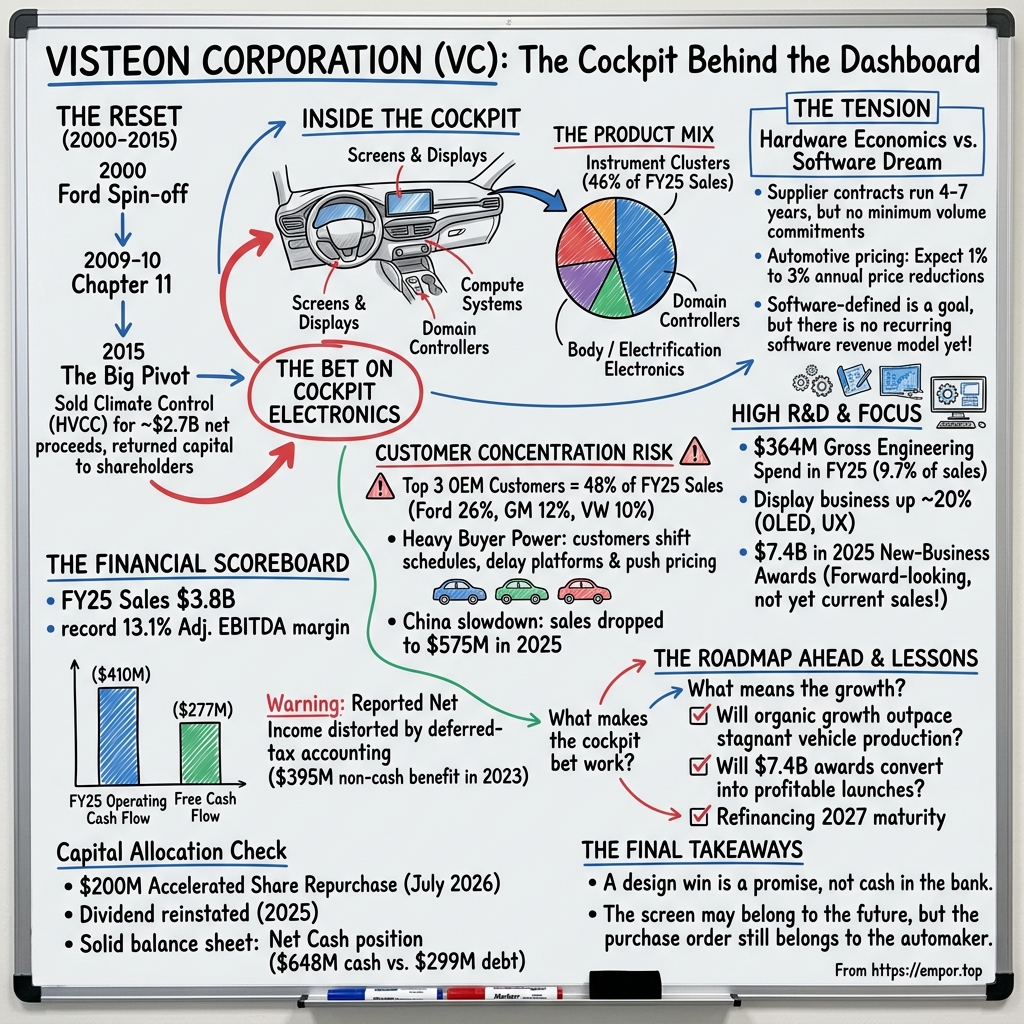
What does Visteon actually put on the plate? The single largest product is the instrument cluster, the display behind the steering wheel that shows speed, range, warnings and navigation prompts. Clusters brought in about $1.75 billion in 2025, roughly 46% of all sales.5 The rest is spread across a set of related products. Infotainment systems run the center-console screen and its apps. Information displays are the glass panels themselves. Cockpit domain controllers are the central computers that can run several screens at once. Body and electrification electronics include the battery-management systems that monitor electric-vehicle batteries. Each of those lines brought in roughly $400 million to $500 million in 2025.5
The cockpit domain controller deserves a moment, because it's the product most often cited when people call Visteon a software-defined-vehicle company. In older cars, each screen had its own small computer: one box for the cluster, another for the radio, another for climate controls. A domain controller replaces several of those boxes with one powerful computer that runs multiple displays and software functions at once, rather like replacing a drawer full of separate gadgets with one smartphone. Visteon markets its version under the SmartCore name.5 If an automaker consolidates the cockpit onto one controller, the supplier of that controller captures a larger share of the electronics bill in each car. That's the content-per-vehicle argument in its purest form.
But technical capability isn't the same as shipped revenue. Domain controllers were about 11% of 2025 sales.5 Meaningful, yes, but still smaller than the cluster business they partly aim to absorb. And the revenue model behind them is identical to the rest of the company: piece prices, per vehicle, with no subscription stream. Visteon discloses no recurring software revenue.5 The software it writes is real, and it's a large part of why its engineering bill is so high. But economically, that software is sold embedded in hardware, and the automaker pays for it once, on the bill of materials, at a price that declines over time.
This is where the popular story and the filings diverge. Visteon is often described as a software-defined cockpit company, and management uses that language. The disclosed revenue model says something narrower. Visteon is an electronics supplier with substantial software and engineering content. "Software-defined" describes the direction the industry is heading and the kind of work Visteon's engineers do. It isn't evidence that Visteon earns software-style recurring economics.
The forward indicator management points to is new-business awards, the estimated lifetime revenue of programs Visteon has won but not yet started shipping. Visteon reported about $7.4 billion of new business awarded in 2025, which management described as a record.8 That figure is worth taking seriously and worth reading carefully. An award is the supplier's estimate of what a program will bring in over its life, based on the automaker's projected volumes. If the automaker builds fewer cars than it projected, or delays the launch, or cancels the program, the award shrinks. If prices fall faster than assumed, it shrinks again. Awards are a promise of work, not cash in the bank.
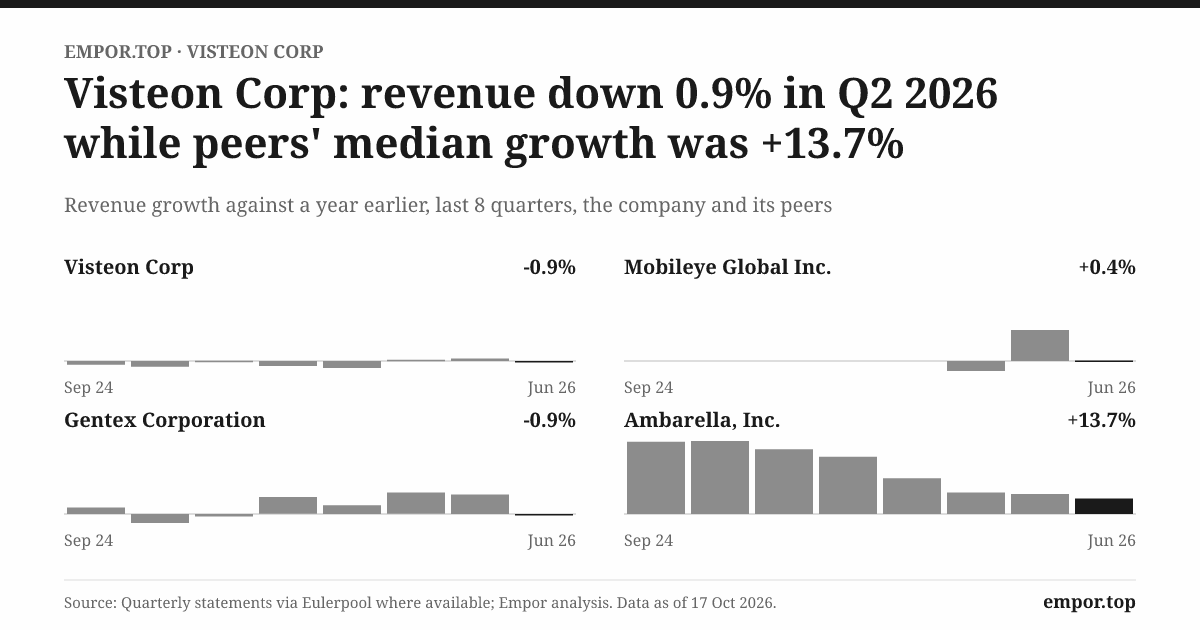
So three questions follow every award announcement. How much converts into actual sales? When do the launches start? And at what margin? Visteon doesn't publish a historical conversion rate for its awards, so investors can't check how earlier announced backlogs turned into revenue. The best test available is the one the income statement provides. Over the decade from 2015 to 2025, despite years of announced wins, revenue grew only about 1.5% a year.5 Awards have clearly kept the business alive and modernized its product mix. They haven't, on the evidence so far, produced sustained growth.
The measure that ties all of this together is content per vehicle. If global production is flat and automakers cut prices 1% to 3% a year, Visteon has to sell more dollars of electronics into each car just to stand still. It has to sell meaningfully more to grow. Every argument about the company, bullish or bearish, eventually becomes an argument about that one rate. And content per vehicle isn't decided by Visteon alone. It's decided by a short list of customers who have every reason to keep that number as low as they can.
IV. The Screen Is the Showcase; the Customer Owns the Schedule
Walk through a Visteon investor presentation and you'll see sweeping curved displays, glowing pillar-to-pillar screens and concept cockpits that look like the bridge of a starship. Walk through its annual report and you find a different picture, written in a single sentence about customers. In 2025, three automakers — Ford, General Motors and Volkswagen — accounted for 48% of Visteon's sales.5 Ford alone was 26%.5 The screens are the showcase. The customers own the schedule.
That concentration is getting higher, not lower. The top three rose from about 43% of sales in 2023 to 48% in 2025.5 Ford's share climbed from about 22% to 26% over the same period.5 A quarter of a century after the spin-off, Visteon's former parent is still its most important customer by a wide margin. Part of that is good news: Visteon has won substantial Ford content on recent programs. Part of it is the mirror image of trouble elsewhere, particularly in China.
To understand Visteon's competitive position, map where it sits. Above it are the automakers, which decide which vehicles get built, how many, and who supplies them. Below it are the chipmakers, display-panel makers and software vendors whose parts and code go into its products. Visteon's job is integration: turning those pieces into a cockpit that passes the automaker's safety, durability and cost tests, and producing it reliably for years. That role creates value, but it also leaves Visteon squeezed from both directions. It can't set the volumes above it, and it can't easily dictate the costs of the semiconductors below it.
The competitive field is crowded and much of it is larger. Bosch, Continental, Denso and Aptiv are giant diversified suppliers with cockpit or electronics businesses inside much broader portfolios. Harman, owned by Samsung, competes hard in infotainment and digital cockpits. Marelli competes in displays and electronics. And Chinese suppliers, led by 德赛西威 Desay SV, have become formidable in their home market. Comparing whole-company revenue would be misleading, because most of these rivals sell brakes, powertrains, sensors or consumer audio alongside cockpit products. What matters is that, in each of Visteon's product lines, there are several credible alternatives an automaker can call.
So does Visteon have a moat? The evidence for technical relevance is real. Visteon keeps winning programs, and its record award year in 2025 shows automakers still trust it with new cockpits.8 Its display business grew about 20% in 2025 while total sales fell, which suggests products customers actively want.8 Rating agencies cite leading positions in digital clusters and domain controllers.5 But a moat needs more than relevance. It needs evidence that customers stay when they could leave, that Visteon wins a rising share of competitions, and that it can hold prices. Visteon doesn't disclose customer retention rates, win-loss rates or the expected margins on new awards. Without those, the case for durable advantage rests mainly on management's framing and on the awards themselves.
Put buyer power in concrete terms. Ford, GM and Volkswagen can move a future program to another supplier when the current one ends. They can delay a platform launch by a year, leaving Visteon with engineering costs already spent and no revenue to cover them. They can negotiate annual price cuts and settle commercial disputes at year-end. Each of them is many times Visteon's size. A supplier earning a large share of its revenue from three such buyers has, almost by definition, limited pricing power.
The receivables tell a related story, and one that's easy to misread. At the end of 2025, GM accounted for about 18% of Visteon's trade receivables while contributing only 12% of sales.5 Ford was the reverse, around 12% of receivables on 26% of sales.5 Volkswagen was roughly in line, 11% of receivables on 10% of sales.5 Does GM pay slowly? The receivables share points to longer payment terms or timing of collections at GM relative to Ford. It doesn't, on its own, show credit deterioration. Visteon doesn't publish an aging schedule or name specific overdue balances, so the gap can't be traced to late payments. And the company's bad-debt allowance was only about $9 million against more than $600 million of receivables, with essentially no new provision in 2025.5 The sensible reading is that these are slow but solvent payers whose terms tie up working capital, rather than a collection problem.
The broader working-capital picture is improving, though it hasn't fully healed. Debtor days, which measure how long it takes to collect a typical sale, peaked at 87 in 2020, when pandemic shutdowns scrambled every automaker's payment cycle, and had fallen to 66 by 2025.5 That is real progress. But cash is also tied up elsewhere. Visteon carried about $40 million of contract assets for reimbursable pre-production engineering at the end of 2025, plus about $113 million of long-term capitalized commercial-contract payments, money paid to customers in connection with winning or keeping business.5 Those payments are a quiet tell about bargaining power. In this industry, suppliers sometimes pay to play.
The China Problem
The sharpest test of Visteon's competitive position isn't in Detroit. It's in China. Visteon's China sales fell from about $950 million in 2023 to roughly $575 million in 2025.5 In two years, close to 40% of the business disappeared. The cause is the fastest market-share shift the auto industry has seen in decades. Domestic Chinese automakers such as 比亚迪 BYD, 吉利 Geely and 小米 Xiaomi took share from the foreign joint-venture brands that were Visteon's traditional customers in China, and those domestic automakers tend to buy from domestic electronics suppliers.
Visteon has said plainly that its content per vehicle on Chinese domestic automaker platforms is structurally lower than on Western legacy platforms.5 Read that sentence twice, because it cuts against the growth thesis. The fastest-growing automakers in the world are building cars where Visteon either isn't present or earns fewer dollars per car. Winning business with them may help diversify the customer list, but it may not help content per vehicle. And as those Chinese automakers expand into Europe, Southeast Asia and Latin America, they bring their own supplier ecosystems with them. China is both a lost market and a preview of the competition coming to Visteon's other markets.
One more relationship needs clarifying, because it sometimes confuses people new to the company. Visteon holds 50% of Yanfeng Visteon Investment, a Chinese joint venture with 延锋 Yanfeng, accounted for as an unconsolidated affiliate.5 It isn't a parent company, and nothing about it suggests hidden control of the listed business. Dealings with affiliates are small and disclosed: billings to affiliates were about $35 million in 2025, under 1% of sales, and purchases from them were about $19 million.5 The joint venture is carried at zero on Visteon's books, with Visteon under no obligation to fund its losses.5 There is no tunneling story here. If anything, the joint venture's diminished value is another sign of how hard China has become for foreign-linked suppliers.
The verdict from this war-game is straightforward. Visteon has a focused portfolio, good momentum in displays and a credible award pipeline. Those facts establish that automakers want its products. They don't establish a moat, because the buyers are powerful, the rivals are numerous, and the evidence that would prove durable advantage — retention, share gains, price realization — isn't published. Which raises the obvious follow-up: if the moat isn't proven, what exactly is Visteon spending all that engineering money to build?
V. The Engineers Behind the Display
Visteon's real factory isn't only the plant floor in Mexico, Portugal or India. It's the engineering center, where thousands of people write cockpit software, validate display designs, test controllers against temperature extremes and work through the safety certifications a dashboard computer must pass. The company employed about 10,500 people at the end of 2025, spread across Europe, the Americas, Asia and China.5 A large share of the company's spending goes not into steel or plastic but into those people's time.
The size of that spending is the first thing to grasp. In 2025, Visteon's gross engineering expense was about $364 million, close to a tenth of sales.5 It had risen from about $330 million in 2023, even as sales declined.5 For a hardware assembler, that would be extraordinary. For a cockpit-electronics supplier, it's the cost of staying relevant. Every new vehicle program needs custom software, custom graphics and custom integration work, and the automaker expects it to be ready years before the first car ships.
Some of that bill is paid back. Automakers often reimburse suppliers for program-specific engineering, either directly or through the piece price. Visteon recovered about $144 million from customers in 2025, which brought net engineering expense down to about $220 million, or roughly 5.8% of sales.5 That net figure is the more honest measure of what Visteon itself is investing. It's still substantial, and it rose from about 4.9% of sales in 2024.5 Visteon is spending more of its own money on engineering at the very moment revenue is shrinking.
Add the factories. Capital expenditure was about $133 million in 2025, roughly 3.5% of sales.5 Together, net engineering and capex take up about 9% of revenue every year. That makes Visteon more engineering-intensive than a simple component maker, but it isn't asset-light. It still needs surface-mount production lines, display-assembly clean rooms, launch teams and inventory. The economics combine the cost structure of a software house with the capital needs of a manufacturer, while the pricing comes from neither: it comes from the automaker.
What's the evidence that this spending is turning into a business? The strongest clue is displays. Information displays grew about 20% in 2025, while overall sales fell.8 Management highlighted wins in OLED displays, a premium technology in which each pixel emits its own light and that allows thinner, curved and higher-contrast screens, along with new cockpit-domain-controller programs.8 On the Q2 2026 call, management again pointed to display launches and new programs as the source of its outperformance against customer production.9 Those are genuine commercial proof points. But they have to be separated from what they aren't yet: recognized revenue across many years at proven margins.
In May 2025, Visteon made one small acquisition to deepen its engineering bench. It bought a user-experience electronics engineering and consumer-research business for $55 million in cash, plus up to $9 million of contingent payments.5 That's tiny relative to a company with $3.8 billion of sales, and the logic is clear enough. As cockpits become more screen-driven, automakers care more about how drivers actually interact with them, and a supplier that can bring consumer research to the design table has more to offer. But Visteon hasn't disclosed the acquired business's revenue or earnings, so there's no way to say whether $55 million was cheap or expensive. It's a capability purchase whose value will show up, or not, in future program wins.
There is a downside mechanism hiding inside all of this. Engineering costs are largely fixed in the short term. You can't send home half of your software team because one automaker delayed a launch by six months, not without losing the very people who make you competitive. So when vehicle volumes and sales fall, engineering doesn't fall with them. Margins get squeezed from the bottom up. That's precisely what the 2026 quarters have shown: revenue roughly flat to slightly down, while operating margins slipped from close to 10% a year earlier to between about 6% and 8%.7 Rising engineering on falling sales is either an investment in tomorrow's content or a fixed cost the business can't earn back. Right now, the evidence can't fully tell those two apart.
The test going forward is visible and simple. Watch display growth, program launches and the margins that follow as awards convert to shipments. If engineering spending is building a content advantage, net engineering as a share of sales should eventually stabilize while revenue grows. If revenue keeps sliding while engineering climbs, the spending is closer to an entry fee for staying in the game. Either way, the answer will arrive through the income statement. The trouble is that Visteon's income statement has been one of the least reliable guides in the auto-parts industry.
VI. The Tax Gain That Made a Bad Year Look Like a Great One
Imagine reading Visteon's 2023 annual results cold. Net income attributable to shareholders came in at roughly half a billion dollars, the highest since the HVCC year.10 Earnings per share were around $17.10 On a revenue base of about $4 billion, that implies a net margin above 12%, the kind of figure you'd expect from a premium software company, not a cockpit supplier fighting annual price-downs. Something didn't fit.
The answer was a tax accounting entry. When a company has lost money in the past, it accumulates tax losses and credits that can reduce future tax bills. Accounting rules let it record those future savings as an asset, but only if it's confident it'll earn enough profit to use them. Until then, the asset sits behind a "valuation allowance," a reserve that keeps it off the books. Visteon, given its history of losses, had carried such an allowance against its U.S. deferred tax assets for years. In 2023 it concluded that profits were now reliable enough and released most of it. That produced a non-cash U.S. deferred tax benefit of about $395 million.5 Not a dollar of cash came in the door. But reported earnings soared.
A smaller benefit of about $71 million followed in 2024.5 Then, in 2025, the direction reversed into a deferred tax provision of about $55 million.5 And the story took one more twist. Effective at the end of 2025, Visteon changed the method it uses to decide how much of those U.S. deferred tax assets it can realistically use, switching from an "incremental cash tax savings" approach to a "tax-law-ordering" approach.5 The change was applied retroactively, which means the 2023 and 2024 figures were restated.
That restatement creates a trap for anyone comparing years. Under the retroactively adjusted statements in the 2025 annual report, net income attributable to Visteon was about $568 million in 2023, $296 million in 2024 and $201 million in 2025.5 Many data services still show the earlier, as-originally-reported figures for 2023 and 2024, about $486 million and $274 million.1011 Both sets are "real," but they rest on different accounting bases. For any year-on-year comparison, the restated 2025 annual report is the right source, and the label matters as much as the number.
Strip the tax noise away and the operating picture is much clearer. Profit before tax, which is unaffected by the valuation-allowance swings, rose from about $257 million in 2023 to about $338 million in 2025.5 Operating cash flow tells a similar story: about $267 million in 2023, $427 million in 2024 and $410 million in 2025.5 After capital spending, free cash flow was about $290 million in 2024 and $277 million in 2025.5 That's the more trustworthy gauge of what the business generates. For a company with a market value around $2.5 billion, it amounts to a free-cash-flow yield of roughly 6%.
Why did cash jump in 2024 and hold up in 2025? Part of the answer is genuine operating improvement: higher underlying margins and tighter cost control. Part of it is working capital. In 2024, working capital released about $38 million of cash; in 2023 it consumed about $72 million.5 Those swings can make one year look better than the next without any change in the underlying business. Warranty payments matter too. Visteon paid about $30 million to settle warranty claims in 2025, up from about $17 million in 2023.5 And cash taxes rose in 2025 as the company's U.S. tax position normalized.5 One year's conversion ratio, in other words, isn't a structural fact. It's a reading that will move with launches, warranty claims and taxes.
The long view needs the same care. Add up Visteon's results from 2014 through 2025, using standard data-provider series, and you get about $3.5 billion of cumulative net profit against about $2.8 billion of cumulative operating cash flow.53 A quick reader would conclude that one in five dollars of reported profit never showed up as cash. But that comparison mixes in two events that were never supposed to produce operating cash. The roughly $2.3 billion HVCC gain arrived as investing cash flow, because it came from selling a business.3 And the 2023–24 tax benefits arrived as no cash at all. Take those two out, and the operating business has, if anything, converted profit into cash rather well in recent years.
That's the verdict. Visteon's recent cash generation is solid, and reported net income is a poor guide to it. Investors should anchor on pre-tax profit, operating cash flow and free cash flow, and should treat any headline net-income figure from 2015, 2023 or 2024 with suspicion until they've checked what drove it. What remains genuinely open is the future: how much free cash the business generates once cash taxes are fully normalized and the current warranty and working-capital patterns settle. The fiscal 2026 and 2027 cash-flow statements will answer that question. Meanwhile, a related question has already been answered in part, by what management chose to do with the cash it has.
VII. The Cash Returned, the Cash Kept, and the New Buyback
On July 23, 2026, Visteon reported its second-quarter results and, in the same announcement, unveiled a $200 million accelerated share repurchase.12 An accelerated repurchase works like a buyback paid up front: the company hands a bank the money, the bank delivers a large block of shares almost immediately, and the final count is settled over the following months. It's a statement of conviction, or at least of preference. Of all the things Visteon could have done with $200 million, management chose to shrink the share count, and to do it quickly.
To weigh that choice, you need the full capital-return history. After the HVCC sale, Visteon paid its roughly $1.7 billion special dividend in 2016 and bought back stock steadily.5 For most of the following decade it paid no regular dividend at all. In March 2023 the board authorized a $300 million repurchase program running through 2026, and by the end of 2025 only about $74 million of it remained.5 In the third quarter of 2025, Visteon reinstated a regular quarterly dividend of $0.275 per share.5 By June 2026, cumulative treasury stock, the accounting record of shares bought back over the years, stood at about $2.4 billion.7 Shares outstanding fell from about 28.2 million at the end of 2022 to about 26.7 million by mid-2026.7
Now put the new buyback against the balance sheet. At the end of June 2026, Visteon held about $648 million in cash against about $299 million of funded debt, and its $400 million revolving credit line was untouched.7 That's a net cash position of roughly $350 million, down from about $470 million at the end of 2025.75 The $200 million repurchase will reduce it further. Visteon can clearly afford it. The question is whether the balance sheet is being run for resilience or for returns, and the honest answer is that it's tilting toward returns.
One correction belongs here, because a headline figure in many data feeds overstates Visteon's debt. Standard databases show "borrowings" of about $540 million at the end of 2025.5 That number mixes funded financial debt with other obligations, most notably operating lease liabilities of about $130 million.5 Funded debt — the term loan Visteon actually borrowed from banks — was about $301 million at year-end.5 It carries a floating rate, amortizes slowly, and matures in July 2027.5 Leases are real obligations, but they're the rent on offices and plants, not borrowings that need refinancing.
Here's the skeptical investor's question, the one an activist would put to the board. Over a decade, revenue has grown about 1.5% a year.5 The company spends close to 10% of sales on gross engineering. It's losing share in China and depending more on three customers. If the growth problem is real, why spend $200 million on stock rather than on software capability, new platforms or acquisitions that could expand content per vehicle? Management's implicit answer is that the stock is cheap relative to the cash the business produces, and that engineering is already funded from operations. That might be right. But the decision makes visible how management currently weighs return of capital against reinvestment.
The man making that call has run the company for more than a decade. Sachin Lawande became chief executive in June 2015, the same month the HVCC sale closed.3 An electrical engineer by training, he came from Harman, where he had led its infotainment business, so he arrived as an electronics insider rather than a traditional auto-parts operator. That background shows in the company he built: one focused almost entirely on the digital cockpit, with engineering as its center of gravity. His tenure also includes the trough of 2020, the semiconductor-shortage scramble of 2021 and 2022, and the margin recovery since. Few auto-supplier CEOs have run one strategy, at one company, for this long.
His pay has risen with the company's adjusted profitability. Lawande's reported compensation was about $16.8 million in 2025, up from about $9.3 million in 2021.13 Most of it came in stock: restricted stock units and performance shares, with the performance awards tied partly to adjusted EBITDA and relative total shareholder return.13 He owned about 1.6% of the company on a beneficial basis, including stock units and exercisable options.13 Shareholders have endorsed the package: the 2026 say-on-pay vote passed with about 95% support.14 The board has an independent chair, Francis Scricco, and seven of eight directors are independent.13
The incentives cut both ways. Meaningful equity ownership aligns Lawande with shareholders, and relative TSR targets reward him for beating peers rather than for riding the market. But an incentive plan built heavily on adjusted EBITDA rewards operational targets, cost control and margin, without directly testing whether growth investments earn attractive returns. And buybacks raise per-share metrics mechanically. None of that implies bad faith. It does mean shareholders can't rely on the pay plan to answer the reinvestment question for them.
On acquisitions, the record is too thin to judge. The $55 million user-experience engineering purchase in 2025 was a modest bolt-on.5 There's no evidence of a failed acquisition in the recent record, and also no meaningful acquisition history to assess. Discipline can't be inferred from one small deal.
Credit agencies, at least, like what they see. S&P raised Visteon to BB+ in August 2025, and Moody's raised it to Ba1 in December 2025, each one notch below investment grade.5 Both cited net cash, solid margins and free cash flow, and both flagged customer concentration and production cyclicality as the limits.5 Those upgrades support financial flexibility. But credit strength is a measure of how safely a company can repay debt, not of how well it can grow. A business can be an excellent credit and a mediocre compounder at the same time. The real question is whether Visteon's operating results deserve the confidence the balance sheet implies.
VIII. The Margin Record Behind the "Resilient" Story
In 2025, global light-vehicle production grew about 4%.8 Visteon's sales fell about 3%.5 On the Q4 2025 call, management nonetheless described a year of outperformance: against production at its key customers, adjusted for currency and commodity pass-throughs, Visteon said new launches and displays had helped it outgrow the market that actually mattered to it.8 Both statements can be true at once. Together, they capture the central tension in Visteon's recent record.
Why did revenue fall in a growing market? Management named three reasons.8 Lower commodity recoveries meant automakers reimbursed Visteon less for raw-material and chip costs as those costs eased, which reduced reported sales without necessarily hurting profit. China weakness removed hundreds of millions of dollars of revenue. And demand for battery-management systems fell as electric-vehicle programs slowed. Some of that is benign accounting, some is cyclical, and some is structural. The China loss in particular doesn't look like a temporary dip.
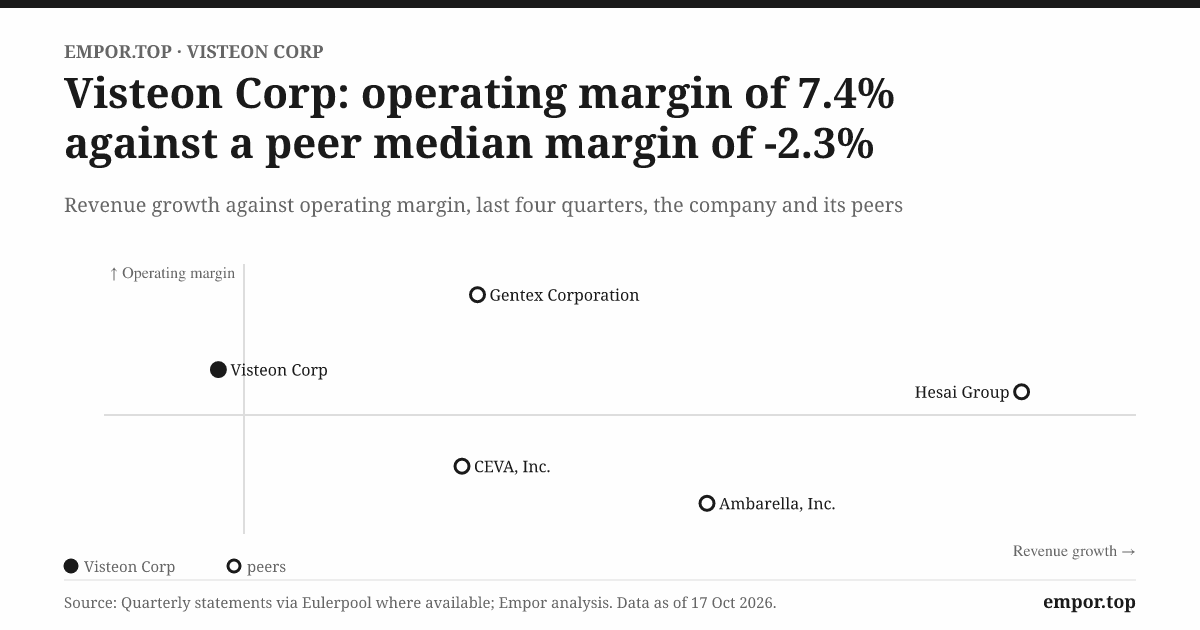
The counterpoint is margin. Visteon reported a record adjusted EBITDA margin of about 13.1% for 2025, despite lower sales.8 GAAP operating margin rose to about 8.8%, from about 3.4% in 2024.5 That's affirmative evidence of execution. Visteon cut costs, improved mix and squeezed more profit out of each dollar of sales. But it raises an obvious question: which gains will last? Cost control and favorable mix can be sustained. One-time customer recoveries and commercial settlements, the payments automakers make to compensate suppliers for volume shortfalls or cost increases, can't. Visteon's 2025 results included such settlements, and the auditor flagged them as a judgment area.5
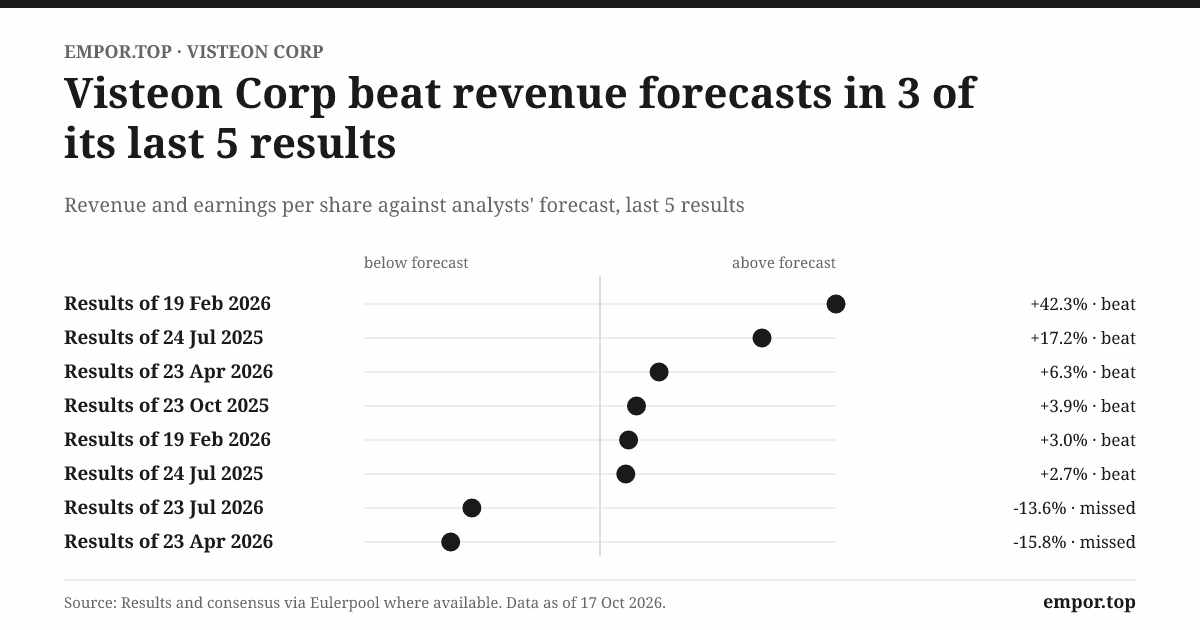
The 2026 quarters have offered a partial answer. Operating margins fell back to about 6% in the first quarter and about 7.6% in the second, down from close to 10% a year earlier, even though revenue was roughly flat.7 On the Q2 2026 call, analysts pressed on precisely this gap between steady sales and weaker profits, and management pointed to launch costs, engineering investment and tariff and pricing effects, while reaffirming its focus on margins for the year.915 The answers were specific enough to be checkable, which is to management's credit. But the sequence matters: 2025's record margin looks, in hindsight, partly flattered by recoveries that didn't repeat at the same level.
Then there's warranty, the quiet cost of complexity. As cockpit electronics take over more of a car's functions, a software glitch or display defect can trigger costly field fixes. Visteon's warranty and recall reserve rose to about $107 million at the end of 2025, from about $71 million two years earlier.5 In 2025 it provisioned about $47 million and paid out about $30 million.5 When a company adds to its reserve faster than it pays claims, either it's being prudent about new launches or it's seeing a rising claims trend that will become cash later. Visteon doesn't say which programs drive the increase. The trend deserves watching against launch activity.
The auditor's report adds context without alarm. Deloitte issued a clean, unqualified opinion on the 2025 financial statements.5 It identified two critical audit matters, the areas where auditors had to exercise the most judgment: non-routine customer pricing adjustments, and the change in the method for assessing deferred tax assets.5 Critical audit matters aren't findings of error. They tell investors where the numbers depend most on management's estimates. In Visteon's case, those are precisely the two areas this story has already flagged: what customers pay at year-end, and how the tax line is built.
The remaining legal exposure is modest. In Brazil, labor and tax claims total about $45 million, with about $6 million accrued.5 The long-running dispute over bonds tied to Visteon's former headquarters in Van Buren Township, Michigan, was settled in 2023 for $12 million and dismissed with prejudice.5 Neither is material relative to the company's cash.
If you could track only three numbers to know whether Visteon is working, they would be these. The first is organic sales growth against customer production. In 2025 that gap was positive by management's measure, but total revenue still fell. The second is adjusted EBITDA margin, which reached a record of about 13.1% in 2025 and has been under pressure in 2026. The third is free cash flow after working capital and cash taxes, which was about $277 million in 2025, slightly down from 2024.5 Resilient margins and cash are real achievements. But outperformance isn't the same as growth, and a company can beat its customers' production for years while still shrinking. That brings the story to its central question.
IX. What Would Make the Cockpit Bet Work?
Every few weeks, a Visteon press release announces another win: a new display program with a European automaker, a cockpit controller for an Asian brand, an OLED screen for a premium model. Each one arrives with the same implied message: the company is winning. An investor reading it has to decide what it actually proves. Technical relevance? Future revenue? Durable pricing power? The answer determines whether Visteon is a growth story the market is missing or a capable cyclical supplier priced about right.
The Case For and the Case Against
Start with the bull case, argued at its strongest. Cars will carry more screens and more computing per vehicle for years. Instrument clusters are going fully digital. Center displays are getting larger. Passenger displays are moving from luxury to mainstream. Domain controllers are consolidating dozens of small computers into a few powerful ones. If Visteon captures a fair share of that shift, its content per vehicle can rise even if global production stays flat. The bull has evidence: displays grew about 20% in 2025, the company booked a record $7.4 billion of awards, and margins reached records despite falling sales.8 Add a net-cash balance sheet, and the bull sees a company whose product cycle is turning just as its financial risk has disappeared.
Now the bear case. Revenue grew only about 1.5% a year from 2015 to 2025.5 It fell in 2024, in 2025 and in the twelve months to June 2026.57 Every year of announced wins in that decade was offset by price-downs, lost programs, China and cycles. The structure that produced that result hasn't changed. Piece-price contracts still cap pricing. Ford, GM and Volkswagen still take nearly half the sales. Chinese suppliers are still cheaper and are following Chinese automakers abroad. To the bear, content gains are real but they're being competed away before they reach the bottom line.
The industry structure explains why both sides can sound right. Buyer power is the dominant force: a handful of automakers control programs, volumes and sourcing, and Visteon's top three customers prove the point. Rivalry is intense, with large diversified suppliers and fast-rising Chinese players bidding for the same programs. Supplier power is meaningful too, because chipmakers like the ones that rationed semiconductors in 2021 and 2022 can squeeze margins from below. Switching costs exist: once a cockpit is designed around one supplier's hardware and software, changing mid-program is expensive and risky. But switching costs end when the program ends, and automakers re-bid the next generation. Visteon doesn't disclose its re-win rate, so there's no way to measure how sticky its incumbency really is. Substitutes are real as well. Some automakers, including Tesla and several Chinese brands, design cockpit computers in-house, and others buy reference designs that reduce the supplier's role. Threat of new entrants is moderate: automotive qualification is slow and demanding, but well-funded Chinese and consumer-electronics firms have shown they can clear it.
Hamilton Helmer's 7 Powers framework sharpens the verdict. Scale economies exist in engineering, since spreading a software platform across many programs lowers its cost per car, but Visteon is smaller than Bosch, Continental or Harman in electronics, so scale doesn't obviously favor it. Network effects are absent; a cockpit isn't more valuable because other automakers use the same supplier. Counter-positioning is weak; incumbents can and do copy Visteon's architecture. Switching costs are present but bounded by program life. Brand matters to the automaker's engineering team, not to the driver, who has never heard of Visteon. Cornered resource is hard to find: no unique patent estate or exclusive supply is disclosed. Process power, the accumulated know-how of launching cockpits on time, at quality and at cost, is probably Visteon's most credible power, and its margin record supports it. Put together, the evidence suggests a competent specialist with real execution capability, not a company protected by a strong structural moat.
The software-defined vehicle deserves its own scrutiny, because it's the growth vector most often invoked. The idea is that cars become platforms whose features are updated and sold over the air, like phones. If that happens, the value in the cockpit could shift toward software. But the value could shift to the automaker, which owns the customer relationship and the software subscription, rather than to the supplier, which is paid once per unit. Visteon has no disclosed recurring software revenue.5 So the right way to track this vector is through shipped units, revenue, margins and repeat awards for domain controllers and software-heavy systems. Demonstrations and technical milestones don't count as proof.
The capital-allocation record adds one more data point to the case. It includes the large return of HVCC proceeds, years without a regular dividend, consistent buybacks, a small capability acquisition and now a $200 million accelerated repurchase.512 That's a coherent pattern: return excess cash and fund the strategy from operations. It's also a pattern that hasn't produced growth. Whether that's prudence or missed opportunity depends on a counterfactual nobody can test.
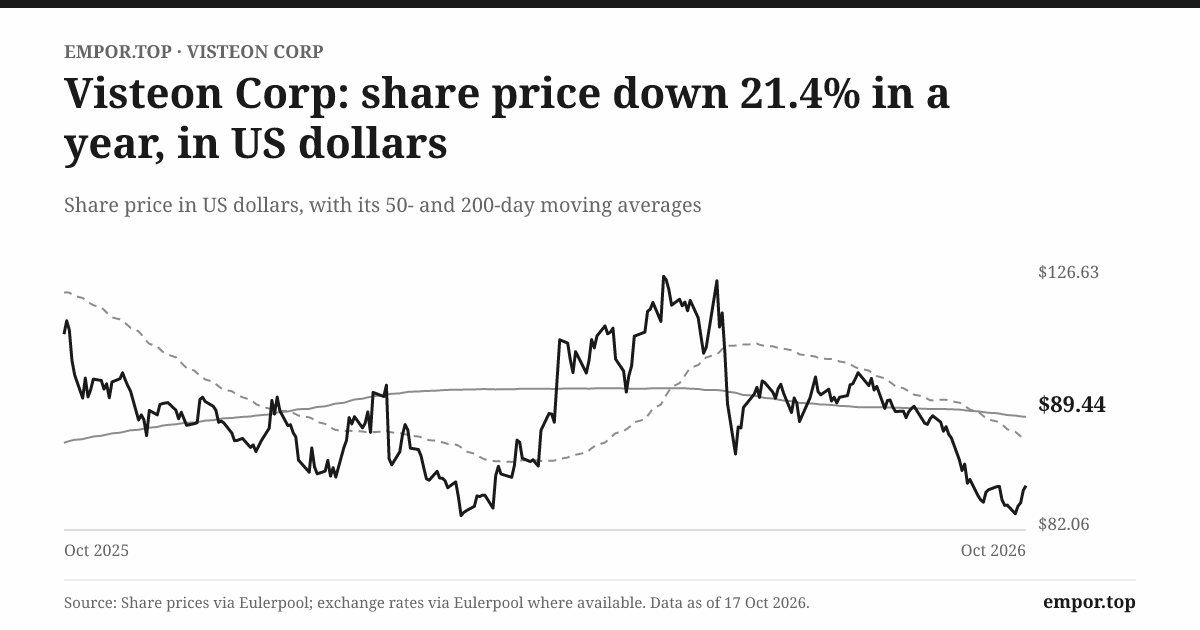
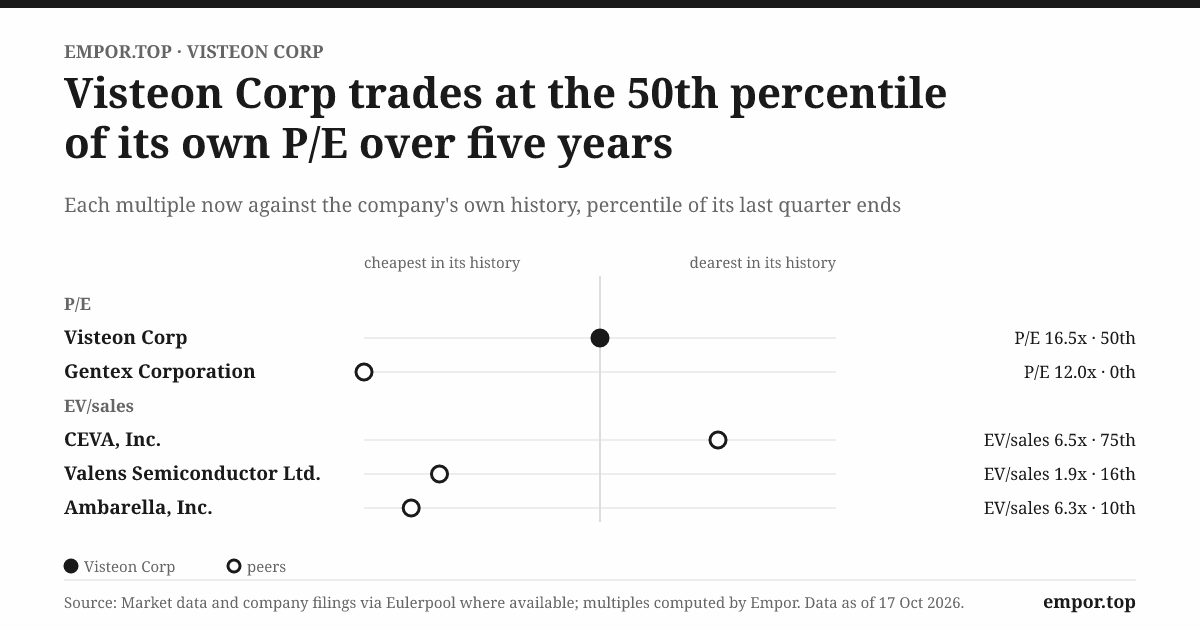
How does the market price all of this? At about $89 a share in mid-October 2026, Visteon traded at roughly 16.5 times trailing earnings, close to its five-year median of about 16.8.5 Its enterprise value was about 5.8 times EBITDA, in the range typical of large auto suppliers and nowhere near the multiples given to software companies.5 Its free-cash-flow yield was about 6.4%. In plain terms, the market prices Visteon as what its filings describe: a cyclical electronics supplier with a clean balance sheet. That valuation assumes cash generation holds roughly where it is. It doesn't assume a growth breakout. And it's down about 28% from its 52-week high, a reminder of how quickly sentiment can shift on a quarter's margins.5
So what would prove the bulls right? Four things, measurable in the next few annual reports. Organic growth sustained above vehicle production, enough to return sales above $4 billion. Continued display growth that comes with profitable launches, not margin-diluting ones. A falling share of sales from the top three customers, achieved by winning new customers rather than by losing old ones. And free cash flow above about $250 million a year under normalized cash taxes. If those happen, the evidence for a content-driven growth story will be strong. If they don't, the bear's reading of the decade will be confirmed.
Two gaps will limit confidence either way. Visteon doesn't publish a numerical aging schedule for its receivables, and it doesn't publish customer retention or win-loss data. Without them, claims about collection quality and switching costs remain inference rather than measurement. On the current evidence, Visteon is a capable specialist with financial resilience. Sustained growth and a strong moat aren't yet established. Which makes the history of this company more instructive than any single quarter.
X. Lessons from a Company That Sold Its First Bet
There's a particular image worth holding onto from the summer of 2015. Billions of dollars arrived from the sale of HVCC. Visteon could have done almost anything with that money. It could have bought a software company, an electronics competitor, a display maker. Instead it gave most of the money back and kept the smaller business it believed in. Eleven years later, that decision still frames what Visteon is and what it isn't. The lessons from it belong to this company and no other.
The first lesson is about portfolio focus. Selling the old business can create focus; it can't create a growth engine by itself. Visteon's sale of HVCC turned a sprawling Ford spin-off into a coherent cockpit-electronics company, and focus did deliver things that matter: better margins, cleaner execution, a sharper identity with customers. But the revenue line since 2015 shows that focus didn't automatically produce growth. Founders and boards who break up a company to unlock value should remember both halves. The market rewards the clarity on announcement day. It only rewards the growth once it shows up.
The second lesson is about awards. A design win is a promise of work, not cash in the bank. Visteon's $7.4 billion of 2025 awards is a real signal that automakers want its cockpits.8 But an award is a forecast built on someone else's production plan, at a price that will decline every year, with margins the supplier doesn't publish. Investors in any business that sells into long programs — aerospace, defense, automotive, enterprise software — should translate every backlog announcement into three questions: when does it ship, how much survives, and at what margin?
The third lesson is about returning capital. Cash returned is real; cash earned again is the test. The HVCC special dividend and the buybacks since were tangible money in shareholders' hands, and nobody should dismiss that. But a company that keeps handing back cash has to keep generating it, and Visteon's case now rests on whether the electronics business can produce something like $250 million or more of free cash a year, every year, through cycles. The 2026 accelerated repurchase is a bet that it can.
The fourth lesson is the one that sits at the heart of this story. A software story still has to survive a hardware contract. Visteon spends close to a tenth of sales on engineering and talks the language of the software-defined vehicle. Its products really are full of software. But its contracts still price that work per unit, per car, with annual price-downs and no minimum volumes. Until those economics change, the label on the company matters less than the terms on the purchase order. Whatever an industry says about its future, investors should follow the contracts.
Visteon's next lesson isn't written yet. It depends on whether all that engineering converts into profitable shipments. And the moments that decide it are already on the calendar.
XI. The Next Two Model Years
Tonight, Visteon stands at a recognizable point in the auto-supplier cycle. Its sales run at about $3.8 billion a year, roughly where they stood in 2022.5 It has a display pipeline its customers clearly want, a $200 million accelerated buyback underway, about $299 million of funded debt and a term loan maturing in July 2027.712 The balance sheet buys time. It doesn't answer the growth question. Over the next two model years, a series of results days and filings will.
The first thing to watch is whether new programs lift sales above the flat base of the past decade. A return above $4 billion of annual revenue, driven by launches rather than by one-time recoveries or commodity pass-throughs, would be the clearest sign that content per vehicle is finally outrunning price-downs. If revenue stays near $3.8 billion while awards pile up, the gap between promised and delivered business will become impossible to ignore.
The second is the product mix. Watch displays and cockpit domain controllers. If they keep growing faster than the company and carry healthy margins as they ramp, the strategy is working. If they grow but margins fall during launches and never recover, Visteon will have bought growth at the cost of returns.
The third is the customer map. China sales and the top-three customer share will show whether Visteon can diversify away from its largest legacy customers. A falling top-three share driven by new wins with Asian, Indian or Chinese automakers would answer one of the bear's sharpest objections. A falling share driven by losing Ford or GM programs would be the opposite.
The fourth is cash. Free cash flow after cash taxes, working capital and rising warranty payments has to hold up for the capital-return story to be sustainable. Investors should check that the buyback is funded by free cash flow, not by drawing down the cushion or borrowing.
The fifth is financing. The July 2027 term-loan maturity is a milestone, not a crisis. With cash exceeding funded debt and an untouched revolver, refinancing should be routine.7 But the terms Visteon gets, and whether it chooses to carry more debt alongside buybacks, will reveal how management now thinks about leverage.
Finally, there's management's own credibility. Its 2026 guidance, set out at the February results and revisited on the Q2 call, should be compared against what's delivered when the full-year figures arrive in early 2027.89 The Q2 call's mix of steady sales and softer profit already gave analysts a reason to probe.1516 Whether the second half closes that gap will say a great deal about how well management reads its own business.
Each of these outcomes points toward one of two futures. In one, Visteon becomes what it has long promised: a cockpit specialist whose content gains finally show up as growth. In the other, it stays a disciplined, cash-generative supplier running hard to stand still. Both futures are respectable. Only one is a growth story. The tension that remains is that, from the outside, the two look almost identical until the revenue line decides.
XII. Outro
Go back to that dashboard from the opening scene. The cluster glows, the center screen wakes up, the driver taps an icon and the car responds. It all feels like software, smooth, updatable and endlessly improvable. Behind the glass sits something far older: a vehicle program chosen years ago, a supplier contract with a price that falls every year, and an automaker's production schedule that can change on a Monday morning.
Visteon spent a quarter century getting to this seat. It shed the many kinds of parts it made as Ford's offshoot, survived bankruptcy, sold its climate business and staked everything on the interface between driver and car. That bet gave it focus, margins and a clean balance sheet. What it hasn't yet given it is control. About 46% of its sales still come from instrument clusters, its adjusted margins are respectable but not software-like, and its revenue has grown about 1.5% a year over a decade.5 The opportunity is to make the cockpit worth more in every car. The constraint is that someone else decides how many cars get built and what each cockpit costs.
The screen may belong to the future; the purchase order still belongs to the automaker.
References
-
Visteon Corp Form 10-12B/A (Spin-off Registration Statement) — SEC, 2000-05-19 ↩↩
-
Visteon Corporation 2015 Special Distribution and Share Repurchase Announcement — SEC, 2015 ↩↩↩
-
Visteon Corporation 2025 Form 10-K — SEC, 2026-02-19 ↩↩↩↩↩↩↩↩↩↩↩↩↩↩↩↩↩↩↩↩↩↩↩↩↩↩↩↩↩↩↩↩↩↩↩↩↩↩↩↩↩↩↩↩↩↩↩↩↩↩↩↩↩↩↩↩↩↩↩↩↩↩↩↩↩↩↩↩↩↩↩↩↩↩↩↩↩↩↩
-
Visteon Corp Form S-1/A (Chapter 11 Reorganization Registration) — SEC, 2010-12-22 ↩
-
Visteon Corporation Q2 2026 Form 10-Q — SEC, 2026-07-23 ↩↩↩↩↩↩↩↩↩↩
-
Visteon Q4 2025 Earnings Call Transcript — The Motley Fool, 2026-02-19 ↩↩↩↩↩↩↩↩↩↩↩↩
-
Visteon Corporation Q2 2026 Earnings Call Transcript — Seeking Alpha, 2026-07-23 ↩↩↩
-
Visteon Corp Form 10-K for Fiscal Year Ended December 31, 2023 — SEC, 2024-02-20 ↩↩↩
-
Visteon Corp Form 10-K for Fiscal Year Ended December 31, 2024 — SEC, 2025-02-18 ↩
-
Visteon Corporation Q2 2026 Financial Results and Accelerated Repurchase — Visteon, 2026-07-23 ↩↩↩
-
Visteon Corporation 2026 Definitive Proxy Statement — SEC, 2026-04-28 ↩↩↩↩
-
Visteon Corporation 2026 Annual Meeting Voting Results — SEC, 2026-06-15 ↩
-
Visteon Q2 2026 earnings call transcript — Investing.com, 2026-07-23 ↩↩
-
Visteon Q2 2026 Earnings Results and Call Transcript — MarketBeat, 2026-07-23 ↩
 LinkedIn
 WhatsApp
 Reddit
 Hacker News
 Email
 Kindle
 RSS Feed
 Spotify
 Apple Podcasts
 Amazon Music
 Audible
 YouTube