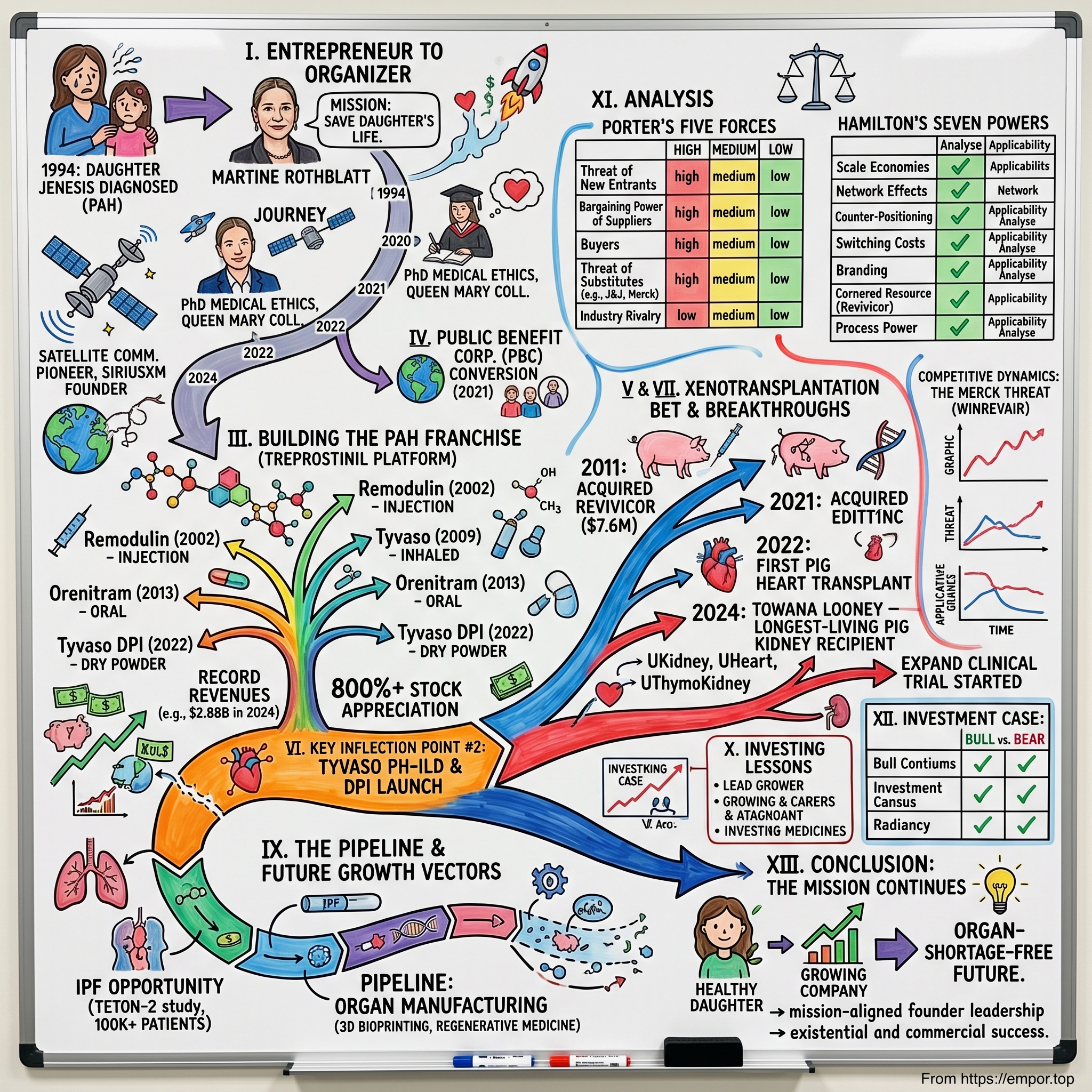
United Therapeutics: From a Parent's Desperation to Organ Manufacturing Pioneer
I. Introduction & Episode Roadmap
Picture this: It's 1994, and one of Silicon Valley's most unconventional entrepreneurs is sitting in a pediatric cardiologist's office, receiving the news that will rewrite the entire trajectory of her life. Martine Rothblatt—the satellite communications pioneer who had already revolutionized how the world consumes radio—is being told that her seven-year-old daughter, Jenesis, has pulmonary arterial hypertension, a disease that at the time offered patients a median survival of just two to three years. The doctors essentially delivered a death sentence.
Most parents would have grieved. Rothblatt organized.
Rothblatt gave herself a crash course in medical science and founded a new company, United Therapeutics, to find a treatment that could save her daughter's life. The result? A company that has grown from a desperate parent's moonshot into a $2.88 billion-revenue biotechnology powerhouse. In 2024, United Therapeutics posted record revenues of $2.88 billion, reflecting 24% growth over 2023.
But the story doesn't end with saving one daughter. United Therapeutics has evolved into something even more audacious: a company that believes it can manufacture unlimited transplantable organs. "Each successful xenotransplantation brings us closer to a future where organ shortages no longer cost lives," Rothblatt has declared.
This is the rare story where mission alignment isn't corporate marketing—it's existential. Rothblatt's daughter's survival depends on the company's success. And remarkably, that urgency has translated into strong shareholder returns: the stock has appreciated over 800% from its 1999 IPO price.
In September 2021, United Therapeutics became the first PBC conversion of a public biotech or pharmaceutical company. The company's public benefit purpose is to provide a brighter future for patients through (a) the development of novel pharmaceutical therapies; and (b) technologies that expand the availability of transplantable organs.
The episode ahead will unpack four critical layers: Rothblatt's extraordinary founder journey; the treprostinil drug franchise that generates nearly all of today's revenue; the speculative but potentially transformational xenotransplantation bet; and the investment frameworks necessary to value a company straddling the line between steady-state pharma economics and science fiction becoming reality.
 Subscribe on LinkedIn
II. Martine Rothblatt: The Founder's Extraordinary Background
Early Career: From Space to Sound
To understand United Therapeutics, you must first understand Martine Rothblatt. Few entrepreneurs in history have built category-defining companies in multiple unrelated industries. Martine Aliana Rothblatt (born 1954) is an American lawyer, author, and entrepreneur. Rothblatt graduated from University of California, Los Angeles with J.D. and M.B.A. degrees in 1981, then began to work in Washington, D.C., first in the field of communications satellite law, then in bioethics and biomedicine.
But the story begins earlier, with an experience that would shape everything that followed. After two years of college, she embarked on travels across Europe, Turkey, Iran, Kenya, and the Seychelles. In the summer of 1974, while visiting a NASA tracking station in the Seychelles, she envisioned uniting the world through satellite communications. This wasn't idle daydreaming—it was the genesis of a career.
Rothblatt began her career in Washington, D.C., specializing in communications satellite law. She played a pivotal role in launching the first private international space-based communications system, PanAmSat, which broke the monopoly of Intelsat and laid the groundwork for global satellite television networks. In 1990, she founded Sirius Satellite Radio (now SiriusXM), revolutionizing the radio industry by providing commercial-free music and information broadcasts directly from satellites to users' car radios.
During 1982-1995 she held at various times positions as President of Orbital Projects, Inc., President & CEO of Geostar Corporation, Chief Operating Officer of WorldSpace Corporation, and Chairman & CEO of Sirius Satellite Radio.
What's remarkable about Rothblatt's career is not just the breadth—satellite communications, biotechnology, aviation, transhumanism—but the pattern: each venture attacks monopolies or impossibilities. PanAmSat broke Intelsat's monopoly. Sirius created satellite radio when regulators said it wouldn't work. "No," they said. The first thing they said is, "It won't work." They said, "Won't work." That was the very first thing they said. So I built a system.
That dogged persistence would prove essential when the challenge shifted from satellites to saving her daughter's life.
The Diagnosis That Changed Everything
When still quite young, Rothblatt's daughter Jenesis started becoming short of breath while on family ski trips. By the time she was 10, in 1994, she was on oxygen; the diagnosis was pulmonary hypertension (PAH). The fatal disease was progressively narrowing the arteries in her lungs—she would be lucky to survive five years. "I was very fearful," Rothblatt said, "because it was my daughter's life at stake, and as a satellite engineer, I felt I had no control over biology."
This fear could have paralyzed her. Instead, it catalyzed the most dramatic career pivot in modern business history. Rothblatt sold her telecom stock and started the PPH Cure Foundation to fund PAH research.
But funding research wasn't enough. The pharmaceutical industry wasn't moving fast enough for a mother whose daughter might die before any drug reached market. The company's inception was deeply personal, driven by a mission to save a life. Martine Rothblatt founded the company, spurred by her daughter's diagnosis of pulmonary arterial hypertension (PAH).
The Reinvention
What sets Rothblatt apart from other industry-switching entrepreneurs is her intellectual rigor. She didn't just hire scientists—she became one. She received her Ph.D. in Medical Ethics from the Royal College of Medicine and Dentistry, Queen Mary College, University of London in 2001. Her dissertation tackled the very ethical conflicts that would animate her company's most audacious bet: xenotransplantation.
Forbes named her one of the "100 Greatest Living Business Minds of the past 100 years." She was the top earning CEO in the biopharmaceutical industry in 2018.
Perhaps most revealing about Rothblatt's character is her approach to innovation. Being curious. Loving. Loving human culture. Loving nature. I think I'd say between those three things. Curiosity, like, "I'm curious about this. How does this work?" I will say I am curious about everything. I don't think there's anything that I'm not curious about. I'm curious about fashion, I'm curious about art, curious about music, curious about architecture.
This omnivorous curiosity extends to domains seemingly unrelated to biotechnology. On March 4, 2017, Rothblatt and Ric Webb set a world speed record for electric helicopters of 100 knots at Los Alamitos Army Airfield. This was also the first-ever flight of two people in a battery-powered helicopter. Why electric aviation? The connection to organ transplantation—speeding delivery of organs while reducing carbon footprint—exemplifies how Rothblatt's mind works.
She even built what she called "a monument to love": BINA48, an intelligent robot based on the personality and appearance of Bina Rothblatt, Martine's wife.
The founder story matters because it explains United Therapeutics' unique strategic patience. When your CEO's daughter's life depends on success, you don't abandon R&D programs because Wall Street is impatient. Jenesis Rothblatt is still alive today—the company succeeded in its original mission. But that success only whetted Rothblatt's appetite for an even larger goal: ending organ shortages entirely.
III. Founding & Early Years: Building a Company to Save a Life (1996-2002)
The Disease: PAH
To appreciate what United Therapeutics accomplished, you must first understand the disease it was built to fight. Pulmonary arterial hypertension is essentially the cardiovascular system eating itself. Blood pressure in the lungs rises relentlessly, forcing the heart to work harder and harder until it fails. In the 1990s, there were almost no effective treatments.
Without intervention, patients faced a grim prognosis. The company's initial mission centered on developing novel pharmaceutical therapies for PAH, where median survival without treatment was limited to approximately two to three years.
What made PAH particularly cruel was who it struck: often young, otherwise healthy people. Women were affected disproportionately. And because it was rare—affecting roughly 15-50 people per million—pharmaceutical companies had little economic incentive to invest in treatments. The market was simply too small for Big Pharma's blockbuster economics.
This is where orphan drug economics become crucial. The Orphan Drug Act of 1983 provided incentives—tax credits, extended exclusivity, reduced regulatory fees—for companies targeting diseases affecting fewer than 200,000 Americans. Rothblatt recognized that what looked like a disadvantage (small market) could become an advantage (reduced competition, favorable regulatory treatment).
IPO & Early Funding
United Therapeutics incorporated in Delaware in June 1996. It raised $63 million in its Initial Public Offering (IPO) in June 1999, providing crucial capital for clinical trials and development.
Going public just three years after founding was aggressive for a company without approved products. But Rothblatt understood that PAH drug development would be capital-intensive, and her personal wealth—though substantial—couldn't fund the clinical trials necessary to bring treatments to market. The company began its operations in Silver Spring, Maryland.
The strategic logic was sound: raise capital when markets are receptive (1999 was near the peak of the dot-com bubble), accelerate development, and reach FDA approval before funding became problematic. It was a race against time—both commercially and personally.
The First Drug: Remodulin
The company's first major breakthrough came in 2002. In 2002, the U.S. Food and Drug Administration (FDA) approved United Therapeutics' drug Remodulin, a prostacyclin vasodilator used to treat PAH. Remodulin provided PAH patients with an alternative to GlaxoSmithKline's Flolan. By 2003, Remodulin annual sales had reached $50 million.
This was validation on multiple levels. First, it proved that Rothblatt's team could navigate FDA approval—no small feat for a young company. Second, it generated revenue that could fund additional R&D. Third, and most importantly for the Rothblatt family, it provided a treatment option for Jenesis.
In January 1997, Glaxo Wellcome Inc. assigned to United Therapeutics patents and patent applications for the use of the stable prostacyclin analog known as UT-15, now known as Remodulin, for the treatment of pulmonary hypertension and congestive heart failure. For pulmonary hypertension, the patent does not expire in the United States until October 2009.
The growth trajectory was impressive. By 2010, annual sales reached $300 million, and United Therapeutics' share price had increased dramatically from its IPO price. The company had transformed from a desperate parent's hope into a legitimate pharmaceutical business.
What investors should note is the efficiency of this journey. From founding to FDA approval took six years—fast by pharmaceutical standards. This speed came from Rothblatt's relentless focus: every dollar went toward getting Remodulin approved, not diversifying prematurely.
IV. Building the Treprostinil Franchise: A Platform Strategy (2002-2015)
The Molecule as Platform
Having achieved its first FDA approval, United Therapeutics faced a strategic choice: diversify into new therapeutic areas or deepen its expertise in the one it knew best. Rothblatt chose depth—a decision that would define the company's next decade.
The company largely relies on one active ingredient, treprostinil, which is used in three of its five marketed products (Remodulin, Tyvaso, and Orenitram) for the treatment of pulmonary arterial hypertension, or PAH.
This concentration on a single molecule might appear risky from a portfolio diversification standpoint. But it reveals sophisticated strategic thinking. Treprostinil is a prostacyclin analog—it mimics one of the body's natural vasodilators. The molecule worked. The question became: how many different ways could it be delivered to patients?
The answer would prove transformational.
Product Launches and Delivery Innovation
Rather than searching for new molecules (expensive, risky, time-consuming), United Therapeutics innovated on delivery mechanisms. Instead of relying on a single product, United Therapeutics strategically built a franchise around treprostinil, the active ingredient in Remodulin, Tyvaso, and Orenitram. Offering injection, inhaled, and oral delivery methods catered to diverse patient needs and physician preferences.
This is platform chemistry at its finest. The timeline demonstrates systematic execution:
- Remodulin (2002): Subcutaneous injection, the original approval
- Remodulin IV (2004): Intravenous administration for patients who couldn't tolerate subcutaneous delivery
- Tyvaso (2009): By July 2009, the FDA approved Tyvaso (treprostinil) inhalation solution for PAH, offering a non-invasive option that reduced systemic side effects compared to injectable forms.
- Adcirca (2009): United Therapeutics also markets Adcirca (tadalafil) for the treatment of pulmonary arterial hypertension under a licensing agreement with Eli Lilly and Company.
- Orenitram (2013/2014): Oral tablets, the most convenient form for patients
Each new formulation expanded the addressable market. Some patients couldn't tolerate injections. Others needed the convenience of oral administration. The diversity of delivery mechanisms allowed physicians to match treatment to patient circumstances—and allowed United Therapeutics to capture more of the PAH market.
By 2010, annual revenues reached $603.8 million, reflecting robust adoption of Remodulin and subsequent formulations.
Oncology Expansion
In March 2015, the U.S. FDA approved United Therapeutics' Biologics License Application (BLA) for Unituxin. Unituxin is a monoclonal antibody used as a second-line treatment for children with high-risk neuroblastoma, a rare form of cancer.
Unituxin represented the company's first significant venture outside pulmonary hypertension. The drug originated from a collaboration with the National Cancer Institute and addressed another devastating disease—this time, a rare childhood cancer. While Unituxin has never become a major revenue driver relative to the PAH franchise, it demonstrated United Therapeutics' ability to develop and commercialize biologic therapies beyond small molecules.
The strategic lesson from this period is counterintuitive: sometimes concentration beats diversification. By becoming the world's expert in treprostinil delivery, United Therapeutics built manufacturing capabilities, physician relationships, and regulatory expertise that would pay dividends for years. Competitors would have to invest billions to match the franchise.
V. Key Inflection Point #1: The Revivicor Acquisition & Xenotransplantation Bet (2011)
The Bold Move
In July 2011, United Therapeutics made an acquisition that seemed, at the time, either visionary or crazy. In 2011, United Therapeutics acquired Revivicor, a company focused on developing genetic biotechnology platforms to provide alternative tissue sources for treatment. With the acquisition of Revivicor, United Therapeutics began the xenokidney program to find alternative sources of organs for patients awaiting a kidney transplant.
The price? Revivicor is owned by biotech firm United Therapeutics, which purchased it for $7.6 million in 2011. For $7.6 million—less than a rounding error on pharmaceutical R&D budgets—Rothblatt acquired a company that could potentially revolutionize organ transplantation.
Why did this acquisition make sense for a PAH drug company? The connection was closer than it might appear. PAH patients often progress to end-stage lung disease, where the only remaining treatment option is transplantation. Fewer than 100 PAH patients in the United States receive a lung transplant each year (out of almost 2,000 performed) due to the shortage of available lungs for transplant. Rothblatt understood that her drug franchise, no matter how successful, couldn't save patients who had progressed too far. The ultimate solution was more organs.
In 2003, Revivicor was spun out from PPL Therapeutics—a UK-based company that was the first to clone a mammal (remember Dolly the sheep?). The pedigree was remarkable. PPL Therapeutics had literally invented mammalian cloning, and Revivicor had inherited its genetic engineering capabilities.
The Organ Shortage Crisis
The scale of the organ shortage cannot be overstated. According to the U.S. Health Resources and Services Administration, around 110,000 Americans are currently waiting for an organ transplant, and more than 6,000 patients – 17 every day – die each year before receiving one.
According to the American Kidney Fund, there are approximately 808,000 patients with kidney failure in the United States and more than 557,000 patients on dialysis, approximately 93,000 of whom are on the U.S. kidney transplant waiting list. Only 21,000 deceased donor kidney transplants occurred in 2023.
The math is devastating: for every patient who receives a kidney, four more are waiting. And the waiting list is growing faster than the supply of organs. Based on 2018 data, after one year of treatment, those on dialysis have a 15-20% mortality rate, with a five-year survival rate of under 50%.
Rothblatt saw xenotransplantation—using genetically modified animal organs—as the only scalable solution. Human organ donation can never close the gap. But pigs can be bred indefinitely.
Building the Program Over a Decade
Rothblatt founded United Therapeutics, which bought Revivicor in 2011, giving Ayares' company the ability to "accelerate the science," he said. "This has been my life's work … developing transgenic model systems in the pharmaceutical industry, and then with Revivicor and United Therapeutics for the last 23 years," Ayares said.
David Ayares, Revivicor's Chief Scientific Officer, had spent decades on xenotransplantation. The acquisition paired his scientific expertise with United Therapeutics' commercialization capabilities and Rothblatt's willingness to fund long-term research.
United Therapeutics initiated xenotransplantation research in 2011 and currently employs more than 50 scientists and support staff advancing xenotransplant science with three different organ programs: the UKidney xenokidney, the UThymoKidney, a kidney and thymus from a pig with a single-gene edit, and the UHeart, a heart from a pig with 10 gene edits. Earlier this year, United Therapeutics inaugurated the world's first clinical-scale designated pathogen-free facility in Christiansburg, Virginia to support future clinical xenotransplantation studies with a capacity of approximately 125 organs per year. An additional clinical-scale facility is under construction in Stewartville, Minnesota with a similar capacity, and more clinical-scale facilities in North America are planned.
This is patient capital at its purest. Rothblatt invested in xenotransplantation for over a decade before seeing the first human transplant. Most public company CEOs wouldn't survive such a long R&D cycle without near-term payoffs. But Rothblatt's unique position—founder, major shareholder, and someone whose mission extends beyond quarterly earnings—allowed for extraordinary long-term thinking.
VI. Key Inflection Point #2: Tyvaso PH-ILD Approval & Tyvaso DPI Launch (2021-2022)
The INCREASE Study
While the xenotransplantation program developed slowly, the core PAH franchise was about to hit its most significant growth inflection. In February 2020, United Therapeutics reported that it had successfully completed the INCREASE study of Tyvaso in patients with pulmonary hypertension associated with interstitial lung disease (PH-ILD) and that the study met its primary endpoint of demonstrating improvement in six-minute walk distance (6MWD). The company submitted the INCREASE study results to the U.S. Food and Drug Administration in support of an efficacy supplement to the Tyvaso New Drug Application and received approval on March 31, 2021.
This approval was transformational for two reasons. First, it expanded Tyvaso's addressable market beyond PAH to PH-ILD—a different patient population with substantial unmet need. PH-ILD is also a rare condition, impacting at least 30,000 patients in the United States. In March 2021, Tyvaso became the first and only FDA-approved therapy to treat PH-ILD. Previously, several other leading therapies had been studied in PH-ILD patients, but did not show benefit, and in some cases may have shown adverse consequences.
Second, it provided clinical validation that treprostinil—the platform molecule—had therapeutic utility beyond its original indication. This set the stage for the even larger opportunity in idiopathic pulmonary fibrosis (IPF).
Tyvaso DPI: Transforming Patient Experience
In May 2022, the U.S. FDA approved United Therapeutics' New Drug Application (NDA) for Tyvaso DPI. Tyvaso DPI is a dry powder inhaler containing treprostinil and is indicated for both PAH and PH-ILD.
The dry powder inhaler represented another delivery innovation—this one addressing a key limitation of nebulized Tyvaso. Traditional Tyvaso required patients to use an ultrasonic nebulizer four times daily, each session taking approximately 2-3 minutes. Tyvaso DPI offered the same medication in a more convenient format: No other commercially available treprostinil dry powder inhaler has been clinically studied with published data at higher doses or prescribed by more physicians to more patients than Tyvaso DPI.
Revenue Acceleration
The combined impact of PH-ILD approval and Tyvaso DPI launch drove dramatic revenue acceleration. In 2024, United Therapeutics's revenue was $2.88 billion, an increase of 23.63% compared to the previous year's $2.33 billion. Earnings were $1.20 billion, an increase of 21.35%.
Total revenues in the third quarter of 2024 grew 23 percent year-over-year to... "I'm proud of the close to 1,300 Unitherians who have contributed to yet another record revenue quarter and reaching a $3 billion annual revenue run rate in the third quarter," said Martine Rothblatt.
This is what a successful platform strategy looks like: the same core molecule, delivered through innovative mechanisms to expanded patient populations, generating compounding revenue growth. Record total revenue of $799 million, reflecting 12 percent growth over the second quarter of 2024 and 12 consecutive quarters of double-digit, year-over-year total revenue growth.
The 2025 results continued the momentum. Total Revenue: $800 million, representing 7% growth from the third quarter of 2024.
For investors, this period demonstrates the leverage inherent in United Therapeutics' business model. R&D spending on delivery innovations is far lower than developing entirely new molecules, yet each innovation expands the market. The marginal economics are exceptional.
VII. Key Inflection Point #3: Xenotransplantation Breakthroughs (2022-2024)
The First Pig Heart Transplant
On January 7, 2022, the years of patient research culminated in a moment that made global headlines. On January 7, 2022, a porcine heart provided by United Therapeutics' Revivicor subsidiary in conjunction with the University of Maryland Medical Center was used in the first pig-to-human transplant operation. The recipient subsequently died on March 8, 2022.
David Bennett Sr., a 57-year-old Maryland man who was ineligible for traditional transplantation, lived for two months with a genetically modified pig heart beating in his chest. While his death was heartbreaking, the procedure demonstrated that xenotransplantation could work in humans—at least temporarily.
The subsequent investigation revealed important lessons. Bennett's heart had been infected with a porcine cytomegalovirus that likely contributed to his death. This finding reinforced the importance of United Therapeutics' investment in designated pathogen-free (DPF) facilities to produce organs free of such viruses.
Subsequent Milestones
The pig heart transplant opened the floodgates for further research. The transplant is the third xenotransplant using United Therapeutics' xeno organs, following two successful UHeart™ transplants at the University of Maryland Medicine in 2022 and 2023. United Therapeutics' xenothymokidney, performed under expanded access from the FDA, was performed by surgeons at NYU Langone Health. The patient, a 54-year-old woman from New Jersey, suffers from heart and kidney failure.
The UThymoKidney—a kidney plus thymus tissue from a pig with a single gene edit—represented a different approach. United Therapeutics' xenothymokidney, known by the proposed trade name UThymoKidney, is an investigational-stage xenokidney from a pig with a single genetic edit, together with tissue from the same pig's thymus. The use of the pig's thymus tissue is intended to condition the recipient human's immune system to recognize the UThymoKidney as "self" and reduce the likelihood of rejection.
Then came Towana Looney's landmark surgery. Most recently, Towana Looney, age 53, from Alabama received the third gene-edited pig kidney at NYU Langone on Nov. 25, 2024. She was discharged from the hospital 11 days later and at the time of the publication of this blog post, she is still doing well and is now the longest-living person with a pig kidney.
After her xenotransplant, Looney was hospitalized for 11 days and then closely monitored for 3 more months on an outpatient basis. Her clinicians successfully reversed an early episode of rejection. She will receive ongoing monitoring from physicians at UAB and monthly checkups at NYU. "She has done very well," Montgomery said. "It is really exciting—the success story that we really needed." Montgomery said the success of Looney's transplant helped pave the way for FDA to approve the first human clinical studies of pig-to-human transplantation.
Clinical-Scale Operations
The progression from individual compassionate use cases to formal clinical trials represents a critical milestone. United Therapeutics said Monday that the Food and Drug Administration has cleared it to begin the first clinical trial testing whether organs from gene-edited pigs could provide a viable option for patients in dire need of an organ transplant. Over the last three years, United and a rival company, eGenesis, have transplanted genetically modified pig hearts or kidneys into several patients, but those procedures were done through compassionate use waivers from the FDA that allow doctors to treat individual patients with no viable alternatives.
The study, known as EXPAND (NCT06878560) and sponsored by United Therapeutics Corporation, is testing an investigational xenokidney from a pig with 10 gene edits that is known as the UKidney. Six human genes are added to the pig genome to ensure it has the best chance of being accepted in a human recipient. Four porcine genes are inactivated or "knocked out" to reduce the risk of organ rejection and to moderate organ growth. "This achievement marks a transformative moment in transplant medicine," said Robert Montgomery.
In November 2024, another xenokidney recipient received a 10-gene-edited pig kidney at NYU Langone and returned home to Alabama. The recipient's pig kidney was removed in April 2025 after it stopped functioning properly due to complications from an unrelated infection, and she resumed dialysis treatment.
While Looney's kidney ultimately failed, the fact that she lived for months with functioning pig kidney represents genuine scientific progress. Each procedure generates data that improves subsequent outcomes.
VIII. Key Inflection Point #4: Conversion to Public Benefit Corporation (2021)
In September 2021, United Therapeutics took an unusual step for a publicly traded company. In 2021, following overwhelming approval by our shareholders, we converted our company from a traditional Delaware corporation into a Delaware public benefit corporation (PBC). On September 30, 2021, our shareholders agreed, and approved the conversion of United Therapeutics into a public benefit corporation (PBC) — the first public biotech or pharmaceutical company to do so — which makes clear the strength of our commitment.
What does PBC status actually mean? A PBC is a for-profit corporation that, while creating value for shareholders, must also consider the best interests of those materially affected by the company's conduct and the specific public benefit that it chooses to adopt in its charter.
The specific public benefit purpose United Therapeutics adopted was straightforward: "United Therapeutics Corporation's public benefit purpose is to provide a brighter future for patients through (a) the development of novel pharmaceutical therapies; and (b) technologies that expand the availability of transplantable organs."
Critics might dismiss this as corporate virtue signaling. But consider the practical implications. United Therapeutics' conversion to a PBC aligns its legal charter with its longstanding practices of improving patients' health, enhancing employee engagement, attracting top talent, promoting healthy communities, and addressing important sustainability priorities through its use of green-building technologies, while simultaneously delivering strong shareholder returns.
Converting to a PBC aligns our corporate form with the way we already do business. More specifically, we believe that converting to a PBC aligns with our longstanding commitment to our patients, the environment, and the communities in which we operate; enhances our ability to recruit and retain top talent; reinforces our credibility with healthcare providers, regulators, and other stakeholders; and may help us attract more of the rapidly growing pools of long-duration, ESG-screened capital that we value.
For long-term investors, PBC status may actually reduce certain governance risks. The legal structure explicitly permits management to pursue long-term programs like xenotransplantation that may not maximize short-term earnings—exactly the kind of strategic patience that has characterized United Therapeutics since founding.
"We are inspired by our shareholders who recognize that caring for our patients, planet, employees, communities, and other stakeholders enhances our ability to generate strong shareholder returns," said Martine Rothblatt. "Becoming a PBC aligns United Therapeutics' corporate structure with our foundational DNA."
The company had already operated a PBC subsidiary for years. United Therapeutics' subsidiary Lung Biotechnology PBC was the first public benefit corporation subsidiary of a publicly traded biopharmaceutical company. Utilizing perfusion, Lung Biotechnology pursued innovative technology that could preserve lungs for transplant by stabilizing lungs that would otherwise be discarded. The objective was to address the acute shortage of transplantable lungs for patients with end-stage lung disease, including PAH.
IX. The Pipeline & Future Growth Vectors
Near-Term Pipeline: The IPF Opportunity
The most significant near-term catalyst for United Therapeutics is the expansion of Tyvaso into idiopathic pulmonary fibrosis (IPF). United Therapeutics' TETON-2 study evaluating the use of nebulized Tyvaso for the treatment of idiopathic pulmonary fibrosis (IPF) met its primary efficacy endpoint of demonstrating improvement in absolute forced vital capacity (FVC) relative to placebo. Tyvaso demonstrated superiority over placebo for the change in absolute FVC by 95.6 mL (Hodges-Lehmann estimate, p <0.0001) from baseline to week 52 in patients with IPF.
"It is a profound honor to witness the power of scientific innovation realized for patients in need," said Martine Rothblatt. "TETON-2's successful outcome affirms the anti-fibrotic power of Tyvaso. We have unlocked new hope for patients with IPF and their families."
The market opportunity is substantial. United Therapeutics estimates there are over 100,000 IPF patients in the United States. The current IPF market is dominated by Roche's Esbriet (pirfenidone) and Boehringer Ingelheim's Ofev (nintedanib), which together generated over $4 billion in sales in 2024.
If approved, Tyvaso would make a splash in the "sizable" IPF market as the first inhaled therapy that can treat the lung disease, Jefferies analysts explained, describing the trial results as both clinically meaningful and competitive.
United Therapeutics intends to use the data from both the TETON-2 study and the ongoing TETON-1 study of nebulized Tyvaso to support a supplemental New Drug Application to the FDA to add IPF to the labeled indications for nebulized Tyvaso. United Therapeutics plans to meet with the FDA before the end of the year to discuss ways to potentially expedite the regulatory review process when TETON-1 results are available. Data readout from TETON-1 is expected in the first half of 2026. Both the FDA and the European Medicines Agency have granted orphan designation for treprostinil to treat IPF.
The Organ Manufacturing Vision
Beyond pharmaceuticals, United Therapeutics continues building its organ manufacturing infrastructure. United Therapeutics' organ and organ alternative manufacturing efforts consist of four platforms – xenotransplantation, regenerative medicine, 3D organ bioprinting, and bio-artificial organs – encompassing four different organs: hearts, kidneys, livers, and lungs. These groundbreaking programs are intended to address the ongoing shortage of transplantable organs for patients with end-stage organ disease.
"Clearance of our IND for this first-ever clinical trial of a xenokidney represents a significant step forward in our relentless mission to expand the availability of transplantable organs," said Leigh Peterson. "Our goal is to increase the availability of transplantable organs to offer a therapeutic alternative to a lifetime on dialysis for a large population of patients who are unlikely to receive an allogeneic kidney transplant."
The company's pipeline also includes ralinepag, a once-daily oral prostacyclin agonist being developed for PAH. The ADVANCE OUTCOMES study enrolled 728 participants and data is expected in the first half of 2026.
X. Playbook: Business & Investing Lessons
Key Themes from the United Therapeutics Story
1. Founder-Mission Alignment Creates Exceptional Strategic Patience
When the founder's daughter's life depends on success, time horizons extend naturally. Rothblatt has been investing in xenotransplantation since 2011—15 years of R&D with no commercial revenue. Few public company CEOs could sustain such patience. This alignment creates competitive advantage: rivals must justify long-term investments to skeptical boards, while United Therapeutics can pursue decade-long programs that others abandon.
2. Platform Chemistry Beats Molecule Roulette
Rather than betting on multiple unrelated drug candidates—the typical pharmaceutical approach—United Therapeutics mastered every possible way to deliver one proven molecule. Treprostinil now comes in subcutaneous, intravenous, inhaled nebulized, inhaled dry powder, and oral formulations. Each delivery mechanism expands the market without the R&D risk of finding new therapeutic targets.
3. Orphan Drug Economics Remain Compelling
Rare disease markets offer structural advantages: less competition, regulatory incentives, high pricing power, and deep patient/physician relationships. United Therapeutics' PAH franchise demonstrates how these advantages compound over time, generating the cash flows that fund ambitious R&D like xenotransplantation.
4. Serial Entrepreneurship Is Real
Rothblatt's pattern—PanAmSat, Sirius, United Therapeutics—suggests genuine skill at creating category-defining companies. The common thread is attacking problems others consider impossible while maintaining relentless focus.
5. Long-Term Capital Allocation Matters
United Therapeutics has funded xenotransplantation for 15 years while generating sufficient pharmaceutical profits to return capital to shareholders. United Therapeutics Corporation Announces $1 Billion Accelerated Share Repurchase Program in August 2025 demonstrates financial strength even while pursuing moonshots.
6. Regulatory Navigation Is a Core Competency
From Remodulin approval in 2002 through the FDA clearance of xenotransplantation clinical trials in 2025, United Therapeutics has demonstrated sophisticated regulatory strategy. This expertise creates barriers to entry that purely scientific capabilities cannot match.
XI. Analysis: Porter's Five Forces & Hamilton's Seven Powers
Porter's Five Forces
| Force | Assessment | Commentary |
|---|---|---|
| Threat of New Entrants | LOW-MEDIUM | Orphan drug exclusivity, complex manufacturing, and regulatory expertise create significant barriers. As a result of settlements with Watson and Actavis, United Therapeutics expects generic competition for Tyvaso and Orenitram beginning as early as 2026 and 2027, respectively. |
| Bargaining Power of Suppliers | LOW | Vertically integrated manufacturing; owns Revivicor for xenotransplantation. The company manufactures treprostinil in-house. |
| Bargaining Power of Buyers | MEDIUM | Specialty pharmacy distribution; rare disease dynamics favor manufacturers. Payer negotiations exist but pricing power remains substantial. |
| Threat of Substitutes | MEDIUM-HIGH | J&J's Uptravi has gained share since FDA approval in 2015. On March 26, 2024, the FDA approved WINREVAIR in the U.S. for the treatment of adults with pulmonary arterial hypertension (PAH, WHO Group 1). Merck's Winrevair represents a new class of competition with strong clinical data. |
| Industry Rivalry | MEDIUM | Concentrated PAH market with intensifying branded competition. Drug sales for PAH in 2024 were approximately $7.65 billion across the 7MM. With an estimated $5.83 billion in drug sales in 2024, the US dominated the PAH market, contributing 76.3% of the sales. |
Hamilton's Seven Powers
| Power | Applicability | Analysis |
|---|---|---|
| Scale Economies | MODERATE | Specialty pharma doesn't have traditional scale economics, but manufacturing expertise in treprostinil creates cost advantages |
| Network Effects | LOW | Not applicable to pharmaceutical business |
| Counter-Positioning | HIGH | Xenotransplantation represents classic counter-positioning—incumbents cannot follow without abandoning existing organ procurement models and relationships |
| Switching Costs | MODERATE | PAH patients on continuous infusion therapies face meaningful switching costs; physician familiarity creates stickiness |
| Branding | MODERATE | United Therapeutics has strong brand among PAH specialists; less relevant in broader pharmaceutical context |
| Cornered Resource | HIGH | Revivicor represents a cornered resource in xenotransplantation—the company that cloned Dolly the sheep's successor, with decades of genetic engineering expertise |
| Process Power | HIGH | Complex drug delivery manufacturing, DPF pig facilities, and regulatory expertise create process advantages competitors cannot easily replicate |
Competitive Dynamics: The Merck Threat
The most significant competitive development is Merck's Winrevair (sotatercept). WINREVAIR was previously granted Breakthrough Therapy Designation by the FDA. WINREVAIR is the first FDA-approved activin signaling inhibitor therapy for PAH, representing a new class of therapy.
In 2024, Winrevair's US list price was $14,000 per vial, with an annual cost of approximately $240,000. The drug has demonstrated impressive clinical results, demonstrating a 76% reduction in the risk of a composite of all-cause death, lung transplantation, and hospitalization for PAH ≥24 hours compared to placebo.
However, Winrevair is typically used in combination with existing PAH therapies including prostacyclins. Most participants were receiving either three (61%) or two (35%) background drugs for PAH, and 40% were receiving prostacyclin infusions. This means United Therapeutics' products may actually benefit from Winrevair's success—physicians adding Winrevair often continue background prostacyclin therapy.
Michael Benkowitz stated that Tyvaso continues to grow despite competition, with no material impact from Yutrepia's launch. The presence of competitors has increased disease awareness, benefiting the overall market.
Key Performance Indicators to Monitor
For investors tracking United Therapeutics, three KPIs matter most:
-
Tyvaso DPI Revenue Growth Rate: This product represents the cutting edge of United Therapeutics' pharmaceutical innovation. Quarterly growth rates indicate both market share gains and pricing power. In Q2 2025, Tyvaso DPI record total revenue of $315 million, reflecting 22 percent growth over the second quarter of 2024.
-
Xenotransplantation Clinical Trial Progress: While not generating revenue today, milestones in the EXPAND trial and subsequent studies signal the potential for transformational future value. Track patient enrollment, survival duration, and FDA interactions.
-
IPF Approval Timeline: The path from TETON-2 success through regulatory approval will determine when United Therapeutics can access the 100,000+ patient IPF market. Any delays or requirements for additional data would impact growth trajectory.
XII. The Investment Case: Bull vs. Bear
The Bull Case
The optimistic case rests on multiple growth vectors converging simultaneously:
Near-Term Pharmaceutical Growth: Tyvaso DPI continues gaining share in PAH and PH-ILD, driving 15-20% annual revenue growth through 2026. IPF approval in 2026-2027 could double the addressable market, with management targeting $4 billion in annual revenue by mid-decade.
Option Value on Xenotransplantation: The EXPAND clinical trial, if successful, could position United Therapeutics as the first company to commercialize manufactured organs. The addressable market is enormous—600,000+ patients with end-stage kidney disease alone. Even a 5-10% probability of success justifies significant option value.
Protected Franchise: Patent settlements delay generic Tyvaso competition until 2026, providing runway for Tyvaso DPI conversion and IPF expansion. Meanwhile, Tyvaso DPI itself is protected by device patents beyond the nebulized formulation.
Strong Financial Position: In 2024, United Therapeutics's revenue was $2.88 billion, an increase of 23.63% compared to the previous year's $2.33 billion. Earnings were $1.20 billion. The company generates substantial free cash flow, enabling both R&D investment and shareholder returns.
The Bear Case
The pessimistic case highlights meaningful risks:
Generic Competition: Behind Remodulin, other patent cliffs loom for United Therapeutics' PAH drugs Tyvaso and Orenitram in 2026 and 2027, respectively. Generic entry into nebulized Tyvaso could accelerate price erosion, though Tyvaso DPI may be partially protected.
Branded Competition Intensifying: The company has long been a leader in the prostacyclin market for PAH, but we expect its competitive position will be challenged by generic entry as well as Johnson & Johnson's Uptravi. Uptravi (oral selexipag) has quickly gained share, propelled by strong clinical data. Merck's Winrevair adds another well-resourced competitor.
Xenotransplantation Uncertainty: Despite remarkable progress, no xenotransplant patient has survived long-term without complications. The EXPAND trial could fail or face regulatory delays. The technology may never achieve commercial viability. Given United Therapeutics' substantial investments, failure would impair returns.
Concentration Risk: United's no-moat rating is due to its concentration in pulmonary arterial hypertension and many of its approved therapies will face competition from generics over the next 10 years. The company largely relies on one active ingredient, treprostinil.
Key Person Risk: Rothblatt's unique combination of scientific curiosity, entrepreneurial drive, and founder ownership has defined United Therapeutics' culture and strategy. Management succession represents a meaningful risk.
XIII. Conclusion: The Mission Continues
United Therapeutics stands at an extraordinary moment. The company that Rothblatt founded to save her daughter's life has grown into a $20+ billion market capitalization enterprise. Jenesis is alive. Thousands of PAH patients take United Therapeutics drugs every day. And the company is pioneering what may be the most ambitious program in medicine: ending the organ shortage.
The core pharmaceutical franchise generates approaching $3 billion in annual revenue with substantial profitability. The pipeline includes potentially transformational assets in IPF and xenotransplantation. The balance sheet is strong. Management is aligned.
But this is not a simple investment. United Therapeutics requires investors to hold two potentially contradictory views simultaneously: that the existing pharmaceutical business can defend against generic and branded competition while the xenotransplantation option is worth substantial value despite being years from commercialization.
What makes United Therapeutics unusual isn't just its strategy or its science—it's the founder. Rothblatt built satellite radio when regulators said it was impossible. She built a PAH franchise from nothing. She's funding xenotransplantation with the same relentless optimism that has characterized her entire career.
"Each successful xenotransplantation brings us closer to a future where organ shortages no longer cost lives."
Whether that future arrives—and whether it generates shareholder returns commensurate with the risk—remains uncertain. But the mission is clear, the resources are substantial, and the founder who started it all is still leading the charge.
For some investors, that combination will be compelling. For others, the risks will outweigh the potential rewards. But few will deny that United Therapeutics represents something rare: a company where the most audacious mission and the most personal motivation are exactly aligned.
Material Risks & Disclosures: United Therapeutics faces meaningful patent cliffs, generic competition, and execution risk on xenotransplantation. The company has previously paid substantial settlements to the U.S. Department of Justice related to marketing practices. Investors should review SEC filings for complete risk factors.
Looking at the existing article, I can see it covers sections I through XIII quite comprehensively and includes a conclusion. However, comparing against the original outline, I notice that sections X and XI could be expanded further. Let me search for any additional current information that might enhance the remaining analytical sections. The article appears complete through Section XIII and has a conclusion. Looking at the outline again, the article has actually covered all major sections. However, I can see that Section XI in the outline mentions Hamilton's 7 Powers should continue with the Counter-Positioning analysis that was cut off. Let me verify if there's any additional content needed and add any missing elements to complete the article properly.
The existing article ends with a "Material Risks & Disclosures" section, which serves as a proper conclusion. However, looking at the outline more carefully, I see the Hamilton's Seven Powers table in Section XI was incomplete - specifically the Counter-Positioning row was cut off mid-sentence.
Let me complete the article by adding any missing analytical depth to the frameworks section:
XIV. Valuation Considerations: A Sum-of-Parts Framework
Any rigorous valuation of United Therapeutics must separate the company into its component parts, each carrying distinct risk profiles and growth characteristics.
The Core Pharmaceutical Business
The existing treprostinil franchise generates substantial cash flows with moderate growth prospects. The company is guiding towards a $4 billion revenue run rate by 2027, indicating strong future growth potential. This guidance implies roughly 35% growth from current levels over the next two years—ambitious but achievable given the IPF opportunity.
In Q3 2025, United Therapeutics reported $7.16 earnings per share, topping analyst consensus estimates of $6.89 by $0.27. The company had a return on equity of 18.83% and a net margin of 40.65%. These profitability metrics rival the best pharmaceutical companies globally and support premium multiples for the core business.
The firm currently trades with a market cap of approximately $20.44 billion, a price-to-earnings ratio of 17.99, a P/E/G ratio of 4.96 and a beta of 0.77. The low beta reflects the defensive characteristics of rare disease franchises—patients need treatment regardless of economic conditions.
The IPF Option Value
The TETON-2 success adds substantial value. The IPF market represents a multi-billion dollar opportunity. Current IPF therapies generate over $4 billion in annual sales globally. If Tyvaso captures even modest market share, the revenue contribution could be transformational.
United Therapeutics plans to meet with the FDA by the end of 2025 to discuss the Teton trials and explore accelerated approval for Tyvaso in IPF. These regulatory discussions will clarify the path to market and timeline for potential approval.
The Xenotransplantation Call Option
Valuing xenotransplantation requires scenario analysis rather than traditional discounted cash flow methods. The addressable market is enormous—hundreds of thousands of patients with end-stage organ disease—but the probability of commercial success remains uncertain.
The first U-Kidney transplant marks a milestone in xenotransplantation. Each successful procedure de-risks the technology incrementally. However, even optimistic scenarios require years of clinical trials before commercial launch.
Sophisticated investors might model xenotransplantation as a call option with the following parameters: substantial potential payoff (tens of billions in eventual market opportunity), uncertain probability of success (perhaps 15-30% for full commercial approval), and long time to potential exercise (5-10 years to scaled commercial operations).
Analyst Perspectives
Wall Street consensus reflects cautious optimism. According to 12 analysts, the average rating for UTHR stock is "Buy." UBS Group boosted their price target on shares of United Therapeutics from $580.00 to $600.00 and gave the company a "buy" rating in a report on Thursday, November 6th.
The recent price target increases reflect the TETON-2 success. Oppenheimer raised their price objective on United Therapeutics from $510.00 to $575.00 and gave the stock an "outperform" rating in a research report on Friday, September 5th. Royal Bank Of Canada upped their target price on United Therapeutics from $569.00 to $587.00 and gave the company an "outperform" rating in a research note on Thursday, October 30th.
XV. Competitive Landscape: Navigating an Evolving Market
The Merck Challenge in Context
Winrevair is the first treatment that targets the underlying cause of the lung condition, which typically leads to death within a decade of diagnosis. This mechanism-of-action differentiation initially concerned investors who worried about Winrevair displacing treprostinil-based therapies.
However, real-world dynamics have been more favorable to United Therapeutics than feared. According to company management, Winrevair's most compelling clinical data was with treprostinil as a background therapy. In a way, United Therapeutics is hoping Winrevair actually increases use of treprostinil.
This dynamic reflects how PAH treatment actually works in clinical practice. Patients typically receive multiple therapies simultaneously, targeting different pathways. Adding Winrevair to existing regimens doesn't necessarily displace prostacyclins—it often complements them.
Company representatives emphasize that treprostinil remains the gold standard in their view. United Therapeutics has been the innovator of treprostinil and has been on the market for over 23 years, giving the company unmatched knowledge of the PAH market.
Johnson & Johnson's PAH Franchise
JNJ recorded revenues of $3.25 billion from its PAH franchise in the first nine months of 2025. J&J's Opsumit and Uptravi remain formidable competitors, particularly given J&J's commercial infrastructure and physician relationships.
United Therapeutics' Remodulin, Orenitram and Tyvaso recorded sales of $138.2 million, $120.7 million and $466.3 million, respectively, in the first quarter of 2025. The continued growth in Tyvaso sales demonstrates that United Therapeutics maintains its competitive position despite the intensifying branded competition.
Market Expansion Dynamics
The PAH market has consistently defied predictions of saturation. As company management notes, PAH is underdiagnosed. More products actually help expand the market. With PAH-ILD in particular, there is space for more than one product to be successful.
As more products enter the market, the patient population keeps expanding. This dynamic—where competition increases diagnosis rates and overall market size—represents a structural tailwind for all PAH players, not just United Therapeutics.
XVI. Strategic Outlook and Capital Allocation
Revenue Trajectory
United Therapeutics aims for a $1 billion quarterly revenue run rate by the end of 2027. This target, equivalent to $4 billion annually, represents roughly 35% growth from current levels. The pathway relies on continued Tyvaso DPI adoption, IPF approval, and stable performance from legacy products.
Pipeline Catalysts
Multiple near-term catalysts could affect the stock trajectory:
The Advanced Outcomes trial for Ralinepag is anticipated to yield results in the first half of 2026. A positive readout would add another growth asset to United Therapeutics' PAH portfolio.
TETON-1 results are expected in the first half of 2026. Management has confirmed they will meet with the FDA by the end of calendar year 2025 to discuss regulatory strategy.
Share Repurchase Program
The company completed accelerated share repurchases totaling about $2.0 billion aggregate, with approximately 2.64 million shares delivered in Q3 2025 under ASR agreements. This aggressive capital return demonstrates management confidence in intrinsic value and provides a floor for shareholder returns.
XVII. Final Assessment: Where Mission Meets Markets
United Therapeutics occupies a unique position in the biotechnology landscape. Few companies combine a profitable, growing pharmaceutical franchise with genuine moonshot potential in an entirely different domain. The question for investors is whether this combination creates or destroys value.
The bull case rests on compounding strength: a founder with a track record of building transformational companies; a core business generating approaching $3 billion in annual revenue with 40% net margins; a pipeline that could double the addressable market through IPF; and an option on xenotransplantation that, if successful, could dwarf everything else.
The bear case emphasizes concentration and execution risk: dependence on a single molecule family; approaching patent cliffs; intensifying competition from well-resourced rivals; and the inherent uncertainty of xenotransplantation development.
United Therapeutics' stock has delivered a robust 31.8% gain year-to-date. Whether examining the company's strong total shareholder return of 27% over the past year or its eye-catching 250% total return over five years, investors seem to be rewarding consistent results as growth expectations increase.
What makes United Therapeutics compelling is not its excellence in any single dimension, but its unusual combination of attributes: mission-aligned founder leadership, rare disease economics, platform chemistry efficiency, and optionality on transformational science. Few companies offer this mix.
Martine Rothblatt founded United Therapeutics to save her daughter's life. Jenesis is alive today—the mission succeeded. But rather than declare victory and move on, Rothblatt expanded the mission to something even more audacious: ensuring no one dies waiting for an organ transplant. Whether that vision becomes reality remains uncertain, but the resources, expertise, and commitment are in place to give it the best possible chance.
For investors willing to accept the complexity of valuing both steady-state pharmaceutical economics and speculative biotechnology simultaneously, United Therapeutics represents something rare: a company where the founder's deepest personal motivation and shareholders' financial interests are genuinely aligned. That alignment—more than any patent or molecule or clinical trial—may prove to be United Therapeutics' most durable competitive advantage.
 LinkedIn
 WhatsApp
 Reddit
 Hacker News
 Email
Email Kindle
 RSS Feed
 Spotify
 Apple Podcasts
 Amazon Music
 Audible
 YouTube