U.S. Physical Therapy, Inc.: The Clinic Roll-Up That Became a Hospital Partner
I. Record Visits, a Loss Per Share
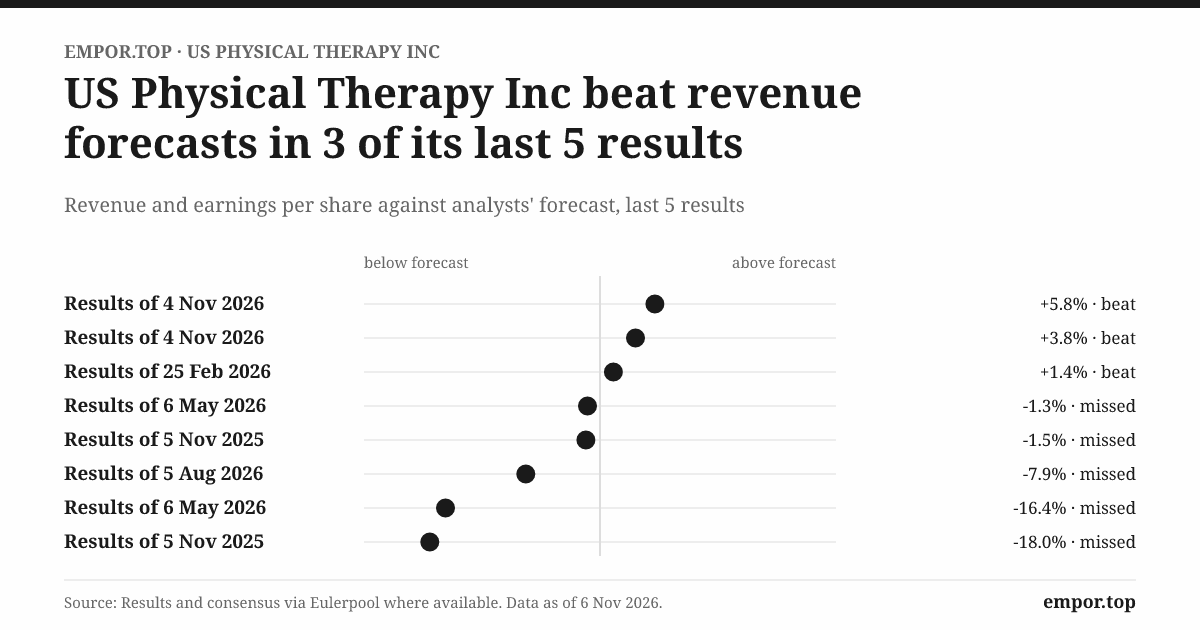
On the first Thursday of November 2026, Christopher Reading opened U.S. Physical Therapy's third-quarter call with the kind of numbers most healthcare operators would like to report. Revenue had reached about $223 million, up 13% from a year earlier.1 Patient visits set another record. Adjusted EBITDA, the measure management steers by, rose to about $28 million from $24 million.1 Reading told analysts the company had now strung together 27 consecutive months of record monthly visit volume.2
Then came the line that made the quarter hard to read. Under generally accepted accounting principles, USPH lost $1.04 per diluted share, against a profit of 48 cents a year earlier.1 This was not because the clinics had lost money. Net income attributable to USPH shareholders was about $11 million.3 The company's own explanation, printed in the release, sounded almost like a riddle: improving performance increases the value of the ownership interests held by its clinic partners, "which has a dilutive effect on earnings per share."1
That sentence is the right place to start this story, because it contains the whole company in miniature. USPH does not usually own its clinics outright. It buys a majority of a practice and leaves the therapists who built it holding the rest, along with a contractual right to sell that stake back to USPH later at a price set by a multiple of earnings.4
When a partnership earns more, the price USPH may one day have to pay for the partner's stake rises too. In the third quarter, the company marked those obligations up by about $36 million, and GAAP routes that revaluation around net income and straight into the earnings-per-share calculation.3 Strip it out, as management does, and adjusted earnings came to 80 cents a share, up from 66 cents.1 Leave it in, and the per-share line turns red.
Neither number is the "real" one. The adjusted figure shows how the clinics performed. The GAAP figure is a reminder that a growing share of that performance comes with a bill attached, payable to people who are not public shareholders. The gap between the two had grown large enough over the year to matter. For the first nine months of 2026, net income attributable to shareholders was about $26 million, down from $35 million, while diluted EPS swung from a profit of $1.85 to a loss of 90 cents.3
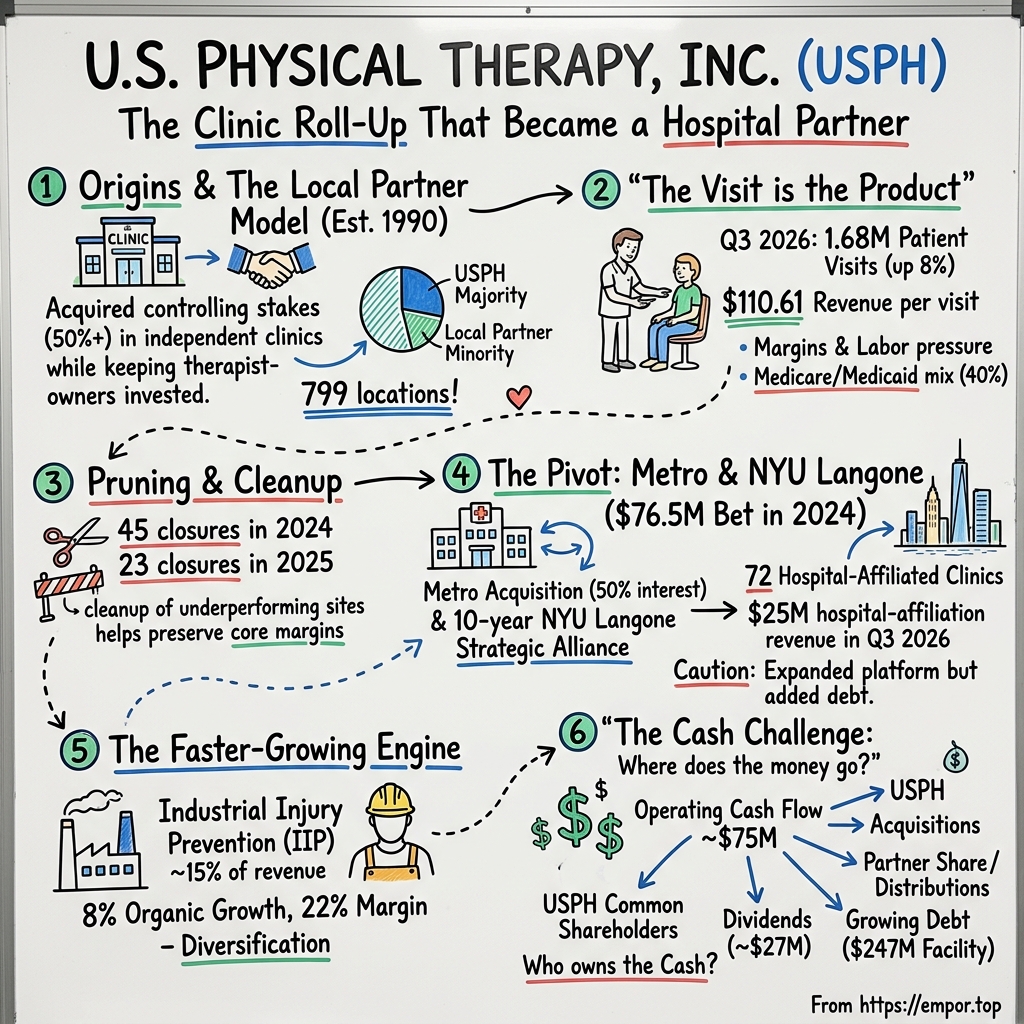
The scale behind those figures is substantial. At the end of September, USPH owned or managed 799 outpatient locations across the United States, up from 777 a year earlier.3 Alongside them sits a smaller industrial injury prevention business that sends therapists and athletic trainers into employers' workplaces. And since early 2026 there has been a third thing, new enough that it barely existed on the prior year's income statement: hospital affiliations, under which 72 of USPH's clinics now operate inside hospital systems' clinical networks.2 In the third quarter alone, those affiliations produced about $25 million of revenue.3
The record looks different again once partners are counted. In 2025 the consolidated business earned about $58 million of net income. Of that, roughly $18 million belonged to noncontrolling partners, leaving about $40 million attributable to USPH shareholders.4 The company then charged another $18 million, after tax, for the revaluation of redeemable partner interests, so the earnings actually used to compute EPS were about $22 million, or $1.42 per share.4
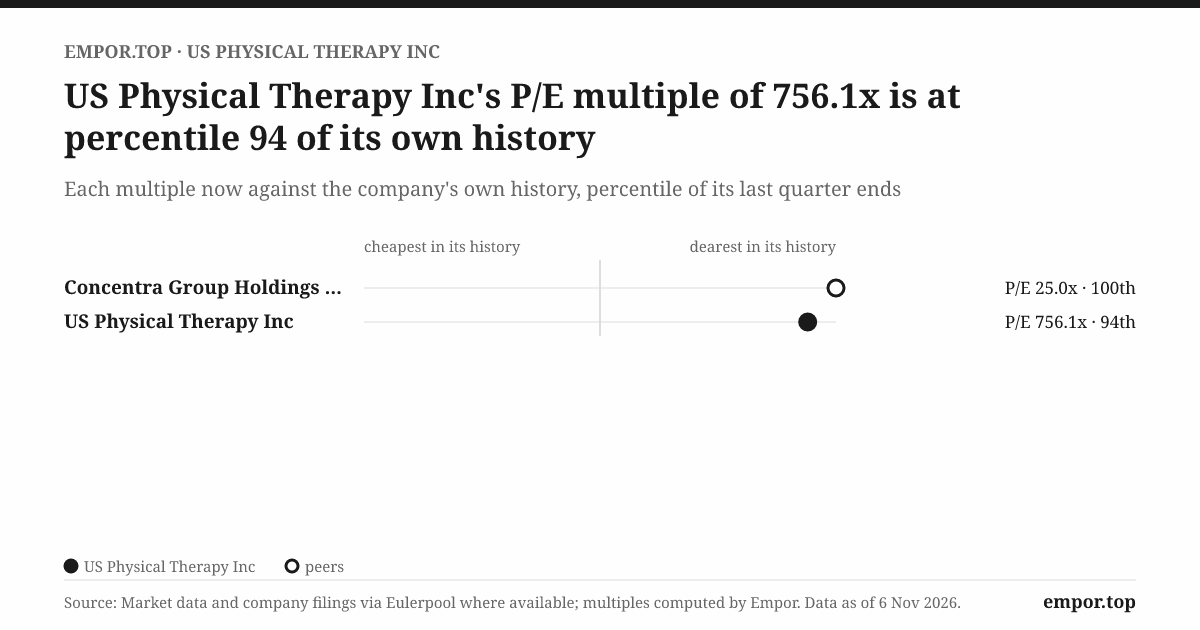
Each of those layers is a separate claim on the same clinics. Several data services publish lower profit figures for the same year, and that is one reason trailing price-to-earnings ratios on this stock look absurd. Over the four quarters to September, GAAP EPS was a loss of roughly $1.35, so a conventional P/E has no meaning at all.3
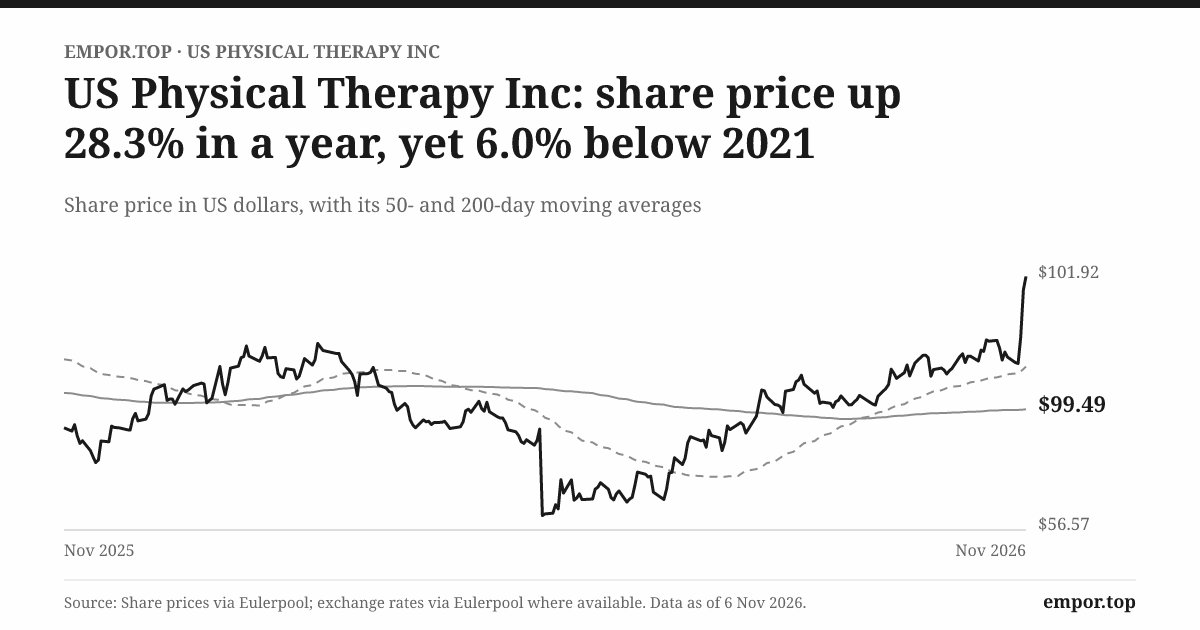
The market has not been deterred. On November 6, the shares closed at about $99.49, a 52-week high and well above the year's low near $59, giving the company a market value of roughly $1.5 billion.5 Investors are clearly paying for something other than trailing GAAP earnings.
So this story has three questions to answer. First, can patient volume and pricing outrun the twin pressures of labor and reimbursement, in a business where therapists are scarce and the government sets much of the price? Second, can acquisitions and the new hospital affiliations earn their cost as borrowing climbs?
Third, and most important for a long-term owner, does a long record of cash generation actually turn into lasting returns per share, once partners, sellers and lenders have taken their cut? Answering any of them starts with the unusual way this company was built: by persuading local therapists to sell control of their practices while keeping their own money in them.
 Subscribe on LinkedIn
II. A Clinic Network Built Around Local Partners
Picture a physical therapist in a mid-sized American city around the turn of the century. She has built a practice over a decade: three clinics, a dozen clinicians, referral relationships with the orthopedic surgeons down the road, and a waiting room full of post-surgical knees and aching backs. She is good at treating patients.
She is less fond of payor contracts, billing software, compliance audits and the question of what happens to her equity when she wants to slow down. A private buyer might offer her a check and a two-year employment contract. USPH offered something different: a check for most of the business, a continuing ownership stake in the rest, and the job of running it.
That pitch has been the company's engine since its founding in Houston in 1990.6 Outpatient physical therapy was, and remains, a fragmented business of independent practices, hospital outpatient departments and physician-owned clinics. A fragmented market invites a consolidator, but physical therapy has a peculiar problem for one. The asset is mostly people. A clinic's value sits in the therapists' schedules and the trust of local referral sources, and both can walk out of the door. USPH's answer was to make sure the people who mattered most did not want to.
The transaction pattern became a template. USPH typically buys a controlling interest, generally between 65% and 75% of the partnership, though its disclosed range runs from 30% to 99%.4 The managing therapist keeps the remaining interest and the operating role. Because USPH controls the entity, it consolidates all of the practice's revenue and costs, then deducts the partner's share of profits further down the income statement.
Most acquired partnerships also carry put and call rights. The partner can require USPH to buy the remaining stake, and USPH can require the partner to sell, at a price set by a predetermined multiple of earnings, and these rights do not expire, even on a partner's death.4 In its own investor material, USPH has described buying out partners "on the back end at typically the same" multiple it paid at the start, and claimed more than 50 acquisitions completed under this model.7
The structure solves a real problem. A selling therapist who keeps a meaningful stake has every reason to keep working hard, keep recruiting, and keep the surgeons sending patients. USPH gets local operators with skin in the game; the seller gets liquidity now and a second payday later, priced on the earnings she helps produce in between. Management calls this being the "partner of choice" for experienced therapists.7 Whether that phrase describes a durable advantage or a sales pitch is one of the questions this story will keep returning to.
The same structure explains the riddle of the third quarter. Because the buyout price is tied to earnings, a clinic that improves becomes more expensive to buy out. Those future obligations sit on the balance sheet as redeemable noncontrolling interests, valued at what USPH would owe, and every revaluation flows into EPS.4 When the partner's clinics get better, the partner's claim gets bigger. That is fair to the partner. It also means public shareholders do not capture the full benefit of improvement in a partnership they do not wholly own, and the cost of that improvement can arrive later as a cash payment.
The scale of the arrangement is now considerable. At the end of 2025, USPH counted 780 clinics, 746 owned and 34 managed, across 44 states.4 By September 2026 the count had reached 799.3 Each of those clinics sits inside a partnership whose economics are shared in a slightly different way, which makes USPH less a single company than a federation of small businesses with a common back office, a common balance sheet and a common stock ticker.
Steering that federation for more than two decades has been Christopher Reading. A physical therapist by training, Reading graduated with high honors from the Medical College of Virginia in 1985, then spent 1990 to 2003 at HealthSouth, rising to senior vice president of operations responsible for more than 200 facilities in ten states.8 He joined USPH in 2003 as chief operating officer, became chief executive and a director in 2004, and added the board chair in May 2024.6
He is also president of APTQI, an industry group that lobbies on therapy reimbursement.6 That background matters. Reading is not a financier who discovered healthcare; he is a clinician-turned-operator who learned multi-site management inside one of the largest rehabilitation chains of its era. His instincts, judging by his calls, run toward visit counts, staffing and rates, delivered in specific numbers rather than adjectives.
The partnership model is the company's signature. To judge whether it works, though, one has to step inside a single clinic and watch how a visit becomes revenue, and how much of that revenue survives the journey.
III. The Visit Is the Product
A patient's journey usually begins somewhere else: an orthopedic surgeon's office after a knee replacement, a primary-care physician's referral for back pain, an employer's injury report, or increasingly a self-referral, since most states now allow patients to see a physical therapist with few or no restrictions.9 The front desk verifies insurance and books an evaluation. A therapist assesses the patient, writes a plan of care, and schedules a course of visits, often two or three a week for several weeks. Each visit is billed under specific treatment codes, adjudicated by an insurer or a government program, and eventually collected, partly from the payor and partly from the patient.
Everything about USPH's economics flows through that sequence, and it is worth slowing down to see the three levers that determine whether a clinic makes money.
The first lever is volume. A therapist's schedule is the factory floor. Once a clinic has paid its rent and its therapists, each additional visit costs relatively little to deliver, so productivity, measured as visits per clinic per day, is the heart of profitability. In the third quarter of 2026, USPH's clinics averaged about 33.4 visits a day, up from 32.2 a year earlier, and total visits rose 8% to about 1.68 million.1 That rise is meaningful. A clinic that adds one patient a day without adding a therapist adds almost pure margin.
The second lever is price, measured as revenue per visit. Here USPH has much less control. In 2025, Medicare and Medicaid together accounted for about 40% of the company's visits and about 36% of net patient revenue.4 The gap between those two percentages tells its own story: government patients pay less per visit than the average.
Medicare's physician fee schedule, which sets therapy rates, fell by about 1.8% for most of 2024 and by roughly 2.9% in 2025, before a proposed increase of about 1.75% for 2026.104 Commercial insurers negotiate, but they are large and patient. Workers' compensation pays better. So a clinic's revenue per visit is largely a function of who walks in, not of what the clinic chooses to charge.
In the third quarter, revenue per visit nonetheless reached $110.61, up from $105.54.1 That nearly 5% rise is unusually strong for this industry, and the explanation is the new hospital affiliations. Management attributed most of the rate gain to hospital-affiliated clinics, while Medicare revenue per visit rose about 2%, workers' compensation about 8%, and commercial rates were flat in the quarter.2
Mature clinics, those open long enough to be compared with themselves, grew revenue about 6%, with roughly three points from more visits and three from better rates.12 That is a healthy result. It is also a reminder that the price gain came mostly from a new arrangement, not from rising rates across the existing book.
The third lever is cost, and this is where the third quarter got complicated. Labor is the dominant expense in a therapy clinic: therapist salaries, benefits, front-desk staff and the managers who coordinate them. USPH self-insures its employee health plan, which means it pays employees' medical claims directly, with stop-loss insurance only above a threshold.
In 2026 that plan was hit by what Reading described as a handful of very large, complex claims, including several premature infants.2 Year-to-date claims ran about $7 million above the prior year, and in the third quarter alone the excess cost about 150 basis points of physical therapy margin.2 Reading's frankness was notable: the company cannot control the timing or size of such claims.2
The trajectory was worse than a one-quarter spike. In the second quarter, management had put the health-cost drag at about 100 basis points, on claims about $3.2 million above the prior year.1112 By the third quarter it had grown.
The response was targeted labor reductions, mostly administrative; Eric Williams, president and chief operating officer for the eastern operations, said the company had removed "several million dollars worth of labor."2 Management also pointed to patient-intake software rolled out to 420 locations and to centralizing billing and collections, with benefits expected in the fourth quarter and into 2027.2 Even with the benefit drag, PT gross margin edged up to 18.9% from 18.6%.1 For the nine months, it was about 18%, against 19% a year earlier.1
It helps to do the arithmetic for a single clinic, because it shows how thin the cushion is. Thirty-three visits a day at about $110 each comes to roughly $3,650 of revenue per clinic per working day, or something under $1 million a year. At a PT gross margin near 19%, that leaves perhaps $170,000 to $180,000 a year of clinic-level profit before corporate overhead, interest, taxes and the partner's share.
Now imagine the same clinic losing one therapist for three months, or absorbing a 2.9% Medicare cut on the 40% of visits that come from government programs, or paying an extra few thousand dollars in benefit claims per employee. Each of those shocks is small in isolation. Each of them can take a meaningful bite out of a profit pool that size. That is why USPH's management talks about staffing and visits per day with something close to obsession, and why a single bad year in a self-insured health plan can move the company's consolidated margin by more than a percentage point.
There is a fourth lever investors tend to overlook: collection. A therapy clinic does not get paid its list price. Each payor contract carries a discount, and the clinic must estimate how much of every bill will actually be collected. USPH estimates these contractual allowances clinic by clinic and payor by payor using historical collection patterns, and its auditor, Grant Thornton, flagged the estimate as a critical audit matter because it requires judgment about future collections.4
That is not a warning sign in itself; it is common in healthcare services. It does mean that revenue in this business is partly an estimate. The provision for credit losses ran at about 1.2% of net patient revenue in 2025 and about 1.1% in the first nine months of 2026, which suggests stable collection experience rather than deterioration.43
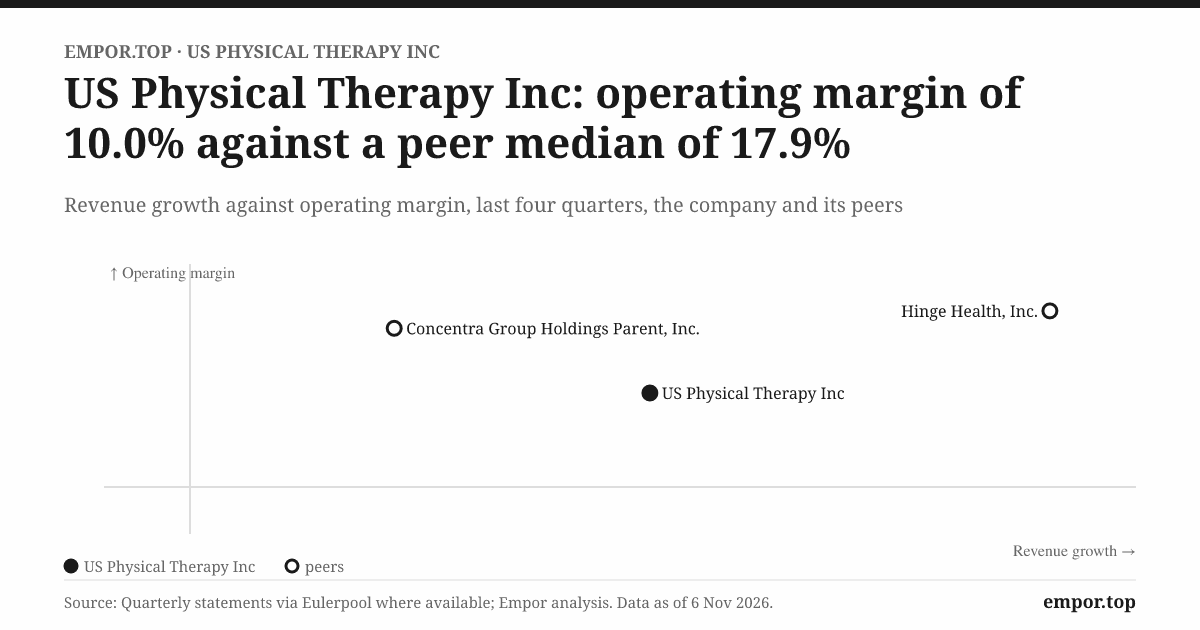
Put the levers together and the long-run record comes into focus. From 2015 to 2025, USPH's revenue grew at about 8.9% a year, roughly from $331 million to $781 million.4 Operating profit grew at only about 5.5% a year over the same stretch, and operating margin slid from about 14% to about 10%.4 Return on invested capital, which had run in the high teens in the middle of the last decade, fell to around 7%.4 The company got much larger. Each dollar of revenue, and each dollar of capital, became less profitable.
Part of that decline was a long run of Medicare rate cuts. Part was wage inflation for therapists after the pandemic. Part was the cost of acquisitions, which add revenue and goodwill faster than they add margin. Whatever the mix, the verdict on the unit economics is clear enough.
USPH can grow the core business by filling schedules, improving rates and using clinics more intensively, and the third quarter showed all three working at once. But the company is a price-taker on much of its revenue and a wage-payer in a tight labor market, and nothing in its filings shows durable pricing power or patient switching costs. The visit is the product, and the product's price is mostly set by someone else.
That raises the obvious next question. If no single clinic has much power over its price, does owning nearly 800 of them change the equation?
IV. Can a Local Clinic Chain Have a Moat?
Imagine a map of any American metro area with every outpatient therapy clinic marked on it. A handful of pins belong to USPH. More belong to Select Medical, the largest operator in the country. A cluster carries hospital logos. Others belong to private-equity-backed chains. The great majority belong to nobody anyone has heard of: two-clinic practices, a sports-medicine group attached to an orthopedic practice, a lone therapist with a lease and a website. Patients in that city have many options within a short drive, therapists have many possible employers, and insurers have many in-network clinics to choose from.
That is the market USPH competes in. The company's own investor presentation described a U.S. rehabilitation market of more than $40 billion and stated that no company holds more than 10% of it, using Select Medical, with about 1,925 outpatient rehabilitation clinics, as the proxy for the largest operator.7 The same presentation put ATI Physical Therapy at more than 850 clinics, against USPH's then-count in the high 700s.7 A 2025 industry overview by the investment bank Stifel counted more than 38,000 outpatient physical therapy clinics in a market it sized at about $37 billion.9 Do the arithmetic and USPH's 799 locations represent roughly 2% of the country's clinics.
This is a war game with many players and no dominant one. Select Medical brings sheer scale and a broader footprint in hospital-based care alongside its outpatient clinics. ATI fields a national network of its own. Large hospital systems run their own outpatient therapy departments and steer their surgical patients toward them. And thousands of independents compete on the oldest weapon in healthcare: the local therapist's reputation.
What does USPH's scale actually buy in that arena? Three things are plausible. It can spread the cost of billing, compliance, technology and payor negotiation across many clinics, which a two-clinic practice cannot. It can recruit acquisition targets, because it has a repeatable deal structure and the balance sheet to fund it. And it can offer therapists a career path and equity that a small practice cannot. Each of those is a real operating advantage. None of them, on its own, stops a rival from opening across the street.
The more interesting claim is the partnership model itself. Management describes it as "highly retentive" and says the structure raises the likelihood of referral-source loyalty.7 The logic is sound: a therapist-owner who keeps a stake and a role should stay longer, recruit better and protect relationships with referring physicians more fiercely than a salaried manager. The trouble is evidence.
USPH does not publish partner retention rates, clinician turnover, referral-source concentration or acquisition-cohort returns that would let an outsider compare its clinics with rivals'. The model's strongest support is circumstantial: the company has kept doing deals in the same form for two decades, which suggests sellers keep finding it attractive. That is evidence of a working acquisition machine. It is not proof of lower costs or better clinical outcomes.
The pressure from each side of the market is easy to name. Rivalry is intense because supply is fragmented and the cost of opening a clinic is low: a lease, some equipment, and a licensed therapist. Buyers are powerful, since Medicare sets its rates by regulation and large commercial insurers negotiate from a position of strength.
Suppliers, in this business, are mostly therapists, and a shortage of licensed clinicians gives them leverage over wages, which is why staffing has been a running theme on every USPH call of the past two years.2 Patients and referring physicians can choose, and direct-access laws in most states let patients bypass the referral entirely.9 Substitutes, from home exercise programs to virtual therapy, nibble at the edges.
Run the war game from a rival's chair and the threats become concrete. A large hospital system that wants to keep its surgical patients inside its walls can open or buy therapy clinics near its surgery centers and steer referrals there, which is precisely the force USPH chose to join rather than fight in New York. A private-equity-backed chain hunting for the same acquisition targets can bid up the price of a good practice, because the seller is choosing among several buyers, not one.
A star therapist who dislikes a new scheduling system can leave and open a practice down the road, taking some patients and a referring surgeon's goodwill along. And an insurer renegotiating rates can simply point out that dozens of other in-network clinics are within a short drive. USPH's defenses against each of these exist, but they are operational rather than structural: better pay and equity for therapists, a reputation as a fair partner for sellers, and enough local density in some markets to matter to an insurer.
That leaves a clear and testable picture. USPH's scale makes it an efficient consolidator in a market that rewards consolidation, but it does not make the company the price-setter in any market it serves. The partnership model and the new hospital ties are advantages to test, not to assume. The test is not the number of pins on the map. It is what happens inside the clinics USPH already owns: whether mature-clinic visits keep rising, whether revenue per visit holds its gains, and whether PT margin improves. If those stall while acquired locations keep the reported growth rate up, the scale story weakens considerably.
There is one place in the company's own record where the scale story was tested hard, and failed at the level of individual clinics. It happened only two years before the third-quarter call.
V. Forty-Five Clinics Had to Close
In 2024, USPH shut 45 of its owned clinics.10 For a company whose identity is built on adding locations, that was a striking number. The year before, it had closed 15.10 The closures cost about $4.4 million in lease and related charges, up from less than $200,000 in 2023, and the company also took a $2.4 million impairment on assets held for sale.10
Closures are not unusual in clinic businesses. A location that opened in the wrong strip mall, lost its lead therapist, or saw a hospital competitor move in may never reach adequate volume. What made 2024 notable was the scale of the clean-up and its effect on the reported numbers. USPH's consolidated gross margin fell to about 18.5% from 20.1% the year before, including the closure costs; excluding them, it was about 19.1%.10 Even on management's adjusted basis, margins had slipped. The closures were not the whole story of the margin decline, but they were visible evidence that some of the network was not earning its keep.
The record goes back further than 2024. In 2019, USPH sold its interest in a partnership that operated 30 clinics, and in 2020 it closed 34 clinics and sold 14 previously closed ones.7 Read together, those disclosures describe a recurring pattern rather than a single bad year. The company adds clinics through acquisitions and de novo openings, then periodically prunes those that underperform. That is how a disciplined operator should behave. It also means that gross additions overstate the network's real progress, and that some share of the capital deployed each year ends up in locations that are later shut or sold.
The sequence matters for what came next. The 2024 clean-up happened in the same year that USPH made its largest recent strategic commitment, the purchase of half of a New York management company known as Metro. So investors were asked to judge a large new bet at the very moment the old machine was being repaired.
The following year looked better. In 2025, USPH closed or sold 30 clinics, 23 of them owned, and closure costs fell to about $270,000.4 Through the first nine months of 2026, the company added 40 locations and closed or sold 19, and closure costs in the third quarter were a small credit.13 The pattern suggests that the worst of the pruning was done in 2024, and that the network is now growing net of closures at a healthy pace.
Did the clean-up produce better discipline? The honest answer is that outsiders cannot fully tell. Management continued to describe acquisitions and de novos as core growth routes, and kept doing them. What USPH does not publish is the information that would settle the question: the returns on acquired clinics by vintage, the share of each year's acquisitions later closed, or the payback period on de novo openings. Without that, an investor can see that closures fell, but cannot see whether the remaining clinics are earning their cost of capital.
So the verdict here should stay narrow. The closures do not show that the model failed. They show that expansion does not always produce durable returns, that the company recognizes failures and acts on them, and that the cost of those failures was material enough in 2024 to dent margins. For anyone evaluating USPH's capital allocation, that makes two measures essential: closure rates, and the profitability of clinics acquired in the past three to five years. The company reports the first. It does not report the second.
That gap matters most for the deal that changed the company's direction.
VI. Metro: A $76.5 Million Bet on a Partner Network
Michael Mayrsohn was still in his thirties when he sold half of his business to a public company. Metro Physical & Aquatic Therapy had built a network of clinics across Long Island and the New York metropolitan area, and Mayrsohn was its chief executive and one of its owners.613 Before any hospital was involved, Metro was already a busy operation, handling something like 550,000 to 600,000 visits a year by Reading's account, and adding about 120,000 visits year over year even before the new alliance took effect.14
On October 31, 2024, USPH bought a 50% interest in Metro's management services organization, which provided administrative and management services to about 50 outpatient clinics.10 USPH became the managing member. The price was $76.5 million, with up to $20 million more in contingent consideration tied to future performance.4 Mayrsohn joined USPH's board.6
The structure was the partnership model writ large. Instead of buying a single practice, USPH bought half of a regional platform whose sellers kept the other half, along with an earn-out that would reward them if Metro hit its targets. In April 2025, the platform added a home-care practice for speech and occupational therapy, a sign that USPH intended Metro to grow by acquisition on its own account.4 By early 2026, Metro was the largest single partnership in the company.
Then, on February 2, 2026, came the announcement that turned Metro from a regional acquisition into a strategic pivot. Metro and NYU Langone Health formed a ten-year strategic alliance under which 60 of Metro's existing outpatient clinics in Long Island and the New York metropolitan area would become part of NYU Langone's clinical services network.13 A little over three weeks later, USPH announced a second ten-year alliance, this time with a hospital system on the Gulf Coast covering 10 clinics of another subsidiary partner.4 By the end of the third quarter, the company counted 72 clinics across the two agreements, with all of them integrated.12
Why would a hospital system want this, and why would USPH agree? The likeliest economic logic is reimbursement. In many cases, hospitals can bill for outpatient therapy at hospital-based rates, which are typically higher than the rates paid to freestanding clinics. A hospital system also gains a network of convenient locations for its surgical patients, keeping them inside its system. USPH, in turn, gains a stable contractual partner, higher revenue per visit, and a referral relationship with one of the most prominent health systems in the country.
The accounting is unusual, and it explains much of the headline revenue growth. Under the affiliation agreements, USPH receives two kinds of payment: a per-visit fee, and reimbursement for the salaries of the licensed clinical staff who now work under the hospital's umbrella.12 Because the hospital reimburses those clinicians' wages, the reimbursements are recorded as revenue.12 USPH treats the arrangement as a single performance obligation to provide integrated therapy services over the life of the contract.3
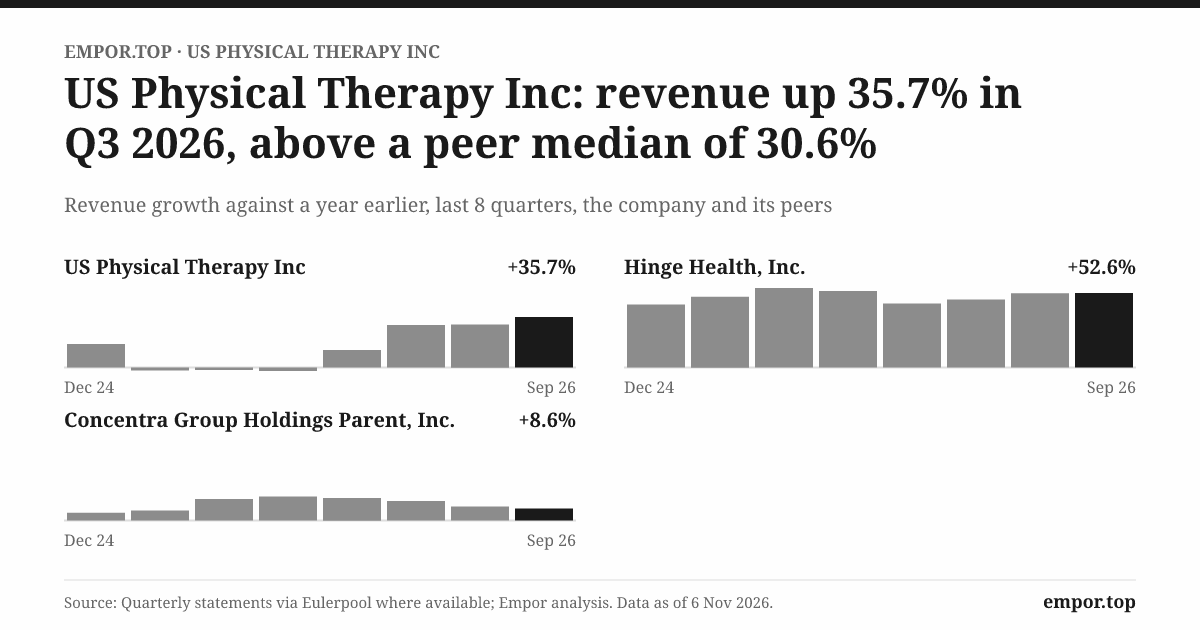
The effect on reported numbers is large. Hospital affiliation revenue rose from about $5.6 million in the second quarter, when the integration was only partly complete, to about $25 million in the third.113 In the same quarter, net patient revenue, the money billed directly to patients and insurers, fell about 1.8%.1 Almost all of the company's 13% revenue growth came from this new line, and part of it is a pass-through of wages that USPH would otherwise have recorded as costs.
So the hospital revenue is real, but it should be read carefully. Management said on the call that hospital affiliations accounted for more than 13% of revenue; that matches their share of PT operations revenue, while against total company revenue they came to about 11%.21 And margins, expressed as a percentage of a revenue line that now includes reimbursed salaries, mechanically fall even if the dollars of profit rise.
What has management said about the profit? In May, the company put the annualized EBITDA contribution of the hospital arrangements at about $7 million, with the Gulf Coast agreement adding several million dollars more.14 In August, Reading said the 2027 contribution would be bigger than originally indicated.12 The company also bore an upfront cost: it hired about 50 clinicians ahead of the transition, at roughly $100,000 each in total cost, expenses Reading said NYU would pick up once the clinics were inside the arrangement.12 On the third-quarter call, management declined to break out the partnerships' EBITDA.2 So the strategy's profitability rests largely on management's guidance, not on disclosed results.
Benchmarking the Metro price is harder than it looks. The disclosed terms give a purchase price and a contingent ceiling, but not Metro's EBITDA at the time of the deal, its debt, or the share of profit that flows to USPH after the sellers' half. Without those numbers, any multiple is a guess. The same caution applies to USPH's 2026 acquisitions. In January, it bought half of an eight-clinic practice for about $6.2 million and 70% of an industrial injury prevention business with about $7 million of annual revenue for about $15.1 million.313
In July, it bought 67% of a 12-clinic practice with about $12 million of annual revenue for about $16.4 million.13 Together the three deals carried about $37.5 million of consideration and added about $40 million of goodwill.3 Grossing up the ownership stakes, the 12-clinic practice was valued at about two times revenue and the injury-prevention business at about three times. Those are price-to-revenue ratios, not enterprise-value multiples, and they say nothing conclusive about whether USPH overpaid.
The Metro bet, then, has already done something important: it opened a new channel, and the channel has produced revenue quickly. Metro's clinics were also busier than the company average, at about 45 visits per clinic per day.12 What it has not yet done is prove that the channel is more profitable per dollar of capital than the old business.
The forward test has three parts. Hospital affiliation revenue should hold its third-quarter share. The affiliation margin, if management ever discloses it, should justify the strategy. And the debt-funded capital that USPH has spent on Metro and on its newer deals should produce operating profit that exceeds the cost of that capital and the partners' share.
While investors focused on New York, the company's smaller business had been quietly growing faster than the core.
VII. The Smaller Business That Grows Faster
Inside a distribution warehouse or a manufacturing plant, a USPH athletic trainer watches a worker lift a box. The trainer adjusts the worker's posture, recommends a stretching routine, and records the session. If the worker develops early signs of strain, the trainer intervenes before it becomes a recordable injury, a workers' compensation claim and an expensive trip to a clinic. That is industrial injury prevention, USPH's second segment, and it sells a very different product from the clinics: fewer injuries for employers, rather than treatment for patients.
The segment has two demand streams. The first is on-site injury prevention, sold to employers on service agreements. Employers buy it because workplace injuries are expensive, both in claims and in lost productivity, and because a well-run program can show results in safety metrics. The second is post-offer employment testing, in which prospective employees are screened for physical ability before starting a job. That stream depends far more directly on hiring activity, so it rises and falls with the labor market.
In the third quarter of 2026, the segment's revenue was about $33 million, up about 14% from a year earlier, or about 8% excluding the acquisition completed at the end of January.1 Its gross margin improved to about 22% from about 20%.1 That is a healthier profile than the PT business. The margin is higher, the growth is faster, and the employers who buy the service do not have their rates set by Medicare.
The record also includes a warning. In 2023, USPH took a goodwill and intangible-asset impairment of about $17.5 million in the industrial injury prevention segment.10 An impairment is an admission that an earlier acquisition was worth less than the company paid for it. The segment had been built partly through acquisitions, and some of that capital did not earn its expected return. Two years later, the business is growing again, and the January 2026 acquisition shows that management still sees it as a place to deploy capital.
So proportion matters. The segment produces about 15% of total revenue; PT still drives the company. Its organic growth and margin are encouraging, but one quarter of strong results does not establish a trend, and acquired revenue can easily masquerade as underlying momentum. The right measures are organic growth and segment margin, tracked separately from acquisitions, and the history of the 2023 impairment argues for watching whether the newer deals perform better than the older ones.
Whatever the mix of businesses, the real question for a shareholder is the same: how much cash do they produce, and where does it go?
VIII. The Cash Arrives—Then It Gets Divided
On paper, USPH looks like a reliable cash generator. In 2025, it produced about $75 million of cash from operations and spent about $14 million on fixed assets, leaving free cash flow of roughly $61 million.4 It paid about $27 million in dividends.4 For a company whose GAAP per-share earnings swing wildly with partner revaluations, that steady cash is reassuring, and over the long run the cash has consistently exceeded reported profit, in part because depreciation and amortization, non-cash revaluation charges and partners' shares all depress net income without consuming cash.
But cash from operations is not the same as cash available to shareholders, and the first nine months of 2026 show the difference vividly. The company generated about $64 million of operating cash, up from $50 million a year earlier.3 Then it spent. About $16 million went to fixed assets. About $36 million went to buying majority interests in new businesses.
Another $23 million went to buying out existing partners' minority stakes, and about $14 million to paying contingent consideration on earlier deals. Partners received about $17 million in distributions. Shareholders received about $21 million in dividends and about $19 million in share repurchases.3 Add it up and the company's uses of cash exceeded its operating cash by about $80 million, a gap it filled by borrowing.3
That bridge is the most revealing picture of the business in this story. Of every dollar of operating cash, a large share goes to partners, either as current distributions or as buyouts of their stakes, and to sellers, as earn-outs. What remains for common shareholders has to compete with new acquisitions. And when management chooses to do all of those things at once, as it did in 2026, the balance sheet absorbs the difference.
The financing was put in place in April. USPH announced a new $450 million, five-year credit facility, made up of a $175 million term loan and a $275 million revolver, maturing on April 14, 2031, and replacing a $325 million facility that would have expired in June 2027.15 Borrowings under the facility rose from about $162 million at the end of 2025 to about $247 million at the end of September 2026.1
Interest expense for the first nine months was about $9.6 million, up from $7.1 million.3 In September, the company entered an interest-rate swap on about $171 million of notional value that fixes the term-loan rate at about 4.6% from June 2027.1 The extended maturity and the swap reduce refinancing and rate risk. They do not change the basic fact that the company now carries more debt than it did a year ago, at a higher cost.
Beyond the bank debt sit two other obligations that matter. The first is leases. Most clinics are leased, with a weighted-average remaining term of about 4.8 years at the end of 2025, and those leases are fixed obligations that do not shrink when a clinic underperforms.4 The second is the partners' put rights. Those rights do not expire, and their price rises with clinic earnings.4 In other words, the better the business does, the larger the future cash claim. The company's filings report no covenant breach.3 Its credit agreement limits dividends to $50 million a year, comfortably above the current payout.4
The company's own history shows how these claims behave under stress. In 2020, when the pandemic emptied waiting rooms, revenue fell about 12% and dividend payments dropped from roughly $14 million the year before to about $4 million, as the board paused the payout to preserve cash.16 Operating cash flow that year actually rose, and the dividend was restored the following year.16
The episode is a useful reminder in both directions. The business generated cash even in its worst modern year, which supports the idea that the dividend is backed by real cash. But when the board had to choose, the common dividend was the claim it cut first, because the partners' distributions, the leases and the debt service were not optional.
The dividend itself raises a fair question. In February 2026, the board raised the quarterly dividend to 46 cents from 45 cents.4 At current share counts, that amounts to about $27 million a year, more than GAAP EPS supports in a year when the per-share line is negative. But GAAP EPS is the wrong yardstick.
The dividend is covered by free cash flow, and the revaluation charges that push EPS negative are non-cash. The better question is whether free cash flow, after partner distributions, buyouts and earn-outs, covers the dividend and the buyback. In 2026, on the evidence of the nine-month bridge, it did not cover everything, which is why borrowing rose.
The buyback is the most debatable use. USPH repurchased about $5.6 million of stock in November 2025, after making no repurchases in 2023 or 2024, then bought back about $19 million in the first nine months of 2026.43 With the shares since rising to a 52-week high, those purchases look well timed in hindsight. Whether they were the best use of borrowed money depends on returns from the alternatives, which the company does not disclose.
That leaves the investor's question in plain terms. Is USPH buying productive clinics and repurchasing shares at sensible prices, or is it funding partners' claims and its own growth with rising debt? The cash is real. So are the competing claims on it. And the judgment about which uses earn their cost rests, for now, with management.
IX. Reading's Scorecard: Growth, Incentives, and Trust
On the third-quarter call, Reading reaffirmed full-year adjusted EBITDA guidance of $102 million to $106 million, then added a caution.12 Employee health costs, he said, were likely to stay high in the fourth quarter.2 It was a characteristic moment. He gave analysts the guidance they wanted, then told them exactly why the path to it might be bumpier than they hoped.
The guidance itself has been remarkably consistent. Management first set the 2026 range in early 2026, then reaffirmed it on the first-quarter call in May and again in August.1411 Through the first nine months, adjusted EBITDA was about $75 million, which leaves the company needing between $27 million and $31 million in the fourth quarter to land in the range.14111
That is in line with the third quarter's run rate, but not by a wide margin, and the health-cost caution gives the guidance less cushion than the headline suggests. Analysts noticed early. On the first-quarter call, Joanna Gajuk of Bank of America pointed out that the first quarter represented about 19% of the full-year guidance, below the more-than-20% share it had represented in prior years.14 Reading replied that the quarter had come in almost exactly where the company had budgeted.14
The current team around Reading has changed. By the second-quarter call, Jason Curtis was serving as interim chief financial officer; by the third quarter, Nchacha Etta had joined as executive vice president and CFO, and the November call was his first.122 Eric Williams runs the eastern operations as president and chief operating officer, and Graham Reeve runs the west.2 The CFO transition is worth watching, not because there is evidence of trouble, but because a new finance chief is the person most likely to change how the company explains partner revaluations and hospital economics to investors.
Pay offers a second lens. Reading's total compensation was about $4.47 million in 2025, up from about $3.64 million in 2024.6 The main objective incentive plan was tied to adjusted EBITDA, with a target range of $88 million to $95 million; the company reported $95.0 million and paid the full objective award.6 The CEO-to-median-employee pay ratio was about 93 to 1.6 The incentive design deserves a skeptical look.
Adjusted EBITDA excludes clinic closure costs, business acquisition costs and changes in the fair value of contingent earn-outs, among other items, and the revaluation of partner interests never touches it at all.74 Those exclusions make operating trends easier to see, but they also mean that the biggest costs of the growth strategy, the earn-outs, the partner buyouts, the closures, sit partly outside the measure that drives pay. A plan that rewards EBITDA growth can be satisfied by buying EBITDA, even at a price that does not create value per share.
Ownership offers a third. Directors and executive officers together owned about 2.4% of the stock as of March 2026.6 That is collective, modest ownership, not a controlling stake. The largest holders were institutions, led by BlackRock at about 14% and Kayne Anderson Rudnick at about 8%.6 At the May 2026 annual meeting, say-on-pay received about 13.2 million votes in favor and 0.9 million against, roughly 94% support.17 Shareholders, in other words, have not objected to the pay design.
Governance has two features worth noting. Reading chairs the board as well as running the company, with Dr. Bernard Harris serving as lead independent director since May 2024.6 Five of seven director nominees were independent; Reading and Mayrsohn were not.6 And Mayrsohn, as Metro's chief executive and a director, is also landlord to two Metro clinics through entities he owns.
USPH paid about $0.5 million in rent on those leases in 2025, less than 0.1% of revenue, with about $2.6 million of future minimum rent outstanding at year-end.4 A third-party valuation firm concluded the leases were consistent with fair market value.6 The amount is small. The dual role still deserves attention, because Mayrsohn also stands to benefit from Metro's earn-out and from the value of the partner stake that USPH may one day buy.
The analysts' questions on the November call were revealing in what they probed. Gajuk asked whether hospital revenue would step up again in the fourth quarter from its $25 million level; Reading explained that the final tranche of Metro clinics had joined only in September, so the fourth quarter would be the first full period with both partnerships in place.2
Jack Slevin of Jefferies asked about the strength of patient volume, and Reading answered with the record-visit streak and a reminder that in a tight labor market, meeting demand means hiring ahead of it.2 Other analysts pressed on whether the partnerships' EBITDA would be disclosed separately; management said it would not.2 That last answer matters more than it seems. The company's most important new strategy will be judged, for now, on management's own characterization of its profitability.
The best evidence of management's credibility is the consistency between prepared remarks and answers under questioning. On the third-quarter call, Reading and Williams quantified the health-cost headwind, described specific staffing cuts, and acknowledged that they could not predict when claims would normalize.2 When asked about the 2027 Medicare fee schedule, Reading said the company had not yet had enough time to map it out fully.2
That is the language of an operator who prefers not to overpromise. The record of guidance kept also supports him. Set against it are weaker GAAP EPS, repeated rounds of clinic closures, and the absence of public data on acquisition returns. The test of the next year is simple: whether the cost actions show up in fourth-quarter and 2027 margins, and whether guidance holds.
With the people and their incentives on the table, it is time to weigh the competitive position as a whole.
X. Porter's Five Forces & Seven Powers
A therapist with a strong local reputation brings patients to a clinic, not because of the USPH logo on the lease, but because a surgeon trusts her and a former patient recommended her. That is the most important competitive fact about this business, and it cuts both ways. It means the asset USPH buys is largely a person, and that the person can, in principle, leave. It also means the partnership model, which keeps that person invested, addresses the right problem.
Run the five forces against the economics, and the picture is not flattering. Rivalry is high: the market is fragmented, with no company above about 10% share, and the barriers to opening a clinic are modest.7 Buyer power is high: Medicare and Medicaid account for about 40% of visits and set their rates by regulation, while commercial insurers negotiate from scale.4
Supplier power is meaningful, because licensed therapists are scarce and their wages and benefits are the largest cost line, a pressure the 2026 health-claims spike made vivid. The threat of new entrants is real, since a therapist can open a practice with a lease and equipment. Substitutes, including home programs, virtual therapy and chiropractic care, are partial but present. None of those forces favors a provider with pricing power.
Hamilton Helmer's Seven Powers framework asks a sharper question: which, if any, of the durable advantages applies? Scale economies exist in billing, compliance and technology, but they do not translate into a cost position that rivals cannot match, since Select Medical is larger. Network effects do not apply in any strong sense. Switching costs are low for patients, who can book elsewhere, and for insurers, which have many clinics in network. Brand is local, attached to therapists rather than to USPH. Counter-positioning, cornered resources and process power are the more interesting candidates.
The partnership model and its repeatable acquisition process may amount to process power: a way of buying and running practices that rivals with a different model cannot easily copy. And the hospital affiliations could become a form of cornered resource if they deliver exclusive referral flows and better rates over a ten-year term. But the filings do not quantify retention, referral exclusivity or cost advantages, so those powers remain plausible rather than proven.
The why-win case is straightforward. USPH can recruit local practice sellers, add clinics, run them on centralized systems, and keep operators invested in their success. The hospital affiliations add a second route to higher rates and more referrals. The why-not case is equally clear. A mature clinic still depends on local clinicians, reimbursement schedules and execution. Scale alone does not insulate margins from benefit inflation or payor changes, as 2026 demonstrated, and the company's long record of falling returns on capital is the strongest evidence against any claim of a wide moat.
That points to a small set of measures. Three KPIs matter most: mature-clinic revenue growth, which was about 6% in the third quarter; revenue per visit, at $110.61 and rising about 5%; and PT gross margin, at about 18.9% and edging up.1 The capital-allocation cross-check is returns on acquired clinics and the level of facility borrowings.
Which brings us to the lessons this company teaches, beyond the numbers.
XI. Business & Investing Lessons
The first lesson comes from the therapist who sold control of her practice and kept a stake. In a people business, the seller's continued effort is part of what you bought. USPH understood that early and built a structure around it: equity that keeps the seller invested, a put right that rewards her for growth, an operating role that keeps her in the clinic.
The price of that design is that the seller shares in the upside forever, and that her share of the improvement is the public shareholder's cost. Any company built on acquired service businesses faces the same trade, and most handle it less elegantly. But the measure of whether it works is not the number of deals done. It is whether sellers stay, clinics grow, and the buyout price, when it finally comes due, is earned by real improvement.
The second lesson comes from the 45 clinics closed in 2024. A growing map is not the same as a growing return. USPH added clinics every year, and the map got bigger. Return on invested capital fell from the high teens to about 7%. Clinics that looked like growth when they were opened or acquired later turned into closure costs and impairment charges.
The lesson for investors is to look past location counts and ask the harder question: what does each new clinic earn, after closures, partner shares and the capital it consumed? A company that cannot answer that question publicly is asking investors to trust its judgment on the most important capital decision it makes.
The third lesson comes from the nine-month cash bridge of 2026. Cash is real; the claim on it is shared. USPH generates steady operating cash, and that cash is the strongest part of its financial profile. But partners take distributions, sellers take earn-outs, departing partners take buyouts, lenders take interest, and shareholders take dividends and buybacks. When all of those claims arrive in the same year as a burst of acquisitions, the balance sheet makes up the difference. The investor's job is to count the claims, not just the cash.
The fourth lesson comes from the NYU Langone alliance. The best new channel is the one that changes the economics of the old one. The hospital affiliations did not add new clinics; they changed how 72 existing clinics are paid. If they deliver higher rates and steadier referrals without eroding margins, they may prove to be the most valuable move USPH has made in years.
But the evidence so far is revenue and management's guidance, not disclosed margins or per-share earnings. A channel that inflates revenue through pass-through wages can look transformative on the top line and modest at the bottom. The lesson is to wait for the bottom line.
Those lessons frame the bull and bear case, which is where the story's tensions come to a head.
XII. Analysis & Bear vs. Bull Case
Set two numbers side by side. In the third quarter of 2026, USPH recorded about 1.68 million patient visits, the most in its history.1 In the same quarter, borrowings under its credit facility stood at about $247 million, up more than half since the end of 2025.1 One number is the business working. The other is the business being financed. The investment case is the question of which one proves more important.
The bull case is not wishful. Patient demand is at record levels and has been for more than two years.2 Revenue per visit has risen faster than at any point in recent memory, driven by a hospital channel that did not exist a year ago. Mature clinics are growing revenue at about 6%, split evenly between more patients and better rates.12 The industrial injury prevention business is growing organically with improving margins.
The Medicare outlook has improved, with Reading describing an early read of the 2027 fee schedule as about 0.7% positive and calling the planned phase-out of a practice-cost adjustment, over two years starting in 2027, "directionally very positive."2 And management has held its EBITDA guidance through a year of unexpected health costs. If the hospital affiliations mature as management expects, the core clinic economics could improve materially.
The bear case is equally grounded. Clinicians are expensive and scarce. Payors, especially Medicare, constrain rates, and three years of cuts before 2026 showed how quickly that can squeeze margins. Benefit claims, which the company cannot control, can overwhelm near-term margin improvement. Acquisitions add debt without disclosed returns, and the record of closures shows that expansion can fail. Partner claims grow with clinic earnings and will eventually require cash. And goodwill, at about $733 million in September 2026, exceeds the company's book equity, which means the balance sheet consists in large part of the premium paid for past acquisitions.34
Test the bull's strongest claims against the record. The claim that the partnership model produces superior returns meets a decade of falling return on capital and repeated rounds of closures; that history does not reject the model, but it narrows the claim to a smaller one: the model is a good way to acquire practices, not proof of superior returns once acquired.
The claim that hospital affiliations transform the economics meets the absence of any disclosed margin and the reality that much of the new revenue is reimbursed wages; that leaves the claim intact but unproven, with the affiliation's contribution to operating profit as the settling figure. The claim that management allocates capital well meets the 2023 injury-prevention impairment, the 2024 clinic closures and the lack of cohort disclosure; the evidence supports a management team that recognizes failures and acts, not one that avoids them.
Imagine a skeptical activist with a few percent of the stock arriving at the next annual meeting. The first demand would be disclosure: publish returns on acquired partnerships by vintage, the closure rate of each year's additions, and the profit contribution of the hospital affiliations, so that shareholders can judge the capital allocation that drives the whole strategy. The second would be incentives: add a per-share measure, such as cash earnings per share after partner distributions and buyouts, alongside adjusted EBITDA, so that executives are paid for value created rather than EBITDA acquired.
The third would be sequencing: in a year when operating cash fell short of acquisitions, partner buyouts, earn-outs, dividends and buybacks combined, why borrow to do all of them at once rather than choosing? The fourth would be governance: with the chief executive also chairing the board and a director serving as both the largest partner's chief executive and a landlord, the activist would ask the independent directors to show their work on related-party reviews and the Metro earn-out. None of those demands implies wrongdoing. Each of them would make the company easier to judge.
Valuation tells its own story. At about $99 a share, the company is worth roughly $1.5 billion in equity and about $1.9 billion including debt.5 Against management's adjusted EBITDA guidance midpoint of $104 million, that is about 18 times, a full multiple for a business with modest returns on capital, low pricing power and a competitive, fragmented market.51 The price-to-book ratio is about 3.5 times and the dividend yield about 1.8%.5
The trailing P/E is meaningless, because trailing GAAP EPS is negative, and comparisons to the company's own five-year median P/E are equally unhelpful while partner revaluations distort the per-share line. What the multiple appears to assume is that the hospital affiliations and mature-clinic growth will lift profits meaningfully over the next few years. The share price rise from about $59 to about $99 over the past year suggests the market has already priced in much of that improvement.
The forward falsifiers are specific. Mature-clinic visit and rate growth should hold near current levels. PT margin should improve once health claims normalize. Affiliation margins, if disclosed, should justify the strategy. Acquisition returns should exceed the cost of borrowing. And borrowings should stabilize or fall as the acquisitions mature. If those hold, the bull case strengthens. If they fail, the bear case wins.
XIII. Epilogue
Tonight, USPH stands at a hinge. The 72 hospital-affiliated clinics are fully integrated, which makes the fourth quarter of 2026 the first full period with both alliances operating.2 The company has promised to give 2027 guidance in February.2 The new Medicare fee schedule takes effect in January. The interest-rate swap begins in June. Each of those moments will answer part of the story's central questions.
The first moment is the fourth-quarter report. If the company lands in its $102 million to $106 million adjusted EBITDA range despite high health costs, it will confirm that management's cost actions are working and that the hospital affiliations are contributing as promised. If it misses, the market will ask whether the affiliations are less profitable than advertised or whether the health-cost problem is deeper than one bad year.
The second is the 2027 guidance. Management has said the hospital contribution in 2027 will exceed its earlier estimate.12 The February guidance will show how much, and whether the improved Medicare outlook translates into margin. A strong guide would suggest that 2026 was an investment year and that the payoff is arriving. A cautious one would suggest that the cost pressures are more persistent than the bull case assumes.
The third is the cash bridge for the full year. If borrowings stabilize as acquisition spending slows, the balance-sheet concern eases. If borrowing keeps rising while the company continues to buy, buy back and pay dividends, the question of whether growth is creating value per share becomes more urgent.
There is also a quieter variable that will play out over the next two years: Medicare. Reading's first read of the final 2027 rule was cautiously positive, and the planned two-year phase-out of a practice-cost adjustment could help therapy providers further into 2028, though he stressed that the company had not yet modeled it fully.2 After three straight years of cuts before 2026, even a modest run of increases would be a tailwind on roughly two-fifths of the company's visits. It would not, however, change the underlying fact that the government sets the price. A favorable rule is a gift that the next rule can take back.
And beneath all of it sits the partner question. Every dollar of improvement in a partnership raises the price of the partner's stake. The better USPH performs, the larger the claim. The story will turn on whether hospital affiliations and mature-clinic growth can expand profit per share faster than those claims grow, while the company integrates its deals and manages its debt. That tension does not resolve in one quarter. It is the shape of the business.
XIV. Outro
Go back to the therapist-owner who sold control of her practice and kept a stake. Her clinics are now part of a network of nearly 800 locations, some of them inside one of the most prominent hospital systems in the country. Her patients still arrive one at a time, still need a therapist's hands and judgment, still have their visits billed and collected. Nothing about the essential act has changed.
That is what makes USPH unlike most consolidators. It bet that a national company could grow by keeping local clinical partners close rather than buying them out. The bet has produced a larger company. The test it still has to pass is whether the network makes each visit more valuable, or simply makes the company larger, and whether the value left for public shareholders, after the partners, the sellers and the lenders, grows along with it.
References
-
Third Quarter 2026 Earnings Release — U.S. Physical Therapy, Inc., 2026-11-04 ↩↩↩↩↩↩↩↩↩↩↩↩↩↩↩↩↩↩↩↩↩↩↩↩↩↩
-
U.S. Physical Therapy (USPH) Q3 2026 Earnings Call Transcript — The Motley Fool, 2026-11-05 ↩↩↩↩↩↩↩↩↩↩↩↩↩↩↩↩↩↩↩↩↩↩↩↩↩↩↩↩
-
Quarterly Report on Form 10-Q for the quarter ended September 30, 2026 — U.S. Physical Therapy, Inc., 2026-11-05 ↩↩↩↩↩↩↩↩↩↩↩↩↩↩↩↩↩↩↩↩↩
-
Annual Report on Form 10-K for 2025 — U.S. Physical Therapy, Inc., 2026-02-27 ↩↩↩↩↩↩↩↩↩↩↩↩↩↩↩↩↩↩↩↩↩↩↩↩↩↩↩↩↩
-
2026 Proxy Statement — U.S. Physical Therapy, Inc., 2026-04-16 ↩↩↩↩↩↩↩↩↩↩↩↩↩
-
Q1 2025 Investor Presentation — U.S. Physical Therapy, Inc., 2025-05 ↩↩↩↩↩↩↩↩
-
Christopher J. Reading, Senior Leadership — U.S. Physical Therapy, Inc. ↩
-
Annual Report on Form 10-K for 2024 — U.S. Physical Therapy, Inc., 2025-03-03 ↩↩↩↩↩↩↩
-
Second Quarter 2026 Earnings Release — U.S. Physical Therapy, Inc., 2026-08-05 ↩↩↩↩
-
USPH Q2 2026 Earnings Call Transcript — The Motley Fool, 2026-08-13 ↩↩↩↩↩↩↩↩
-
Form 8-K: Strategic Alliance with NYU Langone Health — U.S. Physical Therapy, Inc., 2026-02-04 ↩↩↩
-
USPH Q1 2026 Earnings Call Transcript — The Motley Fool, 2026-05-07 ↩↩↩↩↩↩
-
U.S. Physical Therapy Announces New $450 Million Credit Facility — U.S. Physical Therapy, Inc., 2026-04-15 ↩
-
SEC Filings and Annual Reports — U.S. Physical Therapy, Inc. ↩↩
-
Form 8-K: 2026 Annual Meeting Voting Results — U.S. Physical Therapy, Inc., 2026-05-19 ↩
 LinkedIn
 WhatsApp
 Reddit
 Hacker News
 Email
 Kindle
 RSS Feed
 Spotify
 Apple Podcasts
 Amazon Music
 Audible
 YouTube