Concentra Group Holdings Parent, Inc. (NYSE: CON): The Business Architecture of Occupational Medicine
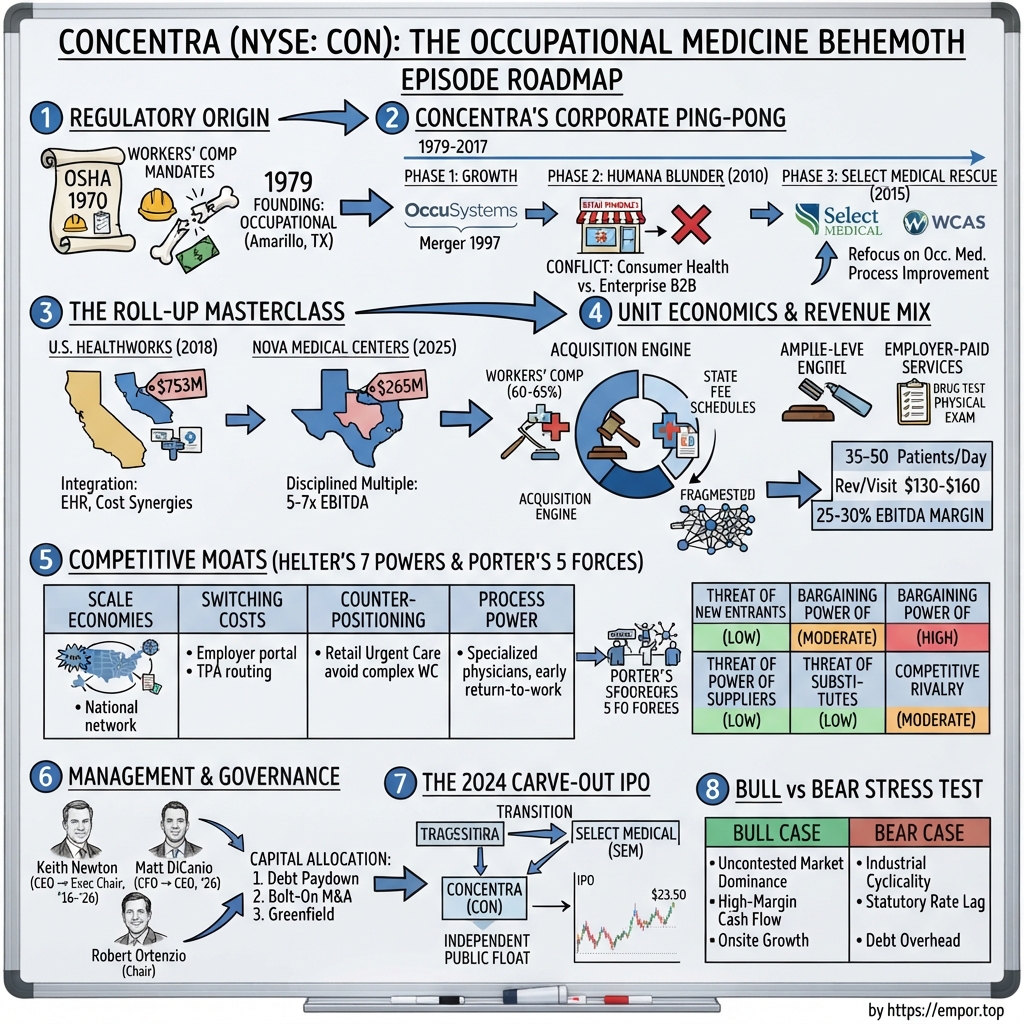
I. Introduction & Episode Roadmap
Somewhere in America right now, a forklift operator in a distribution center outside Dallas has just crushed a finger between a pallet and a steel rack. What happens in the next ninety minutes is not a medical question. It is a logistics question, a legal question, an insurance question, and — for the employer — a question that will echo through its insurance premiums for the next three years.
The worker will not go to an emergency room. He will not call his primary care physician, because in most states his primary care physician is legally irrelevant to this injury. Instead, a supervisor will pull up a laminated card or an internal portal, find the pre-designated clinic, and send him there. There is a good chance that clinic has a red-and-white sign on it that says Concentra.
That is the entire business, and it is bigger than most investors realise. As of December 31, 2025, Concentra operated 628 stand-alone occupational health centers across 41 states and 411 onsite health clinics embedded inside employer worksites in 44 states, staffed by roughly 13,000 colleagues and affiliated clinicians, seeing approximately 53,000 patients on an average business day.1 By the end of the second quarter of 2026 those counts had grown to 633 centers and 415 onsite clinics across 46 states and the District of Columbia.2 In 2025 the company recorded 6.3 million workers' compensation visits and treated approximately 839,000 initial injuries — which, measured against U.S. Bureau of Labor Statistics injury counts, works out to roughly one in every four work-related injuries in the United States.1
The thesis, stated plainly. Occupational health is the least consumer-facing corner of American healthcare. There is no patient shopping for a provider, no health plan prior authorisation, no deductible, no co-pay. Reimbursement for a workers' compensation visit is set by a state fee schedule — a published maximum-allowable rate determined by a state labor department or workers' compensation board, on a timetable that is deliberately insulated from state and federal budget cycles.1 The buyer is an employer or its insurance carrier. The product is not "care" in the retail sense; it is a certified return-to-work decision, documented to a standard that will survive a claims adjuster and, occasionally, a deposition.
That structure has two consequences that run in opposite directions, and the whole investment argument lives in the tension between them. On one hand, it produces a payor mix almost unheard of in American healthcare: less than approximately 1% of Concentra's visit-related revenue came from government payors as of the 2024 prospectus.3 There is no Medicare rate cut to fear, no Medicaid redetermination cliff, no commercial network exclusion. On the other hand, it means the company does not set its own prices in roughly two-thirds of its business. It waits for legislatures and regulatory boards, and it has historically waited to the tune of about 3% a year in rate growth from 2016 through 2025.1
The corporate event that made this investable. For nine years Concentra was a subsidiary — first of a health insurer that misread it, then of a hospital operator that understood it. Select Medical Corporation took it public in July 2024 at $23.50 a share and distributed the remainder to its own shareholders four months later, creating a standalone public company with roughly $1.9 billion of revenue at the time and a balance sheet loaded with the debt used to fund the separation.34
Where the story goes from here:
- How a 1970 federal statute manufactured an industry, and how a physician in the Texas Panhandle built the first company to exploit it.
- The ownership relay race — venture capital to public markets to leveraged buyout to a health insurer that could not make it work, and finally to an operator that could.
- The roll-up mathematics: what Concentra actually paid for U.S. HealthWorks, Nova Medical Centers, and Pivot Onsite Innovations, and what the disclosed post-synergy multiples reveal about M&A discipline.
- The unit economics of an injury visit, and why workers' compensation revenue per visit is more than double employer-services revenue per visit.
- The carve-out architecture, the leverage it created, and the deleveraging that has since driven the equity.
- A war-game of the competitive position using Helmer and Porter — followed by an honest accounting of what could break it, including a Department of Justice False Claims Act investigation that most narratives about this company quietly skip.
Let's start where the industry started: with a piece of federal legislation.
 Subscribe on LinkedIn
II. Founding Context & The Early Days of Occupational Medicine (1979–2009)
Amarillo, Texas, in 1979 was not an obvious place to found a healthcare company. It was a place of feedlots, meatpacking, helium plants, and the Pantex nuclear weapons assembly facility — an economy built almost entirely on people doing physical things with heavy objects. Which, it turns out, made it a nearly perfect laboratory.
Dr. Richard Rehm opened an occupational medicine clinic there that year.5 Concentra dates its founding to 1979 and has never moved off that date.1 What Rehm noticed was not a clinical gap. It was an administrative one.
The statute that created a market. The Occupational Safety and Health Act of 1970 had, over the preceding decade, layered a set of federally mandated medical obligations onto American employers: workplace safety standards, medical surveillance, exposure monitoring, record-keeping. Separately, every state ran — and still runs — its own workers' compensation system, a no-fault statutory bargain in which employers pay for work-related injury care and injured workers give up the right to sue. Layer on Department of Transportation physical examinations for commercial drivers and, later, federally regulated drug and alcohol testing programs, and by the late 1970s a mid-sized manufacturer had a compliance checklist that no ordinary doctor's office was set up to handle.
Hospital emergency departments hated the work. Workers' compensation claims meant paperwork routed to a third party, slow settlement, and a stream of low-acuity recheck visits that clogged bays meant for trauma. Family practices were worse: they had no interest in certifying whether a patient could lift 40 pounds overhead, and no framework for doing so defensibly. The care itself was not hard. The documentation was hard, and nobody wanted to own it.
Rehm's insight was that this was a throughput business dressed as a medical one. As he put it to the Dallas Business Journal, the goal was to "minimize the dollar volume per patient" — an unusual sentence for a physician entrepreneur, and a tell that he was building a standardised production system rather than a practice.5 Volume, protocol, and turnaround time were the product.
Scaling out of the Panhandle. He opened a second clinic in Dallas in 1985, and in 1990 formalised the enterprise as OccuSystems Inc., bringing in the veteran executive John K. Carlyle as chief executive.5 Carlyle did what founders of clinic chains rarely manage: he raised institutional capital. OccuSystems secured $35 million in venture funding from Welsh, Carson, Anderson & Stowe and the Sprout Group — a name to remember, because Welsh Carson would reappear in this story twice more over the following twenty-five years.5
The growth curve that followed was the classic multi-site healthcare compounding pattern: revenue rose from $7.8 million in 1991 to $47 million in 1993, and OccuSystems went public in 1995, raising $68.7 million.5 By then the strategic logic had inverted. It was no longer about being the best clinic in a market; it was about being the only vendor a multi-state employer had to call.
The 1997 merger and the first bad idea. In April 1997, OccuSystems merged with Boston-based CRA Managed Care Inc. — a company incorporated in 1978 as Comprehensive Rehabilitation Associates, which had built more than 100 field case-management offices and gone public the same year as OccuSystems.5 The combined entity took the name Concentra and generated $459 million of revenue in 1997.5
On paper it was elegant: OccuSystems owned the physical delivery network, CRA owned the cost-containment and case-management layer that insurers paid for. One company would treat the injury and manage the claim. In practice it was two different businesses with two different buyers, and the integration went badly enough that chief executive Donald Larson resigned in 1998.5
This is worth pausing on, because it is the first appearance of a pattern that recurs three times in Concentra's history. Every owner who has tried to bolt a different business model onto the clinic network has struggled. Every owner who has treated the clinic network as the product has done well. The 1997 merger was version one of that mistake.
Into private hands. In August 1999, Welsh Carson took Concentra private for approximately $1.1 billion through Yankee Acquisition Corp., lifting its stake to roughly 93%.5 Under private ownership the business crossed $1 billion of revenue in 2003 and reached $1.2 billion by 2004.5 The 2000s were a period of consolidation and cash generation rather than reinvention — which, given what came next, may have been the point.
So what. The origin story matters for one specific reason. Concentra's economics were never a function of clinical differentiation; they were a function of absorbing a regulatory burden that no other provider category wanted. That is a durable position as long as the burden stays burdensome. It is also the reason the business kept attracting owners who mistook it for something else — an insurance feeder, a retail clinic chain, a managed-care platform. In 2010, the largest of those buyers arrived.
III. Ownership Ping-Pong: The Humana Blunder & The Select Medical Rescue (2010–2017)
In December 2010, Humana Inc. closed on the purchase of Concentra for approximately $790 million in cash.6 At the time Concentra ran more than 300 medical centres across 42 states and generated roughly $800 million of annual revenue.6 Humana was buying a business at about one times revenue and expecting to add roughly $800 million to its consolidated top line the following year.6
The strategic story Humana told was the story every diversifying insurer told in that era: healthcare was going retail, and payors needed to own care delivery. Concentra had hundreds of high-visibility, street-front clinical locations in exactly the suburban and industrial corridors where Humana's Medicare Advantage and commercial members lived. Convert those into primary care and urgent care access points, steer members into them, capture the medical loss ratio, and the whole thing becomes a vertically integrated flywheel.
It did not work. It is worth being precise about why, because the failure modes are structural rather than a matter of poor execution.
The customer was the wrong customer. In occupational medicine, the person receiving care is not the person choosing the provider and is not the person paying. The employer's risk manager selects the clinic; the insurance carrier or third-party administrator pays the claim at a statutory rate; the injured worker shows up because a supervisor told him to. The entire commercial apparatus — sales force, account management, reporting, service-level metrics — is aimed at the employer. Humana's core competence was underwriting risk and managing an insured population. Those are not adjacent skills. They are barely in the same building.
The operating models collide inside the clinic. An occupational health centre is optimised for a specific mix: a first-visit injury evaluation that must be documented to a legal standard, a physical therapy suite running scheduled recheck appointments, an X-ray room, and a steady conveyor of pre-employment physicals and regulated drug screens with defined chain-of-custody procedures. Insert walk-in consumer urgent care into that room and you have introduced an unschedulable, low-reimbursement, high-variance queue into a facility whose profitability depends on predictable throughput. The clinical staff are the same people. The waiting room is the same waiting room.
The capital went to the wrong place. Retail conversion absorbs capital and management attention — signage, hours, consumer marketing, commercial payor contracting — none of which strengthens the employer-facing franchise. Meanwhile the things that actually compound in this business, such as employer account penetration and the data plumbing that connects a clinic to a third-party administrator's claim system, are unglamorous and easy to defer.
The exit. In March 2015 Humana signed a definitive agreement to sell Concentra, and on June 1, 2015 the sale closed for $1.055 billion to MJ Acquisition Corporation, a joint venture in which Select Medical Corporation held 50.1% and Welsh, Carson, Anderson & Stowe XII held 49.9%, with Cressey & Company also investing.78 Welsh Carson was buying its way back into a business it had first funded a quarter-century earlier.
Humana's four-and-a-half-year round trip netted a nominal gain of roughly $265 million on the headline price.67 Against the capital, management time, and strategic distraction consumed, it is a case study that the diversifying-payor cohort would do well to reread.
What Select Medical actually did. Select Medical was, and is, a hospital company — critical illness recovery hospitals, inpatient rehabilitation, outpatient therapy. It had no consumer ambitions for Concentra. What it brought was a specific competence: running large numbers of therapy-intensive, protocol-driven, labour-heavy sites of care at consistent margins.
The turnaround was not a dramatic restructuring so much as a refocusing. The retail experiment was retired. Capacity went back to employer health and workers' compensation. Consumer health — the walk-in, non-occupational visit — survives to this day, but as a rounding error: 227,024 visits in all of 2025 against 13.5 million total, and chief executive Keith Newton has told analysts that urgent care runs at fewer than 1,000 visits a day out of roughly 50,000, small enough that a bad respiratory season is not material either way.910
The company also invested where Humana had not. Concentra's own account of its clinical model rests on outcomes data, and management has published progressively larger studies. On the fourth-quarter 2025 call, Newton said the company had by then reviewed more than 550,000 claims treated between 2020 and 2025 in partnership with employers and payers, and found that average total workers' compensation claim cost for Concentra-treated claims was 25% lower than non-Concentra providers, with average claim duration 65 days shorter.10
Treat that number with the appropriate caution. It is a company-conducted retrospective study on company-selected claims, not a randomised or independently audited result, and it is unavoidably exposed to case-mix selection — the employers who route to Concentra may also be the employers with better safety programmes and stronger modified-duty capacity. But even discounted, it describes the correct commercial argument. Concentra does not sell cheap visits. It sells shorter claims, and a shorter claim is what protects an employer's experience modification rate and therefore its future insurance premium.
So what. The Humana episode established the negative case — that this asset degrades when its owner tries to make it something else — and the Select Medical decade established the positive one. But an operating turnaround alone does not get a business from $800 million to $2.2 billion of revenue. That required buying things.
IV. The Roll-Up Playbook: U.S. HealthWorks & Nova Medical Benchmarking
Here is the single most important structural fact about occupational medicine as an industry: almost nobody who owns these clinics wants to own these clinics.
Concentra's own competitive disclosure describes the landscape with unusual candour. The industry is "extremely competitive and highly fragmented." Independent practices of one to three locations are a significant source of competition. A limited number of groups have reached regional scale, "typically confined to a few markets or states with between 10 and 50 total locations," often backed by middle-market financial sponsors. And hospital systems own a large number of occupational health clinics, typically one to three per metro area — with, in the company's words, "an increasing trend in recent years of hospitals divesting these practices often viewed as non-core to the health system."1
That last sentence is the entire acquisition strategy in one line. The natural seller is a health system that inherited an occupational medicine programme, cannot make the administrative complexity pay at its scale, and would rather redeploy the real estate and clinical staff. The natural buyer is the one operator for whom the administrative complexity is already a fixed cost.
The U.S. HealthWorks transaction. The largest expression of that logic closed on February 1, 2018, when Concentra acquired U.S. HealthWorks from Dignity Health Holdings Company in a transaction valuing the target at $753 million. Dignity Health took a 20% equity interest in the combined entity, valued at $238 million, with the remainder paid in cash.11 The combined organisation spanned more than 700 medical centres and employer worksite clinics in 44 states, delivering care to more than 44,000 patients per day.11
The strategic content was geographic. U.S. HealthWorks was the second-largest pure-play operator in the country and was heavily weighted toward California and the West Coast — precisely the density that a national employer contract requires and that Concentra could not have built organically without a decade of de novo openings. It also converted the most credible national alternative into part of the incumbent, which is a different kind of value than synergy.
The specific pre- and post-synergy multiples on that 2018 deal were not disclosed by the company, and any precise figure quoted for them should be treated as an estimate rather than a fact. What is observable is the pattern in the deals Concentra has done since it became a public reporting company — where management has, unusually, put target multiples on the record and then reported against them.
Nova Medical Centers: the benchmark deal. Concentra announced an agreement to acquire Nova Medical Centers in late January 2025 and closed it effective March 1, 2025 for a purchase price of $265 million.1213 Nova brought 67 occupational health centres across five states, weighted toward Texas and the Southeast, and was financed with $102.1 million of new term debt, $50.0 million drawn on the revolving credit facility, and cash on hand.13
Nova mattered because it was a pure-play. Not a hospital sideline, not a consumer urgent care chain with an occupational medicine bolt-on, but a business built on the same statutory revenue base — which means the acquired revenue behaves like Concentra's own revenue, the clinical protocols map cleanly, and the cost synergies are real rather than theoretical.
By the first quarter of 2026, Newton reported that Nova's integration was complete, all expected synergies had been captured, and the deal was "tracking well towards the original objective of reaching a transaction multiple below 7.5 times adjusted EBITDA."9 By the second quarter, chief financial officer Matt DiCanio said both Nova and the Pivot deal were "ahead of underwriting."14
Pivot Onsite Innovations: buying a second growth engine. In April 2025 Concentra agreed to acquire Pivot Onsite Innovations from Athletico Physical Therapy, closing at the end of May 2025 for $55 million.15 Pivot operated more than 200 onsite health clinics at employer locations in over 40 states, and the transaction roughly doubled the size of Concentra's onsite segment overnight.15 Management's stated target was a transaction multiple below 9 times adjusted EBITDA, and by the first quarter of 2026 said the deal was running ahead of that.9
Reading the discipline honestly. Three things are worth extracting.
First, the multiples are genuinely low by healthcare services standards. A sub-9x onsite platform and a sub-7.5x post-synergy clinic portfolio compare favourably to a market in which, as DiCanio told analysts in February 2026, onsite and advanced primary care platforms have been "largely trading based on revenue multiples over recent years" — which is investor-speak for assets priced on stories rather than earnings.10 Management explicitly declined to chase that market, saying it would "continue to patiently monitor" and look to be opportunistic "at attractive valuation."10 Declining to buy at the top is a form of capital allocation, and it is the form that is easiest to abandon quietly.
Second, and less comfortably, the multiples are self-reported and non-GAAP. "Post-synergy adjusted EBITDA multiple" is a management-defined construct. The synergies are asserted rather than independently verified, and no external party audits whether the denominator has been assembled favourably. What an investor can verify is the consolidated outcome: whether reported adjusted EBITDA and free cash flow actually rose in the way the deal maths implied, and whether leverage came down on schedule. On that test, so far, the answers have been yes.
Third, the strategy has an obvious ceiling and management says so. Asked on the second-quarter 2026 call about the deal pipeline, Newton was blunt: "As far as anything the size of Nova, that's not going to happen," describing instead "several nice midsized ones" that would not materially move leverage.14 Earlier in the year the company framed its ongoing M&A as "smaller one to five centre deals," citing the January 2026 purchase of Reliant from MBI, which added three net centres in California.10 Once the large pure-play targets are gone — and after U.S. HealthWorks and Nova, the list is short — the roll-up degrades into a slow accretion of ones and twos plus de novo construction.
So what. The M&A record supports a specific and limited claim: Concentra has bought below the multiple at which its own equity trades, integrated on schedule, and disclosed target multiples in advance rather than after the fact. That is evidence of discipline. It is not evidence that acquisitions can carry growth from here. From 2027 onward, the burden shifts almost entirely to organic visit growth, statutory rate increases, de novo openings, and the onsite segment. Which means it is time to look under the hood at the economics of a single visit.
V. The Mechanics of Occupational Care: Industry Structure & Economic Engine
Strip away the corporate history and Concentra is an arbitrage on a peculiar feature of American law: fifty separate state systems that each decide, by regulation, what a doctor gets paid to treat a hurt worker.
How the money actually moves. When a worker is injured on the job, the cost of care is determined either by a state fee schedule or, in states without one, by "usual, customary and reasonable" guidelines.1 The fee schedule sets a maximum allowable amount for each procedure code. Oversight sits with a state labor department or workers' compensation board, and — this is the structurally important part — the rate determination "is independent of state and federal budgets."1 The provider bills the employer's insurance carrier or third-party administrator. There are no co-pays and no deductibles.1 As of the most recent annual report, Concentra offers centres or telemedicine services in 38 states plus the District of Columbia that operate published fee schedules.1
Compare that to the rest of American healthcare, where a provider's realised rate is the output of an annual negotiation with a commercial insurer that has every incentive to narrow its network, and where the government payor share is subject to political cycles. Concentra's exposure to government payors was under approximately 1% of visit-related revenue.3
The trade-off is that the company is a price-taker with a regulatory lag. Historically, annual growth in visit-related revenue attributable specifically to reimbursement rates has averaged approximately 3% from 2016 through 2025, across both workers' compensation and employer services.1 That is the number to hold in your head. Three percent, on average, over a decade — through a period that included the highest inflation the U.S. had seen in forty years.
What the rate cycle looks like in practice. The 2026 rate year is a good illustration of both the lumpiness and the lag. Roughly 75% to 80% of Concentra's annual fee schedule adjustments land in the first quarter, Newton has said.9 California's increase took effect March 1, 2026, and Tennessee's on April 1 — the latter a blended increase of roughly 30% depending on visit type, according to DiCanio.914 Because California arrived two months into the quarter, first-quarter workers' compensation revenue per visit grew only 2%; by the second quarter, with both states in effect and a favourable mix of higher-reimbursement initial injury visits, it grew 4.9%.914 Management then guided rate growth back toward roughly 3% for the remainder of the year.14
That is a business where a good year and a bad year are determined largely by which state boards happened to act.
The other half of the revenue: employer services. Pre-employment physicals, Department of Transportation examinations for commercial drivers, respirator fit tests, regulated and non-regulated drug screens with chain-of-custody handling, breath alcohol testing. These are billed directly to the employer on a contracted fee schedule. No claim, no adjuster, no state board.
In 2025 the split was stark. Workers' compensation generated $1,306.2 million of revenue on 6,215,456 visits — about $210 per visit. Employer services generated $659.5 million on 7,104,227 visits — about $93 per visit.16 More than half the traffic through the door produces less than a third of the centre revenue.
DiCanio went out of his way on the first-quarter 2026 call to hammer this point home, telling analysts that employer services is "often the initial point of entry with employer customers, but those services are typically completed at much lower contribution margins," while workers' compensation "is the primary engine of our business, accounting for approximately two-thirds of our total centre revenue."9
The reason he bothered is instructive about how this stock trades. Employer services volume is a hiring proxy — every new hire needs a physical and a drug screen — so in a "low-hire, low-fire" labour market it stalls, and a casual reader of the segment table might conclude the business is stalling. It isn't, because the injury book is driven by the stock of employed workers rather than the flow of new ones.
Myth versus reality. Four consensus beliefs about this business deserve testing.
Myth: Concentra is an urgent care chain. Reality: consumer health was 227,024 visits out of 13.5 million in 2025 — under 2% of volume.16 The physical plant resembles urgent care; the revenue model does not resemble it at all.
Myth: state fee schedules are a reliable inflation hedge. Reality: they are a reliable lag. The 3% decade average includes years when wage inflation ran well above it. The hedge works over long periods and fails over short ones, which is precisely when it matters.
Myth: the pure-play occupational medicine market is small — a billion-and-a-half dollars or so. Reality: that framing confuses Concentra's addressable clinic market with the underlying spend. The IPO prospectus cited an estimated 3.5 million work-related injuries and illnesses in the United States in 2022, and total work-injury costs of approximately $167.0 billion in 2021, including roughly $37.0 billion of medical spend.3 Concentra's own 2025 revenue of $2.16 billion sits inside that pool.16 The company is large in its niche, not large relative to the money flowing through workers' compensation medicine.
Myth: Concentra dominates a consolidated market. Reality: it is the largest player in a market that remains highly fragmented, where the next tier consists of regional operators with 10 to 50 locations and thousands of independent practices and hospital programmes.1 Being four or five times the size of your nearest competitor is a real advantage; it is not the same as controlling the market, and 628 centres in a country with roughly 375,000 employer locations served leaves a great deal of ground uncovered.1
Unit economics, as far as they are disclosed. Concentra does not publish centre-level P&Ls, and any specific claim about visits-per-day breakeven or centre-level EBITDA margin should be treated as an estimate rather than a reported figure. What the company does disclose is enough to see the operating leverage working.
Cost of services — essentially everything that happens inside a centre, dominated by clinical labour and occupancy — ran at 71.7% of revenue in 2025, improved from 72.2% in 2024.10 By the second quarter of 2026 it was 68.3%, down from 70.7% a year earlier, which DiCanio described as the best efficiency quarter "in quite some time," noting that on a trailing-twelve-month basis the ratio "has come down pretty much every single quarter since the IPO."14
The mechanism Newton describes is not price. It is visits per full-time-equivalent employee: "our colleagues within the centres are able to see more patients on a per person basis than what they've done in the past purely because of some of those technologies and the elimination of a lot of non-clinical activities."14 On wages, he has repeatedly distinguished the model from hospitals: "We didn't have the RNs. We didn't feel a lot of the pressures that others felt," with clinical wage inflation tracking general inflation at roughly 2% to 3%.1014
That distinction is doing significant work in the margin story. Occupational health centres are staffed largely with physicians, advanced practice clinicians, physical therapists, and medical assistants — not the registered-nurse and travel-nurse cost base that destroyed hospital margins between 2021 and 2023. Whether that insulation holds through a genuinely tight clinical labour market is untested at this company as a standalone.
So what. The economic engine is a fixed-cost network monetised by two very different revenue streams: a high-value, regulator-priced injury book and a low-value, employer-priced screening book that functions as customer acquisition. Growth comes from three levers only — more visits through existing doors, higher statutory rates, and more doors. Everything else is second-order. Which raises the question of where the doors are, and what has been happening inside the fastest-growing part of the estate.
VI. Segment Deep Dive & Hidden Business Drivers
Concentra reports three operating segments, and the size ranking is almost the inverse of the interest ranking.
Occupational health centres — the engine room. In 2025 the centre segment produced $1,306.2 million from workers' compensation, $659.5 million from employer services, and a small consumer health remainder, against total company revenue of $2,163.4 million.16 Call it roughly nine-tenths of the business.
Geographically, the estate is concentrated where American industry is concentrated. As of December 31, 2025, roughly 16% of centres were in California, 16% in Texas, 6% in Florida, 5% in Pennsylvania and 4% in Colorado, with the remaining 53% spread across 36 other states.1 That distribution is a direct read on where warehousing, manufacturing, construction, and long-haul transportation sit.
The customer base is the genuinely striking disclosure. As of the end of 2025 Concentra partnered with approximately 200,000 employers nationwide, including 100% of Fortune 100 companies, supporting approximately 375,000 employer locations — with both the employer count and the location count up more than 40% since 2015.1 Services to the largest employer customer accounted for a small single-digit share of revenue; at the time of the IPO prospectus the figure was approximately 3%, with the top 1,000 customers together representing roughly 37% of revenue.3
That is an unusual concentration profile. It means no single account loss is material, but it also means the sales motion is genuinely difficult — Newton has noted that "we've got over 200,000 small customers out there, which drive a large majority of visits to us," and that the most common reason for losing one is not service failure but turnover in the customer's own risk-management seat: "the new decision maker comes in and is not really aware of Concentra."1014
The company's response has been to industrialise account management. Over 2025 and into 2026 management described deploying prospecting technology to identify potential customers, and what Newton called "AI initiatives" to flag existing customers whose usage is quietly declining — an early-warning system for churn among accounts too small to cover with human coverage.10 Whether that is a durable edge or table-stakes CRM investment is not yet answerable from outside. What is observable is that workers' compensation visit growth excluding acquisitions ran 2.8% in 2025, accelerated to 6.2% in the first quarter of 2026, and settled at 3.7% in the second — above the low-single-digit long-term algorithm management continues to guide to.10914
Onsite health clinics — the fastest-growing thing in the building. This segment operates clinics physically located inside customer worksites: distribution centres, assembly plants, fulfilment hubs. The employer pays directly. The specific contract structures, terms, and retention rates are not disclosed, so treat confident claims about cost-plus economics or contract length as unverified.
What is disclosed is the trajectory. Onsite revenue was $64 million in 2024, $110.2 million in 2025 — up 72%, or 11.6% excluding Pivot — and by the first quarter of 2026 was approaching a $150 million run rate.109 Organic growth accelerated through the period: 14.6% in the fourth quarter of 2025, 20.9% in the first quarter of 2026, and 27.9% in the second quarter of 2026.10914
The interesting part is what has been added to it. Concentra deployed the Epic electronic health record inside its onsite clinics roughly eighteen months before the first quarter of 2026, which opened the door to "advanced primary care" — an employer-paid model in which the onsite clinic handles routine primary care for the workforce, not just injuries. Newton described this candidly as "a white space we typically did not play in just because we did not have the capabilities and the technologies to support that type of delivery of care," and noted that it required building relationships with the benefits broker community "where historically, we did not have those relationships because we didn't need them on the occupational health care side."9
Management estimates the serviceable addressable market for the onsite segment at between $15 billion and $20 billion, with only a small portion currently penetrated.9 That is a management estimate rather than an independently verified market figure, and the competitive set here is materially tougher than in occupational medicine: Premise Health and Marathon Health anchor the employer primary care category, while Medcor, CAREonsite and WorkCare compete on the occupational health side.1 These are well-capitalised specialists, not hospital sidelines.
There is also a discipline question embedded here. This is precisely the adjacency into which a confident management team could overpay — DiCanio has already noted that platform valuations in the space are elevated and revenue-multiple based.10 Concentra bought Pivot for $55 million at a stated sub-9x target. If a future deal in this segment carries a materially higher multiple and a longer synergy horizon, the "disciplined roll-up" narrative would need re-examining.
Other businesses — small, and honestly labelled. Telemedicine, pharmacy operations, and related occupational health services generated $87.5 million in 2025, growing 8.7%, and $13.7 million in the second quarter of 2026, up 13.3%.1614 Roughly 4% of revenue.
Concentra Telemed is worth a sentence of explanation because it is routinely oversold in third-party write-ups. It is not a consumer telehealth product. It is a channel for handling the parts of an occupational health episode that do not require hands — initial injury triage, follow-up rechecks, some return-to-work consultation — with the practical effect of freeing physical capacity for the high-reimbursement first visits and therapy sessions that must happen in person. It is a throughput tool. It is not, on current disclosure, a business.
So what. The centre network is the cash engine and the source of the moat; the onsite segment is where growth and optionality live, and also where the competitive protection is weakest. An investor who wants to understand whether Concentra is compounding or merely riding a rate cycle should watch the onsite organic growth rate and the centre-level cost of services ratio far more closely than the headline revenue line. Both of those, however, ultimately depend on who is running the place.
VII. Current Management, Governance & Capital Allocation
On the afternoon of August 6, 2026, Concentra put out an earnings release with a second item buried behind the numbers: after more than a decade running the company, chief executive Keith Newton would hand the role to president and chief financial officer Matt DiCanio effective November 1, 2026, becoming executive chairman of the board. Robert Ortenzio, the current chairman, would step down from that role on the same date while remaining a director.2
The next morning, Newton opened the call by addressing it before the quarter. "After more than a decade as Concentra's chief executive officer and a relationship with a company that has spanned over 30 years," he said, "I have decided effective November 1 of this year to transition from the CEO role into a new role at Concentra as its Executive Chairman of the Board."14
Keith Newton. The thirty-year relationship is not a figure of speech. Newton helped direct operations at OccuSystems from 1995 to 1999 — meaning he was inside the original Rehm-Carlyle machine before the CRA merger. He left, ran DentalOne Partners as chief executive from 2011 to 2015, and returned to Concentra as chief executive in 2015, arriving essentially in lockstep with the Select Medical and Welsh Carson buyout. He holds a BBA in accounting from Texas A&M.17
That biography explains a great deal about how the company is run. Newton is not a healthcare visionary; he is a multi-site operator who left the business during its managed-care detour and came back when it was refocused on clinics. His public language is relentlessly operational — visits per FTE, patient time in centre, Google ratings, net promoter scores, turnover — and conspicuously free of platform rhetoric. Asked on the second-quarter 2026 call about strategy under new leadership, he redirected to bench depth: "It's not just Matt and I making the decisions and pushing them down," describing an executive team with an average Concentra tenure of approximately 20 years and a senior management layer of "the next 50 to 75 people" at roughly the same tenure.14
That tenure statistic is a genuine asset in a business where the moat is partly institutional memory of 38 different state fee schedules. It is also, viewed less charitably, a description of a very inbred leadership culture — which is worth noting when the same team then hands the top job to an internal candidate.
Matt DiCanio. DiCanio is the more conventional modern executive: a B.S. from the University of Richmond, an MBA in finance and economics from Columbia, a start as a CPA at KPMG, then investment banking at Bank of America Merrill Lynch and a stint as principal and co-head of the healthcare vertical at a Dallas middle-market bank.17 He joined Concentra, became president in 2023 and added the chief financial officer title in 2024, and owns the growth machinery — de novo development, M&A and integration, real estate, the onsite group, and Concentra Ventures.17
He is, in other words, the person who built the deal pipeline being promoted to run the company that will execute it. His own framing of the transition was continuity: "The strategy we've articulated since our IPO — delivering on our strong customer value proposition, expanding access through de novo development and disciplined acquisitions and driving operating leverage across the platform — is working, and it will not change on November 1."14 Asked directly by Goldman Sachs' Scott Fidel whether he would lean into anything differently, he declined to name a single change: "the story is going to stay exactly how it is today."14
Investors can take that two ways. Continuity in a business whose advantage is operational consistency is defensible. But a chief executive who arrives promising to change nothing has also given up the usual new-CEO licence to confront what isn't working — and there is at least one open question, the chief medical officer succession, sitting in the tray. Dr. John Anderson, chief medical officer since 2014 and a presence across the predecessor companies for nearly five decades, announced his retirement effective end of 2026; as of the first-quarter call the company had a pipeline of internal and external candidates and expected to fill the role "in the coming months," with a consulting agreement to bridge the transition.9 In a company whose commercial pitch rests on clinical protocol design, that seat matters more than its usual weight.
Governance: the honest version. Three items deserve a skeptical investor's attention.
First, incentive design. Concentra's Executive Leadership Team Management Incentive Plan pays annual cash bonuses on two metrics only: adjusted EBITDA, weighted 60%, and earnings per share, weighted 40%, with multipliers from 0% to 200%. Target bonus was 125% of base salary for Newton, 100% for DiCanio, and 75% for other named executives in 2025, against 2025 EBITDA targets ranging from $407 million to $431 million and EPS targets from $1.2138 to $1.3543.18 Note what is absent: no return-on-invested-capital metric, no leverage metric, no relative total shareholder return.
That absence matters more than it might seem. EBITDA and EPS are both metrics a leveraged acquirer can move by deploying capital — buy an asset at 7.5x with debt at roughly 7%, and both go up regardless of whether value was created. Management talks about ROIC frequently and clearly tracks it internally; asked about hurdle rates in February 2026, DiCanio said "we obviously follow that very closely, the ROIC metric. We know it is very important to investors."10 But it is not in the plan. Long-term incentives compound the point: the November 4, 2025 grants were time-vesting restricted stock vesting equally over four years — 225,000 shares to Newton, 180,000 to DiCanio — not performance share units.18 Time-vesting equity rewards tenure and share price, not execution against a target.
Second, alignment with actual shareholder outcomes. The proxy's pay-versus-performance disclosure shows that $100 invested in Concentra at the IPO was worth $88.86 at the end of 2025, against $110.42 for the peer group.18 For the first eighteen months as a public company, the equity underperformed while adjusted EBITDA grew every quarter. The 2026 re-rating — the shares traded around $34.95 on August 25, 2026, against a 52-week range of $18.55 to $35.90 and a market capitalisation of roughly $4.5 billion — has repaired that, but the sequence is a useful reminder that operating performance and shareholder return diverged for a long stretch.19
Third, related parties. Since January 27, 2025, Newton's son has served as senior vice president of strategy and finance, with a $315,000 base salary, a $157,500 target bonus, a November 4, 2025 award of 37,500 restricted shares valued at $726,000 at grant, and a bonus of approximately $317,500 paid on February 27, 2026. The company states the compensation was set consistent with practices for employees of equivalent qualifications and responsibilities.18 Separately, both Ortenzio and director Thomas sit on Select Medical's board, and Ortenzio owned 11.3% of Select common stock as of February 28, 2026.18 None of this is improper, and the amounts are immaterial to a company generating over $2 billion of revenue. But an activist would file it under governance texture, particularly at a company that only ceased to be a "controlled company" under NYSE rules following the November 2024 distribution.20
Capital allocation: what has actually been done. The stated priorities are deleveraging, bolt-on M&A, de novo construction, a modest dividend, and opportunistic buybacks. The record through the second quarter of 2026:
Net leverage per the credit agreement fell from 3.4x at both December 2025 and March 2026 to just under 3.0x at June 2026 — a target management had set for year-end 2026 and hit two quarters early, driven by $121 million of second-quarter free cash flow and adjusted EBITDA growth on the denominator.14 The reward is mechanical: DiCanio noted the Term Loan B spread steps down 25 basis points to 175 basis points now that leverage is below 3.25x.14 The new stated target is "near 2.5x."14
Buybacks have been real but modest: approximately 661,000 shares for $15 million in the first quarter of 2026 and about 424,000 shares for $11 million in the second, leaving roughly $54 million of the original $100 million authorisation.914 The quarterly dividend has held at $0.0625 per share, roughly $8 million a quarter.14 Capital expenditure guidance for 2026 is $70–80 million, most of which management characterises as positive-ROI projects — de novos, IT, relocations, strategic renovations — with only a small portion true maintenance.10
So what. This is a management team that has done what it said it would do on the metrics it publishes, and that deserves credit. The gap worth watching is between what is measured publicly and what is paid for privately: the bonus plan rewards EBITDA and EPS, both of which leverage flatters, while the capital discipline that investors are actually underwriting sits outside the compensation architecture entirely. That gap was created by the transaction that made Concentra a public company in the first place.
VIII. The 2024 Carve-Out & Tax-Free Spin-Off Architecture
Separating a subsidiary from a parent is rarely a single event. Concentra's separation from Select Medical was engineered as a sequence, and the order of operations is where the money moved.
Step one: the debt. Before a single share was sold, the capital structure was built. Concentra Health Services priced $650.0 million of 6.875% senior notes due 2032 through an escrow issuer, with interest payable semi-annually beginning January 15, 2025.21 Alongside them came credit facilities comprising an $850.0 million term loan maturing July 26, 2031 at Term SOFR plus 2.25% on a leverage-based pricing grid, and a $400.0 million revolving credit facility maturing July 26, 2029 at Term SOFR plus 2.50%.22
This is the part of a carve-out that determines everything downstream. Roughly $1.5 billion of new debt was raised at the subsidiary level, and the proceeds — apart from a modest retained amount — flowed upstream to Select Medical as a dividend.3 Concentra went public carrying the borrowings that funded its own liberation.
Step two: the IPO. Shares began trading on the New York Stock Exchange under the ticker CON on July 25, 2024, and the offering closed on July 26 at $23.50 a share for 22,500,000 shares, generating gross proceeds of $528.8 million and net proceeds of $499.7 million after $29.1 million of underwriting discounts and commissions.3 Underwriters subsequently exercised part of their option, purchasing an additional 750,000 shares for $16.7 million of net proceeds.3 Net proceeds were used to pay down long-term debt and a related-party promissory note; excluding $34.7 million, the debt financing proceeds went to Select Medical as a dividend.3 After the IPO, Select still owned 82.23% of Concentra and continued to consolidate its results.3
Selling under a fifth of the equity is a deliberate choice. It establishes a public price and a trading history without surrendering control, and it satisfies the technical requirements for the second step.
Step three: the distribution. On November 25, 2024, Select Medical completed a tax-free distribution of 104,093,503 Concentra shares to its stockholders of record as of November 18, 2024, at a ratio of 0.806971 Concentra shares for each Select Medical share, with cash paid in lieu of fractional shares.423
The tax-free structure is the reason for the two-step design. A straight sale of the business would have triggered corporate-level tax on Select Medical's gain. A qualifying distribution to shareholders does not. The cost is that the parent receives no cash for the distributed stake — which is exactly why the debt was raised and dividended up first. Select Medical extracted its cash through leverage and retained the tax efficiency through distribution. Concentra shareholders own a company that funded that extraction.
Why separate at all. The businesses had genuinely divergent risk profiles. Select Medical's remaining portfolio — critical illness recovery hospitals, inpatient rehabilitation, outpatient therapy — is substantially Medicare-reimbursed, exposed to annual federal rate updates, site-neutral payment policy debates, and length-of-stay scrutiny. Concentra's revenue is state-fee-schedule and employer-paid with under 1% government exposure.3 Two assets with opposite regulatory sensitivities inside one reporting entity get valued on the blend, and the blend is usually closer to the worse of the two.
Whether the separation "unlocked value" is a question the market answered slowly. It took roughly eighteen months for the equity to clear its IPO price on a total-return basis relative to peers.18 The re-rating came in 2026, when the operating results, the deleveraging, and the end of separation costs converged.
Step four: actually becoming a company. The unglamorous part. A transition services agreement with Select Medical covered human resources, finance, accounting, IT, real estate, compliance, legal operations, risk management, government affairs, distribution and tax services for a period not to exceed 24 months following separation.18 Replacing those services meant hiring several hundred people and standing up independent systems — costs that hit G&A while the revenue base did not change.
The build-out is now essentially finished, and management tracked it publicly at every step: more than 80% of expected new hires complete by February 2026, more than 95% by May, with functional separation targeted "by the end of this summer, well ahead of the November 2026 deadline."109 By the second-quarter call, Newton reported the enterprise resource planning system had been converted to Concentra's own instance in May 2026, that the teams were "substantially complete," and that remaining TSA spend was "largely immaterial and limited to knowledge transfer" and would be eliminated entirely by November.14
The financial signature of that build is visible in the numbers. Adjusted G&A ran 8.0% of revenue in 2024, rose to 8.4% in 2025 and 8.8% in the first quarter of 2026 as the hires annualised, then eased to 8.4% in the second quarter as revenue growth outran the cost base.10914 Adjusted EBITDA margin still climbed from 19.8% in 2024 to 20.0% in 2025 — expansion achieved while absorbing standalone costs the prior year did not carry.10
So what. The separation created a clean, focused business with an unusually attractive payor mix and left it carrying roughly $1.57 billion of debt to fund the parent's exit.16 Two years on, leverage is below 3.0x, the TSA is nearly retired, and the cost drag reverses in 2027 rather than recurring. When Bank of America's Joanna Gajuk pressed on whether 2026 margins were a new floor, DiCanio's answer was measured — noting that the second and third quarters are seasonally the highest-margin, that the company had run near 20% for four or five years while absorbing public company and separation costs, and that margins "do anticipate to move up" as growth continues.14 That is a reasonable statement rather than a promise, and it is the right posture. The harder question is whether the competitive position justifies believing it.
IX. Competitive Moats: Helmer's 7 Powers & Porter's 5 Forces
Imagine you are the head of risk management for a national logistics company with 900 facilities and 140,000 hourly employees. Your job is to reduce the total cost of workplace injury — not the cost of a doctor's visit, but the fully loaded cost of a claim, including indemnity payments for lost time, litigation, and the effect on next year's insurance premium. You need one provider relationship that works in Fresno, Scranton, Laredo and Boise, that knows which modified-duty jobs exist at each site, that bills the right third-party administrator, and that notifies the right supervisor within an hour of an injury.
There are, realistically, not many phone numbers you can dial. That is the moat, and it is worth taking apart carefully rather than asserting.
Hamilton Helmer's 7 Powers, applied
Scale economies — the primary power, and the most defensible. The relevant scale here is not purchasing scale; it is coverage scale. National employer contracts require national coverage, and coverage is expensive and slow to build. The IPO prospectus disclosed that approximately 65% of employer locations sat within roughly 12 miles of a Concentra centre.3 With approximately 375,000 employer locations served across 200,000 employers, and 100% of the Fortune 100 as customers, the network is the product.1
The evidence that this converts into commercial advantage is indirect but consistent: Concentra's employer customer count and employer location count have each grown more than 40% since 2015, and Newton has described a compounding dynamic in which adding centres makes existing large customers use the network at more of their own sites — "every time we continue to add pins on the map, what that does, it makes it easier for those larger customers to use us more as far as more sites."114
The limit on this power is that it is national, not local. In any single metro area, a well-run independent clinic with a good relationship to three local employers is perfectly competitive. Concentra wins the multi-site account; it does not automatically win the single-site one. And the majority of its visits come from small customers.14
Switching costs — real, but modest per account. An employer using Concentra has configured a profile: which drug testing panel applies to which job class, which carrier or TPA receives the bill, which modified-duty positions exist at which site, who gets the injury notification. Re-establishing that across hundreds of locations with a new vendor is genuine operational friction for a risk manager who has no incentive to create work.
But be careful how much weight this bears. Concentra's own disclosure is that the most common reason for losing a customer is turnover in the customer's decision-making seat — a new risk manager who simply doesn't know the incumbent.10 That is not the behaviour of a business with high switching costs; it is the behaviour of a business with default status that erodes when the human relationship breaks. The company's response — technology to detect declining usage and prompt outreach — is an admission that the lock-in is behavioural rather than structural.
Counter-positioning — the most underrated power here. Consumer urgent care chains optimise for speed, consumer branding, and commercial insurance billing. Workers' compensation is, for them, a strategically unattractive line: 38 different state fee schedules, employer-specific protocol tracking, mandatory reporting turnaround, occasional deposition and legal documentation requirements, and reimbursement that is set by regulators rather than negotiated.1 A consumer urgent care operator that built the capability to serve it well would degrade the throughput model its own economics depend on.
This is textbook counter-positioning: the incumbent adjacent player cannot adopt the model without damaging its existing business. It is also why the trend disclosed in the annual report runs the direction it does — hospitals divesting occupational health programmes as non-core, creating a steady supply of sellers rather than a steady supply of competitors.1
Process power — plausible, partially evidenced. The claim is that Concentra's clinicians are trained in return-to-work protocols that safely shorten claim duration, and that the company's data and systems execute this at scale. The supporting evidence is the internal outcomes study across more than 550,000 claims from 2020 to 2025 showing 25% lower average total claim cost and 65 fewer days of average claim duration.10 The supporting evidence for the operational half is the trailing improvement in cost of services as a share of revenue in nearly every quarter since the IPO.14
The honest caveat, again, is that the outcomes study is self-published and unadjusted for case mix. Process power is the hardest of Helmer's powers to verify from outside, and this one should be held as plausible rather than proven.
The powers Concentra does not have. No network effects — one employer using Concentra does not make it more valuable to another. No branding power in the pricing sense; a fee schedule does not care about brand. No cornered resource. Those absences are worth stating because they cap what the moat can do: it protects share and stabilises volume, but it does not create pricing power. Pricing is delegated to state boards.
Porter's Five Forces, applied
Threat of new entrants — low, and structurally so. Replicating a national occupational health network requires capital, an employer sales force, TPA integrations, state-by-state provider registration, and — critically — time. Concentra opened seven de novo centres in 2025 and targets eight to ten in 2026, with a funnel of 30 to 40 sites and payback typically under three years.1014 That cadence tells you the honest speed limit on organic network construction: even the incumbent, with capital, brand, and a pipeline, adds roughly 1.5% to its footprint per year. A challenger starting from zero would need decades.
Bargaining power of buyers — moderate, and asymmetric. Two buyer classes exist. Large national employers and their TPAs have leverage in negotiating employer-services pricing and network participation; but for the injury book, the price is a state fee schedule, which no buyer can negotiate below. On the employer-services side, the buyer power is visible in the numbers: employer services revenue per visit grew only 2.7% in 2025 and just 1.2% in the fourth quarter, when mix shifted toward lower-dollar drug screens rather than higher-dollar physicals.10 Buyers cannot cut the injury rate, but they can trade down within the screening menu.
Bargaining power of suppliers — the most genuinely uncertain force. The supplier is clinical labour. Management's consistent position across multiple calls is that Concentra's wage inflation tracks general inflation at 2% to 3%, because the model does not depend on registered nurses, and that turnover is improving with fewer open positions.10 That has held so far. But it is the one input that could break the margin story, because the revenue side is capped at roughly 3% by regulation. If clinical wages inflate at 5% for a sustained period while fee schedules move at 3%, centre margins compress mechanically, and there is no pricing lever to pull.
Threat of substitutes — low. The alternatives are emergency departments, which are dramatically more expensive and structurally uninterested in the work, and primary care offices, which lack walk-in injury capacity, on-site imaging, physical therapy suites, and regulated drug screen collection. Telemedicine substitutes for some visit types, but Concentra owns that channel itself and uses it to expand physical capacity rather than cannibalise it.
Competitive rivalry — moderate and local rather than national. After U.S. HealthWorks and Nova, there is no national pure-play rival of comparable scale. The named competitor set in the annual report is instructive for its modesty: MBI Industrial Medicine, Akeso Occupational Health/Agile Occupational Medicine and ProActive Work Health Services among regional groups; Kaiser Permanente and Banner Health among larger hospital-operated programmes; Premise Health, Marathon Health, Medcor, CAREonsite and WorkCare in the onsite segment.1 Rivalry is fought clinic by clinic in local markets, not campaign by campaign nationally — which is precisely why a share gain of two or three points of visit volume a year is a plausible outcome and a doubling is not.
So what. The competitive position is real and unusually well-protected on the entry and substitution dimensions, weak on pricing power, and dependent on a labour-cost assumption that has held but is not guaranteed. It is a durable share position in a slow market, not a compounding machine with escape velocity. Which brings us to what could actually go wrong.
X. Skeptical Investor Stress Test & Current Risk Radar
There is a version of the Concentra story that is entirely bullish and entirely incomplete. Here is the version a short-seller or activist would write.
Risk 1: This is a leveraged bet on the blue-collar employment cycle, and the cycle has been unusually kind. Concentra's injury book scales with the number of people doing physical work. Management is admirably specific about this: following BLS revisions, Newton noted that the overall U.S. labour market grew only 0.1% in 2025, while production and non-supervisory workers — roughly 80% of the private labour market and the closest proxy for Concentra's patient base — added more than 450,000 net jobs and grew 0.4%.10
That divergence saved the year. It also illustrates the exposure: a recession that hits manufacturing, construction, warehousing and transportation harder than the white-collar economy would hit Concentra's volumes squarely. Employer services would go first, because hiring stops before employment falls; the injury book would follow with a lag as headcount declines.
The current tailwind — reshoring and data-centre construction — is management's stated source of optimism, and the language has been notably disciplined. In the second quarter of 2026 DiCanio said it was "still a little early to definitively point towards reshoring as a key driver," while flagging "encouraging activities in markets proximate to data center development."14 Newton added that the evidence is anecdotal: employer services activity picking up in construction and manufacturing, which historically leads workers' compensation volume.14 A skeptic would note that a construction boom is the most cyclical possible source of upside, and that visit growth of 6.2% in one quarter and 3.7% the next is not a trend line — it is noise around a low-single-digit algorithm that management itself keeps reiterating.914
Risk 2: The regulatory lag cuts both ways, and 2026 flattered the comparison. Statutory rate growth has averaged approximately 3% since 2016.1 The 2026 year benefited from two unusually large discrete events — California in March and a roughly 30% blended Tennessee adjustment in April — that will not repeat annually.14 Asked what comes next, Newton was candid that it was "too early to know what's going to transpire completely in 2027," expecting clarity late in the third quarter or early fourth.14
The structural problem is that rate setting is a political and administrative process the company does not control and cannot forecast. New York is the clearest illustration in both directions: Concentra operates zero centres there because the fee schedule is too low to justify capital, and in mid-January 2026 the state board published revised rates lifting evaluation and management codes by approximately 50% — which management called "a good first step" while noting that both E&M and physical therapy codes remained "below where we feel they should be in order to commit the capital to enter the state in a meaningful way," with final rates expected around January 1, 2027.10 A company that stays out of the fourth-largest state on economic grounds is telling you something honest about how binding the constraint is.
Risk 3: Legal and regulatory overhang that rarely makes the bull case. This is the item most third-party write-ups of Concentra omit entirely, and it is disclosed plainly in the annual report.
Concentra is being investigated separately by the U.S. Department of Justice and the California Department of Insurance, in each case relating to its billing and coding for physical therapy claims.1 The DOJ matter traces back to 2021, when Select Medical — then the parent — received a letter from a trial attorney in the DOJ's Civil Division, Commercial Litigation Branch, Fraud Section, stating that the DOJ, together with the Department of Health and Human Services, was investigating potential False Claims Act violations relating to billing for physical therapy services. Although the initial requests concerned Select's outpatient therapy clinics, in 2022 and 2023 the DOJ sought and Concentra produced additional data and documents relating to its own physical therapy services.1
Separately, on November 10, 2025, by order of the Superior Court of California for Santa Clara County, a qui tam lawsuit under the California Insurance Fraud Prevention Act was unsealed after the California Department of Insurance declined to intervene. The complaint alleges that certain physical therapy referral guidelines resulted in the submission of false and fraudulent claims to private insurers.1 The company states it is unable to predict the timing or outcome of these matters.1
Why this deserves weight: physical therapy is not a peripheral service line for Concentra. Therapy conversion — the practice of moving an injured worker from an initial injury visit into a course of physical therapy — is central to both the clinical model and centre economics, and the company's outcomes claims rest on it. An adverse finding on referral guidelines would not merely be a fine; it would touch the operating model. The company declined to intervene is a meaningful procedural fact in the qui tam's favour, but relators can and do proceed alone.
Add to this the Perry Johnson & Associates data breach: on November 10, 2023, a third-party medical transcription vendor notified Concentra that patient information had been affected by a cybersecurity event, and in February 2024 Concentra sent notices to almost four million patients. Six putative class actions were consolidated in the Eastern District of New York, with a consolidated complaint filed August 19, 2024 alleging negligence, breach of contract and failure to comply with statutory duties including HIPAA. The company works with its cyber insurance carrier and does not believe the matter will be material.1
None of these has produced a reserve large enough to move the financials. All of them are open. A bull case that does not mention them is not a complete bull case.
Risk 4: The leverage is lower but the structure still binds. Total debt stood at $1,574.4 million at December 31, 2025 and roughly $1.57 billion at June 30, 2026, against cash of $158 million and net leverage just under 3.0x.1614 Interest expense ran $109.3 million in 2025.1 The term loan is floating-rate at SOFR plus a leverage-based spread, and the $650 million of fixed-rate notes carry a 6.875% coupon to 2032.2122
The direction of travel is favourable — the spread steps down 25 basis points below 3.25x leverage, and management targets "near 2.5x."14 But the structure limits optionality. It is why the dividend is a token $0.0625 a quarter, why the buyback authorisation is $100 million rather than $500 million, and why Newton could tell analysts flatly that another Nova-sized deal "is not going to happen."14 In a downturn, a business with 70% fixed-cost centre operations and $1.5 billion of debt has considerably less room than its margin profile suggests.
Risk 5: Execution and the M&A treadmill. Nova and Pivot integrated on schedule by management's own account.9 But the growth arithmetic changes from here. In 2025 acquisitions contributed roughly half of the 13.9% revenue growth — organic growth excluding Nova and Pivot was 6.4%, or 6.8% on a per-day basis.10 With no large deals in the pipeline, 2027 growth has to come from low-single-digit visit growth, ~3% rate, high-single-digit de novo additions contributing under 1% of visits, and onsite expansion. That is a mid-single-digit organic revenue algorithm before margin leverage. It is respectable. It is not what 2025 and 2026 looked like, and the comparison will be visible.
Risk 6: The margin narrative has a one-time component. A meaningful slice of 2026's margin expansion is the reversal of costs rather than new efficiency. Second-quarter adjusted EBITDA margin of 23.3% versus 20.9% a year earlier included the benefit of just under $4 million of Nova integration costs in the prior-year quarter that have since been synergised away.14 Separation costs roll off entirely when the TSA ends in November 2026. Both are real economic improvements, but neither repeats. The question for 2028 is what the margin does once the easy comparisons are exhausted, and the answer depends entirely on whether visits-per-FTE keeps improving.
What an activist would push on. Not much on strategy — the strategy is coherent and being executed. The pressure points would be governance and incentives: the absence of any return-on-capital or relative-performance metric in either the annual bonus or the long-term equity plan at a company whose entire equity story is disciplined capital deployment; time-vesting restricted stock at the scale of 225,000 and 180,000 shares to the two senior executives; an internal-only chief executive succession from a leadership team averaging two decades of tenure; and a related-party employment arrangement in the finance organisation.18 Individually minor. Collectively, the profile of a company that still runs like a private subsidiary two years after it stopped being one.
So what. The risks are not exotic. They are cyclicality, regulatory lag, an open federal fraud investigation touching a core service line, leverage, and a growth algorithm that gets harder after 2026. None of them is currently impairing results. All of them are the things that would show up first if the story turned.
XI. Playbook, KPIs to Watch & Bull vs. Bear Investment Spine
At the end of the second-quarter 2026 call, Mizuho's Ann Hynes asked the question every analyst wanted answered: the company had beaten consensus adjusted EBITDA by roughly 13% and raised full-year guidance by about 4%. Was there conservatism baked in, or was management seeing something?
DiCanio's answer was, by the standards of corporate guidance, unusually direct. He noted they had raised guidance by more than the beat, walked through the second-half assumptions — low-single-digit visit growth, 3% rate, continued cost of services improvement, flat G&A — and conceded: "there's could potentially be a little conservatism in the outlook for the rest of the year. So it's definitely not something we're seeing."14 Newton added the operator's version: "we felt really good about" sticking a stake in the ground with several months left in the year.14
Raised revenue guidance to $2.325–$2.375 billion, adjusted EBITDA to $485–$495 million, and free cash flow to $220–$240 million, with capital expenditure unchanged at $70–$80 million.2 That is the third consecutive raise in 2026, after an initial January framework of $2.25–$2.35 billion of revenue and $450–$470 million of adjusted EBITDA.109
Sequential raises against an initial guide are the single most useful behavioural signal a management team emits. Concentra's pattern since the IPO has been to set an achievable framework, beat it, and raise — the opposite of the guide-high-then-cut pattern that destroys credibility. The counter-reading is that beating a conservative bar is a lower bar. Both are true. The relevant test is whether the initial guide for 2027, when it arrives in January, is set against the elevated 2026 base or resets to something more comfortable.
The three KPIs that actually matter
Ignore the headline revenue line; acquisitions have made it uninterpretable for two years running. Three metrics carry the story.
1. Same-centre workers' compensation visit growth, excluding acquisitions. This is the purest read on whether Concentra is gaining share and whether the blue-collar economy is expanding. It is the metric management itself brackets to a "low single digit" long-term algorithm, and it has recently run above it. Watch the gap between reported and algorithm: when organic workers' compensation visit growth converges back toward 2%, the cyclical tailwind has ended. When it goes negative, the employment cycle has turned. Track it separately from employer services visits, which lead the cycle but carry less than half the revenue per visit.
2. Cost of services as a percentage of revenue. This is the entire operating leverage thesis in one ratio: clinical labour and occupancy against centre revenue. It went from 72.2% in 2024 to 71.7% in 2025 to 68.3% in the second quarter of 2026, with a rising trailing-twelve-month trend since the IPO.1014 It is seasonal — the second and third quarters are structurally the strongest — so compare year-over-year, not sequentially. If wage inflation begins outrunning fee schedule growth, this line moves before anything else does.
3. Onsite health clinics organic revenue growth. The low-capital-intensity, employer-paid, cross-sellable segment that management is positioning as the next growth engine, running in the mid-to-high 20s organically as of mid-2026 against a management-estimated $15–20 billion serviceable market.149 Management has explicitly said mid-to-high 20s "may not be sustainable long term."14 Where it settles — high teens versus high single digits — determines whether this is a genuine second engine or a nice adjacency.
Everything else, including revenue per visit and adjusted EBITDA margin, can be reconstructed from those three plus the published fee schedule calendar.
The bull case
Structural position that cannot be quickly replicated. The largest occupational health provider in the United States by locations, treating roughly one in four American work-related injuries, serving approximately 200,000 employers including every company in the Fortune 100, with 65% of served employer locations within about 12 miles of a centre.13 A challenger cannot buy that; the assets have already been consolidated, and building it de novo at the industry's demonstrated construction rate would take a generation.
A payor mix that removes the risks that damage most healthcare businesses. Under 1% government reimbursement, no commercial network exclusion risk, no patient collections, no deductibles.3 The counterparty is an employer or an insurance carrier paying a statutory rate.
Demonstrated operating leverage and cash conversion. Free cash flow conversion — free cash flow divided by net income — was 114% in 2025, roughly in line with the five-year average.10 The 2026 guidance implies $220–$240 million of free cash flow on $485–$495 million of adjusted EBITDA.2 Leverage fell below 3.0x two quarters early, triggering a 25 basis point spread reduction, with a stated path toward 2.5x.14
Optionality that is real rather than rhetorical. New York remains entirely unentered, with a fee schedule revision expected to take effect around January 1, 2027 and management describing a state where it "could add dozens of locations or more" if rates move sufficiently.10 The onsite segment has doubled and is compounding. Neither is in the current run rate.
The bear case
It is a cyclical business trading on a non-cyclical multiple. Visit volume tracks blue-collar employment. Employer services already show the strain of a low-hire environment. A manufacturing, construction or logistics downturn would compress the highest-margin part of the mix at the same time that fixed centre costs stay fixed.
No pricing power, by design. Roughly two-thirds of centre revenue is priced by state regulators at a decade average of approximately 3% growth.1 Wage inflation of 4–5% for a sustained stretch would compress margins with no offsetting lever except throughput, and throughput improvement has finite headroom.
The growth algorithm gets materially harder after 2026. Organic growth excluding acquisitions was 6.4% in 2025.10 With no large deals available and de novos contributing under 1% of visits, the forward algorithm is mid-single-digit revenue growth plus margin expansion.1014 Multiple compression is the risk if the market has extrapolated 2025–26 growth rates.
Unresolved legal exposure aimed at a core service line. A DOJ False Claims Act investigation and a California Department of Insurance investigation into physical therapy billing and coding, plus an unsealed CIFPA qui tam alleging that referral guidelines produced fraudulent claims.1 Physical therapy is not peripheral to this business.
Governance that has not fully caught up to public-company status. Incentive plans built entirely on EBITDA and EPS with no capital-efficiency or relative-performance component; time-vesting rather than performance-vesting equity; an internally-sourced chief executive succession from a leadership team averaging roughly 20 years of tenure; a related-party employment arrangement in senior finance.18
The spine, stated plainly
Concentra wins from here if three things are simultaneously true: blue-collar employment holds or grows, state fee schedules continue to deliver roughly 3% a year, and centre-level labour productivity keeps improving faster than wages. Under those conditions, a fixed-cost network with 200,000 employer relationships and no meaningful national rival throws off growing free cash flow, deleverages toward 2.5x, and converts an increasing share of that cash into buybacks, dividends, and small accretive deals.
The case breaks if any one of those three fails — and the most likely failure is the third, because it is the only one management controls and the only one where the improvement has already been substantial. Cost of services has fallen for eight consecutive trailing-twelve-month periods.14 Every subsequent basis point is harder than the last.
What would falsify the bull case, concretely: organic workers' compensation visit growth turning negative for two consecutive quarters; cost of services as a percentage of revenue rising year-over-year in a non-seasonal quarter; a 2027 fee schedule cycle that comes in materially below 3%; an adverse development in the DOJ or California matters that requires a reserve; or an acquisition in the onsite space at a revenue multiple, after two years of management saying valuations there are too high.
What would confirm it: a 2027 initial guide set against the raised 2026 base rather than a reset one; onsite organic growth settling in the high teens; leverage through 2.5x with the capital going to repurchase rather than a stretch deal; and a New York fee schedule in January 2027 that finally makes the fourth-largest state economic.
The company treats roughly one in four workplace injuries in America and gets paid, on average, about $210 to do it. Everything else is a question of how many injuries there are, what the states decide that number should be, and how many people it takes to handle them.
References
-
Concentra Group Holdings Parent, Inc. Annual Report on Form 10-K for the fiscal year ended December 31, 2025 — SEC EDGAR, 2026-02-26 ↩↩↩↩↩↩↩↩↩↩↩↩↩↩↩↩↩↩↩↩↩↩↩↩↩↩↩↩↩↩↩
-
Concentra Group Holdings Parent, Inc. Announces Results For Its Second Quarter Ended June 30, 2026 and Raises FY 2026 Guidance — Concentra Investor Relations, 2026-08-06 ↩↩↩↩
-
Concentra Group Holdings Parent, Inc. Prospectus filed pursuant to Rule 424(b)(4) — SEC / Concentra Investor Relations, 2024-07-26 ↩↩↩↩↩↩↩↩↩↩↩↩↩↩
-
Concentra Announces Completion of Spin-Off from Select Medical — Concentra Investor Relations, 2024-11-25 ↩↩
-
History of Concentra Inc. — FundingUniverse / International Directory of Company Histories ↩↩↩↩↩↩↩↩↩↩
-
Humana Inc. Completes Acquisition of Concentra Inc. — Humana Inc., 2010-12-21 ↩↩↩↩
-
Humana Announces Closing of Sale of Concentra to Select Medical and Welsh Carson — Humana Inc., 2015-06-01 ↩↩
-
Select Medical Corporation Announces Signing of a Definitive Agreement to Acquire Concentra Inc. Through Joint Venture with Welsh Carson — PR Newswire, 2015-03-23 ↩
-
Concentra (CON) Q1 2026 Earnings Call Transcript — The Motley Fool, 2026-05-08 ↩↩↩↩↩↩↩↩↩↩↩↩↩↩↩↩↩↩↩↩
-
Concentra (CON) Q4 2025 Earnings Call Transcript — The Motley Fool, 2026-02-27 ↩↩↩↩↩↩↩↩↩↩↩↩↩↩↩↩↩↩↩↩↩↩↩↩↩↩↩↩↩↩↩↩
-
Select Medical and Dignity Health Announce Completion of Transaction to Combine Concentra and U.S. HealthWorks — Concentra, 2018-02-01 ↩↩
-
Concentra Announces Preliminary 2024 Financial Results, Agreement To Acquire Nova Medical Centers, and 2025 Financial Guidance — Concentra Investor Relations, 2025-01 ↩
-
Concentra Announces Fourth Quarter and Full Year 2024 Results and Closing of Nova Medical Centers Acquisition — Business Wire, 2025-03-03 ↩↩
-
Concentra (CON) Q2 2026 Earnings Call Transcript — The Motley Fool, 2026-08-07 ↩↩↩↩↩↩↩↩↩↩↩↩↩↩↩↩↩↩↩↩↩↩↩↩↩↩↩↩↩↩↩↩↩↩↩↩↩↩↩↩↩↩↩↩↩
-
Concentra Announces Closing of Pivot Onsite Innovations Acquisition — Business Wire, 2025-05-30 ↩↩
-
Concentra Group Holdings Parent, Inc. Announces Fourth Quarter and Year Ended 2025 Results — Concentra Investor Relations, 2026-02-26 ↩↩↩↩↩↩↩
-
Concentra Group Holdings Parent, Inc. Definitive Proxy Statement on Schedule 14A — SEC EDGAR, 2026 ↩↩↩↩↩↩↩↩↩
-
Concentra Group Holdings Parent Inc (CON) Financials & Stock Data — The Wall Street Journal ↩
-
Concentra Group Holdings Parent, Inc. Definitive Proxy Statement on Schedule 14A — SEC EDGAR, 2025-04 ↩
-
Select Medical Holdings Corporation and Concentra Group Holdings Parent, Inc. Announce Pricing of Offering of $650 Million of 6.875% Senior Notes due 2032 by Concentra Escrow Issuer Corporation — PR Newswire, 2024-07 ↩↩
-
Concentra Group Holdings Parent, Inc. Announces Results For Its Second Quarter Ended June 30, 2024 — Concentra Investor Relations, 2024-08-01 ↩↩
-
Select Medical Holdings Corporation Announces Declaration of a Special Stock Distribution to Spin-Off Concentra — PR Newswire, 2024-11-12 ↩
 LinkedIn
 WhatsApp
 Reddit
 Hacker News
 Email
Email Kindle
 RSS Feed
 Spotify
 Apple Podcasts
 Amazon Music
 Audible
 YouTube