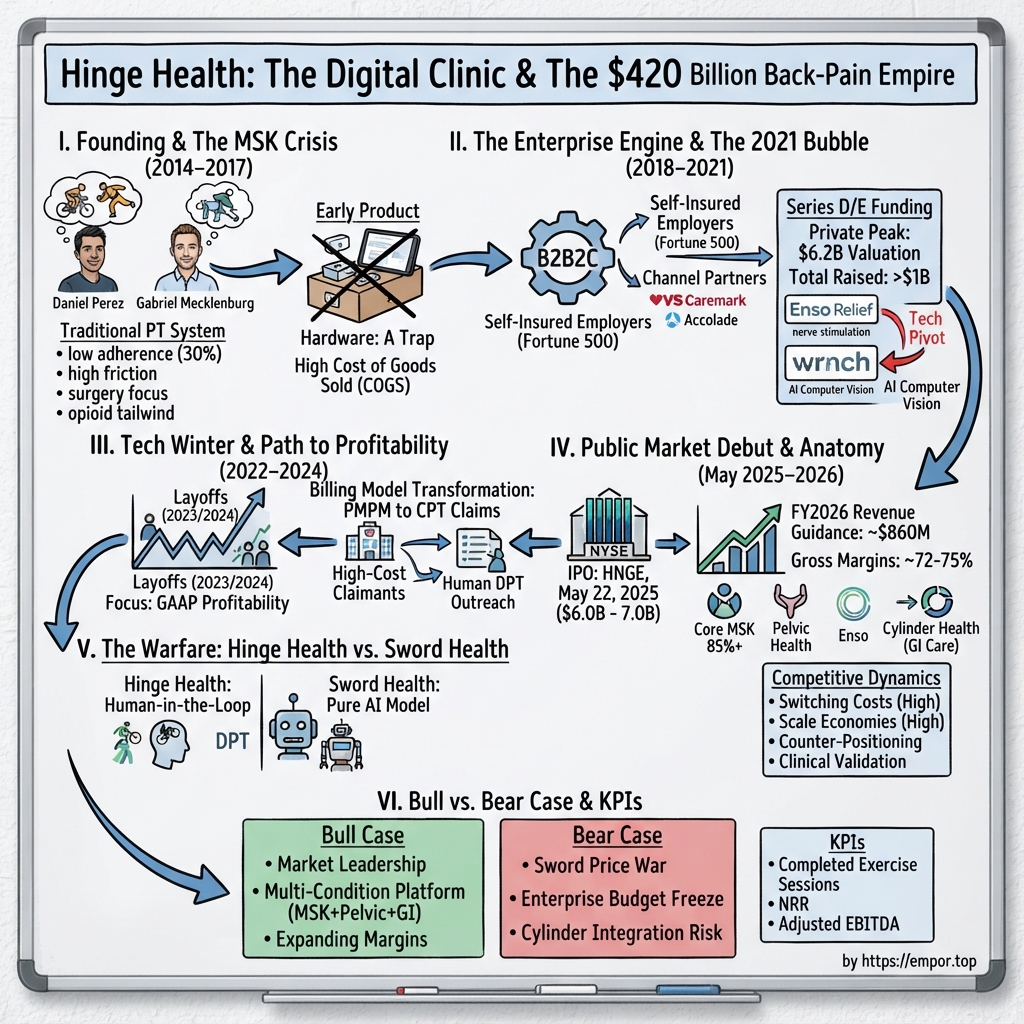
Hinge Health: The Digital Clinic and the Back-Pain Empire
I. Introduction & Episode Roadmap
On the afternoon of August 4, 2026, Daniel Perez sat down in front of a webcam to deliver quarterly financial results that marked a sharp departure from the recent history of digital health. His company, Hinge Health, reported $212.8 million in second-quarter revenue—a 53% increase year-over-year. GAAP gross margin reached 86%, while free cash flow hit nearly $100 million for the quarter. The company then spent $105 million to acquire a business in a therapeutic area it had never previously treated.1
Four years earlier, Hinge Health stood as a prominent example of the 2021 venture capital boom's excesses: holding a $6.2 billion private valuation and carrying over 1,700 employees, yet losing money across its core operations.23 By 2024, the company cut roughly a tenth of its workforce.3 Fifteen months later, in May 2025, it went public at a valuation roughly 60% below its peak private benchmark.4
This is the story of how Hinge Health evolved from shipping cardboard boxes of Bluetooth sensors to American office workers into operating the largest virtual musculoskeletal clinic in the United States by revenue—and whether its underlying business model is fundamentally defensible or simply ahead of competitors.
Why musculoskeletal care became the battleground
The market context clarifies the company's core business model. Musculoskeletal conditions—ranging from chronic back and knee pain to acute joint discomfort—represent the single most expensive and persistent category of spending for American employer health plans. Bessemer Venture Partners, which led Hinge's Series C funding round in late 2019, estimated the market size at roughly $600 billion, calling the sector "riddled with inefficiencies and poor patient experience."5
The structural bottleneck lies in patient compliance. Standard physical therapy is clinically effective, but utilization remains low. Hinge management estimates that only about 9% of U.S. adults visit a physical therapist annually, asserting that broader access could raise that figure to 12–15%.6 Lacking accessible physical therapy, patients frequently pursue higher-cost interventions: diagnostic imaging, therapeutic injections, and surgery. Hinge's twenty-first published study, appearing in the Journal of Health Economics and Outcomes Research, reported that participants in its chronic back program recorded 60% fewer low-back imaging visits at three months compared to a control group.6 Whether that reduction reflects true clinical divergence or self-selection bias remains an open question examined later in this analysis.
The financial structure of U.S. corporate health benefits enabled this model. Most large employers are self-insured, directly assuming medical claim costs while paying insurers solely to process claims. For a corporate benefits executive, an expensive orthopedic surgery represents a direct cost rather than a third-party claim. A program that purports to convert a $40,000 knee replacement into twelve weeks of digitally guided exercise is pitched not as an employee benefit, but as direct line-item expense reduction.
The scale today, and the arc that got here
By the end of 2025, Hinge Health reported 2,830 enterprise clients, covering roughly 24.6 million contracted lives and counting 782,890 active enrolled members.7 Client count expanded to 2,929 by the second quarter of 2026.1 In August 2026, management raised full-year revenue guidance to between $856 million and $860 million—representing approximately 46% annual growth—and projected a 28% non-GAAP operating margin.1
The company's valuation trajectory reflects this reset. Hinge priced its initial public offering at $32.00 per share on May 22, 2025, establishing an initial public market valuation of roughly $2.5 billion—a sharp reduction from its $6.2 billion private peak in October 2021.82 By the market close on August 28, 2026, the stock traded at $87.35 per share, representing a market capitalization near $7 billion within a 52-week range of $30.08 to $95.57.9 While public market investors who entered at the IPO saw substantial gains, private investors from the 2021 round required nearly five years to recover their capital.
Six analytical threads frame this narrative. First, the company's origins with two injured graduate students in Britain seeking to redesign physical therapy delivery. Second, the enterprise distribution strategy that targeted self-insured employers before expanding into health plan networks and pharmacy benefit managers. Third, the technological transition from shipping physical hardware kits to deploying smartphone-camera computer vision. Fourth, the post-2021 financial restructuring that reshaped unit economics ahead of the IPO. Fifth, product expansion across adjacent therapeutic categories, including pelvic health, nerve-stimulation wearables, migraine management, and gastrointestinal care. Sixth, competitive dynamics with primary rival Sword Health, alongside an evaluation of Hinge's core clinical and commercial claims.
The narrative begins where the pain started.
 Subscribe on LinkedIn
II. Founding & The MSK Crisis (2014–2017)
In 2014, Hinge Health emerged from two graduate students recovering from severe physical injuries. Daniel Perez had fallen off a bicycle at high speed, suffering multiple bone fractures, while Gabriel Mecklenburg had torn his anterior cruciate ligament on a judo mat. Perez was pursuing a PhD at Oxford; Mecklenburg was completing his degree at Imperial College London.10 Comparing recovery experiences, they identified a shared obstacle: a disjointed, slow rehabilitation system biased toward high-cost interventions.
That frustrating care pathway became the company's founding catalyst. Rather than starting from a market-sizing spreadsheet or a specific technological breakthrough, the founders built their thesis around their own experience with physical recovery. Both founders later cited the health care system's over-reliance on surgery and opioids as the primary operational problem they sought to solve.10
The three structural failures they were betting against
The business model targeted three structural failures in musculoskeletal care.
The first was operational friction. Unlike pharmaceuticals, physical therapy requires active behavioral adherence—consistently performing routine exercises over many weeks. Logistics such as travel time, co-payments, and mid-day clinic appointments lower patient compliance. While specific adherence rates and co-payment thresholds are absent from Hinge's public disclosures, the economic mechanism is straightforward: care that requires travel is frequently skipped, and skipped care fails to deliver outcomes.
The second failure was clinical escalation. When conservative care is delayed or avoided, medical providers typically rely on diagnostic imaging followed by interventional procedures. This cascade drives high spending: imaging studies frequently reveal structural variations that trigger costly surgical interventions. Hinge's commercial strategy aimed to shift spending away from high-cost procedures toward conservative, exercise-based therapy. Management reiterated this thesis in early 2026, stating that members accessing its network recorded higher rates of non-surgical orthopedic evaluations and physical therapy, alongside lower rates of imaging and surgery, compared to commercial benchmarks.6
The third failure was the opioid prescribing pathway. Musculoskeletal pain historically served as a major entry point for long-term opioid prescriptions among working-age populations, and the founders framed the reduction of opioid dependency as a primary goal.10 While this objective highlights the social rationale of the business, it represents a qualitative mission rather than a directly audited financial line item.
The first product was a box
Hinge Health's initial offering differed significantly from today's digital platform. Rather than a software application, the company delivered a physical kit containing a dedicated tablet computer preloaded with therapy software, wearable bands equipped with motion sensors, hardware accessories, and a stand for a twelve-week, coach-led program.105 Dedicated human coaches employed by Hinge supported member progress throughout the regimen.
In 2016, this hardware-centric model was practical. Smartphone cameras and mobile computer vision could not reliably evaluate exercise posture in home environments, whereas wearable inertial sensors provided accurate movement tracking. Shipping dedicated hardware also allowed the company to control user experience directly.
The twelve-week program design reflected a behavioral insight: effective digital physical therapy required structured execution rather than an on-demand video library. By offering a defined schedule paired with human coaching and explicit completion milestones, Hinge replicated the structure of traditional physical therapy prescriptions.10 The fundamental challenge in musculoskeletal care was not a lack of clinical knowledge—such as understanding that strengthening target muscle groups alleviates joint pain—but securing patient adherence.
This focus made member enrollment and retention Hinge's core operational competency. Onboarding covered individuals and maintaining their participation required combining consumer marketing, behavioral science, and clinical oversight. A decade later, driving member participation remains central to revenue growth, with management explicitly attributing yield expansion to targeted enrollment campaigns and member referrals rather than new software features.12
During this early period, Hinge made its most significant commercial decision by shifting away from direct-to-consumer sales toward risk-bearing enterprise clients. Operating under a business-to-business-to-consumer model, Hinge adopted a per-engaged-employee pricing structure sold to self-insured employers instead of a direct consumer subscription.10 This transition directly linked the company's revenue to employer healthcare cost savings rather than consumer discretionary spending.
Testing the hardware moat against the record
The early strategy tested a central thesis: that proprietary hardware shipped to patients created a durable competitive advantage that software-only rivals could not match.
Hinge's financial evolution ultimately disproved that assumption. Bessemer Venture Partners, an early investor, noted after the IPO that the platform evolved from physical kits with tablets and sensors into a computer-vision system running on smartphone cameras to track over 100 biomechanical landmarks in real time—an evolution that "reduced costs and improved business margins."5 Removing the initial sensor hardware eliminated logistics costs and expanded profit margins.
That financial impact appears clearly in the historical record. Hinge's gross margin expanded from 66% in 2023 to 77% in 2024, reaching 83% on a non-GAAP basis for full-year 2025 and 87% in the second quarter of 2026.1161 This 21-percentage-point margin expansion over three years reflects the transition from physical motion sensors to smartphone computer vision alongside automated care management.
However, Hinge did not abandon hardware entirely; instead, it shifted toward targeted clinical devices. Enso, a wearable electrical nerve-stimulation device integrated into Hinge's product line by September 2021, represents a product management seeks to deploy more broadly.12 Chief Financial Officer James Budge informed investors in February 2026 that gross margin gains from artificial intelligence efficiency tools would be largely offset by expanded Enso distribution, guiding to approximately 100 basis points of improvement in 2026.6 Management is effectively trading margin performance for member engagement, supported by Chief Executive Officer Daniel Perez's statement that members receiving an Enso device complete roughly 70% more exercise therapy sessions.6
The historical record demonstrates that shipping motion sensors created logistics overhead rather than a permanent competitive moat, prompting Hinge to adopt computer vision when the technology matured. At the same time, management continues to deploy specialized hardware when it demonstrably improves member compliance. The key metric evaluating this strategy is whether expanding Enso distribution increases total member enrollment yield sufficiently to justify the incremental hardware expense.
While technology deployment presented an initial operational hurdle, the primary commercial question in 2017 was whether enterprise buyers would adopt the model at scale.
III. The Enterprise B2B2C Engine & The 2021 Bubble (2018–2021)
The enterprise health benefits industry runs on a rigid calendar. Chief Executive Officer Daniel Perez described the dynamic on Hinge's second-quarter 2026 earnings call: more than 70% of employer purchasing decisions occur between the middle of the third quarter and the first half of the fourth quarter for benefits that take effect on January 1.12 Missing that single window forces a vendor to wait twelve months for the next selling cycle.
Navigating that annual procurement cycle became central to Hinge Health's commercial expansion, serving as a primary catalyst for its growth.
Selling to the people who actually bear the risk
The commercial pitch to self-insured employers rested on straightforward financial logic. Because self-insured companies pay employee healthcare claims directly from their own accounts, Hinge charged fees based on engaged members while arguing that active participation reduced expensive orthopedic claims. In effect, corporate benefits buyers were purchasing an option to avoid surgical costs rather than buying standard wellness software.
That approach drove steady adoption across major corporate employers. By the end of 2025, Hinge President Jim Pursley reported that the company's client roster included 53% of the Fortune 100 and 45% of the Fortune 500.6 While individual corporate accounts beyond those publicly named remain undisclosed, the broader client base expanded to over 2,800 enterprise customers spanning manufacturing, retail, hospitality, technology, and the public sector.6
The channel multiplier
To scale beyond direct enterprise sales, Hinge established distribution partnerships with health plans, pharmacy benefit managers, third-party administrators, and benefit platforms—building over 60 channel relationships by the end of 2025.6 Integrating into these established platforms placed Hinge directly into existing corporate benefit catalogs, reducing procurement friction for enterprise buyers.
The strategic value of this channel strategy became evident in early 2026 when Hinge disclosed that three of the five largest U.S. health plans by self-insured lives had selected Hinge Health for their own corporate employees.6 While this metric represents a company-sourced disclosure rather than an independently audited figure, adoption by health plan operators themselves served as a significant commercial validation.
By mid-2026, channel distribution yielded broader structural integration. Pursley announced that Hinge had been selected as the default, opt-out physical therapy solution for a major health plan's commercial book of business covering clients with under 3,000 lives, with member onboarding scheduled to begin in early 2027.12 Securing default status within a major carrier's distribution network replaced an incumbent vendor and established a structural distribution advantage.12
The composition of Hinge's covered population shifted alongside this expansion. Exiting 2025 with approximately 24.6 million contracted lives, roughly 22 million belonged to self-insured employers, while 2.6 million were enrolled through fully-insured, Medicare Advantage, and Federal Employee Program plans—a segment that grew 135% from approximately one million lives a year earlier.6 Hinge added 4.8 million net new contracted lives during the 2025 selling season alone.6 For non-self-insured populations, the company used a staged rollout strategy, securing initial sub-populations before expanding access across larger member groups.6
This distinction carries analytical weight. Self-insured employers evaluate vendors on immediate projected claims savings within a single annual buying cycle. Fully-insured and government health plan books require longer implementation timelines, but once integrated, deliver member populations in large blocks. The 135% growth in Hinge's non-self-insured segment during 2025 serves as a key indicator of whether its health plan distribution strategy can sustain compounding growth.
2021: the money arrives
Capital flows into digital health accelerated sharply in 2021. Hinge completed a fundraising round at a $3 billion valuation in January 2021, followed nine months later on October 28, 2021, by a $600 million financing package—comprising $400 million in Series E primary capital co-led by Tiger Global and Coatue, alongside $200 million in secondary share purchases by Alkeon Capital and Whale Rock—that raised its valuation to $6.2 billion.2 The company's enterprise customer count had roughly doubled year-over-year to over 575 clients.2 Total funding raised surpassed $1 billion in total deal value, with cumulative primary equity capital reaching approximately $828 million by April 2024.23
Management stated that the proceeds would fund expansion into new care modalities, patient experience enhancements, and surgical avoidance initiatives.2 Public capital markets, however, valued the company on elevated revenue multiples driven by expectations that pandemic-era virtual care utilization would remain permanently elevated.
Two acquisitions, one of which quietly rewrote the company
In September 2021, Hinge acquired wrnch, a Montréal-based computer-vision company founded by Paul Kruszewski.13 The acquisition integrated technology capable of tracking 87 body movement points via standard smartphone cameras—enabling measurement of full-body movements such as exercise posture—and established what Hinge described as the digital health industry's largest computer-vision engineering team.14 Financial terms of the transaction were not disclosed.
The technology operates similarly to a motion-capture system without external sensors. Using a smartphone camera, algorithms trained on movement datasets map joint positions in three-dimensional space, assessing exercise depth, knee alignment, and spinal posture in real time. Branded as TrueMotion, the system tracked movement across more than 100 reference points by December 31, 2025, supported by 40 issued patents and 88 pending patent applications.15
Around the same time, Hinge acquired Enso, a wearable nerve-stimulation device designed to deliver electrical impulses that temporarily block pain signals. By offering targeted non-invasive pain relief, the device aimed to improve member adherence during physical rehabilitation exercises.
Testing the 2021 valuation and the "invincible model" thesis
The $6.2 billion private valuation in late 2021 reflected investor assumptions that Hinge possessed a highly defensible enterprise software franchise paired with proprietary hardware.
Subsequent market pricing tested those assumptions. Hinge did not complete subsequent private funding rounds at higher valuations. Instead, the company completed its initial public offering three and a half years later at a valuation of approximately $2.5 billion—roughly 60% below its 2021 private peak—and required until mid-2026 for its public market capitalization to return to $6.2 billion.89 Investors participating in the Series E round faced a nearly five-year timeline to recover their invested capital on paper, highlighting the gap between late-stage venture valuations and public market pricing.
Regarding operational costs during the sensor-kit era, Hinge did not publicly break out fulfillment expenses, leaving the precise cost of hardware logistics unquantified. Disclosed financials show that gross margins stood at 66% in 2023, reflecting a cost structure that burdened operating efficiency during the physical hardware deployment phase.11
The wrnch acquisition proved central to resolving this margin constraint. Rather than serving merely as a feature enhancement, transitioning from shipped tablet-and-sensor kits to smartphone-based computer vision enabled Hinge to eliminate physical hardware shipping overhead, laying the foundation for subsequent gross margin expansion.
Addressing hardware overhead positioned the company to tackle broader operational and expense discipline across its entire operating structure.
IV. The Tech Winter, Restructuring & Path to Profitability (2022–2024)
As venture capital valuations collapsed across digital health following the 2021 boom, the enterprise sales environment shifted abruptly. Corporate benefits buyers faced heightened scrutiny from chief financial officers seeking to justify pandemic-era software vendor commitments.
Hinge Health's 2023 financial performance reflected a business that had not yet adapted to this tighter fiscal environment. While revenue reached $292.7 million, gross margin remained constrained at 66%, resulting in a net loss of $108.1 million.11 The figures highlighted a company scaling top-line revenue faster than its underlying unit economics could support.
The cuts
In April 2024, Hinge cut approximately 10% of a workforce that had exceeded 1,700 people.3 Management framed the reduction as a step to "accelerate our path to profitability, speed up decision making, and better focus our investments."3 The company executed the layoffs from a position of relative liquidity, holding roughly $400 million of cash on its balance sheet and stating it was "not under pressure to hit the public markets" that year.3
Subsequent financial results demonstrated rapid operational progress. In 2024, revenue expanded 33% to $390.4 million, while gross margin improved to 77%.11 Concurrently, Hinge narrowed its net loss from $108.1 million to $11.9 million—an 89% reduction in a single year.7
While occasionally characterized as a modest administrative trimming, contemporaneous reporting indicated that the reduction affected roughly 170 people across various functions, including core engineering teams.3 The restructuring represented a substantive operational recalibration rather than a superficial expense reduction.
Myth versus reality: what actually changed in the billing model
A common narrative surrounding Hinge Health's transformation is that it shifted from per-member-per-month wellness stipends to billing medical claims under Current Procedural Terminology (CPT) codes—effectively becoming a virtual clinic paid on a fee-for-service basis. Company disclosures detail a fundamentally different operational mechanic.
Hinge's revenue formula relies on three core variables: eligible lives (how many people are covered), yield (the percentage of those people who enroll and engage), and average selling price per engaged member.6 Multiplying these variables generates calculated billings, which the company recognizes as revenue over the subscription period.12 Rather than adopting fee-for-service claims billing, management migrated clients from an older upfront subscription model to an engagement-based pricing model—by the end of 2025, about 50% of eligible lives had moved to it.6 On the first-quarter 2026 earnings call, Budge confirmed that pricing on the legacy upfront model had not changed in several years.16
This distinction clarifies where commercial risk resides. Were Hinge a traditional claims-billing clinic, its financial exposure would center on reimbursement policies and payer coverage decisions. Under engagement-based pricing, exposure centers directly on enrollment and active participation. The growth algorithm relies on yield—a metric the company defines, measures, and reports itself. Demonstrating this operational dependency, Hinge's 10-K itself flags the risk that investors may not perceive its operating metrics to be accurate.15
Medical claims data plays a distinct strategic role elsewhere in the platform. Hinge built an engine called HingeConnect that integrates electronic health record data, insurance claims feeds, prior authorization records, and health plan referrals, and applies algorithms to identify likely high-cost individuals before they become high-cost claimants.15
This data engine addresses a central challenge in digital health: the tendency of voluntary programs to attract low-risk individuals rather than high-cost claimants. By analyzing claims records, HingeConnect identifies indicators such as recent spinal imaging or pending surgical authorizations, triggering direct outreach by Hinge's clinical team. This mechanism directly connects member engagement metrics to employer healthcare savings.
While engagement-based pricing eliminates employer concerns over paying fixed fees for unutilized benefits, it transfers member adoption risk to Hinge. Revenue increases only as clinical engagement grows. Consequently, financial performance depends heavily on behavioral conversion rates, which are inherently more volatile and harder to forecast than contract renewals.
Testing the "value-based contracts guarantee retention" claim
A key investment thesis asserts that deep technical integration and demonstrated return on investment make enterprise accounts structurally sticky, allowing revenue to compound automatically.
Commercial disclosures provide strong support for client retention. Hinge reported a 97% annual client retention rate in 2025 and net dollar retention well above 110%, against management's own stated industry bar of 110%.6 Bessemer notes the company had no customer churn in its early years.5 Furthermore, yield improved from 3.4% at the end of 2024 to 3.9% at the end of 2025, then to a guided 4.45% for 2026—meaning existing clients keep producing more revenue without price increases, since average selling price has been essentially flat.612
However, competitive dynamics demonstrate that enterprise accounts remain subject to churn. Pursley disclosed that in the final month of 2025, a large enterprise with over 200,000 lives left a competitor for Hinge,6 and in the second quarter of 2026 a Fortune 15 company moved nearly 300,000 lives to Hinge, again displacing an incumbent.12 While proving Hinge's competitive strength, these account migrations confirm that enterprise switching costs across the sector are surmountable. Addressing why Hinge won the Fortune 15 account, Pursley's answer was unusually candid: it was the product experience that carried it, and "there were some other elements that we probably were playing at a disadvantage and playing from behind."12
In addition, potential self-selection bias complicates clinical outcome evaluations. Individuals who voluntarily enroll in digital exercise programs are, on average, more motivated than non-participants, whereas the highest-cost orthopedic claimants often show lower baseline engagement. Hinge addresses this through HingeConnect and proactive clinician outreach. However, existing published studies compare active participants to non-randomized control groups rather than randomized enrollment cohorts, leaving the true population-wide effect open to interpretation.
Ultimately, enterprise retention reflects ongoing execution and rising member yield rather than permanent structural lock-in. Client stickiness depends on delivering measurable clinical performance and deepening engagement within legacy accounts.
With its cost structure restructured and growth engine humming, the founders prepared to take the company public.
V. The Public Market Debut & Financial Anatomy (May 2025–2026)
The bar for a digital health IPO in the spring of 2025 was on the floor. The category had produced almost nothing but disappointment since 2021. So when Hinge Health priced at $32.00 per share on May 22, 2025 — the top of its $28–32 range — and then opened at $39.25, roughly 23% above the offer, it was read across the industry as a referendum on whether the category could still be financed.17
The mechanics of the deal are worth a moment because they say something about intent. Hinge sold 8,522,528 shares itself; existing holders sold 5,143,472; the total of 13,666,000 shares generated roughly $437.1 million of gross proceeds, with a 2,049,900-share greenshoe, led by Morgan Stanley, Barclays, and BofA Securities.8 The company's own stated use of proceeds was to cover tax withholding on vesting restricted stock units.8 Read that again: the primary purpose of the offering was not to fund the business. Hinge did not need the money. It needed a liquid currency and a public market. At pricing, the implied market capitalization was roughly $2.5 billion.17
The first full year: better than the plan
Full-year 2025 revenue reached $587.9 million, up 51% from $390.4 million, and comfortably ahead of the company's own $572–574 million guidance.76 Non-GAAP gross margin hit 83% for the year and 85% in the fourth quarter; non-GAAP operating income was $119 million, a 20% margin, versus negative 7% in 2024.6 Free cash flow reached $179.6 million, a 31% margin — a target the company had set for itself at the IPO and hit seven months later.76
The GAAP picture looked entirely different, and this is the most important accounting judgment in the story. On a GAAP basis, Hinge reported a 2025 net loss of $528.3 million and an operating loss of $546.4 million.711 The gap between a $546 million GAAP operating loss and $119 million of non-GAAP operating income — roughly $665 million — was overwhelmingly stock-based compensation triggered by the IPO, as restricted stock units with performance conditions vested. It is a real cost to shareholders in the form of dilution, and it is genuinely non-recurring at that magnitude. Both statements are true simultaneously, and investors who look only at the non-GAAP line are ignoring roughly two-thirds of a billion dollars of value transfer.
There was a second, subtler presentation choice. In the fourth quarter of 2025, GAAP diluted earnings per share were $0.37.7 On the same call, Budge cited $0.49 using "now normalized share counts."6 The higher number is not wrong, but it is a management-selected denominator. Budge did commit to something checkable: annual dilution from stock grants had declined in each of the prior three years, and he expected a further decline in 2026.6
The 2026 guidance sequence, and what it reveals
Watch this sequence carefully, because it is the clearest window into how this management team sets expectations.
In February 2026, Hinge guided full-year 2026 revenue to $732–742 million — about 25% growth — and told investors that figure was $39 million above sell-side consensus.6 In June, at its first Investor Day, it raised to $818–824 million, about 40% growth.18 In August, it raised again to $856–860 million, about 46% growth, with non-GAAP operating income of $236–244 million.1
Growing from a 25% guide to a 46% guide in six months is either exceptional execution or systematic conservatism. Budge's own framing supports the latter reading: he explained that guidance "is typically based on what we see in front of us" — the yield already being experienced, plus lives already won in prior sales seasons.12 That is a defensible methodology and it produces a consistent pattern of beats. It also means investors should mentally discount the initial annual guide rather than treat it as a forecast. The honest characterization is that this team guides to the floor, not the expectation. Whether that is prudence or expectation management is a judgment call; what matters analytically is knowing which one you are reading.
The driver of the raises was singular. Lives came in as expected. Average selling price came in as expected — essentially flat. All of the upside was yield, which management now expects to reach roughly 4.45% for 2026 versus 3.9% exiting 2025.12 Budge attributed it to clinically targeted enrollment campaigns, member-to-member referrals, and members returning for additional care.12
This is the single most important thing to understand about Hinge's economics: the company is not growing by raising prices. It is growing by converting a larger fraction of an already-contracted population. That is a genuinely attractive form of growth — no price friction, no new sales cycle — but it is also finite in a way price increases are not, and the ceiling is unknown. Perez has pointed to 12–15% as a long-run North Star versus the ~9% of adults who see a physical therapist today.12 That is an aspiration, not a forecast, and it is worth treating as such.
It is also worth noting what the denominator is doing. Hinge ended 2025 with 20.1 million trailing-twelve-month average eligible lives and guided 2026 on an assumption of 24.4 million — growth that was already banked from prior sales seasons rather than dependent on the current one.6 That is the structural reason this business has unusually good forward visibility: a given year's revenue is largely determined by contracts signed in the preceding autumn, so the only real variable within the year is conversion. It also explains why a disappointing sales season would not show up in results for roughly twelve months, which is a genuine hazard for investors reading current numbers as a real-time signal.
The company chose 2026 to spend some of that visibility. Management described the year as one of incremental investment — research and development headcount to accelerate new products, and sales and marketing aimed at the in-person network and the small and medium business segment — while still guiding to margin expansion.6 By mid-year, the small-business bet was showing: lives in that segment more than doubled year-over-year in the first half, in what Pursley described as one of the company's lowest-penetrated categories with materially faster deal cycles.12
The second quarter of 2026, in plain English
The June-quarter results extended every trend. Revenue of $212.8 million beat a $200–202 million guide. GAAP operating income was $40.4 million against a $580.7 million loss a year earlier. Non-GAAP operating margin reached 29%, a full 1,000 basis points above the prior year. Free cash flow was $99.6 million — a 47% margin — and GAAP diluted EPS was $0.52, with net income of $43.7 million. Cash and marketable securities stood at $475.6 million. Trailing-twelve-month calculated billings reached $861.8 million, up 52%.1
Billings growing faster than revenue is the detail that matters most, because billings lead revenue in this model. It is the closest thing Hinge has to a forward indicator, and it was running ahead.
One honest asterisk: roughly 100 basis points of that 87% non-GAAP gross margin came from a one-time tariff refund.12 It is small, but it is a reminder that Enso is a physical device manufactured through third parties and subject to import economics and FDA quality-system regulation — an exposure the 10-K acknowledges among general economic risks including tariffs.15
What the company actually sells — and what it does not disclose
The outline of this business is often described in segment terms. It should not be. Hinge Health does not report revenue by product line, and any breakdown of "MSK versus pelvic versus device revenue" is inference, not disclosure. What management has said is directionally clear: as of the second quarter of 2026, almost all enrollment yield still came from digital physical therapy.12 The core MSK clinic is the business.
Around it sit several genuine expansions. The women's pelvic health program addresses pregnancy and postpartum recovery, bladder control, pelvic pain, and pelvic strength.10 A fall-prevention program called Balance targets Medicare Advantage populations; Hinge's twenty-third published study, in the Journal of Comparative Effectiveness Research, reported that adults 65 and older at risk of falls who used the program had 37% fewer falls and 57% lower odds of an emergency room visit at three months versus a control group.12
HingeSelect is the most strategically interesting and the least monetized. It is a high-performance in-person provider network — Hinge steering members to vetted physical therapists and orthopedic specialists, spanning over 5,000 locations by mid-2026.12 Management reported that about 85% of HingeSelect members moved forward with a conservative care plan, most often digital physical therapy.6 Perez has described it as a two-sided marketplace that will eventually create network effects and become "one of our most enduring competitive advantages" — while simultaneously stating the company does not expect much revenue impact until at least 2027.6 That is a claim about the future with essentially no revenue evidence behind it yet, and it should be weighted accordingly.
Migraine was the first true adjacency. Hinge launched its Migraine Care Program on April 29, 2026, built around an FDA-cleared version of Enso using trigeminal nerve stimulation, with 125-plus clients covering more than two million lives at launch.19 By the second quarter it had over 450 clients and more than five million lives, and more than ten health plans had switched it on for clients underneath their partnership contracts.12 That is fast adoption on the sales side. On the revenue side, management has been careful: at Investor Day it framed migraine as contributing roughly 10–20 basis points of yield improvement in 2027, and reaffirmed that figure on the second-quarter call.12 Certification and client sign-ups are not revenue. Ten to twenty basis points of yield is the actual number management is willing to stand behind.
Cylinder, and the first real capital allocation test
On August 4, 2026, Hinge announced a definitive agreement to acquire Cylinder Health for $105 million in cash, expected to close in the third quarter.20 Cylinder is a virtual-first digestive health company: nearly 100 clients across two million lives, more than 150,000 people treated over its life, partnerships with two of the three largest PBMs and three of the top five self-insured health plans, led by founder Terry Boch.20
The strategic logic Perez offered has three parts. GI conditions affect roughly one in four U.S. adults and drive about $135 billion in annual medical spend, with 69% of U.S. counties lacking a gastroenterologist.12 The conditions are highly comorbid with what Hinge already treats, sharing gut-brain and central-sensitization mechanisms.20 And demand has intensified because GLP-1 medications frequently cause gastrointestinal side effects — a genuinely non-obvious observation that Perez and Pursley both raised.12
The diligence detail that carries the most weight: 52 of Cylinder's roughly 100 clients were already Hinge Health clients.12 That overlap is what makes the integration risk lower than a typical adjacency deal — same buyers, same channel partners, same sales motion.
The honest counterweights, all from management's own mouth. Cylinder was running at a loss and will take "a year to two years" to reach Hinge's margin profile. Product integration is expected to complete by the summer of 2027. Revenue contribution in 2026 is $7–8 million over roughly four months, implying a $20–25 million annualized business — and Budge said the year they are "really looking towards" for it to take off is 2028.12 Hinge paid $105 million, roughly four to five times current revenue, for an unprofitable company whose meaningful contribution is two years out.
That is a defensible tuck-in, not a masterstroke, and it should be described as the former. Perez himself framed the value as buying an "18–24-month head start" versus building from scratch.12 The company's prior integration record is genuinely relevant here and genuinely thin: wrnch was absorbed successfully over years, and Enso became a shipping product. Two integrations, both technology assets rather than commercial organizations, is a small sample on which to underwrite a people-and-clients acquisition. Perez also disclosed that Hinge receives two or three inbound acquisition approaches in some weeks and reviews each — a volume that makes the "high bar" characterization worth verifying over time rather than accepting.12
Governance: who actually controls this company
Hinge operates a dual-class structure. Each Class A share carries one vote; each Class B share carries 15 votes; and Series E preferred shares carry 15 votes each on the as-converted basis, though they cannot vote in director elections.15 As of December 31, 2025, the founders, their affiliates, and holders of more than 5% of capital stock collectively held a substantial majority of voting power, and the 10-K states plainly that this concentration "will limit or preclude your ability to influence corporate matters."15 As of February 23, 2026, there were 55.8 million Class A shares, 22.9 million Class B shares, and 2.58 million Series E preferred shares outstanding.15
There is a wrinkle worth flagging: the remaining Series E preferred is held by a single holder, Tiger Global, and retains rights that the company itself identifies as potentially affecting the value of common stock.15 Founder Class B converts automatically to Class A when the holder ceases to be an employee or director; non-founder Class B converts seven years after the IPO.15
On insider selling: Perez sold 150,000 Class A shares on May 6–7, 2026, at weighted average prices around $55, through his spouse's account under a Rule 10b5-1 plan adopted September 11, 2025, for roughly $8.3 million. He retained Class B shares convertible into 9,488,845 Class A shares, plus 4,721,252 performance stock units.21 Pre-planned sales of a small fraction of a founder's stake are unremarkable; the disclosure is included because the pattern — insiders selling while the company buys back stock at higher prices — is one a skeptical investor should track rather than ignore.
Which brings us to the competitor that has spent a decade insisting Hinge is doing it wrong.
VI. The Warfare: Hinge Health vs. Sword Health & Competitive Dynamics
During Hinge Health's second-quarter 2026 earnings call, Needham analyst Ryan MacDonald raised the question central to the company's competitive landscape. He noted that the chief executive of a principal rival had recently reported a 70.5% win rate for the selling season and asked Hinge management how concerned they were.12
Hinge President Jim Pursley declined to debate the competitor's figures, stating that Hinge's win rates reached an all-time high before redirecting the conversation to product capabilities. Chief Executive Officer Daniel Perez addressed the claim directly, noting that private competitors face few constraints on public statements. Perez added that the competitor had claimed a 70% win rate for five years while Hinge remained significantly larger, suggesting the competitor's figures did not add up.12
That exchange captured the core dynamic of the sector's primary rivalry.
The two philosophies
Sword Health, founded by Virgílio Bento, has built its strategy around an artificial-intelligence-first care model centered on its Phoenix AI care specialist, alongside plans to extend automated treatment into cardiovascular, gastrointestinal, and speech therapy.22 Sword raised $40 million at a $4 billion valuation in June 2025, bringing total funding to $380 million while reporting a $240 million annual revenue run rate and positive cash flow.22 Bento deferred initial public offering plans, telling TechCrunch that a public listing would occur much later than anticipated—potentially in 2028—to allow the company to demonstrate scaled execution across multiple therapeutic areas first.22
In January 2026, Sword acquired Kaia Health, absorbing Kaia's U.S. member base and gaining access to Germany's digital health reimbursement framework covering over 70 million individuals.23 Financial terms of the transaction were not disclosed.23 Hinge's 2025 Form 10-K explicitly lists Kaia—noting its acquisition by Sword—alongside Omada Health and Vori Health as its primary digital competitors, while acknowledging potential competition from health plans and hospital systems developing internal digital programs.15
Direct scale comparisons require careful interpretation because the two companies report non-identical operational metrics. At the time of the Kaia acquisition, Sword reported over 700,000 members across three continents who had completed 10 million AI sessions since 2020.23 In comparison, Hinge reported 782,890 active members at year-end 2025 and 41 million member activity sessions during 2025 alone, contributing to over 100 million cumulative sessions.76 While proprietary session definitions cannot be reconciled directly, the difference in volume aligns with Perez's assertion that Hinge operates three to four times larger than its nearest competitor.12 That comparison remains a company-sourced claim, as no independent market share audit exists.
This philosophical divide carries practical commercial consequences. Sword contends that replacing human clinicians with automated systems removes the principal cost driver in digital care. Hinge argues that it has captured labor efficiencies without eliminating clinical oversight: in 2025, the company expanded its member base by 47% while keeping care team costs flat, supported by a 28% drop in the average time clinicians spent on asynchronous messaging following the rollout of automated routing tools.6
Hinge's AI care assistant, Robin, drew a 92% positive rating from engaged members, leading management to project flat care team expenses again in 2026.6 This hybrid approach captures automation benefits while preserving the human clinical presence preferred by enterprise procurement teams and health plan auditors. However, if a fully automated competitor demonstrates comparable clinical outcomes at a lower price point, enterprise purchasing priorities could shift rapidly.
Seven Powers, tested rather than asserted
Switching costs — real but crossable. Client retention of 97%, deep integration into benefits portals and health plan catalogs, and the administrative burden of retraining employee populations provide structural stickiness. However, account migrations involving 200,000 and 300,000 covered lives demonstrate that switching costs can be overcome. While switching friction is moderate rather than absolute, Hinge has consistently operated as a net beneficiary of enterprise account transitions.
Scale economies — the strongest power here. Training computer vision models and expanding enterprise distribution infrastructure represent substantial fixed investments. Spreading those costs across tens of millions of member sessions enabled Hinge to serve 47% more members while keeping care team costs flat. Scale economies remain high and supported by operating evidence.
Process power — moderate. Accumulating twenty-three published clinical studies and return-on-investment analyses creates an evidence base that early-stage rivals cannot replicate quickly, serving as a key differentiator in formal procurement reviews.12 The primary qualification remains methodological: because published studies compare voluntary participants against non-randomized control groups, they cannot fully isolate clinical efficacy from self-selection bias.
Counter-positioning — weakening by design. Hinge originally positioned its digital platform as a direct, structural replacement for traditional brick-and-mortar physical therapy. The rollout of HingeSelect alters that narrative. By building an in-person provider network, Hinge transitioned from pure virtual counter-positioning to a hybrid delivery model—a practical commercial move for members requiring hands-on care, but one that dilutes its original disruption story.
Cornered resource, branding, network economies — not established. Management asserts that a two-sided marketplace will emerge around the HingeSelect network, generating self-reinforcing network effects.6 By management's own admission, this initiative has generated no material revenue to date.
Porter's five forces
Buyer power is high. Self-insured employers and health plans exercise substantial bargaining leverage through structured procurement cycles, with security and legal assessments lengthening sales timelines.12 Hinge contends that stringent buyer requirements favor scaled incumbents capable of demonstrating population-level clinical outcomes and passing data privacy audits, though this perspective reflects a company-aligned assessment.
The procurement process illustrates these demanding requirements. Benefits executives typically trial competing platforms directly—working with physical therapists, evaluating wearable hardware, and testing digital features—before initiating technical, security, and financial return-on-investment reviews.12 This extensive vetting process favors established providers capable of delivering audited outcome metrics while creating hurdles for early-stage vendors.
Threat of new entrants is moderate. Multi-year clinical trials, lengthy health plan contracting, and regulatory oversight for physical devices present real barriers to entry. Nevertheless, well-capitalized software entrants face relatively low marginal cost barriers, particularly given strong capital deployment into healthcare artificial intelligence.
Threat of substitutes is meaningful. In-person physical therapy, surgical interventions, pharmaceutical pain management, and broader chronic care platforms compete directly for corporate health benefit allocations. Additionally, integrated benefit navigation platforms pose a structural substitution risk by bundling basic physical therapy features into broader administrative packages.
Rivalry is intense. Hinge and Sword Health compete head-to-head for enterprise accounts within a concentrated annual purchasing window.
Supplier power is low across software operations and modest for physical devices, where third-party contract manufacturers and FDA quality-system regulations introduce supply chain dependencies.15
The net read: Hinge's competitive moat rests primarily on scale economies and published clinical evidence, supported by default health plan distribution channels, while network effects remain speculative. The company maintains a strong market position, though one that remains exposed to shifts in enterprise procurement and competitive pricing dynamics.
VII. Material Risks, Stress Test & Investment-Story Spine
Every quarter that Hinge beats and raises makes the following section easier to skip and more important to read.
The risk radar that actually matters
Point-solution consolidation. The most credible structural threat is that employers, exhausted by vendor sprawl, consolidate benefits into fewer platforms—and that MSK becomes a bundled feature rather than a standalone solution. Hinge's answer is to become the consolidator itself across MSK, pelvic health, migraine, and GI care, which is precisely the logic Perez articulated in describing multi-product expansion as "not just a yield lever" but "a moat."12 The tension in that answer is that Cylinder was itself an absorbed point solution, underscoring the direction of the market—and indicating that Hinge is winning the roll-up strategy, not that the roll-up will stop with Hinge.
AI-driven price competition. If a rival delivers comparable published outcomes with materially less human labor, the pricing floor moves downward. Hinge's defense is that it has already captured most of its automation savings while retaining clinicians. The observable test for this risk is average selling price. Management has repeatedly guided to an essentially flat ASP.12 If ASP begins to decline, a true price war will have arrived.
Cylinder integration. The specific exposures are known and disclosed: an unprofitable acquired business, a product integration targeted for completion by summer 2027, and a unified multi-condition application promised for 2027.12 The key mitigant is customer overlap. The risk is that a company managing four clinical condition programs simultaneously loses the operational focus that drove its MSK dominance—a concern RBC analyst Rishi Jaluria raised directly on the second-quarter call.12
Metric integrity and regulatory exposure. Yield is a company-defined metric, and Hinge's own risk factors acknowledge that any inaccuracy or perceived inaccuracy in operating metrics could harm its business.15 Separately, the Enso device remains subject to FDA post-market regulation, including quality-system requirements that extend to third-party manufacturers.15 The company reported no pending litigation it believes would be material as of its 2025 annual report.15 That represents a clean legal slate at the time of filing—not a permanent condition, and not a substitute for ongoing monitoring.
Concentration and cyclicality. Hinge has not disclosed material client concentration. The primary cyclical risk centers on corporate employment levels: revenue depends directly on covered employer lives, meaning a significant contraction in white-collar or industrial headcount mechanically shrinks the eligible user base even if every enterprise client renews.
Reimbursement and policy drift. Because Hinge receives payment from employers and health plans under commercial contracts rather than primarily through fee-for-service medical claims, it remains less exposed to procedure-code revaluations than a traditional healthcare provider. That insulation is partial rather than absolute: as the company expands into Medicare Advantage populations through its fall-prevention program and moves deeper into health plan books, more of its revenue sits downstream of decisions made by payers whose economics are governed by federal policy. The mechanism to monitor is not a CPT code; it is whether a health plan partner under margin pressure decides that a supplemental virtual benefit is discretionary.
The activist's brief
A skeptical investor building a short thesis would base it on six core planks, each deserving a direct evaluation.
The evidence is self-selected. The strongest version of this critique notes that individuals who voluntarily enroll in a digital exercise program are healthier and more motivated than non-participants, meaning comparisons to a "similar control group" overstate net cost savings. This represents a legitimate methodological objection across the digital health ROI literature. Hinge's partial answer is HingeConnect, which identifies likely high-cost individuals from claims data before voluntary enrollment occurs.15 While this provides a substantive response, it remains an observational mechanism rather than a randomized controlled trial.
The GAAP-to-non-GAAP gap is enormous. A $665 million spread between GAAP operating loss and non-GAAP operating income in 2025 is a substantial divergence. Management's defense—that IPO-triggered RSU vesting represents a non-recurring expense at that scale, and that annual dilution has declined for three consecutive years with further reductions expected—is credible and verifiable.6 The full-year 2026 share count guidance of 85 million to 87 million diluted shares remains the primary metric for holding management accountable.12
Guidance is set to be beaten. Raising a full-year revenue growth forecast from 25% to 46% within six months represents a wide forecasting margin in the company's favor. Management's methodology explains the approach, but investors should recognize that initial annual guidance serves as a floor. A business whose guidance is designed to be exceeded will eventually produce a quarter where merely meeting expectations is interpreted as a disappointment.
Buybacks while insiders sell. Hinge's board authorized a $250 million share repurchase program in November 2025, buying back 1.4 million shares for $65 million in the fourth quarter of 2025 and approximately 480,000 shares for $26 million in the second quarter of 2026. After deploying $196.5 million through July 29, 2026, the board authorized an additional $300 million buyback.6121 Chief Financial Officer James Budge framed the new authorization as roughly matching trailing four-quarter free cash flow.12 The optics remain notable: the company repurchased stock at prices well above levels where corporate insiders sold shares under pre-arranged trading plans. While these trades reflect separate mechanical processes, buying back stock at roughly 2.7 times the IPO price represents a capital allocation choice with real opportunity costs that should be judged on long-term returns rather than signaling value.
Dual-class insulation. Founder-controlled voting power means public shareholders have limited governance recourse beyond selling their shares. Strong operational execution has minimized investor concern over this structure, though governance limits become paramount if operational performance deteriorates.
The four-product problem. The most substantive long-term investment concern centers on the combined execution load of recent initiatives. Within eighteen months, Hinge launched an in-person provider network, introduced a migraine program, acquired a digestive health business, and expanded into a small-business distribution channel—all while committing to unify these offerings into a single application in 2027. Individually, each move appears strategic and cost-effective. Collectively, they mark a transition away from a pure single-product model at a time when core MSK operations were expanding rapidly. When RBC analyst Rishi Jaluria questioned how management would maintain focus, Perez responded that platform components are reusable and go-to-market channels are shared, lowering the incremental cost of each new therapeutic area.12 That rationale holds if execution remains seamless, though current evidence relies primarily on the early launch of the migraine program.
The spine: why this wins, and what breaks it
The fundamental case for Hinge's market position rests on clear structural factors: it holds the largest contracted member population in its category, maintains a distribution network that increasingly positions it as a default provider, operates a cost structure where member scaling does not require proportional staffing increases, and drives revenue growth by expanding conversion rates within existing enterprise contracts rather than relying on price increases or new customer acquisition. These factors represent concrete operational mechanisms supported by empirical disclosures.
Conversely, the primary operational risk is a plateau in member yield. Because every guidance increase in 2026 resulted from higher yield, a flattening conversion rate would slow revenue growth toward the underlying growth rate of contracted lives—a significantly lower trajectory that would compress valuation multiples. Secondarily, ASP erosion under competitive pricing pressure would undermine the business model faster than customer churn, signaling that virtual musculoskeletal care has become commoditized.
VIII. Playbook, KPIs & Verdict: Bull vs. Bear Case
What this story actually teaches
Hardware must earn its margin, not defend a moat. The simplistic lesson—that hardware is inherently burdensome while software is superior—misses the operational nuance of Hinge's strategy. Hinge phased out its shipped tablet-and-sensor kits because they created fulfillment overhead without building a defensible moat, enabling gross margin to expand roughly 20 percentage points over three years. Management then reinvested a portion of those margin gains into the Enso nerve-stimulation device, noting that the wearable significantly improves session completion rates while guiding 2026 gross margin expansion down to approximately 100 basis points.6 The broader lesson is a pragmatic evaluation framework: physical devices must alter member behavior enough to offset their ongoing margin drag.
Sell the buyer's actual problem, and get on their shelf. The core distribution insight extended beyond selling directly to corporate employers. The highest-leverage strategy involved securing default distribution within partner networks—demonstrated by Hinge's agreement with a major health plan's small-business segment, where covered accounts receive Hinge on an opt-out basis.12 A single distribution partnership yields thousands of downstream enterprise clients.
A marked-down unicorn can rebuild, but the recovery carries real costs. Hinge successfully restructured its cost structure, achieved profitability, and ultimately surpassed its peak private valuation in public markets. However, that operational turnaround required cutting approximately 170 positions, while Series E venture investors required nearly five years to recover their invested capital. A complete assessment requires weighing both the operational recovery and the friction involved.
The three KPIs that matter
Yield. The percentage of contracted eligible lives that actively enroll and participate. Yield represents the primary driver of revenue growth, accounting for each guidance increase in 2026. Management has set a long-term yield goal of 12% to 15%, compared to an expected 4.45% in 2026.12 Investors should track this metric quarterly, observing both its absolute level and rate of expansion.
Contracted and eligible lives added per selling season. Because yield represents a percentage of an underlying pool, total contracted lives establishes the addressable revenue base for the following year. Annual procurement cycles cluster in the second half of the year, meaning a weak selling season will manifest in calculated billings before appearing in recognized revenue.
Free cash flow margin relative to long-term operating margin targets. Chief Financial Officer James Budge has established a long-term target of 35% or higher for non-GAAP operating margin.12 The margin gap between 2026 guidance of 28% and that long-term target reflects remaining operational leverage. The pace at which Hinge bridges that gap—while absorbing Enso hardware costs and initial operating losses from Cylinder—serves as the clearest indicator of underlying platform scalability.
A deliberate omission: Client counts and net dollar retention are widely cited but offer limited forward predictive value at this stage. With annual client retention at 97% and net dollar retention comfortably exceeding management's 110% benchmark, these metrics function as lagging indicators. Yield changes direction first.
The bull case
The positive investment thesis relies on demonstrated operational mechanics rather than unproven assumptions. Hinge covers roughly 25 million contracted lives with a current conversion yield near 4.45%. If yield reaches even the lower bound of management's 12% to 15% long-term target, revenue would nearly double from the existing contracted base without securing new enterprise accounts or raising prices. Additional growth levers include expanded contracted lives from an active sales pipeline, a small-business channel where contracted lives more than doubled year-over-year in the first half of 2026, and incremental yield contributions from newly introduced migraine and gastrointestinal programs.12
Concurrently, the operating model demonstrates clear scale economies: care team expenses remained flat despite significant member growth, non-GAAP operating margin expanded 1,000 basis points year-over-year in a single quarter, and free cash flow generation proved sufficient to finance an acquisition, execute share repurchases, and fund internal R&D within the same fiscal year.121 Supported by $475.6 million in cash and marketable securities with no material debt, the balance sheet provides high growth, expanding margins, and capital allocation flexibility.1
The bear case
The cautious thesis begins with the same core metric: yield. Yield is an internal, company-defined metric, and Hinge's risk disclosures explicitly note that any inaccuracy or perceived inaccuracy in operating metrics could adversely affect the business.15 Because no independent third-party benchmark exists, if member conversion flattens in the mid-single digits after initial high-intent users enroll, top-line growth would decelerate sharply, leaving the stock vulnerable following its post-IPO appreciation.
Second, competitive dynamics remain unsettled. Primary rival Sword Health is well-capitalized, cash-flow positive by its own accounting, actively acquiring assets, and building a multi-condition virtual care platform.2223 Both companies claim record win rates within the same enterprise market. If fully automated AI care models achieve clinical parity at lower cost, competitive pressure could force reductions in average selling prices—the key pricing variable Hinge has maintained flat.
Third, multi-product revenue expansion remains largely prospective. Management projects the migraine program will contribute 10 to 20 basis points of yield in 2027, while the acquired Cylinder digestive health business represents an unprofitable $20 million to $25 million annualized unit expected to deliver material returns in 2028. Similarly, the HingeSelect in-person provider network is not expected to generate meaningful revenue before 2027. Hinge is expanding from its core musculoskeletal offering into four distinct clinical areas, but its track record of converting new product launches into material revenue rests almost entirely on its initial musculoskeletal core and Enso device integration.
Fourth, corporate governance limits public shareholder oversight through dual-class voting control, while management executed corporate share buybacks at prices significantly higher than prices realized by executives during pre-planned share sales.
Where that leaves the story
The most balanced evaluation distinguishes between verified performance and forward claims. Hinge Health has demonstrated scale economies, expanded its distribution channels through health plan partnerships, and met or exceeded financial guidance for five consecutive quarters following its public listing and operational restructuring. These outcomes represent audited, empirical performance.
In contrast, management's multi-condition platform strategy, proposed network effects from HingeSelect, and long-term yield projections remain unproven. While backed by early adoption metrics and management targets, these initiatives have yet to generate substantial recognized revenue, with company guidance placing significant financial impact in 2027 and 2028.
Resolving the central investment question requires monitoring a single fundamental metric: the rate at which contracted eligible lives convert into active, participating members over successive quarterly reporting periods.
References
-
Hinge Health reports record second quarter 2026 financial results; signs definitive agreement to acquire Cylinder Health — Hinge Health Investor Relations, 2026-08-04 ↩↩↩↩↩↩↩↩↩
-
Hinge Health reaches $6.2bn valuation following $600m investment in round led by Coatue and Tiger Global — Private Equity Wire, 2021-10-28 ↩↩↩↩↩↩
-
Virtual physical therapist Hinge Health lays off 10% of its workforce — TechCrunch, 2024-04-11 ↩↩↩↩↩↩↩
-
Hinge Health: Reimagining possibilities and better outcomes with virtual care — Bessemer Venture Partners ↩↩↩↩
-
Hinge Health Q4 2025 Earnings Script — Hinge Health, Inc., 2026-02-10 ↩↩↩↩↩↩↩↩↩↩↩↩↩↩↩↩↩↩↩↩↩↩↩↩↩↩↩↩↩↩↩↩↩↩↩
-
Hinge Health reports fourth quarter and full year 2025 financial results — Hinge Health Investor Relations, 2026-02-10 ↩↩↩↩↩↩↩
-
Hinge Health Announces Pricing of Initial Public Offering — Hinge Health Investor Relations, 2025-05-22 ↩↩↩↩
-
Hinge Health (HNGE) stock quote and 52-week range — StockAnalysis, 2026-08-28 ↩↩
-
Report: Hinge Health's Business Breakdown & Founding Story — Contrary Research ↩↩↩↩↩↩↩
-
Hinge Health Q2 2026 Earnings Script — Hinge Health, Inc., 2026-08-04 ↩↩↩↩↩↩↩↩↩↩↩↩↩↩↩↩↩↩↩↩↩↩↩↩↩↩↩↩↩↩↩↩↩↩↩↩↩↩↩↩↩↩↩↩↩
-
Hinge Health Acquires wrnch to Advance Human Motion Tracking Capabilities — Mercom Capital Group, 2021-09 ↩
-
Hinge Health Acquires Computer Vision Technology Wrnch To Boost Its Motion Tracking Capabilities — Wearable Technologies, 2021-09 ↩
-
Hinge Health, Inc. Annual Report on Form 10-K for the year ended December 31, 2025 — Hinge Health, Inc., 2026-03-03 ↩↩↩↩↩↩↩↩↩↩↩↩↩↩↩↩
-
Hinge Health (HNGE) Q1 2026 Earnings Call Transcript — The Motley Fool, 2026-05-05 ↩
-
The IPO Buzz: Hinge Health (HNGE) Prices IPO at $32 – High End – & Stock Flies in NYSE Debut — IPOScoop, 2025-05-22 ↩↩
-
Hinge Health hosts its first Investor Day and raises guidance — Hinge Health Investor Relations, 2026-06-09 ↩
-
Hinge Health launches comprehensive Migraine Care Program — Hinge Health, Inc., 2026-04-29 ↩
-
Hinge Health to acquire Cylinder Health, expanding into gastrointestinal care — Hinge Health Investor Relations, 2026-08-04 ↩↩↩
-
Form 4 — Hinge Health, Inc. insider trading activity (Daniel Perez), 2026-05 ↩
-
Sword Health nabs $40M at $4B valuation, pushes IPO plans to at least 2028 — TechCrunch, 2025-06-17 ↩↩↩↩
-
Kaia Health Joins Sword Health — Kaia Health, 2026-01-28 ↩↩↩↩
 LinkedIn
 WhatsApp
 Reddit
 Hacker News
 Email
Email Kindle
 RSS Feed
 Spotify
 Apple Podcasts
 Amazon Music
 Audible
 YouTube