UroGen Pharma: The Gel That Changed the Business
I. The Quarter That Changed the Question
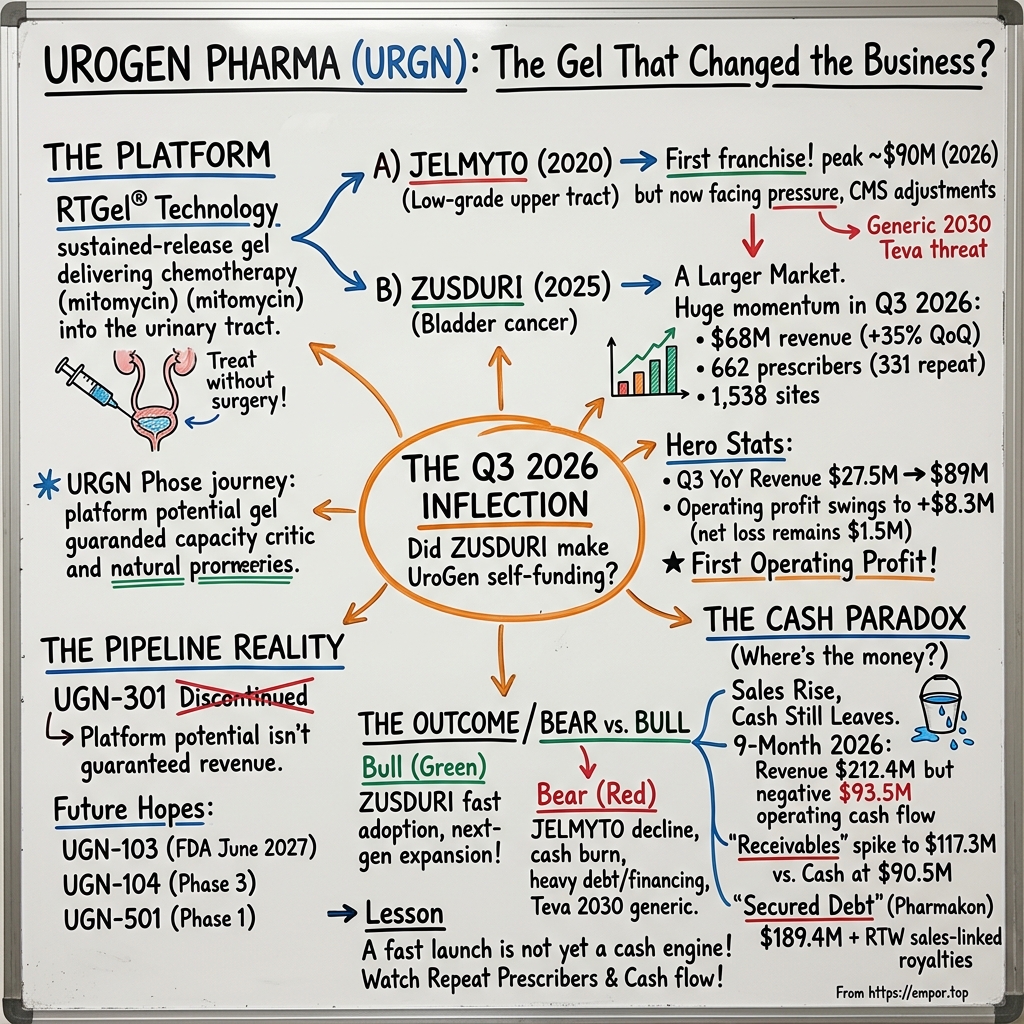
On November 4, 2026, UroGen Pharma published a quarterly result that would have been hard to imagine eighteen months earlier. The company reported $89 million of revenue for the third quarter, and $68 million of it came from a drug that had been on the market for little more than a year, a bladder-cancer treatment called ZUSDURI.[^1] For the first time in its life as a commercial company, UroGen's quarterly operating line was comfortably above zero, at a profit of about $8.3 million.[^1]
The same release carried a less happy line. UroGen lowered its full-year outlook for JELMYTO, the older product that had carried the company since 2020.[^1] One medicine was taking off while the other was losing altitude, and both were announced in the same press release.
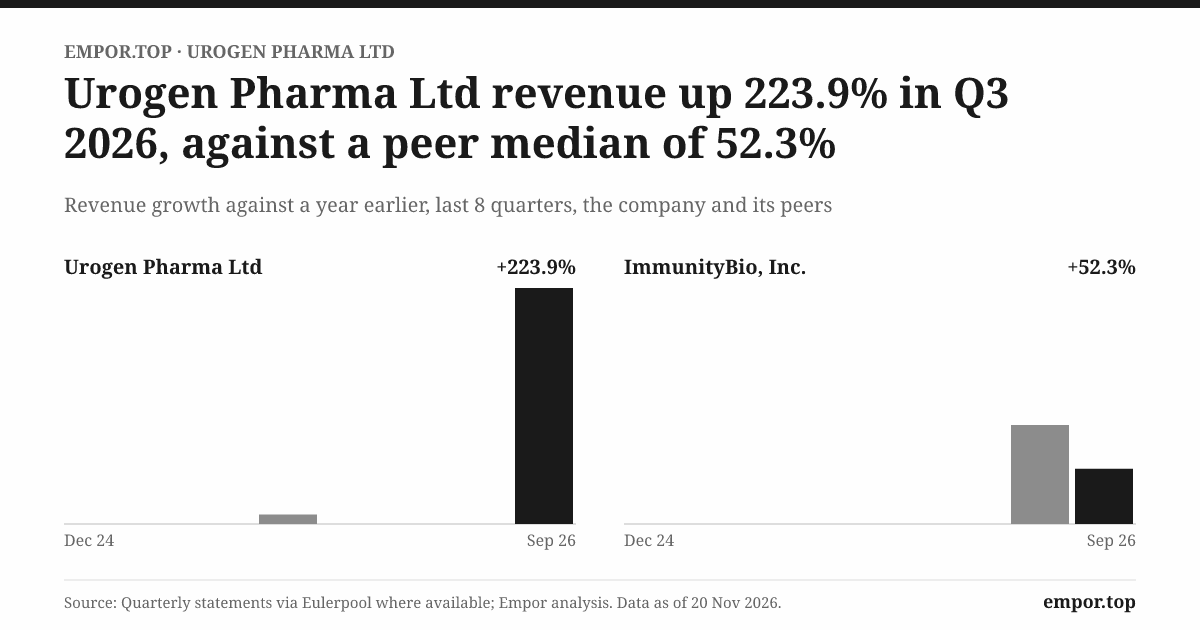
The scale of the change is easiest to hold as a single comparison. A year earlier, in the third quarter of 2025, UroGen had booked $27.5 million of revenue and lost $27.4 million at the operating line.1 So revenue more than tripled in twelve months, and the operating result swung by roughly $36 million. For a company whose income statement had been a sea of red ink for more than a decade, that swing is the headline.
The headline has a footnote, though, and it is one investors should read closely. After interest and financing charges, UroGen still reported a small net loss, about $1.5 million, for the quarter.1 And across the first nine months of 2026, while revenue climbed to $212.4 million, the business used $93.5 million of cash in its operations.1 The profit-and-loss statement had turned the corner. The bank account had not.
That gap frames the whole story. UroGen has spent years proving that a peculiar piece of chemistry, a gel that is liquid when cold and solid at body temperature, could carry an old chemotherapy drug into parts of the urinary tract where it would otherwise wash away. It has proved that twice to the U.S. Food and Drug Administration. What it has not yet proved is that the gel can pay for itself.
There are three questions inside that one. The first is whether ZUSDURI's early growth becomes lasting operating cash, rather than a launch curve that flattens once the most enthusiastic urologists have tried it. The second is whether the new drug can more than offset the older one, which now faces both competitive pressure and a dated generic-entry clock. The third is how much of whatever ZUSDURI earns actually reaches ordinary shareholders, after a secured lender and a sales-linked financier have taken their share.
Some housekeeping on who is who. UroGen Pharma Ltd. is incorporated in Israel and its ordinary shares trade on Nasdaq under the ticker URGN.2 Its commercial business in the United States is run by a wholly owned subsidiary, UroGen Pharma, Inc., and the company reports a single operating segment.1 There is no parent group hiding behind the listed entity, and no controlling shareholder.[^4] What happens to UroGen's products happens to UroGen's shareholders, with the important exceptions of its creditors, which the story will reach in due course.
The arc runs in three acts. UroGen began as a clinical-stage delivery-technology company with no product revenue. It became a one-product commercial company in 2020, when JELMYTO won approval for a narrow form of upper-tract cancer. And in 2025 it became a two-product company, with ZUSDURI aimed at a much larger population of bladder-cancer patients. Today the second product is growing far faster than the first ever did.
That progression is the source of the bull case and the source of the bear case at the same time. Is the gel becoming a repeatable business, one that wins prescriptions, collects cash and funds its own next product? Or is UroGen still doing what it has done for most of its history, converting clinical milestones into a costly launch that needs more capital?
The third-quarter numbers changed the question from "can this company sell anything?" to "can what it sells pay its way?" That is a much better question to have. It is not yet an answered one. To see why, the story has to go back to the gel itself, and to the strange problem it was designed to solve.
 Subscribe on LinkedIn
II. A Delivery System Looking for Its First Market
Picture the bladder as a plumbing problem. A urologist who wants to treat a tumor on the bladder wall can pour a chemotherapy solution directly into the organ through a catheter. The drug touches the tumor, which is exactly what the doctor wants. Then, within a couple of hours, the patient has to urinate, and the medicine goes down the drain with everything else. The kidney keeps producing urine, the urine keeps diluting the drug, and the contact time that the chemistry needs is the one thing the body refuses to give.
UroGen's founding insight was that the problem was not the drug. Mitomycin, the chemotherapy at the center of both of its approved products, is an old and well-understood agent. The problem was time. If the drug could be persuaded to stay in place, it might do more of its work before it was flushed out.
The answer was a formulation the company calls RTGel, a reverse-thermal hydrogel.3 The idea behind it is the opposite of how most substances behave. Butter melts when it warms; RTGel solidifies. Kept cold, it is a liquid that can be pushed through a narrow catheter. Once it reaches body temperature, it sets into a gel that clings to the tissue and then slowly dissolves in urine over a period of hours, releasing the drug as it goes.3 A liquid going in, a solid while it works, and a liquid coming out: that is the whole trick, and it is a clever one.
The company that would become UroGen spent its early years in Israel developing that platform, and its first revenues had nothing to do with selling medicines. In 2016, the business booked about $17 million of revenue, largely from a licensing arrangement with Allergan that sought to use RTGel in a different urological setting.3 That was the revenue of a technology company renting out its idea, not a drug company selling a product. When UroGen listed on Nasdaq in 2017, its prospectus described an initial offering of about 3.5 million shares and a pipeline whose most advanced programs were mitomycin-in-gel treatments for urothelial cancers.3
Urothelial cancer is cancer of the lining of the urinary tract, the same type of tissue running from the inside of the kidney, down the ureters, and into the bladder. Many of these tumors are low-grade, meaning they tend to grow slowly and rarely spread, but they come back again and again. For patients, low-grade does not mean low-burden. The traditional answer is surgery: scraping or burning the tumor away through an endoscope, often under general anesthesia, and then doing it again when it recurs.
That is where UroGen positioned itself. Its medicines are localized treatments delivered into the urinary tract, designed to treat tumors while avoiding or delaying some of those repeat surgical procedures. The ambition was not to cure cancer in a new way. It was to replace a cycle of operations with a cycle of instillations.
The first proof point came in April 2020, when the FDA approved JELMYTO for low-grade upper tract urothelial cancer, the version of the disease that grows inside the kidney's collecting system and the ureter.[^6] It was a narrow indication, a rare cancer in an awkward part of the body, where the surgical alternative can include removing the kidney entirely. UroGen launched the drug that June, in the middle of a pandemic that had emptied many hospital procedure rooms, and booked $11.8 million of product revenue in its first two launch quarters.[^6] The company had become a commercial business.
The second, bigger proof point took five more years. The product then known as UGN-102 took the same formulation approach into the bladder, specifically for patients with recurrent low-grade, intermediate-risk non-muscle-invasive bladder cancer. That is a mouthful, but the meaning is straightforward: tumors that sit on the bladder's inner surface, have not invaded the muscle wall, are not aggressive, and keep returning. It is a far larger patient group than upper-tract disease.
The path to approval was not smooth. On May 21, 2025, an FDA advisory committee of outside experts voted five to four that the drug's overall benefit-risk profile was not favorable.4 Panelists who voted no pointed mainly to uncertainty created by the lack of a control arm in the pivotal trial, which had treated all its patients with the drug rather than comparing them with a group receiving something else.4 The FDA's own briefing documents had pressed for randomized evidence.4
Advisory committees advise; they do not decide. On June 12, 2025, the FDA approved the drug as ZUSDURI, the first medicine the agency had approved for that specific bladder-cancer setting.5[^9]
That split vote deserves to be treated as real counterevidence, not as an embarrassment to be explained away. Nine experts looked at the data and divided almost evenly on whether the benefits outweighed the risks. The approval settled the regulatory question. It did not settle the clinical one, and it certainly did not settle the commercial one. Urologists who read the same briefing documents make their own judgments, one patient at a time.
That is the right lens for everything that follows. Two approvals show that RTGel is real technology and that UroGen knows how to steer a product through the FDA. They show that the platform can deliver drugs locally without surgery in specific settings. But the economic bet is not simply that the gel works. It is that UroGen can win adoption, reimbursement and repeat use in a part of medicine where established practice, established alternatives and the habits of thousands of urologists shape demand.
A platform is only as valuable as the products that carry it, and the first product's history offers the best available evidence of what that conversion actually looks like.
III. JELMYTO's First Five Years
Launching a drug in June 2020 meant launching it into closed doors. Hospitals had postponed elective procedures, sales representatives could not walk into clinics, and the patients who needed JELMYTO were, by definition, being treated for a slow-moving cancer that could often wait. Even so, it was a respectable start for a medicine aimed at a rare indication.[^6]
The road to that moment ran through a single-arm trial called OLYMPUS, which tested the mitomycin gel in patients with low-grade upper-tract tumors. The results gave the FDA enough to approve the drug, and they gave UroGen a story to tell urologists: here is a way to treat a tumor inside the kidney without cutting the kidney out.[^6]
What followed was the unglamorous work that most biotech investors skip over. UroGen had to persuade hospitals and practices to stock the drug, set up the logistics of a product that needs to be kept cold and mixed before use, train doctors on how to instill it into the upper urinary tract, and secure reimbursement so that the treating site would actually be paid. Each of those steps takes time, and each one is a place where a launch can stall.
The revenue history shows a franchise that was built, not one that exploded. Total company revenue rose from about $11 million in 2020 to about $48 million in 2021, $64 million in 2022, $82 million in 2023 and $90 million in 2024, almost all of it from JELMYTO.[^4] That is real growth, and it is also a revealing shape. The steepest year was the second, when the drug was simply reaching more of its eligible patients. After that, the curve flattened. By 2024 revenue grew by less than 10%.[^4]
That flattening is the first piece of evidence about the ceiling on a narrow indication. Low-grade upper tract urothelial cancer is not a large market, and once a drug has reached most of the specialists who see it, growth depends on winning a larger share of patients who were going to be treated anyway. JELMYTO established that UroGen could commercialize a specialty medicine. It did not establish a protected growth curve.
It is worth pausing on how distinct the two markets are, because investors sometimes blur them. JELMYTO treats tumors in the upper tract, inside the kidney's plumbing, often in patients being managed at academic centers. ZUSDURI treats recurrent tumors in the bladder, a far more common condition managed by community urologists across the country. The drugs share a chemistry and a delivery system. Their launch curves and competitive pressures are not interchangeable, and JELMYTO's history is a guide to UroGen's execution, not a template for ZUSDURI's ceiling.
Then came 2026, and the first open crack in the older franchise. In the third quarter, JELMYTO sales were about $21 million, down from $25.7 million a year earlier.[^1] Management lowered its full-year JELMYTO outlook from a range of $97 million to $101 million to roughly $90 million.[^1]
The company offered two explanations. The first was that competitors' clinical trials were enrolling patients who might otherwise have started JELMYTO.6 That deserves a moment of translation. When a rival company runs a trial for a new treatment in the same disease, eligible patients can enroll and receive the experimental therapy, often at no cost. Each patient who enters a trial is a patient who does not start a commercial drug. It is an indirect form of competition, but a real one, and it shows that rivals are actively working to displace UroGen's first product.
The second explanation was a true-up related to the Centers for Medicare & Medicaid Services' rules on discarded drug.6 The mechanism is technical but worth understanding. When a single-dose package of a drug is opened and only part of it is used, Medicare requires manufacturers, above a certain threshold, to refund the government for the wasted portion. UroGen includes those Medicare discarded-drug refunds among the deductions it estimates against gross sales.1 A true-up is simply a correction when the estimate proves wrong. It lowers reported revenue without any change in how many patients were treated.
Those are two very different explanations, and investors should weigh them differently. A discarded-drug true-up is an accounting adjustment that, once corrected, should not recur at the same scale. Competitor trial enrollment is a structural signal, because it means that the drug's patient starts depend on what rivals are doing, not just on UroGen's sales force. The company deserves credit for naming both causes and revising its guidance rather than letting the number drift. Whether the revised outlook proves accurate is the next test of that candor.
There is also a clock on the older franchise, and it is now precise. In April 2024, UroGen sued Teva Pharmaceuticals for patent infringement after Teva sought approval for a generic version of JELMYTO.7 In June 2026 the companies settled. The settlement grants Teva a non-exclusive license to sell a generic version beginning September 15, 2030, if the FDA approves it, subject to certain exceptions that could bring the date forward.8
For investors, that settlement is both a relief and a ceiling. It removes the risk of losing a patent case and facing a generic tomorrow. It also tells everyone roughly when the drug's protected years end. A specialty medicine that is losing patient starts today and faces a generic in under four years is not the growth engine of this company. It is a cash contributor with a known shelf life.
The organization that JELMYTO paid for is now the organization selling ZUSDURI, and its size is a useful reality check. At the end of January 2026, UroGen employed 291 people worldwide, about 150 of them in customer-facing roles.2 That is a lean field force for a company trying to reach thousands of urologists across the United States. It explains why site activation and repeat prescribing matter so much: a team of that size cannot knock on every door, so it has to make each activated practice count.
The fair reading of JELMYTO's first five years is that it worked as a business-building exercise. It gave UroGen a commercial team, distributor relationships, reimbursement experience and a revenue base of roughly $90 million a year. It did not produce a franchise that could stand still and keep growing. Whether the 2026 decline reflects temporary disruption from competing trials or the first sign of a lasting ceiling is something only the next few quarters of JELMYTO net sales and patient starts can answer.
The reason the JELMYTO slip did not dominate the November release is that the second product was arriving in the clinic with far more force.
IV. The New Launch Meets the Clinic
Imagine the moment from a community urologist's point of view. A patient has had a low-grade bladder tumor removed twice already, each time under anesthesia in an operating room. It is back. The standard path is a third operation. Since mid-2025, there has been another option: a course of mitomycin gel instilled directly into the bladder through a catheter in the office, over a series of weekly visits, with the aim of clearing the tumor without the operating room.[^9]
Each time a urologist makes that choice, UroGen's revenue moves. By the third quarter of 2026, UroGen reported 662 unique prescribers of ZUSDURI, 331 repeat prescribers and 1,538 activated sites of care.6 An activated site is a clinic or hospital that has done the work to stock, mix and bill for the drug. A repeat prescriber is a doctor who has used it for more than one patient. The fact that half of the prescriber base had come back for a second patient is the single most encouraging number in the launch.
ZUSDURI generated $68 million in the quarter, up 35% from the second quarter.[^1] To appreciate the slope, compare it with JELMYTO, which took roughly three years to reach an annual run rate that ZUSDURI's quarterly sales now exceed. The faster launch reflects the larger addressable population and the fact that UroGen came into this launch with an existing commercial organization.
How a prescription becomes revenue matters, because it shapes how investors should read every launch number. UroGen sells primarily through two national specialty distributors.1 It recognizes product revenue when the distributor obtains control of the product, typically when it is delivered to a treating physician or a pharmacy that mixes the drug.1 There is no subscription, no multi-year contract, and no disclosed minimum purchase commitment.1 Revenue depends on patient starts, the number of treatments each patient receives, how quickly new sites activate, whether insurers pay, and the deductions between gross price and net revenue for rebates, chargebacks, government programs and copay assistance.1
So the operating indicators are the closest thing UroGen has to a recurring-revenue metric, and their sequence tells the story. Between the second and third quarters of 2026, unique prescribers rose from 452 to 662, repeat prescribers from 204 to 331, and activated sites from 1,444 to 1,538.[^13]6
Notice what those three numbers say together. Site activation barely moved, growing by about 6%. Prescribers grew by nearly half, and repeat prescribers by more than 60%. In other words, the growth in the quarter came less from opening new doors and more from doctors behind doors already open deciding to use the drug, and then use it again. That is the pattern a healthy launch should show once the infrastructure is in place. It also implies that the easy gains from site activation are largely behind the company, and that future growth depends increasingly on deepening use.
The analyst questions on the third-quarter call went right at that issue.6 Analysts asked whether quarter-on-quarter growth of that magnitude could persist, whether JELMYTO's flattening curve was a useful analog for ZUSDURI, and how the holiday season might affect patient starts. Management's answer was that the bladder market was considerably larger than JELMYTO's and that it expected further growth, while acknowledging that holidays reduce patient starts and that the launch remained at an early stage.6
That is a reasonable answer, and it is also the answer every management team gives at this stage of a launch. The concrete part is the market-size distinction, which is real. The uncertain part is everything else: how many eligible patients will actually be treated, how many treatments they receive, and how many doctors who have tried the drug once will keep using it a year later.
Management offered two further indicators. It estimated that roughly 70% of the addressable market sits in community settings rather than academic centers, and it reported that more than 60% of ZUSDURI use was as primary therapy, meaning the drug was being chosen as the main treatment rather than as an add-on.6 Both numbers point in an encouraging direction, because community urologists are the core of bladder-cancer care and primary use implies the drug is replacing surgery rather than supplementing it. Both are also company-reported figures. They are useful indicators to follow, not independent proof of market share or durable demand.
Set the advisory committee's split vote beside these prescribing figures. Today, hundreds of practicing urologists are using the drug, and hundreds have used it more than once. That is the strongest commercial rebuttal UroGen could hope for, and it is meaningful. Doctors vote with their prescription pads, and these doctors are voting.
But the two kinds of evidence answer different questions. The committee assessed the clinical evidence; prescribers are answering whether the drug is worth trying for their patients. A drug can win the second vote without settling the first, and the first can come back if real-world recurrence rates, safety signals or treatment durability disappoint. Approval opened the market. Actual use is now the stronger commercial evidence. Repeat treatment patterns over several years will determine whether that use lasts.
What is ZUSDURI actually competing against? The principal substitute is the status quo: repeat surgery to remove recurrent tumors, sometimes combined with established intravesical therapies that urologists have used for decades. Clinical practice is sticky, and an operation that a surgeon knows well, gets paid for, and can schedule easily is a formidable competitor even when it is not the patient's preferred option.
There are also new rivals coming. The competing clinical-trial enrollment already dragging on JELMYTO starts is a reminder that other companies are developing treatments for urothelial cancers. It would be a mistake to assume ZUSDURI is insulated simply because it was first approved in a distinct indication. Today's trial enrollment is tomorrow's approved competitor, and urologists who are trying ZUSDURI now will be offered alternatives later.
The honest verdict on the launch has two parts. The momentum is substantial, the repeat-prescriber ratio is early evidence that doctors are satisfied enough to come back, and the sheer speed of the revenue ramp shows that UroGen's commercial machine can execute. That supports the case for continued growth.
What one year of launch data cannot establish is retention over several years, price realization after deductions, or mature unit economics. There is no clean public peer group and no comparable market-share series that would establish a relative commercial edge. The evidence supports a differentiated product with strong early adoption. It does not yet support a proven cost, distribution or switching-cost moat.
One more mechanism deserves attention, because it links the launch to the cash story that follows. Every dollar of ZUSDURI's reported revenue is a net figure, after UroGen's estimates of rebates, chargebacks, discounts under the federal 340B program, Medicaid rebates, copay assistance and Medicare discarded-drug refunds.1 Those estimates are constrained to amounts the company does not expect to reverse, but they are still estimates.1 The JELMYTO true-up in 2026 showed what happens when one of them is wrong. As ZUSDURI's payer mix settles, similar corrections are possible, and they would show up as lower revenue without any change in patient demand.
Which is why the next question matters so much. If the platform is the source of lasting value, then the products beyond mitomycin should be proving it. The record there is more sobering.
V. The Pipeline That Did Not Advance
In November 2025, in the same results release that celebrated ZUSDURI's first full quarter on the market, UroGen announced it was stopping UGN-301.[^14] The program had paired RTGel with zalifrelimab, an immunotherapy designed to unleash the body's own immune response against tumors, and it was supposed to show that the gel could carry more than an old chemotherapy.[^14]
In one sense, the Phase 1 study did what it was meant to do. It provided proof of concept that RTGel could deliver an immunotherapy locally in the bladder.[^14] The delivery worked. But the drug's clinical profile did not meet UroGen's threshold to justify moving into Phase 2, and the company discontinued the program.[^14]9
That is the single most important piece of evidence for anyone valuing UroGen's platform. The bull thesis on any delivery technology is that it can be applied again and again: take a good drug, put it in the gel, keep it in contact with the tumor, and create a new product. UGN-301 tested that thesis directly, and the answer was that successful delivery alone is not sufficient. The cargo still has to work. A great delivery truck does not turn a disappointing package into a good one.
Seen across the company's history, the pattern is clear. Both approved products use mitomycin; UGN-301 was discontinued, and the licensing work with Allergan in the 2010s did not become a lasting revenue stream. The platform's track record of converting technical milestones into commercial products is real, but it is narrower than the word "platform" implies. So far, it is a mitomycin franchise.
That context shapes how to read the current development ladder. The most advanced next product is UGN-103, a next-generation mitomycin formulation intended for the same bladder-cancer setting as ZUSDURI. The FDA accepted its New Drug Application in 2026 and set a goal date of June 2027 for its decision.9 UGN-104, another next-generation mitomycin formulation aimed at the upper tract, is in Phase 3.9 UGN-501 entered Phase 1 in 2026.9
UGN-103 is the most interesting of these, and the most important to frame correctly. If approved, it could extend the bladder franchise with an improved formulation, potentially carrying UroGen's position in that indication well beyond ZUSDURI's own patent life. That is lifecycle management, and done well it is valuable. It is also, notably, more mitomycin. The program with the nearest regulatory decision is the one that stays closest to what UroGen has already proved, which is a sensible way to allocate risk and a revealing commentary on where confidence in the broader platform actually sits.
The spending behind this ladder is large relative to the company's size. Research and development cost $67.1 million in 2025, roughly 61% of that year's revenue.2 In the first nine months of 2026, R&D was $58.9 million.1 The ratio fell sharply as ZUSDURI sales expanded, because the revenue grew far faster than the spending. But the spending itself is rising: third-quarter R&D was $26.0 million, up from $14.0 million a year earlier, as UGN-103, UGN-104 and UGN-501 advanced.1
The company says it expenses R&D as incurred and does not track total R&D spending by individual program.1 That matters for anyone trying to judge the return on each bet. It is impossible, from the outside, to say how much UroGen spent on UGN-301 before stopping it, or how much UGN-103 will have cost by the time of its decision. Investors should not imply that reported R&D maps cleanly to any one candidate.
The newest program came from outside. In 2025, UroGen acquired assets from IconOVir Bio, including an oncolytic-virus candidate called ICVB-1042, later renamed UGN-501.[^16] An oncolytic virus is a virus engineered to infect and kill cancer cells while sparing healthy ones, and in principle a gel that holds it in the bladder could improve its exposure to tumors. UroGen paid $4 million in shares upfront, with a $15 million milestone payable on reaching a sales threshold and low-single-digit royalties if products emerge.[^16]
That deal structure is modest and sensibly contingent. Most of the potential cost arrives only if the asset produces sales, which limits the downside if UGN-501 fails as UGN-301 did. No directly comparable transaction establishes whether the price was cheap or expensive, but at roughly the cost of a few weeks of R&D spending, it is not a bet that endangers the company.
UroGen also struck a collaboration with IntraGel and invested $4 million in the third quarter of 2026.1 Both moves are best understood as small pipeline options. They are not evidence of an acquisition-led growth strategy, and they are not revenue.
The calibrated conclusion is that the pipeline has real optionality, but the company's own record narrows the claim. RTGel has converted into products twice, both times with mitomycin, and once failed to convert with a different drug despite delivering it successfully. That history does not reject the platform thesis. It shrinks it to a smaller, more defensible version: UroGen is very good at making mitomycin stay where it is needed, and anything beyond that remains to be proved. UGN-103's FDA decision in June 2027 is the event that tests the lifecycle version of the claim. UGN-501's clinical data, whenever they arrive, will test the broader one.
Every one of those bets has to be funded, and funding is where UroGen's story gets complicated.
VI. Sales Rise, Cash Still Leaves
Here is the puzzle. In the nine months to September 2026, UroGen sold $212.4 million of medicine, almost three times as much as in the same period a year earlier.1 Over the same nine months, its operating activities consumed $93.5 million of cash.1 Sales nearly tripled, and the business still burned cash at a pace not far from its loss-making past. Where did the money go?
The answer sits on the balance sheet. At the end of 2025, UroGen was owed $33.1 million by its customers. By the end of September 2026, that figure had risen to $117.3 million.1 The increase in receivables alone absorbed about $84 million of cash in nine months, close to the entire operating cash outflow.1
Put that receivables balance against the quarter's sales and it becomes vivid. UroGen's customers owed it about $117 million at quarter-end, against roughly $89 million of sales in the quarter. That means the company was carrying around four months of revenue as unpaid bills. For a business whose drugs are delivered to physicians and pharmacies within days, that is a long wait.
There are innocent explanations, and they are probably most of the story. A launch that is growing 35% a quarter will always have receivables racing ahead of collections, because each quarter's sales are larger than the last, and the cash from the previous quarter's smaller sales is what arrives. Distributors and their payment cycles do not speed up just because a product is popular. UroGen reported no customer credit losses and no allowance for doubtful accounts at September 30, 2026.1
But there is no receivables aging in the filings, which means outsiders cannot see how much of the $117 million is current and how much is overdue.1 The fact sheet's measure of debtor days, the average time customers take to pay, had already risen from about 69 days in 2023 to about 111 days in 2025, before the 2026 build began.2 A rising collection period during a launch is normal. A rising collection period that keeps rising after the launch matures would not be.
The channel concentration magnifies the importance of this. UroGen's largest distributor accounted for about half of its product sales in the first nine months of 2026, down from 80% in the same period a year earlier, and 35% of receivables at the end of September, down from 59% at year-end 2025.1 The company does not name the distributors.1 The diversification is real progress. Still, two national specialty distributors stand between UroGen and nearly all its cash. If either one changes its payment terms, its inventory policy or its appetite for the product, UroGen will feel it immediately.
Why have profit and cash diverged so persistently over UroGen's history? Over the twelve years from 2014 through 2025, the company lost a cumulative $945 million, while its operations consumed $734 million of cash.2 The losses were larger than the cash burn because several expenses on the income statement do not leave the bank account at the time they are recorded. Share-based pay to employees reduces earnings but is paid in stock. Depreciation and amortization are accounting charges for past investment. And the financing charges on UroGen's sales-linked funding arrangement accrue on paper before they are settled in cash.2
In 2026, those same mechanisms were at work. The nine-month net loss was $39.4 million, but $16.2 million of share-based compensation and $2.5 million of accrued financing charges were non-cash.1 Strip those out and the company's underlying operations were roughly at breakeven on a cash basis before working capital. Then the receivables build swallowed the difference and more.
That is the honest reading. The company's reported operating losses have been flattered by nothing; if anything, the income statement has looked worse than the cash flows over its history because of non-cash charges. But stock-based compensation is a real cost to shareholders, paid in dilution rather than dollars. And today the working-capital demands of the launch mean that the improving income statement is not yet showing up as cash.
Then there is the financing. In early 2026, UroGen refinanced its loan from Pharmakon Advisors, replacing $125 million of prior principal with a new $200 million first tranche at a fixed interest rate of 8.25%.[^17]1 The loan matures five years after closing, with four equal quarterly principal payments beginning in the second quarter of 2030.1 A second $50 million tranche is optional and conditional.1 At the end of September 2026, the loan was carried on the balance sheet at $189.4 million.1
The terms are a reasonable trade for a company in UroGen's position. A fixed rate removes interest-rate risk, and delaying principal repayment until 2030 gives the ZUSDURI launch four more years to generate cash before the loan has to be paid down. But the loan is secured by substantially all the assets of UroGen and its U.S. subsidiary, including intellectual property.1 It carries negative and operating covenants, and a breach can accelerate the debt and trigger make-whole and prepayment amounts.1 The patents on the gel that drives the business are, in effect, pledged to the lender.
At 8.25% on $200 million, interest alone runs to roughly $16 million a year. That is the main reason the third quarter's $8.3 million operating profit became a small net loss. The operating business has turned positive. The capital structure has not yet caught up.
The second claim on the company's future is less visible and arguably more important. RTW Investments, one of UroGen's largest shareholders, provided funding through a prepaid forward arrangement. In exchange, UroGen pays RTW a share of product sales.1 In the first nine months of 2026, the rate on JELMYTO was 13% of annual net sales up to $200 million, and the rate on ZUSDURI was 2.5% up to the same threshold, subject to contractual tiers and conditions.1 By the end of September, UroGen had paid or owed RTW $59.5 million cumulatively.1 RTW holds a first-priority security interest over the specified products, their intellectual property, regulatory approvals, contracts, proceeds and related receivables.1
This is financing, not an ordinary related-party sale. It does not appear on the balance sheet as conventional debt, but it behaves like a royalty on top-line revenue, which means it takes its cut before any of UroGen's costs are paid. A 13% claim on JELMYTO sales is substantial. The 2.5% rate on ZUSDURI is far lighter, which is fortunate, since ZUSDURI is where the growth is.
So what does the balance sheet look like when the claims are laid side by side? At the end of September 2026, UroGen held $90.5 million of cash, cash equivalents and marketable securities, down from $120.5 million at year-end 2025.1 Against that sat roughly $189 million of secured term debt and an ongoing sales-linked payment stream to RTW. Shareholders' equity had been negative since 2022, meaning that accumulated losses had more than consumed the capital investors had put in.2
It is worth remembering how recently the company last needed outside money in size. In 2024, financing activities brought in roughly $194 million, which is why cash and short-term investments stood at about $237 million at the end of that year.2 Twelve months later, after a year of launch spending and operating outflows of about $162 million, that cushion had roughly halved.2 The 2026 refinancing added fresh capital, yet cash still fell by another $30 million in nine months. The direction of travel has been one-way for two years, and the receivables build is the main reason it has not yet reversed.
A smaller exposure sits in the cost base. UroGen reports in U.S. dollars but runs operations in Israel, with costs denominated in shekels, and it does not currently hedge that exposure.1 Remeasurement gains and losses flow through the same "interest and other income" line, and the company does not publish a year-by-year currency bridge.1 Next to the receivables and the financing claims, this is a footnote, but a shekel that strengthens against the dollar quietly raises the cost of every Israeli employee and contract.
The interest income on UroGen's cash pile, which had been a modest cushion, has also shrunk: interest and other income fell to $1.8 million in the first nine months of 2026, from $4.4 million a year earlier, mainly because there was less cash to earn interest on.1
For the equity holder, the conclusion is direct. The new revenue base is improving reported operating results, but collection timing and financing claims mean profitability is not yet cash self-sufficiency. The validation that matters is cash collected and retained after debt costs and RTW payments. If the receivables convert to cash in the fourth quarter and operating cash flow turns positive, the company may never need to sell another share to fund itself. If they do not, the cash pile is not large enough to absorb many more quarters like the first three of 2026.
That makes the question of who is steering the company, and how they have handled the money in the past, more than a governance footnote.
VII. The CEO's Bet on Commercial Scale
When Elizabeth Barrett arrived at UroGen in January 2019, she was taking a considerable step down in corporate scale and a step up in personal exposure. She had spent the previous year as chief executive of Novartis Oncology, one of the largest cancer businesses in the world, and before that had served as global president of oncology at Pfizer.10 She succeeded Ron Bentsur, who stepped down as UroGen's CEO, and inherited a company with no approved product and an FDA submission for its first drug under way.1110
Barrett's background explains UroGen's strategy better than any mission statement. She is a commercial operator, not a scientist-founder. Her career was spent launching and selling cancer medicines inside large pharmaceutical organizations, and the board that hired her was explicitly preparing the company for a commercial stage.10 Under her leadership UroGen launched JELMYTO in 2020, won approval for ZUSDURI in 2025 and refinanced its debt in 2026. Every one of those moves is the work of someone who believes value is created at the point of sale.
Around her, the leadership team has the same commercial tilt with a clinical anchor. Christopher Degnan serves as chief financial officer and signed the September 2026 quarterly report.1 Mark Schoenberg, a urologic oncologist, serves as chief medical officer.[^4] The board is chaired by Arie Belldegrun, the co-founder of Kite Pharma, whose presence lends UroGen the credibility of a biotech entrepreneur who built and sold one of the defining cell-therapy companies.[^4]
How has the team been paid? Barrett's reported total compensation was $4.31 million in 2025, $4.15 million in 2024 and $4.64 million in 2023.[^4] Over those same three years, UroGen's annual net losses grew from $102.2 million to $153.5 million.[^4] Her 2025 package included a $774,066 discretionary bonus and $2.12 million of stock awards.[^4] The compensation committee tied incentives to corporate goals including product-sales targets and regulatory milestones.[^4]
Those incentive measures deserve scrutiny, because they reward exactly the things this story has shown to be necessary but insufficient. Sales targets and regulatory approvals were met, which is why ZUSDURI exists and is growing. But neither measure directly rewards cash generation, per-share value or capital efficiency. An executive can hit a sales target and an approval milestone in the same year that the company burns more cash and issues more shares. A skeptical shareholder would ask whether the scorecard should include operating cash flow now that the company has reached commercial scale.
Shareholders have expressed some of that skepticism. At the June 2026 annual meeting, the say-on-pay proposal passed with about 25.1 million votes for and about 3.2 million against.12 Roughly 5 million votes were cast against Barrett's own re-election as a director.12 Every proposal passed, and there is no sign of an activist campaign. But opposition at that scale, concentrated on the chief executive and her pay, is a governance signal worth noting.
Ownership offers context. As of March 31, 2026, Barrett beneficially owned about 2.2% of the company.[^21] The disclosed holders above 5% were RTW Investments at 9.9%, Paradigm BioCapital at 8.7%, BlackRock at 5.2% and Morgan Stanley at about 5.1%.[^4] A year earlier, the list had looked different: RTW at 8.2%, RA Capital at 6.9%, Adage at 6.4% and BlackRock at 5.4%.13 RA Capital and Adage dropped below the 5% threshold, Paradigm rose above it, and RTW increased its stake. No controlling shareholder exists.
The audit record offers no counterweight to worry about. PwC gave the 2025 financial statements an unqualified opinion with no emphasis-of-matter paragraph, and neither the auditor's report nor the September 2026 controls disclosure identified a material weakness.21 The company also reported that it was not a party to any material legal proceedings as of its latest quarterly filing.1 The governance questions at UroGen are about incentives, dilution and the structure of its financing, not about the integrity of its books.
RTW's position deserves particular attention. It is simultaneously UroGen's largest disclosed shareholder and the counterparty on a sales-linked financing arrangement that takes a share of product revenue. Those roles are not necessarily in conflict, since RTW benefits from the drugs selling well in both capacities. But they are not identical either. A financier with a royalty-like claim is paid before costs; an equity holder is paid after them. Investors should know that the largest shareholder sits partly ahead of them in the queue.
The best test of management credibility is to compare what it said with what happened. Around the 2025 approval, management argued that ZUSDURI's market was substantially larger than JELMYTO's.[^9] By the second quarter of 2026, ZUSDURI's revenue of $50.4 million already exceeded JELMYTO's quarterly sales.[^13] By the third quarter, ZUSDURI had grown another 35%.[^1] On the central launch promise, management has so far delivered.
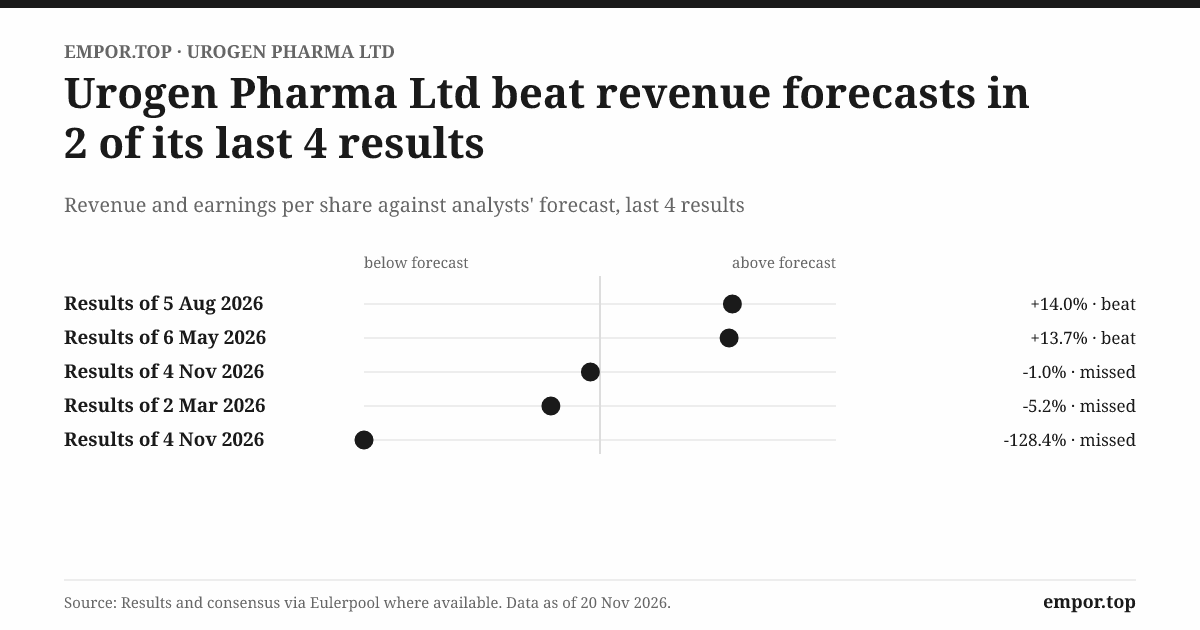
The JELMYTO guidance cut is the counterweight, and it is a useful one precisely because it shows how this team handles bad news. It set a range of $97 million to $101 million, then cut it to roughly $90 million, and offered two specific causes rather than vague references to market conditions.[^1]6 That is not overpromising in the serious sense, but it is a forecasting miss on the product management knows best, the one with five years of history behind it. The evidence supports neither a blanket endorsement of management's forecasting nor a claim of repeated overpromising.
On the third-quarter call, analysts pressed on growth durability, holiday seasonality, the JELMYTO outlook and when the company would generate cash.6 The concrete answers concerned the size of the market and the drivers of the JELMYTO shortfall. The less concrete answers concerned exactly when operating cash flow would turn positive, which is the question that matters most to the equity.
The capital-allocation record is mixed. UroGen has funded itself, over the years, through a 2017 IPO, a $120 million private placement in 2023, an at-the-market equity program and other offerings.21 The share count tells the story of that dilution. Dividing each year's net loss by its loss per share implies about 22 million shares in 2020 and about 49 million in 2025.2 The share base has more than doubled in five years. In the first nine months of 2026, UroGen issued another 791,091 shares for $11.1 million.1
The 2026 refinancing marked a shift from equity toward secured debt and sales-linked financing. That reduces near-term dilution, which shareholders should welcome. It also encumbers the company's assets and adds fixed interest costs, and it does not erase dilution risk if the cash generation disappoints.
Management, then, has delivered two approvals and a fast-growing second launch. It has also presided over prolonged losses, steady dilution and secured borrowing. Both statements are true at once, and investors who want to judge the case need to weigh them together, which is what the bull and the bear are each trying to do.
VIII. Analysis & Bear vs. Bull Case
Two products, one gel, two different exams. ZUSDURI has to prove that repeat use holds up at scale, that doctors who tried it in 2025 and 2026 are still choosing it in 2028. JELMYTO has to absorb competition and run out its remaining protected years before a licensed generic can arrive in 2030. The market's price on the company tells investors how much it is betting on the first exam.
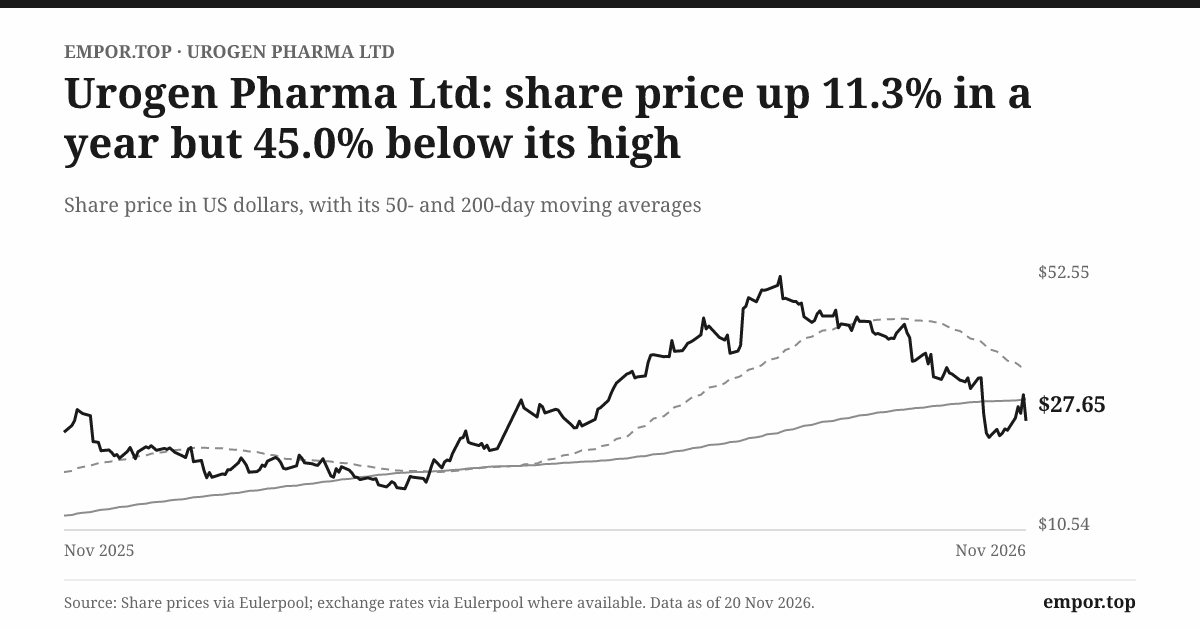
At the close on November 20, 2026, UroGen's shares traded at $27.65, giving the company a market value of about $1.5 billion and an enterprise value, adding net debt, of about $1.6 billion. That works out to about 6.5 times its trailing twelve months of sales. Its free-cash-flow yield was negative 8.6%, meaning the business consumed cash equal to almost a tenth of its market value over the past year. The shares sat about 45% below their 52-week high of $50.30 and well above their low of $17.00, a range that captures how violently investors have swung between enthusiasm and doubt.
So what does the market believe? At 6.5 times sales with negative free cash flow, investors are paying for meaningful future growth and for an eventual margin that the company has never achieved. There is no price-to-earnings ratio to consult, because earnings remain negative. A market-data service estimated UroGen's five-year average enterprise value to sales at about 6.37 times, though its observation date was October 23, 2026, not November 20.14 That suggests the market is valuing UroGen roughly in line with its own history despite a radically changed revenue base. It is not a fair-value estimate, and it is not proof of a moat. It simply says that the market is treating ZUSDURI's ramp as largely expected, not as a surprise.
Peer comparisons are even looser. On the same October date, the same service listed Novocure at about 2.6 times sales and Kestra Medical at about 16 times.14 Neither is a clean match: one sells a device-based cancer therapy, the other a wearable cardiac technology. The spread between them mostly shows how widely the market prices specialized medical businesses depending on growth and perceived durability. UroGen sits closer to the high-growth end of that spectrum than its history of losses alone would justify, which is another way of saying the price already assumes that ZUSDURI keeps working.
Consider what that assumption requires in plain arithmetic. At roughly $1.6 billion of enterprise value, a buyer of the whole company would be paying for the current revenue run rate of about $350 million a year, if the third quarter were simply repeated, and for everything beyond it. For that price to be justified on cash returns, UroGen would need to convert a large share of future revenue into free cash flow after RTW's cut, Pharmakon's interest and an R&D budget that is still rising. None of that has happened yet. The valuation is a bet on the transition from launch to cash, not a reward for having completed it.
Where the power sits
The moat case deserves one careful hearing. Hamilton Helmer's framework of seven powers asks what structural feature allows a company to earn returns that competitors cannot copy. For UroGen, the candidate powers are clear. The first is a cornered resource: patents and formulation know-how around RTGel, plus two FDA approvals in specific indications. The second is switching costs: once a urology practice has activated, trained its staff, stocked the drug and learned to bill for it, there is friction in changing. The third, more speculatively, is a counter-positioning argument: an office-based instillation competes with surgery that hospitals and surgeons are paid to perform, which established players may be slow to undermine.
The evidence for each power is real but incomplete. The patents are genuine, but the Teva settlement shows that the JELMYTO franchise has a defined end date, and UGN-103 is in part an effort to extend the bladder franchise beyond ZUSDURI's own protection. Switching costs exist at the site level, but site activation does not lock a doctor into prescribing. Repeat prescribers are the best evidence of stickiness, but they measure early behavior rather than long-term retention. No disclosed peer market-share series, mature retention data or comparative unit economics shows a durable advantage yet. The honest verdict is that UroGen has a differentiated product and early adoption, not a proven moat.
Michael Porter's five forces sharpen the picture. Buyer power is significant. Two national specialty distributors handle nearly all product sales, and the company carried substantial receivables, leaving it little leverage in that relationship. Behind the distributors sit insurers and the Centers for Medicare & Medicaid Services, whose discarded-drug and rebate rules have already cut into reported JELMYTO revenue.
The threat of substitutes is the dominant force. The main alternative to ZUSDURI is not a rival drug but repeat surgery, a procedure that urologists know, that is reimbursed, and that has decades of clinical acceptance. The threat of new entrants is visible in the competing clinical trials already drawing patients away from JELMYTO. Rivalry within the narrow indications is currently limited, but that is a feature of being early, not a permanent condition. Supplier power is less visible, since the filings do not quantify supplier concentration. Overall, the industry structure favors the payers, the distributors and established clinical practice more than it favors a new entrant with one formulation technology.
The case for and the case against
The bull case is straightforward. ZUSDURI's launch has been strong, and the company reached operating profitability within roughly five quarters of launch.[^13][^1]6 UGN-103 could extend the bladder franchise if approved in 2027, and UGN-104 and UGN-501 offer further possibilities. If the launch continues even at a slower pace, revenue could outrun costs by a wide margin, and the operating leverage visible in the third quarter would compound.
The bear case is just as specific. UGN-301 failed to advance despite proving that the gel could deliver its cargo, which tempers any assumption that the platform will keep producing products. ZUSDURI's launch is still early, and its growth rate will likely slow. JELMYTO's outlook has weakened, and Teva can enter in 2030. The company remains a cash consumer, with secured debt pledged against its intellectual property, a sales-linked financing stream, and two distributors controlling access to its revenue.
A skeptical long-short investor would aim at four soft spots. First, collections: receivables have grown sharply, and the filings offer no aging to dispel the doubt. Second, incentives: management pay rewards sales and approvals, while shareholders need cash generation and per-share value. Third, Pharmakon's interest, RTW's share of sales and stock-based compensation reduce what reaches common shareholders. Fourth, the platform claim remains unproven beyond mitomycin.
The management case deserves a stress test of its own. The third-quarter operating profit was a genuine inflection, achieved as revenue outgrew a cost base that is itself still rising. But nine-month operating cash flow remained heavily negative. The critical question is whether guidance, collections and funding needs converge in the coming quarters. If the fourth quarter shows strong collections and positive operating cash flow, the bull case gains its most important missing proof. If receivables keep growing faster than sales, the bears will have their best evidence.
Weighing it all, the history narrows the bull thesis rather than rejecting it. UroGen has proved it can launch mitomycin-based urology drugs and that its second launch is far stronger than its first. It has not proved a broad platform, a durable moat or cash self-sufficiency. At this valuation, execution must convert into cash.
Three numbers will tell investors which way the story is turning. The first is ZUSDURI's repeat prescribers and net sales, both rising sharply in the third quarter.6[^1] The second is JELMYTO's net sales and patient starts, which were falling.[^1] The third is operating cash flow after receivable collections and RTW payments, which remained negative over the first nine months of 2026.1 Repeat prescribing tells investors whether demand is durable; JELMYTO tells them how quickly the old base is eroding; and cash flow tells them whether any of it reaches shareholders.
IX. Playbook: Business & Investing Lessons
UroGen's story is unusual because it contains, inside one company, almost every stage of the journey from a laboratory idea to a commercial business. A gel that sets at body temperature won approval in two settings. A third attempt with a different drug stopped short of Phase 2. And more than $900 million of cumulative losses sit behind the company's first operating profit. Those moments carry lessons that reach well beyond urology.
The first lesson is that a platform earns its keep one prescription at a time. RTGel was a clever invention for years before it was a business, and its early licensing revenue from Allergan did not make it a lasting business. It became a business when a specific product reached patients and providers were paid. For founders building on a technology, the lesson is that the market does not pay for capability. It pays for a specific product that a specific buyer chooses, again and again.
The second lesson is that an approval opens the door; it does not make the clinic walk through it. The close advisory vote and subsequent repeat prescribing belong to the same story. Regulatory milestones are the start of the commercial test, never its conclusion. A drug that wins approval narrowly can succeed in the clinic, and a drug that wins approval easily can fail there.
The third lesson is that a fast launch is not yet a cash engine. UroGen's latest results showed the gap between operating profit and cash generation. Revenue and cash can move on different clocks during a launch, leaving a company looking profitable while its bank balance falls. Investors in any fast-growing product business should read the cash-flow statement before they celebrate the income statement.
The fourth lesson is that optionality is a budget, not a forecast. UGN-301 showed that technical delivery success alone did not justify further development. That result should discipline how investors think about UGN-103, UGN-104 and UGN-501. Each is a real option with a real chance of success, and each is a cost that will be paid whether or not it works. UroGen's narrow record of converting technical milestones into revenue should limit how much investors assign to those options.
There is a final lesson for the capital markets. UroGen has funded its journey through several forms of capital, each taking a different slice of the future. The company that emerges has a growing product and a crowded capital structure. Every dollar raised kept the science alive; every claim it created now stands between ZUSDURI's revenue and the common shareholder. The gel was the invention. The financing was the price of getting it to market.
X. Epilogue
Tonight, UroGen stands at the most interesting point in its history. It has a second product growing faster than its first ever did, an older franchise losing ground, a quarter of operating profit behind it, and a balance sheet that still shows more debt than cash. The story will be decided not by a single dramatic event but by a sequence of quieter ones over the next several quarters.
The first is the fourth-quarter report, which will arrive early in 2027 and carry the most important number of the year: cash. If September’s receivables convert into collections and operating cash flow turns positive, UroGen will have shown that its launch is not merely booking sales but getting paid for them. That would answer the central financing question and make further equity issuance far less likely. If receivables keep climbing faster than sales, or collections lag, the question of how the company funds itself will return.
The second is ZUSDURI’s trajectory after the launch surge. Management has already warned that holidays reduce patient starts, so the fourth quarter may show slower growth for reasons that are entirely seasonal. The real signal will come in the first half of 2027, when investors can see whether repeat prescribers, sites of care and net sales keep expanding once the early adopters have had their turn. If repeat prescribers continue to rise as a share of the base, the evidence of durable demand strengthens. If growth stalls while site activation is already largely complete, the launch will have found its ceiling earlier than the bulls expect.
The third is JELMYTO’s performance against its revised outlook for 2026. If the shortfall proves to be mostly the discarded-drug true-up and temporary trial enrollment, sales could stabilize. If competitor trials turn into competitor approvals, the decline could accelerate well before Teva’s licensed entry. Either way, the older drug is now a source of cash to be harvested rather than a source of growth.
The fourth is UGN-103. The FDA decision is the next regulatory moment that matters, and an approval would give UroGen a way to extend its bladder franchise with a newer formulation. But the story has already taught the lesson that approval alone will not settle the commercial question. UGN-103 would need to win doctors, payers and repeat use just as ZUSDURI has had to, and it would need to do so without simply cannibalizing ZUSDURI’s own patients. Meanwhile, UGN-104’s Phase 3 progress and UGN-501’s early data will test whether the gel can do anything beyond mitomycin.
Set against the story’s central questions, the outcomes are clear in shape if not in timing. Positive operating cash flow plus continued ZUSDURI growth would show that the gel has become a self-funding business. ZUSDURI growth without cash would show a launch that still needs capital. And a slowing ZUSDURI alongside a falling JELMYTO would show a company that has moved from one narrow franchise to two, with a heavier balance sheet than before.
The decisive combination is not merely an FDA approval or a record quarter. It is commercial growth that survives competition, is collected in cash, and pays its creditors and its financiers while leaving something for its owners. UroGen has never had that combination. For the first time, it has a realistic chance of getting there.
XI. Outro
Go back to that November morning, and to the two lines on the same press release. One product, launched little more than a year earlier, sold $68 million of medicine in a quarter. The other, the drug that built the company, was losing ground as its forecast fell. Together they produced a quarter of operating profit even as cash continued to flow out the door.
That combination is what makes UroGen unlike the conventional biotech success story, in which approval is the climax and everything after is a victory lap. Here, approval was the easy part, relatively speaking. The hard part is the one investors cannot see in a press release: collecting the bills, funding the debts, defending the franchise and persuading urologists to keep choosing a gel over the operating room.
The image that stays is the gel itself. It was designed to do one thing the body resists, which is to stay in place long enough to work. UroGen has proved that its chemistry can do that. The question that remains is whether its economics can do the same: hold on long enough, inside a crowded market and a crowded capital structure, for the growth to stick.
References
-
Quarterly Report on Form 10-Q for the period ended September 30, 2026 — UroGen Pharma Ltd., 2026-11-04 ↩↩↩↩↩↩↩↩↩↩↩↩↩↩↩↩↩↩↩↩↩↩↩↩↩↩↩↩↩↩↩↩↩↩↩↩↩↩↩↩↩↩↩↩
-
Annual Report on Form 10-K for 2025 — UroGen Pharma Ltd., 2026-03-02 ↩↩↩↩↩↩↩↩↩↩↩↩
-
Amendment No. 1 to Form F-1 Registration Statement — UroGen Pharma Ltd., 2017-04-24 ↩↩↩↩
-
FDA ODAC Votes 5-to-4 Against UGN-102 Intravesical Solution for Bladder Cancer — CancerNetwork, 2025-05-21 ↩↩↩
-
FDA Approval Letter for ZUSDURI, NDA 215793 — U.S. Food and Drug Administration, 2025 ↩
-
UroGen Pharma Q3 2026 Earnings Call Transcript — Stock Analysis, 2026-11-04 ↩↩↩↩↩↩↩↩↩↩↩
-
Annual Report on Form 10-K for 2025, Note 20: Commitments and Contingencies — UroGen Pharma Ltd., 2026-03-02 ↩
-
Form 8-K on JELMYTO Patent Litigation Settlement — UroGen Pharma Ltd., 2026-06-02 ↩
-
Ex-Novartis Oncology CEO Liz Barrett joins UroGen — Fierce Biotech, 2019 ↩↩↩
-
UroGen Taps Oncology Veteran Elizabeth Barrett as Its New CEO — BioSpace, 2019 ↩
-
Form 8-K, 2026 Annual Meeting Voting Results — UroGen Pharma Ltd., 2026-06-22 ↩↩
-
UroGen EV/Sales History — TGMCharts, data as of 2026-10-23 ↩↩
 LinkedIn
 WhatsApp
 Reddit
 Hacker News
 Email
 Kindle
 RSS Feed
 Spotify
 Apple Podcasts
 Amazon Music
 Audible
 YouTube