CG Oncology: The Story of the Bladder-Sparing Cancer Breakthrough
I. Introduction & Episode Roadmap
On the morning of January 25, 2024, a small crowd gathered on the Nasdaq floor around a banner for a company largely unknown outside urology. The biotechnology initial public offering market had been effectively closed for two years. Crossover funds had marked down valuations, and generalist investors had largely exited the sector. Into that quiet market stepped CG Oncology, an Irvine, California-based company with a single drug candidate, no revenue, and a lead asset whose molecular blueprint originated in a 1990s gene-therapy laboratory that no longer existed.
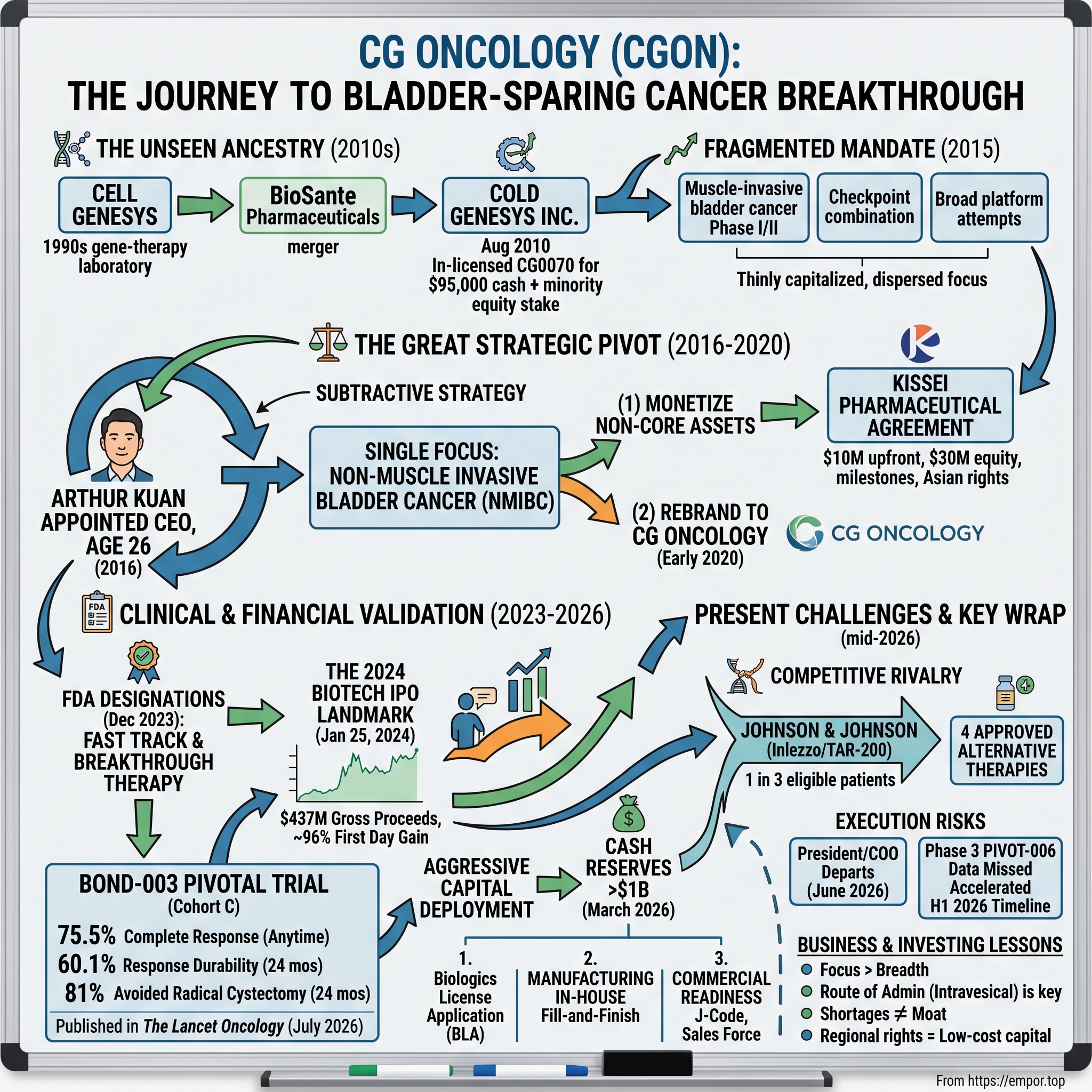
The offering priced above its expected range at $19.00 per share and was upsized to 20 million shares, raising $380 million in gross proceeds.1 Underwriters then exercised their overallotment option in full, bringing total gross proceeds to approximately $437 million across 23 million shares.2 The stock closed its first trading session at $37.17, representing a single-day gain of about 96%.3 For a biotech sector accustomed to two years of minimal activity, the market response marked a notable reopening.
The central question is how a company built around a repurposed adenovirus—an asset transferred from a defunct dot-com-era gene therapy pioneer to a struggling women's-health specialty pharmaceutical firm, and ultimately acquired by a two-person startup for $95,000 in cash plus a minority equity stake—became one of the most closely watched clinical urology stories of the decade.4
Part of the answer is that CG Oncology abandoned attempts to build a broad platform company. The broader explanation turns on a series of decisions made between 2015 and 2020 by a venture investor in his twenties who concluded that previous management had focused on the wrong question: evaluating what the virus could kill rather than where clinicians could effectively deliver it.
The disease targeted by CG Oncology is non-muscle invasive bladder cancer, or NMIBC, which accounts for roughly three-quarters of all bladder cancer diagnoses and represents approximately 600,000 prevalent cases in the United States.5 For half a century, the standard frontline treatment has been Bacillus Calmette-Guérin (BCG)—a live attenuated tuberculosis vaccine strain instilled directly into the bladder via catheter to stimulate an immune attack on tumor cells. While effective, BCG is produced by a single manufacturer for the North American market through a process that has repeatedly failed to meet global demand.6 When BCG fails or is unavailable, the primary alternative is radical cystectomy: surgical removal of the bladder followed by life with a urostomy bag or a reconstructed neobladder. Patient desire to avoid cystectomy serves as the primary clinical and commercial driver of this market.
CG Oncology has drawn significant industry attention for several reasons. As of mid-2026, the company holds what researchers consider a leading long-term durability dataset in BCG-unresponsive disease, published in The Lancet Oncology on July 27, 2026.[^7] Management reports more than $1 billion in cash reserves, providing a projected financial runway through 2029.[^8] The company's market capitalization exceeds $6 billion.7
At the same time, substantial operational and competitive risks remain. CG Oncology has not yet submitted a complete Biologics License Application (BLA) or generated commercial product revenue. Its President and Chief Operating Officer departed on June 30, 2026, and the company is currently searching for a Chief Commercial Officer.8 Its primary competitor, Johnson & Johnson, entered the market fourteen months earlier and is capturing approximately one in three eligible patients.9 Furthermore, a Phase 3 readout that management previously accelerated by a full year—prompting a 29% single-day stock advance—has passed its projected timeline without publication.
This analysis examines that central tension across several dimensions. It traces CG Oncology's lineage through Cell Genesys, BioSante, and Cold Genesys to show how a discarded asset was repurposed. It evaluates the strategic pivot that focused the business on a single clinical indication. It details the underlying viral biology and benchmarks the clinical data against four approved competing therapies. Finally, it reviews the company's capital markets history, commercialization readiness, execution against management timelines, and the critical indicators that will ultimately validate or undermine the investment thesis.
 Subscribe on LinkedIn
II. The Bladder Cancer Crisis & The BCG Shortage Drama
Inside a typical urology practice, the clinical routine highlights a stark paradox in modern oncology. In one room, a nurse threads a catheter to instill a suspension of live Mycobacterium bovis into a patient's bladder—a protocol essentially unchanged since 1976. In an adjacent room, a urologist informs another patient that because the clinic's Bacillus Calmette-Guérin (BCG) allocation was cut again, the recommended three-year maintenance schedule must be reduced, split, or replaced. One of the most common cancers in the developed world remains reliant on a rationed, century-old vaccine.
The defining characteristic of non-muscle invasive bladder cancer is not immediate lethality, but persistence. Tumors are surgically resected, the bladder is instilled with therapy, and the patient enters surveillance—only for a follow-up cystoscopy eighteen months later to reveal a recurrence. This cycle can repeat for a decade or more, with each iteration requiring office visits, diagnostic scopes, operating room time, and additional drug courses. Consequently, a disease that appears manageable on a single day becomes extraordinarily expensive over a lifetime, while the patient experience is defined by the dread of recurring scopes.
BCG transformed this landscape in the 1970s. By instilling live attenuated mycobacteria directly into the bladder, the treatment provokes a localized inflammatory response, recruiting immune cells to clear residual tumor tissue. This approach established bladder cancer as one of the earliest solid tumors successfully treated with immunotherapy long before the advent of modern checkpoint inhibitors.
The primary vulnerability of BCG therapy lies in its fragile supply chain. Merck & Co. is the sole North American manufacturer of TICE BCG. Scaling the production of live attenuated bacteria in legacy facilities presents technical challenges far distinct from chemical synthesis or monoclonal antibody manufacturing. Yields fluctuate, batches fail, and production capacity cannot rapidly expand. Although Merck reported increasing TICE BCG production by more than 100% while operating at maximum capacity, chronic shortages persisted as global demand continued to rise.6 For over a decade, patients faced inconsistent access to the standard of care.
CG Oncology designed its commercial thesis to capitalize on this supply gap by offering a synthetic, off-the-shelf, BCG-independent therapy. Administered through the same catheter and clinical workflow without requiring new capital equipment, the drug avoids reliance on a single biologic manufacturing facility.
However, bullish investment theses often overlook an impending shift in supply. Merck committed over $650 million to construct a TICE BCG manufacturing facility at its Hilleman Center in Durham, North Carolina, expecting the plant to open by late 2026 to roughly triple its production capacity.10 Should this facility launch on schedule, the supply constraint that historically bolstered alternative NMIBC pitch decks will diminish significantly over the coming years.
Nevertheless, an expanding BCG supply does not undermine CG Oncology's core target market. The BCG-unresponsive population—patients whose disease recurs or persists despite adequate therapy—represents between 20% and 40% of all BCG-treated cases.11 These patients require a distinct therapeutic mechanism rather than additional BCG. While increased BCG availability heightens competition in intermediate-risk and BCG-naïve settings where the incumbent drug is inexpensive and accessible, it does not solve the challenge of treatment failure.
A precise investment analysis must therefore separate supply dynamics from clinical efficacy. CG Oncology is fundamentally positioned not against a temporary supply shortage, but against a specific clinical failure mode where disease recurrence historically mandated radical cystectomy. This persistent clinical need has attracted significant competition, with four alternative therapies already receiving regulatory approval.
This market context leads directly to the question of where cretostimogene originated.
III. Origins: Cell Genesys, BioSante, & The Founding of Cold Genesys (2010–2015)
Every biotech asset has an ancestry, and cretostimogene's traces back to turn-of-the-millennium oncolytic virus therapy—a sector that encountered widespread clinical challenges before effective local delivery mechanisms were established.
The underlying concept was compelling: engineer a virus to selectively replicate inside cancer cells, hijack their machinery, and cause targeted cell lysis. Rather than administering a fixed chemical dose, clinicians would introduce a replicating agent that expanded within the tumor. Cell Genesys, a gene therapy pioneer based in South San Francisco, was among the leading developers in this space. One of its primary constructs was CG0070, the compound eventually renamed cretostimogene grenadenorepvec.
However, early developers encountered severe biological and pharmacological barriers with systemic administration. When delivered intravenously, viral vectors were rapidly filtered by the liver or neutralized by pre-existing antibodies, as most adults had already been exposed to common adenovirus serotypes. Consequently, minimal active virus reached solid tumors. As high-profile clinical trials failed, investment capital retreated from the sector, leaving oncolytic viruses widely viewed as unproven technology by the late 2000s.
Cell Genesys did not survive this industry downturn. In 2009, BioSante Pharmaceuticals acquired Cell Genesys in an all-stock merger valued at approximately $38 million, a transaction primarily structured to secure Cell Genesys's cash reserves and corporate entity rather than its pipeline.4 As a specialty pharmaceutical firm focused on women's health, BioSante had little strategic interest in developing an inherited oncolytic virus program.
This dynamic created an opening for private entrepreneurs to acquire an asset that had absorbed tens of millions of dollars in prior development. In August 2010, Alex Yeung and Paul DeRidder incorporated Cold Genesys, Inc. in California and in-licensed exclusive worldwide rights to BioSante's oncolytic virus technology, including CG0070. In exchange, BioSante received a 19.9% equity stake in the newly formed startup and $95,000 in cash.4
From a valuation perspective, the structure reflected the asset's low perceived value at the time. The founders committed minimal cash, while BioSante accepted a minority stake in an unproven startup rather than writing off the intellectual property entirely. Evaluated against CG Oncology's present valuation exceeding $6 billion, the transaction represents one of the most stark revaluations of an asset in recent biotechnology history.7
The subsequent operational strategy at Cold Genesys illustrates a common challenge in early-stage biotechnology development. Rather than focusing resources on a single indication, Cold Genesys initially attempted to build a multi-indication platform around its lead asset. In 2014, the company raised a $13.6 million Series A financing round with participation from healthcare investment firm Ally Bridge Group and expanded its clinical exploratory work across several tumor types.12 By October 2015, Cold Genesys announced FDA acceptance of a Phase I/II trial combining CG0070 with an anti-CTLA-4 checkpoint inhibitor as neoadjuvant immunotherapy for muscle-invasive bladder cancer—a disease setting characterized by higher surgical complexity and aggressive competition.13
This broad strategic approach risked dispersing capital across multiple preliminary indications. Developing multiple exploratory pipelines with limited cash often yields small, non-definitive datasets that support incremental fundraising rounds without advancing a clear path toward regulatory approval.
Despite these strategic distractions, Cold Genesys achieved an important regulatory milestone during this period. The company secured an agreement with the FDA under a Special Protocol Assessment for the Phase 2/3 "BOND" trial, evaluating CG0070 in non-muscle invasive bladder cancer patients with carcinoma in situ.14 This regulatory agreement established a defined framework for pivotal testing that would prove critical in later years. Nevertheless, by late 2015, Cold Genesys remained a thinly capitalized company with a fragmented clinical mandate, prompting questions about its ability to execute a costly pivotal program.
A fundamental restructuring of the company's strategic priorities was required to move the lead asset forward.
IV. The 26-Year-Old CEO & The Great Strategic Pivot (2015–2020)
Arthur Kuan joined Cold Genesys through its investor base. He was a founding member of Ally Bridge Group, the healthcare investment firm that led Cold Genesys's Series A financing in 2014.15 At the time, evaluating an oncolytic virus developer was a challenging assignment; the broader therapeutic class had a history of clinical failures, and Cold Genesys was pursuing a scattered, multi-indication strategy.
Rather than remaining on the investment side, Kuan left Ally Bridge Group to join Cold Genesys, initially serving as vice president of research and clinical project management.15 In 2016, following the departure of co-founder Alex Yeung, the board appointed Kuan as chief executive officer at age 26.
Executive appointments of 26-year-old venture investors without prior operational experience are rare in biotechnology, an industry dominated by veteran scientists and seasoned executives. Kuan inherited a company with a viable clinical asset, an unfocused development plan, and a shrinking cash runway.
His primary strategic decision was subtractive. Rather than expanding the pipeline to attract speculative capital, he narrowed the company's scope. Cold Genesys terminated its muscle-invasive bladder cancer program, abandoned systemic administration ambitions, and dropped its platform framing. Instead, management directed resources toward a single question: in which clinical setting did this specific virus hold a distinct delivery advantage?
Oncolytic viruses historically failed when administered systemically due to delivery barriers rather than underlying biology. Intravenous delivery exposes viral vectors to hepatic clearance, systemic dilution, and circulating neutralizing antibodies before reaching solid tumors. In contrast, non-muscle invasive bladder cancer offers an ideal local delivery environment. The bladder functions as an accessible, closed reservoir, allowing a clinician to instill a high concentration of virus directly onto the tumor surface via catheter, hold the solution for an hour, and then have the patient void it.
By prioritizing local bladder instillation over systemic delivery, management addressed the primary historical failure mode of oncolytic virology. Kuan's thesis focused not on creating a superior virus, but on selecting a delivery route where physical barriers were minimal.
Maintaining this focus required strict capital allocation discipline. A single-indication biotech cannot offer investors a broad platform story or pipeline optionality. From 2016 through its initial public offering, the company committed exclusively to non-muscle invasive bladder cancer.
Two structural moves defined the conclusion of this period.
First, in early 2020, the company rebranded from Cold Genesys to CG Oncology, signaling a shift from a vector research startup to a commercially focused oncology firm.
Second, in March 2020—amid global capital market disruptions at the onset of the COVID-19 pandemic—CG Oncology signed a licensing and commercialization agreement with Kissei Pharmaceutical Co., Ltd., a Japanese specialty pharmaceutical company with an established urology presence.16 Kissei acquired exclusive rights to develop and commercialize cretostimogene in combination with DDM across 20 Asian territories, including Japan, South Korea, Taiwan, India, and much of Southeast Asia, while CG Oncology retained manufacturing rights.17
The financial terms included $10.0 million upfront, up to $100 million in development and commercial milestones, tiered sales royalties in licensed territories, and a critical $30.0 million equity investment by Kissei into CG Oncology's Series D preferred round.17 The agreement was subsequently amended in September 2022.
The transaction carried three main implications for CG Oncology. First, it secured $40.0 million in combined non-dilutive capital and equity financing during a severe global market contraction, extending the operational runway into Phase 3 testing. Second, CG Oncology monetized regional rights in markets where it lacked commercial infrastructure, while retaining full ownership in North America and Europe. Third, validation from an established Japanese urology franchise provided external endorsement of the asset's clinical rationale.
While a $10.0 million upfront payment and $100 million milestone ceiling represented modest terms by global licensing standards, the deal reflected the leverage of a private, single-asset company securing essential Phase 3 funding. Ultimately, the Kissei agreement provided the capital necessary to advance clinical trials evaluating whether an engineered virus could help patients avoid radical cystectomy.
V. The Science of Cretostimogene: How an Engineered Virus Kills Cancer
At a mechanistic level, cretostimogene grenadenorepvec functions less like a conventional pharmaceutical and more like a targeted biological machine designed around two integrated components.
Its chassis is human adenovirus serotype 5 (Ad5)—a common cold virus and one of the most thoroughly characterized viral vectors in medicine. Unmodified, Ad5 infects respiratory epithelial cells, replicates, and lyses the host cells. The engineering challenge was to restrict viral replication exclusively to cancer cells while equipping the virus to trigger a localized immune response.
Function one: the tumor-selective ignition switch.
Healthy cells rely on the retinoblastoma (Rb) pathway to act as a molecular brake on cell division. In a majority of bladder cancers, this Rb pathway is dysfunctional or inactivated, removing control over cell proliferation.
Cretostimogene exploits this defect by placing its essential viral replication gene under the control of the human E2F-1 promoter—a genetic switch activated when the Rb pathway is disrupted. In healthy cells with an intact Rb pathway, the promoter remains inactive, preventing viral replication. In cancer cells where the Rb pathway is broken, the promoter triggers viral replication, causing the tumor cell to rupture.
This design wires viral selectivity directly into the tumor's underlying genetic defect, allowing the virus to target malignant cells based on their intrinsic signaling states.
Function two: the alarm bell.
Direct viral lysis provides localized tumor destruction, but cretostimogene is converted into an immunotherapy by a passenger gene inserted into its genome: human granulocyte-macrophage colony-stimulating factor (GM-CSF).
GM-CSF is a cytokine that recruits and activates antigen-presenting dendritic cells. When infected tumor cells rupture, they simultaneously release tumor-associated antigens and GM-CSF into the bladder tissue, signaling the immune system to process tumor fragments and present them to T-cells.
This process is intended to generate an in-situ vaccination effect, transforming the tumor site into an immune priming ground. Beyond clearing directly infected cells, this mechanism aims to induce a durable immune response against uninfected tumor cells throughout the bladder lining. This proposed immune education provides the theoretical foundation for long-term treatment durability—the primary clinical metric underpinning the investment thesis.
Importantly, while clinical durability data can be measured directly, the role of GM-CSF in causing that durability remains a mechanistic hypothesis. CG Oncology has not published human clinical data isolating the specific efficacy contribution of the GM-CSF payload from that of direct viral oncolysis. Consequently, clinical durability represents empirical outcome data, whereas the proposed dual mechanism remains an explanatory framework.
The delivery detail that quietly matters most.
The bladder urothelium is lined with a protective glycosaminoglycan and mucin layer engineered to prevent solute absorption. While essential for organ function, this protective barrier impedes viral delivery, preventing viral vectors from efficiently adhering to and penetrating target cells.
To overcome this barrier, cretostimogene is co-administered with dodecyl-β-D-maltoside (DDM), a mild surfactant that transiently disrupts the mucin layer and enhances viral transduction into urothelial cells. This formulation detail is central to the product's clinical activity, as reflected in Kissei's regional licensing agreement, which explicitly covers cretostimogene in combination with DDM.17
Why urologists find it easy.
Translating this biological approach into commercial adoption depends significantly on clinical workflow and logistics. Speaking at the Jefferies Global Healthcare Conference on June 3, 2026, CEO Arthur Kuan described a product shipped frozen that remains stable at standard refrigerated temperatures (2°C to 8°C) for four to six weeks and requires only a standard closed-system transfer device for administration. Kuan summarized the clinical integration by stating, "if you can give BCG, you can give cretostimogene."18
This administration profile eliminates the need for specialized capital equipment, ultra-low cold-chain storage at the clinic level, or extensive staff retraining. In community urology practices—where the majority of non-muscle invasive bladder cancer patients receive care—low operational friction is a key driver of physician adoption, allowing a novel therapy to integrate directly into established catheterization routines.
The ultimate commercial test remains whether this biological design and delivery profile translate into competitive clinical efficacy.
VI. Clinical Validation: The BOND-003 Trial & Competitive Benchmarking
In December 2023, the FDA granted cretostimogene both Fast Track and Breakthrough Therapy designations in high-risk, BCG-unresponsive non-muscle invasive bladder cancer, based on an anytime complete response rate of 75.7% among the first 66 efficacy-evaluable patients in its pivotal trial.19 Breakthrough designation is neither formal approval nor a guarantee of regulatory success; rather, it represents agency acknowledgment that preliminary evidence suggests a candidate may offer substantial improvement over available care. Six weeks after receiving the designation, CG Oncology completed its initial public offering.
BOND-003 Cohort C: the anchor dataset.
The pivotal study supporting this regulatory path is BOND-003, a single-arm Phase 3 trial. Cohort C enrolled patients with high-risk, BCG-unresponsive disease presenting with carcinoma in situ, with or without accompanying Ta or T1 papillary tumors. This represents one of the most challenging patient populations in urology—individuals who have failed standard immunotherapy and whose primary remaining option is radical cystectomy.
CG Oncology published the Cohort C results in The Lancet Oncology on July 27, 2026, marking a critical milestone in peer-reviewed clinical validation.[^7] The study met its primary endpoint, with 75.5% of patients achieving a complete response at any time.
In non-muscle invasive bladder cancer, initial tumor clearance is only a starting point. The critical clinical and commercial metric is long-term durability: whether a patient remains disease-free and retains their bladder two years later.
On this measure, the published data demonstrate notable persistence. Response durability reached 64.2% at twelve months and 60.1% at twenty-four months, indicating that response rates stabilized over time. Approximately 90% of patients who maintained a complete response at twelve months remained disease-free at twenty-four months. Median duration of response reached at least 27.9 months and remained ongoing, with the longest responder disease-free past 51 months. Overall, 89% of patients avoided cystectomy at twelve months and 81% at twenty-four months. Furthermore, only 3.4% of patients progressed to muscle-invasive disease, yielding a 96.6% progression-free rate at both 48 and 96 weeks.[^7]
Safety represents the second pillar of the dataset. BOND-003 reported no Grade 3 or higher treatment-related adverse events, no treatment-related trial discontinuations, and no treatment-related deaths.[^7] In a disease where the majority of patients are over age 65, treatment tolerability directly influences whether patients can adhere to multi-year maintenance schedules.
An essential analytical limitation of BOND-003 is its single-arm design, which lacks a direct randomized control group. Cross-trial comparisons in BCG-unresponsive disease are inherently complex because enrollment criteria, definitions of BCG unresponsiveness, monitoring schedules, and patient subgroup compositions vary across studies. Comparative data must therefore be interpreted within these methodological bounds.
The rest of the pipeline, briefly.
Beyond Cohort C, CG Oncology has pursued additional clinical indications. At the Society of Urologic Oncology annual meeting in December 2025, the company presented results from BOND-003 Cohort P, which evaluated papillary-only BCG-unresponsive disease. Among 51 evaluable patients, high-grade event-free survival reached 95.7% at three months, 84.6% at six months, and 80.4% at nine months, with no radical cystectomies, no disease progressions, and no Grade 3 or higher treatment-related adverse events.20 At the same meeting, initial data from CORE-008 Cohort A in high-risk BCG-naïve patients demonstrated an 88% complete response rate.20
On May 15, 2026, the company reported initial findings from CORE-008 Cohort CX, evaluating cretostimogene combined with intravesical gemcitabine in high-risk BCG-exposed and BCG-unresponsive patients. The combination achieved an 85.7% complete response rate in the intent-to-treat population and 92.3% among efficacy-evaluable patients, with high-grade event-free survival of 96.0% at three months and 89.5% at six months, at a median follow-up of 6.6 months.[^23] Chief Medical Officer Vijay Kasturi noted that the study showed "robust clinical activity across both treatment schedules, a favorable safety profile, and comparable efficacy."[^23]
Two aspects of the CORE-008 Cohort CX update warrant scrutiny. First, over 80% of enrolled patients were treated in community practice settings, indicating that the administration protocol is feasible outside specialized academic medical centers. Second, with a median follow-up under seven months, these early combination data represent preliminary findings in a small cohort rather than mature durability outcomes.
The competitive war-game.
As of mid-2026, CG Oncology is preparing to enter a market where four alternative treatments have already secured regulatory approval.
Merck's Keytruda received approval for BCG-unresponsive NMIBC in January 2020 based on a 41% complete response rate that fell to approximately 19% at twelve months.21 Administered via systemic intravenous infusion, Keytruda carries systemic immune-related toxicity risks. While it established the modern regulatory framework in this setting, its modest durability and systemic side-effect profile limited its clinical adoption.
Ferring's Adstiladrin, an intravesical adenoviral gene therapy delivering interferon alfa-2b, was approved in December 2022 after demonstrating a 51% complete response rate and roughly 24% durability at twelve months.22 In its first full year of commercial availability, Adstiladrin generated approximately €70 million, or $77 million.23 This commercial trajectory provides a realistic baseline for the adoption rate of novel intravesical biologics in urology practices.
ImmunityBio's Anktiva, an IL-15 superagonist approved in April 2024, demonstrated a complete response rate of approximately 62%. Because Anktiva is administered alongside BCG, its commercial distribution remains linked to the global supply constraints of the underlying bacterial vaccine. Despite this dependency, Anktiva recorded $113.0 million in net product revenue in 2025—a sevenfold increase year over year—and generated $44 million in the first quarter of 2026 alone.24
The most direct competitive challenge comes from Johnson & Johnson. In September 2025, the FDA approved Inlexzo—formerly TAR-200—an intravesical system designed to release gemcitabine continuously inside the bladder over three-week cycles for up to fourteen courses, placed via a co-packaged catheter during an outpatient visit.25 Approval was based on Cohort 2 of the Phase 2b SunRISe-1 trial, which showed an 82% confirmed complete response rate in 83 patients, with 51% maintaining response for at least twelve months.26
To differentiate cretostimogene against Inlexzo, CG Oncology management emphasizes comparative durability beyond twelve months and overall tolerability. Speaking at the Jefferies Global Healthcare Conference on June 3, 2026, CEO Arthur Kuan noted that Inlexzo's landmark complete response rate at twelve months was approximately 45%, compared to roughly 46% at twelve months and 42% at twenty-four months for cretostimogene, while highlighting that multi-year durability data for Inlexzo remain unpublished.18 Kuan also contrasted cretostimogene's zero Grade 3 treatment-related adverse events against the local urinary discomfort and toxicity profile associated with an indwelling chemotherapeutic delivery device.
This competitive position presents distinct commercial tradeoffs. The long-term durability argument for cretostimogene is backed by peer-reviewed two-year data, and its favorable safety profile offers a clear clinical rationale. However, these comparisons rely on cross-trial evaluations rather than head-to-head clinical studies. Furthermore, while two-year durability curves resonate with academic opinion leaders, community urologists—who manage the majority of NMIBC cases—may prioritize established commercial support, familiar reimbursement codes, and existing commercial momentum, where Johnson & Johnson has established an early presence.
Translating clinical durability into market share thus represents the primary operational challenge facing CG Oncology as it approaches commercialization—a challenge governed by commercial execution rather than therapeutic mechanism.
VII. The 2024 Biotech IPO Landmark & Capital Deployment Strategy
To understand why the January 2024 IPO mattered beyond CG Oncology itself, you have to remember what the preceding two years felt like. The 2021 biotech bubble had deflated with unusual violence. Hundreds of small-cap companies traded below cash. Crossover investors who had marked up private rounds at 2021 valuations were sitting on positions they could not exit. New issuance had essentially stopped. Bankers had a standing joke that the IPO window wasn't closed, it was bricked over.
CG Oncology went first. The offering priced above range at $19.00 for 20 million shares, and the underwriters' option was exercised in full, taking the deal to 23 million shares and about $437 million gross.12 BioPharma Dive framed the pricing as a hopeful signal for the sector; the first-day close near $37 confirmed it.273 Over the following weeks the stock traded into the high $40s.
Then reality reasserted itself. By mid-2025, CGON was trading in the mid-$20s, below its first-day close and roughly a third above the IPO price — an eighteen-month round trip that had less to do with the data than with the sector's derating and the growing shadow of a competitor with a 2025 approval date. The 52-week low of $23.65 sits in that period.7 This is worth stating plainly because IPO-pop narratives tend to obscure it: a shareholder who bought on day one and held through mid-2025 lost roughly a third of their money while the clinical program was, by every public measure, working.
The balance sheet, and how it got that way.
What the company did with the money is where the analysis gets interesting.
Full-year 2025 closed with a net loss of $161.0 million, or $2.08 per share, against $88.0 million and $1.41 in 2024 — a near-doubling of the loss.[^31] Then the pace accelerated further. In the first quarter of 2026 alone, R&D expense reached $43.7 million against $27.5 million in the year-ago quarter, G&A hit $20.8 million against $14.8 million, and the net loss came to $60.2 million, or $0.71 per share, on revenue of just $1.1 million.[^8]
Annualize that and the company is spending at roughly a quarter of a billion dollars a year, pre-launch. That is not the burn profile of a disciplined clinical-stage biotech; it is the burn profile of a company building commercial and manufacturing infrastructure ahead of an approval it does not yet have.
Management funded it by tapping the equity market aggressively into strength. In January 2026 the company sold 3,623,101 shares through its at-the-market facility for approximately $188.0 million in net proceeds, bringing cash to roughly $903.0 million as of February 26, 2026.[^31] Then, over the balance of the first quarter, it sold a further 6.9 million shares for approximately $391.4 million net.[^8] Cash, cash equivalents and marketable securities stood at $1.076 billion at March 31, 2026, up from $742.2 million at the end of 2025, with management stating the balance funds operations through 2029.[^8]
Here is the analytical read, and it cuts both ways.
The favorable interpretation is straightforward and largely correct: this is textbook opportunistic financing. The stock had roughly doubled off its 2025 lows. Management issued into that strength, at prices far above where the shares traded eight months earlier, and converted a two-year runway into a four-year one. A single-asset company facing a BLA review, a competitive launch, and a manufacturing inspection does not want to be negotiating for capital from a position of weakness. Raising when you can rather than when you must is one of the few genuinely reliable rules in biotech finance.
The skeptical interpretation deserves equal airtime. Roughly 10.5 million shares were issued in a single quarter — real dilution, taken before the company had proven it could sell anything. The stated runway "through 2029" is a management estimate resting on an assumed spending trajectory, and that trajectory has been rising sharply. And the phrase "fully funded to commercialization" has been the standard reassurance of many biotechs that subsequently raised again. The honest position is that the balance sheet is genuinely strong, that it materially reduces near-term financing risk, and that it is not the same thing as a proven business.
Where the money goes.
Three destinations, in rough order of near-term consequence.
First, the BLA. The rolling submission began in the fourth quarter of 2025. Clinical and non-clinical modules were completed as of the first-quarter report, with the remaining chemistry, manufacturing and controls module targeted for the fourth quarter of 2026.[^8]18 Kuan called the effort "a tremendous undertaking."[^8]
Second, manufacturing. This is the least visible and most underrated line item. The company acquired a fill-and-finish site in July 2025 and has been upgrading it to CBER inspection standards; commercial-scale drug substance production remains outsourced, with only fill-and-finish retained in-house.18 Management has stated the process is "locked" and not changing for commercialization, with current GMP capacity of up to 50,000 vials annually — described as sufficient for launch.18 For a live viral product, CMC is not a formality. It is frequently the thing that delays approvals, and a pre-approval facility inspection is a discrete, binary risk event that has nothing to do with how good the efficacy data are.
Third, commercial readiness — account profiling, an expanded access program, J-code and reimbursement groundwork, and eventually a field force.
Notably absent: acquisitions. Management has not deployed the balance sheet into business development, pipeline diversification, or platform expansion. For a company sitting on a billion dollars, that restraint is itself a strategic statement — and, given how many biotechs have destroyed value buying second assets with post-IPO cash, a defensible one.
The question is whether restraint in capital allocation translates into competence in commercial execution. Those are very different skills.
VIII. Business Model, Commercialization & Urology Channel Dynamics
The structural characteristics of community urology create an environment where a specialized biotechnology company can plausibly compete against global pharmaceutical competitors like Johnson & Johnson without deploying a massive sales force.
Commercializing therapeutics in medical oncology presents significant structural hurdles: prescribers are fragmented across academic centers, hospital networks, and community clinics, while formulary access requires navigating complex institutional pathways committees. Community urology follows a far more concentrated structure. Non-muscle invasive bladder cancer is managed primarily in outpatient community practices, which have consolidated into large physician group practices, such as those represented by the Large Urology Group Practice Association (LUGPA). As a result, a few hundred practice groups manage a disproportionate share of national patient volume.
This practice concentration explains why CG Oncology plans to cover the U.S. market with a targeted field force. Chief Executive Officer Arthur Kuan has indicated the sales team will likely range between 50 and 75 representatives, aligning with field force sizes deployed by competitors in this therapeutic space.18 While establishing a team of that scale represents a substantial operational commitment for a pre-revenue company, it remains a fraction of the commercial footprint required for primary care or broad oncology launches. The concentrated prescriber base allows a dedicated specialty team to reach key prescribers efficiently.
How urologists actually get paid.
The economics of physician-administered therapeutics in the United States center on the buy-and-bill model. Under this structure, a medical practice purchases the drug upfront, administers it in the office, and bills the payer—earning a margin on the drug's reimbursement rate along with an administration fee. Intravesical bladder therapies fit this commercial workflow seamlessly: clinic staff administer the drug on a defined schedule using standard catheterization procedures already performed routinely in community urology offices.
The primary hurdle for commercial adoption under buy-and-bill is obtaining a permanent J-code—the standardized healthcare reimbursement code that allows clinics to submit claims and secure reliable reimbursement. Prior to J-code assignment, practices must bill under unclassified or miscellaneous codes, resulting in delayed reimbursement, heightened administrative burden, and constrained adoption despite clinician interest. Management has explicitly identified J-code assignment timelines and inclusion in National Comprehensive Cancer Network (NCCN) guidelines as central metrics for its commercial launch.18
A clear case study highlights the importance of reimbursement coding in this channel. Johnson & Johnson's Inlexzo secured its permanent J-code on April 1, 2026; in the first week following code implementation, new patient insertions rose by over 50%, and by the second week, insertions surged by nearly 90%.9 This rapid acceleration underscores that commercial trajectory in community urology is driven heavily by regulatory and coding milestones. For CG Oncology, the precise sequence of regulatory approval, J-code assignment, and guideline inclusion will shape initial adoption and revenue velocity far more than clinical trial data alone.
The gross margin question.
Positive investment projections often assume biologic-style gross margins of 85% to 90% at commercial scale. The theoretical rationale is logical: viral vector manufacturing carries high fixed overhead but relatively low marginal costs per vial. Furthermore, Kuan noted that a replication-competent virus like cretostimogene generates higher yields per manufacturing run than non-replicating adeno-associated virus (AAV) platforms, reducing the direct cost per dose.18
However, CG Oncology has not yet disclosed commercial-scale cost of goods sold. During the first quarter of 2026, the company reported $1.083 million in revenue against $2.962 million in cost of sales.[^8] Because these figures represent collaboration and development agreements rather than commercial product sales, extrapolating commercial margins from them would be premature. Nevertheless, these financials underscore that the company has yet to demonstrate positive unit economics in practice, leaving gross margin expectations reliant on forward-looking projections rather than observed commercial performance.
Expanding the addressable market.
CG Oncology's commercial strategy encompasses three sequential market segments, only the first of which is near potential regulatory approval.
The primary indication—high-risk, BCG-unresponsive non-muscle invasive bladder cancer—serves as the initial entry point. This segment carries Fast Track and Breakthrough Therapy designations, features the completed BOND-003 pivotal dataset, and is the subject of the company's active BLA submission. It also represents an increasingly crowded market where four alternative therapies have already received approval and Johnson & Johnson holds a fourteen-month commercial lead.
The second expansion opportunity centers on intermediate-risk NMIBC, evaluated in the Phase 3 PIVOT-006 trial. This indication offers significant expansion potential, as there are currently no FDA-approved therapies specifically indicated for adjuvant intermediate-risk disease, a population exceeding 50,000 patients in the United States.[^32] The trial enrolled approximately 364 patients across North America to evaluate transurethral resection of bladder tumor (TURBT) combined with cretostimogene versus surveillance alone. Powered to measure recurrence-free survival, the study design reflects a target threshold of roughly a 30% relative risk reduction.18 Any potential BLA submission for this indication would follow the initial BCG-unresponsive filing.
The third layer focuses on combination regimens and earlier treatment settings, including the CORE-008 cohorts in BCG-naïve and BCG-exposed patients, alongside combination studies with pembrolizumab. Strategic management aims to transition cretostimogene from a salvage option for treatment failure into a foundational therapy for earlier intervention. Kuan highlighted that the BCG-exposed population represents approximately 50,000 additional patients, while emphasizing preliminary combination data showing a 92% complete response rate when paired with intravesical gemcitabine compared to 76% for monotherapy.18
Establishing cretostimogene as a frontline foundational therapy represents the core long-term investment thesis, distinguishing a niche salvage treatment from a primary agent used across broad NMIBC management. However, this earlier-line strategy remains the most unproven element of the commercial model. Displacing standard frontline BCG will require definitive randomized clinical data directly comparing cretostimogene against BCG in a setting where the incumbent vaccine is established, inexpensive, and expected to become significantly more accessible as Merck expands manufacturing capacity.
IX. Strategy, Governance, & Management Credibility Stress Test
The most revealing corporate filing CG Oncology issued in early 2026 was not a clinical update, but a regulatory disclosure.
On May 26, 2026, the company disclosed in an 8-K filing that President and Chief Operating Officer Ambaw Bellete would depart effective June 30, under a separation agreement reached on May 20. The board appointed Chief Executive Officer Arthur Kuan as President—adding to his responsibilities as Chairman—while the company initiated a search for a Chief Commercial Officer.8
Bellete was recruited specifically to build commercial capabilities. His executive background, including senior leadership roles at Photocure and Bausch Health, provided established urology commercial experience alongside a chief executive officer with a venture capital background. Bellete's departure occurred approximately four months before CG Oncology expects to complete its initial Biologics License Application, leaving the company without a Chief Commercial Officer as it prepares to deploy its sales force.
Sell-side analysts reacted with restraint. Wolfe Research characterized the departure as operational, noting no expected impact on chemistry, manufacturing, and controls (CMC), BLA timing, or the Phase 3 PIVOT-006 trial.28 Senior executive departures occur for routine reasons, and CG Oncology disclosed no disputes regarding accounting, financial reporting, or clinical conduct. Nevertheless, the organizational shift established a clear pattern: a pre-commercial, single-asset biotech company consolidated the presidency into the CEO role while losing its primary commercial operator months ahead of a potential launch against Johnson & Johnson.
The timeline question.
A second management credibility test involves execution against public timelines for the Phase 3 PIVOT-006 trial in intermediate-risk disease.
On January 9, 2026, CG Oncology announced that topline Phase 3 data in intermediate-risk NMIBC would be reported in the first half of 2026—nearly a full year ahead of schedule, citing accelerated trial enrollment across more than 90 clinical sites.[^32] Investors responded aggressively, driving the stock up 29% from $41.93 to $54.20 on volume of 7.0 million shares, more than five times its daily average.7
Management repeatedly confirmed this updated guidance throughout the spring. The company reaffirmed the first-half timeline in February 2026,[^31] reiterated in May that data would arrive "in the coming months,"[^8] and stated at the Jefferies Healthcare Conference on June 3 that the readout was forthcoming.18
As of August 1, 2026, CG Oncology has not reported topline data for PIVOT-006.
This delay represents a clear guidance miss. In event-driven Phase 3 oncology trials, precise timing is inherently difficult, and slower-than-projected event accrual does not imply clinical failure or safety concerns. Furthermore, management maintained transparent guidance rather than quietly revising expectations. However, because the company publicly accelerated its official timeline—and received a 29% valuation expansion as a result—missing the accelerated target introduces a quantifiable discount factor into future management projections.
Where management has delivered.
Balanced against these commercial and timing friction points is a solid record of core scientific and regulatory execution. Submissions for individual BLA modules have proceeded according to management's disclosed sequence. The manufacturing process was finalized early rather than altered late in development—a discipline that has frequently delayed regulatory reviews for competing gene therapy platforms. Management also executed opportunistic equity financings during periods of market strength, building a substantial cash reserve rather than raising capital under pressure. Additionally, the company avoided dilutive acquisitions to expand its pipeline, maintaining a singular focus across four years of public disclosures: developing a single intravesical therapeutic centered on response durability.
An activist's angle.
A rigorous institutional analysis highlights four primary governance and operational pressure points.
First, expense acceleration. Combined research and development and general and administrative expenses reached $64.5 million in a single pre-revenue quarter, with G&A expenditures rising 41% year over year.[^8] Rapid G&A growth prior to commercial drug availability raises questions regarding operational efficiency and organizational scaling.
Second, capital strategy and risk retention. CG Oncology raised approximately $580 million through equity markets in early 2026 rather than securing a commercial partner for North American or European markets. While retaining full regional rights maximizes potential economics, executing an independent commercial launch without an established commercial leadership team transfers significant operational execution risk directly to equity holders.
Third, governance concentration. Kuan serves as Chairman, President, and CEO of a single-asset company, supported by an executive team that includes a chief financial officer appointed in April 2026, a chief medical officer, a chief technical officer, and a general counsel.29[^8] While combining executive roles occurs frequently in biotech governance, consolidating executive authority narrows independent leadership oversight during a period of rising operational complexity.
Fourth, commercial modeling constraints. Management has declined to disclose specific parameters regarding its expanded access program or target commercial pricing.18 While standard practice prior to regulatory approval, this policy leaves the key variables governing early adoption and launch trajectory absent from public financial models.
These factors portray a business where clinical and regulatory execution has outpaced commercial infrastructure development. While this operational imbalance is manageable, resolving it remains urgent given the commercial head start established by competing therapies.
X. Playbook: Business & Investing Lessons
Stripping away the specific biology, CG Oncology offers four transferable lessons, each of which challenges conventional biotechnology wisdom.
1. Single-indication focus can beat platform breadth—and it is a financing strategy, not just a scientific one.
The dominant model in early-stage biotechnology is the platform: a single technology, multiple targeted indications, a corporate partnership for each program, and a growth narrative that scales easily. That narrative attracts early capital. It is also how smaller developers frequently falter—spreading capital across several underpowered datasets, none of which meet regulatory standards for approval.
Cold Genesys spent 2010 to 2015 executing that platform strategy. What changed was not the underlying science, but the strategic decision to eliminate secondary exploratory programs and focus exclusively on one patient population in one organ. Focus did not merely conserve capital; it fundamentally altered what that capital produced. A single, registration-quality dataset represents a distinct asset class that can be filed, licensed, or monetized. While pipeline breadth optimizes for the next financing round, clinical depth optimizes for an eventual commercial exit or approval.
The trade-off is symmetric. Concentration cuts both ways: the same strategic focus that generated a $6 billion market capitalization means a single adverse regulatory outcome remains an existential threat.
2. The route of administration can matter more than molecular novelty.
Cretostimogene is not a fundamentally more sophisticated construct than the oncolytic viruses that failed during the 2000s. Its E2F-1 promoter and GM-CSF payload are molecularly elegant, but early developers possessed equally sophisticated designs. What those early programs lacked was a mechanism to deliver viral agents directly to tumors at high concentrations without systemic clearance by the liver and neutralization by circulating antibodies.
The bladder resolved that barrier through anatomy rather than genetic engineering. As an accessible, closed reservoir, it allows localized delivery via catheter. The generalizable lesson: when a therapeutic class repeatedly fails, developers must evaluate delivery constraints before redesigning the molecule. The strategic move is identifying clinical settings where physical delivery barriers are minimal, rather than engineering complex solutions around systemic obstacles. Inhaled, intraocular, intrathecal, and intravesical therapies share this underlying logic—enabling localized drug concentrations that systemic administration cannot safely achieve.
3. Supply bottlenecks create commercial openings, but they represent borrowed time rather than a moat.
The chronic shortage of Bacillus Calmette-Guérin (BCG) served as a central pillar in non-muscle invasive bladder cancer investment theses for nearly a decade, prompting urologists to seek alternative therapies. However, a supply shortage is a temporary market imbalance driven by manufacturer capacity, and capacity constraints eventually yield to investment. Merck's $650 million facility in Durham, North Carolina—expected to open by late 2026 and triple TICE BCG production capacity—represents that market adjustment.10
The durable commercial opportunity was never the supply shortage itself. Rather, it resides in the roughly 20% to 40% of BCG-treated patients whose disease recurs or persists despite adequate therapy.11 Distinguishing between a transient supply constraint and a persistent clinical failure mode separates a temporary trade from a structural investment thesis—a distinction corporate pitch decks rarely emphasize.
4. Regional out-licensing is the least expensive capital a pre-commercial biotech can raise.
The March 2020 licensing agreement with Kissei Pharmaceutical secured $10.0 million upfront and $30.0 million in equity during a severe global market contraction, trading regional commercial rights CG Oncology was ill-equipped to exploit independently.17 Beyond providing non-dilutive capital, the transaction extended the operational runway required to survive as an independent entity until its 2024 initial public offering.
The generalizable insight for biotech leadership is clear: geographic rights in markets a company lacks the infrastructure to serve represent low-cost balance-sheet leverage. Partnering with established regional firms converts non-core intellectual property into essential operational runway. The core discipline lies in what management retains—CG Oncology kept full ownership of North American and European rights along with manufacturing, preserving the primary drivers of enterprise value.
XI. Helmer's 7 Powers & Porter's 5 Forces Analysis
Strategic frameworks serve primarily as a discipline to test whether a competitive advantage is real or merely asserted. Applied rigorously to CG Oncology, most of the candidate powers emerge weaker than promotional narratives suggest.
Hamilton Helmer's 7 Powers
Cornered Resource — real, but narrower than claimed. CG Oncology holds exclusive worldwide rights to a specific engineered construct: the E2F-1 promoter driving conditional replication, the GM-CSF insert, and the DDM co-administration formulation. That intellectual property traces back through BioSante to Cell Genesys and is genuinely proprietary.4 What it does not do is block the broader therapeutic category. Ferring's Adstiladrin is also an intravesical adenoviral product and reached the market three and a half years earlier.22 The cornered resource protects this molecule, not the mechanism class or the delivery route.
Counter-Positioning — the strongest of the four, but directed at the wrong competitor. Cretostimogene is BCG-free, catheter-delivered, and outpatient. Against Anktiva, which requires BCG co-administration and therefore inherits BCG's supply constraints, that represents genuine counter-positioning—ImmunityBio cannot decouple from BCG without conducting a new pivotal trial.24 Against Keytruda, the contrast between a local instillation and a systemic infusion carrying immune-related toxicity risks is equally clear.21 However, Johnson & Johnson's Inlexzo is also intravesical, outpatient, and BCG-free.25 Consequently, the counter-positioning argument fails to reach the primary competitor, where competition centers on durability, tolerability, and sales force execution.
Switching Costs — plausible in theory, unproven and potentially reversed in practice. The core argument holds that once a urology practice integrates cretostimogene protocols, staff training, inventory, and reimbursement workflows, switching to an alternative becomes costly. That logic is sound in principle, but directional dynamics present a hurdle: Johnson & Johnson has been building those exact clinical workflows since September 2025 and secured a permanent J-code on April 1, 2026.9 If switching costs exist in this channel, the incumbent currently benefits from them, forcing CG Oncology to overcome established routines. A structural dynamic that works against an entrant is an obstacle rather than an asset.
Process Power — asserted rather than demonstrated. Fifteen years of viral stability and formulation expertise, a locked manufacturing process, and an annual capacity of up to 50,000 vials represent meaningful operational assets.18 However, whether these capabilities constitute Helmer's definition of process power—an embedded organizational advantage that competitors cannot replicate even when understood—cannot be validated until the product is manufactured at commercial scale, inspected by CBER, and delivered reliably. At present, these factors represent operational capability rather than an unassailable moat.
Scale Economies, Network Economies, and Branding are effectively absent. Manufacturing scale relies on third-party contract development and manufacturing organizations available to competitors; network effects do not exist for physician-administered oncology drugs; and brand equity in this category stems from clinical trial data and treatment guidelines rather than corporate identity.
The summary is straightforward: one clear power in counter-positioning against earlier entrants, one narrow cornered resource, and two unverified hypotheses. The investment case rests substantially on commercial execution rather than structural protection.
Porter's 5 Forces
Threat of new entrants — moderate, and higher than standard industry assumptions. The barriers to entry are substantial: a Phase 3 clinical program in non-muscle invasive bladder cancer costs well over $100 million, regulatory designations require years to secure, and viral vector manufacturing remains technically demanding. Nevertheless, the indication has become an active development space, with companies including UroGen, Protara, AstraZeneca, and Pfizer competing alongside approved developers.11 A market that has seen four regulatory approvals in six years is not one where barriers have prevented entry.
Bargaining power of suppliers — low, representing a genuine structural advantage. Contract manufacturing capacity for viral vectors is competitive and increasingly commoditized, while cretostimogene requires no scarce biological input comparable to live bacterial BCG cultures. CG Oncology has strategically retained fill-and-finish capabilities in-house while outsourcing drug substance manufacturing—maintaining control over the release-critical step without bearing the capital expenditure of full commercial production.18 Relative to competitors whose supply chains depend on single fermentation facilities, this structure provides a durable operational edge.
Bargaining power of buyers — moderate and rising. Large urology group practices purchase as consolidated commercial entities and leverage their purchasing power accordingly. Crucially, buyer leverage expands as the number of approved treatment options increases—a figure that grew from one to four between 2022 and 2025. A clinical practice evaluating Adstiladrin, Anktiva, Inlexzo, and—if approved—cretostimogene possesses bargaining leverage that was unavailable when radical cystectomy was the sole alternative to BCG failure.
Threat of substitutes — high. Radical cystectomy remains the definitive surgical substitute, offering curative potential and serving as the primary intervention these therapies seek to delay or avoid. Beyond surgery, each approved biologic serves as a direct substitute, while off-label intravesical chemotherapy regimens—particularly gemcitabine and docetaxel—are inexpensive, widely utilized, and supported by growing real-world clinical evidence.
Competitive rivalry — high and intensifying. Johnson & Johnson is deploying an extensive commercial organization across a market it characterizes as large and underpenetrated, reporting that roughly one in three eligible patients is initiating therapy and that new patient insertions increased by approximately 75% quarter over quarter.9 Meanwhile, ImmunityBio is generating triple-digit revenue growth,24 and Ferring is expanding both its clinical development program and manufacturing footprint.23 CG Oncology enters this competitive environment with favorable long-term durability data, but without established commercial infrastructure or a Chief Commercial Officer.
The framework evaluation yields a clear conclusion: while cretostimogene demonstrates strong long-term durability data, the surrounding industry structure presents significant commercial headwinds, and CG Oncology's structural moats remain thinner than its clinical data suggest.
XII. Bull vs. Bear Case & What to Watch (KPIs & Risk Radar)
The Bull Case
The bull case rests fundamentally on the shape of the durability curve.
In BCG-unresponsive NMIBC, initial three-month clearance is common across multiple agents; the decisive clinical threshold is whether a patient retains their bladder at two years. On this measure, cretostimogene offers a robust peer-reviewed dataset: a 60.1% duration of response at 24 months, approximately 90% of 12-month responders maintaining response at two years, and an 81% overall bladder preservation rate, with a median duration of response of at least 27.9 months and ongoing.[^7] By comparison, published data for Johnson & Johnson's Inlexzo have not yet extended past 12 months.26 If these response curves remain stable, this durability gap represents the central clinical argument for urologists seeking to delay or avoid radical cystectomy.
The tolerability profile reinforces this position. Reporting zero Grade 3 or higher treatment-related adverse events, zero treatment-related discontinuations, and zero treatment-related deaths in a pivotal trial of predominantly elderly patients is exceptionally rare in oncology clinical trials.[^7] In a multi-year treatment setting, superior tolerability supports patient compliance, giving the drug a practical advantage in real-world persistence.
Third, the expansion thesis extends beyond the initial salvage setting. The Phase 3 PIVOT-006 trial targets a U.S. intermediate-risk population exceeding 50,000 patients with no FDA-approved adjuvant therapies—a substantial, uncontested market if the study yields positive results.[^32] Meanwhile, initial cohorts from the CORE-008 combination trial, showing a 92% complete response rate alongside intravesical gemcitabine compared to 76% for monotherapy, point toward potential utility in earlier-line combination regimens.18
Fourth, the balance sheet mitigates the primary financial failure mode of single-asset biotechnology companies. Management's reported cash reserves exceeding $1 billion provide a projected operational runway through 2029, protecting the company from dilutive capital raises or unfavorable licensing deals during initial commercialization.[^8]
Finally, strategic optionality provides downside support. A de-risked, approvable, single-indication urology asset with fully retained North American and European rights represents an attractive acquisition target for major pharmaceutical firms seeking to expand their specialty oncology portfolios.
The Bear Case
The bear case suggests CG Oncology could achieve clinical success yet struggle with commercial execution.
First, extreme pipeline concentration leaves no margin for error. Cretostimogene represents the company's sole asset. An adverse CBER inspection finding at the fill-and-finish facility, a Complete Response Letter on the CMC module, a regulatory delay, or an unexpected safety finding would impair the entire enterprise valuation. This operational risk is heightened as the company continues upgrading the manufacturing facility acquired in July 2025 to meet CBER inspection standards.18
Second, Johnson & Johnson holds a significant first-mover advantage. Inlexzo received regulatory approval in September 2025, established a permanent J-code on April 1, 2026, and by the second quarter of 2026 was capturing approximately one in three eligible patients, with new insertions growing roughly 75% sequentially.925 Practices adopting Inlexzo are establishing routine clinical workflows around an indwelling device. Assuming CG Oncology completes its BLA submission in the fourth quarter of 2026 and receives standard review, cretostimogene is unlikely to enter the market before mid-2027—granting the incumbent nearly two years of unimpeded market expansion supported by an established commercial infrastructure.
Third, CG Oncology must build its commercial organization from scratch. The company has no history of commercial product sales. Following the departure of President and COO Ambaw Bellete on June 30, 2026, the Chief Commercial Officer position remained vacant.8 Furthermore, management must recruit, train, and deploy a planned 50-to-75 person specialty sales force.18 Launching a commercial product requires operational capabilities that this executive team has not yet demonstrated in a market environment dominated by a major pharmaceutical competitor.
Fourth, current market valuation incorporates high expectations. Trading near $71 per share with a market capitalization exceeding $6 billion, relative to a U.S. high-risk BCG-unresponsive market estimated between $1.0 billion and $1.5 billion, the stock price assumes significant commercial success in intermediate-risk and earlier-line indications.7 Consequently, positive results from the PIVOT-006 trial are essential to justify the current valuation—yet topline data have already exceeded management's accelerated first-half 2026 timeline.
Fifth, macroeconomic tailwinds are diminishing. Should Merck's Durham manufacturing facility open on schedule in late 2026 and triple TICE BCG production capacity, the supply shortage that historically favored alternative therapies will subside, particularly in the BCG-naïve and intermediate-risk populations targetable for pipeline expansion.10
Risk Radar
Beyond broader market dynamics, four specific risk factors present potential operational hurdles.
Regulatory and manufacturing. The chemistry, manufacturing, and controls (CMC) module represents the final and most complex component of the BLA submission. Pre-approval facility inspections represent a discrete regulatory threshold independent of clinical trial efficacy, and live viral vector therapies historically face heightened regulatory scrutiny regarding manufacturing consistency and facility compliance.
Reimbursement sequencing. Regulatory approval does not immediately translate into commercial revenue. As demonstrated by Inlexzo's market rollout, securing a permanent J-code serves as the operational catalyst for widespread practice adoption.9 Any delay between FDA approval and permanent reimbursement coding would restrict initial drug uptake regardless of clinical merits.
Concentration in the U.S. payer environment. Near-term commercial value remains overwhelmingly concentrated in the United States. Consequently, the commercial model remains sensitive to U.S. healthcare policy, Medicare Part B reimbursement structures, and buy-and-bill spread dynamics that influence community urology practice economics.
Key personnel. For a single-asset company preparing for a commercial launch, the departure of its senior commercial executive months before regulatory filing creates significant execution risk, particularly as Chief Executive Officer Arthur Kuan now holds three concurrent executive titles.8
The Three KPIs That Matter
Investors and analysts can evaluate CG Oncology's execution across three primary operational indicators:
1. BLA completion, FDA acceptance, and PDUFA assignment. Management expects to submit the final CMC module in the fourth quarter of 2026.[^8] Key milestones include complete submission, formal filing acceptance, PDUFA date assignment, and successful pre-approval facility inspection. Any timeline slippage directly extends Johnson & Johnson's period of unimpeded market presence.
2. PIVOT-006 topline data and execution timing. Topline results from the Phase 3 PIVOT-006 trial represent the primary clinical binary event for market expansion into intermediate-risk NMIBC. Having accelerated the target readout to the first half of 2026 in January, the passing of that window makes publication timing a key test of management guidance.[^32]
3. Commercial infrastructure milestones ahead of launch. Critical operational indicators include appointing a Chief Commercial Officer, initiating field force recruitment, securing permanent J-code assignment, and obtaining inclusion in NCCN guidelines—the four gating factors cited by management.18 Tracking these milestones provides an early measure of commercial readiness prior to initial product revenue.
XIII. Epilogue
There is a version of this story that ends in January 2024 with a stock surging 96% on its first trading session—the headline narrative most familiar to casual market observers. It is also the least instructive element of the company's development.
The more revealing arc runs from a $95,000 cash payment and a 19.9% equity stake in 2010 to a peer-reviewed Lancet Oncology publication in 2026 showing that roughly four out of five patients with high-risk disease that failed standard therapy preserved their bladders at two years.4[^7] That path navigated a defunct gene therapy pioneer, a specialty pharmaceutical firm with no strategic use for the compound, five years of fragmented pipeline development, a 26-year-old chief executive who narrowed corporate focus to a single disease, a regional licensing deal executed during a global pandemic, and a strategic bet on local intravesical delivery.
CG Oncology demonstrated that a single-indication strategy can yield competitive clinical data without the extensive infrastructure of an established pharmaceutical competitor.
What remains unproven is commercial execution. The company has yet to market a drug, deploy a field force, secure a permanent reimbursement code, or defend market share against an established competitor holding a fourteen-month head start in community urology practices. Furthermore, its chief operating officer departed shortly before the anticipated Biologics License Application submission, and a key Phase 3 readout missed its accelerated timeline. Despite these operational hurdles, public market valuations reflect high confidence in commercial adoption.
Long-term investors in single-asset biotechnology companies are ultimately underwriting a transition from clinical development to commercial execution—a shift requiring distinct organizational capabilities and leadership. CG Oncology reaches this inflection point with robust long-term durability data and more than $1 billion in cash, but without an established commercial track record.
The clinical evidence for cretostimogene has been established; the commercial and operational test now begins.
XIV. Outro & Links
For investors, the durable takeaway is a distinction that CG Oncology's trajectory illustrates with unusual clarity: clinical differentiation and competitive advantage are not the same thing. Cretostimogene's two-year durability and adverse event profile represent, on published evidence, the most compelling dataset in the indication. Yet neither of those clinical achievements automatically places a single vial into a community urology practice. Doing so requires a dedicated field force, a permanent J-code, guideline inclusion, and experienced commercial leadership—and all four milestones remain ahead of the company rather than behind it.
For founders, the central lesson lies in the strategic pivot itself. CG Oncology did not generate its enterprise value by inventing a novel viral vector. Instead, leadership audited a discarded asset, identified the primary delivery constraint that had hampered an entire therapeutic field, and selected the single clinical setting where that constraint did not apply—and then maintained that singular focus for a decade.
The path forward carries clear calendar targets: complete the final manufacturing module, pass the facility inspection, report Phase 3 PIVOT-006 trial results, recruit the commercial leadership team, and determine whether entering the market second with superior durability data proves to be a winning strategy or an expensive one.
References
-
CG Oncology Announces Pricing of Upsized Initial Public Offering — CG Oncology Inc., 2024-01-24 ↩↩
-
CG Oncology Announces Upsized $437 Million IPO — Cooley LLP, 2024-01-29 ↩↩
-
CG Oncology, Inc. (CGON) Stock Price and Historical Data — StockAnalysis.com ↩↩
-
Cold Genesys Buys BioSante's Oncolytic Virus Technology — Genetic Engineering & Biotechnology News, 2010 ↩↩↩↩↩
-
Non-Muscle Invasive Bladder Cancer Market Size and Epidemiology — DelveInsight ↩
-
BCG Shortage: Key Facts for Bladder Cancer Patients and Families — Bladder Cancer Advocacy Network ↩↩
-
CG Oncology, Inc. (CGON) Stock Overview, Price and Market Capitalization — StockAnalysis.com, 2026-07-31 ↩↩↩↩↩
-
CG Oncology, Inc. Form 8-K — President and COO Departure and Executive Changes — SEC / StockTitan, 2026-05-26 ↩↩↩↩
-
Johnson & Johnson Q2 2026 Earnings Presentation and Commentary — Johnson & Johnson / Investing.com, 2026-07-15 ↩↩↩↩↩↩
-
Merck to Construct New Facility in the United States to Expand Manufacturing Capacity for TICE BCG — Merck & Co. Inc. ↩↩↩
-
BCG-Unresponsive Non-Muscle Invasive Bladder Cancer Market Analysis — OpenPR, 2026 ↩↩↩
-
Using Assets of Defunct Cell Genesys, Cold Genesys Gets $13.6 Million Series A for Oncolytic Virus Targeting Bladder Cancer — MedCity News, 2014-07 ↩
-
Cold Genesys Announces FDA Acceptance of a Phase I/II Clinical Trial Using CG0070 Plus an Anti-CTLA-4 Checkpoint Inhibitor — Business Wire, 2015-10-19 ↩
-
Cold Genesys, Inc. Announces Agreement With FDA on Special Protocol Assessment of a Phase 2/3 Pivotal Trial of CG0070 — BioSpace ↩
-
CG Oncology CEO Highlights Biotech's Oncolytic Immunotherapy for Bladder Cancer — MedCity News, 2021-08 ↩↩
-
CG Oncology Announces License and Commercialization Agreement with Kissei Pharmaceutical Co., Ltd. for CG0070 in Japan and Other Asian Countries — Business Wire, 2020-03-26 ↩
-
CG Oncology, Inc. Form 10-Q for the Quarter Ended March 31, 2026 — SEC EDGAR, 2026 ↩↩↩↩
-
CG Oncology (CGON) Transcript: Jefferies Global Healthcare Conference 2026 — StockAnalysis.com, 2026-06-03 ↩↩↩↩↩↩↩↩↩↩↩↩↩↩↩↩↩↩
-
CG Oncology Receives Both FDA Fast Track and Breakthrough Therapy Designation for Cretostimogene Grenadenorepvec in High-Risk BCG-Unresponsive NMIBC — BioSpace, 2023-12 ↩
-
New Cretostimogene Grenadenorepvec Data Highlight its Potential to Become the Backbone Therapy for High-Risk Non-Muscle Invasive Bladder Cancer — CG Oncology Inc., 2025-12 ↩↩
-
Merck Keytruda FDA Approval in BCG-Unresponsive High-Risk NMIBC — Merck & Co. Inc., 2020-01-08 ↩↩
-
Ferring Receives Approval from U.S. FDA for Adstiladrin for High-Risk, BCG-Unresponsive Non-Muscle Invasive Bladder Cancer — Ferring Pharmaceuticals, 2022-12-16 ↩↩
-
ImmunityBio Reports Record Q1 2026 Results: Net Product Revenue Increased Nearly 2.7x Year-Over-Year to $44 Million — ImmunityBio Inc., 2026-05-07 ↩↩↩
-
U.S. FDA Approval of INLEXZO (gemcitabine intravesical system) Set to Transform How Certain Bladder Cancers Are Treated — Johnson & Johnson, 2025-09-09 ↩↩↩
-
FDA Approves TAR-200 in BCG-Unresponsive NMIBC With CIS — OncLive, 2025-09-09 ↩↩
-
CG Oncology Prices Larger-Than-Expected $380M IPO in Hopeful Sign for Biotech — BioPharma Dive, 2024-01-25 ↩
-
Wolfe Sees CG Oncology COO Exit as Operational, No Impact to Key Programs — TipRanks, 2026-05 ↩
 LinkedIn
 WhatsApp
 Reddit
 Hacker News
 Email
Email Kindle
 RSS Feed
 Spotify
 Apple Podcasts
 Amazon Music
 Audible
 YouTube