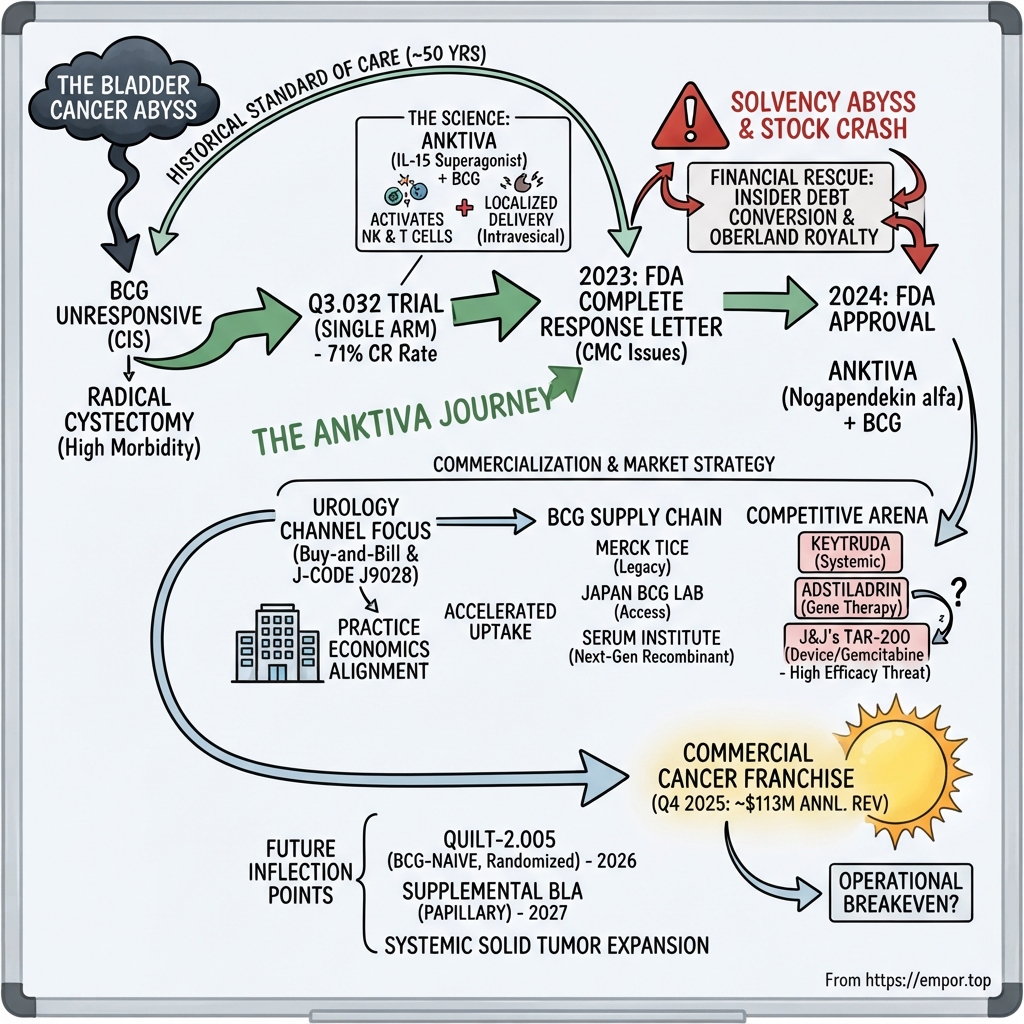
ImmunityBio: Patrick Soon-Shiong, ANKTIVA, and the War on Bladder Cancer
I. Prologue: The Bladder Cancer Abyss & The 71% Miracle
Every year in urology clinics across the United States, thousands of patients face one of the bleakest conversations in medicine. Typically in their seventies and often former smokers, these individuals have spent months undergoing routine intravesical therapy: a catheter delivers live bacteria directly into the bladder, followed by an afternoon of acute, burning discomfort. Patients endure the regimen because the alternative is catastrophic. Yet routine surveillance cystoscopies frequently reveal that the tumors have returned. The bacteria have stopped working.
At that juncture, the urologist must deliver the verdict: radical cystectomy, the complete surgical removal of the bladder. In men, surgeons typically remove the prostate as well; in women, the uterus. Pelvic lymph nodes are dissected, and the urinary tract must be reconstructed—either diverted into an external collection bag via an ileal conduit or redirected into a neobladder fashioned from a section of intestine. It remains one of the most morbid elective procedures in general surgery, carrying ninety-day complication rates that exceed 50%. For an elderly patient with cardiovascular disease, the operation carries substantial mortality risk.
This clinical dilemma underpins the entire ImmunityBio narrative. Bladder cancer ranks as the sixth most common malignancy in the United States, accounting for roughly 83,000 new diagnoses each year. Approximately 75% to 80% of these cases present as non-muscle invasive bladder cancer (NMIBC), meaning the malignancy remains confined to the urothelial lining without penetrating the muscular wall. While treatable at this stage, the disease is notoriously prone to recurrence, and the standard defense against relapse has remained largely unchanged since the mid-1970s.
That standard is Bacillus Calmette-Guérin, or BCG, an attenuated strain of bovine tuberculosis bacterium originally developed as a vaccine in the 1920s. In 1976, Canadian urologist Alvaro Morales demonstrated that instilling BCG directly into the bladder triggered an inflammatory immune response capable of clearing localized tumors. Intravesical BCG has served as the standard of care ever since—functioning as a remarkably durable, if rudimentary, immunotherapy that turns the bladder into a localized training ground for the immune system.
Yet BCG frequently fails. For patients diagnosed with carcinoma in situ (CIS)—an aggressive, flat tumor variant that carpets the bladder lining rather than forming discrete, resectable polyps—a substantial proportion eventually become classified as "BCG-unresponsive." For decades, that designation served as an immediate surgical referral.
That landscape shifted on April 22, 2024, when the FDA approved ANKTIVA—nogapendekin alfa inbakicept-pmln, an IL-15 receptor agonist known throughout development as N-803—in combination with BCG for adult patients with BCG-unresponsive NMIBC with CIS, with or without papillary tumors.[^3][^4] The pivotal data came from the single-arm QUILT-3.032 trial, which produced a complete response rate of roughly 71% and a median duration of response exceeding two years, with the longest responses extending beyond 47 months.[^4] For the vast majority of responders, the therapy allowed them to avoid cystectomy.
Those results proved compelling in a setting where the historical default was organ removal. Yet they also carried the standard caveats of single-arm oncology studies: the trial lacked a randomized control arm, results were evaluated against historical benchmarks rather than a concurrent control group, and because the drug was administered alongside BCG, isolating the specific contribution of the IL-15 agonist relies on clinical inference rather than direct comparative measurement. Regulators accepted the totality of the evidence, but evaluating the asset requires weighing clinical efficacy against trial design limits.
That dynamic frames the central corporate question: How did a company that was, in 2023, a pre-revenue biotechnology firm burdened by an FDA manufacturing rejection, a cash runway measured in months, short interest exceeding a quarter of its float, and a stock that shed half its value in a single trading session become, by 2026, the owner of a commercial oncology franchise generating more than $100 million annually?
The answer centers on Dr. Patrick Soon-Shiong: a transplant surgeon, inventor of Abraxane, architect of two separate multi-billion-dollar corporate sales, owner of the Los Angeles Times, and ImmunityBio's controlling shareholder, executive chairman, chief scientist, and financial backer of last resort.
The investment reality surrounding ImmunityBio balances two competing forces. On one side is a clinically validated biologic addressing a severe unmet medical need. On the other is an unconventional corporate structure characterized by insider voting control exceeding two-thirds, hundreds of millions of dollars in related-party debt repeatedly converted into equity, a royalty agreement skimming top-line revenue, and emerging competition from pharmaceutical giants such as Johnson & Johnson, which are advancing alternatives that do not rely on scarce global BCG supplies.
Understanding how a single molecule came to carry this complex web of clinical promise and corporate risk requires tracing the story back to a surgical residency in Los Angeles.
 Subscribe on LinkedIn
II. The Polymath's Playbook: Patrick Soon-Shiong, Abraxane, & The Nant Empire
Patrick Soon-Shiong was born in Port Elizabeth, South Africa, to Chinese immigrants who had fled Japanese-occupied China. After training at medical school under apartheid—where non-white physicians received half the salary of white colleagues for identical work—he left for Canada and then UCLA. By his thirties, he had built a reputation for pioneering surgery. In 1986, he performed what was reported as UCLA's first successful whole-pancreas transplant, before spending years pursuing an even more audacious ambition: encapsulating insulin-producing islet cells in a protective membrane to permit transplantation without lifelong immunosuppression.
While that islet research never yielded an approved therapy, it crystallized a principle that would define his commercial career: in pharmacology, the delivery vehicle matters as much as the payload.
That insight produced Abraxane. Paclitaxel, the cytotoxic agent originally derived from Pacific yew bark and commercialized by Bristol Myers Squibb as Taxol, ranks among the most effective chemotherapy agents ever discovered—and historically among the most difficult to administer. Because paclitaxel does not dissolve in water, BMS formulated it using Cremophor EL, a polyethoxylated castor oil solvent. The solvent caused severe hypersensitivity reactions, requiring patients to undergo premedication with high-dose steroids and antihistamines alongside slow intravenous infusions. The delivery vehicle, in short, fought the therapy.
Soon-Shiong resolved the problem by eliminating the chemical solvent altogether. By binding paclitaxel to human serum albumin—the bloodstream's primary carrier protein—his team engineered nanoparticles roughly 130 nanometers wide that dissolved directly in saline. The formulation eliminated Cremophor, removed the requirement for routine premedication, shortened infusion times, and permitted clinicians to deliver higher therapeutic doses. It was not a novel chemical entity, but an engineered envelope for an established drug—and it proved exceptionally lucrative.
The commercial realization unfolded in two acts. First came American Pharmaceutical Partners, the generic injectables business Soon-Shiong developed into a hospital pharmacy mainstay, which Fresenius acquired in 2008 for roughly $4.6 billion.[^12] Second was Abraxis BioScience, the branded spinout housing Abraxane, which Celgene agreed to acquire in June 2010 in a cash-and-stock transaction valued at approximately $2.9 billion up front plus contingent value rights, yielding a headline valuation near $3.8 billion.4 Celgene established Abraxane as a cornerstone of its solid-tumor portfolio, and following Celgene's subsequent sale, the asset returned to Bristol Myers Squibb—the very drugmaker whose formulation dilemma had created the opportunity.
Together, the two exits generated roughly $8 billion in total transaction value, establishing Soon-Shiong as a formidable figure in biotechnology with the capital to fund an expansive new agenda.
What he built with those proceeds, however, complicates the corporate narrative. Under the umbrella of NantWorks, Soon-Shiong assembled a sprawling constellation of private and public entities: NantHealth for clinical informatics, NantKwest for natural killer cell therapy, NantCell and NantOmics for biologics and genomic sequencing, and private investment vehicles including Nant Capital, Cambridge Equities, and California Capital Equity. Tying them together was an expansive scientific initiative dubbed Cancer MoonShot 2020, later rebranded Cancer Breakthroughs 2020. The thesis argued that oncology's next frontier would not rely on escalating cytotoxic chemotherapy, but on orchestrating the patient's own immune system: natural killer cells, cytotoxic T cells, dendritic cells, and engineered cytokines working in concert.
Scientifically, the core thesis proved prescient. Over the subsequent decade, immuno-oncology emerged as the dominant paradigm in cancer therapeutics. For investors, however, the defining question was whether the corporate architecture erected to pursue that vision created durable value or destroyed it.
Testing the synergy claim
The central premise promoted across Nant marketing materials and Soon-Shiong's public presentations was that vertical integration would fundamentally accelerate drug development. By combining proprietary molecular diagnostics, in-house bioinformatics, captive manufacturing facilities, and shared corporate infrastructure, the Nant ecosystem was supposed to deliver therapies faster and cheaper than an independent biotechnology company could manage.
The operational record offers little support for that claim.
NantHealth went public in June 2016 at $14 per share, marketing itself as an operating system for precision oncology. Commercial adoption stalled, the company endured financial restatements and executive turnover, customer churn mounted, and the stock steadily declined before an affiliate took the company private in 2023 at roughly $1 per share. NantKwest followed a similar path: after a 2015 initial public offering priced at $25 per share, the stock spent years languishing in the single digits. Meanwhile, Verity Health System, a six-hospital California network acquired and managed by Soon-Shiong-affiliated entities, accumulated persistent operating losses and filed for Chapter 11 bankruptcy protection in 2018 amid labor disputes and regulatory scrutiny over real estate arrangements.
Does that history validate the synergy model, narrow it, or dismantle it?
The evidence dismantles it. While the underlying science remains credible—and the Abraxane track record confirms Soon-Shiong's ability to translate a formulation insight into a multi-billion-dollar franchise—the claim that the interconnected Nant structure confers operational advantages fails across multiple corporate vehicles over a decade. A recurring pattern emerged: grand scientific framing and aggressive capital raises followed by severe execution bottlenecks in mundane operational functions, including manufacturing compliance, billing, sales execution, and quality management.
A more disciplined assessment points to a narrower conclusion. Soon-Shiong is a talented translational inventor and an effective capital raiser who previously proved how to transform a formulation insight into a commercial blockbuster. At ImmunityBio, genuine enterprise value has materialized when ANKTIVA was operationally insulated and steered by seasoned commercial and regulatory professionals—rather than integrated into the broader Nant apparatus. The operational question going forward is whether ImmunityBio can sustain its commercial momentum and manufacturing execution independently of new affiliated ventures.
That insulation was not an intentional corporate strategy from the outset. It came about because a struggling public shell required an operational rescue, and a promising private pipeline required a public market listing.
III. The Frankenstein Consolidation: NantKwest, ImmunityBio, & The 2021 Reverse Merger
In July 2015, NantKwest completed what was then the largest biotechnology initial public offering in history for a preclinical entity, raising approximately $207 million at $25 per share. On its first day of trading, the stock surged toward a valuation approaching $3 billion—an extraordinary figure for a business whose lead assets were experimental cell lines.
Those cell lines represented a compelling scientific concept. NantKwest's platform centered on NK-92, an immortalized natural killer cell line derived from a lymphoma patient in the 1990s. Whereas T cells require a specific antigen presented in a precise molecular context to initiate an attack, natural killer cells scan for the absence of normal self-markers, destroying abnormal or infected cells. In theory, NK-92 could be grown in a bioreactor, irradiated for safety, and infused into patients without tissue matching—the classic promise of an "off-the-shelf," allogeneic cell therapy that avoids personalized, multi-week vein-to-vein manufacturing. NantKwest engineered several variants, including haNK, featuring a high-affinity CD16 receptor designed to pair with monoclonal antibodies, and taNK, equipped with chimeric antigen receptors.
Translating that concept into viable therapeutics proved far more difficult. Cell therapy manufacturing is capital-intensive, cold-chain logistics are unforgiving, and infused natural killer cells exhibited poor persistence when targeting solid tumors. Without an approved commercial anchor, NantKwest burned cash for five years while its share price slid into the single digits and investor interest waned.
Meanwhile, Soon-Shiong's privately held ImmunityBio held a distinct asset portfolio: the IL-15 superagonist N-803, adenovirus-vector vaccines engineered on a second-generation hAd5 backbone, yeast-based vaccines, and toll-like receptor agonists. Advancing those programs required substantial capital. NantKwest offered an existing Nasdaq listing, cash reserves, and a public shareholder base running low on patience.
The merger was announced in December 2020 and closed on March 9, 2021, with the combined company taking the ImmunityBio name and the ticker IBRX on the Nasdaq Global Select Market.3 The exchange ratio allocated roughly 72% of the combined equity to ImmunityBio holders and roughly 28% to legacy NantKwest shareholders.3 Because Soon-Shiong held controlling stakes in both entities, the transaction functioned in substance as an internal reorganization of his own assets—a corporate consolidation that formally required minority shareholder approval.
Did public shareholders get a fair deal?
Evaluating that transaction requires setting it against contemporary immuno-oncology mergers and acquisitions. In 2020, Gilead paid $4.9 billion in cash to acquire Forty Seven and its clinical-stage CD47 antibody, magrolimab. In 2019, Sanofi spent roughly $2.5 billion to acquire Synthorx, whose lead candidate, THOR-707, was an engineered cytokine variant pursuing a biological premise analogous to N-803. In both instances, corporate acquirers led by independent boards paid negotiated cash premiums following arm's-length due diligence.
The NantKwest reverse merger possessed none of those characteristics. There was no cash consideration, no rival bidder, no unaffiliated acquirer testing valuation benchmarks, and the controlling principal on both sides of the table was identical. At closing, amidst the peak of the 2021 biotechnology bull market, the combined entity carried an equity value exceeding $7 billion—a valuation resting on a pipeline whose lead candidate had not yet secured regulatory approval and whose manufacturing facilities had yet to clear FDA inspection.
Legacy NantKwest shareholders received a 28% interest in an enterprise whose valuation hinged almost entirely on whether N-803 could clear the FDA. In doing so, they surrendered any claim on an alternative resolution, such as an outright sale of the natural killer cell platform, an orderly wind-down, or a return of remaining capital. The transaction effectively transferred the clinical and manufacturing execution risks of an unapproved private pipeline onto a public shareholder base with little practical ability to resist, in exchange for rescuing a cell-therapy vehicle that had lost momentum as a standalone enterprise.
The fact that N-803 eventually earned FDA approval three years later does not retroactively validate the fairness of the transaction process. Favorable outcomes do not erase structural governance risks, and conflating end results with procedural fairness is precisely how public investors often talk themselves into controlled companies.
One subsequent corporate decision, however, proved operationally critical. Rather than managing commercial and regulatory execution directly, Soon-Shiong recruited Richard Adcock as chief executive officer, stepping aside to serve as executive chairman and global chief scientific and medical officer. Adcock brought healthcare delivery experience from leadership roles at GE Healthcare and Verity Health. The appointment established an essential operational division of labor: while Soon-Shiong directed scientific strategy and broad corporate initiatives, professional leadership assumed responsibility for building the commercial sales infrastructure, quality systems, reimbursement framework, and Biologics License Application submission.
ImmunityBio subsequently submitted its Biologics License Application for N-803 in BCG-unresponsive non-muscle invasive bladder cancer to the FDA. Understanding the regulatory scrutiny and commercial stakes that followed, however, requires examining the molecule itself—and the bioengineering that distinguished it from earlier cytokine therapies.
IV. The Molecule: Engineering the IL-15 Superagonist
For thirty years, the most tantalizing and most formidable drug in oncology was interleukin-2.
High-dose IL-2, approved as aldesleukin in the early 1990s, achieved something almost no other contemporary cancer therapy could match: durable, complete remissions in a modest fraction of patients with metastatic melanoma and renal cell carcinoma. Instead of simply extending progression-free survival by several months, the therapy produced long-term cures in patients who faced terminal prognoses. Oncologists who practiced through that era recall the regimen with profound respect—and acute trepidation.
Administering high-dose IL-2 required intensive care monitoring. The cytokine frequently triggered capillary leak syndrome, a life-threatening complication in which blood vessels turn porous, plasma floods surrounding tissues, blood pressure collapses, and the lungs fill with fluid. Patients were pushed to the edge of multi-organ failure to elicit an antitumor response, making treatment-related mortality an accepted element of the clinical risk calculus.
Beyond its extreme toxicity, the molecule suffered from an inherent biological contradiction. IL-2 binds to a high-affinity receptor complex containing IL-2Rα, commonly designated CD25. The immune cells expressing the highest density of CD25 are regulatory T cells, or Tregs—the immune system's braking mechanism, tasked with suppressing immune reactions and preventing autoimmunity. Consequently, high-dose IL-2 simultaneously depressed the accelerator and the brake: while activating tumor-killing effector cells, it also expanded the very suppressor cell population responsible for shielding tumors from immune destruction.
Interleukin-15 is IL-2's structural cousin, engineered by nature without that counterproductive dynamic. It signals through shared beta and gamma receptor chains to stimulate cytotoxic CD8+ T cells and natural killer cells, but it does not engage CD25 and therefore avoids preferentially expanding regulatory T cells. On paper, it represents IL-2 stripped of its built-in self-sabotage.
Yet native IL-15 makes an ineffective therapeutic agent. In circulation, its serum half-life is measured in minutes. Furthermore, IL-15 functions differently from conventional secreted cytokines. Rather than diffusing freely through the bloodstream to bind distant targets, IL-15 operates primarily through trans-presentation: an antigen-presenting cell captures IL-15 on its surface, bound within its own IL-15 receptor alpha chain, and physically presents it to the receptor complex on an adjacent T cell or natural killer cell. The interaction functions less like an ambient broadcast than an intercellular handshake. Intravenous injection of uncomplexed IL-15 bypasses that presentation mechanism, causing the protein to be cleared before it can engage target effectors.
What N-803 actually is
ANKTIVA (N-803) addresses both pharmacokinetic and mechanistic hurdles through a three-part recombinant fusion complex designed to stabilize that handshake.
First, the molecule incorporates a mutated IL-15 variant carrying a single amino acid substitution—an asparagine-to-aspartate change at position 72—that increases binding affinity to the beta/gamma receptor complex four- to fivefold. Second, that mutated cytokine is pre-complexed with the "sushi domain" of the human IL-15 receptor alpha chain, replicating the binding platform normally provided by an antigen-presenting cell. By delivering the cytokine pre-loaded into its receptor alpha domain, the complex arrives in an active, pre-trans-presented conformation rather than depending on host cells for presentation. Third, the receptor fragment is fused to the Fc domain of human IgG1. This Fc fusion serves two essential functions: it harnesses the body's natural antibody-recycling pathway to extend circulating half-life from minutes to roughly twenty-four hours, and it dimerizes the structure, allowing each fusion protein to display two active IL-15 complexes simultaneously.
The practical distinction is striking: where native IL-15 functions like an ambient signal quickly lost in circulation, ANKTIVA functions like a stabilized, targeted payload delivered directly to effector lymphocytes.
Why the bladder is the ideal venue
The commercial viability of ANKTIVA, however, stems as much from the anatomy of the target organ as from the molecular engineering itself.
The human bladder functions as an isolated reservoir. A urologist can instill the therapeutic solution directly through a urethral catheter, instruct the patient to retain it for two hours, and then have the patient void the volume. The drug concentrates directly at the mucosal tumor site before being expelled, keeping systemic absorption minimal. The severe systemic toxicities that historically constrained cytokine therapies—capillary leak, vascular collapse, and multi-organ failure—are largely avoided through localized intravesical delivery.
The mechanistic pairing with BCG provides a complementary biological dynamic. Intravesical BCG provokes an acute inflammatory response within the urothelium, recruiting natural killer cells and effector T cells to the bladder wall. ANKTIVA then acts locally to activate and expand those recruited immune cells, sustaining their cytotoxic function. In essence, BCG sounds the alarm to draw immune cells to the urothelium, while the IL-15 superagonist arms and stimulates the responders. In BCG-unresponsive disease, where recurrent tumors persist despite repeated bacterial instillation, the combination is designed to revitalize exhausted effector cells that had failed to clear the malignancy on their own.
Testing the platform claim
ImmunityBio has positioned IL-15 superagonism not merely as a localized urologic treatment, but as a systemic immunotherapy platform capable of converting immunologically "cold" tumors into responsive "hot" malignancies across lung, colorectal, pancreatic, and glioblastoma settings. The company's long-term enterprise valuation hinges substantially on this expansion narrative.
The history of cytokine drug development, however, urges caution—with Nektar Therapeutics offering a clear precedent. Nektar developed bempegaldesleukin, a pegylated IL-2 prodrug engineered with a similar conceptual rationale: selectively stimulating effector lymphocytes while avoiding the expansion of regulatory T cells. In 2018, Bristol Myers Squibb committed up to $3.6 billion to partner on the asset based on compelling Phase 1 and 2 biomarker data demonstrating robust immune-cell proliferation. Yet in 2022, pivotal Phase 3 trials in metastatic melanoma and renal cell carcinoma failed to demonstrate a clinical benefit over standard checkpoint inhibition, dissolving the partnership and wiping out the majority of Nektar's market value.
The parallel underscores a critical distinction in immuno-oncology development. Early-phase single-arm cytokine trials reliably demonstrate peripheral natural killer and CD8+ T-cell expansion, because cell proliferation is the intrinsic pharmacodynamic function of these signaling proteins. But expanding circulating lymphocytes does not reliably translate into progression-free or overall survival advantages in randomized, controlled Phase 3 trials where the control arm receives modern standard-of-care therapy.
Evaluating ImmunityBio's platform thesis requires drawing a firm boundary between validated and speculative applications. ANKTIVA's localized efficacy in BCG-unresponsive non-muscle invasive bladder cancer is clinically established and supported by durable multi-year complete responses. In contrast, its utility as a systemic agent in advanced solid tumors remains unproven, supported primarily by mechanistic rationale and early-phase clinical signals—precisely the evidentiary threshold reached by earlier cytokine candidates that ultimately failed in late-stage testing. For investors, the decisive benchmark will be randomized Phase 3 data establishing a statistically significant overall survival benefit in systemic solid-tumor indications. Until such evidence emerges, the broader platform represents an unhedged speculative option rather than a proven commercial franchise.
Yet even ImmunityBio's core bladder cancer franchise nearly unraveled before reaching commercialization—not over biological mechanisms, but over the physical realities of pharmaceutical manufacturing.
V. The Valley of Death: The 2023 CMO CRL & The Solvency Abyss
In the spring of 2023, ImmunityBio operated as though regulatory approval were weeks away. The company was recruiting field staff, building out a specialty commercial team aimed at community urology clinics, and preparing for a nationwide commercial launch.
Then, in May 2023, the FDA issued a Complete Response Letter.[^9]
A Complete Response Letter typically halts a commercial rollout in its tracks. What made this rejection distinctive—and, from a clinical standpoint, potentially addressable—was what the agency omitted. Regulators did not reject the underlying efficacy data or demand an expensive new randomized clinical trial. Instead, the deficiencies centered on chemistry, manufacturing, and controls: pre-license inspections of the third-party contract manufacturing organizations producing N-803 had uncovered compliance failures.[^9] The FDA also requested updated duration-of-response data and clarifications regarding safety monitoring.
In biotechnology, a manufacturing-only rejection is often viewed as the least damaging form of regulatory setback. The sponsor does not need to re-prove biological efficacy; it simply needs to remediate its supply chain. In practice, however, theoretical survivability means little if capital markets conclude the enterprise has become uninvestable.
The stock plunged more than 50% in a single trading session, collapsing from roughly six dollars to two dollars, before grinding lower throughout the remainder of the year to trade below $1.50. Meanwhile, short interest swelled to more than a quarter of the public float. A short position of that magnitude reflected more than skepticism about the underlying science; it represented a direct wager against the balance sheet—a bet that the company would run out of cash and be forced to issue deeply discounted equity into a broken market.
That wager was grounded in straightforward financial reality. ImmunityBio was burning roughly $80 million each quarter while generating no product revenue, leaving its cash reserves with less than twelve months of operational runway. External financing channels were virtually shuttered. The broader 2022–2023 biotechnology downturn had severely restricted secondary equity offerings for pre-revenue firms, while the March 2023 regional banking crisis—marked by the collapse of Silicon Valley Bank, the primary venture lender to the sector—abruptly froze private credit markets. An unprofitable drug developer carrying an active manufacturing rejection found itself locked out of traditional capital.
The founder as creditor
What followed highlighted the central structural reality of ImmunityBio as an investment vehicle—one that presents both an extraordinary backstop and a profound corporate governance dilemma.
Entities affiliated with Soon-Shiong, principally Nant Capital and Cambridge Equities, stepped in to finance the shortfall. Between 2021 and 2023, these affiliated vehicles extended hundreds of millions of dollars in secured promissory notes to keep the company solvent.
The positive interpretation is substantial: the controlling shareholder possessed the personal wealth and willingness to backstop an operational going concern through an acute regulatory freeze. Few clinical-stage biotechnology firms enjoy that degree of insider liquidity. Without it, ImmunityBio would almost certainly have faced a distressed asset sale in 2023, and ANKTIVA would have ended up in another drugmaker's pipeline.
Yet the governance implications remain stark. At the company's moment of greatest financial vulnerability, a single individual functioned simultaneously as controlling shareholder with supermajority voting power, executive chairman, chief scientific and medical officer, and primary secured creditor holding the company's intellectual property as collateral. Key lending terms—including interest rates, maturities, collateral pledges, and conversion privileges—were arranged between entities answering to the same beneficial owner. There was no competitive market bidding process to determine what an arm's-length lender would have demanded. While a special committee of independent directors nominally reviewed related-party transactions, that internal review served as the sole structural safeguard for minority shareholders.
The financial consequence eventually surfaced in the broader capital structure when those notes were exchanged for equity. Insider rescue financing does not eliminate the cost of capital; it defers dilution, leaving the conversion terms largely in the hands of a party sitting on both sides of the negotiating table.
Oberland: renting the top line
The second lifeline came from outside the company, and its terms revealed the market's true assessment of ImmunityBio's risk profile in late 2023.
In December 2023, the company entered into a Revenue Interest Purchase Agreement with Oberland Capital—a structured royalty financing arrangement rather than a conventional loan or equity offering—providing up to $300 million in capital.2 Oberland agreed to fund manufacturing remediation and commercial launch preparations in exchange for tiered royalties on ANKTIVA net sales, with the repayment obligation terminating once Oberland received a specified multiple of its funded capital, capped between roughly 1.95 and 2.25 times the principal depending on repayment timing.2 The financing agreement was subsequently expanded, reaching up to $375 million by early 2026.[^2]
Royalty monetization is genuinely non-dilutive to the common share count, explaining its appeal to corporate leadership. Yet it carries a substantial economic burden that does not surface as traditional interest expense. Under a multiple-of-capital structure, rapid commercial success accelerates the effective cost: strong ANKTIVA sales allow Oberland to reach its targeted return cap more quickly, diverting vital cash flow during the critical early years of commercialization. Because royalty payments come directly off the top line—the highest-margin revenue a business generates—they permanently compress operating margins. Resorting to structured royalty monetization on the eve of a product launch signaled clearly that management could not secure conventional debt or equity on acceptable terms.
Simultaneously, the company addressed its operational mandate: overhauling internal quality systems, assisting its contract manufacturing partners through remediation, and compiling the requested duration-of-response follow-up data. The regulatory effort paid off in October 2023, when the FDA accepted ImmunityBio's resubmitted Biologics License Application and established a target action date of April 23, 2024.[^4]
ImmunityBio had secured a second regulatory chance, albeit at substantial financial cost. The looming challenge, however, was whether clearing the FDA would translate into something far more demanding: commercial adoption and sustainable cash flow.
VI. The Commercial Breakthrough: FDA Approval, Buy-and-Bill, & J-Code J9028
The approval arrived a day ahead of schedule. On April 22, 2024, the FDA approved nogapendekin alfa inbakicept-pmln in combination with BCG for BCG-unresponsive non-muscle invasive bladder cancer with carcinoma in situ, with or without papillary tumors—supplied as a 400-microgram single-dose vial.[^3][^4] Commercial product became available for ordering within three weeks.[^4]
Yet clearing regulatory review immediately confronted ImmunityBio with an obstacle that derails more promising therapies than flawed clinical data: the mechanics of specialty reimbursement.
Why urologists, not oncologists
Understanding ANKTIVA's commercial architecture requires examining the specific specialty that treats the disease.
Non-muscle invasive bladder cancer is managed almost exclusively by urologists—surgeons rather than medical oncologists. The urologist conducts the initial cystoscopy, performs the transurethral resection, interprets pathology, administers intravesical instillations, and directs surveillance cystoscopies for years afterward. Medical oncologists rarely participate unless the malignancy invades the muscular wall or metastasizes. Clinically and economically, the patient remains within the urology practice.
That prescriber base is highly concentrated. The commercially addressable market centers on roughly two thousand high-volume urologists, heavily clustered within independent practices affiliated with LUGPA, the Large Urology Group Practice Association. These consolidated, multi-site groups operate their own infusion suites, specialized nursing staff, and billing infrastructure. For a biotechnology company deploying a targeted commercial organization, this concentrated footprint offered a manageable sales target.
Buy-and-bill, and why it is a strategic weapon
Physician-administered biologics in the United States generally bypass retail pharmacies. Instead, practices operate under a "buy-and-bill" model: the clinic purchases the drug, maintains inventory, administers the infusion or instillation, and bills the payer directly. Under Medicare Part B, reimbursement is calculated at the drug's Average Sales Price plus a statutory add-on, conventionally set at ASP plus 6%.
Six percent of a $35,800 specialty vial generates vastly different practice economics than six percent of an off-patent generic. ImmunityBio established ANKTIVA's wholesale acquisition cost at approximately $35,800 per 400-microgram vial. The dosing protocol calls for an induction course of six weekly instillations, followed by maintenance therapy at months three, six, nine, and twelve, and semi-annually thereafter through year three. For a patient who achieves a complete response and remains on therapy, treatment can total approximately twenty-one vials across the complete protocol.
From the urologist's perspective, the treatment alternatives present sharply diverging economic incentives. Referring a patient to a medical oncologist for systemic intravenous pembrolizumab transfers clinical management—and therapy-related reimbursement—outside the practice. In contrast, ANKTIVA is instilled through a catheter by the practice's existing nursing staff in an established procedure room, keeping the patient under the urologist's direct care.
In business strategy terms, this dynamic represents classic counter-positioning. The primary competitive challenge for an established incumbent like Merck is not merely efficacy on the merits; it is that intravenous checkpoint inhibition requires the referring surgeon to surrender both patient management and procedure revenue. Incumbents cannot easily counter a delivery framework that aligns directly with the channel economics of the primary prescriber.
That structural advantage carries an important caveat. Aligning physician financial incentives with clinical prescribing creates operational tailwinds, but it also exposes the franchise to policy risk. The ASP-plus-percentage reimbursement framework remains a recurring target for Medicare payment reform, and any shift toward flat administrative fees would compress practice economics. What benefits ANKTIVA commercially reflects current regulatory policy rather than a permanent feature of healthcare delivery.
The J-code, or: how a billing code moved a stock
Between May and December 2024, ANKTIVA lacked a dedicated permanent reimbursement code. Practices were forced to bill Medicare and commercial payers using miscellaneous or temporary C-codes. In practice, unclassified coding required manual claim reviews, extended prior-authorization timelines to several weeks, and forced independent practices to float tens of thousands of dollars in working capital per patient without certainty regarding reimbursement timing. For independent medical groups operating on working-capital constraints, that friction served as a powerful disincentive to prescribe.
The operational bottleneck eased when the Centers for Medicare & Medicaid Services assigned a permanent, product-specific Healthcare Common Procedure Coding System code—J9028, designating nogapendekin alfa inbakicept-pmln for intravesical injection, billed per microgram at 400 units per vial—effective January 1, 2025.[^5]
The commercial impact was immediate. A permanent J-code transitioned claims from manual adjudication to automated claims processing, compressed prior-authorization timelines from weeks to days, established predictable gross-to-net realizations, and allowed practices to manage inventory cash flows with confidence. Prescribing adoption accelerated accordingly.
The episode illustrates a fundamental reality of specialty pharmaceutical launches: the clinical evidence for ANKTIVA was identical in December 2024 and January 2025, but commercial uptake shifted once the reimbursement infrastructure standardized the payment workflow. Specialty launch trajectories are frequently dictated as much by administrative coding mechanics as by underlying clinical efficacy, with the multi-month gap between regulatory approval and permanent coding representing an unavoidable feature of the U.S. reimbursement system.
The numbers, and what they mean
Following its mid-2024 launch into unclassified coding headwinds, ANKTIVA generated modest initial sales before accelerating. Full-year 2025 net product revenue reached approximately $113 million, representing a roughly sevenfold increase over the partial and code-constrained initial launch year.[^2]
Evaluating those financial results requires contextualizing three distinct factors.
First, commercial demand validated physician willingness to adopt the biologic once reimbursement hurdles normalized. The sharp revenue ramp following the J-code assignment confirmed that the initial commercial constraint was administrative rather than a lack of clinician interest.
Second, the baseline requires perspective. While $113 million in a first full commercial year marks a solid specialty launch, it does not represent an immediate blockbuster trajectory. The percentage increase appears particularly steep because the 2024 comparison base was suppressed by coding friction, and the ultimate commercial benchmark remains penetration across the broader eligible BCG-unresponsive population.
Third, top-line product revenue does not immediately equate to free cash flow. Reported revenue arrives net of Oberland's tiered royalty obligations, while the business continues to absorb commercial sales expenditures, contract manufacturing costs, and research spending across an active clinical pipeline. Top-line product sales represent the initial operational milestone toward financial sustainability, not the final destination.
Furthermore, the entire commercial franchise rested upon a critical operational dependency that ImmunityBio did not directly control: the global supply of BCG.
VII. The Strategic Moat & The BCG Geopolitics: Partnering with Serum Institute
ImmunityBio's commercial launch in 2024 exposed an unusual operational vulnerability.
The company had brought to market a biologic priced at approximately $35,800 per vial, the culmination of extensive protein engineering and an estimated $1 billion in cumulative capital investment. Yet ANKTIVA's FDA label required concurrent administration with BCG—a century-old suspension of attenuated bovine tuberculosis costing roughly $150 per dose that American urologists routinely struggled to obtain.
ANKTIVA is not approved as a monotherapy for carcinoma in situ. Without BCG, clinicians cannot administer the therapy within its approved label.
The oldest supply chain problem in oncology
The domestic BCG shortage represents one of the most persistent operational challenges in modern oncology. After Sanofi exited BCG manufacturing in 2012 following contamination issues at its production facility, Merck's TICE strain remained the sole FDA-licensed supply for the United States. Merck has operated that legacy manufacturing facility at capacity for more than a decade.
The resulting shortfall forced widespread rationing. Urologists routinely split vials—administering one-third or one-half doses to stretch inventory across multiple patients—and frequently deferred or omitted maintenance courses. While clinical trials establishing BCG's efficacy relied on full-dose induction alongside multi-year maintenance instillations, American urology practices have often delivered reduced regimens due to persistent product shortages.
Resolving the shortage is complicated by regulatory barriers. Because BCG is a live biological product rather than a synthetic chemical, no generic pathway exists for approval. Each strain—including TICE, Tokyo-172, Moreau, and the Russian BCG-I—is a distinct living organism maintained through serial passaging over a century. Sponsors cannot establish conventional bioequivalence for a bacterium; an alternative strain seeking entry into the U.S. market requires an independent Biologics License Application supported by dedicated clinical trial evidence. For decades, the substantial capital required to conduct clinical trials for a commodity biologic priced in the low hundreds of dollars discouraged potential competitors.
ANKTIVA altered those commercial incentives by transforming a low-cost commodity into the rate-limiting input for a specialty regimen commanding a five-figure price tag.
The Serum Institute deal
In May 2024, weeks after approval, ImmunityBio announced an exclusive global partnership with the Serum Institute of India—the largest vaccine manufacturer in the world by volume, a company that produces more doses annually than any other and that has manufactured BCG for decades for markets outside the United States.[^6]
The agreement established two distinct tracks. The near-term track sought supplemental inventory through access to Serum Institute's standard BCG, already licensed and distributed across multiple international markets. The longer-term initiative focused on developing a next-generation recombinant BCG, engineered to provoke stronger CD8+ and CD4+ T cell responses with a potentially improved safety profile.[^6]
ImmunityBio also secured supply of the Tokyo-172 strain from Japan BCG Laboratory (日本BCG製造), establishing a mechanism to provide product to U.S. patients facing domestic stockouts through an FDA Expanded Access Program.
Strategically, the arrangement addressed a fundamental operational bottleneck. Beyond securing physical supply, ImmunityBio mitigated its exposure to a commercial rival: Merck manufactures both domestic BCG and Keytruda (pembrolizumab), an alternative systemic therapy in bladder cancer. Establishing a relationship with a high-volume vaccine manufacturer lacking a competing oncology portfolio reduced supplier bargaining power and addressed an acute operational vulnerability in the commercial rollout.
Testing the supply moat claim
ImmunityBio's corporate positioning has extended beyond supply diversification, presenting the Serum Institute partnership as a durable competitive advantage—exclusive access to next-generation recombinant BCG intended to allow the company to supply the entire treatment regimen rather than an individual component.
Evaluating that claim against regulatory realities reveals significant constraints. Neither Serum Institute's standard BCG nor Japan BCG Laboratory's Tokyo-172 holds a commercial Biologics License Application from the FDA. Consequently, availability to American patients depends on expanded access protocols and bridging trials. Expanded access does not function as an efficient commercial distribution channel: it requires institutional review board approvals, extensive patient-specific documentation, and administrative burdens that community practices must absorb without dedicated reimbursement. Facing domestic stockouts, community urologists are considerably more likely to split commercial vials, delay therapy, or select alternatives that do not require BCG than navigate the administrative overhead of an expanded access program.
Does that evidence validate the supply moat claim, narrow it, or dismantle it?
The evidence narrows it. While the arrangement offers a credible long-term solution to physical volume constraints, converting that partnership into a true commercial moat requires a standard U.S. biologics license for the Serum Institute strain. Until ImmunityBio or its partner secures formal FDA approval, exclusive access to alternative BCG represents an operational hedge rather than a proven competitive moat.
Furthermore, persistent friction in the BCG supply chain creates an enduring incentive for clinicians to adopt therapies that avoid the bacterium altogether—and alternatives that bypass BCG are advancing into the market.
VIII. The Competitive Arena: ANKTIVA vs. Keytruda, Adstiladrin, & J&J's TAR-200
At medical gatherings such as the American Urological Association annual meeting, the commercial stakes in bladder cancer are on display. A decade ago, BCG-unresponsive non-muscle invasive bladder cancer was a therapeutic desert where the sole definitive intervention was surgical cystectomy. By 2026, the space had evolved into a crowded specialty battleground, shaped by three competing therapeutic approaches.
Merck's Keytruda: right drug, wrong delivery
Pembrolizumab secured FDA approval in this setting in January 2020 on the strength of the KEYNOTE-057 trial, becoming the first systemic therapy approved for BCG-unresponsive carcinoma in situ. In that study, the complete response rate reached approximately 41%, with a median duration of response near sixteen months.
Set against ANKTIVA's single-arm 71% complete response rate and multi-year durability, the efficacy comparison appears lopsided—with the standing caveat that cross-trial comparisons between separate, single-arm studies involve different patient populations, distinct enrollment criteria, and different eras of standard care. No head-to-head clinical trial exists.
Yet the more decisive commercial disadvantage is not efficacy, but route of administration. Keytruda is an intravenous systemic checkpoint inhibitor. It carries the potential for severe immune-related adverse events—such as pneumonitis, colitis, hepatitis, and endocrine dysfunction—affecting a notable minority of patients. In a patient cohort where the median age is approximately seventy-three and cardiovascular or pulmonary comorbidities are common, managing localized bladder cancer by inducing systemic immune activation presents a clinical trade-off many urologists and patients hesitate to make when localized alternatives exist. Combined with referral mechanics that transfer patient oversight—and procedural reimbursement—outside the urology clinic, Keytruda's position in non-muscle invasive bladder cancer remains structurally constrained despite the therapy's broader commercial stature.
Ferring's Adstiladrin: good drug, broken factory
Nadofaragene firadenovec, approved in December 2022, represents an innovative biological mechanism in the category. As an intravesical gene therapy, the treatment utilizes a non-replicating adenoviral vector carrying the gene for human interferon alfa-2b. Instilled directly into the bladder, the vector transduces urothelial cells, temporarily prompting the patient's own bladder lining to produce the cytokine locally rather than administering a manufactured protein.
The clinical profile proved solid, demonstrating a complete response rate of approximately 51% at three months. Furthermore, the dosing protocol is the least demanding in the class, requiring an instillation once every three months, compared to ANKTIVA's more intensive induction and maintenance schedule.
Adstiladrin's primary commercial constraint, however, has been manufacturing. Commercial-scale viral vector production remains one of the most persistent operational bottlenecks in biotechnology, and Ferring contended with prolonged supply constraints that curtailed its market launch. That shortfall provides a clear lesson for investors: in intravesical oncology, commercial outcomes have repeatedly hinged on supply reliability and manufacturing execution rather than marginal differences in response rates. ImmunityBio's own 2023 Complete Response Letter demonstrated the same operational principle from the opposite direction.
J&J's TAR-200: the real threat
Johnson & Johnson's market entry is not a biologic, but an intravesical drug-delivery device.
TAR-200—informally called "the pretzel" because of its looped shape—consists of a flexible silicone tube preloaded with gemcitabine, an established, low-cost chemotherapy agent. Placed into the bladder through a urethral catheter during a standard office visit, the device coils into a configuration that prevents voiding, releasing gemcitabine continuously over several weeks before retrieval and replacement.
The engineering addresses a longstanding pharmacokinetic limitation in intravesical oncology: dwell time. Conventional chemotherapy instillations remain in the bladder for one to two hours before excretion, exposing malignant tissue to a brief concentration spike followed by rapid clearance. TAR-200 replaces that intermittent spike with continuous, low-dose exposure. Conceptually, deploying an advanced delivery system to improve an off-patent cytotoxic drug mirrors the exact development playbook Patrick Soon-Shiong executed with Abraxane. In an ironic corporate twist, the most formidable competitive challenge to ImmunityBio's biologic franchise is an engineered envelope housing an established chemotherapy molecule.
Data from the SunRISe-1 trial presented in 2024 demonstrated a complete response rate around 82% in BCG-unresponsive carcinoma in situ, alongside durable responses and favorable local tolerability.6
Crucially, TAR-200 does not require concurrent BCG administration. As a monotherapy, it sidesteps the entire supply bottleneck: no dose rationing, no expanded access paperwork, and no reliance on a competitor's manufacturing facility.
Testing ANKTIVA's competitive moat
The bull thesis argues that ANKTIVA's response rate, first-mover entry, and entrenched buy-and-bill relationships establish a durable commercial moat in this indication.
The disconfirming evidence is substantial. TAR-200 demonstrated a higher point-estimate complete response rate—roughly 82% compared to ANKTIVA's 71%, with the familiar qualification that cross-trial comparisons lack randomized validation—while eliminating the BCG requirement entirely. In addition, Johnson & Johnson fields an expansive commercial organization that already maintains deep relationships with urology practices nationwide through its prostate cancer franchise, including apalutamide and abiraterone. TAR-200 is also an office-administered, urologist-controlled, buy-and-bill product. Because administration remains inside the urology suite, Johnson & Johnson does not encounter the channel friction that disadvantaged Merck's intravenous Keytruda. The counter-positioning advantages that favor ANKTIVA against systemic checkpoint inhibitors do not apply against TAR-200.
Verdict: the competitive moat is real but narrow and time-limited. ANKTIVA established an authentic first-mover advantage among urologists who integrated the biologic into clinical workflows during 2025 and 2026. Moreover, switching barriers during an active treatment protocol are meaningful: clinicians are unlikely to switch a patient who achieves a complete response at three months to an alternative therapy mid-course. Yet in a specialty market with limited switching frictions once a treatment protocol concludes, a first-mover advantage provides an operational lead rather than a permanent barrier to entry.
The falsifiable question is straightforward: once TAR-200 achieves broad commercial availability and reimbursement, will ANKTIVA's quarterly vial volume continue to expand in absolute terms, or will it plateau? Continued volume growth would demonstrate that overall market expansion accommodates both therapies and that urologists identify distinct clinical niches for each. A volume plateau within two quarters of widespread competitive availability would signal market displacement. That metric offers the clearest test of whether ANKTIVA's commercial moat is durable.
ImmunityBio has sought to counter that emerging competitive pressure along two fronts: pursuing a supplemental Biologics License Application for papillary-only disease, with an FDA target action date of January 6, 2027, to expand its addressable patient population,[^2] and advancing clinical protocols aimed at BCG-free administration. Both initiatives remain unresolved.
IX. Strategic Playbook: Hamilton Helmer's 7 Powers & Porter's 5 Forces
Stepping back from the clinical narrative to apply formal strategic frameworks resolves these competitive dynamics into a clear structural picture.
The 7 Powers
Counter-positioning — strong, but only against one opponent. The office-administered, urologist-retained economics described earlier represent a business model Merck structurally cannot match without cannibalizing its established oncology referral channel. This represents ImmunityBio's most authentic strategic advantage. Its limitation is that it is opponent-specific: it offers no protection against a competitor adopting the identical in-office delivery model, which is precisely how Johnson & Johnson has positioned TAR-200.
Cornered resource — moderate, partly contingent. The tripartite fusion architecture is protected by composition-of-matter and method-of-use patents extending into the mid-2030s, and manufacturing an IL-15/IL-15Rα-Fc complex reproducibly at commercial scale is not trivial—as the company learned expensively. The exclusive Serum Institute arrangement would represent a second cornered resource if the recombinant strain achieves U.S. licensure. At present, it remains an option on one.
Switching costs — moderate, and narrower than they appear. Switching costs are high within an active treatment course, but low between individual patients. Every newly diagnosed BCG-unresponsive patient presents an unconstrained clinical decision without accumulated switching friction. There is no proprietary data lock-in, no installed equipment base, and no workflow integration beyond standard in-office instillation protocols. In this indication, market share is re-contested continuously with every new diagnosis.
Process power — improving from a low base. The company achieved cGMP compliance for a complex biologic following a public regulatory rejection, and it has sustained commercial distribution without reported supply interruptions. That execution is meaningful in a category where a direct competitor's rollout was hobbled by manufacturing bottlenecks. Yet dependable production is not a durable competitive advantage; it represents essential operational table stakes that the company was forced to pay for twice.
Scale economies, network economies, branding — absent. Generating approximately $113 million in annual revenue confers no meaningful manufacturing scale advantage against pharmaceutical giants like Merck or Johnson & Johnson. There are no network effects in a therapeutic biologic lacking a connected data or platform component. Furthermore, brand power in physician-administered oncology rests entirely on clinical trial evidence rather than corporate reputation.
The 5 Forces
Threat of substitutes — high. Radical cystectomy remains the surgical fallback, still selected by urologists and patients wary of persistent recurrence risk. Adstiladrin competes directly with a less demanding quarterly dosing schedule. Meanwhile, TAR-200 presents a higher point-estimate complete response rate without requiring co-administration with BCG. Three distinct substitutes target a single indication.
Buyer power — moderate to high, and concentrated. Because the median non-muscle invasive bladder cancer patient is in their seventies, Medicare serves as the dominant payer and primary price-setter via statutory Average Sales Price reimbursement rules. Simultaneously, community urology practices, increasingly consolidated into large specialty groups, negotiate as coordinated regional blocs. A sole-source specialty biologic retains near-term pricing latitude, but the primary ultimate payer is a federal program under persistent political and regulatory pressure to constrain Medicare Part B add-on expenditures.
Supplier power — mitigated but not eliminated. ImmunityBio has moved to diversify its dependence on Merck's legacy BCG supply, subject to significant regulatory constraints on unapproved foreign strains. A secondary supplier exposure persists in contract manufacturing organizations producing the biologic itself—the proximate trigger of the 2023 Complete Response Letter.
Barriers to entry — high. Demonstrating durable complete responses in non-muscle invasive bladder cancer demands multi-year follow-up and long-horizon capital, while the FDA enforces rigorous chemistry, manufacturing, and controls standards on intravesical biologics. This creates robust protection against nascent entrants, but provides no defense against well-capitalized competitors that have already crossed the regulatory threshold.
Rivalry — high and intensifying. A therapeutic category that had seen no new drug approvals for decades before 2020 has evolved into a crowded arena featuring multiple approved or late-stage alternatives and a well-capitalized multinational pharmaceutical incumbent.
The synthesis: ImmunityBio holds one strong, opponent-specific power and several moderate advantages within an industry structure characterized by viable substitutes, concentrated buyers, and intensifying rivalry. That profile represents a defensible specialty foothold rather than an unassailable commercial fortress. It is an industry structure where operational execution and capital structure dictate long-term enterprise outcomes—which turns attention to the corporate governance and financing dynamics operating outside the clinic.
X. The Skeptical Investor Stress Test: Governance, Debt, & Bull vs. Bear
Imagine an activist investor preparing a campaign against ImmunityBio. The presentation slides are ready: recruit independent board directors, initiate a comprehensive strategic review, unwind hundreds of millions of dollars in related-party obligations, and explore a sale of the commercial oncology franchise to an established urology drugmaker.
They can save their time. The campaign will not work, and the structural arithmetic explains why.
The controlled-company reality
Patrick Soon-Shiong controls approximately 66.3% of ImmunityBio's beneficial voting power through Nant Capital, Cambridge Equities, and affiliated trusts.1 That is not merely an influential equity position; it is arithmetic supremacy. Every board election, merger authorization, charter amendment, and shareholder proposal is decided before the ballots are cast.
Because of that concentration, ImmunityBio qualifies as a "controlled company" under Nasdaq listing standards, permitting it to rely on exemptions from baseline corporate governance mandates—including requirements for a majority-independent board and fully independent nominating and compensation committees.1
For minority shareholders, the practical translation is absolute: no external mechanism exists to compel corporate change. No proxy contest can succeed. No unsolicited takeover bid can proceed. No activist fund can force an asset divestiture or executive replacement. The company's corporate strategy, capital allocation, related-party debt terms, and clinical pipeline priorities are governed entirely by the scientific convictions and financial preferences of a single individual, leaving public shareholders to participate on whatever terms result.
Founder control is not inherently negative—concentrated ownership has created substantial value across technology and healthcare, and in ImmunityBio's case, insider capital was the sole reason the business survived its 2023 solvency crisis. But that control carries a tangible structural cost: a permanent governance discount that public markets inevitably apply until ownership changes.
The dilution machine
Tracing the mechanics of that insider rescue financing reveals its full balance-sheet consequence.
When Soon-Shiong-affiliated entities stepped in to fund the company during its 2023 regulatory freeze, those credit lines did not remain permanent debt. Instead, they have been repeatedly converted into common shares—exemplified by the conversion of $25 million in Nant Capital promissory notes into common equity at approximately $5.40 per share in March 2026.7 Driven by successive debt conversions and secondary share issuances, ImmunityBio's total shares outstanding pushed past 700 million.[^2]
The corporate pattern is unmistakable: a controlling shareholder extends emergency credit to his own company during distress on terms arranged between affiliated parties, and subsequently converts that debt into equity at valuations and timetables he substantially influences. Each conversion extinguishes a balance-sheet liability—an outcome public markets generally welcome—while expanding his proportional ownership and diluting public holders. When conversions occur near depressed share prices, the resulting equity dilution is magnified.
A charitable interpretation views this arrangement as an alignment of interests: converting debt into equity strengthens solvency and demonstrates a willingness to absorb equity risk rather than drain scarce cash from a commercializing business. A skeptical view recognizes that repeated conversions allow an insider to accumulate equity control at favorable prices while bypassing external capital-market discipline. A disciplined assessment must account for both realities. The decisive test is forward-looking: does the share count stabilize now that commercial product revenue has arrived? If conversions and equity sales continue at an aggressive pace through 2027 despite growing commercial receipts, the dilution pattern reflects a permanent structural mechanism rather than a temporary crisis response.
Compounding that dilution is the Oberland financing agreement, which siphons tiered royalties directly off net product sales until a predetermined return multiple is reached.2 As a result, ImmunityBio converts top-line sales into operating cash flow at a significant structural discount, even before absorbing standard commercialization costs and clinical development expenses. A dollar of ANKTIVA revenue yields far less free cash flow than an equivalent dollar generated by an unencumbered specialty pharmaceutical peer—a structural reality that any disciplined valuation must incorporate.
The optionality, sized honestly
Outside bladder cancer, ImmunityBio's most consequential clinical program is QUILT-3.055, evaluating ANKTIVA alongside checkpoint inhibitors in patients with non-small cell lung cancer whose disease has progressed following prior checkpoint therapy.
The clinical stakes are immense. Non-small cell lung cancer progressing after checkpoint inhibition represents one of the most intractable challenges in solid-tumor oncology. Once a patient fails pembrolizumab or nivolumab, therapeutic options are largely restricted to conventional cytotoxic regimens—most commonly docetaxel—which deliver single-digit response rates and negligible durability. If ANKTIVA can resensitize checkpoint-refractory tumors by reactivating exhausted T cells and natural killer cells, the commercial addressable market would expand from hundreds of millions of dollars in localized urology to billions across systemic oncology.
Yet that platform ambition demands rigorous valuation discipline. As established in the earlier analysis of cytokine biology, the scientific rationale for systemic immune stimulation is well understood, but the clinical evidence standard remains unmet. ImmunityBio has not demonstrated a statistically significant overall survival benefit in a randomized systemic solid-tumor trial, and the historical track record of engineered cytokines in late-stage randomized settings is littered with failures. A prudent valuation model allocates the overwhelming majority of enterprise value to core bladder cancer commercialization, treating the broader solid-tumor pipeline as high-risk, low-probability optionality—representing at most a modest fraction of the corporate narrative until late-stage randomized data emerges.
Management credibility
Evaluating corporate stewardship requires analyzing long-term execution rather than executive rhetoric.
On the negative side of the ledger, the 2023 Complete Response Letter represented an unforced operational failure in manufacturing oversight, occurring in an organization whose founder had operated commercial pharmaceutical facilities for three decades. Furthermore, Soon-Shiong's broader constellation of public vehicles has compiled an extensive record of missing commercial expectations. His public communication has frequently outpaced validated clinical evidence, presenting early-phase biomarker proliferation in language that implies late-stage certainty. That tendency is an observable operational pattern, warranting a persistent credibility discount on forward-looking guidance.
On the positive side, the operational turnaround following the rejection proved disciplined. Management addressed the specific chemistry, manufacturing, and controls deficiencies cited by the FDA, resubmitted the application, and secured approval on the subsequent review cycle without being forced into additional clinical trials. The company recruited professional commercial leadership to execute the specialty launch rather than managing operations through affiliated entities. It moved proactively to mitigate domestic BCG supply shortages through international manufacturing partnerships, and it secured non-dilutive royalty capital when traditional equity markets were inaccessible. These were demanding, competent operational executions that salvaged the commercial franchise.
The balanced conclusion is that execution improved materially once commercial operations were insulated from the broader Nant ecosystem, with the 2024–2026 record outperforming the prior decade. Whether that operational discipline endures remains the defining operational question, one that will be settled by quarterly commercial metrics rather than corporate assurances.
Bull and bear
The bull case. ANKTIVA cements its role as the standard of care in BCG-unresponsive carcinoma in situ, defending its market share through durable, multi-year complete responses that competing therapies struggle to match. A supplemental Biologics License Application approval for papillary-only disease on its January 6, 2027 PDUFA date substantially expands the addressable patient population.[^2] The Serum Institute collaboration secures formal U.S. regulatory licensure, resolving domestic BCG supply constraints and allowing ImmunityBio to distribute the entire combination regimen. Net product sales scale into several hundred million dollars annually, satisfying the Oberland royalty cap, guiding the business to operating breakeven, halting equity dilution, and providing unpriced optionality should systemic cytokine trials deliver unexpected efficacy.
The bear case. Johnson & Johnson's TAR-200 enters the urology channel with an eighty-two percent complete response rate, an established commercial sales footprint, and freedom from BCG co-administration, arresting ANKTIVA's prescription growth. The supplemental papillary filing encounters regulatory delays or enters a market already captured by competing devices. Top-line Oberland royalties, heavy specialty marketing expenses, and broad platform research burn through balance-sheet cash, prompting recurring equity dilutions at terms set by the controlling shareholder. Meanwhile, systemic clinical trials replicate the historical pattern of cytokine development—robust peripheral lymphocyte proliferation failing to translate into randomized survival advantages—leaving ImmunityBio as a sub-scale specialty commercializer burdened by an encumbered balance sheet.
Both outcomes ultimately depend upon the same observable commercial and clinical milestones.
XI. Epilogue: 3 Golden KPIs & What to Watch
Before reducing the enterprise to operational metrics, the clinical achievement warrants straightforward acknowledgment. A surgeon who left apartheid-era South Africa, built and sold two pharmaceutical businesses, assembled a sprawling corporate empire, and then personally backstopped a distressed biotechnology firm through an acute regulatory freeze ultimately delivered an approved biologic that allows patients with aggressive bladder cancer to avoid radical cystectomy. Regardless of what investors conclude regarding governance, dilution, or promotional rhetoric, thousands of patients avoided surgical urinary diversion. That clinical reality underpins the company's valuation.
Yet clinical utility does not, by itself, constitute an investment thesis. High-impact therapeutics housed within complex corporate architectures rank among the most difficult assets to value in public markets, because biological efficacy and shareholder returns can diverge for years.
Looking ahead, three operational metrics carry the primary signal.
1. Quarterly net product revenue and commercial vial volume. This represents the most direct measure of clinical demand. Vial volume matters more than the headline dollar figure, because it strips out gross-to-net adjustments and pricing fluctuations to reflect physician adoption directly. The critical indicator will be absolute sequential volume growth, particularly in the quarters following the broad commercial availability and reimbursement of Johnson & Johnson's TAR-200. Continued volume expansion would demonstrate that the addressable market is accommodating both therapies. A volume plateau, conversely, would signal competitive displacement—an inflection that will register in unit volume long before it surfaces in reported revenue.
2. Urology practice penetration and patient persistence. This dynamic turns on two related variables: how many large community urology practices are actively ordering, and how extensively ANKTIVA is utilized across their physician partners. More crucially, what proportion of complete responders persist through the twelve-to-thirty-six-month maintenance protocol? Treatment persistence represents an essential commercial variable: practice economics and revenue projections assume a complete twenty-one-vial course, and every patient who discontinues therapy early substantially diminishes expected lifetime value. In the absence of direct persistence disclosures, the ratio of total commercial vials distributed to new patient starts provides an informative proxy.
3. Cash burn net of the Oberland royalty. This balance-sheet metric dictates whether minority shareholders preserve their equity ownership. The decisive benchmark is neither top-line revenue nor early pipeline updates, but quarterly operating cash burn after deducting Oberland royalty obligations, evaluated against remaining liquidity. Every quarter of operating deficits pushes the enterprise closer to another financing requirement—and historical precedent indicates that future capital raises may involve additional debt conversions at valuations negotiated between affiliated entities. Achieving operational self-funding is the only mechanism that permanently halts the dilution cycle.
Three upcoming calendar catalysts will directly influence those indicators.
The FDA's decision on the supplemental Biologics License Application for BCG-unresponsive papillary-only disease, carrying a PDUFA target action date of January 6, 2027, which would expand the addressable patient population beyond the carcinoma in situ setting.[^2]
The primary data readout from the Phase 3 QUILT-2.005 trial, evaluating ANKTIVA in combination with BCG against BCG alone in frontline, BCG-naive patients. This readout carries exceptional evidentiary significance: unlike the pivotal registration study, QUILT-2.005 is randomized and controlled. It represents the first clinical opportunity to isolate and measure the specific therapeutic contribution of the IL-15 superagonist beyond BCG, rather than relying on historical benchmarks and clinical inference. A definitive positive result would substantially substantiate the biological thesis; an ambiguous or negative outcome would raise immediate questions regarding how much of the original complete response rate was attributable to the cytokine rather than the bacterial backbone.
And the formal regulatory pathway toward U.S. licensure for Serum Institute's recombinant BCG—the milestone required to convert an international supply arrangement into a validated, defensible competitive moat.
Beyond those clinical and regulatory milestones, the remaining narrative is promotional noise. These observable benchmarks will determine whether ImmunityBio matures into a durable oncology enterprise or remains a cautionary case study in corporate complexity.
References
-
ImmunityBio Form 10-K for the Fiscal Year Ended December 31, 2024 — U.S. Securities and Exchange Commission, 2025-03-14 ↩↩
-
ImmunityBio Enters into Up to $300 Million Royalty Financing with Oberland Capital — SEC Form 8-K, 2023-12-29 ↩↩↩
-
ImmunityBio and NantKwest Complete Merger Creating a Leading Clinical-Stage Immunotherapy Company — Business Wire, 2021-03-09 ↩↩
-
Celgene to Acquire Abraxis BioScience — Celgene Corporation Press Release, 2010-06-30 ↩
-
QUILT-3.032 Trial of IL-15 Superagonist N-803 with BCG in BCG-Unresponsive NMIBC — NEJM Evidence ↩
-
Results of the SunRISe-1 Phase 2/3 Study of TAR-200 in BCG-Unresponsive NMIBC — Journal of Clinical Oncology, 2024-05-04 ↩
-
Form 8-K: Conversion of Nant Capital Promissory Notes to Common Stock — U.S. Securities and Exchange Commission, 2026-03-06 ↩
 LinkedIn
 WhatsApp
 Reddit
 Hacker News
 Email
Email Kindle
 RSS Feed
 Spotify
 Apple Podcasts
 Amazon Music
 Audible
 YouTube