Trustmark Corporation: The Bank That Sold Its Insurance Engine
I. The $345 Million Exit
In the spring of 2024, a Mississippi bank did something banks rarely do on purpose. It sold one of its steadiest businesses, and then it booked a loss of almost two hundred million dollars.
The business was Fisher Brown Bottrell Insurance, an insurance agency that Trustmark Corporation had owned for decades and that sold property, casualty and employee-benefits coverage to the same kinds of Southern businesses that banked with Trustmark National Bank. On April 23, 2024, Trustmark announced it would sell the agency to Marsh & McLennan Agency, the middle-market brokerage arm of the global insurance giant, for $345 million in cash.1 The deal closed in the second quarter of that year. By the time the accountants finished, the final annual report recorded $336.9 million of cash proceeds and a pretax gain of $228.3 million, or about $171 million after tax.2
A gain that size would have been a fine headline on its own. Trustmark did not let it stand alone. In the same quarter, management sold about $1.6 billion of low-yielding bonds from its available-for-sale portfolio, securities bought when interest rates sat near zero and now worth far less than their purchase price. Selling them turned a paper loss into a real one: $182.8 million before tax.3 The proceeds went into roughly $1.4 billion of new securities yielding about 4.85% on average.3
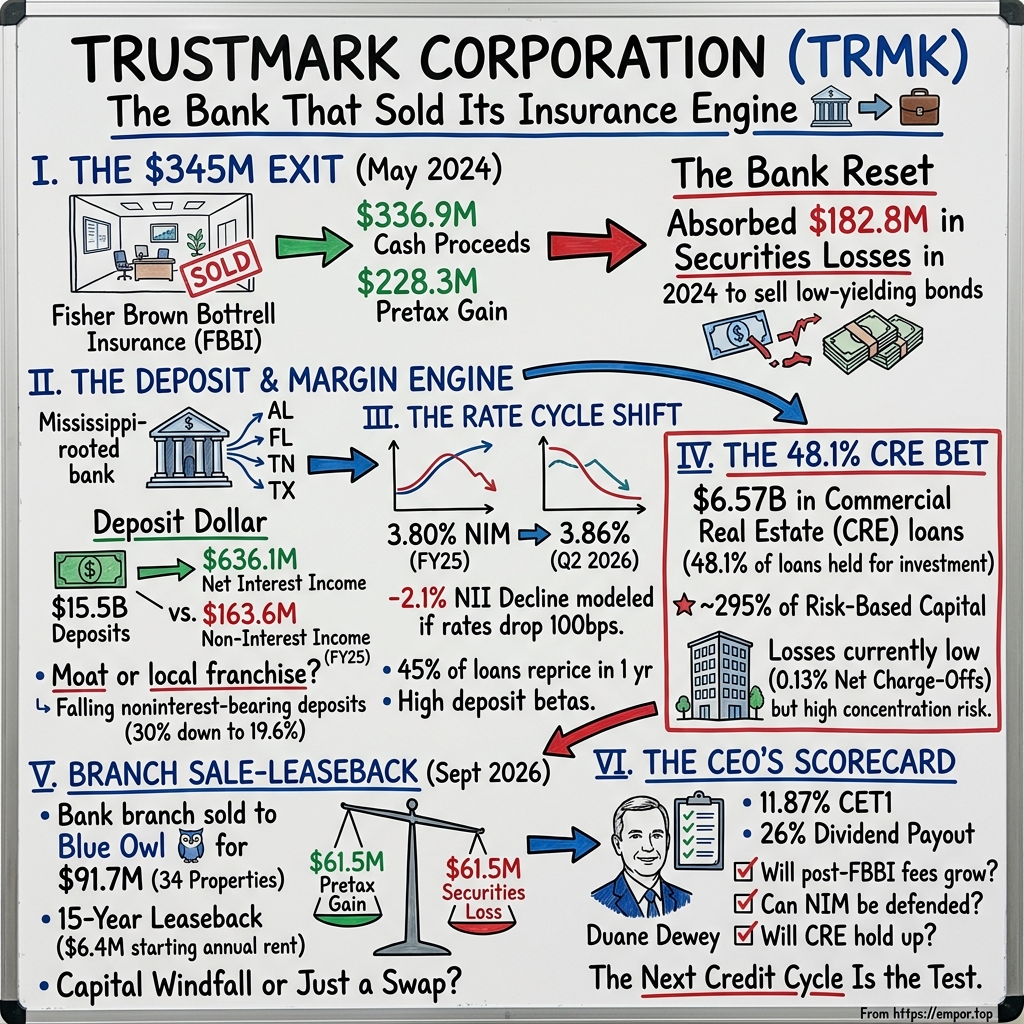
Put the two moves side by side and the shape of the trade appears. Trustmark took a business that earned fees whatever interest rates did, cashed it in near its value, and used the gain to absorb the pain of resetting a bank balance sheet that had been stuck earning yesterday's rates. It was a bet that a cleaner, higher-earning bank was worth more than a bank with an insurance agency bolted on. It was also a bet that the bank, now standing more or less alone, could carry the company's earnings through whatever the rate cycle and the property market did next.
That raises four questions, and this story is organized around them. The first is whether the bank can hold its net interest margin, the spread between what it earns on loans and bonds and what it pays depositors, once interest rates fall. The second is whether it can replace the reliable fees the insurance agency used to supply. The third is whether a loan book in which nearly half the money sits in commercial real estate can avoid the losses that have hurt so many regional lenders. The fourth is whether the buybacks and property sales that followed are building value or simply moving risk from one line of the balance sheet to another.
It helps to be precise about whose story this is. Trustmark Corporation is a bank holding company incorporated in Mississippi, and almost everything it owns sits inside Trustmark National Bank, a lender chartered in 1889.4 Marsh McLennan's scale, its brokerage strategy and its other acquisitions belong to the buyer, not here. After the sale, what remains of Trustmark is a general bank and a wealth-management business, and those two pieces are the economics a shareholder actually owns.4
There is one more piece of housekeeping, and it matters for anyone who looks at Trustmark through a stock screener. For a bank, "revenue" is not a natural number. Data services build it in different ways, some adding gross interest income, some netting interest expense, and in Trustmark's case they also have to cope with an insurance business that vanished midway through 2024 and a quarter in which a giant securities loss pushed noninterest income below zero. Screener revenue figures therefore jump around in ways that say more about bookkeeping than about the business, including a second quarter of 2024 in which reported revenue appears to collapse by two-thirds. The right scorecard for a bank is simpler: net interest income plus fee income, from continuing operations, as the company files them. In 2025 that came to roughly $800 million.4
The sale, then, bought Trustmark capital and a chance to earn more on its balance sheet. It also removed a source of income that did not depend on lending. Whether the trade worked comes down to a single question: how much the bank alone can earn once the one-time gains and losses have washed through. To answer it, start where every bank starts, with a deposit walking in the door.
 Subscribe on LinkedIn
II. The Deposit Dollar That Has to Earn Twice
Picture a dollar arriving at a Trustmark branch in Jackson, Mississippi. Maybe it is a paycheck, maybe a payment to a small contractor, maybe a municipal tax receipt. The customer expects it back whenever they want it. The bank's job is to keep enough of that dollar on hand to honor that promise, and to lend or invest the rest at a yield comfortably above whatever it pays the depositor. The dollar has to earn twice: once as a source of cheap, stable funding, and again as a loan or bond earning a spread.
Everything Trustmark does is a variation on that loop. Interest earned on loans and securities, less interest paid on deposits and borrowings, produces net interest income. Around that core, the bank sells services: account fees, debit and credit card interchange, mortgage origination and servicing, and wealth management for families and institutions that want their money invested or held in trust. Those services produce noninterest income, the fee line.
In 2025 the core was overwhelming. Trustmark earned $636.1 million of net interest income on a reported basis and $163.6 million of noninterest income.4 Adjusted for tax-exempt municipal bonds, net interest income was about 81% of total revenue, and fees made up the remaining fifth.4 The fee pool came from four roughly equal streams: deposit service charges of about $44 million, card fees and wealth-management fees of around $33 million and $40 million, and net mortgage banking of about $33 million.4 Wealth fees are largely priced as a sliver of the assets under management, which means they rise and fall with markets as well as with client wins. Mortgage banking depends on gain-on-sale margins and on how the value of the servicing rights the bank keeps moves with rates. None of the four is large enough to steady earnings by itself.
The funding side of the loop is where a bank's franchise lives. At the end of 2025 Trustmark held about $15.5 billion of deposits.4 About 35% of them were above the federal insurance limit, a share that barely moved from a year earlier, which is not alarming for a commercial bank with business and public-sector customers but is a reminder that a third of the deposit base belongs to customers with a reason to watch the bank closely.4 Behind the deposits sat about $1.96 billion of unused borrowing capacity at the Federal Home Loan Bank of Dallas and another $1.51 billion at the Federal Reserve discount window, the backup lines that matter if depositors ever move faster than expected.4
A local franchise, not yet a proven moat
Trustmark is a mid-sized regional lender with about $19 billion of assets and a footprint rooted in Mississippi that reaches into Alabama, Florida, Tennessee and Texas.45 Fitch Ratings described its deposit franchise in Mississippi as entrenched and placed it third in the state by deposit share.6 Its natural competitors are other Southeastern regionals of similar or larger size, among them Hancock Whitney, Renasant, Cadence Bank and Simmons First National, all of which chase the same small businesses, developers and households along the Gulf South and mid-South.
The tempting conclusion is that a 130-plus-year-old bank with a top-three share in its home state owns a moat. The evidence supports a narrower claim. Depositors can and do move money, especially when a money-market fund or an online bank pays visibly more. Commercial borrowers routinely shop their loans among several banks. National lenders and digital banks have widened that choice every year. Trustmark's branches, relationship bankers and long local history plausibly help it keep customers who value advice and convenience over the last basis point of yield. But the company does not publish customer retention rates, deposit acquisition costs or pricing data that would let an outsider measure how much of that advantage exists. The fair verdict is a local franchise with real roots and unproven pricing power.
One number tests the franchise better than any adjective. Noninterest-bearing deposits, the checking balances that cost the bank nothing in interest, were more than 30% of Trustmark's deposits in 2021.4 By the end of 2025 they had fallen to about $3.04 billion, or 19.6%.4 Some of that drift was inevitable: when rates jumped from near zero, every treasurer in the Southeast moved idle cash into accounts that paid something. But the result is a structurally more expensive funding base. A bank whose depositors are willing to sit in free checking accounts has a cushion; a bank whose depositors expect to be paid has a cost that moves with the market. Trustmark has less of that cushion than it did five years ago, and it is not alone; the whole regional-bank industry went through the same shift. Its local relationships did not prevent the migration. They may only have slowed it.
The asset side has its own sensitivity. About 45% of Trustmark's loans held for investment carry floating or adjustable rates, tied to benchmarks such as SOFR or the prime rate, and reprice within a year.4 The remaining 55% are mostly fixed-rate commercial real estate and residential mortgages that reprice over three to fifteen years.4 When rates rose, that floating half lifted loan yields quickly. The same mechanism, run in reverse, is the threat the bank faces now.
So the deposit dollar carries the whole story. Its cost has risen because fewer customers leave it idle, and the yield it earns depends on loans that reprice with the Federal Reserve. That leaves the question of what the last rate cycle did to Trustmark's earnings, and what the next one might undo.
III. The Rate Cycle Rewrote the Earnings Story
In 2022, Trustmark's earnings fell off a cliff. Net income dropped to about $71 million, less than half the prior year's level.4 The Federal Reserve was raising rates at the fastest pace in four decades, and Trustmark, like most banks, was caught with a large portfolio of bonds bought at pandemic-era yields and a pile of deposits that had flooded in during 2020 and 2021. Accumulated other comprehensive loss, the running total of unrealized losses on those bonds, reached about $380 million at the end of 2022.4 That number does not hit the income statement directly, but it sits on the balance sheet as a quiet warning: if the bank ever had to sell those bonds, it would crystallize the loss.
Then the picture turned. Net income recovered to about $165 million in 2023 and reached about $224 million in 2025.4 Net interest margin, the spread measured against all earning assets, widened to 3.80% for 2025 and stood at 3.86% in the second quarter of 2026.47 Diluted earnings per share over the twelve months to June 2026 reached about $3.95, compared with $1.18 in 2022.7
A rebound that steep invites a mistake: reading the three-year growth rate as if it were the company's natural speed. It is not. Measured from the 2022 trough, net income compounded at about 47% a year. Measured over ten years, from about $116 million in 2015 to $224 million in 2025, it compounded at about 6.8% a year.4 That slower number is the more honest baseline. It covers a full decade of the long tenure of Gerard Host, chief executive from 2011 through 2020, which was marked by modest asset growth and conservative lending, and the first five years under his successor. The recent surge is that baseline plus a very favorable rate cycle, not a new engine.
What changed inside the bank was mostly repricing. The floating half of the loan book moved up with benchmark rates. Maturing low-yield securities rolled off and, in the 2024 reset, were sold and replaced at higher yields. Management also added protection for the downside: interest-rate swaps and floor spreads that lock in a minimum yield on part of the floating loan book. By the end of 2025 the notional value of those hedges reached about $1.63 billion, up from $1.5 billion a year earlier.4 A floor spread works like insurance on a variable-rate loan: if benchmark rates fall below a set level, the hedge pays the bank the difference, up to a cap.
The model says rate cuts still hurt
Here is the counterweight to the bullish margin story, and it comes from Trustmark's own risk disclosures. At the end of 2025, the bank's simulation estimated that an immediate, parallel 100-basis-point rate cut would reduce annual net interest income by about 2.1%, and a 200-point cut by about 4.8%.4 On a base of roughly $640 million, the 100-point case equals about $13 million a year. A 100-point rise, by contrast, would add about 1.5%.4 In plain terms, even after its hedges, Trustmark remained mildly asset-sensitive: its earnings still do better when rates go up and worse when they come down. Those figures assume a static balance sheet and an instantaneous shock, which real life rarely delivers, but they are the bank's own best estimate and they point the same way as the repricing math.
The funding side is the counterargument. Interest-bearing deposits of about $12.5 billion include large blocks of time deposits and public funds whose rates moved quickly as the Fed hiked.4 Those same customers will see their rates cut quickly as the Fed eases, which lets interest expense fall alongside loan yields. If deposit costs fall as fast as asset yields, the margin can hold. The catch is the shrinkage of noninterest-bearing deposits. Free money cannot get any cheaper, so a bank with less of it has less room to soften the blow when loan yields fall.
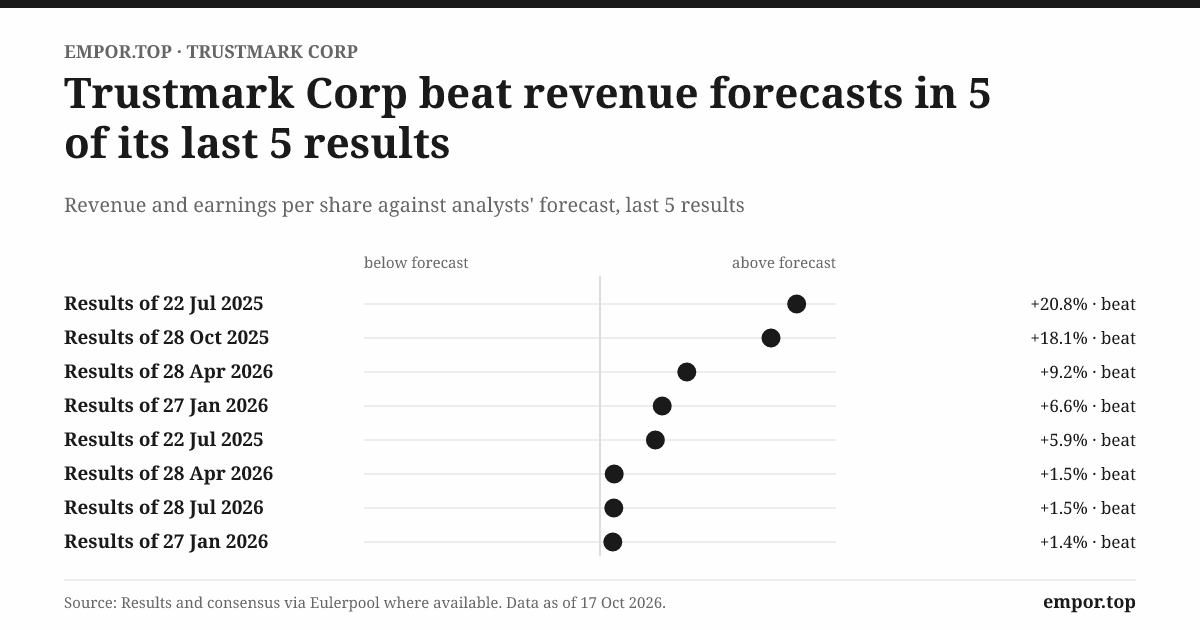
The earnings calls are where investors can test whether management's account of all this holds together. Analysts covering Trustmark have repeatedly pressed on margin durability, deposit pricing and loan demand on recent calls, including the second-quarter 2026 call in late July.89 The useful exercise is not to collect optimistic quotes. It is to set the margin outlook management offers each quarter beside the margin it then reports, and to check whether its explanation for any shortfall is specific: which deposits repriced, which hedges rolled, which loans paid off. The filed record so far is a margin that kept rising into mid-2026, which is consistent with management's description of a balance sheet positioned for the cycle; the sensitivity table is a standing reminder that the direction of the next move is unfavorable.
One more distortion deserves a flag. Trustmark's 2024 tax line shows a negative effective rate, because a large loss in continuing operations generated a tax benefit while the taxable gain on the insurance sale sat in discontinued operations.2 Headline 2024 net income of about $223 million therefore mixes a year of insurance earnings, the sale gain, and the securities loss; it is nearly meaningless as a guide to ordinary earnings. Continuing operations alone tell the real story, and they show a bank that took a heavy one-time hit in 2024 and earned normally on either side of it.
The recovery is real. So is the rate sensitivity. Which brings the story back to the trade that made the recovery possible: what, exactly, did Trustmark give up when it sold its insurance agency, and what did it get in return?
IV. The Insurance Sale Bought a Bank Reset
For most of its life inside Trustmark, Fisher Brown Bottrell was the kind of business bankers envy. Insurance commissions do not depend on the shape of the yield curve. A company renews its property coverage and employee-benefits plans every year whether rates are at zero or at five percent, and the agency takes a commission each time. Revenue grows with premiums, which tend to rise with inflation. In a bank holding company whose main engine sways with interest rates, an agency like that is ballast.
It was also, by 2024, a business worth more to someone else. Insurance brokerage had become one of the hottest corners of private-market dealmaking, with large brokers and private-equity-backed roll-ups bidding for regional agencies. A buyer such as Marsh McLennan Agency could spread an acquired agency's revenue across a national platform of specialists and carriers. A bank in Jackson, Mississippi could not.
The price reflected that. Trustmark said the $345 million transaction value equaled about 5.9 times the agency's 2023 revenue and about 28 times its net income.1 On a simple reading, Trustmark was being offered nearly three decades of the agency's profit in cash on the day of closing. Those are striking multiples for a bank to receive. They are not, by themselves, proof of a premium to the market: the company did not publish a comparison with peer agency transactions, and brokerage valuations in that period were high across the board. The safest verdict is that Trustmark sold at a full price in a hot market, rather than at a price that beat the market.
It is also worth being exact about the three numbers that often get blurred. The $345 million was the announced deal value.1 The cash the company actually recorded, after adjustments, was $336.9 million.2 The pretax accounting gain was $228.3 million, because the agency's book value, including goodwill from its original acquisition, was subtracted from the proceeds.2 The gain is the most widely quoted figure; the cash is what Trustmark actually got to spend.
Spending the gain on the bond book
What Trustmark did with the money was the more consequential decision. In the second quarter of 2024 it sold about $1.6 billion of available-for-sale securities with low yields, realizing a $182.8 million pretax loss, and bought about $1.4 billion of new securities yielding 4.85% on average.3 The logic is simple once the analogy is clear. Imagine owning a bond that pays 1.5% when new bonds pay nearly 5%. The old bond is worth less than you paid, but that loss exists whether or not you sell; holding it simply means earning the low coupon for years until it matures. Selling recognizes the loss today and lets the bank earn the higher yield on most of the money from tomorrow. The insurance gain gave Trustmark the capital cushion to absorb that recognition without denting its regulatory ratios.
The bill landed in 2024's continuing operations. Pre-provision net revenue from continuing operations, the bank's earnings before credit costs and taxes, fell to about $75 million that year, crushed by the securities loss; noninterest income was actually negative, at about minus $23 million.2 In 2025, with the loss behind it and the higher-yielding bonds in place, pre-provision net revenue rebounded to about $288 million.4 The accumulated loss on the remaining securities shrank from about $84 million at the end of 2024 to roughly $14 million at the end of 2025.4 Trustmark had effectively cleared the bond overhang that, in 2023, had turned unrealized losses at some regional banks into crises.
That is a genuinely clean outcome on the balance sheet. It is a less clean outcome on diversification. With the agency gone, noninterest income slipped to about a fifth of revenue, and Fitch explicitly cited the loss of revenue diversification as one of the factors holding back Trustmark's credit rating.64 The agency had produced well over $150 million a year of revenue before the sale.1 The remaining fee lines have grown: wealth management rose about 8% in 2025 to around $40 million, and net mortgage banking climbed about a quarter to roughly $33 million.4 Together, those two businesses produced about $73 million in 2025. They are healthy, but they are less than half the size of what the agency brought in, and mortgage banking in particular swings with housing activity and rates in a way insurance commissions never did.
Trustmark's earlier acquisition record helps calibrate how this decision fits the company's habits. Its last notable bank deal, the 2017 purchase of Reliance Bank in Huntsville, Alabama, added seven offices for about $24.8 million of consideration.10 That was a modest tuck-in beside a balance sheet that now runs to nearly $19 billion. Trustmark is not a serial acquirer, and the agency sale was not a pivot toward deal-making. It was a one-time portfolio decision by a management team that, on the record, prefers to repair what it has.
The sale proceeds and the higher bond yields are not, by themselves, evidence of value creation. They prove that Trustmark converted one asset into another and paid a known cost to do it. The proof will come in sustained pre-provision earnings above the pre-sale run rate, in fee income that grows rather than stalls, and in returns on tangible equity that hold once the rate tailwind fades. The bank came out of the trade earning more from its spread and less from anything else. That makes the next question unavoidable: what, exactly, is that spread financing?
V. The 48% Bet on Commercial Property
Drive through any growing Southern suburb and the loan book of a bank like Trustmark rises around you: the strip center anchored by a grocery store, the medical office building beside the hospital, the self-storage units off the interstate, the new apartment complex with a leasing banner still on the fence. That is commercial real estate lending, and it is the heart of Trustmark's balance sheet.
At the end of 2025, Trustmark held about $6.57 billion of commercial real estate loans, about 48% of its $13.67 billion of loans held for investment.4 That total breaks into three pieces. The largest is nonfarm, nonresidential property, such as offices, retail, industrial and owner-occupied business premises, at about $3.3 billion. Next is other commercial real estate, mostly multifamily and investor-owned property, at about $2.1 billion. The smallest is construction and land development, at about $1.1 billion.4
Regulators look at that exposure against capital rather than against loans. Trustmark's commercial real estate book equaled about 295% of its total risk-based capital.4 Interagency supervisory guidance treats 300% as a level at which examiners expect heightened risk management, along with rapid growth in the category. It is not a legal ceiling, and crossing it does not mean a bank is in trouble; it means the bank should expect more questions and must show stronger controls, stress tests and concentration limits. Trustmark sits just beneath that marker. Construction lending, the riskiest slice because the collateral is not finished and producing income, was about 51% of capital, well under the separate 100% supervisory threshold.4
A Mississippi problem that came and went, for now
The credit record so far is good, but not untroubled. Nonaccrual loans, loans on which the bank has stopped recognizing interest because repayment is in doubt, rose to $84.4 million at the end of 2025, about 0.64% of loans, and $73 million of that sat in Mississippi.4 By June 2026 the total had fallen to $49.7 million, or 0.36% of loans, as problem commercial credits in Mississippi were resolved; the Mississippi figure dropped to about $31 million.7 Net charge-offs, the losses the bank actually wrote off, were about 0.13% of average loans in 2025 and about 0.10% annualized in the first half of 2026.47 For a regional bank with heavy property exposure, losses of a little over a tenth of a percent a year are low.
There is a reasonable reading of that sequence and a more skeptical one. The reasonable reading is that underwriting worked: a cluster of problem loans surfaced, the bank worked them out, and the losses were small. The skeptical reading is that commercial real estate problems typically arrive in waves, as leases expire and loans come up for refinancing at higher rates, and a single resolved cluster does not prove the next wave will be as benign. Both readings fit the facts. What history clearly supports is the narrower claim that Trustmark's credit losses have been contained through the rate shock so far; it does not yet support a claim that its concentration has been tested by a property downturn.
The reserve tells the same story with the same limits. Trustmark's allowance for credit losses on loans held for investment was about $148 million at June 2026, about 1.07% of loans, and it covered nonaccrual loans almost three times over.7 That coverage ratio rose sharply because the nonaccrual pile shrank, not because the reserve grew; the allowance actually fell from about $157 million at year-end.74 Coverage of nearly 300% sounds like a fortress. It is really a ratio between a forecast and today's problem loans. If collateral values fall or borrowers' rent rolls weaken, tomorrow's problem loans can be larger than today's, and the reserve is only as good as the forecast behind it.
That forecast is exactly where the auditor looked hardest. Crowe LLP, Trustmark's auditor since 2015, issued a clean opinion on the 2025 statements, and its single critical audit matter was the allowance: specifically, the reasonable and supportable economic forecasts and the loss-driver analysis used to estimate expected credit losses under the CECL accounting standard.4 A critical audit matter is not a warning sign. It is the auditor flagging the place in the accounts where management's judgment does the most work, and for Trustmark that place is the property book.
Fitch's view sits neatly on the same seam. It affirmed Trustmark's issuer rating at BBB with a stable outlook, citing the deposit franchise, low charge-offs and solid capital as strengths, and naming commercial real estate concentration and limited geographic diversification as constraints.6 A rating agency is effectively saying the same thing: the record is good, and the exposure is large.
The evidence that will settle this is not a management statement that credit quality remains strong. It is the loan table in the next annual filing: criticized and classified loans, delinquencies broken down by property type, any modifications for borrowers in difficulty, and charge-offs through a full year. Contained losses on a large concentration buy a bank the right to keep making the same bet. They also make the next question pointed, because Trustmark has recently been selling real estate of its own.
VI. The Branch Sale That Came With a Matching Loss
On September 3, 2026, Trustmark signed away the ground under 34 of its own branches. The buyer was Blue Owl Real Estate Capital, part of the alternative-asset manager that has made a business of buying operating properties from companies and leasing them straight back.11 Trustmark sold the properties for $91.7 million, agreed to rent them back under triple-net leases, meaning the bank still pays the taxes, insurance and maintenance, for an initial term of 15 years, and committed to an initial annual rent of about $6.4 million rising 1.5% a year.11 The branches stay open. Customers walking in will notice nothing.
On paper, the sale produced a pretax gain of about $61.5 million, the difference between what Blue Owl paid and what the old buildings were carried at after years of depreciation.11 Read alone, that looks like a windfall. It was not read alone, because Trustmark did the same thing it had done in 2024. Alongside the property sale, it sold about $630 million of low-yielding securities, realized a pretax loss of about $61.5 million, and bought about $628 million of securities yielding roughly 5%.11 The gain and the loss were sized to cancel each other.
That symmetry is the point. Management used the property gain to pay for another round of bond repositioning without a hit to earnings or capital. It is a tidy piece of financial engineering, and it is also why the property gain should not be described as a capital or earnings windfall. Net, the transaction converted owned buildings and underwater bonds into higher-yielding bonds and a long-term lease obligation.
Does the trade pay its rent?
The economic test is arithmetic, and the inputs are known. On the asset side, Trustmark now earns about 5% on roughly $628 million of securities instead of whatever lower yield the old bonds paid; the filing does not state the old yield, so the exact pickup is not disclosed. If the old bonds yielded, say, around 2%, the gain would be on the order of $18 to $19 million a year before tax, comfortably above the starting rent. On the cost side, the bank now pays about $6.4 million a year in rent, compounding at 1.5% a year, so that by the fifteenth year the annual rent will be around $7.9 million. It also gave up the option value of owning the land and buildings, and any appreciation on them.
The higher bond income is front-loaded and depends on rates; the rent is contractual and rises every year. If rates fall and the new securities pay down or are eventually replaced at lower yields, the trade becomes less attractive over time, while the lease marches on. Over fifteen years the cumulative rent will exceed $100 million, larger than the sale price. That is not an argument that the deal was a mistake; companies sell and lease back property precisely because a bank earns more deploying capital in its core business than in owning buildings. It is an argument that the true return will appear only in later reports, as higher interest income on one line and higher occupancy expense on another.
The sale-leaseback also lives inside a broader capital story. Trustmark's dividends were about $58.5 million in 2025, roughly 26% of net income, near the lowest payout in more than a decade.4 Its share repurchases were larger: about 2.2 million shares for $80 million in 2025, roughly 3.5% of the share count, under a program approved after the insurance sale closed.4 The board then authorized a fresh $100 million program for 2026, and by June the share count had dropped to about 58.2 million.7 In total, dividends and buybacks returned about 62% of 2025 earnings to shareholders.
The money for those payouts travels upstream. The holding company has no business of its own; its cash comes from dividends paid by Trustmark National Bank. In 2025 the bank sent up about $155 million, almost double the 2024 amount, to service holding-company debt and fund the buybacks.4 The holding company also refinanced its Tier 2 capital, issuing $175 million of 6% subordinated notes due 2035 to redeem $125 million of 3.625% notes.4 That refinancing added regulatory capital, but at a markedly higher coupon, a small reminder that Trustmark's cost of capital has risen along with everyone else's.
The skeptical investor's test for buybacks is the price paid, not the share count. Trustmark bought stock at prices around 1.2 times book value and roughly 1.5 times tangible book. At that price, buybacks create value only if the bank earns a return on tangible equity well above its cost of equity for years to come; otherwise they simply shrink a company that could have grown. Common equity tier 1 capital, the regulator's core cushion, rose to about 11.9% of risk-weighted assets by June 2026, comfortably above requirements, so the payouts have not weakened the bank's safety margin.7 But a high capital ratio combined with modest loan growth also signals something less flattering: the bank is generating more capital than it can deploy in profitable lending.
The pattern across 2024 and 2026 is now clear. Twice, Trustmark has paired a one-time gain with a matching securities loss to reset its bond book. Both moves were defensible; both made reported earnings cleaner afterward. Neither is a repeatable source of earnings. Which puts the spotlight on the people making these choices, and on how they are paid for them.
VII. The CEO's Scorecard Is the Next Credit Cycle
Duane Dewey did not arrive at the top of Trustmark as an outsider with a turnaround plan. He became president and chief executive on January 1, 2021, after a long career inside the company, succeeding Gerard Host, who had led the bank for a decade.412 That continuity is part of Trustmark's character. It is a bank that promotes from within and changes slowly, and its leadership has the habits that implies: cautious underwriting, steady dividends, and a preference for balance-sheet repair over bold expansion.
Dewey's tenure has nonetheless been eventful. He inherited a balance sheet swollen with pandemic deposits, watched the 2022 rate shock cut earnings in half, sold the insurance agency, reset the bond portfolio twice, and stepped up capital returns. The outcomes are easy to read selectively. On the positive side, the bank never needed to raise equity, credit losses stayed low, capital rose, and the accumulated securities loss that hung over the balance sheet in 2022 is almost gone. On the more cautious side, the strongest years of his tenure coincided with the highest interest rates in a generation, and much of the improvement in reported earnings came from a rate tailwind and from one-time transactions. Measured against the decade-long earnings base rather than against the 2022 trough, his record is solid but not yet exceptional.
Pay design reveals what the board is rewarding. Half of Trustmark's long-term executive awards are performance share units that vest according to three-year return on average tangible equity and total shareholder return relative to peers; the other half are restricted stock that vests over time.12 In 2025 Dewey's total compensation was about $3.64 million, up from about $3.24 million in 2024, and it included about $1.51 million of annual incentive pay.12 The return-on-tangible-equity metric has the virtue of measuring profitability on the capital shareholders actually own. Its weakness is that it rewards the very rate cycle that lifted the whole industry, and it can be flattered by buybacks that shrink the equity base. A skeptic would want to see how the board treated the 2024 securities loss and the paired 2026 transactions in calculating incentive results; the proxy's metrics are disclosed, but the question of whether one-time items were adjusted out deserves close reading each year.
Ownership and governance send moderate signals. Directors and executive officers together owned about 1.7% of the shares, and Dewey held about 138,000 shares.12 The largest holders are index and institutional managers: BlackRock with about 15%, Vanguard with about 11%, and Dimensional, Wellington and State Street with roughly 5% to 7% each.12 Ten of eleven directors are independent, with Dewey the only executive on the board.12 At the April 2026 annual meeting, about 98.9% of votes cast backed the say-on-pay proposal.13 Those are healthy signals, but they are signals, not proof. Index funds tend to vote with management absent a crisis, and near-unanimous approval tells you shareholders are not unhappy, not that they have tested the strategy.
The related-party items are small, and they deserve a precise size rather than a shrug. Trustmark paid $400,000 in 2025 for naming rights to Trustmark Park, the minor-league ballpark in Pearl, Mississippi, to an entity about 90% owned indirectly by director William Yates III and his family; Yates's own economic interest was estimated at about $119,000.12 Trustmark also signed a modest $30,000 marketing agreement with another Yates-linked entity.12 In the other direction, Yates-affiliated construction businesses paid the bank about $348,000 for trust and retirement-plan administration and about $123,000 in brokerage commissions.12 Against roughly $800 million of continuing revenue, the flows in each direction round to nothing, and they run both ways. They are worth knowing about because naming rights are a discretionary marketing spend tied to a director; they are not a governance problem at this scale.
The executive bench is changing. In 2026 Trustmark reorganized its chief financial officer and chief operating officer roles, a transition that matters because the CFO is the voice that explains margin, hedging and capital decisions to investors.7 New titles are not a new strategy. The test for the incoming team will be whether its explanations on future calls match the trajectory it described earlier, and whether it explains misses specifically rather than in generalities.
Legal matters are modest but not invisible. In 2021 Trustmark settled a redlining investigation by the Department of Justice and the Consumer Financial Protection Bureau over its lending in majority-Black and Hispanic neighborhoods of the Memphis area, committing to a loan subsidy fund, new branches and outreach.4 Those remedial commitments run through 2026, so their completion is a near-term governance milestone. Separately, the 2025 annual report states that no pending ordinary-course claims are expected to produce a probable and estimable material loss.4
Management has earned credibility on balance-sheet repair and on credit so far. It has not yet shown it can grow fees after the insurance sale or protect earnings in a falling-rate environment, and those are precisely the tasks the next cycle will set. The question for investors, then, is what the market is already assuming about how that test will go.
VIII. Analysis & Bear vs. Bull Case
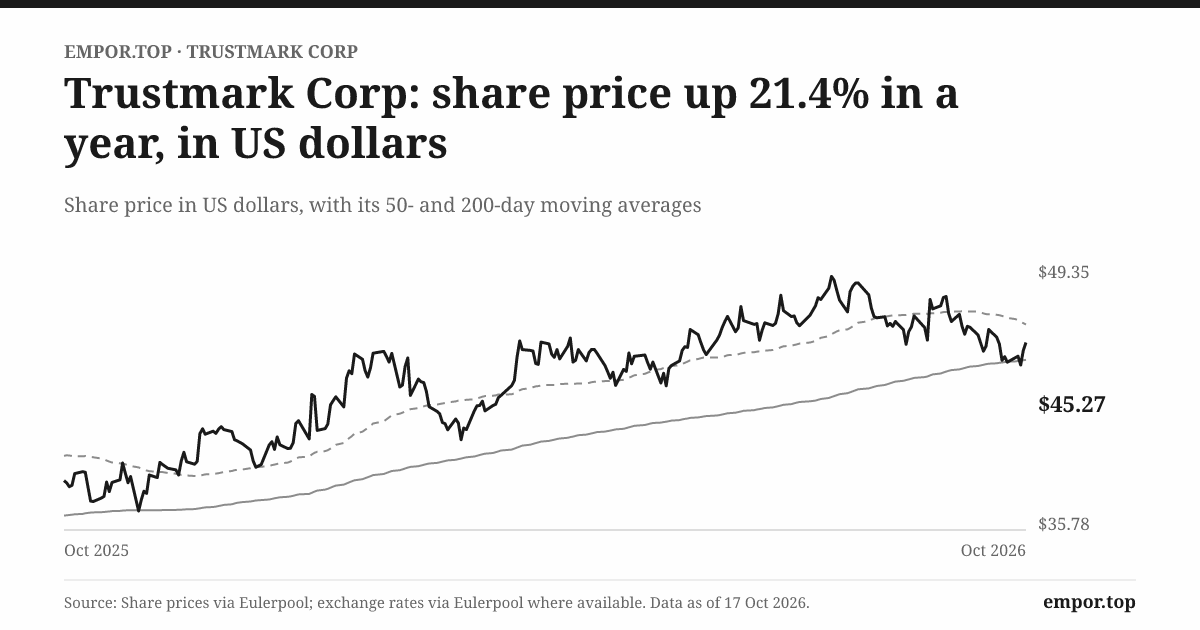
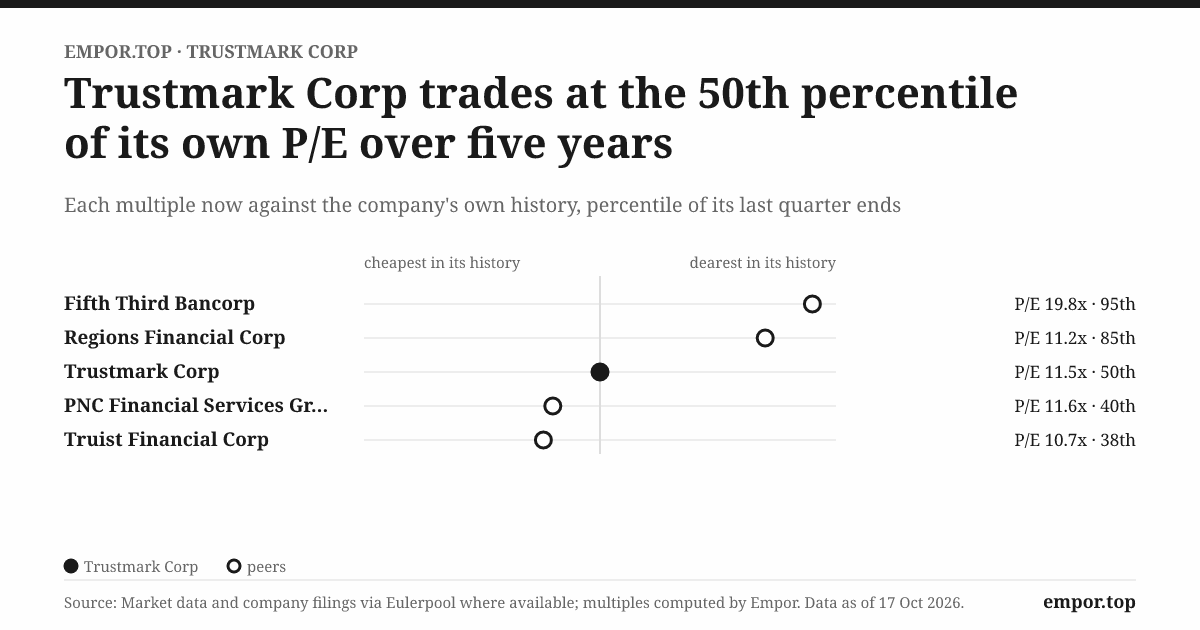
On October 17, 2026, Trustmark's shares closed at about $45.27, giving the company a market value of about $2.7 billion.7 That price is about 11.5 times trailing earnings, almost exactly the bank's own five-year median of 11.4 times. It is about 1.2 times book value and roughly 1.5 times tangible book value of around $30 a share at the end of 2025, with a dividend yield of about 2.2%.4 The Southeastern regional peers, Hancock Whitney, Renasant, Cadence and Simmons, trade in broadly similar ranges. The market, in other words, is not paying Trustmark a premium for its reset, and it is not marking it down for its risks. It is pricing the bank as normal.
Normal is itself an assumption. A price near the historical median implies that today's earnings, which benefited from the highest rates in a generation and a cleaned-up bond book, are roughly sustainable. That is the crux of the debate.
Two ways the story ends
The bull case runs like this. Trustmark has a deep local deposit franchise, a margin that kept widening into mid-2026, credit losses that stayed low through a rate shock, and capital well above requirements. The 2024 and 2026 bond resets locked in higher yields that will keep paying for years, and the hedges protect part of the floating loan book against rate cuts. If deposit costs fall as fast as asset yields, the margin can hold near today's level, and with buybacks shrinking the share count, earnings per share can keep growing even if total earnings plateau. In that world, a bank priced at a normal multiple compounds tangible book value and returns capital steadily.
The bear case needs nothing exotic. It needs the familiar regional-bank squeeze. Rates fall, floating loans reprice down, and deposit competition from money-market funds and online banks keeps funding costs sticky because fewer customers hold free checking balances than in 2021. At the same time, the commercial real estate book, nearly half of loans and about three times capital, suffers a refinancing wave as fixed-rate loans mature into higher rates, and charge-offs climb from a tenth of a percent toward the levels typical of a normal credit cycle. With the insurance agency gone, there is less fee income to cushion either blow. Earnings then fall, and a stock at a normal multiple of peak-cycle earnings turns out to have been expensive.
Michael Porter's competitive forces frame why the bear case cannot be dismissed. Buyer power is meaningful on both sides of the balance sheet: depositors can move money with a phone tap, and commercial borrowers routinely solicit bids from several banks. Rivalry is intense, with national banks, larger Southeastern regionals and community banks all competing for the same customers. The threat of substitutes keeps rising, as private-credit funds finance commercial property and fintech platforms gather deposits. The threat of new bank entrants is limited by regulation, which genuinely helps incumbents. Supplier power, in banking terms the cost of funding, has risen since 2021, as the shrinking share of free deposits shows.
Hamilton Helmer's seven powers sharpen the moat question. Trustmark does not have network effects, and its scale is modest beside super-regional and national banks, so scale economies offer no edge. It has no counter-positioning, no cornered resource and no proprietary process that rivals cannot replicate. Its most plausible power is a form of switching costs: businesses that run payroll, treasury management and lending through one relationship banker find it tedious to move. The second plausible power is a local brand built over more than a century. But the company publishes no retention, pricing or cost-of-acquisition data that would show those powers at work, and the decline in noninterest-bearing deposits is direct evidence that switching costs did not stop customers from moving idle cash when rates rose. The honest conclusion is that Trustmark has a franchise, but the record narrows any moat claim to a modest one, largely a function of relationship convenience rather than pricing power.
On valuation tools, the bank-appropriate measures are price to earnings, price to book and, above all, price to tangible book set against sustainable return on tangible equity. Screener metrics such as enterprise value to EBITDA are meaningless for a deposit-taking bank, because they treat customer deposits and wholesale borrowings inconsistently; Trustmark's apparent EV/EBITDA of about 2.5 times says nothing about its value. The same caution applies to the screener's return-on-invested-capital figures, which swing wildly from year to year for the same reason.
Three measures will tell investors which story is coming true. The first is net interest margin together with deposit mix, which last read 3.86% in the second quarter of 2026 with noninterest-bearing deposits near a fifth of the total.7 The second is credit in the property book: criticized and classified commercial real estate loans and net charge-offs, the latter last running at about 0.10% annualized.7 The third is fee growth alongside the efficiency ratio, which shows whether the bank can expand income beyond its spread without letting costs, now including the new rent, run ahead.
The thresholds to watch are simple. A margin sustained above roughly 3.75% with contained credit costs would support the recovery thesis. A margin falling below roughly 3.60%, or charge-offs climbing above about 0.40%, would challenge it. Those are markers for monitoring, not company guidance. And they lead naturally to the lessons this particular bank teaches.
IX. Business & Investing Lessons
Trustmark's story is unusual mainly because it made capital allocation visible. Most years, a regional bank's decisions disappear into a smooth line of quarterly earnings. In 2024, the insurance sale and the bond loss landed in the same year, and in 2026 the branch sale and a second bond loss landed in the same week. Those moments let an investor see the choices the bank made, and four lessons follow from them.
The first lesson: a sale price is not a strategy; the reinvestment return is. When Trustmark sold Fisher Brown Bottrell for about 28 times its earnings, the headline sounded like a triumph, and the cash proceeds of $336.9 million were real.2 But the price only measured what the buyer thought the agency was worth. What Trustmark's shareholders will actually get depends on what the bank earns on the proceeds, and that return is being paid out in bond yields, buybacks and a thinner fee base over years. Founders and boards who sell a division should judge the deal by what replaces it, not by the multiple on the announcement.
The second lesson: in a bank, cash flow is a map of lending and deposits, not a clean measure of owner earnings. Trustmark's operating cash flow swung from about $348 million in 2021 to about $116 million in 2024 and back to about $244 million in 2025, for reasons that had more to do with mortgage loans held for sale and deposit flows than with profitability.4 Investors who apply industrial-company tools to a bank misread it. Pre-provision net revenue, the bank's earnings before credit costs and taxes, is the more honest gauge, and it showed both the 2024 collapse and the 2025 rebound clearly.
The third lesson: a reserve is a promise against a forecast. Trustmark's allowance covers its problem loans nearly three times over, a figure that sounds like armor. Yet the allowance is built on economic scenarios and loss-driver models, which is precisely why the auditor singled it out as the hardest judgment in the accounts.4 With nearly half the loan book in commercial property, the reserve is only as good as the forecasts behind it, and only the next credit cycle will show how good those were.
The fourth lesson: capital return is only as good as the price paid. Trustmark's dividend payout has fallen to about 26%, near its lowest in more than a decade, while buybacks have risen.4 Buying back stock at about 1.5 times tangible book value creates value only if the bank keeps earning strong returns on that equity. Shrinking the share count is easy; earning more on each remaining share is the hard part, and the measure of the strategy.
X. Epilogue
Tonight, Trustmark stands in an in-between moment. The September branch sale and its matching securities trade are done, but almost none of their effects have shown up in reported results. The third-quarter 2026 earnings release and call, the first to absorb part of a quarter with the new rent and the new bond yields, are due shortly after this story's date. They will be the first near-term test of the rate and credit questions that frame the bank's reset.
The rate test will play out quarter by quarter. As the Federal Reserve eases, the bank's floating loans will reprice lower, its hedges will begin to pay, and its deposit costs should fall. The scoreboard is the margin. A margin that holds around 3.75% would show the hedges and deposit repricing doing their job. A slide toward 3.60% would show that a funding base with fewer free deposits cannot keep pace with falling asset yields. Watching the deposit mix alongside it will reveal whether customers keep migrating from free checking into paid accounts.
The credit test runs on a slower clock. The property book will be measured through a full reporting cycle: criticized and classified loans, nonaccruals, delinquencies by property type and net charge-offs. Annual charge-offs below about 0.20% would support the claim that Trustmark's underwriting is a genuine edge; a move toward 0.40% would signal that the concentration has finally met a downturn.
The fee test will be decided in the 2026 annual report. Wealth management and mortgage banking together produced about $73 million in 2025.4 If they approach roughly $85 million, the post-agency bank will have shown that its fee franchise can grow on its own. If they stall, earnings will remain hostage to the spread. Alongside that, occupancy expense will show how much the new leases cost each year.
And then there is the management test. The new finance and operating leadership will be explaining all of this on calls. The most useful exercise for investors is to compare what is said each quarter with what was said before: whether assumptions are stated plainly, whether misses are explained specifically, and whether the story stays consistent from call to call. The tension that remains is simple to state and hard to resolve: Trustmark has turned a one-time sale into a cleaner bank, but it has not yet proven that the cleaner bank can earn as well when the cycle turns against it.
XI. Outro
Go back to that dollar arriving at a branch in Jackson. It is still the engine of everything Trustmark does: about 81% of the bank's revenue in 2025 came from the spread it earns on dollars like it.4 It funds the grocery-anchored strip center, the apartment complex and the medical office building, the loans that make up nearly half the book.4 It supports a relationship that a local bank has built over more than a century.
That same dollar also carries the bank's risks. Its cost depends on whether the customer leaves it idle or demands a rate, and the loans it funds depend on the health of Southern commercial property. Trustmark sold its insurance engine to make that dollar work harder. The rest of the story will show whether a bank that bet on its spread can earn its keep when rates fall and property cools, the very forces that have powered its rise.
References
-
Trustmark Announces Agreement to Sell Fisher Brown Bottrell Insurance, Inc. to Marsh & McLennan Agency LLC — Trustmark Corporation, 2024-04-23 ↩↩↩↩
-
2024 Annual Report on Form 10-K — Trustmark Corporation, 2025-02-19 ↩↩↩↩↩↩
-
Trustmark Corporation Announces Second Quarter 2024 Financial Results — Trustmark Corporation, 2024-07-23 ↩↩↩
-
2025 Annual Report on Form 10-K — Trustmark Corporation, 2026-02-23 ↩↩↩↩↩↩↩↩↩↩↩↩↩↩↩↩↩↩↩↩↩↩↩↩↩↩↩↩↩↩↩↩↩↩↩↩↩↩↩↩↩↩↩↩↩↩↩↩↩
-
Investor Relations: Corporate Overview — Trustmark Corporation ↩
-
Fitch Affirms Trustmark at 'BBB'; Outlook Stable — Fitch Ratings, 2025-04-18 ↩↩↩
-
Q2 2026 Quarterly Report on Form 10-Q — Trustmark Corporation, 2026-08-05 ↩↩↩↩↩↩↩↩↩↩↩↩
-
Q2 2026 Earnings Call Transcript — Trustmark Corporation, 2026-07-29 ↩
-
Trustmark (TRMK) Q3 2025 Earnings Call Transcript — The Motley Fool, 2025-10-29 ↩
-
2019 Annual Report on Form 10-K — Trustmark Corporation, 2020-02-28 ↩
-
Sale-Leaseback of 34 Branch Properties on Form 8-K — Trustmark Corporation, 2026-09-10 ↩↩↩↩
-
2026 Definitive Proxy Statement — Trustmark Corporation, 2026-03-16 ↩↩↩↩↩↩↩↩↩
-
2026 Annual Meeting Voting Results on Form 8-K — Trustmark Corporation, 2026-04-29 ↩
 LinkedIn
 WhatsApp
 Reddit
 Hacker News
 Email
 Kindle
 RSS Feed
 Spotify
 Apple Podcasts
 Amazon Music
 Audible
 YouTube