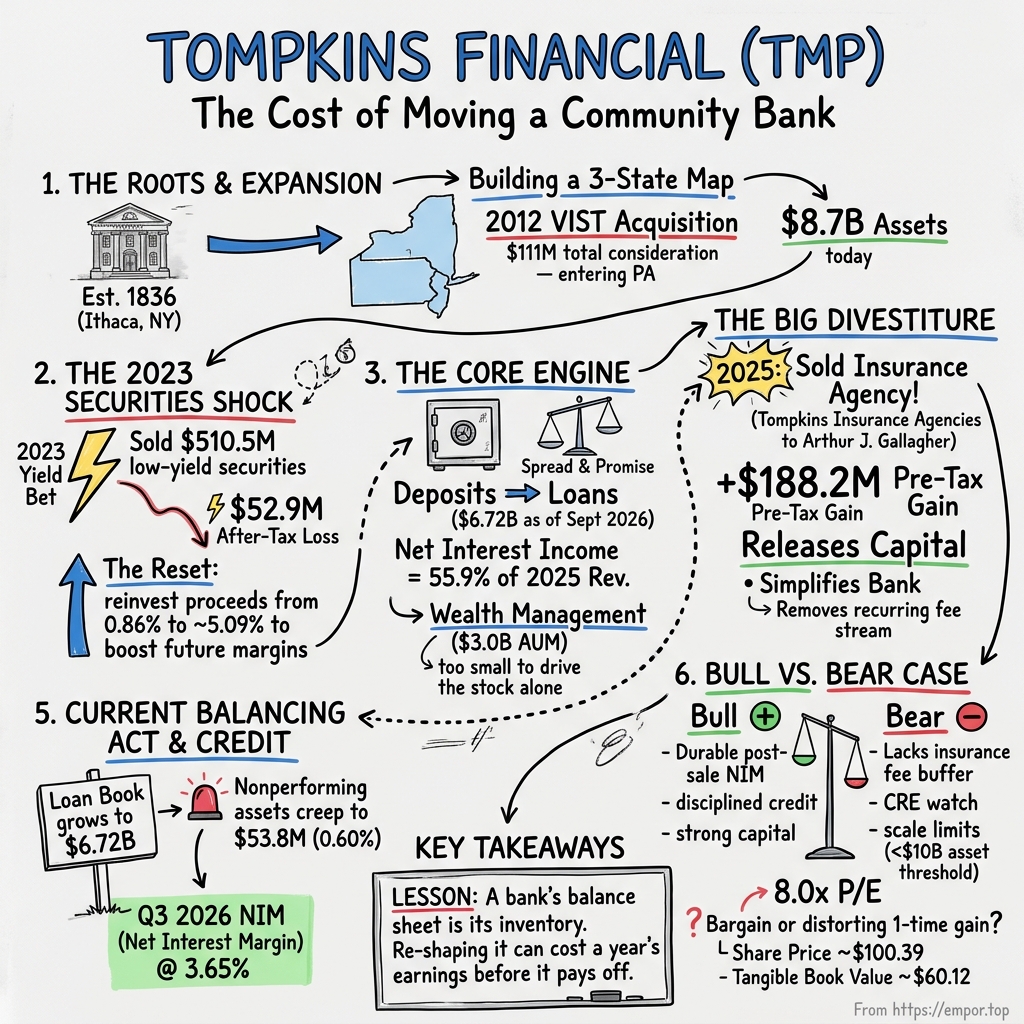
Tompkins Financial: The Cost of Moving a Community Bank
I. The $188 Million Gain That Changed the Earnings Story
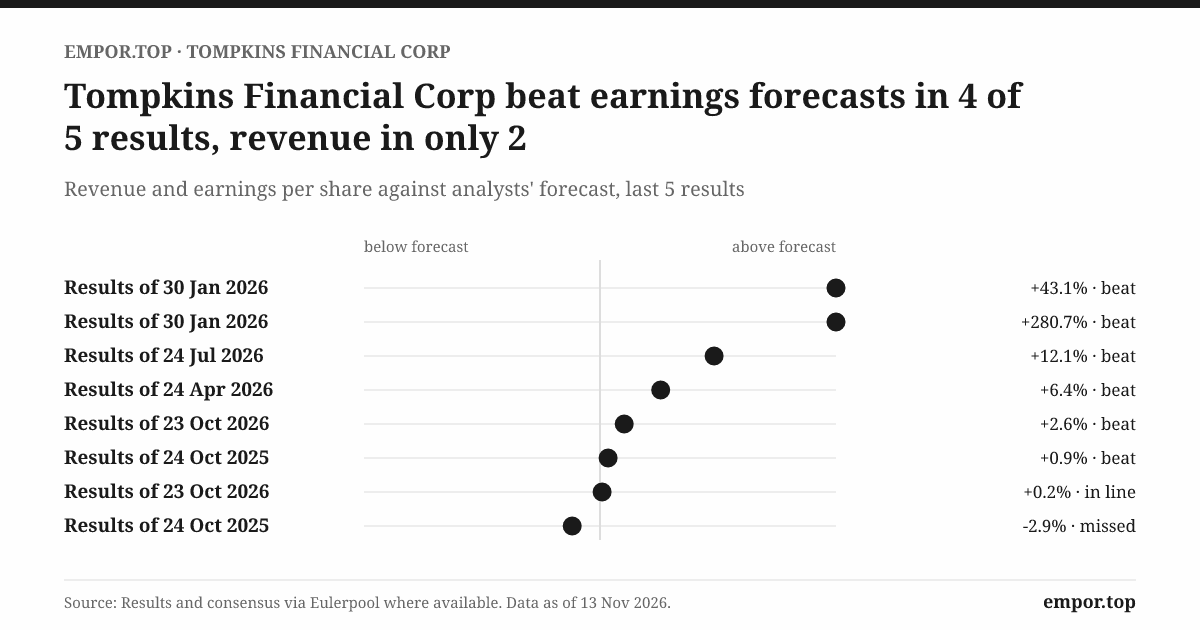
On January 30, 2026, a bank from Ithaca, New York, reported the best year in its history. Tompkins Financial Corporation said it had earned $161.1 million in 2025, more than double the $70.9 million it earned in 2024.1 In the fourth quarter alone, it earned $96.2 million, or $6.70 a share.1 For a company that usually earns somewhere between a dollar and two dollars a share in a quarter, that number looked like a misprint.
It was not a misprint. It was a sale.
Three months earlier, on October 31, 2025, Tompkins had sold Tompkins Insurance Agencies to Arthur J. Gallagher for about $223 million in cash.2 The agency had been part of the company for decades, a quiet engine of commissions that rose and fell with insurance premiums rather than interest rates. Selling it produced a pretax gain of $188.2 million.1 That one line, more than anything the bank did with a loan or a deposit, is why 2025 looks like a record.
Here is the paradox at the heart of this story. Tompkins reported its richest year at the very moment it gave up one of the businesses that had made it more than a bank. The record did not come from doing more. It came from owning less.
And the record was not even the whole picture. In the same quarter, Tompkins sold a large block of low-yielding bonds and booked a $78.7 million pretax loss on them.1 So the company took the windfall from the insurance sale and used much of it to absorb the cost of resetting its bond portfolio. Strip out both the gain and the loss, and management's own measure of adjusted net income for 2025 was $90.4 million, up 27.7% from the year before.12 That is a good year for a bank of this size. It is not a $161 million year.
Then the first post-sale results arrived, and the story got more interesting. Tompkins called its first quarter of 2026 a record.3 By the third quarter, it was earning $28.7 million a quarter, or $2.00 a share, up 21% from the same quarter a year earlier, even though the insurance commissions were gone.4 Over the first nine months of 2026, net income reached $84.0 million, up almost 30%.4 The bank, standing on its own, was earning more than the bank plus the insurance agency had earned the year before.
That is the investigation. Three questions sit underneath it, and they will follow the story to the end.
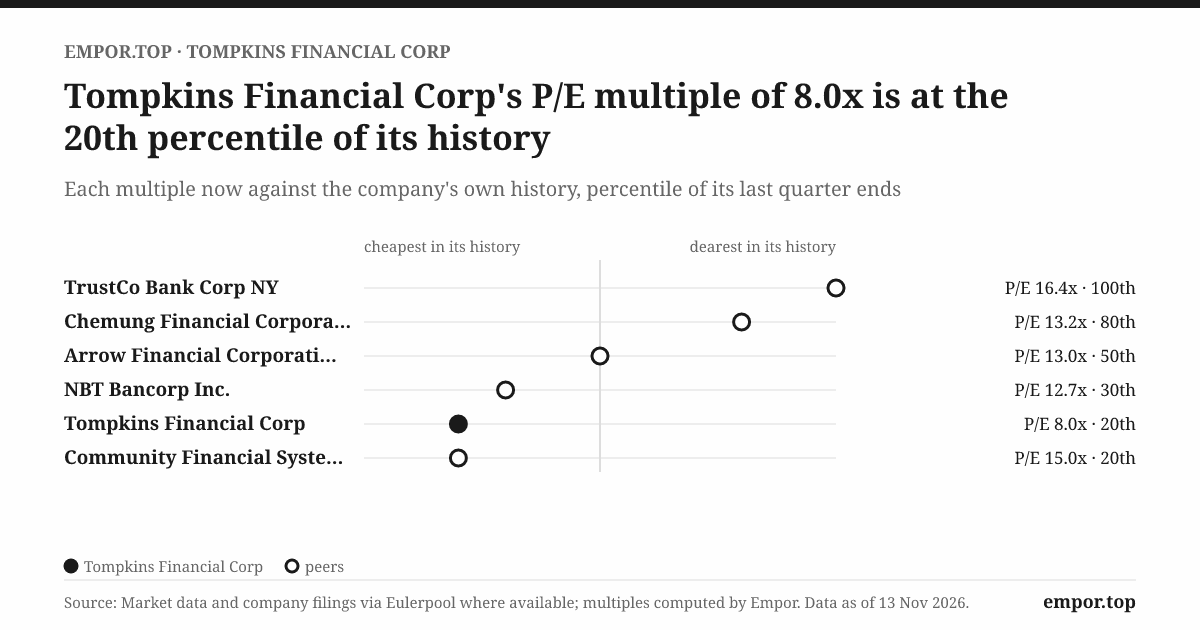
The first is about credit. Tompkins is growing its loan book at a healthy clip. Can it keep doing that without the bad loans growing faster than the good ones? The second is about the spread. A bank lives on the gap between what its loans and bonds earn and what it pays for deposits. Tompkins's gap has widened sharply. Can higher asset yields keep beating funding costs when rates move? The third is about price. Some stock screens show Tompkins trading at about eight times earnings, far below its own five-year median of about thirteen times. Is that a bargain, or a mirage created by a one-time gain sitting inside the trailing earnings?
Before answering any of them, it helps to know what Tompkins is today. It is a financial holding company with roots in Ithaca that go back to 1836.2 At the end of 2025 it had $8.7 billion in assets, 54 banking offices, 38 in New York and 16 in Pennsylvania, and 870 employees.2 By September 2026, its assets had grown to just under $9.0 billion.4 Its money is made in four regional markets: central New York around Ithaca, western New York, the Hudson Valley north of New York City, and southeastern Pennsylvania.2 Next to the bank sits a wealth-management business, Tompkins Financial Advisors, that is real but small.
Now line up three numbers. In 2023, Tompkins earned $9.5 million.5 In 2025, it earned $161.1 million.1 In the first nine months of 2026, it earned $84.0 million.4 Each figure tells a different story about the same bank. The first is a bank absorbing a self-inflicted loss on its bonds. The second is a bank cashing in a business. The third is the first clean look at what remains.
None of those three numbers, on its own, is the bank's true earning power. The job here is to find out which one is closest, and how much one year of post-sale evidence can really prove. The answer starts much earlier, with a bank that spent most of two centuries in one small college town and then decided that was not enough.
 Subscribe on LinkedIn
II. An Ithaca Bank Builds a Three-State Map
For most of its life, Tompkins was the bank of Tompkins County. The company traces its banking roots in Ithaca to 1836, when Ithaca was a small settlement at the southern tip of Cayuga Lake, decades before Cornell University turned it into a college town.26 The holding company itself is much younger. Tompkins Financial was organized in 1995 to own the Ithaca bank.6 By 2012, the county it was named for had only about 102,000 residents.6
That smallness is the origin story that still shapes the pitch. A bank that knows the dairy farmer, the college landlord and the family-owned manufacturer by name can make lending judgments that a distant credit model might not. Every community bank tells some version of that story. The question for Tompkins was how to grow without losing the thing it was selling.
The answer, starting in the late 1990s, was to buy other community banks and let them keep their local names. In 1999, Tompkins combined with Letchworth Independent Bancshares, the parent of The Bank of Castile in western New York.6 It added Mahopac National Bank in the Hudson Valley, and in May 2008 that bank expanded into Westchester County by acquiring Sleepy Hollow Bancorp.6 Alongside the banks, Tompkins assembled an insurance agency, buying smaller agencies over the years, including Olver & Associates, an Ithaca property-and-casualty agency, in June 2011.6 The model was a federation: separate bank charters with local boards and local presidents, sharing a parent's capital, technology and back office.
By 2011, Tompkins reported that the federation had reached roughly $3.4 billion in assets across New York.7 It needed a bigger move to change its scale, and it found one about 200 miles south.
On January 26, 2012, Tompkins announced that it would buy VIST Financial, a bank holding company based in Wyomissing, Pennsylvania, near Reading.7 VIST had about $1.4 billion in assets, $1.2 billion in deposits and 21 branches spread across Berks, Montgomery, Philadelphia, Chester, Delaware and Schuylkill counties.7 Stephen Romaine, the Tompkins CEO, said the deal gave the company the chance "to expand into one of the most attractive markets in the mid-Atlantic region," and the announcement noted that VIST's communities had demographics similar to Tompkins's New York markets.7
The structure revealed the philosophy. It was an all-stock deal, with each VIST share converting into 0.3127 of a Tompkins share, and it was valued at about $86 million when announced.7 VIST Bank would keep its own charter, its own board and its own chief executive, Robert D. Davis.7 Tompkins was buying a regional franchise and promising to leave its local face intact.
The price also reveals something. Tompkins said it was paying about 1.18 times VIST's tangible book value, with a core deposit premium of just 1.5%.7 In plain terms, Tompkins paid only slightly more than the net worth on VIST's books, and very little extra for the value of VIST's deposit relationships. That was not a trophy price. VIST was a bank still carrying government capital from the 2008 crisis, under the Troubled Asset Relief Program, and Tompkins was in a position to clean that up.
The deal closed on August 1, 2012.6 By then the accounting had grown. Tompkins issued 2,093,689 shares valued at $82.2 million, and it separately paid $26.5 million to buy out VIST's TARP preferred stock, warrant and accrued dividends from the U.S. Treasury just before the merger.6 Including smaller payments for VIST's stock options, the total consideration came to $111.0 million, and Tompkins recorded $47.4 million of goodwill.6 VIST brought $889 million of loans.6
How should a listener judge that price? One crude yardstick is that Tompkins paid about 8 cents for every dollar of VIST's assets. But asset size alone cannot tell whether Tompkins overpaid, because a bank's value depends on the quality of its loans, the stickiness of its deposits and how much capital it carries. Tompkins's filings do not lay out a set of comparable transactions that would settle the premium question. What can be said is that the headline multiple of tangible book was modest, and that almost half of the total consideration ended up as goodwill, the accounting residue of paying more than the identifiable assets were worth.
What the deal bought was a map. Overnight, Tompkins became a two-state company with about $4.8 billion in assets and 67 banking offices on a pro forma basis.7 By the end of 2012, it had four banks and 66 offices, 46 in New York and 20 in Pennsylvania.6
Fast-forward thirteen years and the map has been pruned. Tompkins had 54 offices at the end of 2025, with 16 in Pennsylvania rather than 20.2 The federation itself is gone, too: the separate charters, Tompkins Trust Company, The Bank of Castile, Mahopac Bank and VIST Bank, were folded into a single bank, Tompkins Community Bank, operating in four regional markets under local presidents.2 The local names gave way to one brand, and the branch network got smaller even as total assets kept rising toward $9 billion. That is how most community banks have adapted to customers who use phones more than lobbies, and it is a reminder that "local" now means local decision-makers more than local buildings.
Did expansion earn superior returns? The record argues for caution. Across the decade from 2014 to 2022, Tompkins's return on equity sat in a band of roughly 9% to 14%, solid for a community bank but not exceptional.28 Over the ten years to 2025, revenue grew about 8% a year and net profit about 11% a year, figures flattered at the end by the insurance sale.2 Acquisitions widened the footprint and made the company larger. The evidence supports the claim that they were strategic. It does not show that they consistently earned more than Tompkins's cost of capital, and Tompkins does not publish deal-by-deal returns that would prove it.
There is one more thread from these years that matters later. The insurance agency was assembled the same way as the bank map: piece by piece, agency by agency. Wealth management was built alongside it. Of those three service lines, banking, insurance and wealth, the company has now kept two and sold one. After two centuries of building, the obvious question is which of the remaining pieces actually earns the money.
III. The Bank's Product Is a Spread—and a Promise
Picture the owner of a machine shop in Cortland County who needs $2 million to buy new equipment. She walks into a Tompkins office. The banker on the other side of the desk has to answer two questions at once. Will this borrower pay the money back? And what will it cost the bank to have that $2 million to lend?
That second question is the one most people forget. A bank does not lend money it owns. It lends money it has borrowed, mostly from depositors: the shop owner's neighbors, the county school district, the local hospital, the retiree with a certificate of deposit. When the bank needs more than deposits provide, it borrows from wholesale sources such as the Federal Home Loan Bank. Then it puts that money to work in loans and bonds.
The difference between what those loans and bonds earn and what the funding costs is net interest income. Divide that by average interest-earning assets and you get the net interest margin. Think of a grocer who buys apples wholesale and sells them retail: the margin is the markup. A bank's apples are dollars. If Tompkins pays an average of about 1.5% for its deposits and earns well over 5% on its loans, the gap is the raw material of profit.4 Everything else, salaries, branches, technology, loan losses and taxes, is paid out of that gap and out of fees.
That is why net interest income is the center of gravity. In 2024, it was about 71% of Tompkins's revenue.2 In 2025, the share fell to about 56%, but only because the $188 million insurance gain inflated the denominator for one year.2 Take the gain away and the bank is, once again, overwhelmingly a spread business.
The scale of that business is easy to state. At the end of September 2026, Tompkins had $6.72 billion of loans and $7.41 billion of deposits.4 Commercial and commercial real-estate loans made up about 74% of the loan book at the end of 2025, and agricultural loans about 5%, a reminder that dairy and crop farms in upstate New York and Pennsylvania are still real customers.2 The rest is mostly residential mortgages and consumer lending.
The deposit side matters just as much. About $1.97 billion of those deposits paid no interest at all.4 These are typically operating accounts: the payroll account of the machine shop, the checking account of the family, the escrow balance of the property manager. They are the cheapest money a bank can get, and they tend to stay because moving them is a nuisance. When people talk about a bank's "franchise," this is often what they mean.
Now the promise. The bank does not only sell spread. It sells confidence that it will be there when the shop owner needs a line of credit extended in a bad month, and that its own balance sheet will not wobble when the economy does. That promise is backed by capital. At the end of September 2026, Tompkins had total capital equal to about 14.9% of its risk-weighted assets, and readily available liquidity of about $1.5 billion, or 17% of total assets.4 Those are comfortable cushions, larger than they were a year earlier, partly because of the insurance sale.
How do the businesses compare? The company reports in segments, and the 2025 figures make the hierarchy obvious. The banking segment reported $149.5 million of net income in 2025, a number swollen by the insurance gain, which was booked in the bank-and-parent side of the house.2 The insurance segment earned $8.1 million for its ten months of ownership.2 Wealth management earned $3.5 million.2
Wealth deserves a closer look, because it is the piece the company kept and because it is easy to overrate. Tompkins Financial Advisors managed or held in custody about $3.0 billion of client assets at the end of 2025, down about 4% from the year before.2 Those assets produced $21.4 million of revenue in 2025.2 That revenue rose about 4.6%, helped by market appreciation, product mix and a one-time gain on the sale of some customer accounts, yet the segment's net income fell 8.2% as costs and internal charges rose.2
Put plainly, wealth management is a fee business that earns roughly 70 cents of revenue for every $100 of client money, and keeps a small slice of that as profit. Its fees come from investment advice, trust administration and financial planning. Many of those fees are tied to the value of client portfolios, so a falling stock market shrinks revenue even if no client leaves. Tompkins does not disclose what share of company-wide revenue is recurring, nor any standard contract length for wealth clients. What can be said is that wealth adds a stream of fees that is not driven by interest rates, and that it is far too small to change the investment case on its own. The $3.5 million it earned in 2025 is less than 4% of the bank's adjusted net income.
So the earnings of this company come down to a short list of things. How fast can it grow loans? How good is it at choosing borrowers? What does it pay for deposits? And what do its bonds yield? Those four levers explain almost every swing in this story.
This is also where some common financial measures stop working. Industrial investors like free cash flow, debtor days and enterprise value to EBITDA. For a bank, all three are close to meaningless. Operating cash flow swings with deposit and loan movements, not with the quality of earnings. "Debt" is the bank's raw material, not a burden on it. Some data screens show Tompkins with an enterprise value of under $90 million against a market value of about $1.4 billion, and an EV-to-EBITDA multiple of 0.3. That is not a hidden bargain. It is what happens when a formula treats a bank's cash and bonds as spare money rather than as money owed to depositors.
The measures that matter are different. Net interest margin tells you how profitable the spread is. Credit costs, meaning provisions and charge-offs, tell you how much of the spread leaks out through bad loans. Deposit growth and deposit costs tell you whether the funding base is healthy. Capital ratios tell you how much shock the bank can absorb. And tangible book value per share, the net worth of the bank after stripping out goodwill, tells you whether all of it is compounding for shareholders.
The machine-shop owner, in other words, is the whole business in miniature. Tompkins wins if it lends to her at a sensible rate, funds that loan with her own operating deposits and her neighbors' savings, and gets paid back. The open question is whether Tompkins is better at that than the bank down the street. Every community bank says its local relationships are an advantage. Whether those relationships amount to an economic edge, or simply describe how a small bank has to compete, is what the next part of the story has to test.
IV. The Local Advantage Meets a Much Bigger Balance Sheet
Stay with the machine-shop owner for one more moment. Down the road from the Tompkins office is a branch of a much larger bank. That bank can offer her a slicker app, a bigger credit line if her business doubles, a treasury-management platform that connects to her accounting software, and a deposit rate subsidized by a balance sheet many times larger. Tompkins can offer a banker who has visited her shop, a loan decision made by people who live in the same county, and a phone number that a human being answers.
Which one wins? That is the competitive question for every bank of Tompkins's size, and it is worth playing out as a war game.
Start with the size of the players. At the end of 2025, Tompkins had $8.7 billion in assets.2 Community Financial System, the Syracuse-based parent of Community Bank N.A., which operates across overlapping stretches of upstate New York and Pennsylvania, had about $17.3 billion, roughly twice Tompkins's size.9 M&T Bank, the Buffalo-based regional that dominates much of upstate New York, had about $212.9 billion, roughly 24 times larger.[^10] In other words, Tompkins competes in its own markets against a neighbor twice its size and a giant more than twenty times its size, before counting the national banks.
Tompkins is candid about this in its own filings. It says it competes with commercial banks, savings institutions, credit unions, finance companies and internet-based financial firms, and that some of those competitors have substantially greater resources.2 It describes its strategy as one of "responsible and sustainable growth" and says a community-based organization is better positioned to establish personalized financial relationships.2 That is the claim. The job is to weigh it.
Think about the five forces acting on a bank like this one.
Borrowers have real bargaining power. A creditworthy business owner can collect term sheets from three or four lenders in a week, and commercial real-estate developers routinely do. For good credits, loan pricing is competitive almost by definition. Depositors, who are effectively the bank's suppliers, have even more power than they used to. When rates rose in 2022 and 2023, money flowed from checking accounts into money-market funds and Treasury bills, and banks had to pay up to keep it. Tompkins felt that directly, as the next chapter will show.
Substitutes are everywhere. Credit unions, which pay no federal income tax, compete hard for consumer deposits and auto loans in upstate New York. Online banks and brokerage platforms offer high-yield savings without any branch at all. Private credit funds have moved into middle-market commercial lending. Rivalry among existing banks is intense, and the largest competitors spend more on technology in a year than Tompkins earns.
The one force that works in Tompkins's favor is the barrier to entry. Starting a new bank requires regulatory approval, capital and years to build a deposit base. New banks are rare. That protects the incumbents as a group, but it does not protect Tompkins against the incumbents already in its markets.
So where could a real edge come from? There are three candidates.
The first is the cheap deposit base. If local relationships are real, they should show up as sticky operating accounts that pay little or no interest. Tompkins has some evidence here. About 27% of its deposits at September 2026 paid no interest, and its average cost of deposits was 1.52% in the third quarter, down from 1.64% a year earlier.4 Deposits grew 5% over the year.4 That is a healthy profile. But the company does not publish a peer comparison of deposit costs, and without one it is impossible to say whether Tompkins's funding is cheaper than its competitors' or simply in line with them.
The second candidate is underwriting judgment: knowing which local borrowers are good. The evidence is mixed and will get its own chapter. In 2026, net charge-offs have been very low.4 In 2025, one commercial real-estate loan of $17.3 million slid into nonaccrual status, and charge-offs for the year were about $11 million.2 Local knowledge did not prevent that.
The third is customer loyalty itself. This is where the evidence runs out. Tompkins does not disclose customer retention rates, how many loan deals it wins or loses, what it costs to acquire a customer, or how its loan pricing compares with competitors'. Loan growth is visible, about 7% over the year to September 2026, and so is the branch network.42 But growth can be bought with price, and a branch network is a cost as much as an asset.
There is another way to look at size. Being small has real advantages. A bank with 870 employees can make decisions faster than a giant, and it can afford to know its customers.2 It can focus on segments, such as agricultural lending, that large banks find too specialized. Those advantages are not imaginary.
But size also sets limits. Cybersecurity, digital banking, anti-money-laundering systems and regulatory reporting all carry large fixed costs. A bank with $9 billion in assets has to spread those costs over a much smaller base than a bank with $200 billion. Tompkins says it is investing in technology and personnel as it prepares to cross the $10 billion asset threshold, where regulators impose heavier requirements.2 That spending is the tax a mid-sized bank pays for staying independent.
So what does the war game conclude? Tompkins has a plausible relationship-banking position in its upstate New York and Pennsylvania markets. Its deposit base is healthy, its loan book is growing and its markets are stable. But the claim that local relationships constitute a durable economic advantage, a moat that lets Tompkins earn more than its competitors for longer, is not established. No market-share data, retention figure or pricing evidence proves it. The history narrows the claim to a smaller version: Tompkins is a competent community bank whose local presence helps it compete. It does not show that the presence is a power that others cannot copy.
The test that would change that verdict is straightforward. If Tompkins can keep its deposit costs flat or falling relative to market rates through the next rate cycle, while growing loans without a rise in losses, the relationship claim gains real evidence. If deposits start leaving for higher yields elsewhere, the claim weakens.
And there is one place where Tompkins's management has already shown, very visibly, how it responds when funding costs move against it. It happened in 2023, and it cost the company almost an entire year of profit.
V. The 2023 Loss Was a Bet on Better Yields
The trouble started with a decision almost every bank in America made in 2020 and 2021. Deposits poured in during the pandemic, loan demand was soft, and interest rates were near zero. Banks parked the extra money in high-quality bonds: Treasuries, government-agency securities, mortgage-backed securities. Those bonds were safe from default. They were not safe from rising rates.
Then rates rose faster than at any time in four decades. For a bank, that does two painful things at once. It makes the old low-yield bonds worth less on paper, because nobody wants to buy a bond paying 1% when new ones pay 5%. And it makes deposits more expensive, because depositors can now earn real money elsewhere.
Tompkins felt both. The cost of its interest-bearing deposits jumped from 0.69% in the last quarter of 2022 to 2.04% in the last quarter of 2023.5 The share of deposits that paid nothing slipped, and period-end deposits fell by more than $220 million in the fourth quarter of 2023 alone.5 Meanwhile, much of its bond portfolio was still earning less than 1%. The spread was being squeezed from both sides. Net interest margin fell from 3.05% in 2022 to 2.84% in 2023.5
A bank in that position has two choices. It can wait. The old bonds will mature eventually, and when they do, the money can be reinvested at higher rates. The loss on paper never becomes a loss in the income statement. Or it can sell the low-yield bonds now, take the loss immediately, and reinvest at today's higher rates.
Waiting is the comfortable choice, because it protects reported earnings. Selling is the uncomfortable one, because it turns a paper loss into a real one and lands it squarely in the year's results. Tompkins chose to sell.
In the second and third quarters of 2023, mostly in the third, Tompkins sold $510.5 million of available-for-sale securities.5 Those bonds yielded, on average, about 0.86%.5 The proceeds were reinvested at an estimated yield of about 5.09%.5 The cost of making that switch was a pretax loss of about $70.0 million, or $52.9 million after tax, equal to $3.69 per diluted share.5
The consequence was a collapse in reported profit. Tompkins earned $85.0 million in 2022. In 2023, it earned $9.5 million, or 66 cents a share.5 Take the securities loss away and the adjusted figure was about $62.4 million, which was still a decline from 2022 because higher deposit costs and higher operating expenses were also eating into earnings.58 So 2023 contains two different stories. One is a deliberate, one-time charge. The other is a genuine squeeze on the core business. Treating the $9.5 million as the bank's earning power gets the first story wrong; ignoring the decline in the adjusted figure gets the second story wrong.
Here is the economics of the trade in plain terms. Moving about half a billion dollars from bonds paying under 1% to bonds paying about 5% adds something like $21 million a year of extra interest income, before tax. Against a pretax loss of $70 million, that implies a payback period of a little over three years, assuming the new bonds keep their yields and the money stays invested. It is a bit like a homeowner paying a large penalty to break a bad mortgage and refinance into a better one. The penalty hurts immediately. The savings come every month afterwards.
The early evidence came fast. In the fourth quarter of 2023, the average yield on Tompkins's securities rose to 2.33% from 1.59% in the third quarter, and the company attributed improvement in its margin to securities bought at higher yields than those sold.5 In 2024, net income rebounded to $70.9 million.1
But there is a detail that complicates the victory lap. Tompkins's net interest margin for full-year 2024 was 2.79%, lower than in 2023, not higher.1 The repositioning helped, but deposit costs kept rising through 2024 and overwhelmed part of the benefit. The trade did what it was supposed to do; it just was not enough on its own to turn the margin around. That came in 2025, when funding costs finally eased and loan yields kept rising, and margin climbed to 3.17%.1
Then Tompkins did it again.
In the fourth quarter of 2025, flush with cash from the insurance sale, Tompkins sold $564.2 million of available-for-sale securities that yielded about 1.56%.1 It said the proceeds were largely reinvested at an estimated yield of about 4.52%, with a weighted-average life of about five and a half years.1 The pretax loss was $78.7 million.1
Run the same arithmetic. Picking up roughly three percentage points of yield on $564 million adds about $17 million a year of pretax income. Against a $79 million loss, that implies a payback of around four and a half years, a longer horizon than the 2023 trade. The bonds sold this time yielded more, so the gain from swapping them was smaller.
And notice the timing. The second repositioning happened in the same quarter as the insurance gain. That is not an accident of the calendar. A one-time gain of $188 million gave Tompkins a cushion large enough to absorb a $79 million loss without reporting a weak year. The insurance sale, in effect, paid for the bond reset. Whether that is clever capital management or a convenient way to bury a cost in a good-news quarter depends on what the reinvested bonds earn over the next several years.
What do these two trades say about the people running Tompkins? They show a management team willing to accept short-term accounting pain for long-term earnings power, which is less common than it should be. Many banks of similar size chose to hold their underwater bonds to maturity in 2023 and live with years of compressed margins. Tompkins did not.
They do not show that management can predict interest rates. Nobody should read them that way. The 2023 trade looks good partly because rates stayed high for longer than many expected. If rates had fallen sharply in 2024, the reinvested bonds would have been worth more, but the bank would have locked in a loss on bonds that would have recovered on their own.
The trades also reveal a recurring exposure rather than a solved problem. A bank that holds a large bond portfolio carries the risk of the next rate move with it. At the end of 2025, after the reset, the accumulated unrealized loss sitting in Tompkins's equity, known as accumulated other comprehensive loss, was $19.1 million.4 By September 2026, it had grown to $73.2 million, and book value per share slipped from $66.74 in June to $65.19 in September.4 Some of the freshly bought bonds were already worth less than Tompkins paid. The balance sheet that was reset in 2025 is once again marked by the market every quarter.
So the forward test is concrete. Over the next several years, the extra interest income from the 2023 and 2025 trades should add up to more than the roughly $149 million of combined pretax losses. Investors can watch that through the yield on the securities portfolio and the overall margin, and they should weigh it against the new paper losses building in equity. The trades were a bet on better yields. The bet was placed twice, and the second one was paid for by selling something else.
That something else was a business with a very different relationship to interest rates.
VI. Selling Insurance Made the Bank the Whole Story
For most of the 21st century, a Tompkins customer could get a mortgage, a checking account, a retirement plan and a homeowner's policy without leaving the company. The insurance agency, Tompkins Insurance Agencies, sold property and casualty, commercial and personal lines across upstate New York and Pennsylvania. It did not take insurance risk itself; it earned commissions for placing policies with insurers. That made it a different kind of business from the bank. Its revenue rose with insurance premiums, not with interest rates.
On October 31, 2025, that business changed hands. Arthur J. Gallagher, one of the largest insurance brokers in the world, completed its purchase of the agency for approximately $223.0 million in cash, subject to customary adjustments.21 Tompkins booked a pretax gain of $188.2 million and paid about $4.3 million in deal-related costs.1 The sale added about $54.4 million to its 2025 tax bill.1 What remained in the listed company was the bank and Tompkins Financial Advisors.
Why sell? Tompkins's public explanation is short. In the January 2026 results, Romaine said the company had "restructured our balance sheet," and that the restructuring "provides us with capital to support strategic investments for the future."1 That is the extent of the public rationale. Tompkins did not lay out a detailed plan for the proceeds.
The economics of the sale are easier to read than the strategy. In its ten months under Tompkins in 2025, the insurance business generated $36.3 million of revenue and $11.0 million of pretax income.2 On a full-year basis, that is roughly $13 million of pretax profit a year. Gallagher paid about seventeen times that annualized pretax income. Put another way, Tompkins gave up an income stream of roughly $8 million to $10 million a year after tax in exchange for about $170 million of after-tax cash.
That is a high price for an insurance agency of this size. Insurance brokerage has been one of the hottest corners of financial services for consolidators, because agency revenue is recurring, needs little capital and grows with premiums. Selling into that demand let Tompkins capture a valuation that its own stock, trading as a bank, would never have assigned to the agency.
There is a cost on the other side of the ledger. Insurance commissions were the part of Tompkins's income that did not depend on the spread between loans and deposits. When rates squeezed the bank in 2023, the agency kept earning commissions. That diversification is now gone. Tompkins is now almost entirely a bank, with a small wealth business attached, and its earnings will move more directly with rates and credit.
The transition shows clearly in the 2026 numbers. In the third quarter of 2026, noninterest income fell about 47% from a year earlier, to $12.6 million, and the company said an $11.3 million drop in insurance revenue was the main reason.4 Wealth fees rose about 7%, and service charges and card income rose too, but those gains were small next to the hole left by insurance.4 Noninterest expense fell about 9%, because the insurance staff and their costs left with the business.4 In the third quarter of 2025, insurance salaries and benefits alone had been about $6.1 million.4
Here is the reveal: the bank more than filled the gap. Net interest income in the third quarter of 2026 was $77.3 million, up $13.4 million from a year earlier.4 That increase alone exceeded the insurance revenue that walked out the door. So when Tompkins reported net income up 21% in the third quarter, it was not because the sale had been costless. It was because the spread business was growing fast enough to cover it.
The balance sheet changed too. Goodwill and intangible assets fell from $93.4 million to $72.8 million when the agency left, because the accounting value of past insurance acquisitions went with it.4 Tangible book value per share, the net worth that excludes goodwill, jumped from $48.19 in September 2025 to $60.03 at the end of 2025.1 Tier 1 leverage, a basic measure of capital against assets, rose from 9.41% a year earlier to 10.73% by September 2026.4
That rise in capital is the real asset the sale created. A bank with more capital can grow loans faster, absorb larger losses, pay larger dividends or buy back stock. The question is which of those Tompkins will do.
The answer so far is: a little of each, and not much of any. Tompkins bought back 53,636 shares for $4.5 million in the first nine months of 2026.4 Against a market value of about $1.4 billion, that is about a third of one percent. It raised its dividend; the payment declared for the fourth quarter of 2026 was 13.8% higher than a year earlier.4 And loans grew about 7%, which consumes capital at a steady pace.4 None of that is a large, deliberate deployment of the windfall.
A skeptical shareholder might put it this way. The sale converted a recurring income stream into a pile of capital. If the capital simply sits in the bank, earning the return on equity of a community bank, then shareholders traded a high-multiple fee business for a low-multiple pile of equity. If it funds faster, well-underwritten loan growth, or buys back shares well below intrinsic value, or pays for the investments needed to cross $10 billion efficiently, the sale will have created value. Which of those happens is not yet visible.
The cleanest way to judge the sale will be per share. Before the sale, the insurance agency contributed something like 55 to 70 cents a year of earnings per share. After the sale, the company needs to show that the capital released, plus the reinvested bond yields, produce more than that, and that tangible book value per share compounds faster than it would have with the agency attached. One quarter of 21% earnings growth is promising. It is not that proof.
With the insurance agency gone, the bank's own loan book is now the whole story. And that book is growing fast enough to raise the most important question in banking: what happens to credit quality when you lend more?
VII. The Loan Book Is Growing; Credit Has to Keep Up
On October 23, 2026, Tompkins released its third-quarter results, and two numbers sat side by side in the same document. Loans were up to $6.72 billion, compared with $6.29 billion a year earlier, a gain of almost 7%.4 Nonperforming assets were $53.8 million, up about 12% from $48.2 million at the end of 2025.41 One number is growth. The other is a warning light. Every bank lives with both, and the investor's job is to decide which is louder.
Start with the good news, because it is real. Tompkins's spread has widened dramatically. Net interest margin was 3.17% for full-year 2025, 3.42% in the fourth quarter of 2025 and 3.65% in the third quarter of 2026.14 That is almost a full percentage point above the 2.79% low of 2024.1 On a balance sheet of nearly $9 billion, every tenth of a percentage point of margin is worth roughly $8 million to $9 million a year of net interest income.
Where did the improvement come from? Three forces worked together. Loans repriced higher as older, low-rate loans matured and were replaced. The bond portfolio, reset twice, now yields far more than it did. And funding costs eased: the average cost of deposits was 1.52% in the third quarter of 2026, down from 1.64% a year earlier.4 Loan growth, mostly in commercial real estate and commercial-and-industrial lending, added volume on top.4 Over the first nine months of 2026, net interest income rose about 24%.4
That is the engine behind the post-sale earnings. It is also the part of the story most sensitive to change. If rates fall, loan yields will drift down while deposit costs may not fall as fast. If competition for deposits heats up, funding costs could rise even with rates flat. The margin is high now partly because conditions have been favorable.
Now the warning light. Nonperforming assets, loans that have stopped paying as agreed plus foreclosed property, stood at $53.8 million at the end of September 2026, or 0.60% of total assets.4 Compared with a year earlier, that was almost unchanged; compared with the end of 2025, it was up. More revealing is the next tier down. Banks classify troubled-but-still-paying loans as "special mention," which means they deserve close attention, or "substandard," which means there is a well-defined weakness. Together, those criticized loans were $151.1 million at September 2026, up from $140.0 million three months earlier.4
Tompkins attributed the increase to two commercial real-estate relationships: a $12.7 million credit downgraded to special mention and a $4.6 million credit that slipped from special mention to substandard.4 It said the collateral behind them "remains sufficient to mitigate potential loss exposure."4 That is a reasonable statement, and it may well be right. It is also the kind of statement every bank makes until it is not.
The losses actually realized so far are small. Net charge-offs, loans written off as uncollectible net of recoveries, were $3.6 million for the first nine months of 2026, an annualized rate of about 0.07% of loans.410 The allowance for credit losses, the reserve the bank holds against future losses, was $60.5 million, or 0.90% of loans.4
Here is the subtlety. A year earlier, that allowance was 0.95% of loans.4 So while criticized loans have risen, the reserve as a share of the book has edged down. That is not necessarily a mistake; the bank says its reserve models reflected updated economic forecasts, and fast-growing new loans may be of higher quality than the book's average.4 But it is the opposite of building a cushion. If the criticized loans turn into real losses, reserves will have to catch up through higher provisions, and provisions come straight out of earnings.
History gives some useful perspective. Tompkins's credit record in 2025 was a mixed signal. On one hand, early delinquencies improved sharply: loans 30 to 89 days past due fell to $8.8 million at the end of 2025, or 0.14% of loans, from $28.8 million a year earlier.2 Commercial real-estate loans on nonaccrual status fell to $22.9 million from $32.6 million.2 On the other hand, a single $17.3 million commercial real-estate loan moved directly from 30-to-89 days past due into nonaccrual status in the first quarter of 2025, and the bank charged off about $11.2 million of loans during the year.2
That single loan is the most important lesson in the credit file. In a book of more than $6 billion, a $17 million loan is less than 0.3%. It does not move the aggregate ratios much. But for a bank whose annual net income runs around $100 million, one loan of that size can turn a good quarter into a mediocre one. Aggregate ratios can look calm while individual loans carry concentrated risk. That is especially true in commercial real estate, where a single office building, apartment complex or retail center can be a large exposure.
So the material risks run through three mechanisms. First, local commercial real-estate weakness. If property values or rents fall in Tompkins's markets, or if borrowers cannot refinance maturing loans at today's rates, nonaccruals and charge-offs will rise. Second, deposit competition. If depositors demand higher rates, the margin compresses even if loans perform. Third, rate moves that hit the two sides of the balance sheet differently. Loans and bonds reprice on one schedule, deposits on another, and the gap between them is what Tompkins earns.
For an investor tracking this bank quarter by quarter, two measures carry most of the information. The first is net interest margin, now 3.65%, up about 0.45 percentage points over the year to September 2026.4 It tells you whether the spread recovery is holding. The second is criticized and nonperforming commercial real-estate loans set against net charge-offs, now $151.1 million of criticized loans, rising, against a charge-off rate of about 0.07%, low.4 It tells you whether the growth is being bought with future losses.
There is one more number on the horizon, and it is a line rather than a ratio. At September 2026, Tompkins had about $8.98 billion in total assets.4 At last year's growth rate of roughly 6%, it would approach $10 billion within about two years. Crossing $10 billion brings direct examination by the Consumer Financial Protection Bureau, a different and typically more expensive deposit-insurance assessment method, and, under the Durbin Amendment, a cap on the interchange fees the bank earns on debit cards.2 Tompkins says it is already investing in people and systems to prepare.2 Those costs arrive before any benefit of the extra scale. For a bank whose card income is a meaningful fee line, the interchange cap alone can be a noticeable hit.
The verdict on credit is narrower than either bulls or bears would like. Stronger margins and steady loan growth support the current earnings recovery, and very low charge-offs this year are encouraging. The rise in criticized and nonperforming loans is an early warning, concentrated in commercial real estate, not evidence of a broad credit break. The next several quarters will decide which reading wins.
Which raises the question of the people making these decisions. Credit discipline, balance-sheet resets, a $223 million sale: all of it ran through the same chief executive, who has held the job for almost two decades.
VIII. Romaine's Record: Growth, Repositioning and the Price of Incentives
Stephen Romaine became chief executive of Tompkins Financial in January 2007 and joined the board in May of that year.11 At 61, he has now run the company through the 2008 financial crisis, the VIST acquisition, the pandemic, the rate shock of 2022 and 2023, and the insurance sale.11 Few public-company CEOs anywhere last that long, and in community banking, long tenure is both common and double-edged.
His path to the top ran through the Hudson Valley. Before taking the top job, Romaine was president and CEO of Tompkins Mahopac Bank from 2003 through 2006, and before that he was executive vice president and chief financial officer of Mahopac National Bank, the Putnam County bank that became part of Tompkins.11 He also chairs the board of the operating bank.11 In other words, Romaine came up as a finance executive at a subsidiary bank, not as a lender or a branch manager.
That background is visible in the company's biggest decisions. The bond resets fit a CFO's approach: accept a measurable loss now in exchange for higher yields later. The insurance sale fit the same logic: sell an asset when someone else will pay more for it than the company's own shareholders' multiple would imply. Matthew Tomazin, the current chief financial officer, has held that role through the recent period of repositioning and divestiture.11
What about pay? Romaine's reported total compensation was $3.22 million in 2025, up from $1.87 million in 2024 and $2.76 million in 2023.11 On its face, a 72% jump in a single year looks alarming, especially in a year whose headline profit was driven by a one-time sale.
Look inside the number, though, and the picture changes. Romaine's salary was about $887,000 in 2025, up modestly.11 His stock awards were about $630,000.11 His annual cash incentive was $594,000.11 The largest single piece, $904,619, was the change in the actuarial value of his pension and deferred compensation.11 In 2024, that line was zero.11 Pension values move with interest rates and years of service; they are not a bonus anyone decides to pay. So most of the year-over-year jump came from pension accounting, not from a discretionary reward.
The incentive design matters more than the total. Tompkins's annual bonus plan is based on three equally weighted corporate measures: core earnings per share, core revenue per share and core pre-tax, pre-provision revenue per share.11 Crucially, "core" excludes the insurance gain, the securities loss and some other one-time items.11 In 2025, core EPS came in at $6.34 against a target of $5.55, and the corporate portion paid out at 125%.11
That design cuts both ways, and a careful shareholder should notice both edges. It means the CEO was not paid for the $188 million gain, which is good. It also means he was not charged for the $78.7 million securities loss, or for the $70 million loss in 2023. The bonus plan treats repositioning losses as outside the scorecard. If those trades work, shareholders benefit and management is not penalized for the upfront cost. If they do not work, the loss never touches management's annual bonus. The alignment, in other words, runs through long-term stock ownership more than through the annual plan.
So how much stock do the people in charge own? As of March 2026, Romaine beneficially owned 87,534 shares.11 At a share price around $100, that is a stake of roughly $9 million, close to three times his total 2025 compensation and about ten times his salary. That is meaningful personal exposure. All 21 directors and executive officers together owned about 2.5% of the company.11 The largest holders are index and institutional managers: BlackRock with about 13.2%, Vanguard with about 9.7% and State Street with about 8.4%.11 Tompkins's own bank, acting as agent or custodian for clients, held about 5.4%.11 There is no controlling shareholder.11
Shareholders have not objected. At the annual meeting on May 19, 2026, the advisory vote on executive pay drew about 9.56 million votes in favor and about 220,000 against, roughly 97% support among votes cast.12 The prior year's support was 98%.11 All eleven director nominees were re-elected, and KPMG was ratified as auditor for 2026 by a wide margin.12
The other governance checks are clean, within their limits. KPMG issued unqualified opinions on Tompkins's 2025 financial statements and on its internal controls.2 Loans to directors and executives were made on terms comparable to those for unrelated borrowers, and none were nonaccrual, past due, restructured or flagged as potential problems at year-end 2025.11 Those checks rule out some classes of trouble. They do not establish that capital is being allocated well.
That is where a skeptic would focus. Consider Romaine's record as a series of promises and outcomes. The VIST acquisition expanded the map, though the Pennsylvania footprint later shrank and returns on equity were steady but unremarkable. The bond repositioning delivered better yields, though margin did not turn up until 2025. A year after the insurance sale, no large strategic investment has been announced.1
Notice, too, the 2023 pay figure. In the year net income fell to $9.5 million, Romaine's reported compensation was $2.76 million, including a cash bonus of about $250,800 and a pension-value increase of about $1.1 million.11 Much of that, again, was pension accounting. But a shareholder could fairly ask whether the pay system ever produces a lean year for management when shareholders have one.
The capital-allocation questions are sharper still. Tompkins is sitting on stronger capital ratios than at any time in recent years. It made only modest stock buybacks in the first nine months of 2026.4 It pays roughly $36 million a year in dividends.2 A skeptical shareholder or activist would ask management to say clearly what the excess capital is for. Is it a cushion for the $10 billion transition? Fuel for an acquisition? A reserve against commercial real-estate losses? Or simply caution?
Each answer has a different implication for shareholders, and the silence is itself information. Long-tenured management teams at community banks often prefer more capital to less, because capital buys safety and independence. Shareholders, especially the large index holders, may prefer that excess capital earn its keep or come back to them. Romaine's record shows a manager willing to make bold balance-sheet moves. It does not yet show what he intends to build with the money those moves freed up.
The verdict on management, then, is bounded. The filings explain the major moves clearly, the bond repositioning was followed by better margins, pay is designed around core results rather than one-time gains, and the CEO owns a meaningful stake. The long tenure, the pension-heavy pay, and the absence of a clear plan for post-sale capital make normalized returns the real test. And normalized returns are exactly what the stock market is trying to price.
IX. Analysis & Bear vs. Bull Case
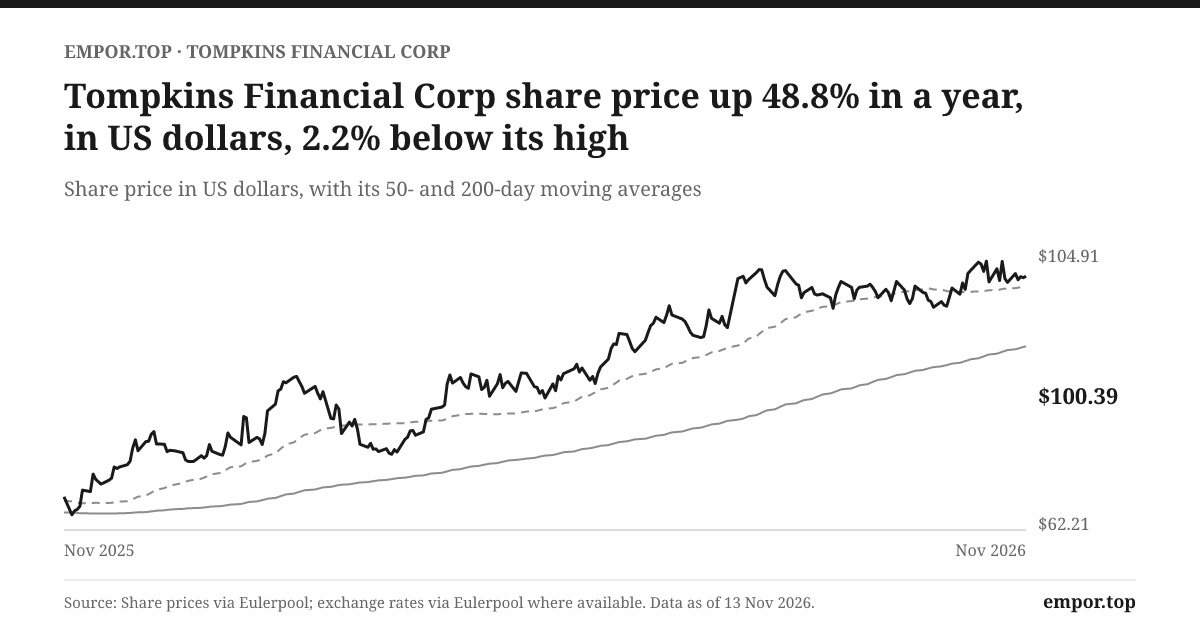
On November 13, 2026, Tompkins stock closed at $100.39, within about 2% of its 52-week high of $102.62 and more than 50% above its 52-week low of $64.50. The market value was about $1.4 billion. On a standard stock screen, the shares traded at about 8.0 times trailing earnings, against a five-year median of about 12.6 times. A screen like that practically shouts "cheap."
It is not that simple, and the reason is the number on which that multiple is built. Trailing twelve-month earnings per share were $12.57.41 That figure adds together the last four reported quarters: the fourth quarter of 2025, at $6.70 a share, and the first three quarters of 2026, at $5.86.14 More than half of the trailing earnings, in other words, came from a single quarter that included the insurance gain.
Swap the gain out and the picture changes. Using Tompkins's own adjusted figure for the fourth quarter of 2025, $1.78 a share, the trailing twelve months come to about $7.64.14 At $100.39, that is about 13 times earnings. Annualize the third quarter of 2026 instead, $2.00 a share times four, and the multiple is about 12.5 times.4 Either way, the stock is not trading at a deep discount to its own history. It is trading roughly in line with it. The low headline multiple is a transaction-driven mirage, not a bargain hiding in plain sight.
For a bank, the better lens is book value and return on equity. At September 2026, tangible book value per share was $60.12, and book value per share was $65.19.4 The share price is therefore about 1.67 times tangible book. Return on equity in the third quarter of 2026 was about 11.9%, which is about 12.8% on tangible equity.4 A bank earning low-teens returns on tangible equity and trading at roughly 1.7 times tangible book is priced as a solid, unexceptional franchise: the market is paying a premium for growth and stability, not for a moat. Those 19% trailing returns on equity some screens show, like the eight-times multiple, are inflated by the sale.
So what is the market assuming? Roughly this: that Tompkins can sustain something like its current post-sale earnings, a little more than $2 a share per quarter, with some growth, and that credit losses stay manageable. The price does not assume a collapse, and it does not assume a step change in profitability. It leaves room for disappointment in either direction.
Before weighing bull against bear, it is worth assembling the moat argument using the industry forces already described and Hamilton Helmer's framework of seven durable powers.
The industry forces remain unfavorable: borrowers and depositors have bargaining power, substitutes are plentiful, and rivalry is intense. Only the regulatory barrier to new entrants offers protection, and it protects all incumbents equally.9[^10]
Viewed through Helmer's seven powers, scale economies favor Tompkins's larger competitors; it is sub-scale by any national standard and must spread technology and compliance costs over a smaller base. Network economies are absent. Counter-positioning, a business model incumbents cannot copy without hurting themselves, does not apply; relationship banking is the oldest model in the industry. Cornered resource is tempting to claim for local knowledge, but local knowledge is held by people who can be hired away, not by the institution.
Three powers deserve closer examination. Switching costs are real for operating accounts: moving payroll, treasury services and autopay arrangements is painful, and Tompkins's roughly $2 billion of noninterest-bearing deposits suggests some customers find it not worth the trouble.4 But the company does not disclose retention data, and the 2023 deposit outflow showed the limits of stickiness when rates jump.5 Brand matters locally, and nearly two centuries in Ithaca is not nothing; but there is no evidence that the Tompkins name commands a pricing premium. Process power, a superior underwriting culture, would be the most valuable power a bank could have. Tompkins's credit record is respectable, but the $17.3 million loan that slipped in 2025 and the rising criticized loans in 2026 show it is not exceptional.24
The conclusion: Tompkins has no demonstrated power in Helmer's sense. It has a competent franchise with modest switching costs and a local brand. That is a perfectly good business. It is not a moat.
Now let the bull make its best argument. Post-sale bank earnings are growing at more than 20% a year. Net interest margin has risen almost a full percentage point from its 2024 trough, and the two bond resets locked in higher yields for years to come. Funding costs are falling, not rising. Capital and liquidity are stronger than at any time in recent memory, giving the bank options: faster lending, larger buybacks, or acquisitions. The insurance sale was done at a rich price, crystallizing value that the market would never have assigned inside a bank stock. And the stock, on properly normalized earnings, trades at roughly its own historical multiple, not a premium, despite earnings momentum.
The bull would add that Tompkins has shown it is willing to make hard decisions early. Many banks sat on underwater bonds; Tompkins acted twice. If that decisiveness carries over to deploying capital, the next few years could compound tangible book value faster than the market expects.
Then hand the floor to the bear. The five-year median multiple the stock is being compared with spans unusual earnings, including 2023's near-wipeout, so even the normalized comparison is not clean. The insurance fee stream, the one part of the company not tied to interest rates, is gone forever, leaving earnings more exposed to the rate cycle. Margin expansion has been powered partly by favorable conditions that may not last; if rates fall, loan yields will reprice down faster than some deposit costs. Nonperforming assets and criticized commercial real-estate loans are rising while the reserve ratio is drifting lower. And a bank of under $10 billion faces larger, better-funded competitors and an expensive regulatory step-up approaching within a few years.
The bear would also point to the unresolved capital-allocation question. Capital that sits idle earns a mediocre return. A bank whose best answer to "what next?" is a modest buyback and a higher dividend may be telling shareholders that it has no better ideas.
A skeptical long-term investor would press management on one issue above all: capital. Why hold excess capital, or buy back shares at roughly 1.7 times tangible book, rather than invest more aggressively in technology to narrow the scale gap, improve returns on tangible equity, or pursue carefully priced acquisitions that would spread the coming $10 billion costs over a larger base? Tompkins has disclosed no activist campaign. But the questions an activist would ask are exactly the ones the company has left open.
What would change the conclusion? Several quarters of post-sale earnings per share above $2, with returns on tangible equity rising rather than flat. Stable or improving commercial real-estate credit, with criticized loans turning down. And net interest margin holding up through a change in rates or deposit conditions. If those arrive together, the bull case gains real evidence and the argument for a richer valuation strengthens. If credit turns or the margin fades, the stock's current price, roughly 13 times normalized earnings, will look full.
The neutral verdict is this: Tompkins is a credible regional franchise with improving earnings momentum and a strong capital position. It has no demonstrated moat. And the low headline multiple is not, on inspection, a clean value signal. The story's most important lessons are not about valuation at all. They are about what it costs to change a bank.
X. Business & Investing Lessons
Go back to the third quarter of 2023. A bank that had earned $85 million the year before chose to sell half a billion dollars of bonds and book a loss that wiped out most of a year's profit.5 It did so on purpose, in plain sight, while its funding costs were climbing. Then, two years later, it did it again.
The first lesson lives in that scene. A bank's inventory is its balance sheet; changing it can cost a year's earnings before it earns a better spread. Retailers mark down old stock to make room for new. Banks do the same with bonds and loans, except that the markdown arrives all at once and the benefit trickles in over years. Investors who judged Tompkins by its 2023 earnings saw a bank in crisis. Investors who judged it by the yield on what it bought saw a bank refinancing its future. The wider point for founders and investors is that the most important decisions often look worst in the quarter they are made. The proof lives in the quarters that follow, and only patient measurement can tell a smart markdown from a desperate one.
The second lesson came with the insurance sale.12 For one quarter, it looked like a bank having the best year in its history. A sale can make a company look richer overnight; only the next cycle shows whether shareholders got richer. A gain is a conversion: a stream of future income turned into a lump of capital today. Whether that conversion creates value depends entirely on what happens to the lump. Put to work at a higher return than the business it replaced, it compounds. Left idle, it quietly dilutes. The lesson reaches far beyond banking: whenever a company reports a record built on a disposal, the right question is not how big the gain was, but what the cash will earn.
The third lesson returns to the machine-shop owner's choice between a local banker and a giant's balance sheet. Local knowledge is a strategy, not yet a moat. The proof is who stays, who borrows and what the bank earns on the relationship. Every company has a story about its edge. The edge is real only when it shows up in numbers a competitor cannot match.
The fourth lesson is quieter, and it lives in the pay table. Its bonus plan left the one-time gain and securities losses outside the scorecard.11 What a bonus plan leaves out tells you what management will never have to explain. For any company that makes recurring "one-time" adjustments, the investor's job is to add them back up and see whether they still look one-time.
XI. Epilogue
Tonight, Tompkins is a simpler company than it has been in decades. It is a bank of almost $9 billion in assets, with a small wealth business attached, a margin at its highest level in years, capital ratios stronger than at any time in recent memory and a share price near its high.4 It is also a bank whose post-sale earnings record is exactly three quarters long.
The next moments that will decide the story are close. If the pattern of recent years holds, late January 2027 will bring Tompkins's fourth-quarter and full-year 2026 results. That release will give investors the first full year of the bank standing alone, and the first year-over-year comparison in which the insurance gain is on only one side. If net income for 2026 lands comfortably above 2025's adjusted $90.4 million, the step-up looks durable. If the fourth quarter shows margin slipping or provisions climbing, the 2026 recovery will look more like a favorable cycle than a new level.
The margin will be the first reading. It stood at 3.65% in the third quarter of 2026, with deposit costs of about 1.5%.4 If rates move and the margin holds, the two bond resets and the loan repricing will have earned their keep. If it fades quickly, the market will remember that spread gains are rented, not owned.
Credit will be the second reading. The two commercial real-estate relationships that pushed criticized loans higher in the third quarter will either stabilize, be paid off, or migrate into nonaccrual and charge-off.4 One outcome confirms management's statement that collateral is sufficient. The other would show why aggregate ratios cannot be trusted alone. Watch whether net charge-offs stay near their recent low rate while loans keep growing.
The third reading is per share. Tangible book value per share was $60.12 in September 2026.4 If that number compounds steadily from here, net of new bond marks, the insurance sale will have proved its worth. If it drifts, the capital released by the sale will have been parked rather than put to work.
And then there is the line. At its current pace, Tompkins will approach $10 billion in assets within a couple of years. At that point, the bank will face new examiners, new costs and, almost certainly, lower debit-card fees.2 The way Tompkins crosses that line, by growing into it, buying its way across or deliberately slowing to stay below, will say more about management's ambition than any statement in a press release.
The central questions remain open. The earnings step-up is real but young. The loan book is growing but showing early strain. The margin is wide but rate-dependent. The stock is not as cheap as it looks. Each of the next few quarterly reports will push those questions one step closer to an answer.
XII. Outro
In 1836, a bank opened its doors in a small settlement at the southern end of a long, cold lake in upstate New York. Nearly two centuries later, the company that grew from it is trying to prove something that bank never had to: that a balance sheet of under $10 billion, stripped of its insurance agency and reset twice in three years, can still earn its place among competitors that dwarf it.
Most bank stories are about loans. This one is about the price of changing what a bank owns, the year of profit given up in 2023, the agency given up in 2025, and the patience required to see whether either decision paid. Tompkins has made the trades. The next few years of earnings and credit will show whether they paid.
References
-
Q4 and Full-Year 2025 Earnings Release — Tompkins Financial Corporation, 2026-01-30 ↩↩↩↩↩↩↩↩↩↩↩↩↩↩↩↩↩↩↩↩↩↩↩↩↩
-
2025 Form 10-K — Tompkins Financial Corporation, 2026-02-26 ↩↩↩↩↩↩↩↩↩↩↩↩↩↩↩↩↩↩↩↩↩↩↩↩↩↩↩↩↩↩↩↩↩↩↩↩↩↩
-
Tompkins Financial Corporation Reports Record First Quarter Financial Results — Tompkins Financial Corporation, 2026-04-24 ↩
-
Q3 2026 Earnings Release — Tompkins Financial Corporation, 2026-10-23 ↩↩↩↩↩↩↩↩↩↩↩↩↩↩↩↩↩↩↩↩↩↩↩↩↩↩↩↩↩↩↩↩↩↩↩↩↩↩↩↩↩↩↩↩↩↩↩↩↩↩↩↩↩↩
-
2023 Fourth-Quarter Earnings Release — Tompkins Financial Corporation, 2024-01-26 ↩↩↩↩↩↩↩↩↩↩↩↩↩
-
2012 Form 10-K, Including VIST Acquisition Accounting — Tompkins Financial Corporation, 2013-02-28 ↩↩↩↩↩↩↩↩↩↩↩
-
VIST Merger Announcement — Tompkins Financial Corporation, 2012-01-26 ↩↩↩↩↩↩↩↩
-
2023 Form 10-K — Tompkins Financial Corporation, 2024-02-29 ↩↩
-
2025 Form 10-K — Community Financial System, Inc., 2026-02-27 ↩↩
-
Q3 2026 Form 10-Q — Tompkins Financial Corporation, 2026-10-30 ↩
-
2026 Proxy Statement — Tompkins Financial Corporation, 2026-04-06 ↩↩↩↩↩↩↩↩↩↩↩↩↩↩↩↩↩↩↩↩↩↩↩
-
2026 Annual Meeting Voting Results, Form 8-K — Tompkins Financial Corporation, 2026-05-26 ↩↩
 LinkedIn
 WhatsApp
 Reddit
 Hacker News
 Email
 Kindle
 RSS Feed
 Spotify
 Apple Podcasts
 Amazon Music
 Audible
 YouTube