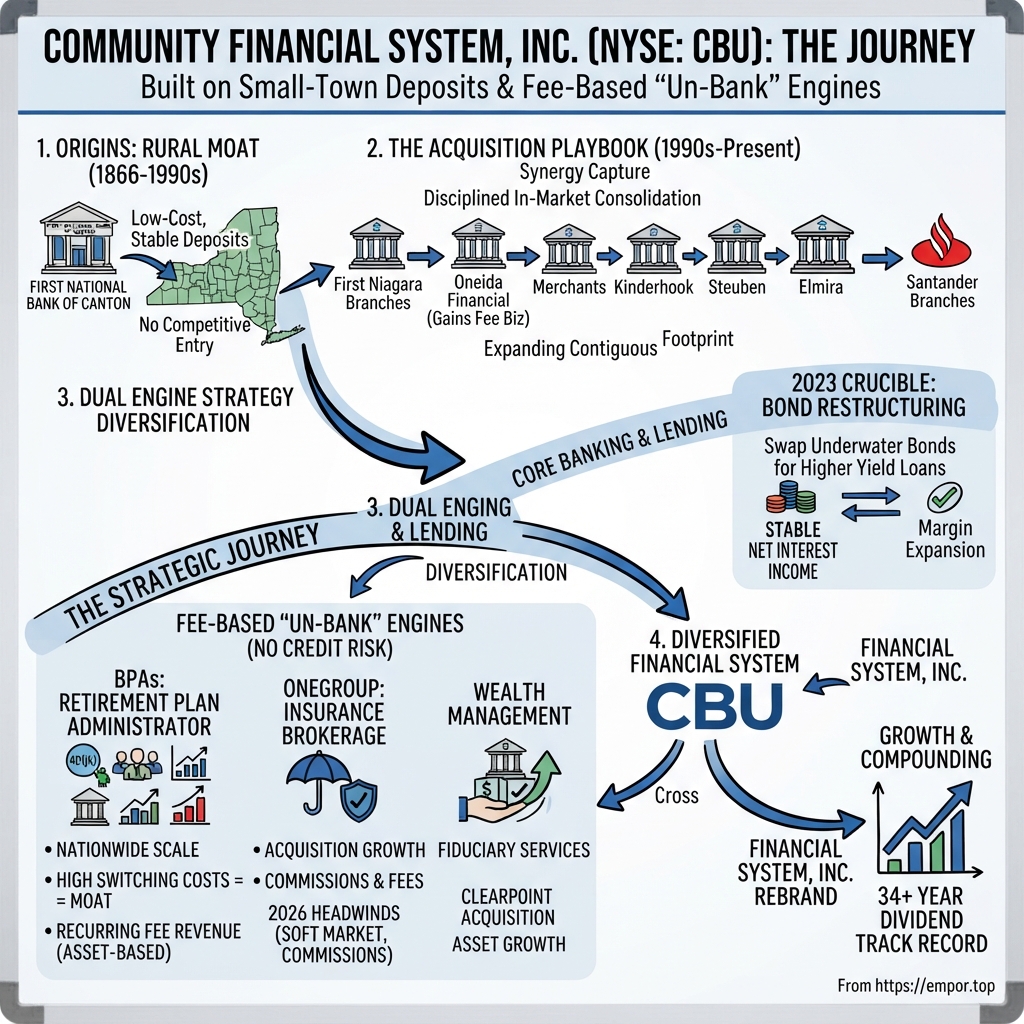
Community Financial System, Inc. (NYSE: CBU): The Empire Built on Small-Town Deposits and Fee-Based "Un-Bank" Engines
I. Introduction: The Upstate Anomaly
There is a quiet stillness in DeWitt, New York, on a weekday morning in late winter. The office park off Erie Boulevard is unassuming—low brick buildings, a parking lot salted gray, and the Syracuse skyline faint on the horizon. Nothing about the exterior suggests it serves as the corporate headquarters of an institution holding roughly $17.8 billion in assets, a retirement-plan administrator serving nearly one million American workers, and a dividend track record that survived the savings-and-loan crisis, the dot-com bust, the 2008 global financial crisis, and the 2023 regional banking turmoil.1
Community Financial System, Inc. does not fit the typical profile of a multibillion-dollar financial company.
Between March 2023 and the end of 2024, the American regional banking sector weathered its sharpest stress test in fifteen years. Silicon Valley Bank collapsed in 48 hours. Signature Bank followed quickly, and regulators subsequently seized and sold First Republic Bank. Dozens of regional lenders discovered that their bond portfolios sat heavily impaired after 525 basis points of Federal Reserve interest-rate hikes, that uninsured commercial deposits could flee rapidly via digital channels, and that commercial real estate loans underwritten at 3.25% could not easily be refinanced at 7%. The KBW Regional Banking Index tumbled into severe distress.
Community Financial moved in the opposite direction. It continued raising its shareholder payout; by the third quarter of 2026, the company had declared its 34th consecutive year of dividend increases, lifting the quarterly dividend to $0.49 per share.1 It also continued growing net interest income quarter after quarter, precisely when industry spread margins were under severe pressure; the second quarter of 2026 marked its ninth consecutive quarter of net interest income expansion.1 The company achieved this from a footprint that conventional bank strategists often overlook: the rural dairy counties of northern New York, the Southern Tier, Vermont, western Massachusetts, and northeastern Pennsylvania.
The disguised compounder
The institution traces back to 1866, when the First National Bank of Canton opened in St. Lawrence County, close enough to the Canadian border that its earliest customers were local dairy farmers and lumber mill operators. For most of the following century, it operated strictly as a traditional small-town lender. Over the past three decades, however, the bank executed a dual-track strategy: acquiring community banks while systematically purchasing non-banking operating businesses.
The resulting enterprise outgrew its historical identity. In May 2024, the holding company retired the name Community Bank System, Inc. and rebranded as Community Financial System, Inc., with the change taking effect May 15 and the shares trading under the new name on May 24. Notably—and contrary to occasional market assumption—no shareholder vote was required; Delaware corporate law did not mandate one, and the board enacted the change directly.2 That governance detail highlights management's deliberate repositioning: the executive team was formally asserting a diversified corporate identity rather than waiting for an investor mandate.
That identity extends well beyond banking. Alongside Community Bank, N.A., the holding company operates BPAS, a national retirement and employee-benefit administrator; OneGroup, a commercial insurance brokerage; and a wealth and fiduciary management business expanded in 2026 through the acquisition of ClearPoint Federal Bank & Trust. In 2025, those three fee-based divisions generated $136.0 million in employee benefit services revenue, $54.4 million in insurance services revenue, and $37.1 million in wealth management revenue. Combined noninterest revenue reached $311.5 million, accounting for 38% of the company's $811.7 million in total revenue.3
That revenue breakdown defines the business model. A typical regional bank of comparable asset size generates 15% to 20% of revenue from noninterest fees, with much of that tied to deposit service charges and overdraft penalties—fee lines that regulators have spent a decade curbing. Community Financial derives nearly two-fifths of its total revenue from fee-based operations. The majority of these operations require no credit reserves, consume minimal regulatory capital as they expand, and remain largely insulated from yield-curve fluctuations.
What this episode is actually about
The reality of Community Financial is more nuanced than a simple story of a rural bank discovering fee income. The investment thesis rests on four structural pillars that warrant rigorous evaluation:
The geographic moat. Management argues that maintaining top market share across small communities of 5,000 to 30,000 residents creates a stable deposit franchise with exceptionally low price sensitivity. Operating metrics support that contention. However, that insulation involves an operational trade-off: these markets exhibit minimal population and economic growth, dictating how the company must allocate capital.
The fee machine. The company positions BPAS and OneGroup as recurring, capital-light businesses that deserve higher non-bank valuation multiples. While these segments provide diversified cash flow, recurring revenue is not automatically countercyclical—a distinction evidenced by commercial insurance market dynamics during 2026.
The acquisition record. Over three decades, the company has completed more than fifteen bank and branch acquisitions without incurring major asset-quality crises or resorting to heavily dilutive equity offerings. The strategic question is whether these transactions built enduring, organic franchise value or functioned primarily to replace deposit runoff in mature, low-growth counties.
The leadership handoff. On January 1, 2024, a seventeen-year community banking executive stepped aside for a former Wall Street financial-institutions investment banker.4 That transition marked a notable leadership pivot. The central question is not whether Dimitar Karaivanov possesses the requisite strategic skill—the post-transition operating performance demonstrates disciplined execution—but whether the conservative credit culture that underpinned a multi-decade dividend record remains intact under leadership trained in financial engineering and transactional strategy.
Each of these strategic dynamics originates in a geographic network that began in a small courthouse town along the St. Lawrence River.
 Subscribe on LinkedIn
II. Origins & Geography: The Economics of Non-Metro Dominance
Canton, New York, sits roughly twenty miles south of the Canadian border along the Grasse River, anchored by a county courthouse and two colleges. When the bank began operating there in the nineteenth century, the community was a working agricultural and timber outpost requiring direct, relationship-based credit. While that local orientation has endured, the surrounding economics of non-metropolitan banking have shifted decisively in the institution's favor.
The topography of a footprint
Understanding Community Financial requires examining its geographic map alongside the balance sheet. Tracing Route 11 from Watertown down through Syracuse, east toward Utica and Oneonta, west across Elmira and the Southern Tier, and north toward Plattsburgh reveals a contiguous rural grid. That network extends east into Vermont and western Massachusetts, and south into the Scranton–Wilkes-Barre and Allentown corridors of northeastern Pennsylvania. Community Bank, N.A. operates a retail network spanning hundreds of branches across that territory, with FDIC deposit and branch data confirming the depth of its local market share.5
What unites these markets is not rapid economic expansion, but the absence of new competitive entry. For money-center institutions and large regional lenders, operating a physical branch in a community of eight thousand residents characterized by flat population trends and modest household incomes is economically uncompelling. Staffing, facilities, physical security, and regulatory overhead create fixed costs that cannot be justified without significant deposit scale. As national banks spent the 2010s paring rural locations to redeploy capital into digital acquisition across dense metropolitan centers, they left behind local banking vacuums.
In commercial banking, an absence of competition alters basic pricing dynamics. Rural retail customers do not generate higher revenue per account, but competitive intensity remains structurally lower. When several lenders compete for the same suburban deposits, funding costs quickly escalate into an aggressive bidding contest. When a market is served by only one or two incumbents and natural barriers deter outside entrants, deposit pricing becomes far more manageable.
What that buys on the liability side
The financial impact of that dynamic appears directly in the cost of funds. In the second quarter of 2026, with the federal funds rate holding well above its pre-2022 range, Community Financial's cost of total deposits was 1.07%—down 12 basis points from the prior year—while its all-in cost of funds stood at 1.18%.1 That level of funding cost is lower than what many regional institutions achieved in 2019, prior to the sharpest monetary tightening cycle in four decades.
Executive leadership attributes that pricing leverage directly to balance-sheet flexibility. On the July 2026 earnings call, when asked whether deposit competition would eventually erode margins, Karaivanov emphasized that the bank was observing municipal funds pricing above unsecured wholesale debt and chose not to match those terms: "we don't have to participate in that because we have flexibility." He cited a loan-to-deposit ratio of 76% as the primary driver of that balance-sheet latitude.6
That flexibility reflects structural liquidity rather than depositor sentiment alone. While conventional banking lore often attributes low funding costs to community customer loyalty, sentiment alone does not establish an economic moat. The structural reality is that because Community Financial funds only about three-quarters of its loan book with deposits while maintaining a substantial securities portfolio, it can systematically bypass deposits priced above marginal wholesale alternatives. An institution operating at a 95% loan-to-deposit ratio enjoys no such option—it must pay prevailing market-clearing rates or allow its asset base to contract. Community Financial's granular rural base generates a low deposit beta, while its balance-sheet slack provides management the tactical discretion to enforce it.
The cost of the moat
Yet that geographic insulation carries a distinct commercial trade-off. Markets that deter outside entrants are typically economies with minimal organic growth. Upstate New York's non-metropolitan counties have experienced decades of flat or declining populations. Because a financial institution cannot compound earnings over the long term on an organically stagnant deposit base, Community Financial has had to generate growth externally—through bank acquisitions, selective market-share gains, and de novo expansion into faster-growing adjacent markets.
That branching initiative marks a notable strategic pivot. Rather than relying solely on whole-bank purchases, the company has begun opening branches in higher-growth regional corridors; by mid-2026, those de novo offices held roughly $140 million in deposits. Combined with branches acquired from Santander in Pennsylvania's Lehigh Valley, management expected to end 2026 with approximately $700 million of new additive funding in expansion markets.6 That expansion highlights an inherent friction: while the investment narrative highlights the profitability of the legacy rural franchise, the company is actively committing capital to buy and build deposits in commercial hubs like Allentown and Scranton. The rural core provides low-cost funding, but it does not generate enough organic volume to fuel balance-sheet expansion on its own.
Management has also pointed to regional demographic and housing indicators to support its outlook. On the July 2026 earnings call, Karaivanov noted that Scranton ranked first nationally for home-price appreciation in ICE's May 2026 data, with Rochester second, Albany fifth, Syracuse sixth, and Allentown fourteenth—a pattern he attributed to housing inventory running roughly 50% below historical averages. He also noted that Central New York housing permits had risen from under 400 units annually four years earlier to more than 2,400.6 While some market observers connect these trends to anticipated semiconductor manufacturing and regional infrastructure projects, management has maintained a conservative posture. When asked directly about the commercial impact, he stated that the company was "not there yet," emphasizing that regional infrastructure activity was not what was driving growth and that even a meaningful economic pickup would be difficult to register immediately on a balance sheet of this size.6
The neighbors
Community Financial does not operate without regional competition. Its closest operational peer is Norwich, New York-based NBT Bancorp, an Upstate institution of comparable asset size that also runs a substantial retirement-plan administration business, competing directly across both traditional banking and fee-based services. Ithaca-based Tompkins Financial operates a similar wealth-and-insurance model within a more concentrated footprint. Northwest Bancshares brings a thrift-oriented balance sheet across overlapping markets in western New York and Pennsylvania. In metropolitan areas, Buffalo-based M&T Bank operates on a substantially larger scale, focusing primarily on commercial real estate and middle-market commercial lending rather than village retail branches.
The key dynamic across these contiguous markets is competitive rationality. When two disciplined incumbents share a non-metropolitan county, neither benefits from initiating an unprovoked deposit bidding war. That behavioral balance has largely held across the footprint, though it remains vulnerable to margin pressure. During the July 2026 call, Karaivanov observed that regional competitors were accepting thinner loan spreads even as rates rose, noting that "actual rates offered to customers went down in our markets, just compressing spreads pretty meaningfully"—a trend that prompted Community Financial to decline much of that lending business.6 When competitive equilibria soften, pricing discipline is typically the first casualty.
For investors, the strategic takeaway of the geographic network is narrower than unvarnished bull cases suggest. The rural footprint provides a durable funding advantage, verified by low funding costs and backed by deliberate balance-sheet liquidity rather than depositor inertia. However, it does not function as an organic growth engine. That structural ceiling explains why, beginning in the 1990s, management sought expansion in commercial lines completely detached from physical branch geography.
III. The Secret Engine: Assembling the Fee-Based "Un-Bank"
In the late 1990s, leadership at the New York bank holding company confronted an inherent structural limitation of commercial banking.
The operational math was straightforward: every incremental dollar of loan growth requires backing capital—regulatory capital and, under the modern Current Expected Credit Losses accounting regime, an immediate allowance against lifetime expected losses. Spread income depends on the margin between funding costs paid to depositors and yields earned on loans and securities—variables heavily dictated by Federal Reserve monetary policy rather than individual bank discretion. Leveraged at roughly ten to one, even a moderate credit downturn can erase years of retained earnings.
To generate high returns on tangible common equity within that structural framework, an executive team faces two primary paths: take on greater credit risk—a strategy that historically precipitated numerous bank failures—or develop revenue streams that do not depend on balance-sheet leverage.
Community Financial chose the second path, turning primarily to retirement plan recordkeeping.
Pillar one: BPAS, the business nobody notices
At its core, BPAS handles the administrative mechanics of workplace retirement plans. When an employer establishes a 401(k), an administrator must track individual employee contributions, allocate funds across investment menus, calculate daily account valuations, file mandatory compliance forms, conduct nondiscrimination testing to ensure plans do not disproportionately favor executives, process plan loans and hardship withdrawals, and distribute participant statements. This recordkeeping function operates as essential back-office plumbing: high-volume, rules-governed, and legally exacting, characterized by strict federal guidelines, direct fiduciary liability, and severe penalties for noncompliance.
Originally a modest regional administrator, BPAS expanded over three decades through sequential bolt-on acquisitions and continuous software investments into a nationwide operation. The division supports more than 10,375 retirement and benefit plans, over 980,000 participants, $132 billion in trust assets, and $1.3 trillion in fund administration—delivering services that span workplace retirement plans, actuarial and pension consulting, healthcare consulting, individual retirement accounts, VEBA and HRA administration, collective investment funds, fund administration, and institutional trust services.7
Two of these service offerings provide notable customer retention. A VEBA—voluntary employees' beneficiary association—and its counterpart, the HRA (health reimbursement arrangement), are tax-advantaged trusts that employers, frequently school districts and municipal governments, establish to fund retiree healthcare obligations. Managing these vehicles requires holding trust assets, processing medical reimbursement claims, and undergoing recurring annual audits. The second is collective investment trust (CIT) administration. These pooled institutional vehicles operate similarly to mutual funds but are available exclusively to qualified retirement plans, steadily gaining market share from traditional mutual funds in defined-contribution plans due to lower expense structures.
This operational complexity creates substantial competitive barriers rooted in switching friction. Migrating a retirement plan to a competing recordkeeper requires a trading blackout period for participants, extensive data conversions where mapping discrepancies create direct fiduciary liabilities, and mandatory re-testing of compliance parameters. The plan sponsor—frequently a corporate human resources executive rather than an investment specialist—bears personal fiduciary responsibility for operational errors. Consequently, plan sponsors rarely change providers merely to shave basis points off fees; transitions typically occur only after major operational failures. That switching friction establishes a durable structural moat that cannot easily be dislodged by incremental technological improvements.
These retention dynamics translate into measurable operating leverage. Employee benefit services generated $136.0 million in revenue in 2025,3 and during the second quarter of 2026, the segment recorded $34.9 million in revenue—a 7.7% year-over-year increase that yielded a 16.2% increase in pretax earnings.16 Delivering earnings growth at more than twice the pace of revenue expansion reflects the scalability of modern administrative platforms, where adding incremental participants incurs minimal marginal overhead.
However, this recurring revenue model is not entirely immune to broader financial market cycles. A significant portion of BPAS revenue is asset-based, calculated as a percentage of total assets under administration. While the business carries no direct credit risk, it remains exposed to equity market volatility; a sharp equity downturn can compress fee revenue even as plan counts and underlying administrative workloads remain unchanged. Retirement plan assets under administration reached $16.5 billion by mid-2026 according to segment reporting—a milestone Karaivanov observed had become comparable in total volume to the bank's own balance sheet.6
Pillar two: OneGroup, and a lesson in fee-business honesty
OneGroup serves as the company's insurance brokerage division, offering commercial property and casualty coverage, employee benefits consulting, personal lines, and risk management services. Like BPAS, it expanded through programmatic acquisitions of independent agencies across the regional footprint.8 The commercial brokerage model requires minimal regulatory capital: the broker collects commissions and fee percentages on placed policy premiums and typically retains a substantial portion of accounts upon annual renewal. Client retention tends to remain elevated because changing brokers requires an enterprise to re-disclose its complete corporate risk profile to a new intermediary.
During 2026, however, OneGroup encountered operational headwinds, providing an instructive case study in the inherent cyclicality of non-banking fee income.
Insurance services delivered $54.4 million in revenue in 2025.3 During the second quarter of 2026, the segment generated $13.2 million, representing a 4.8% decline year over year, while pretax earnings fell 10.8%.16 Executive leadership addressed the shortfall directly. Karaivanov opened the July 2026 earnings discussion by acknowledging that insurance revenues "were short of expectations" and stating that "clearly, insurance will be challenged this year and fall short of our expectations." Management attributed the decline to three interrelated factors: lower carrier contingent commissions, softer commercial premium pricing, and organic contraction across certain product lines. When questioned by analysts, Karaivanov quantified approximately $1 million of the year-to-date deficit as contingency-related, noted that division revenue was down 6.5% year-to-date, and declined to project an immediate rebound, remarking that performance "could go either way."6
That performance illustrates key structural exposures in fee-based models. Contingent commissions represent profit-sharing incentives paid by insurance carriers based on the underwriting loss experience and total volume of the broker's placed business. These payments represent high-margin revenue but fluctuate based on end-market loss ratios outside the intermediary's control. Concurrently, soft premium markets present pricing pressure: when commercial property and casualty premium rates soften, a broker compensated on a percentage of premium receives lower commission revenue for placing the same volume of client risk. An insurance brokerage operates not as a fixed subscription business, but as an intermediary tied to broader underwriting pricing cycles.
This dynamic directly tests a core element of the traditional bull thesis: the premise that fee-based businesses function as an unyielding, countercyclical hedge against traditional banking pressures. While non-banking subsidiaries successfully eliminate balance-sheet credit cyclicality, they remain subject to distinct operating and underwriting cycles of their own.
Pillar three: wealth, and a small acquisition with a large signal
The wealth management and fiduciary division integrates institutional trust administration with registered investment advisory services. That segment delivered strong operating performance in 2026, generating $10.4 million in second-quarter revenue, an increase of 19.8% year over year, while pretax earnings expanded 46.5%—operating results that indicate expanding operating scale against the division's fixed administrative base.16
External acquisitions contributed directly to that expansion. In January 2026, Community Financial announced the acquisition of ClearPoint Federal Bank & Trust for approximately $40 million, bringing roughly $1.5 billion in assets under management.3 The transaction closed on June 1, 2026, for $39.0 million in cash, providing an additional $120.1 million in assumed deposits.16 Supported by that integration, total wealth assets under management and administration reached $17.1 billion by mid-2026.6
What the segment structure reveals
Effective January 1, 2024, the company formally reorganized its financial reporting into four distinct operating segments: Banking and Corporate, Employee Benefit Services, Insurance Services, and Wealth Management Services. During full-year 2024, noninterest revenues across the non-banking financial services segments reached $217.9 million, an increase of 10.6%, against consolidated net revenues of $746.3 million, as each of the four business units posted record revenue totals.9
Segment reporting represents more than a routine accounting adjustment. By breaking out three fee-based subsidiaries independently, management effectively invited the market to value each operating business on its own fundamental merits—a disclosure choice central to the holding company's rebranding strategy. However, granular reporting also invites direct analytical scrutiny. It prevented the 2026 insurance slowdown from being obscured by strength in banking or wealth management, ensuring that divisional headwinds were immediately visible to shareholders.
The strategic premise of internal cross-selling—such as a commercial lending officer in Watertown introducing a business borrower to a OneGroup commercial insurance broker or a BPAS retirement plan administrator—functions effectively as a mechanism to lower customer acquisition costs. Yet it does not represent an independent organic growth engine; the 2026 insurance performance illustrated that access to a captive retail banking network could not entirely prevent top-line contraction. The non-banking subsidiaries generate value primarily through high client switching costs and capital-efficient returns on equity, rather than mere physical proximity to banking branches.
The banking franchise, meanwhile, expanded through its traditional playbook: acquiring neighboring institutions.
IV. The M&A Compounding Playbook: Disciplined In-Market Consolidation
Consider the scenario that played out dozens of times over three decades in conference rooms in DeWitt. On one side of the table sat a founding family or a local board that had overseen an independent bank in an Upstate New York county for generations, now confronting three mounting operational realities: a senior leadership team nearing retirement without a designated successor, compliance and regulatory expenses compounding faster than loan growth, and technology vendors demanding similar baseline outlays whether an institution held $1 billion or $15 billion in assets. On the other side sat Community Financial System—then operating as Community Bank System—offering cash or stock, a commitment to preserve the local brand identity during the transition, and a plan to absorb the back-office infrastructure into its central operating platform.
That consolidation dynamic provided the primary engine for balance-sheet growth. Disciplined execution determined whether it produced lasting shareholder value.
The geographic formula
Community Financial's acquisition criteria have been strict and operationally conservative: buy institutions in secondary and tertiary markets contiguous to its existing footprint, deliberately bypassing major metropolitan centers like New York City, Boston, and Philadelphia. The underlying logic is mathematical rather than defensive. When an acquired institution's branches directly adjoin or overlap the existing footprint, cost synergies become predictable: consolidating data centers, terminating duplicate core-processing vendor contracts, centralizing compliance and internal audit functions, rationalizing redundant overlapping branches, and eliminating public-company administrative overhead. Achieving those efficiencies does not depend on persuading newly acquired customers to buy unfamiliar products.
That approach contrasts with aggressive metropolitan expansions, where regional lenders pay substantial premiums to enter dense urban centers without existing branch density, local credit familiarity, or operational overlap. In those transactions, acquirers must justify elevated purchase prices through optimistic revenue synergies—attempting to win business from established urban incumbents. That strategy has repeatedly destroyed shareholder capital across banking cycles; Community Financial largely avoided it.
The deals that defined the method
The First Niagara branch carve-out in 2012 illustrated that strategy in its purest form. When First Niagara acquired HSBC's Upstate New York branch network, federal antitrust regulators mandated branch divestitures—primarily in smaller rural markets that larger regional institutions had little interest in operating. Community Bank acquired those locations at a modest deposit premium, immediately establishing leading deposit market share across several rural counties. The structural benefit of a branch transaction lies in its risk profile: it transfers retail deposits and selected branch-level relationships without absorbing the seller's broader credit underwriting decisions, securing inexpensive funding without inheriting legacy loan-book risk. Historical branch and deposit detail for Community Bank, N.A. remains verifiable through the FDIC's records.5
Oneida Financial Corp. in 2015 marked a strategic turning point. While Oneida operated as a traditional community bank, it also owned commercial insurance brokerage and employee benefits administration operations that became foundational to OneGroup. Community Financial acquired a banking franchise and gained an operating fee platform in the process; the transaction history is documented in the company's filings.10 Strategically, the acquisition unified the banking and fee-services components into a single corporate M&A thesis rather than two separate programs.
Merchants Bancshares in 2017 represented the company's interstate expansion. The roughly $304 million transaction extended the franchise into Vermont and western Massachusetts, adding Vermont's second-largest commercial bank.[^11] The purchase price reflected a premium to tangible book value typical of late-cycle bank valuations at the time. Management justified the valuation through familiar operational levers: migrating the target onto Community Financial's core back-office infrastructure, preserving local brand equity at the customer-facing level, and eliminating the administrative cost structure behind it.
Kinderhook Bank Corp. in 2019 drew scrutiny from market skeptics. It was a $93.4 million all-cash transaction for a Capital District institution, priced at a meaningful premium to tangible book value near what proved to be the cyclical peak of national bank M&A valuations.11 In defense of the transaction, paying entirely in cash avoided diluting existing shareholders, and geographical overlap in the Albany region facilitated direct operational consolidation. Conversely, critics noted that paying an elevated multiple at a market peak for a franchise in a slow-growth region represented an expensive capital allocation regardless of the financing structure.
Steuben Trust Corporation in 2020 closed in July of that year for $106.8 million amid early pandemic uncertainty, solidifying the bank's position in western New York's Steuben and Allegany counties.12 Completing a whole-bank acquisition while the trajectory of the broader credit cycle remained deeply uncertain demonstrated notable managerial resolve, which was subsequently validated as regional credit performance remained stable.
Elmira Savings Bank in 2022, completed in May for $82.8 million in cash, consolidated the Southern Tier footprint.13 The transaction's financing structure was revealing: with the company's equity valuation trading below levels that justified issuing stock, management opted to fund the purchase entirely in cash. That decision underscored a disciplined capital allocation policy that viewed equity as currency to be spent only when trading at favorable multiples rather than as an expedient for routine deal-making.
The acquisition playbook subsequently evolved. In the Santander branch transaction, announced June 25, 2025, Community Bank, N.A. agreed to acquire seven branches in the Allentown, Pennsylvania area, alongside associated loans and wealth management accounts, paying an 8.0% deposit premium—amounting to roughly $48 million in estimated cash consideration—to assume approximately $600 million in deposits and purchase about $33 million in branch-related loans.1415 The transaction closed on November 10, 2025, and by the second quarter of 2026 had contributed $543.7 million in assumed deposits.6 This differed fundamentally from the 2012 First Niagara carve-out: rather than picking up discounted rural branches shed in forced divestitures, paying an 8.0% deposit premium represented a deliberate capital commitment to expand into the faster-growing Lehigh Valley corridor alongside de novo branch openings—a marked evolution from the historical strategy of strictly acquiring inexpensive, contiguous rural footprints.
Did CBU overpay? The honest audit
The transaction record demands a rigorous, balanced assessment rather than an uncritical endorsement.
On the positive side, executing three decades of serial acquisitions without an acute credit crisis reflects disciplined underwriting. Community Financial navigated the 2008 global financial crisis without accepting TARP capital, and its acquired loan portfolios have avoided the delayed credit deterioration that frequently derails serial acquirers; in the second quarter of 2026, annualized net charge-offs stood at just 12 basis points, while nonperforming loans accounted for 0.50% of total loans.1 The company's capacity to extract back-office cost synergies has been repeatedly validated across multiple operating environments.
On the critical side, two structural vulnerabilities stand out. First, Community Financial has consistently paid at the upper end of Northeast community bank pricing multiples, a strategy that leaves little room for integration error or delayed cost extraction. Second, and more fundamentally, organic growth across acquired legacy markets has historically been modest. Operating in non-metropolitan counties with flat demographic trends forces an institution to acquire simply to maintain balance-sheet expansion—a structural dynamic that can weaken negotiating leverage if an acquirer cannot credibly walk away from potential transactions.
Recent operating performance provides counterevidence that challenges that critique. Loan balances grew 7.3% year over year by mid-2026, an expansion executive leadership attributed directly to organic market-share capture rather than acquisitions, with Karaivanov observing that regional growth rates were consistent enough that Central New York could not be distinguished from other markets.16 Karaivanov also cited third-party mortgage data ranking Community Bank as the second-largest originator in its footprint, up from fifth four years earlier.6 If that market-share capture persists through a full cycle, the structural critique of the bank as a captive acquirer weakens materially.
The balanced conclusion is that Community Financial's M&A record demonstrates exceptional operational cost-extraction and conservative credit underwriting, but does not yet prove that transactions generate sustained organic momentum in mature acquired markets. Resolving that question requires tracking organic loan and deposit growth in legacy Upstate regions—excluding newly acquired assets and de novo branch openings—over a multi-year horizon. The performance data across 2025 and 2026 are constructive, but the tracking window remains short.
Any evaluation of this programmatic acquisition strategy must also account for its direct balance-sheet legacy. By mid-2026, book value stood at $39.41 per share, but tangible book value was $21.96—meaning that goodwill and other intangible assets accounted for roughly 44% of stated equity.1 That spread is the natural mathematical consequence of three decades of acquisitions, and it carries two major analytical implications. First, it flatters return on tangible common equity, reported at 22.91% in the second quarter of 2026, because the calculation strips out the accumulated capital spent on acquisition premiums; by comparison, return on total equity during the same quarter stood at 12.10%.1 Second, it leaves a significant portion of stated capital exposed to impairment testing should an acquired operating subsidiary face prolonged earnings deterioration—a risk profile that warrants close attention to fee-segment operating trends, particularly in insurance.
Yet none of these integration challenges constituted the most severe test of the company's modern operating history. That test arrived in the spring of 2023, when the American regional banking sector experienced an unprecedented liquidity shock.
V. The Fed Shock & The 2023 Crucible: Silicon Valley Bank, Bond Losses, and the Balance Sheet Reset
Understanding the steps Community Financial took in early 2023 requires examining the balance-sheet trap that ensnared much of the American banking sector during the pandemic years.
In 2020 and 2021, federal fiscal stimulus and elevated consumer savings flooded commercial banks with deposits. Facing subdued loan demand and guidance from the Federal Reserve signaling that policy rates would remain anchored near zero for years, institutions accumulated substantial low-cost liquidity with few commercial lending outlets. Consequently, banks deployed excess liquidity into fixed-income securities: U.S. Treasuries, agency mortgage-backed securities, and municipal bonds—instruments carrying negligible credit risk but yielding 2% or less.
That environment shifted abruptly in March 2022, when the central bank initiated an aggressive monetary tightening campaign, lifting the federal funds rate by 525 basis points over roughly eighteen months.
The underlying accounting mechanics quickly created severe balance-sheet strain. Because fixed-rate bonds pay a predetermined coupon, rising market yields cause the fair market value of existing debt securities to fall—often by 15% to 20% for longer-duration paper. For securities categorized as available-for-sale, unrealized losses bypass the standard income statement and accumulate within Accumulated Other Comprehensive Income (AOCI), reducing stated shareholders' equity while leaving reported net income nominally untouched. While economically real, an unrealized mark-to-market loss does not impair liquidity unless an institution is compelled to liquidate the underlying securities to fund deposit withdrawals.
That operational vulnerability precipitated the collapse of Silicon Valley Bank in March 2023. SVB relied on a concentrated, uninsured depositor base composed primarily of venture-backed technology firms. When withdrawals accelerated, the bank was forced to liquidate underwater securities to fund outflows, crystallizing paper losses that immediately depleted its regulatory equity. Signature Bank failed days later, sparking broad turmoil across the regional banking sector and forcing investors to scrutinize liability structures across the industry: specifically, who provided the deposits and how rapidly those balances could exit.
The answer in CBU's case
Community Financial's deposit structure represented the functional antithesis of that vulnerability. Its funding base was predominantly retail and municipal, distributed across hundreds of small-town branch locations. Accounts were granular, sitting largely within federal deposit insurance thresholds, with negligible exposure to venture capital, cryptocurrency firms, or tech-sector corporate payrolls. Without a concentrated, interconnected depositor network, the panic that spread through digitally coordinated commercial accounts found no traction across rural Upstate New York and northern Pennsylvania.
The deposits remained stable. Community Financial continued to report deposit expansion in subsequent quarters, and by mid-2026 total deposits of $14.71 billion were 7.4% higher than a year prior.1 A fragmented, physical branch network—often viewed as an operational drag in benign operating environments due to facility overhead, branch staffing costs, and efficiency ratios higher than digital-only models—proved to be an essential defensive asset during systemic stress. That stability offered tangible proof of the defensive utility of the rural footprint, demonstrating a durable mechanism for capital preservation during industry panics.
The decision nobody had to make
Yet Community Financial faced an operating decision that was entirely voluntary. Because its deposit base remained stable, the bank faced no liquidity pressure to liquidate underwater assets. Management could have pursued the conventional community banking approach: leave the underwater securities on the balance sheet, wait for the bonds to mature and the AOCI discount to amortize, and avoid recognizing an explicit accounting loss on the income statement.
Instead, on February 1, 2023—weeks prior to the collapse of Silicon Valley Bank—the company announced a deliberate restructuring of its investment securities portfolio. It sold $786.1 million in book value of lower-yielding available-for-sale debt securities, realizing an estimated after-tax loss of approximately $39.6 million. Proceeds of $733.8 million were redeployed to pay off existing wholesale borrowings that carried a cost roughly 320 basis points above the yield of the liquidated securities. Management estimated the realized loss would be recouped in approximately two years, noted that the restructuring was neutral to shareholders' equity and book value per share, and expected it to be accretive to the Tier 1 leverage and tangible equity-to-assets ratios by roughly 20 basis points.16
The strategic rationale reflected a pragmatic balance-sheet calculation. The economic decline in the securities' value had already taken place, fully recognized within AOCI. Liquidating the portfolio did not generate a new economic deficit; it transferred an existing unrealized loss into realized accounting results in order to retire wholesale debt costing 3.2 percentage points more than the underlying bonds were yielding. Eliminating that negative spread generated immediate quarterly cash-flow savings. Because stated equity had already absorbed the market discount, total equity remained unaffected, leaving short-term reported net income as the primary accounting casualty.
Many regional bank executives avoided similar restructurings because recognizing an upfront accounting loss can draw negative investor scrutiny and depress headline earnings. The decision to accept an immediate accounting hit to capture ongoing economic spread was consistent with the background of Karaivanov, then serving as chief operating officer after a career in financial institutions investment banking, where assets are evaluated primarily on continuous yield-spread economics rather than historical cost accounting.
What it bought, verified over three years
Subsequent operating results demonstrated the financial impact of that restructuring. For full-year 2024, the net interest margin registered at 3.04%, or 3.07% on a fully tax-equivalent basis—down seven basis points from 2023 at the cyclical trough, with the cost of total deposits averaging 1.23% for the year.17 From that baseline, spread margins expanded. By the second quarter of 2026, the fully tax-equivalent margin reached 3.49%, an increase of 19 basis points year over year and 4 basis points sequentially, while net interest income rose to $139.1 million, marking the ninth consecutive quarter of expansion.1
Management indicated that this reinvestment cycle would accelerate in late 2026. On the July 2026 earnings call, Karaivanov highlighted the fourth quarter as the inflection point where the institution would begin "unshackling ourselves from the weight of our securities portfolio" as maturing bonds generated substantial liquidity. Specifically, the bank anticipated receiving more than $1 billion in cash flows over the subsequent eighteen months, allowing capital previously locked in securities yielding roughly 2% to be reinvested into loans yielding approximately 6%.6 For the full year, management guided to net interest income growth between 10% and 11% and projected an exit margin in the low-to-mid 3.5% range for 2026, offset only by an anticipated third-quarter seasonal dip tied to municipal deposit flows and overnight borrowings.16
However, that repricing tailwind remains subject to industry-wide competitive pressures. When asked during the July 2026 call how long asset-yield repricing could sustain margin gains, Karaivanov cautioned against over-relying on internal asset-liability projections, noting that his models pointed to an expansion trajectory where "I don't believe it, to be honest with you, because of just banks being very good at competing their margins away."6 That qualification underscores an essential structural reality: while mechanical bond roll-offs provide predictable cash flows, aggressive competitor pricing for commercial loans can quickly erode theoretical spread gains.
For investors, the 2023 regional banking turmoil highlighted two distinct operational dynamics that are frequently conflated. The rural retail footprint protected Community Financial's liquidity and solvency during an acute systemic shock, confirming the defensive durability of its granular deposit franchise. Yet preserving and growing net interest income required an active, deliberate balance-sheet restructuring that traded reported accounting losses for long-term spread recovery. The funding moat provided survival; strategic capital allocation determined the subsequent earnings trajectory.
VI. Leadership Transition & The "Financial System" Rebrand
On January 1, 2024, Community Bank System changed chief executives, completing a leadership handoff between two distinctly different career profiles.
Mark Tryniski's seventeen years
Mark E. Tryniski led the company for seventeen years. Arriving from the accounting profession, he served as chief financial officer and then chief operating officer before assuming the top role in 2006—meaning his first major test as chief executive was navigating the 2008 global financial crisis.
A banking crisis tests operational discipline far more effectively than a sequence of benign quarters. Community Financial navigated 2008 and 2009 without accepting capital from the Troubled Asset Relief Program (TARP) and avoided the credit impairments that forced dozens of regional peers into dilutive recapitalizations or receivership. That resilience stemmed largely from underwriting choices made well before credit markets cracked: declining construction lending, subprime residential mortgages, and speculative out-of-market commercial real estate that offered attractive yields during the mid-2000s boom. In credit underwriting, discipline is often visible only in hindsight—and primarily as an absence of distress.
During Tryniski's tenure, the company expanded from a small regional lender with low-single-digit billions in assets into a diversified institution holding roughly $15 billion, assembling the foundation of its non-banking fee platform along the way. That conservative approach preserved a shareholder payout record that reached 34 consecutive years of annual dividend increases.1 The defining legacy of that era was steady balance-sheet compounding achieved without emergency capital injections.
Dimitar Karaivanov's arrival
His successor, announced in August 2023 and effective at the start of 2024, was Dimitar A. Karaivanov.4 Bulgarian-born, Karaivanov built his career as a financial institutions investment banker, advising regional lenders on mergers, capital raises, and balance-sheet restructuring—the exact transactional toolkit Community Financial had engaged for decades. He joined the company in 2021 with responsibility for financial services and corporate development, became chief operating officer in 2022, and assumed the chief executive role on January 1, 2024.
Placing a former sell-side adviser at the head of a conservative community bank is an unusual transition that presents distinct trade-offs. The clear advantage is analytical fluency: an executive who spent decades evaluating bank balance sheets understands capital allocation mechanics intimately, an orientation demonstrated by the decisive February 2023 securities portfolio restructuring. The inherent risk for long-term investors is cultural: investment banking is an advisory craft centered on transaction velocity, whereas community banking relies on underwriting patience and low-cost deposit retention.
Nearly three years into that tenure, disclosed performance metrics offer reassurance on the primary credit questions. Underwriting standards have not deteriorated. In the second quarter of 2026, annualized net charge-offs registered at 12 basis points of average loans, nonperforming loans stood at 0.50% of total loans, and the allowance for credit losses totaled $91.7 million, or 81 basis points of loans—providing reserve coverage of approximately eight times trailing twelve-month net charge-offs.16 When leadership teams pursue aggressive growth, credit standards typically loosen; here, management has actively declined marginal lending. On the July 2026 earnings call, Karaivanov noted that competitors were accepting compressed loan spreads while Community Financial deliberately stepped back, remarking that "our growth could have been even higher this quarter if we had taken a similar approach."6
What has evolved is management's posture toward balance-sheet velocity. Tryniski's operating model focused on steady accumulation and patient holding. Karaivanov has favored active capital reallocation: taking an upfront accounting loss on underwater bonds when reinvestment yields warrant it, paying an 8.0% deposit premium to acquire branches in higher-growth corridors, opening de novo locations to supplement legacy branches, and committing $39 million to scale the fiduciary wealth business. That approach reflects a more dynamic capital allocation strategy. While it has bolstered spread margins through 2026, it also raises execution stakes on each successive capital deployment.
A related disclosure during the 2026 insurance slowdown offered insight into management's reporting posture. On the July 2026 call, Karaivanov reported a pre-tax gain exceeding $3 million on an insurance-related equity investment during the quarter, calling it "a great example of the optionality associated with our presence in the broader insurance space" and observing that the company made "more than 5x our money."6 Crucially, management disclosed that one-time gain alongside the divisional operating shortfall rather than using the windfall to mask underlying contraction in core insurance commissions. Disclosing nonrecurring gains concurrently with operating headwinds provides investors with transparent divisional accounting.
Alignment and incentives
Executive compensation architecture directly influences capital allocation. Community Financial's incentive framework ties annual cash bonuses and long-term equity awards to relative return on average tangible common equity against peer banks, core operating earnings-per-share growth, operating efficiency, and revenue expansion across the non-banking financial services divisions; specific performance benchmarks, grant levels, and executive share ownership guidelines are detailed in the company's annual proxy statement.18
Two aspects of that incentive structure warrant analytical examination. First, linking executive compensation to return on average tangible common equity in an acquisitive company can distort incentives. Because purchase accounting subtracts goodwill and intangible assets from tangible common equity, serial acquisitions mechanically shrink the equity denominator, lifting reported ROATCE without necessarily expanding underlying economic returns. That dynamic is common across commercial banking compensation design, but it remains a structural bias investors must monitor. Second, explicitly conditioning executive pay on revenue growth in non-banking subsidiaries aligns leadership incentives directly with management's stated strategic repositioning. If non-banking fee businesses represent the justification for a premium valuation multiple, tying executive compensation to non-banking expansion provides internal accountability—ensuring that divisional setbacks, such as the 2026 insurance contraction, directly affect management payouts.
The rebrand, read skeptically
The holding company's formal rebrand took effect on May 15, 2024, with shares trading under the name Community Financial System, Inc. starting May 24. Executive leadership presented the change as recognition of a diversified financial model spanning four operating segments. Notably, Delaware corporate law did not require a shareholder vote to authorize the corporate name change, and none was conducted.2
The corporate rationale behind the rebrand is clear. For decades, the equity has been indexed, evaluated, and priced primarily as a Northeast regional bank—a sector typically valued on multiples of tangible book value and mid-cycle net interest spreads. However, with non-banking financial services generating nearly two-fifths of net revenues, management has argued that the company deserves a blended multiple that reflects the higher valuation multiples private markets assign to retirement plan administrators and commercial insurance brokers. The rebrand functions as a public argument to close that valuation discount.
Yet a corporate name change does not compel a market re-rating. Sum-of-the-parts valuation arguments frequently fail to materialize in financial services for a structural reason: non-banking fee subsidiaries housed within a regulated bank holding company rarely achieve standalone non-bank valuation multiples. Unless a subsidiary can be cleanly divested without forfeiting internal client referrals and shared corporate overhead, public markets continue to apply a conglomerate discount. Renaming the corporate parent does not alter that structural friction. Achieving a lasting multiple expansion requires consistent, double-digit compounding across the fee-based subsidiaries—a standard that the insurance division failed to meet during 2026.
That operational reality redirects analytical focus back to the traditional balance sheet, which continues to generate the overwhelming majority of consolidated earnings.
VII. Competitive Landscape & Core Banking Economics
Strip away the non-banking fee businesses, and what remains is a traditional, conservative commercial lender.
By the middle of 2026, the core banking operation held roughly $17.4 billion in assets under management's segment reporting, funded by $14.71 billion in total deposits and supporting $11.28 billion in loans—a loan-to-deposit ratio of approximately 76%.16 With second-quarter net interest income reaching $139.1 million against total consolidated revenues, traditional spread lending continued to generate roughly two-thirds of the company's total top line.1
Reading the loan book
The loan book's composition explains why Community Financial's credit performance has remained stable across interest rate cycles. The portfolio is weighted toward residential mortgages, owner-occupied and small-balance commercial real estate, business lending, and indirect consumer auto loans—displaying the granular, collateral-backed characteristics typical of non-metropolitan relationship lending. Exposure to downtown office properties, a category that severely impaired metropolitan lenders after 2022, remains negligible by circumstance rather than deliberate avoidance: tertiary markets like Oneonta simply contain little downtown Class A office space.
Portfolio expansion in 2026 stemmed primarily from commercial business lending. Management guided to full-year loan growth between 5% and 6%, while anticipating that consumer lending—primarily residential mortgages and indirect auto loans—would strengthen during the second half of the year.16 Mortgage originations provided an informative competitive benchmark: during the July 2026 call, Karaivanov noted that the mortgage pipeline had reached its highest level in seven years, even within what he acknowledged was "not a booming mortgage market."6 Capturing market share in a sluggish housing environment demonstrates competitive positioning more clearly than expanding volume during cyclical market booms.
Asset-quality indicators reflected that conservative loan mix: nonperforming loans stood at 0.50% of total loans, annualized net charge-offs remained at 12 basis points, delinquencies in the 30-to-89-day window improved seasonally, and credit reserve additions were concentrated within the business lending portfolio.16 That allocation is particularly noteworthy: the allowance increased primarily to support expanding commercial loan balances, the fastest-growing segment of the balance sheet. While provisioning ahead of commercial loan growth represents prudent practice under the Current Expected Credit Losses accounting framework, business lending also remains the primary credit line to monitor if broader economic conditions weaken.
The structural competitive position
The competitive dynamics across Community Financial's core footprint favor incumbent community lenders through distinct operational mechanisms. Across towns with populations between 5,000 and 30,000, the steady branch retrenchment of large national banks has left the local incumbent with three durable relationship anchors:
First, public-funds and municipal payroll deposits. In New York, holding public deposits requires dedicated collateral pledging and specialized relationship administration, establishing operational requirements that favor established local incumbents.
Second, small-business commercial lending relationships, where credit underwriting depends on assessing actual corporate cash flows and local business reputation rather than automated credit-scoring algorithms.
Third, in-person branch services—including notary services, safe deposit boxes, and immediate dispute resolution—that anchor retail and commercial clients to a physical branch routine.
Against Norwich-based NBT Bancorp, the company's closest peer, the competition is direct across both sides of the business: each operates an extensive Upstate New York branch network alongside a national retirement-plan administration subsidiary, competing for commercial loan officers across Syracuse, Albany, and Scranton, as well as workplace retirement plan sponsors nationwide. Against Tompkins Financial, the overlap centers on wealth management and commercial insurance across a more concentrated regional footprint. Overlap with Buffalo-based M&T Bank remains limited because M&T's scale directs its balance sheet toward larger metropolitan areas and middle-market corporate borrowers. Against digital fintech platforms and brokerage cash-sweep programs, competitive exposure is asymmetrical: while digital platforms attract rate-sensitive consumer savings balances, they rarely dislodge operational municipal payroll accounts or commercial small-business treasury relationships.
The branch question
The prevailing consensus across commercial banking over the past decade held that physical branches were legacy liabilities that should be rationalized. Community Financial's operational strategy has run counter to that trend. During 2026, the company accelerated physical network expansion by opening de novo offices, establishing three regional headquarters, and integrating the acquired Santander branch network in Pennsylvania—an expansion that drove occupancy and equipment expenses up by $2.4 million year over year in the second quarter.6
That overhead represents a tangible capital outlay with an uncertain long-term return. The optimistic case is that physical offices secure low-cost deposits and customer acquisition capacity in faster-growing corridors where branch presence still attracts small-business relationships, supported by the $140 million in de novo deposits accumulated by mid-2026 meeting management's plan. The skeptical case contends that an institution already operating with an elevated efficiency ratio is adding fixed brick-and-mortar overhead just as broader industry peers are retrenching—a cost pressure reflected in full-year 2026 core noninterest expense guidance of $550 million to $555 million, an increase of 7% to 8%.16
Management has provided detailed disclosures regarding these branch and transaction expenses. Executive disclosures broke out approximately $8 million to $9 million in incremental operating costs associated with the Santander branch purchase and $4 million to $5 million tied to ClearPoint, while noting that operating noninterest expenses during the first half of 2026 rose 4.2% when excluding acquisitions completed over the prior twelve months, compared to a reported 6.2% headline increase.6 That granular reporting allows investors to isolate baseline operational cost inflation from integration expenses. Ultimately, determining whether the roughly $700 million in newly added expansion-market deposits generates sufficient risk-adjusted returns to justify the accompanying fixed-cost overhead will require several years of divisional profitability data.
VIII. Strategic Frameworks: 7 Powers & Porter's 5 Forces
Applying strategic frameworks with discipline clarifies which competitive advantages are durable and which are merely comforting corporate narratives. When evaluated rigorously, these models separate structural moats from cyclical fortune.
Hamilton Helmer's 7 Powers, applied with a scorecard
Switching Costs — strong, and the single most defensible power across the enterprise. This strength does not reside in traditional commercial banking, where depositor retention reflects habit, geographic convenience, and inertia rather than prohibitive exit costs, but in BPAS. The friction involved in migrating an employer-sponsored retirement plan is operational, fiduciary, and personal: mandatory participant blackout periods, data conversion risks where mapping discrepancies create legal liabilities, fresh nondiscrimination and compliance testing, and an HR director's direct personal exposure if an administrative conversion fails. This represents the primary structural power in the portfolio capable of withstanding a well-capitalized competitor offering lower prices, precisely because the switching barrier is administrative and legal rather than product-driven.
Scale Economies — real but bounded. In BPAS, the proprietary recordkeeping platform and compliance infrastructure support incremental plan participants at minimal marginal overhead, an operational leverage demonstrated by the segment's pretax earnings expanding at roughly twice its revenue growth rate.6 In commercial banking, back-office processing, compliance, and technology investments amortize across a dense contiguous branch network—the core economic logic underpinning three decades of bank acquisitions. However, that scale remains bounded: Community Financial is a mid-sized regional institution competing on technology outlays against national money-center banks with multibillion-dollar IT budgets, while BPAS is an independent recordkeeper competing against national giants such as Fidelity and Empower. Scale advantages achieved relative to smaller local community banks do not constitute scale advantages against national industry leaders.
Cornered Resource — an overstated claim that warrants reclassification. Bullish analyses often characterize deep public-funds and municipal banking relationships across Upstate New York school districts, towns, and counties as a cornered resource. While these relationships are genuinely valuable and difficult for outside entrants to replicate quickly, they are not cornered assets in Helmer's theoretical sense: they remain contestable, undergo periodic municipal request-for-proposal reviews, and represent the most price-sensitive component of the liability base, as demonstrated by management's decision to bypass public funds priced above wholesale borrowings.6 These constitute an established relationship advantage rather than a cornered resource—a critical distinction, because relationship advantages require continuous pricing discipline and service maintenance rather than conferring permanent economic rents.
Process Power — plausible but unproven. The holding company's integrated referral architecture—where a commercial lending officer in Watertown introduces a borrower to a OneGroup insurance broker and a BPAS retirement specialist—represents an organizational capability that regional peers cannot easily replicate, requiring simultaneous ownership of non-bank subsidiaries and shared cross-selling incentives. However, the definitive test of process power is whether it consistently produces superior financial outcomes that competitors cannot match. The organic revenue contraction in insurance during 2026 demonstrated that internal referral mechanics cannot insulate non-bank subsidiaries from broader commercial underwriting cycles.6
Counter-Positioning, Branding, and Network Economies — largely absent. Community Financial operates without structural counter-positioning that prevents incumbents from adopting its business model; its regional banking brand commands no pricing premium on retail deposits or commercial loans; and neither community banking nor retirement recordkeeping exhibits two-sided network effects where the platform becomes more valuable to existing participants simply by adding another user. Identifying the strategic powers an enterprise lacks is just as essential for valuation as recognizing those it possesses.
Porter's Five Forces, with the uncomfortable entries kept
Threat of new entrants: low in commercial banking, moderate-to-high across fee-based businesses. Establishing de novo commercial branches in rural Upstate New York counties characterized by flat demographic trends is economically irrational for outside lenders, and New York's regulatory branching environment adds friction. Conversely, retirement plan administration faces minimal geographic barriers: national recordkeeping platforms operate across all fifty states and can contest corporate plan sponsors without deploying physical infrastructure. The protective barrier shielding BPAS is high switching friction rather than capital entry cost—distinct defensive mechanisms with fundamentally different operational risks.
Bargaining power of buyers: low for retail depositors, meaningful across institutional relationships. Granular retail depositors display minimal price sensitivity and sluggish deposit betas. Municipal finance officers and commercial treasury accounts, by contrast, exercise substantial pricing power; Community Financial's operational response has been to decline overpriced public balances rather than match elevated bidding, an option enabled entirely by its conservative 76% loan-to-deposit ratio and balance-sheet liquidity.6 Across the fee divisions, workplace retirement plan sponsors hold modest pricing leverage because operational switching is cumbersome, whereas commercial insurance clients command significant power given transparent market pricing and high broker substitutability.
Bargaining power of suppliers: moderate, but structurally decisive. In banking, suppliers provide funding liabilities. Wholesale liquidity—comprising Federal Home Loan Bank advances and brokered deposits—operates as a commoditized, price-taking market, which is why management's early 2023 portfolio restructuring to eliminate wholesale borrowings created immediate economic value. In the insurance division, the critical supplier group consists of commercial insurance underwriters, which unilaterally set carrier contingent commissions and underwriting guidelines. The 2026 insurance earnings contraction demonstrated that carriers hold material supplier leverage over a non-banking revenue stream that investors often treat as steady and recurring.
Threat of substitutes: elevated in commercial lending, low for insured deposits and fiduciary trust. Commercial real estate developers and regional businesses can increasingly access alternative liquidity through private credit funds and non-bank commercial lenders that expanded aggressively over the past decade. Conversely, FDIC-insured transaction accounts, collateralized public-funds depositories, and institutional fiduciary trust administration face negligible direct substitutes; institutional trust and wealth administration cannot be readily displaced by digital consumer fintech applications.
Competitive rivalry: moderate, and displaying marginal pricing friction. The rational pricing equilibrium among contiguous regional peers—principally Community Financial, NBT Bancorp, and Tompkins Financial—has historically contained destructive deposit bidding. However, executive disclosures in July 2026 regarding regional competitors discounting commercial loan spreads despite elevated benchmark rates highlighted emerging competitive friction.6 Investors should view the benign rivalry across Upstate New York as an observable behavioral equilibrium vulnerable to cyclical pressure, rather than an immutable structural feature.
A rigorous framework evaluation yields a more disciplined verdict than enthusiastic investment narratives suggest. Community Financial commands one primary defensive power—prohibitive switching costs within employee benefit administration—alongside real but bounded scale economies in core operations, a municipal relationship advantage frequently mischaracterized as a cornered resource, and an industry structure governed by a rational competitive truce rather than permanent natural barriers. The holding company operates an exceptionally sound business model, but its competitive moat is maintained through disciplined execution rather than absolute structural immunity.
IX. Historical Falsification Layer: Testing Management's Core Theses
Frameworks describe. History adjudicates. Here are the four central claims underpinning the investment thesis, each evaluated against the strongest disconfirming evidence in the company's historical operating record.
Claim 1: The rural non-metro deposit moat makes CBU resilient to rate cycles
The test: Track deposit costs and net interest margins through the 2022–2024 monetary tightening campaign, the most aggressive rate cycle in the modern operating record.
The evidence: Community Financial avoided panic-driven deposit flight during the sharpest regional banking turmoil since 2008—verifying that element of the thesis under direct systemic stress. However, its deposit beta was not zero. The cost of total deposits climbed to 1.23% for full-year 2024 from near-zero levels at the start of the tightening cycle, while the full-year net interest margin fell to 3.04% from 3.11% in 2023, extending a multi-year compression from pre-tightening levels.17 Because long-duration, fixed-rate residential mortgages and municipal securities repriced slowly, funding costs rose faster than asset yields for roughly two years, meaning that net interest income expansion ultimately required an active balance-sheet restructuring rather than relying on deposit durability alone.16
Verdict: narrows the claim. The deposit franchise successfully defends liquidity and solvency during periods of acute industry stress. It does not, however, insulate operating earnings from cyclical spread compression. The forward benchmark is the cost of total deposits in any renewed tightening cycle: if deposit costs remain materially below the regional peer median while asset yields reprice higher, the narrowed claim holds.
Claim 2: BPAS and OneGroup provide an all-weather countercyclical hedge
The test: Examine fee-division performance when financial markets and commercial insurance underwriting cycles soften.
The evidence: Disclosed operating results have challenged this premise on two separate fronts. BPAS revenue is structured partly as an asset-based fee on total assets under administration; an equity market contraction mechanically reduces fee revenue even if client plan retention remains flawless. That structure introduces market volatility even in the absence of balance-sheet credit risk. More decisively, the insurance division recorded a 4.8% year-over-year revenue contraction in the second quarter of 2026, accompanied by a 10.8% decline in pretax earnings, as leadership cited lower carrier contingent commissions, softening commercial premium pricing, and organic contraction across select product lines—acknowledging a 6.5% year-to-date revenue deficit while declining to forecast an immediate rebound.16 A revenue stream that contracts because underwriting carriers reduce profit-sharing payments does not operate as an unyielding hedge against traditional banking pressures; it simply reflects exposure to a different operating cycle.
Verdict: rejects the countercyclical claim; qualifies it as capital-light secular diversification. That diversification remains financially meaningful: eliminating credit reserves and regulatory capital consumption from roughly two-fifths of total revenue fundamentally enhances return on equity. However, it represents an operating hedge with distinct commercial risks. The adjudicating benchmark is organic growth across each fee division excluding external acquisitions: if the insurance segment cannot sustain mid-single-digit organic growth without purchasing independent agencies, the business functions as an acquisitive roll-up rather than an organic compounder.
Claim 3: Acquisitions have been flawlessly disciplined without overpaying
The test: Examine transaction multiples across historical market cycles alongside subsequent organic growth trends within acquired territories.
The evidence: The empirical record presents mixed evidence that warrants balanced assessment. On underwriting and expense extraction, execution has been consistent: three decades of transactions without severe asset-quality deterioration, no reliance on TARP funding, and verified back-office synergy capture. Management's decision to finance the Kinderhook and Elmira Savings Bank transactions entirely in cash rather than issuing undervalued equity demonstrated discipline regarding the value of the holding company's shares.1113 Conversely, Kinderhook was acquired at a notable premium to tangible book value near the cyclical peak of regional bank valuations, the Santander branch acquisition required an 8.0% deposit premium totaling roughly $48 million, and cumulative acquisition accounting left goodwill and other intangible assets representing roughly 44% of stated equity by mid-2026.114
The deeper structural critique—that operating within mature, non-metropolitan counties compels the company to acquire simply to prevent balance-sheet contraction—is what recent operating performance has begun to challenge. Loan growth of 7.3% year over year by mid-2026, driven by organic market-share gains across regional markets alongside an advance to the second-largest mortgage originator across its footprint, runs counter to the profile of an institution dependent on serial M&A to generate volume.16
Verdict: intact on cost synergies and credit; narrowed on value creation; the organic-growth rebuttal is real but short. The validating metric will be multi-year organic loan and deposit expansion across legacy regions, evaluated independently of acquired balances and de novo branch additions. The falsifying event would be an intangible impairment write-down within any fee subsidiary, which would formally record a past acquisition as an overpayment under statutory accounting standards.
Claim 4: A Wall Street investment banker won't alter a conservative underwriting culture
The test: Track loan-loss metrics and capital deployment choices following the executive leadership handoff.
The evidence: Credit indicators through mid-2026 confirm underwriting continuity: annualized net charge-offs stood at 12 basis points, nonperforming loans remained at 0.50% of total loans, and the credit allowance provided coverage of roughly eight times trailing twelve-month net charge-offs, accompanied by an absence of shared national credits or syndicated metropolitan office exposure.16 More revealing than reported ratios was executive behavior: management deliberately declined commercial lending volume when regional competitors compressed loan spreads, opting to forgo headline balance-sheet growth to preserve asset pricing discipline.6
What has shifted is capital management posture. The February 2023 bond sale demonstrated a readiness to realize an immediate accounting loss to secure multi-year spread expansion, diverging from the patient hold-to-maturity orientation of prior leadership.16 Share repurchases have been framed as an opportunistic tool deployed during market softness rather than as a fixed programmatic schedule, while management has weighed equity buybacks against an active insurance M&A pipeline described by Karaivanov as possessing potential "needle movers" larger than past transactions.6
Verdict: confirmed on credit culture; the risk has migrated rather than disappeared. Credit underwriting standards survived the executive transition intact. However, managing de novo branch openings, out-of-market branch integrations, a fiduciary bank acquisition, and a pipeline of larger insurance targets represents a more active capital deployment strategy than the company historically pursued. The primary strategic question is no longer whether leadership will compromise credit standards, but whether larger insurance transactions can earn their cost of capital—a thesis that would be challenged if an acquisition were executed at an elevated valuation multiple into a softening commercial insurance pricing cycle.
X. The Bull vs. Bear Case & The Material Risk Radar
Every investment thesis in regional banking eventually reduces to a fundamental question about what an investor is actually buying: a traditional spread-lending business with a fee kicker, or a diversified fee platform anchored by an inexpensive funding advantage. The bull and bear cases for Community Financial System largely reflect a disagreement over which description is accurate.
Why this wins from here
The repricing tailwind is mechanical and not yet exhausted. This provides the clearest, most quantifiable element of the constructive case. Over the eighteen months following mid-2026, more than $1 billion in cash flows from maturing securities yielding in the low single digits will be redeployed into loans yielding roughly three times that amount.6 That reinvestment does not rely on aggressive balance-sheet expansion; it reflects the scheduled contractual maturity schedule of the bank's bond portfolio. Management guided to full-year 2026 net interest income growth of 10% to 11%, targeting an exit net interest margin in the low-to-mid 3.5% range.1 Yet management also acknowledged an essential qualification: commercial lenders have a long history of competing away excess spread, a structural risk Karaivanov acknowledged when evaluating his own asset-liability forecasting models.6
The funding advantage is verified rather than asserted. A 1.07% cost of total deposits that declined year over year during the third year of an elevated interest-rate environment—even while absorbing higher-priced deposits from de novo expansion and the Santander acquisition—provides the strongest empirical evidence supporting the investment thesis.16 Maintaining a loan-to-deposit ratio of roughly 76% ensures the bank retains the operational flexibility to systematically decline aggressively priced funding.6
Operating leverage across the fee businesses is demonstrable. In the second quarter of 2026, employee benefit services pretax earnings expanded 16.2% on revenue growth of 7.7%, while wealth management pretax earnings rose 46.5% on a 19.8% revenue increase.16 Both divisions demonstrated the ability to convert top-line growth into disproportionate profit expansion, illustrating the operating leverage inherent in scaled administrative and fiduciary platforms.
The sum-of-the-parts valuation case carries merit, with notable structural limits. Public markets continue to price the equity primarily as a Northeast regional lender, yet roughly 38% of total revenue originates from fee-based operations that typically command substantially higher earnings multiples in private market transactions.3 If the non-banking divisions compound earnings at high-single to low-double-digit rates while the banking franchise expands its margin, the consolidated valuation multiple could rationally re-rate higher. However, this dynamic lacks an immediate external catalyst: management has signaled no intention to spin off or separate these divisions, and an embedded fee subsidiary rarely commands a pure standalone multiple so long as it remains housed within a regulated bank holding company.
Acquisition optionality remains viable in a consolidating regional landscape. Smaller community banks across the Northeast confront the same succession pressures and regulatory compliance costs that have driven regional consolidation for three decades. Community Financial possesses both a demonstrated back-office integration capability and what management characterized as an active M&A pipeline, particularly in commercial insurance where leadership identified potential larger targets.6 That transactional optionality remains credible because the integration track record is proven.
What could break it
Demographic headwinds represent an unresolved structural ceiling. The core legacy footprint continues to experience flat to declining population trends. While organic loan growth in 2026 proved encouraging, and regional housing appreciation and industrial infrastructure projects around Central New York, Scranton, and Albany offer potential long-term benefits, management cautioned that local development activity has only transitioned from planning to initial permitting. Karaivanov noted that the company has not yet begun lending meaningfully into these regional projects and stated directly that the activity will not move the needle on financial performance over the next twelve months.6 Investors should therefore treat expansion-market activity as an evolving opportunity rather than a verified structural pivot.
Insurance segment contraction presents an immediate operational challenge. With division revenue down 6.5% year to date and management declining to project whether full-year results will stabilize, the insurance brokerage business faces clear cyclical headwinds driven by softening commercial premium rates and carrier reductions in contingent profit-sharing commissions.6 From a skeptical capital allocation perspective, using external acquisitions to offset organic revenue declines would effectively mean deploying capital into a softening underwriting cycle—funds that could alternatively support share repurchases—while adding to an intangible asset balance that already represents roughly 44% of stated book value.1
Expense growth continues to outpace baseline historical inflation. Management guided full-year 2026 core noninterest expenses to between $550 million and $555 million, representing a 7% to 8% increase year over year.1 While executive disclosures transparently isolated the incremental costs associated with branch openings, regional headquarters, and the integration of ClearPoint and the Santander branches, committing to fixed brick-and-mortar overhead while a key fee-generating subsidiary contracts compresses the company's operational margin for error.
Escalating regulatory expectations near scale thresholds. As total assets approach the $20 billion threshold, supervisory scrutiny, formal stress-testing requirements, and enterprise compliance overhead inevitably increase. At the same time, ongoing federal regulatory pressure on traditional banking fees continues to constrain deposit service charges. While this regulatory transition represents an incremental cost rather than a sharp cliff, the mounting overhead risks absorbing operating leverage that would otherwise flow through to net income.
Competitive pricing pressure and substitution in retirement recordkeeping. Well-capitalized national platforms such as Fidelity and Empower compete aggressively for small and mid-sized workplace plan sponsors through extensive digital distribution and scale-driven pricing. While high switching friction effectively defends BPAS's existing client base, administrative friction alone does not secure new plan sales. Analysts should monitor net plan additions rather than aggregate assets under administration, as asset totals fluctuate with broader equity market valuations regardless of market-share capture.
The material risk radar
Three specific exposures warrant heightened attention because their underlying risk mechanisms are concrete rather than theoretical:
Commercial real estate concentration, accurately scoped. While exposure to urban office towers is virtually nonexistent given the bank's non-metropolitan footprint, the true credit exposure centers on small-balance commercial retail and multifamily properties across secondary and tertiary markets. In these regions, tenant cash flows are sensitive to local economic activity and high municipal property tax burdens. The relevant early-warning indicator to monitor is the commercial business lending reserve addition that management recorded during the second quarter of 2026.6
Cybersecurity and fiduciary data vulnerability at BPAS. Administering benefit programs for approximately 980,000 participants requires safeguarding Social Security numbers, confidential health records, and detailed financial data for nearly one million American workers.7 In an institutional recordkeeping and trust business, a significant data breach or operational outage does more than trigger remediation expenses and regulatory penalties; it directly compromises client trust—the precise foundation that underpins customer retention and elevated switching costs. Operational failure at BPAS represents the most consequential idiosyncratic tail risk across the entire enterprise, carrying systemic reputational consequences that exceed any single credit exposure on the bank's balance sheet.
Execution complexity across multiple simultaneous capital programs. Management is concurrently executing de novo branch expansion, integrating acquired Santander retail branches, absorbing ClearPoint's fiduciary trust business, and evaluating an active insurance acquisition pipeline. Regarding internal automation, leadership provided measured guidance rather than speculative claims: Karaivanov noted that roughly a dozen employees were engaged in exploring artificial intelligence applications, with only a small group dedicated full-time, observing that tangible productivity gains were largely confined to internal software development, while overall headcount remained flat year to date despite acquisitions. He stated explicitly that evaluating whether these tools yield genuine operational breakthroughs would require six months of testing, followed by another six months before any efficiency improvements would be visible in reported operating margins.6 Investors should interpret these efforts as disciplined technological evaluation rather than imminent overhead reduction.
The three KPIs that matter
Evaluating the long-term investment thesis requires focusing on three observable operating metrics rather than broad corporate narratives:
One: Cost of total deposits, read alongside net interest margin. This metric pair tests the central structural claim. If deposit costs remain anchored near current levels while the net interest margin progresses toward the mid-3.5% range as securities cash flows are redeployed, both the funding moat and the reinvestment tailwind will be verified. If deposit costs drift higher as regional competitors bid aggressively for liquidity, the low funding beta will prove to have been cyclical rather than a permanent structural moat.
Two: Organic revenue growth in each fee segment, excluding acquisitions. Headline noninterest revenue is inflated by external transactions, while assets under administration expand mechanically with rising equity markets. Divisional organic growth—and specifically whether the insurance brokerage business returns to positive organic growth without acquiring independent agencies—serves as the definitive test of whether the non-banking fee platform operates as an organic compounder or merely an acquisitive roll-up.
Three: Organic loan and deposit growth across the legacy footprint, separated from de novo and acquired balances. This figure directly addresses the demographic question confronting Upstate New York and northeastern Pennsylvania. Management's enhanced disclosures regarding acquired and de novo deposit balances now allow analysts to isolate baseline franchise performance from external balance-sheet additions.
Return on average tangible common equity is the performance benchmark governing executive compensation and the figure most cited in investor presentations, but it offers limited clarity for outside investors because purchase accounting mechanically flatters the metric in a company where goodwill and intangibles represent roughly 44% of stated equity.1 Tracking return on total equity provides the undistorted assessment of comprehensive capital efficiency.
XI. Epilogue & Playbook: Business & Investing Lessons
A striking contrast sits at the center of the Community Financial story. An institution founded in 1866 to lend against dairy herds in a northern border county now derives a substantial share of its earnings from administering retirement trusts for employers across all fifty states. The connective tissue between those two realities is not disruptive technology or Silicon Valley-style vision, but something far more disciplined: three decades of methodically acquiring small businesses without compromising credit standards or incurring catastrophic balance-sheet losses.
Four broader lessons emerge from the company's operating record:
Lesson 1: The riches are in the niches that megabanks abandon—but niches do not grow. The steady withdrawal of national banks from towns of 5,000 to 30,000 residents created a durable funding advantage that appears directly in deposit costs that declined even during the sharpest monetary tightening cycle in forty years. That granular liability base is the genuine prize, and it is rarer than it appears. Yet the same demographic and economic forces that deter outside entrants also constrain organic expansion. That structural ceiling explains why Community Financial spent decades manufacturing growth through acquisitions—and why, by 2026, it was paying deposit premiums to expand into the Lehigh Valley rather than relying solely on legacy Upstate New York counties. Investors attracted to the rural deposit moat must recognize that it functions as a liability-side pricing advantage, not an organic balance-sheet engine.
Lesson 2: Diversification is real when it doesn't require capital—but capital-light is not the same as cycle-proof. Generating revenue that requires no regulatory capital and zero credit reserves fundamentally alters the return profile of a commercial bank. It elevates returns on tangible common equity without expanding leverage—a rare structural benefit in financial services. Community Financial's fee-based subsidiaries eliminated credit risk from roughly 38% of consolidated revenue. However, as the 2026 insurance performance demonstrated, removing credit exposure does not eliminate cyclicality; it substitutes credit risk with alternate cycles, including equity market fluctuations in asset-based administration fees and carrier underwriting discipline in insurance brokerage. The strategic takeaway is not that non-banking fee income serves as an all-weather hedge, but that it represents a distinct operational risk profile supported by superior capital efficiency.
Lesson 3: M&A discipline means buying geography, not hope—and then being honest about what geography buys. The holding company's acquisition record succeeded because back-office cost synergies within contiguous footprints are mathematically predictable, whereas optimistic revenue synergies across unfamiliar metropolitan markets frequently fail to materialize. That represents a transferable insight for serial acquirers across any consolidating industry. The less comfortable reality is that an acquisition thesis predicated on cost extraction generates an earnings step-up only once per transaction. Three decades of programmatic deal-making left intangible assets representing roughly 44% of stated equity, obligating the enterprise either to continue sourcing transactions or to accelerate organic expansion. Operating results across 2025 and 2026 suggest early progress on organic loan and deposit capture. Yet two constructive years represent an encouraging inflection rather than conclusive proof of full-cycle compounding.
Lesson 4: A name change is a hypothesis, not a result. Adopting the Community Financial System banner was an implicit thesis presented to the market: price the enterprise as a diversified financial platform rather than a rural community bank. The underlying thesis carries substance—segment reporting confirms the scale of non-banking cash flows, switching costs in retirement administration remain formidable, and operating leverage across benefits and wealth is evident in disclosed margins. Yet public markets re-rate financial institutions based on verified, compounded earnings growth rather than corporate nomenclature. An operational contraction in insurance, such as the one experienced in 2026, directly impedes sum-of-the-parts multiple expansion. The corporate rebrand required no shareholder vote; earning a durable market re-rating requires sustained, multi-segment compounding.
What the historical record ultimately reveals is an enterprise that executed a small number of demanding operational disciplines exceptionally well: securing low-cost deposits, maintaining conservative credit standards, absorbing contiguous acquisitions, and constructing an administrative retirement business with high switching barriers. The company is now pursuing a strategy where its historical precedent is less established: accelerating organic expansion in faster-growing commercial corridors while managing four distinct operating divisions under executive leadership oriented toward transactional capital deployment. A 34-year dividend track record demonstrates the durability of the first operating model. The coming years will determine whether the second can match it.
References
-
Community Financial System, Inc. Reports Second Quarter 2026 Results — Form 8-K Exhibit 99.1, SEC EDGAR, 2026-07-28 ↩↩↩↩↩↩↩↩↩↩↩↩↩↩↩↩↩↩↩↩↩↩↩↩↩↩↩↩↩↩↩↩
-
Community Bank System, Inc. Changes Corporate Name to Community Financial System, Inc. — Business Wire, 2024-05-15 ↩↩
-
Community Financial System, Inc. Reports Fourth Quarter and Full Year 2025 Results — Form 8-K Exhibit 99.1, SEC EDGAR, 2026-01-27 ↩↩↩↩↩
-
Community Bank System, Inc. Announces Dimitar A. Karaivanov to Succeed Mark E. Tryniski as President and CEO — Business Wire, 2023-08-16 ↩↩
-
FDIC BankFind Suite — Historical Branch and Deposit Data for Community Bank, N.A. — Federal Deposit Insurance Corporation ↩↩
-
Community Financial System, Inc. (CBU) Q2 2026 Earnings Call — Prepared Remarks and Analyst Q&A, 2026-07-28 ↩↩↩↩↩↩↩↩↩↩↩↩↩↩↩↩↩↩↩↩↩↩↩↩↩↩↩↩↩↩↩↩↩↩↩↩↩↩↩↩↩↩↩↩↩↩↩↩
-
Why BPAS — A Trusted Retirement & Benefits Partner, Benefit Plans Administrative Services, Inc. ↩↩
-
OneGroup NY, Inc. — Insurance Brokerage and Risk Management Services Profile ↩
-
Community Financial System, Inc. Reports Fourth Quarter and Full Year 2024 Results — Form 8-K Exhibit 99.1, SEC EDGAR, 2025-01-21 ↩
-
Community Financial System, Inc. — SEC EDGAR Filing History (CIK 0000723188) ↩
-
Community Bank System, Inc. to Acquire Kinderhook Bank Corp. in $93.4 Million All-Cash Transaction — Form 8-K, SEC EDGAR, 2019-01-25 ↩↩
-
Community Bank System, Inc. Completes Merger with Steuben Trust Corporation — Form 8-K, SEC EDGAR, 2020-07-17 ↩
-
Community Bank System, Inc. Completes Acquisition of Elmira Savings Bank — Form 8-K, SEC EDGAR, 2022-05-13 ↩↩
-
Santander Bank Announces Agreement to Sell Seven Branches to Community Bank, N.A. — Santander US, 2025-06-25 ↩↩
-
Community Financial System, Inc. — Form 8-K Exhibit 99.1 (Santander branch purchase and assumption agreement), SEC EDGAR, 2025-06-25 ↩
-
Community Bank System, Inc. Announces Balance Sheet Repositioning — Form 8-K Exhibit 99.1, SEC EDGAR, 2023-02-01 ↩↩↩
-
Community Financial System, Inc. Form 10-K for the Fiscal Year Ended December 31, 2024 — SEC EDGAR, 2025-02-28 ↩↩
-
Community Financial System, Inc. Form DEF 14A Notice of Annual Meeting of Shareholders — SEC EDGAR, 2024-04-05 ↩
 LinkedIn
 WhatsApp
 Reddit
 Hacker News
 Email
Email Kindle
 RSS Feed
 Spotify
 Apple Podcasts
 Amazon Music
 Audible
 YouTube