Strategic Education, Inc.: The Student, the Visa, and the $134 Million Write-Down
I. The quarter that erased a year of profit
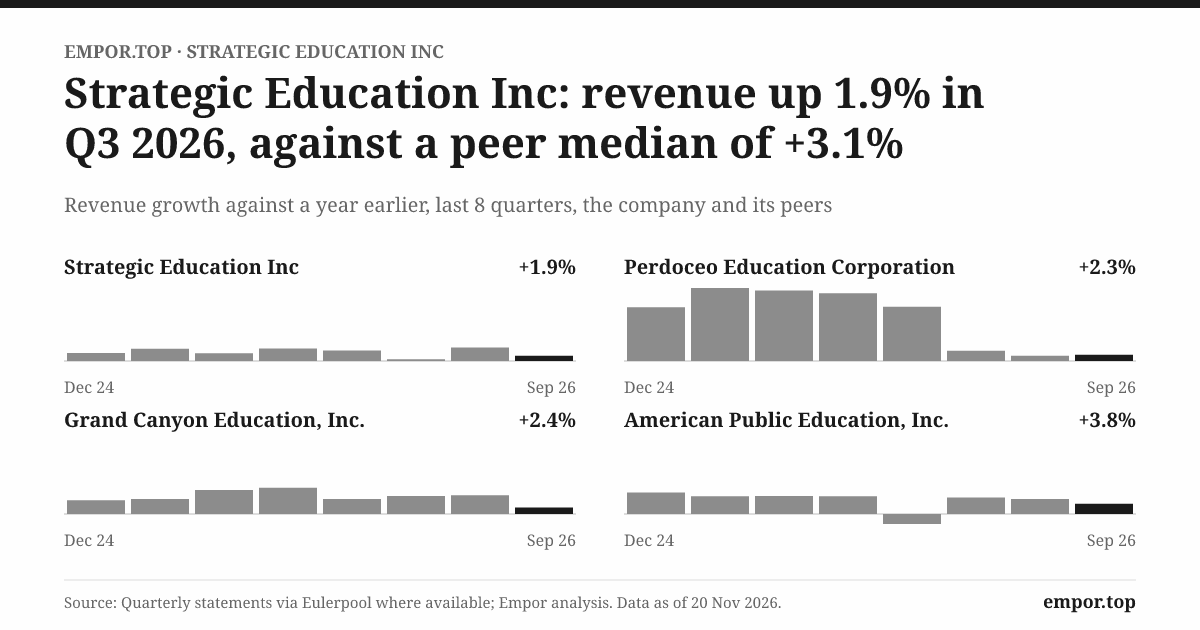
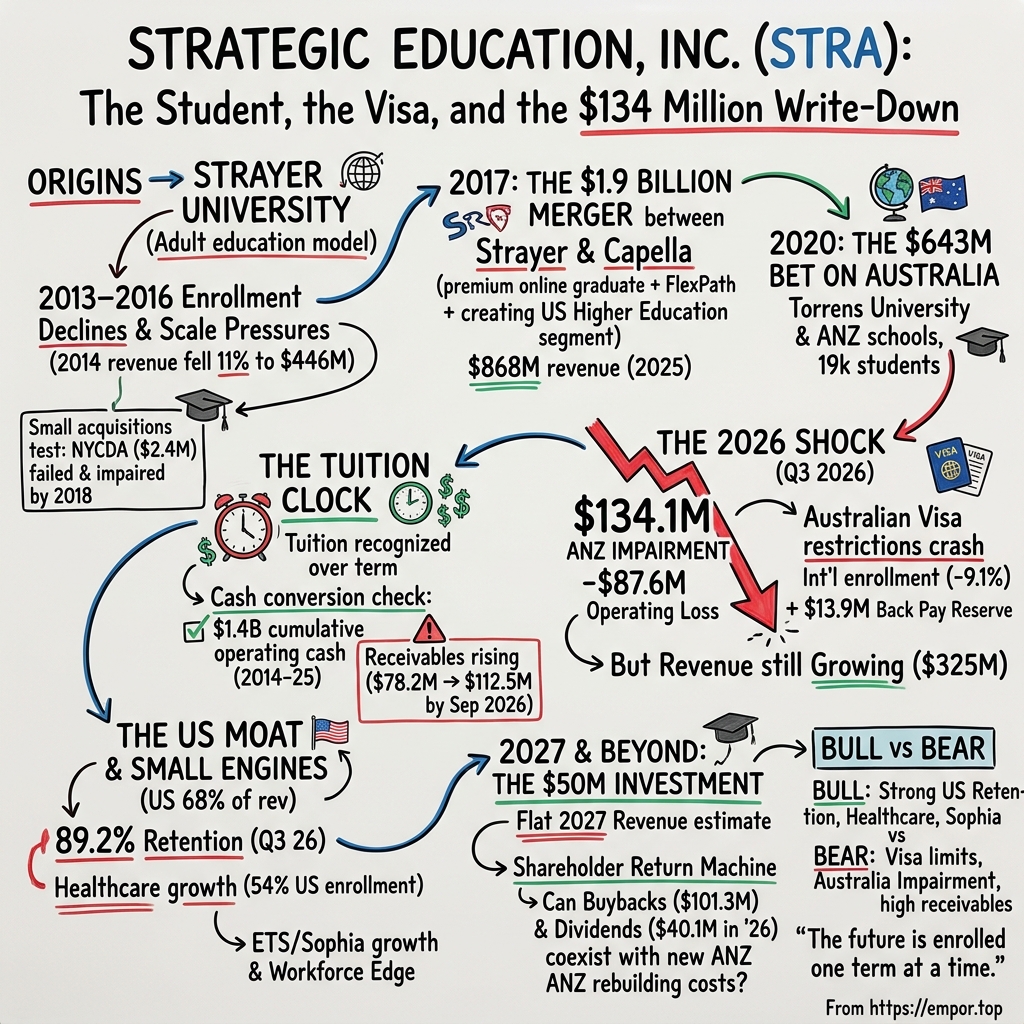
On November 5, 2026, Strategic Education told investors two things that did not seem to belong in the same press release. The first was ordinary, even reassuring. Revenue for the third quarter had come in at about $325 million, a little higher than a year earlier, and the company said its American universities had just posted the best student retention rate in their history.13 The second was a number with a minus sign in front of it. The company had lost $87.6 million at the operating line, because it had written down the value of its Australian and New Zealand business by $134.1 million.12
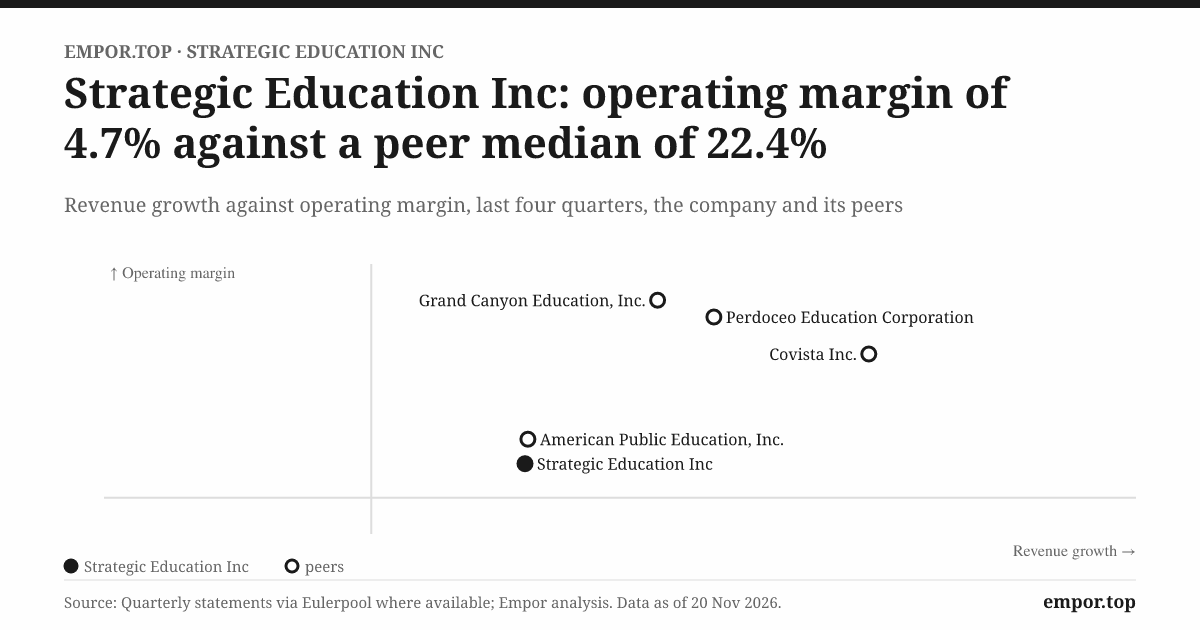
Strip the write-down out and the quarter looks almost dull. On management's adjusted, constant-currency basis, revenue was flat at about $320 million and operating income was about $50 million, a margin of a little under 16%.3 Put the write-down back in and the picture changes completely. The net loss for the quarter was about $98 million, or $4.68 a share.1 Add in a separate $13.9 million reserve for back pay owed to casual academics in Australia, booked over the summer, and the company's operating income for the first nine months of 2026 shrank to roughly $4 million.2 A business that had earned nearly $200 million of operating profit in 2025 had, on paper, almost nothing to show for three quarters of 2026.4
The write-down is an accounting entry, not a cheque. No cash left the building when the auditors and management agreed that the Australian business was worth less than the balance sheet said. But an impairment is still a confession. Goodwill is the premium a buyer pays above the value of the assets it can touch, and it sits on the balance sheet as a standing claim that the acquired business will earn enough in the future to justify that premium. When a company impairs goodwill, it is admitting that the future it paid for has become smaller. Management said exactly that: it had "lowered our near-term growth expectations for the ANZ segment."3
The reason was a government half a world away from the company's Herndon, Virginia headquarters. Australia had tightened its student visa system, and on the November call chief executive Karl McDonnell described visa approvals for prospective students slowing sharply, in some months falling as much as 80% from a year earlier.3 Enrollment in the Australian segment was down about 9%, and the decline, he said, was "entirely a function of international enrollment."3 Then came the line that moved the stock most: the company expected consolidated revenue in 2027 to be, most likely, flat.3
To understand why that sentence matters, it helps to know what Strategic Education actually is. It is not one university but a holding company for several. In the United States it owns Strayer University, founded in 1892 as a business college, and Capella University, an online institution founded in 1993.6 Together they form the U.S. Higher Education segment, which produced about $868 million of the company's $1.27 billion of revenue in 2025.4 In Australia and New Zealand it owns Torrens University Australia, Think Education and Media Design School, bought from Laureate Education in 2020.10 And it runs a smaller third business called Education Technology Services, home to Sophia, a low-cost online course subscription, and to employer education-benefit programs that steer workers toward its universities.4
Each of these businesses faces a different kind of weather. The American universities live and die by whether working adults believe a degree will pay off. The Australian schools now live and die partly by visa policy in Canberra. The technology business lives by whether employers and self-directed learners keep paying for cheap, flexible credit. In the third quarter of 2026, the American business held steady, the technology business grew, and the Australian business hit a wall.
That is the central tension of this story. The largest and most profitable part of Strategic Education is still a pair of American universities that serve adults with jobs and families. The most visible surprise of 2026 came from the business bought specifically to make the company less dependent on those two universities. Diversification was supposed to reduce risk. Instead, it introduced a new kind.
The stakes go beyond one quarter. Over the past decade, Strategic Education has grown mostly by buying things, first Capella and then the Australian schools, and has returned large amounts of cash to shareholders through dividends and, lately, aggressive share buybacks. The questions an investor now has to answer are uncomfortable ones. Can this company grow without another acquisition? Does the tuition model, which turns enrollment into cash with remarkable consistency, produce durable returns on the capital that has been poured into it? And can the cash returns continue while management spends about $50 million on new growth initiatives in 2027?3
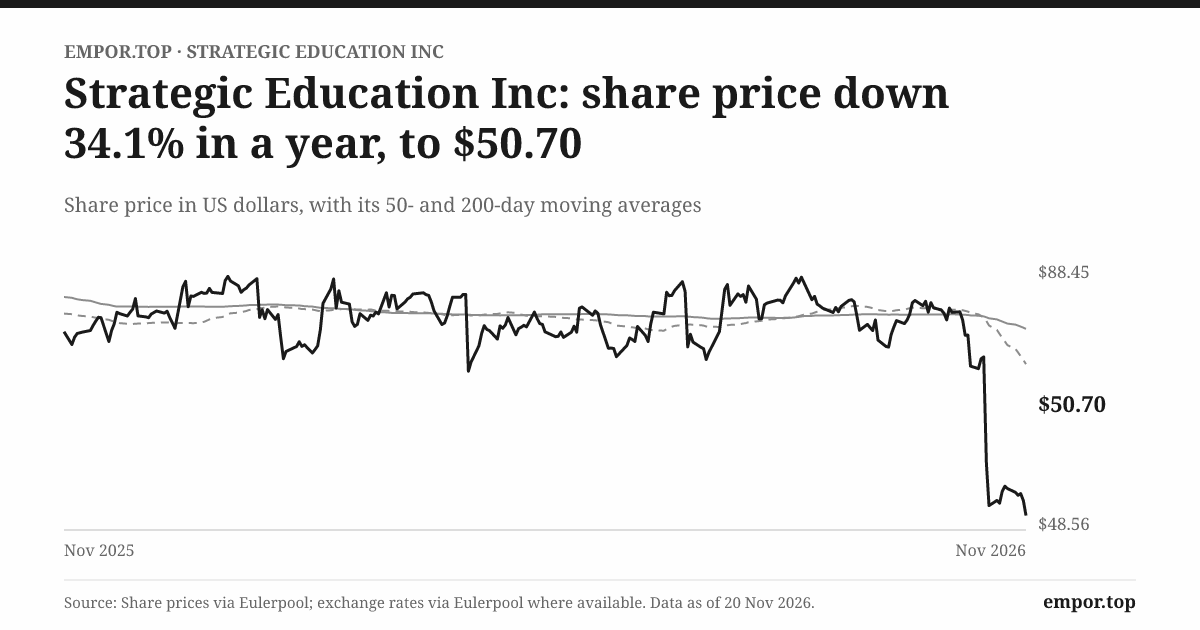
The market's first answer was skeptical. By November 20, 2026, the shares had closed at $50.70, about 41% below their 52-week high. The rest of this story is an attempt to work out whether that discount describes a temporary shock in Australia or a structurally slower company. To do that, it is necessary to go back to a moment when the core American business looked like it might be in permanent decline, because that is where the logic of every acquisition since began.
 Subscribe on LinkedIn
II. The enrollment decline that made scale matter
In 2011, Strayer Education was one of the most admired companies in for-profit education. It had revenue of about $627 million and net income of about $106 million, and it had spent the previous decade growing steadily by doing something unglamorous very well: teaching business, accounting and information technology to working adults at campuses across the eastern and southern United States, and increasingly online.5 Its chief executive, Robert Silberman, was a former Assistant Secretary of the Army who had run CalEnergy and worked at International Paper before taking over Strayer in 2001.12 He wrote long, candid letters to shareholders and reprinted an excerpt of Strayer's 1912 student catalog in every annual report, a signal that he saw the company as a steward of an old institution rather than a growth stock.6
Then the students stopped coming. Over the next four years, revenue fell by roughly 30%, from about $627 million in 2011 to about $434 million in 2015, and net income in 2013 collapsed to about $16 million.5 The decline did not come from one scandal or one rule. It came from a combination of things that hit the entire for-profit sector after the financial crisis: an improving job market that made adults less eager to go back to school, heavy federal scrutiny of for-profit colleges, and a growing public suspicion that some of these degrees were not worth the debt students took on to buy them. Silberman himself believed the most important economic driver of his business was what he called employment confidence, the willingness of an adult to invest time and money in a degree because they trust it will improve their job prospects.6
By 2013, Strayer's leadership was telling shareholders plainly that falling new-student starts would weigh on enrollment and revenue for years. That was also the year the company changed chief executives. Karl McDonnell, who had joined as president and chief operating officer in 2006 after working as an investment banker at Goldman Sachs, as chief operating officer of InteliStaf Healthcare, and in senior roles at companies including Walt Disney, became chief executive in May 2013.12 Silberman moved to executive chairman. The two men ran the company together for the next decade, which matters for the rest of this story: almost every major decision since, including both large acquisitions, was made by the same leadership pair.
The response was a mixture of retreat and reinvention. At the end of 2013, Strayer restructured "to better align our resources with our current student enrollments," and over 2013 to 2015 it closed physical campuses, including about 20 locations mostly in the Midwest.5 It cut undergraduate tuition by 20% for new students starting in the winter of 2014, and it introduced a Graduation Fund that gave bachelor's students one free course for every three they completed, a reduction of up to a quarter of the tuition needed for a degree.5 The point of the fund was clever: it rewarded persistence, so the discount flowed only to students who kept enrolling, which is exactly the behavior that makes a university economically viable.
The pain still showed up in the numbers. Revenue fell about 11% in 2014 to roughly $446 million, and average enrollment fell about 8% to around 40,000 students.5 By fall 2015, enrollment had stabilized at about 43,000, but the tuition cuts meant each student was bringing in less money than before.5 Strayer had stopped shrinking in headcount terms while still shrinking in dollars. It is a useful reminder that a university's revenue is the product of two things, students and revenue per student, and that a company can fix one while the other keeps sliding.
There were attempts to diversify beyond the traditional degree. In December 2011, Strayer had acquired the Jack Welch Management Institute, an online executive MBA built around the former General Electric chief's name and involvement.5 And in January 2016, it bought the New York Code and Design Academy, a non-accredited coding bootcamp that taught web and app development mostly in New York City.57
The coding academy is a small episode, but it deserves a closer look because it is the cleanest early test of a claim that would later justify much larger deals: that the company could buy a new educational format and grow it into a durable business. The headline price was tiny, $2.4 million in cash.7 The real economics were more complicated. Strayer also promised the sellers up to $12.5 million in earnout payments tied to the academy's results and $5.5 million tied to state regulatory permits, and it paid $4.6 million in retention money to the two founders.7 It paid $6.5 million of the permit-related consideration in 2016. Within about a year, the forecasts had soured. In 2017, the company wrote the earnout liability down to zero because revised revenue projections meant no earnout would ever be paid, and in 2018 it impaired the academy's goodwill and intangible assets.78
The episode was immaterial to the company's finances, but it showed something important. Strategic fit is not the same thing as a business. Bootcamps were fashionable in 2016, coding was a career skill employers wanted, and Strayer had distribution to working adults. None of that was enough to make the academy profitable. The bootcamp was eventually folded into a "non-degree programs" segment alongside similar coding investments that Capella had made.6
By 2017, Strayer had steadied. Its enrollment rose 8% in 2018 to about 47,700 students, the best operating year in a decade according to Silberman.6 But the company had learned that a single, well-run university with a strong brand could still lose almost a third of its revenue when the market turned. It needed broader programs, more graduate students, more online expertise and more scale over which to spread its fixed costs. One summer day in 2017, the answer called on the phone.
III. The $1.9 billion merger that put Capella beside Strayer
In August 2017, Kevin Gilligan, chairman and chief executive of Capella Education, called Robert Silberman to talk about combining their companies.6 Silberman later wrote that Strayer had not been looking for a large deal, partly because he believed mergers in higher education were especially risky. Universities, he argued, are cultural institutions, and culture is the hardest thing to judge from the outside. He had spent 18 years watching what he called "the train wrecks which can occur when academic institutions build cultures that do not prioritize student achievement."6 But he had admired Capella for years, knew its leaders personally, and had heard good things about it from Strayer faculty who had earned doctorates there.6
Capella was a different animal from Strayer. Founded in 1993 by Steve Shank, it had been fully online from the start and originally offered only doctoral degrees.6 By 2017 it served roughly 38,000 students across bachelor's, master's and doctoral programs in fields like nursing, psychology, social work, counseling, public health, education and business.6 Its student body was about two-thirds graduate and one-third undergraduate; Strayer's was the reverse.6 Capella also held something rare: approval from its accreditor and the U.S. Department of Education to offer direct-assessment, competency-based degrees through a format called FlexPath, in which students advance by demonstrating mastery rather than by sitting through a fixed number of class hours.6 Think of the traditional credit hour as paying for time in a gym; FlexPath pays for being able to lift the weight.
The two companies announced their merger on October 30, 2017, as an all-stock "merger of equals."9 Capella shareholders received 0.875 Strayer shares for each of theirs, a premium of about 22% to Capella's closing price on the last trading day before the announcement.9 The combined company had an equity value of roughly $1.9 billion, Strayer's holders would own about 52% and Capella's about 48%, and the new entity would be renamed Strategic Education, keep the STRA ticker, and be based in Herndon, Virginia, with a significant presence in Capella's home city of Minneapolis.9 Silberman became executive chairman, Gilligan vice chairman, and McDonnell chief executive.9 The deal closed on August 1, 2018, with roughly 10 million new shares issued to Capella's owners, effectively doubling the share count to about 22 million.67
The promise was specific. Management said the combination would generate about $50 million a year of cost savings, fully phased in within 18 months, by consolidating executive and corporate functions, some marketing and information technology.9 It also projected earnings-per-share accretion of 20% to 25% by 2019 and a $2.00 annual dividend.9 In his 2018 letter, Silberman went further and laid out a long-term ambition: assuming a reasonably healthy economy, the company should be able to grow revenue in the mid-to-high single digits annually, expenses more slowly, and earnings and cash flow in the low double digits.6
What Strategic Education did not do is equally important. It did not merge Strayer and Capella into a single university. Each kept its own accreditation, its own board and its own president.9 The listed company became a shared back office and capital allocator sitting above two separate institutions, which kept regulatory risk contained but also limited how deeply the two could be integrated. Management planned to swap expertise: Capella's online course design and competency-based model would flow to Strayer, while Strayer's physical support centers and its "Strayer Studios" course production, which rebuilt online courses with documentary filmmakers, would flow to Capella.6
The first year looked good. Silberman reported that on a pro forma basis, as if the companies had been combined throughout, revenue had grown about 3% in 2018 to roughly $924 million, and adjusted pre-tax operating income had grown about 14% to roughly $140 million.6 Under generally accepted accounting principles, however, 2018 showed an operating loss of about $23 million, because merger costs, purchase accounting and the amortization of acquired intangibles hit the income statement.8 Silberman anticipated that gap and promised to report adjusted figures alongside GAAP ones, adding a useful self-check: adjusted earnings per share "should almost always roughly equal our actual owners' distributable cash flow per share."6
So did the merger work? The honest answer is that it created scale but has not delivered the growth its architects described. Here is the cleanest test available. Silberman's pro forma 2018 revenue was about $924 million.6 In 2025, the two U.S. universities produced about $868 million of revenue, and the Education Technology Services segment roughly another $140 million, together a little over $1 billion.4 That is growth of only about 1% a year over seven years, well short of "mid to high single digits," and some of the ETS growth comes from businesses that were not part of the 2018 pro forma base. The U.S. segment earned about $102 million of operating income in 2025, a margin of roughly 12%.4 Those are respectable figures for a mature university operator. They are not the figures of a platform compounding at double digits.
The evidence has limits. Public filings do not isolate merger synergies as a clean standalone return, and the period included a pandemic, a hot labor market that historically pulled adults out of school, and a long wave of regulatory change. The cost savings were real; Silberman wrote that by the end of 2018 the company was "well on our way."6 But cost savings are a one-time step down in expenses, not a growth engine. Once they were banked, the combined U.S. business went back to depending on the same thing Strayer always had: enough working adults deciding to enroll, and staying.
The verdict on the 22% premium is narrower than it might seem. Measured against Capella's unaffected share price, it was a clear premium, but in an all-stock deal both sets of shareholders share the risk, and there is no clean acquisition comparison that would prove it expensive. What the record does show is that the merger bought breadth, a graduate-heavy student base, a competency-based format and a nursing and health portfolio that would later become the company's best U.S. growth area. What it did not buy was escape from the enrollment cycle. Two years later, with the U.S. business steady but not surging, management went looking for growth somewhere else entirely, and this time it paid cash.
IV. The $643 million bet on Australia
On July 29, 2020, in the middle of a pandemic that had shut borders around the world, Laureate Education announced that it had agreed to sell its Australian and New Zealand operations to Strategic Education.10 The timing was unusual. International student travel to Australia had largely stopped, yet Strategic Education was buying a portfolio whose growth had depended heavily on foreign students. The seller was motivated: Laureate said the sale was "an outgrowth of the process Laureate initiated earlier this year to explore strategic alternatives for each of its business units," and Goldman Sachs ran the process.10
What Strategic Education bought was three institutions with about 19,000 students. Torrens University Australia, founded by Laureate in 2014, was the first new university to open in Australia in 20 years. Think Education, a vocational and higher-education provider, had joined Laureate in 2013. Media Design School in Auckland, which had joined in 2011, taught design and creative technology.10 Their programs spanned business, education, hospitality, design and health.10 McDonnell's comment at the time was brief and enthusiastic: the company had "been impressed by the growth and impact" of the three institutions.10
The price was $642.7 million, paid in cash and subject to adjustments for working capital, debt and forecasted performance.10 The deal closed on November 5, 2020, and after those adjustments Laureate received about $650 million after fees and expenses.11 This was a very different transaction from the Capella merger. Capella had been paid for with shares, so Capella's former owners shared the risk of the combination. Torrens was paid for with cash, so Strategic Education's shareholders bore all of it. The company's cash balance shrank sharply that year and its borrowings rose, and it took on exposure to an entirely different regulatory system, currency and labor-law regime.4
How expensive was it? This is the question investors most want answered and the one the public record answers least well. Neither Laureate's announcement nor its closing release disclosed the profits of the Australian and New Zealand business at the time of sale.1011 So there is no clean way to compute the multiple Strategic Education paid against the earnings it bought. What is possible is a hindsight check. In 2025, five years after the purchase, the segment produced about $257 million of revenue and $35.5 million of operating income.4 The purchase price is therefore about two and a half times that later revenue and about 18 times that later operating income. Neither figure proves an overpayment. Currency movements, the cash that came with the business and five years of reinvestment all muddy the comparison. But an 18-times multiple of operating profit, earned five years after the purchase, implies a pre-tax return of roughly 5 to 6% on the price paid. That is a thin return on a cash acquisition, before the 2026 write-down.
The growth thesis is easier to test than the price. Strategic Education bought a business with about 19,000 students.10 At the end of the third quarter of 2026, the segment had about 17,100, down about 9% from a year earlier, while revenue fell about 7% to $64 million and operating income slipped to about $10 million from $12.5 million.3 Six years after the purchase, the business had fewer students than when the company bought it.
Why? The answer is almost entirely policy. Australia's international education industry is one of the country's largest service exports, but it became politically contentious as student numbers surged after borders reopened, adding to pressure on housing and migration. The federal government responded by slowing and tightening student visas. On the second-quarter call in July 2026, McDonnell told analysts that Torrens was still under the cap the government had set, but that visa approvals were slow "for whatever reason," while expressing encouragement about domestic student growth.13 By November, the tone had changed. Visa approvals had slowed so much that in some months they were down as much as 80%, and the government had effectively closed the market for international students already in Australia to transfer between institutions by requiring them to obtain a new visa to switch schools.3 McDonnell said he was "a little surprised" by the transfer rule.3
That distinction between international and domestic students is the most important nuance in the Australian story, and it cuts in management's favor. The decline, McDonnell said, was "entirely a function of international enrollment."3 Domestic new enrollment had grown every quarter of 2026, including 9% in each of the second and third quarters, and domestic students now accounted for close to 70% of new enrollment in Australia.3 In other words, the Australian students Torrens recruits at home are coming in growing numbers; the ones it recruits from abroad are being blocked at the border. The underlying demand for what Torrens teaches does not appear to have collapsed. What collapsed was access to one large group of customers.
That nuance does not rescue the original thesis, though. A business bought in part for its access to international students has discovered that this access is controlled by a government that can change the rules faster than a university can adapt. This is the core lesson of the Australian deal. In the U.S., Strategic Education's universities are exposed to federal financial-aid rules, but those rules affect demand indirectly. In Australia, a visa decision can switch off a recruiting channel almost overnight. Management cannot control that growth pool, and the impairment is the company's acknowledgment that it had been valuing the business as if it could count on it.
There was also a second, entirely unrelated Australian problem. A long-running dispute with the Fair Work Ombudsman, Australia's workplace regulator, centered on whether casual academics at Torrens had been properly paid for the time they spent marking student work. Management's position was that grading is part of teaching a course and therefore covered by existing pay.13 The courts ultimately disagreed. After the Full Federal Court reinstated the regulator's compliance notice, the High Court denied the company special leave to appeal on August 6, 2026, and the company recorded a $13.9 million reserve for estimated back pay, payroll taxes, benefits and interest covering 2020 to 2025.2 McDonnell noted that the matter dated back to the close of the transaction in 2020, which is to say it was a liability the company effectively bought along with the schools.13
Management's recovery plan now rests on domestic growth. The company plans to expand in Adelaide, add new health science programs, open a new campus in Perth in late 2027 and launch asynchronous online programs.3 It expects new-student growth in Australia to turn positive in the second half of 2027, and total enrollment to return to growth in early 2028.3 That timeline is plausible given the domestic trend, but it is a forecast, and the company has already been surprised once by how severe the visa restrictions became. The question that carries forward is whether domestic students can grow fast enough to make the Australian business less dependent on a policy-sensitive source of demand. To judge that, and the American business too, it helps to understand exactly how a student turns into cash.
V. The tuition clock: when enrollment becomes cash
Picture a 34-year-old nurse in Ohio who decides to finish her bachelor's degree through Capella, or an office manager in Atlanta who enrolls at Strayer for an MBA. Each signs up for a term, often financed with a federal student loan or partly by an employer's tuition-assistance benefit. Each receives instruction over several weeks. And each, before signing up for the next term, must settle any outstanding balance or make an arrangement to pay it.2 Multiply that sequence by about 85,000 American students and 17,000 Australian ones, and you have the engine of Strategic Education.3
The accounting follows the teaching. Tuition is recognized as revenue over the period of instruction, not when a student enrolls or pays.4 In Australia, tuition is set by course and billed by the subjects a student enrolls in.4 At Capella, new students can start in any month, and FlexPath students pay a flat amount for a period of time and take as many courses as they can complete.4 Revenue per student therefore moves with several dials at once: how many courses each student takes, which programs they are in, the posted price, and the discounts and scholarships the company offers.4 On the July call, an analyst pointed out that U.S. revenue per student had risen because the company was giving fewer scholarships and discounts, and chief financial officer Daniel Jackson agreed.13 That is a revealing detail. In this business, the most effective price increase is often simply discounting less.
The cost side is straightforward. The company spends money on faculty and student support, course materials, facilities, technology, marketing to recruit new students, and general administration.4 It does not report research and development as a separate line; course development and technology investment are buried within broader operating costs.4 Capital spending is modest, about $44 million in 2025, or roughly 3.5% of revenue.4 The workforce has been shrinking even as revenue grew: the company had about 6,100 employees at the end of 2025, down about 5.5% from a year earlier, while revenue rose about 4%.4 That combination, fewer people producing more revenue, is a sign of productivity harvesting. It boosts margins, but it also means some of recent profit growth came from cost discipline rather than demand.
Now the part that makes this business attractive to investors: it converts profit into cash unusually well. Over the 12 years from 2014 to 2025, the company earned about $700 million of net profit and generated about $1.4 billion of cash from operations, roughly twice as much.4 In 2025 alone, operating cash flow was about $198 million against net income of about $127 million, and free cash flow after capital spending was about $154 million.4 Cash from operations came to about 88% of earnings before interest, taxes, depreciation and amortization, a measure of how much of the underlying operating profit actually arrives as cash.4
Why does cash run so far ahead of reported profit? Three mechanisms explain most of it. First, the acquisitions created large non-cash charges. When a company buys another, it books the acquired brands and student relationships as intangible assets and then amortizes them, which reduces reported profit without consuming any cash. Second, a meaningful part of executive and employee pay comes in stock, which is also an expense without a cash outflow. Third, timing: tuition arrives around the start of a term, often from federal aid disbursements, while many costs of teaching that term are paid as it goes. Over the decade, the company typically had negative working capital, meaning its customers and suppliers effectively funded part of its operations.4
But a tuition clock only keeps ticking if students keep enrolling. The model is not a subscription with a contract; much of the student relationship renews one term at a time, and the company discloses no recurring-revenue share, standard contract term or minimum commitment.4 A student who drops out takes all future revenue with them. That is why persistence, the share of students who continue from one term to the next, is as much an economic number as an academic one.
And there is one place where the cash machine is showing strain. Who pays late? Mostly students. They are the company's main customers, a diverse group with no single dominant payer, and most of them use federally funded financial aid.4 When aid does not cover the full bill, or when a student's eligibility changes, the student owes the balance directly. The company estimates how much of those balances it will never collect using the age of each receivable and its historical collection rates.4
At the end of 2025, net tuition receivables, what students owed after subtracting the allowance for bad debts, stood at about $78 million. By September 30, 2026, the figure had risen to about $112.5 million.2 Behind that net number was a gross balance of about $158 million and an allowance of about $46 million, meaning the company expects to write off more than a quarter of what students currently owe.2 In the first nine months of 2026, it wrote off about $41.8 million net of recoveries, slightly more than the $41.0 million in the same period a year earlier.2 Over the longer run, receivables have crept up as a share of sales: in 2014, they equaled about two weeks of revenue; by 2025, more than three weeks.4
There is a reassuring counterpoint. Bad-debt expense in the third quarter was 4.6% of revenue, a hair better than 4.7% a year earlier.2 And receivables in this business are seasonal, swelling around term starts and falling as aid disburses. A September balance could simply reflect the timing of fall enrollment. The problem is that the company does not publish an aging schedule showing how long balances have been outstanding, or what share of September's receivables it subsequently collected.2 Without that, an investor cannot tell whether the increase is timing or deterioration.
The right conclusion is a calibrated one. The tuition model has produced strong cumulative cash conversion for a decade, and it supports the company's dividends and buybacks. But it is not a fortress. It depends on new starts, on students continuing, and on collecting what they owe, and the recent rise in receivables turns collection from an accounting footnote into a live question. Ultimately, all three of those depend on one thing: whether students keep choosing Strayer and Capella over everything else they could do with their time and money.
VI. The moat is tested one term at a time
Go back to that office manager in Atlanta. She is 38, has a job, two children and maybe 10 free hours a week. She is weighing an MBA from Strayer against a cheaper online certificate, a course at the community college down the road, an online program from her state's flagship public university, a free or nearly free credential from her employer's learning platform, and the option of doing nothing at all. Every one of those alternatives is a click away. That is the competitive arena Strategic Education's largest business operates in, and it is a hard one.
Start by putting the core business in proportion. U.S. Higher Education generated about $868 million of revenue in 2025, roughly two-thirds of the company total, and about $102 million of segment operating income, nearly three times the roughly $35.5 million the Australian business earned.4 Whatever happens in Australia, the investment case rises or falls with Strayer and Capella. In the third quarter of 2026, that business had about 84,700 students, down 1% from a year earlier, with revenue flat at about $214 million and operating income of about $22 million, a margin of about 10%.3
The strongest evidence that these universities have something durable is operational. In the third quarter, U.S. student retention reached 89.2%, which McDonnell called "a new all-time high for U.S. Higher Education."3 It had already hit a record of about 89% in the second quarter.13 For a working-adult university, that is the single most important behavior to watch, because a retained student is the cheapest revenue there is. The company already paid to recruit her; every term she stays is revenue without another marketing bill.
The second piece of evidence is distribution through employers. Employer-affiliated students, those who enroll through a corporate partnership or tuition-benefit program, made up about 35% of U.S. enrollment in the third quarter, up two percentage points from a year earlier.3 On the July call, McDonnell said roughly half of U.S. student acquisition now comes through employer channels, with the rest from paid search and outdoor advertising.13 That matters because employer channels are cheaper and more reliable than search advertising, and employees whose tuition is partly paid by their employer tend to stay enrolled. The third piece is healthcare. Health programs, led by Capella's nursing and related degrees, accounted for about 54% of U.S. enrollment in the third quarter, up from 49% a year earlier, with healthcare enrollment growing about 9%.3
Now the contrary evidence, and it sits right beside the good news. Total U.S. enrollment still fell. The reason is that students who come in without an employer connection have been declining for eight consecutive quarters, down about 4% in the third quarter.3 So the business is growing in its healthcare niche and through employers while shrinking in the open market where it competes head-to-head for individual adults through advertising. That is a narrower, more specific franchise than "a leading online university." McDonnell said he expects the unaffiliated decline to keep moderating and possibly reach break-even or growth by the end of 2027, and he expects net positive new-student growth in 2027.3 Those are expectations, not results.
Who are the rivals? Among public companies, Grand Canyon Education, which provides services to Grand Canyon University, and Perdoceo Education, which owns Colorado Technical University and American InterContinental University, are online-focused peers of comparable scale.1415 But the comparison is imperfect. Their business models differ: Grand Canyon is a services provider to a separate nonprofit university, and Perdoceo's mix is different again. The real competitive set is much wider: hundreds of traditional nonprofit and public universities now run large online programs, community colleges are cheaper, and non-degree providers sell short, career-focused credentials. Strategic Education's own filings describe the market as fragmented and highly competitive.4
Here the logic of competition is unforgiving. Students hold the power. They have many alternatives, they can compare prices, and before they enroll they face almost no switching costs. Rivals are numerous. Substitutes, from employer training to short credentials, are multiplying. The main barriers to entry are accreditation and the rules for participating in federal financial aid, which take years to satisfy and keep out casual newcomers. But those barriers protect the right to compete, not a share of students. Being accredited does not make anyone enroll.
What about the deeper sources of advantage, the kind that let a company earn above-average returns for decades? Employer distribution looks like the most plausible one. The company says 83 corporate agreements cover about 4 million employees; if they steer workers toward Strayer and Capella, that is a channel a new entrant cannot easily replicate.3 But the company does not disclose how concentrated those agreements are, how often they renew, or whether employers also offer competitors' programs alongside. Many corporate education-benefit platforms are explicitly multi-provider. That is the classic test of switching costs, and the data needed to pass it is not published. Brand and reputation help too, especially Capella's standing in nursing and Strayer's history of more than 130 years. There is no network effect in any meaningful sense: a new student does not make the degree more valuable for the next one.
History is the best stress test. Strayer had a famous brand, years of operating history, a disciplined management team and strong cash flow in 2011. It still lost nearly a third of its revenue in four years when demand turned.5 That episode does not prove the same thing will happen again; the company is now broader, more online and more employer-connected. But it rejects the strongest version of the moat claim, that brand and longevity protect enrollment. What remains is a narrower, more defensible claim: Strayer and Capella have built a real operational edge in retaining students and in recruiting through employers and healthcare, which may support stable enrollment and margins, but has not yet been shown to produce pricing power or share gains across a full cycle.
The practical watchpoints follow directly. Are U.S. new enrollments growing? Does persistence stay near record levels? Is revenue per student holding up without more discounting? And is the growth coming from the employer and healthcare channels, or finally from the open market too? Those answers will arrive term by term. Meanwhile, management is betting that two smaller businesses can grow fast enough to carry the company while it waits.
VII. The small growth engines management wants to scale
In the years after the Capella merger, Strategic Education built a third leg. Today it is called Education Technology Services, and on the November 2026 call it was the part of the company McDonnell clearly most enjoyed talking about.3 The segment sells two things. One is Sophia, an online platform that offers low-cost, self-paced general education courses for a monthly subscription, which students can then transfer for credit to a degree program. The other is employer education-benefit programs, most visibly a platform called Workforce Edge, which manages tuition benefits for corporations and, along the way, introduces their employees to Strayer and Capella.4
The growth is real. In the third quarter, ETS revenue rose about 12% to roughly $43 million, while Sophia's revenue rose about 20% to about $21 million and its average subscriber count rose about 22%.3 Workforce Edge covered 83 corporate agreements and about 4 million employees, and enrollments flowing from it into Strayer or Capella rose about 4% to around 4,000 students.3
The more striking number is profitability. ETS earned about $18 million of operating income in the third quarter, a margin of about 42.5%.3 Compare that to the U.S. universities, which earned about $22 million on five times the revenue.3 In July, McDonnell said ETS "now represents nearly 40% of SEI's consolidated income from operations."13 That is the surprise inside this company. Investors tend to think of Strategic Education as a university operator with a small tech side project. By profit, the side project has become nearly as important as the universities themselves.
Why are the margins so high? Sophia is close to a software business. Once a course is built, adding another subscriber costs very little, and there are no faculty assigned to individual students in the way a traditional class requires. Employer programs are distribution businesses with low marginal costs. The appeal is obvious: a fast-growing, high-margin business that also feeds students to the universities.
But proportion matters. ETS revenue is still a small fraction of the U.S. universities' and well under a fifth of consolidated revenue. A 12% growth rate on roughly $43 million a quarter adds far less in absolute dollars than a 1% change in U.S. Higher Education revenue subtracts. Even the fastest-growing piece of the company cannot by itself offset a sustained decline in the core.
And the growth has already slowed. In the second quarter, Sophia's revenue had grown about 27% and its subscribers about 32%.13 By the third quarter, those rates had fallen to about 20% and 22%.3 When an analyst from Truist asked why, McDonnell said the slowdown was "almost entirely a function of anniversarying that large corporate client," and that excluding that client, direct-to-consumer subscription growth was "still close to 20% and growing."3 The company did not name the client or quantify its share of revenue, which leaves investors unable to judge how concentrated Sophia's growth was.3 There was another uncomfortable exchange in July, when an analyst from BMO asked whether students using AI to complete Sophia's assessments, and the negative press around it, explained slower growth. McDonnell said the company takes academic integrity seriously and is adding enhancements, but did not say whether it had slowed growth.13 A low-cost, self-paced course platform is precisely the kind of product most exposed to students outsourcing work to chatbots.
Healthcare is the other growth vector, and it is not speculative. It already accounts for more than half of U.S. enrollment and is growing about 9%.3 About 38% of healthcare students come through employer partners, which ties the two growth stories together: hospital systems paying to upgrade their nurses' credentials.3 Healthcare has a structural tailwind in chronic staffing shortages and licensing requirements that make degrees necessary rather than optional. It also has a structural risk, because nursing programs face close scrutiny from licensing boards and need clinical placements that limit how fast they can scale.
Management plans to pour money into all three of these areas. It expects to spend about $50 million on growth investments in 2027, spread across ETS, U.S. healthcare and Australian domestic programs, while productivity savings offset nearly half of that cost and total operating expense growth is limited to about 2%.3 That is a meaningful commitment for a company that earned about $196 million of operating income in 2025.4
The test here is commercialization, not reach. Four million employees covered by employer programs is a large number, but only about 4,000 enrolled through Workforce Edge in the quarter.3 Subscriber growth is encouraging, but what matters is paid revenue and margins. The company's own history urges caution about calling any new format a durable growth engine before it is proven at scale: the coding academy fit the strategy too. The fair verdict is that ETS and healthcare are plausible growth vectors with real revenue, already contributing meaningfully to profit. They are not yet large enough to replace the core, and the investment plan will reveal whether they can grow without their margins being eaten.
There is also a two-sided question looming over all of it. Artificial intelligence could make course design and student support far cheaper, which would help margins. It could also change how prospective students find universities, as people increasingly ask chatbots rather than search engines which program to choose. On the November call, McDonnell said, "I can't say that we've really seen any adverse impact from it yet," and noted that admission yield and the ratio of acquisition cost to lifetime value were near all-time highs.3 That is an absence of evidence, not evidence of absence. Which brings the story to the people making these bets, and whether their record suggests they will see the next problem sooner than they saw the last one.
VIII. Can management earn back the Australian write-down?
Karl McDonnell does not look like the archetype of a for-profit education executive. His background is in investment banking and healthcare staffing, and he earned his MBA at Duke.12 He has spent two decades at the company and has served on the board since 2011.12 His style on earnings calls is calm, measured and brief. He does not oversell, and he does not dwell on bad news either. On November 5, 2026, he had a lot of bad news to deliver.
His longtime partner has been Robert Silberman, who remains chairman.12 Daniel Jackson, the chief financial officer, steered the company through the Capella merger and integration alongside McDonnell.6 This is a leadership team with unusual continuity. That cuts both ways: it has institutional memory, and it owns every major decision of the past decade, including the Australian deal it just wrote down.
How have they been paid? In 2025, McDonnell's total compensation was about $5.67 million, made up of about $1.02 million of salary, $1.39 million of cash incentive pay and $3.25 million of stock awards.12 It had been about $5.4 million in 2023, while GAAP net income rose from about $70 million to about $127 million over those years.124 Pay was broadly stable while earnings rose, which suggests a compensation system that is not extravagant. Incentives combine a salary, a cash bonus tied to pre-set corporate goals, and equity that vests over time and partly on performance.12 Shareholders have broadly endorsed it; more than 98% of votes cast at the 2025 annual meeting supported the say-on-pay resolution.12 McDonnell beneficially owned about 159,000 shares as of early 2026, roughly 0.7% of the 22.6 million shares outstanding on the record date: meaningful personal wealth, but not an owner-operator stake.12
The governance picture is clean in the places investors usually worry about. Ten of the twelve director nominees in 2026 were independent; the other two were McDonnell and Silberman.12 The company reported no related-party transactions in 2025 requiring disclosure.12 In February 2025, the audit committee dismissed PricewaterhouseCoopers and appointed Deloitte & Touche, with no disagreements or reportable events, and Deloitte gave clean opinions on the 2025 financial statements and internal controls.124 There is no controlling shareholder; the largest holders are institutions such as Bank of Montreal and Dimensional Fund Advisors, the latter reporting about 6.6% as of September 30, 2026.1216
The more revealing test of credibility is how management talked about Australia as the problem unfolded. Compare the two most recent calls. In late July, McDonnell told analysts Torrens was still under the government's visa cap, that approvals were slow "for whatever reason," and that the company was encouraged by domestic growth.13 He also said the last quarter would be the low point for revenue growth, and the company was still discussing a target of about 200 basis points of adjusted margin improvement for 2026.13 When an analyst asked whether that target included the Fair Work charge, the answer trailed off as McDonnell said they were waiting for the High Court to rule.13
Three months later, the language was sharper and the numbers were worse. Visa approvals were down as much as 80% in some months, the transfer market was effectively closed, the 2026 outcome was "unlikely" to land inside the company's notional outlook, and 2027 revenue was likely flat.3 Management lowered its near-term growth expectations enough to impair $134 million of goodwill and intangibles.3 To its credit, management then gave specifics: the domestic growth rates, the share of new enrollment from domestic students, a timeline for new-student and total-enrollment recovery, the list of growth investments and the expected expense growth.3 Those are concrete commitments investors can check.
The honest verdict is mixed. Management did eventually recognize the scale of the Australian problem and quantified it clearly, rather than drip-feeding small charges over many quarters. But it was late. In July, a quarter before the write-down, the tone was still that visa delays were a timing nuisance. The court loss on marking pay was also foreseeable for months; the company's position that "grading is part of teaching" lost at the Full Federal Court before the High Court declined to hear it.213 And the reserve may not be the end of it: remediation is being prepared and discussions with the regulator continue, so the final cost could exceed the estimate.2
There is a separate overhang at home. Several putative class actions over a 2026 data-security incident in the U.S. were consolidated; the company moved to dismiss and said it could not predict the outcome.2 No amount has been reserved. For a company that holds the financial and personal data of tens of thousands of students who use federal aid, a breach is not only a legal risk but a regulatory one.
The measure of management from here is simple to state and hard to meet. The company promised that $50 million of investment, partly funded by productivity savings, will restore growth to its notional rates in 2028 and beyond.3 If 2027 passes with that investment producing growth and without another round of large charges, the Australian write-down will look like a painful one-time correction. If it brings more impairments or restructurings, the pattern will look less like bad luck and more like a habit of paying for growth that does not arrive. And while that test plays out, management has been making another choice that deserves just as much scrutiny: what to do with the cash.
IX. The cash return machine meets a new investment bill
In the second quarter of 2026, Strategic Education bought back about 421,000 of its own shares for roughly $33 million, an average of close to $78 a share.13 In the third quarter, it bought about 347,000 more for $28.5 million, about $82 a share.3 Across the first nine months of the year, it spent $101.3 million on buybacks and another $40.1 million on dividends.2 Then, after the quarter ended, the board extended the repurchase authorization through 2027.2 On November 20, the stock closed at $50.70. Every share the company retired over the summer would have been about a third cheaper if it had waited.
That is hindsight, and hindsight is cheap. Nobody, including management, knew in August that the Australian visa squeeze would force an impairment. But the arithmetic is a useful way into the larger question of this section: how well has Strategic Education used the cash its tuition model throws off, and can it keep paying shareholders at the current rate while spending more on growth?
Start with the long record. From 2014 through 2025, the company generated about $1.1 billion of free cash flow.4 About $431 million of that, roughly 41%, went out as dividends, which only began in 2017 and now run at about $2.40 a share a year.413 The company's cash pile ended that period only about $53 million larger than where it started.4 The rest of the money went three places. The biggest was the Australian purchase, which consumed roughly $640 million of cash in 2020.11 The second was paying down the revolving credit borrowings used around that deal. The third, increasingly, was repurchasing stock. From 2021 through 2025, roughly $660 million flowed out through financing activities, and dividends accounted for less than half of it.4
The dividend itself has not always been comfortably covered. In 2021 and 2022, as earnings sagged after the pandemic, the company paid out more in dividends than it earned, reaching about 128% of net profit in 2022.4 It kept the dividend anyway, which is a statement of confidence in the cash flow, and cash flow did cover it even when reported profit did not. By 2025, the payout had fallen back to about 45% of net profit as earnings recovered.4 Today, at about $0.60 a quarter, the dividend amounts to roughly a 4.7% yield on the current share price.13
Now put 2026 beside the new spending plans. In the first nine months of the year, buybacks and dividends together came to about $141 million, slightly more than the roughly $137 million of free cash flow the company generated over the same period.23 For the first time in a while, the company returned more cash than it generated in free cash flow, and it did so in the quarters immediately before announcing about $50 million of growth investment for 2027, only partly offset by productivity savings.3 At the end of September, it held about $139 million of cash and marketable securities.2
The balance sheet gives management room. The company had no borrowings under its $250 million revolving credit facility at the end of September and was in compliance with all its covenants.2 The facility allows additional debt for acquisitions up to a leverage cap.2 But "no debt" is not quite "no obligations." The company carries about $109 million of lease liabilities, mostly for campus and office space.4 It has an unresolved Australian back-pay bill that may exceed the $13.9 million already reserved, an unquantified data-breach lawsuit and a segment whose returns have just been marked down.2 And roughly a fifth of its revenue comes in currencies other than the dollar, mostly Australian dollars, with no hedging; a 10% adverse move would have cut 2025 revenue by about $25 million.4
The capital allocation record, viewed whole, is uneven. The Capella merger, paid for in stock, broadened the platform and built the healthcare business that now drives U.S. enrollment, but it did not deliver the growth rate its architects described. The Australian purchase, paid for in cash, has produced a thin return and a nine-figure impairment. The coding academy was trivial in size and a clear failure, and it should not be allowed to stand in for the much larger deals. Taken together, they suggest a management team that is disciplined about costs and dividends, but whose acquisitions have produced less than promised.
Which brings up the question a skeptical activist would ask. If management believes the shares are cheap, buying them back is a reasonable use of cash, especially when the alternative is another acquisition. But a buyback only creates value when the company pays less than the shares are worth, and the company's estimate of that worth was clearly too high in the summer. Should repurchases continue at the 2026 pace when the share price has fallen, earnings contain large charges, and the company is about to raise its investment spending? Or should the board slow buybacks until it can see whether the $50 million of investment produces the growth management expects? Neither answer is obviously right. What is clear is that the cash machine, which has comfortably funded dividends for a decade, is now being asked to fund dividends, buybacks and a new growth push at the same time, from a base of revenue that management expects to be flat next year. That brings the story to the price the market has put on all of it.
X. Analysis & Bear vs. Bull Case
On November 20, 2026, Strategic Education's shares closed at $50.70, down about 41% from their 52-week high of about $86. With about 22 million shares outstanding after this year's buybacks, that puts the company's market value at roughly $1.1 billion, and with about $139 million of cash and no bank debt, the enterprise value is a little under $1 billion.12
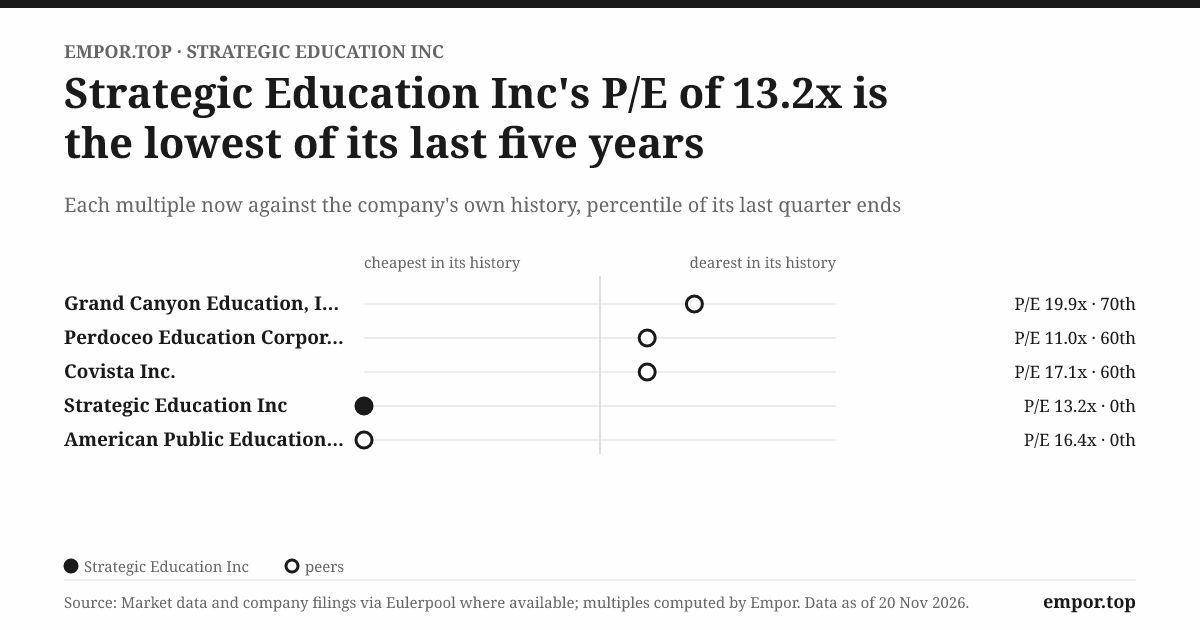
What is the market paying for? The answer depends entirely on which earnings you use. Market data services quote a price-to-earnings ratio of about 13 times, against a five-year median of about 25 times, which makes the shares look like they are trading at half their usual valuation. But that ratio rests on an earnings figure that does not match the company's reported results. Over the last four quarters, GAAP earnings per share were only about $0.20, because of the impairment, so the strict GAAP multiple is in the hundreds and means nothing.1 On 2025's GAAP earnings of $5.55 a share, before any of this year's problems, the shares trade at about nine times.4 And 2025's free cash flow of about $154 million is about a seventh of the current market value.4 For comparison, Grand Canyon Education traded at about 10 times estimated 2026 EBITDA and Perdoceo at about 11 times earnings in late October, on different dates and bases.1718 By most measures, then, Strategic Education is valued roughly in line with, or modestly below, its online-education peers and well below its own history. The market is no longer paying for growth. It is paying for a business it suspects will stay about the size it is.
The bull case starts with the core. U.S. Higher Education is the largest profit contributor, retention is at record highs, healthcare enrollment is growing and now accounts for more than half of U.S. students, and employer channels are bringing in a rising share of them.3 ETS is growing at double digits with margins above 40% and is already a large contributor to operating income.313 The cash model has, for a decade, converted reported profit into about twice as much operating cash, supporting a dividend even through years when earnings dipped.4 Australia's decline is driven by visa policy rather than by a collapse in demand, and domestic new enrollment is growing.3 If 2027 delivers U.S. new-student growth, ETS keeps compounding, and Australian domestic growth starts to offset international losses, earnings could return to 2025 levels or better, and the shares would be priced at a single-digit multiple of normal earnings.
The bear case starts with the same numbers seen from the other side. U.S. enrollment is still shrinking, because unaffiliated students have declined for eight straight quarters.3 Australian enrollment is below where it was when the company bought the business six years ago, the goodwill has been impaired, and the visa regime is controlled by a government that has shown it can tighten again.310 The back-pay reserve may not be final.2 Tuition receivables have risen sharply, and the company does not publish an aging schedule.2 Sophia's growth is decelerating and partly depended on an unnamed corporate client.3 Management expects flat revenue in 2027 while spending more, and has been returning more cash than it generates.23 In this telling, the company is a mature, ex-growth university operator whose acquisitions have not worked as promised, and whose cash returns are about to be squeezed.
The industry structure explains why the bear case cannot be dismissed. Students have many alternatives, substitutes are multiplying, and rivalry is intense in a fragmented market; accreditation and federal-aid eligibility keep out newcomers without protecting market share. The most powerful "supplier" is unusual: the federal government, which provides student aid, and the Australian government, which controls who can get a visa. Historically, about three-quarters of Strayer's students used federal aid.5 That makes regulatory and political shifts, in both Washington and Canberra, the single largest external risk. When a BMO analyst asked on the November call about a potential Democratic Congress, McDonnell said the company had "a high degree of confidence" in its regulatory posture.3 That is reassurance, not evidence.
Against Hamilton Helmer's seven sources of lasting competitive advantage, the picture is modest. The shared back office, technology platform and marketing budget offer some scale economies, and FlexPath's direct-assessment approval is rare but not exclusive. As discussed, switching costs, brand and retention offer only limited advantages; there is no network effect or counter-positioning. The most credible advantage is process power, the accumulated operational skill of keeping working adults enrolled, which the record-high retention suggests is real. But process power is the weakest of Helmer's moats, because it can be copied with time and money.
The valuation, then, is not a puzzle. It reflects a company with a sound but unremarkable competitive position, a cash-generative model, recent capital allocation missteps and a flat near-term outlook. Three numbers will decide which case wins. The first is enrollment and persistence by segment: U.S. enrollment was about 84,700, down about 1%, with retention at a record 89.2%, while Australia was about 17,100, down about 9%.3 The second is tuition receivables against revenue: net receivables rose from about $78 million to about $112.5 million in nine months, even as bad-debt expense improved slightly to 4.6% of revenue.2 The third is free cash flow after dividends, buybacks and the new growth investment: in the first nine months of 2026, distributions slightly exceeded free cash flow.2 If U.S. enrollment turns positive, receivables normalize and free cash flow covers the company's commitments with room to spare, the bulls will have their evidence. If not, the low multiple will look less like a discount and more like an accurate price.
XI. Business & Investing Lessons
Put three moments side by side. In October 2017, Strayer offered Capella's shareholders a 22% premium and promised $50 million of annual savings.9 In July 2020, it agreed to pay $642.7 million in cash for a set of Australian schools with about 19,000 students.10 And in November 2026, it wrote $134.1 million off the value of those schools, which by then had fewer students than when it bought them.13 Each decision made sense when it was made. Each says something about what is really being bought when one education company buys another.
The first lesson: a university acquisition is a wager on future cohorts, not just the students already enrolled. When Strategic Education bought the Australian business, it was not buying 19,000 students; most of them would graduate within a few years. It was buying the ability to recruit the next 19,000, and the next. That ability depended on a visa system it did not control. Founders and investors evaluating any education acquisition should ask not how many students the target has today, but who controls the pipeline that brings in tomorrow's, and what happens if that gatekeeper changes its mind.
The second lesson: in education, persistence is both an academic outcome and an economic engine. Strayer's Graduation Fund in 2013 rewarded students with free courses only if they kept enrolling, which was good pedagogy and good business at once.5 Today's record retention rate is the company's single strongest piece of evidence for a real operational edge. A student who stays costs nothing more to recruit, and every additional term she completes is revenue the company has already paid to earn. The lesson extends beyond this company: in any business where customers renew one period at a time, retention is the moat, and everything else is marketing.
The third lesson: a broad online catalog is not a moat until students stay, employers send them, and revenue per student holds. Strayer had a famous brand and a disciplined management team in 2011, and it still lost almost a third of its revenue in four years.5 The Capella merger broadened the catalog and doubled the student base, but the U.S. business has grown only about 1% a year since.64 What has worked is narrower: healthcare programs, employer channels and operational skill in keeping adults enrolled. Breadth is a portfolio; the moat is something much more specific.
The fourth lesson: cash can outlast accounting profit for a while, but it cannot make a shrinking enrollment base grow. The tuition model converted about $700 million of reported profit into about $1.4 billion of operating cash over 12 years, and that cash paid dividends even in years when earnings fell short of them.4 It also funded buybacks at prices well above today's. Cash is a measure of how efficiently a business harvests its customers; it is not a substitute for finding new ones. When a company's cash returns start to exceed its free cash flow while its revenue is expected to be flat, the cash machine is borrowing from the future.
XII. Epilogue
Tonight, Strategic Education stands at an unusual junction. It is a profitable company with no bank debt, record student retention, a fast-growing, high-margin technology business, and a decade-long record of turning tuition into cash. It is also a company that has just written down its biggest cash acquisition, expects revenue to be flat next year and is about to spend roughly $50 million more on growth.3 Its three businesses face three different kinds of weather, and 2027 will be the year that reveals which forecast was right.
The first moment to watch arrives with each quarterly report in 2027, when the company discloses Australian enrollment. The company expects new-student growth to turn positive in the back half of 2027 and total enrollment to grow in early 2028, supported by its domestic growth plans.3 If domestic growth continues at around 9% and international declines bottom out, the Australian business will be on its way to being a smaller but more stable domestic university group, less exposed to Canberra's visa decisions. If international enrollment keeps falling faster than domestic grows, the impairment will have been the first chapter of a longer story.
The second moment is U.S. new-student growth. McDonnell expects it to turn positive in 2027, with a possible end to the long decline in unaffiliated enrollment.3 Record retention is valuable, but retention alone cannot grow a business; it only slows the leak. The company needs new students, from the open market as well as through employers and healthcare, to turn a stable U.S. franchise back into a growing one.
The third is ETS, and specifically Sophia's paid revenue. Can it sustain growth and maintain academic integrity as AI tools make self-paced assessments easier to game? The answer will determine whether ETS is the company's growth engine or a promising side business that plateaus.
Underneath all three sits the financial test: whether growth and cash flow can justify the investment plan and absorb further Australian costs or charges.23 A company that delivers flat revenue, stable margins and enough cash to cover its dividends and a slower pace of buybacks will have proved that the 2026 shock was contained. A company that delivers more charges will have proved the bears right.
The valuation question stays open to the evidence. A low multiple can recover quickly when earnings normalize, and it can stay low for years when growth stalls. The market has priced Strategic Education as a company that has stopped growing. Whether that price is a discount or a diagnosis depends on students in Ohio and Atlanta and Adelaide, and on a visa officer in Canberra.
XIII. Outro
Somewhere tonight, a nurse in Ohio is deciding whether to sign up for her next term at Capella. She has to settle her balance first. She has to believe the degree is still worth finishing. And she has to find the hours, around a shift schedule and a family, to keep going. If she enrolls, Strategic Education earns another term of tuition, takes one more step toward collecting what she owes, and gets one more data point in its record retention rate. If she does not, all three stop at once.
That is what makes this company a distinctive education investment. It is not one university, but a collection of them, spread across two hemispheres and three very different markets, each of which has to earn its next enrollment from scratch. Acquisitions brought it scale and diversity; a government half a world away showed how quickly diversity can turn into exposure. What has held Strayer together for more than a century is the simple, relentless discipline of the tuition clock: one student, one term, one payment at a time. For Strategic Education, the future is enrolled one term at a time.
References
-
Strategic Education Q3 2026 Results (Exhibit 99.1) — SEC, 2026-11-05 ↩↩↩↩↩↩
-
Strategic Education Q3 2026 Form 10-Q — SEC, 2026-11-05 ↩↩↩↩↩↩↩↩↩↩↩↩↩↩↩↩↩↩↩↩↩↩↩↩↩↩
-
Strategic Education Q3 2026 Earnings Call Transcript — StockAnalysis, 2026-11-05 ↩↩↩↩↩↩↩↩↩↩↩↩↩↩↩↩↩↩↩↩↩↩↩↩↩↩↩↩↩↩↩↩↩↩↩↩↩↩↩↩↩↩↩↩↩↩↩↩↩↩↩↩↩↩↩↩
-
Strategic Education 2025 Form 10-K — SEC, 2026-02-27 ↩↩↩↩↩↩↩↩↩↩↩↩↩↩↩↩↩↩↩↩↩↩↩↩↩↩↩↩↩↩↩↩↩↩↩↩↩↩↩↩↩↩
-
Strayer Education 2015 Form 10-K — SEC, 2016-02-19 ↩↩↩↩↩↩↩↩↩↩↩↩
-
2018 Letter to Shareholders — Strategic Education, 2019 ↩↩↩↩↩↩↩↩↩↩↩↩↩↩↩↩↩↩↩↩↩
-
Acquisitions note, NYCDA and Capella (2018 Form 10-K) — SEC, 2019 ↩↩↩↩↩
-
Strayer Education and Capella Education merger announcement — SEC, 2017-10-30 ↩↩↩↩↩↩↩↩
-
Laureate Education and Strategic Education enter into definitive agreement for sale of Laureate's Australian and New Zealand operations — Laureate Education, 2020-07-29 ↩↩↩↩↩↩↩↩↩↩↩
-
Laureate Education announces closing of sale of its Australian and New Zealand operations to Strategic Education — Laureate Education, 2020-11-05 ↩↩↩
-
Strategic Education 2026 Proxy Statement — SEC, 2026-03-11 ↩↩↩↩↩↩↩↩↩↩↩↩↩↩
-
Strategic Education Q2 2026 Earnings Call Transcript — Equibles, 2026-07-29 ↩↩↩↩↩↩↩↩↩↩↩↩↩↩↩↩↩
-
Dimensional Fund Advisors Schedule 13G/A on Strategic Education — SEC, 2026-10 ↩
-
Grand Canyon Education valuation ratios — MarketScreener, accessed 2026-11-21 ↩
-
Perdoceo Education P/E ratio — FinanceCharts, accessed 2026-11-21 ↩
 LinkedIn
 WhatsApp
 Reddit
 Hacker News
 Email
 Kindle
 RSS Feed
 Spotify
 Apple Podcasts
 Amazon Music
 Audible
 YouTube