Perdoceo Education Corporation: The Turnaround That Bought a New Future
The Company That Had to Close Its Way Back
In December 2015, the company then called Career Education Corporation did something that for-profit education executives rarely do in public. It admitted that one of its most famous brands could not be saved. The company announced it would stop enrolling new students at its American Le Cordon Bleu culinary campuses and teach out the students who remained, a process that would run until the final classes ended in 2017.1 Le Cordon Bleu was a name with real romance attached to it: white jackets, copper pans, the promise that a career-changer in Atlanta or Minneapolis could buy a little piece of Parisian culinary prestige. By the end of 2015 the romance had collided with arithmetic, regulation and student debt, and the arithmetic won.
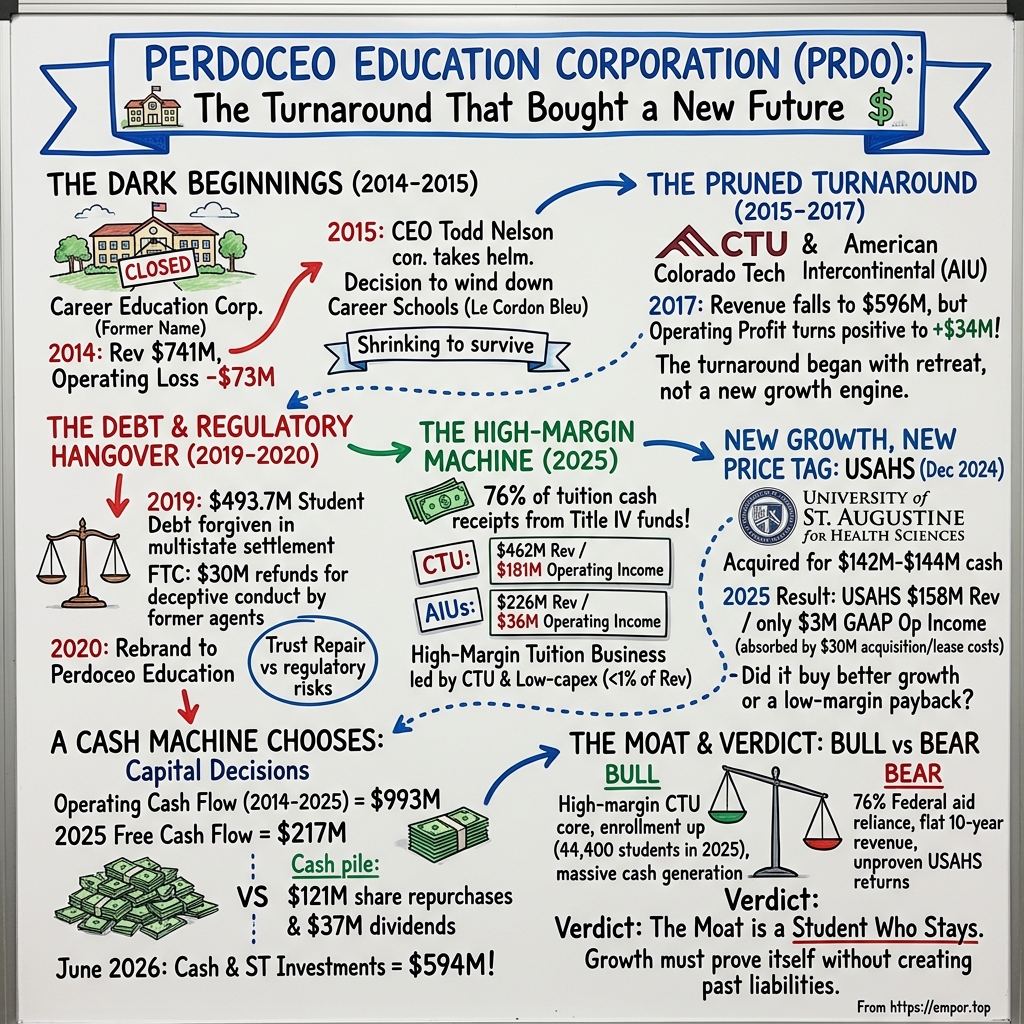
The company making that decision had a new chief executive, Todd Nelson, who had arrived in 2015 and who would end up owning almost everything that followed.2 He did not inherit a growth story. He inherited a sprawling portfolio of campuses, a shrinking student base, mounting scrutiny from state and federal authorities, and an income statement that was bleeding. In 2014, the company reported about $741 million of revenue and an operating loss of roughly $73 million.3 Every dollar of revenue was arriving with more than a dollar of cost attached.
Fast forward to the evening of October 30, 2026, and the same listed company looks almost unrecognisable. It trades on the Nasdaq Global Select Market as Perdoceo Education Corporation, under the ticker PRDO, with a market value of roughly $2.1 billion.4 It generated about $217 million of free cash flow in 2025, carried far more cash and investments than borrowings, paid a quarterly dividend, and bought back shares by the tens of millions of dollars.5 The business that was once closing campuses is now one that analysts describe, without irony, as a cash machine.
That contradiction is the heart of this story. Between 2014 and 2017, revenue fell to about $596 million, yet operating profit swung from a deep loss to a positive $34 million.67 The company got smaller and better at the same time. That is not unusual in turnarounds; it is, in fact, the most common way turnarounds work. The uncomfortable question is what kind of recovery it was. Did Perdoceo build a stronger education business, one that serves students well enough to keep them enrolled and keep regulators satisfied? Or did it simply shrink until only the profitable pieces remained, leaving the less fortunate schools, and the students who attended them, in the rear-view mirror?
That question splinters into four more that will run through the rest of this episode. The first is whether today's growth is organic or bought, because the company's most recent revenue jump came largely from an acquisition. The second is whether its core schools have any defensible edge in a market where students can choose a state university, a rival online provider, or simply keep working. The third is whether enrollment can grow without repeating the regulatory failures of the past, failures that ended with the company forgoing collection of hundreds of millions of dollars in student debt. And the fourth is whether management, now sitting on a large pile of cash, can keep allocating it well.
Before going further, it helps to know what Perdoceo actually is today. It owns three academic institutions. Colorado Technical University, known as CTU, is the largest, a mostly online university focused on working adults in fields like business, information technology, cybersecurity and healthcare administration. The American InterContinental University System, AIUS, is the second, and includes the online American InterContinental University and Trident University. The University of St. Augustine for Health Sciences, USAHS, is the newest, a graduate health-sciences school acquired at the end of 2024 that trains physical therapists, occupational therapists, nurses and other clinicians.5
One more piece of housekeeping matters for the rest of the story. Career Education Corporation is not a parent company sitting above Perdoceo. It is Perdoceo, under its former name. The company changed its name in 2020, but the corporate entity, the SEC filing record that runs back to 1997, and the shareholders are continuous.65 When this story talks about the schools Career Education closed and the settlements it signed, it is talking about the same listed company whose shares trade today. That continuity matters, because the liabilities and the reputation travelled with the company through the name change.
So the story starts not with a founding garage or a visionary idea, but with a retreat. To understand what Perdoceo is worth now, you have to understand what it gave up to survive.
 Subscribe on LinkedIn
The Turnaround Started With a Smaller Company
Picture the board's problem in 2015. Career Education was not one business; it was a collection of them. There were the online universities, CTU and AIU, which taught working adults through laptops. And there was the career-college segment: brick-and-mortar campuses teaching culinary arts, health, design and other hands-on trades, including the U.S. Le Cordon Bleu schools.17 The campus businesses carried everything that makes education expensive. They needed buildings, kitchens, labs, local admissions teams and faculty in dozens of cities. They also faced a federal regulatory environment that was becoming openly hostile to programs whose graduates struggled to repay their loans.
The decision the company made in 2015 was to wind down most of that career-college segment and concentrate its resources on CTU and AIU.7 It is tempting to describe that as a clean strategic pivot, the kind of focus-on-your-core move that business schools teach. That framing is too generous. The campuses were not abandoned because management discovered a better use of capital. They were abandoned because they could not be made to work. Enrollment was falling, the fixed costs did not fall with it, and the regulatory rules that tied federal aid eligibility to graduates' debt and earnings made many of those programs a liability rather than an asset. CTU and AIU became the core because they were what was left standing.
The person who presided over this retreat brought an unusual resume for the job. Todd Nelson had already run some of the largest names in American for-profit education, including a stint at the helm of Apollo Group, the parent of the University of Phoenix, and later at Education Management Corporation.2 He was, in other words, an industry lifer who had seen the boom years of online education from the inside, and who had also seen how quickly a federal policy shift could turn a growth engine into a liability. Arriving at Career Education in 2015, he did not try to rescue the campus empire. He shrank it.
The financial record of those years reads like a company undergoing surgery without anaesthetic. Revenue fell from about $847 million in 2015 to about $596 million in 2017.76 Operating losses of about $92 million in 2015 and $32 million in 2016 gave way to an operating profit of about $34 million in 2017. The bottom line was messier still: 2017 ended with a net loss, after an outsized tax charge in the year of the federal tax overhaul, even though the underlying operations had turned profitable.6 For a listener trying to hold the shape in mind, the sequence is simple. The company lost roughly a quarter of its revenue in two years and, in the process, went from losing about eleven cents on every dollar of revenue to making about six.
That improvement kept compounding. Operating margin rose from about 12% in 2018 to about 21% in 2020.6 The mechanism was not mysterious. Online universities do not need the physical footprint that campuses do, so once the campuses were gone, a much larger share of each tuition dollar flowed through to profit. The company did not discover pricing power or a new product. It removed the parts of the business that were consuming the profits of the parts that worked.
But the turnaround came with a cost that never appeared in the operating margin line. Students who had enrolled at the closing campuses had to finish their programs during a teach-out or transfer elsewhere. Old receivables, money former students still owed the company, remained on the books and in the courts of public opinion. The closures were the end of a business line, but they were not the end of the obligations it created, and the story of the next section is about precisely those obligations.
The leadership chronology matters here, because a turnaround needs an owner. Nelson led as chief executive from 2015 until January 2022, when he moved to the role of executive chairman and Andrew Jansen became CEO.8 That arrangement lasted less than two years. In November 2023, Nelson returned to the chief executive role.2 The return is not a scandal, but it is worth noting as a governance fact: the man who led the turnaround is also the man running the company's first large acquisition and its current capital allocation. The record being judged is largely his.
It is worth dwelling on what Nelson's style seems to have been, judged by his decisions rather than his speeches. He did not attempt a grand reinvention or a splashy acquisition in his first years. He cut, consolidated and waited. The company kept a large cash balance even while it was losing money, which gave it the room to teach out closing campuses rather than abandon students mid-program, and it avoided raising new equity during the worst years; borrowings were close to zero at the end of 2016 and 2017.6 That conservatism looks sensible in hindsight. It also produced a company that, for most of the following decade, was better at protecting value than at creating new avenues for it.
Now set the historical test. Measured from 2015 to 2025, Perdoceo's revenue was essentially flat, growing at roughly zero percent a year.6 Over the same decade, net profit compounded at about 12% a year. That gap is the whole turnaround in a single comparison. Management rebuilt profitability far faster than it rebuilt the top line. The flat revenue figure is partly misleading, because the 2015 revenue base still included campuses that were being shut, so it is not a same-portfolio growth rate. But it does set a demanding bar for the current growth story. A company that spent a decade proving it could make a smaller business more profitable has not yet proved it can make a larger business grow. Every claim about the future in this story has to clear that bar.
And before the company could make that case, it had to deal with the bill from its past.
The Debt That Followed the Old Business
On January 4, 2019, Georgia's attorney general announced a settlement with a for-profit education company that brought relief to more than 16,000 Georgians.9 Georgia was one of many. The agreement, struck between Career Education Corporation and attorneys general from almost every state, was a multistate settlement over the way the company had recruited students. Under its terms, the company agreed to forgo collecting approximately $493.7 million in debt owed by about 179,500 former students, and it agreed to reform how it recruited and enrolled people.9
It is worth pausing on what those numbers mean. The forgiven debt was not federal student-loan debt; it was money owed directly to the company, institutional debt that students had taken on to cover gaps between what federal aid paid and what the programs cost. Half a billion dollars of receivables simply evaporated as an asset. More importantly, the settlement was an official acknowledgement, by dozens of state law-enforcement officials, that the company's recruitment practices had been serious enough to warrant one of the largest debt-relief settlements of its kind. The conduct requirements reinforced the point. The company agreed not to misrepresent things like job prospects, costs and the transferability of credits, to give prospective students clear disclosures before they enrolled, and to submit to oversight by an independent administrator.9
A separate federal case added another layer. The Federal Trade Commission alleged that lead generators working for Career Education had used deceptive tactics to drive prospects toward its schools, including falsely suggesting affiliations with the U.S. military. The company resolved the matter and the FTC later announced nearly $30 million in refunds to people affected by the conduct.10
The consensus narrative about this period runs roughly as follows: the company had a bad decade, paid its fines, changed its name and moved on. The record supports only part of that. The financial recovery was real. The settlement terms were met without visibly derailing the business, and the company's operating results improved through 2019 and 2020. But the settlement was not a routine legal expense that a strong company absorbed. It was evidence about the product itself. In education, the product is not just instruction; it is the promise a recruiter makes to a nervous 30-year-old about what a degree will do for their life. When regulators conclude that the promise was oversold, they are questioning the core of the business, not a peripheral sales practice.
That distinction matters because legal risk did not end in 2019. Today, Perdoceo faces False Claims Act lawsuits connected to CTU's compliance with credit-hour requirements, the rules that define how much instructional work a course must involve to count toward federal-aid eligibility.5 In one case, the Department of Justice declined to intervene, and the private whistleblower, known in these cases as the relator, elected to keep pursuing it. A separate False Claims Act suit was unsealed in 2023, and there too the government declined to intervene.5 A government decision not to join a case is often read as a sign of weakness in the claim, and it does lower the odds of the most severe outcomes. It does not end the case.
At the end of 2025, the company had accrued about $1.8 million for estimated legal fees and settlements.5 Against roughly $160 million of annual net income, that is a rounding error. But the accrual measures what the company can reasonably estimate today, not what is at stake. These cases touch the plumbing of federal student aid, which funds the overwhelming majority of the company's tuition, and the company itself says it cannot estimate losses in some proceedings.5 The legal costs are already visible in the operations: in the second quarter of 2026, CTU's operating income fell about 5% from a year earlier, and the company attributed the decline to higher legal fees, saying the segment's profit would otherwise have risen.11 A small accrual, in other words, sits next to a real and recurring drag on the flagship school.
Two other pieces of evidence help bound the question of trust. The first is the auditor. For 2025, the company's auditor gave an unqualified opinion on the financial statements and on internal controls over financial reporting, with no material weakness identified.5 That is meaningful evidence that the numbers in this story are fairly reported. It is not evidence about student outcomes or recruitment conduct, which are outside what a financial audit tests. The second is the outlook the company published in August 2026, which assumed no significant operating impact from an FTC settlement.11 That a 2026 outlook needed to mention the FTC at all is a reminder that the relationship with federal consumer-protection regulators remains an active part of the operating environment rather than a closed chapter.
Consider, too, the arithmetic of the debt relief from the company's side. Forgoing collection on roughly $494 million of receivables sounds ruinous, yet the company's operating margin actually improved in 2019.6 The most plausible reading is that much of that money was never realistically going to be collected, because it was owed by former students, many from closed campuses, whose balances had already been reserved against or written off. That is a sobering detail. It suggests the settlement cost the company far less in cash than its headline implied, and it suggests that the original enrollments had generated debts that students could not realistically repay. The relief was a correction of a past mistake, not a new expense, and a correction of that size tells investors how far the old model had drifted from what its customers could bear.
Which brings us back to the 2020 name change. Perdoceo is a Latin-sounding name that carries none of Career Education's baggage, and a cynic would say that was the point. A rebrand is not evidence of anything. The right way to judge whether the company became more accountable is through what happened afterward: whether students stayed enrolled, whether collections improved, and whether compliance problems faded. On collections, the record is encouraging, as the next section will show. On student outcomes, the company publishes much less than an investor would want, a gap that comes up again when the question turns to Perdoceo's competitive edge.
The verdict on this chapter is therefore deliberately limited. The financial recovery does not erase the seriousness of what came before, and the current litigation keeps the question open. The test now is whether today's schools produce outcomes and disclosures that keep students, regulators and federal payers confident. To see why that confidence is worth so much, follow the money through a single student's term.
How Tuition Becomes a High-Margin Business
A working adult in Texas clicks through an online application to CTU, perhaps for a bachelor's degree in cybersecurity. Before a single lecture is streamed, a lot has already happened. An admissions adviser has talked with the student. A financial-aid team has helped the student fill out the federal aid application and worked out which grants and loans will cover which parts of the cost. And when the term begins, the student is billed for that term's tuition and fees.5
Here is the first important mechanical detail. Being billed is not the same as the company booking revenue. Perdoceo recognizes tuition revenue over the course of the term, as the instruction is actually delivered.5 Think of it like a gym membership paid at the start of the month: the gym has the cash, or the promise of it, on day one, but it only truly earns the fee as the month passes and the member keeps coming. If the student withdraws halfway through, the economics change, both for the student and, through federal aid rules on returning unearned funds, for the school.
The pricing unit is tuition per student per term or per program.5 There are no long-term contracts and no minimum commitments. Employers sometimes provide tuition assistance and the company runs corporate partnership programs, but the business does not disclose any share of revenue that is contractually recurring.5 So revenue is driven by four levers: how many new students enroll, how many continuing students persist from one term to the next, the mix of programs they take, and the tuition rates for those programs. Of those four, persistence matters most, because a continuing student costs far less to keep than a new student costs to find.
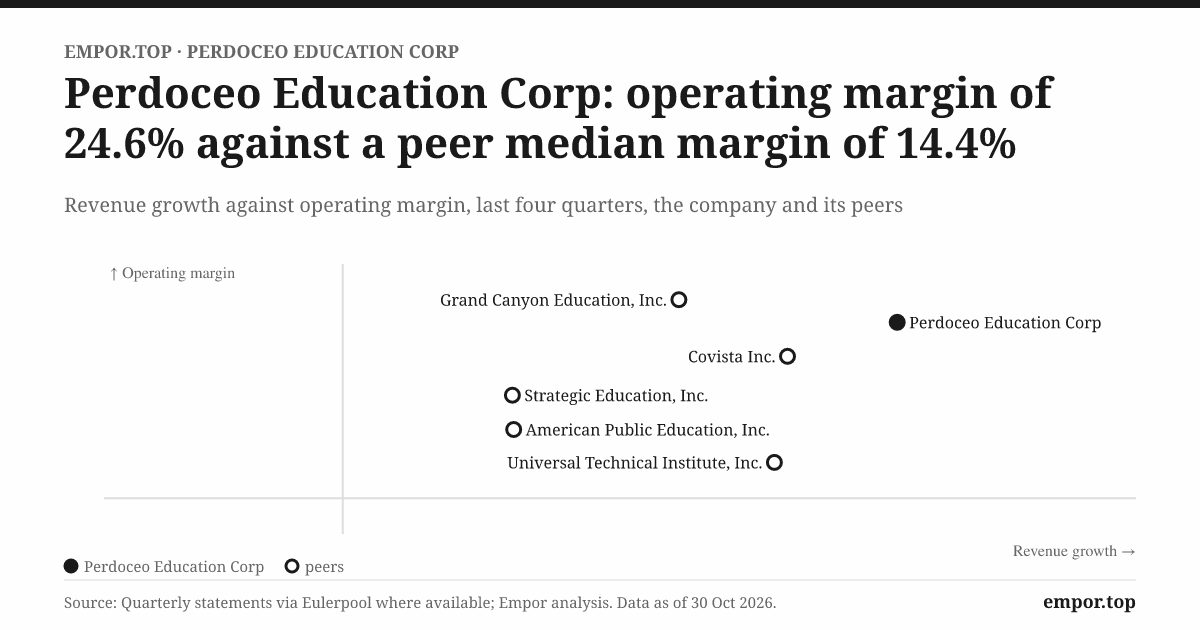
Now look at where the money actually lands. In 2025, CTU generated about $462 million of revenue and about $181 million of operating income.5 That is a margin of almost 40%, a figure that would make many software companies envious. AIUS generated about $226 million of revenue and about $36 million of operating income, a margin closer to 16%.5 CTU accounted for about 55% of the company's revenue, AIUS for about 27%, and the newly acquired USAHS for the rest. The headline consolidated operating margin of about 23% in 2025 is therefore an average of very different businesses.6 CTU is the engine; the other schools are, for now, passengers.
Why can an online university be this profitable? Because once the platform, the curriculum and the faculty model exist, the cost of adding another online student is modest. There are no new classrooms to build. Perdoceo's capital expenditure was about $8.6 million in 2025, roughly 1% of revenue, and $4.6 million the year before.5 Management expected it to rise to about 1.5% of revenue in 2026, still a tiny fraction of what a campus-based university spends. The big costs are people and marketing: the company employed about 6,000 people at the end of 2025, including about 1,435 at USAHS, and spends heavily on admissions, advertising and student support.5
The other reason the cash model is attractive is timing. Because tuition is billed at the start of a term and much of it is paid by federal aid disbursed during the term, the company tends to receive cash before or as it earns revenue, rather than months afterward. Over most of the past decade, the business has operated with negative working capital, meaning its customers and the aid system have effectively financed its day-to-day operations.6 That is why the company can grow without needing much outside capital.
But the same plumbing that makes the model attractive is also its greatest vulnerability. In 2025, about 76% of Perdoceo's tuition cash receipts came from Title IV federal student-aid programs, a share that was 77% in 2024 and 76% in 2023.5 Title IV is the umbrella for federal Pell Grants and Direct Loans, and access to it depends on accreditation, eligibility rules and compliance with a thicket of regulations. This is not customer concentration in the usual sense; there is no single client that can walk away. It is payer and regulatory concentration. The federal government does not choose which school a student attends, but it sets the conditions under which roughly three dollars of every four in tuition cash can flow to Perdoceo at all. A change in eligibility, a delay in disbursements, or a finding of non-compliance could affect demand and cash collection simultaneously.
There is a new wrinkle on this front. The federal government has eliminated the Grad PLUS loan program for new borrowers, a change that matters most for graduate students like those at USAHS. Perdoceo's 2026 outlook assumes no material impact, on the basis that affected students will turn to private lending instead.11 That is an assumption, not a fact, and it will be tested as new graduate cohorts enroll.
Who pays late? The answer is students, and the company is reasonably transparent about how it handles them. Student receivables are unsecured for some students and carry an allowance for expected credit losses. The company says it generally writes off balances once a student has been out of school for more than 90 days without paying.5 Some students use payment plans extending beyond a year; those non-current receivables were about $4.8 million at the end of 2025 and $5.0 million at the end of June 2026, small against a business of this size.512 The company says that producing an aging schedule of these non-current balances is impractical, so investors do not get the detailed view of how old the debts are.5
The best available signal is how quickly revenue turns into cash. Debtor days, the number of days of revenue sitting in receivables, peaked at about 33 in 2019 and fell to about 14 by 2025.6 That is a significant improvement. It suggests that the company has become more disciplined about billing and collecting, and it is at least consistent with the post-settlement reforms that required more transparent enrollment practices. It is not proof of better student outcomes, because a student who pays on time may still drop out or fail to find the job they were promised.
And that is the business's central tension. Enrollment growth can expand a highly profitable engine, but only if students persist, complete their programs and remain eligible for federal aid. A student who withdraws in week three is not just lost revenue; they are a potential complaint, a returned aid disbursement and a data point in the next regulatory review. The company's economics reward exactly the behavior that regulators want to see, which is students staying and completing, but they also historically rewarded the behavior regulators punished, which is aggressive recruiting. Keeping those two incentives aligned is the job.
In 2024, management decided that the engine needed a new cylinder, and went shopping.
The New Growth Arrived With a New Price Tag
On July 1, 2024, Perdoceo announced it had agreed to buy the University of St. Augustine for Health Sciences.13 The deal closed that December.5 For a company that had spent nearly a decade shrinking, it was a statement of intent. USAHS was not another online undergraduate school. It was a graduate institution training physical therapists, occupational therapists and nurses, with hands-on clinical requirements and physical campuses in places like Florida, California and Texas.13 Perdoceo was stepping into graduate health sciences in a meaningful way for the first time in recent years.
The strategic logic was straightforward. Health-care demand is driven by an aging population, clinical professions have licensing requirements that make degrees non-negotiable, and graduate students tend to be more motivated and better financed than adult undergraduates. Adding USAHS diversified Perdoceo's program mix away from the business, IT and general-studies programs that dominate CTU and AIUS, and it gave the company a foothold in a category where it could potentially apply its online-delivery expertise to blended programs.
What did Perdoceo pay? According to the announcement, USAHS had about $170 million of revenue in 2023 and about $35 million of operating income, and the purchase price was roughly $142 million to $144 million in cash.13 That works out to about 0.8 times sales and about 4.1 times operating income. The company paid $137.8 million in acquisition cash in 2024 and later received about $0.8 million back in a working-capital true-up.5
On those numbers, the headline price does not look like an overpayment. Paying less than one year's revenue and about four years of the seller's operating income for a going concern is, on its face, modest. But "modest" is not the same as "cheap", and there is no close, directly comparable set of transactions that settles the question. Private health-sciences universities do not change hands often, and each has a different mix of programs, campuses and accreditation. The honest verdict is that the price was not obviously high, and that the return has to be measured afterward.
So what happened afterward? In 2025, the first full year under Perdoceo's ownership, USAHS reported about $158 million of revenue and only about $3 million of GAAP operating income.5 At first glance, that is alarming: a business bought on the basis of about $35 million of operating income delivered less than a tenth of that in its first year.
The reconciliation is in the accounting, not necessarily the operations. When one company acquires another, it must revalue the target's assets at fair value and then depreciate and amortize them, including intangible assets like student relationships and trade names that the seller never carried on its books. On top of that, the USAHS deal involved a sale-leaseback arrangement on property that, for accounting purposes, failed to qualify as a sale, so Perdoceo records it as a financing obligation with associated lease and interest costs.5 Together, acquisition-related depreciation, amortization and finance-lease expense absorbed about $30 million of USAHS's 2025 segment profit.5 Add that back and the business looks closer to its pre-deal earning power, though still below the $35 million the seller had reported.
The 2026 numbers suggest some progress. In the first half of the year, USAHS revenue rose about 10% and the segment swung to roughly $10 million of operating income from a small loss a year earlier.11 Enrollment at the end of June 2026 was about 4,210 students, up 6% from a year earlier.11 Management told investors on the August call that USAHS was on track for strong 2026 results and that the fall pipeline looked strong.14
Still, the gap between USAHS and the rest of the company is striking. CTU earns close to 40 cents of operating profit on each dollar of revenue. USAHS, even with first-half 2026 improvement, earns closer to 12 cents. Part of that is the acquisition accounting, part is the structural cost of running clinical programs with labs and physical campuses, and part may be integration spending. Investors cannot fully separate those effects from the outside. What they can see is that the acquisition added about 19% of 2025 revenue and contributed almost none of the segment operating profit, while CTU and AIUS still supplied nearly all of it.5
There is also the matter of the balance sheet. The failed sale-leaseback added about $57 million of financing liability, with future minimum payments under the arrangement of about $154 million.5 Those are not conventional bank loans and carry no covenants that the company has disclosed, but they are real obligations that come with the acquired campuses. When the borrowings line on Perdoceo's balance sheet jumped from about $27 million at the end of 2023 to about $132 million at the end of 2024, this lease-related financing was a large part of the reason.65
How does this fit Perdoceo's history of deploying capital? Before USAHS, the company had largely been a cash accumulator and an occasional buyer of its own shares. It had previously bought Trident University, now part of AIUS, but USAHS was the first significant move into a genuinely new academic category in recent years. That means investors have little track record by which to judge this management team as acquirers. The best evidence of their discipline lies in the opposite direction: they were willing to close businesses that did not work, which is a rarer and more painful skill than buying new ones.
The verdict for now is clear enough. The price was not demanding, but the return is unproven. The next test is cash returns after acquisition charges for a full comparable year of operations. A business bought for about $140 million needs to produce something like $15 to $20 million a year in after-tax cash to earn a respectable return; USAHS's 2026 trajectory suggests it may get there, but 2025 did not. And that raises a broader question about the company's growth: once you take the acquisition out, how much is left?
What the Enrollment Numbers Can—and Cannot—Prove
At the end of 2025, Perdoceo counted about 44,400 students across its three institutions, up about 7.3% from a year earlier.5 On its own, that looks like a company with momentum. But the three schools were moving at very different speeds, and the consolidated figure hides as much as it reveals.
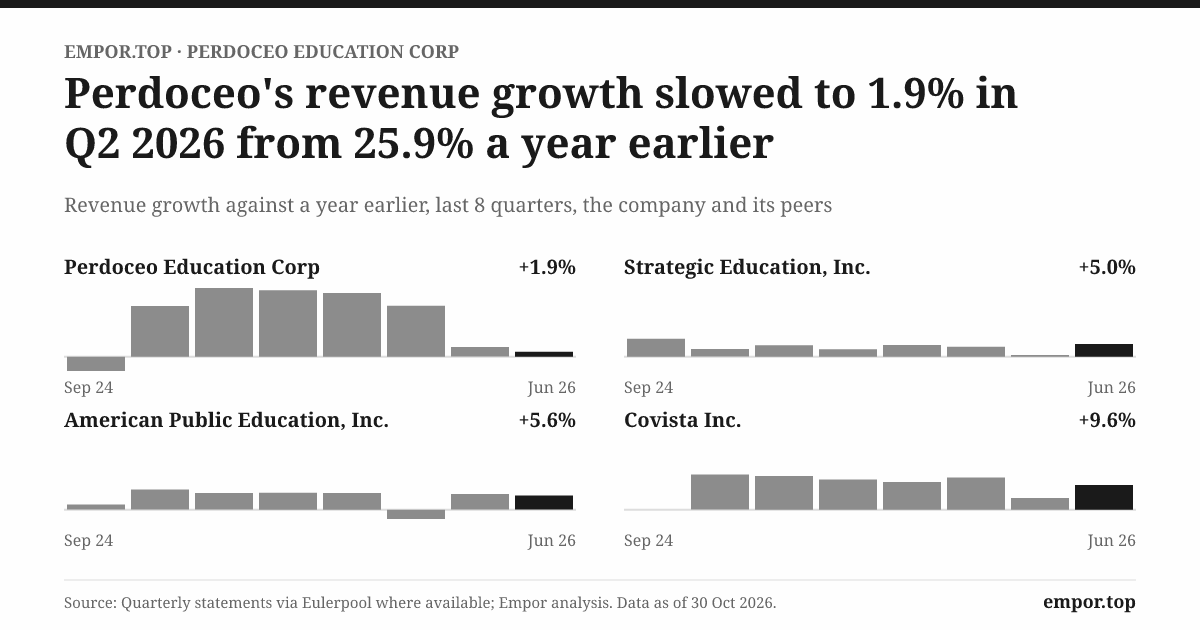
Start with the headline that most investors saw. Consolidated revenue rose about 24% in 2025, the fastest growth the company had reported in a decade.6 Of the increase, about $147.5 million came from the USAHS acquisition.5 Strip that out and the remaining schools grew only modestly. The longer view tells the same story more starkly. Over three years, revenue grew about 6.8% a year; over five, about 4.3%; and over ten, essentially zero.6 The recent step-up is real, but it is mostly bought, not built.
Now look at each school. CTU's enrollment rose about 6.6% in 2025, while its revenue rose about 4.1%.5 That gap between students and dollars is not alarming in itself; it can reflect shifts in program mix, more part-time students, or the timing of when new students start. But it does mean CTU's revenue per student was drifting down slightly, which is worth watching. Still, CTU has the strongest evidence of a functioning growth loop: more students, more revenue and very high margins.
AIUS is more puzzling. Its enrollment rose about 11.2% in 2025, yet its revenue slipped about 0.4%.5 How can a school add one student in ten and earn slightly less money? The company's explanation was a calendar quirk. AIUS added an extra session start in December 2025, which inflated the year-end student count but shifted the associated revenue into 2026, because those students began paying for instruction delivered in the new year.5 The company also said Trident, part of AIUS, was affected by the federal government shutdown, which disrupted some students' funding, particularly military learners who rely on tuition assistance.5 Both explanations are plausible. Both also highlight how much an enrollment snapshot can move for reasons that have nothing to do with underlying demand.
USAHS enrollment rose about 2.6% in 2025, a modest gain for a school that Perdoceo bought to grow.5
The first half of 2026 brought growth back toward earth. Revenue rose about 3.0% compared with the first half of 2025, and total enrollment at the end of June was about 46,830, up just 0.7% from a year earlier.11 Inside that number, CTU grew 0.6%, AIUS fell 1.0% (the company attributed the decline to Trident), and USAHS grew 6.0%.11 That is not a collapse, but it is a long way from the year-end 2025 growth rates.
How did management explain it? On the August 2026 call, Nelson said operating performance at the academic institutions had been ahead of expectations for the first half of the year.14 Chief financial officer Ashish Ghia, who has held the role since 2018, framed CTU's slowdown as an arithmetic artifact: the school was lapping record quarters from 2025 and graduating a record number of students in 2026, so its reported second-half enrollment might trend lower year over year before normalising in 2027.142 For AIUS, management guided to strong enrollment growth in the third quarter, a decline in the fourth, and a rebound in early 2027, all because of the shifting session calendar.14
There is something to admire in that candour. Management told investors in advance that the enrollment figures would look weaker, and explained why, rather than letting the market discover it. A record number of graduates is, after all, the outcome a good school should want; a student who finishes and leaves is a success, not a churn statistic. But there is also a reason for caution. Each explanation, a calendar shift here, a lapping effect there, a government shutdown somewhere else, may be individually true while collectively making the underlying demand trend very hard to observe. Investors are being asked to look through a lot of timing noise.
One more detail from the August call deserves mention. The published transcript of that call contains management's prepared remarks and then ends; there is no analyst question-and-answer session in it.14 That means investors heard the company's framing of enrollment timing, retention and AI without hearing it challenged in real time. A company has no obligation to take questions, but when the most important debate about a business is whether its growth is organic or timing-driven, unchallenged prepared remarks are a weaker form of evidence than an answer given under cross-examination.
What about the deeper question of whether students are actually benefiting? Here the disclosures thin out. Ghia said retention trended near multi-year highs, and the company's 2026 outlook assumed that 2025's high retention and student engagement would continue.1411 Those are encouraging statements. But the company does not publish detailed retention rates, cohort completion rates or graduate employment outcomes by institution in its financial filings. Enrollment is a measure of how many students are paying; it is not proof that they are completing, getting jobs or getting value. For a company with this company's regulatory history, that distinction is not academic.
So which numbers should an investor actually watch? The most useful are the ones that strip out acquisition and calendar effects: same-institution revenue growth, especially at CTU; retention, if and when the company quantifies it; and student-receivable losses, which reveal whether new students are paying or quietly walking away. Consolidated growth, on its own, will mislead more often than it informs.
The growth story, then, is mixed and modest at the latest margin. CTU is still growing, AIUS has not converted its enrollment gains into revenue, and USAHS has not yet shown the scale economics that would justify the purchase. But even modest growth from a business with these margins throws off a great deal of cash. The question is what management does with it.
A Cash Machine Chooses What to Buy Back
In 2025, Perdoceo spent about $121 million buying back its own shares, more than three times the roughly $37 million it paid out in dividends.5 It bought about 4.1 million shares at an average price of about $29.17.5 Those are not the actions of a company worried about its future cash needs. They are the actions of a company with more cash than it knows what to do with, deciding that its own stock is the most attractive asset available.
To understand how it reached that position, go back to the long record. From 2014 through 2025, Perdoceo generated about $729 million of cumulative net profit and about $993 million of cash from operations.6 Cash flow ran at about 136% of reported profit over twelve years. Some of that excess reflects non-cash charges, like depreciation, amortization and stock compensation, and some reflects the timing benefits of collecting tuition early. Either way, the profits were real, and they arrived as cash.
Where did the cash go? Over those twelve years, free cash flow, the cash left after capital spending, totalled about $893 million.6 Dividends absorbed only about $81 million of it, because the company paid no dividend at all until 2023. Cash and short-term investments rose by about $293 million over the period. The rest went to acquisitions, including USAHS, to share repurchases, and to the settlements and costs of the legacy business. By June 2026, cash and short-term investments stood at about $594 million.12
The 2025 numbers show the machine running at full speed. Operating cash flow was about $225 million against net income of about $160 million, and free cash flow was about $217 million.5 Management attributed the year-over-year increase chiefly to higher operating income.5 Of that free cash, about $121 million went to buybacks and $37 million to dividends, leaving a comfortable margin even before the company's cash pile.
Capital returns continued into 2026. In January, the board authorized a new $100 million repurchase program; by the end of June, about $85 million remained, after the company bought back roughly 0.4 million shares in the first half of the year.11 The pace had slowed markedly from 2025, and the average price paid in the second quarter was about $34.19, well above the 2025 average.11 In August, the company raised its quarterly dividend by about 13% to $0.17 a share, the third increase since dividends began in 2023.1114
The cash pile also earns its own income, and that matters when judging the quality of reported earnings. In 2025, other income of about $21 million, mostly interest on cash and investments, made up close to a tenth of pretax income.5 That is meaningful, but it is not what drives the business; the operating schools produce the great majority of profit. Its significance is subtler. If interest rates fall, or if the company spends its cash on acquisitions or buybacks, that income shrinks, and some of the earnings growth investors have seen will run in reverse. A shareholder valuing Perdoceo on earnings per share is partly valuing a money-market fund.
How should one judge those buybacks? The simplest test is whether the company bought its stock for less than it is worth today. On that narrow test, the 2025 repurchases look good: shares bought at about $29 were trading at about $31.53 on October 30, 2026.4 But that is a short window and a modest gain, and it says little about long-term value creation. The better comparison is the return on retained cash versus the alternatives.
A dollar used to buy back stock at roughly 12 times earnings earns an implied return of about 8% a year, the earnings yield. A dollar left in money-market funds earns whatever short-term rates pay; in 2025, the company's $26 million of interest income on its cash and investments was meaningful but represented a lower return.5 A dollar invested in USAHS has to clear the same bar, and so far it has not done so on a reported basis.
Who decides? Nelson's reported total compensation was about $5.5 million in 2025, down from about $6.7 million in 2024, a year in which the company's net income actually rose.2 Named executives receive a mix of time-based and performance-based equity awards.2 Directors and executive officers as a group owned about 1.5% of the company in March 2026, a stake that gives them some exposure to the share price but not a controlling interest.2 The largest holders are institutions: BlackRock at about 14.3%, Vanguard at about 7.9% and Dimensional at about 6.6%, according to the 2026 proxy.2 There is no controlling shareholder and no founder with a dominant stake. Ordinary institutional ownership should not be mistaken for insider alignment; index funds own the stock because it is in the index.
Shareholder votes provide a modest check. At the May 2026 annual meeting, say-on-pay passed with about 53.1 million votes in favour and about 1.1 million against.15 Director opposition was highest for Leslie Thornton and Gregory Jackson, each of whom drew more than two million votes against.15 Those are not rebellions, but they are signals worth tracking if they grow.
An activist looking at this record would ask a pointed question. If the core business generates more cash than it can reinvest, and organic growth is modest, why does the company keep such a large cash balance? With an enterprise value of about $670 million against a market value of about $2.1 billion, the market is effectively telling the company that well over a billion dollars of its value is cash and investments, earning a modest yield.4
The answer management would likely give is optionality, the ability to act on acquisitions when the right opportunity emerges, a phrase Nelson used on the August call.14 That answer is reasonable for a company in a heavily regulated industry where a large cash buffer has real value. It is also the answer that every management team gives when it wants to keep cash, and it should be judged by the returns on the acquisitions it actually makes.
So far, the capital-allocation record is split. Management deserves credit for being willing to exit businesses that failed, as the campus closures showed. It deserves credit for converting earnings into cash and returning a growing share of it. But the one significant acquisition, USAHS, is too recent to judge, and the company has not yet shown that it can earn returns on new investments comparable to the returns in its core. The things to track together are post-acquisition free cash flow, return on invested capital, and the pace of buybacks relative to the share price. Return on invested capital has already fallen from about 60% in 2020 to about 34% in 2025, partly because the cash and the acquisition have grown faster than operating profit.6
All of which makes the question of the moat urgent. A business that throws off cash only has durable value if its edge lasts.
The Moat Is a Student Who Stays
Imagine the choice from the student's side. A 34-year-old medical-office manager in Ohio wants a bachelor's degree in health-care administration. They could enroll in their local state university's online program, which might be cheaper and carries a familiar name. They could choose one of several large online universities that advertise heavily. They could pick CTU. Or they could decide that the timing is wrong, the debt is frightening, and the current job is fine. Every one of those options is a real competitor, and the last one, not enrolling at all, may be the most powerful.
That is the competitive arena in which Perdoceo has to prove it has an edge. Its scale is substantial: about 44,400 active students at the end of 2025 and about $846 million of revenue.5 But it is not the largest player. Grand Canyon Education, which provides services to Grand Canyon University and other partner institutions, generated about $1.1 billion of revenue in 2025.16 Strategic Education, which owns Strayer and Capella universities, generated about $1.27 billion.17 American Public Education, which runs American Public University System and other schools, and a range of specialist providers compete for overlapping adult, online and career-focused students. These companies do not have identical business models; Grand Canyon is primarily a services partner to a nonprofit university, and Strategic Education has international operations. But they are all fishing in the same pond of working adults with federal-aid eligibility.
Run the competitive forces through that student's choice. Buyer power is meaningful. Students are individuals, not concentrated institutional customers, but they have many alternatives and face very low switching costs before they enroll. After they enroll, switching costs rise somewhat, because transferring credits is messy and a student who has completed two years at CTU has an incentive to finish there. But the company's filings do not quantify that stickiness, and students can and do drop out. The threat of substitutes is high: public universities have built large online programs, and employers increasingly accept certificates and skills-based credentials. Supplier power is moderate; faculty, technology vendors and especially digital advertising platforms, which control the flow of prospective students, take a share of the economics. Rivalry is intense, fought mostly through marketing spending.
What about barriers to entry? Accreditation and Title IV eligibility are necessary to operate at scale, and they take years to obtain. That keeps out casual entrants. But they are not exclusive resources. Every serious competitor also holds them, so they protect the industry from newcomers more than they protect Perdoceo from its existing rivals. A regulatory barrier that everyone in the room has already cleared is not much of a moat.
Now apply Hamilton Helmer's seven powers, the framework that asks what structural advantage lets a company earn persistently high returns. Scale economies exist in online education, because curriculum and technology costs can be spread over more students, and CTU's margin of nearly 40% suggests it enjoys them. But Grand Canyon and Strategic Education are larger, so Perdoceo does not have a scale advantage over its biggest rivals. Network effects are weak; one student's enrollment does not make the degree more valuable to the next, apart from a modest alumni effect. Switching costs exist mid-program but not at the point of choice.
Brand is double-edged: CTU and AIU are known, but the company's past means the brand carries regulatory baggage. Counter-positioning, cornered resources and process power are hard to identify with confidence. The company says it uses artificial intelligence to support recruitment and student engagement, and Nelson told investors that the shift to AI-driven search was changing how prospects research schools, though its effect on enrollment had been modest so far.14 But the company does not quantify any economic advantage from its technology, and competitors are investing in the same tools.
So what evidence supports a limited advantage? The strongest is CTU itself. A school with nearly 30,000 students, enrollment growth of about 6.6% in 2025 and margins near 40% is doing something right.5 The company also points to corporate partnership programs, where employers steer employees toward its schools, and to reported high retention and engagement.14 Those are real signals.
The limits are equally real. Detailed retention rates, cohort completion outcomes, price realization and market share are not disclosed. Tuition increases, if any, are not broken out, so it is impossible to say whether the company has pricing power or simply volume. The legacy settlement shows that the company has, in the past, relied on aggressive recruiting rather than product quality to fill seats. And the slowing enrollment in 2026, however well explained, does not support a claim that demand is structurally strong.
The historical test is particularly sharp here. The company once owned some of the most recognisable names in career education, including Le Cordon Bleu. Those brands did not protect the business when the economics and regulatory environment turned. Brand, in this industry, has proved to be a weak defence. The edge that matters is whether students persist and succeed, because persistence is both the economic engine and the regulatory shield.
The verdict, then, is that Perdoceo has scale in its chosen programs and some evidence of recent enrollment and retention strength, but the filings do not establish strong switching costs, pricing power or a clear cost advantage over larger peers. The moat claim should remain narrow and unproven. Why it may win: its programs fit what working adults want, its online delivery is efficient, and if it keeps students enrolled, the economics are excellent. Why it may not: students have abundant alternatives, three-quarters of tuition cash depends on federal aid, the differentiation is weakly evidenced, and enrollment gains might not turn into completed degrees and durable cash. The KPI that would confirm or refute the claim is retention, published in a consistent way, over several years.
Business & Investing Lessons
Two scenes bookend this story. In one, a company shut the doors of culinary campuses that carried one of the most famous names in cooking. In the other, nearly a decade later, the same company wrote a cheque of roughly $140 million for a graduate school that trains physical therapists and nurses. Between those scenes, the company shrank before rebuilding its operating margin to about 23% in 2025.6 The lessons in that arc are specific to Perdoceo, but they travel.
The first lesson comes from the Le Cordon Bleu closure: brand recognition cannot compensate when the economics and outcomes fail. For founders, the lesson is that brand is a promise about outcomes; when the outcomes fail, the brand turns from an asset into evidence for the prosecution. For investors, it is a warning against paying for name recognition in any business where a regulator, not the customer, ultimately decides whether the product may be sold.
The second lesson comes from the recovery in cash generation. Persistence drives both revenue and working capital. The fall in debtor days and the long run of cash flow exceeding reported profit point to students staying and paying.6 The wider point is that in subscription-like businesses with a social dimension, the metric that makes the money and the metric that keeps the licence can be the same one. Managers who chase the first without the second end up losing both.
The third lesson belongs to USAHS. An acquisition is not accretive in the way that matters until its cash returns clear the purchase accounting. The first full year under Perdoceo’s ownership produced almost no operating income after acquisition-related charges.5 Some of that is accounting noise, but the noise is made of real things: real lease payments, real integration costs, real obligations that came with the campuses. The discipline that matters is not the multiple paid at signing. It is whether, three years later, the acquired business is producing cash that justifies the capital, measured after every cost that came with it.
The fourth lesson comes from the 2019 settlement. Regulatory access is earned one student at a time, and can be lost through conduct that once looked like a sales tactic. The settlement left roughly $494 million of student debt uncollected.9 The lesson for any business that depends on a government payer is that the sales funnel is part of the regulated product. Every promise made at the top of the funnel can come back as a liability at the bottom.
The common thread is that cost control rebuilt the margins, but cost control is a one-time trick. You can close a campus only once. The next phase of the Perdoceo story depends on something harder: proving that the company can grow and earn trust at the same time, without recreating the model that produced the old liabilities. That is what the market is now being asked to price.
Analysis & Bear vs. Bull Case
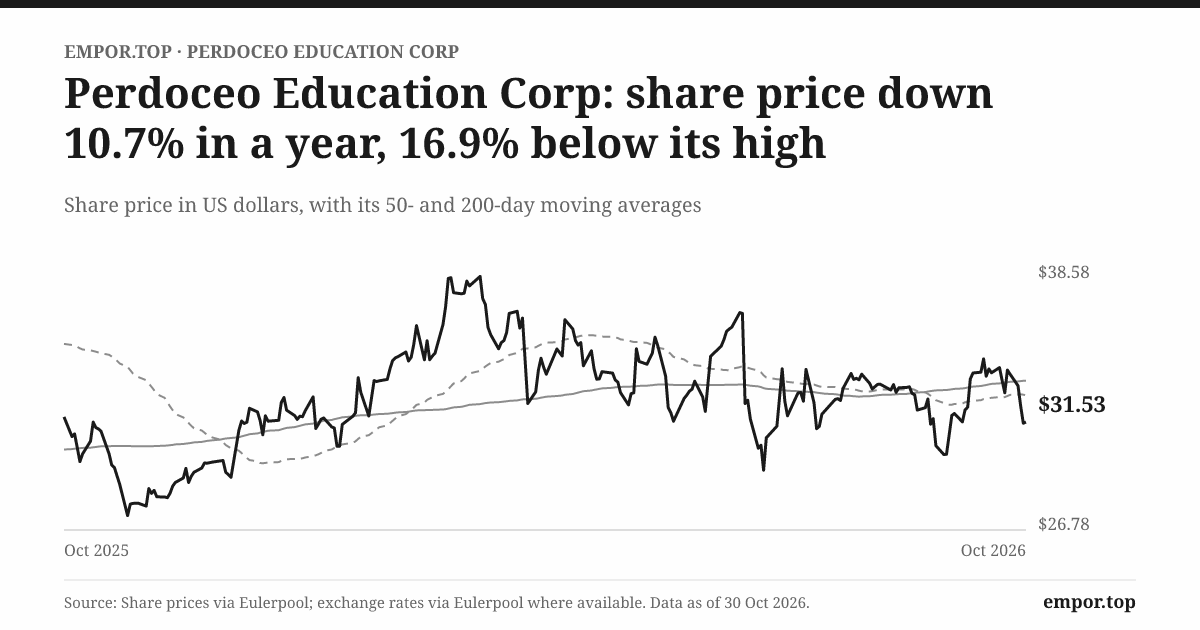
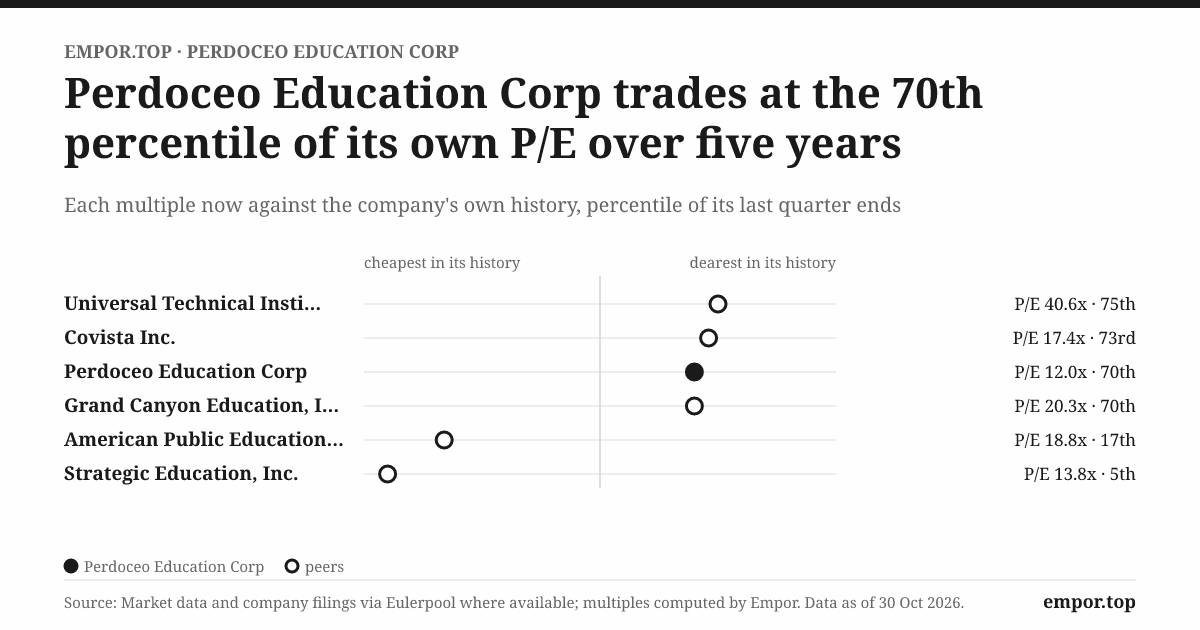
On October 30, 2026, Perdoceo's shares closed at about $31.53, roughly 17% below their 52-week high of about $37.95.4 At that price, the stock traded at about 12 times trailing earnings, compared with a five-year median of about 9.5 times.411 It is not a stock in distress; it sits above its own historical valuation. Yet it is also priced like a business the market does not fully trust. The question is which of those readings is right.
Start with the bull case in its strongest form. CTU is a high-margin core, earning close to 40 cents of operating profit on each dollar of revenue and still growing enrollment.5 The company has expanded enrollment over the past two years, and management guided to adjusted operating income of about $258 million to $263 million in 2026, up from about $238 million in 2025, while projecting adjusted earnings per share of about $3.10 to $3.16, up from about $2.61.11 Free cash flow covers dividends and buybacks with room to spare, and the balance sheet carries substantial cash against modest conventional borrowing.
With an enterprise value of about $670 million, the market is valuing the operating business at roughly 2.4 times EBITDA and about 3.2 times operating profit.4 A free-cash-flow yield of about 10.5% means that, on current numbers, the business generates cash equal to about a tenth of its market value each year.4 For a bull, that is a profitable, cash-rich, shareholder-friendly business at a price that assumes little growth, with USAHS as an option that could turn into a meaningful second engine.
Now give the bear case equal weight. Revenue has been essentially flat for a decade, so the company has not yet demonstrated that it can grow organically for a sustained period.6 Federal aid supplies about 76% of tuition cash receipts, which means the business depends on the policy priorities of Washington.5 The company's history includes one of the largest student-debt settlements in the industry, and there are unresolved False Claims Act cases involving its flagship school.59 USAHS has yet to prove its returns.5 The latest quarter showed enrollment growth of less than 1%.11 For a bear, the low multiple is not a bargain; it is the market's correct pricing of regulatory risk and a cash pile that will be spent on acquisitions of uncertain quality.
How should the multiple be read? Against its own history first. Twelve times earnings is above the company's five-year median, which means the market has already rewarded Perdoceo for the recovery in margins and the growth in earnings per share. The free-cash-flow yield of about 10.5% says the opposite: that relative to the cash the business throws off, the stock remains cheap, or that the market is applying a heavy discount for risk. Both are true at the same time. The market is paying more than it used to for the earnings, but it is still not paying much for the cash. That gap is essentially a vote on how durable the cash flows are.
Peers add context, not proof. In early October 2026, Grand Canyon Education traded at about 19 times earnings, American Public Education at about 18 times and Lincoln Educational Services at about 30 times.181920 Perdoceo's lower multiple could be read as an opportunity, but the peers differ in scale, program mix and regulatory history. Grand Canyon is larger and serves a nonprofit university partner; Lincoln is a smaller trades-focused business with a different growth profile. A lower multiple for Perdoceo is consistent with the market discounting its history and its reliance on federal aid; it does not, by itself, demonstrate mispricing.
Perdoceo's moat remains unproven, so the bull case must rest on execution: on CTU continuing to grow, AIUS converting enrollment into revenue, and USAHS producing real returns.
Three measures will settle the case, and investors should focus on them rather than consolidated growth. The first is same-institution enrollment and revenue growth, above all at CTU, where enrollment was up about 0.6% at the end of June 2026, slowing sharply from 2025.11 The second is student retention and receivable losses, which reveal whether new students are staying and paying; the company says retention is near multi-year highs but does not publish the rate.14 The third is post-acquisition free cash flow and return on invested capital, measured after buybacks and dividends; the latter stood at about 34% in 2025, down from about 60% in 2020.6
There is one more stress test worth applying. If cash is abundant and organic growth is modest, management has to show why the next dollar belongs in USAHS expansion, another acquisition or share repurchases rather than in a larger distribution to shareholders. The company has already raised its dividend and authorised a new buyback, and it says it will act when the right acquisition emerges.14 Those choices are defensible. But they should be judged by realized returns, not by the word "disciplined". A management team that closed the businesses that failed has earned some trust. A management team that has made one major acquisition, still in its early years, has not yet earned a verdict on its ability to buy well.
The case, in the end, turns on two things: whether the existing schools can grow without the acquisition, and whether the acquisition can earn its keep. Everything else, the valuation, the dividend, the buybacks, follows from those answers.
Epilogue
Tonight, Perdoceo sits at an unusual point in its history. For the first time since the turnaround began, the company has a full year of USAHS consolidated in its results and is nearing a full year of comparison to measure it against. It also has, for the first time in a long while, a management team trying to prove that growth, rather than retreat, can create value.
The first moment that could decide the story was the delivery of the 2026 outlook. Management guided to adjusted operating income of about $258 million to $263 million, up from about $238 million in 2025.11 That guidance rested on explicit assumptions: that retention stays near the high levels of 2025, that prospective-student interest holds steady, that the company keeps reinvesting in marketing and admissions, and that federal policy changes, including the elimination of Grad PLUS loans, do not hurt enrollment.11 If the company meets that guidance with organic growth, the market will have to take the growth story more seriously. If it meets it only through cost cuts or lower marketing, the story will look like the turnaround playbook repeated rather than a new chapter.
The second set of moments belongs to the individual schools. CTU has to show that the slowdown in its enrollment growth is the lapping effect management described and not a sign of fading demand; the test is whether enrollment returns to growth in 2027 as promised.14 AIUS has to show that its calendar shifts are just that, and that its enrollment can produce revenue growth over a full year. USAHS has to turn its enrollment growth, up about 6% at the end of June 2026, into reported operating profit and cash flow that clear the cost of its acquisition.11 Each of these is a concrete, observable test that will play out over the next few quarterly reports.
The third set of moments is regulatory. The False Claims Act cases involving CTU continue, and the legal fees are already visible in the school's results.11 Changes to federal student-aid rules will shape how many students can enrol and how they pay for it. None of these is necessarily a catastrophe, but each could change the economics of the business faster than any marketing campaign.
There is also the matter of the cash itself. By the end of June 2026, cash, restricted cash and short-term investments totalled about $735 million, up about $91 million in six months.11 With most of the $100 million buyback authorisation still unspent and management signalling openness to acquisitions, the next large capital decision will say a great deal about what kind of company Perdoceo intends to become. A second acquisition before USAHS has proven itself would test investors' patience. A larger return of capital would concede that the core cannot absorb the cash. Either choice will be revealing, and neither has been made.
Against all of this, return to the central questions. Is the growth coming from existing schools or from the acquisition? So far, mostly the acquisition. Can enrollment grow without weakening outcomes and regulatory standing? The early evidence on collections is good; the evidence on outcomes is not published. Can management keep allocating cash well? The buybacks and dividends are reasonable; the acquisition is unproven.
Perdoceo has demonstrated that it can make a smaller company profitable. It has not yet shown that a larger one can grow just as well. That is the question that will define the next chapter.
Outro
Go back to the student at the start of the term, when tuition is billed and revenue begins to be recognised. What the company does not yet know is whether the student will stay, finish and walk away with something worth what they paid.
That gap, between the tuition payment and the completed degree, is the whole Perdoceo story in miniature. The company that survived by closing schools has built a business where the cash arrives early and the proof of value arrives much later. Its next decade depends on narrowing that gap, so that the growth it reports is growth that students, regulators and shareholders can all believe.
References
-
Career Ed Closing Down Le Cordon Bleu Operations — Inside Higher Ed, 2015-12-17 ↩↩
-
2026 Proxy Statement — Perdoceo Education Corporation, 2026-04-09 ↩↩↩↩↩↩↩↩
-
Career Education Corporation 2014 Form 10-K — SEC, 2015-03-03 ↩
-
2025 Form 10-K — Perdoceo Education Corporation, 2026-02-19 ↩↩↩↩↩↩↩↩↩↩↩↩↩↩↩↩↩↩↩↩↩↩↩↩↩↩↩↩↩↩↩↩↩↩↩↩↩↩↩↩↩↩↩↩↩↩↩↩
-
Annual reports and periodic filings, SEC EDGAR filing record — Perdoceo Education Corporation ↩↩↩↩↩↩↩↩↩↩↩↩↩↩↩↩↩↩↩↩↩
-
Career Education Corporation 2015 Form 10-K — SEC, 2016 ↩↩↩↩
-
Todd Nelson Transition to Executive Chairman, Form 8-K — Perdoceo Education Corporation, 2022-01-20 ↩
-
Carr Announces Settlement with For-Profit Education Company — Georgia Attorney General, 2019-01-04 ↩↩↩↩↩
-
Career Education Corporation — Federal Trade Commission case record ↩
-
Second Quarter and Year to Date 2026 Results — Perdoceo Education Corporation, 2026-08-06 ↩↩↩↩↩↩↩↩↩↩↩↩↩↩↩↩↩↩↩↩
-
Form 10-Q for the quarter ended June 30, 2026 — Perdoceo Education Corporation, 2026-08-06 ↩↩
-
Perdoceo to Acquire University of St. Augustine for Health Sciences — Perdoceo Education Corporation, 2024-07-01 ↩↩↩
-
Q2 2026 Earnings Call Transcript — Stock Analysis, 2026-08-06 ↩↩↩↩↩↩↩↩↩↩↩↩↩
-
Annual Meeting Vote Results, Form 8-K — Perdoceo Education Corporation, 2026-05-27 ↩↩
-
Lincoln Educational Services Ratios and Metrics — Stock Analysis, 2026 ↩
 LinkedIn
 WhatsApp
 Reddit
 Hacker News
 Email
 Kindle
 RSS Feed
 Spotify
 Apple Podcasts
 Amazon Music
 Audible
 YouTube