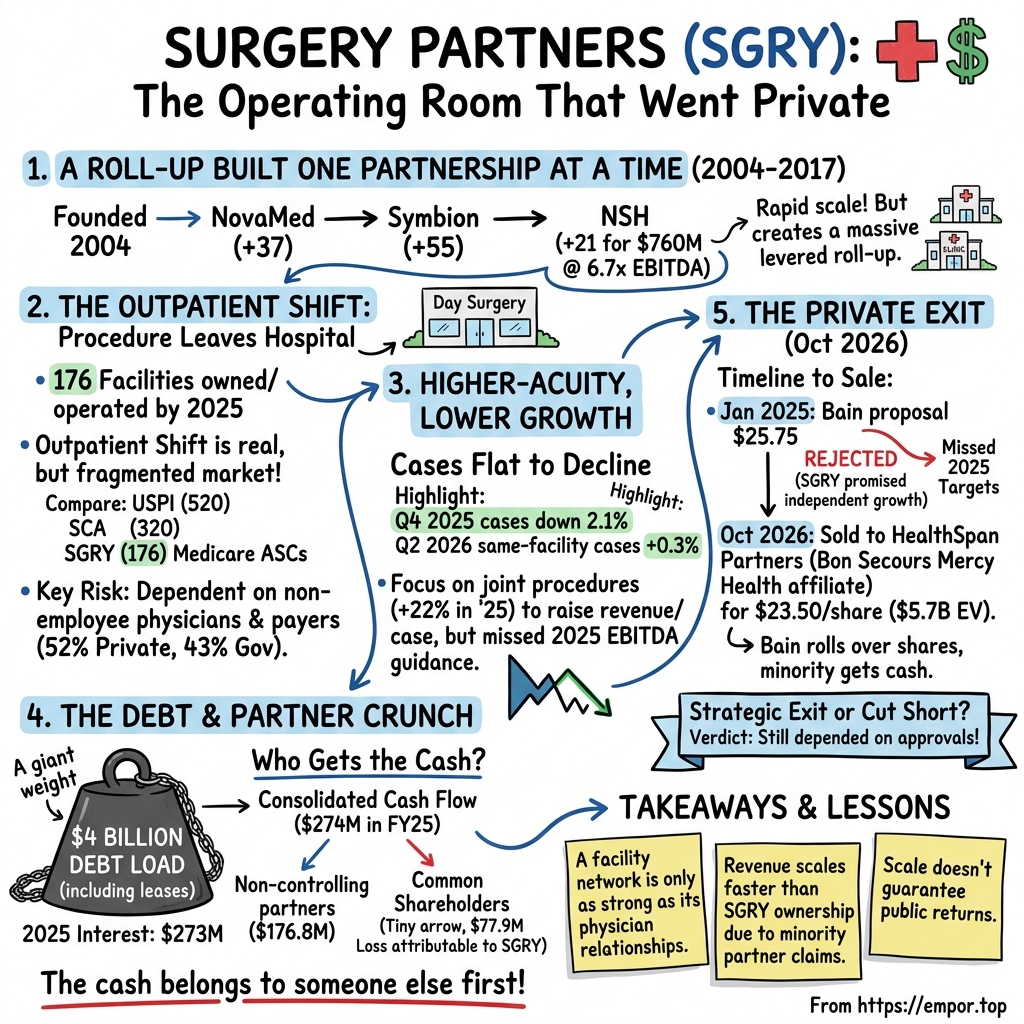
Surgery Partners: The Operating Room That Went Private
I. $23.50 for a Company Still Promising to Grow
On Friday, October 23, 2026, the board of Surgery Partners signed a document its own independent directors had effectively turned down sixteen months earlier: an agreement to stop being a public company.1 The buyer is HealthSpan Partners, which the company described as a contractual affiliate and supporting organization of Bon Secours Mercy Health, a large nonprofit Catholic health system.2 Shareholders other than Bain Capital would receive $23.50 in cash for each share. Bain's funds, which owned roughly two of every five shares, would not take the cash at all. They would roll their stock into the buyer and stay at the table.2 The press release put the enterprise value at about $5.7 billion, and when the announcement went out on Monday, October 26, it promised that the company's name, brand and headquarters would survive the change of ownership.2
Here is the contradiction at the centre of this story. In January 2025, Bain had offered $25.75 a share to take the company private.3 A committee of independent directors studied that proposal for five months and then, on June 17, 2025, walked away, saying that Surgery Partners' "prospects to deliver long-term growth and value creation as an independent publicly traded company exceeded the value of the Proposal."4 On the same day the company reaffirmed its 2025 forecast for adjusted EBITDA of $555 million to $565 million.4 Sixteen months later the board accepted $2.25 a share less than the offer it had declined, from a different buyer, with the same sponsor rolling over.
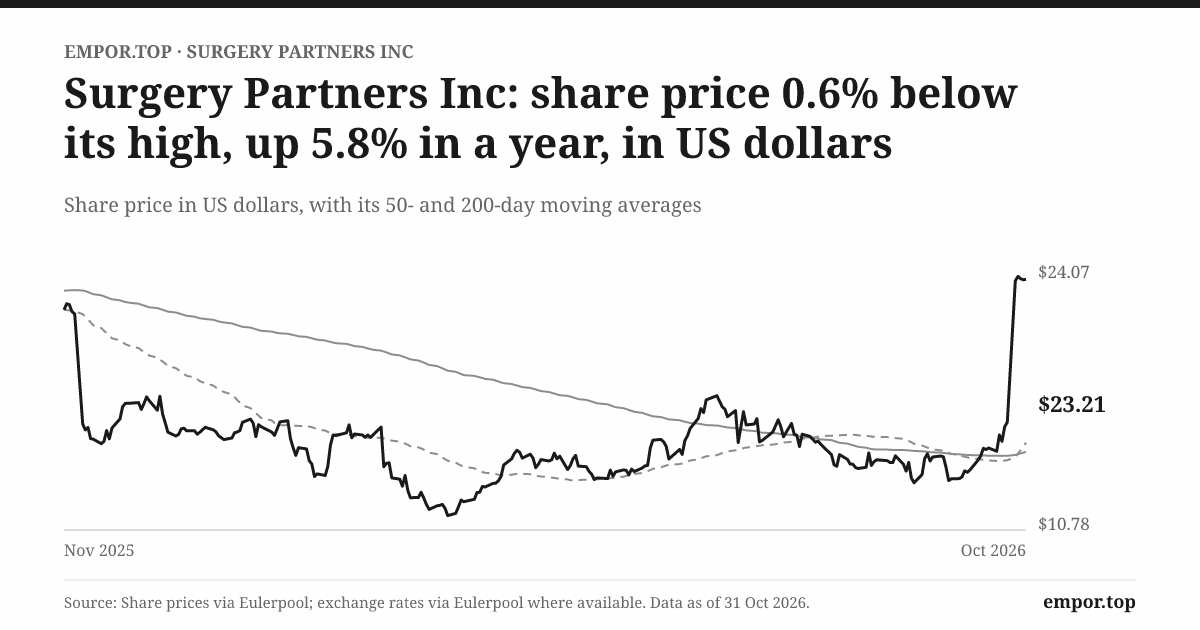
The company's chief executive, Eric Evans, framed the new deal as "the best path forward for Surgery Partners, delivering an attractive all-cash premium to our shareholders."2 He had a point about the premium. In the year before the announcement the stock had fallen as low as $11.49, and on October 30, 2026, it closed at $23.21, a whisker below the deal price and within a fraction of a percent of its 52-week high.[^5] The market had stopped arguing about what Surgery Partners was worth on its own and had started pricing the probability that the deal would close.
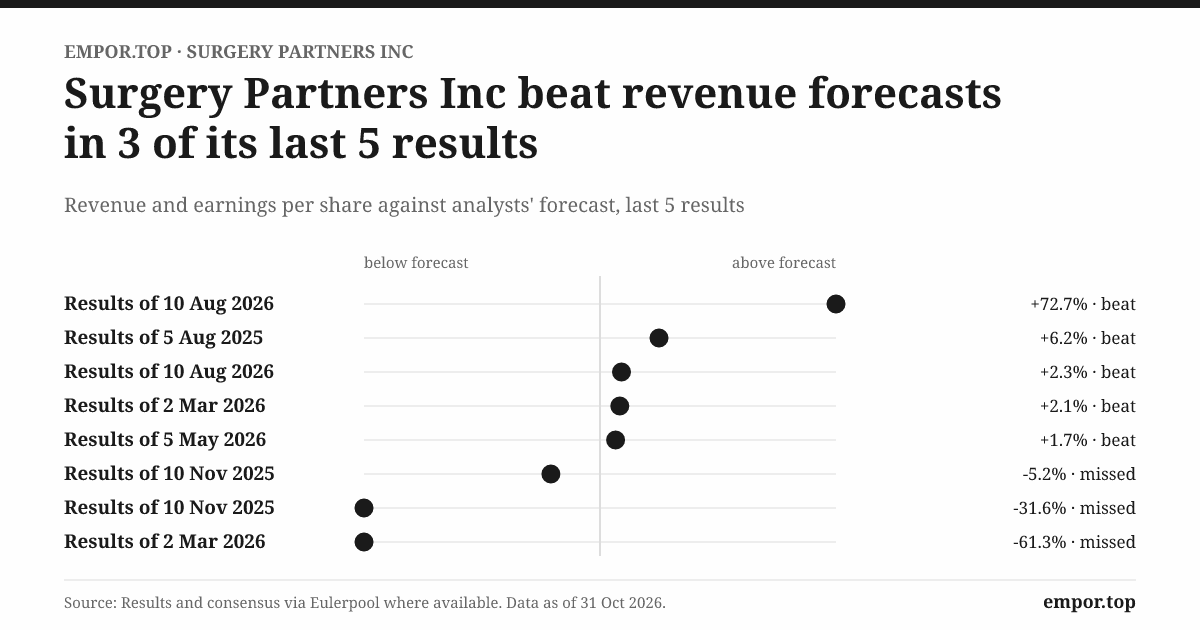
So why would a company that had defended its independence as a public growth platform agree to sell itself? The short answer is that the growth it had promised did not show up on schedule. The year Surgery Partners told investors to believe in ended with adjusted EBITDA of $526 million, well short of the range the board had reaffirmed while rejecting Bain.5 The stock that had been worth $25.75 to Bain was, by the following year, trading at less than half that at its low point.
The longer answer is what this story is about. Surgery Partners is a business that sits on top of a very real trend. Surgery is leaving the hospital. Knee replacements, cataract operations, spine procedures and cardiac catheterizations that once required an inpatient bed now happen in short-stay facilities where the patient walks in in the morning and goes home by dinner. Surgery Partners owned or operated 176 of those facilities at the end of 2025.6 The question is not whether the trend is real. It is who captures the economics of it.
That question has three candidates besides the common shareholder. There are the physicians, who own minority stakes in most of the facilities and who take their share of profits before anything reaches the listed company. There are the lenders, who were owed roughly $3.7 billion at the end of 2025.6 And there is the sponsor, Bain, which has been the largest shareholder since 2017 and which, in this deal, gets to keep its exposure to the platform's future while outside holders are cashed out at a fixed price.
The investigation that follows keeps one boundary firmly in place. This is the story of the listed company, Surgery Partners, Inc., and the facilities it owns or manages. It is not the story of Bain's wider portfolio, and it is not the story of Bon Secours Mercy Health, whose hospitals and finances belong to a different enterprise altogether. The deal does put a price on what this platform is worth to a health system. It does not settle whether the public company could have delivered more on its own, and as of October 31, 2026, closing still depends on a shareholder vote, regulatory clearance and other conditions.1 To understand how a company got to this point, it helps to go back to how it was built: one partnership, and one acquisition, at a time.
 Subscribe on LinkedIn
II. A Roll-Up Built One Partnership at a Time
Surgery Partners began in 2004 as a small operator of surgical facilities in partnership with physicians, the kind of business that a few dozen regional players were building across the American South and Midwest at the time.7 The model was simple to describe and hard to scale. A group of surgeons who did a lot of outpatient work would co-own a facility with an operator. The surgeons brought the cases. The operator brought capital, management, payer contracting, billing and the dull administrative machinery that keeps an operating room legal and staffed. Both shared the profits. A surgeon who owned a slice of the building where they operated had a reason to bring cases there, and an operator that controlled a portfolio of such buildings had a reason to keep the surgeons happy.
The company's transformation came through two big deals, both done under the ownership of the private-equity firm H.I.G. Capital. In 2011 it bought NovaMed, a Chicago-based operator focused heavily on eye surgery, which added 37 facilities.7 In 2014 it bought Symbion, a Nashville operator with 55 facilities, many of them in multi-specialty centers and a handful of surgical hospitals.7 By the time Surgery Partners went public, its investor presentation described a business that had been remade by those two transactions: larger, more diversified by specialty, and more dependent on the debt that had paid for it all.7
The IPO itself came at the end of September 2015. The company priced 14.285 million new shares at $19 each, and the stock began trading on Nasdaq on October 1.[^9] It was a respectable debut for a company that, on the reported numbers, had grown revenue from about $400 million in 2014 to almost $1 billion in 2015, largely because Symbion's revenue arrived for a full year.6 The balance sheet told a less flattering story. Shareholders' equity had been negative before the IPO, and borrowings were about $1.3 billion at the end of 2015, against roughly $145 million of operating profit.6 The IPO did not de-lever the company so much as give it a public currency and a public price.
The Bain turn
Then, in May 2017, came the deal that set the shape of the company for the next decade. On May 9, Surgery Partners agreed to buy National Surgical Healthcare, an operator owned by the private-equity firm Irving Place Capital, for $760 million of enterprise value.8 NSH brought 21 surgical facilities in 15 markets, and the combined company would have 125 facilities across 32 states.8
The financing was the more consequential part of the transaction. Bain Capital agreed to buy H.I.G.'s roughly 54% stake in Surgery Partners at $19 a share, the same price the public had paid at the IPO, and to invest about $295 million of preferred equity to fund the NSH purchase, within a total commitment of up to $800 million.8 In one stroke, the company changed sponsors, bought a large platform and layered preferred stock into its capital structure. From that point on, Bain was the largest shareholder, and every subsequent strategic decision, including the two take-private episodes of 2025 and 2026, would be shaped by the fact that the most powerful voice in the room belonged to a private-equity firm with its own exit clock.
Was NSH a good price? The answer depends heavily on which earnings number you divide into $760 million, which is itself a lesson about this industry. The lenders' presentation showed NSH pro forma adjusted EBITDA of about $82 million, which implies a multiple of a little over nine times.8 A widely repeated alternative puts the multiple nearer 6.7 times on a larger EBITDA figure of about $113.5 million. The gap matters because surgical facility earnings come in two flavors: the earnings of the whole facility, and the earnings that belong to the operator after the physician partners take their share. A valuation study of healthcare services transactions from 2010 to 2019 warned about exactly this problem, noting that press reports on Optum's 2017 purchase of Surgical Care Affiliates sometimes "failed to subtract the portion of EBITDA attributable to their physician JV partners."9 That same study put the median ASC transaction multiple over the decade at 7.7 times EBITDA, with the middle half of deals between about 6.8 and 9.2 times, and found that larger targets commanded higher multiples.9 Optum paid about 17 times estimated 2016 EBITDA for SCA, the decade's outlier.9
So NSH sat somewhere between a below-median bargain and an above-median platform price, depending on the definition, and well below what a strategic buyer like Optum had been willing to pay for national scale. That range is the honest conclusion. The comparison is rough, the asset mixes differ, and a multiple paid tells you nothing about the return earned afterward.
The machine keeps running
The acquisition habit never stopped. Over the following years, the company bought individual centers, physician practices and ancillary businesses, and it divested others. In 2025 alone, Surgery Partners acquired controlling interests in 12 surgical facilities plus several practices and ancillary businesses for $162.1 million net of cash acquired.6 By then the network had grown to 176 owned or operated facilities, and the company was describing itself, at the time of the merger, as a network of more than 200 locations in 30 states with about 5,000 affiliated physicians.2
What the record does not show is whether all this buying earned its keep. Surgery Partners does not publish an acquisition-by-acquisition scorecard: no disclosure of what each acquired center earned in its third year against what was paid for it. Investors have had to infer returns from aggregate measures. The company's return on invested capital, by one standard calculation, was about 6% in 2025, and it had hovered in a band of roughly 3% to 7% for most of the decade after the NSH deal.6 Debt, meanwhile, roughly tripled from the IPO year to 2025.6 Those two facts together do not prove that acquisitions destroyed value. They do say that the platform has grown into a bigger and more leveraged version of itself without yet producing the kind of return on capital that would make the case for the roll-up obvious.
That leaves the central test of the strategy unresolved, and it is a test with a precise form. If acquisitions work, same-facility growth should hold up after the deals, acquired sites should contribute visibly to earnings, transaction costs should fall as the machine matures, and leverage should come down between deals. The rest of this story checks each of those things. But first, it is worth understanding why anyone would want to own a network of operating rooms in the first place.
III. The Procedure Leaves the Hospital
Picture a patient in her early sixties who needs a knee replaced. A decade ago, the default would have been a hospital: admission the morning of surgery, a night or two in a ward, the full overhead of an institution designed to handle trauma, cancer and heart attacks. Today, if her surgeon, her insurer and her health allow it, she can have the same operation in a short-stay surgical facility, walk out the same day with a walker and a prescription, and recover at home. The procedure is the same. The building, the cost structure and the bill are different.
That migration is the tailwind under Surgery Partners. Outpatient facilities run fewer services, carry less overhead and schedule more predictably than hospitals, which makes them cheaper for payers, more convenient for patients and often more productive for surgeons, who can move between rooms rather than wait for a hospital's operating schedule to clear. Medicare's decisions over the past several years to let more procedures, including total joint replacements, be paid in outpatient settings widened the funnel. On the second-quarter 2026 call, the company's chief operating officer said the business had "started seeing cases, and continue to see cases, that come off the inpatient only list come into the ASCs."10
The scale of Surgery Partners within this trend is substantial. At the end of 2025, it owned or operated 176 facilities and consolidated 121 of them in its financial statements.6 It reported $3.3 billion of revenue for the year, and almost all of it, about $3.2 billion, came from patient services, which means the fees billed when cases are performed.6 The remainder came from management fees, physician practices and other services that support the facility platform but are not its economic engine.
How a case becomes revenue
The economics are straightforward to describe. Revenue is earned when a procedure is done and billed to the patient or, much more often, to an insurer or a government program. The amount collected for each case depends on three things: what kind of procedure it was, who is paying, and what the contract with that payer says. A cataract operation and a spinal fusion generate very different bills. The same knee replacement can pay very differently depending on whether the patient has commercial insurance through an employer or is covered by Medicare. Costs, on the other side, are mostly the clinical staff in the room, the supplies and implants used, the building and its leases, and the overhead of running the network.
Two variables, then, drive the business. Volume, meaning how many cases the network performs, depends on physicians choosing to operate there, on patients needing elective procedures, and on facilities having the capacity and staff to take them. Price, meaning revenue per case, depends on case mix and payer mix. A business like this can grow by doing more cases, by doing more expensive cases, or by getting paid more for the same cases. Each lever behaves differently in a downturn, and the company's recent history tested all three.
The payer exposure deserves particular attention. In 2025, private insurance accounted for about 52% of patient-service revenue and government payers, chiefly Medicare and Medicaid, for about 43%, with self-pay and other sources making up the rest.6 Surgery Partners does not report any single customer above a concentration threshold and does not name its largest payers. That absence is reassuring in one sense, because no single contract can sink the company, but it masks a structural exposure. Nearly half of the money comes from public programs whose rates are set by regulators rather than negotiated, and commercial insurers, the remaining half, are themselves highly concentrated in most local markets. The company itself flags reimbursement changes and the deferral of elective procedures as material risks.6
The physician problem
The single most important fact about this business, and the one that most clearly separates it from a hospital, is that the people who generate the revenue mostly do not work for it. Most physicians who operate in Surgery Partners facilities are not employees and are not required by contract to bring their cases there.6 A surgeon can hold privileges at a Surgery Partners center, a competitor's center and the local hospital, and send each patient wherever is most convenient. The equity stake gives that surgeon an incentive to favor the facility they co-own, and federal rules constrain how those arrangements can be structured, but the incentive is a reason, not a requirement.
That means the company's real customers, in the sense that matters for volume, are physicians. It must recruit them, keep them, give them efficient operating rooms and reliable staff, and secure payer contracts in their local markets that make their patients welcome. In the first half of 2026, the company said it had recruited about 330 new physicians.10 On the same call, management noted that new recruits "typically double their business in year two," which means a recruiting class is an investment that pays off with a lag.10 It also means that when experienced physicians retire or leave, the volume they took with them does not instantly come back. That dynamic is exactly what broke the company's 2025 forecast.
Big, but not the biggest
Surgery Partners is one of a handful of national operators in a market that remains highly fragmented. One 2025 count of Medicare-certified ASCs credited Tenet's United Surgical Partners International with about 520 centers, Optum's SCA Health with about 320, AmSurg with about 250, HCA with about 150, and Surgery Partners with about 132.11 By that measure, the largest competitor had roughly four times the center count of Surgery Partners, and two of the top three were owned by companies that also own hospitals or insurance businesses. Those parents can steer patients and contracts in ways an independent operator cannot.
The competitive picture is local, not national. A surgery center competes with the hospital down the road, with the other center across town, and increasingly with physician offices that can perform simpler procedures without a facility fee at all. Physicians choose among those options, payers influence where they send members, and new facilities can be built with a modest amount of capital if a group of surgeons decides to defect. A national brand counts for little in that contest. What counts is the relationship with the local surgical group, the reliability of the operating room and the terms of the local payer contracts.
That is why the company's own account of its advantage centers on its partnership model, physician recruitment and patient satisfaction. Those are real operating capabilities, and the company's long record of attracting physician partners is evidence that it can execute them. But they are not, on the evidence available, a moat in the strict sense. The filings do not show high switching costs for surgeons, durable pricing power with payers, or a cost position that competitors cannot match. The honest version of the claim is narrower: Surgery Partners is a competent operator riding a real market shift, whose advantage is earned market by market and has to be re-earned every time a surgical group reconsiders where to operate. The test of that claim is in the numbers that measure physician loyalty indirectly: same-facility cases, revenue per case and the pace at which new recruits ramp. And in late 2025 those numbers started to wobble.
IV. Higher-Acuity Cases, Lower Growth
On March 3, 2026, Eric Evans opened the fourth-quarter earnings call with an admission that chief executives usually try to avoid. Adjusted EBITDA for 2025 had come in at $526 million, up 3.5% from the year before but, in his words, "significantly below our expectations."12 Fourth-quarter adjusted EBITDA had actually fallen about 4% from a year earlier, and the total number of surgical cases performed across consolidated facilities was down 2.1%.5 Then he pivoted to the strategy he wanted investors to remember: more complex procedures. Total joint replacements had grown 15% in the quarter and 19% for the year.12
That pivot is the company's growth story in miniature. Higher-acuity procedures, meaning more complex operations like total joints, spine work and cardiac interventions, pay much more per case than routine procedures such as cataracts or endoscopies. If a center can do fewer, richer cases, revenue can grow even when volume stalls. The question this chapter asks is whether that shift can restore growth without eroding margins, or whether it is a story about one fast-growing procedure category papering over a broader slowdown.
The long run and the recent run
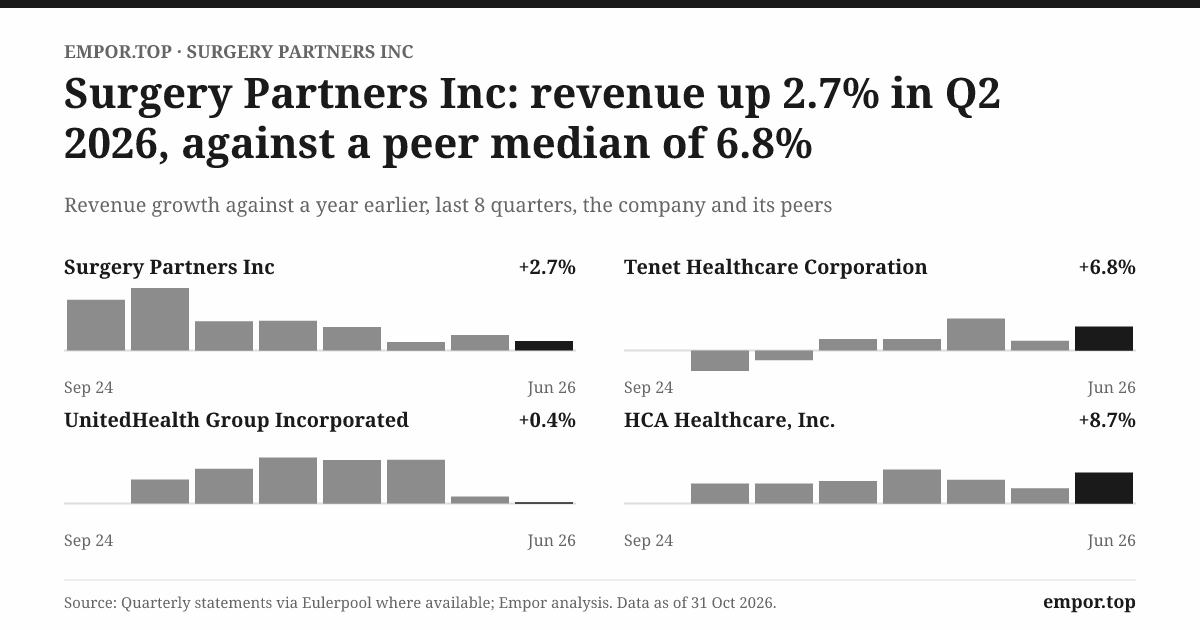
Start with the arc. From 2015 to 2025, revenue compounded at about 13% a year.6 Most of that came from acquisitions, including the NSH deal, so it was never a clean measure of organic demand. But the slowdown since is unmistakable. Revenue grew about 6% in 2025, and across the four quarters to June 2026 it grew only about 4%.513
The more telling measure is same-facility performance, which strips out acquired and divested centers to show how the existing network is doing. In 2025, same-facility revenue grew 4.9%, made up of 3.4% more cases and 1.4% more revenue per case.5 That is respectable, and it is below reported growth, which tells you that acquisitions were still adding to the top line. In the fourth quarter, though, the mix changed. Same-facility revenue grew 3.5%, with cases up only 1.3% while revenue per case rose 2.1%.5
By the second quarter of 2026, the shift had become stark. Same-facility revenue rose 5.0%, which looks healthy, but cases rose only 0.3%. Almost all of the growth came from revenue per case, which was up 4.8%.13 In the first half of 2026, same-facility cases grew less than 1%.13 Put plainly, the network was barely doing more procedures than a year earlier. It was getting paid more for each one.
There are two possible readings. The optimistic one is that this is exactly the acuity strategy working: fewer cataracts, more knees, more revenue per room. The skeptical one is that volume has stalled, and that higher revenue per case reflects a mix of procedure acuity, payer contract increases and the loss of lower-paying volume, not a growth engine that can run for years. The evidence supports a narrower version of the optimistic story. Total joints really are growing at double-digit rates, and on the first-quarter 2026 call Evans said he did not "see that changing in the near future."14 But total joints remain one category inside a network that does a very wide range of procedures, and a strong category cannot compensate indefinitely for flat overall case counts.
What actually went wrong
The fourth-quarter call is where the company explained the gap, and the explanation was unusually specific. Evans said "three discrete issues in those markets explain our entire gap," pointing to three of the company's larger surgical hospitals.12 Surgical hospitals are the minority of the portfolio, larger facilities that can keep patients overnight, and they behave more like small hospitals than like surgery centers. In one market, competitors had dropped Medicare Advantage patients, changing which patients showed up. In another, growth was strong but "it was all in Medicare," with added pressure from anesthesia costs. In a rural market, experienced physicians had left and been replaced by newer surgeons who initially saw more Medicare patients and fewer commercially insured ones.12
The common thread is payer mix. Evans said the company's commercial share fell about 120 basis points for the year and about 370 basis points in the fourth quarter, a swing he called "quite unusual."12 CFO David Doherty added that some facilities "were unable to adjust quickly enough to the changing payer mix."12 In plain terms, when a commercially insured patient is replaced by a Medicare patient for the same procedure, revenue falls while the cost of the staff and supplies stays roughly the same. Margins absorb the difference.
That explanation has the virtue of being specific and the drawback of being incomplete. When Barclays' Andrew Mok asked how many facilities were affected, the number was not given. When Leerink's Whit Mayo pressed on how much revenue the three markets had lost, Evans did not quantify it.12 The diagnosis was clear, but the dimensions of the problem were left for investors to infer.
What recovery looked like by the summer
The company set a deliberately measured 2026 outlook: revenue of $3.35 billion to $3.45 billion and adjusted EBITDA of "at least $530 million," barely above 2025's result, which Doherty said implied "slight margin compression."12 By the second-quarter call in August, the company said the commercial mix was about 49% of revenue, roughly 350 basis points below a year earlier, but that this was "primarily isolated to our larger surgical hospitals and was consistent with the assumption embedded in our full-year guidance."10 Physician departures from the fourth quarter were "moderating as expected."10 Adjusted EBITDA for the second quarter was $125 million, slightly below the year before, with the margin down almost a full percentage point.13
So the company did what it said it would do in the first half of 2026: it met a lowered bar. That is not nothing, because a company that has just missed is judged first on whether it can hit its reset target. But it is not a recovery in the sense the 2025 board had in mind. Cases were flat, margins were lower, and the growth algorithm still depended on revenue per case rather than volume.
The business risks attached to this model are therefore the ones the year exposed. Elective procedures can be postponed when patients face higher deductibles or economic uncertainty. Payers can change prior-authorization rules or shift Medicare Advantage contracting. Labor and supply costs, especially expensive implants for joint replacements, can rise faster than reimbursement. Each of those mechanisms hits a business that already has thin room for error, in part because most of the cash Surgery Partners generates belongs to someone else first.
V. The Cash That Belongs to Someone Else First
Here is a puzzle that has confused casual readers of Surgery Partners' financial statements for a decade. Add up the twelve years from 2014 through 2025, and the company reported cumulative net losses attributable to its shareholders of about $882 million.6 Over the same twelve years, it generated about $2.0 billion of cash from operations and about $1.3 billion of free cash flow after capital spending.6 How can a business lose almost $900 million and generate $2 billion of cash?
It is tempting to see in that gap either an accounting conspiracy or a hidden cash machine. It is neither. The answer lies in how a business with physician partners keeps its books, and once you understand it, you understand who actually owns the cash.
The ownership bridge
Imagine a single surgery center that earns $10 million a year. Surgery Partners owns 51% of it; a group of local surgeons owns 49%. Because Surgery Partners controls the center, accounting rules require it to consolidate the whole thing: all of the revenue, all of the costs, all $10 million of profit and all of the cash the center produces. But only $5.1 million of that profit belongs to Surgery Partners' shareholders. The other $4.9 million appears in the income statement as "net income attributable to non-controlling interests," and it is subtracted before arriving at the bottom line that matters to the public shareholder.
The cash flow statement, however, starts from the consolidated figure. It shows all $10 million coming in as operating cash. The surgeons' share of that cash only leaves later, when the center makes distributions to its partners, and those distributions appear lower down, in the financing section. So operating cash flow is, by construction, a measure of the whole network's cash generation, not the listed company's share of it.
Now scale that up. In 2025, Surgery Partners' consolidated net income was about $99 million. After $177 million was allocated to non-controlling interests, the company's shareholders were left with a loss of about $78 million.6 Read that again: the partners' share of profit was larger than the entire consolidated profit. That can happen because the corporate layer, where Surgery Partners carries its debt, its interest costs, its acquisition expenses and its headquarters, sits entirely on the listed company's side of the ledger. The facilities make money; the partners take their share at the facility level; and the parent company absorbs the interest bill on borrowings that paid for its stakes in those facilities.
The other items in the bridge are more familiar. Depreciation and amortization of about $176 million in 2025 reduced profit without consuming cash that year.6 In 2024, a deferred tax charge of about $132 million depressed reported earnings without affecting cash.6 Those non-cash items explain why operating cash consistently exceeded reported profit. They do not change the basic structure: a large share of every dollar of facility profit belongs to partners, and the interest on the debt lands on the public company.
Where the cash went in 2025
Operating cash flow fell to about $274 million in 2025 from about $300 million in 2024.6 Two working-capital items drove much of the decline. Receivables, money owed by insurers and patients, absorbed about $54 million of cash as the company grew and as billing cycles stretched, and other operating balances absorbed about $57 million more.6 Average days sales outstanding, the time it takes to collect a typical bill, was 60 days in 2025, essentially unchanged from 61 in 2024.6
That stable collection period is mildly reassuring. It suggests the company is not booking revenue it cannot collect. But a stable ratio on a growing revenue base still ties up more cash each year, and Surgery Partners does not publish a full aging table showing how much of its receivables are more than 90 days old or how much it writes off each year. The company describes estimating its collections using contract terms and historical write-offs, which is standard, and its auditor issued a clean opinion on the 2025 statements and on internal controls.6 Even so, an investor cannot independently check the quality of the receivables book beyond the headline ratio.
After capital spending, free cash flow was about $196 million in 2025.6 That sounds healthy against a market value of roughly $2.9 billion on October 30, 2026. But the interest bill in 2025 was about $273 million.6 Interest is already deducted before operating cash flow, so the $196 million is after interest. What it is not after is the partners' distributions, which come out of financing cash flow, and the debt repayments that a company trying to deleverage needs to make. Once those are counted, the cash genuinely free for the listed company's shareholders shrinks to a fraction of the headline figure.
The partners' other claim
There is one more layer of partner economics, and it is easy to misread. Some physician investors and facility partners also own the buildings that Surgery Partners leases. In 2025, related-party lease costs totaled about $56 million, split between operating and finance leases, roughly a quarter of the company's total lease costs.6 Related-party revenue, mainly management fees from facilities in which insiders have interests, was about $20 million, less than 1% of sales.6
Those figures matter for facility economics because they mean some partners are also landlords, collecting rent in addition to their share of profit. That arrangement is common in the industry and is disclosed. What it is not is a Bain arrangement. The disclosed related-party leases are primarily with physician investors and facility partners, and the filings do not show any management fee, royalty or rent paid to Bain. The sponsor's economics flow through its shares, not through side payments.
So the verdict on the profit-versus-cash gap is clear. The gap is real, but it is mostly an artifact of consolidation, not evidence of hidden earnings power. Surgery Partners does generate meaningful cash across its network. The common shareholder, however, holds a claim that sits behind the partners at the facility level and behind the lenders at the corporate level. The way to measure what is actually left is to follow free cash flow after interest, after partner distributions and after debt service, and to stop treating consolidated operating cash as money the public company can spend.
That framing leads directly to the hardest question about this business. If the cash left over is modest and the company keeps buying facilities, how does it ever pay down the debt that sits on top of the whole structure?
VI. The Growth Algorithm Meets a $4 Billion Debt Load
In 2025, Surgery Partners was running two programs at the same time, and they pulled in opposite directions. One program was the growth machine: acquisitions, new centers built from scratch, recruitment and equipment. The other, announced as the year turned sour, was what management called "portfolio optimization," a polite name for selling or restructuring assets to raise cash and reduce debt.5 A company trying to grow by buying assets and shrink its debt by selling them is telling you something about the tension in its model.
What the company reinvests in
Surgery Partners has no research and development budget in the conventional sense. Its reinvestment takes other forms: de novo centers built from the ground up with new physician partners, upgrades to existing facilities, robotics, the recruiting of new surgeons, and, above all, acquisitions. On the first-quarter 2026 call, Evans said the company had deployed 73 surgical robots and described robotics as "an unlock" for higher-acuity work.14 At mid-2026 it had six de novo centers under construction and seven more in its pipeline.10
Property and equipment spending was about $79 million in 2025, roughly 2.4% of revenue, down from about 3% two years earlier.6 That low capital intensity reflects the nature of the business: surgery centers are not expensive to equip relative to the revenue they produce, and many buildings are leased rather than owned. Acquisitions consumed about twice as much, at $162 million net of cash acquired in 2025.6 And the cost of doing deals was itself material. Transaction, integration and acquisition costs, which the company excludes from adjusted EBITDA, were about $74 million in 2025.6 When a company spends almost half as much on the process of acquiring as on the acquisitions themselves, and does so year after year, the question of whether those costs are really one-time becomes a fair one.
Management's own target had been to deploy about $200 million a year on acquisitions, and on the fourth-quarter call it framed the expected earnings from that spending on the assumption of paying about eight times EBITDA.1214 By the second-quarter 2026 call, Evans conceded that "we will clearly not reach our $200 million average annual M&A investment target in 2026."10 Whether that reflected discipline, a lack of attractive targets, or a balance sheet that could no longer support it, the result was the same: the acquisition engine had slowed.
The question that matters is whether the capital being deployed earns more than it costs. The company's return on invested capital was about 6% in 2025.6 With unsecured notes carrying a 7.25% coupon, and term loans at floating rates, the return on capital was, on that simple measure, below the company's marginal cost of borrowing.6 That comparison is crude, because returns on invested capital are depressed by goodwill from past deals and because consolidated returns include partner shares. But it points in an uncomfortable direction.
The weight on the balance sheet
At the end of 2025, total debt was about $3.7 billion.6 It was made up of about $1.4 billion of senior secured term loans, $1.2 billion of 7.25% unsecured notes due 2032, about $200 million of other secured loans, and $936 million of finance leases.6 That last item deserves a word. Finance leases are leases on buildings and equipment that accounting rules treat like debt because the company effectively owns the asset for most of its life. They are real obligations, but they are not borrowings from a bank. Operating leases of about $323 million are separate again and sit outside the debt total.6 An investor who adds all of these together gets a scarier number; an investor who looks only at bonds and loans gets a smaller one. Neither is wrong. They measure different things.
The lenders' preferred measure, net leverage under the credit agreement, which adjusts for cash and for partners' share of earnings, was about 4.3 times at the end of 2025 and 4.4 times at the end of June 2026, up from 4.1 times a year earlier.510 On a simpler basis, consolidated debt divided by adjusted EBITDA was 4.9 times at year-end 2025, and the company put net debt to adjusted EBITDA on its balance-sheet basis at 5.1 times in mid-2026.510 Leverage, in other words, was drifting the wrong way.
The rate exposure compounded the problem. The company had used interest-rate swaps and caps to blunt the rise in borrowing costs, but $1.2 billion of swaps matured at the end of March 2025, and five caps with $1.4 billion of notional value took their place.6 Caps limit how bad things get; they do not lock in low rates the way swaps did. Interest expense was about $273 million in 2025, and on the first-quarter 2026 call the company flagged roughly $7 million of additional interest cost tied to the expired swap.614 The credit agencies watched closely. Moody's affirmed its rating on the borrowing entity at B2 with a negative outlook in August 2025, and S&P affirmed it at B with a stable outlook in November 2025, both firmly in speculative-grade territory.1516
Selling to deleverage
Portfolio optimization took its most concrete form in the summer of 2026. In July, the company agreed to sell its interests in Mountain View Hospital and Idaho Falls Community Hospital to Intermountain Health.1310 On the second-quarter call, Doherty said gross proceeds would be about $795 million, roughly seven times the hospitals' trailing adjusted EBITDA and about 17 times the distributions the company had received from them over three years.10 Those hospitals carried about $350 million of consolidated debt, of which the company's share was roughly three-quarters, and accounted for about a third of its finance lease obligations.10 Proceeds would go "primarily to pay down debt," cutting leverage by about 0.3 turns, with no tax leakage expected.10 Evans called it "the most impactful part of our strategic review process to date."10
The deal is revealing in two ways. First, selling at about seven times EBITDA a business that the company itself valued, through its own M&A target, at about eight times suggests that the market for larger surgical hospitals was less generous than the market for ASCs. Second, a sale that removes a sizable chunk of EBITDA and lowers leverage by only about 0.3 turns shows how heavy the debt load is relative to what any single asset sale can fix. The divestiture remained subject to physician and board approvals at the time of the second-quarter call, and net cash proceeds were not yet determinable.10 When an analyst asked whether more sales would follow, Evans replied that "you shouldn't expect there's going to be specific reports beyond that."10
What about the record of past deployments? Between 2022 and 2024, the company recorded no non-cash impairment charges on its facilities, which means it never formally wrote down what it paid for acquisitions in that period.6 That is a fact in the company's favor, but it is a weak one. Impairment tests compare book values to estimated future cash flows, and they rarely fire until something has gone badly wrong. The absence of write-downs does not prove that acquisitions earned their cost. It only shows that none had failed badly enough to force the accountants' hand.
The verdict on this chapter, then, is neither "disciplined capital allocator" nor "value destroyer." The public evidence is too thin for either label. What is clear is that Surgery Partners kept investing through a period in which its return on capital was close to its cost of debt, its leverage edged up, and its transaction costs stayed persistently high. That is the backdrop against which management made its most consequential promise.
VII. The 2025 Promise and the Q4 Reset
Eric Evans came to Surgery Partners from the world of hospital operations. Before joining the company as chief operating officer in April 2019, he had run hospital operations for Tenet Healthcare, one of the country's largest hospital chains, and before that he led Tenet's Texas region and its hospitals in El Paso.17 He holds an industrial management degree from Purdue and an MBA from Harvard Business School, and he has sat on the board of Teladoc Health since 2023.17 He became CEO in January 2020, just in time to lead an outpatient surgery business through a pandemic that shut down elective procedures across the country.17 David Doherty became CFO in February 2022.17
That background matters for how to read this management team. Evans is an operator, fluent in the mechanics of staffing, payer contracting and capacity, and the company's calls under his leadership tend to be detailed about operating levers. The question about any management team, though, is not how fluent it is. It is whether its promises turn into outcomes, and whether it explains the gaps when they do not.
Confidence in June, a miss in March
The key moment came in June 2025. When the special committee ended its discussions with Bain, the company's release carried a headline that framed the outcome as a vote of confidence: the board "reaffirms its confidence in the Company's long-term growth prospects."4 The same release reaffirmed guidance for 2025 revenue of $3.30 billion to $3.45 billion and adjusted EBITDA of $555 million to $565 million, and promised an Investor Day in the second half of the year.4
That was a claim the company could be held to, and it did not hold. Actual 2025 adjusted EBITDA was $526 million, about 5% below the bottom of the range the board had reaffirmed.5 By the fourth-quarter call, Doherty described the result as "below our revised guidance expectation we provided on our last call," indicating that the target had already been lowered during the year before the final shortfall.12 Evans acknowledged that "our performance does not reflect the potential of our business."12
There is a credible and a less credible way to read this sequence. The credible reading is that management faced genuinely unanticipated headwinds in a handful of surgical hospitals, diagnosed them specifically, and reset expectations to a level it then met in the first half of 2026. The company did reaffirm its 2026 guidance on both the first- and second-quarter calls, and it delivered the mid-year portfolio announcement it had promised.1410 The less credible reading is that the board should have been more cautious when it reaffirmed its forecast after rejecting Bain. Both readings contain truth. The record shows a management team that was too optimistic in mid-2025, admitted it plainly, and then set a conservative bar it could clear. It does not yet show a team that has restored growth.
How the managers are paid
Compensation tells you what a board wants management to optimize. In 2025, Evans' reported total compensation was about $6.1 million, of which $5.0 million was stock awards valued at the grant date.17 Neither Evans nor Doherty received a cash bonus for 2025, because the company missed its targets.17 That is accountability of a real kind: the annual incentive plan did what it was designed to do when the numbers fell short.
The design of that plan, however, deserves scrutiny. The scorecard weighted adjusted EBITDA at 70%, net revenue at 15% and a cash-flow measure at 15%.17 Adjusted EBITDA excludes, among other things, transaction and integration costs. A plan so heavily weighted toward an adjusted earnings measure creates an incentive to pursue acquisitions that add EBITDA, while the costs of doing them sit outside the metric. Nothing in the record shows that this incentive distorted decisions. It does mean that investors evaluating management's capital allocation should look at the adjusted figures and the excluded costs together.
Management's own stake in the outcome is modest. Evans beneficially owned about 1.4 million shares, around 1.1% of the company including options exercisable within 60 days, and all directors and executive officers together held about 2% as of March 31, 2026.17 Bain, with 38.2%, was by far the most influential holder, though it did not hold a majority.17 At the June 2026 annual meeting, the say-on-pay resolution passed easily, with about 112 million votes for and 2 million against.18
Did the story change?
Comparing the calls across 2026 reveals a narrative that held together but narrowed. On the fourth-quarter call, the emphasis was on three discrete problems and a measured outlook.12 On the first-quarter call, Evans said the pressures had "moderated," the company reaffirmed its annual target, and it promised a resolution on a key part of portfolio optimization by mid-year.14 On the second-quarter call, it delivered that resolution with the Idaho Falls sale, reaffirmed guidance again, and quietly dropped the $200 million annual acquisition target for the year.10 Analysts asked concrete questions about payer mix, divestitures and cost relief. They got concrete answers on the Idaho Falls economics and payer mix, while answers on further sales, expense relief and the precise size of the 2025 problem were deferred or qualitative.1210
That pattern is consistent with a management team executing a reset, not with one hiding problems. But it is also consistent with a company whose public-market story had narrowed from growth to repair. About three months after the second-quarter call, the board decided that the repair would be completed in private.
VIII. The Sponsor's Exit Becomes a Health-System Bet
The first take-private attempt had been Bain's alone. On January 27, 2025, Bain proposed to buy every share it did not already own for $25.75 in cash.3 The proposal was explicit about protections for outside holders: any deal would require approval by a fully empowered special committee of independent directors and a majority of the shares not held by Bain.3 At the time, Bain owned about 39% of the company.3 The committee hired advisers, negotiated for five months, and then, in June, the two sides concluded their discussions without a deal.4
The second attempt was built differently. The buyer was HealthSpan Partners, through a holding company called Spyglass Topco, with Bon Secours Mercy Health signing the merger agreement as guarantor of the buyer's payment obligations.1 HealthSpan's president, Dr. Wael Haidar, is also president of clinical operations at Bon Secours Mercy Health.2 Bain was no longer the bidder. It was the partner. Under a support agreement, Bain's holding entities agreed to vote for the merger and, immediately before closing, to contribute their shares to the buyer in exchange for equity in it.1
Two prices, two moments
It is tempting to compare $23.50 with $25.75 and conclude that outside holders got a worse deal. That comparison misleads. The $25.75 proposal arrived when the company had just reported a strong 2024 and was forecasting EBITDA growth into 2025; the $23.50 agreement came after a year in which the company missed its forecast, its leverage rose and its stock fell to the low teens.5[^5] The two prices reflect different businesses at different moments, and they come from different buyers with different motives.
What can be said is narrower and sharper. The special committee in 2025 bet that the public company could deliver more than $25.75 on its own, and that bet did not pay off on the evidence of the following sixteen months. Shareholders who held through the period end up with less than they would have received under the Bain proposal, before accounting for the time value of money. That is not proof the committee was wrong to decline; it may not have had a firm deal to accept, and the committee's job was to judge value as best it could at the time. But it is a fact any assessment of the 2025 decision has to reckon with.
The structure of the deal
The governance of this transaction was built to address the obvious conflict: the largest shareholder sits on both sides. A special committee of independent and disinterested directors led the negotiations, advised by Moelis & Company and Goodwin Procter, and recommended the deal unanimously to the board.2 The merger requires approval by a majority of all outstanding shares and also by a majority of votes cast by unaffiliated shareholders, meaning holders other than Bain, the directors and the company's senior officers.1 That second condition gives outside holders a genuine veto. Holders who believe the price is inadequate also retain appraisal rights under Delaware law.1
The protections for the buyer are standard. Surgery Partners agreed not to solicit competing bids, subject to a fiduciary exception for a superior proposal, and to pay a termination fee of about $109 million in certain circumstances, including if the board changes its recommendation or accepts a better offer.1 The buyer has committed debt financing from Jefferies, and the deal is not conditional on financing.21 Closing requires the shareholder approvals, expiration of the antitrust waiting period and other customary conditions, with an outside date of July 23, 2027, and the parties expected to close in the first quarter of 2027.21
What a health system sees
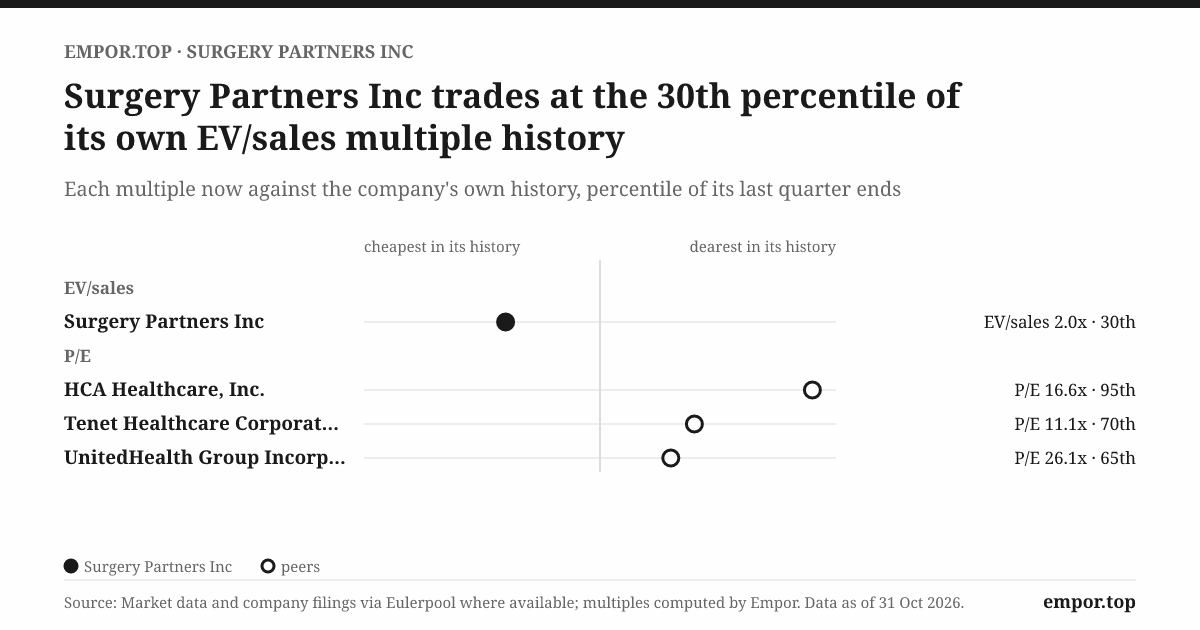
Set the price against operating value, and the strategic premium becomes visible. An enterprise value of about $5.7 billion divided by 2025 adjusted EBITDA of $526 million gives about 10.8 times.25 By contrast, the stock market on October 31, 2026, valued the company's enterprise at about 7.1 times EBITDA on a standard data-provider calculation.6[^5] Those two numbers use different definitions of enterprise value and different earnings bases, so the comparison is context rather than a clean measure. The direction, however, is clear: the buyer is paying a multiple well above where public investors had priced the company, and closer to what large strategic buyers have historically paid for national surgery platforms.
Why would a health system pay more than public investors? The answer lies in who can use the asset. For a public shareholder, Surgery Partners is a set of cash flows encumbered by partners and lenders. For a health system, it is a way to capture outpatient surgical volume that is already leaving hospitals, including possibly its own. Large health systems face the same migration Surgery Partners rides, but from the other side: every knee replacement that moves to an ASC is revenue leaving a hospital. Owning a national outpatient operator lets a system participate in that migration rather than lose to it. That logic is the same one that led Optum to buy SCA and Tenet to build USPI.9 The company's own transaction materials say Surgery Partners will remain a secular organization with its existing name and headquarters, not a Catholic ministry entity, and that payer contracts are expected to remain in effect through closing.219
The boundary matters here. Bon Secours Mercy Health is a large system with its own hospitals, finances and strategy, but none of its revenue or facilities belongs to Surgery Partners. Its role in this transaction is as guarantor and strategic sponsor of the buyer, and whatever combined vision it has for the outpatient platform will be tested only after closing.
What is still unknown
As of October 31, 2026, the most important document for evaluating this deal had not yet been published. The merger proxy, along with the Schedule 13E-3 disclosure required in transactions involving affiliates such as Bain, will lay out the background of the negotiations, the fairness analyses, the economics of Bain's rollover equity and the full terms of the termination protections.19 Until then, outside shareholders know what they will receive but not exactly how the special committee arrived at the price, what alternatives it explored, or how much more favorable the rollover equity might prove for Bain if the platform performs well under its new owner.
That last point is the essence of the transaction's economics. Outside holders are exiting at a fixed price today. Bain is staying in, betting that the platform will be worth more under a health-system owner than it was in public hands. Both cannot be right about the future. The question, which the next section takes up directly, is what evidence would tell you who has the better side of that trade.
IX. Analysis & Bear vs. Bull Case
Surgery Partners enters the closing stretch of its public life carrying almost $4 billion of borrowings on the most expansive definition, a credit-agreement leverage ratio of about 4.4 times, and a share price that sits just under the cash offer.610[^5] For the outside shareholder, the investment question has largely collapsed into a single variable: will the deal close? But the underlying business question has not gone away, because it determines what happens if the deal breaks, and it determines whether Bain and its new partner have made a good bet. Is Surgery Partners a scaled platform with room to grow, or a low-margin, leveraged partnership network whose value is clearest to a strategic buyer?
The forces around the operating room
Start with the structure of the industry, because it sets the ceiling on what any operator can earn. Think of the five pressures that squeeze an industry's profits, and apply each to a surgery center.
The first pressure comes from buyers, and here the buyers are payers. Commercial insurers in most local markets are concentrated, and government programs set their rates by regulation. With roughly 43% of patient-service revenue coming from public payers, Surgery Partners has little leverage over almost half its pricing.6 The fourth quarter of 2025 showed how quickly payer mix can move against the company even without a single rate cut.12
The second pressure comes from suppliers, and the most important supplier is not a vendor but the physician. Surgeons supply the cases, are mostly not employees, and can operate elsewhere.6 Implant and supply makers, and the clinical labor market, add further cost pressure; supplies alone ran at about 27% of revenue in early 2026.14 When the most important input can walk across the street, supplier power is high.
The third pressure is substitution. Hospitals, hospital outpatient departments and, increasingly, physician offices compete for the same procedures. The shift toward outpatient care is a tailwind for ASCs against hospitals, but the same logic that moves a procedure from a hospital to an ASC can eventually move simpler ones from an ASC to an office.
The fourth is new entrants. Building a surgery center requires a few million dollars, a group of surgeons and a payer contract, which is a meaningful but not prohibitive barrier. A surgical group that becomes dissatisfied with its operating partner can, in principle, build its own center with a competitor.
The fifth is rivalry. The market is fragmented, but the leading national players are large and well capitalized, and two of the biggest are owned by companies with hospitals or insurance arms. USPI's center count was about four times Surgery Partners' in one 2025 tally.11
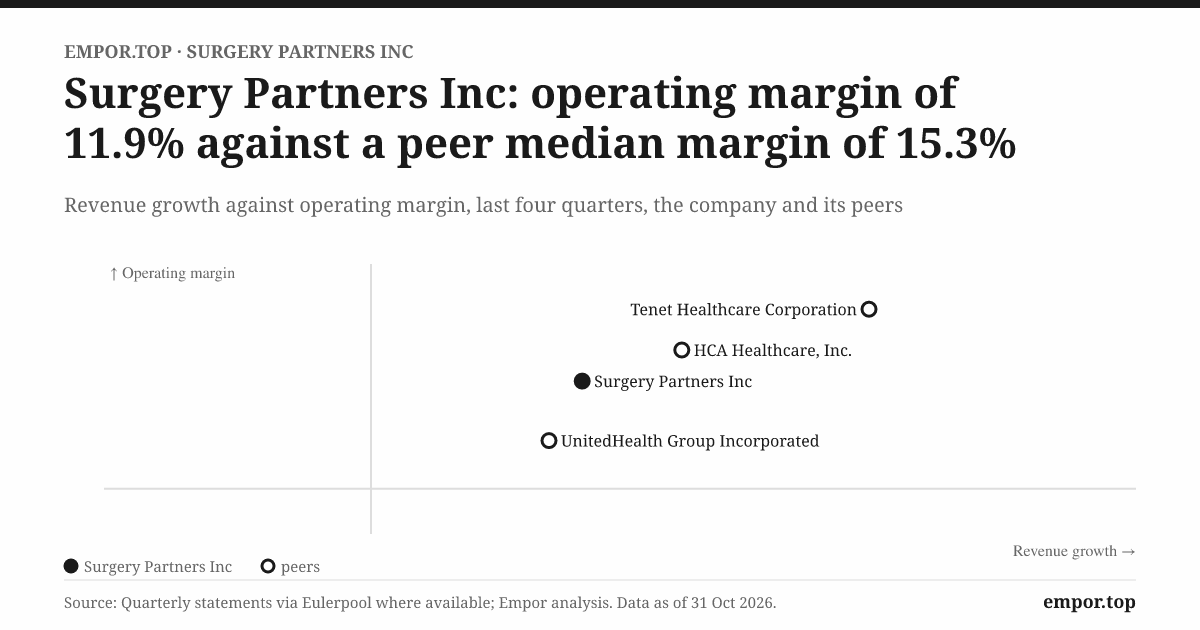
Put together, the industry structure is reasonably attractive at the level of the individual facility, where well-run centers can earn healthy margins, and much less attractive at the level of a leveraged national operator, which must pay for its access to those facility profits by sharing them with partners and servicing debt.
Which powers, if any?
A second way to test the moat is to ask which durable sources of advantage the company actually has. Of the seven commonly cited sources of lasting competitive power, most do not fit. Surgery Partners has no network effects; one more center does not make the others more valuable to patients. It has no proprietary technology or patents that matter. Its brand is invisible to most patients, who choose a surgeon rather than a facility. Switching costs exist for physicians, because moving a practice to a new facility is disruptive, but they are moderate and they did not prevent the departures that hurt the company in 2025.
Two powers come closest to applying. One is a modest scale economy: a national operator can spread billing, payer contracting, supply purchasing and compliance across many facilities, and it can offer physicians capital and management expertise that an independent center cannot. The company's acquisitions and its 330 physician recruits in the first half of 2026 suggest that physicians do value what it provides.10 The other is something like cornered local positions: in some markets, a well-established multi-specialty center with a loyal surgical group is hard to dislodge. But neither of these is clearly stronger at Surgery Partners than at its larger competitors, and the company's return on capital of about 6% does not look like the signature of a business with real competitive power.6
So the verdict is that the evidence leaves the company's advantage intact but narrow and unproven. It is a capable operator in an attractive niche, not a business with a moat that protects returns above its cost of capital. The KPI that would change that conclusion is sustained same-facility case growth combined with rising margins, which would show that physicians are choosing its facilities and that it can grow without simply paying more for growth.
The bull case, tested
The bull case begins with the migration of procedures out of hospitals. Total joints, spine, cardiology and other higher-acuity procedures are moving to outpatient settings, and Surgery Partners has built its network and its robotics base to capture them. Total joints grew 19% in 2025 and kept growing at double-digit rates into 2026.1214 Same-facility revenue held up at about 5% even in a bad year.513 Physician recruiting continued, and the initial revenue contribution of the 2026 recruiting class was running about 16% ahead of the previous year's.10 The Idaho Falls sale, if completed on the terms described, would reduce debt, cut Medicaid exposure and make the company more of a pure outpatient business.10
Tested against the company's own record, the bull case survives in a narrower form. Higher-acuity growth is real, but it is one category, and total same-facility cases barely grew in the first half of 2026.13 Recruiting is strong, but the 2025 problem showed that departures of experienced physicians can offset recruits for a year or more. The narrower claim the evidence supports is that Surgery Partners can grow revenue in the mid-single digits through a mix of acuity and price, not that it has returned to a growth engine powered by volume.
The bear case, tested
The bear case is about who captures the economics. Adjusted EBITDA grew, but not fast enough to outpace the debt and interest burden, and the company has reported an attributable net loss in every year since 2017.6 In the second quarter of 2026 it lost about $15 million attributable to shareholders.13 Partner distributions, debt service and leases absorb most of the cash before the common shareholder sees any of it. The acquisition machine has produced scale, but the return on invested capital has stayed close to the cost of debt, and the company does not publish the deal-level data that would show whether its acquisitions earned their cost.
This case, too, needs to be tested rather than assumed. The losses partly reflect non-cash charges and the accounting treatment of partner earnings; operating cash flow has been positive every year, and free cash flow was about $196 million in 2025.6 Its auditor gave a clean opinion on both the 2025 financial statements and internal controls.6 The bear case, therefore, is not that the business is broken. It is that the structure of claims on the business leaves the public shareholder with a thin and volatile residual. That narrower version is well supported by the record.
What a skeptical investor would demand
An activist looking at this company would ask three questions. Can management prove that acquisitions earn returns, rather than just add revenue? That would require showing the post-deal earnings of acquired facilities against their purchase price and the integration costs, which the company does not disclose. Can management prove that higher-acuity growth is durable, rather than one procedure cohort? That would require same-facility case growth returning to the low-to-mid single digits while revenue per case keeps rising. And can management prove that portfolio optimization actually reduces leverage? That would require net leverage falling meaningfully after the Idaho Falls proceeds land, not drifting back up as acquisitions resume.
Three numbers capture the answers. The first is same-facility case growth, which fell from about 3.4% in 2025 to about 0.3% in the second quarter of 2026.513 It is the clearest measure of whether physicians are bringing more patients. The second is free cash flow after capital spending and partner distributions, which shows what is left for debt repayment or shareholders; free cash flow before distributions was about $196 million in 2025, down from about $210 million in 2024.6 The third is credit-agreement net leverage, which rose from about 4.1 times to about 4.4 times over the year to June 2026.10 All three were moving in the wrong direction at the last public reading.
The risks that matter most follow from the mechanics already described. Reimbursement changes and payer-mix shifts can cut revenue per case without warning. Labor and supply inflation, including tariffs on imported supplies that the company flagged as a roughly $4 million headwind for 2026, can squeeze margins.12 Interest rates and refinancing risk loom over a company whose term loan matures in 2030 and whose notes carry a 7.25% coupon.6 Acquisition integration remains a recurring cost. And now there is a new risk on top of the old ones: the possibility that the merger fails to close, which would return the company to public markets with all of these questions unresolved and with a stock price no longer supported by a cash bid.
X. Business & Investing Lessons
The platform Surgery Partners built with Bain in 2017 was being sold nearly nine and a half years later, with Bain rolling over.8 In between lies a set of lessons that belong to this company more than to any other.
The first lesson is that facility networks depend on physicians' choices. Surgery Partners learned that when departures from three of its larger hospitals broke its forecast in 2025.12 For founders building healthcare platforms, the implication is that the real balance sheet includes relationships that never appear on it. For investors, it means the most important due-diligence question about a surgery operator is not how many centers it owns but how many surgeons would follow it if it moved.
The second lesson is that revenue scales faster than ownership: consolidated figures include the partners' share of facility profits.6 That structure is not a flaw. It is the price of aligning physician incentives. But it means headline revenue and EBITDA overstate what the public shareholder owns, and any investor who values the company on consolidated figures without subtracting partners' claims is buying something larger than what they actually get.
The third lesson is that an acquisition multiple is a starting price, not a return. NSH's valuation depended on how earnings were counted, and the industry median offered a rough benchmark.89 But neither number answered the question that mattered: what did those facilities earn, relative to what was paid, over the following decade? Surgery Partners never published that answer. For a company whose growth strategy rests on acquisitions, the absence of a deal-level scorecard is itself information. A buyer that can prove its acquisitions work usually shows its work.
The fourth lesson is that a public growth story has to survive its own guidance. The board declined Bain's offer and reaffirmed guidance in June 2025, then missed it; sixteen months later, the company agreed to sell for less.45 The miss was explained, the reset was conservative and the company met it. But markets do not grade the explanation; they grade the result. A company that turns down a bid on the strength of its forecast is making the most expensive promise in public markets, and it is judged by whether that forecast holds.
The fifth lesson is that leverage decides who captures the upside. Surgery Partners built a genuinely large outpatient platform in one of healthcare's most durable growth markets. But the claims on its cash left the public shareholder with a thin residual. Scale can create a strategic asset that a health system will pay handsomely for, without ever making that asset attractive to the shareholders who financed its construction.
XI. Epilogue
Tonight, as October 2026 closes, Surgery Partners is a company in waiting. The signed merger agreement has become the single most consequential fact about it, more important for the share price than any quarterly result, any physician-recruiting class or any change in payer mix.1 Its stock trades a few cents below $23.50, which is the market's way of saying it expects the deal to close but is not certain.[^5]
The next moments that will decide the company's fate are concrete. The merger proxy and the Schedule 13E-3 disclosure will reveal the full history of the negotiations: who else was approached, what the special committee's advisers concluded about fairness, and what Bain's rollover equity is worth.19 Then comes the shareholder vote, where the unaffiliated majority condition gives outside holders a genuine voice.1 Then the antitrust review and other regulatory approvals, then closing, which the parties expected in the first quarter of 2027.2
If the deal closes, the physician-partnership model, the facility portfolio and the debt will be managed under a new relationship with HealthSpan and Bon Secours Mercy Health. The tests will remain the same ones this story has applied: can the platform grow cases, convert earnings into cash, and reduce leverage? But they will be answered in private, and public investors will learn the answers, if at all, only when the new owners eventually seek an exit of their own.
If the deal does not close, the company would return to public markets without the floor of a cash bid. Its investors would then return to the questions that preceded the merger: whether 2026 guidance of at least $530 million in adjusted EBITDA would hold, whether the Idaho Falls proceeds would land and reduce debt as promised, whether same-facility cases would recover from near-zero growth, and whether leverage would start to fall.1310 The stock price in that scenario would depend heavily on those answers, and the 2025 experience is a reminder of how quickly forecasts can slip.
The tension that remains is the one this story started with. The deal resolves the price. It does not resolve which group made the better call.
XII. Outro
Somewhere tonight, in one of Surgery Partners' facilities, a patient who arrived that morning for a knee replacement is heading home on a walker. The surgery took place in a building the company helps run, performed by a surgeon who owns part of it, paid for by an insurer that negotiated the price, on equipment financed by lenders who expect their interest. The patient will never know any of that. They will only know they slept in their own bed.
That is the bargain Surgery Partners made. It helped move surgery out of the hospital, and it built a national network of operating rooms one local partnership at a time. What it never resolved was who would capture the cash those operating rooms produced. Now the same network that once promised public-market growth has been priced by a health system, and the sponsor is staying at the table.28 The operating room is going private. The question of who it really belonged to goes with it.
References
-
Form 8-K: Merger Agreement and Support Agreement — Surgery Partners, Inc., 2026-10-26 ↩↩↩↩↩↩↩↩↩↩↩
-
Surgery Partners to Be Acquired by HealthSpan Partners (Exhibit 99.1) — Surgery Partners, Inc., 2026-10-26 ↩↩↩↩↩↩↩↩↩↩↩↩↩
-
Surgery Partners Confirms Receipt of Bain Capital Proposal — Surgery Partners, Inc., 2025-01-28 ↩↩↩↩
-
Surgery Partners and Bain Capital Conclude Discussions (Exhibit 99.1) — Surgery Partners, Inc., 2025-06-17 ↩↩↩↩↩↩
-
Q4 and Full Year 2025 Results and 2026 Guidance — Surgery Partners, Inc., 2026-03-02 ↩↩↩↩↩↩↩↩↩↩↩↩↩↩
-
2025 Form 10-K — Surgery Partners, Inc., 2026-03-02 ↩↩↩↩↩↩↩↩↩↩↩↩↩↩↩↩↩↩↩↩↩↩↩↩↩↩↩↩↩↩↩↩↩↩↩↩↩↩↩↩↩↩↩↩↩↩↩↩
-
Surgery Partners IPO Investor Presentation — Surgery Partners, Inc., 2016-03 ↩↩↩↩
-
National Surgical Healthcare Acquisition Presentation (Exhibit 99.1) — Surgery Partners, Inc., 2017-05-10 ↩↩↩↩↩↩↩
-
Q2 2026 Earnings Call Transcript — Stock Analysis, 2026-08-10 ↩↩↩↩↩↩↩↩↩↩↩↩↩↩↩↩↩↩↩↩↩↩↩↩↩
-
The Biggest ASC Companies by Market Share — Becker's ASC Review, 2026-02-04 ↩↩
-
Q4 2025 Earnings Call Transcript — Stock Analysis, 2026-03-03 ↩↩↩↩↩↩↩↩↩↩↩↩↩↩↩↩↩
-
Q2 2026 Results — Surgery Partners, Inc., 2026-08-10 ↩↩↩↩↩↩↩↩↩↩
-
Q1 2026 Earnings Call Transcript — The Motley Fool, 2026-05-05 ↩↩↩↩↩↩↩↩
-
Moody's Affirms Surgery Center Holdings at B2, Outlook Negative — Cbonds, 2025-08-08 ↩
-
S&P Affirms Surgery Center Holdings at B, Outlook Stable — Cbonds, 2025-11-21 ↩
-
2026 Proxy Statement — Surgery Partners, Inc., 2026-04-23 ↩↩↩↩↩↩↩↩↩
-
2026 Annual Meeting Voting Results — Surgery Partners, Inc., 2026-06-05 ↩
-
Transaction FAQ Filed as DEFA14A — Surgery Partners, Inc., 2026-10-28 ↩↩↩
 LinkedIn
 WhatsApp
 Reddit
 Hacker News
 Email
 Kindle
 RSS Feed
 Spotify
 Apple Podcasts
 Amazon Music
 Audible
 YouTube