Super Group (SGHC) Limited: The House Built on Two Different Bets
I. The Quarter the House Hit a Record
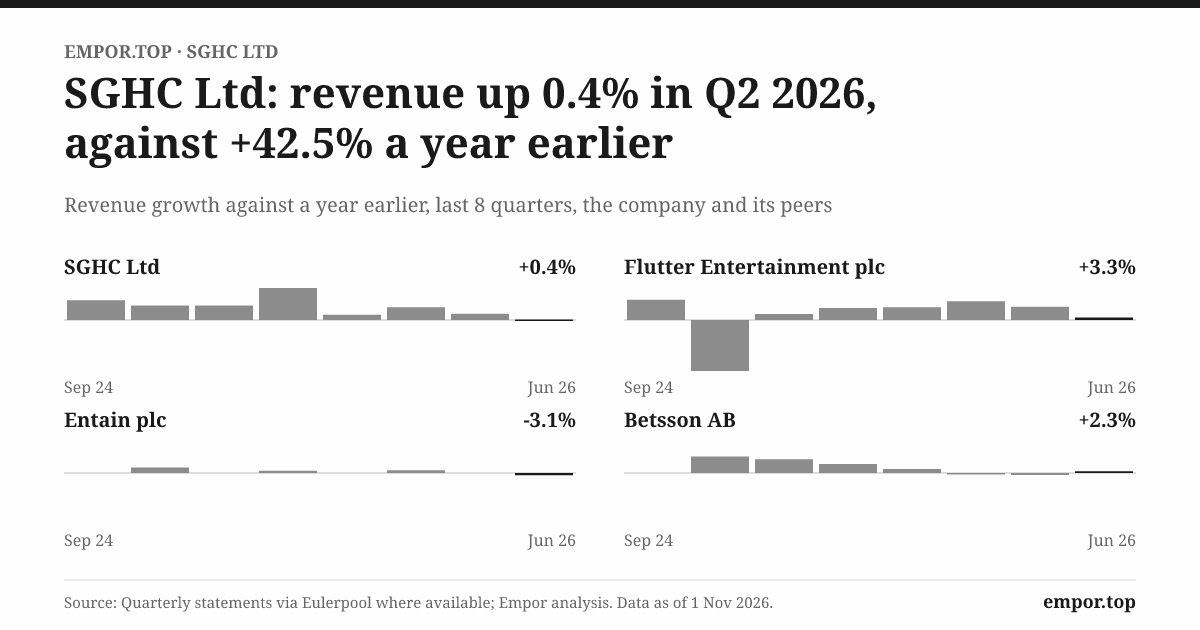
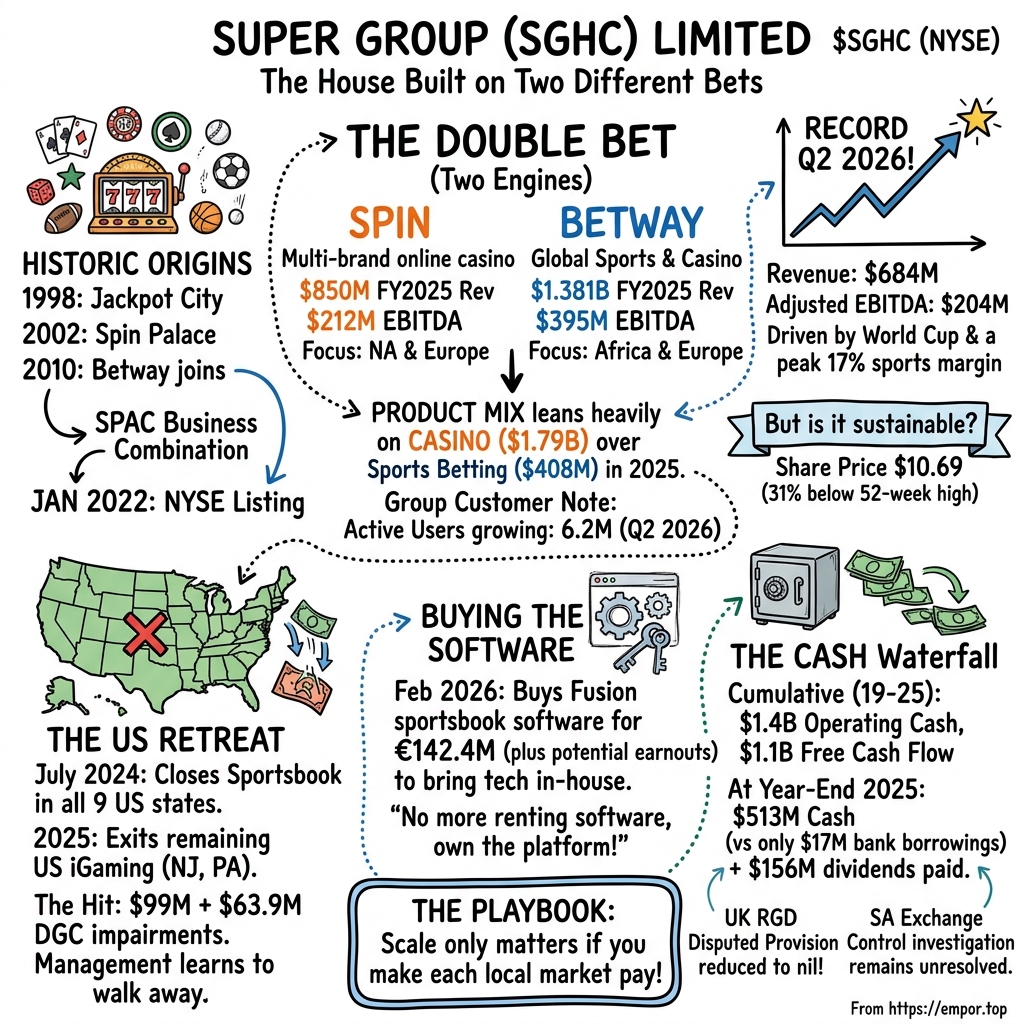
On August 4, 2026, Super Group reported the biggest three months in its history. Revenue for the second quarter came to $684 million, up 18% from a year earlier, and adjusted EBITDA, the company's preferred measure of operating profit, rose 30% to $204 million.1
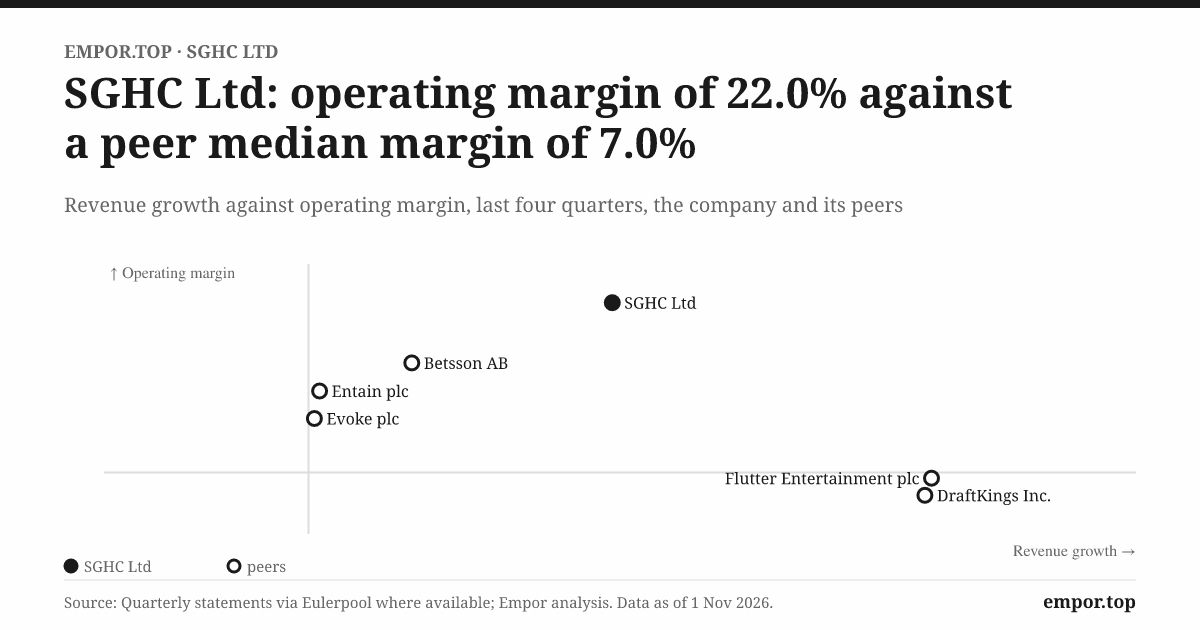
For every $100 that customers left behind after their winnings and bonuses, the company now kept about $30 as adjusted operating profit, up from about $27 a year before.2 Management then did something it had refused to do three months earlier and raised its full-year outlook, to more than $2.6 billion of revenue and more than $710 million of adjusted EBITDA.1
The backdrop was the loudest sporting event on earth. The expanded FIFA World Cup ran through June and into July, and on the following morning's call chief executive Neal Menashe described customers placing more than 166 million football bets during the tournament, about 100 million of them on World Cup matches.2 The company said new-customer sign-ups were more than three times what they had been during the previous World Cup. Then came the number that made analysts lean in: the sports margin, the share of sports bets the house keeps after paying out winners, hit a record 17% for the quarter.2
Records invite a simple story, and the simple story is that a global betting company has found its stride. The more useful story starts with what the record was made of. Super Group is really two businesses wearing one ticker. The first is Betway, a sports-led brand whose name sits on the shirts and stadium boards of some of the most watched football clubs in the world, and whose engine room is in Africa.
The second is Spin, a stable of online casino brands with names like Jackpot City and Spin Palace, built to find players through search, affiliates and direct marketing rather than through football sponsorship.3 In 2026 the company stopped reporting along that brand line and began reporting by geography instead, with an Africa segment and an International segment, but the two underlying bets remain: one on sport as a gateway, one on casino as the daily habit.4
Before going further, it matters which Super Group this is. The company on the New York Stock Exchange under the ticker SGHC is a holding company incorporated in Guernsey that owns Betway, Spin and their operating businesses.3 It has nothing to do with Super Group Limited, the logistics and mobility group listed in Johannesburg, which has its own credit ratings, its own fleets and its own investors.5 Any credit opinion, truck count or dividend history attached to the South African company belongs to that company alone.
The stakes are easy to state and hard to settle. Where does growth come from once the World Cup is over? Do Betway's brand and the group's shared technology, payments and compliance machinery give it an edge that rivals cannot buy, or simply a head start they can erode? And can management deploy a growing cash pile without repeating the expensive American adventure that ended, in 2024 and 2025, with Super Group shutting down its US sportsbook and then its remaining US online casino operations?3
The evidence for those questions does not sit in the headline wagers. A betting company can take enormous volumes of bets and still earn little if it overpays for customers, hands too much back in bonuses or gets an unlucky run of results. The figures that matter are quieter: how many customers keep playing each month, how much of the revenue comes from casino rather than sport, what the sports margin was, how much of adjusted EBITDA survives as real cash, and how much of that cash management spends wisely.
On those measures the quarter was strong but not clean. Sports revenue jumped about 29%, faster than casino's 16%, helped by a house that won more often than usual.1 Average monthly active customers were 6.2 million, up 13% on a year earlier, yet down from 6.4 million in the first quarter.24
Management itself told analysts to expect a normal blended sports margin closer to 13% or 14%.2 Strip out the tournament and the friendly results, and the question the record raises is the one this story follows: which part of Super Group would still be growing if the World Cup and favourable trading had never happened?
 Subscribe on LinkedIn
II. Two Casino Brands Before There Was a Super Group
Long before it had a stock ticker, Super Group's business existed as a collection of online casino brands that were among the earliest on the internet. Jackpot City dates to 1998, when online casinos were a novelty run out of small offshore jurisdictions and the idea of playing roulette on a home computer was faintly exotic. Spin Palace followed in 2002.6
These were not sports brands and they had no stadium sponsorships. They were built to be found, by players searching the web, by affiliate websites that earned a fee for every player they sent, and by marketing teams that learned early that online gambling is a distribution business as much as a gaming one.
The group added Betway in 2010.6 Betway brought what the casino brands lacked: a sportsbook, and with it a reason for people to visit on a Saturday afternoon rather than only late at night. From 2015 the group pushed Betway into Africa, starting in markets where football is close to a national religion and mobile phones had become the main way to get online.6 That decision, more than any other, explains the company investors see today. In the second quarter of 2026, Africa produced $310 million of revenue and $133 million of adjusted EBITDA, more profit than the entire International segment.1
For most of its life, this was a private operation with an unusual ownership structure, controlled through trusts and holding entities rather than founders with their names on the door. The route to public markets came through a special-purpose acquisition company. Sports Entertainment Acquisition Corp., a blank-cheque vehicle already listed in New York, agreed in 2021 to combine with the group, and the combined company registered its shares through a Form F-4, the filing foreign issuers use when shares are offered as part of a merger.7 The listing on the NYSE followed in January 2022.6
A SPAC merger is not a traditional initial public offering. In an IPO, underwriters build a book of investors who buy newly issued shares at a price set through negotiation. In a SPAC, an already-listed cash shell merges with a private company, and the private company's owners end up with most of the shares of the combined entity.
The operating business does not change on the day of the deal. What changes is the setting around it: access to US capital markets, quarterly disclosure to American investors, a stock that can be used as currency, and an audit and internal-control regime built for the SEC.3
That distinction matters for how to read the record. The financial history that starts in 2019 is the history of the operating predecessor, not a decade of listed-company performance, and the accounting treats SGHC Limited as the predecessor that carried into the listed company.3 The early public years were not smooth. Revenue fell about 7% in 2022, the first full year after the listing, and 2023 ended with a small net loss.3 The shares have been no calmer: at their worst point over the past five years, they fell almost 80% from a previous peak.
The listing materials framed the two brands as parts of one operation, supported by shared capabilities.6
The 2025 investor day restated the same logic, presenting the group as an operator that could take a proven model into one licensed market after another.8 In that telling, scale is not just size. It is the ability to spread fixed costs, from software to compliance teams, across many countries at once.
There is a tension buried in that premise, and it never quite goes away. Shared capabilities can lower costs, but they do not lock customers in. An online casino player can download a rival's app in thirty seconds, and the slot games on that rival's app often come from the same handful of studios. A sports bettor can check prices on three apps before placing a parlay. The listing gave Super Group money and a stage. It did not answer whether the brands could hold customers who are always one tap from leaving, which is the question every phone screen in the business poses.
III. The Betway App Has to Earn Its Place on the Phone
Picture a customer in Johannesburg on a Saturday in 2025. She opens the Betway app to put a few rand on a Premier League parlay, picking four, six, maybe twelve results in a single ticket because the payout on a long shot is thrilling. While she waits for the matches, a tile on the same screen offers her a slot game.
By the end of the weekend her sports bets may have lost, but she has also played the slot several times, and she will play it again on Tuesday when there is no football at all. That journey, from match day to everyday, is the business model in miniature.
In 2025, Betway's average monthly active customers rose about 15% to five million, as management pushed casino features alongside sport.3 Spin's active casino customers in North America grew as well.3 Across the group, average monthly active customers reached 6.1 million in the fourth quarter of 2025, a record at the time, and 6.4 million in the first quarter of 2026, before the dip to 6.2 million in the second.942
Those numbers establish reach. Whether that reach is an advantage depends on what each customer is worth after all the costs of finding and keeping them, and that needs a short lesson in how a betting company makes money.
Wagers are not revenue
When a customer bets $100, the company does not earn $100. Most of that money goes back out as winnings. In sports betting, the operator keeps the margin, the share of the total amount staked that customers lose over time. A 13% margin means that across many bets of $100, the house keeps about $13. In casino, the games are designed so the house wins a small percentage of each spin over millions of spins, which makes casino revenue much steadier. From whatever is left, the company subtracts customer bonuses and free bets, and certain sales taxes, to arrive at reported revenue.3
Revenue is only the beginning of the toll road. From it come gaming taxes set by each government, fees to payment processors who move money in and out, royalties to the studios whose slot games appear on the app, commissions to affiliates who sent the customer, and marketing, which at Super Group runs at about 21% to 22% of revenue under management's own guidance.2 In Africa, Menashe told analysts in May 2026, processing fees are the single biggest expense after taxes, because sports customers deposit, cash out and redeposit the same money repeatedly, paying a fee each time.4
That cost explains one of the stranger projects in the group. In South Africa, Super Group launched the ZAR Supercoin, a digital coin that trades on South African crypto exchanges, as the first step in what management describes as its own payments infrastructure, and began a phased beta of a consumer wallet in April 2026.94
The pitch is engagement, but the economics are about fees: if customers keep money inside the Betway ecosystem rather than moving it through banks and card processors each time, the group pays less to move it. Menashe has been candid that adoption will be slow, and the company has not disclosed how much it has saved so far.4 For now it is an experiment, not a profit driver.
That is why the casino matters so much. Sport is event-driven, with weekends, tournaments and a variable hold that swings with whether favourites win. Casino is a daily habit that works on a Tuesday in July. It is also expensive in its own way, demanding a steady supply of new content, smooth payments, constant fraud control and continuous customer acquisition.
In 2025, Betway was the bigger engine by a wide margin. Its revenue grew 25% to $1.381 billion and its adjusted EBITDA reached $395 million.3 Spin's revenue grew 17% to $850 million, with adjusted EBITDA of $212 million, held back by heavy marketing and losses in the US online casino business it was in the process of leaving.3 Put simply, Betway produced about 62% of group revenue and an even larger share of segment profit, and it was growing faster.
The surprise sits inside Betway. A brand most people associate with football shirts makes most of its money from casino. Betway's online casino revenue rose from $716 million in 2024 to $940 million in 2025, while its sports revenue grew from $363 million to $408 million.3
Across the whole group, casino contributed $1.79 billion of 2025's $2.231 billion of revenue, sports betting $408 million and brand licensing, the fees other operators pay to use the Betway name in some markets, about $26 million.3 Chief financial officer Alinda van Wyk put it bluntly on the February 2026 call: sport is about 20% of the business and casino about 80%, which, in her telling, lets the group ride out the ups and downs of sports results.9
This is the first important conclusion of the story. Sport is the shop window and casino is the shop. Football sponsorships, World Cup campaigns and Premier League parlays are how Betway introduces itself, and the casino is where most of the lasting revenue comes from. The World Cup made this explicit.
Menashe told analysts that about 53% of the customers acquired during the 2026 tournament had already placed a casino wager, against 23% in the 2022 World Cup cohort.2 Earlier in the year he had spoken of a typical cross-sell of 60% to 70% into casino.4 The aim is plain: turn a one-tournament football fan into a year-round casino player.
What the customer numbers prove, and what they do not
Management describes this as a "super persistent annuity revenue model", a phrase Menashe used on the August call to describe customer cohorts that keep generating predictable revenue year after year.2 At the 2025 investor day and again in the 2026 presentations, the company showed cohort charts in which each year's new customers stack on top of earlier ones, a picture it calls layer caking.92 If that pattern holds, it is the best evidence available for a durable business, because it would show customers staying rather than churning.
The trouble is what the company does not publish in a form outsiders can test. Super Group reports active customers but not a retention rate by brand or market, not the cost of acquiring a customer, and not how long it takes for a customer to pay back that cost.3 When an analyst asked in August for an exit-rate customer number for July, Menashe answered with colour about European football volumes rather than a figure.2
When another asked about the sequential fall in active customers from 6.4 million to 6.2 million, Menashe attributed it to normal seasonality, the short overlap of the World Cup with the quarter, and tax changes in two smaller African markets that pushed out low-value customers.2 That explanation is plausible. It is also exactly the kind of claim that a retention disclosure would settle and that the current disclosure does not.
So the honest verdict on the customer evidence is that it proves reach and engagement, not loyalty. Five million Betway customers and 6.2 million across the group tell an investor the brands are big and growing. They do not, on their own, tell an investor that those customers would stay if a rival offered a better bonus.
A useful way to test the edge is to ask what would happen if a well-funded rival tried to take Betway's customers in South Africa, its most important market. South Africa was the largest online gambling market in Africa in 2025, with about $3.3 billion of interactive gross win, and the head of the South African Bookmakers' Association named the top three operators there as Hollywoodbets, Betway and Lottostar.10
Betway is a leader, not a monopolist, and it faces at least two local rivals with strong brands of their own. The same industry body estimated that a majority of online gambling activity in the country happened on illegal platforms, which means the licensed operators are also competing with offshore sites that pay no local tax.10
Against that rival, Super Group has three real assets. The first is brand. Betway is the exclusive global betting partner of Arsenal, Manchester City and, from the 2026–27 season, Manchester United, which Menashe pointed out were the top three finishers in the previous Premier League season.2 In markets where English football is the main betting sport, that visibility is hard to replicate cheaply, and Menashe argued it lets Betway launch in new African countries at low marketing cost because the brand already resonates there.2
The second is shared operating scale: one technology stack, centralized call centres and risk teams, and a trading operation that sets prices for many markets at once. Menashe said on the August call that all call centres were now under one roof on one technology stack, which he linked to the margin gains.2 The third is licensing, the slow and expensive work of getting permission to operate in each jurisdiction.
Each asset has a limit. Brand helps a company find customers but does not stop them leaving; Super Group's rivals also sponsor clubs and leagues, and the sponsorship cost has to come out of the 21%-to-22% marketing budget. Scale lowers unit costs but is available to any large operator, and two of Super Group's peers are much larger.
Licensing is a genuine barrier against small entrants, but the same regulators who grant licences can raise taxes or rewrite the rules, as the UK did in April 2026 with an online gaming tax increase that management estimated would cost about $30 million of EBITDA before mitigation.4
What is missing from that list says as much as what is on it. One customer's betting does not make the app better for the next, so there is no network effect pulling players toward the biggest operator. And a player who gets bored or gets a better offer can move to a rival app in seconds, often to find the same slot games waiting there. The advantages Super Group has are the kind that make it cheaper to win a customer, not the kind that make it hard to lose one.
The peer comparison should be used for scale, not for share. Flutter, the owner of FanDuel, Paddy Power and Betfair, reported about $16 billion of revenue in 2025, and DraftKings about $6.1 billion, against Super Group's $2.23 billion.1112 Those companies are concentrated in the US and Europe, where Super Group has largely chosen not to fight, and their accounting and product mixes differ. No authoritative global market-share comparison exists. The comparison does show something important: Super Group is a mid-sized operator that has prospered by going where the giants are thinner on the ground, especially Africa and Canada outside Ontario.
That map became visible in 2026, when Super Group began reporting Africa and everything else as separate segments. In the first quarter, Africa earned $98 million of adjusted EBITDA and International $73 million, and van Wyk observed that the business was less heavily weighted toward Africa than many investors had assumed.4 By the second quarter, the two had pulled apart.
Africa's revenue grew 36% and its adjusted EBITDA 47%, to $133 million, while International revenue grew 7%, or 12% excluding the vanishing US business, and its adjusted EBITDA was flat at $84 million.2 Management blamed the UK tax increase and the short-term cost of what it called strategic generosity campaigns, a polite name for spending on customer bonuses in the hope of future loyalty.2
Inside International, the picture is uneven in instructive ways. The UK, where Betway is not one of the giants, grew revenue 34% in the second quarter and set a monthly record in May, which Menashe credited to product improvements that finally let the Betway app compete head-on with the market leaders.24 Canada outside Ontario grew 11%. New Zealand grew 14% despite reduced marketing, as the company waited for a local licensing regime.2 Ontario is the cautionary tale. When that province regulated online gambling, operators had to move every existing customer onto newly licensed software on a single date before they could market it, an approach Menashe called a "big bang", and heavy spending by rivals followed. For Alberta's regulated launch in July 2026, Super Group chose a phased migration focused on retaining its most valuable customers, and Menashe predicted a more rational competitive environment.24 That is a sensible lesson learned. It is also a reminder that every regulatory transition is a moment when customers are up for grabs.
Africa has its own unfinished business. Nigeria, the continent's most populous country, is still small for Betway; in May, Menashe said the company needed to double or triple its business there, and in August an analyst pressed him on how Betway would compete with the two leading operators, which have strong retail networks.42 Namibia is scheduled to launch in the fourth quarter of 2026, and management talks of entering one to three African countries a year, but only where taxes and banking allow money to move reliably.2 Growth in Africa, in other words, is not just a marketing question. It is a question of whether a market's plumbing lets an online operator get paid.
The calls show how the story has shifted. In the February 2026 call, management framed 2025 as the year it "refined" its portfolio by exiting US iGaming to focus on markets where it expected durable advantages, celebrated Africa's 27% growth for the year and acknowledged that customer-friendly results in December, when favourites won across the Africa Cup of Nations and European football, had cost roughly $20 million of EBITDA.9
By May, the tone was about margin resilience: the company said it had changed promotional mechanics, pricing and payout structures to protect the sports margin, and pointed to a trailing two-year sports margin of about 13%.4 By August, it was celebrating the 17% record and a 30% adjusted EBITDA margin, while also telling analysts to model 13% to 14% for sports.2
When an analyst asked how much of the World Cup margin was structural and how much was luck, Menashe said it was "definitely structural", citing pricing, product and a larger Africa business, and in the same answer guided back to the 13%-to-14% range.2 Those two statements can both be true: better pricing may have lifted the normal level, while the record quarter still benefited from favourable outcomes. But the guidance is the more useful signal. Management is not asking investors to treat 17% as the new normal, and neither should anyone else.
That leaves a clear verdict. Betway is the larger and faster-growing engine, casino is the dominant profit pool across both brands, and the evidence supports real brand reach and operating scale. It does not prove a high-switching-cost moat. Customers multi-home, game supply overlaps and the company does not disclose retention or payback in a way that settles the question. The test is simple to state: if record customer counts keep coming without marketing creeping above that 21%-to-22% band, the annuity story is real. If growth has to be bought back with ever larger campaigns, it is not.
There was one place where Super Group did try to buy growth on a grand scale, with a strategy that rested on brand and operating scale, and the answer came back unambiguously negative. That place was the United States.
IV. The American Expansion That Turned Into a Retreat
In July 2024, after an internal review, Super Group announced that it would close its Betway sportsbook in every one of the nine US states where it operated.13 The company said it saw no long-term path to profitability. For a business whose listing story had leaned on American optionality, it was a striking admission, and it arrived only about two and a half years after the shares began trading in New York.
The bet had been laid out clearly at the start. The 2021 listing materials presented Digital Gaming Corporation, known as DGC, as the vehicle for entering the US market, combining Betway's brand with DGC's licences and market access.6 At the time, American sports betting was the hottest growth story in global gambling. States were legalizing one after another after the Supreme Court struck down the federal ban, and investors were rewarding any operator with a credible plan to take part. Super Group completed the acquisition of DGC in January 2023.3
The economics that did not work
The American market turned out to be a war of attrition. Customer-acquisition costs were enormous, promotional offers were lavish, state taxes were in some cases punitive, and two dominant operators, FanDuel and DraftKings, had already won most of the national brand recognition. A mid-sized foreign operator with a famous name in Africa and the UK had little leverage. Betway was live in nine states, but being live is not the same as being chosen.
The accounting tells part of the cost. In 2024, the company reported a loss of about $99 million from the US sportsbook closure, impaired $28.5 million of assets and recorded a $7 million goodwill impairment on DGC.13 It had already sold DGC's business-to-business division to Games Global in February 2024, narrowing what remained of the American platform.14 The parent's own controls had struggled with DGC as well: a 2023 material weakness concerned the documentation of the forecasts used to test DGC goodwill for impairment, a weakness the company reported as remediated by the end of 2024.3
Then the retreat went further. In June 2025, Super Group decided to leave its remaining US online casino operations in New Jersey and Pennsylvania, citing strategic priorities, the regulatory environment and performance.3 It recorded a further $63.9 million impairment on DGC that year.3 The second quarter of 2025, the period that absorbed the decision, ended with a small net loss of about $3 million, even though the business outside the US was growing strongly.1
It helps to separate the strategic choice from the accounting. An impairment is not a cash outflow on the day it is booked. It is an admission that money already spent, often years earlier, on an acquisition or an asset will not come back under the revised plan. So the impairments understate the full cost, which also includes operating losses, marketing spent to acquire American customers, and management time. But they document, in audited numbers, that the American thesis was wrong.
What the retreat says about management
There are two ways to read this record. The generous reading is that management did what good operators do: it ran an experiment, saw the economics were not working and stopped, rather than pouring in more money to save face. The company's results since support that reading in one sense. Once the US was gone, Menashe told analysts in May 2026, the teams no longer had to worry about the US states and could concentrate on markets where the group was already strong.4 He also listed Belgium and Italy among other places the company had left because it saw no path to profitability.4
The harder reading is that the record contradicts a simple claim of disciplined capital allocation. Super Group did not exit once; it exited sportsbook and then iGaming, with goodwill impairments in multiple years, a control weakness tied to the same acquisition and a business-to-business division sold off along the way. The initial market-entry thesis and the economics behind it were weaker than management expected. Correcting a mistake is a virtue. Making it in the first place, on this scale, is evidence too.
That matters because management's current language on capital allocation is confident. On the February 2026 call, Menashe said the company would not overpay for acquisitions and that it had "seen lots of our competitors overpay, and that's not what we do."9 In August he repeated: "we will not overpay and we do not need to rush."2 Those statements may well describe the company's intentions.
They do not sit comfortably next to DGC, and neither call offered a detailed account of which American assumptions failed, nor a stated rule, such as a maximum payback period or a cap on losses per market, that would prevent a repeat. The closest thing to a rule is the pattern in management's answers about Africa: enter one to three countries a year, and only where taxes and banking make sense.2
The verdict is that the US experience narrows the claim of capital-allocation discipline rather than destroying it. Management showed it can stop. It has not yet shown it can avoid starting the wrong thing, and the core businesses, which kept growing in Africa, Europe and Canada while the US unwound, paid for the lesson in capital and credibility.
The next large deployment of capital was not a new country at all. It was a decision to own the software that sits behind Betway's sportsbook everywhere outside Africa.
V. Buying the Software That Betway Used to Rent
On February 28, 2026, Super Group completed the purchase of the Fusion sportsbook software, the engine that prices bets, settles them and runs the betting screens customers see in Betway's markets outside Africa.3 For years, the group had not owned this technology. It had licensed it from Apricot Investments, paying for the right to use software that sat at the heart of its most visible brand.3 Now it owned the worldwide rights outside the US, along with US rights to related Marown software.3
The price was €142.4 million, or about $167 million, with additional earnout payments possible if the sportsbook performs.3 The earnout could add up to €210 million more, but only if sportsbook revenue more than doubles over the earnout period.3 In plain terms, Super Group paid a fixed amount up front and promised a larger sum later if the purchase turns out to be a big success.
Renting versus owning
The logic is easiest to see through an analogy. A restaurant that rents its kitchen can cook well, but it cannot knock down a wall, install a new oven or change the opening hours without the landlord's agreement, and it pays rent whether business is good or bad. Buying the building costs a lot up front, but it gives control over every renovation and turns the rent into a saving.
For Betway, owning the sportsbook software means control over the product roadmap: which features get built, in what order, and how fast. It means the ability to adapt the product to each country's rules without waiting on a licensor. And it means saving the royalty fees that came with the licence.
At the 2025 investor day, van Wyk set out an expected $35 million a year in savings once the integration was complete, which she later described on the February call as an annualized projection rather than a day-one benefit, coming from lower royalty fees, infrastructure improvements and bringing development staff into the group.9 She confirmed that the savings expected in 2026 were included in that year's guidance.9
The timeline was long. The agreement was struck in May 2024, but completing it required regulatory approval in the jurisdictions where the product operates, which is why closing took until February 2026.39 In the meantime the group had already increased the development resources dedicated to the sportsbook, so the purchase formalized a relationship rather than starting one from scratch.3
By May, Menashe said more than 100 people supporting the sportsbook were moving into Super Group's own structure, and that the global Betway sportsbook was already showing improved speed, flexibility and efficiency.4 By August, van Wyk explained that part of a jump in general and administrative costs, from about $90 million to $100 million a quarter, came from absorbing the Apricot operational business and a small marketing company, and that costs would settle back to the low $90 millions.2
What the price buys, and what it does not tell
The purchase makes strategic sense. Sportsbook technology is not a commodity for an operator whose brand promise is about pricing, parlays and live betting. Owning it removes a dependency on a single licensor for a core capability, and the projected savings, if achieved, would amount to about 5% of 2026 adjusted EBITDA guidance each year.1
But the filings do not give outsiders what they would need to judge the price. Super Group does not disclose stand-alone revenue, profit or cash flow for the software business, nor a valuation multiple that could be compared with other sportsbook technology deals.3 Was €142 million a bargain for a platform that would have cost more to rebuild, or a full price for software that was already being licensed on reasonable terms?
The disclosed facts do not settle it. What can be said is that if the $35 million of annual savings materializes, the up-front price would be recovered in roughly four to five years from savings alone, before counting any revenue benefit from a better product. That is a respectable return if the savings are real, and it is the claim investors should hold management to.
The earnout deserves perspective. It is contingent on sportsbook revenue more than doubling. It is not evidence that the growth has arrived, and if it is paid in full it will mean the business succeeded, but it will also raise the total price materially.
There is a governance wrinkle that belongs right here, next to the deal. The seller, Apricot Investments, appears in Super Group's related-party note among entities with which the group has dealings involving common trust beneficiaries, relationships the company assessed as not meeting the accounting definition of related parties under IAS 24.3 On the February 2026 call, an analyst asked directly whether the Apricot transaction had always been treated at arm's length.
Menashe's reply focused on what owning the software would allow the company to do, and van Wyk pointed to the regulatory approvals and the description in the previous annual report; neither answer addressed the arm's-length question head-on.9 That does not mean the price was unfair. It does mean that the counterparty is close enough to the group's ownership structure that independent investors deserve a fuller account of how the price was set.
The forward test is concrete. By the end of 2026 and into 2027, Super Group should be able to show whether royalty savings are flowing, whether product releases are faster, and whether the International sportsbook margin, which has historically trailed Africa's, is closing the gap. The software purchase is a bet that owning the tools improves the economics. Whether the whole platform turns customer growth into durable cash after taxes, royalties and marketing is the bigger question, and it is a question about the cash flow statement.
VI. The Cash Is Stronger Than the Earnings Story—With Caveats
At the end of 2025, Super Group held $513 million in cash and cash equivalents, up 32% in a year, even after paying $156 million in dividends during 2025.39 In February 2026 it paid a special dividend of more than $125 million on top of that.9 By June 30, 2026, after returning $218 million to shareholders over the previous twelve months, cash stood at $548 million.12 Few things say more about a business than its ability to hand out that much money and still finish with more than it started.
The long record supports the impression. Over the seven years from 2019 to 2025, Super Group earned about $1.0 billion of cumulative net profit but generated about $1.4 billion of cash from operations, roughly 139% of reported profit.3 After capital spending, that left about $1.1 billion of free cash flow, of which only about $205 million, less than a fifth, went out as dividends over that span. In 2025 alone, the company generated about $360 million of operating cash and, after investment in software and equipment, a bit over $320 million of free cash flow.3
Why would cash exceed profit by so much? Part of the answer is the nature of the business. An online operator collects customer deposits up front and pays winners out of a float, and it has few physical assets to maintain. Part of the answer, though, is accounting. Profit is calculated after charges that do not involve cash leaving the building that year.
In 2025, those charges included about $74 million of depreciation and amortization and about $68 million of impairments, much of it the write-down of DGC.3 Those charges reduced net profit, but the cash had been spent in earlier years. An impairment year therefore makes cash conversion look unusually strong.
Working capital adds a second distortion. Customer balances, amounts owed by payment processors and timing differences around paying suppliers move from year to year, and they can lift or depress operating cash in any single year. Trade and other receivables rose from $63 million to $85 million during 2025, mostly money owed by payment-service providers and brand licensees.3
Measured in days of revenue, receivables were 18 days at the end of 2025, down from a peak of 38 in 2021, which suggests money is not getting stuck.3 The company says its expected credit losses on these balances are immaterial, though it does not publish an ageing table showing how much is overdue and by how long.3
The debt picture is simpler than a headline might suggest. Total borrowings of about $81 million at the end of 2025 sound like leverage, but $64 million of that was lease liabilities, mostly for offices, and only about $17 million was interest-bearing debt.3 Against $513 million of cash, Super Group is effectively debt-free. Early in 2026 it negotiated a $100 million revolving credit facility, with an initial three-year term, as a backstop rather than a necessity.3 Nothing in the balance sheet forces management's hand. The questions are all about what management chooses to do.
From hoarding to paying out
For most of its recent history, Super Group paid no dividends at all. Then, in 2024, it began paying about $49 million, and in 2025 it paid $156 million, equal to about 72% of that year's net profit.3 The median payout over the previous five years was zero. So the current level is a policy shift, not a long-established habit, and it is worth noticing how quickly it accelerated.
In February 2026 the board raised its minimum quarterly dividend target from 4 cents to 5 cents a share, to be reviewed each quarter.9 The company also changed its presentation currency from euros to US dollars in 2025, citing, among other reasons, the holding company's growing dollar exposure and its quarterly dividend programme.3
The shift goes further. At the June 2026 annual general meeting, shareholders approved a resolution allowing the company to buy back up to 14.99% of its shares.15 That is an authority, not a purchase. Through the second quarter, the company had reported no repurchases, and its capital returns came through dividends.1
In August, Menashe put the issue in unusually direct terms: "we recognize that we have excess cash," and said management and the board were actively evaluating the most effective way to deploy it.2 When pressed, van Wyk said there was no change in approach: discipline first, organic growth, dividends and buybacks always in mind, and only bolt-on acquisitions that strengthen the core.2
The cash record, then, supports financial flexibility, not an assumption that every dollar of reported operating cash is repeatable and distributable. It is a genuine strength that Super Group can fund its software, its sponsorships, its market entries and a substantial dividend from internal cash, and it can do so without debt. But the right measure of the next few years is not the size of the pile. It is the track record of what happens to it.
A company with excess cash and no controlling shareholder faces a particular kind of pressure. Here, though, the ownership picture is more nuanced than "no controlling shareholder" suggests, and it shapes whose interests a buyback or a special dividend serves most.
VII. The People Behind a Company With No Controlling Owner
When Neal Menashe and Alinda van Wyk present Super Group's results, they do it as a double act that has been running for a long time. Menashe, the chief executive, speaks in a breathless, enthusiastic register, full of "super" and "unbelievable", fond of football references and quick to describe himself as a Manchester United fan.2
Van Wyk, the chief financial officer, supplies the numbers and the caveats, often correcting or tightening his answers in the same breath. On the May 2026 call, when an analyst asked why the company had not raised guidance after a record first quarter, she said Super Group was "just not in the beat and raise treadmill game", and he added that the company had never raised guidance that early in a year.4 Three months later, it raised.
Menashe has been chief executive since the group took its current form in 2021.3 Van Wyk has held senior finance roles with the business since 2000 and has been chief financial officer since 2021.3 That is a long tenure with the operating businesses, which brings deep knowledge of markets such as South Africa, and also means the same team that approved the DGC acquisition is the team now promising disciplined capital allocation.
In 2026, the leadership bench widened. Kirsty Ross, previously chief of staff, became chief operating officer; Justin Stock, long the group's external counsel, joined as group head of commercial and M&A; and Alon Ben-David serves as chief technology officer.4
Judging the record by behaviour
The right way to judge this team is by what it has done over time. The record has three parts. The first is a consistent strategy of brand plus casino plus licensed markets, which has been stated in much the same terms from the listing to the investor day to the latest calls.68 The second is the costly US adventure followed by two exits, showing both a willingness to stop and a weakness in the original judgment. The third is a strong run since: revenue growth of about 22% in 2025, rising margins and a cash pile that kept growing while dividends rose.9
Guidance behaviour is a smaller but telling test. In February 2026, management guided to at least $2.55 billion of revenue and more than $680 million of adjusted EBITDA, explicitly building in a normalized sports margin, the UK tax increase and the regulatory changeover in Alberta.9 It reaffirmed that guidance in May and raised it in August.41 That is a reasonable pattern so far. The real test will come when the full year is reported in early 2027: whether management explains any shortfall in market-level terms rather than blaming the sports calendar alone.
The pay and the owners
Executive pay is where the disclosure thins. Super Group reported aggregate compensation for executives and directors of $28 million in 2025, made up of about $11 million in cash and $17 million of other benefits, double the $14 million of 2023.3 Total key-management remuneration was $31 million.3 The company does not break that number out by person, so outsiders cannot see what the chief executive or chief financial officer earned, or how much of it depended on performance. The company says individual disclosure is not required in its home jurisdiction, which is true, but it leaves investors judging alignment with one eye closed.3
Ownership is the other half of the alignment question. Super Group reports no ultimate controlling party.3 But two holders, Knutsson Limited and Chivers Limited, held 44.85% and 19.35% of the shares at the end of 2025, which together make up roughly 64%, and the company describes them as exercising significant influence.3 Menashe held about 3% personally, and directors and officers as a group about 4%, as of March 2026.3 The company counted only four shareholders of record, with almost all shares held through US custodians, though the real number of beneficial owners is far larger.3
That structure means the people who will decide whether to authorize buybacks, dividends or acquisitions are closely tied to the two largest holders. It also means a buyback could raise their percentage ownership further unless they participate. The two holders' stakes edged down slightly during 2025, from 45.26% and 19.45% a year earlier.3
A few related-party items matter more for what they say about the structure than for their size. The company paid $2.2 million to Whitfield Management for key-management services in 2025.3 It made an interest-free $3.5 million loan to Bellerive Capital for a possible joint investment in a company called ClipFarm, repayable within three months if the investment did not proceed.3
And it described dealings with entities including Smerelda Property Investments, Camden Property Holding and Apricot Investments, the sportsbook seller, that share common trust beneficiaries but which it assessed as falling outside the IAS 24 definition of related parties.3 The company does not quantify those dealings as a share of revenue or costs. Apart from the software purchase, none of these items is large relative to a business of this size, but together they describe a web of connected entities whose economics outsiders cannot fully see.
The June 2026 annual meeting offered a limited stress test of shareholder sentiment. Every director was reappointed with at least about 99% support.15 The buyback authority passed with about 93% in favour and about 7% against, the highest opposition of the meeting.15 With roughly two-thirds of the votes held by two influential holders, any dissent among the remaining third is magnified, and 7% against on a buyback is a signal worth noting, but it is not an activist campaign.
The verdict on management is calibrated. Menashe and van Wyk have a record of execution and of correction, and the business has grown strongly under them. That is evidence, not proof. Pay is disclosed only in aggregate, the related-party web is partly unquantified, and two holders own about two-thirds of the shares. The credibility test is straightforward: compare the guidance raised in August with the outcome, and see whether any miss is explained market by market.
The other place where credibility is earned or lost is in front of regulators, and in September 2026 one of those tests produced a surprising result.
VIII. A £26 Million Provision Meets a New Ruling
On September 25, 2026, the UK's Upper Tribunal ruled in favour of Jumpman Gaming, a Super Group subsidiary, in a long-running dispute with HM Revenue & Customs over Remote Gaming Duty, the tax charged on online casino operators serving British customers.16 The tribunal allowed two of Jumpman's grounds of appeal and reduced the disputed tax assessments to nil.16 For a company that had set aside $26.4 million against the assessments at the end of 2025, it was a rare piece of regulatory good news.3
The dispute covered the years 2018 to 2022, and the provision included penalties and interest.3 It mattered enough that Deloitte, Super Group's auditor, flagged it as a critical audit matter in its report on the 2025 financial statements, meaning it was one of the areas requiring the most difficult judgment in the audit.3 At that point, the First-tier Tribunal had already dismissed Jumpman's appeal, so the provision reflected a loss at the first stage of litigation.3
The scope of the ruling is precise. It resolves the assessments that were before the tribunal, not every tax and regulatory risk the group faces. The provision predates the ruling, so the next filing will need to show whether the company releases it, keeps part of it, or holds it pending a further appeal by the tax authority, and how much of the penalties and interest is affected. Until then, the most an investor can say is that a liability of about $26 million that looked likely at the end of 2025 now looks much less likely.
The risks that have not cleared
Other exposures remain open. In South Africa, a subsidiary is under investigation by the South African Reserve Bank over historic cross-border transfers, an exchange-control matter.3 The company paid a non-binding deposit of R30 million, about $1.8 million, in January 2026, but recorded no further liability because the potential amount could not be reliably measured.3 That last phrase is the important one. A matter with no reliable estimate is a matter whose range of outcomes is wide, and South Africa is the group's largest market.
The UK has a longer memory, too. In March 2020, Betway agreed to pay £11.6 million after the Gambling Commission found failings in how it handled high-spending customers and in its anti-money-laundering checks.17 That was six years ago, under a different regulatory regime, but it is the most serious public enforcement action on the Betway brand, and it is the backdrop against which the company's current emphasis on compliance should be judged.
Smaller exposures round out the picture. Super Group carried a $9 million provision for customer claims at the end of 2025, up from about $7 million a year earlier.3 The DGC control weakness was reported as remediated by the end of 2024.3 And South Africa's government was reviewing gambling taxation; on the February call, Menashe said operators were due to submit responses to a government paper and that there were no new updates.9
The structural point is the one that runs through this whole business. Licensing, gaming taxes and consumer-protection rules are not peripheral costs. They are part of the product. Each market's rules can change revenue, costs or the right to operate at all, and Super Group's growth depends on dozens of these rulebooks. The UK tax increase, Alberta's regulated launch and New Zealand's local licensing plans are recent examples.2 A good tribunal ruling in one case does not change that exposure. It simply removes one item from a list that will always be long.
IX. Analysis & Bear vs. Bull Case
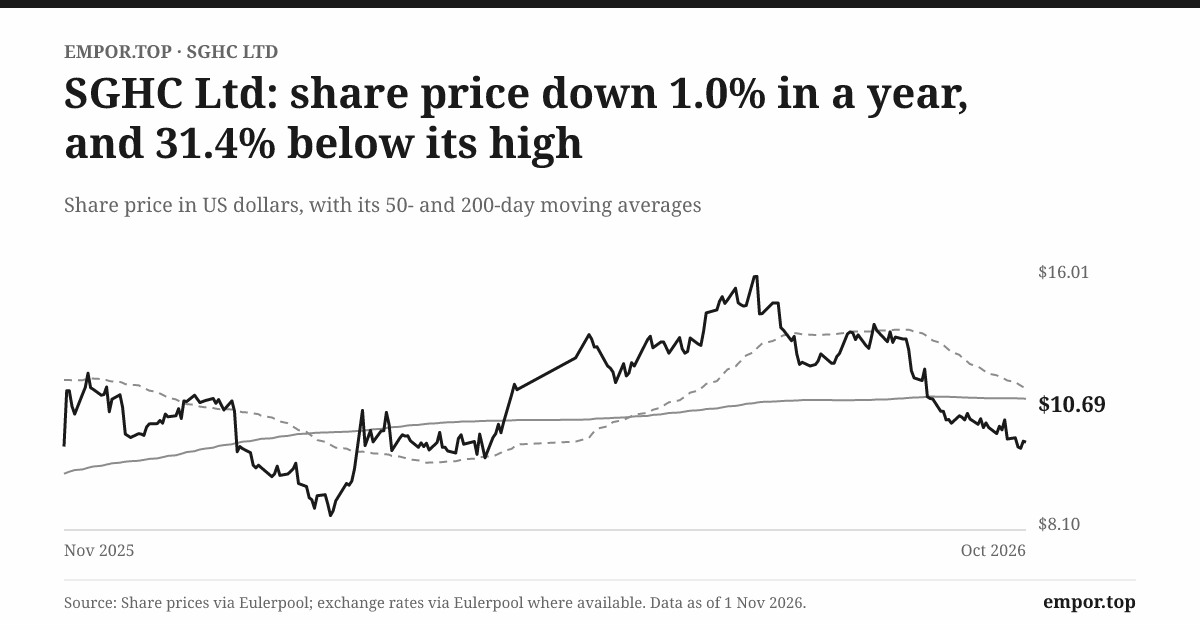
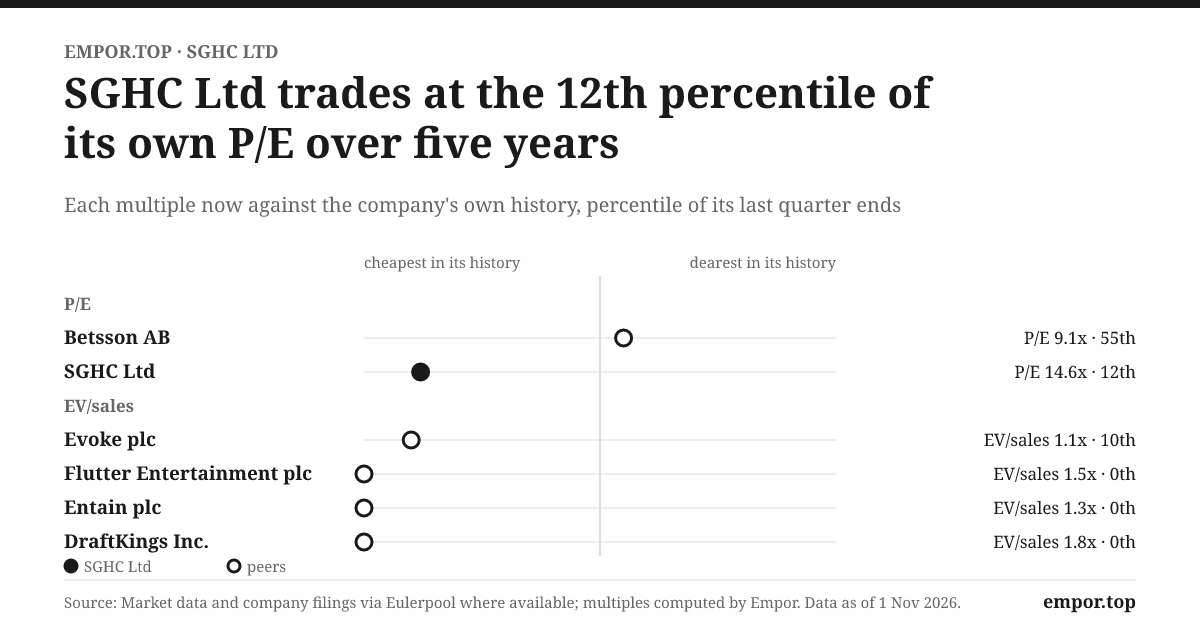
On November 1, 2026, Super Group's shares closed at $10.69, about 31% below their 52-week high of $15.59, giving the company a market value of about $5.4 billion. At that price the stock traded at about 14.6 times last-twelve-month earnings per share of $0.73, against a median of about 27.2 times over the previous five years. Measured another way, the enterprise value of about $5.0 billion was about 8.1 times reported EBITDA and about 2.1 times revenue. The dividend alone yields about 4.1%.
A discount to the company's own history is a fact. Whether it is an opportunity depends on what the market is assuming. Different screens tell different stories even about the multiple: a third-party industry screen dated October 24, 2026 showed Super Group at about 23.6 times earnings, using a different earnings base, while Flutter and DraftKings had no meaningful positive earnings multiple at all.18
The multiple depends heavily on which earnings an investor trusts. What is clear is that the market is pricing Super Group well below its own past and far below what it pays per dollar of revenue for larger American-focused peers, and that gap reflects a judgment about how durable these profits are.
What the optimist sees
The bull case has concrete support. Super Group has broad geographic exposure, which reduces its exposure to any single market's tax changes. Its revenue base is dominated by casino, which provides steadier income than sport. Betway's brand has real reach, now amplified by the three biggest clubs in English football. The group had 6.2 million average monthly active customers in the second quarter of 2026.2
Africa, its strongest region, grew revenue 36% in that quarter with adjusted EBITDA up 47%, and the company has a pipeline of new African markets, starting with Namibia in the fourth quarter of 2026.2 Its operating margin reached about 19% in 2025, up from under 5% in 2023, and adjusted EBITDA margins hit 30% in the second quarter of 2026.32 And it generates more cash than it needs, with no meaningful debt, so it can fund growth and pay dividends at the same time.
In the bull's telling, the shift in margins is operating leverage, not luck. Van Wyk described it plainly in August: revenue is growing faster than the cost base, with efficiencies in trading, marketing, payment processing and technology.2 The headcount record supports that claim.
Average employees fell from about 3,700 in 2023 to about 2,900 in 2025, while revenue rose sharply.3 Management has said it expects to get close to a 30% adjusted EBITDA margin on a sustained basis in 2027.2 If it does, at a multiple that is half its five-year median, the market would be underpricing a business that has become more efficient, not less.
What the skeptic sees
The bear case has equal weight. The products are replicable. Slot games come from the same studios that supply rivals, sportsbook odds are visible to any customer comparing apps, and the World Cup that delivered record acquisition was available to every bookmaker on the planet. Customers can switch in seconds.
Marketing at 21% to 22% of revenue is an ongoing and large toll, and affiliates, payment processors and game studios each take their share. Tax and licensing rules can change with little warning, as the UK's 2026 tax increase and the regulatory transitions in Canada show.4 Sports outcomes can move a quarter's margins by tens of millions of dollars, as the December 2025 results demonstrated.9
The record adds weight to the bear's concerns. The US entry ended in a sportsbook exit and then an iGaming closure, with material impairments in two separate years. The corrective exit limits future losses but does not erase the evidence about how the original bet was made. Ownership is concentrated, with two holders owning about two-thirds of the shares, executive pay is disclosed only in aggregate, and the related-party web around entities like Apricot is not fully quantified. The South African Reserve Bank investigation remains open, with no estimate of its possible cost.
Long-run growth has also slowed. Revenue grew about 16% a year from 2020 to 2025, but only about 12% a year over the three years to 2025.3 The 2026 guidance implies growth in the mid-teens, but that year includes the World Cup.
The moat analysis comes down to a few forces. Among Helmer's seven powers, Super Group's genuine sources of advantage are scale economies in technology, trading and compliance spread across many markets, and branding in markets where English football dominates the betting slip. Process power in pricing and payments is plausible but unproven. It has no network effect, minimal switching costs and no cornered resource; even its newly owned sportsbook software is one of several comparable platforms in the industry.
Porter's five forces sharpen the picture. The threat of new entrants is moderated by licensing in regulated markets but heightened in grey and illegal markets, which in South Africa are believed to take a majority of online activity.10 Buyer power is individually weak but collectively strong through costless switching. Supplier power is real, from game studios to payment processors to sports-rights holders who sell sponsorships at rising prices. Substitutes, including illegal sites, are always present. And rivalry among licensed operators is intense, as Hollywoodbets and Lottostar in South Africa and every major brand in the UK demonstrate.10
The verdict is that Super Group's edge is real but local and operational, not structural. It lies in being very good at running licensed online casinos and sportsbooks in markets where the global giants are less focused, and in spreading fixed costs across those markets. That edge can persist for a long time, but it has to be re-earned each year through product, pricing and marketing efficiency rather than being protected by customer lock-in.
A skeptical investor would press on three questions. How much of the 2026 guidance is organic and recurring rather than World Cup-driven? Management said the guidance assumes organic growth without aggressive persistency assumptions, but it has not broken out the tournament's contribution.2 What share of the margin improvement comes from better sports hold rather than efficiency? Given that management itself guides to a 13%-to-14% normal sports margin against the 17% achieved in the second quarter, some of the 2026 gain is clearly hold. And what return is expected on the Fusion software purchase beyond the $35 million savings target? The company has not said.
Three measures can settle the thesis over time. The first is monthly active customers alongside retention, by brand or region: the latest reading is 6.2 million, up 13% from a year earlier but down from 6.4 million in the first quarter.24 The second is sports margin alongside casino revenue growth: in the second quarter the sports margin was a record 17%, while casino revenue grew about 16%.21 The third is free cash flow after investment and shareholder returns: in 2025, operating cash of about $360 million funded investment and $156 million of dividends, while cash still rose.3
The valuation test is simple. A low multiple matters only if earnings and cash survive less favourable sports outcomes, regulatory change and the next competitive spending cycle. If Super Group can hold margins near 30% while growing active customers, the current multiple is a discount. If margins slip back to the levels of 2023 and 2024, the multiple may not be cheap at all.
X. Playbook: Business & Investing Lessons
The cleanest way to see what Super Group teaches is to set two decisions side by side. It closed its US sportsbook after concluding there was no path to profit, then spent €142.4 million to own the technology that runs Betway's sportsbook everywhere else. One decision walked away from a market; the other doubled down on a capability. Together, they show what this company has learned and what it still has to prove.
The first lesson is that a global brand opens the door, but local economics decide whether you stay. Betway's name was not enough to make the US business pay against entrenched rivals and expensive customer acquisition. In Africa, the brand is already known, and that is where the group's best margins are. Brand reach is a ticket of entry. Every market still sends its own bill.
The second lesson is that a customer count is a beginning, not a moat. Super Group's customer numbers and cohort charts are real achievements. But until a company shows how long its customers stay and how quickly they repay the cost of acquiring them, the headcount of players is a measure of marketing success, not of loyalty. In a business where every rival is one tap away, the only durable customer is the one who stays when a competitor offers a better bonus.
The third lesson is that owning the tool can improve control, but the price still has to earn a return. The Fusion purchase gave Betway control of its sportsbook roadmap and the chance to stop paying royalties to a licensor. It also carried a potential earnout and involved a counterparty that shares trust beneficiaries with the group's ownership structure. A strategic asset is still an investment, and investors should judge it by the savings and product gains it delivers, not by the elegance of the logic.
The fourth lesson is that cash gives management options, but it does not make every option wise. Super Group says it has more cash than it needs. That same cash, a few years earlier, funded the DGC acquisition that produced impairments across multiple years. The difference between a generous dividend policy and a costly acquisition can be one board meeting. The discipline investors should demand is not global reach or adjusted EBITDA alone. It is market-by-market returns, customer economics and the fate of every dollar deployed.
For founders and investors beyond gambling, the wider lesson is that a digital product can travel the world in an afternoon, but the rules it lives under are written one country at a time. Portability creates the opportunity. Local economics decide the outcome.
XI. Epilogue
Tonight, Super Group stands at the end of its strongest-ever stretch, with raised 2026 guidance, a sportsbook it now owns and about $548 million of cash at the end of June.1 The World Cup is over, and with it the tailwind that helped lift the second quarter. What comes next will show which parts of the record are repeatable.
The first decisive moment is the full-year 2026 report, expected early in 2027. The raised outlook sets a demanding benchmark.1 Meeting or beating it after a quieter second half would support the claim that the business has structurally improved. Missing that benchmark, especially if the explanation leans on sports results alone, would suggest the 2026 record was more event than engine.
The second is the customer data. Super Group will report active customers for the third and fourth quarters, and Menashe told analysts he expected customer numbers to resume growing with the new European football season and the Manchester United partnership.2 If the post-World Cup cohort keeps playing casino through the autumn, the cross-sell story becomes evidence. If the customer count stalls, the World Cup was mainly a short-lived acquisition spike.
The third is margin quality. With management guiding to a 13%-to-14% normal sports margin, investors will be watching whether casino growth and efficiency gains can sustain margins near 30% as sport normalizes.2 The Fusion integration is part of this test, with royalty savings, faster product releases or a narrowing gap between International and African sports margins as measures of progress.
The fourth is capital. Super Group has buyback authority and has acknowledged excess cash.152 What it actually does, whether larger dividends, real repurchases, new African markets or an acquisition, and how it explains the choice, will be the clearest test yet of whether the lessons of the US have been absorbed. Investors will also want to see whether the stakes of the two influential holders change as a result.
The fifth is the regulatory ledger. The next filing should clarify the provision and any appeal following the Upper Tribunal ruling.163 The South African Reserve Bank investigation may produce an outcome or at least an estimate. And South Africa's tax review could change the economics of the group's most important market.
The unresolved question is the one this company was built around. Super Group was designed to enter markets: to take a brand, a casino portfolio and a shared operating platform into country after country. It has proved it can do that. What it has yet to prove consistently is that it knows which markets, which customers and which capabilities are worth owning, and that it can keep earning above its costs in each of them once the excitement of entry fades.
XII. Outro
Go back to that August morning. A global betting operator had just reported the best quarter in its history: $684 million of revenue, record deposits and wagers, a sports margin the industry would envy and a guidance raise to match.1 Customers had placed more than 100 million bets on World Cup matches alone. The house was full.
Three months later, the share price sat at $10.69, almost a third below its recent high. The record quarter is the sound of a large online house running at full capacity. The share-price gap is the market asking a quieter question: whether that capacity lasts when the tournament ends, the favourites lose and the next rulebook changes. Super Group can take the brand around the world; the hard part is making every market pay.
References
-
Super Group Reports Financial Results for Second Quarter of 2026 — Super Group via SEC, 2026-08-04 ↩↩↩↩↩↩↩↩↩↩↩↩↩
-
Q2 2026 Earnings Call Transcript — Super Group, 2026-08-05 ↩↩↩↩↩↩↩↩↩↩↩↩↩↩↩↩↩↩↩↩↩↩↩↩↩↩↩↩↩↩↩↩↩↩↩↩↩↩↩↩↩↩↩
-
Super Group (SGHC) Limited 2025 Form 20-F — SEC, 2026-04-17 ↩↩↩↩↩↩↩↩↩↩↩↩↩↩↩↩↩↩↩↩↩↩↩↩↩↩↩↩↩↩↩↩↩↩↩↩↩↩↩↩↩↩↩↩↩↩↩↩↩↩↩↩↩↩↩↩↩↩↩↩↩↩↩↩
-
Q1 2026 Earnings Call Transcript — Super Group, 2026-05-12 ↩↩↩↩↩↩↩↩↩↩↩↩↩↩↩↩↩↩↩↩↩
-
Research Update: South Africa-Based Super Group Ltd. Ratings Affirmed — S&P Global Ratings, 2025-07-08 ↩
-
2025 Investor Day Presentation — Super Group via SEC, 2025 ↩↩
-
Q4 and FY2025 Earnings Call Transcript — Super Group, 2026-02-24 ↩↩↩↩↩↩↩↩↩↩↩↩↩↩↩↩↩
-
Who's Dominating the African Gambling Market Today? — iGaming Business, 2026-04-15 ↩↩↩↩
-
Super Group (SGHC) Limited 2024 Form 20-F — SEC, 2025-04-25 ↩↩
-
Super Group Completes Sale of DGC B2B Division to Games Global — Super Group, 2024-02-07 ↩
-
Submission of Matters to a Vote of Security Holders (2026 AGM), Form 6-K — SEC, 2026-07-01 ↩↩↩↩
-
Jumpman Has Won Its Remote Gaming Duty Appeal in the Upper Tribunal — CMS, 2026-09-29 ↩↩↩
-
Betway to Pay £11.6m for Failings Linked to VIP Customers — UK Gambling Commission, 2020-03-12 ↩
-
Gambling Stocks: Market Values and Valuation Measures — Investingly, 2026-10-24 ↩
 LinkedIn
 WhatsApp
 Reddit
 Hacker News
 Email
 Kindle
 RSS Feed
 Spotify
 Apple Podcasts
 Amazon Music
 Audible
 YouTube