Sweetgreen, Inc.: The Salad Chain That Sold Its Robots
The kitchen robot leaves; the sales problem stays
In a handful of Sweetgreen restaurants, the most interesting thing is not on the menu. It sits behind the counter: a long, gleaming machine that drops measured portions of grains, greens and roasted vegetables into a bowl as it glides along a track, while the people around it chop, restock and hand the finished meal across the counter. Sweetgreen called it the Infinite Kitchen. For four years it was the clearest symbol of the company's ambition, the proof that a salad chain founded by three college friends could be something closer to a technology company that happened to sell lunch.
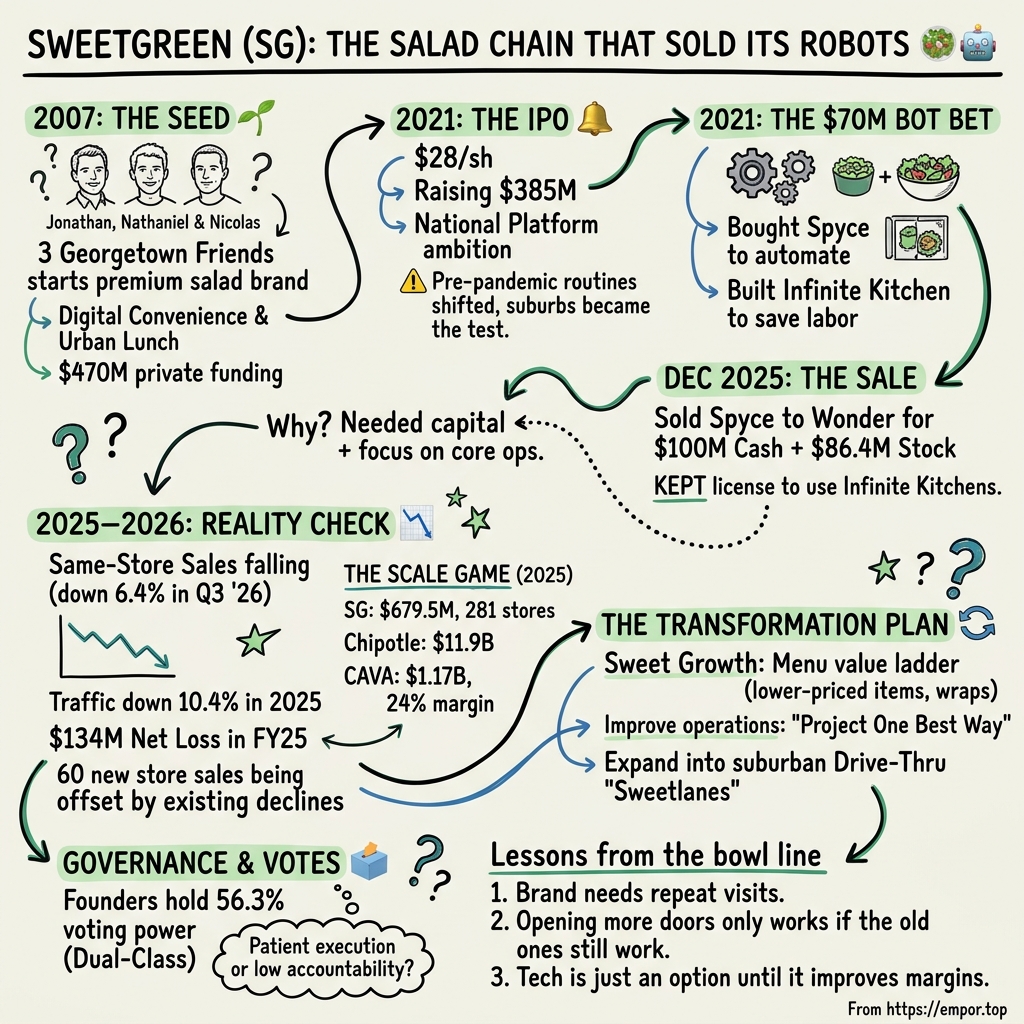
Then, as 2025 turned into 2026, Sweetgreen sold the business that built it. Wonder, the food-hall and delivery company, agreed to buy Spyce, the robotics startup behind the Infinite Kitchen, for $100 million in cash and preferred stock that Sweetgreen valued at $86.4 million.1 The deal closed on December 29, 2025, the first day of Sweetgreen's 2026 fiscal year, and Sweetgreen kept a licence to keep using and deploying the technology in its own restaurants.2 So the company that once bought a robotics business so it could own the future of its kitchen now rents that future from someone else, and still plans to put the machines in some of its new stores.
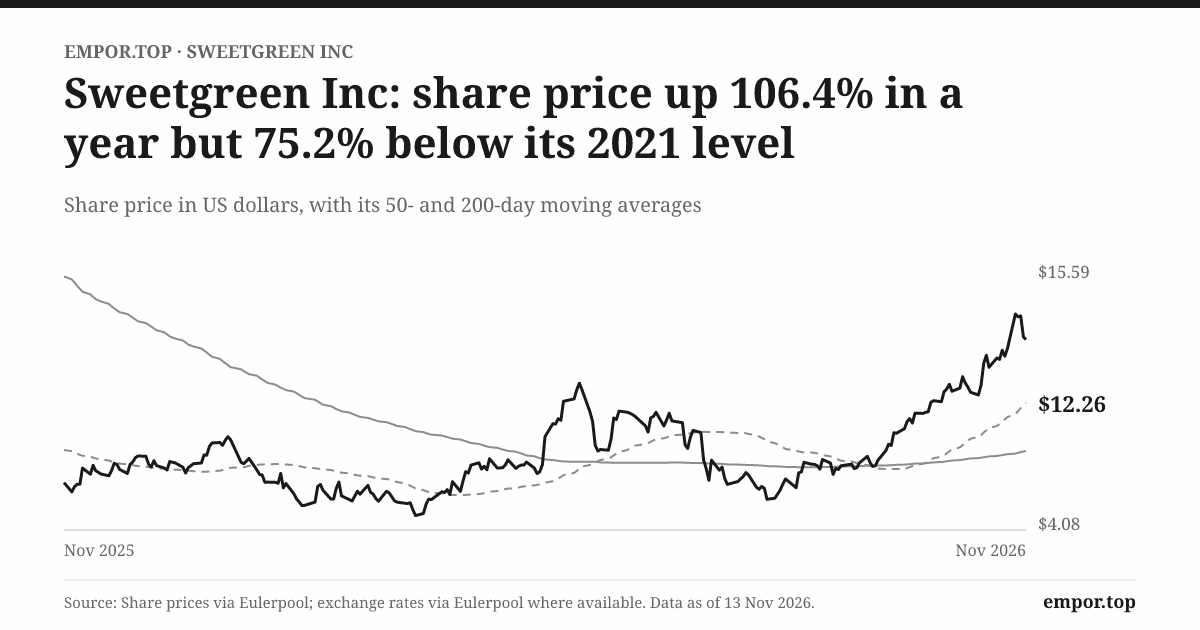
That is the first contradiction in this story, and it is not the most important one. The more pressing problem is in the dining rooms. Through the third quarter of 2026, Sweetgreen's existing restaurants were still selling less than they had a year earlier. In the third quarter, which ended on September 27, revenue was about $176 million, the company operated 285 restaurants, and same-store sales fell 6.4%.3 It extended a run, unbroken since the start of 2025, in which restaurants open for more than a year sold less than they had the year before.34 On November 13, 2026, the stock closed at $12.26, which valued the whole company at about $1.5 billion.5
The accounting tells a deceptively cheerful tale. Add up the last four reported quarters and Sweetgreen earned a net profit of about $19 million, its first positive twelve-month result as a public company.2 Look a little closer and the profit belongs to the robot sale, not to the salads. In the first 39 weeks of 2026, Sweetgreen booked a $160.5 million gain on disposing of Spyce, while the business of running restaurants lost $93.5 million at the operating line.2 Strip out the one-time gain and the company is still doing what it has done every year since it went public: spending more to operate its restaurants and headquarters than its customers pay it.
Which is why management's most recent good news deserves attention and caution in equal measure. On the third-quarter call in early November, the company said comparable sales in October had risen roughly 5%, with transactions up about 4%, the first positive month in a long time.[^6] After nearly two years of shrinking traffic, that is genuinely encouraging. It is also a single month, set against a weak October a year earlier and a summer in which a food-safety scare had scared customers away.
Four questions run through everything that follows. The first is whether traffic and restaurant economics can recover, because a restaurant chain is ultimately a machine for turning visits into cash, and Sweetgreen has been losing visits. The second is whether the profit rebound is real, or whether it is a single gain dressed up as a turnaround. The third is whether automation can still help Sweetgreen now that it no longer owns the technology business, and what the licence will cost. The fourth is about the people in charge: the three founders still control the company's votes, and the question is whether that control buys patience for a long repair job or shields management from the accountability a struggling business needs.
Sweetgreen can still open restaurants; the harder task is to get customers back into the ones it already has. To understand why that has proved so difficult, the story has to go back to a small storefront near a university campus in Washington, and to a lunch habit that once looked like the future of eating.
 Subscribe on LinkedIn
Three Georgetown friends build a lunch brand
In 2007, three recent Georgetown University graduates, Jonathan Neman, Nathaniel Ru and Nicolas Jammet, opened a small salad shop near the campus where they had studied.6 None of them was a chef or a restaurant operator. What they had was a complaint shared by many students and young office workers: it was easy to eat fast and easy to eat well, but hard to do both at the same time. Their answer was to take the salad, usually treated as a side dish or a diet compromise, and make it the main event of a quick, customizable lunch built from fresh ingredients.
The founders were unusual restaurant entrepreneurs, and their personalities shaped the company that followed. Neman, who would become chief executive and eventually chairman, was the strategist and the public face, the founder who spoke about Sweetgreen as a platform and a brand rather than a chain of salad counters.6 Ru became the keeper of the brand and its culture, and Jammet gravitated towards the food and the concept.7 The three titles they held for much of the company's public life, chief executive, chief brand officer and chief concept officer, describe the division neatly.7 They also describe an ambition: from the start, the founders were building something that was meant to feel more like a consumer brand than a food-service operation.
That ambition showed up in places most salad chains never went. Early on, the company started Sweetlife, a music and food festival in the Washington area that grew to feature well-known headline acts, and it partnered with chefs and local farms to put names and stories behind its seasonal bowls.6 The festival was memorable marketing and it gave a regional chain a cultural presence far larger than its store count. It was never a separate profit engine, and it is best understood as a statement of intent: Sweetgreen wanted customers to feel they were joining something, not just buying lunch.
The product underneath the branding was simple and well designed. A customer walked in, or later tapped an app, chose a seasonal bowl or built one, and left with a meal of greens, grains, proteins and toppings assembled in front of them. It was convenient in the way fast food is convenient and virtuous in the way fast food is not. It was also expensive for something bought several times a week. A Sweetgreen bowl competed not only with sandwiches and burritos but with a packed lunch, and the company's model depended on customers deciding, again and again, that freshness and convenience were worth a premium.
For a decade and a half, the setting made that decision easy. Sweetgreen thrived in dense urban districts where office workers needed lunch near their desks, had above-average incomes and had grown used to ordering ahead on their phones. Digital ordering became a defining part of the experience. In 2025, about 62% of Sweetgreen's revenue came through digital channels, including roughly 35% through the company's own app and website rather than third-party delivery services.4 That owned channel matters because it gives Sweetgreen the customer's data, a direct way to market to them and a sale without a delivery platform's commission.
The brand built on that urban lunch occasion was real. It is worth being precise, though, about what a brand can and cannot prove. Recognition and a clean aesthetic help win a first visit. Loyalty is shown by repeat visits, and pricing power is shown when a company raises prices and customers keep coming. Sweetgreen's recent history tests both, and the results, as later chapters show, have not been kind.
The world around the brand also shifted. The pandemic emptied the office districts that had fed Sweetgreen's lunch rush, and the return to the office was partial and uneven, with many workers coming in only a few days a week. That hit the core occasion directly: a habit formed five days a week becomes much weaker at three. Sweetgreen responded by moving into suburbs and smaller cities where people eat lunch closer to home and dinner matters more. The shift shows up in the company's geography. New York City's metropolitan area remains Sweetgreen's largest disclosed concentration, but its share of revenue fell from about 28% in 2023 to about 24% in 2025.4 That is diversification, which lowers the risk of a single city's slowdown. It is also a sign that the company is now selling its bowl to customers who did not grow up with it, in places where the premium lunch is a harder sell.
Writers have started to describe that cultural shift bluntly. Early in 2026, The Atlantic examined how a brand that once defined the ambitious young professional's power lunch had come to be seen by some as a millennial cliché, a mark of a particular era of office life that was fading.8 That framing can be overdone, since brands go in and out of fashion without their underlying business collapsing. But it captures the risk well: a brand built on a moment has to keep proving that the moment is not over.
By the time Sweetgreen went public, then, it had built something distinctive: a recognizable brand, a large digital customer base and a footprint concentrated in some of America's most valuable lunch markets. What it had not yet proved was that each of those restaurants could reliably earn a good return, or that the formula could travel far beyond the districts that made it famous. Before its IPO, the company had raised roughly $470 million from private investors to build the business.6 The question public investors were asked to answer in 2021 was how much of the opportunity rested on proven store economics, and how much on a promise of future scale.
The IPO priced a national chain still learning to scale
In November 2021, Sweetgreen's shares started trading on the New York Stock Exchange under the ticker SG.4 The company had priced its offering at $28 a share and raised about $385 million after underwriting costs.4 The timing was excellent for a seller. Investors in late 2021 were paying generously for growth stories with a technology angle, and Sweetgreen arrived with both: a brand loved by its customers and, as of that summer, its own robotics company. For a while afterwards, the market valued the salad chain more like a high-growth consumer technology business than a restaurant company.
The founders' pitch was ambitious and consistent. Sweetgreen, they said, was not just a restaurant chain but a platform for building healthier food systems and a national brand with room for many hundreds of locations across the United States.6 The prospectus described a large, underserved market for healthy fast-casual food, a highly engaged digital customer base, and a store model that the company believed could be replicated in new markets.6 It also, as all good prospectuses do, laid out the risks in plain view. Sweetgreen had a history of net losses and expected to keep losing money, its business depended on the urban lunch occasion that the pandemic had disrupted, and it might never achieve or sustain profitability.6
That combination is the key to reading the IPO fairly. Investors were not misled about the absence of profits; the losses were disclosed on the first pages. What they were buying was a bet that the company's scale-up would eventually turn those losses into earnings, as new stores matured, as overheads were spread over a bigger base and as automation cut the cost of labour. The IPO was a financing event for a promise. Five years on, the useful question is how much of that promise has been delivered.
Revenue tells part of the story. Sweetgreen's sales rose from about $340 million in 2021 to about $680 million in 2025, roughly doubling in four years.4 Measured over a longer stretch, that looks like dazzling growth, but much of it reflects a recovery from the pandemic's depressed base and an expanding store count. Over the three years from 2022 to 2025, revenue grew about 13% a year. In 2025 itself, it grew less than half of one percent.4 The headline trajectory, in other words, flattened precisely when the company had the most stores and the most capital at work.
Profit tells a harder story. Sweetgreen has not reported an annual net profit as a public company. Its net loss narrowed from about $190 million in 2022 to about $90 million in 2024, a trend that looked like the scale story finally working, and then widened again to about $134 million in 2025 as sales weakened.4 Some of those losses are not cash. Stock-based compensation, depreciation of restaurant fit-outs and impairments of underperforming stores are accounting charges that do not drain the bank account in the year they are recorded. Between 2019 and 2025, Sweetgreen's cumulative net losses came to roughly $888 million, while its operating activities consumed only about $179 million in cash over the same period.4 That gap is real and it matters: the business is less cash-hungry than its income statement suggests.
The comfort ends when the cost of new restaurants is added back in. A restaurant chain grows by building restaurants, and each one costs money to fit out before it sells a single bowl. Over those seven years, after capital spending on stores and technology, Sweetgreen's free cash flow was negative by about $769 million.4 Put simply, almost every dollar the company raised from private investors and from the IPO was spent building and running the business, with nothing yet coming back to shareholders in cash. The company has never paid a dividend, and the shares it has issued have been mostly to employees and to the former owners of Spyce rather than through repeated public offerings.4
Here the capital cycle comes into focus. The IPO filled the bank account; the company used it to open restaurants at a rapid clip; and, for a while, the operating trends improved enough to suggest the formula was working. In 2023 and 2024, operating cash flow turned positive, and Sweetgreen was close to funding its own operations, if not its expansion.4 Then sales at existing restaurants turned down in 2025, operating cash flow went negative again, and cash fell from about $215 million at the end of 2024 to about $89 million a year later.4 Without the money from the Spyce sale, the company would have entered 2026 with a much thinner cushion than its growth plans required.
The verdict on the IPO is therefore mixed in a specific way. It gave Sweetgreen the capital to become a national chain, and the company used it to roughly double its footprint. It did not, by itself, prove that the restaurants could earn the returns needed to justify that footprint. The stock market reached its own conclusion: from its peak, Sweetgreen's share price fell by about 91% at its worst point over the past five years, and even after a sharp rebound in 2026, it trades well below the IPO price.5
There was, however, one part of the IPO story that was about more than salads, and it is the part that gives this company its odd shape today. A few months before going public, Sweetgreen had bought a robotics startup, betting that it could change how a restaurant kitchen worked.
A $70 million bet on a faster bowl
Picture the lunch rush at a busy Sweetgreen in Manhattan before the robots. A queue of people stretches towards the door. Behind the counter, a line of employees passes each bowl from station to station: one adds greens, another scoops grains, another adds protein, another the toppings, another the dressing, and someone at the end tosses, lids and hands it over. Every station is a person, and every person is a cost. If someone calls in sick, the line slows. If a new hire scoops too generously, the food cost rises; if they scoop too stingily, the customer feels short-changed.
Now picture the Infinite Kitchen. Bowls travel along an automated line beneath a row of dispensers, each holding an ingredient and releasing a measured portion as the bowl passes. The orders come in from the app and the counter, and the machine assembles them in sequence. The employees are still there, but they are doing different jobs: washing and chopping ingredients, cooking proteins, refilling the dispensers, checking orders and talking to customers. The promise is not a restaurant without people. It is a restaurant where people do the parts machines cannot do, while the machine handles the repetitive assembly with more speed and consistency.
That promise is why Sweetgreen bought Spyce in 2021. Spyce, based in Boston, brought an engineering team and automation know-how that Sweetgreen wanted inside the company.6 Rather than buying equipment from a vendor, Sweetgreen decided to own the capability. The total cost came to about $70 million once the later payments to Spyce's former owners were included, a mix of cash and Sweetgreen stock, some of it contingent on reaching milestones.4
The logic was sound in one important respect. Labour is the largest controllable cost in a fast-casual restaurant, and it is getting more expensive. In 2025, Sweetgreen's restaurant labour and related costs consumed about 29% of its revenue.4 If automation could reduce the number of people needed on the line at peak hours, or let the same team handle more orders in the same hour, it would attack the cost that matters most. Faster throughput also matters for sales: a lunch restaurant can only make money during the few hours when customers want lunch, and every customer who walks away from a long queue is revenue lost for good.
The trouble is that a working machine is not the same thing as a better business. Sweetgreen deployed Infinite Kitchens in a growing number of new and remodelled restaurants, and management spoke enthusiastically about them on earnings calls. The company said they delivered faster service and more consistent portions in those locations.9 But the company has never published a full, audited comparison of Infinite Kitchen restaurants against comparable conventional ones: labour hours per bowl, sales per hour at peak, the extra capital cost of the equipment, maintenance expenses and, at the end of it, restaurant-level margins and payback periods. Without that data, an investor cannot tell whether the machine earned its cost.
It is also striking how little Sweetgreen was spending on research and development by the end. In 2025 the company reported about $1 million of R&D expense, essentially flat from the year before and a tiny fraction of its revenue.4 Meanwhile it spent roughly $107 million on capital expenditure, mostly building restaurants.4 Whatever Sweetgreen was, it was no longer running a large technology research platform. The money that went into automation in its final years showed up mainly as equipment inside new restaurants, which means its returns, if any, were buried in store-level results that the company does not split out. Much of the engineering work had already been done, and the question had shifted from invention to deployment and economics.
So it was perhaps less surprising than it seemed when Sweetgreen announced that it would sell Spyce to Wonder. Wonder had been assembling restaurant brands and food-technology assets under one roof, and it wanted the Infinite Kitchen for its own operations.1 Sweetgreen sold Spyce, retaining a licence to use and deploy the technology and signing transitional supply and service agreements.12 The deal produced the $160.5 million gain recorded in 2026.2
The headline numbers invite an easy conclusion: bought for $70 million, sold for $186 million, a tidy windfall. That arithmetic does not survive scrutiny, and the honest answer is that the filings do not let anyone calculate the true return. The purchase price was paid over several years, partly in shares whose value changed. Sweetgreen also spent money developing the technology after the acquisition, much of it absorbed in general operating costs rather than clearly separated. On the other side, about half the sale price came as preferred stock in a private company. That security has no public market, its value depends on Wonder's own prospects, and Sweetgreen cannot easily turn it into cash. And the most important number is missing entirely: what the machines did for the restaurants that used them. The sale monetized the technology assets. It did not settle whether the original investment earned an adequate return.
What the sale does show is a strategic reset. Four years after buying a robotics company to own the future of its kitchen, Sweetgreen concluded that owning the development business was not worth the cost, the distraction or the capital. That is not proof that the technology failed. Restaurant companies regularly decide to buy rather than build, and Wonder's willingness to pay suggests the technology has value to someone. But it does undercut a central part of the IPO-era story, in which proprietary automation would set Sweetgreen apart from every other salad and bowl chain. If Wonder can license or deploy the same system elsewhere, the technology becomes less a moat and more a tool that competitors may one day also rent.
The licence also changes Sweetgreen's cost structure in a way that is not yet visible to outsiders. Instead of paying engineers, the company now pays a licence and service fee to Wonder, recorded within its operating expenses.2 Sweetgreen has not quantified those costs separately.2 That makes the arithmetic of each new automated restaurant harder, not easier, to assess.
The consequence is clear, even if the final verdict is not. Sweetgreen kept access to the system and handed over the burden and the upside of developing it. From here, the robots will be judged like any other piece of kitchen equipment: by whether they lower labour costs, speed up service and raise restaurant margins by enough to justify their price and their licence fees. That test depends on something the robots cannot fix on their own, which is whether enough customers are walking through the door.
New stores added sales; existing ones gave them back
Imagine a restaurant chain as a bathtub. New restaurants are the tap, pouring fresh revenue in. Existing restaurants that lose customers are the drain. In 2025, Sweetgreen opened the tap wide and still barely raised the water level. The 60 net new restaurants it had opened over the previous two years added about $58 million of revenue in 2025, while restaurants open long enough to count as comparable lost about $53 million.4 The tub ended the year a fraction of a percent fuller than it started. All that construction, all that capital, all those new teams hired and trained, and the company's revenue grew by less than half of one percent.
To understand why that matters, it helps to follow a single sale. A customer decides to have lunch, chooses Sweetgreen over a sandwich shop, a burrito chain or a desk lunch, orders a bowl through the app or at the counter, and pays a price that reflects the menu, any discounts and the ingredients they added. Revenue is the sum of those decisions. It rises when more customers come, when they come more often, when they spend more per visit and when prices go up. Digital ordering changes how the order arrives, not whether the customer wanted to come in the first place. Sweetgreen's strong digital mix is a convenience and a source of data; it is not a contract, and it does not guarantee the next visit.
That is why the company's operating figures for 2025 were so damaging. Same-store sales fell 7.9%. Underneath that, traffic, meaning the number of transactions, fell by about 10%, and the average restaurant's annual sales, or AUV, fell about 8% to roughly $2.7 million.4 Price increases and mix partly cushioned the drop in visits, but the core signal was unambiguous: fewer people were choosing Sweetgreen, and those who did were not spending enough more to make up the difference.
Lower sales per restaurant ripple straight through a restaurant's economics, because so many of its costs are fixed. The rent is the same whether the restaurant serves 800 people a day or 700. The manager's salary, the minimum crew and the equipment depreciation do not fall with traffic. So when AUV drops, restaurant-level margin, the profit each restaurant earns before corporate overhead, falls faster. Sweetgreen's restaurant-level margin was about 15% in 2025, down from about 20% the year before.4 That five-point drop is the shrinking traffic expressed in dollars.
The cost lines show where the damage landed. Labour alone took about 29 cents of every revenue dollar in 2025.4 Labour is the line a restaurant can flex least when traffic falls, because a store still needs enough people to open, prep, cook and serve at lunch no matter how many customers arrive. The headquarters tells a similar story. Sweetgreen ended 2025 with about 6,500 employees, slightly more than a year earlier, while revenue barely moved.4 A growing company is supposed to spread its overhead across more sales each year; in 2025, Sweetgreen spread a slightly larger organization across the same sales. That is the absence of operating leverage, and it explains why a small revenue stall produced a much larger swing in losses.
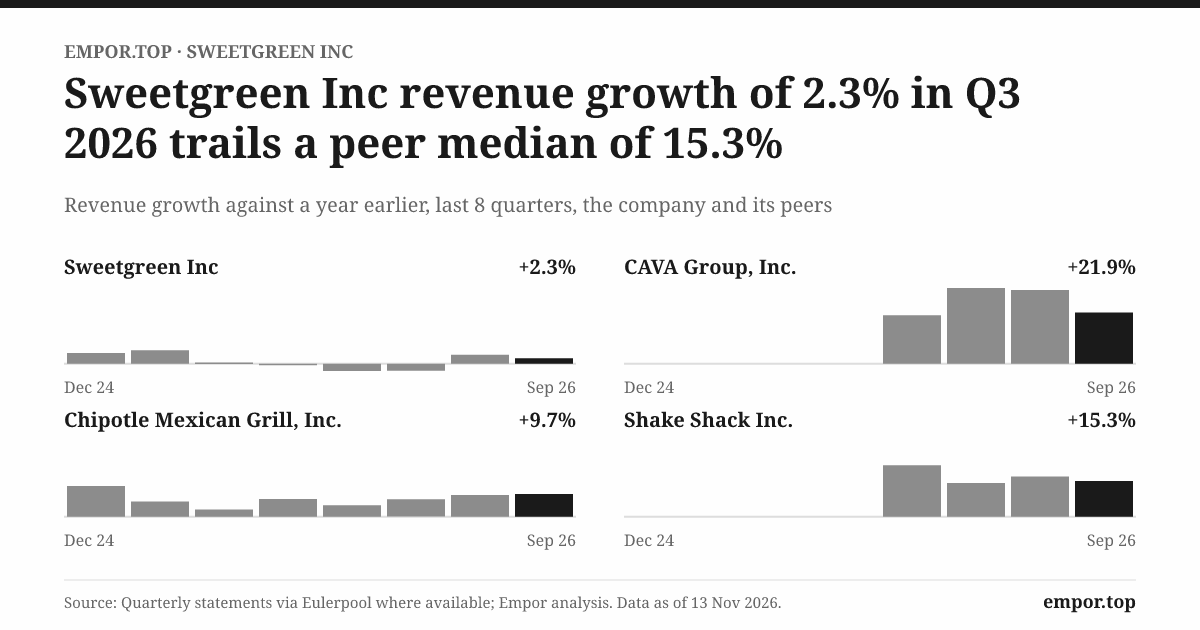
Set beside its closest rivals, Sweetgreen looks small and, for now, less productive. Chipotle, the giant of fast-casual dining, reported about $11.9 billion of revenue in 2025 from more than 4,000 restaurants.10 CAVA, the Mediterranean bowl chain that went public in 2023 and is the most direct comparison in format and customer, reported about $1.17 billion from 439 restaurants, with same-restaurant sales up about 4%.11 Sweetgreen, with about $680 million and 281 restaurants at the end of 2025, is the smallest of the three and was the only one whose existing restaurants were shrinking.4
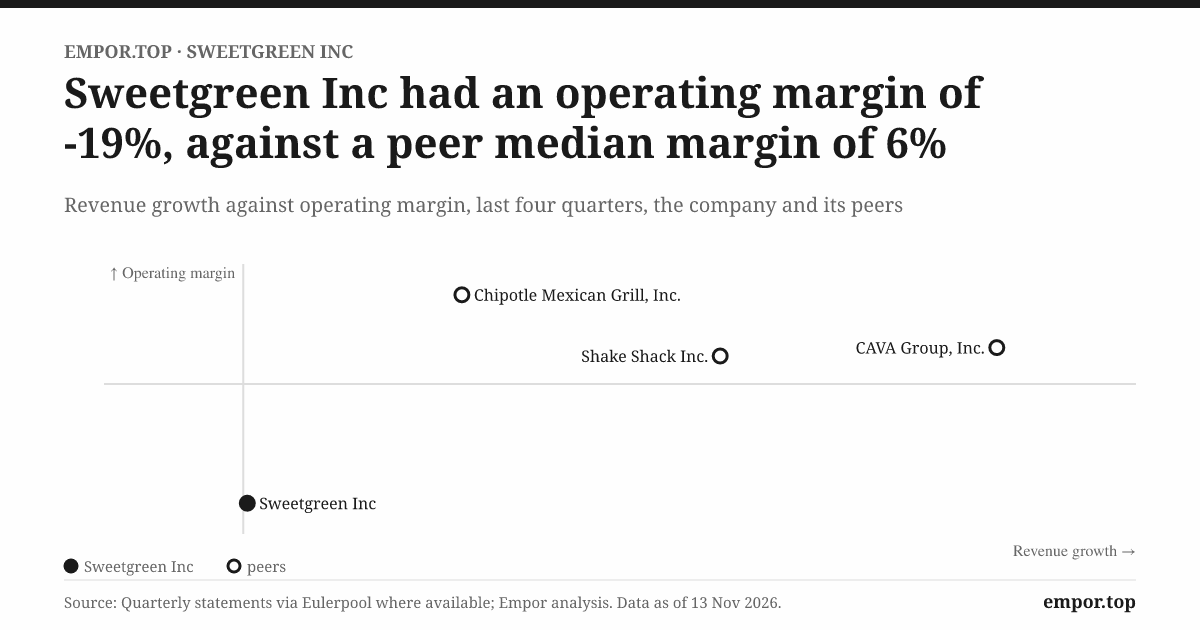
The unit economics comparison sharpens the point. CAVA's average restaurant generated about $2.9 million in annual sales in 2025 and earned a restaurant-level margin of about 24%.11 Sweetgreen's average restaurant generated about $2.7 million and earned about 15%.4 The two companies define these measures slightly differently, so the comparison is directional rather than exact. But the gap is too large to be a matter of definitions. A CAVA restaurant was producing more sales and keeping a much larger share of them. When two bowl concepts court a similar customer and one is growing while the other shrinks, the market's verdict on value is hard to dismiss.
The competitive structure explains why. Diners face almost no switching costs: choosing a CAVA bowl, a Chipotle burrito, a supermarket salad or something cooked at home costs nothing but a moment's thought. Rivalry is intense, from national chains with greater purchasing scale to independent local spots with lower overheads. Sweetgreen has no large customers who could squeeze its prices, since it sells to millions of individuals, but collectively those individuals have all the bargaining power that comes from being able to walk next door. On the supply side, Sweetgreen's contracts with distributors and farms are generally short-term, and the company does not disclose how concentrated its vendor base is.4 Its 2024 decision to suspend a leafy-greens supplier over food-safety concerns shows that supply can be both a quality and a reputation risk.4
So does Sweetgreen have a moat? It has real assets: a brand that people recognize, a large digital customer base, and a footprint in some of America's most valuable urban districts. But a moat is something that keeps customers coming back even when a rival offers a similar product at a similar price, and the evidence for that is missing. Sweetgreen does not disclose customer retention, cohort behaviour or its share of the fast-casual market over time. The 2025 numbers point the other way: when the company relied on price and mix to support sales, traffic fell. That is the opposite of pricing power. The fair conclusion is that Sweetgreen has a brand that helps win a visit, and nothing yet shown to lock one in.
The recent quarters show how deep the slide went and how the company has tried to stop it. In the first quarter of 2026, same-store sales fell almost 13%, the worst result of the downturn.12 On the call, management described a business still adjusting to a menu reset and the loss of momentum from 2025.12 In the second quarter the decline narrowed to about 6%, which looked like progress, though much of the improvement came against a weak comparison and the mix of what customers bought had shifted towards cheaper items as promotions pulled in value-seekers.1314 Then, in the third quarter, same-store sales fell 6.4%, with traffic down about 5%, product mix down about 2% and price adding less than a point.3
The third quarter also carried an unusual explanation. During the summer, an outbreak of cyclospora, a parasite associated with fresh produce, drew headlines that touched Sweetgreen, and the company said the resulting headlines had depressed customer demand.314 The company attributed the decline in traffic primarily to that reduced demand.3 It is a plausible explanation. Food-safety scares are among the most damaging things that can happen to a fresh-food brand, and Chipotle's experience a decade ago showed how long they can linger. But it is also an incomplete one. Traffic was already falling sharply in 2025, long before the outbreak, and the product-mix decline points to customers trading down to cheaper options. The outbreak almost certainly made a bad situation worse; it did not create the situation.
That distinction matters for how investors read the third-quarter call. Analysts pressed management on how much of the weakness came from the outbreak and how much from value perceptions, operations and the menu.[^6] Management's answer leaned on the October improvement: comparable sales up roughly 5% and transactions up roughly 4%, which the company presented as evidence that the outbreak's effect was fading and its value initiatives were working.[^6] Both may be true. It is also true that October 2025 was a weak month to compare against, and that a promotional push can lift traffic for a few weeks without changing long-term behaviour.
The new-store tap has also slowed. In the third quarter of 2026, new restaurants added about $14 million of revenue, while comparable restaurants lost about $11 million, the same pattern as 2025 in miniature.3 Revenue grew a little over 2%, and that growth came entirely from the expanding footprint. Opening more doors still raises reported sales. It does not yet mean customers are choosing Sweetgreen more often.
The verdict for this chapter is therefore cautious. The existing fleet is not a dependable growth engine today, and the comparison with CAVA suggests the problem is partly specific to Sweetgreen rather than an industry-wide slump. October's numbers are a possible turning point, and they deserve to be taken seriously as such. The test that would confirm a recovery is simple to state and hard to fake: same-store transactions rising for several consecutive quarters, after the outbreak and the easy comparisons have rolled out of the numbers, with AUV climbing back towards where it was before the slide. Management has a plan to get there, and it has given it a name.
"Sweet Growth" meets the value question
By the middle of 2025, Sweetgreen's leaders had a problem they could no longer describe as temporary. On the second-quarter call that August, management cut the company's outlook for the year, citing weaker traffic and a more cautious consumer.9 It was not the last cut. As the year went on and the numbers kept disappointing, the guidance came down again, and the story management told shifted from growth and innovation towards fixing the basics.49
The result was a turnaround programme the company called the Sweet Growth Transformation Plan. Stripped of its name, it is a set of practical bets on what made customers stop coming. The first is value. Sweetgreen introduced lower entry-price options and what it described as a value ladder, a menu structure that gives customers a clear choice between a cheaper bowl and more premium options, rather than forcing them to build an expensive bowl ingredient by ingredient.15 The second is portions: the company increased protein portions after customers complained that bowls felt skimpy for the price.1516 The third is menu innovation, including wraps, which give the brand a format that can be eaten on the move and offered at a lower price point.1516 The fourth is loyalty, with offers designed to bring lapsed customers back and reward frequent ones.16 The fifth, and probably the most important, is execution: a programme of standardized operating procedures the company called "Project One Best Way," meant to make each restaurant prepare food and serve customers in the same consistent manner.9
Each of these levers works through a specific mechanism, and each carries a specific cost. Better value should raise transactions and frequency, because customers who felt priced out come back and occasional customers come more often. But a lower entry price also lowers the average check, and if the extra visits do not make up for it, revenue per restaurant falls. Bigger portions should improve satisfaction and repeat visits, but they directly raise food costs on every bowl sold. Discounts and loyalty offers attract trial, but they can train customers to wait for a deal. Menu novelty draws curious diners, but only repeat purchases turn curiosity into a habit. Consistent execution, by contrast, has few downsides: a bowl that arrives correct, generous and on time is the cheapest way to keep a customer, which is why it matters so much that it was a problem in the first place.
The early financial evidence shows those costs biting before the benefits arrive. In the second quarter of 2026, same-store sales fell about 6%, but the breakdown was revealing: traffic fell only 2%, while product mix fell more than 4%.13 Customers were coming back, but they were buying cheaper meals. Restaurant-level margin fell to about 13% from about 19% a year earlier.13 In the third quarter it fell further, to about 10%.3 In plain terms, the value strategy was working on the volume line and hurting on the profit line, and the outbreak made the profit line worse. That is the central trade-off of any restaurant turnaround: you can buy customers back with value, but you have to pay for them, and the payment arrives first.
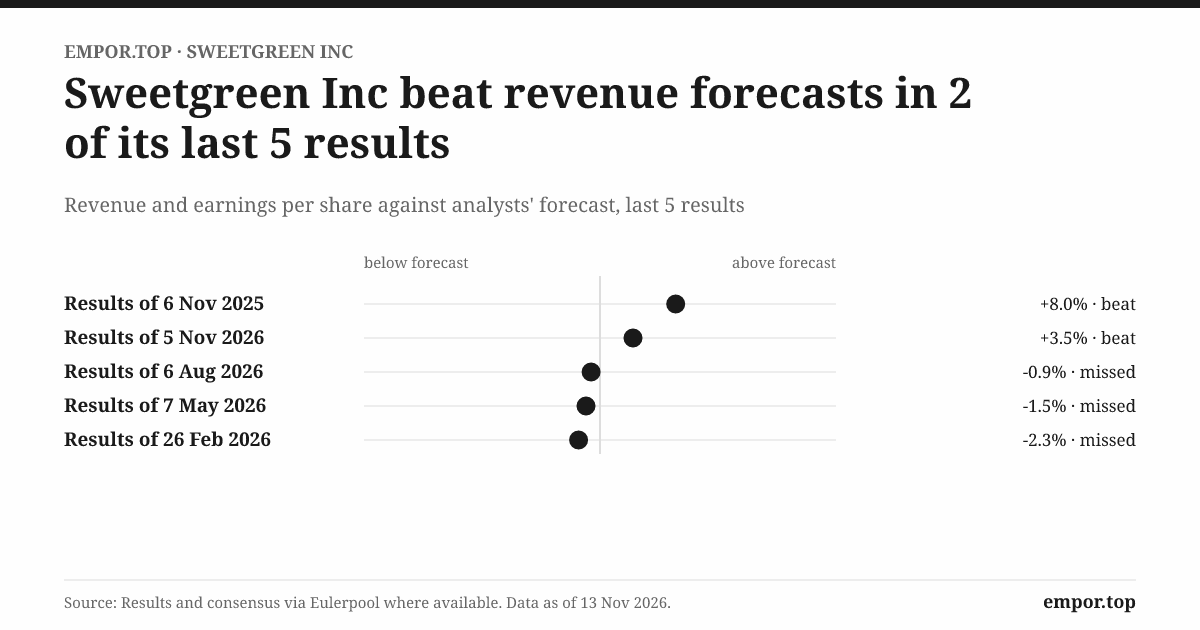
Management's track record is part of the story too, because a plan is only as credible as the people executing it. Sweetgreen cut its 2025 outlook repeatedly as the year deteriorated.94 In the second quarter of 2026, after the outbreak disrupted demand, it lowered its full-year outlook again.13 The third-quarter update continued to imply a loss-making year, with adjusted EBITDA, a measure that excludes many non-cash and one-time costs, expected to be negative.3 None of these cuts is unusual on its own, since restaurant companies regularly revise guidance when demand shifts. The pattern, though, is a series of forecasts that proved too optimistic, followed by explanations that leaned on external factors, from the consumer environment to the outbreak.
Comparing what management says in prepared remarks with what it concedes in analyst questions is useful here. In the scripted portion of the calls, the emphasis has been on the plan, the October improvement and the long-term opportunity.[^6]14 In the question-and-answer sessions, analysts have repeatedly asked how much of the margin decline is temporary, how much is the permanent cost of better value, and how the company will know whether the plan is working.[^6]14 Management's answers have pointed to improving transactions and to cost efficiencies that should offset the investment in value. Those are reasonable answers. They are also promises whose fulfilment has not yet shown up in the financial statements.
The outbreak deserves to be treated seriously, but in proportion. A food-safety headline can genuinely send customers elsewhere for months, and Sweetgreen's traffic in the third quarter did weaken relative to the second. But the weakness in traffic began in early 2025, and the mix decline in the second quarter came before the outbreak hit. The honest reading is that Sweetgreen faced three overlapping problems at once: a value perception that had eroded, execution that had become inconsistent, and then a food-safety scare that landed on a brand already under pressure. The plan addresses the first two directly. The third will fade only if no new incident follows.
The real test of the plan is not a single month's comparable sales, however good. It is sustained transaction growth paired with a restaurant-level margin that stabilizes and then rises. If transactions grow but margins keep falling, Sweetgreen will have bought back its customers at a price it cannot afford. If margins recover but transactions stall, the company will have simply reversed its value investment. Only both together would show that the plan has repaired the business rather than just rearranging its economics.
Meanwhile, Sweetgreen is testing whether its brand can travel to places that do not run on office lunch. In August 2026 it opened its first East Coast Sweetlane, a drive-through format, in McLean, Virginia, a suburb of Washington, as part of a strategy to reach customers who eat closer to home and arrive by car.17 It is a sensible experiment. Suburban demand is less dependent on office attendance, and drive-through convenience is something the fast-food industry has proved customers value. But one restaurant, or even a handful, is a test, not a proof. Sweetgreen's growth will depend on whether formats like Sweetlane produce strong sales and margins at scale, and that evidence is still years away. Whether the people running the company are the right ones to deliver it is, in a founder-controlled company, a question shareholders cannot fully answer on their own.
The founders still hold the votes
Every year, Sweetgreen holds an annual meeting where shareholders vote on directors, on the auditor and on executive pay. In June 2026, they approved the company's executive compensation by a wide margin: about 172 million votes for, about 3 million against, and a sliver of abstentions.18 On paper, that is a resounding endorsement. In practice, it says less than it seems, because the vote was never really in doubt.
Sweetgreen has two classes of stock. The Class A shares, which trade on the NYSE, carry one vote each. The Class B shares, held mainly by the founders, carry ten votes each.7 As a result, the three founders held about 56% of the company's total voting power in 2026, even though their economic ownership is far smaller.7 Neman alone held about 20% of the votes, with Ru and Jammet holding about 18% each.7 No combination of outside shareholders can outvote them. The outside register, meanwhile, is dominated by index funds and growth managers. As of April 2026, Baillie Gifford held about 10% of the Class A shares, Vanguard about 8%, BlackRock about 7% and Woodson Capital, a hedge fund, about 6%.7 Those are large stakes, but in a dual-class company they are economic interests, not levers of control. The say-on-pay vote, the election of directors and any proposal to change the company's direction all depend, in the end, on what the founders want.
There is a case for this structure, and it is not a weak one. Founders with control can take a long view, ignore short-term market pressure and make unpopular decisions that pay off years later. Some of the most successful companies of the past generation were built under exactly this arrangement. Sweetgreen's founders have, by most accounts, behaved like owners: they have been with the company for nearly two decades, their wealth is tied to its shares, and they have shown a willingness to make big strategic moves, from buying Spyce to selling it.
There is also a case against it, and Sweetgreen's recent record makes it more pressing. Control without accountability works when the people in control are executing well. When a company misses its forecasts repeatedly, loses customers for two years and reverses a major strategic bet, outside shareholders normally have tools to demand change: they can vote against directors, support an activist or press for new leadership. At Sweetgreen, those tools are blunted. The lead independent director, Clifford Burrows, a former Starbucks executive, provides a check inside the boardroom, but Neman combines the roles of chief executive and chairman, and the ultimate authority rests with the founders.7
Jonathan Neman's own pay offers a window into how the board thinks about incentives. His total compensation in 2025 was about $3.2 million, most of it in stock options that only become valuable if the share price rises.7 He received no annual cash bonus, because the company missed its targets.7 That looks like alignment: the chief executive is paid mainly in equity, and he got no reward for a bad year. But the absence of a bonus in a year of sharply falling sales is the minimum one would expect, not proof that pay is tied to a recovery. And the founders' earlier performance awards, which paid out handsomely when the share price was high, show that the incentive structure has rewarded stock-market moments as much as operating results; in 2024, founder performance units worth about $68 million vested as share-price hurdles were met.4
The management team has also changed in ways that bear on execution. Nathaniel Ru stepped back from his executive role at the end of 2024 and stopped being an employee at the start of 2026, though he remains a director.7 The chief financial officer, Mitch Reback, who had guided the company through its IPO, was succeeded in 2025 by Jamie McConnell, who joined with a signing bonus and equity awards.7 In 2026, the company also added a chief strategy officer role.7 New leaders can bring fresh discipline, and the second half of 2026 has shown a sharper focus on value and operations. Whether that reflects a genuine change in how the company is run, or just a new set of faces explaining the same problems, will be clear only from results.
Credibility is earned through actions over time, and the record here is mixed. The 2025 guidance cuts, the value reset, the Spyce sale and the explanations offered for each miss form a pattern of a management team that has been willing to change course but has not always predicted its own results well. The Spyce sale, whatever its ultimate merits, shows that the founders will reverse a cherished bet when the economics demand it. The repeated guidance cuts show that their read of the business has been too optimistic. Both are true at once.
One related-party relationship deserves a brief mention because of the founders' control. Sweetgreen's headquarters landlord is partly owned, indirectly, by a fund in which the founders and a former chief financial officer hold minority, passive interests.4 The company paid that landlord about $5 million in rent in 2025, which is roughly 0.7% of revenue.4 It is not a material drain on earnings, and the company discloses it properly. But in a company where the founders control the votes, investors are entitled to watch such arrangements closely.
The most forward-looking governance signal is at the restaurant level. Sweetgreen introduced a new incentive plan for restaurant managers, linking their pay to tenure, the scale of their restaurants, performance and equity ownership.[^6] The logic is sound: a fast-casual restaurant lives or dies by the quality of its general manager, and turnover among managers is one of the industry's most persistent problems. Whether the plan works will be measured not in proxy statements but in manager retention rates and in the consistency that the company's Project One Best Way is meant to deliver. Those are the numbers that will decide whether the founders' long horizon is a strength or a shelter, and they lead directly into the question every shareholder must answer: at today's price, what exactly is the market paying for?
Analysis & Bear vs. Bull Case
On November 13, 2026, Sweetgreen's shares closed at $12.26, about 8% below their high for the past year and more than two and a half times their low of $4.70.5 For a company still losing money at the operating line, that rebound is remarkable. The market has, in effect, decided that the worst of the slide is over. The question for anyone looking at the stock is what that price assumes, and whether the evidence supports it.
At that price, Sweetgreen was valued at about $1.5 billion, or about 2.1 times its annual sales.5 Adding its lease obligations and subtracting its cash gives an enterprise value of about $1.7 billion, roughly 2.5 times sales.5 The price-to-earnings ratio of about 77 times is meaningless here, because the earnings it uses are inflated by the Spyce gain. A better way to think about the valuation is this: the market is paying around two and a half dollars for every dollar of revenue from a chain whose restaurants currently earn a margin of about 10% to 15% before overhead, and whose overall operations lose money. That multiple only makes sense if investors expect margins to recover substantially and the store base to keep growing profitably. A comparison with Sweetgreen's own valuation history is not possible on an earnings basis, because the company has rarely had positive earnings to measure, so there is no reliable way to say whether the stock is cheap or expensive by its own standards.
The bull case, put fairly, runs like this. Sweetgreen has one of the most recognizable brands in American fast-casual food, a large base of digital customers and a market for healthy, convenient meals that remains large and underpenetrated. The value initiatives are beginning to bring customers back, as October's traffic suggests. New formats such as Sweetlane could open up suburban markets where real estate is cheaper and competition less intense. The Infinite Kitchen, now licensed rather than owned, could still reduce labour costs in new restaurants without the burden of a development budget. And with the outbreak behind it and easier comparisons ahead, the company could return to positive same-store sales in 2027, at which point the fixed-cost structure that hurt it on the way down would work in its favour on the way up. Every extra dollar of sales in an existing restaurant carries a high incremental margin, because the rent and the minimum crew are already paid for.
The bear case is equally coherent. Sweetgreen sells a premium-priced, discretionary product in a market with almost no switching costs, against larger and better-capitalized competitors. Its average restaurant volume has fallen, its traffic has declined for most of the past two years, and its margins have been squeezed by the very value investments meant to fix the problem. Its lease commitments are fixed and long-lived, while its sales have proved volatile. Each new restaurant requires substantial capital. If new restaurants open into the same weak demand that existing ones face, expansion could compound losses rather than value.
A careful look at the moat helps decide between these cases, and it is worth doing once, in full. Porter's five forces framework points to a tough industry structure, and Helmer's seven powers framework reveals few lasting advantages. Sweetgreen's strongest claim is its brand, but the 2025 traffic decline as prices held suggests its ability to command a premium has weakened. Process power, its other plausible advantage, remains unproven. The honest verdict is that Sweetgreen's moat is narrower than its IPO-era story implied: a real but eroding brand, with process power still a work in progress.
The balance sheet requires careful reading. At the end of 2025, Sweetgreen reported about $354 million of what some data services call borrowings, but these were almost entirely operating lease liabilities, the present value of future rent on its restaurants and offices.4 The company had no funded debt, and its former revolving credit facility expired unused at the end of 2024.4 That is a genuine strength: there are no lenders who can demand repayment or impose covenants. But leases are not free. Sweetgreen's undiscounted future rent obligations came to about $460 million, and those payments must be made whether a restaurant thrives or struggles.4 For a chain with volatile sales, that fixed obligation is the equivalent of debt in everything but name.
The auditors point at the same pressure from a different angle. Sweetgreen's 2025 audit opinion was clean, on both the financial statements and the internal controls, but the matter the auditor singled out as requiring the most judgement was the impairment of long-lived store assets.4 In plain English, that means deciding whether underperforming restaurants will ever earn back what was spent building them. Each decision depends on management's forecasts of store-level cash flow, and those forecasts have proved optimistic before. If AUV keeps falling, more stores will fail that test, and the write-downs will turn past capital spending into recognized losses. The legal picture, by contrast, is quiet: the company accrued under $4 million for settlements and legal fees at the end of 2025 and does not describe any material tax demand or regulatory penalty.4
The cash position looks healthier after the Spyce sale, but it requires context. Sweetgreen ended September 2026 with about $120 million in cash, up from about $89 million at the end of 2025, thanks largely to the $100 million it received from Wonder.24 It also holds the Wonder preferred stock, valued at about $86 million, which is not cash and cannot easily be sold.2 The operating business, meanwhile, is still burning cash: in 2025, operations consumed about $13 million and capital spending was about $107 million.4 The Wonder money bought time, perhaps a year or more of expansion at the current pace. It is not a recurring source of cash, and if operations do not improve, the company will eventually face a choice between slowing growth, raising capital or both. The company's own annual report warned that continued negative operating cash flow could require new debt or equity financing.4 Even the interest income that a cash pile throws off is shrinking. Sweetgreen earned about $6.5 million of interest in 2025, roughly 1% of revenue, and it said lower rates and smaller money-market balances reduced that income in 2026.42 A company living partly on the yield of its IPO money is a company whose IPO money is running down.
That leaves three numbers that matter more than any others for following Sweetgreen from here. The first is same-store transactions, alongside AUV, which together show whether customers are coming back and spending enough to make each restaurant productive; transactions were still down about 5% in the third quarter, though management reported growth in October.3[^6] The second is restaurant-level margin, the cleanest test of whether the value strategy and any automation are improving the economics of each store; it was about 10% in the third quarter, lower than a year earlier.3 The third is free cash flow excluding asset-sale proceeds, which shows whether the business can fund itself; it was negative by about $119 million in 2025.4 If those three numbers move in the right direction together, the bull case gains real evidence. If any one stalls, the others are unlikely to carry the story.
A skeptical shareholder or an activist, if Sweetgreen's governance allowed one to matter, would press a simple question: should the company slow its openings and focus on making existing restaurants work? There is no disclosed activist campaign, and the founders' control makes one unlikely to succeed. But the question is legitimate, and 2025 supports it. New restaurants added revenue while existing ones lost almost as much, and the capital spent on those openings came from a shrinking cash pile. Management has, in fact, trimmed its pace, guiding to a smaller pipeline of net new openings.3 The evidence that would vindicate that choice is improving sales and cash economics at existing stores. One more signal is worth noting: Baillie Gifford, the long-term growth investor that was Sweetgreen's largest outside holder, reduced its stake from about 10% of the Class A shares in April 2026 to about 8% by the end of September.719 That is not a verdict, since large funds trim positions for many reasons. But it means the patient institutional money that backed the growth story has become somewhat less patient.
Lessons from the bowl line
Go back to the Infinite Kitchen for a moment. It is still there, in a growing number of Sweetgreen restaurants, dropping measured portions into bowls with the same precision as before. The difference is that Sweetgreen no longer owns the business that makes it. The most striking piece of technology in this story is now licensed from a company that paid about $186 million in cash and stock for something Sweetgreen had bought for about $70 million.14 And yet the company that sold it is still losing money, still waiting for its customers to come back and still trying to prove that its restaurants can pay for themselves. Sweetgreen's history offers four lessons that belong to it and no other company.
The first lesson begins at a small storefront near Georgetown. Three young founders made a salad feel like a meal, and then made it feel like a lifestyle, complete with a music festival and a following among young professionals. For years, that brand seemed to guarantee the habit. But the habit was tied to a specific place and moment, the urban office lunch, and when that moment weakened, the brand could not hold the customers on its own. A brand can make a new habit feel obvious; only repeat visits show whether the habit belongs to the customer. Founders who build consumer brands should remember that the strongest marketing in the world is a hypothesis about behaviour, and the customer's next visit is the test.
The second lesson comes from the arithmetic of 2025, when dozens of new restaurants added almost exactly as much revenue as the existing ones lost. That is the trap every expanding retailer and restaurant chain must avoid: new stores mask the decline of old ones in the headline numbers, and investors who watch only total revenue miss the problem until it becomes impossible to hide. Opening more doors is growth only when the old doors still work. For investors, the lesson is to look past the store count to the same-store numbers, and to treat a company whose growth comes entirely from expansion with caution until the existing base stabilizes.
The third lesson belongs to the robots. Sweetgreen bought a technology company because automation promised to transform the economics of a labour-intensive business, and the technology appears to have worked as a machine. But the company never published the evidence that it worked as a business, and four years later it sold the development operation while keeping a licence to use the product. A technical breakthrough is an option until it moves labour, throughput or margin in the stores. That lesson applies far beyond restaurants: any company that buys a technology to transform its operations should be able to show, in its own operating numbers, what the technology has changed.
The fourth lesson comes from the guidance cuts of 2025 and the value reset that followed. Sweetgreen's management promised improvement, missed, revised, explained and promised again. Each explanation may have been reasonable on its own, but together they eroded the market's willingness to take the next promise at face value. A turnaround earns credibility one forecast kept at a time. Management teams in trouble often reach for bold new plans; the more persuasive move is usually a modest forecast, met and then exceeded, quarter after quarter.
None of these lessons erases what makes Sweetgreen unusual. Its cultural brand, its urban footprint, its automation experiment and its founder control make it a different kind of restaurant company from most. But none of them exempts it from the basic test that every restaurant chain faces: whether customers come back often enough, at prices high enough, to pay for the restaurant around them.
Epilogue
Tonight, Sweetgreen stands at a hinge point. The cyclospora headlines are fading. A growing number of restaurants use the licensed Infinite Kitchen. The value ladder, the bigger portions, the wraps and the loyalty offers have been in place long enough to show their effect over a full quarter. And management has staked its credibility on the October rebound being the beginning of a trend rather than a blip.
The next few quarters will decide which story is true. The first milestone is the fourth-quarter report, due in early 2027, which will show whether October's comparable-sales growth held through November and December, or faded as the easy comparisons ran out. The company's updated outlook calls for about ten net new openings and adjusted EBITDA for 2026 of negative $20 million to negative $23 million.3 Hitting that range would be a modest but meaningful sign of forecasting discipline. Missing it again would deepen the credibility discount that the 2025 cuts created.
The second milestone is same-store transactions. If they turn positive for a full quarter, and stay positive into the spring of 2027 when the comparisons get harder again, Sweetgreen will have its first real evidence that customers are choosing it more often. If transactions stall once the promotions fade, the value strategy will have bought only a temporary bump.
The third milestone is margins. Restaurant-level margin needs to stabilize and then rise, because a recovery in sales that comes at the expense of profit per restaurant is not a recovery at all. AUV, the average restaurant's annual sales, is the bridge between the two.
The fourth milestone is cash. With about $120 million in the bank and a business that still consumes cash once restaurant construction is included, Sweetgreen's ability to keep investing without a financing need depends on its operating cash flow improving.24 A return to positive operating cash flow would ease that pressure considerably.4 Continued outflows would force harder choices about the pace of growth.
A quieter question sits on the balance sheet. The Wonder preferred stock, carried at about $86 million, is now one of Sweetgreen's largest assets after its restaurants and its cash.2 Its value depends on how Wonder, a private company still building its own business, performs. If Wonder thrives, that stake could become a useful source of future cash. If Wonder struggles or needs new money on harsher terms, the stake could be marked down, and part of the Spyce gain would quietly reverse. Sweetgreen sold its robots partly for a piece of its buyer's future, and that piece will need watching.
Investors should also ask for the store-level evidence needed to judge automation: whether Infinite Kitchen restaurants outperform conventional ones.
And investors should watch the language. If management's story stays consistent over the next year, with the same priorities, the same metrics and forecasts that are met, the founder-led recovery case will gain strength. If the narrative shifts again, towards a new initiative or a new explanation, the case for patience will weaken. Sweetgreen can still open restaurants. The investment story turns on getting customers back into the ones it already has.
Outro
Picture a customer at a Sweetgreen counter on a weekday afternoon, watching through the glass as a machine drops greens, grains and roasted vegetables into a bowl. The bowl glides along the track, gets its dressing and arrives in the customer's hands in a minute or two. It is a small marvel. And the machine that made it belongs, in a sense, to someone else.
Sweetgreen's ambition has always been to make a better meal feel as easy as fast food. Sweetgreen sold the robotics business, but the harder machine to fix was never the one behind the glass. It is the restaurant business itself: the rent, the crew, the ingredients and, above all, the customer's decision to come back tomorrow. No technology can answer that question. Only the next visit can answer it, showing whether it feels worth the price.
References
-
Sweetgreen Announces Sale of Spyce to Wonder — Sweetgreen via SEC, 2026-01-29 ↩↩↩↩
-
Sweetgreen, Inc. Form 10-Q for the quarter ended September 27, 2026 — SEC, 2026-11-06 ↩↩↩↩↩↩↩↩↩↩↩↩
-
Sweetgreen, Inc. Third Quarter 2026 Financial Results — SEC, 2026-11-05 ↩↩↩↩↩↩↩↩↩↩↩↩
-
Sweetgreen, Inc. 2025 Form 10-K — SEC, 2026-02-27 ↩↩↩↩↩↩↩↩↩↩↩↩↩↩↩↩↩↩↩↩↩↩↩↩↩↩↩↩↩↩↩↩↩↩↩↩↩↩↩↩↩↩↩↩
-
Sweetgreen Investor Relations: Stock Information — Sweetgreen ↩↩↩↩↩
-
Sweetgreen, Inc. Form S-1 Registration Statement — SEC, 2021-10-25 ↩↩↩↩↩↩↩↩
-
Sweetgreen, Inc. 2026 Proxy Statement — SEC, 2026-04-23 ↩↩↩↩↩↩↩↩↩↩↩↩↩
-
How Sweetgreen Became Millennial Cringe — The Atlantic, 2026-01-08 ↩
-
Sweetgreen Q2 2025 Earnings Call Transcript — earningscalls.dev, 2025-08-07 ↩↩↩↩↩
-
Chipotle Announces Fourth Quarter and Full Year 2025 Results — SEC, 2026-02-03 ↩
-
Sweetgreen (SG) Q1 2026 Earnings Call Transcript — The Motley Fool, 2026-05-08 ↩↩
-
Sweetgreen, Inc. Announces Second Quarter 2026 Financial Results — Sweetgreen, 2026-08-06 ↩↩↩↩
-
Sweetgreen Q2 2026 Earnings Call Transcript — Equibles, 2026-08-06 ↩↩↩↩
-
Sweetgreen Looks to Value Ladders and Entry-Level Prices to Win Back Guests — QSR Magazine ↩↩↩
-
Sweetgreen Opens First East Coast Sweetlane in McLean, Explains Suburban Strategy — Axios, 2026-08-11 ↩
-
Sweetgreen, Inc. Form 8-K, 2026 Annual Meeting Voting Results — SEC, 2026-06-15 ↩
-
Baillie Gifford & Co Schedule 13G/A for Sweetgreen, Inc. — SEC, 2026-10-20 ↩
 LinkedIn
 WhatsApp
 Reddit
 Hacker News
 Email
 Kindle
 RSS Feed
 Spotify
 Apple Podcasts
 Amazon Music
 Audible
 YouTube