Schrödinger, Inc.: Can the Molecule Become a Business?
I. The Milestone That Didn't Make a Quarter
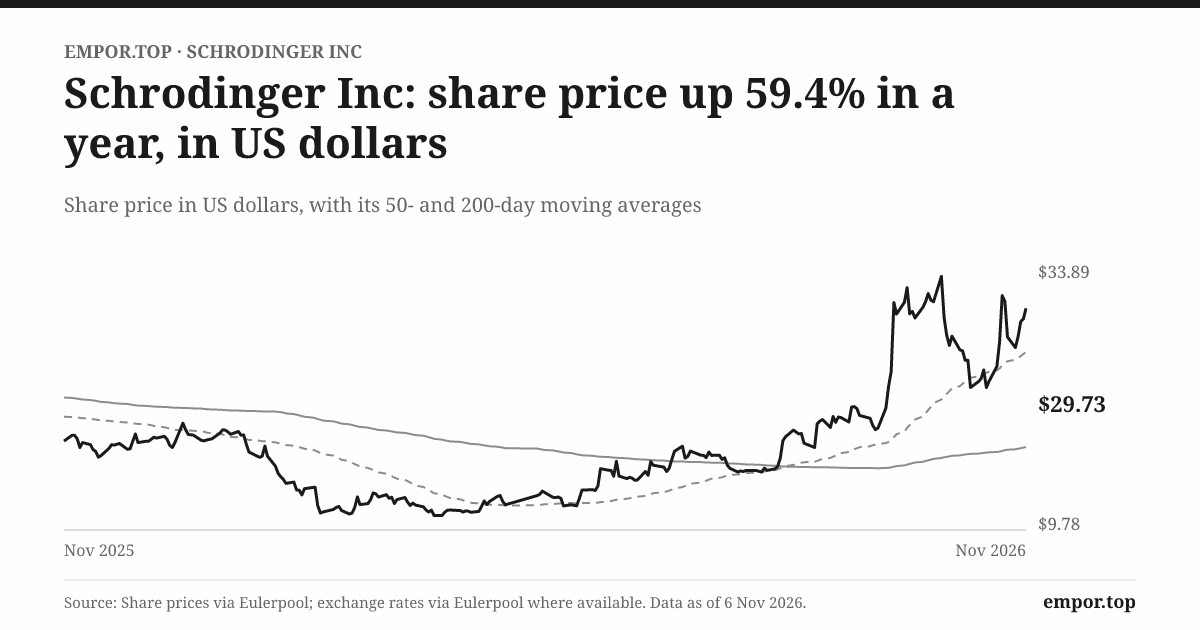
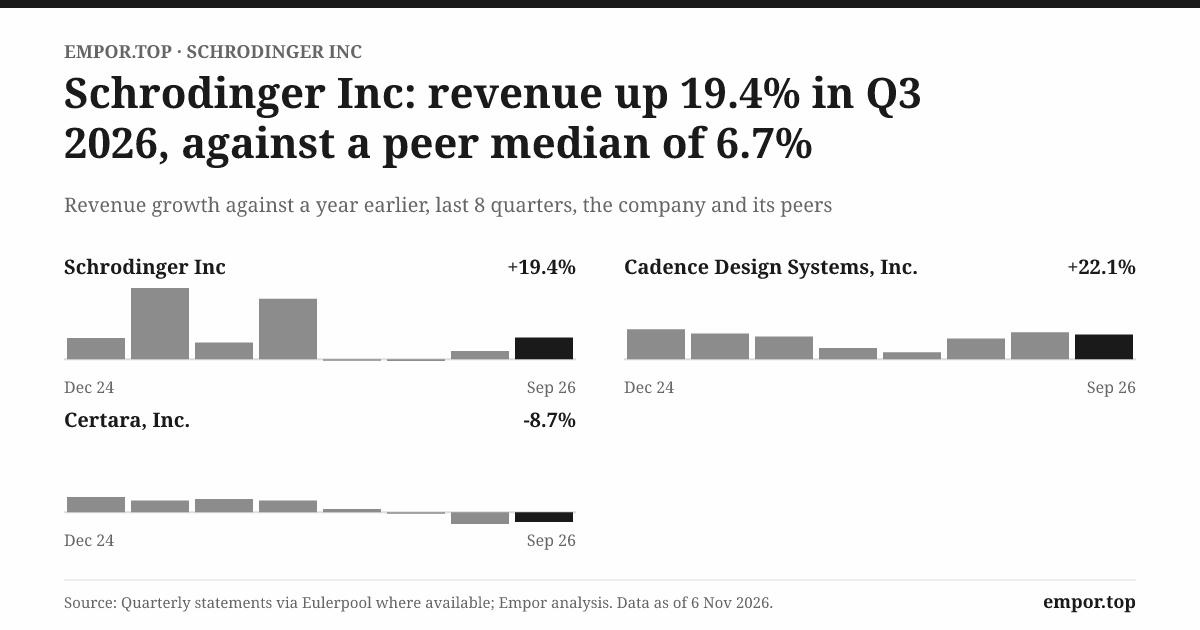
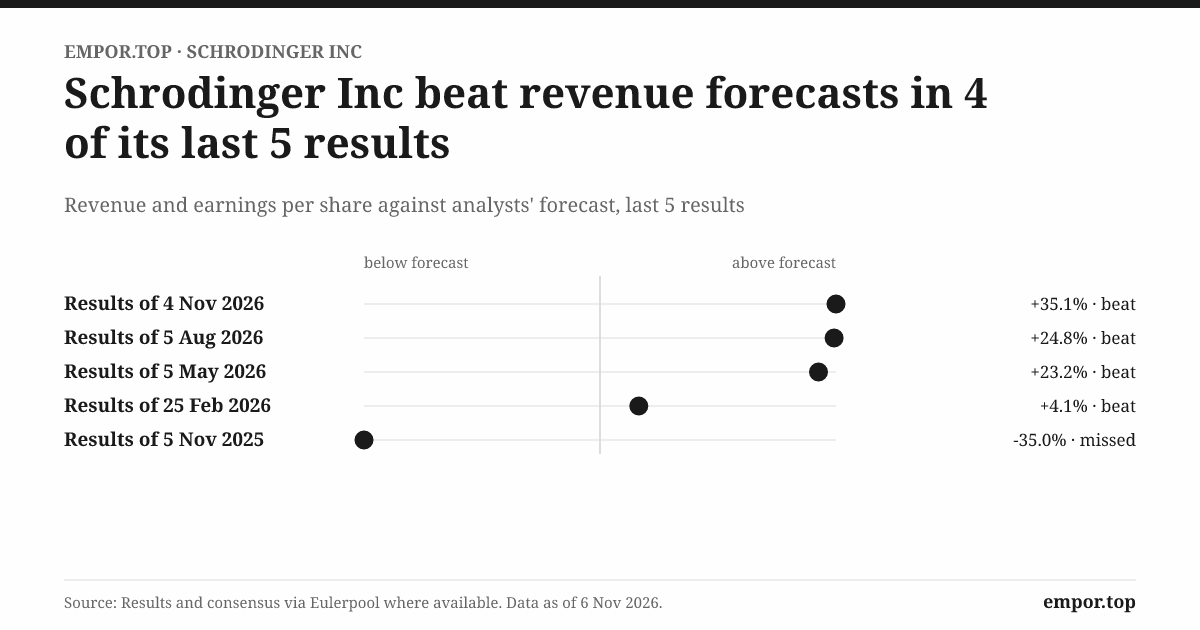
On November 4, 2026, Schrödinger reported a third quarter that looked very good from a distance. Revenue came in at about $64.5 million, up roughly 19% from a year earlier.1 The operating loss had nearly halved. The company raised its guidance for annual contract value, its preferred measure of software demand, and raised its outlook for drug discovery revenue as well.1 The stock had climbed from about $11 at its 52-week low to almost $30, within a few dollars of its high.2
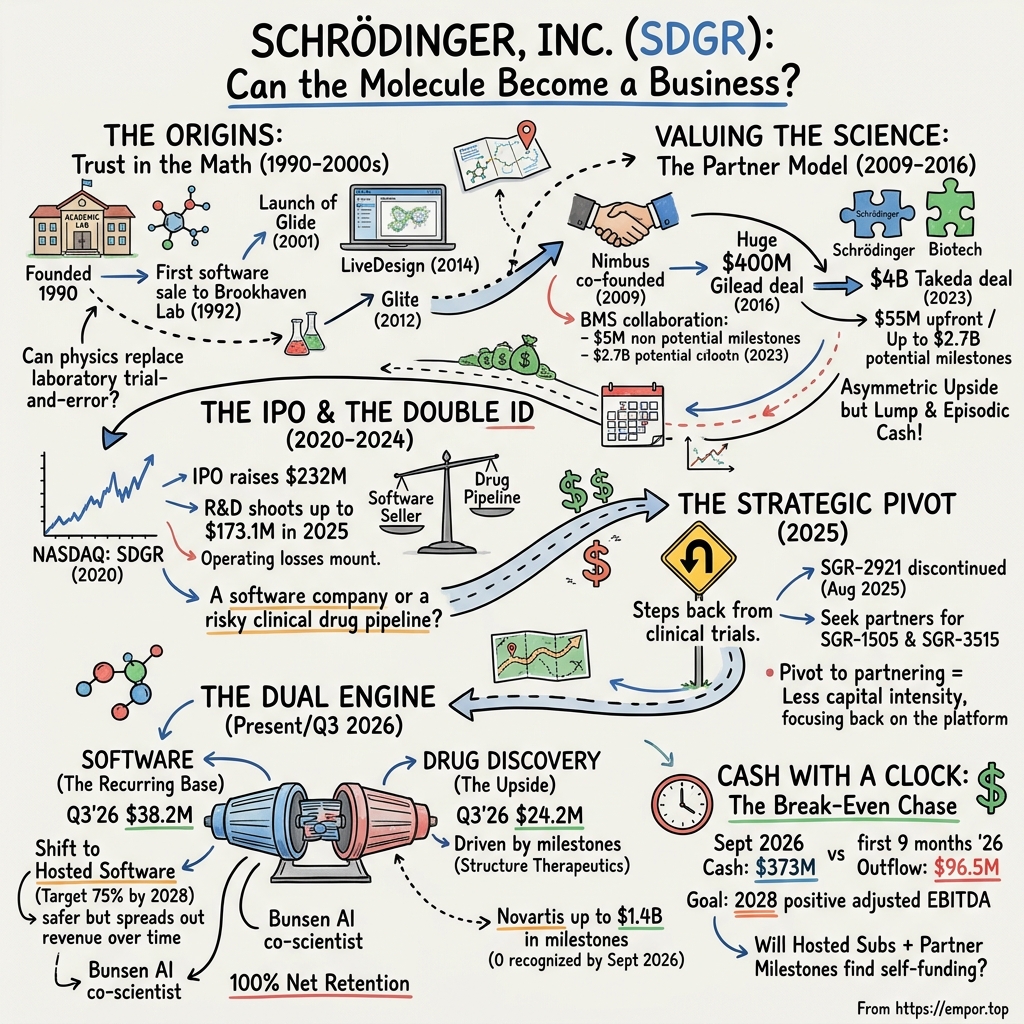
Look closer and the quarter splits in two. On one side was the software business, which sells computational chemistry tools to pharmaceutical and biotech companies: about $38.2 million of revenue, the larger and steadier engine.1 On the other was drug discovery, about $24.2 million, nearly double the $13.0 million of a year earlier.1 That jump did not come from a new product or a gradual build. It came primarily from one milestone payment tied to Structure Therapeutics, a company whose progress Schrödinger has a contractual stake in.3 A small remainder of revenue came from contribution funding, a grant-like stream that is tied mainly to philanthropic arrangements.1
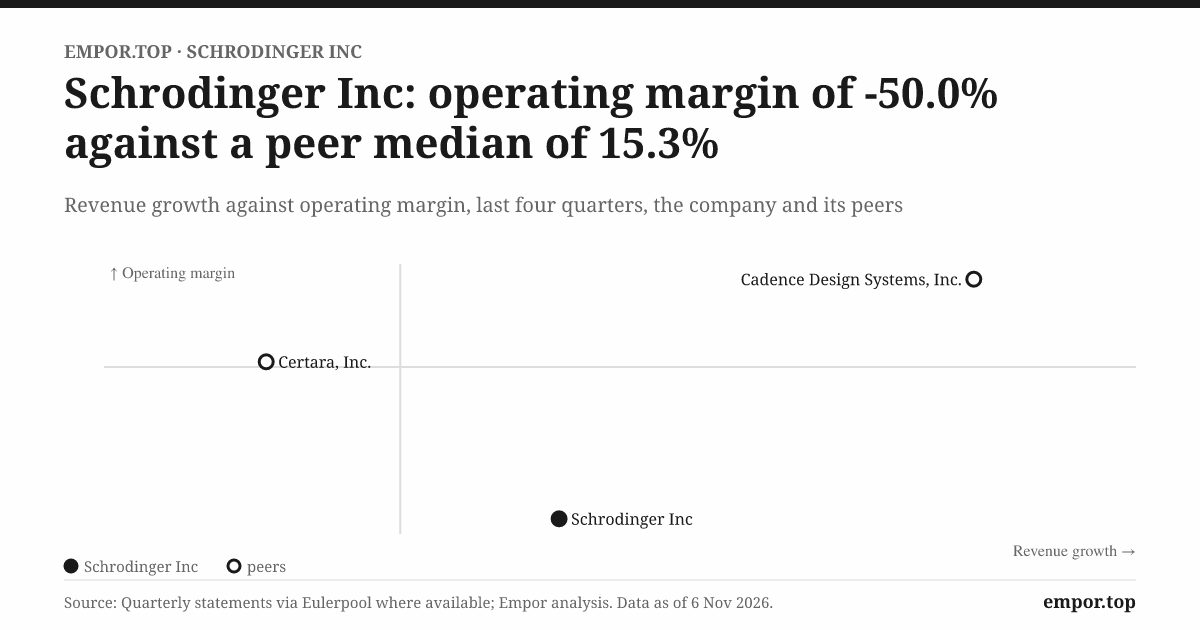
Then there is the line that never makes a headline. Across the first nine months of 2026, Schrödinger's operations used about $96.5 million of cash.3 The company still loses money on an accounting basis, and it is losing cash on a cash basis too. That is not a crisis. The company held about $373 million of cash, restricted cash and marketable securities at the end of September, and it has no funded borrowings.3 But it is a fact that sits awkwardly next to a quarter of 19% growth.
So the split-screen is the story. A software franchise is growing, with hosted subscriptions rising fast. A drug discovery arm can produce a large quarter whenever a partner crosses a threshold. And underneath both, a company that has been building since 1990 is still not paying its own way.
The stakes are easy to state and hard to resolve. Schrödinger is trying to answer three questions at once. Can computational chemistry, the business of predicting how molecules behave before anyone makes them, become a recurring subscription that customers renew and expand? Can the discoveries that its software helps produce turn into repeatable economics rather than the occasional windfall? And can the company reach its stated goal of positive adjusted EBITDA in 2028, which management set out in February 2026?4
To follow that argument, a listener needs a sense of scale. Over the twelve months to September 2026, Schrödinger booked about $267 million of revenue.3 Software is the bigger half and is built around one-year license and subscription agreements that renew. Drug discovery is smaller and episodic: research funding from collaborators, option fees, milestones, and the hope of royalties.5 One business behaves like a utility bill. The other behaves like a lottery ticket that a scientist has carefully weighted. Both run on the same platform and draw on the same pool of cash.
The investor's problem is that the reported numbers blend the two. A strong drug discovery quarter flatters total revenue. A software customer that moves from an on-premise license to a hosted subscription can make software revenue look weaker in the short run even when the customer is spending more. And investment gains on stakes in other biotechs can swing net income from a loss to a profit and back again. In the second quarter of 2026, Schrödinger reported a small net profit; in the third, a net loss of about $38 million.61 Neither figure says much about whether the business is getting healthier.
That is why the third quarter is a useful place to start rather than a place to stop. It contains, in miniature, every tension in the company's history: a platform that scientists value, a discovery engine that occasionally produces a windfall, an accounting transition that clouds the scoreboard, and a cash line that has refused for most of a decade to turn decisively positive. Each of those threads has a beginning, and each of them has to be followed to the end before anyone can say what kind of company this is.
The first clue, then, is that progress and cash generation are not the same thing at Schrödinger. The company can show scientific progress, rising demand and even rising revenue while still consuming cash. Whether the gap closes is the question that runs through everything that follows. To understand why the gap exists at all, the story has to go back to a time when the company's only job was to make chemists believe a computer.
 Subscribe on LinkedIn
II. The First Customer Was a Laboratory
In 1992, two years after its founding, a small company named after a quantum physicist made its first software sale. The buyer was not a drug company. It was Brookhaven National Laboratory, the government research site on Long Island.7 That detail tells you where Schrödinger began: in the world of physicists and theoretical chemists, people who wanted to calculate how electrons arrange themselves in a molecule, not people who needed to hit a quarterly drug pipeline target.
The founders came from that world. Richard Friesner, a chemistry professor at Columbia University, and Bill Goddard, a chemist at the California Institute of Technology, started the company in 1990 with a narrow goal: take computational chemistry developed in academic labs and turn it into software that other scientists could use.7 Friesner never left the orbit of the company. He remains a director, and he held about 3% of the shares in 2026.8 Columbia's role did not end either. Schrödinger still licenses technology from academic institutions and paid about $8.4 million in total royalties to its licensors in 2025.5
To see why this was hard, it helps to understand what the software claims to do. A drug is usually a small molecule that fits into a pocket on a protein, a bit like a key in a lock. The lock is made of thousands of atoms that jiggle and flex. The key can be one of an almost unimaginable number of possible chemical shapes. Chemists traditionally explore that space by making molecules in the lab and testing them, which is slow and expensive. Schrödinger's bet was that physics could do some of that exploration first. If you can compute how tightly a candidate binds to the pocket, you can throw away bad ideas before anyone spends weeks synthesizing them.
The catch is that physics is expensive to compute and easy to get wrong. A calculation that is right only some of the time is worse than useless, because it can send a team down a dead end with false confidence. So for its first decades, Schrödinger's real product was not any single program. It was trust. It had to persuade skeptical bench chemists that a number on a screen was reliable enough to change which experiment they ran next.
The tools accumulated slowly. In 2001, the company released Glide, a program for docking, which tests how millions of virtual molecules might sit in a protein's pocket and ranks them.7 Later came tools for refining protein structures, for running molecular simulations, and for computing binding strength with a method called free energy perturbation, which Schrödinger sells as FEP+.5 Think of docking as a rough sorting machine and FEP+ as a precision scale: one quickly narrows the field, the other tries to tell you which of two very similar molecules will actually perform better. In 2014, the company launched LiveDesign, a collaborative environment where chemists and computational scientists can share ideas, run models and record decisions in one place.7
That last product matters more than it sounds. Individual tools can be swapped. A workspace where a whole discovery team records its designs and decisions starts to become part of how the team works. Schrödinger was moving from selling calculators to selling a workbench.
There is a reason the industry was slow to embrace all this. For much of the 1990s and 2000s, computers were fast enough to run crude approximations of molecular behavior but too slow to run the rigorous versions at the scale drug discovery needs. Chemists had seen plenty of computational predictions fail, and many concluded that their own intuition, built over thousands of syntheses, was a better guide. Schrödinger's progress therefore depended on two curves meeting: its own steady improvement in the accuracy of its methods, and the falling cost of computing power, especially the graphics processors that made heavy physics calculations affordable. Neither curve was something the company could rush. A software start-up in a hotter market might have pivoted toward whatever customers wanted that year. Schrödinger kept refining the same underlying science, which is a large part of why its tools came to be respected, and also why it took so long for that respect to show up in the financial statements.
The through-line is a very long research investment. Schrödinger spent most of three decades improving the accuracy of its physics and the breadth of its workflows. Even in 2025, after cutbacks, research and development consumed about $173 million, about two-thirds of revenue.5 Of the company's roughly 850 employees in early 2026, 363 held doctorates.5 This is a company that still looks, in its staffing, like a university department with a sales force attached.
Management argues the investment is paying off in a specific way: customers increasingly trust computed results enough to act on them. On the third-quarter 2026 call, executives described customers relying on calculations in place of some physical experiments.9 That is the right kind of evidence to look for, because it describes behavior rather than features.
But scientific capability and commercial proof are different claims, and the gap between them is the heart of this story. A tool can perform well in a lab without becoming indispensable. It can be admired without being broadly adopted. It can be broadly adopted without commanding a high price, because big pharmaceutical customers are sophisticated buyers who run their own computational groups and test competing vendors. Thirty years of physics produced a technically distinctive platform. It did not, by itself, establish pricing power or durable customer economics.
There was one way to test the platform's value that went beyond software licenses: use it to discover drugs and see whether anyone would pay for what came out. That test began with a biotech start-up in Cambridge, Massachusetts.
III. Nimbus Put a Price on the Science
In 2009, Schrödinger and the venture firm Atlas Venture co-founded Nimbus Therapeutics.7 The idea was simple to describe and radical in practice. Nimbus would be a drug company that used Schrödinger's computational platform as its main discovery engine. It would go after difficult targets, proteins that conventional chemistry had struggled with, and see whether physics-based design could produce molecules worth buying.
For a software company, this was a way to put a price on the science. Software licenses tell you what customers will pay to use a tool. A drug sale tells you what a large pharmaceutical company will pay for the result.
The first answer came in 2016. Gilead Sciences agreed to buy Nimbus's program against an enzyme called acetyl-CoA carboxylase, or ACC, which was being studied for fatty liver disease. Gilead paid $400 million upfront, with more promised if the program hit milestones.10 For a company that had been founded seven years earlier on the promise of computational design, it was a striking validation.
The second answer was far bigger. In late 2022, Takeda agreed to acquire the Nimbus subsidiary holding a TYK2 inhibitor, a potential treatment for psoriasis and other immune diseases. When the deal closed in February 2023, Takeda had paid $4 billion upfront, with up to $2 billion more tied to sales milestones.11 That is the kind of number that makes people believe a computer can find a drug.
Here the popular version of the story and the record diverge, and the difference matters to any Schrödinger investor. Nimbus sold those assets, not Schrödinger. Schrödinger was a co-founder and a shareholder, and its software and scientists were part of the discovery work, but it did not receive $4 billion. Its economics came through its stake in Nimbus. In 2023, the one year in the last nine in which Schrödinger reported a net profit, that profit came from investment gains rather than from its operations, which lost about $177 million that year.5 The Nimbus sales were proof that the platform's discovery context can produce valuable molecules. They were not proof that Schrödinger itself has a predictable revenue stream from them.
Schrödinger also ran collaborations in its own name, and they illustrate the same boundary from a different angle. In 2020, the company signed a collaboration with Bristol Myers Squibb that began with a $55 million upfront payment.5 Over time, Schrödinger disclosed that the collaboration could bring up to $2.7 billion in potential milestones.5 Those two numbers sound like they belong to the same deal, and they do, but they mean very different things. The upfront is money that arrived. The milestone total is a ceiling, the sum of payments that would be owed only if many programs succeeded at every stage of development and commercialization. In an industry where most drug candidates that enter clinical testing never reach patients, a headline milestone figure is a description of the best case, not a forecast.
The collaboration model is worth understanding because it still drives the drug discovery segment. A partner pays Schrödinger to do research on a target. If the partner likes the results, it may pay an option fee to take a program forward. As the program advances through development, the partner pays milestones. If it ever becomes a medicine, Schrödinger may receive royalties on sales.5 Each layer depends on someone else's decision and on clinical results that no software can guarantee.
The appeal of the model is asymmetry. Schrödinger gets paid for its science and keeps a slice of the upside without carrying the full cost of a late-stage trial, which can run into the hundreds of millions of dollars. A single success can be worth more than years of software sales. The weakness is that large outcomes are rare and arrive on no predictable schedule. A milestone that lands in one quarter instead of the next can move reported revenue by tens of millions of dollars, as it did in the third quarter of 2026.
Weigh the evidence, and the Nimbus story narrows the bullish claim without rejecting it. It shows that computation can contribute to molecules that big companies value very highly. It does not show that Schrödinger can repeatedly convert that ability into its own cash flow, and the company's segment results since have been lumpy rather than steady. The right way to hold this history is as proof of possibility.
There is also a structural lesson buried in the Nimbus arrangement. By co-founding a separate company rather than running the programs itself, Schrödinger let outside venture investors fund most of the risk, let a dedicated management team make the development decisions, and kept a stake that could pay off without burdening its own income statement. The price of that structure was that most of the value went to others. Spin-outs and stakes are a way of owning a slice of many lottery tickets cheaply. Owning programs outright is a way of owning a much larger share of fewer tickets, at full price. The choice between those two models is not a scientific question. It is a capital allocation question, and the company's answer to it was about to change, then change back.
That raised an obvious question in the boardroom. If the molecules were this valuable, why let partners and spin-outs capture most of the value? Why not own more of the risk, and more of the reward, directly? The answer to that question was financed by the stock market.
IV. The IPO Turned a Platform Into a Pipeline
In early February 2020, weeks before the pandemic reshaped markets, Schrödinger priced its initial public offering on Nasdaq at $17 a share. It offered nearly 11.9 million shares.12 When the underwriters exercised their option to buy additional shares, gross proceeds reached about $232 million.13 The timing turned out to be extraordinary. Over the following year, investors became fascinated with computational drug discovery, and by the end of 2020 the stock traded at about 44 times sales.14
The IPO did more than fund the company. It funded a change of identity. In its prospectus, Schrödinger described itself as two things at once: a software company selling its platform to the industry, and a drug discovery company using the same platform to build its own pipeline, both in collaborations and in wholly owned programs.12 The logic was elegant. Internal programs would prove what the platform could do and attract partners. The internal chemists would also be the platform's most demanding users, feeding improvements back into the software.
The cost was just as real. Drug development is not a software business. A clinical trial must be staffed, monitored and paid for regardless of what the software division sells that quarter. Schrödinger's first wholly owned clinical trial began in 2022.5 As the pipeline grew, so did spending. Research and development rose to about $202 million in 2024, roughly 97% of that year's revenue.5 Operating losses widened every year from 2020 to 2024, reaching about $209 million in 2024.5 Cash used in operations ran at well over $100 million a year from 2022 through 2024.5
This is where the double role became a double claim on the same limited cash. Every dollar spent on a clinical trial was a dollar not spent on software sales or product engineering, and the internal pipeline had to justify itself not against an abstract standard but against the software business it was competing with for money.
In 2025, management changed course. The company said it would no longer independently advance new discovery programs into the clinic and would seek partners for its two remaining clinical programs: SGR-1505, an inhibitor of a protein called MALT1 being studied in blood cancers, and SGR-3515, an inhibitor of the WEE1 and MYT1 enzymes being studied in solid tumors.5 In August 2025, the company discontinued the clinical program for a third molecule, SGR-2921.5 A restructuring eliminated about 60 positions, roughly 7% of the workforce, and research spending fell to about $173 million for the year.5
The discontinuation of SGR-2921 deserves a moment, because it is the company's own record testing its most ambitious claim. The pitch for internal drug discovery rested on the idea that the platform produces better candidates. Better is not the same as safe and effective, and a molecule designed with excellent physics can still fail in patients for reasons the model never considered. That is not unusual in biotech. It is, however, material evidence against treating every platform-generated candidate as future value.
So was the post-IPO move into proprietary therapeutics a disciplined extension or a costly second business? The record supports a narrower verdict than either extreme. It was a reasonable experiment, funded by an unusually generous public market, that turned out to be more capital-intensive than the software business could comfortably carry. The 2025 pivot is a credit to management's willingness to change course. It also concedes something important. Schrödinger is now prioritizing discovery and partnerships, not proving that it can repeatedly build and finance a drug company. That makes the software business, which has to sell the science day after day, the center of the investment case.
V. The Science Must Sell Twice
Picture the decision as it happens inside a large pharmaceutical company. A medicinal chemistry team has a promising series of molecules against a cancer target. It must decide which dozen of several thousand possible variations to make next. It can run the critical calculations on Schrödinger's platform. It can use another vendor's tools. It can lean on the in-house computational group that the company has built over two decades, which may run a mix of commercial software, open-source code and its own machine-learning models. Or it can skip the computation and trust the chemists' intuition.
Every renewal season, Schrödinger is competing for that decision. That is why the science must sell twice: once to win the trial, and again to win the renewal.
The customer's job is concrete. Computational tools help screen enormous virtual libraries, model how a molecule interacts with its target, predict properties such as solubility or toxicity, and decide which experiments are worth running.5 A good tool saves months and reduces the number of molecules a team must make. A great tool changes which ideas get pursued at all.
How Schrödinger charges for that help shapes everything about its software economics. On-premise licenses are generally priced on the scale of use, roughly how much computing a customer intends to run, rather than on the number of scientists with a login.5 Agreements are typically one year long, with only a small number of multiyear contracts.5 That structure has a hidden advantage: when a customer's scientists start trusting the calculations and run more of them, the contract can grow without the company having to sell to new people. It also has a hidden weakness. A one-year agreement gives the customer a fresh chance every year to negotiate, to shrink usage, or to shift some of the work to a cheaper tool. Royalties from software, paid by partners who embed or resell the technology, were a minor contributor, about 3.5% of software revenue in 2025.5 The franchise lives or dies on renewals.
The competitive set is broad. Dassault Systèmes sells scientific software through its BIOVIA brand. Chemical Computing Group sells MOE, a long-established modeling environment. Cadence owns OpenEye, another computational chemistry specialist. Large pharmaceutical companies run in-house systems, academic and open-source tools cover many workflows, and a new generation of AI-native start-ups claims to design molecules with machine learning rather than physics.5 The market is fragmented and product-specific: a customer might use Schrödinger for binding-strength calculations and someone else for cheminformatics. Schrödinger does not disclose market share, and nothing in its filings establishes a clear share lead or a price premium relative to peers.5
The positive evidence is about behavior, and it has improved recently. In the third quarter of 2026, software revenue was about $38.2 million and annual contract value, the annualized value of software contracts, grew 17% from a year earlier.1 Excluding contribution ACV, the grant-like funding that can move independently of customer demand, growth was 24%.1 Hosted software revenue grew 49% year over year.1 Remaining performance obligations, the contracted revenue not yet recognized, stood at about $187 million, with 62% expected in the next twelve months.3 And management said on the third-quarter call that customers increasingly trust computed results enough to rely on them.9
The counterweight comes from the company's own retention data. In fiscal 2025, net dollar retention was 100%.4 That number deserves a plain translation. It means that the customers Schrödinger had at the start of the year spent, in aggregate, about the same at the end. Some expanded, some shrank or left, and the net was flat. For a software company with a superior product and high switching costs, investors usually look for retention well above 100%, because existing customers expanding their use is the cheapest growth there is. A company at 100% is stable, not compounding. Fiscal 2025 ACV grew only about 4%.4 The 2026 acceleration is real and promising, but it is a few quarters old.
Concentration adds another layer. In fiscal 2025, one customer accounted for about 17% of revenue.5 In the third quarter of 2026, two customers accounted for 20% and 15% of quarterly revenue, a figure that includes drug discovery partners.3 When a handful of large buyers matter that much, buyers have bargaining power, and they know it.
Apply the power test the way a skeptical buyer would. Buyer choice is broad: credible alternatives exist for most workflows, and the largest customers can build their own. Customer concentration is material. And the platform must keep proving accuracy, workflow integration and renewal value. Switching costs exist, because teams that have built years of designs and decisions inside LiveDesign do not move lightly, and because scientists trained on a tool tend to keep using it. But the evidence, a flat retention rate and modest growth until recently, is not enough to call the customer captive. The fairest verdict is that Schrödinger has a respected, technically differentiated platform with broad use, and a moat that is intact but unproven as a source of strong expansion or pricing power.
The newest product bet sits right on this fault line. In 2026, Schrödinger launched Bunsen, which it describes as an AI co-scientist, in early access.9 The idea is to put an AI assistant on top of the physics platform, helping scientists plan workflows, run calculations and interpret results. Strategically, it is the right move. The biggest long-term risk to a physics-based software vendor is that machine learning reduces the value of expensive calculations, or that AI-native competitors make the workbench feel old. Bunsen is a way to fold AI into the core product rather than be disrupted by it. But it is a product bet. The company has not disclosed paid adoption or revenue for Bunsen, and it should not be treated as a proven revenue engine.9
The science may help the platform sell. The next test is whether the move to hosted contracts and new products makes that demand more visible and more profitable, and that test runs straight through an accounting change that makes the scoreboard harder to read.
VI. Hosted Software Makes the Scoreboard Harder to Read
Imagine a pharmaceutical customer that has licensed Schrödinger's software for years on its own servers. Every year it signs a renewal, and under accounting rules much of that license's value is recognized as revenue right away, when the software is delivered.5 Now imagine the same customer moves to Schrödinger's hosted platform, where the software runs in the cloud. The customer may pay the same amount, or more. But the revenue now trickles in month by month over the contract.5
Nothing about the customer's commitment has weakened. The reported revenue in the quarter of the switch, however, can drop sharply. Multiply that across dozens of customers and you get a company whose revenue line can mislead in both directions.
A simple example shows the effect. Suppose a customer has paid $1.2 million a year for an on-premise license, and most of that value has been recognized when each year's renewal is signed. Now it moves to a hosted contract worth $1.4 million a year. ACV rises by about $200,000, a real gain in demand. But in the quarter the customer switches, reported revenue from that customer may fall, because instead of booking most of a year's value at once, the company books one month at a time. Over a full year the accounting catches up. In the meantime, the income statement tells a story of shrinkage while the contract tells a story of growth. That is the gap management asked investors to look through, and it is why ACV, rather than quarterly revenue, became the company's headline software measure.
In February 2026, management decided to lean into that transition rather than tiptoe around it. On the fourth-quarter 2025 call, it said it would accelerate the shift to hosted contracts, that the move would pressure reported 2026 revenue, and that it was targeting 75% of software revenue from hosted arrangements by the end of 2028.154 It also gave investors a rule of thumb: each percentage-point increase in hosted mix could reduce reported revenue by roughly $2 million to $3 million in a year, depending on renewal timing.15 That is unusually specific guidance, and it is the kind of explanation that lets outsiders separate the accounting effect from the underlying demand.
The progress since has been fast. In the third quarter of 2026, hosted software accounted for 45% of software revenue in the quarter, and 32% on a trailing four-quarter basis, compared with 23% a year earlier.1 By the second-quarter call in August, management had already said hosted adoption was running ahead of its expectations, and after the third quarter it raised its full-year ACV guidance to $222 million to $232 million.161
Compare the story across calls and it holds together. In February, management said hosted conversion would make revenue noisy, told investors to watch ACV instead, and set a target. By August and November, hosted mix was rising, ACV guidance was moving up, and the explanations were consistent with the February framing.15169 That consistency is worth noting. It is not proof that the strategy works, but it is a sign that management is explaining its own scoreboard rather than changing the rules midgame.
There is one number, however, that the transition has made worse, and it matters. Software gross margin was about 75% in the third quarter, down two percentage points from a year earlier.1 Hosted software costs more to deliver, because Schrödinger pays for the computing power its customers use, and physics calculations are computationally hungry. On-premise customers paid for their own servers. So the move to hosted can lift customer convenience, stickiness and visibility while compressing the margin on each dollar of sales. For a software company valued on the expectation of high margins, that trade-off is central.
Analysts pressed on exactly these points. On the third-quarter call, they asked how quickly customers were converting, how revenue recognition would evolve, and how the funding environment for biotech customers was affecting demand.9 Management answered with specific hosted-mix and ACV figures.9 Bunsen's paid economics remained undisclosed; product-level uptake and paid economics for the predictive toxicology offering, which is funded in part by the Gates Foundation, were also undisclosed.95 Those products are where the company says the next growth will come from, and their economics remain invisible from outside.
The analytical conclusion is that hosted adoption is real and the accounting effect has been explained clearly. But hosted mix is a means, not an end. ACV growth must translate into strong renewals, and software gross margin must eventually recover as the company optimizes its cloud costs and prices hosted contracts. Reported revenue can lag bookings during the transition, which is fine, so long as the lag eventually closes into real economics.
The way to watch it is to hold three readings together: hosted share, ACV growth excluding contribution, and software gross margin. Any one of them can tell a flattering story on its own. Rising hosted share with falling margins is a cost problem. Rising ACV driven by contribution funding is not customer demand. Margin recovery without ACV growth is a shrinking business getting efficient. Only all three moving in the right direction would show the transition is working.
If software is becoming more visible, drug discovery is moving the other way, toward a smaller, partner-funded role that still has the power to swing a quarter.
VII. The Pipeline Steps Back From the Clinic
There is a particular kind of quiet that follows a decision to stop. In 2025, Schrödinger's leadership looked at its internal portfolio, a set of programs that had once been the clearest expression of the IPO-era ambition, and decided that the company would no longer carry new discovery programs into human trials on its own.5 For the ongoing clinical programs, SGR-1505 and SGR-3515, the plan became to find partners.5 For a company that had spent five years telling investors its own pipeline would prove the platform, it was a public admission that the cost of proof had become too high.
What remains is a drug discovery business with a different shape. It is not a mini-biotech racing toward approvals. It is a research services and partnership business with long-dated options attached.
To see how it makes money, separate its revenue into four kinds. First, collaboration research funding: partners pay for Schrödinger's scientists to work on their targets, which looks a bit like a consulting contract. Second, contribution funding, the grant-like stream that arrives from philanthropic arrangements. Third, milestones, which are paid when a partnered program hits a development or regulatory checkpoint. Fourth, royalties, which flow only if a medicine is sold, and which were a small part of the segment in 2025, about 2.4% of drug discovery revenue.5 The first two are fairly predictable. The last two are not. They depend on partner decisions and clinical results that Schrödinger does not control.
The third quarter of 2026 shows what happens when the unpredictable kind arrives. Drug discovery revenue was about $24.2 million, up from about $13.0 million a year earlier, and the increase came primarily from a milestone tied to Structure Therapeutics.3 Management raised full-year drug discovery revenue guidance to $75 million to $85 million.1 On its face, that is a healthy year for a segment of this kind. But it is a year shaped in part by events, and the question for investors is how much of it would recur without them.
The partner list shows both promise and attrition. Schrödinger's collaboration with Novartis, amended to expand its scope, carries up to about $1.424 billion in potential milestones plus royalties.3 That is a large headline. Through September 2026, however, no Novartis milestone revenue had been recognized.3 With Eli Lilly, the record is mixed: Lilly terminated an additional target in March 2026, while another target remained active.3 Those two facts belong side by side. Big partners are willing to sign with Schrödinger, which is evidence that its discovery work is valued. They are also willing to walk away from specific programs, which is a reminder that a signed collaboration is a starting line.
On the third-quarter call, analysts probed the durability of collaboration revenue, and management pointed to the breadth of active programs with partners.9 That is a fair argument, but breadth is not the same as conversion. The historical test for this kind of optionality is the rate at which the company has turned technical milestones into revenue, and Schrödinger's own record here is lumpy: a large Nimbus-related gain in 2023, a BMS upfront in 2020, a Structure milestone in 2026, and, in between, years in which the segment grew slowly or fell.5
The 2025 pivot deserves credit for what it is. It was a sensible reduction in capital intensity, and it aligned the drug business with what Schrödinger is best at: using the platform to make discovery faster and handing the expensive late stages to companies with the balance sheets to carry them. The discontinuation of SGR-2921 before the pivot is also a warning against extrapolating a technical success into a commercial one.5
The strongest proof the drug strategy works would be a material development or commercial milestone from a large partnership, or research funding that grows steadily without being dominated by one-off events. Until one of those arrives, drug discovery is best understood as meaningful optionality with episodic economics. And episodic economics are hard to plan a balance sheet around, which brings the story to the cash.
VIII. A Cash Cushion With a Clock
In fiscal 2025, Schrödinger did something it had not done in years: its operations generated cash. The figure was about $13.9 million, positive after three consecutive years of more than $100 million a year of outflows.5 For a company chasing a 2028 profitability goal, that sounded like an inflection.
Nine months later, the inflection had disappeared. In the first nine months of 2026, operations used about $96.5 million.3 So which year was the real one?
The answer is that neither year, on its own, is a good guide, and the reason sits in the mechanics of how losses and cash relate. Over the nine fiscal years from 2017 through 2025, Schrödinger reported cumulative net losses of about $592 million and cumulative operating cash outflow of about $517 million.5 Cash burn was somewhat smaller than accounting losses, which is typical for a company that pays a large share of its people in stock. That gap is not a free lunch. Stock compensation, about $43 million in 2025, does not use cash, but it dilutes shareholders, and it is a real cost of running the business.5
The positive 2025 cash flow had a specific explanation. The company's operating cash flow that year included about $118 million of favorable working-capital changes, the timing of when customers paid and when deferred revenue was collected, on top of that stock compensation add-back.5 In other words, the business did not suddenly become self-funding. A lot of cash arrived early, and some of it was spent in 2026. The nine-month 2026 cash flow statement shows the reverse effect: deferred revenue consumed about $43.5 million of cash, even as falling receivables released about $34.7 million.3 Working capital lent the company money in 2025 and asked for some of it back in 2026.
Investment marks add another layer of noise. Schrödinger holds equity stakes in several biotechs that grew out of its platform or partnerships. Their market prices move, and Schrödinger records those changes in net income. In the first nine months of 2026, a $17.6 million noncash fair-value gain was included in a nine-month net loss of about $92 million.3 A 2026 event connected to Ajax Therapeutics, another holding, also affected reported earnings.3 Earlier, Schrödinger's stake in Morphic produced large mark-to-market gains in 2024 before the position was exited, and its Structure stake has swung up and down.5 These gains are real money when they are realized, but they are not operating returns, as the second quarter of 2026 showed.6
The balance sheet is the cushion. As noted, at September 30, 2026, cash, restricted cash and marketable securities totaled about $373 million, and Schrödinger had no funded debt.3 Its only significant fixed obligations are leases, mostly for its offices, with a present value of about $104.6 million and payments extending through 2037.3 Some data services classify those leases as borrowings, which is why a simple debt-to-equity ratio shows a figure near 0.3; the economic reality is a tenant with long leases, not a borrower with a maturity wall.5 There is no disclosed covenant or refinancing pressure.3
The cushion has a clock, though. At the 2026 nine-month burn rate, the company would use about a third of the cushion each year. Management's plan depends on that burn narrowing quickly as software ACV grows and expenses fall. Expenses are falling: operating expenses fell 13% in the third quarter and research spending fell 20%.3 Whether that is enough is the open question.
A rough piece of arithmetic shows why the clock matters. If the company simply repeated its first nine months of 2026 forever, the cushion of about $373 million would cover roughly three more years of cash use. That is not the plan, and it is not the likeliest path, because the fourth quarter has historically been the company's strongest for collections and expenses are falling. But it frames the margin of error. The company has enough room to execute the hosted transition and reach its 2028 target if burn narrows steadily. It does not have enough room to absorb another multiyear period of internal clinical spending, which is part of why the 2025 pivot was not just strategically sensible but financially necessary.
Two smaller checks are worth a moment. Receivables had looked alarming in fiscal 2024, when receivables measured in days of revenue spiked to about 450 before falling to about 149 a year later.5 The more useful view is the composition. At September 2026, net trade receivables were about $48.4 million, with another $22.5 million of unbilled receivables and $22.2 million of contract assets, much of it tied to milestones and collaboration work.3 Two customers accounted for 31% and 24% of receivables at quarter end.3 The company does not publish an aging schedule, so concentration rather than the days figure is the risk to watch.
Related parties are the second check. Related-party revenue was about $17.3 million in 2025, roughly 6.8% of revenue, including arrangements with the Gates Foundation and Gates Ventures.5 In the first nine months of 2026, related-party revenue was about $6.8 million, most of it contribution revenue.3 The Gates Foundation Trust is also one of Schrödinger's largest shareholders.8 Nothing in the filings suggests these arrangements are improper, and the audit committee reviews them.8 But they are material enough that an investor tracking customer demand should separate them, which is exactly why ACV excluding contribution is the cleaner measure.
Finally, the capital record. Schrödinger is not a roll-up story. Its money has gone mainly to research, internal drug programs and selected biotech stakes, not to acquisitions. It raised about $8.9 million under its at-the-market equity program in 2024, raised nothing under it in 2025, and had about $241 million of capacity remaining at year end.5 That capacity, combined with continuing stock compensation, leaves dilution as a live consideration. The balance sheet provides meaningful runway. The test is whether management uses that runway to reach self-funding, rather than to buy another few years of the same burn.
IX. The People Who Have to Make the Numbers Converge
Ramy Farid has run Schrödinger since 2008.8 That is a long time for any chief executive, and an unusually long time in a sector where companies tend to cycle through leaders every time strategy changes. Farid is a scientist by training, and his tenure spans the company's whole public transformation: the Nimbus years, the IPO, the pipeline build-out, and the 2025 retreat from independent clinical development. He presents the 2028 plan built around ACV growth, hosted conversion and positive adjusted EBITDA as the next chapter of a story he has been narrating for nearly two decades.4
Continuity cuts both ways. A CEO who has been in charge through both the expansion and the pullback understands the platform deeply and carries institutional credibility with scientists and partners. He is also the person who approved the strategy he later reversed. Investors should judge that reversal on its merits: changing course after evidence accumulates is a strength, but it comes after years of heavy spending.
Farid's incentives are meaningful. He held about 3.4% of Schrödinger's shares as of April 2026, a stake worth roughly $75 million at the November market value.82 That is real exposure to shareholder outcomes, though not controlling. His reported total compensation was about $4.1 million in 2025, compared with about $8.5 million in 2021 and between $3 million and $4.5 million in the years in between.8 Most of that is equity awards rather than cash, so the reported total is not what he took home in salary. Set against the company's record of losses in four of those five years, the pay is not outlandish for a Nasdaq company of this size, but it is not tied to a history of profits either.
The people around Farid matter as much as he does, because the 2028 plan is an operating plan rather than a scientific one. The software business is run by a chief operating officer for software, Kenneth Lorton, and sold by a commercial organization led by Mannix Aklian.8 The platform's science is overseen by chief scientific officer Robert Abel, and the therapeutics group by Karen Akinsanya.8 That division of labor mirrors the company's two businesses, and it creates the same tension in miniature: each leader has a legitimate claim on resources, and the plan only works if the claims on the drug side keep shrinking while the software side keeps growing.
The finance seat has changed recently. Geoffrey Porges, who had been chief financial officer, left in June 2025, and Richie Jain became CFO in May 2025.8 A new CFO arriving as the company pivots toward profitability matters, because the person who explains the hosted transition to investors is also the person who must deliver the cost discipline behind the 2028 goal.
The board is majority independent and is led by an independent chair, Michael Lynton.8 Shareholders, mostly institutions, have been broadly supportive but not uncritical. At the June 2026 annual meeting, say-on-pay passed easily, with about 51.3 million votes for and fewer than 1 million against.17 The vote to add 3 million shares to the equity plan was different: about 41.4 million votes for and 10.8 million against.17 Director elections drew opposition of roughly 9.4 million to 10.7 million votes.17 Read together, those votes say that shareholders accept how executives are paid but are uneasy about how many new shares are being created to pay everyone.
The more important test is behavior. In February 2026, management chose to frame guidance around ACV rather than revenue, saying hosted migration would make reported revenue volatile.15 That could have been an evasion: a company switching to a friendlier metric just as its headline number weakens. What makes it more credible is what followed. Management gave a specific rule of thumb for the revenue effect, set a measurable hosted target, and then raised ACV guidance after the third quarter, along with drug discovery guidance.151 On the calls, executives gave detailed conversion and recognition mechanics when analysts asked.916
The unresolved part is the hardest. Management has to sustain software growth, recover software gross margin and control cash burn at the same time. Those goals pull against each other. Growth needs sales and product investment; margin recovery needs cloud cost discipline; burn reduction needs headcount restraint. The plan is credible enough to monitor, not yet proven. The dilution dissent and the history of losses keep the burden of proof on execution, and the market has recently started to price that execution generously.
X. Analysis & Bear vs. Bull Case
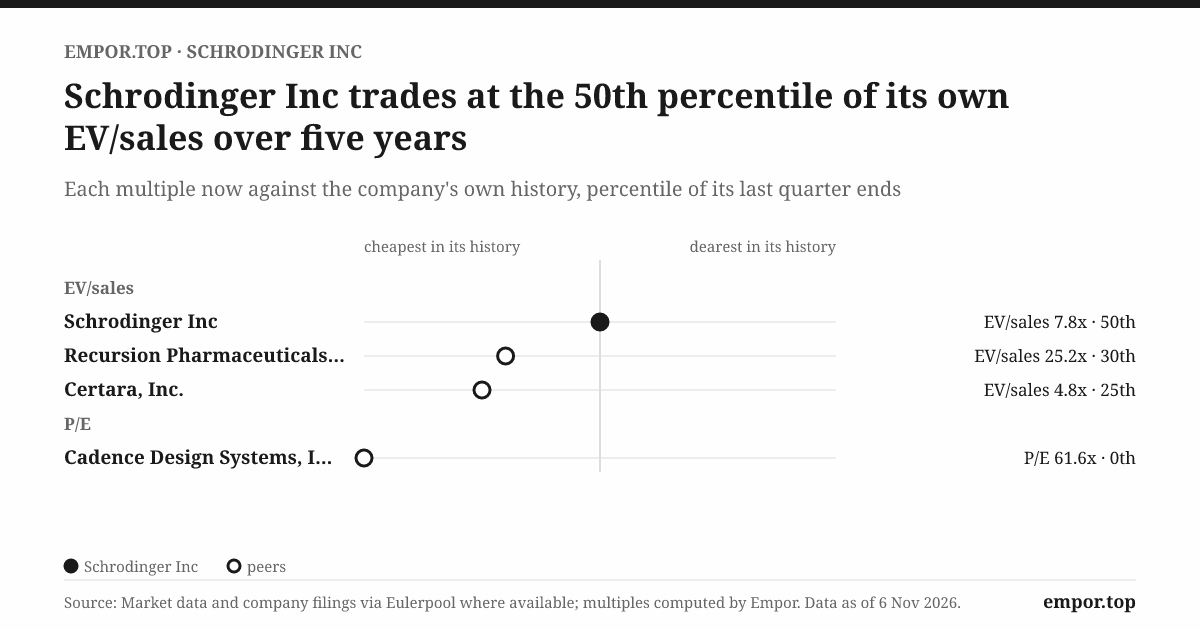
On November 6, 2026, Schrödinger's shares closed at about $29.73, giving the company a market value of about $2.2 billion and an enterprise value, after subtracting net cash, of about $1.9 billion.2 That works out to roughly 7.8 times trailing sales on an enterprise basis and about 8.2 times on a price basis.2 The stock was within 9% of its 52-week high and almost three times its 52-week low, after a five-year stretch in which it had at one point fallen about 80% from its peak.2
The history of that multiple is the best place to start. At the end of 2020, in the first flush after the IPO, Schrödinger traded at about 44 times sales.14 The multiple then fell almost every year, to about 5 times at the end of 2025.14 The market has spent five years marking down its view of what computational drug discovery is worth as a business. The rebound to nearly 8 times in late 2026 is a partial reversal, driven by the ACV acceleration and the pivot away from clinical spending. For a rough peer reference, Certara, which sells biosimulation software and services to drug developers, traded at about 3.7 times sales in October 2026.18 Certara's mix of products and services is different, so the comparison is context rather than a verdict. But it does suggest that the market is paying Schrödinger a substantial premium for something: either faster software growth, or the drug discovery optionality, or both.
What does that price appear to assume? It assumes that the recent software acceleration is durable, that hosted conversion eventually lifts margins rather than compressing them, that drug discovery continues to produce occasional large payments, and that losses narrow to the 2028 target without heavy dilution. None of those is impossible. All of them have to happen together.
Why it could win, and why it might not
The bull case starts with a genuine technical asset. Physics-based modeling, refined over three decades, is hard to replicate, and FEP+ in particular has become a widely used method for predicting binding strength.5 Accumulated workflows, from docking through LiveDesign, embed the platform in how discovery teams work. Hosted adoption is growing quickly, which should make usage more visible and harder to unwind. And there is a possible feedback loop between software customers and drug programs: Schrödinger's own discovery work and its partnerships show what the software can do, and that may help the software sell.
The bear case starts with the company's own numbers. Net dollar retention of 100% in fiscal 2025 is not the signature of a product with strong pricing power.4 Customer concentration is high. Competing vendors and in-house tools offer alternatives for most workflows. AI-native competitors argue that machine learning can find molecules faster and more cheaply than physics, and big pharma is investing heavily in its own AI groups. And Schrödinger does not disclose any market-share series that would let an investor see whether it is winning or losing ground.
Run the industry through Michael Porter's five forces and the picture sharpens. Buyer power is real: the customers are a concentrated set of large pharmaceutical companies with sophisticated procurement and in-house alternatives. Supplier power is modest, though cloud computing costs now bite harder as hosted grows and gross margin has slipped. The threat of substitutes is the most serious force, because the substitute might not be another vendor's software; it might be an internal machine-learning model or simply a cheaper, good-enough approach. Rivalry among existing vendors is meaningful but not brutal, since the market is fragmented by workflow. Barriers to entry for a credible physics-based platform are high, but barriers for an AI start-up with venture funding are lower.
Hamilton Helmer's 7 Powers framework asks which durable advantage, if any, the company holds. Switching costs are the most plausible: teams that have built years of designs inside LiveDesign do not move lightly. But switching costs should show up in retention and expansion, and a 100% retention rate says they protect the base without driving growth. Process power, the accumulated know-how of an organization that has refined these calculations for decades, is plausible and hard to copy, and the trust customers place in its results, which management highlighted on the third-quarter call, would be its expression.9 Neither power is yet demonstrated by pricing or by retention superior to peers. Counter-positioning cuts the other way: an AI-native entrant could build a cheaper product that Schrödinger cannot easily match without cannibalizing its own pricing, which is exactly why Bunsen exists.
The verdict on the moat is that it is intact but unproven. History does not reject it; the platform has kept its customers through decades of competition. But history narrows it. The moat appears to protect existing revenue rather than to generate the expansion that a software premium implies. The KPI that would confirm a stronger moat is net dollar retention rising meaningfully above 100% during the hosted transition; a retention rate stuck at 100% while ACV growth relies on new logos and contribution funding would falsify it.
What the optionality is really worth
Drug optionality needs a probability-weighted lens. The Nimbus sales and the BMS and Novartis deal ceilings show the potential value of a successful molecule. The company's own discontinued program, the Lilly termination and milestone-driven quarterly revenue argue against treating those headline values as anything close to expected value. An investor who mentally adds the Novartis milestone ceiling to Schrödinger's valuation is counting a best case that the company itself has not yet begun to recognize.
The capital allocation record supports caution about investment marks. No large acquisition sits on Schrödinger's record, so there is no purchase price to benchmark. The capital went into research, internal pipelines and biotech stakes. The Morphic gains of 2024 were real but have run their course, and that stake now carries no value on the balance sheet; the Structure stake has swung both ways.5 These are volatile, sometimes very profitable side-bets, not operating returns.
An activist reading the filings would push on three things. First, the two-business structure: does a software company need to own a drug discovery operation, or would separating them clarify both? Second, dilution: why does a company with $373 million of cash need to keep adding equity-plan capacity? Third, margin: why is software gross margin falling as the company moves to hosted, and what is the plan to reverse it? Management has partial answers to each. The partnering pivot reduces the drug business's capital needs; the equity plan is how it pays scientists; hosted margins should recover as contracts mature. Partial answers are not the same as proof.
The AI question deserves its own moment, because it is the risk that could change the shape of the market rather than just the share of it. Physics-based methods are accurate but expensive: a single rigorous binding calculation can consume substantial computing time. Machine-learning models trained on large amounts of experimental and simulated data can make rough predictions in a fraction of that time. If those models become good enough for most decisions, the value of the expensive calculation shrinks to the handful of cases where precision really matters. Schrödinger's counterargument is that physics generates the high-quality data that AI models need, and that combining the two, as Bunsen is meant to do, makes its platform more valuable rather than less.9 That argument is plausible, and the recent ACV acceleration does not suggest customers are abandoning physics. But it is an argument about the future, and the company does not disclose any data showing AI products contributing meaningfully to revenue. Investors should treat AI as both the biggest threat and the biggest product opportunity in the case, with neither yet settled.
Three KPIs capture the case. The first is ACV growth excluding contribution, which was 24% in the third quarter of 2026, up sharply from the low single digits for fiscal 2025.14 The second is hosted share alongside software gross margin: hosted reached 45% of quarterly software revenue while margin slipped two points to about 75%.1 The third is operating cash flow adjusted for working-capital timing, which was negative about $96.5 million for the first nine months of 2026.3 The first is improving. The second is moving in the direction management wants on mix but the wrong direction on margin. The third has not yet turned.
The valuation should be judged against Schrödinger's own long decline in sales multiples as well as against the imperfect Certara comparison. At roughly 8 times sales, the market is no longer paying 2020's euphoric price, but it has moved well off the 2025 trough. That leaves limited room for execution to disappoint.
XI. Business & Investing Lessons
Go back to Brookhaven in 1992, to a small group of scientists selling a program to a national laboratory. Then jump forward to 2025, to a board deciding it would stop pushing its own discovery programs into the clinic.75 More than three decades separate the two moments. In between, Schrödinger built one of the most technically respected platforms in its field, helped seed molecules that sold for billions, went public at a dizzying valuation and then watched that valuation shrink for five years. The lessons that belong to this company come from the distance between those two scenes.
The first lesson: a good calculation earns a trial; a good renewal earns a business. Brookhaven bought Schrödinger's software because the physics was interesting. Pharmaceutical companies renew it only if the physics changes what they do and saves them more than it costs. Thirty years in, Schrödinger's own retention data show customers staying but not, on average, spending more each year. For founders of deep-tech companies, the lesson is that technical excellence opens the door, but the economic proof arrives later, in the renewal file, and it should be measured there.
The second lesson: a milestone is proof of possibility, not a forecast. Takeda's $4 billion payment for Nimbus's TYK2 program was a spectacular validation of computational drug discovery. It was also a payment to Nimbus. The BMS collaboration's $2.7 billion ceiling and the Novartis collaboration's $1.4 billion ceiling are numbers that describe what might happen if almost everything goes right. And the third quarter of 2026, a milestone-shaped quarter, showed how much a single payment can move a reported line. Investors in platform biotech should treat milestone totals as option values that decay with every failed trial, not as revenue that has merely been delayed.
The third lesson: a pivot is only discipline if the cash curve changes. The 2025 decision to stop independently advancing programs into the clinic was the right kind of decision. It reduced capital intensity and focused the company on what its platform does best. But nine months into 2026, operating cash outflow was still running near $100 million. A strategy shift that changes the narrative without changing the cash flow is just a new story. The credit management earns for the pivot will be settled by whether burn falls as promised.
The fourth lesson is about accounting itself: when a company changes how it sells, it changes how it reports, and the honest response is to give investors the conversion factor. Schrödinger's management did that with its rule of thumb on hosted mix. Investors should watch for companies that change metrics without supplying the bridge.
The wider discipline for investors is simple to say and hard to practice. Track recurring adoption and margin recovery beside the scientific breakthroughs, not after them. The breakthroughs are more exciting. The renewals pay the rent.
XII. Epilogue
Tonight, Schrödinger stands at the start of the final quarter of 2026 with a story more coherent than at any point since its IPO. It has raised ACV guidance to $222 million to $232 million and drug discovery revenue guidance to $75 million to $85 million.1 It has a stated objective of positive adjusted EBITDA in 2028 and a goal of reaching 75% hosted software by the end of that year.4 It has about $373 million in cash and securities and no funded debt.3 And it has a stock price that already reflects much of this improvement.
The next moments that will decide the story are on the calendar. The first is the fourth-quarter 2026 results and the 2027 guidance that comes with them, which, if the company follows its usual calendar, will arrive in late February 2027. Fourth quarters have historically been Schrödinger's largest, because many on-premise renewals fall at year end.5 As more of those customers move to hosted, the shape of the fourth quarter will reveal how well the ACV guidance converts into contracted business, and whether the 2027 outlook keeps the momentum without leaning on contribution funding.
The second is the hosted conversion itself. If hosted share climbs toward the 2028 target while software gross margin stabilizes and then recovers, the transition will have done what management promised: made software revenue more predictable without sacrificing its economics. If margin keeps slipping as hosted grows, investors will be holding a business with more visibility and less profit per dollar, and a premium multiple would be harder to defend.
The third is partner-funded progress in SGR-1505 and SGR-3515. The company has said it will seek partners for both. A deal on attractive terms would validate the platform's output and reduce capital needs. Failure to find a partner, or a partner deal that values the programs modestly, would say something more uncomfortable about what the market thinks platform-designed clinical assets are worth.
The fourth is drug discovery revenue that does not depend on a single milestone. The Novartis collaboration is the most visible test. A first recognized Novartis milestone would be the kind of evidence the bull case needs. A string of quarters in which drug revenue drifts back toward its pre-milestone run rate would argue that the third quarter of 2026 was a peak, not a trend.
Imagine the two endings. In the first, the next annual report shows ACV inside or above the raised range, management guides to another year of strong growth excluding contribution funding, gross margin stops falling, and a partner signs on for one of the clinical programs. In that version, the hosted transition starts to look like the classic software story, a temporary accounting dip followed by more durable, more visible revenue, and the 2028 target becomes a destination rather than a hope. In the second, ACV lands at the low end, retention stays flat, margin keeps sliding as compute costs rise, and drug revenue falls back without a milestone to prop it up. In that version, investors are left with a respected scientific platform that grows modestly, burns cash and trades at a premium multiple that its operating economics do not yet support. Most likely, reality will land somewhere between those endings, which is exactly why the individual indicators matter more than the headline.
And beneath all of it is the cash test. The company needs to show burn narrowing after working-capital timing and investment gains are stripped out. A 2028 EBITDA target is meaningful only if each operating indicator moves in the right direction together: ACV excluding contribution growing, retention moving above 100%, hosted mix rising with margin recovering, and cash use falling.
The tension is that each of these indicators can improve while another worsens, and the company's history is full of years in which progress on one front coincided with setbacks on another. The next two years will decide whether Schrödinger finally makes them converge.
XIII. Outro
In 1992, a few scientists at a young company sold software to a laboratory on Long Island.
More than three decades later, that promise is still being tested. Schrödinger's fate turns on whether computation becomes a renewable subscription, a valuable drug, or, at last, both at once.
References
-
Schrödinger Reports Third Quarter 2026 Financial Results — Schrödinger, Inc., 2026-11-04 ↩↩↩↩↩↩↩↩↩↩↩↩↩↩↩↩↩
-
Quarterly Report on Form 10-Q for the Quarter Ended September 30, 2026 — Schrödinger, Inc., 2026-11-04 ↩↩↩↩↩↩↩↩↩↩↩↩↩↩↩↩↩↩↩↩↩↩↩
-
Q4 and FY2025 Results Call Deck — Schrödinger, Inc., 2026-02-25 ↩↩↩↩↩↩↩↩
-
Annual Report on Form 10-K for 2025 — Schrödinger, Inc., 2026-02-25 ↩↩↩↩↩↩↩↩↩↩↩↩↩↩↩↩↩↩↩↩↩↩↩↩↩↩↩↩↩↩↩↩↩↩↩↩↩↩↩↩↩↩↩↩
-
Schrödinger Reports Second Quarter 2026 Financial Results — Schrödinger, Inc., 2026-08-05 ↩↩
-
Defining Moments in Schrödinger's History — Schrödinger, Inc. ↩↩↩↩↩↩
-
2026 Proxy Statement — Schrödinger, Inc., 2026-04-28 ↩↩↩↩↩↩↩↩↩↩
-
Schrödinger (SDGR) Q3 2026 Earnings Call Transcript — The Motley Fool, 2026-11-05 ↩↩↩↩↩↩↩↩↩↩↩↩
-
Nimbus Therapeutics Announces Closing of Gilead Sciences' Acquisition of Nimbus Apollo and Its ACC Inhibitor Program — Nimbus Therapeutics, 2016-05-17 ↩
-
Takeda Completes Acquisition of Nimbus Therapeutics' TYK2 Program Subsidiary — Takeda, 2023-02-08 ↩
-
Initial Public Offering Prospectus — Schrödinger, Inc., 2020-02-05 ↩↩
-
Schrödinger Announces Closing of Initial Public Offering — Schrödinger, Inc., 2020-02-10 ↩
-
SDGR Stock Valuation and Historical Multiples — Fundamentalytics ↩↩↩
-
Schrödinger Q4 2025 Earnings Call Transcript — Stock Analysis, 2026-02-25 ↩↩↩↩↩
-
Schrödinger Q2 2026 Earnings Call Transcript — Stock Analysis, 2026-08-05 ↩↩↩
-
2026 Annual Meeting Results, Form 8-K — Schrödinger, Inc., 2026-06-23 ↩↩↩
 LinkedIn
 WhatsApp
 Reddit
 Hacker News
 Email
 Kindle
 RSS Feed
 Spotify
 Apple Podcasts
 Amazon Music
 Audible
 YouTube