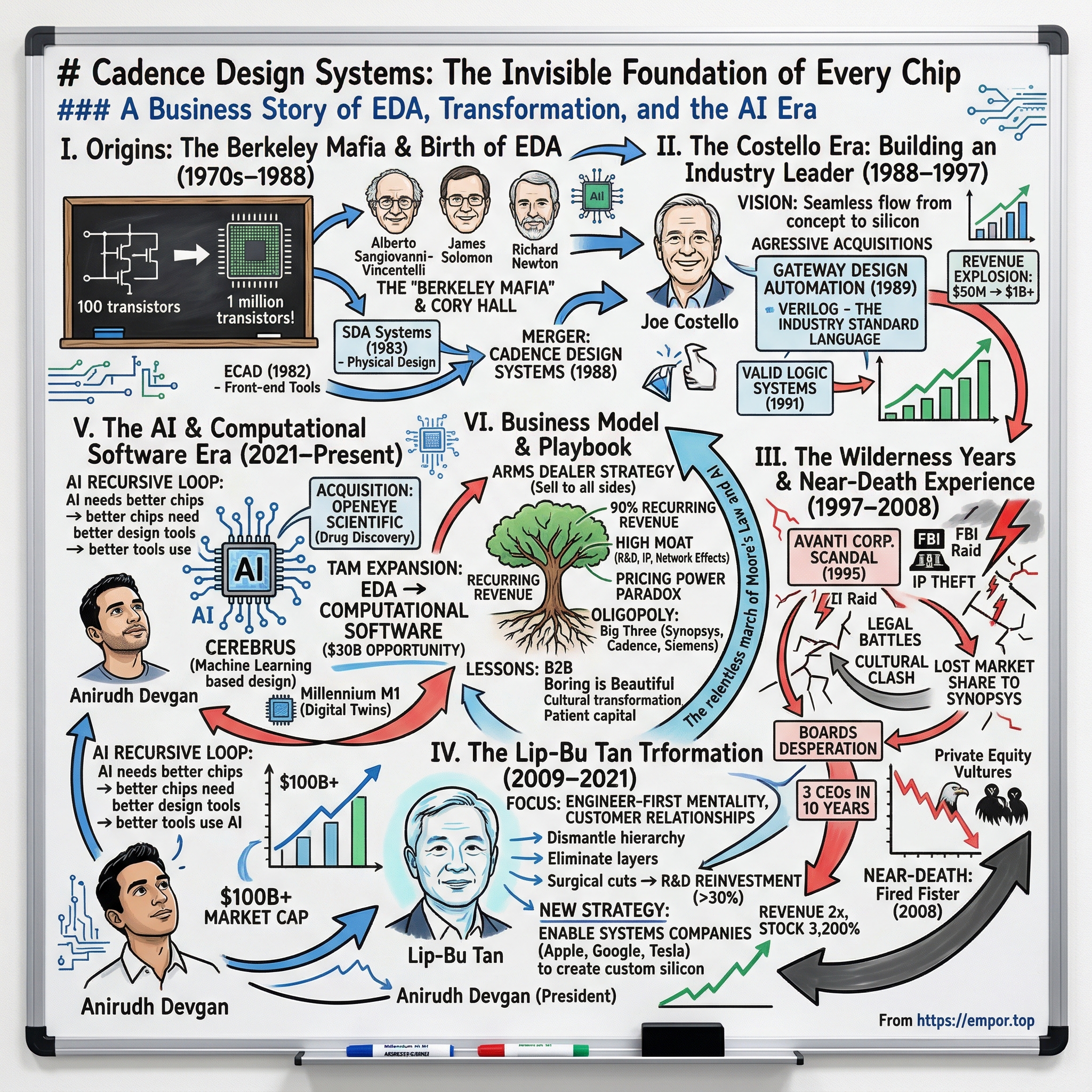
Cadence Design Systems: The Invisible Foundation of Every Chip
I. Introduction & Episode Roadmap
There is a building in San Jose, on Seely Avenue, that almost no consumer has ever heard of. No product sold there carries a brand recognized on a store shelf. Yet if the software developed inside it stopped working tomorrow, the global supply of new semiconductors would grind to a halt — not gradually or partially, but almost immediately.
That building is the headquarters of Cadence Design Systems, and its leverage stems from pure arithmetic. A modern flagship processor packs roughly one hundred billion transistors onto a piece of silicon smaller than a postage stamp. No human being places those transistors. What places them, routes their wiring, verifies them against the laws of physics, simulates their heat and electromagnetic interference, and generates the file a fabrication plant uses to etch them is software — a category known as Electronic Design Automation, or EDA. Cadence is one of only three companies in the world that provides a complete EDA software stack.
While its impact is massive, Cadence's scale is modest by enterprise software standards. The company generated $5.30 billion in revenue in fiscal 2025, up just over 14% from $4.64 billion the prior year, operating on a GAAP margin of 28.2% and a non-GAAP margin of 44.6%.1 That revenue is a fraction of the roughly $700 billion semiconductor industry its tools help design each year. Cadence converts that top line into cash efficiently, generating $1.73 billion in operating cash flow in 2025 against capital expenditures of $142 million — less than 3% of sales.1 Entering September 2026, the stock traded in the low $300s for a market capitalization near $86 billion, down roughly 25% from its peak near $417 per share in June.4 It remains one of the most consistently valued — and debated — software businesses in tech.
Cadence does not simply sell software; it sells arms in a technology war without taking sides. When Nvidia and a hyperscaler's internal silicon team race to build a superior AI accelerator, both rely on the same core suite of design tools. When Apple, AMD, and Qualcomm compete over mobile and PC processors, all three pay Cadence. As Google refines its tensor processors, Amazon develops its Trainium and Graviton chips, Microsoft builds its Maia accelerators, and Meta advances its MTIA silicon, every program requires a certified design flow. Because only three vendors can supply one, Cadence does not need to pick winners. It only needs the competition to persist.
That neutrality is the company's strongest structural feature, but it has distinct boundaries. Being indifferent to which customer wins does not insulate Cadence from shifts in underlying chip architectures, geopolitical export restrictions, or product line decline.
The central question for investors is historical and forward-looking: how did a business formed in 1988 through the merger of two struggling startups — a company later embroiled in trade secret theft, mismanaged into accounting turmoil, and written off by much of Silicon Valley — become an indispensable tollbooth for advanced chip design? And is that market position truly durable, or merely the current state of an industry that has changed leadership before?
The industry has indeed changed hands before, a reality often omitted from bullish thesis presentations. Cadence's competitive moat has failed spectacularly in the past. Between 1997 and 2008, the company lost its lead in digital design to Synopsys, saw stolen source code turned into a competitor's product line, suffered a 47% revenue collapse due to revenue-recognition missteps, and posted a net loss of $1.85 billion in 2008 alone.2 Any argument that high switching costs render EDA invulnerable must account for that lost decade.
The business's trajectory spans five distinct acts: its academic roots at UC Berkeley and the 1988 merger of SDA Systems and ECAD; the Joe Costello growth era of 1988 to 1997, which established the EDA platform playbook while introducing R&D and accounting vulnerabilities; the subsequent era of scandal and restructuring; the Lip-Bu Tan turnaround from 2009 to 2021, which restored operational stability and eventually led to Tan's appointment to Intel's board of directors;5 and the current Chief Executive Anirudh Devgan era beginning in December 2021. Devgan's tenure has featured AI-assisted design tools, expansion into system-level simulation software, a $140 million criminal export-control settlement with the U.S. government, and an ongoing debate over whether artificial intelligence enhances or threatens Cadence's core value proposition.
That debate centers on a question investors have weighed all year: if AI agents automate chip design, does Cadence capture the new efficiency value, or does its software risk becoming commodity infrastructure?
Management's position is clear. Devgan contends that autonomous AI agents increase demand for underlying simulation engines because an agent testing a hundred design iterations executes those tools a hundred times, whereas a human engineer might execute them only once or twice.37 While logically consistent, this claim reflects the perspective of an executive with a direct financial interest, and its long-term financial impact remains unproven in disclosed revenue. Evaluating that claim against execution forms the central focus of this analysis.
 Subscribe on LinkedIn
II. Origins: The Berkeley Mafia & The Birth of EDA (1970s–1988)
In a lecture hall at UC Berkeley in the late 1970s, professor Alberto Sangiovanni-Vincentelli taught circuit simulation to graduate students who would, within fifteen years, lead much of the electronic design software industry. His department produced SPICE — the Simulation Program with Integrated Circuit Emphasis — an academic codebase that became the intellectual ancestor of every commercial analog circuit simulator. Berkeley released SPICE into the public domain for free, seeding an entire commercial ecosystem.
The problem SPICE and its successors addressed was straightforward in concept but exceptionally complex to solve. A microchip is a physical object bound by electromagnetic laws, resistance, capacitance, and thermal dynamics, yet it must be designed as an abstract logical blueprint. Design software must translate between that logical description and physical reality, proving that the circuit will operate as intended.
Chip design resembles city planning on a scale that strains human intuition. An engineer defines what the system must accomplish, while the software determines the layout of billions of transistors, routes their interconnections, verifies physical rule compliance, checks signal timing, and ensures the chip will not overheat or suffer signal interference. Finally, the software generates the precise manufacturing blueprint required by the semiconductor foundry. With modern chips packing tens of billions of transistors operating on picosecond schedules, a single undetected error can cost tens of millions of dollars. Consequently, EDA tools serve as the ultimate authority for design validation, leading to the industry term "signoff" — the point where engineers accept the software's verification that a design will work.
In 1980, Carver Mead and Lynn Conway published a landmark textbook on Very Large Scale Integration (VLSI) systems that formalized chip design methodology, decoupling circuit design from physical manufacturing. This conceptual separation created the fabless semiconductor model and enabled the rise of dedicated foundries. However, it also shifted the industry bottleneck: once chip designers no longer needed to own fabrication facilities, software tools became their primary constraint.
Two startups emerged in Silicon Valley to address complementary halves of this software bottleneck.
ECAD arrived first, founded in August 1982 by Glen Antle, Paul Huang, and Ping Chao. Its flagship product, introduced the following year, was a design-rule checker named Dracula.6 Design-rule checking forms the back end of the design flow — the unglamorous, indispensable task of verifying that drawn circuit geometry can be manufactured without short circuits, breaks, or physical defects. It acts as an automated building inspector, and no commercial chip reaches production without it.
SDA Systems followed in 1983, founded in San Jose by James Solomon, a former National Semiconductor analog designer, along with Berkeley professors Richard Newton and Sangiovanni-Vincentelli among the co-founders.7 SDA targeted front-end design: schematic capture, custom analog layout, and the then-novel concept of an integrated software environment, replacing the disjointed point tools that engineers had previously stitched together manually.
In 1988, the two companies merged to form Cadence Design Systems.6 The strategic logic was clear: neither company could sell a complete design flow independently, and customers resisted managing tool integration themselves. Combining front-end layout tools with back-end verification created the industry's first comprehensive integrated circuit design suite.
Popular accounts often frame Cadence as an immediate dominant force upon its founding, but historical records contradict that view. In 1988, the EDA market was dominated by a trio known as DMV — Daisy Systems, Mentor Graphics, and Valid Logic Systems — whose business model relied on selling proprietary hardware workstations with design software bundled on top.8 Cadence entered as a smaller, software-only outsider, designing its tools to run on standard UNIX workstations from vendors like Sun Microsystems.
Cadence succeeded not through superior scale, but by aligning with a major platform shift. As general-purpose UNIX workstations outpaced proprietary design hardware on price and performance, DMV's bundled hardware model shifted from a competitive asset to a customer liability. Semiconductor companies resisted buying hardware they did not want simply to access the software, favoring tools that ran on their existing enterprise workstations.
Daisy Systems eventually collapsed, while Valid Logic Systems was absorbed by Cadence. Mentor Graphics survived by abandoning the hardware model and today operates as Siemens EDA — the third major competitor in the modern EDA market, demonstrating that incumbents can survive architectural transitions by adapting.
This period established a recurring rule in EDA: while incumbent switching costs are real, structural architecture shifts ultimately decide market leadership. Cadence has experienced both sides of that dynamic across its history. For investors evaluating the company in 2026 amidst emerging AI design workflows, keeping this historical precedent in mind is essential.
By late 1988, the newly merged Cadence possessed a complete design flow, a favorable software-only cost structure, and an industry context where predecessor EDA companies had routinely stalled at a few hundred million dollars in revenue. Scaling beyond that ceiling required leadership willing to break through it deliberately.
III. The Costello Era: Building the Platform Playbook (1988–1997)
Joe Costello, a physicist by training who served as president of SDA before the merger, became chief executive of the combined Cadence in 1988 and led the company for nine years.9
At the time, prevailing industry sentiment held that EDA revenues plateaued between $300 million and $400 million due to a limited customer base of chip design teams. Costello rejected that ceiling, arguing that growth depended on deepening customer relationships—specifically, that selling an end-to-end workflow commanded higher value than selling standalone point utilities. By 1997, Cadence surpassed $1 billion in annual revenue.[^10] His successor, Jack Harding, later noted that Costello largely drove the company's expansion to that billion-dollar mark himself.7
Cadence achieved this growth through three concurrent strategies.
First, the company aggressively pursued acquisitions. The most consequential was the 1989 purchase of Gateway Design Automation for $72 million.6 Gateway, founded by Prabhu Goel, owned Verilog—a hardware description language that allowed engineers to specify circuit behavior in text rather than drawing physical schematics—alongside the Verilog-XL simulator to execute those descriptions. Cadence acquired Automated Systems in 1990 and absorbed former DMV rival Valid Logic Systems in 1991, establishing Cadence as the world's largest EDA vendor.7
Second, Cadence made a strategic decision to open the Verilog specification to an industry standards body rather than maintain it as a proprietary format. Verilog became an open industry standard—and eventually an IEEE standard—alongside the U.S. Department of Defense-funded VHDL, establishing the two primary languages used to describe microchips.6
Before Verilog and VHDL, engineers designed circuits manually, drawing schematics gate by gate. Hardware description languages allowed engineers to write functional requirements in code—for example, specifying how data moves across clock cycles. The physical schematic became an automated output rather than a manual input. This shift allowed chip complexity to scale exponentially without requiring a proportional increase in engineering headcount.
While open-sourcing Verilog appeared generous, it served a deliberate commercial strategy. Standardizing the language drove universal adoption, creating broad demand for tools that could process it. Because Cadence originated the language, its simulator remained the premier engine for executing Verilog code. By distributing the standard freely and monetizing the underlying simulation engine, Cadence established a platform strategy similar to modern software companies that open-source formats while selling proprietary runtimes.
However, Cadence omitted a crucial layer of the design stack. Converting behavioral text into physical logic gate arrangements requires logic synthesis. Synopsys, founded in 1986 by Aart de Geus, commercialized synthesis and secured the top entry point of the digital design flow. While Cadence controlled language verification through simulation, Synopsys controlled the translation step into physical hardware. In the expanding 1990s market, this appeared to be a division of labor, but it ultimately provided Synopsys a strategic foothold in digital design.
Third, Cadence transformed its commercial architecture, transitioning customers from individual point-tool purchases to multi-year enterprise license agreements covering broad swaths of the design workflow. This model established the modern EDA sales structure: major semiconductor companies contracting for three-year access to software bundles. The approach stabilized revenue, raised customer switching costs, and positioned Cadence as an indispensable strategic partner rather than a transactional tool supplier.
In 1997, at the height of Cadence's expansion, Costello departed. Named top chief executive in America by Chief Executive magazine, he resigned at age 43 to pursue educational software.9
However, the enterprise platform playbook carried unseen risks. Under accounting standards of that era, multi-year license agreements permitted vendors to recognize a substantial portion of a three-year contract's value immediately upon signing. This front-loaded revenue recognition created the appearance of rapid product growth on the income statement while incentivizing initial contract execution over product maintenance. Consequently, reported revenue could continue growing even if core software competitiveness began to lag.
Costello left Cadence as the world's leading EDA vendor by market share, but he bequeathed a business whose reported growth relied heavily on revenue-recognition conventions while its digital design tools faced mounting competitive pressures. Both vulnerabilities emerged shortly after his departure.
IV. The Wilderness Years: Scandal, Turmoil & Near-Death (1997–2008)
In December 1995, police officers executed a search warrant at the Sunnyvale offices of Avant!, an Electronic Design Automation vendor founded in 1991 by former Cadence engineers. Prosecutors alleged that Avant! was selling place-and-route software—tools that dictate where circuit blocks physically sit on a silicon die and how their connecting wires are routed—built using Cadence's stolen source code. What followed was nearly a decade of parallel civil and criminal litigation that reached the California Supreme Court.10
The criminal case concluded with Avant! pleading no contest to conspiracy to misappropriate trade secrets and related charges, paying roughly $35.3 million in fines and $195.4 million in restitution, while its chairman, Gerald Hsu, also entered a no-contest plea.10 The civil litigation ended in November 2002, after Synopsys had acquired Avant!, with Synopsys paying Cadence $265 million in two installments to settle the matter.11
Yet while Cadence won in court, it suffered a profound strategic defeat.
While Cadence spent years litigating, Synopsys bought the defendant in June 2002. Synopsys acquired far more than a legal liability; it secured Avant!'s Apollo and Astro place-and-route product line, folding it into a digital design flow Synopsys already dominated at the front end through logic synthesis. Synopsys now controlled synthesis, place-and-route, and timing signoff within a single integrated stack. Meanwhile, Cadence's competing digital implementation tool, Silicon Ensemble, was aging, and executive attention was consumed elsewhere.
The result was the largest market-share transfer in EDA history—and it came at the expense of the victim of the trade-secret theft. Throughout the 2000s, Synopsys established itself as the default digital implementation vendor for leading-edge designs, forcing Cadence back into its traditional strongholds in analog and custom design. Litigation recovered cash, but it could not recover lost customers.
The financial impact was swift. Revenue dropped from $1.43 billion in 2001 to $1.12 billion in 2003, pushing Cadence into an operating loss.2 A company that had surpassed $1 billion in sales in 1997 was, six years later, smaller and unprofitable.
In 2004, the board hired Michael Fister, an Intel executive who had led its enterprise processor business, expecting him to bring operational discipline. Instead, Fister intensified the aggressive commercial practices of the Costello era. Cadence relied heavily on licensing terms that permitted upfront revenue recognition, artificially inflating short-term results and pulling cash forward. On paper, top-line figures rebounded—reaching $1.20 billion in 2004, $1.48 billion in 2006, and $1.62 billion in 2007, with net income rising to $296 million that year.2
Then in 2008, the strategy unraveled.
In June 2008, Cadence launched a $1.6 billion cash takeover bid for Mentor Graphics, offering $16 per share for its remaining major competitor.12 Mentor's board rejected the offer. As credit markets froze during the expanding financial crisis, Cadence lost the financing needed to support the deal and withdrew the bid in September. The move reflected a company attempting to buy its way out of a product deficit just as capital markets closed.
The real crisis broke in October when Cadence's accounting collapsed. The company restated its first- and second-quarter 2008 financial results to correct roughly $24 million of revenue booked in the wrong periods. More critically, Cadence disclosed that a substantially larger share of its future license revenue would have to be recognized ratably over the contract term rather than upfront.14 The disclosure revealed that reported sales had been borrowing against future periods—a practice that had reached its limit.
On October 15, 2008, Fister resigned as chief executive alongside four other senior executives.13
The financial fallout demonstrated the limits of software lock-in. Revenue collapsed 47% from its 2007 peak of $1.62 billion down to $1.04 billion in 2008 and $853 million in 2009. Cadence recorded a net loss of $1.85 billion, or $7.29 per share, in 2008 due to massive goodwill write-downs, followed by an additional $150 million loss in 2009.2 The company's stock plummeted into low single digits.
Customer lock-in remained intact throughout the crisis: engineers continued using Virtuoso, and chip design did not stop. Yet lock-in could not prevent severe destruction of shareholder value caused by three self-inflicted failures: a revenue-recognition model that distorted financial health, an R&D program that allowed the core digital design flow to erode, and a board that attempted to resolve a product gap through a hostile acquisition.
The lesson for investors is clear: customer lock-in in EDA protects revenue continuity, but it does not protect revenue growth, market share, margins, or valuation. Those depend on continuous R&D execution and product performance. In late 2008, Cadence required leadership that understood this distinction—and it ultimately found it on its own board.
V. The Lip-Bu Tan Transformation: Cultural Reset & Customer Obsession (2009–2021)
Lip-Bu Tan did not initially seek the chief executive role. A venture capitalist and founder of Walden International with deep relationships across the Asian semiconductor supply chain, Tan had joined Cadence's board of directors in 2004. In December 2008, he agreed to serve as interim chief executive for a company that had just lost its top five executives, was bleeding cash, and had seen revenue fall by roughly half in eighteen months. By January 2009, the board removed the interim title, beginning what became a twelve-year tenure.5
What Tan inherited was an engineering crisis disguised as a financial collapse. Cadence had spent a decade prioritizing short-term sales over core software development, alienating key customers. Tan responded with a straightforward shift in strategy: move the company's focus back to software engineering and align product development directly with customer requirements.
First, Tan elevated research and development to Cadence's primary capital allocation priority. Even in the depths of the 2009 downturn, Cadence devoted 42% of its revenue—$355 million out of $853 million—to R&D.2 Directing over two-fifths of a shrinking revenue base to engineering while generating operating losses was a commitment few corporate boards would tolerate, but it laid the foundation for the company's operational recovery.
Second, Tan leveraged his industry connections directly. His distinct advantage over a traditional corporate operator was his personal relationship with chief executives across leading silicon foundries and fabless design firms. Cadence aligned its software roadmap directly with foundry process nodes. When foundries advanced to 28-nanometer nodes—and later to 16-nanometer and 14-nanometer FinFET geometries—Cadence tools were fully certified and ready at launch rather than lagging competitors by a year.
That alignment proved critical during the mid-2010s industry transition to FinFET architecture. The shift to three-dimensional transistors fundamentally altered semiconductor physics, rendering older design modeling tools obsolete. Every EDA vendor had to rebuild its underlying simulation engines. Because Cadence had collaborated directly with foundries during process development, its engineers gained a multi-year head start. That early access established the process design kit relationships that remain central to Cadence's competitive position.
Third, Tan reformed Cadence's commercial model. He shifted contract accounting from upfront recognition to ratable, subscription-style revenue recognition, spreading contract value over the delivery period. While this transition suppressed short-term reported sales, it forced financial transparency: under ratable accounting, top-line growth required recurring customer renewals and expansions, preventing weak software products from masking operational decline.
Fourth, Cadence expanded beyond core chip design into adjacent systems engineering, a strategy branded "System Design Enablement." In 2013, Cadence acquired Tensilica for approximately $380 million to enter the semiconductor intellectual property market, offering pre-verified circuit blocks such as digital signal processors. The company also expanded into printed circuit board design, advanced packaging, and system-level thermal and electromagnetic simulation tools like the Clarity 3D solver, capturing adjacent design budgets within existing accounts.
The turning point for digital design occurred in 2012, when Tan hired Anirudh Devgan, a corporate vice president at Magma Design Automation who held a doctorate from Carnegie Mellon and had spent twelve years at IBM Research.15 Devgan was tasked with rebuilding Cadence's digital implementation suite from scratch to compete with Synopsys. On March 10, 2015, Cadence launched the Innovus Implementation System, reporting order-of-magnitude performance gains over its previous tools.15 Paired with the Tempus timing signoff engine, Innovus provided Cadence with a competitive digital design flow for leading-edge nodes for the first time since the 1990s.
The financial results reflected the turnaround. Annual revenue expanded from $853 million in 2009 to $2.99 billion in 2021,2 while GAAP operating margins rose from negative territory to consistently above 30%. In announcing Tan's appointment to its board of directors, Intel noted that during his tenure, Cadence more than doubled revenue, expanded margins, and achieved share price appreciation exceeding 3,200%.5
However, three key contextual factors qualify that stock performance. First, the starting point in late 2008 followed a 90% stock decline, providing a depressed baseline. Second, the recovery coincided with a major expansion in semiconductor demand across mobile, cloud, and artificial intelligence markets.
Third, per-share returns experienced substantial dilution. Cadence's weighted average diluted share count rose from roughly 254 million in 2008 to over 312 million in 2015—a nearly 25% increase—as the company issued convertible instruments and equity compensation to fund R&D during cash-constrained years. Only after generating strong free cash flow did Cadence use share repurchases to lower the count back to approximately 273 million by 2021.2 While long-term shareholders benefited overall, funding recovery through equity dilution and repurchasing shares at higher valuations represented a costly necessity of restructuring rather than ideal capital allocation.
The underlying operational recovery stemmed from software execution rather than financial engineering. Re-establishing competitive standing in digital design required roughly six years from Devgan's hire to measurable market share gains—illustrating the lead time required to shift competitive dynamics in EDA. Consequently, when Cadence announced in July 2021 that Tan would step down as chief executive in December to become executive chairman, handing leadership to Devgan, investors viewed the transition as a continuation of established strategy.16
VI. The Anirudh Devgan Era: Intelligent System Design & AI-Driven EDA (2021–Present)
Anirudh Devgan is not a salesman. He is an algorithms person who ended up running a public company, and the difference shows in how he talks. Ask him about competitive threats and he answers with architecture. On the second-quarter 2026 earnings call he described his entire strategic worldview as a "three-layer cake": accelerated compute and proprietary data at the bottom, physically accurate simulation and optimisation engines in the middle, and AI agents and orchestration on top.37 He has been repeating that formulation, more or less unchanged, for four years. Investors should note the consistency; narrative discipline across cycles is one of the few observable proxies for whether a management team believes its own strategy.
Devgan holds a doctorate in electrical and computer engineering from Carnegie Mellon, spent twelve years at IBM Research, and joined Cadence in 2012 from Magma.15 He became president in 2017 and chief executive in December 2021, with Tan moving to executive chairman before leaving the board in 2023.16 In February 2026 he joined the board of Lam Research, a signal of standing in the broader semiconductor equipment complex.42
His strategic frame, "Intelligent System Design," is the enlargement of Tan's system-level ambition into something considerably more aggressive: the claim that Cadence's addressable market is not chip design software but engineering simulation generally — anything where a physical system needs to be modelled before it is built.
The acquisition programme. The evidence for that claim is a series of purchases that moved progressively further from silicon. Cadence added computational fluid dynamics through NUMECA and Pointwise and radio-frequency design through AWR. In August 2022 it closed the acquisition of OpenEye Scientific for approximately $500 million, entering molecular modelling and computational drug discovery — a market with no overlap whatsoever with its customer base.19 In March 2024 it agreed to acquire BETA CAE for approximately $1.24 billion, buying structural mechanics and crash simulation used by automotive and aerospace manufacturers.18
Closer to home, in 2025 it bought the Artisan foundation IP business from Arm — the standard cell libraries and memory compilers that are the most basic building blocks of any chip, and the layer on which every other design decision rests — alongside embedded security specialist Secure-IC.20 In November 2025 it acquired ChipStack, a roughly twenty-person Seattle startup out of the AI2 incubator building AI agents for chip verification, a deal whose price was not disclosed and whose importance turned out to be entirely disproportionate to its size.21
And then, on 4 September 2025, it did something much larger. Cadence agreed to buy the entire Design & Engineering business of Sweden's Hexagon AB — including MSC Software, one of the foundational names in mechanical simulation — for approximately €2.70 billion, or roughly $3.16 billion, structured 70% in cash and 30% in Cadence stock.2241 The deal closed on 23 February 2026.23 It roughly doubled the scale of Cadence's system analysis franchise and moved it squarely into competition with Dassault Systèmes and Siemens for the mechanical engineer's budget.
Does the record support the acquisition thesis? Partially, and the qualification matters. Chief financial officer John Wall's own framing on the first-quarter 2026 call was that Hexagon would contribute about $160 million of revenue in 2026 and be dilutive to non-GAAP earnings by roughly $0.28 per share, with accretion expected in 2027 — and that most of the dilution came not from operations but from foregone interest income on the cash used.38 He described 2026 explicitly as "an integration year." That is a candid answer, and it is the right one, but it also concedes the point: Cadence paid roughly $3 billion for an asset contributing about 2.5% of this year's revenue at a margin Wall put in the 5–10% range.38 The strategic case may well be sound. The financial case is entirely a 2027-and-beyond argument, and it is unproven today.
It is tempting to call this record disciplined, and the temptation should be resisted, because the affirmative evidence supports something narrower. Cadence's bolt-ons in and adjacent to silicon — Tensilica, AWR, the interface and foundation IP portfolio — have visibly converted into products and disclosed revenue growth. The furthest-afield bets have not yet been shown to. OpenEye was bought four years ago for half a billion dollars, and drug-discovery revenue has never appeared as a separate disclosed line, nor featured in the growth narrative on recent calls. That silence is not proof of failure. It is an absence of evidence where evidence would be expected if the bet were working, and it is the correct prior to bring to the much larger simulation acquisitions that followed.
AI in the tools, and then AI as the tool. Cadence launched Cerebrus in July 2021, a reinforcement-learning engine that searches the space of design settings for better power, performance and area outcomes — automating the tuning that senior engineers used to do by intuition.17 Verisium followed on the verification side, using machine learning to triage debug data and prioritise where to look. In May 2025 the company introduced the Millennium M2000 supercomputer built on NVIDIA Blackwell systems, an appliance sold to run Cadence's own solvers, claiming up to 80x faster performance and 20x lower power than CPU-based predecessors.32
Then, in 2026, the strategy escalated. Building on the ChipStack acquisition, Cadence shipped its first AI "super agent" in February and unveiled a portfolio at CadenceLIVE in April: ChipStack for register-transfer-level design and verification, ViraStack for analog and custom design, InnoStack for digital implementation and signoff, and AgentStack as the orchestration layer coordinating them.38 At Computex in May, together with NVIDIA, it announced what it called the industry's first fully autonomous virtual AI design engineer, extending ChipStack to Level-5 autonomy using NVIDIA Nemotron models.3433
The claimed results are striking and should be treated as claims. Devgan told analysts in July that ChipStack had more than twenty customer engagements and was in production on multiple chip designs, that ViraStack had more than twenty-five engagements delivering 2x to 10x productivity gains, and that early customer results included more than 40x faster RTL validation — reducing a five-week verification cycle to under a day on an advanced-node design.37 None of these figures are audited, none are attributed to named customers, and Wall was careful to add that the guidance assumed no "sudden step function" from agentic revenue.37 The gap between the marketing numbers and the guidance numbers is the most useful thing on that call.
The export-control reckoning. The other defining event of the Devgan era is not a product. On 28 July 2025 Cadence agreed to plead guilty to conspiracy to violate US export controls and to pay more than $140 million in combined criminal and civil penalties.24 The conduct, according to the Department of Justice, ran from 2015 to 2021: Cadence's China subsidiary exported EDA hardware, software and semiconductor design technology to an entity operating as the Central South CAD Center, an alias for China's National University of Defense Technology — a military university placed on the US Entity List in 2015 over its role in supercomputers linked to nuclear simulation work.2425
This deserves to be stated without softening. A company whose entire commercial position rests on being the trusted infrastructure of the Western semiconductor industry conducted a multi-year scheme to circumvent that industry's most sensitive export rules, and admitted criminal conduct to end it. The financial cost was absorbable — the charge is visible in the second quarter of 2025, when GAAP operating margin fell to 19.0% against a non-GAAP figure of 42.8%.3 The governance cost is harder to price. The conduct spanned the leadership transition from Tan to Devgan, which means it cannot be quarantined as a legacy issue of a prior regime.
The surrounding regulatory environment moved almost as violently. In late May 2025, the Bureau of Industry and Security imposed licence requirements on EDA exports to China, effectively cutting the industry off from a market that had been the fastest-growing in the world. Barely five weeks later, on 2 July 2025, the restrictions were rescinded as part of the broader US–China trade understanding reached in London, and the EDA vendors resumed supply.2627 Cadence's China revenue was $680 million in 2025, or 12.8% of total revenue.2 Every quarter since, Wall has attached the same explicit caveat to guidance: it assumes export control regulations remain substantially similar.37 That is an honest disclosure and a permanent asterisk.
The customer tailwind. Against all that, the demand environment through 2026 has been the best in the company's history. The reason is a structural change in who designs chips. Apple, Google, Amazon, Microsoft, Meta and Tesla all now run internal silicon programmes, and each of them adds design teams that did not exist a decade ago. Devgan's read on the second-quarter call was that hyperscaler commitment to custom silicon was materially higher than twelve months earlier, that AI semiconductor companies were growing rapidly, that memory and analog had recovered, and that venture-funded chip startups had returned after a dormant period — not only in AI accelerators but in networking and CPUs.37
Cadence also finally cracked the account it had been locked out of for two decades. In the second quarter of 2026 it announced a multi-year engagement with Intel covering the 14A process node, spanning design IP, agentic EDA and design-technology co-optimisation. Devgan called it a twenty-year-old problem finally solved, and noted pointedly that it happened "with Lip-Bu and his new team."37 The man who rebuilt Cadence now runs its newest large customer. Whether that is a durable commercial relationship or a relationship-dependent one is a fair question, and one Cadence will not have to answer until the current agreement comes up for renewal.
VII. Business Model, Segment Economics & Competitive Dynamics
Strip away the technology and Cadence is fundamentally a subscription software business with three distinct peculiarities: its customers are among the most sophisticated engineering organizations on earth, its product is validated by a third party—the silicon foundry—rather than by the buyer, and a portion of its revenue comes from selling physical hardware at software-adjacent margins.
How the revenue is actually built. Cadence reports three product groups. Core EDA—comprising digital implementation and signoff tools, the custom and analog platform anchored by Virtuoso, the Xcelium simulator, and Palladium and Protium hardware—accounted for 70% of 2025 revenue while growing 13%. Semiconductor IP, the licensable circuit blocks business, generated 14% of revenue and expanded nearly 25%. System Design and Analysis—covering printed circuit board design, 3D-IC packaging, and the multiphysics simulation portfolio—represented 16% of revenue with 13% growth.2 Roughly 80% of total revenue is recurring, with the remaining 20% recognized upfront—a revenue mix Chief Financial Officer John Wall expects to maintain.37
Two of those lines deserve closer attention than their standalone percentage implies.
The first is Virtuoso, the custom and analog design environment inherited from SDA Systems in 1988. Analog design has resisted full automation for four decades because it deals with continuous physical phenomena rather than discrete digital logic, relying heavily on tacit engineering knowledge. As a result, Virtuoso has served as the default working environment for analog engineers for a generation. The scripts, custom libraries, and internal workflows built on top of Virtuoso inside semiconductor companies represent decades of accumulated institutional memory. This represents Cadence's deepest competitive moat—not merely as a proprietary software technology, but as an embedded component of its customers' workflow memory.
The second area is hardware. Palladium emulators and Protium prototyping systems are specialized hardware appliances, priced in the millions of dollars, that allow engineers to run unfinished chip designs as if they were operational silicon before committing to a multi-million-dollar fabrication run. As chip complexity has surged, emulation has evolved from a luxury into what Wall describes as a "strategic capacity layer" for AI chip roadmaps.37 It has become Cadence's fastest-growing segment, delivering record quarters across 2025 and 2026, with Wall noting in July 2026 that hardware remained supply-constrained rather than demand-constrained.37 The trade-off is that physical hardware carries lower gross margins than software and introduces inventory and supply-chain lead-time risks into an otherwise capital-light model. Indeed, inventory expanded in the second quarter of 2026, which Wall attributed to manufacturing against a growing order backlog.37
Margins, and the gap between reported metrics. In fiscal 2025, Cadence recorded a GAAP gross margin of approximately 86%, a GAAP operating margin of 28.2%, and a non-GAAP operating margin of 44.6%.12 That 16-percentage-point operating spread is substantial, driven primarily by non-cash adjustments. Stock-based compensation formed the largest single driver at $455 million in 2025—representing 8.6% of revenue—followed by acquisition-related amortization.2 Consequently, non-GAAP diluted earnings per share reached $7.14, compared to GAAP earnings per share of $4.06.1
Stock-based compensation at this magnitude represents a real economic cost to shareholders, as reflected in share count trends. Cadence allocated $925 million to share repurchases in 2025, yet its weighted average diluted share count stood at 273.3 million compared to 278.9 million in 2021—a modest 2% net reduction over four years despite roughly $3 billion in cumulative share repurchases.2 In practice, the buyback program serves primarily to offset equity dilution rather than to return net capital to shareholders. While standard practice across enterprise software, treating these repurchases as net capital return misinterprets their financial impact.
Why customers do not switch: the foundry certification loop. Retraining costs—the time required to transition thousands of engineers to alternative toolchains and scripting environments—are frequently cited as Cadence's primary moat. While real, switching friction is only the secondary barrier.
The decisive barrier resides at the semiconductor foundry level. Before a new manufacturing process enters volume production, the foundry releases a process design kit containing models that describe precise transistor physics at that node. Foundries co-develop these process design kits directly inside EDA engines years before chip designers gain access. Tools certified for a process node provide implicit assurance that a design verified through them will yield functional silicon.
The commercial stakes are exceptionally high. A leading-edge tape-out costs tens to hundreds of millions of dollars in fabrication and engineering expenses. If a prototype chip fails due to a signoff error, the commercial impact of missed market windows far exceeds the direct expense of re-spinning the design. Consequently, engineering leadership will not risk an uncertified software flow to secure marginal savings on software licensing. The true switching barrier is not user retraining, but the unacceptably high risk of uncertified manufacturing.
Cadence continues to reinforce this ecosystem integration through key foundry partnerships—including 3D-IC packaging collaborations with TSMC, 2-nanometer and 3D-IC initiatives with Samsung Foundry, the multi-year Intel 14A node agreement, and design-flow developments with Japan's Rapidus.37 Furthermore, foundry diversification expands this advantage: as leading-edge manufacturing options multiply, certification requirements grow, reinforcing the position of established EDA suppliers.
Analyzing competitive dynamics through business framework lenses. Evaluated through Hamilton Helmer's 7 Powers framework, Cadence exhibits three structural advantages, while a fourth commonly cited power is absent.
Switching costs represent the company's primary power, driven by the foundry signoff certification mechanism rather than simple software familiarity. Cornered resources apply through co-developed process design kits and decades of silicon-correlated physics data—assets unavailable to new entrants at any price because they are generated as byproducts of long-standing customer and foundry relationships. Devgan emphasized this structural advantage in describing why AI design agents require "proprietary silicon-correlated data" alongside "deterministic physics-based engines."37 Scale economies manifest in research and development: Cadence invested $1.77 billion in R&D in 2025—representing 33% of total revenue—supported by roughly 15,000 employees, including approximately 10,000 R&D personnel and over 1,000 PhD holders.238 Spreading fixed engineering overhead across a global customer base creates a cost structure that potential startups cannot replicate.
Conversely, true network effects do not apply to core EDA software. A chip design firm derives no direct benefit from a competitor using the same software. The perceived network effect is actually the foundry certification ecosystem—a distinct structural dynamic with different operational dependencies.
Evaluating the industry through Porter's Five Forces highlights several key operational realities. Competitive rivalry is high and expanding, with Synopsys (further enlarged by its acquisition of Ansys) and Siemens EDA competing directly for major accounts. Large semiconductor firms routinely maintain dual-vendor environments specifically to retain leverage during contract renewals. The threat of new entrants remains low for comprehensive design flows due to immense R&D scale requirements. The threat of substitutes remains limited today; while open-source EDA tools exist for academic and specialized applications, Devgan noted in July 2026 that even an AI-orchestrated open-source workflow must ultimately execute deterministic underlying simulation engines.37
Buyer power represents an underappreciated force. Cadence's revenue relies heavily on a concentrated group of sophisticated technology leaders that understand EDA cost structures and negotiate multi-year contracts. While Cadence has benefited from expanding customer R&D budgets—with Wall noting in April 2026 that "the overall pricing environment has improved"—pricing realizations during an industry-wide chip investment cycle reflect favorable demand conditions rather than guaranteed structural pricing power.38
Three market assumptions requiring critical examination. Investors frequently rely on three simplified assumptions regarding EDA economics that warrant closer scrutiny.
First, the belief that EDA functions as a comfortable duopoly with unconstrained pricing power overstates vendor leverage. The industry is shared among three primary players—Cadence, Synopsys, and Siemens EDA. Major semiconductor clients deliberately qualify multiple vendors for critical steps in their design flows specifically to prevent vendor lock-in from converting into unchecked pricing power at renewal. Dual-sourcing represents a deliberate buyer countermeasure to vendor switching friction, capping incremental margin extraction.
Second, claims that Cadence operates with near-90% gross margins overlook structural product mix shifts. GAAP gross margin stood at approximately 86% in 2025, with incremental margin pressure resulting from growth in emulation hardware and acquired multiphysics simulation businesses, which carry lower gross margins than pure software.2 Expanding into system-level simulation and hardware acceleration expands Cadence's total addressable market, but it introduces structural gross margin dilution.
Third, the assumption that Cadence is immune to semiconductor cyclicality confuses volume cyclicality with R&D spending cycles. While EDA revenue is insulated from short-term chip shipment fluctuations—since chip design projects continue during unit downturns—it remains vulnerable to broader engineering R&D budget contractions. During the 2008–2009 downturn, corporate spending cuts drove a nearly 50% drop in Cadence's annual revenue.2 Current growth is anchored by an aggressive AI infrastructure buildout funded by a concentrated group of enterprise buyers. While this cycle is backed by substantial capital commitments, EDA demand ultimately remains tied to customer R&D spending capacity.
Cadence's competitive moat is structurally robust and validated by deep foundry integration, yet its current financial expansion is amplified by unprecedented industry demand—a backdrop that can make operational moats appear broader than their long-term baseline.
VIII. Playbook: Lessons for Founders, Executives & Investors
Thirty-eight years of Cadence's operational history yield seven transferable lessons. Four of them are cautionary — a fitting ratio for a business that has been both an industry leader and a near-casualty within the same generation of employees.
Sell the workflow, not the tool. Cadence's history reflects the progressive expansion of its commercial scope: moving from a point design-rule checker to an integrated flow, then to multi-year enterprise agreements, and ultimately to a system simulation portfolio spanning silicon, packaging, printed circuit boards, fluids, and structures. Each expansion raised the revenue ceiling per customer. However, expanding a product line only succeeds when the components genuinely integrate; Chief Executive Anirudh Devgan's emphasis on a "full flow" in system analysis implicitly acknowledges that until the Hexagon acquisition, Cadence was selling a collection of standalone tools rather than a unified workflow in that segment.37
Give away the standard, sell the engine. Opening the Verilog specification surrendered potential language licensing fees, but it secured Cadence a dominant position in the simulation engines that processed the standard. The broader lesson applies across infrastructure markets: controlling an interface standard is generally less valuable than owning its premier execution engine, and attempting to monetize both can cost a vendor the market.
Revenue recognition reflects corporate strategy. Cadence learned this lesson through financial collapse. Upfront revenue recognition incentivizes contract signing, whereas ratable recognition forces a focus on customer renewals. A firm relying on upfront recognition inevitably prioritizes short-term sales execution over sustained product quality. At the surface, Cadence's 2008 collapse appeared to be an accounting adjustment, but it was fundamentally the result of a licensing model that concealed years of product erosion.
In deep-tech infrastructure, R&D underinvestment can be terminal. Rebuilding market standing requires prolonged capital commitment. Cadence directed 42% of its shrinking revenue to engineering in 2009 to restore its product foundation. Having allowed its digital implementation tools to lag for nearly a decade, the company required six years and a ground-up codebase rewrite to recover competitive parity — an effort that hinged on bringing in key engineering leadership. R&D underinvestment compounds silently over time until the competitive gap becomes impossible to bridge at any spending level.
Neutrality is a commercial position, not a regulatory shield. The multi-vendor neutrality model provides commercial durability, but it carries geopolitical risks. A software vendor whose tools enable advanced capabilities in strategic industries will eventually be regulated as an instrument of national policy rather than a standard commercial supplier. Cadence's $140 million export-control settlement demonstrates the cost when a company fails to internalize that reality.24 For infrastructure providers in geopolitically sensitive sectors — such as semiconductors, defense, and advanced computing — trade compliance is not an administrative overhead function, but a fundamental condition of the license to operate.
Acquire core capability rather than standalone revenue. Cadence's acquisition history divides into two distinct categories. Targeted acquisitions that added specialized engineering teams and technology adjacent to core simulation engines — such as Tensilica, AWR, ChipStack, and the Arm foundation IP portfolio — integrated directly into the product lineup. Conversely, acquisitions that purchased installed customer bases in adjacent engineering disciplines, ranging from OpenEye to Hexagon's Design & Engineering business, face longer timelines to demonstrate cross-selling synergy. While both strategies can yield returns, capability acquisitions strengthen product roadmaps, whereas revenue acquisitions primarily expand top-line scale.
Track contract structure incentives over executive messaging. This principle applies as directly to Cadence in 2026 as it did during the upfront licensing era of the 2000s. As Cadence introduces consumption-based pricing for its autonomous AI agents alongside its ratable software subscriptions, financial incentives shift from periodic renewals to active tool utilization. While consumption pricing aligns costs with compute usage, it also alters how revenue flows through the income statement. Just as analyzing the transition from upfront to ratable accounting provided early signals of operational health in prior cycles, monitoring how consumption metrics influence recurring software revenue remains essential for evaluating long-term business performance.
The central lesson across Cadence's history is that its greatest successes stemmed from structural discipline — defining product scope, aligning revenue recognition, and sustaining R&D investment — while its major setbacks occurred when transaction strategy attempted to compensate for product gaps. The aborted 2008 takeover bid for Mentor Graphics illustrates that risk: an attempt to resolve a product deficit through acquisition at the top of a credit cycle. While Cadence's current expansion strategy differs in context and scale, evaluating ongoing large-scale acquisitions against this historical precedent remains a vital exercise for investors.
IX. Bear vs. Bull Case & Skeptical Investor Stress Test
Testing the claims against the company's own record
Claim one: the moat protects against share loss. The company's own history rejects the strong form of this claim outright. Between the late 1990s and the mid-2010s, Cadence allowed Silicon Ensemble to lag technically, watched Synopsys assemble a superior digital stack built partly on stolen technology from Avant!, and surrendered leadership in digital implementation for roughly fifteen years. High switching costs did not prevent that loss. What reversed the trend was a ground-up codebase rewrite—an effort initiated after Anirudh Devgan arrived in 2012, launched as Innovus in 2015, and required until the late 2010s to translate into measurable market share.15
The narrowed claim that survives scrutiny is that Cadence's position protects its installed base against rapid customer churn, granting management several years of lead time before share erosion registers in financial results. It does not protect against technical obsolescence. The key metrics to monitor for signs of decay are straightforward: core EDA growth decelerating below broader design-activity rates, or the disappearance of the competitive displacement wins highlighted on quarterly calls.
On current evidence, the thesis remains intact. In the second quarter of 2026, Cadence's core EDA business expanded 18% year over year.37 For the quarter ended July 2026, Synopsys reported EDA revenue growth of 8.5% and design IP growth of 11%.30 While product definitions and reporting periods differ slightly, a two-to-one growth differential in contested core categories, sustained over multiple quarters, provides empirical evidence that Cadence is capturing market share.
Claim two: multiphysics expansion triples the addressable market. This claim remains unproven, bounded by Cadence's own financial disclosures. BETA CAE required approximately $1.24 billion in 2024,18 while Hexagon's Design & Engineering business cost roughly $3.16 billion before closing in February 2026.2223 Together, these represent over $4 billion in capital deployed to sell simulation software to mechanical and structural engineers in the automotive and aerospace sectors—buyers who operate outside silicon engineering departments, do not use Virtuoso, and have relied on Ansys, Dassault Systèmes, or Siemens for decades.
Financial guidance highlights the operational challenge. Hexagon is expected to contribute about $160 million in 2026 revenue at a modest 5% to 10% operating margin, diluting non-GAAP earnings by roughly $0.28 per share, with accretion delayed until 2027.38 Cross-selling electromagnetic and thermal analysis to existing semiconductor clients has yielded results—driving system design and analysis revenue up 37% year over year in the second quarter of 2026, alongside reported structural simulation displacements.37 However, because that growth rate includes acquired revenue, the question remains whether Cadence can win mechanical design accounts organically rather than simply purchasing top-line revenue at high acquisition multiples.
The claim is unproven, placing the burden of proof on management execution. The critical evaluation test will be 2027 organic growth in system design and analysis—reported separately from acquired contributions—alongside segment margin convergence toward corporate averages. Continued dilution from Hexagon into 2027 would indicate structural friction in the thesis.
The historical precedent of OpenEye Scientific offers a partial parallel. OpenEye was a modest technology acquisition into pharmaceutical research, a sector where Cadence possessed no existing sales distribution or client relationships. Hexagon's Design & Engineering business, by contrast, brings an established client base and distribution channel. The OpenEye acquisition tested whether Cadence could build a new vertical market from scratch; the Hexagon transaction tests whether it can successfully operate an acquired enterprise asset.
What the OpenEye precedent underscores is a disclosure pattern. Cadence has previously acquired into new verticals without providing separate ongoing segment reporting. Investors should anticipate similar reporting practices unless detailed segment breakdowns are explicitly requested, treating non-disaggregated system analysis metrics as a deliberate financial presentation choice.
Claim three: China represents an ongoing growth option. This premise is rejected in its strong form, a reality reflected in management's cautious outlook. China generated $680 million in 2025, accounting for 12.8% of total revenue.2 The Bureau of Industry and Security's May 2025 licensing restrictions demonstrated that this revenue stream can be disrupted swiftly by regulatory action, while its rescission five weeks later showed how political negotiations can alter trade policy independently of commercial dynamics.2627 Furthermore, the $140 million criminal settlement highlights the compliance risks inherent to the market.24
However, domestic technology substitution in China presents a more gradual threat than headlines suggest. Empyrean Technology (华大九天) leads China's domestic EDA market, offering tools for analog and memory design flows.3536 Yet Empyrean reported revenue of RMB 805 million (under $150 million annualized) for the first nine months of 2025, representing 8% year-over-year growth, while directing 73% of first-half revenue to research and development.35 Empyrean remains a significantly smaller entity growing at a slower pace than Cadence while reinvesting heavily to bridge technological gaps. While domestic substitution will advance at mature process nodes with state backing, current evidence indicates it does not pose an immediate threat to Cadence's global market position.
Consequently, China operations are best modeled as a politically sensitive 12% to 13% revenue contribution rather than a primary growth engine. The key monitoring metric is reported annual revenue from China, evaluated alongside whether executive guidance continues to carry explicit regulatory caveats.
Claim four: management execution is credible. The operational record displays notable strengths alongside specific financial trade-offs. On guidance discipline, execution through 2026 has been strong: full-year revenue targets were raised three times—moving from $5.90–$6.00 billion in February, to $6.125–$6.225 billion in April, and to $6.26–$6.34 billion in July.13738 Chief Executive Anirudh Devgan noted that the July adjustment represented the largest single-quarter guidance increase in company history.37
However, earnings metrics followed a different trajectory across those updates. Non-GAAP EPS guidance was set at $8.05–$8.15 in February, lowered to $7.85–$7.95 in April, and restored to $8.05–$8.15 in July—returning to initial targets despite a $335 million midpoint increase in revenue guidance. Concurrently, non-GAAP operating margin guidance was adjusted from 44.75%–45.75% down to 43.75%–44.75%, while GAAP EPS guidance moved from $4.95–$5.05 to $4.76–$4.86.137 Chief Financial Officer John Wall cited Hexagon acquisition dilution, integration costs, and expanded investments in the Intel 14A node partnership, pointing to expected margin expansion in 2027.3738 These adjustments indicate that top-line revenue additions yielded no net margin expansion in 2026, establishing 2027 margin performance as a critical benchmark.
On corporate governance, three factors warrant ongoing monitoring. Compliance violations spanned two executive tenures before ending in a guilty plea. Chief executive compensation for fiscal 2025 rose to $56.7 million from $19.3 million in 2024, driven primarily by long-term equity grants.40 Additionally, capital allocation through share repurchases has served mainly to offset stock-based compensation dilution rather than reduce net share count. Shareholders approved executive compensation plans and re-elected all eleven board directors at the May 2026 annual meeting, reflecting institutional investor support.39
The skeptical investor's stress test
The threat of AI substitution. In July 2026, Cadence shares declined 9% in a single trading session following reports that an AI model developed by Moonshot AI (月之暗面) had autonomously designed a functional microchip using open-source utilities.43 The market reaction reflected concerns that general-purpose AI models might eventually bypass commercial EDA software, contributing to the stock trading below its June peak.4
Devgan addressed the development on the July earnings call, noting that the design involved a small block on a legacy process node operating at reduced clock frequencies—and emphasizing that the AI model still relied on underlying EDA software engines for verification. Management argues that autonomous agents increase tool usage, as iterative design space exploration invokes simulation solvers repeatedly during optimization loops.37 Wall similarly noted that AI agents execute EDA tools continuously while evaluating design options.37
This reasoning is technically sound in the near term. Deterministic physics engines remain essential for signoff validation, as generative models do not compute physical properties without numerical solvers.
However, two structural considerations qualify this outlook. First, converting increased agent activity into revenue growth depends on pricing models. If clients maintain fixed user seat counts while running higher compute workloads, infrastructure costs are absorbed by the client without increasing software licensing fees. Cadence is introducing subscription-plus-consumption pricing for agentic tools, though deployment at scale remains in early stages.38
Second, orchestration layer commoditization represents an ongoing risk. While core physics engines remain necessary, the orchestration software layer—where Cadence seeks to capture incremental software value—could face competition if clients develop proprietary orchestration agents built on open-source foundation models. Devgan acknowledged that enterprise clients may deploy internal agents and are requesting model-agnostic flexibility.37 Under that scenario, Cadence would retain its core physics engine revenue while facing tighter growth boundaries on high-margin agent orchestration tools.
Competitive dynamics with Synopsys. The acquisition of Ansys by Synopsys for $35 billion, completed in July 2025 following regulatory divestitures, created a combined entity with expanded multiphysics capabilities.2829 Synopsys projected fiscal 2026 revenue of $9.69–$9.74 billion with non-GAAP operating margins near 41.5%.30 While Synopsys operates at a larger total scale, its core EDA growth rate has lagged Cadence during integration, and its stock experienced a 35% single-day adjustment in September 2025 following design IP revisions linked to China export restrictions and customer manufacturing delays.31 Large corporate integrations require substantial management focus, a factor that applies equally to Cadence as it integrates Hexagon.
Valuation metrics. Trading at an $86 billion market capitalization against 2026 guided revenue of approximately $6.3 billion and non-GAAP EPS guidance of $8.10,374 Cadence's valuation requires sustained revenue growth and operational execution. The 25% share price adjustment from June highs occurred without reductions in reported earnings, illustrating valuation sensitivity to shifts in long-term growth assumptions.
The two cases, stated plainly
The bull case relies on four primary drivers: 1. Expanding semiconductor design activity across hyperscalers, custom silicon teams, and venture-backed chip ventures. 2. Market share gains in digital implementation and verification suites, reflected in relative growth metrics compared to key competitors. 3. Addressable market expansion through consumption-priced autonomous agent software. 4. Predictable cash generation backed by high recurring software revenue, low capital intensity, and an $8.1 billion order backlog.3
The bear case rests on four counter-arguments: 1. Premium valuation multiples that leave little margin for execution delays or shifts in technology adoption cycles. 2. Near-term earnings dilution from over $4 billion in mechanical simulation acquisitions, with financial accretion pushed to 2027. 3. Geopolitical exposure tied to China revenue (12%–13% of sales), alongside historical regulatory compliance costs. 4. Upgraded 2026 revenue guidance that produced no net increase in full-year non-GAAP EPS expectations due to integration and operational spending.
Both perspectives reflect elements of Cadence's current operational profile. Evaluating the investment case ultimately depends on whether current market valuations accurately reflect these growth opportunities against their corresponding execution requirements.
X. The Future & What to Watch
A key structural feature of Cadence's current position is a reflexive feedback loop that did not exist five years ago. Semiconductor firms use Cadence software, increasingly accelerated by Nvidia hardware, to design AI accelerators. Those accelerators are then deployed into compute clusters that train the artificial intelligence models Cadence embeds in its own design tools — the company's Millennium appliances are built on Nvidia Blackwell systems, and its Level-5 autonomy work uses Nvidia's Nemotron models.3234 Each iteration increases chip complexity and elevates the strategic value of the design software managing it, creating a powerful tailwind during expanding capital expenditure cycles.
However, this loop remains vulnerable to shifts in capital spending. The dynamic relies heavily on artificial intelligence infrastructure budgets controlled by roughly a dozen major technology companies. While Cadence's revenue is insulated from short-term semiconductor unit volume cycles — as design projects persist through cyclical downturns — it remains exposed should hyperscalers pull back on new silicon architecture programs.
A second, more durable structural driver stems from changes in physical chip architecture. As traditional transistor scaling yields diminishing performance gains at smaller nodes, the industry is increasingly turning to multi-die advanced packaging — combining specialized compute, memory, and input/output dies within a single enclosure. Rather than constructing a single monolithic facility, chipmakers are effectively designing interconnected campuses of specialized components. This approach allows each die to be optimized independently, but it drastically complicates the overall system design.
Advanced packaging transforms a traditional fabrication challenge into a complex physics problem. Thermal loads concentrate in three dimensions rather than dissipating across a flat surface, high-density interconnections introduce cross-die signal interference, and power delivery requires intricate interposer routing. These physical phenomena sit squarely at the intersection of Cadence's core EDA tools and its expanded thermal and structural simulation software. Because multi-die architecture is driven by physical limits rather than spending trends, packaging complexity will persist even if AI capital expenditure moderates, reinforcing the strategic rationale behind Cadence's expansion into system analysis.
A third critical dynamic involves the commercial model for automated design tools. If autonomous AI agents deliver the productivity gains Cadence claims, lower design costs could enable smaller teams to undertake advanced chip programs, broadening the addressable customer base. Conversely, higher productivity could reduce engineering seat counts at established accounts. Because traditional EDA licensing has been tied to user seats, Cadence is introducing usage-based consumption pricing for its agentic software. Successfully executing this transition from seat-based licenses to compute-linked consumption will determine whether Cadence can capture the economic value created by design automation.
For investors tracking Cadence, three key operational indicators will determine whether the company can maintain its current trajectory:
Core EDA revenue growth relative to Synopsys. This metric provides the clearest indication of technical competitiveness and market share trends. Because both vendors benefit during industry-wide expansions, relative growth differentials — rather than absolute revenue — reveal whether Cadence is gaining or losing design flow share.
Organic growth and margins in System Design and Analysis. Having deployed over $4 billion into multiphysics acquisitions, management must prove the business can generate organic growth outside core silicon accounts. Evaluating segment growth excluding acquisition contributions, along with margin convergence toward corporate averages by 2027, will distinguish strategic cross-selling success from top-line expansion via deal-making.
Non-GAAP operating margin realization versus guidance. Cadence raised top-line revenue targets multiple times in 2026 without expanding full-year earnings expectations, citing integration expenses and strategic investments. Management has committed to margin expansion in 2027; failure to deliver would indicate that recent acquisitions carry structurally lower profitability than the core software business.
Beyond these financial metrics, regulatory policy remains a critical variable. Chief Financial Officer John Wall's standing earnings call caveat — that financial guidance assumes stable export control rules — underscores the company's persistent exposure to geopolitical trade policy, where regulatory shifts can alter revenue outlooks independently of commercial performance.
XI. Recent News & Earnings Analysis
The second-quarter 2026 results, reported on July 27, represent the strongest financial quarter in company history across several key operational metrics, while highlighting the central strategic question facing the business.
Revenue reached $1.584 billion, up 24% from $1.275 billion a year earlier. GAAP operating margin reached 28.4% compared with 19.0% in the prior-year quarter — a comparison flattered by the export-control penalty recorded in that base period — while non-GAAP operating margin expanded to 45.5%. GAAP earnings per share rose to $1.33, with non-GAAP earnings per share at $2.11. Operating cash flow totaled $635 million, leaving Cadence with $1.44 billion in cash against $2.5 billion in principal debt after allocating $200 million to share repurchases. Quarter-end backlog reached a record $8.1 billion, with $4.2 billion of remaining performance obligations expected to convert to revenue within twelve months.3
Every product group expanded at double-digit rates. Semiconductor IP grew more than 40%, which Chief Executive Anirudh Devgan attributed primarily to organic demand for interface, memory, and chip-to-chip standards — including PCIe, UCIe, HBM, and LPDDR6 — as AI processor bottlenecks shifted from compute capacity to data transfer speed. Core EDA expanded 18%, while system design and analysis grew 37%. Hardware recorded another record quarter driven by Palladium Z3 and Protium X3 emulation systems, adding twelve new customer logos.37
Three exchanges from the earnings call highlight key operating dynamics.
First, Gary Mobley of StoneX pointed out that first-half bookings surged roughly 55% year over year during what was scheduled to be a light contract renewal year. Chief Financial Officer John Wall confirmed that 2026 represents the trough of the three-year renewal cycle, noting that top-line strength was driven by add-on licenses within existing contracts rather than scheduled renewals.37 Add-on expansion provides a clear signal of underlying software demand, as customers voluntarily increase commitment mid-contract without the forcing mechanism of a scheduled expiration.
Second, Ruben Roy of Stifel questioned the implied second-half operating margin near 43% alongside a 19% increase in research and development expenses. Wall explained that the elevated spending was deliberate, covering system-level tools, Hexagon integration costs, and engineering support for the Intel 14A node partnership, reiterating management's goal of returning to operating margin expansion in 2027.37 Wall made a similar commitment in April.38 While management's messaging has remained consistent across quarters, delivering margin expansion in 2027 remains an unverified objective.
Third, Jay Vleeschhouwer of Griffin Securities asked whether supporting autonomous AI agents would require a fundamentally different customer support model, citing an increase in Cadence application engineer job postings. Devgan responded that no step-change in support investment would be necessary, emphasizing that Cadence remains asset-light because clients supply the compute infrastructure, and predicting that AI tools will allow application engineers to transition from post-sales debugging to pre-sales architecture.37 Whether this assumption holds remains a critical variable for long-term margins. If agentic software requires heavy ongoing application engineering support, the cost structure of automated design will differ substantially from traditional seat licenses.
Across the three 2026 earnings calls, management's narrative has remained consistent in structure while raising financial targets. In February, the outlook emphasized execution and productivity-driven margin gains.1 In April, Devgan introduced an explicit operational benchmark, telling investors Cadence expected to achieve the "Rule of 60" — combined revenue growth and non-GAAP operating margin exceeding 60% — for the first time in company history.38 By July, with guidance calling for 19% revenue growth and a 44.25% non-GAAP operating margin, that threshold was cleared. Setting a specific public operating target and achieving it within two quarters provides a clear metric of execution credibility.
The core elements of management's thesis have remained unchanged: the three-layer technology stack, the premise that autonomous agents increase underlying engine execution, and the explicit caveat regarding export control stability. While narrative consistency does not guarantee strategic success, a management team that maintains its operational framework regardless of short-term stock fluctuations provides a clearer baseline for investor evaluation.
Beyond quarterly financial results, three developments shape Cadence's current position. The Intel 14A process node engagement, announced in the second quarter, ended a multi-decade competitive absence at a key enterprise account.37 Integration of Hexagon's Design & Engineering business remains underway, with Devgan reporting initial customer wins and structural simulation displacements, while Wall characterized integration as a full-year process.37 Meanwhile, Cadence's AI super agent portfolio — including ChipStack, ViraStack, InnoStack, AgentStack, and AuraStack for printed circuit board design — progressed from launch to early production deployment over six months, with Level-5 autonomous capabilities scheduled for early-access customers in the second half of 2026.3734
Beneath these headlines, a less visible structural shift is taking place in foundry certification. Beyond its established TSMC partnership, which covers the 3DFabric advanced packaging standard, Cadence expanded its Samsung Foundry collaboration on 2-nanometer and 3D-IC nodes during the quarter, while Japan's Rapidus announced it would integrate the InnoStack agent into its design suite to accelerate turnaround times.37 Each additional process node requires extensive software certification, reinforcing vendor switching costs. While foundry concentration compresses EDA pricing power, a more diversified manufacturing landscape provides a favorable backdrop for established software vendors.
Despite operational momentum, Cadence shares entered September 2026 in the low $300s, well below their June peak near $417.4 The gap between record operating results and valuation reflects the primary question facing the business: while Cadence is executing effectively within its historical domain, investors continue to weigh whether its current business model will capture the full economic value created by the automated design technologies the company is now building.
Thirty-eight years ago, two struggling startups merged because neither could sell a complete design flow independently. The central question for investors today is whether controlling the design flow still guarantees customer lock-in when an increasing share of design engineering is performed by software agents.
References
-
Cadence Reports Fourth Quarter and Fiscal Year 2025 Financial Results — Cadence Design Systems Investor Relations, 2026-02-16 ↩↩↩↩↩↩↩
-
Cadence Design Systems, Inc. Annual Report on Form 10-K for fiscal year 2025 — US Securities and Exchange Commission, 2026-02-19 ↩↩↩↩↩↩↩↩↩↩↩↩↩↩↩↩
-
Cadence Reports Second Quarter 2026 Financial Results — Cadence Design Systems Investor Relations, 2026-07-27 ↩↩↩
-
Cadence Design Systems, Inc. (CDNS) Stock Price, News, Quote & History — Yahoo Finance ↩↩↩↩
-
Intel Appoints Lip-Bu Tan as Chief Executive Officer — Intel Corporation, 2025-03-12 ↩↩↩
-
History of Cadence Design Systems, Inc. — FundingUniverse ↩↩↩
-
A Brief and Personal History of EDA, Part 4: Cadence, Synopsys, and Mentor Graphics — EE Journal ↩
-
Costello, Joe (Joseph) oral history — Computer History Museum ↩↩
-
Cadence Design Systems, Inc. v. Avant! Corporation, 29 Cal. 4th 215 — California Supreme Court via FindLaw, 2002-11-21 ↩↩
-
Settlement Agreement and General Release dated 11/13/2002 (Synopsys/Avant!–Cadence), Exhibit 10.1 — US Securities and Exchange Commission ↩
-
Mentor Graphics Corporation, Form 8-K exhibit regarding the Cadence acquisition proposal — US Securities and Exchange Commission, 2008 ↩
-
Revenue Recognition Puts Cadence Off the Beat — CFO, 2008-10 ↩
-
Cadence Introduces Innovus Implementation System, Delivering Best-in-Class Results with Up to 10X Reduction in Turnaround Time — PR Newswire, 2015-03-10 ↩↩↩↩
-
Cadence Announces Anirudh Devgan to Become CEO in December 2021; Lip-Bu Tan to Transition to Role of Executive Chairman — Cadence Design Systems, 2021-07-26 ↩↩
-
Cadence Launches Cerebrus AI-Driven Chip Design Platform — Cadence Design Systems press release, 2021-07-20 ↩
-
Cadence to Acquire BETA CAE Systems to Expand System Analysis Capabilities into Structural Analysis — Cadence Design Systems press release, 2024-03-05 ↩↩
-
Cadence Completes Acquisition of OpenEye Scientific — Cadence Design Systems press release, 2022-08-30 ↩
-
Cadence to Acquire Arm Artisan Foundation IP Business — Cadence Design Systems, 2025-04 ↩
-
Cadence to acquire Seattle startup ChipStack to boost chip design automation — GeekWire, 2025-11-10 ↩
-
Hexagon agrees sale of Design & Engineering business to Cadence for 2.7bn EUR — Hexagon AB, 2025-09-04 ↩↩
-
Cadence Completes Acquisition of Hexagon's Design and Engineering Business, Advancing Leadership in Physical AI and Multiphysics — Cadence Design Systems, 2026-02-23 ↩↩
-
Cadence Design Systems Agrees to Plead Guilty and Pay Over $140 Million for Unlawfully Exporting Semiconductor Design Tools — US Department of Justice, 2025-07-28 ↩↩↩↩
-
Cadence to plead guilty and pay $140 million to U.S. for China sales — CNBC, 2025-07-28 ↩
-
Synopsys Issues Statement in Connection to the Lifting of Recent U.S. Export Restrictions Related to China — Synopsys, 2025-07-02 ↩↩
-
U.S. lifts chip software curbs on China in sign of trade truce — CNBC, 2025-07-03 ↩↩
-
FTC to Require Synopsys and Ansys to Divest Assets to Proceed with Merger — US Federal Trade Commission, 2025-05 ↩
-
FTC Approves Final Divestiture Order in Synopsys and Ansys Deal — US Federal Trade Commission, 2025-10 ↩
-
Synopsys Posts Financial Results for Third Quarter Fiscal Year 2026 — Synopsys Investor Relations, 2026-08-26 ↩↩
-
Synopsys set to wipe out 2025 gains as shares tank on China business woes — MarketScreener, 2025-09 ↩
-
Cadence Unveils Millennium M2000 Supercomputer with NVIDIA Blackwell Systems to Transform AI-Driven Silicon, Systems and Drug Design — Business Wire, 2025-05-07 ↩↩
-
Cadence and NVIDIA Expand Partnership to Reinvent Engineering for the Age of AI and Accelerated Computing — Cadence Design Systems, 2026-04-15 ↩
-
Cadence Unveils Industry's First Fully Autonomous Virtual Engineer for Chip Design, powered by NVIDIA — Business Wire, 2026-05-31 ↩↩↩
-
Tech war: Chinese EDA leader Empyrean announces breakthroughs in chip design software — South China Morning Post, 2025 ↩↩
-
Empyrean Reportedly Unveils China's First Full-Process EDA Platform for Memory Chip Production — TrendForce, 2025-08-19 ↩
-
Cadence Design Systems Second Quarter 2026 Earnings Conference Call — prepared remarks and analyst Q&A, Cadence Investor Relations, 2026-07-27 ↩↩↩↩↩↩↩↩↩↩↩↩↩↩↩↩↩↩↩↩↩↩↩↩↩↩↩↩↩↩↩↩↩
-
Cadence Design Systems First Quarter 2026 Earnings Conference Call — prepared remarks and analyst Q&A, Cadence Investor Relations, 2026-04-27 ↩↩↩↩↩↩↩↩↩↩↩
-
Cadence Design Shareholders Reaffirm Board and Governance Measures — TipRanks, 2026-05-12 ↩
-
Cadence Design Systems, Inc. Proxy Statement (Form DEF 14A), executive compensation tables — US Securities and Exchange Commission, EDGAR ↩
-
Cadence to Acquire Hexagon's Design & Engineering Business, Accelerating Expansion in Physical AI and System Design and Analysis — Cadence Design Systems, 2025-09-04 ↩
-
Lam Research Appoints Cadence CEO Anirudh Devgan to Board of Directors — Lam Research, 2026-02-03 ↩
-
Why is Cadence Design Systems stock plummeting today? — Investing.com, 2026-07 ↩
 LinkedIn
 WhatsApp
 Reddit
 Hacker News
 Email
Email Kindle
 RSS Feed
 Spotify
 Apple Podcasts
 Amazon Music
 Audible
 YouTube