Recursion Pharmaceuticals: Can AI Turn Biology Into Medicines?
I. The Drug Discovery Machine Meets Its Hardest Test
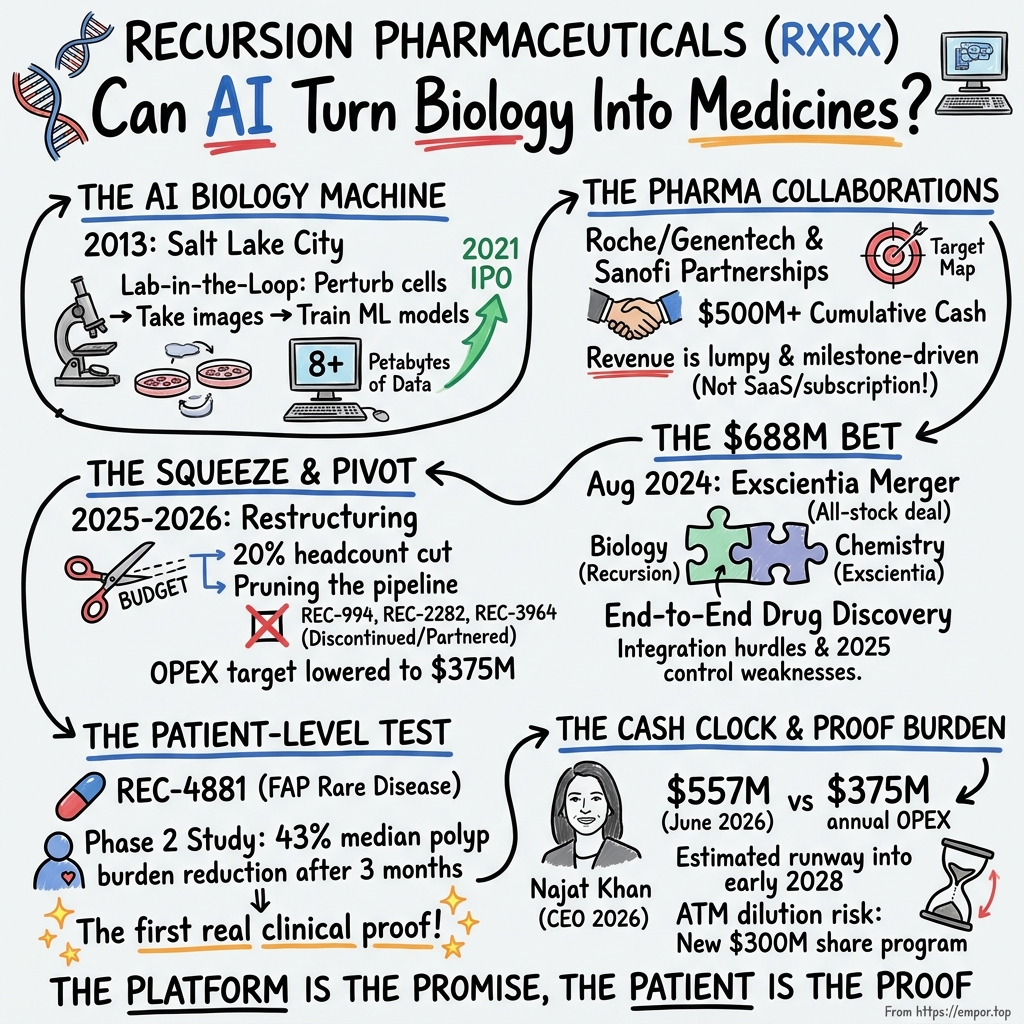
On August 5, 2026, Najat Khan opened Recursion's second-quarter earnings call with something the company had spent most of a decade promising and only rarely delivering: evidence that pointed outside its own walls.1 The first piece came from a partner. A neuroscience target that Recursion had surfaced while building maps of human cell biology for Roche and its Genentech unit had been moved into a joint early discovery program, meaning a large pharmaceutical company had looked at the work and decided to spend its own scientists' time chasing it.1 The second piece came from patients. In a rare inherited disease called familial adenomatous polyposis, a Recursion drug candidate named REC-4881 had been associated with a median 43% reduction in polyp burden after three months of treatment.1
Those are not small things for a company like this. For years, the case for Recursion rested on a picture of the future: robots running millions of experiments on human cells, cameras photographing every one of them, and machine-learning models finding patterns that no human biologist could see. It is a beautiful idea. The problem with beautiful ideas in drug discovery is that the industry is a graveyard of them. Medicines are judged in people, by regulators, over years, and most candidates that enter human trials never reach the market. A platform that generates insight is not the same as a company that generates medicines, and a company that generates medicines is not the same as one that generates cash.
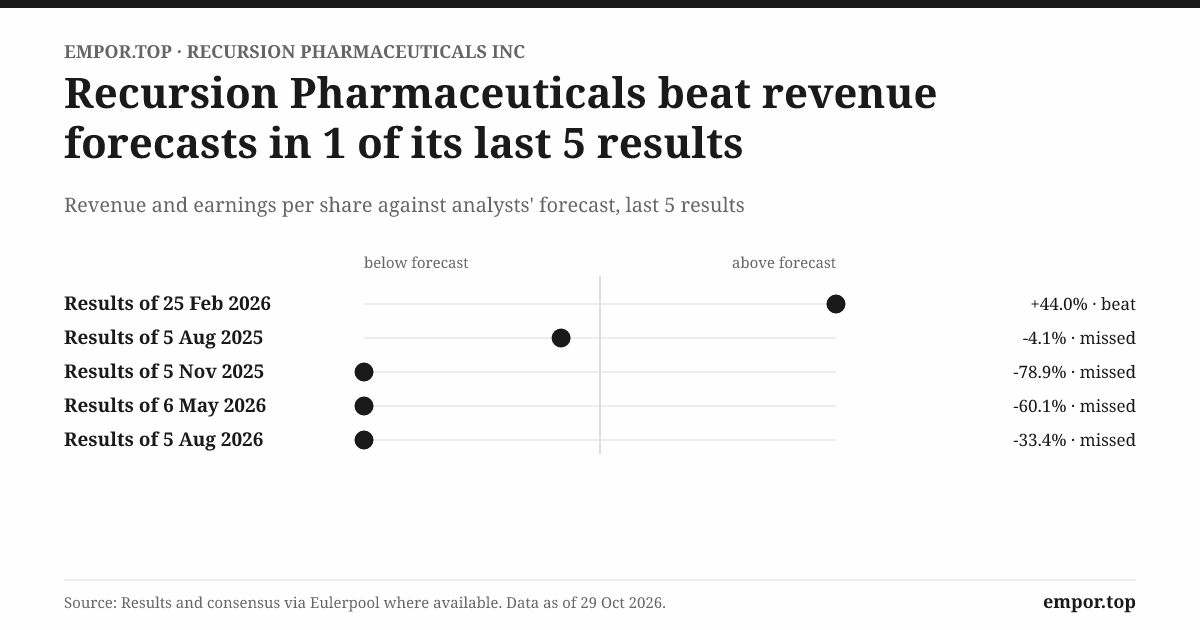
That gap is the subject of this story, and the scale of it is easy to state. In 2025 Recursion booked about $74 million of revenue, nearly all of it from research partnerships, and reported a net loss of roughly $645 million.2 For every dollar of revenue it recognized, it lost almost nine. Then the revenue line went the wrong way: in the first half of 2026, revenue fell about 60% from the same period a year earlier, as partner work shifted between project phases.3 On paper, the company looked smaller and still deeply unprofitable at the very moment it said its science was getting more convincing.
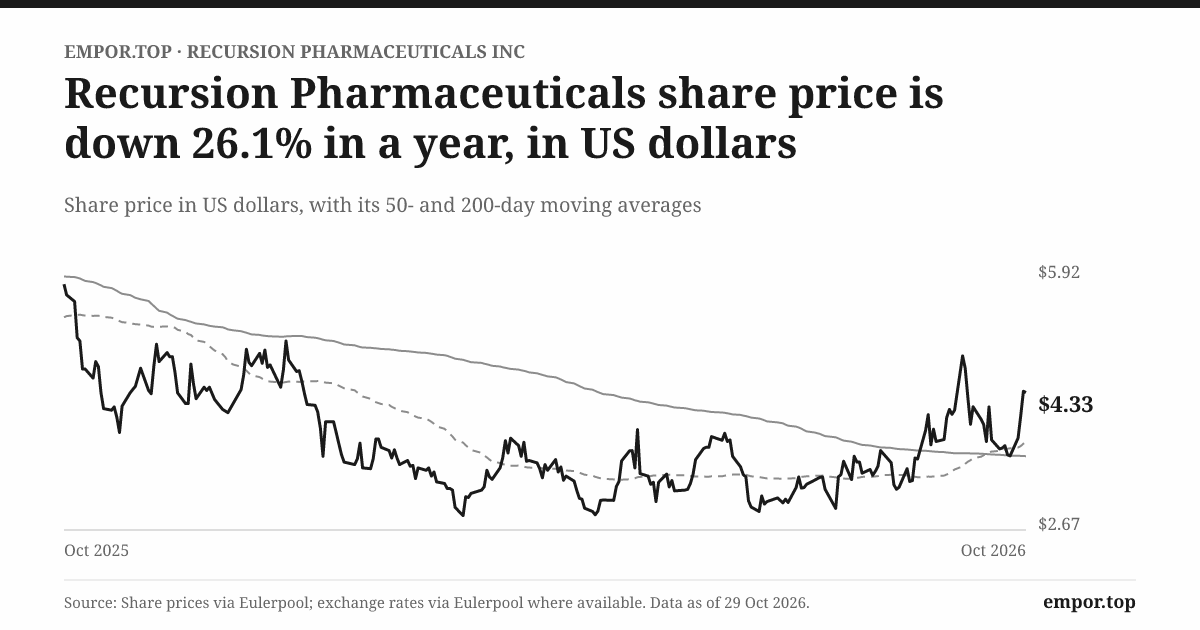
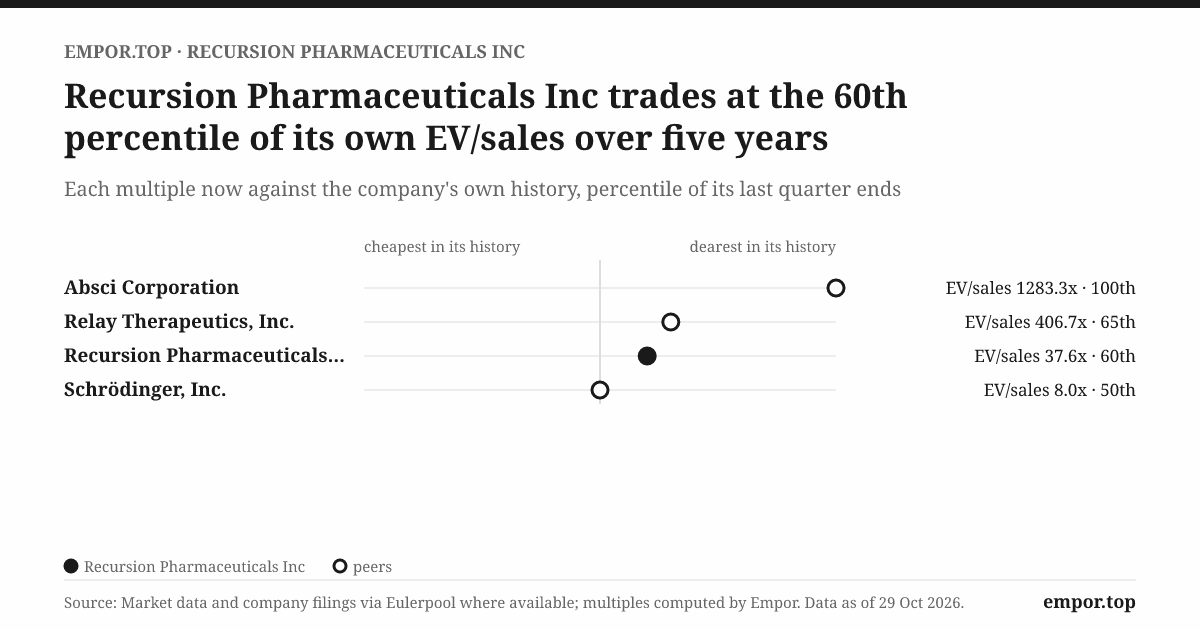
Against that, the company held about $557 million of cash, cash equivalents and restricted cash at the end of June 2026, and management guided to roughly $375 million of cash operating expenses for the year.13 That is the countdown clock running beneath everything else. The market, meanwhile, was paying for the future rather than the present: at about $4.34 a share on October 29, 2026, Recursion was worth roughly $2.3 billion, around 42.5 times its trailing twelve months of revenue.[^4]3 Investors were not buying a royalty stream or a product franchise. They were buying a probability.
Three tests run through the rest of this story. The first is whether the platform produces repeatable value, not one lucky hit but a pattern of partner programs that advance and drug candidates that work. The second is whether the 2024 acquisition of the British AI drug designer Exscientia, and the cost cuts and pipeline pruning that followed it, made the business stronger or merely larger and then smaller again. The third is whether Recursion can buy enough proof before the cash runs low, without asking shareholders to fund the experiment over and over through new stock.
The honest verdict at the start is a narrow one. The August call offered the most concrete evidence Recursion has produced: a partner moving a target forward, and a clinical signal in a disease with no approved therapy that modifies its course. Neither is an approved drug, a royalty or a durable business model. The platform has begun to produce useful biology and promising clinical data. Whether those early signs repeat, and whether they repeat cheaply enough, is the question that the next two years will answer. To see why that question is so hard, the story has to start in a lab in Salt Lake City, with a graduate student who thought biology had a data problem.
 Subscribe on LinkedIn
II. A Cell-Painting Lab Becomes a Public Company
Picture a laboratory where almost no one holds a pipette. In Recursion's Salt Lake City facility, robotic arms move plates of human cells between incubators, liquid handlers and microscopes. Each plate holds hundreds of tiny wells, and each well holds cells that have been disturbed in some deliberate way: a gene switched off, a chemical compound added, a protein that signals inflammation dripped in. Then the cells are stained with fluorescent dyes that light up their nucleus, their mitochondria, their skeleton and other structures, and photographed. The result is a picture of what that disturbance did to the cell's shape and organization. Multiply that by millions of wells and the lab becomes a factory for images of biology under stress.4
The company traced its origin to 2013 and to Chris Gibson, then an MD-PhD student at the University of Utah, who co-founded Recursion with colleagues from the lab of his mentor Dean Li.4 Gibson's insight was not that computers would replace biologists. It was that drug discovery spends most of its money on hypotheses that turn out to be wrong, and that the industry tests those hypotheses slowly, one disease and one target at a time. If you could run experiments at enormous scale and let software compare them, you might see that a drug which reverses one cellular defect also reverses another, or that two genes that look unrelated produce the same visual signature when they break. Biology is too complex to reason through from first principles. Perhaps it could be searched.
The method has a plain-English shape that the company calls a loop. Perturb the cells. Photograph the result. Train models to recognize which pictures resemble each other and which differ from a healthy baseline. Use those patterns to choose the next experiment. Then repeat, and each cycle should make the next guess better. Think of it as learning a language by reading millions of sentences rather than memorizing a grammar book: the models never "understand" a disease the way a physician does, but they can notice that two sentences mean the same thing even when the words are different.
By the time Recursion filed to go public in March 2021, it described a dataset of nearly eight petabytes of biological and chemical data, a scale few young biotech companies could match.4 Its pitch to investors was that this data and the automated lab around it let it explore many disease programs in parallel, kill weak ideas earlier and pick better ones at the discovery stage, where decisions are cheapest to change.4 Recursion listed on Nasdaq in April 2021 under the ticker RXRX, in a market eager to fund anything that combined biotechnology with artificial intelligence.2
What investors were actually buying deserves to be said plainly. In 2019, Recursion's revenue was roughly $1 million, and in 2020 about $3 million.4 The company was not a software business with predictable subscriptions, nor a biotech with a late-stage drug. It was a research platform with an early pipeline, financed by investors who believed the platform would compound into many medicines. By 2025, revenue had grown from that small base, an increase that looks spectacular as a growth rate and modest as a business: it still came almost entirely from partnership contracts.2
There is a common narrative that data scale is itself the moat, that whoever owns the most petabytes wins. The record does not support that conclusion yet. Scale is a real asset: Recursion built physical infrastructure, collected proprietary experimental data under controlled conditions and, with help from Nvidia, built one of the larger supercomputers in the biopharmaceutical industry.2 But nearly eight petabytes of images is an input, like a library full of books. It becomes an advantage only if it leads to decisions that other teams cannot make as well or as cheaply. The S-1's promise was explicitly about better and faster discovery-stage decisions.4 That promise is testable, and the rest of the story tests it.
The founding period also set a cultural pattern that still shapes the company. Recursion presented itself less as a biotech and more as a technology company that happened to work on medicines, with talk of maps, operating systems and industrialized discovery. That language helped it raise money. It also created a standard that would later bite: if the machine is so productive, investors would eventually ask, where are the medicines, and who is paying for them? The first answer Recursion gave was the big pharmaceutical partner, and that is where the story turns next.
III. The Map, the Molecule and the Pharma Partner
Somewhere inside Roche's research organization, a team of neuroscientists received a package from Salt Lake City. It was not a drug. It was a map: a dataset in which Recursion had knocked out genes across human neural cell types, photographed the consequences and used its models to cluster which genes and pathways behaved alike. Roche's scientists had to decide whether the map was good enough to accept, because acceptance carried a price. Under the collaboration, each accepted neuroscience map triggered a fee of $30 million.2 Over time Roche and Genentech accepted multiple such maps, and by the August 2026 call one target drawn from that work had moved into a joint early discovery program.15
That is what Recursion's partnerships actually sell, and it is worth understanding the contract mechanics because they explain almost everything about the revenue line. Roche and Genentech signed on in December 2021 with a $150 million upfront payment, along with the possibility of map fees, program milestones and royalties on any medicines that eventually reach the market.2 Sanofi's relationship arrived through Exscientia, which had signed a deal with a $100 million upfront payment, milestone payments and potential royalties.2 None of this resembles a subscription. There is no monthly seat license and no minimum recurring commitment disclosed in the filings. Payments arrive as lumps when work is delivered, accepted or advanced.2
The accounting turns those lumps into something smoother but still uneven. When a partner pays an upfront fee, Recursion does not book it as revenue all at once. It records the cash as unearned revenue and then recognizes it gradually as it performs the work, measured by costs incurred against the total costs it expects to spend.2 That method depends on estimates, so when management changes its view of how much work remains, revenue moves. In the fourth quarter of 2025, an updated cost estimate added about $12.4 million to revenue, which helps explain why that single quarter showed roughly $35 million of revenue while the quarters on either side showed single-digit millions.2 Investors who saw first-half 2026 revenue fall about 60% were partly watching the mirror image of that pattern, as work shifted between phases and the large recognition events of 2025 did not recur.3
The partners matter in two ways at once. They are customers, and they are judges. A pharma company that pays $30 million for a map is voting with its budget that the map has value. Yet that dual role also creates the most obvious concentration risk in the business. In 2025, two customers each exceeded 10% of revenue and together represented substantially all of Recursion's operating revenue.2 The concentration note does not name them, though the revenue discussion makes the cast fairly clear: Sanofi revenue rose because 2025 included a full year of the acquired Exscientia contract, while Roche revenue fell with the mix and timing of performance obligations.2 A company whose reported sales depend on two counterparties has a revenue line that tells you mostly about the pacing of two research programs.
The roster has also been thinner than the list of famous partner names suggests. In 2024, only one customer crossed the 10% threshold; in 2023, two did.2 Bayer, an early collaborator, redirected its work with Recursion from fibrosis to oncology in 2023, a change of scope rather than a lost customer, but a reminder that partners reshape these deals to suit their own priorities.2 No major customer has defaulted or gone bankrupt, and the filings show no unusual credit terms or overdue balances.23 The risk is not that partners fail to pay. It is that they decide, on their own timetable, how much more to buy.
Management likes to point to a larger number. By early 2026, it said, cumulative cash inflows from partnerships had exceeded $500 million across upfront payments and milestones.5 That is a real figure and a meaningful one: half a billion dollars of non-dilutive money is money shareholders did not have to provide. But set it beside the cost of the enterprise. Recursion spent about $475 million on research and development in 2025 alone.2 Several years of partner cash, added together, roughly equal a single year of R&D. Partnerships have helped fund the company. They have not come close to funding it.
The Genentech step deserves its proper weight. Moving a target into a joint discovery program is evidence that a sophisticated buyer found the biology credible enough to invest more. It is also a long way from a medicine. A discovery program must still find a molecule, show that it works in animals, pass toxicology, enter human trials and then survive them. Each of those gates has historically eliminated most candidates across the industry. An accepted map is a vote of interest; a royalty check is a vote of success. Recursion has many of the former and none of the latter yet.
On the second-quarter call, an analyst pressed on the question that now hangs over every AI drug discovery company: as generative AI tools spread and large pharma builds its own models, what makes Recursion different?1 Khan's answer leaned not on "AI" as a category but on integration: proprietary experimental data generated in Recursion's own labs, connected to chemistry, translational science and clinical development inside one company.1 That is the right answer to test, because it is falsifiable. If the integrated workflow is the edge, it should show up as partner programs advancing at a better rate and internal programs reaching clinical proof faster or more cheaply than peers. A model can be copied or licensed; a decade of physical experiments and the habits of using them are harder to replicate.
The partnership record, weighed as a whole, supports a narrower claim than the one Recursion made at its IPO. Partners have paid real money, accepted real work and, in the Genentech case, carried a target forward. That establishes the platform as a credible research supplier to large pharma. It does not yet establish repeatable revenue, because the base is two customers deep and moves with acceptance events, and it does not establish that the work leads to medicines. And it leaves an awkward question hanging. If partners were paying handsomely for discoveries, why did Recursion need to go out and buy another platform? In August 2024, it did exactly that.
IV. The $688 Million Bet on Exscientia
On August 8, 2024, Recursion announced that it would combine with Exscientia, an Oxford-based company that had been one of the earliest public champions of AI-designed drugs.[^7] The pitch was a story of two halves fitting together. Recursion had built a factory for biological insight, very good at suggesting which targets and pathways mattered. Exscientia had built a precision chemistry engine, using computational design and automated synthesis to create molecules with fewer rounds of trial and error. Put them together, the companies argued, and you would have something close to an end-to-end machine: biology in at one end, drug candidates out the other.[^7]
The deal was paid entirely in stock. Exscientia shareholders received Recursion shares, and Reuters put the implied value at about $688 million.6 The exchange ratio gave Exscientia holders a premium of about 25% to the three-month average share-price ratio between the two companies and about 32% to the six-month average.7 When the deal closed on November 20, 2024, Recursion's prior shareholders held roughly three quarters of the combined company and Exscientia's holders the rest.[^10][^7] The companies also said they expected meaningful annual cost synergies and a combined cash position that would fund operations for several years.[^7]
The all-stock structure is the first thing an investor should understand. It meant Recursion did not have to spend its cash, which it needed for research, and it meant Exscientia's investors swapped one bet on AI drug discovery for another. But stock is not free money. About 102 million new Recursion shares went to Exscientia holders, so every existing Recursion shareholder now owned a smaller slice of a bigger company.2 Whether that was a good trade depends on whether the slice became more valuable than the whole had been before, and that comes down to what Exscientia actually brought.
There was context that made the deal look different to different people. Exscientia had a troubled 2024 before the merger. Its board had removed founder and chief executive Andrew Hopkins earlier in the year after an investigation into his conduct, and the company had been narrowing its pipeline.7 Its share price had fallen far from its post-listing peak. A buyer could see a discounted asset with real chemistry capability, a Sanofi collaboration and several clinical programs. A skeptic could see an AI pioneer whose own record had not yet produced a breakthrough, acquired at a premium by another AI pioneer in the same position.
Benchmarking the price precisely is harder than it sounds. The premiums of about 25% and 32% are observable, and they sit within the range of ordinary public-company takeover premiums. What does not exist in the public record is a clean set of comparable transactions, AI drug discovery companies acquired at known multiples of anything measurable, against which to call the price high or low. Exscientia had no product revenue and lumpy partnership income, just like Recursion. So the defensible conclusion is narrower: the premium was not extraordinary, but the deal was a demanding bet because its value depended entirely on things that had not yet been proven.
The numbers that arrived inside the combined company show why. In 2025, the first full year of ownership, the acquired Exscientia business contributed about $35.3 million of Recursion's revenue, most of it from the Sanofi relationship, and about $158.4 million of operating loss.2 Those figures do not capture the deal's full value, because programs and capabilities that migrate into the combined pipeline do not show up neatly by legal entity. But they make a crucial point. "More pipeline" came with more cost, and the acquired operation lost more than four dollars for every dollar of revenue it brought.
Then came the untangling. Recursion sold Exscientia's Austrian operations in 2025, booking a loss on the disposal of the Exscientia GmbH business and a fee to terminate the Vienna lease.2 Facilities were consolidated, systems merged and teams trimmed, first in the weeks after the deal closed and then in the broader 2025 restructuring.89 Reasonable people can read that sequence two ways. It can be disciplined integration, quickly removing duplication. It can also be evidence that part of what Recursion bought did not fit the strategy it was paying for.
The most uncomfortable inheritance did not show up in the pipeline at all. When Recursion's auditor examined internal controls at the end of 2025, it concluded that they were not effective, because of material weaknesses tied to the acquired Exscientia business, including its financial close process and information-technology controls.2 The financial statements themselves received a clean opinion, so this was not a finding that the numbers were wrong.2 It was a finding that the processes meant to catch errors were not yet reliable. For a company asking investors to trust its estimates, including the cost-to-complete estimates that drive its revenue recognition, that is not a footnote.
The Exscientia scorecard is therefore unresolved rather than failed. Recursion acquired capabilities that plausibly complement its own, programs including REC-617 that now sit in its clinical pipeline, and a second large pharma relationship.10 It also acquired operating losses, integration work and control weaknesses, and it paid with roughly a quarter of its own company. The strategic fit earned the deal the right to be tested. It has not yet earned the verdict that it created value per share issued. And the immediate consequence of all that new cost was a budget that no longer fit the balance sheet, which forced the next chapter.
V. The Pipeline Gets Smaller as the Company Tries to Get More From Each Dollar
In the spring of 2025, Recursion did something that companies built on the promise of abundance rarely enjoy doing: it said no to its own ideas. Alongside its first-quarter results, the company announced it would stop or seek partners for three clinical programs, REC-994 for a vascular brain malformation called cerebral cavernous malformation, REC-2282 for a tumor syndrome called neurofibromatosis type 2, and REC-3964 for recurrent infection with the gut bacterium C. difficile.29 Weeks later, it cut roughly 20% of its personnel.92 The people who had built the most aggressive version of the Recursion pipeline were now being asked to run a smaller one.
To see why, look at what the merged company had become. Research and development spending climbed from about $241 million in 2023 to about $475 million in 2025, nearly doubling in two years.2 The jump had three engines. The first was the acquired Exscientia organization, with its own chemists, facilities and programs. The second was data: Recursion had agreed to buy large volumes of de-identified patient records and molecular data from the precision-medicine company Tempus, and those purchases cost about $49.9 million in 2025 alone.2 The third was acquired in-process R&D, the accounting cost of buying programs before they are proven. Add general and administrative costs, and Recursion's operating costs rose to around $723 million in 2025 against revenue of $74 million.2 R&D alone was more than six times revenue. No partner model, however generous, was going to close that gap.
The Tempus spending deserves a moment, because it shows how the platform's appetite had changed. Recursion's original engine generated its own data from cells in its own lab. The Tempus arrangement added a different raw material: real-world clinical and genomic records from cancer patients, meant to help connect cellular patterns to human disease and to choose which patients a drug might help. Recursion paid partly in shares, so the data cost shareholders twice, once in cash and once in dilution.2 When the budget tightened, spending on those purchases was among the first things to slow, falling by about $47 million in the first half of 2026 compared with a year earlier.3 That is a sensible cut if the data had become less essential, and a quiet admission that not every input to the machine was earning its keep.
It would be easy to tell the 2025 cuts as a tidy efficiency story, in which a sharper management team trimmed fat. The record is messier. Recursion grew its headcount rapidly, including through acquisition, and then reversed part of that growth; it had already trimmed staff in the weeks after the Exscientia deal closed.8 The workforce reduction was a correction to an expansion, not an independent act of discipline. That does not make it wrong. It means the cuts should be judged by what they preserved, not by how large they were.
The portfolio choices tell the clearer story. Several of Recursion's earliest clinical programs had been built around existing molecules that the platform pointed toward new diseases, and the three it stepped back from were among the programs it had once showcased.2 Management said it was concentrating capital on programs with stronger scientific rationale, nearer-term data or better commercial potential, and on its partnerships.5 An investor can respect that and still notice what it implies: a meaningful share of the first generation of platform-derived clinical bets did not survive as funded programs.
The cost discipline that followed is measurable. Recursion reported about $400 million of cash operating expenses in 2025, roughly 10% below what it had originally guided.5 It then set its 2026 target at under $390 million, and by the August call had lowered that to about $375 million.51 In the first half of 2026, R&D expense fell about 31% from the prior year, driven by lower platform spending, fewer Tempus data purchases and lower personnel costs, along with the pipeline reprioritization.3 Beating your own spending guidance and then cutting it again is the kind of behavior that builds credibility, because it is the opposite of the familiar biotech pattern of guiding low and spending high.
There is a vocabulary trap here worth flagging. "Cash operating expense" is a management measure that excludes items such as stock-based compensation and some other costs. It is a useful gauge of how fast money leaves the building, but it is not GAAP operating loss, and it is not the same as cash flow from operations, which also moves with partner payments and working capital. Even at $375 million a year, against revenue that ran about $53 million over the trailing twelve months, Recursion is nowhere near breakeven.3 Lower spending extends the runway. It does not change the destination.
So what did management offer as evidence that a smaller budget preserved the engine? On the Q4 2025 call, Khan framed the industry as moving from building models and announcing collaborations to showing measurable impact in drug programs, and she presented Recursion's plan in those terms: fewer programs, each with clearer data milestones.5 By the Q2 2026 call, the evidence she could point to was the Genentech target advancing and the REC-4881 data.1 That is real, but it is two data points across a period of heavy reorganization. The harder test, whether partner milestones and clinical progress continue at the same or better pace per dollar spent, needs more quarters to resolve.
The calibrated reading of this chapter is that the spending reduction was genuine reprioritization rather than accounting cosmetics. Programs ended, people left, and expensive data purchases slowed. Management has shown it can reset costs and hit its targets. What it has not shown is that the platform's productive capacity survived intact, because that capacity is measured in milestones and patient data that arrive with long lags. A smaller budget is only a victory if the programs left standing produce evidence that could not have been bought more cheaply elsewhere. Of all those surviving programs, one has carried more of the story's weight than any other.
VI. REC-4881 Gives the Platform Its First Patient-Level Test
For a person with familial adenomatous polyposis, the colon is a field that keeps growing weeds. The disease is inherited, usually through a mutation in a gene called APC, and it causes hundreds or even thousands of polyps to form in the large intestine, often beginning in adolescence.2 Left alone, those polyps almost inevitably turn cancerous. The standard answer is surgery, frequently removal of the colon in early adulthood, followed by a lifetime of endoscopies to monitor and cut away polyps that keep appearing in the remaining bowel and upper intestine.2 There is still no disease-modifying therapy approved for FAP.2 The treatment, in effect, is vigilance and the knife.
Recursion estimates that more than 50,000 diagnosed patients live with FAP across the United States and the five largest European markets.1 That is a rare-disease population, small enough to qualify for regulatory incentives and large enough to support a commercial medicine if one works. It is also a population where a pill that shrinks polyps would mean something tangible: fewer procedures, perhaps delayed surgery, perhaps less cancer risk, though that last benefit would take years to demonstrate.
The trail from platform to patient is worth tracing carefully, because it shows exactly what the platform did and did not do. Recursion's image-based experiments modeled the cellular consequences of losing APC function and searched for compounds that pushed those diseased cells back toward a healthy appearance. One class that stood out was inhibitors of MEK, an enzyme in a growth-signaling pathway that cancer researchers have targeted for years. REC-4881 is a MEK1/2 inhibitor that Recursion licensed from Takeda rather than one it invented from scratch.2 In other words, the platform's contribution was the hypothesis: this kind of drug, in this disease. Clinical testing is what turns a hypothesis into evidence.
The TUPELO study supplied the first such evidence. Patients with FAP received REC-4881, and management reported a median 43% reduction in polyp burden after about three months of treatment.1[^14] That is a striking number in a disease with nothing approved to compare it with. It is also an early finding from a small, open-label phase 2 study, not a randomized registration trial, and polyp burden is a surrogate measure rather than the outcome that ultimately matters to patients, which is avoiding cancer and surgery. MEK inhibitors as a class carry known side effects, including skin rash and gastrointestinal problems, so tolerability over months and years is as important as the size of the response.
On the August call, Khan named the next gates.1 The company was continuing enrollment and working on dose optimization, the process of finding the dose that keeps most of the benefit with fewer side effects. It planned further clinical data. And it intended to discuss with the FDA what a potential registration path would look like, which in a disease without an approved drug may require agreeing on endpoints that regulators will accept. Each of those steps can go wrong, and each will take time measured in quarters, not weeks.
The positive result needs to sit beside the pipeline record, because the honest question is not whether Recursion can produce one encouraging signal but at what rate its platform-derived programs convert. The three programs Recursion discontinued or put up for partnering in 2025 had all reached the clinic.2 Before REC-4881's data, Recursion's clinical record was mostly a story of programs that did not make the cut. The FAP result narrows the claim that "the platform produces medicines" to a smaller but now defensible version: the platform has produced at least one hypothesis that looks promising in patients.
The rest of the clinical pipeline should be treated as options rather than assets. REC-617, a CDK7 inhibitor for advanced solid tumors that came from Exscientia, has reported early data, and the company lists several other oncology and rare-disease programs at clinical or near-clinical stages.10 Each could matter. None should be counted as revenue, because in oncology especially, early-stage signals often fail to show the differentiation needed to win in larger trials. A pipeline count is a measure of how many lottery tickets you hold, not of how many will pay out.
Recursion also argues that its chemistry is getting more efficient: that with Exscientia's design tools, it can reach a development candidate by synthesizing fewer compounds and running faster design cycles than industry norms.5 That claim may well be true, and it would be valuable. But it measures a step on the way to a medicine, not the medicine itself. A faster route to a molecule that fails in phase 2 saves money only in the narrowest sense. The endpoint that matters for this company is medicines that work in people and can be developed at a cost that leaves something for shareholders after R&D.
Consider what this one program has to carry. Recursion's R&D spending dwarfed its revenue in 2025.2 If REC-4881 succeeds, it validates a hypothesis the platform generated and provides the company's first realistic path to product revenue. It does not, by itself, prove that the platform's economics work, because one success out of a long list of attempts is what conventional biotech also produces. One clinical signal can change the story. Several independent outcomes, from programs with different biology, must arrive before it changes the confidence. And that raises the competitive question in full: if success depends on repeatable outcomes, what exactly does Recursion have that others cannot assemble?
VII. A Platform Without a Proven Tollbooth
On the fourth-quarter 2025 call, Khan described a turning point not just for Recursion but for the whole field. The early era of AI drug discovery, she argued, had been about building models and announcing collaborations; the next phase would be judged on measurable impact in actual drug programs.5 It was a candid framing, because it set the bar where skeptics had long wanted it. Under that standard, the question is no longer who has the most impressive technology. It is who can turn technology into clinical outcomes repeatedly, and get paid for it.
Start with the industry's structure. Drug discovery is long, expensive and failure-prone. Large pharmaceutical companies hold most of the money, own the late-stage development and commercial machinery, and choose between building capabilities internally and contracting specialists. Into that structure have poured dozens of companies claiming AI advantages, from software vendors to venture-backed discovery shops, and the cost of generating a plausible hypothesis keeps falling as open-source protein-structure and molecule-generation models spread. When generating ideas gets cheaper, the scarce resources move downstream: high-quality experimental data, the ability to make and test molecules, and above all clinical success.
Recursion sits among very different kinds of competitor, and comparisons need care because their business models are not alike. Schrödinger sells physics-based simulation software to drug developers while also running its own programs, so it has a recurring software revenue stream Recursion lacks. Insilico Medicine has built a pipeline of AI-designed molecules and is often cited as an AI-native peer, but its scale and disclosure differ, and no reliable market-share figures exist for this field. Big pharma's own data science groups are perhaps the most important competitors, because they are also Recursion's customers. There is no industry body that publishes market shares for AI-enabled discovery, and Recursion does not claim one.
Run the competitive forces through that structure and the picture is sobering. Buyers are few and powerful: two customers represented substantially all of Recursion's 2025 revenue, which means each negotiation is with a counterparty that has alternatives and leverage.2 Switching costs are not evident in the filings, which disclose no minimum recurring commitments.2 The threat of substitutes is high, because a partner can license a model elsewhere, build its own, or simply run conventional screening. New entrants keep arriving with fresh capital. The supplier side matters less, though Recursion relies on a small number of vendors for certain research and clinical work and made large data purchases from Tempus.2 The forces that favor Recursion are the ones that are hardest to buy: years of controlled, proprietary experimental data, the wet-lab capacity to produce more, and an organization that connects it to chemistry and clinical development.
Hamilton Helmer's framework for durable advantage, which he calls the seven powers, sharpens the test. Scale economies would show up as falling cost per useful experiment or per program; Recursion's spending history does not yet show that. Network effects do not apply in any meaningful sense. Switching costs are not demonstrated, as partners are not locked in. Brand matters a little in recruiting and partnering, not in pricing. Counter-positioning is the most interesting candidate: incumbents built around traditional, hypothesis-first research may find it awkward to reorganize around industrial-scale data generation, though many are trying. A cornered resource, meaning the proprietary dataset and the lab that produces it, is the core claim, and it is real as an asset but unproven as a source of superior returns. Process power, the hard-to-copy habits of running an integrated lab-to-clinic loop, is what Khan's integration answer actually describes, and it is the power the next few years will either confirm or refute.
The affirmative evidence is not nothing. Roche and Genentech have accepted several neuroscience and other maps and pushed a target into discovery; Sanofi has paid milestones; and REC-4881 has produced a patient-level signal.51 Cumulative partner cash of more than $500 million shows that sophisticated buyers have paid for the work.5 Each of those is an independent check on the platform from someone who did not have to say yes.
Technology disruption cuts both ways for a company like this. The same wave of machine-learning tools that made Recursion's story fashionable is now lowering the cost for everyone else. A pharma team can download capable open models, rent computing power by the hour and buy datasets from vendors, which erodes any advantage that rested on software alone. What it cannot easily download is a decade of carefully controlled experiments, run the same way with the same cell lines, or the institutional habit of turning those experiments into chemistry and clinical decisions. That is why Khan's answer emphasized the integrated workflow.1 It is also why the claim must be proven in outcomes: if the integrated workflow is truly superior, the evidence will be programs, not press releases.
The limitations sit right beside them. Revenue is concentrated and recognized in lumps. There are no approved products, no royalties and no evidence yet that Recursion can deliver a successful drug at lower cost than the industry norm. R&D runs at several times revenue. And the market, at about 42.5 times trailing sales, is clearly paying for something beyond the current business, which is reasonable for a pre-commercial biotech but means the price embeds an expectation of future success rather than a record of it.[^4] There is no consistent history of Recursion's own multiple, or a clean set of same-date peer multiples, that would show whether that expectation is high or low by the standards of its class.
The verdict on the moat is therefore a version of "intact but unproven." The most credible edge is the combination of proprietary experimental data with biology, chemistry and clinical workflows in one organization, checked by partners who pay. Evidence of pricing power, lock-in or a repeatable cost advantage remains thin. Three measures would confirm or falsify it: partner programs that advance into paid milestones rather than stalling after map acceptance, clinical outcomes per dollar of R&D, and cash burn against runway. The person now responsible for moving all three, however, arrived only recently in the chief executive's chair.
VIII. Khan Inherits the Integration and the Proof Burden
On January 1, 2026, Najat Khan became chief executive of a company she had not founded and had joined only a couple of years earlier.11 Chris Gibson, who had led Recursion since its days as a university spinout, moved to chair the board.11 The handoff came at an awkward moment and an honest one: the Exscientia deal was a year old, the restructuring was fresh, and the company's own description of its next phase was about proof rather than promise. Khan was inheriting not a startup to grow but a combined organization to make accountable.
Khan arrived with a profile built for that brief. Trained as a scientist, she had spent years in strategy and data science roles in big pharma, most recently at Johnson & Johnson's pharmaceutical business, where she led data science before joining Recursion as its chief research and development officer and chief commercial officer, and later president.11 That background matters in two directions. She knows how large pharmaceutical companies evaluate partners, which is useful when two of them account for nearly all your revenue. And she came to Recursion from the buy side of AI drug discovery, which may explain her emphasis on measurable program impact over technology narratives.
The chief financial officer's résumé is just as relevant. Ben Taylor joined Recursion in November 2024 after serving as Exscientia's chief financial officer and chief strategy officer.11 That puts the integration of the acquired business, its operating losses and the remediation of its control weaknesses squarely within the remit of the executive who knew that business best. It is a sensible appointment for continuity, and it is also the point where accountability concentrates: if Exscientia's financial close and IT controls are not fixed, the person responsible was there on both sides of the deal.
Compensation is mostly equity, which in principle aligns executives with shareholders but also makes pay a large source of dilution. In 2025, Gibson received about $9.6 million in reported compensation, the bulk in stock and option awards, roughly the same as in each of the two prior years even as annual net losses grew from about $328 million to about $645 million.11 Khan received about $5.35 million, plus an additional $1 million in intended-value equity awards tied to her transition to chief executive.11 Executives received 80% of their target annual bonuses for 2025.11 Those numbers are not unusual for a Nasdaq biotech of this size, but they invite a simple question: are the incentives tied to milestones, cost guidance and dilution, the measures that matter here, or to activity? The 80% payout suggests the board judged 2025 as partly successful, which roughly matches the evidence.
Founder influence persists without control. Gibson and his affiliates hold all of Recursion's Class B shares, which carry ten votes each; at the end of 2025 that block represented about 9.6% of voting power, potentially rising to about 10.8% if specified awards vested or were exercised.2 That is meaningful sway in a close vote, not a controlling stake, and the Class B shares are scheduled to convert automatically under specified conditions, including in April 2028.2 The largest economic holders as of April 2026 were index and active managers: Vanguard with about 9.0% of the Class A shares, BlackRock with about 7.2% and Cathie Wood's ARK with about 7.1%.11 ARK's presence is a reminder that part of Recursion's shareholder base bought into the long-duration AI thesis, and such holders tend to be sensitive to whether that thesis is advancing.
How has the team behaved, as distinct from what it has said? The measurable record is mostly favorable on cost: 2025 cash spending came in about 10% under the original target, and 2026 guidance has been lowered twice.51 Programs were cut when data did not support them, and facilities and systems were consolidated. Those are course corrections with consequences, the opposite of drift.
The control finding belongs in the same frame. Investors received financial statements with an unqualified audit opinion, but internal controls were judged ineffective because Exscientia-related weaknesses were still unremediated at year-end 2025.2 Management reported remediation work under way.2 Until the auditor confirms that the fixes have operated effectively for a sufficient period, that remains a live credibility test, especially for a company whose revenue relies on cost estimates.
Shareholders, for their part, have not revolted. At the June 2026 annual meeting, the say-on-pay proposal passed with about 206 million votes for and about 31 million against, a clear majority though lower than the roughly 98% support the previous year.1211 That shift is a mild signal, not a rebellion, and votes are no substitute for operating results. Reading the two most recent calls together, the pattern is consistent: management quantifies cost targets and runway precisely and is more general when asked about timelines for partner milestones and the size of its competitive advantage.51 The differentiation answer, integration rather than AI as such, did not change between the two calls, which is to its credit. The quantities that will judge it, however, are the ones that come from the bank account.
IX. The Cash Clock and the Share Count
Every pre-commercial biotech lives by a clock, and Recursion's is unusually visible. That balance, the company said, was enough to fund operations into early 2028.13 Six months earlier the figure had been about $754 million.23 Roughly $200 million left the building in half a year, even with spending falling. Meanwhile a fresh $300 million at-the-market stock program sat ready, untouched as of June 30.3 The runway and the share-issuance facility are two halves of the same plan.
Start with the gap between accounting losses and cash. Over the seven years from 2019 through 2025, Recursion's cumulative net losses were about $2.0 billion while cash burned in operations was about $1.4 billion.24 The difference is mostly non-cash charges. In 2025 alone, the company added back about $111 million of stock-based compensation and about $84 million of depreciation and amortization, plus the acquired in-process R&D and other items, to get from its net loss to its operating cash flow.2 That is why operating cash use of about $372 million in 2025 looks much smaller than the $645 million net loss.2 It does not make the business cash-generative. Stock compensation is still a cost; it is simply paid in shares instead of dollars, which brings the cost back as dilution rather than as cash burn.
Some of the 2025 cash picture was also flattered by timing. Operating cash flow benefited from about $50 million as prepaid data assets were used up and about $33 million from other receivables and assets, partly offset by a $37 million drop in unearned revenue as earlier partner payments were worked off.2 Those swings will not repeat in the same direction forever. Unearned revenue in particular is cash that partners paid in advance; once it is recognized, it no longer supports the runway.
The balance sheet's liabilities are light by the standards that matter to lenders. At the end of 2025, Recursion reported only about $18.7 million of debt, consisting of notes for tenant improvements and financing for its supercomputer.2 It also had about $77.6 million of lease liabilities and about $147 million of purchase obligations, mostly research commitments.2 Those are real future claims on cash, but there is no covenant to breach and no bond maturity to refinance. Recursion's credit problem is not a lender. It is a business that spends far more than it earns, which can only be closed by partner payments, product revenue or new equity.
The record says which of those has done the work. Recursion's history is a long sequence of share sales. After the 2021 IPO came private placements in October 2022 and July 2023, a June 2024 public offering of about 35.4 million shares at $6.50 for roughly $216 million net, and a Jefferies at-the-market program that raised about $199 million between 2023 and early 2025.213 Then came the largest of all: in 2025, a Citi-run at-the-market program raised about $492 million net by selling about 99.9 million shares, using the facility in full.2 Add roughly 102 million shares issued for Exscientia, shares issued to Tempus as payment for data licensing, and steady stock compensation, and the share base has expanded many times over since the IPO.2 Cash from financing activities totaled more than $1.9 billion over the seven years.2
The per-share arithmetic shows who bears that cost. Recursion's total net loss grew from about $328 million in 2023 to about $645 million in 2025, nearly doubling.2 Yet its loss per share shrank over the same period, from about $1.41 to about $1.22, and to about $0.98 over the twelve months to June 2026.23 The only way a bigger loss becomes a smaller loss per share is a much larger number of shares. A headline that says losses per share are improving is, in this case, mostly a description of dilution. Shareholders did not lose less; they each owned a smaller piece of a larger loss.
An at-the-market program, for listeners unfamiliar with it, is a way for a company to dribble shares into the market through a broker at prevailing prices rather than in one large offering. It is flexible and cheaper than a traditional deal, and it lets management sell when the price is strong. It also makes dilution continuous and quiet. In February 2026, Recursion established a new $300 million program with TD Cowen and, as of June 30, had sold no shares under it.3 That restraint is consistent with the claim that the company does not need to raise immediately. The facility's existence is also a statement about how the gap will eventually be closed if partners and products do not close it first.
Partner payments are the wild card in the runway math. Upfront fees and milestones can extend the clock, sometimes by months, but their timing depends on Recursion delivering work, partners accepting it and programs advancing. Management's runway estimate rests on assumptions about those receipts and about spending that investors cannot fully check from the outside. Treat "into early 2028" as an estimate built on management's plan, not a guaranteed date, and watch each quarter's cash use against it.
A skeptical investor would push on one more point. If this is a disciplined platform, what fixed evidence decides which programs and technology investments stop receiving capital? Management has cut programs once, decisively. It has not published the decision rules, such as the data thresholds that would trigger a stop or the cost-per-program ceiling, that would let outsiders hold it to account before the next cut becomes necessary. With a free-cash-flow yield of about negative 16% at the October share price, shareholders are financing roughly a sixth of the company's market value in cash burn every year.[^4] The runway may reach early 2028. The more important question is what proof Recursion can buy before then, and what the market will make of it.
X. Analysis & Bear vs. Bull Case
Put two documents side by side and the debate writes itself. One is the second-quarter 2026 report: operating costs lower, cash guidance cut again, a Genentech target advancing and REC-4881 data that gave patients with FAP a reason for hope.13 The other is the share price on October 29, 2026: about $4.34, roughly a quarter below its 52-week high of $5.87 and well above its low of $2.84, valuing the company at about $2.3 billion.[^4] That price sat against about $53 million of trailing revenue, $557 million of June cash and a negative 15.7% free-cash-flow yield.3[^4] The stock had fallen as much as 86% from its peak at some point during the previous five years, and it moves with a volatility above 70% a year.[^4] Investors have treated it as a referendum on whether AI can make drugs, and the referendum is still being counted.
It helps to ask what that price assumes. Take away the cash and the enterprise value was about $1.8 billion, roughly 34 times trailing revenue.[^4] That is the sum the market assigns to everything that is not money in the bank: the platform, the partnerships, REC-4881 and the rest of the pipeline. The current partnership revenue cannot justify it on any conventional multiple, so the price is implicitly a bet that at least one product reaches the market or that partner economics grow far larger than today. The book value per share of about $1.76, against a share price of about $4.34, tells a similar story: the market values the company at roughly two and a half times what shareholders have put in net of losses.[^4] There is no consistent history of these multiples or same-date peer figures that would show whether that premium is generous or modest for its class, so the multiple is best read as a statement of expectation rather than a verdict.
The bull case begins with partners. Roche and Genentech have accepted multiple maps, paying fees each time, and one neuroscience target has moved into a joint discovery program; Sanofi has paid milestones; and cumulative partner cash has passed half a billion dollars.51 It continues in the clinic: REC-4881 has produced a meaningful early signal in a disease with no approved therapy, with a path toward regulatory discussions, and REC-617 and other programs give the company several more shots.110 It adds a cost base that is shrinking without, so far, visibly slowing the programs that matter, which extends runway and reduces how often shareholders must be asked for money.13 And it points to a market that might reward a credible AI-to-clinic platform with a scarcity value, because few companies have both a large proprietary experimental dataset and clinical programs to show for it.
The bear case is assembled from the same record. Three clinical programs that once anchored the pipeline were discontinued or put up for partnering in 2025.2 Losses remain enormous and cash use substantial: even after the cuts, the company spends several times its revenue every year.23 Revenue depends on two customers and fell about 60% in the first half of 2026.23 The share count has grown dramatically through offerings, at-the-market programs, an acquisition and stock compensation, and a new $300 million facility stands ready.23 And the defining clinical asset, REC-4881, is an in-licensed molecule whose evidence so far comes from a small, uncontrolled study.
Test the moat once more, not by re-running the forces, but by asking what would break it. The most credible edge, proprietary experimental data combined with integrated chemistry and clinical development, would be broken by substitution: if partners can get comparable insight from their own models, cheaper data or other vendors, map fees would shrink and acceptance would slow. The best evidence against substitution so far is that Roche kept accepting maps and moved a target forward. The best evidence for it is that no long-term minimum commitments or switching costs appear in the filings and that revenue fell sharply in 2026.23 The verdict: the moat is narrowed to a research-supplier advantage with a few paying customers, intact but unproven as a source of durable economics.
Test the acquisition through the fate of the capital. Recursion issued roughly a quarter of the combined company for Exscientia, absorbed about $158 million of operating loss from it in 2025, sold part of its footprint at a loss and inherited control weaknesses.2 In return it got chemistry capability, the Sanofi relationship and programs including REC-617. The return on that capital is not yet visible, which is normal for a two-year-old biotech merger and also a reason not to call it a success.
Test management through promises against outcomes. Beating 2025 cash-spending guidance by about 10% and lowering 2026 guidance twice is real evidence of cost control.51 Remediating the control weaknesses, delivering milestones on time and showing productivity per dollar are the confirming evidence still missing. A management team that has been right on spending is more credible than one that has not, but the harder promises are the scientific ones, and those depend partly on biology no team controls.
What would a skeptical activist ask for? Probably a published capital-allocation framework, with explicit criteria for stopping programs and technology bets; a narrower focus on the clinical assets and partnerships that generate external validation; incentive pay tied more tightly to milestones and per-share outcomes; and a clearer explanation of why the market should pay for the platform separately from the pipeline. None of those requests would be unreasonable. Several are partly addressed by what management already did in 2025.
Three measures matter more than any others for following this company. The first is partner conversion: whether accepted maps and programs at Roche, Genentech and Sanofi advance into paid milestones and later-stage development. The latest reading is positive but thin, with one Genentech neuroscience target moved into joint discovery and cumulative partner cash above $500 million.15 The second is clinical progress per dollar of R&D, where R&D fell about 31% in the first half of 2026 while REC-4881 moved toward dose optimization and regulatory discussions.31 The third is cash burn and share count against runway, with $557 million at June 2026, a $375 million cash spending target for the year and a runway estimate into early 2028.13
The next decision points are already scheduled by the company's own plans: more REC-4881 data and the outcome of FDA discussions on a potential registration path, the progress of partner programs, and continued evidence that cost reductions have not slowed the programs that matter.1 On balance, the bull case has concrete footholds that did not exist two years ago, but the bear case remains substantial because the platform's advantages have not yet been monetized at scale and shareholders are still funding the gap. The thesis is unproven until repeatable clinical and partner economics appear. That leaves a set of lessons that apply well beyond this one company.
XI. Business & Investing Lessons
Go back to the image that started it all: a plate of human cells under a microscope, each well lit up in fluorescent color, each picture fed to a machine. Then follow the chain forward. A pattern in a dish becomes a hypothesis. The hypothesis becomes a map a partner accepts, or a molecule a chemist designs. The molecule enters a trial. The trial produces data. The data persuades a regulator. And somewhere along that chain, at every link, someone has to pay for the next step. Recursion's story is a lesson in how different each link is, and how each needs its own evidence.
The first lesson is about data. Recursion's proprietary biological dataset was a genuine achievement, and it turned out to be the beginning of the argument rather than the end of it.4 Partners paid for what the data could tell them, not for the data itself, and the market has priced the company on what the data might eventually produce. The test remains whether it leads to decisions other teams cannot make as well.
The second lesson is about acquisitions. The Exscientia deal had an elegant logic, biology meeting chemistry, and that logic was persuasive enough to justify trying it. The acquired business's losses, the sale of part of it and its control weaknesses all belong on the scorecard.2 Strategic fit earns a deal the right to be tested, not the right to be called a success. Investors who heard "end-to-end platform" should have asked for the scorecard that would prove it.
The third lesson is about portfolios. When Recursion stopped three early clinical programs, it admitted that some of its most visible early bets had not earned more capital.2 That admission is what made the REC-4881 signal more believable, because it showed the company would move money toward evidence and away from hope. A pipeline is worth something only when capital follows the data, even when the data says the old favorites should go.
The fourth lesson is about time. Management says its runway extends into early 2028.1 Runway sounds like an asset, and in one sense it is, because it gives science time to work. But time in biotech is only valuable if each year buys proof that changes the next financing decision: a better price for new shares, a richer partner deal, or no need to raise at all. A runway that ends where it began, with the same questions unanswered, is just a slower route to dilution.
The fifth lesson is about what counts as proof. A model benchmark impresses engineers. A map acceptance impresses partners. REC-4881's early patient signal impresses physicians.1 Only an approved medicine, prescribed and paid for, impresses all three and the bank account too. For AI drug discovery, the patient is the only judge that cannot be persuaded by a better pitch, which is why every other kind of evidence should be priced as a down payment on that final verdict rather than a substitute for it.
XII. Epilogue
Tonight, Recursion is a company with more evidence than it has ever had and less proof than its valuation implies. It enters this evidence-building stage with a leaner organization, engaged partners and its strongest clinical signal yet.13 Its familiar constraints remain: concentrated revenue, a shrinking cash balance and available stock issuance.23 Each update either adds to the case or subtracts from it.
The first moment to watch is REC-4881. More patients, longer follow-up and a settled dose will show whether the early polyp reductions hold, whether side effects are manageable over many months, and whether the effect is large enough to matter. Then come the FDA discussions. A defined registration path, with agreed endpoints, would turn a promising signal into a development plan with a visible finish line. An unclear or demanding path would push the commercial horizon further out, past the current runway.
The second is the partners. If programs at Roche, Genentech and Sanofi advance from discovery toward development candidates and later-stage milestones, the platform's claim to produce useful biology gets an external confirmation that money cannot buy. If map acceptances keep coming but the programs stall, the partnerships will look more like research services than a source of future royalties. Either way, it is worth keeping target acceptance separate from drug success, because the industry's history is littered with validated targets that never became medicines.
The third is the cash clock. Every quarter will show how much was spent and how many shares were outstanding, set against the company's estimate that the money will last into early 2028.1 A quarter with cash use above the pace implied by guidance, or a burst of at-the-market sales at low prices, would shorten the story. A large partner payment or a disciplined quarter would lengthen it.
The fourth is quieter but matters for trust: the auditor's verdict on whether the Exscientia-related control weaknesses have been fixed and have operated effectively.2 Clean controls will not move the share price on their own. Lingering weaknesses would undermine confidence in the estimates on which the company's revenue depends.
What would change the conclusion? Repeatable patient-level evidence from more than one program, partner economics that broaden beyond two customers and grow more durable, and lower cash burn per meaningful program advance. Any two of those would make Recursion a meaningfully different company from its current position. None of them would by itself guarantee a medicine, because biology keeps the final vote. The tension that remains is simple to state and hard to resolve: Recursion has learned to read cells at an industrial scale, and now has to show it can do so faster than its money runs out.
XIII. Outro
Think again of that plate of cells under the microscope in Salt Lake City, glowing in five or six colors, one image among millions. More than a decade and billions of dollars of shareholder money later, REC-4881 produced an early patient-level signal, compressing the journey Recursion has been promising into a single line of evidence.1
What makes this company distinctive is not the AI, which others have, or the losses, which most biotechs share. It is the scale of the bet that biology can be made computable, and the bluntness of the test now in front of it. The cells are the input. The software is the method. The cash is the clock. The platform is the promise; the patient is the proof.
References
-
Full Transcript of Recursion’s Second Quarter 2026 Earnings Call — Recursion, 2026-08-05 ↩↩↩↩↩↩↩↩↩↩↩↩↩↩↩↩↩↩↩↩↩↩↩↩↩↩↩↩↩↩↩
-
2025 Form 10-K — Recursion Pharmaceuticals, Inc., 2026-02-25 ↩↩↩↩↩↩↩↩↩↩↩↩↩↩↩↩↩↩↩↩↩↩↩↩↩↩↩↩↩↩↩↩↩↩↩↩↩↩↩↩↩↩↩↩↩↩↩↩↩↩↩↩↩↩↩↩↩↩↩↩↩↩↩↩
-
Form 10-Q for quarter ended June 30, 2026 — Recursion Pharmaceuticals, Inc., 2026-08-05 ↩↩↩↩↩↩↩↩↩↩↩↩↩↩↩↩↩↩↩↩↩↩↩↩
-
2021 Form S-1 — Recursion Pharmaceuticals, Inc., 2021-03-22 ↩↩↩↩↩↩↩↩
-
Full Transcript of Recursion’s Fourth Quarter Year-End 2025 Earnings Call — Recursion, 2026-03-03 ↩↩↩↩↩↩↩↩↩↩↩↩↩↩↩
-
Biotech firm Recursion to buy smaller peer Exscientia for $688 million — Reuters, 2024-08-08 ↩
-
Definitive Merger Proxy — Recursion Pharmaceuticals, Inc., 2024 ↩↩
-
Recursion, the AI drug development company, cuts more jobs after finalizing Exscientia merger — STAT, 2024-11-26 ↩↩
-
Recursion lays off 20% of staff in wake of pipeline cutbacks — Fierce Biotech, 2025 ↩↩↩
-
Recursion’s Drug Discovery Pipeline — Recursion Pharmaceuticals, Inc. ↩↩↩
-
2026 Proxy Statement — Recursion Pharmaceuticals, Inc., 2026-04-30 ↩↩↩↩↩↩↩↩↩
-
2026 Annual Meeting Voting Results, Form 8-K — Recursion Pharmaceuticals, Inc., 2026-06-18 ↩
-
Form 10-K for fiscal year 2024 — Recursion Pharmaceuticals, Inc., 2025-02-28 ↩
 LinkedIn
 WhatsApp
 Reddit
 Hacker News
 Email
 Kindle
 RSS Feed
 Spotify
 Apple Podcasts
 Amazon Music
 Audible
 YouTube