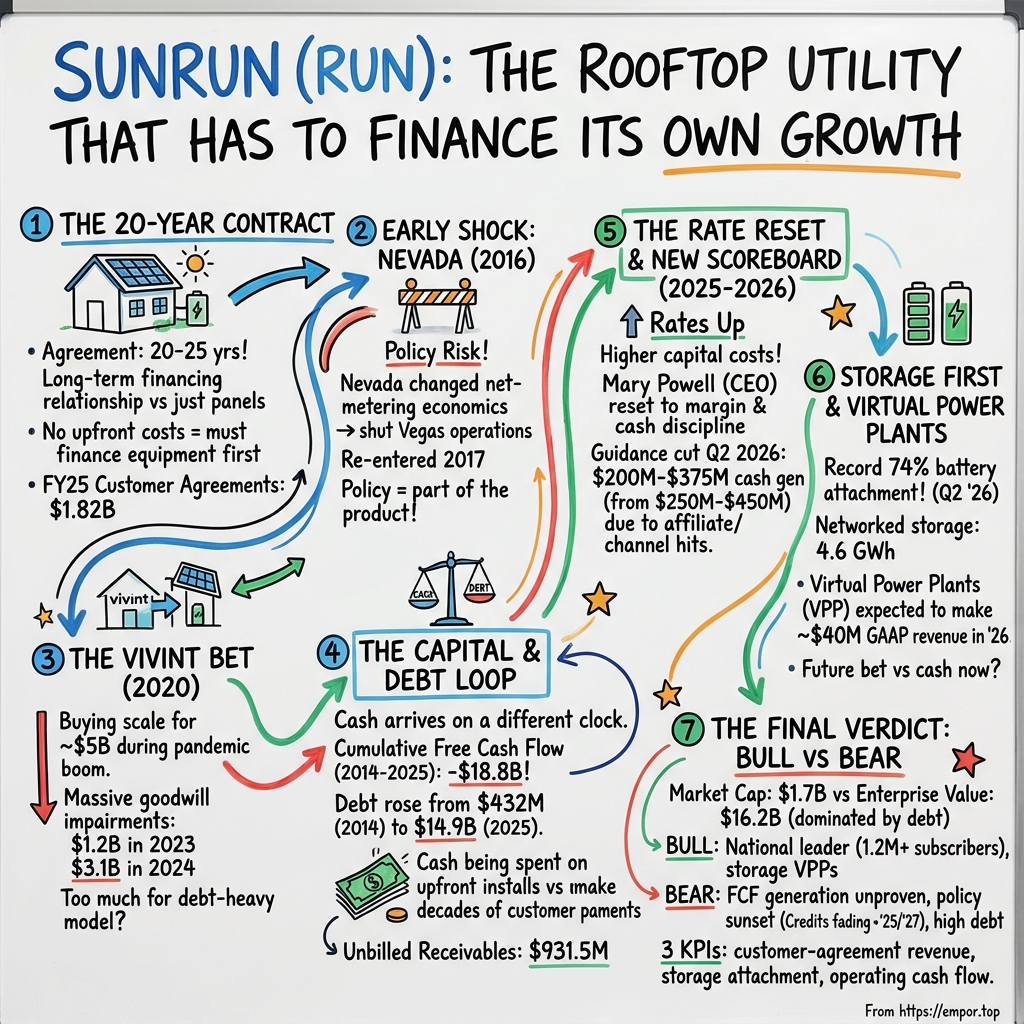
Sunrun: The Rooftop Utility That Has to Finance Its Own Growth
I. More Batteries, Less Cash
On August 5, 2026, Sunrun's management got on its second-quarter call with what looked like the best product news in the company's history. Of the customers who signed up for a Sunrun system that quarter, about three in four took a home battery as well as the solar panels. The attachment rate of 74% was a record.1 For a company that had spent close to two decades pitching itself as a new kind of utility, built one roof at a time, this was the number it had been working toward. A rooftop that only makes power at noon is a cheaper electricity bill. Add a battery that can store that power, release it in the evening and answer a call from the grid, and the rooftop starts to look like a small power plant.
Then, on the same call, management cut the number investors had been told to watch most closely. At the start of the year Sunrun had guided to between $250 million and $450 million of what it calls "Cash Generation" for 2026. Now the range was $200 million to $375 million.1 The quarter itself had produced $23 million of Cash Generation, or $45 million if you set aside $22 million the company had spent stockpiling equipment to protect future tax credits.1 The explanation came in three parts: less volume from the affiliate installers that sell systems Sunrun finances, a slower-than-planned ramp of Sunrun's own direct sales force, and capital that cost a little more than forecast.1 On the call, management tied part of the shortfall to the bankruptcy of Freedom Forever, one of those affiliate partners.2
That is the contradiction at the heart of Sunrun, and the reason it is worth a long look. The product is getting better. The cash is still lagging behind it.
The scale is not in doubt. By the end of June 2026 Sunrun served more than 1.2 million customers and had about 4.6 gigawatt-hours of batteries connected to its network.1 That is a fleet of household power plants larger than many regional utilities could claim to manage directly, spread across thousands of neighborhoods. Sunrun is, by its own description and by industry rankings, the largest residential solar company in the United States.
What is in doubt is what that fleet is worth to the people who own Sunrun's common stock, and the accounting does not make the question easy. In 2025 the consolidated company, which includes dozens of investment funds set up to finance its systems, recorded a net loss of about $1.0 billion. Yet the income attributed to Sunrun's common shareholders that same year was a profit of about $450 million.4 Both numbers are correct. They describe different slices of the same economic machine, and the gap between them is mostly the result of how losses are allocated to the outside investors who supply tax-equity capital. Anyone who reads only one of the two figures will misunderstand the company.
So the story of Sunrun is not a story about whether people want solar panels and batteries on their roofs. Over a million households have already said yes. It is a story about time. Sunrun spends most of the money for each system on the day it is installed, and the customer pays it back across two decades or more. Everything else, from the tax credits to the securitizations to the goodwill write-downs, follows from that timing gap.
Four tests run through this episode. The first is whether contracted revenue is turning into durable cash, rather than accounting income. The second is whether the model can withstand policy and financing shocks, because Sunrun has been hit by both before. The third is whether the 2020 purchase of Vivint Solar, the biggest bet in the company's history, delivered enough scale to justify its price. And the fourth is whether storage and grid services can create a genuinely new profit pool, or whether they remain an attractive option on the balance sheet.
Put more simply: what has to go right for a long-lived rooftop asset to pay its way? To answer that, start with the thing a homeowner actually signs.
 Subscribe on LinkedIn
II. The Contract That Turns a Rooftop into an Asset
Picture the moment of sale. A homeowner in California or New Jersey sits at the kitchen table with a sales representative, a tablet and a projected electricity bill. The pitch is not "buy these panels." It is closer to: let Sunrun put a power plant on your roof, keep it running, insure it and fix it if it breaks, and you pay Sunrun a monthly amount that should be less than what you pay the utility now. Little or no money changes hands that day. What changes hands is a signature on an agreement that typically runs 20 or 25 years.4
That signature is the product. Sunrun calls these arrangements customer agreements, and they come in a few forms. In a lease, the homeowner pays a fixed monthly amount for the use of the system, often with an annual escalator that raises the payment by a set percentage each year. In a power-purchase agreement, the homeowner pays for the electricity the panels actually produce, at an agreed rate per kilowatt-hour. In both cases Sunrun, or more precisely a fund Sunrun manages, owns the equipment, monitors it, maintains it and insures it for the life of the contract, and most agreements include a production guarantee.4 The homeowner gets cheaper or more predictable power without becoming a small power-plant owner. Sunrun gets a long stream of payments.
This was the founding idea. Lynn Jurich and Ed Fenster, who met at Stanford's business school, started Sunrun in 2007 around a simple observation: the barrier to residential solar was not that people disliked it, but that the panels cost tens of thousands of dollars upfront.6 Jurich later described the company's key innovation as "delivering solar as a service."7 Rather than sell a homeowner a product, Sunrun would sell a monthly bill. It was the same move that cable companies made with set-top boxes and that carmakers made with leases, applied to a piece of equipment bolted to a house for a quarter-century.
In 2025 these customer agreements and the incentives attached to them produced about $1.82 billion of Sunrun's $2.96 billion of revenue.4 The rest came from selling systems and products outright, a part of the business that becomes important later in this story.
Here is the catch, and it is the single most important thing to understand about Sunrun. The company has to pay for the panels, the inverter, the battery, the racking, the permit, the electrician and the sales commission before the customer pays the first monthly bill. In 2025 Sunrun paid about $2.50 billion in cash for energy systems, a sum equal to roughly 85% of its revenue that year.4 No ordinary company could fund that from its own operating cash flow. Sunrun does not try to.
Instead it runs a financing loop. Each installed system, with its contract attached, is placed into a fund. Tax-equity investors, often large banks, put money into those funds in exchange for most of the federal tax benefits the systems generate. Lenders provide project-level debt secured by the systems and their customer payments. Once enough contracts pile up, Sunrun bundles their cash flows into securitizations, bonds sold to institutional investors and repaid by thousands of homeowner bills.4 Each layer converts part of a 20-year promise into money today, and that money pays for the next round of installations. When it works, the company grows its fleet faster than its own balance sheet ever could.
This loop explains why Sunrun's reported revenue, its accounting earnings and the cash in its bank account can tell three different stories in the same year. Revenue from a customer agreement is recognized gradually as the service is delivered, so a system installed this year contributes only a sliver of revenue this year. The cost of building it, however, shows up in the cash-flow statement immediately, mostly as an investing outflow. The tax credits flow to fund investors, which changes how profits and losses are split between them and Sunrun's common shareholders. A growing company of this kind will almost always look worse on cash than on revenue, and its earnings can swing either way depending on allocations that have little to do with how many panels went up.
One accounting consequence deserves a plain explanation now, because it will matter later. Many customer agreements include an annual escalator, so the homeowner pays a little more each year. Under the accounting rules, Sunrun generally recognizes that rising stream of payments evenly across the life of the contract. In the early years it therefore books more revenue than it bills, and the difference accumulates on the balance sheet as an "unbilled receivable."4 That is not a homeowner who is late on a bill. It is the accounting gap between an evenly spread revenue line and a payment schedule that starts low and climbs. It is, however, a bet that the homeowner will keep paying for the years when billing catches up.
So the model's appeal is also its burden. A 20-year contract with a creditworthy homeowner can be an excellent asset, the kind infrastructure investors pay good money for. But Sunrun must finance the equipment, the installation and decades of servicing long before those cash flows arrive, and the value of the contract depends on the homeowner staying, paying and remaining satisfied that the deal still saves money. A contract can look valuable on paper and still need years of customer performance and access to funding to prove itself.
There is one more variable in that "still saves money" question, and Sunrun learned early and painfully that it does not control it. The customer's savings depend on what the local utility charges and what it pays for power sent back to the grid. Those numbers are set by regulators. In Nevada, at the start of 2016, they changed overnight.
III. Nevada's Sudden Stop
In January 2016 Sunrun announced it was shutting down all of its operations in Nevada.8 The decision meant hundreds of lost jobs in Las Vegas, and the company did not soften its explanation: it said the layoffs and the exit were the direct result of rules adopted by the state's Public Utilities Commission and of actions by the utility NV Energy and state politicians.8 SolarCity, then Sunrun's biggest rival, had already cut hundreds of Nevada jobs and stopped sales and installations there.8 Within weeks, one of the sunniest residential markets in the country had become one of the emptiest for rooftop solar.
To see why, go back to the kitchen-table pitch. A solar customer saves money in two ways. Power the panels produce and the house uses immediately offsets electricity the homeowner would otherwise buy. Power the panels produce when nobody is home flows back into the grid, and under "net metering" the homeowner receives a credit for it, often at or near the full retail price of electricity. That export credit is a large part of the savings. Late in 2015 Nevada's regulators approved a new rate structure that raised the fixed charges solar customers paid and cut the credit they received for exported power, and applied the changes over time.89 The regulators argued, as utilities often do, that net metering shifted grid costs onto customers without solar. Whatever the merits, the arithmetic of the Sunrun contract stopped working. If the homeowner's savings disappear, the 20-year agreement is no longer something a sales representative can honestly pitch.
Sunrun was by then a public company. It had filed to go public in June 2015 with a pitch built on exactly the proposition described above: make residential solar affordable without requiring a homeowner to buy a system outright, and finance the fleet through funds and debt.6 The prospectus laid out the risks of changing net-metering rules, as such documents do.6 Nevada turned that boilerplate into a lived event within months of the listing. For a young public company, it was a demonstration that a market's entire customer value proposition could be revised by a regulatory order.
The second act came a little over a year later. In June 2017 Nevada's legislature passed Assembly Bill 405, which restored homeowners' right to be credited for exported solar power at close to the retail rate, starting at 95% of it, and included what supporters called a solar bill of rights.9 Sunrun announced it would re-enter the state.9 Vivint Solar announced its own return.9 The same desert, the same rooftops and largely the same customers were attractive again, because the tariff had changed back.
That reversal is often told as a happy ending. It is better understood as the lesson. Sunrun could rebuild in Nevada, but it could not control the rule that decided whether the business worked there. Every one of its 20-year contracts depends on a comparison the customer makes between Sunrun's price and the utility's price, and the utility's price, along with what it pays for exports, is set by public authorities who answer to different constituencies.
The pattern did not stay in Nevada. California, Sunrun's largest market for most of its life, moved in 2023 to a new system that sharply reduced what rooftop solar customers were paid for exported power. Installers in the state reported a collapse in demand, and by early 2024 national coverage was asking whether the rooftop industry was on the verge of collapse.10 The new rules strengthened the case for adding a battery, because a battery lets a household store midday power and use it in the evening rather than sell it back cheaply. Part of the record storage attachment rate in the opening scene is a response to rules like these. The product shift was, in other words, partly forced by policy.
Then came the federal layer. Under the tax law signed on July 4, 2025, the residential clean energy credit, the 30% credit a homeowner could claim for buying a solar system, ended for expenditures made after December 31, 2025.11 Sunrun's 2025 annual report also describes an accelerated sunset of the investment tax credits used by third-party owners like Sunrun for solar projects after 2027, and new restrictions tied to equipment from foreign entities of concern.4 The first change, in principle, nudges customers away from buying systems outright and toward leases and power-purchase agreements, because the third-party owner can still claim a credit while the homeowner no longer can. The second change puts a clock on that advantage. Policy, in Sunrun's business, is not background. It is a line item in the customer's savings and in the company's cost of capital.
So by the end of the 2010s Sunrun had learned two things about its model. It could grow quickly by financing contracts, and any single market could be switched off by a regulator. The obvious response to local shocks is scale: be in so many places, with so many customers, that no single tariff decision can stop the machine. In the summer of 2020, Sunrun went out and bought that scale.
IV. The Vivint Bet Bought Scale—and a Large Goodwill Bill
On July 6, 2020, with much of America still locked down and the stock market rallying hard on anything with "clean energy" in its description, Sunrun announced that it would acquire Vivint Solar in an all-stock deal.12 Vivint, based in Utah, was a smaller residential solar company built largely on door-to-door sales. Sunrun said the transaction valued Vivint at about $3.2 billion of enterprise value, including debt, and that the exchange ratio represented a 10% premium to Vivint's closing share price.12
The strategic pitch was easy to understand. Residential solar was a fragmented market of national players, regional installers and thousands of local electricians. Sunrun argued that combining the two companies would add customers, sales reach and operating scale, lower the cost of acquiring each new subscriber, and give the merged company more weight with suppliers and capital providers.12 In plain English, the deal would make the biggest residential solar company a lot bigger, and Sunrun argued that bigger meant a cheaper machine for turning signatures into financed systems. After Nevada, there was an obvious appeal to having a fleet so wide that no one state could stall it.
The numbers on the balance sheet show how large the bet was. Sunrun's shareholders' equity jumped from under $1 billion at the end of 2019 to about $6.1 billion at the end of 2020, almost entirely because the company issued new shares to pay for Vivint.13 Borrowings roughly doubled over the same year, from about $2.6 billion to about $5.2 billion, because Vivint came with its own project debt.13
There is an important distinction hiding in those figures. The $3.2 billion headline at announcement was an enterprise value based on share prices in early July. Because Sunrun paid in stock, and because Sunrun's stock soared during the second half of 2020, the value of what it actually handed over had grown considerably by the time the deal closed later that year. The acquisition-date accounting, recorded in Sunrun's later filings, put the purchase consideration at about $5.04 billion.13 Those two numbers describe different things at different moments and should not be treated as interchangeable. But the second one is what went onto the balance sheet, and much of the excess of that price over the fair value of Vivint's identifiable assets became goodwill: the accounting placeholder for expected synergies and future profits that cannot be tied to specific panels or contracts.
Was it a good price? The closest landmark is Tesla's purchase of SolarCity, which closed in November 2016 in an all-stock deal valued at about $2.6 billion.14 That deal was famous for its own controversy, but it is not a clean comparison. It came four years earlier, in a different rate and policy environment, involved a buyer whose main business was cars, and was valued on an equity basis rather than the enterprise basis Sunrun used for Vivint. No reliable peer multiple settles the question.
What does settle much of it is what happened next. In 2023, after rising interest rates and the California policy change had pushed down the value of new solar customers and the company's share price, Sunrun recorded a goodwill impairment of about $1.2 billion, visible in a third-quarter operating loss of roughly $1.3 billion.15 In the fourth quarter of 2024 it recorded another, about $3.1 billion, which accounted for most of that year's $3.7 billion operating loss.16 Together the two charges exceeded $4 billion, close to the entire purchase-accounting value of the deal.
An impairment is not a cash outflow. Nobody wrote a $3.1 billion check in December 2024. What an impairment does is admit, in the formal language of accounting, that the future economics management expected when it booked the asset will not materialize at the value it carried. The write-downs measured the combined business, not Vivint's operations in isolation, so it would be unfair to read them as proof that every operating benefit of the merger failed. The combined company did become the larger residential installer, and its subscriber count and fleet kept growing. But it would be equally wrong to treat the charges as noise. When an acquirer writes off goodwill roughly equal to the stock it issued, it is telling investors that, in hindsight, the price was not supported by the durable synergies used to justify it.
The deal also did not change the basic machinery. Bigger did not mean self-funding. The combined company still depended on the same financing loop, and its borrowings kept rising long after the merger closed. Vivint added scale to a capital-intensive model; it did not convert that model into one that could pay for its own growth.
So the verdict on Vivint narrows the scale thesis rather than rejecting it outright. Scale helped Sunrun become the market leader and arguably made it more resilient to any single market's shocks. It did not buy a cheaper cost of capital, protection from rate shocks or a business whose value held up at the price paid. The question that matters more is the one underneath: even a perfectly priced acquisition would only pay off if the contract engine itself eventually turned into cash. So follow the cash.
V. The Cash Arrives on a Different Clock
Imagine a single system going up on a roof in Phoenix. On installation day Sunrun has already paid for the panels and the battery, the crew, the permit, the inspection and the sales commission. The homeowner's first bill arrives a month later and is modest. The rest follows the financing loop that turns those long-term promises into money today.
Now multiply that by hundreds of thousands of systems a year, and you have the Sunrun cash-flow statement.
Over the twelve years from 2014 through 2025, Sunrun's free cash flow, operating cash flow minus capital spending, added up to about negative $18.8 billion. Operating cash flow alone was about negative $4.7 billion over the same span.4 In 2025 operating cash flow was negative $421 million.4 There was no year in that period in which operating cash flow was positive. Financing inflows filled the hole every single year; cash from financing activities ran at more than $3 billion a year from 2022 through 2025.4
That sounds damning, and for an ordinary business it would be. But it is not a standalone verdict on a company whose explicit strategy is to build a fleet of long-lived, contracted assets. A toll-road developer building a new highway also has deeply negative free cash flow during construction. The right question is not whether the cash flow is negative while the fleet grows, but whether the assets being built will produce more cash than the capital raised to build them, after paying the lenders and fund investors who stand in front of the common shareholder. That depends on three things: the terms of the funding, how the customers actually behave, and how much cash is left over after project obligations. Every serious argument about Sunrun is an argument about one of those three.
Start with the customers, because they are the foundation. At the end of 2025 Sunrun carried about $262.6 million of billed accounts receivable, net of an allowance, of which about $191.6 million was owed by customers.4 Next to that sat $931.5 million of unbilled receivables, up from about $682 million a year earlier.4 These are the escalator balances from the kitchen-table contract. But they are large and growing, and they will only turn into cash if homeowners keep paying for years. The allowance against the billed balances rose from about $15.4 million to $20.7 million over 2025, and Sunrun does not require collateral.4
The credit evidence so far is reassuring, with a caveat. As of June 2026, Sunrun said customers on monthly payment plans had an average FICO score at or above 740, comfortably in the "very good" range, and that defaults to date had been immaterial.3 The independent evidence points the same way. In May 2025 the rating agency KBRA reviewed 25 classes of notes across 12 Sunrun solar securitizations and affirmed all of them, noting that the notes had received timely interest and scheduled principal payments and that credit enhancement remained sufficient.17 That is evidence about the performance of those specific asset-backed pools, not a rating on Sunrun the company, but it does suggest homeowners have been paying. The decisive test, however, is long-run cohort data: how many customers from a 2016 or 2019 cohort are still paying in year ten or fifteen, how many sold their homes and transferred the contract, how many defaulted. Sunrun does not publish that cohort-level loss and renewal history, and it is the evidence that would settle whether the unbilled balances are as good as they look.
Now the earnings puzzle from the opening scene. How did Sunrun report a consolidated net loss of about $1.0 billion in 2025 while attributing about $450 million of profit to its common shareholders?4 The answer lies in the funds. Tax-equity investors receive most of the tax credits and accelerated depreciation in the early years. Under the accounting method Sunrun uses to divide fund income, those investors are allocated large losses in the early life of a fund, losses that reflect the tax benefits they have already received. Those losses sit in the "noncontrolling interests" line, so they are excluded when calculating the income attributable to common shareholders. Sunrun's auditor identified the valuation of these noncontrolling interests as a critical audit matter, a signal that the estimates involved are complex and judgment-heavy.4 Add a $196.6 million tax benefit from Sunrun's share of the proceeds of selling investment tax credits to third parties, and the positive common-shareholder figure becomes less mysterious and also less useful as a gauge of operating economics.4
The cash on the balance sheet needs similar care. At the end of 2025 Sunrun reported about $1.2 billion of cash and short-term investments, but only about $823 million of that was unrestricted cash; the other $414 million was restricted cash, held inside financing structures for specific purposes and not freely available to the corporate parent.4
And then there is the debt. At the end of 2025 total borrowings were about $14.9 billion.4 The great majority, about $14.0 billion, was non-recourse debt, meaning it was secured by specific pools of systems and customer contracts rather than by Sunrun the corporation.4 If a pool underperforms, lenders can go after that pool, not the parent's other assets. That structure is a real protection, and it is why a reader should not compare Sunrun's leverage directly with that of an industrial company. But not everything sits in the project boxes. Sunrun also had a $238 million corporate line of credit and about $474 million of convertible notes, and its corporate facility carries quarterly leverage, liquidity and coverage covenants.4 Interest expense in 2025 was about $997 million, almost a billion dollars a year paid for the privilege of owning a fleet ahead of its cash.4 The company repaid its 2026 convertible notes on February 2, 2026, and said it was in compliance with all debt covenants at June 30, 2026.3
Asset-level debt can be non-recourse, in other words, but the company is not immune to the capital markets. Every new cohort of customers needs new funding, and the price of that funding sets how much value each new customer actually creates. Which raises the question that dominated the next chapter: what happens to a model like this when money stops being cheap?
VI. Rates, Impairments and a Change in the Scoreboard
For most of Sunrun's public life, money was cheap. Interest rates sat near historic lows from the 2008 financial crisis until early 2022, and a business that borrows against twenty-year cash flows is, at bottom, a business whose margins are set by the gap between what its customers pay and what its capital costs. When the Federal Reserve began raising rates in 2022, that gap narrowed fast.
The balance sheet shows the slow build-up of exposure. Sunrun's borrowings rose from about $432 million at the end of 2014 to about $14.9 billion at the end of 2025, compounding at more than 35% a year across the decade, much faster than shareholders' equity.4 Debt-to-equity, which had briefly dropped below 1 after the Vivint share issuance, climbed to about 5.1 by the end of 2024 and stood at about 4.75 a year later.4 Part of the rise in that ratio reflected the debt itself; part reflected equity shrinking as impairments wiped out book value.
The deterioration of 2023 and 2024 should be read carefully, because it mixed two very different things. The first was a real change in the economics of new customers. Higher rates raised the cost of the tax equity, debt and securitizations that funded every system, so each new contract was worth less to the common shareholder even if the homeowner signed at the same price. California's new export rules cut demand in Sunrun's biggest state.10 Revenue fell in 2023 and again in 2024, from about $2.3 billion to about $2.0 billion.4 The second thing was the accounting acknowledgment of that change: the goodwill impairments that followed the Vivint chapter. The 2024 operating loss of about $3.7 billion looks catastrophic, but most of it was the $3.1 billion noncash charge.16 By 2025 the operating loss had narrowed to about $126 million.4 Mistaking the impairment for cash burn would overstate the damage; ignoring it would overlook what it said about earlier expectations.
Watching management through that period is instructive. In 2023, Sunrun's message to investors still leaned heavily on subscriber value, the company's estimate of the present value of the cash flows each new customer would produce, and on aggregate growth in that value.5 Subscriber value is a useful concept, but it is a model output that depends on assumed discount rates, default rates and renewal rates. Around the time of the 2023 slowdown and the first impairment, the company's emphasis shifted toward a new headline measure: Cash Generation, a non-GAAP figure meant to capture the cash the business actually produced after project financing.515 That was a meaningful change in the scoreboard. A company that had asked investors to value its future now asked them to judge its present.
The person steering that shift was Mary Powell. She had joined Sunrun's board in February 2018 and became chief executive on August 31, 2021, succeeding co-founder Lynn Jurich, who moved to executive co-chair.19 Powell's background was the opposite of a solar start-up's. She spent two decades at Green Mountain Power, a Vermont electric utility, rising from senior vice president to chief executive, a role she held from 2008 to 2019.20 At Green Mountain she became known as an unusual utility boss, one who pushed the company toward home batteries, customer-sited energy and carbon-free supply, and who led its merger with Central Vermont Public Service, then the state's largest utility.20 Before that she had worked in banking and in state government.20 Her selection made a statement. Sunrun's founders had built a financing and sales machine; the board handed it to someone who had spent her career running a regulated utility and thinking about how distributed batteries could serve a grid.
Powell arrived just before the rate shock, which means the most difficult years of Sunrun's history have been on her watch. Her decisions in that period were not about inventing the model but about reshaping it under pressure: leaning harder into storage as California's rules changed, emphasizing margin over volume, and making Cash Generation the target investors should hold management to. By 2026 the company's language had changed noticeably from the growth-first rhetoric of the early 2020s. Management talked about scaling deliberately and about prioritizing customer experience and asset quality, framing slower subscriber growth as a choice rather than a failure.15
That framing deserves a skeptical reading. Some of the restraint was clearly voluntary: chasing volume at thin margins in a high-rate world would have destroyed value. Some was not: demand was weaker in key markets and capital was dearer. Management's own record also includes the period when it described a valuable growing subscriber base just before writing billions off the goodwill attached to it. The course correction toward margin and cash was necessary, and the direction is the right one for a business with this capital structure. Its credibility, though, depends entirely on delivery, and delivery means real cash in the years ahead, not the language used to describe it.
By the middle of 2025 the next test was already arriving. The July 2025 tax law ended the homeowner's solar credit and set a clock on the third-party credits that underpinned Sunrun's leases.114 The company would have to shift its offer and its customer mix quickly, in a market where rivals were scrambling too. That is the competitive arena the next part of the story enters.
VII. The Largest Installer Still Faces a Fragmented Market
If you want to understand the residential solar market, think less about utilities and more about home renovation. There is no single dominant brand. A homeowner who wants panels can call Sunrun, sign with a regional installer, buy a system from a local electrician with a bank loan, order from Tesla, or decide that the utility bill is fine as it is. The industry is crowded, low on barriers to entry at the sales level, and prone to booms and busts.
In that market Sunrun is the clear leader, though its share fell. Wood Mackenzie, the energy research firm, estimated that Sunrun installed 12.7% of the country's residential solar capacity in 2025, down from 13.6% in 2024.21 The second-ranked installer, Freedom Forever, held about 6.1%.21 Being twice the size of your nearest rival sounds commanding. But it also means that almost nine in ten residential systems were installed by someone else. The quarterly pattern was even more uneven: Sunrun's share moved from about 15.3% in the third quarter of 2025 to about 10.8% in the fourth.21 Some of that swing reflected the timing of policy-driven installation rushes and industry-wide disruptions. Either way, it is not the profile of a company tightening its grip on a market.
The forces around Sunrun explain why. Buyers have real power at the moment of sale. A homeowner can compare quotes from several installers, compare a lease with a loan or a cash purchase, and weigh the whole thing against simply staying with the utility. Utilities and regulators, as Nevada and California showed, influence the savings that make any of these offers attractive. Competitors range from national players to Tesla, which inherited SolarCity's residential business in its 2016 deal, to the thousands of local installers who can sell a system with a loan and no long-term servicing commitment.14 There is no single national share leader with a locked-in customer base. Freedom Forever, ranked second nationally in 2025, went bankrupt in 2026.2
What, then, is Sunrun's advantage? The honest answer begins with what is real. It has national scale, a fleet of about 1.21 million subscribers, and the servicing operation to support them.1 It has a decade and a half of relationships with tax-equity investors, lenders and securitization buyers, and a track record that rating agencies and bond buyers can examine. It can offer leases, power-purchase agreements and storage in many states at once. Those are genuine capabilities, and a new entrant could not replicate them quickly.
But reach and servicing capacity are not the same as pricing power. Sunrun's customers are won before the system goes on the roof, at a moment when they can still pick a rival's offer. Once installed, a 20-year contract with equipment bolted to the house creates real friction: switching is impractical, and the customer is effectively locked in for the life of the agreement. That lock-in protects the cash flows of existing customers. It does nothing to win the next one. The competition that matters, for new subscribers, happens at the kitchen table, where Sunrun's scale shows up mostly in its cost of capital and its marketing reach rather than in a product homeowners cannot get elsewhere.
The supply side tells a similar story. Sunrun relies on a limited number of suppliers for panels, batteries and other components, and it does not disclose how much it buys from its largest suppliers.4 Being the largest buyer in the residential channel plausibly earns better terms, but the filings do not quantify a measured cost advantage, and the new foreign-entity restrictions in the 2025 tax law could make some sources harder to use.4 A scale buyer that cannot name its savings has a hypothesis, not a proven edge.
The cleanest test of whether scale is turning into advantage is share over time. If Sunrun's size really made it the low-cost, most trusted provider, it should be gaining share as weaker installers struggle. Instead, in a year of policy turmoil when competitors were under pressure, its share fell by about a percentage point. That does not reject the scale thesis, but it narrows it. Sunrun's broad installed fleet and financing capability matter, and they make it the most likely survivor in a brutal market. Whether they give it bargaining power over customers is unproven, and the evidence so far suggests they do not. The things to track are market share, customer additions and the price Sunrun realizes per new subscriber.
There was, however, one way in 2025 that Sunrun's revenue jumped far faster than its share. It had found a new kind of buyer.
VIII. Growth That Moved into System Sales
In 2025 Sunrun's revenue rose 45% to about $2.96 billion, its fastest growth in years.4 For a company coming off two years of declining sales, impairments and a crushed share price, that looked like a turnaround. The fourth quarter alone produced about $1.2 billion of revenue, more than double the same quarter a year earlier.4
The headline obscured the mechanism. Customer-agreement revenue, the recurring stream from leases and power-purchase agreements, grew a healthy 21%.4 The rest of the jump came from somewhere else. Energy-system and product sales contributed about $1.14 billion of revenue, and a single customer accounted for about $684 million of system sales, roughly 23% of the company's total revenue.4 That customer was not a homeowner and not a controlling shareholder. It was a third-party investor that bought newly originated systems in a transaction that began in the third quarter of 2025.4
Why would Sunrun sell systems to an investor rather than keep them in its own funds? The logic is financial. Selling a system, with its customer contract, to an outside buyer converts twenty years of expected payments into a sale price today. Under the accounting rules, that sale is recognized as revenue largely at once, rather than spread across the life of the contract. It brings cash in faster and reduces the amount of capital Sunrun must raise for those systems. In a high-rate world, it is a sensible way to recycle capital. But it also means that a surge in reported revenue can happen without any equivalent increase in Sunrun's own long-term customer base, because the customers whose systems were sold now generate cash flows for someone else.
That distinction matters for anyone trying to read Sunrun's growth. Total revenue in 2025 grew more than twice as fast as customer-agreement revenue, so the headline overstates the improvement in recurring customer economics. And the buyer concentration introduces a new kind of dependence. If one investor accounts for nearly a quarter of revenue, then that investor's appetite, pricing and terms become a material variable. The relationship continued into 2026, with system sales to a third-party investor or joint venture driving much of the revenue growth in the first half.3 Sunrun did not disclose any termination or dispute with the buyer, but a single large purchaser of systems has bargaining power over the price, and the price determines how much value Sunrun captures from each sale.
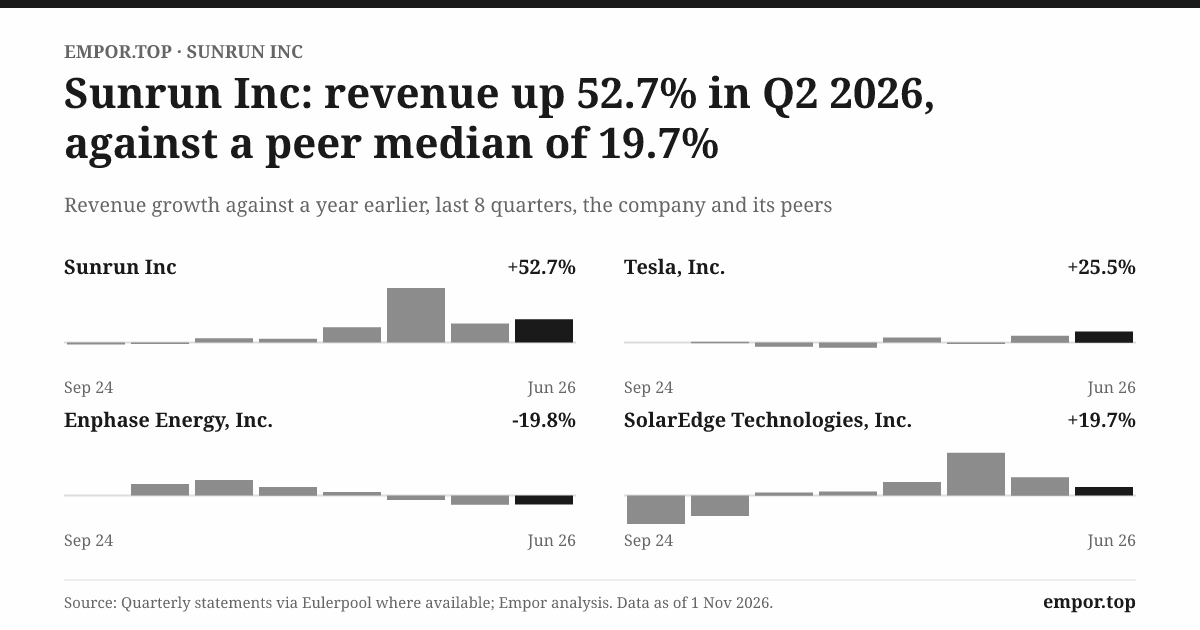
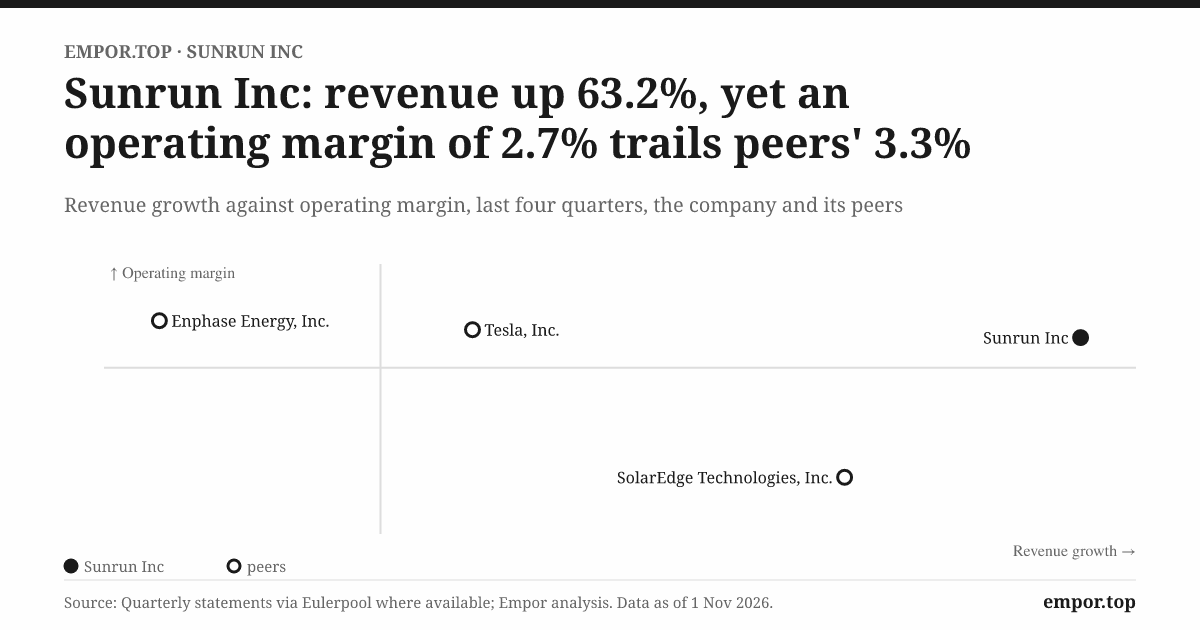
The operating data from 2026 sharpened the point. Second-quarter revenue rose about 53% from a year earlier, to about $869 million, and operating income was positive at about $35 million.1 Yet Sunrun added 19,793 subscribers in the quarter, compared with 28,823 a year earlier, a drop of roughly a third.3 Revenue was soaring while customer additions were falling. That combination is only possible when the revenue is coming from transactions rather than from a growing subscriber base. Management also trimmed its guidance for aggregate subscriber value, its estimate of the total value created by new customers in the year, to between $4.6 billion and $4.9 billion from $4.8 billion to $5.2 billion.2
None of this means the 2025 rebound was illusory. Customer-agreement revenue really did grow 21%, and selling systems to a well-capitalized buyer can be a legitimate, value-creating way to fund growth. But it does mean that total revenue is the wrong number to judge Sunrun by. Subscriber additions and customer-agreement revenue are better tests of underlying momentum, and on the first of those, 2026 so far has been weak.
The question is whether Sunrun's next growth engine can avoid the same pattern, growing without recreating the capital demands and concentration that come with financing or selling ever more systems. Its best candidate is already sitting on its customers' walls.
IX. Storage First, Grid Services Later
Go back to the battery from the opening scene. By the second quarter of 2026, battery uptake had reached a record.1 Across the fleet, its connected storage capacity could, if discharged at once, supply power for a few hours on the scale of a large conventional power plant.1 No single power plant sits behind it. It is a fleet of refrigerator-sized boxes in garages, each owned through a Sunrun fund, each connected to the company's software.
Storage fits the existing business naturally, which is why the attachment rate has climbed. For the customer, a battery provides backup power during outages, a selling point in regions prone to wildfire shutoffs and storms. Under export rules like California's, it also raises the value of the solar system by letting the household store midday power for the expensive evening hours instead of selling it back cheaply. For Sunrun, a battery raises the value of each customer contract, deepens the relationship, and turns an installed asset into something the grid can use.
That last point is the grid-services story. When thousands of batteries are coordinated, they can act together as what the industry calls a virtual power plant, and what Sunrun calls distributed power plants. On a hot summer evening when the grid is strained, a utility or grid operator can pay Sunrun to discharge its customers' batteries, reducing the need to fire up an expensive peaking plant. The homeowner usually gets a share of the payment, and the grid gets capacity it did not have to build.
This is where the distinction between technical scale and commercial scale matters. A gigawatt-hour of connected batteries is capacity. It is not revenue until a utility or market operator pays to use it, and it is not profit until that payment exceeds the cost of running the program and compensating customers. Sunrun expected its distributed power plants to generate about $40 million of gross revenue under GAAP and more than $10 million of operating margin in 2026.1 That is real money and a meaningful step from pilots to paid programs. It is also small next to a business with roughly $3.5 billion of revenue over the past twelve months, well under 2% of it.3
Management saw a larger future. In the second-quarter release, it described a distributed-compute pilot and a letter of intent with Renew Home and Tesla, part of a broader push to monetize its fleet in areas like capacity markets and data-center demand.1 These are interesting possibilities, and the logic is sound: as electricity demand grows, especially from data centers, flexible capacity near the edge of the grid could become more valuable. But a pilot and a letter of intent are not revenue, and the company's own descriptions framed them as expansion plans, not established businesses.1 Sunrun's history offers little evidence either way on how quickly it can convert grid-service milestones into material revenue, because the business is still too young to have a track record. That uncertainty is a reason to treat the grid-services story as an option, not a pillar of the current valuation.
There is also a dependency to watch. Grid-services revenue requires customers to keep enrolling and to allow their batteries to be dispatched, and it requires utilities and regulators to keep designing programs that pay for distributed capacity. The same regulatory exposure that hit solar exports could, in principle, affect how grid services are compensated.
The test, then, is simple to state. Watch the storage attachment rate, which signals whether the core offer is strengthening. Watch customer participation in grid programs, which signals whether the fleet can actually be mobilized. And watch realized grid-services revenue and margin, not announced capacity. If the $40 million grows into hundreds of millions with healthy margins, the fleet becomes a genuinely new source of cash. If it stays small, storage remains an improvement to the core product rather than a new business.
All of which brings the story to the people running it, and to whether their targets and incentives keep these bets tethered to cash.
X. Powell's Scoreboard: Cash, Customers and Credibility
The guidance cut in August 2026 did not come out of nowhere. Three months earlier, on the first-quarter call, management had held its 2026 Cash Generation range at $250 million to $450 million.5 By the second-quarter call the assumptions behind that range had moved. Affiliate-channel volumes were lower, partly because Freedom Forever had gone bankrupt. Sunrun's own direct-sales ramp was taking longer than planned, as newly hired representatives took time to become productive. And capital costs had come in modestly higher than forecast.12 The new range was $200 million to $375 million, a cut of roughly $50 million to $75 million at either end.1
There is a credit and a debit in how management handled it. The credit: the explanation was specific. Management named identifiable operating and capital-market pressures rather than leaning on vague references to market conditions, and it tied the shortfall to channels and costs that investors can track in future quarters. Management also told analysts it expected Sunrun to exit the year at a robust growth rate and with higher unit margins once the expanded sales force reached full productivity.23 The debit: it was still a miss against an outlook reaffirmed only one quarter earlier, and the recovery case rests on a sales ramp that had already slipped once. The useful question for investors is not whether the explanation was reasonable, but whether the next reported cash outcome lands inside the new range.
Incentives point in the right direction. Mary Powell's 2025 base salary was $850,000, and her annual cash bonus was about $1.70 million, alongside equity awards.22 The company's annual incentive program used adjusted net subscriber value and Cash Generation as metrics, and the 2025 plan made a minimum Cash Generation threshold a condition for paying out on the largest bonus metric.22 That is a sensible design for a business whose central problem is converting value into cash: it puts management's pay behind the same scoreboard investors are told to watch.
Two qualifications follow. First, pay continued through a year in which the consolidated company lost about $1.0 billion. That partly reflects the allocation mechanics explained earlier, but it is the kind of fact shareholders notice. Second, Powell's reported beneficial ownership is below 1% of Sunrun's shares.22 Her alignment with common shareholders comes mainly through performance pay rather than a large personal stake. There is no founder-owner here whose wealth rises and falls with the stock in the way it would at a company like Tesla.
Shareholders signaled their view. The 2025 say-on-pay vote received only 67.6% support.22 In a market where most large companies win such votes with more than 90%, a third of votes against is a meaningful dissent. Sunrun reported that it engaged with shareholders afterward and made changes to its plans.22 The vote is best read not as a revolt but as a trust signal: a significant share of the people who own the company were not convinced that pay was matched to results.
The longer record matters for weighing current credibility. In 2023, management's language about subscriber value and growth gave way to a slowdown, guidance revisions and the first goodwill impairment.515 The company then adopted a cash-focused scoreboard and, to its credit, has reported against it consistently. The 2026 cut is the first significant test of whether that scoreboard is a discipline or a marketing device, and the honest answer is that one quarter cannot tell. A specific miss with a clear explanation is better than a vague one. It is still a miss.
Credibility in a business like this is not built with language. It is built with forecasts that turn out to be right and with cash that shows up when promised. The current management regime has pointed the company toward the right goals; whether it can reliably hit them is what the next few reported quarters will show.
That brings the story to the market's own verdict, written in a share price that has fallen a long way.
XI. Analysis & Bear vs. Bull Case
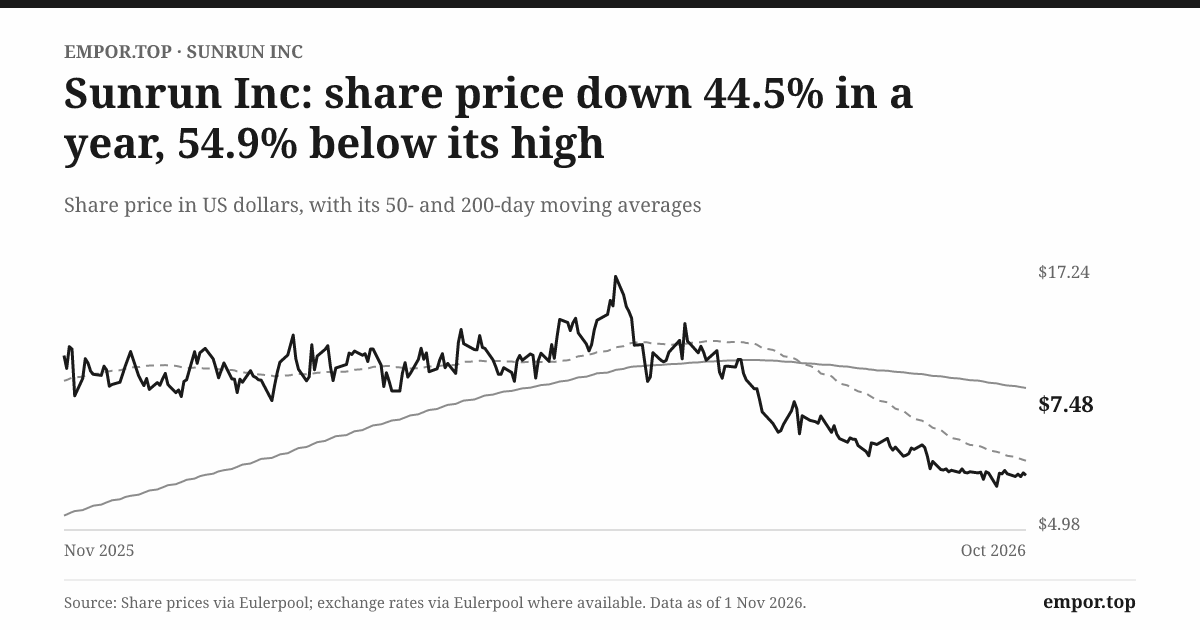
On November 1, 2026, Sunrun's shares closed at about $7.48, roughly 55% below their 52-week high of about $16.58. Over the previous five years the stock had at one point fallen about 90% from its peak. The company's market value was about $1.7 billion. Its enterprise value, which adds the debt and other claims ahead of common shareholders and subtracts cash, was about $16.2 billion. That ratio tells the whole story of the capital structure in one comparison: the common equity is about a tenth of the total value of the enterprise. Nearly everything else belongs, in one form or another, to lenders, bondholders and fund investors.
The multiples are a hall of mirrors. The stock traded at about half its book value and about 4.7 times sales on an enterprise basis. On operating profit, enterprise value was about 176 times trailing earnings, a number made meaningless by how thin and volatile operating profit has been. The price-to-earnings ratio was about 22 times, but the "earnings" are the common-shareholder income that sits alongside a consolidated loss, inflated or deflated by fund allocations and tax-credit proceeds. Free-cash-flow yield was deeply negative, which is what you would expect from a company still building its fleet. None of these numbers can be compared cleanly with Sunrun's own history or with peers, because system-sale revenue, fund accounting and volatile profits distort them. No reliable historical or peer multiple establishes whether the stock is cheap or expensive. What the price does appear to assume is that the value of the contracted fleet, net of the claims ahead of common shareholders, is modest, and that the market does not trust the company's own estimates of subscriber value.
Start with the case for winning. Sunrun combines sales, installation, long-duration servicing and financing access in one company, and it runs one of the largest residential fleets in the country, with about 1.2 million customers.1 Its securitizations have performed, according to KBRA's 2025 review, and its customers have strong average credit scores.173 Storage attachment is rising, which deepens the customer offer and creates a fleet that could earn grid-services income no ordinary installer can match. The federal tax changes, while painful, remove the homeowner's credit for buying outright and so in principle favor the third-party ownership model in which Sunrun specializes, at least until the third-party credits sunset. Management has shifted to a cash scoreboard, and its incentives are tied to it. In 2026 the company was still able to raise about $1.5 billion of non-recourse asset-level debt by August, including a $267 million securitization priced that month, which shows capital markets remain open to it.118
Now the case against. From 2014 through 2025, free cash flow was deeply negative every year and added up to about negative $18.8 billion.4 Debt grew far faster than equity over the decade, and the company paid close to a billion dollars of interest in 2025.4 Its model depends on capital markets to turn future customer payments into present investment, which makes it a hostage to interest rates and investor appetite. Its biggest acquisition ended in more than $4 billion of goodwill write-downs.1516 It lost market share in 2025, and its subscriber additions fell by about a third in the second quarter of 2026.213 A single system buyer accounted for nearly a quarter of 2025 revenue.4 And policy hangs over everything: the homeowner credit ended for new expenditures after 2025, the third-party investment credits are on an accelerated sunset after 2027, and new foreign-entity restrictions could complicate supply.114
Running the industry through Michael Porter's five forces sharpens the picture. Buyer power is significant: homeowners can compare offers before signing, and the single large system buyer has leverage over price. Supplier power is moderate to significant: Sunrun depends on a limited number of panel and battery suppliers, and policy restrictions could narrow the field. The threat of substitutes is real: utility power is always the default, and a homeowner can buy a system with a loan instead of a lease. The threat of new entrants at the sales level is high, because a local installer needs little capital to start selling, though entry into long-term financing and servicing is much harder. Rivalry is intense and cyclical, as the bankruptcy of the number-two installer in 2026 showed. This is not an industry structure that naturally rewards incumbents with high returns.
Hamilton Helmer's seven powers offer a stricter test, because each power must produce both a benefit and a barrier. Scale economies are the most plausible: Sunrun's size should lower its per-customer cost of servicing, financing and procurement, and its lead in residential volume is roughly double its nearest rival's. But the evidence of a measured cost advantage is thin, and share loss suggests scale is not translating into a pricing edge. Switching costs are real for installed customers but irrelevant at the point of sale, which is where growth is decided. Network economies are absent today, though a large coordinated battery fleet could become more valuable to grid operators as it grows, a potential power that depends on the still-small grid-services business. Counter-positioning was arguably Sunrun's original power, when it sold solar as a service while incumbents sold panels, but it has long since been copied. Brand helps, but homeowners compare quotes. There is no cornered resource. Process power, embedded know-how in originating, financing and servicing contracts at scale, is the most defensible quiet advantage: Sunrun's fifteen years of fund and securitization experience are not easily replicated. Weighed honestly, Sunrun has a leading position and some genuine process and scale advantages, but not a moat strong enough to guarantee attractive returns on new capital. The advantage is intact but unproven.
The risks worth tracking follow from that analysis. Policy and cost of capital come first, because they set the economics of every new customer. Execution comes next: subscriber additions fell and Cash Generation guidance was cut, so the direct-sales ramp and the replacement of affiliate volume are the operational tests.13 Asset quality is the slow-moving risk: billed delinquencies, write-offs and cohort performance must hold up against the assumptions behind the growing unbilled balances. And the concentration in system sales needs watching, both in the buyer's share of revenue and in whether more buyers emerge.
Three numbers carry most of the weight. The first is customer-agreement revenue growth, which was 21% in 2025 and is the cleanest measure of whether the recurring base is expanding.4 The second is subscriber additions alongside storage attachment: the first fell to 19,793 in the second quarter of 2026 from 28,823 a year earlier, while the second rose to a record 74%.31 The third is operating cash flow after system creation, read alongside the company's own Cash Generation guidance: GAAP operating cash flow was negative $186 million in the second quarter of 2026, while Cash Generation was positive $23 million, and the gap between those two measures is itself something to watch.1
An activist would not need a campaign to ask the obvious question. If Sunrun really owns a valuable fleet of contracted assets, as its subscriber-value estimates suggest, when does that fleet produce cash for common shareholders without the company repeatedly going back to capital markets? A skeptical investor might also press on disclosure: publish cohort-level performance, reconcile common-shareholder earnings to consolidated economics, and show how much cash is left after project obligations. Those are the answers that would close the gap between what management says the fleet is worth and what the market is willing to pay.
XII. Playbook: Business & Investing Lessons
Go back to that first kitchen-table signature in 2007 and follow it forward. It became a fund, then a securitization, then a cohort. The model was nearly switched off in Nevada, absorbed into a merger that later wrote off its goodwill, and finally fitted with a battery that could serve the grid. Five lessons fall out of that journey, and they belong to Sunrun.
The first lesson: a long contract is only as strong as the financing behind it. Sunrun has to pay for the system long before the contract pays it back, so its value moves with the price of the money used to fund it. Founders who build businesses on long contracts should remember that the duration of the promise is also the duration of the exposure. Investors should value the financing, not just the contract.
The second lesson: policy is part of the product. Nevada's reversal, California's export rules and the 2025 tax law showed how quickly regulation can change the economics of Sunrun's offer. For any business whose customer savings are set by a regulator, the regulator is effectively a co-designer of the offer. A company in that position should price policy risk like a supplier it cannot fire, and investors should treat any growth that depends on a single rule as borrowed rather than earned.
The third lesson: scale can widen the business and still miss the price. Vivint gave Sunrun a larger residential footprint, followed by more than $4 billion in goodwill write-downs. Both are true at once. Getting bigger in a fragmented, capital-intensive market can be strategically right and financially wrong, because scale does not change the underlying economics of each customer. The lesson for acquirers is that buying more of a model is not the same as improving it. The lesson for investors is that a merger's value is measured by what the combined company earns on the price paid, not by the size of the combined company.
The fourth lesson: capacity is not cash until someone pays to use it. Sunrun's batteries form a large distributed storage fleet, but the company expected only a modest grid-services revenue stream in 2026. The gap between those two measures is the gap between an engineering achievement and a business. Technology companies, energy companies and anyone building platforms tend to celebrate installed capacity, users or connected devices. The only number that matters in the end is how much someone is willing to pay to use them, and how reliably.
The fifth lesson: a specific miss is easier to trust than a vague promise, but it remains a miss. Sunrun's August 2026 Cash Generation outlook cut came with specific reasons. That is better practice than blaming "the market." But a company asking investors to judge it by cash, after years of asking them to trust estimates of future value, has to hit the cash numbers. Explanations build patience; delivery builds credibility. Management teams should know that investors keep score on both.
XIII. Epilogue
Tonight, at the start of November 2026, Sunrun sits between two versions of its own future. In one, the fleet of more than a million rooftops is finally turning into a cash-producing utility, with a growing storage base that earns money from the grid and a customer base whose contracts quietly pay down the debt raised to build them. In the other, the company is entering another financing-dependent growth cycle, one in which policy changes, rising capital costs and weaker sales channels force it to keep running faster just to stand still.
The next moments that will decide which version is true are on the calendar. The first is the third-quarter results, expected in early November, followed by the full-year results early in 2027. Those reports will show actual Cash Generation against the revised $200 million to $375 million range.1 Landing comfortably inside that range would be the first sign that the cash scoreboard is a discipline. Missing it again would suggest the problem is not a single quarter's channel disruption but the model's sensitivity to conditions management cannot control. Investors should also watch the gap between Cash Generation and GAAP operating cash flow, which remained deeply negative in the first half of 2026; the two need to move toward each other.
The second set of moments concerns customers. The test is not whether revenue jumps again, because a large system sale can make revenue jump at any time. It is whether customer-agreement revenue keeps growing at a healthy rate and whether subscriber additions recover from the second quarter's drop. If the direct-sales ramp delivers and replaces lost affiliate volume, as management has said it will, subscriber additions should stabilize and then grow. If they keep falling, the company's growth story will rest increasingly on transactions rather than on customers.
The third concerns the grid. Sunrun expected about $40 million of grid-services revenue in 2026.1 The question for 2027 and beyond is whether that figure grows into a material contribution, reported in revenue and margin rather than in announced capacity, pilots or letters of intent. A tripling would be a real signal. A plateau would mean storage is a better product, not a new business.
Hanging over all three is the policy clock. Homeowner credits have already ended, and the third-party credits that underpin Sunrun's leases approach their statutory sunset after 2027.114 How Sunrun adapts its offer and its financing as those credits fade will define the economics of every customer it signs from 2028 onward.
Long-run customer cohort performance and the size of the grid-services opportunity remain unresolved. Both will be answered slowly, one contract and one quarter at a time.
XIV. Outro
Picture the rooftop from the opening scene one more time. There are the panels, angled toward the sun, and in the garage the battery now paired with many new systems. On an ordinary afternoon, that system does one job: it powers a home and lowers a bill. On a hot evening when the grid is strained, it might do a second job, discharging alongside thousands of others to keep the lights on for neighbors who have never heard of Sunrun.
That double life is what makes Sunrun different from most solar installers. Most of its rivals sell a system and walk away. Sunrun sells a system, finances it, services it for twenty years and, increasingly, coordinates it with thousands of others into something that behaves like a power plant. Battery uptake is the promise of that model. The cut cash outlook, in the same quarter, is the test.
Sunrun is trying to make the roof into a power plant, and to make the financing last long enough to prove it.
References
-
Sunrun Reports Second Quarter 2026 Financial Results — Sunrun, 2026-08-05 ↩↩↩↩↩↩↩↩↩↩↩↩↩↩↩↩↩↩↩↩↩↩
-
Sunrun Swings to Q2 2026 Profit, Trims 2026 Forecast — TaiyangNews, 2026-08 ↩↩↩↩
-
Sunrun Inc. Form 10-Q for Q2 2026 — SEC, 2026-08-05 ↩↩↩↩↩↩↩↩↩
-
Sunrun Inc. Form 10-K for FY2025 — SEC, 2026-02-26 ↩↩↩↩↩↩↩↩↩↩↩↩↩↩↩↩↩↩↩↩↩↩↩↩↩↩↩↩↩↩↩↩↩↩↩↩↩↩↩↩
-
Sunrun Investor Relations — Financial Results and Earnings Call Transcripts — Sunrun ↩↩↩↩↩
-
Meet the Woman Who Can Convince Even Republicans to Use Solar Power — Fast Company ↩
-
Sunrun Exits Nevada After Net Metering Decision — Utility Dive, 2016-01 ↩↩↩↩
-
Sunrun Announces Plans to Re-Enter Nevada Solar Market — Sunrun, 2017-06 ↩↩↩↩
-
The Rooftop Solar Industry Could Be on the Verge of Collapse — TIME, 2024-01-25 ↩↩
-
FAQs for Modification of Sections 25C, 25D, 25E, 30C, 30D, 45L, 45W and 179D Under Public Law 119-21 — IRS ↩↩↩↩
-
Sunrun Announces Definitive Agreement to Acquire Vivint Solar — Sunrun, 2020-07-06 ↩↩↩
-
Tesla Finally Completes Its $2.6B Acquisition of SolarCity — SiliconANGLE, 2016-11-21 ↩↩
-
Sunrun Reports Fourth Quarter and Full Year 2024 Financial Results — Sunrun, 2025-02-27 ↩↩↩
-
KBRA Affirms 25 Ratings on 12 Sunrun Transactions — KBRA, 2025-05-29 ↩↩
-
Sunrun Prices $267 Million Securitization of Residential Solar and Storage Assets — Sunrun, 2026-08-04 ↩
-
Sunrun Announces Board Member Mary Powell as Next CEO, Form 8-K Exhibit 99.1 — SEC, 2021-08-05 ↩
-
Former GMP President Mary Powell Named CEO of Largest U.S. Residential Solar Company — VTDigger, 2021-08-08 ↩↩↩
-
U.S. Distributed Solar Installers Navigate Unprecedented Change in 2025 — Wood Mackenzie ↩↩↩↩
-
Sunrun Q2 Earnings Call Highlights — MarketBeat, 2026-08-05 ↩
 LinkedIn
 WhatsApp
 Reddit
 Hacker News
 Email
 Kindle
 RSS Feed
 Spotify
 Apple Podcasts
 Amazon Music
 Audible
 YouTube