QCR Holdings: The Local Bank Near the $10 Billion Line
I. The Loan Book Is Growing. What Is Funding It?
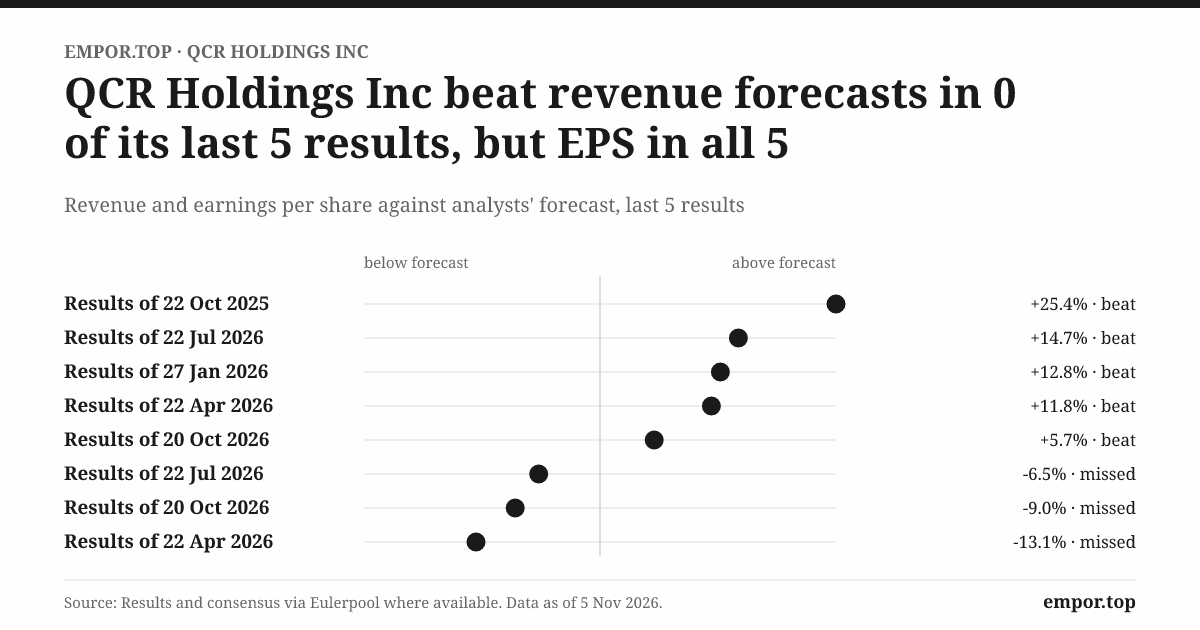
On the morning of October 21, 2026, Todd Gipple got on the phone with the analysts who follow his bank and gave them a credit report most bankers would like to give. Criticized loans, the ones a bank's own examiners have flagged as weaker than they should be, had fallen by $14 million in the quarter to 1.67% of the loan book, which he said was the lowest level since 2019.1 Nonperforming assets were $38 million, or 0.39% of everything the company owned.1 Loans had grown at an 11% annualized pace once a planned runoff portfolio was set aside, and management reaffirmed that it expected gross loan growth of 10% to 15% annualized in the fourth quarter.1 Net income for the quarter was $36.4 million.2
Sixteen days later, QCR Holdings filed its quarterly report with the Securities and Exchange Commission, and the balance sheet told a second story beside the first. At September 30, 2026, the company owed $633.6 million to the Federal Home Loan Bank system, and $623 million of that was overnight money: borrowings that roll every single day. That overnight figure had risen by $365 million in just three months, as loan growth arrived at the same time as balances from QCR's correspondent banks drained away.3
Neither story cancels the other. A bank can be lending well and funding awkwardly at the same moment, and in fact the two often travel together: when a bank's loan officers win more business than its deposit gatherers can fund, the gap has to be filled somewhere, and the fastest place to fill it is the wholesale market. On the call, CFO Nick Anderson described the correspondent outflow as the "typical" movement of those balances in the final weeks of a quarter, and said they had since returned, with total deposits up more than $500 million between quarter-end and mid-October.1 That is a plausible explanation and a checkable one. It is also the kind of explanation investors should hold management to, because a bank's overnight borrowing is cheap and reliable right up to the day it is neither.
The fee line added a third story. QCR's capital-markets revenue, the swap fees it earns mostly around affordable-housing loans, came to $16.9 million in the quarter, down from $23.8 million a year earlier.2 Management said some deals slipped into the fourth quarter and guided to $18 million to $20 million of production in the final three months of the year.1 In a bank whose net income was almost exactly flat year over year, a $7 million swing in a single fee line is not a rounding error. It is the difference between a growth quarter and a standstill quarter.
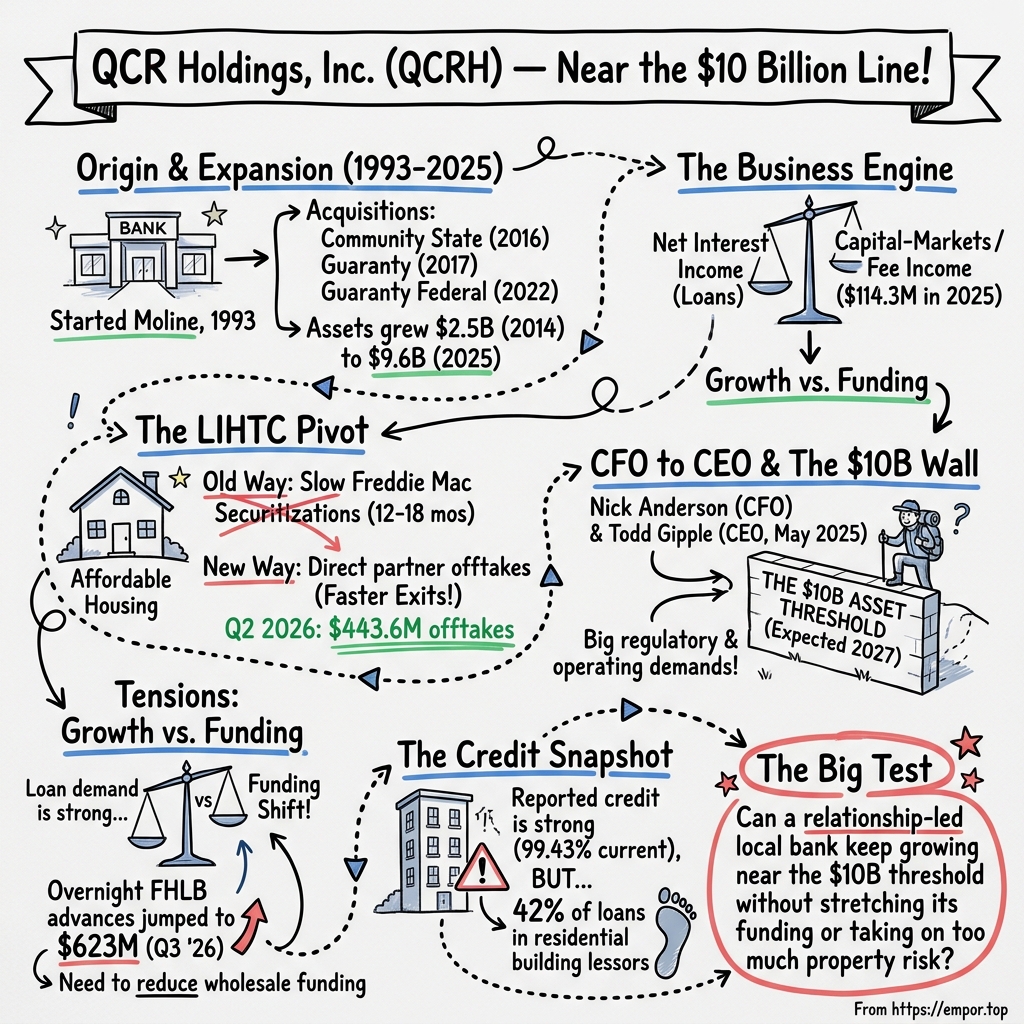
So the question that hangs over QCR Holdings tonight is not whether it is a good bank. By most reported measures it is a profitable, clean one. The question is whether its particular model, a relationship-led community bank that has bolted on a specialty lending franchise and a fee machine, can keep turning loan demand into durable earnings without leaning harder on borrowed money or on fees that rise and fall with the property market.
Four smaller questions sit inside that one, and they will run through this whole story. Can QCR grow anywhere near the pace that defined its last decade, now that the acquisitions that powered much of it have slowed? Are the fees from its low-income housing tax credit lending, the business insiders call LIHTC (pronounced "lie-tech"), durable, or are they a cyclical windfall? Can a loan book this heavy in property lending keep growing without credit quality turning? And can the stock hold the premium the market now pays for it, relative to its own history?
It helps to know exactly what is being asked about. QCR Holdings is a Delaware bank holding company headquartered in Moline, Illinois, listed on Nasdaq under the ticker QCRH since 1993.4 It owns four bank charters. Quad City Bank & Trust serves the Quad Cities straddling the Mississippi between Iowa and Illinois. Cedar Rapids Bank & Trust serves Cedar Rapids and, through its Community Bank & Trust division, the Waterloo–Cedar Falls area. Community State Bank serves the Des Moines area, and Guaranty Bank serves Springfield and southwest Missouri.4 Together they ran 35 locations and held about $9.8 billion of assets at the end of September 2026.5 At the end of 2025 the company employed 967 full-time and 72 part-time staff.4
There is no larger parent above QCR, no family holding company and no controlling shareholder. Its biggest holders are index and quantitative fund managers, each with between 5% and 7% of the shares.6 When this story talks about acquisitions, it means deals QCR itself struck and paid for, which turned the company that existed before each deal into a bigger one afterward. That distinction will matter, because much of the company's famous growth record was bought, and bought growth has to be judged by what it cost.
The setting matters too. QCR is now within sight of $10 billion in total assets, the line at which American regulators treat a bank differently: tighter supervision, more demanding stress planning and, most tangibly, a federal cap on the fees a bank can earn when its customers swipe their debit cards. Management says it has been preparing for that crossing for years and now expects to pass it sometime in 2027.1 It even used loan sales this year partly to keep assets below the threshold for one more year.1 That is a revealing detail. A bank that is managing its size around a regulatory line is a bank that knows how much the line will cost.
The story of how a Moline startup became a bank that has to worry about the $10 billion line begins in the early 1990s, with a simple organizing idea about what a local bank could be.
 Subscribe on LinkedIn
II. A Local Bank Builds Beyond the Quad Cities
The Quad Cities have always been a place of crossings. Davenport and Bettendorf sit on the Iowa bank of the Mississippi; Moline and Rock Island sit on the Illinois side, where the river briefly runs east to west. John Deere's world headquarters is in Moline. The Rock Island Arsenal sits on an island in the middle of the river. It is a metropolitan area of a few hundred thousand people that has long been served, like much of the Midwest, by a mix of tiny community banks and branches of distant giants.
In February 1993, a group of local bankers formed QCR Holdings and set about organizing Quad City Bank & Trust, which opened the following year.7 The company listed its shares on Nasdaq the same year it was formed, which tells you something about the founders' intent: this was never meant to be a sleepy one-branch bank owned by a few families.4 The organizing idea was a locally managed bank, with local loan officers making local decisions, that would sit inside a holding company large enough to share operations, technology and capital across several such banks.
That idea is the whole company in miniature. A small-business owner in Davenport did not want to deal with a call center in Charlotte; she wanted a banker who knew her and could say yes. But a single small bank can only lend so much to one borrower, can only afford so much technology, and can only spread its compliance costs over so many customers. The holding company was supposed to give each local bank the decision-making speed of a community bank and the back office of a regional one.
The model traveled first to Cedar Rapids, an hour and a half west, where QCR started Cedar Rapids Bank & Trust as a new bank in 2001.7 Starting a bank from scratch, a de novo bank in industry language, is slow and expensive. There are no customers on day one, only a charter, a building and bankers poached from competitors who bring their relationships with them. That QCR succeeded at it in Cedar Rapids, where its bank would eventually become the largest by local deposit share, is the strongest early evidence that the founders' idea worked outside its home town.8
Then the company changed gears. In 2016 it bought Community State Bank in Ankeny, giving it a foothold in the fast-growing Des Moines area.7 In 2017 it agreed to buy Guaranty Bank & Trust in Cedar Rapids and fold it into its existing bank there.9 In 2018 it bought Springfield First Community Bank in Springfield, Missouri, its first step outside Iowa and Illinois.7 And in late 2021 it agreed to buy Guaranty Federal Bancshares, the parent of a long-established Springfield thrift, and to merge it into the Springfield bank it had already bought.7
The numbers that came out the other end are dramatic. QCR had about $2.5 billion in total assets at the end of 2014. By the end of 2025 it had $9.6 billion, nearly four times as much, and its net profit had risen from about $14 million to about $127 million over the same span.4 On a ten-year view, profit compounded at roughly 23% a year, a rate that few banks of any size could match.4
The popular version of this story stops there: a scrappy community bank that grew faster than almost anyone. The record supports a more careful version. Several of those years included acquired banks whose assets, deposits and earnings arrived overnight on closing day. QCR does not publish a continuous organic-growth series for the full decade, so it is impossible to say exactly how much of the fourfold rise came from lending to new customers and how much came from buying other banks' customers.4 What can be said is that the recent organic pace is real but slower: QCR reported 11.7% organic loan growth in 2025, and its revenue grew just 1.5% that year, while net profit grew a healthier 12.4%.4
That gap between loan growth and revenue growth is a clue worth holding onto. It says that QCR's loan book has kept expanding, but the revenue that book produces has not expanded in step, partly because the fee line fell. Profit grew faster than revenue, which means costs and taxes did some of the work. A business can do that for a while. It cannot do it forever.
Each acquisition added communities, deposits, lending capacity and goodwill to QCR's balance sheet. That makes the next question unavoidable. Did QCR buy durable local positions at prices that made sense, or did it simply buy size?
III. Three Deals, Three Tests of the Acquisition Playbook
In early November 2021, QCR's executives stood behind a slide deck that put a price on their acquisition playbook. They were buying Guaranty Federal Bancshares of Springfield, Missouri, for roughly $150 million, and the slide said what that meant in the language bankers use to judge each other: 1.61 times tangible book value, and 14.1 times Guaranty's estimated 2021 earnings.10 With the cost savings fully phased in, the presentation said, the earnings multiple would fall to 9.1 times.10
Those two numbers deserve a translation. Tangible book value is, roughly, what a bank would be worth if you sold every asset at the value on its books, paid off every depositor and creditor, and ignored any goodwill from past deals. Paying 1.61 times that figure means paying $1.61 for every dollar of hard net worth. The extra 61 cents is a bet: on the bank's deposit franchise, its customer relationships and, above all, on the costs the buyer expects to strip out. The gap between 14.1 times and 9.1 times earnings is that bet in arithmetic form. Bought as it stood, Guaranty was a full-priced bank. Bought and merged, with overlapping systems and back-office roles eliminated, management argued it would be a reasonably priced one.
The deal terms show how carefully the price was built. Each Guaranty share could be swapped for $30.50 in cash, for 0.58775 QCR shares, or for a mix of $6.10 in cash and 0.4702 shares, with the overall consideration weighted heavily toward stock.7 At QCR's closing price on November 8, 2021, the package was worth about $150.3 million, and Guaranty's shareholders would end up owning about 12% of the combined company.7 Guaranty brought roughly $1.2 billion of assets, about $1.0 billion of deposits and 16 branches across four southwest Missouri counties.7 QCR planned to merge it into Springfield First Community Bank, the bank it had bought three years earlier, and to run the combined bank under the older Guaranty name.7
Guaranty had been looking for a partner for some time. Its board had formed a special committee in 2020, and its investment bank had sounded out potential acquirers in early 2021; at least one other bidder had made an unsolicited approach at a lower price before QCR's proposal won out.7 That background matters for valuation. QCR did not stumble into a bargain from a distressed seller. It won a competitive process for a healthy bank, and in a competitive process the winner usually pays near the top of what anyone was willing to pay.
The rest of the forecast was specific, which is to QCR's credit. The presentation promised $7.6 million of annual cost savings, estimated $13.4 million of one-time integration costs, and projected that the dilution to QCR's tangible book value would be earned back in roughly 2.7 years.10 Tangible-book earn-back is the banker's payback period: how long until the extra earnings from the deal rebuild the hard net worth that the purchase premium and deal costs used up. Under three years was, by community-bank standards of the time, a respectable promise rather than a heroic one.
The earlier Cedar Rapids deal was smaller and simpler. In June 2017, QCR agreed to buy Guaranty Bank & Trust, an 83-year-old Cedar Rapids institution with five offices, for about $44.2 million, paid 79% in QCR stock and 21% in cash.911 Guaranty Bank & Trust brought $266.8 million of assets, $197.3 million of loans and $213.5 million of deposits.9 The price was about 1.53 times adjusted core capital.9 Here the logic was not a new market but a deeper one. QCR already had a bank in Cedar Rapids, so the deal was an in-market consolidation, the kind where cost savings are easiest to find because the buyer can close overlapping branches and fold one back office into another. Local coverage at the time noted that the combination would make Cedar Rapids Bank & Trust the largest community bank chartered in Linn County, second in deposit share only to U.S. Bank.11
What the record says after signing day
Announced multiples alone do not prove overpayment or bargain. They are the opening bid in an argument that only results can settle. So what do the results say?
The cleanest test is market position, because that is what QCR was really buying. On QCR's own FDIC-based tables as of mid-2025, the Cedar Rapids bank was first in its market, with about 21% of local deposits, comfortably ahead of U.S. Bank at about 12%.8 The 2017 deal, in other words, did what it was meant to do: it helped turn a de novo bank into the market leader. In Springfield, the combined Guaranty Bank ranked second with roughly 10% of deposits, behind Great Southern and ahead of Central Trust, OMB and Commerce.8 That, too, looks like a durable local position rather than an orphan branch network. In the Quad Cities, QCR's original market, it held about 22% of deposits and ranked first.8
The weaker case is Des Moines. Community State Bank, bought in 2016, ranked seventh in the Des Moines–West Des Moines market with under 4% of deposits, in a metropolitan market dominated by Principal Bank, Bankers Trust and the national giants.8 Ten years after entering, QCR is a participant in Iowa's largest metro, not a leader. That does not make the deal a failure; a small share of a large, growing market can still be profitable. But it bounds the claim that QCR's playbook reliably produces dominant local franchises. It does so in mid-sized markets where it can be the largest local name. In a big, crowded metro it has not yet shown that.
The second test is earnings. QCR does not publish a deal-level tally showing whether the $7.6 million of Guaranty Federal savings arrived on schedule, or what the actual integration bill came to.4 The company-level record is suggestive rather than conclusive. Diluted earnings per share fell from $6.24 in 2021 to $5.81 in 2022, the year the deal closed and the new shares were issued, then recovered to $8.54 over the twelve months to September 2026.42 That pattern is consistent with a deal that diluted first and paid back later. But 2021 earnings were inflated by unusual conditions across the industry, and later years were shaped by interest rates and the LIHTC fee boom, so the per-share recovery cannot be credited to Springfield alone. The fair verdict is that the Guaranty Federal case has not been disproved by the record, and that QCR has not given investors the data to prove it either.
The other side of capital allocation
Acquisitions are only one way a bank spends its shareholders' capital. The others are dividends, buybacks and simply retaining earnings to fund loan growth, and QCR's choices among them are distinctive. Its dividend is tiny. Over the past decade it has paid out between roughly 3% and 7% of profit in most years, and the yield on the stock was 0.4% in early November 2026.4 For most community banks, a payout that low would be strange. For QCR, it is a statement: almost every dollar of profit has been kept inside the bank to fund growth.
More recently the company has added buybacks. In October 2025 the board authorized the repurchase of up to 1.7 million shares; about 149,000 had been bought by year-end, and in the third quarter of 2026 the company repurchased 94,861 shares for $9.5 million, or roughly $100 a share.42 That price sat close to the stock's 52-week high and at about 1.4 times book value.12 A buyback at that level is not obviously wrong, since a bank earning 12% on its equity can justify paying more than book, but it is not a bargain-bin purchase either. The test of those repurchases is the same as the test of the acquisitions: whether tangible book value and earnings per share grow faster than they would have without them.
The balance sheet behind the holding company was tidied in 2025 too. In September of that year QCR issued $70 million of new subordinated notes, $50 million at 6.875% due 2035 and $20 million at 7.225% due 2037, to refinance a $70 million note that was maturing.4 That pushed a maturity a decade into the future, at a cost that reflects the era's higher interest rates.
The thread that runs from 2016 to 2026 is a claim about discipline. QCR says it buys well and integrates well. The announced terms show that it priced deals with specific, measurable promises; the market-share data show that in two of its four markets those deals helped build genuine local leadership. What the record cannot yet show is the return on those deals after signing day, because the company does not report it. Acquisition discipline, in the end, is a claim about returns, not prices. To understand what those returns depend on, it helps to step inside one of QCR's banks and follow a single customer.
IV. One Bank, Several Ways to Earn a Spread
Picture a commercial borrower in Cedar Rapids: a family that owns a manufacturing business, a few rental properties and a growing pile of cash. They walk into Cedar Rapids Bank & Trust because their banker there has known them for fifteen years and can approve a loan without sending it to a credit committee in another state. That loan is the beginning of the relationship, not the end of it. The family's operating accounts will sit at the bank. Their payroll might run through its treasury services. Their investments might end up with its wealth managers. If the loan is large and the rate is floating, the bank might sell them an interest-rate swap to lock in a fixed payment. Every one of those products earns QCR money in a different way.
The core of it is the oldest business model in finance. A bank borrows money, mostly from depositors, and lends it out at a higher rate. The difference between what it earns on loans and securities and what it pays for deposits and borrowings is net interest income, and it is the engine that pays for everything else. QCR's net interest margin, that spread measured as a share of earning assets, was 3.58% on a tax-equivalent basis in the third quarter of 2026, up slightly from the prior quarter and ahead of management's own guidance.1 In plain terms, for every $100 of loans and securities it carried, QCR earned about $3.58 more over a year than it paid to fund them. That is a healthy spread for a bank of its size, and it is the main reason QCR is profitable.
Around that engine sit the fee businesses. In 2025 QCR earned $114.3 million of noninterest income, the industry's term for everything that is not interest.4 The biggest piece by far was capital-markets revenue, $64.7 million, or about 57% of the total.4 Most of that came from interest-rate swaps tied to its affordable-housing lending, a franchise that gets its own chapter in this story. The rest of the fee income came from trust and wealth management, deposit-service charges, correspondent-banking fees and a handful of smaller lines, including just $2.4 million of genuinely miscellaneous "other" income.4
QCR describes itself as running four distinct businesses: traditional community banking, specialty finance, wealth management and correspondent banking.4 It is a useful map. It is also a map without a legend, because the company does not report a full revenue-and-profit split for each business. An investor can see how much the capital-markets line brings in, but not what it costs to run, how much capital it ties up, or what return it earns on its own. That matters, because the most interesting question about QCR's economics, whether the specialty-finance franchise is a high-return business riding on a plain bank or the other way round, cannot be answered from the outside.
The banks behind the banks
The least glamorous of the four businesses may be the most revealing. Correspondent banking is the service a larger bank provides to smaller ones: clearing their checks, holding their excess cash, selling them pieces of loans too big for them to carry alone, and offering the wire, settlement and investment services a $200 million rural bank cannot build for itself. At the end of 2025, QCR served 190 such downstream banks.4 It is a distribution network of a kind few community banks have: dozens of other bankers across the Midwest who park money with QCR and send business its way.
That network does two things for the economics. It brings in fees, and it brings in deposits, often large ones, which help fund QCR's loan book. But those deposits behave differently from a family's checking account. A correspondent bank's cash moves when its own customers' cash moves, and it tends to flow out at quarter-ends and at certain points in the agricultural year. The episode in the third quarter of 2026, when correspondent balances fell and overnight borrowing rose to fill the hole, is the price of that funding source as well as its benefit.31
What the customer buys from all of this is, in management's telling, local decision-making with a big bank's balance sheet behind it. The family in Cedar Rapids gets a banker who answers the phone and can say yes; the bank behind that banker has $9.8 billion of assets, swap desks, wealth advisers and the ability to lend sums no local competitor can match.5 It is a coherent pitch, and QCR's positions in Cedar Rapids and the Quad Cities suggest it has worked. It is also a proposed advantage rather than a proven one. Large regional banks, credit unions and nonbank lenders all compete for the same borrowers, and the filings offer no evidence of how much more a QCR customer will pay, or how much longer they will stay, than a customer of a rival.
The first economic complication follows directly. The relationship model makes the deposit and lending business sticky in principle, but it does not make every revenue stream predictable. Capital-markets fees depend on transactions, and transactions depend on interest rates, property economics and borrowers' willingness to lock in rates. That fee line fell from $92.1 million in 2023 to $64.7 million in 2025.4 The relationship was still there; the transactions simply came less often. To see why, one has to understand the most unusual thing QCR does: finance affordable housing.
V. The LIHTC Franchise Finds a Faster Exit
On the third-quarter call, Todd Gipple spent part of his prepared remarks explaining why QCR was walking away from a process that had made it money. For several years the company had packaged affordable-housing loans and sold them through Freddie Mac securitizations, pooling the loans, handing them to the government-sponsored mortgage giant and receiving cash and capital relief in return. Changes to Freddie Mac's program, Gipple said, had "significantly increased the complexity, time, and cost of execution despite favorable pricing."1 So QCR was "actively working" with other third parties on alternative loan-sale structures, aiming to complete its first such transaction in the first quarter of 2027.1
It sounds like a back-office change. It is actually a question about the most profitable and least ordinary thing QCR does.
Start with what LIHTC is. The federal low-income housing tax credit is the main way the United States finances new affordable rental housing. A developer who agrees to rent apartments to lower-income tenants at capped rents receives tax credits, which it typically sells to investors, often big banks and corporations, to raise equity. The rest of the project is funded with loans: a construction loan to build it, then a permanent loan once it is leased up. These projects are complicated, highly regulated and slow, and the lenders who understand them well are relatively few.
QCR became one of them. Its banks originate construction and permanent loans for LIHTC projects across the country, not just in their home markets, and many of those loans come with interest-rate swaps. A swap, in plain terms, is a contract in which the developer agrees to pay a fixed rate while the bank's loan floats; the developer gets certainty over a 15- or 30-year horizon, and QCR earns a fee for arranging and standing behind the trade. Because a single large LIHTC loan can produce a large upfront swap fee, a busy quarter of LIHTC closings can generate millions in capital-markets revenue almost at once.
That is why the capital-markets line swings. In 2023, a year of heavy project activity and rising rates that made borrowers eager to lock in, QCR earned $92.1 million from it. By 2024 the figure had fallen to $71.1 million, and in 2025 it was $64.7 million.4 The decline was not a collapse, and over the twelve months cited in its third-quarter materials the line was still about $67 million.1 But the direction from peak is plain, and so is the reason it matters: in 2025 this single fee stream was more than half of QCR's noninterest income.4 KBRA, the rating agency, called the LIHTC-related swap-fee franchise a key strength in January 2026, and noted that it represented roughly 60% of noninterest income in recent periods.13 A strength that large is also a concentration.
Why the balance sheet needs an exit
There is a second, less visible reason the loan-sale process matters. Every LIHTC loan QCR keeps sits on its balance sheet, consuming capital and pushing total assets toward the $10 billion line. Every loan it sells frees capital to make the next one. In management's own framing, that recycling is the model: QCR said its capital-recycling approach had helped produce more than $67 million of capital-markets revenue over the prior twelve months while net interest income rose about $24 million, or 10%.1 Originate, earn the swap fee, hold the loan long enough to earn some interest, then sell it and do it again.
The second quarter of 2026 showed that machine running at volume. That quarter included $443.6 million of LIHTC loan offtake transactions, loans moved off QCR's balance sheet to outside holders.14 Management also said openly that it was using offtakes to keep total assets below $10 billion through 2026.1 That candor is useful, because it shows the loan sales are doing two jobs at once: monetizing the franchise and managing a regulatory threshold.
The old exit had a cost. The Freddie Mac structure required QCR to keep the riskiest slice of each securitization, the first-loss "B" tranche that absorbs any defaults before other investors lose a cent, and it tied up time and money in transaction costs; the third-quarter figures even included a $1.3 million loss connected to a Freddie Mac securitization.1 The new approach QCR described is a complete sale of the loans to private partners without keeping that first-loss piece, which would release more regulatory capital per dollar of loans sold.1 If it works, QCR could recycle capital faster and with less residual risk.
The analysts on the call pushed on exactly the points that would decide that. Jeff Rulis of D.A. Davidson asked how the LIHTC business performs as rates rise; Gipple acknowledged that rate increases are "a bit of a headwind" for developers, while insisting the business is durable.1 Damon DelMonte of KBW asked how large LIHTC was in the pipeline, and management said roughly 70% of the pipeline was LIHTC against 30% traditional lending.1 When asked about growth in capital-markets revenue, Gipple reaffirmed a range of $60 million to $70 million over the next four quarters, declined to raise it, and said more detail would come on the January or April call once the new structures came together.1
That answer is worth sitting with. A 70% LIHTC share of the pipeline means the franchise is not a sideline; it is where most of the bank's new lending is coming from. A fee guidance range that brackets the recent run rate, rather than a return to the 2023 peak, means management itself is not forecasting a rebound. And a promise of more color "in January, certainly April" means the new exit is, today, a plan with a target date rather than a proven channel.
So what can be concluded? The shift away from Freddie Mac is a concrete, logical response to a process management says had become slower and costlier, and the $443.6 million of second-quarter offtakes proves that QCR can move large volumes of these loans to outside holders. It does not yet prove that private buyers will keep paying prices that preserve QCR's economics as volumes grow, or that they will show up in a weaker property market. A completed sale is evidence of execution, not of durable pricing power, and calling the new process a moat would be premature. The confirming evidence would be the first direct offtake closing on schedule in early 2027, followed by several quarters of capital-markets revenue holding inside or above management's range as retained LIHTC balances stay under control.
There is also a harder question beneath the operational one. QCR presents fee income as diversification away from pure spread lending. But when most of that fee income comes from swaps on one category of real-estate loan, and most of the loan pipeline is that same category, the fees do not diversify the bank's exposure to affordable-housing property economics. They amplify it. The swap fee and the loan risk come from the same project. The person who has to manage that trade-off, and to explain it to the market, is a CFO who very recently became the chief executive.
VI. A CFO Becomes CEO Just Before the $10 Billion Threshold
In May 2025, Todd Gipple moved from the chief financial officer's office to the chief executive's, succeeding Larry Helling.6 He was not an outsider brought in to shake things up. He had been QCR's finance chief for years and a director since 2009, which meant he had helped build the very balance sheet he now ran.6 At the same moment, Nick Anderson moved up from chief accounting officer to CFO.6 The two most important financial jobs at the company were now held by people who had been inside its numbers for a long time, but who had never held those exact jobs before.
That kind of succession has a recognizable profile. A CFO-turned-CEO tends to know where every dollar of cost sits and how every regulatory ratio is calculated, which is exactly the skill set a bank needs as it approaches the $10 billion line. What a CFO-turned-CEO has not yet shown, almost by definition, is how he handles the parts of the job that are not arithmetic: winning commercial relationships, managing four semi-autonomous bank presidents, and telling a strategy story the market believes. Gipple's record as CEO is about eighteen months long. That is enough time to judge his consistency, not his results.
Paying and owning
The 2026 proxy put Gipple's 2025 compensation at $1.71 million, up from $1.15 million in 2024 and $1.23 million in 2023.6 Taken alone, a jump of almost 50% in a year when profit rose about 12% looks generous. Read in context, much of it reflects the promotion itself and the equity awards that came with it, so it should not be read as a simple raise for performance.6 Helling, in his final year, received $1.42 million, down from $1.80 million in 2023; Anderson's first reported year as CFO came to $360,000.6 By the standards of American banks with nearly $10 billion of assets, none of these figures is extravagant.
Ownership is a different signal. Directors and executive officers as a group held 3.2% of the shares as of March 2026.6 That is a meaningful stake in dollar terms for the individuals involved, with the company worth about $1.7 billion, but it is not the kind of founder-level ownership that makes management and minority shareholders a single interest.12 QCR has share-retention guidelines for executives, and its stock buybacks help at the margin.6 The fair reading is modest alignment rather than strong alignment.
Shareholders' votes in May 2026 gave a similarly measured message. Say-on-pay passed easily, with about 11.8 million votes for and about 0.5 million against.15 The independent chair, Marie Ziegler, received the most withheld votes of any director nominee, about 563,000.15 Neither result is a revolt. The withheld votes on the chair are a mild signal, the kind that proxy advisers and some institutional holders register over tenure, workload or committee roles, and worth noting chiefly because the board's oversight of a leadership transition and a regulatory crossing will matter more in the next two years than it did in the last ten. The board had 11 directors, 10 of them independent under Nasdaq rules.6
One more governance detail belongs in proportion. Like most community banks, QCR lends to its own directors, executives and their businesses. Those loans and commitments totaled $150.0 million at the end of 2025, up from $115.6 million a year earlier.4 The company says they are made in the ordinary course of business on substantially the same terms as comparable loans to unrelated borrowers, and the proxy reports no material related-party transactions beyond compensation and ordinary banking relationships.46 In a bank whose directors are local business leaders, insider lending is normal. A 30% rise in a year is worth watching, not alarming.
The strategy, said twice
The best way to judge a new CEO in a short tenure is to check whether he says the same things quarter after quarter and whether the things he says can be measured. On that test, Gipple's message has been specific and consistent. The company says it has been in the middle of a multiyear digital transformation, replacing the core banking systems at each of its four charters. On the October call he reported that the third of four core conversions had been completed that month and that the final one was scheduled for the following April.1 He said he was very pleased with the company's technology partners.1 Management reaffirmed quarterly noninterest-expense guidance of $54 million to $57 million and reported an efficiency ratio of 55% in the quarter and 56% year to date.1
The efficiency ratio is the cleanest test of the operating-leverage claim. It measures how many cents of expense a bank spends to earn a dollar of revenue, so lower is better. At 55 cents, QCR is efficient for a community bank. The promise implicit in the technology program is that this number will fall as conversions finish and the bank grows, and that is precisely the kind of promise that can be checked. If the ratio does not improve after the last conversion in 2027, the transformation story will have been an expense story.
Funding is where the new team has set its most measurable goal. Gipple said the bank wants to move its share of noninterest-bearing deposits, the cheapest money a bank has, toward a peer range of 21% to 23%, by about one percentage point a year.1 That is a concrete, slow, verifiable target, and the slowness is honest: deposit mixes do not change quickly.
On acquisitions, the tone has shifted. Management said there was no urgency to do M&A, and described the most likely future targets as a bolt-on in central Iowa or entry into a fifth market of similar size to its existing ones.1 For a company whose growth record was built partly on deals, that is a notable pause, and probably a sensible one with the $10 billion line approaching.
Why does $10 billion matter so much? Above that size, QCR faces the debit-card fee cap and added regulatory demands, including direct CFPB supervision on consumer-protection matters. All of that costs money, whether or not the bank grows its profit.
The company says organizational and regulatory impacts will land around mid-2028, and that it has been layering in the costs of crossing gradually rather than all at once.1 It has described that preparation as a multiyear effort.1 What it has not done, in the materials published so far, is give shareholders a single, consolidated estimate of the annual cost of crossing, combining the lost interchange revenue with the added compliance, technology and staffing expense. That is the number analysts should press for, because it determines how much of the bank's future growth will be spent simply standing still on the other side of the line.
The verdict on the new leadership, then, is that it knows the company's finances intimately, has set specific and checkable goals, and has said the same things consistently across its calls. Its CEO record is short, and the outcomes that would prove its case, a falling efficiency ratio, a better deposit mix, a working new LIHTC exit, have not yet arrived. Confidence on a call is not a result. And the most pressing test of that confidence is already on the balance sheet, in the line that rose by $365 million in a single quarter.
VII. The Loan Growth Is Real; So Is the Funding Shift
Think of a bank's funding as a set of reservoirs, each with a different kind of water. The deepest and steadiest is customer deposits: the payroll accounts, savings and operating balances of households and businesses who bank there because of a relationship. Next come correspondent deposits, the cash other banks park with QCR, which is sizable and useful but moves with those banks' own needs. Then come wholesale borrowings, such as advances from the Federal Home Loan Bank, a cooperative that lends to banks against collateral like mortgages and securities. And finally there are unused credit lines, which are not water at all, only a promise that water can be piped in if needed.
All of these count as liquidity, but they are not equally stable or equally cheap. A relationship deposit may cost little and stay for years. An overnight FHLB advance costs close to the market rate and has to be renewed every day. In normal times that renewal is automatic. In a stressed market it is the first thing to become expensive.
In the third quarter of 2026, QCR's mix tilted toward the wholesale end. Loans grew by about $190 million in the quarter.1 Correspondent deposits fell, and overnight FHLB advances rose sharply.3 In plain terms, the bank's lending ran ahead of its deposit base, and it bridged the difference with the most short-term money available to it.
Management has said the correspondent outflow was typical and that deposits had since recovered; it also said it intended to reduce wholesale funding.13 If that is right, the September balance sheet was a snapshot taken on a bad day, and the fourth-quarter report will show overnight borrowings falling back. If it is wrong, QCR will have shown that its loan growth now depends on wholesale money in a way it did not before.
There are real backstops. At September 30, 2026, QCR had $926.5 million of available credit lines from correspondent banks and a fully unused $60 million holding-company revolving credit facility that runs to June 2027.3 Brokered deposits, money gathered through intermediaries and often the first to leave in a panic, were just 3% of deposits at the end of 2025, a low reliance by industry standards.4 None of this describes a bank in trouble. It describes a bank whose funding mix moved in the wrong direction for a quarter.
The independent view adds a structural caution. When KBRA affirmed QCR's ratings in January 2026, at BBB for senior unsecured debt with a stable outlook and BBB+ for the subsidiary banks' deposits, it also listed low asset liquidity relative to the balance sheet among the constraints on the rating.13 The reason is the securities portfolio. Roughly 60% of QCR's available-for-sale securities were municipal bonds, and nearly all of its held-to-maturity securities were privately placed municipal bonds.13 Municipal bonds are generally sound credits, but privately placed ones cannot be sold quickly in a deep market the way Treasury bonds can. A bank holding mostly Treasuries can raise cash in an afternoon. A bank holding private municipal placements may need to borrow against them instead. KBRA also flagged elevated double leverage at the holding company, meaning the parent has borrowed to fund equity in its subsidiary banks.13
At September 30, 2026, QCR held $186.7 million of cash and about $1.4 billion of securities against roughly $7.2 billion of loans.3 Those municipal holdings also help explain QCR's unusually low tax rate, which has run in the single digits in recent years, because much of the interest is tax-exempt; management guided to an effective rate of 8% to 10% for the fourth quarter.14 The same portfolio that lowers the tax bill makes the balance sheet harder to liquidate. That is a trade-off, not a flaw, but it means the bank leans more on its borrowing lines when deposits move.
Interest-rate sensitivity sits on top of all this. Anderson told analysts the balance sheet was liability-sensitive by $300 million to $400 million, meaning more of its funding reprices quickly than its assets do, and he cited a deposit beta in the last rate cycle of about 56% against an earning-asset beta of about 49%.1 Translated, when rates rose last time, QCR's funding costs rose faster than its asset yields. He nonetheless expected the September 2026 rate increase to be slightly helpful in the near term, partly because about $165 million of fixed-rate loans were repricing from the low-6% range to the mid-6% range.1 Those statements can both be true, but they show that QCR's margin is exposed to the very funding shift that the third quarter displayed.
Selling three branches
On November 2, 2026, QCR announced that it had agreed to sell three branches of its Community Bank & Trust division, two in Waterloo and one in Cedar Falls, to BankIowa.5 The branches held about $140 million of deposits, $29 million of loans and about $153 million of wealth-management assets under management as of September 30.5 The deal is expected to close in the first quarter of 2027, subject to regulatory approval, and is not expected to produce a material gain or loss.5 Gipple said the sale would let QCR sharpen its focus on markets with the greatest long-term growth potential.5
The rationale is visible in the market-share data. In Black Hawk County, which covers Waterloo and Cedar Falls, QCR ranked fifth with about 7% of deposits, far behind Farmers State Bank's 36%.8 That is exactly the kind of market where QCR's playbook does not deliver leadership, and exiting is a sensible way to concentrate resources. The sale also shrinks the balance sheet slightly as the $10 billion line approaches.
But a branch sale is not free in funding terms. The buyer takes about $140 million of deposits and only $29 million of loans, so QCR gives up roughly $111 million more in funding than it hands over in assets. In a quarter when the bank had to borrow overnight to fund its loan growth, that is not trivial. The sale simplifies the footprint; it does not solve the funding question, and on its own arithmetic it makes it marginally harder.
So the next tests are clear. The fourth-quarter balance sheet should show whether correspondent balances remained and overnight FHLB borrowings came down. Deposit costs will show whether QCR is paying up to attract the money its loans need. The noninterest-bearing share will show whether the one-point-a-year goal is on track. And the first quarter of 2027 will show what the branch sale does to the mix. Funding is one side of the bank's risk. The other side is what all that money has been lent against.
VIII. A Clean Credit Snapshot Has a Property-Shaped Footnote
On the October call, the credit numbers were the part management seemed happiest to read out. Criticized loans had fallen to their lowest level since 2019, and Gipple attributed the improvement to "loan payoffs, credit upgrades, and charge-offs."1 That phrase deserves to be heard slowly, because it contains three different things. A credit upgrade means a borrower's condition improved. A payoff means the borrower left, sometimes because it refinanced elsewhere on better terms and sometimes because a weak relationship was resolved. A charge-off means the bank admitted a loss and wrote it down. All three reduce the criticized-loan total. Only the first says the underlying portfolio is getting healthier.
To read a bank's credit, the right tools are not the ones used for an ordinary company. There are no trade receivables or debtor days that matter here. What matters is delinquencies, which track borrowers who are late; nonaccruals, loans so troubled the bank has stopped counting their interest as income; criticized loans, the bank's own watch list of weaker credits; charge-offs, the losses actually taken; and the allowance for credit losses, the reserve set aside for losses the bank expects.
By those measures, QCR's latest snapshot is strong. At September 30, 2026, 99.43% of its loans were current. Only 0.07% were 30 to 89 days late, none were more than 90 days past due and still accruing, and 0.50% were on nonaccrual.3 Nonperforming assets were $38.0 million, or 0.39% of total assets, and net charge-offs in the quarter were about $3 million.31 The allowance for credit losses was $88.4 million, or about 244% of nonperforming loans.3 For a bank of its size, those are clean numbers.
The story behind the trend, though, is more particular than the ratios suggest. At the end of 2025, criticized loans stood at $138.9 million, or 1.94% of gross loans, down from $158.6 million, or 2.34%, a year earlier, and QCR said the decline was mainly due to the payoff of one large relationship.4 By the third quarter of 2026 the ratio was down again to 1.67%.1 So a good part of the improvement over two years came not from the whole book drifting healthier, but from specific large credits being upgraded or leaving. That is good risk management, and it is also the kind of improvement that does not repeat on schedule. A single large relationship can just as easily move the other way.
Where the concentration sits
The reason this matters is where QCR lends. At the end of 2025, loans to lessors of residential buildings, the landlords and developers who own apartment properties, including the LIHTC projects that drive the fee franchise, totaled about $3.0 billion, or 42% of all loans and leases.4 Lessors of nonresidential buildings, offices, warehouses and retail properties, added another $754 million, or 11%.4 More than half of the loan book, in other words, is tied to the economics of commercial and residential rental property.
That is a deliberate choice, and it is how a bank with a specialty in affordable housing should look. It also means QCR's credit risk is correlated. A rise in interest rates, a fall in property values, a slowdown in rent growth or a spike in construction costs would not hit a few borrowers at random; it would hit a large slice of the portfolio at once. Affordable-housing projects have historically had low default rates, helped by long waiting lists and regulated rents, but they are not immune to cost overruns during construction or to rising operating expenses. The same rate increases that Gipple called a headwind for developers are a headwind for the loans.1
There is a useful way to frame the reserve. The 244% coverage ratio means QCR has set aside about $2.44 for every dollar of loans that are already in trouble. That is reassuring about today's problem loans. It is not a forecast that tomorrow's losses cannot rise, because the allowance is built on management's estimates of future conditions applied to a portfolio whose risks are clustered.
The auditor makes the same point in its own language. QCR's independent auditor issued an unqualified opinion on the 2025 financial statements, and its critical audit matter, the area it judged most dependent on difficult management judgment, was the allowance for credit losses.4 That is common for banks, and it is not a warning flag in itself. It is a reminder that the allowance is the single largest estimate in the accounts, and that its adequacy depends on assumptions about the property markets where QCR is most concentrated. The company reported no material pending legal proceedings beyond routine litigation.4
So the verdict on credit is that the reported quality is genuinely strong and the trend has been favorable, but that the improvement owes something to specific payoffs and upgrades, and the concentration means the single clean quarter-end ratio is less informative than how loans migrate between categories over time. The evidence that would test the claim is not another low nonperforming ratio. It is the next several quarters of criticized-loan movement, charge-offs and recoveries specifically in residential lessors, multifamily and construction lending. If those hold steady while the book grows at 10% or more, the clean snapshot will have become a clean record. With that, the question turns from what QCR is to what the market is paying for it.
IX. Analysis & Bear vs. Bull Case
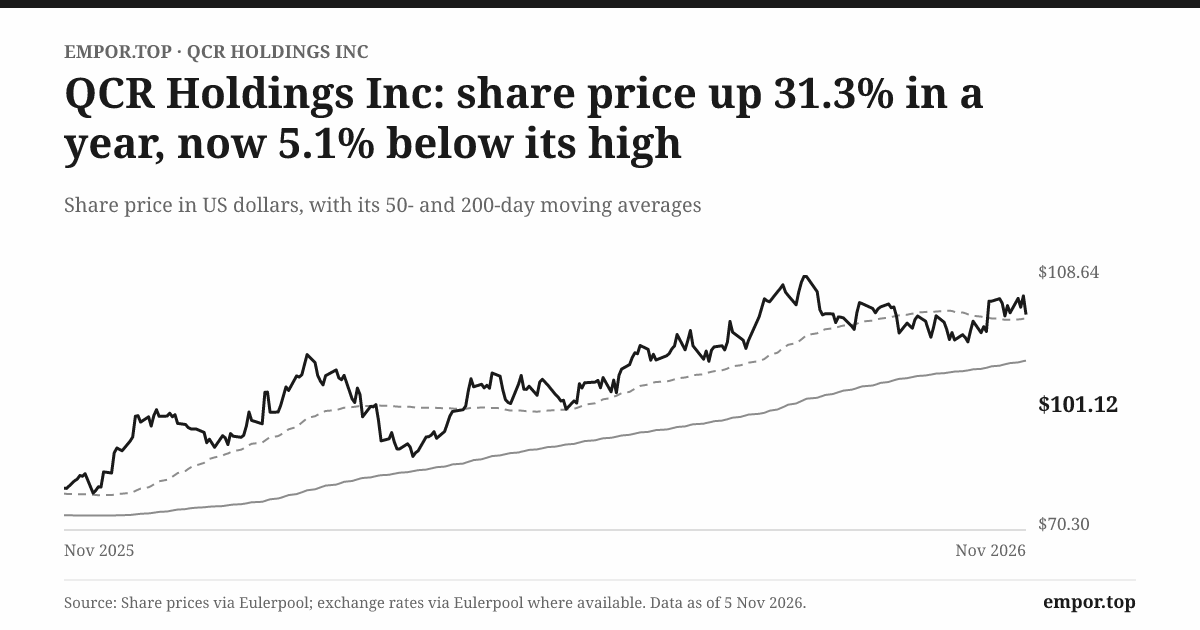
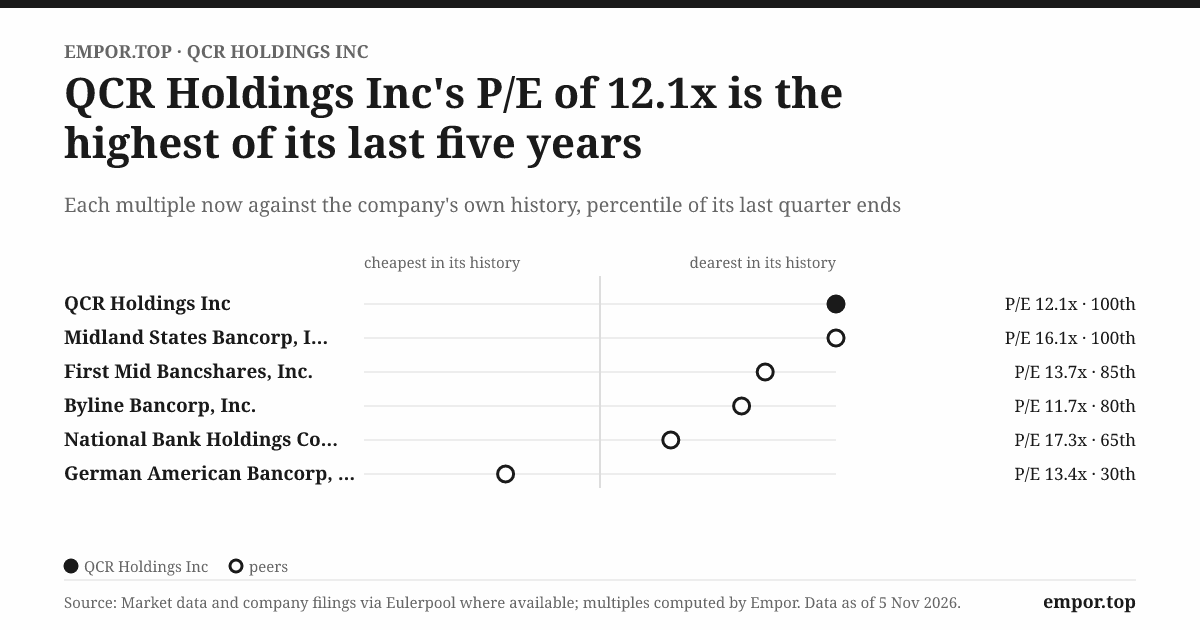
On November 5, 2026, QCR's shares closed at $101.12, about 5% below their 52-week high of $106.59 and well above the low of $75.59 set within the past year.12 At that price the market valued the company at about $1.7 billion, or 12.1 times its trailing earnings.12 Over the previous five years the stock had more typically traded at around 9.3 times earnings.12 It was also priced at about 1.4 times book value, against a trailing return on equity of 12.3%.12
Those numbers tell the market's story in compressed form. A bank earning 12% on its equity and trading at 1.4 times book is being priced roughly in line with what that return justifies; the two numbers are consistent with each other. What has changed is the multiple of earnings. Investors are paying about three more turns of earnings than they usually have, at a moment when third-quarter net income was almost exactly flat with a year earlier.2 Put plainly, the market is paying for growth and stability that the most recent quarter did not itself deliver. That is not irrational, since loan growth, a cleaner credit book and the prospect of a new LIHTC exit are all reasons to pay more, but it leaves less room for disappointment.
It is worth being exact about which valuation measures mean anything for a bank. Enterprise value to EBITDA, enterprise value to sales, working-capital days and free-cash-flow yield are standard tools for an industrial company, and some screens show QCR with an eye-catching free-cash-flow yield above 40%.12 For a deposit-funded bank those figures are close to meaningless. A bank's "debt" is partly its raw material, its operating cash flows mix customer deposits with lending and securities flows, and its cash is not distributable in the way a manufacturer's is, because regulators require it to hold capital against every loan.4 The right lenses are price to earnings, price to book, return on equity and asset quality. Even the cash flows that look large in the accounts are spent, in effect, on funding the next year's loan growth, which in 2025 absorbed about $686 million.4
There is a limit to how far a peer comparison can go here. QCR's own investor materials compare its operating results with a proxy-peer group, but they do not provide a same-date set of peer price-to-earnings multiples, so the premium can be measured confidently only against QCR's own history.16 That is a fair comparison for asking whether expectations have risen. It is not enough to say whether QCR is cheap or expensive relative to other banks.
The competitive map
QCR competes with almost everyone who lends money in the Midwest. Its rivals include other community banks, credit unions with tax advantages, the national giants like Wells Fargo and U.S. Bank, regional banks with larger balance sheets, and nonbank lenders who finance property projects without taking deposits at all.4 The deposit-share tables show the shape of that contest market by market. In the Quad Cities, QCR led with about 22% of deposits against Blackhawk Bank & Trust's 14% and Wells Fargo's 10%.8 In Cedar Rapids it led with about 21% against U.S. Bank's 12% and Farmers State Bank's 11%.8 In Springfield it was second at about 10%, behind Great Southern's 13%.8 In Des Moines it was seventh at under 4%, far behind Principal Bank's 24%.8
Run through Michael Porter's five forces once, and the picture is of a competitive but not brutal industry. The bargaining power of buyers is real: borrowers and depositors can and do shop around, and large commercial customers can split their business between banks. Suppliers of funding, depositors and wholesale lenders, have power too, as the third quarter's shift to overnight borrowing showed. Rivalry is intense, especially in Des Moines. The threat of substitutes comes from nonbank lenders and from capital markets that can fund large property projects directly. The threat of new entrants is low, because bank charters are hard to obtain and the $10 billion line raises costs for anyone scaling up.
Hamilton Helmer's seven powers framework asks a sharper question: does QCR have a durable advantage that lets it earn returns above its cost of capital for a long time? The candidates are counter-positioning, the local decision-making that big banks structurally cannot match; a cornered resource, the specialized LIHTC expertise and relationships with affordable-housing developers; and a modest network effect in the correspondent business, where 190 downstream banks bring deposits and deals to QCR.4 Each has some evidence. Market leadership in two of four markets suggests the local model wins customers.8 The LIHTC pipeline and KBRA's description of the swap franchise suggest real specialization.113
What the filings do not establish is strong switching costs, pricing power or a distinct cost advantage. QCR does not publish customer retention rates, does not show that its loans or deposits are priced better than rivals', and its 55% efficiency ratio, while good, does not prove a scale advantage.1 The LIHTC expertise is valuable, but other lenders also serve the market, and the shift away from Freddie Mac shows QCR does not control its own exit. The most supportable conclusion is that QCR owns a well-run local franchise with a genuine specialty, not a proven moat.
Two ways the story ends
The bull case begins with loan demand. QCR has been growing loans at roughly 10% a year organically, with management guiding to 10% to 15% annualized growth in the fourth quarter.1 Its local market positions in the Quad Cities and Cedar Rapids are leading and, judging by deposit share, stable.8 Its fee business, even off its peak, still brought in around $65 million a year, a supplement to spread income that most community banks simply do not have.4 If the new LIHTC loan-sale structure works, the bank can recycle capital faster, keep more of the fee and less of the risk, and grow past $10 billion with its returns intact. In that world, a 12 times multiple is a fair price for a bank compounding book value at double-digit rates.
The bear case is the mirror image. Capital-markets fees are down roughly 30% from their 2023 peak, and management's own guidance does not foresee a return to it.41 Funding tilted toward overnight borrowing in the latest quarter, and the balance sheet holds securities that are hard to sell quickly.313 More than half of the loan book is tied to rental property, which concentrates credit risk in a single economic cycle.4 Revenue grew just 1.5% in 2025 and fell year over year in the third quarter of 2026, which means the long-run growth record, much of it assisted by acquisitions, is not the current reality.42 And crossing $10 billion will add costs before it adds benefits. In that world, the multiple compresses back toward its five-year median even if earnings hold, and investors lose money owning a good bank.
A skeptical investor, or an activist, would push the board on a few specific choices. Should a bank about to cross a costly regulatory threshold, with funding already tightening, be buying back stock at 1.4 times book, or should it be keeping that capital for loan growth and liquidity? Should it consider acquisitions at all before it can show shareholders the delivered returns on the Guaranty Federal deal? And should it give investors a cleaner breakdown of what the LIHTC business earns, what it costs and how much capital it uses, so the market can value it properly rather than guessing? The answers would test whether management prioritizes per-share returns over size.
Of everything QCR reports, three figures carry most of the case. The first is capital-markets revenue, read alongside the balances of LIHTC loans retained and sold. It was $16.9 million in the third quarter of 2026, down from $23.8 million a year earlier, with management guiding to $60 million to $70 million over the next four quarters.21 If revenue holds while retained balances stay under control, the fee machine is working. If revenue holds only because QCR keeps more loans on its own books, the machine is consuming capital to produce fees.
The second is the funding mix: core deposit growth set against overnight FHLB borrowings. At September 30, 2026, overnight advances stood at $623 million and had risen sharply over the quarter.3 Its direction over the next two quarters will show whether the third quarter was a blip or a new pattern.
The third is credit migration in property: criticized loans and nonperforming assets broken down by category. Criticized loans were 1.67% of the book in the third quarter, the lowest since 2019, and nonperforming assets were 0.39% of assets.1 The direction of those numbers in residential lessors and construction lending will show whether the clean book stays clean as it grows.
None of these numbers predicts the stock. All of them, together, will show whether the business is turning into the bank the multiple already assumes.
X. Business & Investing Lessons
Go back to the moments that defined this story: a de novo bank in Cedar Rapids becoming its market's leader, a slide in November 2021 promising that a 1.61-times-book deal would earn back its dilution in under three years, a quarter of LIHTC loans moving off the balance sheet by the hundreds of millions, and a September balance sheet carrying $623 million of overnight money. Each of those moments teaches something specific about QCR.
The first lesson is that a local brand can travel only as far as the banker and the balance sheet behind it. QCR's four-charter structure was built on the idea that each bank would feel local, with its own name, its own president and its own decision-makers, while sharing the holding company's capital and systems. The market-share data show where that idea works and where it does not. In the Quad Cities and Cedar Rapids, where QCR planted or bought a franchise early and became the largest local name, it leads.8 In Des Moines and Waterloo, where it arrived as a smaller player against entrenched local and national competitors, it has remained one, and in Waterloo it is now selling out.85 The founders' insight was right, but its reach turned out to be specific: a local franchise travels best when it can become the local leader, and stalls when it is just another branch on a crowded street. For founders building anything with a local brand, the lesson is that "local" is not a portable feature. It has to be earned again in every market.
The second lesson is that a deal is a promise written in tangible-book earn-back. The Guaranty Federal deal's announced terms were specific, but QCR has not published whether it met them.10 For investors, the lesson is to treat every announced earn-back as a hypothesis, then look for the evidence afterward. A buyer that tells you what a deal will deliver, and then tells you whether it did, has earned the right to do the next one. A buyer that tells you only the first half is asking for trust instead.
The third lesson is that a loan sale can improve the machine without proving the machine is durable. QCR's LIHTC loan sales and planned shift to direct private buyers are operational improvements to how it recycles capital.141 But the franchise's durability depends on something QCR does not control: whether outside investors keep wanting these loans at prices that leave room for QCR's fee. The danger for any business built on originating assets and selling them is mistaking a buyer's appetite in good times for a permanent feature of the market. The lesson for investors is to judge an origination business by how it performs when the buyers step back, not by how much it sells when they are eager.
The fourth lesson is that in banking, liquidity is part of the product. A family in Cedar Rapids banks with QCR partly because they trust the bank will be there, and a downstream correspondent bank parks its cash with QCR because it trusts the money will come back on demand. That trust is what makes deposits cheap and sticky. It also means a bank's funding decisions are not just treasury housekeeping; they shape the product itself. QCR's recent funding shift makes its product more dependent on the market's mood than before.3131 For every banker, and every investor in banks, the lesson is that growth funded on the wholesale market is growth on loan.
XI. Epilogue
Tonight, QCR Holdings stands just below the $10 billion line it has spent years preparing to cross, with the regulatory consequences expected around the middle of 2028.51 It is working to fund continued loan growth with deposits, while several changes to its lending, footprint and technology systems remain in progress.
The next moments that will decide the story are already on the calendar. The first is the January 2027 earnings call, covering the fourth quarter of 2026. It will show whether correspondent deposits management said had returned in October stayed, whether overnight FHLB borrowings came down, and whether capital-markets revenue met management's guidance.13 If all three happen, the third-quarter funding shift will look like a seasonal wobble. If they do not, the market will have to reprice a bank whose growth depends more on wholesale money than it believed.
The second moment is the first direct LIHTC loan sale, targeted for the first quarter of 2027.1 If it closes on time, at prices that preserve QCR's economics, and is followed by others, the franchise will have a faster and less capital-hungry exit than it had under Freddie Mac. If it slips, or closes on worse terms, the capital-markets line will face the same headwinds that pulled it down from its 2023 peak, and the bank will have to keep more loans on its own books just as it approaches $10 billion.
The third moment is the branch sale to BankIowa, expected to close in the same quarter.5 Once it does, investors will be able to see how the sale changed QCR's funding mix and costs, and whether the Waterloo exit freed management to focus on its stronger markets.
The fourth moment is the April 2027 completion of the final core conversion.1 After that, the efficiency ratio stops having a transformation excuse. If it falls from around 55%, the technology program will have paid off; if it does not, the program will have been an expense with a long tail.
And running beneath all of these is the credit cycle. As the loan book grows, criticized loans, charge-offs and reserves by property category will show whether the clean snapshot of September 2026 holds through a period of higher rates and tougher conditions for developers.1 It would take a weaker property market or a lower-swap-demand period to truly test both the fee franchise and the loan book at the same time, and QCR has not yet faced such a period in its current form.
The valuation question can only be revisited after these answers arrive. A bank trading at 12 times earnings needs its return on equity and earnings per share to keep rising to justify the premium to its own history. The next four to six quarters will show whether growth is becoming more profitable and less dependent on wholesale funding, or whether the bank has reached the size where every new dollar of loans costs more to fund and earns less in fees. The tension that remains is simple to state and hard to resolve: QCR is about to get bigger, and nobody yet knows whether bigger will be better.
XII. Outro
Go back to the call on October 21, 2026. The credit and growth picture was strong, and the final core conversion remained ahead.1 Sixteen days later, the quarterly filing showed $623 million of overnight borrowings sitting beneath it all.3 That tension defines QCR's next test.
QCR's local-banker model has built four banks, two market-leading franchises and a nationally known affordable-housing lending business. Its next test is whether the idea survives scale: whether a bank that crosses $10 billion can still feel local to the family in Cedar Rapids, still fund its loans with that family's deposits, and still live comfortably with every credit it makes. The loan officer's handshake is still the product. The question now is whether the balance sheet behind it is as steady as the handshake.
References
-
QCR Holdings Q3 2026 Earnings Call Transcript — StockAnalysis, 2026-10-21 ↩↩↩↩↩↩↩↩↩↩↩↩↩↩↩↩↩↩↩↩↩↩↩↩↩↩↩↩↩↩↩↩↩↩↩↩↩↩↩↩↩↩↩↩↩↩↩↩↩
-
QCR Holdings, Inc. Announces Net Income of $36.4 million for the Third Quarter of 2026 — QCR Holdings, 2026-10-20 ↩↩↩↩↩↩↩
-
Q3 2026 Form 10-Q — QCR Holdings, Inc., SEC, 2026-11-06 ↩↩↩↩↩↩↩↩↩↩↩↩↩↩
-
2025 Form 10-K — QCR Holdings, Inc., SEC, 2026-02-24 ↩↩↩↩↩↩↩↩↩↩↩↩↩↩↩↩↩↩↩↩↩↩↩↩↩↩↩↩↩↩↩↩↩↩↩↩↩↩
-
QCR Holdings Agreement to Sell Three Branches to BankIowa — SEC Exhibit 99.1, 2026-11-02 ↩↩↩↩↩↩↩↩↩
-
2026 Definitive Proxy Statement — QCR Holdings, Inc., SEC, 2026-04-09 ↩↩↩↩↩↩↩↩↩↩↩
-
Guaranty Federal Merger Proxy/Prospectus — QCR Holdings, Inc., SEC, 2022-02-03 ↩↩↩↩↩↩↩↩↩↩
-
Guaranty Bank Acquisition Form 8-K — QCR Holdings, Inc., SEC, 2017-06-08 ↩↩↩↩
-
Guaranty Federal Merger Presentation — QCR Holdings, Inc., 2021-11 ↩↩↩↩
-
CRBT acquires Guaranty Bank in $44M deal — Corridor Business Journal, 2017-06-23 ↩↩
-
KBRA Affirms Ratings for QCR Holdings, Inc. — KBRA, 2026-01-23 ↩↩↩↩↩↩↩
-
Q2 2026 Investor Presentation — QCR Holdings, Inc., 2026-07 ↩↩
-
2026 Annual Meeting Voting Results — QCR Holdings, Inc., SEC, 2026-05-26 ↩↩
-
Q1 2026 Investor Presentation — QCR Holdings, Inc., 2026-04 ↩
 LinkedIn
 WhatsApp
 Reddit
 Hacker News
 Email
 Kindle
 RSS Feed
 Spotify
 Apple Podcasts
 Amazon Music
 Audible
 YouTube