Palvella Therapeutics: The Company Waiting for February 28
I. The FDA Put a Date on the Bet
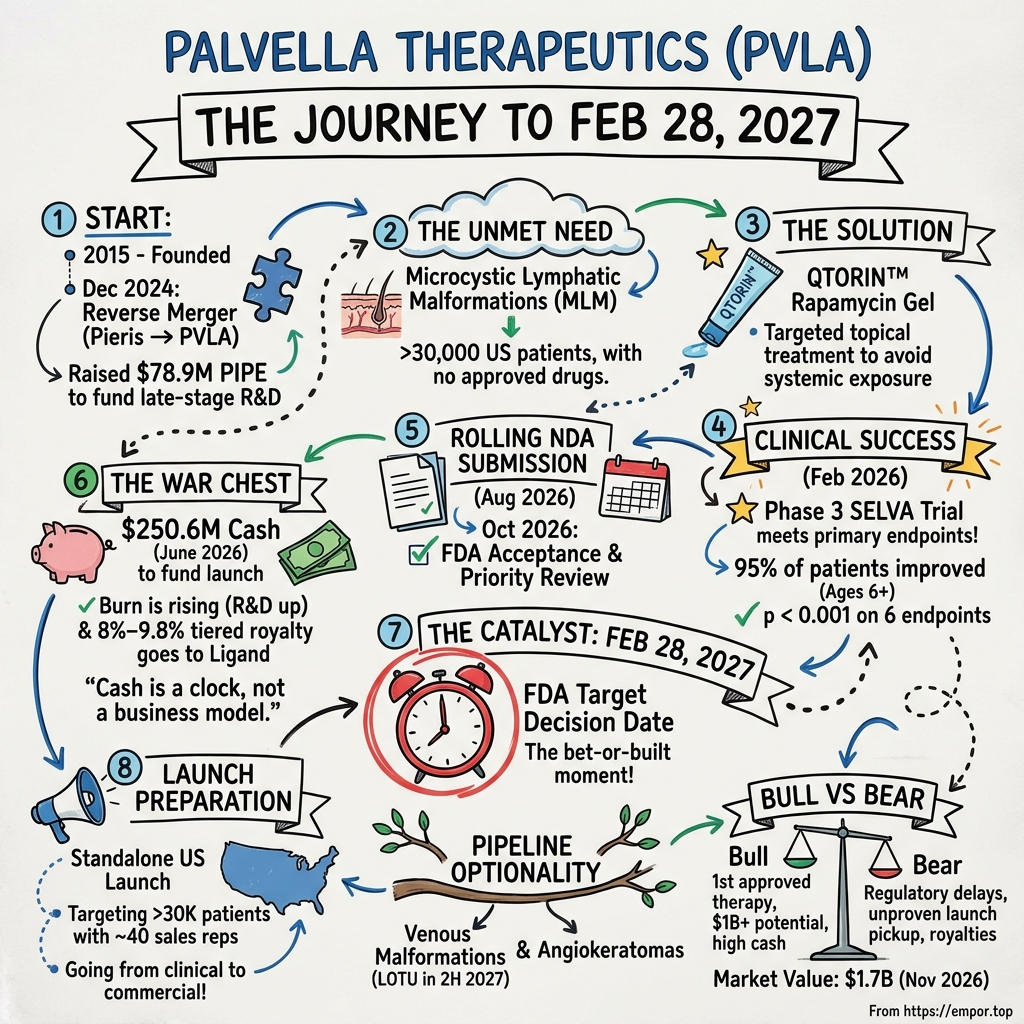
On October 28, 2026, a small drug company in suburban Philadelphia received the kind of letter that biotech founders imagine for a decade before it arrives. The U.S. Food and Drug Administration had accepted Palvella Therapeutics' New Drug Application for QTORIN rapamycin, a topical gel for a rare and disfiguring condition called microcystic lymphatic malformation, and had granted it priority review.[^1] The agency also did something that changes how everyone involved thinks about time. It set a target action date: February 28, 2027.[^1]
That date now hangs over the whole company. Every hire, every manufacturing batch, every conversation with an insurer and every line in the cash forecast is organized around it. The scientists have already finished the hardest part of their work. What remains is a judgment by a regulator, and after that, if the judgment is favorable, a second and quite different test in the market.
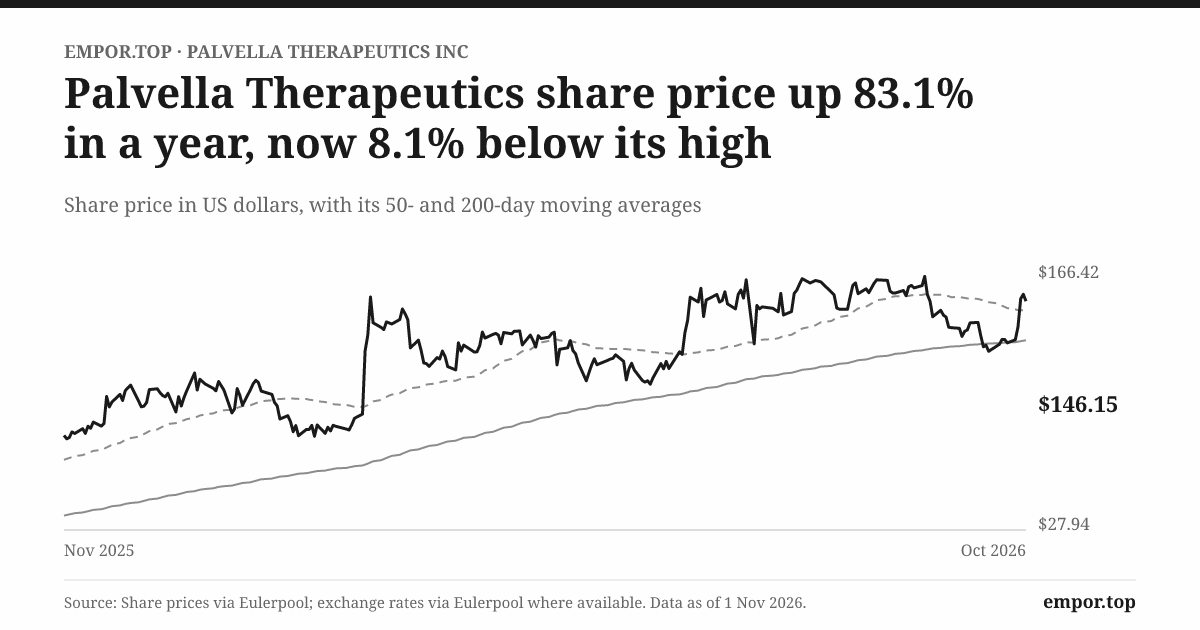
Pull back from the calendar and the picture becomes stark. Palvella has no approved product. It has never booked a dollar of product revenue.1 It has a few dozen employees; there were 29 full-time staff in March 2026.1 And yet on November 1, 2026, the stock market valued it at about $1.7 billion, with shares at $146.15, not far below a 52-week high of $159 and almost double the low of about $75 set during the past year.[^3] For a company with zero sales, that price is not a multiple of anything the company has done. It is a probability-weighted guess about what it might do.
The reason for the guess is a set of clinical numbers that, by the standards of rare-disease drug development, looked unusually clean. In February 2026 Palvella reported that its Phase 3 trial, called SELVA, had met all six of its prespecified efficacy endpoints, each with a p-value below 0.001.[^4] In plain English, the probability that results that strong appeared by chance alone was less than one in a thousand on each measure. Investors who had watched hundreds of small biotechs report murky, "trend toward significance" results took notice. Within days the company had raised a large sum of new money on the back of the data.[^5]
But a strong trial is not an approved drug, and an approved drug is not a business. Priority review shortens the FDA's clock, typically to six months from filing acceptance rather than the standard ten, because the agency judges that the drug, if it works, would be a significant improvement for a serious condition. It does not tell anyone what the agency will conclude. Plenty of drugs with priority review have received complete response letters, the FDA's formal way of saying "not yet." Plenty of approved drugs have launched into markets that turned out smaller, slower or harder to reach than their sponsors predicted.
So this story has four questions running through it. The first is the obvious one: will the FDA approve QTORIN rapamycin, and with what label? The second is whether Palvella can turn approval into a durable business, finding patients scattered across the country, persuading specialists and getting insurers to pay. The third is about money: does the cash Palvella raised in 2026 cover the launch and the next wave of trials without another round of dilution? And the fourth is the one most investors skip until it is too late: if the product succeeds, how much of the value actually reaches Palvella's shareholders after a royalty owed to Ligand Pharmaceuticals on every dollar of future sales?
The stakes are easy to state. At roughly $1.7 billion of market value against no earnings base, the share price already reflects a substantial amount of success. Enterprise value, which strips out the company's cash, was about $1.5 billion.[^3] That is the market's price for a single product candidate in a single rare disease, plus a pipeline of earlier programs built on the same gel. The company that earns that price will have to do something it has never done before: sell a drug.
To understand why investors were willing to pay that much for a promise, it helps to start not with the company but with the patients, and with a disease that, until now, nobody had a drug for.
 Subscribe on LinkedIn
II. A Disease Without an Approved Drug
Imagine a child whose skin, somewhere on the body, is studded with clusters of tiny, fluid-filled bumps. Doctors sometimes compare them to frog spawn. The bumps leak a clear fluid called lymph. They bleed when knocked. They crust, they become infected, and the infections can send a child to hospital. The patch might sit on a thigh, an arm, a chest wall, or, in the worst cases, on the face, tongue, or neck, where it interferes with eating, speaking or simply being looked at in a school corridor. And the condition does not go away. It is present from birth or early childhood and it stays for life.
This is microcystic lymphatic malformation. The lymphatic system is the body's drainage network, a web of fine vessels that collects fluid from tissues and returns it to the bloodstream. In a lymphatic malformation, that network forms abnormally during development. Instead of neat channels, the vessels grow into malformed pockets and sacs. Clinicians divide these malformations by the size of the pockets: macrocystic ones have large cysts, microcystic ones have many tiny ones, and some patients have both.2 The distinction matters enormously for treatment, because the tools doctors have work much better on big cysts than on small ones.
The main existing tools are procedural. Surgeons can cut malformed tissue out, but the lesions are often diffuse and woven into normal structures, so complete removal can be difficult and recurrence is common. Interventional radiologists can inject sclerosing agents, chemicals that irritate the inside of a cyst so that it scars and collapses. That works well when there is a large cavity to inject. In a field of thousands of tiny cysts there is nothing big enough to aim at.2 Lasers and other ablative approaches are used on surface lesions, often repeatedly. For many patients with the microcystic form, the result is a lifetime of managing symptoms rather than resolving them.
In the past decade, the treatment conversation shifted toward biology. Researchers found that many lymphatic and vascular malformations are driven by mutations in a growth-signaling pathway, often involving a gene called PIK3CA, which keeps the mTOR pathway switched on in the affected cells.2 Rapamycin, also known as sirolimus, is a long-established drug that blocks mTOR. Transplant doctors have used it for decades to suppress the immune system. Vascular-anomaly specialists began using oral sirolimus off-label for complicated lymphatic malformations, and the medical literature describes it as a meaningful option for some patients.2 The problem is that swallowing an immunosuppressant every day, sometimes for years, carries real systemic risks, from mouth sores to infections to blood-lipid changes, and requires monitoring of blood levels.
Palvella's idea was simple to state and hard to execute: put the rapamycin where the disease is. QTORIN rapamycin is a 3.9% anhydrous rapamycin gel, applied once a day to the affected skin.[^4] The goal is to get enough drug into the malformed tissue near the surface to dampen the overactive pathway, while keeping the amount that reaches the bloodstream very low. Think of it as the difference between watering one plant with a can and flooding the whole garden with a hose. In SELVA, blood levels of rapamycin stayed below 2 nanograms per milliliter at every time point measured,[^4] a level the company presented as far below what is typical for systemic therapy.
There is no FDA-approved therapy specifically indicated for microcystic lymphatic malformations.1 Palvella estimates that more than 30,000 people in the United States have been diagnosed with the condition.3 The FDA has given QTORIN rapamycin Orphan Drug Designation, Fast Track Designation and Breakthrough Therapy Designation for this indication, and European regulators have granted orphan designation as well.3 Those labels are not approvals, but they are signals: the agency agreed that the disease is serious, that the unmet need is real, and that early evidence suggested a substantial improvement over available therapy.
This is where the consensus story and the record need to be separated. The consensus version goes like this: rare disease, no approved drug, first mover, therefore a moat. The record is more nuanced. Being first to approval in a disease can give a company real advantages, including the first label, the first relationship with the specialist centers, and the first set of payer contracts. Orphan designation brings seven years of U.S. market exclusivity for the approved indication, which blocks another company from winning approval for the same drug in the same use during that window. But first-in-disease status does not prove that patients will use the drug, that doctors will prefer it, or that insurers will pay what Palvella hopes.
The existing alternatives do not vanish when a drug is approved. Surgery and sclerotherapy will remain the right answer for some lesions, especially macrocystic or mixed ones. Off-label oral sirolimus will remain available, cheap and familiar to the specialists who treat the most severe cases. Compounding pharmacies have made topical sirolimus preparations for years, and some dermatologists have used them for superficial vascular lesions. An approved, standardized, insurer-covered product has clear advantages over a compounded cream of uncertain strength, but the existence of those workarounds shapes how much pricing room the company will really have.
So the opening Palvella has is genuine but narrow. It is the chance to be the first standardized, FDA-approved topical therapy for a lifelong disease that existing tools treat poorly. Whether that opening becomes a defensible business will show up in a handful of things nobody can observe yet: how many patients physicians actually put on therapy, how long those patients stay on it, whether payers cover it without punishing paperwork, and whether the clinical improvement holds up outside a trial.
That raises an obvious question about the company itself. How did a small private developer focused on a handful of rare skin diseases end up as a Nasdaq-listed company worth well over a billion dollars? The answer runs through the corporate shell of another biotech that had run out of road.
III. The Shell That Became Palvella
Every public company has an origin story. Palvella's has two, and only one of them is about Palvella.
The first begins in 2015, when Wes Kaupinen founded Legacy Palvella in Wayne, Pennsylvania, around a focused idea: develop topical therapies for serious, rare genetic skin diseases that had no approved treatments.4 The company's early lead program used its QTORIN rapamycin formulation in pachyonychia congenita, a rare inherited disorder that causes painful thickened nails and calluses on the soles of the feet. That program is the first piece of historical evidence an investor should weigh, because it did not work. Legacy Palvella's late-stage trials in pachyonychia congenita failed to meet their primary endpoints.3 The same molecule and the same platform that now stand on the edge of approval in lymphatic malformations had already been through a pivotal disappointment in a different disease.
That failure tells you something important. A topical rapamycin platform is not a guarantee of efficacy across skin diseases. Each disease has its own biology, its own way of measuring improvement, and its own risk of a trial missing. The pivot to microcystic lymphatic malformations, a disease where the mTOR pathway is directly implicated, was in part a lesson learned the hard way: pick the disease where the mechanism fits most tightly.
The second origin story belongs to Pieris Pharmaceuticals, a Boston-based biotech that spent more than a decade developing engineered proteins called Anticalins and partnering them with larger drugmakers. Pieris's income statement is the long history that shows up in the listed company's financial records. It booked collaboration revenue that rose from a few million dollars a year in the mid-2010s to a peak of about $46 million in 2019, then drifted down.1 In 2023 the last major chapter closed: Pfizer assumed substantially all remaining responsibilities for a partnered program, Pieris recognized about $10 million of revenue tied to that transition, and the collaboration business was effectively wound down.1 The listed company's share price over five years shows a peak-to-trough fall of about 94%,[^3] which is mostly a record of Pieris's decline rather than Palvella's progress.
By 2024, Pieris had what many struggling biotechs end up with: a Nasdaq listing, a dwindling cash pile and few prospects. Palvella had the opposite problem: a promising late-stage program and the need for capital to finish it. The two companies agreed to merge in July 2024, and the transaction closed in December.3 Pieris changed its name to Palvella Therapeutics and the combined company began trading on Nasdaq under the ticker PVLA.[^9]
Legally, Pieris was the acquirer. Economically, it was the other way around. In a reverse merger, a private company takes over a listed shell, and the private company's owners and business become the listed company's owners and business. Legacy Palvella's holders received about 6.79 million shares of the listed company.3 Alongside the merger came a private placement, often called a PIPE, of $78.9 million in common stock and pre-funded warrants. Of that, $60 million was new cash and $18.9 million came from converting notes that Legacy Palvella had issued to its investors before the deal.[^9]3
It is worth being precise about what this transaction was. It was not the purchase of an operating business with customers and profits. There was no acquisition premium in the normal sense, no earnings multiple paid, no synergies to deliver. It was a financing and listing transaction: a way for a private drug developer to become public without an IPO roadshow, and to raise money from specialist investors at the same moment. For that reason, the old Pieris revenue history is not a comparable record for the business Palvella runs today. Any chart that shows the listed company's revenue falling to zero in 2024 is showing the end of a different company, not the failure of this one. And anyone tempted to compare the merger with acquisition premiums paid for operating companies is comparing apples with a seed catalog.
The holders of the old Pieris stock did not simply disappear. Before the merger, Pieris issued them contingent value rights, one for each share, entitling them to payments if Pieris or its affiliates received money under certain legacy strategic partner agreements, outlicensing of legacy assets and certain research tax credits.3 At the time, management concluded that no value should be recorded for those rights.3 They are a tidy legal device for letting old holders keep a lottery ticket on the old science. For current Palvella shareholders they are best understood as a ring-fence: whatever the legacy Pieris assets produce flows largely to the old holders, and none of it bears on the economics of QTORIN.
What the transaction bought, above all, was time and capability. The PIPE was meant to fund the company through the Phase 3 SELVA trial and the work needed to prepare an NDA. At the end of 2024, the company held about $84 million of cash.1 For the first time in its history Legacy Palvella had a public currency, analyst coverage and access to follow-on equity markets, which mattered enormously when the trial read out.
There was also a cost. Public companies pay for auditors, lawyers, investor relations, directors' insurance and the constant reporting cycle. A private biotech that once answered to a board of venture investors now answered to the market every quarter. And the shareholder base, once concentrated among founders and venture funds, now included hedge funds and specialist investors who could leave as quickly as they arrived.
The question in December 2024 was whether the platform would deliver the one thing the listing could not buy: a positive Phase 3 result. That answer arrived fourteen months later, and it reshaped the company overnight.
IV. SELVA Turns a Platform Story Into an FDA Filing
The morning of February 24, 2026, was the kind of morning that split a small biotech's history into before and after. Palvella announced topline results from SELVA, its Phase 3 trial of QTORIN rapamycin in microcystic lymphatic malformations.[^4] The trial had met its prespecified endpoints.[^4]
To understand what that means, start with how the trial was built, because its design is both a strength and a limitation.
SELVA was a single-arm, baseline-controlled study. That phrase deserves translation. In a classic randomized controlled trial, some patients get the drug and some get a placebo, and the comparison between the groups is the evidence. In a single-arm trial everyone gets the drug, and each patient serves as his or her own control: researchers measure the disease at the start and again after treatment, and the change is the evidence. The design is common in rare diseases, where patients are scarce and asking a child with a bleeding, infected malformation to spend six months on a placebo gel raises ethical and practical problems. But it means the trial cannot fully rule out improvement that would have happened anyway, or improvement driven by the extra attention patients receive in a study.
Palvella enrolled 51 participants aged three and older; 50 started treatment, including 49 aged six and older, who formed the primary efficacy population, and one child in an exploratory three-to-five-year-old cohort.[^4] Patients applied the gel once daily for 24 weeks, about six months.
The primary endpoint used a scale called the mLM-IGA, short for microcystic lymphatic malformation Investigator Global Assessment. A clinician looks at the lesion and rates the change from baseline on a seven-point scale that runs from minus three, meaning very much worse, through zero, meaning unchanged, to plus three, meaning very much improved. It is a structured version of the question every doctor asks: is this patient better or worse than when we started? Across the primary population, the mean change at week 24 was plus 2.13 points.[^4] On a scale where plus two means "much improved," the average participant landed just above that mark.
The key secondary endpoint is the one that matters most for skeptics. It used a separate multi-component static scale, called the mLM-MCSS, that scored specific features of the lesion, and it was assessed in a blinded way, meaning the person scoring did not know when in the course of treatment the assessment was made.[^4] Blinding is the classic defense against wishful scoring. That measure improved by a mean of minus 3.36 points, where a lower score is better, again with a p-value below 0.001.[^4] For a single-arm study, having a blinded component pointing in the same direction as the investigator assessment strengthens the case considerably.
Then came the responder figures, which were the numbers that traveled fastest. Among the 43 participants who completed the efficacy evaluation period, 95% improved by at least one point on the primary scale, and 86% were rated "much improved" or "very much improved."[^4] The single child in the youngest cohort was rated "very much improved."[^4] These figures are striking, but notice the denominator: they describe completers, not everyone who started. Six of the 49 participants in the primary population did not complete the efficacy period, and completer analyses naturally look better than intent-to-treat analyses, because patients who drop out often do so for reasons that would have lowered the average. The mean change of plus 2.13 is the intent-to-treat figure, and it is the more conservative one.
On safety, the gel was described as well tolerated. Seventeen participants experienced treatment-related adverse events, most commonly application-site acne, discoloration and itching, each in about 6% of participants.[^4] Systemic drug levels remained low.[^4] That profile matters commercially as much as clinically: a drug used daily for years on children's skin needs to be something families can live with.
The road from data to a filing
What happened next is a useful test of management credibility, because the company had published timelines in advance and then had to hit them.
In January 2026, Palvella told investors it expected SELVA topline results in the first quarter of the year.[^10] That was consistent with what it had said in the December 2024 resale prospectus, which also pointed to the first quarter of 2026.3 The results arrived on February 24, inside the window and slightly ahead of the March timing many investors had pencilled in. Alongside the data, the company said it planned to submit its NDA in the second half of 2026, with potential approval in the first half of 2027.[^4]
The company then moved fast in the capital markets. It priced a public offering that raised $230 million in gross proceeds and about $215.8 million after underwriting fees and expenses.[^5]5 Raising money immediately after good news is standard biotech practice, and it is the right practice: a company should sell stock when the price reflects reduced risk, not when it is desperate. The cost, which the next section examines, was dilution.
Palvella used a rolling submission, a process available to Fast Track products that lets a company send completed sections of the NDA to the FDA as they are ready rather than all at once. By the time of its second-quarter results in August, management said the rolling submission was under way and on track.[^12] On August 31, 2026, the company announced it had completed the submission.[^13] On October 28, the FDA accepted it for filing.[^1]
In May 2026, at the International Society for the Study of Vascular Anomalies, researchers presented additional analyses.[^10] Among them were subgroup results; in participants aged six to eleven, for example, the gel showed a statistically significant improvement on the primary scale of plus 2.46 at week 24.[^10] The October FDA announcement also highlighted patient-reported satisfaction measures.[^1] These analyses add texture, and they are encouraging for the pediatric market that matters most. But they are company-reported cuts of the same small dataset, and subgroups of a 49-patient trial contain only a dozen or so people each. They support the primary result; they do not independently confirm it.
Put the milestones together and the pattern is clear. Management said first-quarter data and delivered it in February. It said it would submit an NDA in the second half and completed the submission in August. It sought a speedy review and got priority review. On clinical and regulatory timelines in this program, the company's word and its delivery have matched. That is not nothing in an industry where slipped timelines are routine. It is also not evidence about anything that comes after, a distinction the story returns to when it reaches the people running the company.
What the FDA still has to decide
The FDA's job now is to weigh the full evidence package, which is much larger than a press release: patient-level data, manufacturing and quality information, the long-term safety experience, and the agency's view of whether a single-arm, baseline-controlled design with a clinician-rated scale is adequate evidence of effectiveness for this disease. The breakthrough designation and the blinded secondary endpoint suggest the agency has been involved in shaping that design. But agreement on a trial design before a study is not a promise of approval after it, and the FDA can ask for more data, raise manufacturing questions, or approve with a narrower label than the company would like.
The label is the quiet variable. It will define the approved age range, which lesions and body areas the drug covers, how long patients may use it, and what warnings accompany it. A broad label for children and adults with microcystic lymphatic malformations would give the commercial team the widest possible target. A narrow one would shrink it before the first sales representative made a call.
SELVA moved QTORIN rapamycin from a platform claim to a regulatory case, and on the evidence available it is a strong case. What it cannot do is tell anyone how a drug used by a few dozen trial participants under close supervision will perform among thousands of patients in the real world. That question belongs to the launch, and the launch is a different kind of trial altogether.
V. The First Launch Is a Different Kind of Trial
Picture the patient journey in the real world, not in a trial. A child is born with a lesion that the pediatrician does not quite recognize. Months or years pass. The family sees a dermatologist, perhaps a surgeon, perhaps an interventional radiologist. Somewhere along the way someone mentions the words "vascular anomaly" and refers the family to one of the specialized multidisciplinary centers that treat these conditions, most of which sit inside large children's hospitals. That center confirms the diagnosis, perhaps with imaging. The doctors there decide whether to watch, cut, inject, prescribe oral sirolimus, or, after February 2027, perhaps prescribe a topical gel. Then the prescription meets an insurer. Then the family has to apply a gel every day for months or years.
Each link in that chain is a place where patients fall out. That is why a rare-disease launch is its own kind of experiment, and why the company's preparations matter as much as its data.
By October 2026, Palvella said it was preparing for a standalone U.S. launch rather than handing the product to a larger partner.[^1][^12] It had already deployed medical affairs staff, the scientists who educate physicians about the disease and the data, and had begun building patient-support capabilities, the hub services that help families navigate insurance, prior authorizations and refills.[^1] In its third-quarter 2026 investor materials, the company described a planned sales force of about 40 representatives.[^14] For a rare disease concentrated in specialist centers, that is a focused team, and focus is the right instinct. Forty representatives cannot blanket every dermatologist in the country, but they can cover the vascular-anomaly centers, the pediatric dermatologists and the high-volume referral physicians where most diagnosed patients are likely to be found.
The company estimates more than 30,000 diagnosed U.S. patients,3 and cites a potential annualized U.S. market opportunity above $1 billion.[^12] Those are the figures that investors anchor on, and they deserve scrutiny because they are management estimates, not observed demand.
Begin with the patient number. "Diagnosed" is doing a lot of work. A patient diagnosed years ago may not be in active care, may have a mild lesion that does not bother them, may have a macrocystic component better treated by sclerotherapy, or may be satisfied with oral sirolimus. The number of patients a company can actually reach, persuade and keep on therapy is always smaller, sometimes much smaller, than the number in the epidemiology slide. Rare-disease launches have a long record of starting with the "warm" patients, the ones already known to specialist centers, and then slowing as the company has to dig for the rest.
Now the market figure. A billion-dollar annual opportunity across roughly 30,000 patients implies an average annual revenue per diagnosed patient in the tens of thousands of dollars, if every one of them were treated. Palvella has not disclosed a price. It has not disclosed payer terms, expected persistence or average treatment duration.1[^12] So the market estimate is a scenario, not a forecast. It may be reasonable for an orphan drug, but nobody, including the company, has yet seen a single insurer's coverage decision for the product.
Duration of use may matter more than price. A lifelong disease suggests chronic use, which would make each patient a recurring revenue stream. But the trial ran for 24 weeks. Nobody knows yet how many patients will need continuous therapy, how many will use it in cycles, how many will stop once the lesion improves, and how many will stop because daily application to a child's skin is a chore. Recurring revenue in rare disease is earned through persistence, and persistence is something only a launch can measure.
It is worth being clear about what there is not to analyze. Because Palvella has no product sales, there are no product customers, no sales concentration figures, no receivables to age and no history of price realization.1 The listed company's older revenue records show a collaboration business with Pfizer and other partners, but that belonged to Pieris and says nothing about how hospitals, pharmacies or insurers will treat a Palvella product. The commercial evidence starts from zero.
What has management actually built before approval? The company says its medical affairs staff are in the field and patient-support capabilities are being built; commercial leadership and a sales force are planned. The company depends on contract manufacturers and outside suppliers of the active ingredient for clinical and potential commercial supply, and it has not named them or disclosed the concentration of that supply.1 Manufacturing readiness is one of the things the FDA inspects during review, and supply interruptions after approval have derailed more than one small-company launch. Much of the commercial build, especially hiring the full sales force, will sensibly wait until approval is closer, because hiring 40 representatives for a drug that receives a complete response letter would be an expensive mistake.
That staging is prudent, and it means the launch's success is still almost entirely contingent. If approval comes, the evidence that will test the commercial thesis is not complicated. Watch the number of patients who start therapy, the time from diagnosis or referral to first prescription, the share of prescriptions that insurers approve and how quickly, the share of patients still on therapy after six and twelve months, and, ultimately, net sales. None of those numbers exists today.
And all of them cost money to produce. Building a launch while running new trials is expensive, and the company that does it needs a large enough balance sheet to survive a slow start. That is where the February financing, and a royalty agreement signed years earlier, come into the story.
VI. $250 Million Buys Time, While Ligand Keeps a Claim
On June 30, 2026, Palvella's balance sheet looked like a different company's. Six months earlier it had held about $58 million of cash.1 Now it reported $250.6 million in cash, cash equivalents and short-term investments, including about $62.8 million of short-term investments.5[^12] For a company that had spent most of its life raising money in increments of tens of millions, this was a war chest.
The arithmetic of how it got there tells you about the burn. Start with the $58 million at year-end 2025 and add roughly $216 million of net offering proceeds and you get about $274 million. The company ended June with about $251 million. The difference, a little over $20 million, is roughly what the business consumed in the first half of 2026, after interest income and other small inflows. That is a manageable figure against the cash on hand. The trouble is that it is rising.
Two financings, two different clocks
Compare the two capital raises. The December 2024 PIPE brought in $60 million of new cash plus the conversion of notes, and it was designed to carry the company through SELVA and the preparation of the NDA.[^9] It was enough for a clinical-stage company with a few dozen employees and one pivotal trial. The February 2026 offering raised almost four times as much gross money, and was sized for a different job: a launch, a second pivotal program and the regulatory process at the same time.[^5]
The price of that cash was dilution. The offering added several million new shares, on top of pre-funded warrants that remained outstanding and preferred stock that had converted to common in October 2025.1 For holders who bought before the SELVA readout, dilution after a strong trial was the right trade: selling a slice of the company at a high price to remove financing risk. For anyone modeling the future, it is a reminder that the share count in a biotech moves, and that the market value of about $1.7 billion is spread over a larger base than existed a year earlier.
Where the money goes
The burn is an investment in trials, manufacturing, regulatory work and the launch. Research and development expense, which covers trial costs, drug manufacturing for clinical and regulatory purposes and the people who run them, rose from about $8 million in 2024 to about $23 million in 2025.1 In the first half of 2026 alone it reached $21.8 million, compared with $9.2 million a year earlier.5 General and administrative costs also rose in the second quarter as headcount and public-company costs grew.5 The company's quarterly operating loss tells the same story in one line: from about $8 million in the first quarter of 2025 to about $21 million in the second quarter of 2026.51
That trajectory is what a company should look like as it moves from one trial toward a launch and the next pivotal study. It is not harvesting; it is investing. But the same rising line that signals ambition also shortens the runway. A launch adds a sales force, marketing, market-access teams, patient hub services, commercial inventory and distribution costs, and those costs arrive before meaningful revenue. Most rare-disease launches take several quarters to build momentum. A company spending $20 million a quarter today could plausibly be spending considerably more within a year, and nobody has published a commercial cost forecast.
Management's own description of the runway is conservative by legal necessity. In the second-quarter filing, the company said its cash would fund planned operations for at least 12 months from the filing date.5 That is the minimum language required to avoid a going-concern warning, not a statement that the cash will last until profitability. Investors who hear "$250 million" and think "years of runway" should listen for a more specific statement on the next calls.
The claim Ligand holds
Every future dollar of QTORIN sales already has a passenger. Years before the merger, Legacy Palvella signed a development funding agreement with Ligand Pharmaceuticals, a company whose business model is to finance other people's drug development in exchange for royalties. Ligand funded $15 million. In return it is entitled to up to $8 million of milestone payments and a tiered royalty of 8.0% to 9.8% on future worldwide net sales of the product.1 At the end of 2025, about $5 million of those potential milestones remained.1
This is not ordinary bank debt. There are no disclosed covenants, no maturity date, no refinancing risk. If QTORIN never sells, Ligand gets little. But if QTORIN succeeds, Ligand gets paid on the top line, before Palvella pays for its sales force, its manufacturing or its next trial. A simple illustration makes the point. If the product someday reached $200 million of annual net sales, a royalty in that range would send something like $16 million to $20 million a year to Ligand. At a billion dollars of sales, the figure would approach $100 million a year. The royalty does not threaten the company's survival; it reduces the margin of its success.
The accounting makes this concrete in an unusual way. Because Palvella received cash in exchange for a share of future revenue, it records the obligation as a liability, in effect treating it like a loan that is repaid through royalties. At year-end 2025 the royalty liability stood at $17.8 million, with a separate $2.0 million fair-value liability for the remaining milestones.1 The company accrues imputed interest on that liability based on its estimates of future sales; in 2025 that non-cash interest expense was about $5.8 million.1 The size of that charge depends on assumptions about approval probability, patients, price and timing. If the company's sales expectations rise, the liability and the interest expense rise with them. It is an accounting estimate that will move with every change in the commercial outlook, and the auditor singled it out for special attention, a point that matters for governance.
Why the losses and the cash do not match
Palvella's accounting losses are larger than its cash consumption, and the gap matters for anyone reading the income statement. In 2024, the first year that reflected the merged company, the net loss was about $17.4 million while operating cash use was about $10.8 million. In 2025, the net loss more than doubled to about $41.7 million, while operating cash use was about $25.0 million.1 The difference came from non-cash items, chiefly stock-based compensation and the imputed interest and fair-value movements on the Ligand liability, plus working-capital swings. In 2025, for example, the company collected receivables and German research tax credits that had been booked earlier, which released cash.1 Interest income on the growing cash pile also helped, about $2.6 million in 2025.1
The long-run figures for the listed company, showing cumulative losses of more than a quarter of a billion dollars over a dozen years, are mostly Pieris's history. They do not describe Palvella's cash conversion and should not be read as one continuous record.
So the practical test is not the net loss. It is quarterly operating cash use after the NDA submission and as the launch build-out begins. If that number stays near $20 million a quarter through approval, the June balance buys a long runway. If it climbs steeply before revenue arrives, the clock runs faster than the headline balance suggests. And the speed of that clock depends partly on how much the company chooses to spend on the programs behind QTORIN's first indication, which is where Palvella's ambitions extend beyond a single disease.
VII. One Gel, Several Rare-Disease Bets
There is a moment in the life of every single-product biotech when the founders start describing the company as a platform. Sometimes the word reflects real science. Sometimes it is a way of persuading investors that the company is worth more than its one drug. Palvella reached that moment as QTORIN rapamycin approached its first NDA decision, and the honest answer is that it is a little of both.
The company describes QTORIN as a formulation technology: a way of making an anhydrous, meaning water-free, gel that keeps a drug stable and delivers it into the skin.1 Rapamycin is the first molecule to ride on it, but not the only one. The company's portfolio, sorted by maturity, looks like a staircase.
On the top step sits QTORIN rapamycin for microcystic lymphatic malformations, with an NDA under priority review. One step down is the same gel in cutaneous venous malformations, a related condition in which the malformed vessels are veins rather than lymphatics, causing painful, bluish lesions that can swell, clot and bleed. Palvella estimates that more than 75,000 people in the United States have the condition,3 a population more than twice the size of its first indication. In December 2025 the company reported positive topline results from TOIVA, a Phase 2 trial of the gel in cutaneous venous malformations. At week 12, 11 of 15 participants, about 73%, improved on the trial's investigator global assessment scale, and 10 of 15 were rated much or very much improved.[^15] The most common treatment-emergent side effect was redness at the application site.[^15] The program carries Fast Track designation, and the company said it would discuss a Phase 3 pivotal study and a possible Breakthrough Therapy designation with the FDA.[^15] Later in 2026 it presented further analyses, including improvements in bleeding among patients who had bleeding at baseline.[^10]
Further down the staircase are two earlier bets. LOTU is a Phase 2 study of QTORIN rapamycin in clinically significant angiokeratomas, small, dark, blood-filled skin growths that can bleed and cause discomfort; the company expects topline results in the second half of 2027.[^12] And QTORIN pitavastatin is a second molecule entirely, a statin repurposed as a topical treatment for disseminated superficial actinic porokeratosis, a genetic skin condition that causes scaly, ring-shaped patches, often on sun-exposed limbs.5 Pitavastatin's inclusion is the most direct test of the platform claim, because it asks whether the formulation know-how can carry a different drug into a different disease.
The venous-malformation program deserves the most attention, because it is the plausible second value driver. The biology overlaps with lymphatic malformations: many venous malformations also involve overactive growth signaling that rapamycin targets. The patient population is larger. And the Phase 2 results were encouraging. But the history of drug development is littered with Phase 2 programs that looked good in 15 patients and struggled in a pivotal trial, and Palvella's own history includes a similar setback in pachyonychia congenita.3 A 12-week, 15-patient open-label result does not establish that a Phase 3 trial will succeed, what endpoint the FDA will accept, or whether physicians will prefer a gel to procedures they already use for venous lesions, many of which respond reasonably well to sclerotherapy.
The platform argument, stated once and fairly, goes like this. Palvella has built expertise in formulating stable topical drugs, in running trials in rare skin and vascular diseases, in designing clinician-rated endpoints the FDA will accept, and soon in selling to vascular-anomaly specialists. Each new indication can reuse that capability, and some of them, especially venous malformations, would be sold to many of the same physicians who will prescribe the first product. That is a real economy of scope. A sales representative visiting a vascular-anomaly center could, in time, carry two products into the same room.
What would falsify it? Three things, any of which would be visible within a few years. A later program could fail to reproduce efficacy, which would show that the first success depended on disease-specific biology rather than on a repeatable approach. A later program could need a materially different formulation, delivery method or trial design, which would erase most of the scope economies. Or a later product could win approval and still fail to attract use, which would suggest that the commercial engine does not transfer between diseases. The platform claim, in other words, is currently a hypothesis with one strong data point in lymphatic malformations, one encouraging small data point in venous malformations, and one negative data point in pachyonychia congenita.
The venous-malformation program needs a Phase 3 trial that has not yet started; angiokeratoma data are more than a year away; pitavastatin is earlier still. Each costs money, and that money comes out of the same $250 million that must fund the first launch. The near-term investment case is therefore dominated by one decision on one date. The pipeline is optionality, which is valuable, but it is optionality the company has to pay for while it learns to sell.
Which brings the story to the people who will make those spending decisions, and to the question of whether a team that has proven it can run trials can also run a commercial business.
VIII. The Founder's Next Job Is Commercial Execution
Wes Kaupinen has run Palvella since he founded it in 2015.4 That is a rare kind of continuity in biotech, where founders are often replaced by professional chief executives once a company nears the clinic's finish line. For more than a decade he has been the person telling investors what the company would do next, through a pivotal failure in one disease, a pivot to another, a reverse merger and now an NDA. Founder-led biotechs can be stubborn about their science in ways that waste capital. They can also be unusually persistent in ways that let a promising idea survive long enough to be tested. Palvella's record contains evidence of both, which is why the right way to judge management is by what it said it would do and what happened.
Around him is a small leadership group. Kathleen Goin serves as chief operating officer and Matthew Korenberg, who joined in 2024, as chief financial officer.4 With its small staff in March 2026,1 Palvella was still a company where the executives can name everyone in the building. That will change quickly if approval comes, and the transition from a clinical development organization to a commercial one is where many founder-led teams stumble. Selling a drug requires different hires, different systems and a different tempo: weekly prescription data, territory management, payer negotiations, inventory, compliance training for a field force. Palvella's team will have to build all of that within months.
Promises made, promises kept
The 2026 milestone record was clean: SELVA data arrived in February as forecast,[^10][^4] the rolling NDA submission was completed in August as planned,[^4][^13] and the FDA accepted the application for priority review in October.[^1]
That record supports confidence in the team's execution on clinical and regulatory timelines in this program. It does not support confidence in commercial performance, because there has been no commercial performance to judge. And it should be read alongside the earlier failure in pachyonychia congenita.3 The fair verdict is that management has delivered on the milestones it controlled most directly, and that the hardest set of promises, the ones about patients, prices and sales, have not yet been made in specific enough terms to test.
What the shareholders pay and what they think
Compensation is modest by the standards of a $1.7 billion company and generous by the standards of a company with no revenue. In 2025 Kaupinen's total reported pay was $3.40 million, of which $2.47 million was the grant-date value of stock options and $0.36 million was a cash bonus, with the remainder made up of salary and other items.4 Goin's total was $1.98 million and Korenberg's $1.97 million.4 The bonuses related to 2025 objectives, a year in which the company's net loss more than doubled to $41.7 million,4 but in a pre-revenue biotech, losses rise when the company is doing what it promised, so the loss is not by itself a sign of misaligned pay.
The structure matters more than the size. Most of the chief executive's pay came in options, which are worth something only if the share price rises above the exercise price. That aligns a large part of compensation with shareholders. But grant-date option values are accounting estimates, not cash, and the shares underlying those options are a cost borne by every other holder through dilution. In June 2026, shareholders approved an increase of 750,000 shares in the company's equity incentive plan.6 The vote was 7.69 million in favor and 2.48 million against,6 meaning roughly a quarter of the votes cast opposed it. That is a meaningful minority. The say-on-pay vote, by contrast, passed overwhelmingly, about 10.0 million to 0.16 million.6 Shareholders, in other words, were comfortable with how executives were paid and less comfortable with how many new shares the plan might issue.
Ownership is dispersed. The 2026 proxy reported no controlling holder; the largest disclosed beneficial owners were funds affiliated with First Light Asset Management, at about 6.2%, and Biotechnology Value Fund, at about 6.1%, as of April 2026.4 Biotechnology Value Fund is one of the best-known specialist biotech investors in the United States, and its presence signals that sophisticated healthcare investors examined the data and took a position. It is not a guarantee: specialist funds trade actively and can sell as quickly as they buy. Beneficial-ownership percentages in this company also need care, because options and warrants change the denominators, and the proxy's calculation excludes pre-funded warrants.4 Kaupinen's double-digit stake at the time of the 2024 listing belongs to a different capital structure; after the 2026 offering, the current proxy is the right snapshot.
The auditor's report adds one more piece of evidence. Ernst & Young issued an unqualified opinion on the 2025 financial statements, meaning it found them fairly presented.1 It also identified one critical audit matter, the term auditors use for the area of the accounts that required the most difficult judgment: the probability-weighted estimate of interest expense on the Ligand royalty liability.1 That estimate depends on assumptions about approval, patient numbers, pricing and timing, the very assumptions investors are trying to form. It is not a red flag. It is a reminder that the most important number in Palvella's future, product sales, already sits inside its accounts as an estimate. Management assessed its internal controls as effective, and the annual report did not include a separate auditor opinion on those controls.1
What to listen for next
The next earnings calls will be more revealing than any before them, because the questions are changing. Until now, analysts asked about trial enrollment, endpoints and filing dates, questions management could answer with precision. After the October acceptance, the questions shift to launch staffing and timing, how many of the estimated 30,000 diagnosed patients the company believes it can reach in the first years, what payer conversations have shown, how the Ligand royalty will flow through gross margin, how fast cash use will rise, and which pipeline program gets funded first. The comparison worth making is between management's prepared remarks and its answers when analysts press on those points. A team that answers commercial questions with the same specificity it brought to trial timelines is a team building credibility in a new domain. A team that retreats to "we'll share more at launch" is telling investors that the commercial plan is still forming.
The founder's job has changed. For eleven years, his task was to get a drug through the clinic. From February 28, if the decision is favorable, his task will be to sell it. And whether the market price makes sense depends on how well that next job is done.
IX. Analysis & Bear vs. Bull Case
At $146.15 a share, Palvella's enterprise value was about $1.5 billion on November 1, 2026.[^3] It held $250.6 million of cash and short-term investments at the end of June.5 It had no sales, which is why its enterprise-value-to-sales ratio reads 0.0x, a number that is mathematically correct and analytically useless.[^3] Its price-to-book ratio was about 9.7 times,[^3] which mostly tells you that the stock market values the company's intellectual property, data and prospects far above the cash and equipment on its balance sheet. No P/E ratio exists, because there are no earnings, and the listed company's trading history before December 2024 belongs to Pieris, so there is no meaningful five-year median multiple to compare against.
So what is the market paying for? Roughly $1.5 billion of enterprise value for a product that has not been approved, in a disease with an estimated 30,000 diagnosed U.S. patients, plus a pipeline. If one took management's market-opportunity figure of above $1 billion at face value,[^12] the market would be paying about one and a half times a full-penetration annual market estimate for the entire company. Rare-disease companies with approved, growing products often trade at several times their sales, so the price is not absurd if the launch works. It is, however, already pricing in a high probability of approval and a substantial commercial outcome. The stock's one-year volatility of about 81%[^3] is the market's way of saying how uncertain that outcome remains.
The shape of the industry
Start with the structure of the market Palvella hopes to enter, because the forces acting on it are different from those in most businesses.
The buyers are not one group but three. Patients and families experience the disease and apply the gel. Specialist physicians, concentrated in vascular-anomaly centers and pediatric dermatology practices, decide what to prescribe. And payers, the commercial insurers, Medicaid programs and pharmacy benefit managers, decide whether and on what terms to pay. Payers hold most of the bargaining power. They can require prior authorization, demand that patients try cheaper options such as off-label oral sirolimus first, or limit how long a prescription is covered. In rare diseases, payers typically cover approved orphan drugs with no alternatives, but they scrutinize price and duration, and a gel used on the skin may invite comparisons with compounded alternatives.
The threat of substitutes is the force most often understated in the bull case. Existing procedures and oral sirolimus remain alternatives. QTORIN's advantage is that it treats the microcystic form, which procedures handle poorly, without the systemic exposure of oral sirolimus. That is a genuine differentiation within a crowded toolbox rather than a monopoly over the only tool.
The threat of new entrants is moderated by regulation. Orphan exclusivity would block another company from winning approval for the same drug in the same indication for seven years after approval. Palvella says it owns or controls a portfolio of patents and patent applications covering the QTORIN technology,1 and formulation know-how is genuinely difficult to replicate in topical rapamycin, a molecule that is notoriously unstable and poorly absorbed. But orphan exclusivity protects an indication, not a mechanism. A competitor with a different molecule or a different formulation could pursue the same disease, and the broader field of mTOR and PI3K-pathway drugs for vascular anomalies is attracting attention. Supplier power is modest but real: Palvella depends on outside manufacturers and active-ingredient suppliers that it has not named.1 And rivalry among existing competitors is, for now, minimal, because there is no approved competing drug.
Which powers might Palvella build
Hamilton Helmer's seven powers framework asks what lets a company earn returns above its cost of capital for a long time. Applied honestly to Palvella, most powers are absent and two are potential.
The first potential power is a cornered resource: an approved label, orphan exclusivity, patents and the clinical dataset. If the FDA approves the drug with a broad label, Palvella will hold a regulatory position no competitor can match in the short run. The strength of that position depends on details not yet known, including the label's breadth, how robust the patents prove if challenged, and whether a competitor can design around the formulation. A cornered resource built on regulatory exclusivity is real but time-limited, and it protects the indication rather than the demand.
The second is something like counter-positioning or early-mover advantage in a niche: a focused company whose entire organization is built to serve vascular-anomaly specialists, a market too small for large pharmaceutical companies to prioritize. That could let Palvella become the default partner of the specialist centers, especially if its later programs add products for the same physicians. But this is an aspiration, not a demonstrated power.
The powers that would make the business durable, namely switching costs, network effects, scale economies and brand, have no evidence yet, because there is no commercial history. There is no retention data, no record of price realization, no share-of-market figures. A family that sees good results on the gel may be very reluctant to switch, which would create switching costs, but nobody can know that until patients have been on commercial therapy for a year or more. The fair conclusion is that Palvella has concrete assets that could become a moat, namely its patents, its formulation know-how, its data and a potential first label, and that whether they become one depends on adoption and persistence that remain to be tested.
The bull case
The optimistic version of the story is coherent. The FDA approves QTORIN rapamycin on or near February 28, 2027, with a label covering children and adults. Specialists who have watched patients struggle for years with procedures and systemic drugs adopt a topical, low-exposure option quickly, starting with the known patients at major centers. A focused 40-person field force and patient-support services convert that clinical need into prescriptions and secure coverage. Patients stay on therapy because the disease is lifelong and the gel is tolerable. Revenue builds over several years toward a meaningful share of management's market estimate. The $250 million balance carries the company through the launch and into a Phase 3 trial in venous malformations, which, if successful, roughly doubles the addressable population using the same sales force. In that world, the royalty to Ligand is a cost of success rather than a burden, and the current valuation looks like an early price for a durable rare-disease franchise.
The bear case
The pessimistic version is equally coherent. The FDA issues a complete response letter, asks for more data or approves a narrower label, perhaps limiting age, duration or lesion location, which would delay or shrink the launch. Even with approval, reachable demand proves well below the 30,000-patient estimate, because many diagnosed patients are not in active care, have mild disease, or are adequately managed with existing procedures. Payers require step therapy through oral sirolimus or set restrictive coverage criteria, and compounded topical rapamycin dampens pricing. Persistence is lower than hoped as patients stop applying a daily gel once lesions improve. Launch spending climbs quickly while revenue builds slowly, so cash use accelerates and the company returns to the equity markets earlier than investors expect, at a lower price. And on every dollar that does come in, Ligand takes 8% to nearly 10% off the top. In that world, the current valuation is pricing an outcome the company never reaches.
Both versions are consistent with the evidence available today. That is the point. The SELVA data have removed much of the clinical uncertainty, the financing has removed most of the near-term funding risk, and what remains, regulatory judgment and commercial adoption, cannot be resolved by analysis.
Three numbers to watch
If one had to follow only three measures, they would be these. The first is the FDA decision and the label on or around February 28, 2027: today the reading is an accepted NDA under priority review, with no outcome yet. The second is quarterly operating cash use against the cash balance: operating cash use rose from about $11 million in 2024 to about $25 million in 2025,1 and quarterly operating losses have climbed to about $21 million, with the direction clearly upward. The third, after a launch, is treated patients and net sales: today both are zero. Everything else, from the platform claim to the royalty burden, is downstream of those three.
The valuation, measured against the business's own state, cannot be benchmarked against its sales or earnings because it has neither. It can only be read as a bet on those three numbers.
X. Playbook: Business & Investing Lessons
Go back to December 2024, when a private Pennsylvania drug developer became public through a reverse merger and raised $78.9 million in a PIPE.[^9] It was not glamorous. It was not an IPO with a bell-ringing ceremony and a roadshow. It was a piece of financial plumbing. Fourteen months later, SELVA had read out positively, Palvella had raised $230 million[^5] and filed an FDA application. By June 2026 the company held $250.6 million.5 Each step was a success. Each step also opened a new test. That pattern produces a set of lessons that belong to this company more than any other.
The first lesson is that a public listing can fund the trial; it cannot approve the drug. The reverse merger was a smart way to get capital into SELVA quickly, without the uncertainty of an IPO window. But the value created between December 2024 and October 2026 came from the trial result, not from the listing. Founders who think of a reverse merger as an accomplishment are confusing the vehicle with the destination. The shell gave Palvella a way to raise money; SELVA gave investors a reason to give it. The old Pieris shares are a reminder of what happens when the science fails.[^3]
The second lesson is that a rare disease can be underserved and still be hard to reach. The same rarity that makes microcystic lymphatic malformations a compelling unmet need also makes the patients hard to find, scattered across specialist centers and community practices, some diagnosed decades ago and long since lost to follow-up. The company estimates 30,000 diagnosed patients,3 but a treated patient is a commercial achievement. For investors, the lesson is to treat every rare-disease market estimate as a ceiling, not a forecast, until the first year of prescription data arrives.
The third lesson is that a full cash balance is a clock, not a business model. A quarter of a billion dollars sounds like safety, and in one sense it is: the company is unlikely to face a financing crisis before the FDA decision. But R&D and administrative costs are rising,5 and a launch will add a sales force and commercial infrastructure before revenue catches up. The balance buys time. What fills that time, prescriptions or only expenses, determines whether the next financing is a choice or a necessity.
The fourth lesson is that a royalty is easy to ignore before sales and impossible to ignore after them. The Ligand agreement is a liability on the balance sheet1 and an ongoing claim of 8% to nearly 10% on every dollar of worldwide net sales.1 Early-stage biotechs often sell slices of their future to finance the present, and the trade is frequently sensible. But the cost of a royalty grows with the success it helps to fund. The investor who values a future product on its gross sales without subtracting the royalty is valuing a business that does not exist.
And there is a quieter fifth lesson, drawn from the pachyonychia congenita failure.3 A platform is not proven by its best result. It is proven by how often it works.
XI. Epilogue
Tonight, Palvella is a company in waiting. The NDA sits with the FDA's reviewers. The company says its medical affairs team is visiting vascular-anomaly centers and that the patient-support infrastructure is being built. Its plan for a field force of about 40 representatives[^14] is drawn up, much of it waiting on the regulator. Somewhere in the company's offices there is a forecast of quarterly cash use that has been revised many times, and a cash balance that stood at $250.6 million at the end of June.5
The next decisive moment is fixed: February 28, 2027.[^1] If the FDA approves QTORIN rapamycin with a broad label, the story changes genre. It becomes a commercial story, about prescriptions, payers, persistence and sales, and the company will be judged on a new set of numbers that start at zero. The first quarterly report after launch will show initial revenue, and more importantly, initial patient starts. Within a year, the market will know whether specialists are adopting the gel, whether insurers are paying for it, and whether patients are staying on it.
If the FDA instead issues a complete response letter or asks for more data, the timeline resets. Depending on what the agency wants, that could mean months of additional work or a new study. The cash balance would give the company time, but the valuation, built on a high probability of approval, would have to be rebuilt. If approval comes with a restrictive label, say a narrower age range or limits on duration, the company would launch into a smaller market than investors had pictured.
After the decision, the calendar keeps moving. Quarterly cash use will reveal whether the launch is strengthening or shortening the runway. The venous-malformation program will need a Phase 3 trial, and the company's choice about when and how aggressively to fund it will say a lot about its confidence in the first launch. LOTU results in angiokeratomas are expected in the second half of 2027.[^12] Each of those moments will test a different part of the thesis: the regulatory case, the commercial engine, the capital plan and the platform.
What cannot be answered tonight is just as important. Nobody outside the company knows the price. Nobody knows the payer terms. Nobody knows how many patients will be treated in the first year, how long they will stay on therapy, or what net sales will look like after rebates, discounts and the Ligand royalty. The SELVA data told investors the gel works in a trial. The FDA will tell them whether it can be sold. Only the launch will tell them whether it is a business.
XII. Outro
Go back to the date on the FDA's calendar: February 28, 2027.[^1] For most companies, a single date is a deadline. For Palvella it is something closer to a hinge. Everything before it was the work of turning a rare-disease hypothesis into a regulatory case: a failed program in one disease, a pivot to another, a reverse merger into a fading shell, a clean Phase 3 trial, a quarter-billion-dollar raise and an accepted NDA. Everything after it, if the decision goes the company's way, will be the work of turning a regulatory case into a business, one patient, one specialist and one insurer at a time.
That is what makes Palvella's story unusual. It is not the history of a drug company; it is the history of a company that has not yet become one. It has one NDA, one decision date and no product sales. If approval comes, the test of access, adoption and economics begins. If it does not, the company returns to the clinic and the capital markets to try again. Either way, the date is a beginning, not an ending.
Palvella has put a date on the promise. The market still has to wait for the product.
References
-
2025 Form 10-K, including Auditor's Report and Critical Audit Matter — U.S. Securities and Exchange Commission, 2026-03-31 ↩↩↩↩↩↩↩↩↩↩↩↩↩↩↩↩↩↩↩↩↩↩↩↩↩↩↩↩↩↩
-
Form S-1 Resale Prospectus — U.S. Securities and Exchange Commission, 2024-12-30 ↩↩↩↩↩↩↩↩↩↩↩↩↩↩↩
-
2026 Proxy Statement — U.S. Securities and Exchange Commission, 2026-04-30 ↩↩↩↩↩↩↩↩
-
Q2 2026 Form 10-Q — U.S. Securities and Exchange Commission, 2026-08-04 ↩↩↩↩↩↩↩↩↩↩↩
-
2026 Annual Meeting Vote Results, Form 8-K — U.S. Securities and Exchange Commission, 2026-06-10 ↩↩↩
 LinkedIn
 WhatsApp
 Reddit
 Hacker News
 Email
 Kindle
 RSS Feed
 Spotify
 Apple Podcasts
 Amazon Music
 Audible
 YouTube