Pursuit: The Company That Sells the View
I. What Does It Cost to Own the View?
It is a bright summer morning in Banff, and the parking lots are filling early. A family that flew into Calgary the night before has a plan for the day that looks, from the inside, like a string of separate choices. They will ride a gondola up a mountain and look down on the town. They will drive north toward the icefields, or take a boat across a glacier-fed lake. They will eat somewhere with a view, buy a fleece with a mountain on it, and sleep in a lodge that smells of pine and wood smoke.
To the family, those are five different experiences. To one company, they can be five different sales.
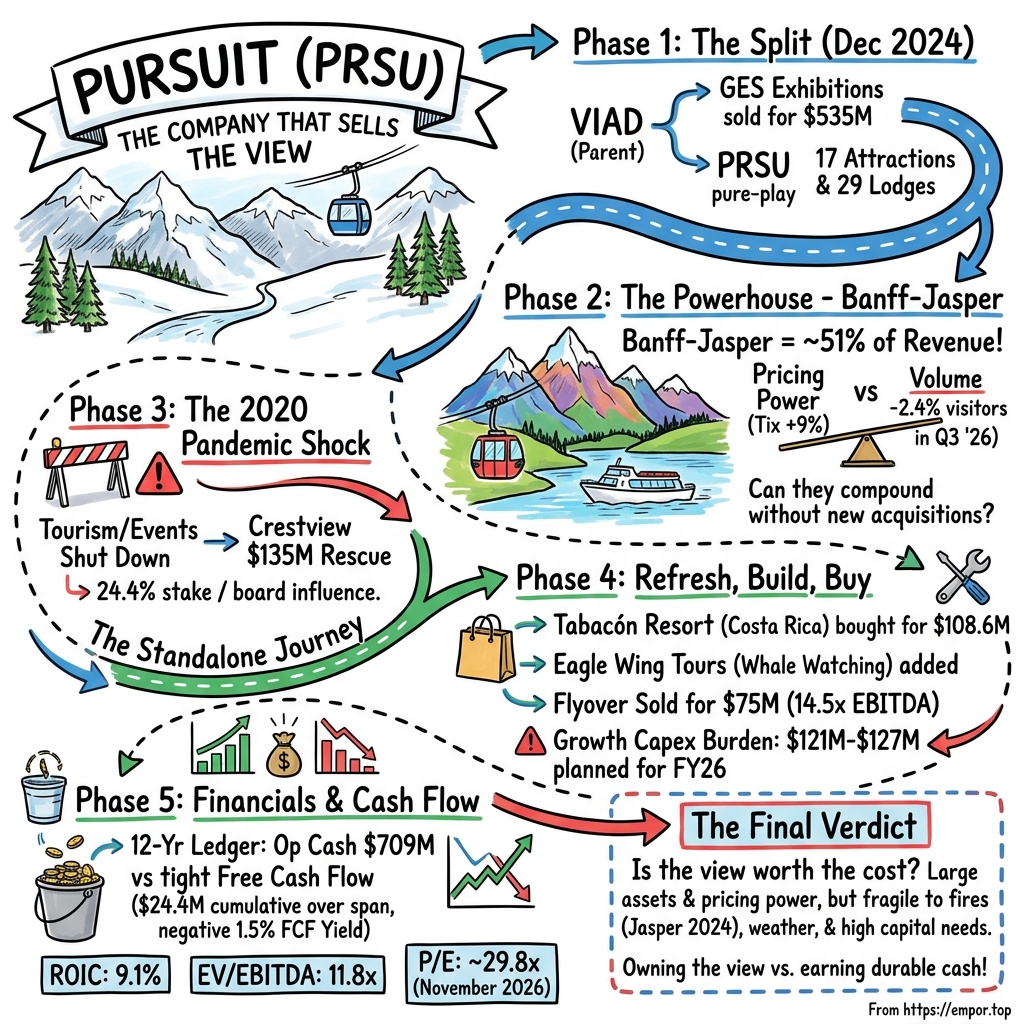
That company is Pursuit Attractions and Hospitality, and its business is owning the experiences around places people already want to see. It operates 17 attractions and 29 lodges across the United States, Canada, Iceland and Costa Rica, a portfolio that sounds sprawling until you look at where the money comes from.1 About half of its revenue, roughly 51% in 2025, came from a single destination collection in the Canadian Rockies around Banff and Jasper.2
That tension sits at the heart of this story. Pursuit sells scarcity. There is only one glacier, one gondola summit, one lake in that valley, and the company owns access to several of them. Scarcity is a wonderful thing to own, because people who have saved for a once-in-a-lifetime trip tend not to haggle over the price of the ride. But scarcity also concentrates risk. A wildfire, a closed highway, a smoky summer or a wet August hits the most valuable part of the portfolio all at once.
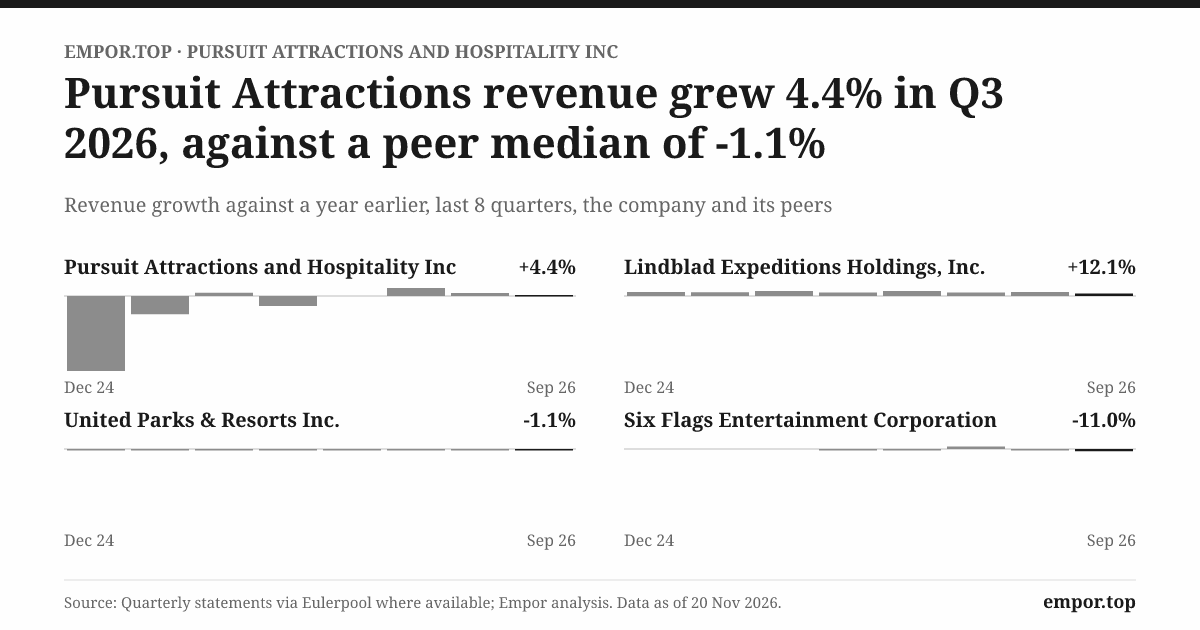
The latest quarter showed both sides of that coin. In the three months to September 2026, the company's same-store attractions charged visitors about 9% more per ticket than a year earlier, while the number of visitors fell by about 2.4%.3 Pursuit made more money from fewer people. That is either the signature of pricing power or the first sign of a ceiling, and the difference matters enormously to anyone deciding what the business is worth.
So the questions for this episode are simple to state and hard to answer. Can this portfolio compound on its own, without leaning on acquisitions or ever-higher ticket prices? Will the hundreds of millions the company is pouring into new projects earn back more than they cost? And does the concentration in one mountain region make Pursuit unusually fragile, or is that concentration the very thing that makes it valuable?
The stakes are measured in a business that brought in about $452 million of revenue in 2025.1 That is a modest company by public-market standards, but it trades at a market value of roughly $1.4 billion, which means investors are paying about three dollars for every dollar of annual sales.4 That price assumes something durable is going on in those mountains.
There is a complication before the story can begin. The long financial record attached to this ticker is not really Pursuit's record. For most of its public life, the company was called Viad Corp, and it was dominated by a much larger trade-show business called GES. When you look at a decade of revenue that peaks above $1.2 billion and then collapses, you are looking at a different company.1 Pursuit, as investors know it today, is barely two years old.
That is why this story has to be told in three movements. First, how a conglomerate assembled a collection of iconic destinations while running a business that had nothing to do with them. Second, what it sold, and what it gave up, to become a standalone company. And third, whether the portfolio left behind can convert guest demand into cash that belongs to shareholders.
The verdict, stated once before the evidence: Pursuit has shown it can raise what each guest spends. It has not yet shown, through a full cycle, that it can grow the number of guests or the cash returns on the capital it keeps investing. To see why, the story starts with a company that had two very different businesses under one roof.
 Subscribe on LinkedIn
II. Viad's Two Very Different Businesses
Picture two scenes from the same company in the same year. In Las Vegas, a convention hall the size of several football fields is being fitted out overnight: carpet rolled across concrete, booths assembled from crates, lighting rigs hung from the ceiling, all so that a trade show can open at nine the next morning. In the Rockies, a bus pulls up at a glacier, and a driver in a branded jacket hands passengers off to a tour guide while a hotel down the valley turns over rooms for the evening rush.
Both scenes belonged to Viad Corp. The first was GES, the exhibition and events business. The second was Pursuit, the travel and hospitality business.8 They had different customers, different seasons, different capital needs and different ways of failing.
GES sold to corporations and trade-show organizers. Its revenue was large, its margins thin, and its fortunes rose and fell with the convention calendar and the willingness of companies to spend on marketing. It needed warehouses, trucks and people more than it needed irreplaceable land. Pursuit sold to individual travelers. Its revenue was smaller, but it owned physical things that could not be reproduced: lodges inside national parks, attractions perched on glaciers and cliffs, access rights that competitors could not simply copy.
For years, Viad pitched this pairing as a portfolio. In its 2017 investor presentation, management framed Pursuit as a collection of "iconic" experiences in destinations people dreamed of visiting, and it laid out a playbook of buying attractions and lodges in those places and then investing to improve them.8 GES was the larger engine; Pursuit was the higher-margin, higher-return jewel that management wanted to grow.
That combination made some things possible. GES generated cash in many years that could help fund Pursuit's acquisitions and projects. The two businesses had somewhat offsetting seasons, since trade shows run through much of the year while Rockies tourism peaks in summer. And a larger, more diversified company had easier access to credit than a small tourism operator might have.
But the combination also blurred the picture. An investor buying Viad was buying a bet on corporate marketing budgets and a bet on summer travel to national parks, wrapped in one share price. It was difficult to value either business properly, and difficult to judge how well management allocated capital between them.
The long financial record tells that story without meaning to. Over the ten years to 2025, revenue reported under this ticker shrank at about 8% a year, from more than a billion dollars to $452 million.1 A casual glance would read that as a business in decline. It was not. It was a company that changed what it was. The revenue fell because the biggest business was sold, and before that because both businesses were knocked flat by a pandemic.
The same is true of profit. Between 2014 and 2025, the company reported net profit in most years, but it also posted losses of roughly $374 million in 2020 and $92 million in 2021, then an enormous $368 million gain in 2024 driven by the sale of GES.1 None of those numbers describe a stable standalone operator of attractions and lodges. They describe a two-business company being shaken, then rebuilt, then split.
For an investor, that leaves little history to draw on.
There is one more distortion worth naming. Because Pursuit's lodges and attractions are physical assets that sat alongside a much bigger events business, measures such as return on equity and asset turnover jumped around wildly across the decade. Return on equity, for instance, ranged from deeply negative during the pandemic, when equity had been almost wiped out, to an eye-catching figure in 2024 inflated by the sale gain.1 Those swings say more about a shrinking denominator and a one-off profit than about the quality of the underlying destinations.
What the history does show is how management behaved with capital over a long period. It shows a company that preferred to build Pursuit through acquisitions of destination assets and through organic projects, while holding onto GES through good years and bad. It shows dividends paid through much of the period. And it shows a moment, in 2020, when both businesses were nearly broken at the same time.
That moment is where the governance of today's Pursuit was born. The rescue that got the company through the pandemic would leave a powerful private-equity sponsor sitting on the shareholder register and in the boardroom, a fact that still shapes who controls the company's choices.
III. The Pandemic Made the Portfolio's Fragility Visible
In the spring of 2020, the trade-show halls went dark and the national parks emptied. There were no conventions to build, no tour buses on the glacier road, no visitors in the lodges. A company with two businesses had been built on the idea that they would rarely suffer at the same time. Now they were suffering together.
The numbers that year read like a stress test nobody had designed. Revenue under the ticker fell by more than two-thirds, from about $1.3 billion in 2019 to roughly $415 million in 2020.1 The company swung to a net loss of about $374 million.1 Operating cash flow, which had been more than $100 million a year, turned negative.1
That is what fragility looks like in an asset-heavy business. Lodges and attractions do not stop costing money when the guests stop coming. Buildings need maintaining, staff need some minimum retention, debt still carries interest. A business that is wonderful when full can bleed when it is empty, and Viad had both a people-intensive events business and a property-intensive tourism business bleeding at once.
So the company went looking for capital. In August 2020, it struck a deal with Crestview Partners, a New York private-equity firm. Crestview committed up to $180 million through a new class of convertible preferred stock, investing $135 million at the outset with up to $45 million more available.9 The preferred shares carried a 5.5% cumulative dividend, meaning that if the company did not pay it in cash, it piled up and would still be owed.9 At the same time, the company's lenders relaxed the covenant tests that would otherwise have tripped as earnings collapsed.9
It helps to be clear about what kind of transaction this was. It was a survival deal. It bought time, gave the company a cushion of equity at the worst possible moment, and let management avoid selling crown-jewel assets at fire-sale prices. That has real value. A company that survives a shock with its best assets intact can benefit enormously when demand returns.
But a survival deal is not evidence of a high-return growth strategy, and it was not free. Convertible preferred stock sits ahead of common shareholders. Its holder gets a fixed dividend and the option to convert into common stock if the shares rise. When it is issued near the bottom, as this was, the sponsor is buying a claim on the recovery on favorable terms. Existing shareholders traded some of their future upside for the certainty of getting to the other side.
The rescue also came with a seat at the table. Crestview received the right to designate directors.1 Years later, after the preferred stock had converted and the company had transformed, that influence remained. On the share count used in the 2026 proxy, Crestview and its affiliates owned about 24.4% of the common stock, making them by far the largest shareholder, and they had two designees on the board.10
That is a meaningful position, though not a controlling one. A holder with roughly a quarter of the shares and two directors can shape strategy, influence the timing of major transactions and weigh heavily on any vote. It cannot simply dictate. For public shareholders, the practical question is whether the sponsor's incentives line up with theirs. A private-equity firm eventually wants to exit, and its preferred timing for a sale, a recapitalization or an acquisition may not match the preferences of a long-term holder.
There is another way to judge the rescue: compare the story told at the time with what happened afterward. During the pandemic, the pitch for Crestview's capital included helping accelerate Pursuit's growth as travel returned.9 Travel did return, and Pursuit did grow, adding destinations and launching projects. But the bigger strategic decision of the post-pandemic period was not in Pursuit at all. It was what to do with GES.
The events business recovered unevenly. Trade shows came back, but the industry had changed, and the case for keeping a large, thin-margin events company welded to a portfolio of scenic attractions grew weaker. In 2024, the company made the decision that defined the modern Pursuit: it sold GES.
The sale repaid debt and simplified everything. It also stripped away the cover that a larger, diversified company provided. Once GES was gone, Pursuit's growth plan was exposed on its own, with no other business to absorb a bad summer.
IV. The $535 Million Exit That Created Pursuit
New Year's Eve is an unusual day to close a deal, but on December 31, 2024, Viad did exactly that. It completed the sale of GES and its Spiro marketing business to Truelink Capital, repaid roughly $393 million of debt, and began operating as Pursuit.6 Two days later, on January 2, the stock started trading under a new ticker, PRSU.6
The price was $535 million. It came in two pieces: a $510 million base price and a $25 million deferred payment.7 The structure matters a little, because a deferred payment is a promise rather than cash in hand. But the headline was clear. The company had sold the bigger, lower-margin half of itself and used most of the proceeds to clear its balance sheet.
Look at what changed in one stroke. At the end of 2023, the company carried about $490 million of borrowings against just $43 million of shareholders' equity, a level of leverage that left little room for error.1 A year later, borrowings had fallen to about $113 million and equity had jumped to roughly $526 million.1 The company that emerged was smaller, simpler and far less indebted.
The financial perimeter shrank too. Where Viad had reported more than a billion dollars of revenue in its best years, Pursuit's 2025 revenue was $452 million, up about 23% from the prior year on a continuing basis.1 For the first time in decades, management could direct every dollar of capital toward attractions and lodging without weighing it against the needs of a trade-show business.
Here the headline numbers become a trap, and it is worth slowing down. In 2024, the company reported net income attributable to shareholders of about $368.5 million.1 In 2025, the figure was $22.7 million.1 Read naively, profit fell by more than 90% in the first year of the new company. That is not what happened.
The 2024 figure was dominated by a $425.6 million gain from discontinued operations, essentially the accounting profit from selling GES.1 Strip that out, and continuing operations lost about $51.8 million in 2024, a year that included the Jasper wildfire and heavy transaction costs.1 In 2025, continuing operations earned about $38.5 million.1 The $22.7 million attributable to Pursuit's shareholders is smaller because part of the profit belongs to minority partners in some of its businesses.1
So the honest comparison runs in the opposite direction from the headline. The continuing business went from a loss to a profit. But that improvement started from a year distorted by fire and transition, and one year of profit is not a trend.
That is the core problem with a clean ticker. PRSU looks like a fresh start, and in many ways it is. But a fresh start also means a short record. To judge whether this business compounds, investors need several audited years of revenue, profit, cash flow and earnings per share, all measured on the same set of assets. As of late 2026, they have one full audited year and three quarters of a second.3
Even that short record is shifting under their feet. Since the GES sale, Pursuit has bought a Costa Rican resort, sold one of its attractions businesses and bought a whale-watching operator. Each move changes the perimeter again. The investor trying to separate organic growth from portfolio reshuffling has to do it quarter by quarter.
What the sale did prove is that management could execute a large, complicated divestiture and use the proceeds sensibly to reduce debt. That is not nothing. Many companies announce strategic reviews and never finish them. This one finished, at a price that cleared most of the borrowings.
There is also a quieter consequence of the sale that a careful shareholder should note. With GES gone, the company lost its counter-seasonal ballast. Trade shows had brought in revenue through the winter months when the Rockies were quiet. The standalone Pursuit now loses money in its first and fourth quarters almost by design, as its quarterly results show, and earns the whole year's profit in the summer.3 Selling GES traded a diversified but low-margin cash flow for a concentrated but higher-margin one. That is a sensible trade for a focused operator, but it moves risk rather than removing it.
One small piece of the Viad era also lingered: the debt repaid at closing did not leave Pursuit debt-free. By the end of 2025, borrowings had crept back up to about $195 million as the company funded the Tabacón purchase and its capital program.1 The balance sheet had been reset, and almost immediately the company began to use it.
What it did not prove is that the remaining business is a great compounder. That question can only be answered at the destination itself, where the guest steps off the bus, and where Pursuit has to decide what to charge, what to build and what to sell.
V. One Guest, Several Ways to Spend
Follow the family from the opening scene through a single day. Before they arrive, they book a room at one of Pursuit's lodges. In the morning, they buy gondola tickets. In the afternoon, they take a lake cruise or a glacier tour, ride a shuttle, eat lunch in a mountaintop restaurant and stop in a gift shop. In the evening, they eat dinner at the lodge.
Each of those is a separate transaction, and Pursuit can earn on all of them. That is the essence of the business model. The company sells admissions, room nights, transportation and guest services, plus food, beverage and retail products.1 It recognizes service revenue when the service is delivered and product revenue at the moment of sale.1
That simple structure tells you what kind of business this is. Pursuit is not a subscription company. Nobody signs a five-year contract to visit a glacier. The company's service obligations are short-term, its customer credit terms are generally within 30 days, and at the end of 2025 it held about $14.5 million of customer deposits, money paid in advance for future visits.1 The company does not report what share of its revenue is recurring, because in the usual sense very little of it is.
Every season, Pursuit has to win its guests again. Weather, airfares, exchange rates, wildfires, highway access and the general mood of travelers all feed directly into revenue. A rainy week in July is not a rounding error; it is lost sales that can never be recovered.
The lodging side of the business has its own economics, and they deserve a moment. A hotel has a fixed number of rooms. Revenue depends on two things: how many of those rooms are filled, called occupancy, and how much each one earns per night, called the average daily rate. Multiply those together and divide by available rooms, and you get revenue per available room, or RevPAR, the standard yardstick for comparing hotels.
An analogy helps. Think of a lodge as an airline with seats that never move. Every night, an empty room is like an empty seat on a departed flight: the revenue is gone forever. So the operator's whole craft is filling as many rooms as possible at the highest price the guest will accept, raising rates on the July Saturday that will sell out regardless and trimming them on the wet Tuesday in shoulder season.
The problem with lodges in national parks and mountain towns is that you cannot easily add rooms, and the season is short. So most of the growth has to come from rate, from renovating rooms so they command higher prices, and from extending the season where weather allows. That constraint is also a protection: competitors cannot easily add rooms either.
Now look at the latest quarter through that lens. In the three months to September 2026, Pursuit's same-store ticket revenue rose about 6%.3 Underneath that number, the effective ticket price rose about 9%, while the number of visitors fell about 2.4%.3 On the lodging side, same-store room revenue rose about 7%, and RevPAR rose about 9%.3
Translate that into plain English. Fewer people came, but each one paid more, and the extra price more than made up for the missing visitors. Management attributed the price gains to yield optimization, the practice of adjusting prices by time, demand and product to capture more from each guest.5 It attributed part of the visitor decline to poor weather.5
This is the price-versus-volume test, and it cuts both ways. A business with real pricing power should be able to raise prices without losing many customers. A 9% price increase against a 2.4% decline in visitors looks, on its face, like strong pricing power. But a falling visitor count is also exactly what the early stages of overpricing look like. If the visitors who stayed away did so because of the rain, they will come back. If they stayed away because the gondola now costs too much, they may not.
The previous quarter offers a useful comparison. In the second quarter of 2026, management also discussed poor weather and same-store price increases.12 Two consecutive quarters of weather explanations do not prove that weather is not the cause; the Rockies can have bad summers. But they do mean that investors should watch closely whether visitor numbers recover in a year with good weather, because that is the only clean test.
On the calls, analysts kept circling back to the same questions: what was happening to visitation, how bookings were pacing for the coming season, and what assumptions sat underneath guidance.512 Management's answers emphasized pricing strength and the long-term appeal of the destinations. That emphasis is reasonable. But the visitor number is the one that would settle the debate, and it is the one that moved the wrong way.
Pursuit is also building a new digital booking platform, intended to drive more direct bookings and make it easier to cross-sell a gondola ticket to someone booking a room, or a cruise to someone buying a ticket.5 The logic is sound. Every booking that comes directly rather than through an online travel agency saves a commission, and every cross-sale adds revenue from a guest the company has already won.
But a booking platform is an execution initiative, not a moat. Online travel agencies spend enormous sums on technology and marketing, and guests are accustomed to booking through them. Pursuit's platform may help at the margin. Whether it changes the economics of the business will show up only in data the company does not yet publish, such as the share of direct bookings or the number of products per guest.
The integrated offer clearly helps Pursuit capture more of each visitor's spending. What it cannot do is make the visitor come in the first place. Strong per-guest economics matter most if the guest still chooses Pursuit's experiences over every other way to spend a holiday, and that is a question about competition.
VI. Six of Nine Attractions—and Still No National Monopoly
Pursuit bought the Jasper SkyTram, an aerial tramway that carries visitors up Whistlers Mountain above the town of Jasper.14 It was a modest acquisition by dollar value. But it provoked something unusual: competitors went to Canada's Competition Bureau and complained.
Their argument was straightforward. Pursuit already operated a large share of the major paid sightseeing attractions in the Banff and Jasper area. With the SkyTram, it would operate six of the nine major attractions the complainants identified.14 They worried that this level of control would let the company raise prices, squeeze independent tour operators or bundle its products in ways rivals could not match.
That complaint is, in a backhanded way, the strongest evidence for Pursuit's competitive position. Competitors do not usually go to regulators about companies that are easy to compete with. The density of Pursuit's assets in one region is real, and the people closest to it think it matters.
In April 2025, the Bureau concluded its review. It found that the SkyTram acquisition did not appear to have substantially lessened or prevented competition.14 That is an important finding, but it needs reading carefully. It was a conclusion about one transaction, under Canada's competition law, at one point in time. It was not a declaration that Pursuit has no market power, nor was it proof that Pursuit has a moat. It simply meant the regulator did not see enough harm from this particular deal to act.
To understand the competitive landscape properly, it helps to stop thinking about global market share. Pursuit does not compete in a single global market for "attractions." It competes place by place, product by product. In the Rockies, its lodges compete with Fairmont's grand railway hotels and with dozens of other local properties. Its tours compete with independent operators. Its attractions compete with free alternatives: hiking trails, viewpoints, the lake you can walk to without buying a ticket. In other park markets, it competes with large concession operators such as Delaware North.
Within that landscape, Pursuit's strengths are easy to describe. It owns iconic sites that cannot be replicated, such as the attractions on the Columbia Icefield. It holds established access rights in places where new development is difficult, often because the land is protected. It can combine lodging and attractions, so a guest who stays at its hotel is already halfway to buying its ticket. And it can sell several pieces of a trip at once, which gives it a convenience advantage over a rival that sells only one.
Now apply the tests that would prove or disprove a durable advantage. The first is substitution. Can a traveler choose something else? Yes, easily. A family that finds the gondola too expensive can hike, drive to a viewpoint or spend the day in a different town. A family that finds the whole trip too expensive can go to the Alps, or Hawaii, or a beach. Pursuit's advantage holds within a destination; it does not stop travelers choosing a different one.
The second test is switching costs. Does a guest who visits Pursuit's attractions once become locked in? There is no evidence that they do. The company does not disclose customer retention, repeat-visit rates or how many guests use multiple Pursuit products versus a mix of providers.1 For many visitors, a trip to the Rockies is a once-in-a-lifetime event, which means there is no repeat business to lock in. That is a strength for pricing, since the guest is less price-sensitive on a dream trip, but a weakness for durability, since every year brings a new set of customers who must be won again.
The third test is local market share and price realization. The complaint gives a rough picture of attraction density in one region, and the price increases in recent quarters suggest the company can charge more. But Pursuit does not disclose a quantified local market share, and a few quarters of price increases do not establish durable pricing power through a downturn.
It is also worth separating two kinds of concentration that are easy to confuse. Pursuit has no customer concentration to speak of: no customer accounts for more than 10% of revenue, and its guests are many individuals, tour groups and travel-trade partners.1 That eliminates the risk of losing one big client. But it has heavy destination concentration. With about half its revenue coming from Banff-Jasper, a local disaster can damage the company far more than a lost customer ever could.2
That disaster arrived in July 2024. A wildfire swept into Jasper, destroying a large part of the town and forcing evacuations at the height of the summer season.1 Pursuit's operations in the area were disrupted, visitors stayed away and the company spent months recovering. Insurance proceeds helped soften the financial blow.1 But insurance does not restore lost visitors, recover damaged reputation or remove the risk of another fire. A business with half its revenue in a fire-prone mountain region faces that risk every summer, and climate trends are not making the risk smaller.
There is a darker reminder of operational risk from the same region. In July 2020, an Ice Explorer vehicle on the Columbia Icefield rolled over, killing three people and seriously injuring others.1 A Canadian occupational-safety proceeding was resolved in 2023 for C$0.5 million, while claims by victims and families remain; the company says its reserves and insurance, subject to deductibles, should cover the exposure.1 Operating attractions in wild places carries risks that a hotel company in a city does not face.
So where does that leave the moat? Pursuit has scarce locations and an integrated platform that makes it easier for a guest to spend more with one company. That is a real advantage. But it is specific to assets and destinations, not a broad, unassailable franchise. It does not prevent guests from going elsewhere, it is exposed to the weather and access of a single region, and it has not been proven through a long period of falling demand. The measures that would show it strengthening are visitor numbers alongside price, and the share of revenue that comes from outside the Rockies.
That second measure is exactly what management has been trying to change, through a growth plan that buys new destinations, builds new experiences and refreshes old ones.
VII. The Growth Plan Has a Price Tag
Costa Rica is a long way from the Canadian Rockies, in climate as well as distance. At Tabacón, guests soak in thermal pools fed by water heated deep beneath the Arenal volcano, surrounded by rainforest instead of glaciers. In 2025, Pursuit bought the resort for about $108.6 million.1
It was the biggest bet of the standalone era. Tabacón is a 105-room eco-luxury resort with thermal attractions, a destination in its own right rather than a stop on someone else's itinerary.15 Strategically, it did several things at once. It added a new country, Costa Rica, to the portfolio. It offered a different kind of guest experience, warm-weather wellness instead of mountain sightseeing. And it began to dilute the company's dependence on Banff and Jasper.
Management's case for Tabacón rests on performance. It said the resort's adjusted EBITDA, a measure of operating profit before depreciation, interest and taxes, grew about 20% in its first year under Pursuit's ownership.5 That is a strong number if it holds. But here the investor runs into a wall. The company's public materials do not provide a complete standalone earnings history for Tabacón before and after the purchase, which means there is no clean way to calculate the multiple Pursuit paid or to compare it with other resort deals.
That does not mean Pursuit overpaid. It means the investor cannot judge whether it did. The 20% growth figure is management's own, presented without the base it grew from. Until the company discloses enough to calculate a return on that $108.6 million, the acquisition remains a hypothesis rather than a proof.
A year later came a move in the opposite direction. Pursuit sold its FlyOver business, a group of city-based flight-simulation attractions, for about $75 million in cash.3 The company said the price represented about 14.5 times the business's transaction EBITDA.4 Before the sale closed, it recorded a $3.1 million impairment on the business, and then booked a $2.8 million loss on the sale itself.3
CEO David Barry described the sale as the final chapter in Pursuit's transition to a pure-play operator of attractions and hospitality in iconic destinations.5 There is a logic to that. FlyOver attractions sit in cities, not in natural wonders, and they rely on technology and content rather than scarce land. They are easier for competitors to copy and less connected to the integrated lodge-and-attraction model.
The sale price suggests discipline. Fourteen and a half times EBITDA is a healthy multiple, a reasonable marker that the market valued the business. But the impairment and sale loss tell a more complicated story. FlyOver was something Pursuit had built and expanded, and selling it at a loss means the company did not recover its full book investment. A good exit price does not, by itself, prove the original investment was a success. It proves the company was willing to sell when it decided the asset did not fit.
Then came Eagle Wing Tours, a whale-watching operator on Vancouver Island, bought for about $16.9 million.3 It is a smaller move, a strategic extension of Pursuit's presence in British Columbia rather than a new profit engine. It adds another experience to sell to guests in a region where the company already operates, consistent with the cluster logic of the Rockies.
Management bundles all of this under a strategy it calls "Refresh, Build, Buy": refreshing existing assets so they earn more, building new experiences at existing destinations and buying new destinations.15 Each element makes sense in isolation. The question is whether together they earn returns above the cost of the capital they consume.
That cost is large. For 2026, Pursuit planned capital expenditure of $121 million to $127 million, of which $88 million to $93 million was for growth projects.4 Set that against 2025 revenue of about $452 million, and the company was planning to spend more than a quarter of a year's revenue on capital projects in a single year.1 Growth projects alone came to roughly a fifth of revenue.
Major projects in this business consume cash for years before they produce any. A new lodge or attraction has to be designed, approved, often on protected land, built in a short construction season and then ramped up over several summers before it reaches mature occupancy. During that time, the capital is tied up and earning nothing.
Benchmarking these decisions is difficult. The FlyOver sale multiple is one disclosed transaction marker. But the company does not provide a comparable set of acquisitions or enough standalone earnings for Tabacón to conclude whether its purchase price was rich or cheap relative to the industry. Investors are being asked to trust a process they cannot fully audit.
On the second- and third-quarter calls of 2026, management described its project pipeline and its approach to returns in broad terms.512 The calls did not provide a full, project-by-project record of returns on past investments, nor a clear account of what would be delayed or cancelled if demand disappointed or budgets overran. Those are the questions a skeptical investor should keep asking.
The good news is that the balance sheet gives the company room to make these bets. The bad news is that borrowing capacity is not the same as earning power. How much growth Pursuit can fund for itself depends not on its credit line but on how much cash its existing destinations throw off, and that is the next part of the story.
VIII. The Cash Flow Behind the Scenic View
Imagine opening twelve years of ledgers for the company that became Pursuit and adding them up. The first total looks reassuring. Between 2014 and 2025, the company generated about $709 million of cash from operations against about $211 million of reported net profit.1 Cash came in at more than three times the rate of accounting profit.
Then you subtract capital expenditure, and the picture changes. Over those same twelve years, free cash flow, the cash left after paying for capital projects, totaled only about $24 million.1 Nearly all the cash the business generated went back into the ground: into lodges, attractions, buildings and equipment.
And then there is the third total. Over the same period, the company paid about $106 million in dividends, more than four times its cumulative free cash flow.1 Cash and short-term investments fell by about $15 million across the span.1 The gap was covered by borrowing, by asset sales and, in the pandemic, by the Crestview preferred stock.
This comparison needs careful handling, because it spans so much change. The period includes GES, the pandemic losses, the Crestview rescue and the sale that created Pursuit. It is not a clean measure of how well today's company converts profit into cash. But it does reveal a pattern that matters for today: this has long been a business where capital spending absorbs most of the cash, and where returns to shareholders have relied on more than free cash flow.
Now narrow the lens to 2025, the first full year as Pursuit. Continuing operations generated about $86.2 million of operating cash flow.1 That figure was helped by large non-cash charges added back, including about $46.1 million of depreciation and amortization and $7.4 million of share-based compensation.1 Working capital moved in different directions, with small cash uses from receivables, inventory, payables and accrued compensation, partly offset by taxes payable and customer prepayments.1
Depreciation deserves a moment, because it is central to how this business works. Depreciation is the accounting charge for the wearing out of buildings and equipment. In a property-heavy business, it is a rough proxy for what it costs to keep assets in working order. If Pursuit's maintenance spending runs close to its depreciation, then a large share of operating cash flow is spoken for before any growth project begins.
Total free cash flow for the company in 2025 was slightly negative, roughly minus $0.75 million.1 The business generated cash, then spent all of it and a little more on capital projects. It paid no dividend that year.1 Over the longer record, its dividend payout ranged from zero to more than 270% of earnings, a range that reflects a company whose profits swung wildly rather than a steady policy.1
The crucial unknown is the split between maintenance capital, the spending needed just to keep the assets as they are, and growth capital, the spending meant to expand them. Management's 2026 plan suggests that growth projects make up the majority of capital expenditure, with maintenance taking roughly $33 million to $34 million of the planned total.4 If that split is right, the underlying business is generating real surplus cash that management is choosing to reinvest. If maintenance needs are larger than they appear, the cash surplus is thinner.
Seasonality makes the cash picture swing hard within each year, and it is worth seeing how hard. In the first quarter of 2026, with the Rockies in the grip of winter, Pursuit lost about $25 million.3 In the third quarter, at the peak of summer, it earned about $83 million.3 Receivables followed the same rhythm, rising from about $9 million at the end of 2025 to about $37 million at the end of September, as travel-trade partners and group bookings settled their summer bills.13 That jump is the calendar at work rather than a sign of customers paying late; the company describes credit terms as generally within 30 days, though it does not publish an ageing table that would show the balances by age.1
The practical consequence is that the whole year's economics are decided in roughly four months. A company that earns most of its profit between June and September has to carry its fixed costs, its staff housing and its interest bill through eight leaner months. That is why a single bad summer can do so much damage, and why the balance-sheet cushion matters more here than it would for a business with smooth monthly revenue.
People are part of that seasonal machine too. Pursuit employs about 2,100 people year-round and hires roughly 2,500 more seasonal workers for the peak.1 In mountain towns where housing is scarce and expensive, recruiting and housing that seasonal workforce is a real operating cost and a constraint on how far the season can stretch.
Pursuit does not provide a full project-by-project history of returns. Investors can see the capital going in, and they can see total profits coming out, but they cannot easily trace which projects produced which returns. That makes it harder to judge whether the next wave of spending will be well spent.
The balance sheet, at least, is strong. At the end of September 2026, Pursuit reported total liquidity of about $293 million and net leverage of about 0.6 times, meaning net debt was well below one year of operating earnings.4 Borrowings excluding leases were about $88.9 million, with about $228.7 million available on a $300 million revolving credit facility that matures in 2030.3 Cash had risen to about $64.3 million from $31.1 million at the start of the year, reflecting the cash-rich summer season.3
That capacity is real, and it is a strength. The lesson of the pandemic has clearly been absorbed.
But capacity cuts both ways. A strong balance sheet can finance a busy pipeline of projects that earn modest returns just as easily as it can finance excellent ones.
Three measures will answer that over time. The first is cash flow after maintenance capital, the closest thing to the owner earnings of the business. The second is return on invested capital, which stood at about 9.1% over the twelve months to September 2026.1 The third is share count, because growth that requires issuing shares is worth less to existing holders. At the share price in late November 2026, Pursuit's free cash flow yield was negative 1.5%: investors were paying for a business that, over the last year, consumed more cash than it generated after capital spending.4
That makes the cost of growth capital especially relevant, and it puts the spotlight on the people deciding how to spend it.
IX. David Barry's Test Is Delivery
David Barry has spent years inside the business he now runs. He led Pursuit as its president through the period when it was the smaller, more promising half of a two-business company, and when GES was sold he became chief executive of the standalone company, the natural choice to lead the operator he had helped assemble.101
That continuity is unusual for a company that has just changed its shape so completely. Many spin-offs and divestitures bring in an outside chief executive to signal a fresh start. Pursuit instead promoted the operator, which says the board saw the new company as the continuation of a strategy rather than a break from one. The flip side is that there is no outsider to blame the past on: the acquisitions, the projects and the pricing strategy all carry the current team's fingerprints.
That history cuts in two directions. Barry knows the assets, the destinations and the people intimately. He was there for the acquisitions that built the portfolio, for the pandemic, for the Jasper wildfire and for the sale. He has presided over a period of strategic follow-through: the divestiture closed, debt was repaid, a new destination was bought, a non-core business was sold and a growth plan was launched.
But much of the record he is judged on was built inside a larger company, where Pursuit's results were blended with GES. The standalone record that belongs to his leadership alone is barely two years long. His real test is not the strategy he has described; it is the delivery that follows.
On the third-quarter call of 2026, Barry repeated his framing of the FlyOver sale as the final chapter of the company's transformation.5 It was a confident framing, but it came alongside continued activity: a fresh acquisition in Eagle Wing, a large slate of growth projects and ongoing share repurchases.5 The transformation may be over, but the capital allocation is busier than ever.
Alongside Barry sits Michael Heitz, who became chief financial officer in 2025, succeeding Ellen Ingersoll.10 The same year, Michael Bosco replaced Leslie Striedel as chief accounting officer.10 Changes in both senior finance roles in the first year of a newly standalone company are not in themselves a warning sign; a smaller company with a different shape often needs a different team. But they do mean the finance leadership's record is also short.
The board has an independent chair, Joshua Schechter, and two directors designated by Crestview.10 That arrangement gives the largest shareholder a strong voice while keeping formal leadership of the board in independent hands.
Pay tells you something about what a board values. Barry's total reported compensation rose from about $3.7 million in 2024 to about $5.4 million in 2025.10 Of that, roughly $3.7 million was in stock awards and about $0.9 million was a cash incentive.10 Heavy reliance on equity can align an executive with shareholders, since the value of the stock awards rises and falls with the share price. But the test of any incentive plan is what it rewards. If the goals emphasize adjusted earnings growth without accounting for the capital required to produce it, they can encourage exactly the kind of spending that inflates earnings while depressing returns.
Shareholders, at least, have not objected. At the 2026 annual meeting, the advisory vote on executive pay passed with about 24.6 million shares in favor and about 0.4 million against.11 That is overwhelming support. It is also worth remembering that a holder with roughly a quarter of the shares carries a lot of weight in any such vote.
Capital allocation is where management's judgment becomes most visible. In 2025, Pursuit repurchased about $10.2 million of its own shares under a new $50 million authorization, leaving about $39.8 million available at year-end.1 It also paid about $14.6 million to buy out minority partners in some of its businesses.1 By the third-quarter call of 2026, management said it had repurchased about 1.2 million shares during the year.5 All of this happened alongside acquisitions, a large growth-capital program and the FlyOver sale.
Buying back shares while also spending heavily on projects is not contradictory, but it does require a clear rationale. A buyback is a bet that the company's own shares are a better investment than its next project. When the stock trades at around 30 times earnings, that bet needs explaining. The company has not published a detailed framework comparing the expected return on repurchases with the expected return on projects.
Guidance offers another window into credibility. In the second quarter of 2026, management raised its full-year outlook.13 In the third quarter, after weather-related weakness in visitor numbers and the portfolio changes from the FlyOver sale and Eagle Wing purchase, it reaffirmed the midpoint of that guidance.4 Holding the midpoint after a soft summer is a reasonable sign of discipline. The harder test is whether explanations consistently separate the pieces: price, visitor volume, acquisitions, divestitures and currency. When those pieces are blended, a good headline can hide a weak organic performance.
There is also bounded positive evidence on reporting quality. The auditor issued unqualified opinions on Pursuit's 2025 financial statements and on its internal controls over financial reporting.1 That supports the reliability of the numbers. It says nothing about whether the projects those numbers fund will succeed.
So the credibility scorecard for Barry's team is forward-looking. It consists of four things: accuracy against guidance, cash returns from projects, a clear rationale for buybacks, and growth in free cash flow per share. The early record shows follow-through on strategy. Whether it shows good judgment about capital will take several more years to know, and the market is already pricing in a great deal.
X. Analysis & Bear vs. Bull Case
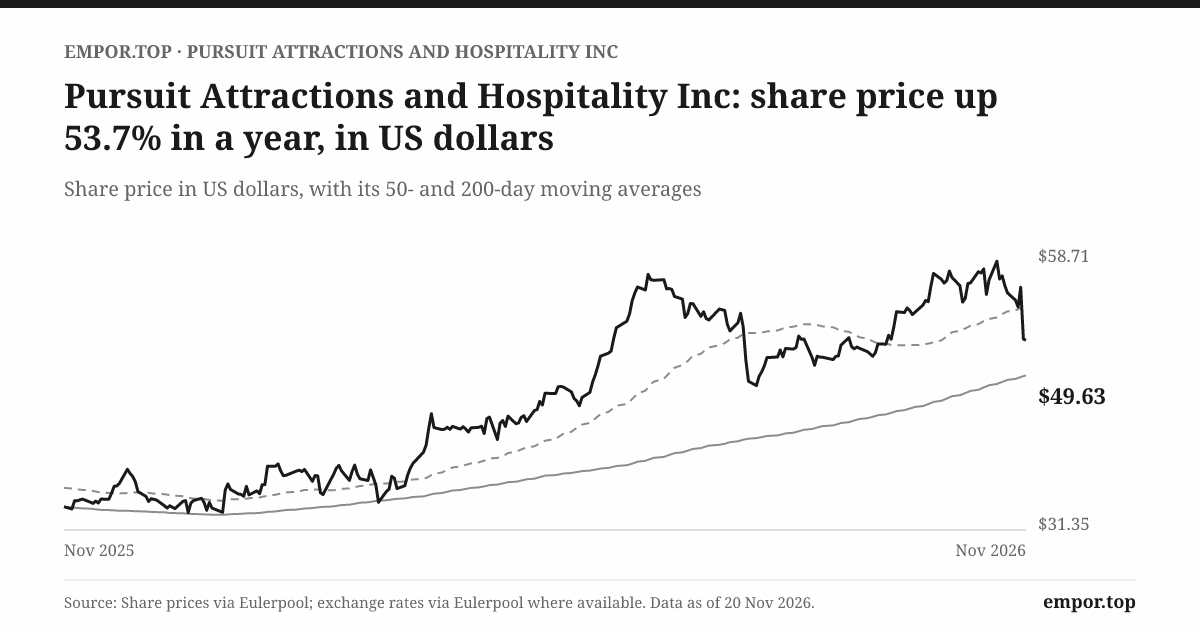
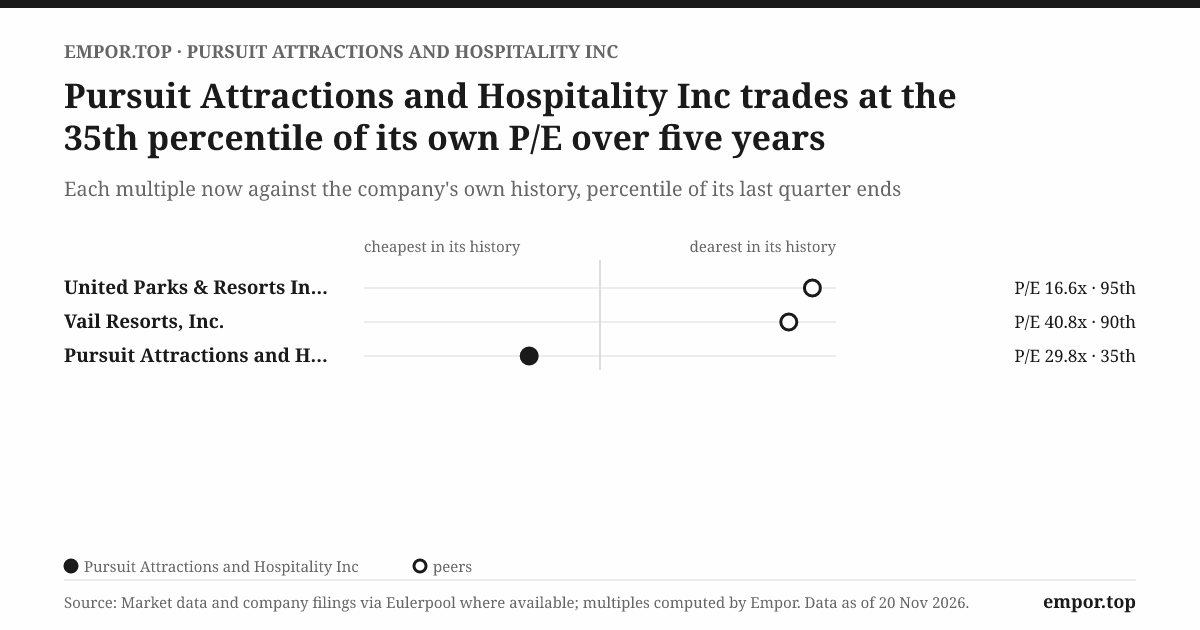
On November 20, 2026, Pursuit's shares closed at about $49.63, roughly 13% below their 52-week high and well above their 52-week low near $32.4 At that price, investors were paying about 29.8 times the company's trailing earnings, below its own five-year median of about 33.3 times.4 On an enterprise basis, which includes debt, the company was valued at about 11.8 times EBITDA, and its free cash flow yield was negative 1.5%.4
A price of about 30 times earnings is the market saying it believes this business will grow its profits substantially. The question is whether that belief is grounded in a portfolio that can compound, or in execution the company has yet to prove.
The bull case has real substance. Pursuit owns valuable destination assets and earns from several points in each guest's trip. It has shown it can raise prices, with same-store ticket prices and RevPAR both up about 9% in the latest quarter.3 Its balance sheet is strong, and its growth plan could diversify it away from a single region.
The bear case is just as concrete. Visitor numbers fell in the latest quarter even as prices rose.3 About half of revenue comes from one mountain region exposed to fires, weather and access disruption.2 Capital spending is large relative to revenue, and the standalone record is short. Tabacón cannot yet be judged on disclosed numbers. A stock priced for growth leaves little room for a bad summer.
To weigh those cases, it helps to run the business through two frameworks that investors use to judge competitive position.
The forces and the powers
Michael Porter's five forces start with rivalry. Within its core destinations, Pursuit faces limited direct rivalry for its signature attractions, because few competitors can replicate a glacier tour or a park lodge. But rivalry for the traveler's day and dollar is broad, from independent tours to free trails to other lodging. Rivalry for the traveler's destination is broader still, since every holiday spot in the world competes for the same vacation budget.
The threat of new entrants is low at the site level. Protected land, permitting and the sheer scarcity of prime locations make it very hard to build a new attraction on the Columbia Icefield. This is probably Pursuit's strongest force. The threat of substitutes, by contrast, is high: other activities, other destinations and simply staying home.
Buyer power is fragmented. No customer accounts for more than 10% of revenue, so individual guests have little bargaining power.1 But they hold the ultimate power of not coming, and online travel agencies that sit between Pursuit and many guests hold meaningful leverage through the commissions they charge. Supplier power is moderate. The most important suppliers are landlords and governments that grant access to protected land, and labor in seasonal tourist towns where housing is scarce. The company does not disclose supplier concentration.1
Hamilton Helmer's seven powers framework asks which durable advantages a business holds. Pursuit's clearest is what Helmer calls a cornered resource: privileged access to scarce sites that competitors cannot get. Its second is a modest form of scale economy within a cluster: owning many assets in one region lets it share marketing, staff housing, transport and booking across them. There is little evidence of switching costs, since guests have no reason to stay loyal once their trip is over. Network effects are absent. Brand matters, though the destination brand, Banff or Jasper, is arguably stronger than the company's own. Process power and counter-positioning do not apply in any meaningful way.
The conclusion from both frameworks is consistent. Pursuit's advantage is real but narrow. It comes from owning specific places, and it is strongest within those places. It does not stop guests from choosing elsewhere, and it does not travel well to new destinations, which must each be bought or built on their own merits.
Testing the claims against the record
The pricing-power claim remains unproven: the latest quarter's prices rose while visitors fell.3 Pursuit can raise prices in the short run, but whether it can do so without eroding demand over time is unclear. The company does not disclose retention, repeat rates, local market share or cost advantages that would settle the question.
Guests can substitute other activities and destinations, while high project spending magnifies the cost of forecasting errors. The pandemic and the 2024 wildfire showed how quickly a demand shock or a regional event can damage the business.
The valuation history should be used cautiously. The five-year median of about 33 times earnings spans the pandemic, the GES years and the sale that created the present company. It is a reference point, not an answer about fair value. Comparing today's multiple with that median tells you little about whether the current business is cheap or expensive.
Currency adds another layer of risk. Pursuit earns revenue in four countries and does not hedge translation exposure on its foreign assets or earnings.1 The company estimated that a 10% adverse move in exchange rates could reduce pretax income by about $8 million.1 In 2025, it recorded a translation gain of about $16.5 million after a loss of about $27.6 million the year before, a swing that shows how much currency can move reported results.1 For a business whose largest destination is in Canada and which reports in US dollars, the value of the Canadian dollar matters.
A skeptical activist looking at this company would probably not start with the assets, which are hard to fault. They would start with disclosure and capital. They would ask why a business spending a fifth of its revenue on growth projects does not publish returns on the projects it has already completed. They would ask why the company buys back stock at around 30 times earnings while also telling investors it has a pipeline of high-return projects to fund. They would ask whether destination-level revenue and profit, especially for Banff-Jasper and Tabacón, should be reported so shareholders can see where value is being created. And they would ask how the board weighs the interests of a sponsor holding a quarter of the shares against those of everyone else. None of these questions implies wrongdoing. Each one points at a gap between what investors are asked to believe and what they can verify.
The debt itself is not the worry. The main facility is a $300 million revolver that runs to 2030, and a separate term loan tied to the Jasper operations carries a fixed 6.5% rate and matures in 2028.3 The revolver is floating-rate, so a heavier draw to fund projects or acquisitions would expose earnings to interest-rate moves.3 At current leverage, that is a manageable risk rather than a pressing one.
The same-store visitor numbers, effective ticket price and lodging RevPAR remain key measures; in the latest quarter, visitors were down about 2.4% while prices and RevPAR rose about 9%.3 If visitors recover while prices hold, the pricing-power claim gains support; if RevPAR keeps rising on occupancy as well as rate, demand is healthy. Cash flow after maintenance and growth capital, measured against invested capital, was roughly zero in 2025.1 If that turns solidly positive as projects open, the capital is earning its keep.
The dividing line for investors is clear. A real destination platform could compound if project returns and guest demand persist. Without those, high prices and acquisition-driven growth could disguise modest owner earnings behind impressive headline numbers.
XI. Playbook: Business & Investing Lessons
Every great business story leaves behind a handful of lessons that belong to it alone. Pursuit's lessons come from the specific moments in its history, from a burning town in the Rockies to a resort in the Costa Rican rainforest, and they are lessons about the economics of owning the places people travel to.
The first lesson comes from Banff and Jasper. Pursuit's greatest strength is the cluster: nearby experiences that can sell to the same guest. But the 2024 Jasper wildfire showed the other side: nearby assets can be exposed to the same shock. The broader lesson for founders and investors is that clustering creates both synergy and correlation, and you cannot have one without the other.
The second lesson comes from Tabacón and FlyOver. The contrast is instructive: Tabacón came with a strong first-year growth figure but without enough disclosure to judge the price paid; FlyOver left with a respectable sale multiple, but also with an impairment and a loss on sale. An acquisition is a hypothesis; the sale price and cash returns are the exam. Investors should resist grading a deal on the day it is announced, because the real grade arrives years later, when the asset is sold or its cash returns are visible.
The third lesson comes from the pandemic rescue. The 2020 deal brought in a powerful sponsor and handed over a meaningful share of future upside. Today, Pursuit carries very little debt, and that low leverage is genuinely valuable. But low leverage is valuable because it preserves choices, not because it guarantees good choices. A strong balance sheet can fund excellent projects or mediocre ones with equal ease. The value lies in what management does with the freedom it provides.
The fourth lesson comes from pricing. In the latest quarter, Pursuit charged its guests more and welcomed fewer of them. The arithmetic worked, and revenue rose. But a higher ticket is not the same thing as a stronger destination; watch whether the visitor comes back. Pricing power is easy to confuse with pricing appetite. The only way to tell them apart is to watch volumes through a full cycle, including a year when the weather is good and there is nothing else to blame.
Taken together, these lessons point to a single distinction that runs through the whole story. Owning a memorable place is not the same as earning a durable return from it. The place is scarce. The return has to be earned, one season at a time, through capital that has to be spent before it can pay back.
XII. Epilogue
As 2026 draws toward its close, Pursuit stands at an interesting moment. The transformation from Viad is complete. The FlyOver sale has closed. Eagle Wing joined the portfolio. Tabacón is maturing into its second year. And a slate of major growth projects is still under construction, absorbing capital and not yet producing returns.
Management's guidance for 2026 put the midpoint of adjusted EBITDA at about $133 million, alongside capital expenditure of $121 million to $127 million.4 Those two numbers sit side by side in a way that captures the whole investment case. The business is expected to generate a substantial operating profit, and almost all of it is earmarked to be spent again on the business. Whether that spending creates value is the question the next few years will answer.
The first moment to watch is the full-year 2026 result, due early in 2027. The headline will matter less than its composition. Investors will want to separate organic performance from the effects of acquisitions, the FlyOver sale, any insurance proceeds, the weather and currency. A strong result built on price alone, with flat or falling visitors, would tell a different story from a strong result built on recovering demand.
The second moment is the summer of 2027. If the weather is kind and the visitor count recovers while prices hold, the pricing-power claim gets its strongest confirmation. If visitors keep falling even in a good season, the company will have to confront the possibility that its prices are reaching a ceiling. Lodging tells a parallel story: occupancy and average daily rate both rising would show genuine demand, while rate alone would suggest the company is pressing on price.
The third moment comes as the growth projects open. Each one is a test of the "Build" in "Refresh, Build, Buy." Investors should look for project-level returns where the company discloses them, and for cash flow after maintenance spending at the company level. If the pipeline opens on time and ramps as promised, the capital spending of 2025 and 2026 will look like an investment. If it opens late or ramps slowly, it will look like a cost.
The fourth thing to watch is the Rockies themselves. Banff and Jasper exposure remains the company's largest single risk and its largest single strength. Changes in access rules, competitive conditions, park policies or the frequency of wildfires could reshape the business faster than any acquisition. The share of revenue from outside the region is the clearest measure of whether diversification is working.
And through all of it, management's credibility will be reassessed: guidance against delivery, capital allocation against stated discipline and, above all, growth in free cash flow per share.
The central questions of this story remain open. The next audited years will reveal whether same-store demand, project returns and per-share cash generation can advance in step. Until they do, the investor is buying a promise attached to a very good view.
XIII. Outro
Go back to the family from the opening scene. It is late afternoon now, and they have reached the gondola summit. Below them, the town is spread out like a model. The hotel where they will sleep is visible in the trees. The lake where they took a cruise glints in the distance. The mountains rise on every side, as they have for millions of years, indifferent to who sells the tickets.
Every part of that view earned something for Pursuit today: the ticket, the room, the meal, the fleece in the shopping bag. That is the promise of the business, and it is a powerful one. People will keep wanting to stand on that summit.
But the view does not pay for itself. The gondola wears out, the lodge needs new rooms, the next project costs a hundred million dollars before it earns a cent, and the next wildfire is always somewhere over the horizon. Pursuit sells access to places people already dream of visiting. Its lasting value depends on making those visits worth more without spending more than they return.
References
-
Form 10-K — Pursuit Attractions and Hospitality, Inc., 2026-02-25 ↩↩↩↩↩↩↩↩↩↩↩↩↩↩↩↩↩↩↩↩↩↩↩↩↩↩↩↩↩↩↩↩↩↩↩↩↩↩↩↩↩↩↩↩↩↩↩↩↩↩↩↩↩↩↩
-
Pursuit 2025 investor presentation — Pursuit Attractions and Hospitality, 2025-03 ↩↩↩
-
Form 10-Q — Pursuit Attractions and Hospitality, Inc., 2026-11-04 ↩↩↩↩↩↩↩↩↩↩↩↩↩↩↩↩↩↩↩↩
-
Q3 2026 earnings call transcript — The Motley Fool, 2026-11-05 ↩↩↩↩↩↩↩↩↩↩
-
Completion of GES sale and transformation into Pursuit — Viad Corp, 2024-12-31 ↩↩
-
Q3 2020 results and liquidity update — Viad Corp, 2020-11-05 ↩↩↩↩
-
2026 proxy statement — Pursuit Attractions and Hospitality, Inc., 2026-04-15 ↩↩↩↩↩↩↩
-
2026 annual-meeting voting results — Pursuit Attractions and Hospitality, Inc., 2026-06-04 ↩
-
Q2 2026 earnings call transcript — The Motley Fool, 2026-08-12 ↩↩↩
-
Pursuit Q2 2026 results — Pursuit Attractions and Hospitality, 2026-08-05 ↩
-
Competition Bureau concluded merger reviews — VIAD Corp / Jasper Sky Tram — Competition Bureau Canada ↩↩↩
-
Pursuit 2025 revenue mix and destination presentation — Pursuit Attractions and Hospitality, 2026-03 ↩↩
 LinkedIn
 WhatsApp
 Reddit
 Hacker News
 Email
 Kindle
 RSS Feed
 Spotify
 Apple Podcasts
 Amazon Music
 Audible
 YouTube