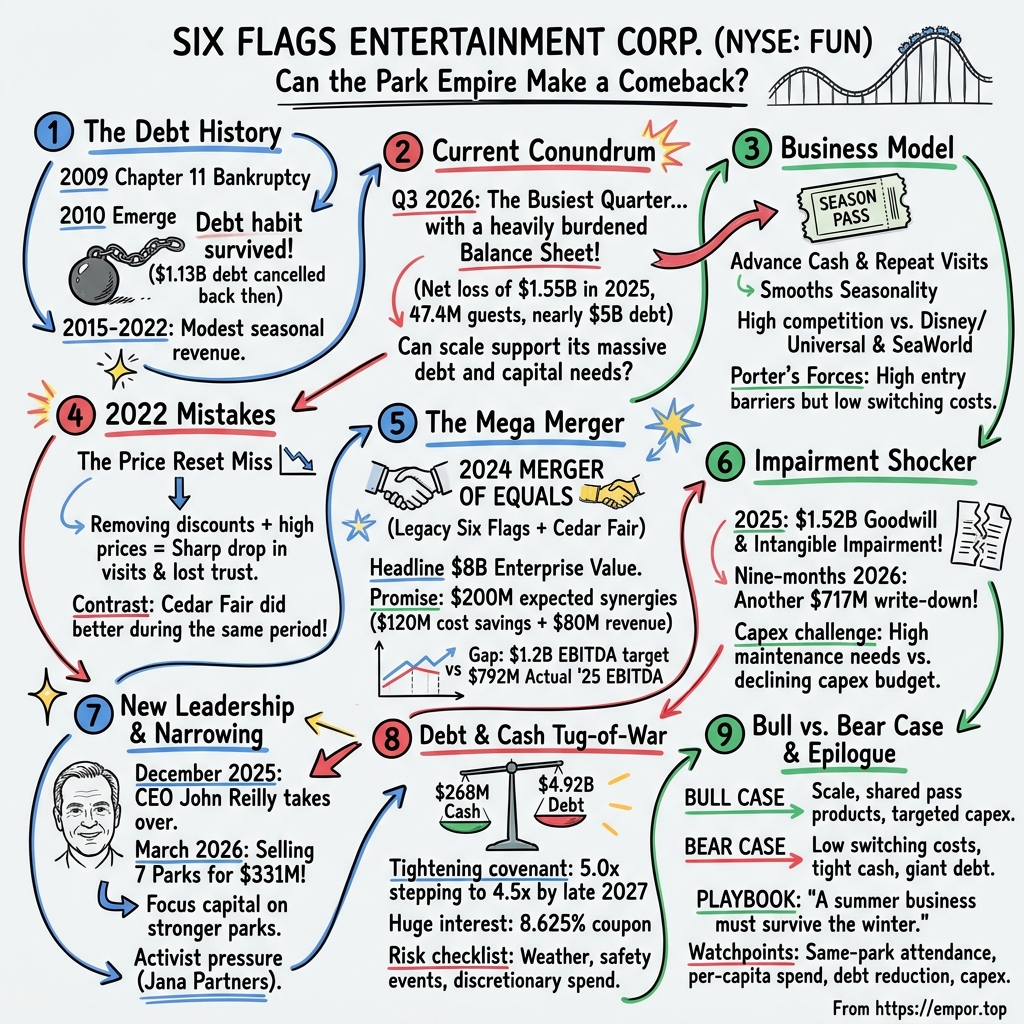
Six Flags Entertainment Corporation (NYSE: FUN): Can the Park Empire Make a Comeback?
I. The busiest quarter, and a balance sheet still in trouble
Summer is the quarter that decides everything at a regional amusement park. From July through September the gates open every day, the water parks fill, the coaster queues snake back toward the parking lots, and the year's profit gets made in a few hot weeks. So when Six Flags reported its third quarter of 2026 on November 5, the busiest stretch of the season was the right place to test whether the company was getting better.1
John Reilly, less than a year into the chief executive's job, had a story to tell. Guests in the company's remaining parks had come back at roughly the same rate as a year earlier, and they were spending a little more each time they came.2 On the call, he described passholders using their passes beyond their home parks, which was exactly the behaviour the merged network was supposed to encourage.3 For a company whose shareholders had spent two years watching attendance disappoint, flat felt like a small victory.
Then came the rest of the filing. Six Flags carried about $4.92 billion of debt against $268 million of cash at the end of September.5 It had recorded another large write-down of its goodwill and intangible assets, $717 million in the first nine months of the year, on top of the $1.52 billion it had written off in 2025.54 Its trailing twelve months of Adjusted EBITDA, the company's preferred measure of operating earnings before interest, taxes, depreciation and a list of adjustments, came to about $779 million.2
Put those figures side by side and the problem becomes plain. Debt was more than six times the company's own measure of annual operating earnings, net of cash. A business that has to rebuild rides, repaint midways and pay interest every year cannot carry that ratio comfortably, especially when every summer is hostage to weather.
That is the contradiction at the heart of Six Flags. In 2025 its parks welcomed 47.4 million visits and produced $792 million of Adjusted EBITDA.4 Tens of millions of people screamed down the drops, ate the funnel cakes and bought the season passes. Yet the same year ended with a GAAP net loss of about $1.55 billion, most of it the write-down, and with a share price that had collapsed.4 The proxy statement later reported that total shareholder return fell 68% during 2025.18
Write-downs of that scale are an accounting admission. When a company cuts the book value of goodwill and brand names, it is saying that the cash it now expects from those parks and trademarks is lower than the cash it expected when it booked them. A single impairment can be a cleanup. Two in a row says the forecasts kept moving the wrong way.
So the questions are not about whether people like roller coasters. They obviously do. The questions are harder. Can a merged network of regional parks grow without losing the local loyalty that brings a family back four or five times a summer? Can Reilly rebuild the sense that a Six Flags day is worth the money while still funding the rides and paying down the debt? And did the merger that created today's company make a stronger operator, or mostly a larger one with a larger capital bill?
One boundary matters before any of that. Today's FUN is the product of a July 1, 2024 combination of the old Six Flags and Cedar Fair, the Ohio-based operator best known for Cedar Point.6 For accounting purposes Cedar Fair is the predecessor, which means the reported history before mid-2024 is Cedar Fair's history, and the former Six Flags parks appear only from the merger date.4 There is no clean, decade-long financial series for the company as it exists today. Any chart that pretends otherwise is mixing two different businesses.
That makes history more important, not less. The two companies brought very different pasts into the marriage. One of them had already been through bankruptcy once, and the habits that brought it there are the place to start.
 Subscribe on LinkedIn
II. The ride survived bankruptcy; the debt habit did too
The idea was born in Texas. The first Six Flags park opened in Arlington in 1961, named for the six national flags that had flown over the state, and it offered something new to American families: a themed park they could reach by car for a day, without flying to Anaheim.7 The regional park was a democratic invention. It turned the Disneyland experience into something a family in Dallas, Atlanta or St. Louis could do on a Saturday.
Over the following decades the brand passed through several corporate owners, acquired parks, licensed Looney Tunes and DC Comics characters, and grew into a national chain.7 Growth by acquisition gave Six Flags a map that no startup could reproduce. It also created the trade-off that would follow the company for the next half-century. Every new park and every headline coaster had to be maintained, insured, staffed and eventually replaced, and the bill for that kept arriving whether attendance rose or fell.
By the 2000s the bill had a debt load attached to it. Years of acquisitions and capital spending were financed with borrowing, and the parks, which earn most of their cash in a few summer months, were servicing that borrowing all year round. In June 2009, with credit markets frozen and the recession biting into leisure spending, Six Flags filed for Chapter 11.7
The bankruptcy was not a dramatic collapse at the gate. The parks kept operating, the rides kept running and season-pass holders kept coming. What changed was who owned the company. When Six Flags emerged in 2010, its creditors took control of the reorganized business, and about $1.13 billion of debt was cancelled in the restructuring.7 The old shareholders were largely wiped out. The people who had lent the company money became its owners.
It is tempting to tell this as a turnaround story, and many did. But a bankruptcy resets the balance sheet; it does not change the physics of the business. A coaster that cost tens of millions to build still needs inspection, parts and eventually replacement. A park still sits on land that cannot be moved to a better market. And attendance still arrives in a seasonal rush, so the company has to finance its winter on the promise of its summer.
What creditors bought was a good set of assets with a bad capital structure. That is the classic bankruptcy bargain, and it often works: strip away the debt, keep the parks, and let the cash that used to go to interest flow into rides and returns. The new owners did exactly that for a while, and the reorganized company spent much of the following decade returning cash to shareholders and refinancing at lower rates.8 But a balance sheet is a habit as much as a number. Once a company learns that its parks can support borrowing, it tends to borrow again, whether for dividends, buybacks, acquisitions or the next big coaster. The debt load that would greet the merged company in 2024 did not come from nowhere.
The post-bankruptcy Six Flags grew, but slowly. Revenue was about $1.26 billion in 2015.8 By the year ended January 1, 2023, it was about $1.36 billion.9 That is less than 1% a year of growth across seven years that included price increases, new attractions and, in the middle, a pandemic that closed parks entirely and then brought crowds roaring back. The company had a famous name and a national map. What it did not show over that period was an ability to compound revenue much faster than inflation.
That slow line says something about the industry's economics. A regional park's customers are mostly local. They visit because the park is close, because the kids like a particular ride, because a pass makes the fifth visit nearly free. Those are real advantages, but they are bounded by geography. A park outside Chicago cannot sell many tickets to families in Houston. Growth has to come from getting the same local households to come more often, stay longer, or spend more while they are inside.
The pandemic briefly obscured that question. When parks reopened in 2021, pent-up demand made almost any pricing look smart, and revenue jumped to about $1.50 billion.9 The real test came the following year, when the company had to decide whether it could charge more without making the visit feel less worthwhile. Before getting to that decision, it helps to understand exactly how a park like this makes its money.
III. The season pass that fills the gates—and fixes the cash calendar
Picture a family in early spring, months before the first coaster runs. The kitchen table has a laptop open to a pass-sale page with a countdown clock and a promise of a lower price if they buy now. They buy four passes. On that day, Six Flags has their cash. The family will not set foot in a park until May, and they may visit three times or thirty, but the money is already in the bank.
That small transaction is the closest thing this business has to a secret weapon. Passes and memberships are sold ahead of the operating season, and memberships are initially non-cancellable for twelve months before continuing until the customer cancels.4 The cash arrives as deferred revenue, a liability on the balance sheet, and turns into recognized revenue as the season unfolds.4 For a company that spends the winter building rides and paying interest with no guests in the gate, pre-sold cash is a bridge across the dead months.
Once the family is through the turnstile, the second half of the economics begins. Admission and parking get people in. Food, drinks, merchandise, games, hotel rooms and paid extras such as front-of-line access are where the visit becomes more valuable.4 In 2025, guests spent about $61.90 per visit across admission and in-park purchases.4 Across 47.4 million visits, that adds up to most of the company's $3.10 billion of revenue that year.4
Here is where the business gets dangerous. The cost of running a park during the season is relatively fixed.4 The rides need operators whether there are a thousand guests or twenty thousand. The maintenance crews work through the night either way. The seasonal workforce, about 91,000 seasonal and part-time employees in 2025, is hired before anyone knows whether July will be sunny.4 So when a rainy weekend wipes out attendance, the revenue disappears and most of the cost stays.
That is operating leverage, and it cuts both ways. A few extra visits per guest, or a few extra dollars spent on food, flow almost straight to profit because the park was already open. A few lost weekends do the reverse. The company's own filing makes this point directly: lost attendance can disproportionately reduce profit.4 A park operator is a fixed-cost machine with a variable-revenue engine, and the weather decides how hard the engine runs.
Underneath all of this sits the physical plant. A coaster is a machine that rattles, flexes and wears out under thousands of cycles a day. Paint, track, trains, control systems, water treatment for the water parks and the electrical backbone of a park all need constant work. The company estimates that its parks require roughly $125 million to $150 million of minimum annual maintenance and infrastructure spending before it builds a single new attraction.4 That is the floor. Below it, rides close, lines lengthen and the experience degrades.
The season pass helps with one more thing: it encourages repeat visits, which keep the per-visit cost of attracting each guest low. The merged network adds a twist. A pass that works at several parks can lure a family to a second park on a road trip, which is the cross-visitation Reilly highlighted in the third quarter.3 If that behaviour scales, the network becomes more valuable than the sum of its parks.
But a pass does not lock anyone in. It is not a phone contract with an early-termination fee. If the family feels next spring that last summer's visits were too crowded, too expensive or too often marred by a broken ride, they simply do not renew. They can go to a different local attraction, take the kids to the beach, or spend the money on a weekend somewhere else. Switching costs are close to zero. The company does not publish a pass renewal rate or a recurring-revenue percentage, so the outside investor cannot measure how loyal the pass base really is.4
Pricing in this business is therefore a constant negotiation with a customer who has already paid. Once a family owns a pass, the admission revenue is sunk; what the park earns next depends on whether they come back and what they spend when they do. A pass priced too cheaply fills the park with visitors who buy little and crowd the rides. A pass priced too richly sells to fewer families and leaves the gates quiet on a weekday. The art is to price the pass low enough to win the household and then earn the margin inside the park, on the burger, the souvenir cup and the faster line. That is why per-capita spending, not admission price alone, is the number operators obsess over.
This is why the word "recurring" should be handled carefully. Season passes and memberships are repeat-purchase products. They are not a disclosed subscription stream with a published retention rate. A family that bought last year is likely to consider buying again, but nothing in the disclosures quantifies that likelihood.
Competition sits at two different scales. At the top are the destination giants. Disney's Magic Kingdom alone drew an estimated 17.8 million visits in 2025.11 Six Flags' 47.4 million visits were spread across dozens of parks.4 Disney and Universal sell a week-long trip built on the world's most powerful characters and franchises, and they compete with Six Flags for the same household leisure budget, if not the same Saturday. One level down, SeaWorld's parks, water parks, zoos, sports events and every other weekend activity compete more directly for the local visit.
A quick tour of the forces acting on the industry shows where the advantage holds and where it stops. Customers are fragmented, so no single buyer has power, but every buyer has alternatives. Suppliers of major rides, insurance, labour and licensed characters matter, and the company carries annual license fees and royalties for Warner Bros./DC and Peanuts characters, though it does not disclose supplier concentration.4 New entrants face enormous barriers: land near a large metropolitan area, zoning, permits and hundreds of millions of dollars of rides before opening day. Substitutes, by contrast, are everywhere. And rivalry is local: the network gives scale in marketing and procurement, yet each park still fights its own battle for its own region.
So the moat is real but narrow. Long-lived sites near big cities, decades-old brands and established ride portfolios are very hard to reproduce. Nobody is going to build a new Cedar Point on Lake Erie. Yet the record is a stubborn check on how far that advantage extends. Legacy Six Flags grew revenue barely faster than inflation for years, attendance has repeatedly disappointed, and the company has written down billions of dollars of brand and goodwill value in two years. Scarce assets have not automatically produced durable pricing power. The moat protects the parks from new competitors. It does not protect them from a guest who decides the day is not worth the price.
That distinction, between a park nobody can copy and a price nobody will pay, is precisely what legacy Six Flags tested in 2022.
IV. The price reset that taught Six Flags how elastic its guests were
In the spring of 2022, the parks reopened to full pandemic-era demand, and the leadership of legacy Six Flags made a bet. For years the company had sold heavily discounted passes and offered free and cheap entry points to fill the gates. Management concluded that this strategy had brought in too many low-spending guests, crowded the parks and hurt the experience for everyone.10 The fix was to remove many of those offers and push prices up. Filling the parks was no longer the goal; serving a higher-value guest was.
There was a real logic to the idea. A park full of guests who paid little and spent little is expensive to run and unpleasant to visit. Long lines, dirty bathrooms and packed food courts degrade the product for the family that paid full price. If the discounted crowd could be thinned out, the remaining guests might have a better day, spend more, and come back. Premium positioning has worked elsewhere in leisure. Why not at Six Flags?
The plan also had an internal coherence that made it attractive to a board. Higher prices would lift per-capita revenue immediately. Fewer guests would lower crowding, which might lower labour needs and wear on the rides. A better-quality crowd would be easier to sell premium extras to, from front-of-line passes to cabanas at the water parks. On a spreadsheet, every line moved in the right direction. The one variable the spreadsheet could not control was the guest's own judgment about whether the day was worth it.
And that judgment is made on very concrete evidence. A family deciding whether to renew a pass remembers last summer: how long the wait was for the headline coaster, whether the water park slides were open, what lunch cost, whether the kids had fun. If those memories are unchanged or worse, a higher price reads as a demand rather than an upgrade. The gap between management's intent and the guest's lived experience is where pricing strategies succeed or fail.
The answer arrived in the attendance numbers. Through 2022, attendance fell sharply as prices rose and the free and discounted passes disappeared. In the third quarter, the most important stretch of the year, revenue fell about 21% from the prior year.10 For the full year ended January 1, 2023, revenue declined to about $1.36 billion from about $1.50 billion. Management attributed the drop to lower attendance after ticket-price increases, the removal of free and discounted passes, and fewer operating days.9
Notice what that explanation included. The company did not blame the decline mainly on the weather or the economy. Its own list put its pricing choices first. When a business deliberately raises prices and loses many more visits than it gains in spending per visit, it has learned something important about its customers: they were more price-sensitive than management assumed, and the experience was not yet good enough to justify the higher price.
The closest comparison was sitting a few hundred miles away. Cedar Fair operated a similar portfolio of regional parks, served similar families and faced the same weather, inflation and post-pandemic consumer. Its business held up far better. It generated about $1.8 billion of revenue in 2023 and roughly the same in 2022, after rebuilding attendance through the period in which legacy Six Flags was shrinking.12 The comparison is imperfect. The two companies had different parks, markets, pass programs and calendars. But it undercuts the claim that Six Flags' weakness was simply a broad industry problem. When your nearest peer is recovering while you shrink, the market is not the only variable.
A careful reading has to keep every factor in view. Attendance depends on price, on the mix between passes and single-day tickets, on how many days a park is open, on rain and heat, and on what the guest spends once inside. Each of those moved in 2022. But the evidence points toward a central cause that was within the company's control. The price architecture changed who came through the gate. It removed the cheapest entry points before the parks had visibly improved.
That is the lesson in plain language. Guests do not pay in advance for an experience they have not yet felt. The company asked families to accept a higher price on the promise that fewer crowds would make the day better, and many families declined to wait and see.
By 2023 the strategy was being reworked. Legacy Six Flags shifted back toward passes and family visits, trying to restore the value proposition without returning to the deep discounting that had started the problem.9 That correction was meaningful. It was not proof that the lost trust had returned. Customers who drift away from a regional park because it felt overpriced do not always come back when prices soften; some of them simply find another Saturday habit.
The episode also tells investors something about management credibility. The 2022 bet was explained clearly and executed decisively. It was also wrong in its timing and its scale, and it cost the company years of attendance. Decisiveness is not the same as judgment. The question for the merger that followed was whether the combined company had learned from that experience, or simply absorbed it.
Because this is the strange part of the story. The next big strategic move did not try to fix legacy Six Flags' customer problem park by park. It combined that business with the peer that had handled the same period better. The two companies brought complementary maps. One of them also brought a customer-recovery problem that no merger could solve on its own.
V. Two rivals merge on a $200 million promise
On November 2, 2023, the two longtime rivals announced that they would combine in what they called a merger of equals.13 The press release had the language of partnership. The terms told a more specific story. Cedar Fair unitholders would own about 51.2% of the combined company, and Cedar Fair's chief executive, Richard Zimmerman, would lead it.13
The strategic logic was easy to sell on a map. Cedar Fair's parks clustered in the Midwest, Canada and parts of the West. Legacy Six Flags reached across Texas, the Northeast, the Southeast, California and Mexico.13 Together they would operate a broad portfolio of amusement parks, water parks and resort properties across North America. A pass could eventually work across a much bigger network. Marketing, procurement, technology and corporate overhead could be shared. The companies argued that the combination would be more resilient, more diversified and better able to invest.13
The mechanics were a stock swap, not a cash purchase. Each Cedar Fair unit became one share of the new company; each legacy Six Flags share became 0.58 shares.6 No one wrote a check for the other's business. Instead, two sets of owners pooled their assets and agreed on the split. That matters for how the price should be judged. In a cash acquisition, the buyer's shareholders bear the full risk of overpaying. In a stock merger of near-equals, both sides share in whatever the combined company becomes.
The headline numbers were large. The combined company was presented at an enterprise value of about $8 billion, with pro forma Adjusted EBITDA of about $1.2 billion including expected synergies.13 That implied a multiple of roughly 6.7 times, which did not look extravagant for a portfolio of hard-to-replicate parks.
But the $1.2 billion had a promise baked into it. The companies expected about $200 million of annual synergies: roughly $120 million from cost savings and $80 million from revenue uplift, such as cross-selling passes and better pricing.13 Cost synergies are the more reliable kind. Two headquarters become one, systems are combined, purchasing is pooled. Revenue synergies are harder. They depend on guests behaving differently, buying the bigger pass, visiting a second park, spending more because of what the merger enabled.
On the conference call that day, the leaders presented the deal as a growth story built on a stronger platform.15 The investor's job is to separate that platform from the forecast placed on top of it. Take the synergies out and the pre-synergy earnings base was materially smaller, which means the honest pre-synergy multiple was higher than 6.7 times. The deal's value to shareholders rested on execution.
Benchmarking is difficult here, because there are few clean precedents for large amusement-park mergers. In the fairness work disclosed in the merger registration statement, Six Flags' advisers used a reference range of about 8 to 12 times EV-to-Adjusted EBITDA in their own valuation analysis.14 That range was a valuation tool, not a list of directly comparable transactions. The precedent set was thin. Against it, the headline 6.7 times did not look obviously excessive. That is not the same as calling it a bargain.
Then there was the question of what "equals" meant in practice. Zimmerman became the combined company's chief executive, and Selim Bassoul, who had run legacy Six Flags, became executive chairman.13 The name and the ticker belonged to Six Flags. The operating leadership leaned toward Cedar Fair.
The two men could hardly have been more different. Bassoul had arrived at Six Flags from the commercial-kitchen equipment industry, an outsider who led the company through the 2022 premium repositioning.10 He talked about the guest mix, the price architecture and the brand the way a manufacturer talks about margin. Zimmerman was a parks lifer who had spent years inside Cedar Fair, rising through finance and operations to run the company that owned Cedar Point, Kings Island and Knott's Berry Farm.13 He talked about operating days, pass programs and capital plans. The structure of the combined leadership reflected an implicit judgment: whatever the logo said, the board wanted the Cedar Fair way of running parks.
That judgment had a cost that did not show up in the press release. Two companies with different pass systems, ticketing technology, pricing philosophies and park cultures now had to become one. Every integration of that kind consumes management attention at the very moment the parks need it most. Season-pass holders do not care about systems migrations. They notice when the app fails at the gate, when a favourite discount disappears, or when the pass they bought last year no longer works the way it used to.
There was also a pay dimension that would later draw attention. Bassoul's 2024 total compensation was about $20.4 million, heavily influenced by equity awards that vested that year.18 Large awards tied to a merger closing are common. They also mean that executives were paid well for completing a deal whose economic value had not yet been proven, which is exactly the sort of detail an unhappy shareholder later points to.
The deal closed on July 1, 2024.6 For the first months, the integration story dominated. The real scorecard came later, and it was not kind. In 2025, the first full year in which the combined company owned both portfolios, Adjusted EBITDA was $792 million.4 That is far below the $1.2 billion presented at signing. The comparison is not apples-to-apples. The 2023 figure was pro forma, it included synergies that had not yet been realized, and the 2025 portfolio was already being reshaped. But a gap of roughly a third is too large to wave away as a definitional quibble. Before anyone calls the merger a success, the company must show how much of that gap is timing, how much is weather and how much is a business that simply earns less than the forecast assumed.
The capital-allocation backdrop also shifted. In 2023, before the merger, Cedar Fair repurchased about 1.7 million units for $75 million.12 After the merger, the combined company issued $500 million of incremental term debt in 2025 and later refinanced two $500 million notes due in 2027 with $1 billion of new notes carrying an 8.625% coupon.5 The company that had been buying back its own units became a company borrowing at high single-digit rates to extend its maturities. That sequence says a great deal about how the outlook changed in two years.
The forecast was the key ingredient of the merger. The first full year would show how much of it had survived contact with the parks.
VI. The first full year revealed the cost of combining the parks
The number that dominated the 2025 annual report was not a sales figure. It was a write-down. The company recorded a $1.52 billion goodwill and intangible asset impairment, cutting the book value it had assigned to former Six Flags parks and brands when the merger closed.4 Then, in the first nine months of 2026, it recorded another $717 million.5
Before judging those charges, the accounting boundary needs to be clear. Cedar Fair is the predecessor, so the 2024 results include former Six Flags parks only from July 1.4 When 2025 revenue of $3.10 billion is compared with 2024, much of the increase comes from owning legacy Six Flags for twelve months instead of six. That is portfolio inclusion, not organic growth. Underneath it, the operating picture weakened: 2025 Adjusted EBITDA fell about $83 million from 2024.4
Now to the loss itself. The 2025 GAAP net loss of about $1.55 billion looks like a business bleeding money. It was not, at least not in cash. The impairment was a non-cash charge. So was about $486 million of depreciation and amortization, the accounting expense that spreads the cost of rides and buildings over their useful lives.4 Cash from operations for the year was $327 million.4 The company did not burn $1.55 billion. It generated a few hundred million of operating cash and admitted that its assets were worth less than previously recorded.
That admission still matters. An impairment test asks whether the future cash a business is expected to generate still supports its book value. The auditor flagged goodwill and intangible impairment as a critical audit matter, because the valuation depended on management's forecasts and discount rates.4 When those forecasts are revised down and the share price falls, the value has to come down too. A second, separate write-down in 2026, triggered by revised forecasts and a lower share price, says the problem did not end with the 2025 cleanup.5 Several large legacy Six Flags parks and the Six Flags brand itself were written down again.5
The cash flow statement also contained a quieter warning. In 2025, the change in deferred revenue was a $402 million use of cash.4 Deferred revenue is the bank of pre-sold passes and tickets. When it shrinks relative to the prior year, it can signal fewer advance sales, a different pass calendar, or both. For a business whose winter liquidity depends on spring pass sales, the advance-sale line is one of the most revealing in the accounts.
The company explained the year in operational terms: adverse weather and fewer operating days reduced attendance, high fixed seasonal costs magnified the revenue miss, and merger-related costs and system integration continued.4 On the Q4 2025 call in February 2026, the new leadership framed the response around fixing those basics.16 Some of that is genuinely outside management's control. Rain is rain. But integration costs, labour scheduling, pass design and operating-day choices are management decisions. The company needs to show that the savings it has made and any improvement in guest economics persist once those one-off merger costs fade.
There is real evidence of cost action. Full-time headcount at the end of 2025 was about 4,225, roughly 15% below the combined December 2024 level after productivity initiatives.4 That is significant for a company whose central cost base is otherwise rigid. Whether those cuts improve the business or simply move the effort to fewer people will show up in ride uptime, cleanliness and guest scores.
Reinvestment is the other test. Capital spending reached $480 million in 2025, the first full combined year.4 For 2026, management first guided to $400 million to $425 million, then lowered the outlook to $350 million to $375 million.45 The lower forecast partly reflects ride projects moved to later years. But maintenance needs, the $125 million to $150 million floor, do not move. Every dollar cut from growth capex is a dollar of new attractions guests will not see next summer. Every dollar cut from maintenance is a risk.
The 2026 numbers add texture. Across the first nine months, the parks the company owned in both periods produced about $613 million of Adjusted EBITDA, against about $627 million a year earlier.1 That is a small decline, not a collapse, and it arrived while the company was cutting costs. The third-quarter Adjusted EBITDA margin held near 42%, which shows how profitable a regional park can be in peak season once the fixed costs are covered.2 The arithmetic works in summer. The problem is the rest of the year, the interest bill and the reinvestment needed to keep summer working.
The nine-month loss in 2026, about $787 million, followed the same pattern as 2025.5 Most of it was the $717 million impairment, plus about $318 million of depreciation and amortization.5 Two smaller items show how the structure of the company leaks into its results. Equity compensation added about $32 million, and about $35 million of accretion on the Georgia call option flowed through the accounts as the value of that future obligation grew with time.5 That second item is a reminder that a promise made decades ago to outside partners in one park is now a cost the shareholders of the whole company carry.
There is a subtler accounting signal in the receivables. Most guests pay at the gate or online, but some buy season-long products on installment plans that run three to twelve months.4 The company's allowance for those plans going unpaid rose from about $9.3 million in 2024 to about $12.0 million in 2025.4 The amounts are small against $3 billion of revenue. The direction is the point. More families stretching pass payments over many months, and more of them failing to finish, would be an early sign that the price is testing the household budget. The first nine months of 2026 also showed fewer installment sales, which helped cash flow but might also mean fewer families were buying on credit at all.5
So the verdict on the first full year is split. Most of the accounting loss was non-cash, and the parks still produce substantial operating cash. But the repeated impairments are meaningful evidence that earlier forecasts and asset values were too optimistic. The cash business is real. The recovery in its earning power is not yet proven. That was the situation the board faced as it chose a new chief executive.
VII. Reilly inherits a smaller portfolio and a bigger trust test
On August 6, 2025, Richard Zimmerman announced that he would step down as chief executive.17 By November, the board had found his replacement. John Reilly became president and chief executive on December 8, 2025, and joined the board the same day.17
Reilly is a parks operator, not a financier. He came to Six Flags from Parques Reunidos, where he had been chief executive of Palace Entertainment in the United States and group chief operating officer across properties in the U.S., Australia and Europe.17 Before that, he served as interim chief executive and chief operating officer of SeaWorld Parks and Entertainment.17 He has spent more than three decades in the amusement industry.17 That background is a signal. A board that hires a career operator after a disappointing integration is saying the problem is execution in the parks, not strategy on a slide.
His pay package reflected the scale of the job and the risk the board wanted him to take. His 2025 reported compensation, about $5.8 million, was mostly a hiring equity award.18 Zimmerman's 2025 reported compensation was about $17.9 million, though the compensation actually realized was far lower as the share price fell.18 Shareholders backed the pay plan at the 2026 annual meeting by a wide margin, about 68.5 million votes for and 5.7 million against, but director Chieh Huang received about 14.4 million withheld votes against 60.2 million in favour, a pocket of dissent in an otherwise supportive vote.23
In August 2026, Reilly bought 15,713 shares through a 10b5-1 trading plan, leaving him with about 297,736 directly owned shares.19 An insider purchase is a positive alignment signal. A chief executive who buys with his own money at depressed prices shares the outcome. It is not evidence of performance. The plan was pre-arranged, and the size is meaningful to Reilly rather than to the company's capital structure.
The more interesting record is what Reilly said over four consecutive calls. On the Q4 2025 call, just weeks into the job, he focused on guest value, ride reliability and operating basics: the unglamorous work of making sure rides run, lines move and the price feels fair.16 On the Q1 2026 call in May, the language moved toward pass design, a regional pass strategy and fixing the attendance mix.20 By the Q2 call in August, the emphasis was paid attendance and cash conversion: getting more of the visits to come from paying guests, and more of the revenue to turn into cash.21 By the third-quarter call in November, he was pointing to same-park attendance near flat and modestly higher spending, along with cross-park pass usage.3
That evolution is coherent. It starts with the product and moves toward the economics, which is the right order. It also leaves three questions that the analyst Q&A keeps circling: why capital spending is falling, how much of the attendance movement belongs to weather rather than execution, and whether the lower spending plan will protect ride reliability. The filings give part of the answer on capex: the reduced 2026 outlook partly reflects ride projects moved into later years.5 On weather, the company's practice of reporting same-park figures helps separate portfolio changes from demand, but no disclosure cleanly isolates rain from execution. The consistency of management's answers over the next few quarters will matter more than any single explanation.
It is worth pausing on how unusual this sequence is. Within roughly four years, the parks that carry the Six Flags name have been run by a premium-pricing outsider, a Cedar Fair operator and now a SeaWorld and Parques Reunidos veteran. Each brought a different theory of the guest. Bassoul's theory was that fewer, richer guests would be better. Zimmerman's was that a broad network and shared pass products would lift the whole system. Reilly's, so far, is that the basics have to work before any theory matters. A guest who has lived through all three eras could be forgiven for not knowing what kind of park Six Flags wants to be. Rebuilding trust begins with answering that question consistently.
There is a cultural dimension too. A regional park is a very local institution. Its seasonal staff are often teenagers from nearby towns, its passholders are neighbours, and its reputation travels by word of mouth at school pickups and office lunches. Integration programs designed at headquarters can easily feel like distant corporate decisions on the ground. With roughly 4,225 full-time employees overseeing tens of thousands of seasonal workers, the company runs a very thin permanent layer over a very large temporary one.4 Getting the guest experience right depends on how well that thin layer trains, schedules and motivates everyone else.
The biggest decision came early. In March 2026, Six Flags agreed to sell seven parks for about $331 million in cash.5 Those parks had drawn about 4.5 million guests, generated about $260 million of revenue and produced about $45 million of Adjusted EBITDA in 2025.1 By September the company had received about $257.7 million, with about $38.4 million held in escrow.1
The math is straightforward. A sale price of $331 million against $45 million of EBITDA is about 7.4 times. That is below the 8 to 12 times reference range used in the merger valuation work. But the comparison is rough. Those were smaller, lower-priority parks with different growth prospects, and a sale of individual parks is not the same thing as a corporate acquisition. The more important point is what the sale says about portfolio discipline. The company decided that not every park deserved the same reinvestment, and that some were worth more in someone else's hands.
The closure of Six Flags America, near Bowie, Maryland, at the end of the 2025 season tells the same story.24 The park was not sold; it was shut. Management said that proceeds and resources from the narrowing portfolio would be redirected toward stronger parks.20 That is a plausible strategy. It is also a test. If retained-park capital spending and guest metrics do not improve, the smaller portfolio will simply be a smaller version of the same problem.
Then came the activist. Jana Partners, with an approximately 9% economic interest alongside partners, had pressed for changes during 2025.22 In March 2026, Reuters reported that Jana had urged the company to explore a sale and to replace its board chair.22 An economic interest is not necessarily equivalent to voting shares, because it can include derivatives and partner holdings. But the message was clear. A large shareholder no longer trusted that the standalone plan would produce enough value on a reasonable timeline.
The activist demand changes the frame for Reilly. A turnaround needs time. An activist's case is that time is expensive, especially when the debt is costly and the equity has fallen far. Reilly's task is to prove that operating improvements can earn patience before the board is forced to consider a sale at a depressed value. That proof will come from the cash.
VIII. The cash test: can the parks carry the debt?
At the end of September 2026, the quarter that should be the company's strongest cash position of the year, Six Flags had $268 million of cash, no borrowings on its revolving credit facility and about $793 million of revolver availability after letters of credit.5 By most standards that is a comfortable liquidity position.
It sits beside about $4.92 billion of debt.5 Net of cash, that is about $4.65 billion. Against trailing Adjusted EBITDA of about $779 million, net debt was roughly six times earnings.2 Interest is the most visible cost of that leverage. Cash interest in 2025 was about $335 million.4 That is nearly half of Adjusted EBITDA before the company spends anything on rides or maintenance.
The 2026 cash picture improved. Nine-month operating cash flow was about $498 million, up from $365 million in the comparable 2025 period.5 Some of that improvement is operational. Some of it came from favourable working capital, lower cash taxes, fewer installment sales and lower integration costs.5 Those are real cash benefits, but some are one-time or timing effects. An investor should treat the improvement as encouraging, not as proof that the business has recovered its earning power.
The refinancing shows the trade-off clearly. In 2026, the company issued $1 billion of notes due in 2032 at 8.625% to refinance two $500 million notes due in 2027.5 Extending the maturities removed a near-term refinancing cliff. It also locked in very expensive debt for six more years. An 8.625% coupon on $1 billion is about $86 million a year of interest on that tranche alone. That is the price of buying time.
The revolver matters more than the quarter-end balance suggests. Because cash comes in during the summer and goes out during the winter, the company typically draws on its revolver ahead of the peak season to pay for staffing, maintenance and capital projects.5 The September cash pile is the high-water mark. The real test is the trough in early spring, before pass sales and the first operating weekends replenish the coffers.
The covenant clock is ticking under all of this. The revolving facility's first-lien leverage covenant was 5.0 times at the September quarter, and the company was compliant.5 The threshold steps down to 4.5 times by late 2027.5 A tighter covenant means less room for a bad summer. If EBITDA stalls and debt does not fall, the company will need either asset sales, more cost cuts or a renegotiation with lenders.
The rating agencies have been watching the same numbers. In June 2025, S&P Global Ratings affirmed its 'BB' issuer rating but revised the outlook to negative, citing weaker expected attendance, per-capita spending, revenue and EBITDA, and leverage expected to remain above its 4.5 times downgrade threshold through at least 2025.25 A negative outlook is a warning that the next move could be a downgrade, which would raise future borrowing costs.
There are also structural obligations to keep in proportion. Two partnership parks have outside limited partners: Six Flags Over Georgia with White Water Atlanta, and Six Flags Over Texas.4 The company elected to acquire the remaining Georgia interests in January 2027; that call option was valued at about $324 million at the end of 2025.4 It chose not to acquire the remaining Texas interests at this stage, which carry a put-option redemption value of about $235 million and could be put, extended or sold at the 2028 option date.4 These are real cash claims that will need funding. The Georgia purchase alone would absorb most of the sale proceeds from the seven parks.
Elsewhere, Six Flags earns design, development, brand-licensing and management fees from Saudi Arabia's Qiddiya project, without required capital investment.4 It is strategically interesting, a way to monetize the brand without building a park. But the company does not disclose those fees as a material share of revenue, so the Qiddiya relationship should be treated as optionality, not as a pillar of the cash case.
A few quieter items round out the balance sheet. Currency is mostly an accounting matter: the company holds U.S.-dollar notes in its Mexican and Canadian entities, so remeasurement produced a gain of about $22.7 million in 2025 after a loss of about $30.8 million in 2024.4 Those swings show up in "other income" but say nothing about how the parks are doing. The auditor gave a clean opinion on both the financial statements and internal controls for 2025, with no material weakness.4 The company's latest quarterly filing identifies a proceeding by Canada's Competition Commissioner concerning Canada's Wonderland, and otherwise says management does not expect ordinary-course claims to have a material effect in aggregate.5 Litigation recovery assets, money the company expects to recover on past claims, fell from about $49 million at the end of 2025 to about $10 million in September 2026.5 None of these items changes the investment case. They are the background noise of a large consumer-facing company, and they are worth knowing precisely so they are not mistaken for signal.
The risks that matter most come back to the business mechanism. Discretionary demand and weather hit a fixed seasonal cost base. High leverage raises refinancing costs and limits investment. And ride safety can damage trust in a way no marketing budget repairs. In October 2026, a guest died after an incident on a ride at Six Flags Over Georgia.26 The company temporarily closed similar coasters across its parks and added safety measures.26 Investigations will establish the facts. What the episode already shows is how quickly a safety event can become an operational, reputational and regulatory issue for a company that sells thrill rides.
In the end, liquidity is available today. Leverage leaves limited room for attendance misses, safety costs or delayed capital projects. The parks can carry the debt in a normal year. The question is how many normal years the company can count on.
IX. Analysis & Bear vs. Bull Case
Two snapshots from the third quarter of 2026 frame the argument. In the first, the company's same-park attendance, which counts only parks it owned in both years, was down just 0.2%, while per-capita spending was up 1.3%.2 Across the first nine months, same-park attendance was up 1.5%.2 In the second, total reported attendance fell, because sold and closed parks were leaving the portfolio. One picture shows a business stabilizing. The other shows a business shrinking. Both are true.
The bull case begins with operating leverage. The company already owns the rides, the land and the operating systems. If it can raise attendance by a few points and spending by a few dollars per guest, much of that incremental revenue falls through to cash, because the fixed cost base is already paid for. The combined network can spread marketing and passholder demand across regions, and the evidence of cross-park visitation on the third-quarter call is a small proof point that the network effect exists.3 The smaller portfolio allows capital to be concentrated in the parks with the best markets and the best rides. And with 15% fewer full-time staff than the combined base, the company has already taken costs out.4
The bear case is just as strong. Regional visits have easy substitutes, and the 2022 pricing experiment showed how fast guests can reject a value proposition they do not believe in. The impairments show that the company's own forecasts have repeatedly been too optimistic. Capex is falling while the debt bill stays high, which raises the risk that the company underinvests in the experience in order to meet its financial commitments. And the Georgia buyout and the tightening covenant compete with the parks for the same cash.
The moat question from the business model applies here without needing to be re-argued. Under Hamilton Helmer's framework, Six Flags has two of the seven powers in partial form. Scale economies help in marketing, procurement and pass design across a large network. Cornered resources exist in the form of scarce park sites near big cities, decades of local brand recognition and licensed characters. Switching costs are low. Network economies are weak; a cross-park pass is a modest benefit, not a self-reinforcing loop. Brand strength varies by park, and the repeated write-downs of the Six Flags brand itself show that brand value is not automatic. Counter-positioning and process power are not evident. The conclusion is a narrowed claim. The company's moat protects it from new entrants. It does not, on the evidence of the past four years, protect it from a guest who decides the visit is not worth the price.
The merger outcome has to be benchmarked honestly. At signing, $8 billion divided by $1.2 billion of synergy-inclusive Adjusted EBITDA was about 6.7 times.13 Measured against 2025's actual $792 million, that same headline enterprise value would be about 10 times.4 The two figures are not strictly comparable: the enterprise value, the time period and the synergy assumptions differ. But the gap explains why synergy delivery and operating recovery are now the investment questions. It does not by itself prove the merger was overpriced. It does prove that the earnings base that justified the price did not show up in the first full year.
The market's current valuation is a dated snapshot. At the November 21, 2026 close, Six Flags' market capitalization was about $1.13 billion, at a share price of about $11.27 Add about $4.92 billion of debt and subtract $268 million of cash, and enterprise value comes to about $5.8 billion.5 Against $779 million of trailing Adjusted EBITDA, that is roughly 7.4 times. Net debt to Adjusted EBITDA is about 6 times.
What does that price assume? The equity is a small slice on top of a very large debt stack. With equity worth roughly a fifth of enterprise value, small changes in EBITDA have outsized effects on the value of the shares. If EBITDA rises, debtholders are protected and the equity can rise sharply. If EBITDA falls, the equity absorbs most of the loss. The stock has traded between roughly $6.60 and $26.28 over the past year, which says the market itself is unsure which way that leverage cuts.27 GAAP earnings multiples are not useful while the company is reporting losses, and the Adjusted EBITDA figure relies on the company's own definition.
Who owns the shares shapes how that tension will be resolved. There is no controlling holder. Legacy Cedar Fair and legacy Six Flags owners started roughly half and half, but ownership has since dispersed.6 Large passive managers such as BlackRock and Vanguard hold sizable positions, and Morgan Stanley reported aggregate beneficial ownership of about 9.2 million shares in a filing cited by the proxy.18 Jana is the most vocal holder. In mid-November 2026, Rubric Capital Management filed a Schedule 13G, which signals a passive stake above 5% rather than an intent to seek control.28 A shareholder base with an active agitator, large index funds and fresh hedge-fund money is one that will judge the turnaround quarter by quarter, not year by year.
Imagine the skeptical investor's letter to the board. It would start with the merger: $1.2 billion of promised earnings became $792 million, and the board approved large merger-related pay before the value was proven. It would move to the write-downs, more than $2.2 billion across 2025 and the first nine months of 2026, and ask why the forecasts behind them kept moving.45 It would point to costly refinancing at 8.625% and a covenant that tightens just as capex is being reduced. And it would ask the uncomfortable portfolio question: if seven parks were worth more to someone else at about 7.4 times EBITDA, which others might be too? The strongest version of that argument is that the company is worth more broken up, or sold to a buyer with a cheaper cost of capital, than run as a leveraged standalone.
The board's answer, implicitly, is Reilly's plan. It holds that the remaining portfolio is the right one, that operational fixes will raise same-park performance, and that cash from operations and asset sales will bring leverage down. The answer is credible as a mechanism. It is not yet supported by a full year of results. That gap between plan and proof is where the activist lives.
For tracking the story, three measures matter more than any others. The first is same-park attendance and its paid component, because it shows whether guests are coming back to the parks the company has chosen to keep. Its latest reading, down 0.2% in the third quarter and up 1.5% across nine months, is near flat.2 The second is per-capita spending, ideally split between admissions and in-park spending, because it shows whether the value proposition is improving or whether the company is simply raising prices. It was up 1.3% in the third quarter.2 The third is free cash flow after interest and maintenance capex, alongside net leverage, because that is the figure that decides whether the debt can come down. The company does not report that figure directly, but the ingredients are in the filings.
The evidence that would change the view is specific. A full year of retained-park results with integration costs clearly separated would show the underlying earning power. Guest metrics sustained without aggressive discounting would show that the value proposition has been repaired. And debt falling after required maintenance investment would show that the business can carry its capital structure. Until those three things happen in the same year, the bull case has a credible mechanism, but it remains unproven.
X. Playbook: Business & Investing Lessons
The first lesson belongs to the summer of 2022. Legacy Six Flags stripped out its cheapest entry points and raised prices, betting that fewer crowds would make the day worth more. Families answered by staying home, and revenue fell by about a fifth in the year's most important quarter.10 The principle is simple enough to write on a ticket booth: you cannot charge for a better experience before the guest can feel one. Premium pricing is the reward for a better product, not the way to create one. For founders, it is a warning about sequencing. For investors, it is a test to apply to any company that announces a "value over volume" strategy: what, exactly, has improved for the customer before the price went up?
The second lesson belongs to the spring of 2026, when the company sold seven parks for about $331 million against about $45 million of EBITDA.51 Some of those parks carried famous names and decades of local history. The sale acknowledged that history is not a business case. A park is not valuable because it has a famous name; it is valuable when its cash can fund the next ride. That applies to any portfolio of physical assets, from hotels to factories to stores. The best operators know which assets earn their reinvestment and which are draining it.
The third lesson belongs to the 2025 annual report, where $1.52 billion of goodwill and brand value disappeared in a single line.4 The merger had been sold on $200 million of annual synergies and $1.2 billion of combined earnings.13 Synergies are a forecast until guests, costs and cash prove them. Cost savings can be planned in a boardroom. Revenue synergies require customers to change their behaviour, and customers do not read merger presentations. An investor evaluating any combination should haircut the revenue synergies first and hardest.
The fourth lesson belongs to the seasonal calendar itself. Every September, the balance sheet looks its best. Every February, the company is drawing on its credit line to get ready for opening day, while paying interest at rates as high as 8.625% on its newest debt.5 A summer business still has to survive winter. Leverage that looks manageable on the best day of the year can become dangerous on the worst, and the covenant that tightens to 4.5 times by late 2027 does not care which month it is measured in.
And the final lesson is about management. Six Flags has had three leaders in a little over three years, a strategic pivot, a merger, two rounds of write-downs, a park sale, a closure and an activist campaign. Each change came with a plausible explanation. The test for Reilly's team is simpler than any of those explanations. It must explain misses clearly, show what changed, and deliver a recovery without treating weather or accounting adjustments as a substitute for operating proof. The parks will tell investors whether it worked. The press releases will not.
XI. Epilogue
Tonight, in late November 2026, the parks are quiet. The coaster trains are coming off the tracks for winter inspection, the water parks are drained, and the company is selling passes for a season that has not yet begun. Six Flags enters the 2027 season with a smaller portfolio, a new chief executive, less capex than it first planned and a covenant threshold moving lower.5
The first decisive moment will come in early 2027, when the company completes its acquisition of the remaining Georgia partnership interests.4 That purchase will absorb a substantial chunk of cash at the same time the company is preparing to open its parks. How it is funded, from cash, revolver or sale proceeds, will show how much room the balance sheet really has.
The next will come with spring pass sales and the first weekends of operation. Advance sales are the earliest public signal of guest intent. Strong pass sales without deep discounts would suggest the value proposition is being repaired. Weak sales, or sales propped up by heavy promotions, would suggest the 2022 lesson has not been fully absorbed.
Then the summer. The full-season trajectory of same-park attendance and per-capita spending will show whether the near-flat third quarter was a floor or a pause. The key is to separate genuine attendance gains from pass mix, operating days and calendar effects. One good quarter is a data point. A full season is a trend.
Investors will also be watching capex closely. The company needs to distinguish clearly between maintenance and growth spending, and to show that the lower spending plan of $350 million to $375 million for 2026 has not come at the expense of ride reliability and guest satisfaction.5 If reliability falls and rides close more often, the savings will prove expensive.
Finally, there is the debt. The covenant tightens to 4.5 times by late 2027.5 Sale proceeds, the Georgia funding and operating cash flow will all show up in net leverage. Analysts on each quarterly call will ask the same questions about attendance, safety, value, capex and liquidity. The words will matter less than whether the answers stay consistent from one quarter to the next.
If the retained parks raise attendance and spending while maintenance continues and debt declines, Six Flags will have shown that its recovery is real. If not, the company will face harder choices, about more asset sales, a tighter cost base or the sale that Jana has already proposed. Management has laid out a path. It has not yet demonstrated the full-year result.
XII. Outro
Somewhere next summer, a family will walk through the gates of a Six Flags park. The kids will run toward the tallest coaster. The parents will check the price of lunch. They will have a good day, probably a great one.
Behind the gate, a different calculation will be running. Every operating day has to cover a seasonal wage bill, a maintenance crew, an interest payment and the cost of the next ride. Six Flags sells a day of escape, but its own future depends on the unglamorous work behind the gate: keeping the rides ready, the price fair and the debt manageable. Millions of people can have a great day at Six Flags. The company still has to prove it can turn those days into durable cash. The next ride is already in view. The question is whether the parks will be ready to run it.
References
-
Six Flags Entertainment Corporation 2026 Third Quarter Results — SEC, 2026-11-05 ↩↩↩↩↩
-
Q3 2026 Supplemental Presentation — Six Flags, 2026-11-05 ↩↩↩↩↩↩↩↩
-
Six Flags (FUN) Q3 2026 Earnings Call Transcript — The Motley Fool, 2026-11-05 ↩↩↩↩
-
Six Flags Entertainment Corporation 2025 Form 10-K — SEC, 2026-02-26 ↩↩↩↩↩↩↩↩↩↩↩↩↩↩↩↩↩↩↩↩↩↩↩↩↩↩↩↩↩↩↩↩↩↩↩↩↩↩↩↩↩↩↩
-
Six Flags Entertainment Corporation 2026 Third Quarter Form 10-Q — SEC, 2026-11-05 ↩↩↩↩↩↩↩↩↩↩↩↩↩↩↩↩↩↩↩↩↩↩↩↩↩↩↩↩↩↩
-
Merger of Cedar Fair and Six Flags Completed — SEC, 2024-07-01 ↩↩↩↩
-
Six Flags Entertainment Corporation 2015 Form 10-K — SEC, 2016-02-25 ↩↩
-
Six Flags Entertainment Corporation Form 10-K for the year ended January 1, 2023 — SEC, 2023 ↩↩↩↩
-
2022 Annual Report — Six Flags Entertainment Corporation, 2023 ↩↩↩↩
-
Magic Kingdom is Still the Theme Park Attendance King, but the Lead is Shrinking — Laughing Place, 2026-10-27 ↩
-
Cedar Fair and Six Flags Merger Announcement — SEC, 2023-11-02 ↩↩↩↩↩↩↩↩↩↩
-
Merger Registration Statement on Form S-4 — SEC, 2023-12-08 ↩
-
Cedar Fair and Six Flags Merger Conference Call Transcript — SEC, 2023-11-02 ↩
-
Six Flags (FUN) Q4 2025 Earnings Call Transcript — The Motley Fool, 2026-02-19 ↩↩
-
Six Flags Appoints John Reilly President and Chief Executive Officer — SEC, 2025-11-24 ↩↩↩↩↩
-
Six Flags Entertainment Corporation 2026 Proxy Statement — SEC, 2026-04-09 ↩↩↩↩↩
-
Six Flags (FUN) Q1 2026 Earnings Call Transcript — The Motley Fool, 2026-05-08 ↩↩
-
Six Flags Q2 2026 Earnings Call Transcript — Stock Analysis, 2026-08-06 ↩
-
Jana Partners Pushes Six Flags to Explore a Sale, Replace Board Chair — Reuters via Investing.com, 2026-03-17 ↩↩
-
Six Flags Entertainment Corporation 2026 Annual Meeting Voting Results — SEC, 2026-05-27 ↩
-
Six Flags America to Close at the End of the 2025 Season — Associated Press, 2025-05-02 ↩
-
Six Flags Entertainment Corporation Outlook Revised to Negative — S&P Global Ratings, 2025-06-16 ↩
-
Six Flags Announces Additional Safety Measures After Fatal Georgia Ride Incident — Associated Press, 2026-10-24 ↩↩
-
Six Flags Stock Information — Six Flags, accessed 2026-11-22 ↩↩
-
Six Flags Entertainment Corporation Schedule 13G — SEC, 2026-11-16 ↩
 LinkedIn
 WhatsApp
 Reddit
 Hacker News
 Email
 Kindle
 RSS Feed
 Spotify
 Apple Podcasts
 Amazon Music
 Audible
 YouTube