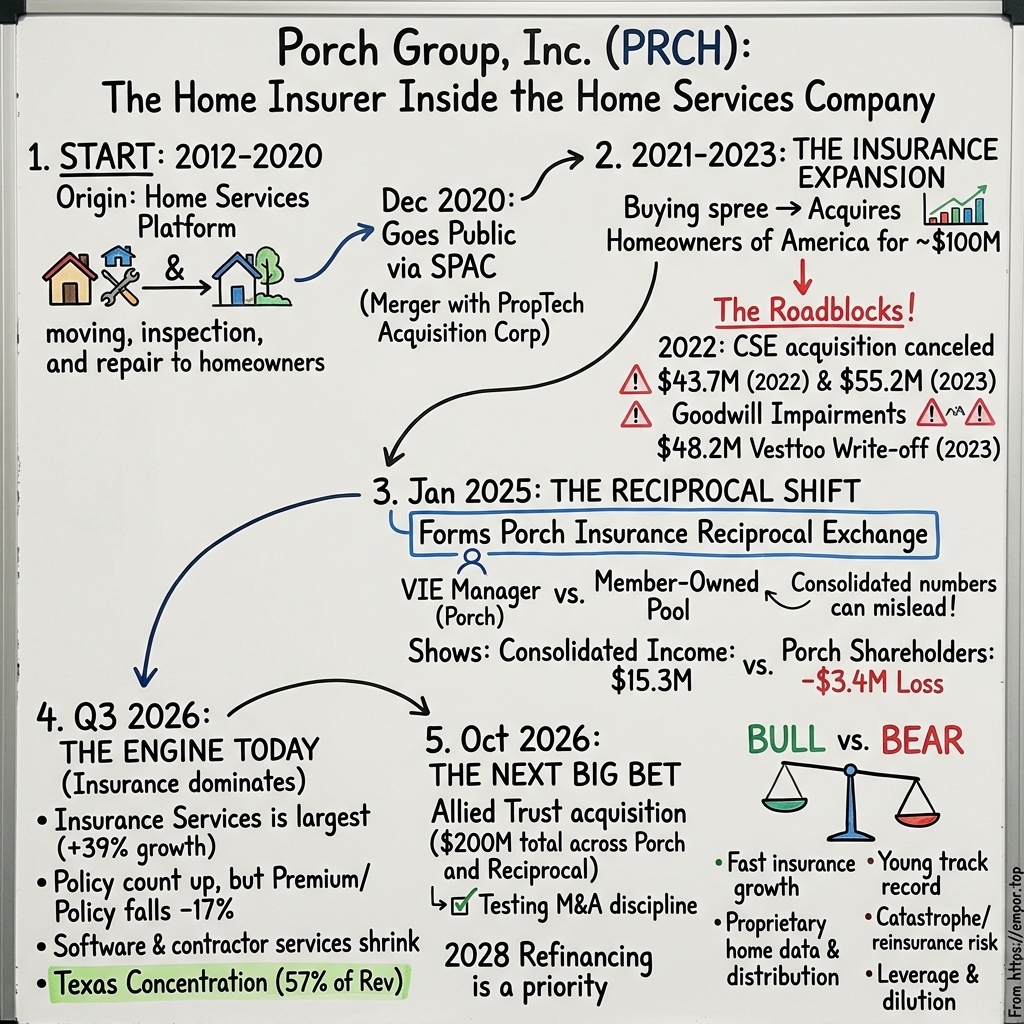
Porch Group, Inc.: The Home Insurer Inside the Home Services Company
I. Forty-Two Percent More Policies, Seventeen Percent Less Premium per Policy
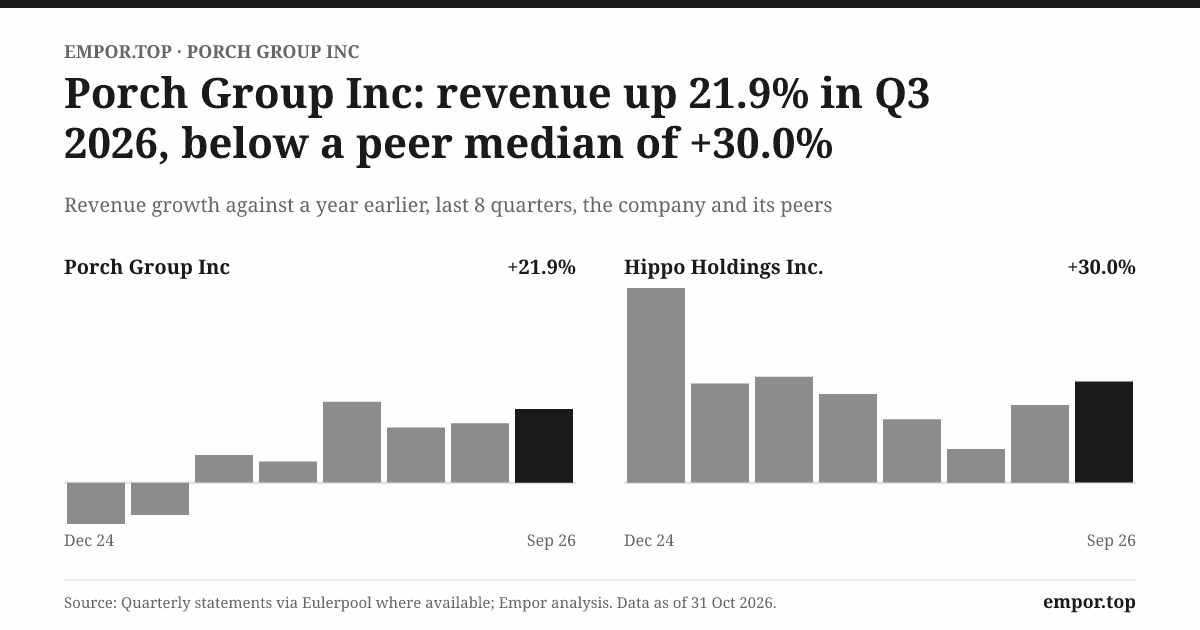
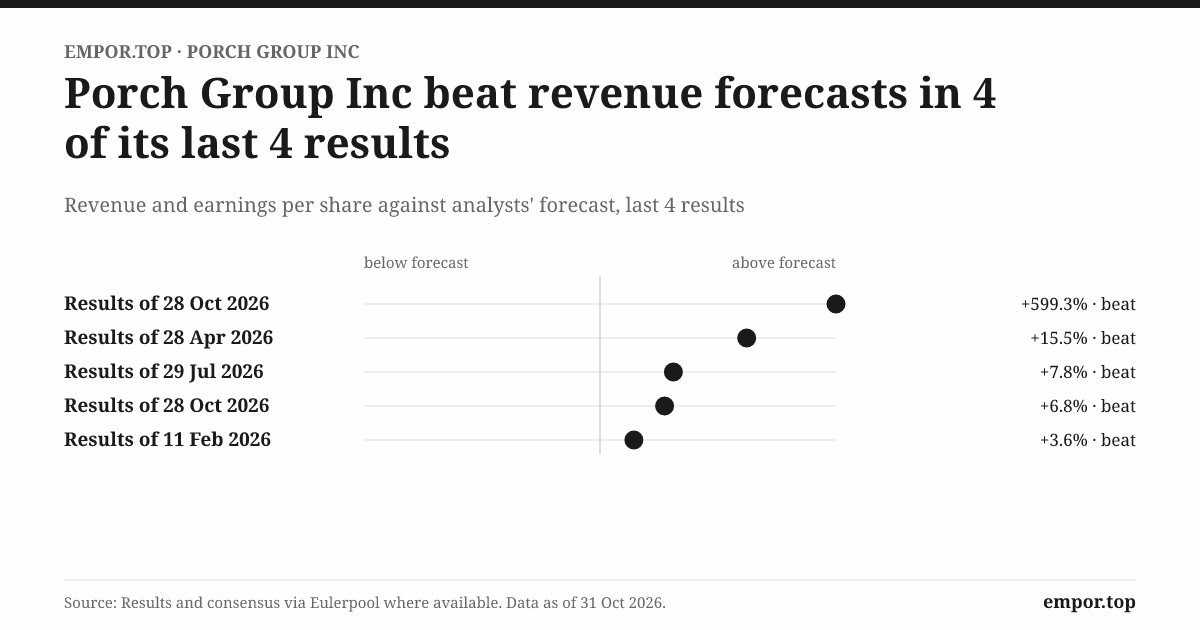
On the evening of October 28, 2026, Porch Group published a set of third-quarter numbers that seemed to say two opposite things at once. The first said the machine was roaring. The insurer that Porch manages wrote about 67,500 homeowners policies in the quarter, 42% more than a year earlier, and the pace had quickened from 38% growth in the second quarter.1 Consolidated revenue reached $143.9 million, and after years in which "Porch" and "net loss" travelled together like a married couple, the company reported $12.2 million of net income attributable to its own shareholders, against a loss of almost $11 million in the same quarter of 2025.1 Management raised its full-year profit guidance again.2
The second message sat a few lines lower, and it was quieter. The premium those policies carried had grown by only 17%, to $161 million.1 Divide one number by the other and the average policy written in the quarter brought in about $2,384 of premium, down from about $2,884 a year earlier, a fall of 17%.1 Porch was writing far more policies, and each one, on average, was smaller.
There are innocent explanations for that, and management offered one. On the earnings call, chief operating officer Matthew Neagle said premium per policy was lower "primarily due to customer mix," and that premium per new customer had declined "just 2%" from the year before.2 In other words, the business was not, by its own account, cutting prices across the board. It was adding many more new customers, and the mix of who those customers were, where they lived and what they bought pulled the average down. That may be exactly right. It is also the kind of sentence that every insurer in a growth spurt says, and it is the kind that the next two years of claims will either confirm or punish. In homeowners insurance, a policy is not a sale in the way a software licence is a sale. It is a promise to pay for hail, fire, wind and burst pipes over the next twelve months, and its profitability is only known after the weather has had its say.
That tension, between volume that is easy to count and economics that take time to reveal, is the first thread of the Porch story. The second is subtler and, for an investor, more important. The insurer writing those 67,500 policies is not owned by Porch Group. It is the Porch Insurance Reciprocal Exchange, a member-owned insurer that Porch manages and, because of how the accounting rules work, consolidates into its own financial statements.3 Its assets exist to pay its policyholders. Its underwriting profits do not belong to the people who own PRCH shares. In 2025, the consolidated company reported $15.3 million of net income, but $18.7 million of that belonged to the Reciprocal, which meant that Porch's own shareholders had a $3.4 million loss.3 A reader who glanced at the headline number would have seen a profitable year. A shareholder who read the footnotes would have seen a company still a little short of breaking even.
So three questions sit underneath the October numbers. Can a company that began life selling software to home inspectors and moving companies turn that network into a genuine advantage in homeowners insurance, one of the most unforgiving businesses in American finance? Can any such advantage survive a full cycle of storms, reinsurance pricing and regulators? And does the growth, once the Reciprocal takes what is its own, become durable earnings and cash for the listed company?
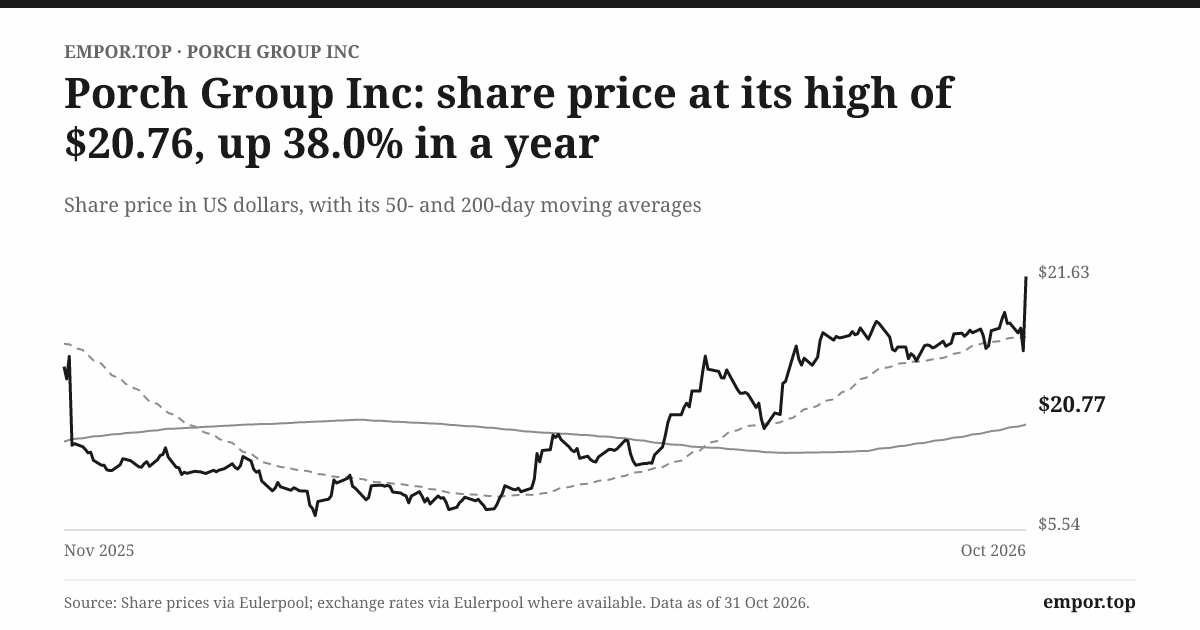
The market has given its provisional answer. On October 31, 2026, the shares closed at $20.76, their high for the year and more than three times the 52-week low of $6.40, which gave Porch a market value of about $2.6 billion.4 That is a big number for a company whose shareholders were, on a strict accounting basis, in the red for 2025. It is also a long way from 2023, when the same shares had lost almost all of their value. The largest peak-to-trough fall in the past five years was 98%.4
To understand how Porch got from a near-death share price to a 52-week high, and whether the high is earned, the story has to go back to the doorway the company first chose into American homes: not the insurance agent, but the person who inspects the house before you buy it.
 Subscribe on LinkedIn
II. A Home Services Platform Goes Public
Matt Ehrlichman has been an entrepreneur for longer than he has been an adult. He started his first business at 14, selling sand dollars on the street, then ran a multi-sport camp for elementary school children across Western Washington for about five years.5 As a child he wanted to be a professional basketball player, and later conceded he was not going to be nearly athletic enough. "I like to win. I am competitive," he told an interviewer in 2016.5 At Stanford, where he earned a bachelor's degree in entrepreneurial engineering and a master's in management science and engineering, he built a company called Thriva out of his dorm room. Active Network bought Thriva in March 2007 for $60 million, and Ehrlichman stayed on as chief strategy officer, helping grow Active's revenue from $65 million in 2006 to $420 million and an IPO in 2011.6
That background matters, because it explains the shape of the company he built next. Active Network was a software business that sat in the middle of a fragmented activity, race registrations and camp sign-ups, and made money from the flow of transactions passing through it. Ehrlichman's next idea applied the same logic to the American home. He launched Porch in September 2013, and within a year it had a partnership with Lowe's.5
The original bet was about where to stand. Homeowners are notoriously expensive to reach, because they rarely think about their house as a category of purchase. But at certain moments in the life of a home, especially when it changes hands, a cluster of professionals descend on it: the inspector, the mover, the title agent, the utility company, the warranty provider. Porch's insight was that if it built the software those professionals used to run their businesses, it would sit next to the homeowner at precisely the moment when the homeowner was making a string of decisions about moving, utilities, security, warranties and, crucially, insurance. Sell inexpensive software to the inspector; earn the referral on the expensive services the buyer needs next.
By the time Porch reached the public markets, the company described itself as providing software and services to more than 10,500 home-services companies, including home inspectors, moving companies, real estate agencies, utilities and warranty firms, plus a moving concierge service for homebuyers.7 It came to Nasdaq not through a traditional IPO but by merging with a special-purpose acquisition company, PropTech Acquisition Corp. The deal closed on December 23, 2020, and the renamed Porch Group began trading under the ticker PRCH the next day.7 The combination raised more than $322 million in gross proceeds, including a $150 million committed private placement and roughly $173 million remaining in the SPAC's trust; almost no SPAC shareholders redeemed.7 "We set out to build a truly great company that makes the home simple, from moving to maintenance and everything in between," Ehrlichman said on the day.7
The timing was not an accident of the calendar. Late 2020 was the peak of the SPAC era, when a company with a story about software and data could raise hundreds of millions of dollars from investors hungry for growth, and do it without the scrutiny of a conventional roadshow. The SPAC route also allowed companies to publish forward projections in their merger materials, something a traditional IPO prospectus avoids. That made the listing a financing event as much as a judgement on a mature business. Porch's actual revenue in 2020 was about $72 million, slightly lower than the year before, and it had lost money every year on record.3 What the cash bought was the ability to become something larger than the business that had been built.
Within weeks, Porch was spending. In January 2021, it announced it would buy Homeowners of America, a Texas homeowners insurer, for about $100 million, alongside smaller acquisitions of the data company V12, the inspection software firm Palm-Tech and the roofing software iRoofing.8 Ehrlichman's framing on the day was direct. "Part of our business is insurance," he said, describing insurance as "the most valuable service in the home and it's a service that is recurring in nature."8 Because Porch knew so much about the home, he argued, its data partnerships gave it "an advantage on pricing risk."8 Porch raised its 2021 revenue outlook from $120 million to $170 million that day, and the shares rose 5%.8
Revenue for 2021 came in at about $192 million, almost triple the 2020 figure and above even the raised outlook.9 But it is worth being precise about what produced that jump. Much of it was bought. The 2021 growth was the arithmetic of acquisition consolidated onto an existing base, not evidence that the platform had organically found its way into insurance economics. The original thesis, that a home-services network could create insurance leads cheaply, would have to be tested later, inside a business Porch had purchased rather than one it had grown.
That left an unresolved question hanging over the newly public company. Could a software network generate repeatable insurance economics, or would Porch have to buy those economics, with all the integration risk, underwriting exposure and accounting consequences that buying an insurer brings? Porch answered with its chequebook.
III. The Insurance Buying Spree—and the Write-Downs
On April 6, 2021, Porch announced that it had closed the Homeowners of America acquisition, and the headline it chose captured the mood of the moment: the deal, it said, created "one of the largest InsurTech companies."10 The price was about $100 million, with roughly $21.7 million paid in Porch stock.10 For that, Porch received a business founded in Texas in 2006. It had been the 12th-largest homeowners insurer in the state's $10 billion market in 2019, was licensed in 31 states and operated primarily in six: Texas, Arizona, North Carolina, South Carolina, Virginia and Georgia.10 Porch described HOA as a hybrid of a managing general agent and an insurance carrier, with "high margins and a capital efficient reinsurance strategy which limits retained risk."10 It expected more than $270 million of pro forma gross written premium for 2021 between HOA and its existing insurance agency.10
The strategic logic was clean on paper. HOA brought licences, an underwriting team, a claims operation and a book of Texas homes. Porch brought what it described as a low-cost pipeline of homebuyers through its software, "proprietary property data collection," and a way to reduce customer acquisition cost.10 "The InsurTech space is nascent," Ehrlichman said, "and this acquisition demonstrates our commitment to industry leadership."10 The bet was that the pipeline and the carrier would be worth more together than apart.
The ambition did not stop there. Porch also agreed to buy CSE Insurance, a California property and casualty insurer owned by the French mutual group Covéa. That deal never closed. On August 8, 2022, Porch signed a mutual termination agreement with Covéa, withdrew its application to the California Department of Insurance and paid no break fee.11 The release announcing the decision was headlined not as a retreat but as a cash gain: ending the deal would increase Porch's expected year-end unrestricted cash by about $50 million. "Given the change in the market and the increase in the cost of capital, we are confident there are other ways to deploy the approximately $50 million in cash that would have been used for purchase price," Ehrlichman said.11
It is worth pausing on that sentence, because it would echo four years later. In mid-2022, interest rates were rising fast, growth stocks were collapsing and the cost of raising capital had jumped. Walking away from a California insurer at that moment was a defensible decision, arguably a disciplined one. But the same release cut Porch's full-year revenue guidance from about $320 million to about $290 million, citing the removal of CSE and a "small macroeconomic adjustment."11 When the year ended, Porch reported revenue of about $275 million, below even the reduced figure.9 A company that had beaten its raised guidance in 2021 missed its lowered guidance in 2022. The lesson an investor could draw was not that management was dishonest, but that its forecasting had been tuned for a world of cheap capital and busy housing markets, and that world had ended.
The bill for 2021 arrives
The more expensive lesson came through the income statement. In 2022, Porch recorded a $43.7 million impairment of goodwill in its insurance business.9 Goodwill is the part of an acquisition price that exceeds the value of the identifiable assets, the accounting placeholder for "what we expect this business to earn beyond its balance sheet." Writing it down is an admission that those expected earnings are now worth less. In the second quarter of 2023, Porch wrote down a further $55.2 million.12 Together, the two charges came to almost $99 million, close to the headline price Porch had paid for HOA. Not every dollar of goodwill came from that one deal, and an impairment is an accounting judgement made under the pressure of a falling share price as much as a verdict on operations. But it is substantial evidence that at least part of the acquisition value did not hold. Porch does not disclose a consistent set of deal-level earnings multiples for its 2021 purchases, so it is not possible to say whether the prices were rich by industry standards at the time. What can be said is that the company itself later concluded they were worth less than it had paid.
That same second quarter of 2023 brought something worse than an accounting charge. HOA had bought reinsurance, the insurance that insurers buy to protect themselves against catastrophic losses, under a contract whose capital had been arranged by an Israeli insurtech called Vesttoo. The contract provided partial quota-share protection, meaning the reinsurer took a slice of every policy, plus up to about $175 million of cover in a catastrophic event.12 In the summer of 2023, Vesttoo faced allegations of fraud relating to the collateral it had provided to HOA and other insurers. The heart of that collateral was a $300 million letter of credit, which the issuing bank's advisers alleged was invalid.12 HOA terminated the contract on August 4, 2023, effective July 1, seized about $47.6 million of liquid collateral from a reinsurance trust of which it was the beneficiary, and recognised a $48.2 million charge to write its receivable down to the cash it could actually collect.12 It then scrambled for replacement protection, securing about $42 million of supplemental reinsurance and seeking more from third parties or Porch's own captive reinsurer.12
The second quarter of 2023 told the whole story of what an insurance strategy can do to a software company's income statement. Porch reported a GAAP net loss of $87.0 million, which would have been far larger without an $81.4 million gain from extinguishing debt below face value; in the same quarter it absorbed the $55.2 million impairment, the Vesttoo write-off and an $18 million loss from catastrophic weather events.12
The Vesttoo loss deserves a precise label, because it is easy to misread. It was not a routine timing difference in reinsurance accounting that would reverse next quarter. It was a counterparty failure: a protection Porch believed it had bought turned out, on the allegations, not to be backed by the collateral it relied on. It was also a controls question. HOA said it had received the original letter-of-credit documents from one of the bank's branches and believed its partners had done appropriate diligence.12 That diligence proved insufficient. For a company whose pitch rested on superior data and risk selection, the episode showed that the risks in insurance are not only in the homes being insured, but also in the chain of financial promises that sits behind the policy.
So by the end of 2023, Porch had bought an insurer, abandoned a second, written off almost $100 million of insurance goodwill and lost a reinsurance partner to an alleged fraud. The share price had collapsed. The insurance footprint, however, was still central to everything management said about the future. The question was how to keep the growth engine while changing who carried the risk. Porch's answer was a structure that is old in American insurance and new to most of its shareholders: if Porch would no longer own the insurer outright, who would own the risk, the assets and the earnings?
IV. The Insurer Porch Manages but Does Not Own
Picture the balance sheet of a conventional insurer as a house with one owner. The shareholders own the capital. When the insurer collects more in premium than it pays in claims and expenses, the profit belongs to them; when a hurricane wipes out a year of profits, the loss is theirs too. Now picture a different house. The people living in it, the policyholders, collectively own it. They pool their premiums and their risk, and they hire a professional manager to run the place: to sell policies, collect premiums, handle claims, buy reinsurance and invest the money. The manager is paid a fee, generally tied to the premium written. The manager does not own the house.
That second house is a reciprocal exchange, and in January 2025, Porch moved its insurer into one. The Porch Insurance Reciprocal Exchange was formed as a member-owned insurer, and Homeowners of America was transferred to it.3 The Reciprocal acquired HOA for its estimated statutory surplus of about $105 million, reduced by $58 million of principal and interest that HOA owed Porch under a surplus note.3 Porch, through its subsidiaries, became the manager.
The mechanics matter, because the structure was designed to change where risk and capital sit. Under the old arrangement, a bad storm season hit Porch's own equity directly, as it had in 2023. Under the new one, underwriting losses fall first on the Reciprocal's surplus, the policyholders' capital cushion. Porch's revenue comes predominantly from fees: management fees tied to the Reciprocal's written premium, policy fees, and premium earned by Porch's own captive reinsurer for the slice of risk it chooses to keep.3 Porch also holds $106 million of surplus notes issued by the Reciprocal.3 A surplus note is a peculiar instrument. It is a loan, but insurance regulators count it as capital for the borrower, and in return the lender generally cannot be repaid principal or interest without the regulator's approval. Porch, in effect, has lent the policyholders' insurer part of its capital, and the regulator decides when it gets that money back.
The timing of those fees adds a further wrinkle. On the third-quarter call, Tabak explained that "the majority of the management fee is recognized upfront, with a portion deferred over 18 months."2 Put simply, when the Reciprocal writes a new twelve-month policy, Porch books most of its fee in the quarter the policy is written, not gradually as the policy's coverage runs. That is standard enough for a manager paid on premium written, and it has a clear consequence for anyone reading Porch's growth. In a year when policy count jumps 42%, a large slug of fee revenue arrives at once, ahead of the claims those policies will eventually generate inside the Reciprocal. Fast growth flatters the manager's income statement early; the underwriting verdict on the same policies lands later, and lands first on someone else's balance sheet.
Here is where the accounting becomes a trap for the casual reader. Although Porch does not own the Reciprocal, it controls the decisions that most affect the Reciprocal's economics, and it absorbs some of its variability through fees and the surplus notes. Under the accounting rules for what are called variable interest entities, that makes Porch the "primary beneficiary," and it must consolidate the Reciprocal's revenue, assets and liabilities into its own statements.3 The policyholders' premiums, claims reserves and investment portfolio all appear on Porch's balance sheet. Then, at the bottom of the income statement, the Reciprocal's share of the profit or loss is carved back out and attributed to the Reciprocal.
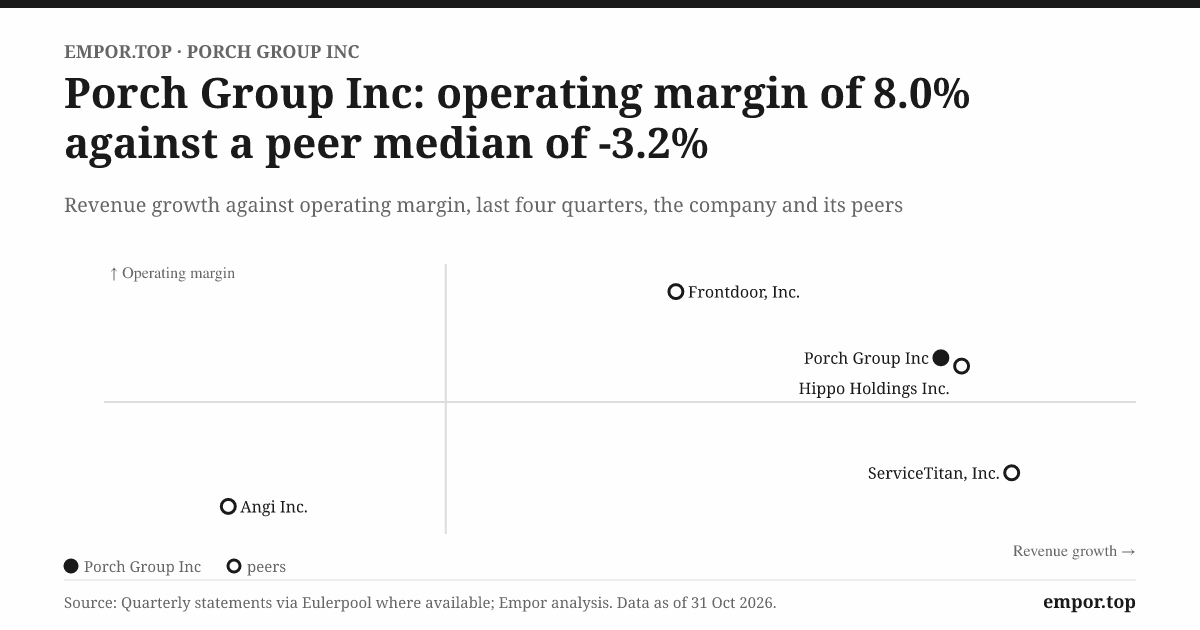
So a single quarter can produce three different revenue figures, each correct and each answering a different question. In the third quarter of 2026, consolidated revenue was $143.9 million. Porch's own segments, Insurance Services, Software & Data and Consumer Services, generated $140.8 million, up 22% on a year earlier.1 And the Reciprocal itself reported $58.1 million of segment revenue.1 The consolidated figure is not simply the sum of the other two, because the fees Porch charges the Reciprocal are revenue to Porch and expense to the Reciprocal, and on consolidation they cancel out. Those intercompany eliminations were $136.9 million in 2025, up from $57.5 million the year before.3 That is a large number relative to a company with roughly $482 million of consolidated revenue.3 It also means a reader cannot look at Porch's consolidated statement and see directly how much of the listed company's income comes from managing the Reciprocal. Porch does not separately disclose its management fees as a share of its own revenue, or publish a standalone fee rate, in its annual report.
The cleanest way to see who owns what is to go to the bottom line, and the 2025 result makes the point vividly: the Reciprocal's share exceeded consolidated net income, leaving Porch's shareholders with a loss.3 In a year when the Reciprocal had a good underwriting result, the policyholders' insurer earned more than the entire consolidated group. The listed company's own operations, after its interest costs and stock compensation, did not quite break even.
That is not a scandal. It is the structure working as designed. A reciprocal is supposed to keep underwriting profits inside the policyholders' capital, building surplus so that the insurer can write more business. Surplus is the binding constraint on any insurer's growth, because regulators and rating agencies limit how much premium an insurer can write against each dollar of capital. A Reciprocal that retains its profits can grow its premium, which grows Porch's fees. The Reciprocal's statutory surplus reached $174.4 million at the end of the third quarter of 2026, up about $22 million from a year earlier.1
But the design has a cost, and investors need to hold both halves at once. When the weather is kind, the Reciprocal keeps the windfall; Porch earns its fee regardless. When the weather is cruel, the Reciprocal's surplus takes the first hit, and if surplus falls, the Reciprocal can write less business, and Porch's fees shrink with it. Porch's surplus notes, which depend on regulatory approval for repayment, sit in the same chain. The manager's income is protected from the first loss, not from a sustained one.
There is one more twist. The Reciprocal owns shares of Porch Group. Late in October 2026, Porch registered an arrangement allowing the Reciprocal to sell up to 10 million of the Porch shares it already holds into the market, alongside up to 5 million new shares that Porch itself might issue.13 The reason, according to Porch, is partly regulatory: insurance regulators do not generally count an insurer's holdings in an affiliate's stock as "admitted" assets, the kind that support policyholder obligations, so selling those shares converts them into capital that counts.13 At the October 31 closing price, 10 million shares would be worth roughly $208 million, more than the Reciprocal's entire statutory surplus. Neither seller is obliged to sell, and these are limits, not completed sales. But the arrangement reveals how tightly the two entities are bound together: the listed company's share price has become a potential source of capital for the policyholders' insurer, whose growth in turn drives the listed company's fees.
Porch has built a manager whose fortunes are tied to a client it does not own, cannot freely draw cash from, and must keep adequately capitalised. The model can generate reliable fee income only if the Reciprocal stays solvent, keeps growing its surplus and pays its claims. And that raises the operational question beneath the structure: can Porch actually win in homeowners insurance against companies many times its size?
V. Can Data and Distribution Beat the Insurance Giants?
Imagine an independent insurance agent in a strip-mall office in suburban Texas. A family has just bought a house, and needs a homeowners policy before closing. The agent types the address into a series of quoting screens, one for each carrier the agency represents, and waits for the prices to come back. Whoever is cheapest, or whoever the agent trusts to pay claims after the next hailstorm, gets the business. The insurer never meets the family. It meets a screen.
That scene, multiplied thousands of times, is now the main road into the Porch Reciprocal's growth. In the third quarter of 2026, the number of producing agency branch locations working with Porch rose 114% from a year earlier, quote volume rose 79% and increased for the eighth consecutive quarter, and the rate at which quotes converted into policies was up 53% year over year.2 Written premium from new customers almost tripled, up 178%.2 These are striking numbers, and they explain the 42% jump in policies written. They also explain something about where the growth comes from. Porch's founding thesis was that its own software network, the inspectors and movers, would feed it cheap, data-rich insurance customers. The fastest-growing channel in 2026 is the independent agent, the most traditional distribution system in American insurance, where Porch competes for the same quote screen as everyone else.
Homeowners insurance is a business in which insurers compete on five things: price, claims handling, distribution, access to reinsurance and the capital to absorb a catastrophe without failing. The industry's incumbents, State Farm and Allstate above all, have decades of claims data, national brands, captive agent networks and balance sheets that can absorb a Gulf Coast hurricane. In Texas, the state that matters most to Porch, State Farm held about 19% of the homeowners market by premium and Allstate about 17%.14 Alongside them, a wave of digitally native insurers, including Hippo and Lemonade, have spent the past decade making their own versions of the data-and-technology pitch.
Porch's Texas exposure is not a detail. About 57% of Porch's consolidated revenue in the third quarter and the first nine months of 2026 came from Texas.15 That is the legacy of buying a Texas insurer, and it is a concentration risk in a state that produces some of the country's most violent hail and wind. It is also tempting, and wrong, to compare the Reciprocal's $161 million of quarterly written premium directly with State Farm's share of the Texas market. A state's market-share figures measure direct written premium across all insurers in that state over a year;16 Porch's reported premium spans several states and is reported quarterly on its own definitions. The honest conclusion is simpler. Porch is a meaningful but small participant in a market where the leaders are many times larger, and where scale confers real advantages in reinsurance buying, claims-adjuster capacity and statistical confidence about loss patterns.
The edge Porch claims, and what it would take to prove it
Porch's argument is that it can compete anyway, because it knows things about houses that others do not. Its software touches home inspections, moves and other transactions, generating what management calls proprietary property data, including details on roofs, systems and condition that a typical application form does not capture.3 In theory that data does two jobs. It finds customers more cheaply, through the home-services relationships, and it lets the insurer price risk more precisely, charging the right premium for a well-maintained house and avoiding the one with the twenty-year-old roof. Ehrlichman made the same argument in 2021, when he said Porch's data gave it "an advantage on pricing risk."8
The evidence that the data works is not nothing. In the third quarter of 2026, management reported a gross loss ratio of 24% and an attritional loss ratio, which strips out catastrophe losses, of 18%.2 For a homeowners book, those are low numbers. But a single quarter's loss ratio is a snapshot taken between storms. The second quarter, Texas hail season, is where homeowners books are tested, and Porch's own history shows how hard that test can be: an $18 million weather loss above historic trends in the second quarter of 2023,12 and, in the second quarter of 2026, a consolidated operating loss of about $4 million in a year otherwise marked by profits.17 The fair verdict on the data claim is that the current loss experience is encouraging, but Porch has not published what would prove it: loss ratios by policy cohort, by channel and by data source, compared over several full seasons against comparable insurers.
The lower average premium raises the same question: is Porch's growth coming from an advantage or from price? Management attributes the decline mainly to customer mix.2 Agency growth into new geographies and products with smaller average premiums would produce exactly that pattern. But a falling average premium is also what an insurer would see if it were winning business at the quote screen by being cheaper than rivals, and in homeowners insurance, winning on price is the easiest way to grow and the most dangerous. The distinction between those two stories will show up in renewal retention, in loss ratios on the new cohorts and in whether premium per policy stabilises. Porch does not publish renewal retention for the Reciprocal's book in its quarterly results.
The analysts on the October call circled the same ground from different angles. Jason Helfstein of Oppenheimer asked about industry pricing and the share of premium Porch captures, Randy Binner of Texas Capital about pricing and the shares that might be issued to pay deferred acquisition consideration, and Jason Kreyer of Craig-Hallum about the agency expansion and whether the Reciprocal had the surplus to support it.2 Those are the right questions. Pricing, capture and capital are the three dials that decide whether faster policy growth is good news, and they interact: an insurer that wins share by pricing below rivals needs more surplus per dollar of profit, and a manager whose fee depends on premium has an incentive to keep the policy count rising. Management's answers emphasised conversion gains and agency productivity rather than price concessions.2 That is a coherent story. It is not yet a proven one, because the figures that would separate price from mix, quote-level pricing compared with competitors and win rates by risk tier, stay inside the company.
Run the competitive forces once, and the picture is consistent. The incumbents have scale and capital. Customers, especially through independent agents, can compare prices every year and switch at renewal with little friction; homeowners insurance has meaningful inertia, but no contractual lock-in. The independent agents themselves are powerful buyers, because they represent many carriers and route business to whichever gives them the best price and service. Reinsurers, the suppliers of catastrophe capacity, can raise their prices sharply after a bad year, and Porch's own history shows that a reinsurance counterparty can fail outright. Porch's home-services relationships may give it a sourcing edge, but nothing in its disclosures establishes exclusive channels or high switching costs.
One more signal deserves careful framing. In September 2026, the rating agency Demotech affirmed an "A" Financial Stability Rating for the Porch Insurance Reciprocal Exchange.18 Demotech's assessment covers capital adequacy, leverage, liquidity, loss reserves, the ratio of premium to surplus, underwriting results, reinsurance quality and geographic concentration.18 That rating matters a great deal to the Reciprocal, because mortgage lenders typically require a homeowner's insurer to carry an acceptable rating, so it is a practical licence to compete. But it is a rating on the Reciprocal's ability to pay claims, not a credit rating on Porch Group's corporate debt, and it does not make the Texas concentration or the reliance on reinsurers go away.
The moat, then, is plausible and unproven. Porch has demonstrated that it can grow distribution and policy count quickly. It has not yet demonstrated, in public numbers, that those policies renew at high rates, carry durable premium and produce superior losses through a full catastrophe season. The evidence that would strengthen the claim is specific: rising renewal retention, a stable or recovering premium per policy, loss ratios that hold through the second-quarter hail season, and reinsurance recoveries that arrive as promised. Until then, the honest description is an insurer winning on the quote screen, for reasons management attributes to data and that the market will have to see survive the weather.
All of which raises an awkward question about the businesses Porch was founded on. If the insurance growth is coming mainly through independent agents, what exactly are the software and services businesses for?
VI. The Software and Services Businesses Shrink Around the Insurance Engine
In the third quarter of 2026, Porch did something that software companies rarely advertise: it got rid of about 4,000 customers. The company sunset a legacy product aimed at small contractors, and Neagle said the decision "resulted in the removal of roughly 4,000 companies."2 The Software & Data segment ended the quarter serving about 18,000 companies, 22% fewer than a year earlier, while annualised revenue per company rose 17% to about $4,840.2
On its own terms, the decision looks sensible. Small contractors are expensive to serve and quick to churn; a product built for them can consume support and development time out of proportion to the revenue it brings in. Pruning them leaves a smaller, more valuable base, and the rising revenue per company is exactly what a deliberate mix decision should produce. It is not the sign of a customer revolt or a lost contract. But it is also a reminder of how much the centre of gravity at Porch has moved.
Consider the three businesses side by side. In the third quarter, Insurance Services, which earns the management fees, policy fees and reinsurance premiums tied to the Reciprocal, generated about $102.8 million of revenue, up 39%.1 Software & Data, the inspection software, moving tools and data products that were the company's original identity, generated about $22.3 million, down roughly 9% from $24.6 million a year earlier.1 Consumer Services, which includes moving services and home warranties sold to homeowners, generated about $18.3 million, down from $19.4 million, with the number of monetised services down 11%.12 Insurance Services now produces almost three-quarters of the revenue of the businesses Porch owns, and management reported that the segment earned about $50 million of adjusted EBITDA in the quarter, at a margin of about 49%.2
The founding thesis survives in Porch's own description: its home-services relationships are meant to make the insurance business better.3
The problem is that Porch does not publish the numbers that would prove this. It does not disclose what share of the Reciprocal's new policies originate from its software or consumer businesses, what those policies cost to acquire compared with agency-sourced business, how their loss ratios compare, or how they convert. Meanwhile, the operating data it does publish point in an awkward direction. The fastest-growing source of insurance business is the independent agency channel, where Porch's home-services network plays no obvious role. And the software and consumer segments, which would need to grow for the funnel thesis to become more important over time, are shrinking.
None of that means the legacy businesses are worthless. Software & Data still generates around $90 million a year at the current run rate, with higher revenue per customer, and it continues to absorb engineering investment. Product and technology expense ran at about $53 million in 2025, roughly 11% of revenue, a level that had held steady for three years, while capitalised software and capital spending rose to about 3% of revenue.3 The data products may support underwriting in ways that do not show up in a segment's revenue line. The fair verdict is that the integrated-platform claim is intact but unproven: insurance is the economic engine, and the software and services businesses are now best understood as smaller standalone operations with a possible, unquantified contribution to the insurer.
There is a quieter implication for valuation. When Porch went public, investors bought a story about a software platform with insurance attached. In 2026, they own an insurance-services company with software attached. The multiples the market applies to those two kinds of companies differ, and so does the risk. A software customer who leaves takes a subscription with them. An insurance customer who stays may bring a claim with them. The shift in identity is not a criticism, but it changes what investors should measure.
Porch's own preferred measure of quality illustrates the point. The company reports a figure it calls recurring revenue, which rose from about $248 million in 2023 to about $394 million in 2025.3 That sounds like a software metric, and in a software company it would mean subscriptions that renew automatically. At Porch, the category also gathers insurance-related streams, management fees, policy fees and reinsurance premiums, whose recurrence depends on whether homeowners renew their policies and whether the Reciprocal keeps writing them. Porch does not publish minimum contract commitments or contract lengths for these revenues.3 Calling them recurring is defensible; treating them as if they carried the same certainty as a multi-year software contract would not be.
And that leads to the question that matters most. Insurance Services growing at 39% is not, by itself, value for shareholders. Growth becomes value only if it turns into cash and GAAP earnings that belong to Porch, and Porch's history on that front is complicated.
VII. From Accounting Profit to Cash in the Bank
Here is a puzzle that would confuse any investor coming to Porch for the first time. Between 2018 and 2025, the company reported cumulative net losses of about $618 million.39 Yet its cumulative cash flow from operations over the same eight years was negative by only about $61.5 million.39 How does a business lose more than half a billion dollars on paper and only a tenth of that in operating cash?
The answer is partly ordinary and partly specific to insurance, and the distinction matters. The ordinary part is non-cash charges. Goodwill impairments, including Porch's roughly $99 million in write-downs in 2022 and 2023, reduce net income without consuming cash in the year they are recorded; the cash was spent earlier, when the acquisition was made. Stock compensation reduces profit without draining the bank account, though it dilutes shareholders instead. Interest on convertible notes can accrue rather than be paid in cash. None of that makes the losses economically irrelevant. An impairment records the destruction of capital that was spent; stock compensation is a real cost borne by owners through dilution. But it explains why the cash statement looks kinder than the income statement.
The insurance-specific part is working capital, and it can swing enormously. An insurer collects premiums upfront and pays claims later; it pays reinsurers and receives recoveries from them on a lag. When those balances move, operating cash flow moves with them, independently of underlying profitability. In 2023, Porch's operating cash flow benefited from a $179.4 million swing in reinsurance receivables, in the same year that it was absorbing the Vesttoo loss.3 Cash flow that year was positive at about $33 million, and then turned negative again in 2024.3
The 2025 result has to be read through the same lens. Operating cash flow reached about $66.4 million, the best in Porch's public history.3 It was a real improvement. But it was assembled from several pieces. Non-cash items added back included about $29 million of stock compensation and about $29 million of non-cash interest.3 A $53.6 million increase in amounts owed to reinsurers, cash Porch's insurer had collected and not yet passed on, added substantially to the total; growth in insurance reserves and deferred acquisition costs pulled the other way.3 Cash owed to reinsurers is not a gift. It is money held temporarily that will be paid out.
That is why the Vesttoo episode belongs beside the 2025 cash flow, not in a separate chapter of history. Reinsurance balances are where the risks of an insurance business hide in plain sight. The 2023 Vesttoo loss showed how a reinsurance receivable could prove less collectible than expected.12 In 2025, a movement in reinsurance balances flattered operating cash. Both are the same kind of number: a promise between an insurer and its reinsurers, recorded on a balance sheet, whose cash value depends on the counterparty. One year it was a real loss. Another year it was a timing benefit. An investor should treat any year's reinsurance-driven cash flow with the memory of both.
The improvement is continuing in 2026, at least on the headline measure: operating cash flow was about $113.8 million for the first nine months.15 But the consolidated figure includes the Reciprocal's cash flows, which belong to policyholders. Porch does not publish a cleanly separated operating cash flow for the listed company alone, reconciled for the Reciprocal and for reinsurance timing over several years. Porch said at the end of the third quarter that it held about $165 million of its own cash and investments, while the Reciprocal held about $333 million.2 That separation of balances is useful. A separation of cash flows would be more so.
Receivables tell a related story. Measured as days of revenue, Porch's receivables fell from about 489 days in 2021 to about 9 in 2025.39 That is a spectacular-looking improvement, but much of it is likely structural rather than a sign of sharper collections. In 2021, Porch had just consolidated an insurer whose balances with reinsurers can dwarf a young company's revenue; as the structure changed and revenue grew, the ratio collapsed. The provision for doubtful accounts tells a more useful story: about $5.3 million in 2025, against $37.2 million in 2023, the year the Vesttoo charge passed through that line.3 The concentration risk has not disappeared, though. At the end of the third quarter of 2026, five reinsurers each represented more than 10% of the amounts due from reinsurers, and together accounted for 59%.15 Porch says reinsurer balances are generally collected within 180 days.15 The 2023 experience shows why that concentration is worth watching.
The final step in the chain, from operating profit to shareholder profit, is where most of the remaining value leaks. Porch's operating profit was about $36.6 million in 2025.3 Below that line, other income contributed about $14.0 million, more than half of pretax profit of $26.7 million, and that other income included $10.8 million of reinsurance recoveries.3 The year before, other income had been flattered by a $14.9 million gain from reducing contingent acquisition payments.3 Then come interest on roughly $475 million of debt principal, taxes and, finally, the Reciprocal's share. The listed company's path from a growing insurance-services segment to earnings that Porch owners can keep runs through all of those filters.
The cash is real, and it is improving. But one strong year, built partly on reinsurance balances and non-cash add-backs, is an incomplete measure of recurring shareholder earnings. A company with this history needs several years of operating cash flow attributable to Porch, after the Reciprocal and reinsurance timing are stripped out, before the improvement can be called durable. And just as the cash was starting to come in, management announced how it intended to spend a large part of it.
VIII. A New Deal Tests the Old Acquisition Record
On October 13, 2026, Porch signed an agreement to buy Allied Trust.19 It was the company's largest acquisition since the 2021 spree, and it arrived at a moment when the share price was surging and the guidance was rising. That is exactly the moment when a founder-led company is most tempted to spend, and exactly the moment when its acquisition record deserves the closest reading.
Matt Ehrlichman remains chairman and chief executive, the role he has held since founding the company. The 2026 proxy statement listed his beneficial ownership at 24.11% as of March 31, 2026, ahead of Granahan at 10.95%, Vanguard at 6.49% and BlackRock at 5.98%.20 Either way, the founder owns a large enough stake to feel every dollar of value created or destroyed, without having majority control. Seven of Porch's eight directors are independent, though the founder chairs the board.20
His pay for 2025 was $14.55 million, mostly in equity.20 The details are revealing. Executive cash bonuses paid at 182% of target, and performance stock units vested at maximum achievement, against goals built on the company's own measures of revenue attributable to Porch shareholders and adjusted EBITDA.20 In the same year, the GAAP result attributable to Porch shareholders was a $3.4 million loss. That is not unusual for a company in transition, and the adjusted targets were set and disclosed in advance. But it does mean the compensation plan rewarded the metrics management controls most directly, at a time when the bottom line shareholders own was still slightly negative. Shareholders seem to have accepted the logic: support for the say-on-pay vote rose from about 80% in 2025 to 93% at the 2026 annual meeting.21
Two buyers, one deal
The Allied Trust transaction is best understood as two deals stapled together, and the boundary between them follows the line that runs through the whole Porch story. Allied Trust is a regional homeowners insurer operating in Louisiana, Texas, South Carolina and North Carolina, and Louisiana accounted for almost half of its 2025 premium, a state where the Reciprocal does not yet write business.22 The Reciprocal, the policyholders' insurer, agreed to buy the carrier itself, Allied Trust Insurance Company, for $105 million: a base price of $55 million in cash, adjusted for surplus and debt at closing, plus $50 million of deferred consideration payable over the following twelve months, in cash or Porch shares.123 Porch, through its wholly owned Homeowners of America holding company, agreed to buy the managing general agency, Allied Underwriters, and a captive reinsurer, for an aggregate base price of $95 million: $75 million in cash and an expected $20 million in Porch shares.123 The total value was about $200 million.24
Porch said the carrier was expected to bring about $60 million of statutory surplus at closing, which would make the Reciprocal's side approximately neutral to its surplus.1 Porch also said the deal would add about $200 million of Reciprocal written premium in the first full year after closing, reflecting "planned portfolio optimization," and about $25 million of adjusted EBITDA, excluding the Reciprocal.22 On that basis, management put its own side of the deal at "less than four times" first-year adjusted EBITDA, and said cash earnings should repay Porch's investment within three years.12
A headline multiple of under four times earnings looks cheap, and it may prove to be. But it rests on two kinds of assumption that deserve to be named. The first is that the earnings figure is a forecast of adjusted EBITDA, a measure that excludes interest, taxes, depreciation, amortisation, stock compensation and other items management chooses to treat as non-recurring, and excludes the Reciprocal. It is not a realised, audited profit. The second is the phrase "portfolio optimization." In insurance, that usually means not renewing policies the new owner considers underpriced or too risky. If Allied's premium shrinks to the planned level and the remaining book performs, the multiple holds. If the shrinking is larger, or the remaining policies produce higher losses, it does not. The right comparison, after closing, is between the $95 million Porch pays and the cash Porch actually earns from the MGA and reinsurer in the first two or three years.
Set beside the 2021 record, the new deal has clearer disclosure. Porch named a price, a structure, an earnings expectation and a payback period. The 2021 purchases were sold on strategic logic and pro forma premium, and were followed within two years by almost $100 million of insurance goodwill impairments. The 2022 CSE retreat was justified by the cost of capital. None of that proves Allied will repeat the pattern; the managers are older, the structure shifts underwriting risk away from Porch's equity and the stated price is lower relative to expected earnings. But it does mean the burden of proof is on realised results. Louisiana, the new state, is hurricane country, which means the Reciprocal is buying into exactly the kind of catastrophe exposure that tests a homeowners insurer's capital.
Paying for it
The financing sits on the same page as the deal, and it involves the share register. On October 30, 2026, Porch filed for an at-the-market programme allowing it to sell up to 5 million new shares, and the Reciprocal to sell up to 10 million existing Porch shares it already owns.13 The Reciprocal receives the proceeds from its own sales, not Porch.13 Up to 5 million new shares would be roughly 4% of the share count implied by the market value at the end of October, and the Allied deal itself contemplates about $20 million of Porch stock on Porch's side and possibly more if the deferred carrier consideration is paid in shares. These are capacity limits, not completed sales.
The debt is the other constraint. At the end of 2025, Porch owed about $475 million of principal: a small 2026 convertible issue, $333 million of secured notes due in 2028 and $134 million of unsecured notes due in 2030.3 The 2026 notes were repaid in the third quarter, leaving about $467 million.15 Management said net leverage, excluding the Reciprocal, had fallen to 2.4 times trailing adjusted EBITDA, and chief financial officer Shawn Tabak said the Allied deal "creates more attractive refinancing options."2 Refinancing the 2028 notes is a stated 2027 priority. A company with a 98% share price collapse in its recent past knows how quickly refinancing windows can close.
It is instructive to compare management's language across these episodes. In August 2022, Ehrlichman walked away from CSE because of "the change in the market and the increase in the cost of capital."11 In August 2023, the company explained Vesttoo as an alleged fraud against it, and moved quickly to replace the lost protection and pursue recovery.12 In October 2026, with the stock at a high, management described an acquisition that would "strengthen an already compelling growth profile and position Porch for a meaningful step forward in 2027."1 The tone has moved with the cost of capital, as it does at most companies. The test of discipline is not the tone. It is whether, when Allied's first full year is reported, the realised earnings look like the promise.
There is a longer yardstick for those promises, too. On the October call, management again referred to the medium-term ambition it set at its 2024 investor day: $3 billion of premium and $660 million of adjusted EBITDA.2 Set against the third quarter's $161 million of quarterly written premium and guidance of roughly $138 million of adjusted EBITDA for 2026, those targets imply a business several times today's size.12 Long-range ambitions are not guidance, and Porch has been clear that formal 2027 guidance will come only in early 2027.23 But the gap between ambition and current scale is exactly the gap that acquisitions are tempting to fill. Allied is the first large step on that road, and the way it is integrated, financed and reported will say more about management's capital discipline than any target slide.
Which raises the larger question, the one the market is pricing every day: what kind of earnings durability does a $2.6 billion valuation actually assume?
IX. Analysis & Bear vs. Bull Case
On the last trading day of October 2026, Porch's shares closed at their 52-week high. At that price, the market valued the company at about $2.6 billion, and its enterprise value, adding debt and subtracting cash, at about $2.7 billion.4 On the consolidated figures for the last twelve months, that is about 4.9 times sales, 28 times EBITDA and 65 times operating profit; the price-to-earnings ratio is above 200.4 Those multiples are distorted, in both directions, by the Reciprocal. Consolidated revenue includes the policyholders' insurer, and consolidated earnings include profits that belong to it. The more relevant yardstick is management's own: guidance of $135 million to $140 million of adjusted EBITDA for 2026, excluding the Reciprocal, up from about $102 million at the start of the year.2 Against the midpoint, the enterprise value is about 20 times. Against the 2027 ambition of more than $180 million, which assumes Allied closes on January 1, it is about 15 times.23 Those are adjusted numbers, before interest, stock compensation and taxes, and the second is a target, not a result.
The market's history with this stock is a lesson in itself. Porch traded at almost 8 times sales at the end of 2021, fell to under 1 times in 2023 and then recovered to about 4.8 times in October 2026.4 The closest listed insurance peers trade lower: Hippo at about 1.6 times sales and Lemonade at about 3.5 times on the same basis.2526 The comparison is imperfect, because Porch is mostly a fee-earning manager while Hippo and Lemonade carry their own underwriting risk, and investors typically pay more for fee streams than for underwriting results. But it shows that the market is already paying for the manager model working.
The case for and the case against
The bull case begins with the evidence of the last year. Policies written are growing more than 40%, insurance-services revenue nearly 40%, agency locations doubling and quote volume rising for eight straight quarters.12 The Reciprocal's surplus has grown to $174.4 million, giving it room to write more business, and it holds an "A" rating from Demotech.118 The listed company has turned positive on the line that matters most, net income attributable to Porch, in the third quarter, and management has raised guidance repeatedly. The fee-based structure means that Porch participates in premium growth without bearing the first loss. Allied, if it performs as promised, adds a new state and a meaningful slice of earnings at a modest stated price. On this reading, Porch has finally found the business its platform was always meant to feed, and the market is recognising it.
The bear case is built from the same record. The company's insurance history includes the acquisition impairments and reinsurance loss already described, as well as a terminated second acquisition.912 Texas generates more than half of consolidated revenue, and five reinsurers account for 59% of reinsurance balances due.15 Premium per policy is falling. The listed company had a GAAP loss as recently as 2025, its profit that year depended heavily on other income, and its cash flow relied on reinsurance timing. Debt of about $467 million must be refinanced, the 2028 notes first. Share issuance is available through the at-the-market programme and the Allied consideration. On this reading, the market is paying a software multiple for a young, concentrated insurance-services business that has not yet been through a hard catastrophe year in its new structure.
There are quieter items on the bear's list as well. Porch still faces litigation under the Telephone Consumer Protection Act arising from marketing calls made in 2019 and 2020; a court dismissed 589 plaintiffs in November 2025, leaving roughly 350, and the company has not quantified a potential loss.3 On the other side of the ledger, the auditor issued a clean opinion on both the 2025 financial statements and internal controls, with no critical audit matters, and Porch reported that earlier control weaknesses had been remediated.3 After the Vesttoo episode, that remediation matters: it is a sign that the company tightened the processes that failed in 2023, though no audit opinion can vouch for a counterparty's collateral.
Where the moat stands
The competitive analysis comes down to a small number of forces. The threat of substitutes is low, because homeowners need insurance and lenders require it; the threat of new entrants is moderate, because capital and licences are barriers, but the decade of insurtech launches shows they can be crossed. Buyer power is significant, because homeowners compare prices and independent agents steer business. Supplier power is high in the specific sense that reinsurers set the price of catastrophe protection and can reprice sharply after a bad year, and Porch has experienced a reinsurer's failure directly. Rivalry is intense: State Farm and Allstate have scale, brand and capital, and Porch is a small participant even in Texas.14
Through the lens of Hamilton Helmer's seven powers, the case for Porch rests mainly on two. The first is a cornered resource, the proprietary home data from the software business. The second is a form of counter-positioning: the reciprocal structure lets Porch earn fees on growth while policyholders' capital carries underwriting risk, something a traditional shareholder-owned insurer cannot easily copy without restructuring. Both are plausible. Neither is proven in public numbers. Porch does not disclose loss performance by data source, and the fastest growth is coming through agents rather than its own network. Switching costs are low. Scale economies favour the incumbents. Network effects and brand are not meaningful at Porch's size. The moat is best described as a promising data hypothesis and a distinctive structure, not a demonstrated wall.
A skeptical long-short investor would put a short list of questions to management. Show the renewal retention and loss ratio of the 2025 and 2026 policy cohorts, separately for agency-sourced and Porch-sourced business. Explain exactly how much of the drop in premium per policy is mix and how much is price. Publish operating cash flow attributable to Porch, after the Reciprocal and reinsurance timing. Disclose the management fee rate. Show the realised returns on Allied against the $95 million. The answers would turn an argument into evidence.
Three indicators matter most for tracking the story. The first is premium per policy alongside renewal retention: the latest reading is a 17% decline in premium per policy, and Porch does not regularly disclose retention. The second is loss and reinsurance performance through a full season: the Reciprocal's gross loss ratio was 24% in the third quarter, a favourable reading taken outside hail season. The third is GAAP net income and operating cash flow attributable to Porch after the Reciprocal: net income attributable to Porch was $12.2 million in the third quarter, against a $3.4 million loss for all of 2025.13
The valuation's burden of proof is clear. At these multiples, the market is assuming that the insurance growth becomes durable earnings that Porch shareholders own, not just premium that the Reciprocal writes. The evidence so far is a strong year and an excellent quarter, built on a structure that has not yet faced a severe storm season.
X. Business & Investing Lessons
The first lesson is that a platform only compounds value when the economics cross its boundaries. Porch built a structure in which the most profitable insurance results, in a good year, stay with the policyholders who own the Reciprocal. The 2025 result made the point with almost comic precision.3 Founders who build ecosystems of related entities, captives, exchanges and managed funds should expect investors to ask where the profit lands, not just where it is recorded. The line that belongs to Porch is simple: consolidation is not ownership.
The second lesson is that in insurance, distribution is the opening bid, and losses and renewals decide the price. Porch's agency locations doubled and quote volume climbed for eight straight quarters, and the result was 42% more policies.2 But an insurer can always grow faster by being the cheapest quote on the agent's screen. What separates a growing insurer from a good one is whether the policies it wins this year are still on its books next year, at a premium that pays for the claims. The 17% fall in premium per policy is not a verdict; it is a question that only renewals and losses will answer.
The third lesson is that an acquisition thesis is not a return. Porch's 2021 insurance acquisitions were followed by almost $100 million in insurance goodwill write-downs.10912 In 2026, Allied Trust arrived with a clearer price and stated payback.2 That clarity is progress. But "less than four times" is a forecast built on adjusted earnings and a portfolio that has yet to be optimised. The return is what is realised after closing, not what is projected before it.
The fourth lesson is that cash flow needs a counterparty story. Porch's best year for operating cash flow was helped by reinsurance timing, while the Vesttoo episode showed how a failed counterparty could turn an expected recovery into a loss.312 An insurer's cash flow statement is a ledger of promises between it and other financial institutions. Read it with the names of the counterparties in mind, and with the memory that, in Porch's history, one of them was alleged to be a fraud.
For investors, the wider lesson of Porch is about the danger of judging a hybrid company by the metrics of either of its halves. Valued as software, it looks expensive; valued as an insurer, it looks like a fee manager; valued as a fee manager, it depends on an insurer it does not own. The only consistent test is the one that cuts through every structure: cash and earnings that belong to the people who own the shares.
XI. Epilogue
Porch enters the final weeks of 2026 in the strongest position of its public life. Its guidance has been raised, its insurer is growing, its shares are at a high and it has agreed to make its largest acquisition in five years. The next twelve months will decide whether that position is a turning point or a crest.
The first moment to watch is the closing of Allied Trust. The deal needs approval from the Texas Department of Insurance and possibly other regulators, and it cannot close before January 1, 2027.1 Management's 2027 ambition, more than $900 million of Reciprocal written premium, more than 360,000 policies and more than $180 million of adjusted EBITDA excluding the Reciprocal, assumes a January 1 closing.23 A delay would push those numbers back; a closing with adjustments to surplus or debt would change the price. And then the real test begins: whether the $25 million of first-year earnings arrives, and how much of Allied's premium survives the portfolio optimisation.
The second moment comes in spring, when Texas hail season arrives. The Reciprocal will face its first catastrophe season with a much larger and newer book, built in part on policies carrying lower average premiums. If loss ratios hold and reinsurance recoveries arrive on time, the data hypothesis gains real support. If they do not, the Reciprocal's surplus will absorb the first blow, and Porch's fees will feel the second.
The third is the balance sheet. Investors will watch how many shares Porch and the Reciprocal sell through the new programme, how much of the Allied consideration is paid in stock and whether the 2028 notes are refinanced on acceptable terms. Each of those decisions determines how much of the growth belongs to existing shareholders.
The central question remains open: whether the insurer's growth produces repeatable earnings for Porch.
XII. Outro
Go back to the house at the start of the story: the family moving in, the inspector who walked the roof, the mover who carried the boxes. A decade ago, Porch bet that it could stand in the middle of that moment and turn the many small transactions around a home into one valuable one. It sold software to the professionals and hoped to sell insurance to the homeowner.
Today that bet has come true in an unexpected form. Porch is now, at its economic heart, the manager of an insurer owned by the families it insures, with growth increasingly coming through the agents it once hoped to bypass. It can grow that insurer, rate it, finance it and even make its shares a source of capital for it. What it has to prove next is the thing every manager of other people's capital must eventually prove: that the growth earns something for its own owners, too.
References
-
Porch Group Reports Third Quarter 2026 Results — Porch Group, 2026-10-28 ↩↩↩↩↩↩↩↩↩↩↩↩↩↩↩↩↩↩↩↩
-
Porch Group Q3 2026 Earnings Call Transcript — StockAnalysis, 2026-10-28 ↩↩↩↩↩↩↩↩↩↩↩↩↩↩↩↩↩↩↩↩↩↩
-
Porch Group 2025 Form 10-K — SEC, 2026-02-20 ↩↩↩↩↩↩↩↩↩↩↩↩↩↩↩↩↩↩↩↩↩↩↩↩↩↩↩↩↩↩↩↩↩↩
-
How This Founder Uses His Competitiveness to Succeed in Business — Entrepreneur, 2016-09-07 ↩↩↩
-
PropTech Acquisition Corp. and Porch.com Announce Closing of Business Combination — Porch Group, 2020-12-23 ↩↩↩↩
-
Porch Breaks into Insurtech with $100M Acquisition — HousingWire, 2021-01-15 ↩↩↩↩↩
-
Porch Group Closes Homeowners of America Acquisition, Creating One of the Largest InsurTech Companies — Porch Group, 2021-04-06 ↩↩↩↩↩↩↩↩
-
Q2 2022 Results and CSE Acquisition Termination — SEC, 2022-08-09 ↩↩↩↩
-
Q2 2023 Results and Vesttoo Receivable Write-Off — Porch Group, 2023-08-08 ↩↩↩↩↩↩↩↩↩↩↩↩↩
-
Porch Group Form 8-K on ATM Agreement — StockTitan, 2026-10-30 ↩↩↩↩
-
Texas Homeowners Insurance Market Overview — Texas Department of Insurance ↩↩
-
Porch Group Q3 2026 Form 10-Q — StockTitan, 2026-10-28 ↩↩↩↩↩↩
-
Demotech Rating Information Disclosure Form — Demotech, 2026-09-14 ↩↩↩
-
Allied Trust Acquisition Agreement, Form 8-K — SEC, 2026-10-13 ↩
-
Porch Group 2026 Annual Meeting Results, Form 8-K — SEC, 2026-06-10 ↩
-
Porch Insurance Group to Acquire Allied Trust Carrier and MGA — Insurance Journal, 2026-10-14 ↩↩
-
Porch Group to Acquire Allied Trust's Insurance Carrier and MGA — Reinsurance News, 2026-10 ↩↩↩↩↩
-
Porch Group Acquires Allied Trust in $200M Deal — Insurance Business, 2026-10-13 ↩
 LinkedIn
 WhatsApp
 Reddit
 Hacker News
 Email
 Kindle
 RSS Feed
 Spotify
 Apple Podcasts
 Amazon Music
 Audible
 YouTube