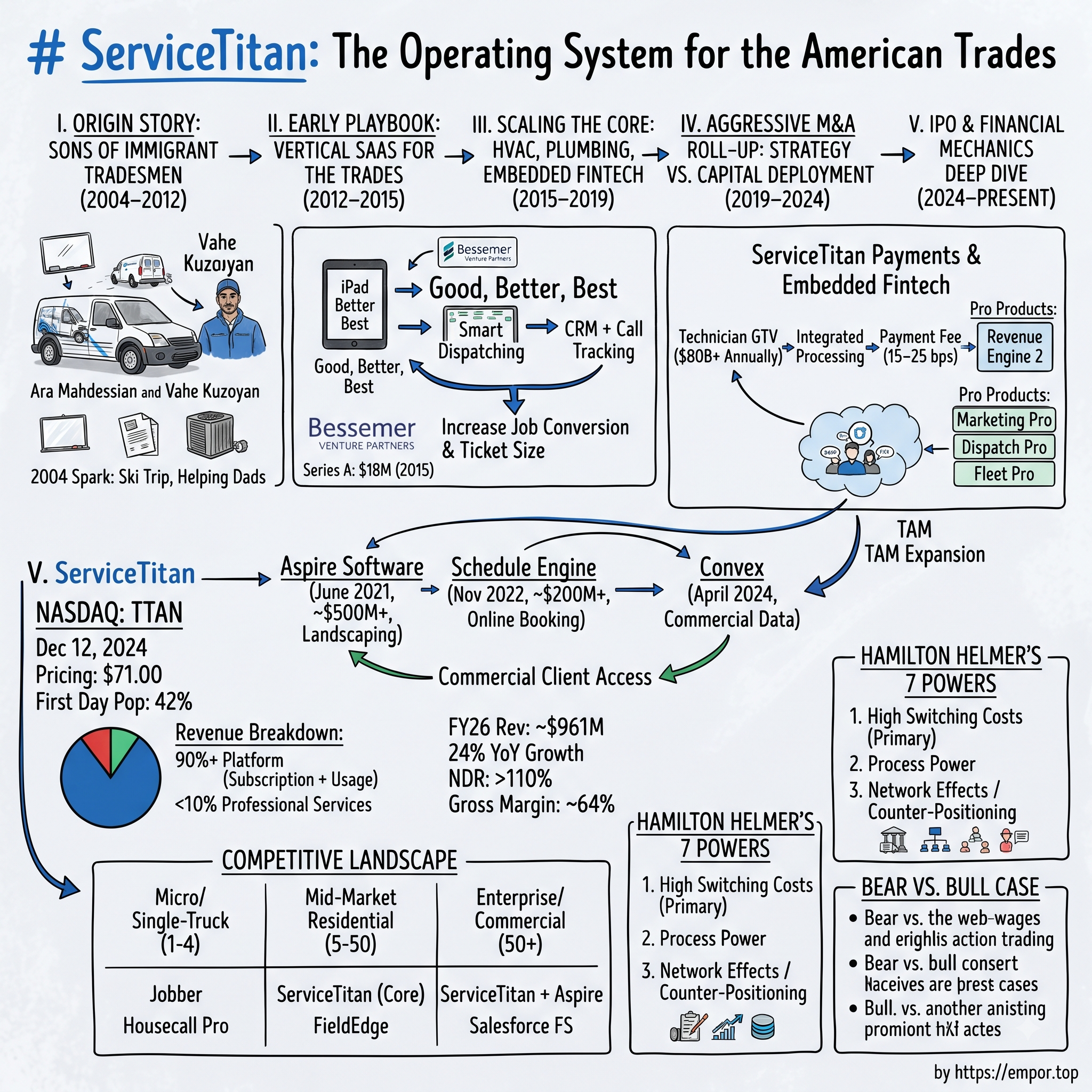
ServiceTitan: The Operating System for the American Trades
I. Introduction & Episode Roadmap
There is a particular sound that defines the American trades economy, and it is not the whir of a drill or the hiss of a refrigerant line. It is the ring of an unanswered phone.
For most of the twentieth century and much of the twenty-first, the typical plumbing or heating-and-air business in the United States operated on a whiteboard, a filing cabinet, and a landline. If a homeowner called at 7:40 p.m. on a Tuesday because their air conditioning failed during a heat wave, and the office manager had departed at five, that job simply evaporated. It went to whichever competitor picked up. The economics of an entire industry — hundreds of thousands of small businesses, millions of tradespeople, and by ServiceTitan's own estimate roughly $1.5 trillion in annual end-customer spending across the United States and Canada — leaked away through missed calls, mispriced jobs, and technicians arriving without the required parts.1
ServiceTitan, Inc. was founded because two sons of Armenian immigrant tradesmen observed that operational leakage at their family kitchen tables and decided to solve it through software.
The company they built has grown into one of the largest pure-play vertical software platforms in North America. In fiscal 2026, which ended January 31, 2026, ServiceTitan generated $961.0 million in revenue, a 24% year-over-year increase, and crossed a $1 billion annualized revenue run rate during its fourth quarter.2 Roughly 10,800 customer accounts — defined by the company as accounts billing more than $10,000 annually, which together represented over 97% of annualized billings — run their operations on the platform.3 Across those accounts, ServiceTitan processed $82.1 billion in Gross Transaction Volume (GTV), its metric for total customer dollars invoiced through the platform.23 Net dollar retention has remained above 110%, while gross dollar retention has stayed above 95% for consecutive years.3
Yet by early August 2026, public markets valued the company at approximately $8.2 billion with its stock trading near $86 — below its December 2024 debut closing price and well off its 2025 peak.4 Over the preceding twelve months, the shares traded between roughly $54 and $120, reflecting notable market volatility despite steady top-line growth.5
This divergence between top-line momentum and market valuation forms the central focus of this analysis.
ServiceTitan offers a clear case study in vertical software strategy: target a fragmented, underserved sector, build domain-specific workflow software, and monetize both software seats and underlying transactional volume. In the trades, ServiceTitan integrated payments and consumer financing into scheduling and dispatch, acquired adjacent verticals, and is now deploying artificial intelligence agents intended to automate operational workflows directly.
Key strategic questions remain. Can a company approaching $1.2 billion in annual revenue sustain 20-plus percent growth as core residential trades mature? Does a business that has accumulated a $1.3 billion deficit as of January 31, 2026, without achieving GAAP profitability, warrant software-multiple valuations given its dependence on stock-based compensation exclusions?3 And does its artificial intelligence initiative represent a expanding competitive moat or an incremental product upgrade?
This analysis traces those questions through several distinct phases: the founding by two students building tools for their parents; the initial product design that turned administrative software into a revenue engine; the embedded financial services layer; the acquisition strategy; the 2024 initial public offering; and an evaluation of the competitive landscape, unit economics, and key metrics for long-term investors.
The story begins on a ski trip.
 Subscribe on LinkedIn
II. Origin Story: Two Sons of Immigrant Tradesmen (2004–2012)
Vahe Kuzoyan was six years old when his family arrived in California from Armenia. His parents spoke no English and had no formal education. His father, Arutyun Kuzoyan, learned the plumbing trade from scratch and eventually opened a small shop in Glendale — a typical operation where the owner acted as lead technician, dispatcher, bookkeeper, and collections department.6
Ara Mahdessian's household ran on a parallel track. His father was a building contractor, and the rhythm of both homes was virtually identical: a full day of field labor gave way to a second shift at the kitchen table late into the night. Writing invoices, chasing payments, and planning the next day's schedule routinely extended the workday past eleven.
The two met at the University of Southern California during a ski trip hosted by the Armenian Student Association. Kuzoyan was a USC student who graduated in 2006 with a double major in neuroscience and computer science after starting in business administration, while Mahdessian attended Stanford University. On that trip, they discovered they had grown up inside parallel family narratives.6
The genesis of the software was practical. After graduating, Kuzoyan agreed to help upgrade the software running his father's plumbing business. Finding commercially available tools outdated, he called Mahdessian with a proposition: if they worked on it together, they could build something better before the summer ended.6
They did not finish before the summer ended, beginning what became a multi-year development effort.
The passenger seat as a research method
What distinguished their initial approach from standard software development was their research method. Instead of designing from a whiteboard, Kuzoyan and Mahdessian spent extended periods riding in the passenger seats of service vans. They stood in kitchens while technicians explained replacement options to homeowners, and observed office managers balancing incoming calls, dispatch boards, and supplier inquiries.
That fieldwork yielded two core operational insights that shaped the product architecture.
First, the critical point of revenue optimization occurs at the home rather than in the back office. When presenting estimates, technicians using traditional paper price books often faced defensive customer reactions. Presenting options on a mobile tablet — with structured pricing tiers, visual aids, and embedded consumer financing — transformed the interaction from a defensive cost discussion into a structured sales presentation.
Second, dispatching represents a multi-variable matching problem rather than a basic scheduling calendar. Assigning technicians solely by geographic proximity yields suboptimal results compared to matching a job with a technician's specific skillset, inventory, and sales conversion track record. Manual dispatchers managing physical whiteboards could not optimize those variables across fleets of dozens of trucks in real time.
The long, quiet decade
The company was incorporated in 2007 as LinxLogic, Inc., a Delaware entity, and did not adopt the ServiceTitan name until 2014.1
The founders operated for seven years before adopting the name that would eventually appear on their public listing, and eight years before raising institutional venture capital. During that period, they developed software for their fathers' businesses and expanded through direct referrals across local contractor networks.
That extended period of low-visibility development enabled the company to encode domain-specific workflows. Trades software requires configuring industry-specific concepts — such as recurring HVAC maintenance memberships, callback tracking, flat-rate pricing catalogs, and billable technician hours — that generic administrative tools do not accommodate.
The central commercial insight from those early years was that contractors did not view software primarily as an administrative tool, but as a vehicle for growth. By demonstrating that the platform could systematically increase average invoice values and job conversion rates, the company reframed software costs from an operational expense into a quantifiable return on investment.
By 2012, the product architecture and revenue model were established. The key strategic challenge shifted to scaling customer acquisition beyond their initial referral networks.
III. The Early Playbook: Unlocking Vertical SaaS for the Trades (2012–2015)
In 2012, the technology stack of a typical residential heating, ventilation, and air conditioning (HVAC) contractor was fragmented and fragile. Accounting often ran on desktop software installed on a single office computer. Field operations relied on legacy, on-premise applications, while technicians carried paper price books in their trucks. Scheduling was tracked on whiteboards, and customer calls on peak summer days routinely went unanswered.
This landscape presented both the opportunity and the core challenge of vertical software: the absence of a dominant incumbent. With no existing budget category to capture or established software rival to displace, ServiceTitan had to define a new product category and persuade capital-conscious trade business owners to adopt cloud software.
The company's initial platform relied on three primary functional mechanisms:
Call tracking and CRM. When a customer called, the software matched the incoming phone number against historical records, instantly displaying past work, installed equipment, warranty statuses, outstanding balances, and the specific marketing campaign that generated the lead. This attribution allowed contractors to trace revenue directly back to individual advertising investments, transforming marketing from an unquantified expense into a measurable input.
Smart dispatching. Rather than relying on a static shared calendar, the platform evaluated operational variables—matching job requirements with technician skills, truck inventory, and geographic location. Because an unsold technician-hour represents non-recoverable revenue while labor costs remain fixed, improving revenue per technician-hour directly expanded operating margins.
The visual price book and mobile presentation. Translating the founders' field observations into software, technicians presented tiered service options—commonly categorized as good, better, and best—on mobile tablets, complete with photos, warranty terms, and integrated consumer financing options. By shifting consumer choice from a binary acceptance decision to a selection among options, structured presentations helped increase average invoice values. While ServiceTitan used these reported ticket lifts as a primary sales pitch, investors should view such figures as customer-reported directional indicators rather than audited metrics.
Bessemer writes the check
By mid-2015, referral momentum had established a track record suitable for institutional underwriting. On June 16, 2015, ServiceTitan announced an $18 million Series A led by Bessemer Venture Partners at a post-money valuation of roughly $100 million, with participation from I2BF Digital, Mucker Capital, and AMENALAV Group.7
Two metrics highlighted the platform's early scale. Customers on the software were processing over $1 billion in annual transactions, and the platform reached more than 1.8 million homes per year across the United States and Canada.7 Eight years after founding, without prior venture funding, the platform processed substantial trade commerce. Byron Deeter, the Bessemer partner who led the investment and joined the board, described ServiceTitan as "the gold standard, rapidly replacing legacy solutions and enabling workers to take advantage of mobile technology."7
Bessemer's investment team evaluated the platform in operating Southern California trade shops rather than relying solely on pitch presentations, validating that the software's commercial value derived from real-time field utility.
The mid-market as a deliberate constraint
The go-to-market strategy focused on mid-market contractors operating fleets of roughly five to fifty trucks, deliberately avoiding single-truck operators.
The economic rationale was straightforward. Single-truck sole proprietorships exhibit higher churn rates due to business failure or cost sensitivity in lean months. Attracting small operators requires self-serve onboarding and low pricing, limiting high-touch sales and implementation support. Conversely, mid-sized contractors operating fleets of 15 trucks maintain dedicated administrative staff, formal payrolls, and marketing budgets. Their operational complexity justifies five-figure annual contract values, while migrating customer histories and workflow records to the platform creates high switching costs.
Distribution relied heavily on trade institutions, including contractor buying groups and best-practice industry associations where business owners shared operational benchmarks. ServiceTitan continues to acquire customers through digital marketing, outbound direct marketing, "significant word-of-mouth referrals," and partnerships with industry associations, original-equipment manufacturers, and distributors.3 For mid-market trade executives, peer recommendations within industry networks proved far more persuasive than conventional advertising.
By 2015, ServiceTitan had established product-market fit, a structured sales process, and institutional venture backing. However, its monetization rested entirely on core software subscriptions. Expanding revenue further would require capturing a share of the transaction flow already moving across its platform.
IV. Scaling the Core: HVAC, Plumbing, and Embedded Fintech (2015–2019)
As ServiceTitan expanded across residential trades, management identified a strategic gap in its operational workflow.
While the software generated the invoice, guided field technicians through tiered options on mobile tablets, and established final pricing at the kitchen table, it stepped aside at the precise moment of payment settlement. Homeowners handed over credit cards, technicians processed transactions on third-party terminals, and independent payment vendors captured processing fees on transactions originated inside ServiceTitan's workflow. Billions of dollars in annual home-services spending were flowing through the platform without yielding transactional revenue for the company.
The mechanics of embedded payments, in plain terms
When a homeowner pays a contractor by credit card, the merchant pays a processing fee typically ranging from 2% to 3%. The majority of this fee covers interchange rates set by card issuers and network processing costs, leaving the merchant-services vendor to capture the remaining processing margin. Historically, trade contractors purchased payment processing independently from separate merchant-services vendors.
ServiceTitan integrated payment acceptance directly into its mobile platform. By allowing technicians to accept payments on the same tablet used to present estimate tiers, transactions automatically reconciled against open invoices and synchronized directly with back-office accounting software. This eliminated manual reconciliation work for office managers who previously matched merchant terminal batches to individual invoices.
Structural considerations distinguish ServiceTitan's model from direct payment processing. The company's fiscal 2026 annual report notes that ServiceTitan does "not process any payments for [its] customers' end customers," but instead maintains "complex relationships with third-party processors" where it earns revenue through referral agreements and by acting as an independent sales organization, or ISO.3 Under this structure, the underlying payment processing contract remains between the contractor and the processor, while ServiceTitan earns a fee for originating and embedding the transaction within its platform software.
This architecture offers distinct operational advantages alongside specific counterparty risks. By avoiding direct settlement, ServiceTitan carries no credit or settlement balance-sheet risk from card processing. However, as disclosed in its regulatory risk filings, if a processing partner terminates an agreement, refuses renewal on commercially reasonable terms, or suffers operational disruptions, ServiceTitan would be forced to secure alternative partners, potentially on less favorable economic terms.3 Its financial model relies on external processing infrastructure outside its direct control.
Why the take rate is small and still enormous
The revenue ServiceTitan earns on each payment dollar represents a fraction of a percent of the total invoice value. However, applied across the platform's expanding transaction base, that modest take rate yields substantial scale. In its initial public offering prospectus, the company disclosed that it captured approximately 1% of its customers' Gross Transaction Volume as overall revenue across all software and services, with the management team anticipating that broader adoption of its add-on products could expand that overall monetization rate toward roughly 2%.1
This disclosure highlighted a fundamental evolution in ServiceTitan's business model. Rather than relying solely on fixed software subscription fees per user seat, the company monetizes the overall economic throughput of the trades sector, utilizing its core enterprise software as the gateway to capture transactional revenue. Under this structure, revenue growth depends on three distinct drivers: acquiring new contractor accounts, expanding product adoption per account, and capturing organic revenue growth from client businesses as customer job volumes expand.
Conversely, this transactional model exposes ServiceTitan to broader macroeconomic cycles within the home-services industry. If elevated interest rates or economic pressures prompt homeowners to delay major capital outlays — such as a $14,000 HVAC system replacement — client transaction volumes moderate, directly weighing on ServiceTitan's usage-based revenue. Embedded financial services provide amplified revenue potential during periods of strong consumer spending, while introducing sensitivity to underlying demand cycles in the home-services economy.
Pro products: monetizing the same customer again
In tandem with embedded payments, ServiceTitan developed a portfolio of specialized add-on modules — categorized internally as "Pro" products — sold to existing platform customers. Marketing Pro automates targeted promotional campaigns based on platform data, such as equipment age and service agreement schedules. Dispatch Pro applies algorithmic matching to optimize technician assignment, while Fleet Pro integrates vehicle telematics into dispatch tracking. Additionally, Scheduling Pro and Contact Center Pro address customer intake efficiency by optimizing call handling and appointment scheduling.
The strategic rationale reflects an outcome-driven expansion model. Each Pro module is sold against specific operational benchmarks rather than general software features. To systematically drive expansion, ServiceTitan developed TitanAdvisor, an internal scoring engine utilized by sales teams to analyze customer platform usage and recommend relevant add-on modules.3 This data-driven sales approach targets an established customer base that has already verified the platform's financial return.
This expansion strategy underpins net dollar retention rates exceeding 110% annually. This metric demonstrates that existing accounts generate increasing revenue year over year through a combination of seat expansion, payment adoption, and supplemental module subscriptions. In vertical software, consistent account expansion of this magnitude signals deep integration into core operational workflows.
The capital that funded it
To support product development and market expansion, ServiceTitan accelerated its private equity capital raises. By June 2021, the company closed a $200 million Series G funding round led by Thoma Bravo at a $9.5 billion valuation, supported by an investor base including Sequoia Capital, Tiger Global Management, Index Ventures, Dragoneer Investment Group, T. Rowe Price, Battery Ventures, Bessemer Venture Partners, and ICONIQ Capital. At the time of the round, ServiceTitan reported approximately $250 million in annual recurring revenue, reflecting 50% year-over-year growth, alongside more than $20 billion in annualized customer transaction volume.8
This combination of 50% top-line growth, a $9.5 billion valuation, and favorable market conditions provided substantial capital for expansion. Armed with extensive funding and facing high growth expectations, ServiceTitan prepared to transition to its next phase of expansion through strategic acquisitions.
V. The Aggressive M&A Roll-Up: Strategy vs. Capital Deployment (2019–2024)
Every vertical software platform eventually reaches a strategic juncture where core market expansion slows. Growth becomes governed by the pace of digital adoption within that vertical and the degree to which existing accounts can be expanded. To sustain high growth rates, platforms must either build internal solutions for adjacent markets or acquire outside platforms. Between 2021 and 2024, ServiceTitan relied heavily on acquisitions.
The shopping list
The company accelerated its dealmaking in 2021 and 2022. In January 2022, ServiceTitan announced the acquisition of FieldRoutes, a cloud and mobile platform serving pest control and lawn care — a vertical built around recurring, route-based services rather than emergency residential repairs.9
Six months earlier, on June 30, 2021, ServiceTitan announced its largest acquisition to that point: Aspire Software, a St. Louis–based platform for commercial landscaping. Aspire brought approximately 50,000 users across landscaping, snow and ice management, and construction, representing roughly $4 billion in annualized transaction volume. Although financial terms were not disclosed, contemporaneous reporting placed the purchase price in the hundreds of millions of dollars.8
Strategic rationale for the Aspire transaction centered on contract structure rather than service category. While residential HVAC operations are transactional and subject to seasonal weather fluctuations, commercial landscaping relies primarily on multi-year maintenance contracts with property managers. Acquiring Aspire diversified ServiceTitan's revenue base, adding a predictable, contracted commercial revenue stream alongside its consumer-driven residential exposure.
In June 2022, ServiceTitan announced the acquisition of Schedule Engine, an online booking and live scheduling platform that integrated automated messaging and remote video diagnostics into contractor customer intake. Financial terms were not disclosed.10 While the acquisition was announced in June 2022, the transaction closed in ServiceTitan's fiscal third quarter of 2023.110 The software integrated homeowner booking requests directly into dispatch workflows, reducing missed lead opportunities.
On April 2, 2024, ServiceTitan acquired Convex, a sales and marketing intelligence platform designed for commercial service contractors. Convex provided property intelligence, sales engagement tools, and customer relationship management to help commercial contractors target prospective buildings within a geographic territory. Terms of the transaction were not disclosed, and Convex co-founders Charlie Warren and Blake Meulmester remained to lead the business unit.11
Acquisition activity continued after the public listing. At its Pantheon customer conference in September 2025, ServiceTitan announced a definitive agreement to acquire Conduit Tech, an HVAC design platform that uses LiDAR scanning to generate permit-ready load calculations. The deal expanded the platform's utility further upstream into system design and proposal generation.12
The capital allocation audit
Evaluating the financial impact of this acquisition strategy requires examining balance sheet composition, as ServiceTitan did not publicly disclose individual transaction prices. As of January 31, 2026, goodwill reached $860.3 million and net intangible assets totaled $176.7 million, out of $1.745 billion in total assets.3 Consequently, acquired intangible assets and goodwill represented roughly 60% of the company's total asset base.
Because several major transactions closed near the peak of software valuations in 2021 and 2022, investors have closely scrutinized the potential risk of overpayment. To date, balance sheet data provides no indication of asset write-downs. Goodwill rose modestly from $845.8 million in fiscal 2025 to $860.3 million in fiscal 2026 due entirely to new business combinations, and the company recorded no goodwill impairments across fiscal 2024, 2025, or 2026.3 The absence of impairment charges indicates that management and external auditors concluded the carrying value of acquired businesses remained supported by operational performance.
However, impairment testing relies on management estimates, and ServiceTitan explicitly identifies the fair value of assets acquired in business combinations as a policy requiring significant estimation.1 Furthermore, accounting impairment testing does not measure economic return on capital. Because acquisitions were funded significantly through equity issued when private valuations exceeded subsequent public market levels, existing shareholders experienced dilution that standard impairment metrics do not capture.
Commercially, integration indicators remain positive. Net dollar retention remained above 110% throughout the integration period, indicating steady expansion within customer accounts and cross-selling across acquired product lines.3 Furthermore, low-margin professional services and other revenue did not expand as a share of total sales, accounting for $35.5 million of ServiceTitan's $961.0 million in total revenue for fiscal 2026 — representing less than 4% of total top-line revenue.2 This controlled cost structure helped protect overall gross margins during the acquisition roll-up.
The broader strategic question remains whether this aggressive capital deployment yielded superior returns compared to organic product development. As top-line growth moderates, the long-term return on invested capital across these acquired assets will remain a core focus for public markets.
By late 2024, capital allocation debates were superseded by a pivotal corporate milestone: ServiceTitan's transition to the public markets.
VI. The IPO & Financial Mechanics Deep Dive (2024–Present)
Most IPO stories are about opportunity. This one was partly about a clock.
The ratchet
In November 2022, with public software multiples in free fall, ServiceTitan raised a $365 million Series H led by ICONIQ with participation from Bessemer and Coatue. To complete the round in a challenging funding environment, the company agreed to a structure that would later become a case study in late-stage financing risk: a compounding IPO ratchet.13
In plain terms, the investors received downside protection. If ServiceTitan eventually went public at a share price below what they had paid, they would receive additional shares to make them whole, diluting existing shareholders. The compounding mechanism added time pressure: if the company did not complete its initial public listing within eighteen months — by May 22, 2024 — the threshold price the IPO had to clear began ratcheting upward each quarter at an 11% annualized rate.13
That deadline passed, and the threshold continued climbing. By late 2024, the original hurdle of roughly $84.57 per share had compounded to nearly $90, on a business whose secondary-market valuation sat well below that mark.13 The longer ServiceTitan delayed its debut, the more expensive waiting became — turning a protective financing concession into an urgent countdown.
The prospectus details how the structure was resolved. ServiceTitan priced its IPO at $71.00 per share, below the conversion prices for the Series F ($105.0878), Series G ($115.7635), and Series H-1 ($84.5712) preferred shares. This triggered downward conversion-price adjustments across all three series, along with a separate adjustment for the Series H.1 Those adjustments were recorded as deemed dividends and converted into additional common shares. Consequently, early equity holders paid for that 2022 funding round twice: first through the initial equity sold, and subsequently through ratchet dilution at listing.
The episode offers a broader lesson in corporate finance: protective terms that preserve headline valuations represent a loan against the future capitalization table, which eventually comes due.
Listing day
On December 11, 2024, ServiceTitan priced 8.8 million shares of Class A common stock at $71.00 per share — above its raised marketing range — with a 30-day option for underwriters to purchase up to 1.32 million additional shares. Goldman Sachs and Morgan Stanley led the underwriting syndicate, and trading opened the following day on the Nasdaq Global Select Market under the ticker TTAN.14
The stock opened at $101.00 and closed at $101.00, a 42% first-day gain that valued the company at approximately $8.9 billion.15 Aggregate proceeds, net of underwriting discounts and offering expenses, totaled $674.1 million.1
A substantial first-day price increase is often framed as a clear success. Evaluated neutrally, however, the pricing implies the shares were listed roughly 30% below immediate market demand, transferring value from the issuing company to initial share recipients. In a software listing environment that had remained constrained for two years, ServiceTitan and its underwriters prioritized transaction certainty over maximum pricing. Given the compounding ratchet deadline, that tradeoff was logical, but it remained a calculated compromise.
How the money actually works
Fiscal 2026 provides a complete picture of the company's financial architecture.
Revenue is divided into two primary categories. Platform revenue reached $925.4 million, up 25% year-over-year, representing the core business.2 Within platform revenue, subscription fees generated $712.3 million, scaling with customer technician counts and module adoption. Usage revenue contributed $213.1 million, capturing transactional throughput across payments, consumer financing referrals, and communications volume. Professional services and other revenue totaled $35.5 million, covering onboarding and data migration — services delivered at low or negative margins because accurate historical data migration is essential for long-term customer retention.2
In the fourth quarter of fiscal 2026, usage revenue expanded by 29% year-over-year compared to 24% for subscription revenue, demonstrating operational momentum in the platform's transactional layer.16
Gross margin performance also reflects ongoing structural shifts. In fiscal 2026, ServiceTitan recorded a GAAP gross margin of 70.1% and a non-GAAP gross margin of 74.0%, exceeding earlier market estimates of roughly 64% that were based on historical revenue mix.2 By the first quarter of fiscal 2027, GAAP gross margin rose to 72.1% and non-GAAP gross margin reached 75.3%, driven by a platform gross margin of 81.3%.1617 These figures show that higher-margin subscription growth and operating leverage in professional services are outpacing lower-margin payment processing costs.
Profitability metrics display a wide divergence between accounting frameworks. On a GAAP basis, fiscal 2026 resulted in an operating loss of $169.2 million and a net loss of $159.9 million.2 On a non-GAAP basis — which excludes stock-based compensation and acquisition-related amortization — the company reported operating income of $94.1 million (a 9.8% operating margin) and net income of $101.7 million.2
The $263 million bridge between GAAP and non-GAAP results consists primarily of stock-based compensation, which reached $197.1 million in fiscal 2026 compared to $163.7 million in fiscal 2025.18 Because equity compensation dilutes existing shareholders rather than consuming cash balance, non-GAAP metrics reflect operational cash flow potential but obscure real shareholder economic costs.
Cash generation showed marked improvement. In fiscal 2026, operating cash flow reached $110.1 million and free cash flow rose to $85.1 million, compared to $15.5 million in free cash flow the prior year.219 The company ended the fiscal year with $428.8 million in cash and cash equivalents and no long-term debt.2
For the first quarter of fiscal 2027, reported on June 4, 2026, revenue increased 25% year-over-year to $268.8 million, while Gross Transaction Volume grew 23% to $21.7 billion — a figure management noted included approximately 300 basis points of growth from an additional business day and favorable weather conditions. Non-GAAP operating income rose to $40.8 million, representing a 15.2% operating margin (up 770 basis points year-over-year), while the GAAP operating loss narrowed to $25.8 million.1617 Free cash flow was negative $9.6 million, improving from negative $22.3 million in the prior-year period due to typical first-quarter seasonality.17
Management credibility, tested against its own record
Evaluating management performance requires comparing initial operational guidance against reported results.
In March 2025, ServiceTitan issued full-year fiscal 2026 guidance projecting revenue between $895 million and $905 million, and non-GAAP operating income between $48 million and $53 million.19 Actual results came in at $961.0 million in revenue and $94.1 million in non-GAAP operating income — beating top-line guidance by roughly $60 million and nearly doubling initial profit targets.2
Management initially guided fiscal 2027 revenue to $1.11–1.12 billion and non-GAAP operating income to $128–133 million, before raising full-year targets after the first quarter to $1.13–1.14 billion in revenue and $142–147 million in non-GAAP operating income.217 This pattern reflects a conservative approach to initial financial guidance followed by upward adjustments as operational visibility improves.
Management also demonstrated discipline regarding margin expectations. On the fiscal 2026 fourth-quarter earnings call, executives noted that the year's 36% incremental operating margin exceeded their 25% long-term target due to strong usage revenue performance and delayed hiring schedules. Rather than raising ongoing margin targets, management reiterated its 25% target for fiscal 2027, explicitly attributing the outperformance in part to expense timing.20
Conversely, management has made significant performance claims regarding new product offerings. On earnings calls, executives stated that customers adopting the company's Max program are expected to roughly double their monthly subscription spend once fully ramped, citing an example of a residential plumbing customer whose EBITDA margin expanded from 18% to 30% while administrative headcount decreased from seven employees to two.20 Because these metrics originate from self-selected customer pilot cohorts without independent auditing, their broader applicability remains to be established.
The AI chapter, and what is actually being claimed
At its Pantheon customer conference in September 2025, ServiceTitan introduced two key product initiatives. Atlas is an integrated artificial intelligence assistant designed to execute plain-English operational commands — such as generating reports, searching jobs, and dispatching technicians — while autonomously adjusting marketing expenditures based on schedule availability. Executive leadership confirmed Atlas incorporates external large language models, including Google's Gemini. The second initiative, Max, packages the company's Pro add-on suite with structured onboarding support to accelerate customer adoption of automation tools.12
Management maintains that Max is an integrated solution rather than a simple product bundle. On the first-quarter fiscal 2027 earnings call, Chief Financial Officer Dave Sherry characterized Max as providing incremental workflow capabilities, while Chief Executive Officer Ara Mahdessian detailed roughly 25 distinct autonomous software capabilities active on the platform.16 Reported early pilot results included customer automation rates exceeding 10% of total jobs, alongside a featured HVAC customer reporting a 16-point increase in call booking rates, a 9-point increase in conversion rates, a 30%+ increase in average ticket size, and a 50%+ rise in revenue per technician.16
Management's rollout strategy presents two contrasting operational signals.
On the positive side, President Vahe Kuzoyan stated during the first-quarter call that customer demand for Max exceeded onboarding capacity, leading the company to deliberately restrict deployment speed to protect service quality.16 Active customer locations on Max doubled during the quarter, with management planning a further doubling in subsequent quarters.16 Controlled product distribution indicates a focus on implementation quality over immediate volume.
At the same time, restricting early deployment to managed implementations means published metrics reflect a select customer cohort. As a result, current data contains inherent selection bias, and the long-term economic impact of Max across a broader, unselected customer base remains unverified.
To strengthen technical execution, ServiceTitan appointed Abhishek Mathur as Chief Technology and Product Officer in March 2026. Mathur previously served as Senior Vice President of Software Engineering at Figma leading AI research and infrastructure, following roles at Meta and Microsoft.21
Who controls the company
ServiceTitan's corporate governance features a multi-class share structure: Class A common stock carries one vote per share, Class B carries ten votes per share, and Class C carries no voting rights. All Class B shares are held by co-founders Vahe Kuzoyan and Ara Mahdessian and their affiliates. As of January 31, 2026, the co-founders controlled approximately 61% of total voting power, a concentration that may increase as unvested equity awards vest.3
This voting control is reinforced by an autumn 2024 grant of 6,483,088 Class B performance-based restricted stock units to the co-founders, which vest upon continued service and the achievement of specified stock-price thresholds.1
For public investors, concentrated voting control represents a clear structural tradeoff. High founder control allows leadership to pursue long-term initiatives — such as deliberate product pacing or sustained research investments — without immediate quarterly public market pressure. However, it also eliminates standard shareholder governance mechanisms, leaving public investors with no direct means to force strategic changes. Consequently, investment in ServiceTitan relies heavily on confidence in the founders' operational execution.
The long-term outlook ultimately depends on how effectively that leadership navigates evolving competitive and macroeconomic market dynamics.
VII. Industry Structure & Competitive Landscape
Walk the exhibit hall of any major trade conference and the competitive landscape divides clearly. Booths at one end sell basic software to single-truck operators; booths in the middle cater to regional businesses operating fleets of forty vans; and enterprise vendors in a separate hall sell to facilities-management departments at national commercial chains. Rather than representing a single market, these segments constitute three distinct operational tiers that share common industry terminology.
The size of the prize, and how to read it
ServiceTitan's initial public offering prospectus provided an unusually granular breakdown of its addressable market opportunity. End customers spend approximately $1.5 trillion annually on trade services across the United States and Canada. The company defined its serviceable addressable footprint at roughly $650 billion of that total, covering both new construction and service maintenance across targeted trades. Applying management's estimate that full adoption of its product suite could capture roughly 2% of customer Gross Transaction Volume as revenue yields a serviceable market opportunity of approximately $13 billion.1
Against that $13 billion addressable market, ServiceTitan's fiscal 2026 revenue of $961.0 million represents a penetration rate in the mid-single digits, leaving substantial headroom under its own market framework.
Two important caveats frame that market opportunity. First, the 2% potential capture rate represents management's estimate under complete customer adoption of every add-on product, whereas the company's actual blended capture rate in fiscal 2026 stood closer to 1.2% of Gross Transaction Volume. Achieving a 2% take rate requires widespread adoption across optional modules — a level of penetration rarely achieved across large software customer bases. Second, the prospectus explicitly noted that ServiceTitan excludes major segments from its addressable market definition: the company does not address all trade verticals, avoids heavy commercial and civil construction, and does not focus on down-market businesses with five or fewer employees.1 The $650 billion figure reflects a deliberately selected target market rather than the total trade economy.
The competitive spectrum
At the lower end of the market, self-serve platforms such as Jobber and Housecall Pro target small operators running small fleets. Customers onboard digitally using credit cards and can cancel with minimal friction, creating a high-volume business model defined by lower average contract values and higher structural churn.
ServiceTitan's decision to forgo smaller operators represents a deliberate strategic choice. Mid-market contractors generate sufficient annual contract value to support high-touch sales outreach and multi-week implementation programs, resulting in stronger customer retention once deployed. However, this strategy creates a top-of-funnel trade-off: growing contractors may standardize on lower-end platforms before reaching mid-market scale, while those down-market competitors actively enhance their software to expand upmarket toward ServiceTitan's core customer base.
In adjacent trades and mid-market categories, specialized and legacy providers maintain established footprints, including FieldEdge, ServiceTrade, WorkWave, AccuLynx, JobNimbus, and BuildOps. ServiceTitan cited these vendors alongside Salesforce, SAP, Housecall Pro, and Jobber in its regulatory filings as competitors offering "point-specific tools," horizontal solutions, "legacy on-premise field service management applications," and "narrow bundled solutions for down-market trades businesses."3 While several of these specialized vendors retain strong regional or vertical market positions, they generally lack ServiceTitan's unified architecture spanning dispatch workflows, mobile point-of-sale capabilities, and integrated financial services.
At the enterprise level, horizontal software providers such as Salesforce Field Service and Microsoft Dynamics 365 offer broad customization capabilities. However, extensive platform flexibility often introduces deployment complexity, requiring third-party system integrators, multi-year implementations, and substantial consulting expenses. Trade contractors typically favor vertical software pre-configured for domain-specific workflows — such as flat-rate pricing catalogs, recurring maintenance memberships, and warranty claims — over general-purpose platforms that require custom engineering.
Horizontal providers compete more effectively in large enterprise environments, such as multi-site commercial contracts, national facilities-management programs, and direct integrations with corporate enterprise resource planning systems. ServiceTitan's acquisitions of Aspire and Convex were designed specifically to expand its reach into these commercial sectors, where its operational advantages are still being established against entrenched enterprise software vendors.
The genuinely new threat
A novel competitive challenge has emerged from rapid developments in artificial intelligence, which ServiceTitan explicitly highlighted in its regulatory risk disclosures. The company warned of potential "competition from non-specialist solutions relying on generic LLMs, GenAI and general-purpose agents," and specifically of "software created using natural language prompts and GenAI (referred to as vibe coding)."3
This disclosure underlines a potential shift in software development economics. Historically, technical complexity and high capital requirements created significant barriers to entry in vertical trade software. If generative artificial intelligence tools drastically lower the cost of assembling functional scheduling and invoicing applications, those traditional entry barriers diminish. ServiceTitan's filings acknowledged that new market entrants emphasizing "fast and automated implementation" may offer functional software that small businesses find sufficient — especially if those customers trade advanced features for speed of deployment.3
Management's counterargument on earnings calls emphasizes that the company's competitive moat derives from accumulated operational data and end-to-end workflow orchestration rather than raw application code, citing more than $80 billion in annual transaction volume moving through an integrated platform that connects marketing lead generation to scheduling, dispatch, invoicing, and payment settlement in a way point solutions cannot replicate.20 That orchestration defense carries weight in mid-market and enterprise environments where operational workflows are complex. It offers less insulation at the lower end of the market, where smaller operators require less workflow integration and low-cost AI-generated tools may prove sufficient much sooner.
Generative artificial intelligence thus presents a dual dynamic for ServiceTitan — enabling the company to develop high-margin automated features for its existing customer base while simultaneously lowering capital barriers for competitors seeking to attack its lower flank.
The company's structural advantages are best examined through more formal lenses.
VIII. Hamilton Helmer's 7 Powers & Porter's 5 Forces
Frameworks are only useful when they force a verdict. Applied objectively, they produce a far more nuanced picture of ServiceTitan's competitive moat than promotional narratives suggest.
Switching costs: the primary and best-evidenced power
Of Hamilton Helmer's seven business powers, high switching costs represent the single strategic advantage ServiceTitan unambiguously controls, supported by behavioral data rather than executive claims.
For an established contractor, the platform contains the core operating assets of the business: a comprehensive customer database spanning decade-long service histories, records of installed equipment and warranty statuses, active maintenance contracts with renewal schedules, customized price books, multi-location warehouse and van inventory, payroll integrations, and embedded payment processing infrastructure. Daily technician workflows run through the mobile application, while office staff manage dispatching and billing around the central dashboard.
Migrating off the platform requires exporting that entire operational history, identifying a system capable of ingesting it, retraining field and back-office staff, and operating dual systems in parallel during the transition — all while continuing to handle live customer calls. The true risk of migrating is not administrative inconvenience, but weeks of severe operational disruption during which customer revenue is directly exposed.
That operational lock-in is demonstrated by gross dollar retention exceeding 95% across fiscal 2024, 2025, and 2026.3 Unlike net dollar retention, gross retention excludes expansion upsells, measuring solely the preservation of existing customer revenue. Sustaining gross retention above 95% for three consecutive fiscal years indicates that fewer than 5% of customer revenue dollars churn annually, even within an industry subject to small-business failure rates.
The strategic implication is significant: ServiceTitan's core revenue base faces limited immediate threat from software competitors. Its primary exposure rests instead on the underlying economic health and business survival of its contractor client base.
Process power: real, but eroding as a differentiator
Nearly two decades of domain specialization — encoded into dispatch logic, flat-rate price books, and mobile interfaces designed for field technicians working in tight attic spaces — represents genuine process power. This operational workflow knowledge cannot be acquired quickly and remains difficult for generic software vendors to replicate, validating why the founders' extended period of bootstrapped product development proved so valuable.
However, process power grounded in domain workflow knowledge is precisely the type of advantage that artificial intelligence compresses most rapidly. Competitors previously unable to study trade workflows can increasingly use automated models to synthesize functional approximations. While ServiceTitan's process power remains an operational asset today, its durability as a competitive differentiator has diminished relative to prior years.
Scale economies and cornered resource: partial
In vertical software, scale economies manifest as the ability to spread research and development costs across a broad revenue base. ServiceTitan invests in product development at a scale smaller mid-market competitors cannot equal, employing 3,414 people across the United States, Canada, Armenia, and other locations as of January 31, 2026.3 Its engineering hub in Armenia provides a cost advantage rooted in the founders' heritage, though it also concentrates operational risk in a geopolitically sensitive region — a factor the company explicitly highlights alongside operations in Macedonia and Poland in its regulatory filings.3
The platform's closest approximation of a cornered resource is its proprietary data asset, encompassing historical transaction records and job outcomes across tens of thousands of trade businesses. Whether this dataset yields a lasting competitive advantage depends on whether domain-specific trade data produces superior artificial intelligence performance compared to general-purpose foundation models. While management asserts that proprietary data creates a distinct moat, that claim remains unverified by independent outside testing.
Network effects: weaker than commonly claimed
The popular narrative surrounding ServiceTitan often overstates its network effects. Direct network effects are virtually non-existent: one contractor adopting ServiceTitan does not increase the platform's value to another contractor, as users do not transact with one another and often operate as local market competitors.
What exists instead is an ecosystem effect comprising supplier integrations that allow contractors to view live distributor pricing and generate purchase orders within job workflows, an app marketplace, third-party integrations for payroll and job costing, and a network of certified platform administrators.123 While these ecosystem ties increase customer switching friction, they represent an expansion of switching costs rather than a true network effect. Strategic evaluations should accordingly discount claims that network effects serve as a primary competitive moat.
Porter's five forces
Threat of new entrants: low in the mid-market, rising at the low end. Developing software to manage multi-location inventory, complex payroll, regulatory compliance, and embedded payments for a fleet of fifty trucks requires multi-year capital investment. However, as ServiceTitan acknowledges in its risk factors, generative artificial intelligence and natural-language coding tools are lowering capital barriers for competitors building entry-level tools for smaller contractors.3
Bargaining power of buyers: low individually, but rising through industry consolidation. A mid-market contractor whose entire operational workflow runs on the platform possesses limited pricing leverage during contract renewals, particularly when software costs are framed against measured revenue gains. However, ongoing private equity roll-ups of regional HVAC and plumbing businesses present a structural challenge. ServiceTitan explicitly cautions in its filings that as client businesses consolidate, larger combined entities may leverage their expanded purchasing power to negotiate lower contract rates.3
Bargaining power of suppliers: moderate and concentrated. The platform relies on critical external partnerships, including third-party payment processors whose contractual terms ServiceTitan does not control. Additionally, its core cloud infrastructure runs primarily on Microsoft Azure, where operational outages or service disruptions remain outside the company's direct control.3
Threat of substitutes: low and declining. Paper records, physical whiteboards, and generic spreadsheets remain the primary substitutes across un-digitized trade businesses. The ongoing secular shift toward digital operations steadily reduces the prevalence of legacy manual methods.
Competitive rivalry: high and intensifying. ServiceTitan faces competition from low-end platforms, enterprise field-management suites, private equity-backed vertical software providers, and emerging AI-native startups. Management asserts that the company maintains its position through platform breadth, domain expertise, mobile field tools, and trade-specific artificial intelligence models.3 That competitive thesis remains compelling in core mid-market trades, though it faces stronger pressure at the market's lower and upper boundaries.
A rigorous analysis yields a clear verdict: ServiceTitan possesses one formidable, empirically demonstrated power in switching costs, a genuine but decaying advantage in process knowledge, and secondary moat elements that are more modest than promotional narratives suggest. These structural dynamics form the baseline for evaluating the company's long-term financial performance and valuation.
IX. Strategic Position, Skeptical Stress Test & Current Risk Radar
Imagine a portfolio manager who has just reviewed the fiscal 2026 results and sees a company beating its own guidance, expanding operating margins, and generating free cash — yet trading below its first-day closing price nearly twenty months after listing. The obvious question is what the public market perceives that the operational results do not show. Evaluating the short thesis requires examining where financial optics diverge from underlying reality.
Myth versus reality
The myth: ServiceTitan is profitable. The reality is that the business is non-GAAP profitable while remaining GAAP loss-making, with an accumulated deficit of $1.3 billion and explicit disclosures in its annual report that management expects operating expenses to increase and GAAP losses to continue.3 Stock-based compensation of $197.1 million in fiscal 2026 represents the primary gap between those two financial views, creating a real economic cost to existing equity holders through share dilution.18 The notable mitigating factor is that free cash flow reached positive $85.1 million in real cash generation.2
The myth: growth is decelerating toward maturity. The reality is more nuanced. Top-line revenue expanded 26% in fiscal 2025, 24% in fiscal 2026, and 25% in the first quarter of fiscal 2027.21917 That represents steady expansion for a platform generating nearly $1 billion in annual revenue. Reacceleration in the latest quarter was driven by commercial expansion, Pro add-on adoption, and early contributions from the Max suite.16 However, management noted that roughly 300 basis points of that quarter's Gross Transaction Volume growth stemmed from an extra business day and favorable weather conditions — a useful reminder that quarterly transactional throughput remains subject to short-term noise.16
The myth: the AI initiative is defensive repackaging. The reality is that the long-term impact remains unverified, largely because the company has structured early deployment in a way that complicates independent evaluation. Performance metrics for the Max suite originate from a deliberately restricted customer cohort. While controlled onboarding reflects sound product implementation, it also filters the performance evidence available to investors.
The three questions an activist would ask
First, on growth arithmetic. Approaching $1.2 billion in revenue for fiscal 2027, ServiceTitan must generate roughly $230 million in net new annual recurring revenue simply to maintain a 20% growth rate — an absolute dollar target that expands each year. With core residential HVAC and plumbing verticals increasingly penetrated, management points to commercial trade expansion as the key growth engine: enterprise customer accounts billing over $100,000 annually exceeded 2,000 in the most recent quarter, with the enterprise segment representing over 60% of total billings as the fastest-growing part of the business.16 That metric offers a concrete operational response. The counter-argument is that enterprise sales cycles are longer, more competitive, and more concentrated, introducing lumpy revenue timing and tighter pricing leverage.
Second, on the margin ceiling. Blended gross margin in the low seventies sits below the 78% to 85% range typical of best-in-class horizontal software. Structurally, payment processing carries third-party costs and professional implementation requires direct labor. The constructive view points to a platform gross margin of 81.3%, demonstrating that core software workflows deliver high incremental margins as revenue mix shifts.16 The cautious view holds that the payments engine — which expands the total addressable market — imposes a structural cap on blended gross margins. If transaction-based usage grows as a proportion of total revenue, margin expansion could lag overall top-line growth.
Third, on capital allocation and governance. An activist challenge would unlikely focus on operational acquisition failures, given that sustained dollar retention and minimal impairments indicate successful integration. Instead, criticism would target governance accountability: undisclosed purchase prices on key transactions, a balance sheet where goodwill and intangibles account for roughly 60% of total assets, continuing acquisitions such as Conduit Tech executed without disclosed financial terms, and 61% voting control held by two co-founders who cannot be unseated. Public shareholders possess no structural mechanism to force strategic changes, a corporate governance reality that must be priced into the equity.
The current risk radar
Macroeconomic and housing sensitivity represents the primary near-term exposure. Usage-based revenue tracks consumer outlays on home repairs and replacements. Major capital projects — such as a $14,000 HVAC replacement — are frequently financed and deferrable; when consumer borrowing costs rise, homeowners opt for lower-cost repairs over full system replacements, compressing average invoice values. This shift affects ServiceTitan's transaction fees with minimal lag. Seasonal fluctuations add further volatility, as platform volume surges during peak summer months across landscaping, pool maintenance, pest control, HVAC, and roofing.3 Illustrating this weather exposure, management noted that the fourth quarter of fiscal 2026 experienced the third-warmest November-to-January period on record, suppressing residential heating demand before a winter ice storm disrupted technician dispatching in the final week of the period.20
Interchange fees and payment regulation. Any regulatory or card-network change that compresses merchant processing margins reduces the pool from which ServiceTitan derives its referral and ISO fees. The platform must also maintain ongoing PCI DSS compliance and adapt to rules set by external payment networks.3
Implementation and onboarding friction. Multi-week data migration serves as the foundation of ServiceTitan's high switching costs, but it also creates initial customer friction. A contractor undergoing a botched implementation or facing staff resistance to mobile software adoption represents a heightened churn risk during year one. The professional services segment operates at low or negative margins because the company chooses to absorb onboarding expenses rather than risk early customer drop-off.
Artificial intelligence execution and talent costs. Scaling domain-specific AI models requires substantial infrastructure investments and specialized engineering talent. Management has explicitly cautioned that intense market competition for AI talent increases development expenses, and that failing to deploy automated features as effectively or rapidly as competitors could materially harm its market position.3 Financial markets have reflected these cost pressures: following the fiscal 2026 results, several sell-side analysts lowered stock price targets despite top-line beats, citing compressed software valuation multiples and rising capital requirements for AI investment.22
Cybersecurity and data concentration. ServiceTitan maintains sensitive operational records — including payment-adjacent data — for tens of thousands of trade businesses and millions of households. A material security breach would compromise customer trust and imperil the third-party processor agreements supporting its financial services revenue.
Collectively, these operational and structural risks explain why the equity trades at a discount despite beating management guidance. Public markets continue to discount a founder-controlled, GAAP-loss-making business operating in cyclical end-markets while funding a major technology transition. Whether that valuation discount represents an overreaction remains a fundamental question for investors evaluating the long-term vertical software model.
What the business narrative offers, regardless of immediate market valuation, is a set of transferable strategic lessons.
X. Playbook & Key Investing Lessons
Strip away the specifics of plumbing and heating, and ServiceTitan offers a repeatable strategic template. Four primary principles define the model.
Founder-market fit is not a slogan; it is a research advantage that compounds. Ara Mahdessian and Vahe Kuzoyan did not select the trades from a market analysis spreadsheet. They grew up inside the industry's operational friction and re-entered it deliberately — riding in service vans and observing sales conversations at kitchen tables. The practical payoff was solving for the primary economic bottleneck. A generalist software team might have focused on building a better scheduling calendar, as dispatch was the most visible pain point. The founders built a revenue engine because they had observed their fathers lose revenue on job conversion rather than administrative organization. Years of unglamorous domain immersion yielded product workflow insights that capital alone could not shortcut. For investors, the transferable question is not whether founders possess passion for a market, but whether they hold structural information advantages that competitors cannot easily replicate.
Software gets you in the door; throughput monetization scales the business. The most consequential strategic decision in ServiceTitan's history was recognizing that the transactional value processed on its platform exceeded the standalone subscription fee. Controlling daily workflow earns the right to embed financial services at the point of payment. This dynamic represents a central playbook lesson of vertical software, but it carries a structural tradeoff: monetizing an industry's throughput directly ties platform performance to that sector's economic cycle. ServiceTitan's usage-based revenue functions as a leveraged claim on North American home-services activity, and that economic exposure operates symmetrically in market downturns as well as expansions.
Choose your customer segment as a strategic constraint, not a default. Bypassing single-truck operators represented a deliberate choice to accept a smaller addressable customer pool in exchange for higher retention and account durability. That mid-market focus yielded five-figure annual contract values, supported a direct sales force, and sustained gross dollar retention above 95%. The long-term cost of that choice, however, is that down-market competitors secure smaller contractors early and attempt to move upmarket toward ServiceTitan's core base. Target segment selection is not a permanent competitive moat; it is a hypothesis on where sustainable unit economics reside, requiring ongoing evaluation as market dynamics shift.
Capital allocation discipline is era-dependent, and structure has a bill attached. The aggressive acquisition cadence of 2021 matched an era of low capital costs and premium software valuations, while the protective Series H ratchet structure in 2022 allowed the company to raise capital without taking an immediate down round. Both decisions created long-term balance-sheet obligations that materialized upon its December 2024 public listing — acquisitions as substantial goodwill requiring ongoing justification, and ratchet provisions as explicit equity dilution for existing shareholders. Financing structures and aggressive M&A represent deferred costs, requiring management to demonstrate clear economic returns under public-market scrutiny.
A final strategic lesson concerns operational pacing. Prior to raising institutional venture capital, the company spent eight years refining its core product alongside contractor networks, followed by deliberate rollouts of new offerings such as Max to protect onboarding quality over immediate volume expansion. In a software sector often focused on rapid scaling, ServiceTitan's development path has emphasized deliberate execution — an operational style closely aligned with its founder-controlled governance structure.
Whether that long-term focus yields sustained market leadership remains the central question for public investors.
XI. Strategic Outlook, Bull vs. Bear Case & Key KPIs
The bull case
The bull case for ServiceTitan rests on three core propositions, each supported by historical operating data.
First, the company's position in the mid-market trade sector remains well protected. Gross dollar retention above 95% across three consecutive fiscal years, achieved within an industry characterized by high baseline small-business failure rates, provides strong empirical evidence that client contractors rarely leave voluntarily.3 This retention is reinforced by brand equity built over two decades within contractor associations and industry buying groups.
Second, account expansion within the installed base provides substantial growth runway even without acquiring new client accounts. Company estimates indicate that ServiceTitan currently monetizes roughly 1% of customer Gross Transaction Volume, with full adoption of its product suite carrying the potential to expand overall monetization toward 2%.1 Each additional Pro module deployed, each payment dollar processed on-platform, and each consumer financing referral advances that monetization rate. Net dollar retention exceeding 110% confirms ongoing account expansion, while usage revenue outpacing subscription growth in recent quarters demonstrates that the transactional layer continues to compound faster than core software seats.163
Third, artificial intelligence capabilities could shift the core product's pricing model. If the Max automated suite delivers operational gains comparable to early pilot reports — such as improved call booking rates, higher conversion, and increased revenue per technician — the platform transitions from an administrative tool into an automated capacity engine, allowing pricing to reflect operational yield rather than seat count. Management's projection that fully ramped Max customers will roughly double their monthly subscription spend represents a central catalyst for potential valuation re-rating, though it remains an unverified claim based on a managed pilot cohort.20
Commercial expansion reinforces these drivers. The enterprise segment now accounts for over 60% of total billings and represents the company's fastest-growing unit, indicating that strategic acquisitions such as Aspire and Convex have added a viable commercial growth vector.16
The bear case
The bear case does not dispute the quality of ServiceTitan's core software, but focuses instead on valuation multiples and three structural vulnerabilities.
First, usage-based revenue exposes the platform to underlying home-services cyclicality. A significant portion of platform revenue depends on consumer spending for major home repairs and equipment replacements. Elevated interest rates or reduced household borrowing prompt homeowners to defer major replacements in favor of minor repairs, depressing Gross Transaction Volume and usage revenue. Concurrently, constrained contractors slow hiring and reduce van counts, curbing subscription seat growth. This correlated exposure creates broader top-line sensitivity across both usage and subscription lines during economic slowdowns.
Second, GAAP profitability may remain elusive as capital requirements for artificial intelligence expansion escalate. Stock-based compensation reached $197.1 million in fiscal 2026, while developing specialized AI models requires sustained expenditure on talent and cloud infrastructure. Management explicitly expects GAAP operating losses to persist as investments continue.318 If public equity markets prioritize GAAP profitability over non-GAAP metrics, the stock may continue to trade at a valuation discount despite positive free cash flow.
Third, competitive compression threatens both market boundaries. From below, generative AI tools lower entry barriers for low-cost software targeting small contractors, potentially constraining ServiceTitan's future mid-market migration funnel. From above, established horizontal platforms and legacy commercial software vendors actively defend enterprise facilities-management accounts, where ServiceTitan's switching-cost advantages are less established.
Public market trading patterns reflect this ongoing valuation debate. Shares reached an all-time high in May 2025 before declining to an all-time low in May 2026, subsequently recovering to near $86 by August 2026 — with the 50-day moving average sitting above the 200-day moving average, signaling a recent momentum recovery.54 This price volatility over an eighteen-month period highlights that market debate centers primarily on valuation multiples and cycle duration rather than near-term operational execution.
The three things worth watching
While numerous operational metrics are reported quarterly, three indicators offer the clearest view of ServiceTitan's trajectory.
Gross Transaction Volume. GTV serves as the central metric for total platform activity, measuring the total dollar amount invoiced by client contractors.3 It reflects both account acquisition and individual contractor transaction volume. Divergence between GTV growth and customer account expansion provides an early indicator of broader home-services activity before changes manifest across subscription revenue lines. Investors should evaluate GTV trends against management disclosures regarding seasonal weather impact and calendar variations.
Net dollar retention. ServiceTitan discloses net dollar retention as a directional benchmark — consistently above 110% — rather than an exact percentage. This metric serves as the primary gauge for account expansion. Successful adoption of Pro modules and the Max automation suite should sustain or lift retention levels. Conversely, a decline toward the 110% threshold would signal either slowing product upsells or shrinking technician seat counts within client fleets. Because of the threshold reporting format, monitoring GTV growth and total account counts provides essential leading context.
Non-GAAP operating margin and free cash flow conversion. Management maintains a long-term target of 25% incremental operating margins, which the company exceeded in fiscal 2026 in part due to hiring schedules and strong usage revenue.20 The key operational test during the ongoing technology investment cycle is whether operating margins continue expanding while free cash flow remains aligned with adjusted operating profits. Sustained free cash flow generation provides the primary validation of non-GAAP profitability metrics.
Where this leaves the story
ServiceTitan has developed a comprehensive software platform for an industry historically underserved by modern cloud technology, built by founders whose initial product design grew out of direct observation of family trade businesses. High switching costs are evidenced by gross retention metrics exceeding 95%, while the embedded throughput monetization model provides expansion opportunity across customer transaction flows. To date, executive management has maintained a pattern of conservative financial guidance paired with top-line execution.
Balancing those strengths are an ongoing market valuation debate, continuing GAAP net losses, structural sensitivity to broader housing and home-services cycles, and an artificial intelligence rollout whose initial performance metrics stem from a managed customer cohort.
Upcoming quarters will not resolve every long-term valuation question, but they will provide concrete empirical data across platform transaction volumes, account expansion metrics, and cash flow conversion.
References
-
ServiceTitan, Inc. Prospectus (Form 424B4) — U.S. Securities and Exchange Commission, 2024-12-12 ↩↩↩↩↩↩↩↩↩↩↩
-
ServiceTitan Announces Fiscal Fourth Quarter and Full Fiscal Year 2026 Financial Results — StockTitan, 2026-03-12 ↩↩↩↩↩↩↩↩↩↩↩↩↩↩
-
ServiceTitan, Inc. Annual Report (Form 10-K) for Fiscal Year Ended January 31, 2026 — U.S. Securities and Exchange Commission, 2026-03 ↩↩↩↩↩↩↩↩↩↩↩↩↩↩↩↩↩↩↩↩↩↩↩↩↩↩↩↩↩↩↩
-
ServiceTitan (TTAN) News and Market Data — StockTitan, 2026-08 ↩↩
-
ServiceTitan (TTAN) Market Capitalization History — CompaniesMarketCap ↩↩
-
Alumnus' billion-dollar software company for the trade industries is inspired by his blue-collar dad — USC Dornsife College of Letters, Arts and Sciences ↩↩↩
-
ServiceTitan raises $18 million Series A at $100 million valuation from Bessemer Venture Partners — PR Newswire, 2015-06-16 ↩↩↩
-
ServiceTitan acquires Aspire to move into landscaping, raises $200M at a $9.5B valuation — TechCrunch, 2021-06-30 ↩↩
-
ServiceTitan Accelerates Expansion Into Pest Control and Lawn Care with Acquisition of FieldRoutes — PR Newswire, 2022-01-04 ↩
-
ServiceTitan Enhances its Online Booking Technology for the Trades with Acquisition of Schedule Engine — PR Newswire, 2022-06-28 ↩↩
-
ServiceTitan Supercharges Commercial Capabilities with Acquisition of Convex — ServiceTitan, 2024-04-02 ↩
-
ServiceTitan Unveils Major Product Expansions Across AI, Financial Tools, Construction, and CRM at Pantheon 2025 — ServiceTitan, 2025-09 ↩↩↩
-
Here's why ServiceTitan was on the clock to go public — TechCrunch, 2024-11-25 ↩↩↩
-
ServiceTitan Announces Pricing of Initial Public Offering — ServiceTitan, 2024-12-11 ↩
-
ServiceTitan pops 42% in cloud software vendor's Nasdaq debut after selling shares at $71 — CNBC, 2024-12-12 ↩
-
ServiceTitan (TTAN) Q1 2027 Earnings Call Transcript — The Motley Fool, 2026-06-05 ↩↩↩↩↩↩↩↩↩↩↩↩↩
-
ServiceTitan Announces Fiscal First Quarter Financial Results — StockTitan, 2026-06-04 ↩↩↩↩↩
-
ServiceTitan Announces Fiscal Fourth Quarter and Full Fiscal Year 2026 Financial Results (Investor Relations) — ServiceTitan, 2026-03-12 ↩↩↩
-
ServiceTitan Announces Fiscal Fourth Quarter and Full Year Fiscal 2025 Financial Results — ServiceTitan, 2025-03-13 ↩↩↩
-
ServiceTitan (TTAN) Q4 2026 Earnings Call Transcript — The Motley Fool, 2026-03-12 ↩↩↩↩↩↩
-
ServiceTitan Appoints Abhishek Mathur as Chief Technology and Product Officer — ServiceTitan, 2026-03-12 ↩
-
Why Are Analysts Slashing Price Targets for ServiceTitan — Kavout, 2026 ↩
 LinkedIn
 WhatsApp
 Reddit
 Hacker News
 Email
Email Kindle
 RSS Feed
 Spotify
 Apple Podcasts
 Amazon Music
 Audible
 YouTube