The Pennant Group, Inc.: The Care Company Built by Acquisition
The spin-off that made a small operator a public company
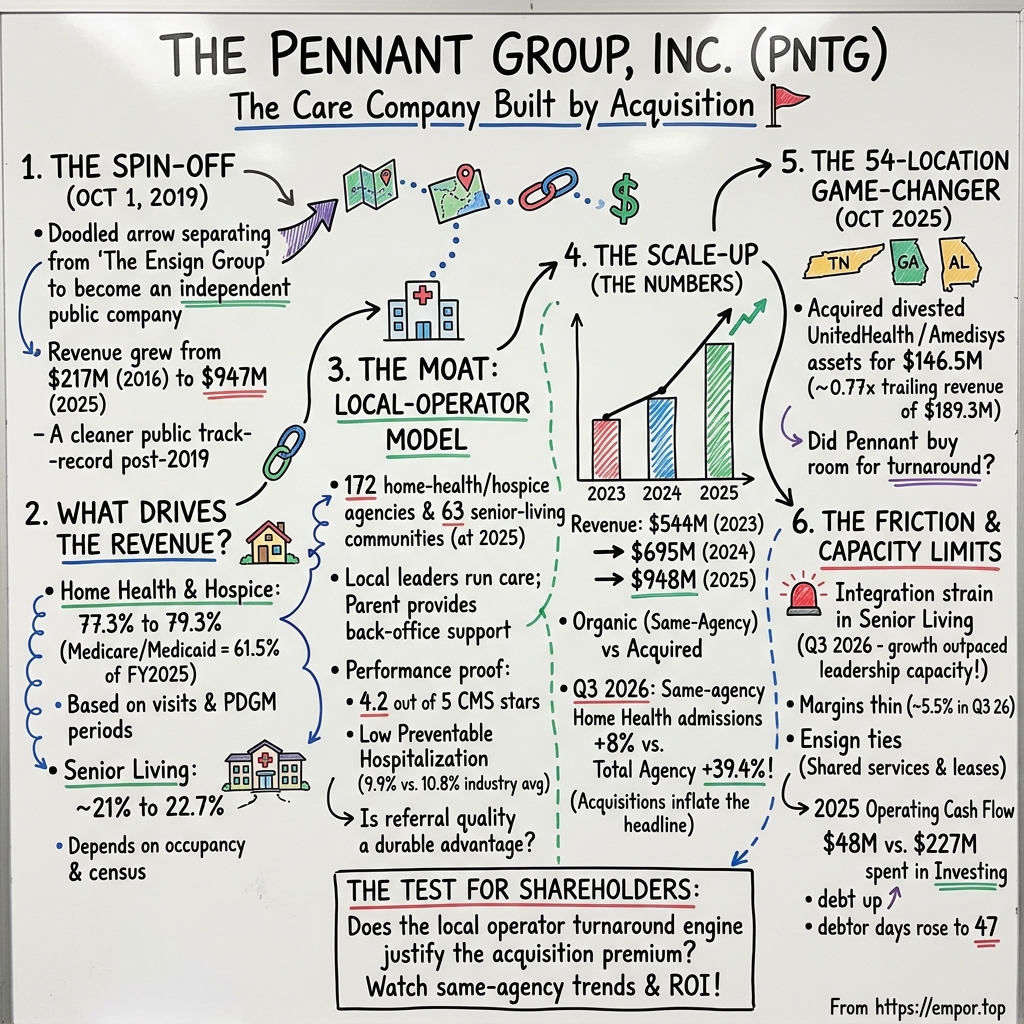
On the morning of October 1, 2019, a company that had never existed on its own woke up as a listed one. The Pennant Group had spent its early life as a set of businesses inside The Ensign Group, the skilled-nursing operator, and that day Ensign handed its home health, hospice and senior-living operations to its own shareholders as a separate stock on NASDAQ.1 There was no roadshow, no IPO pop and no bankers ringing a bell over a new prospectus. Pennant registered on a Form 10 and sent shareholders an information statement, which is how a spin-off reaches the market.2 One day the businesses were a division in someone else's annual report. The next they had their own ticker, PNTG, their own board and their own public scorecard.
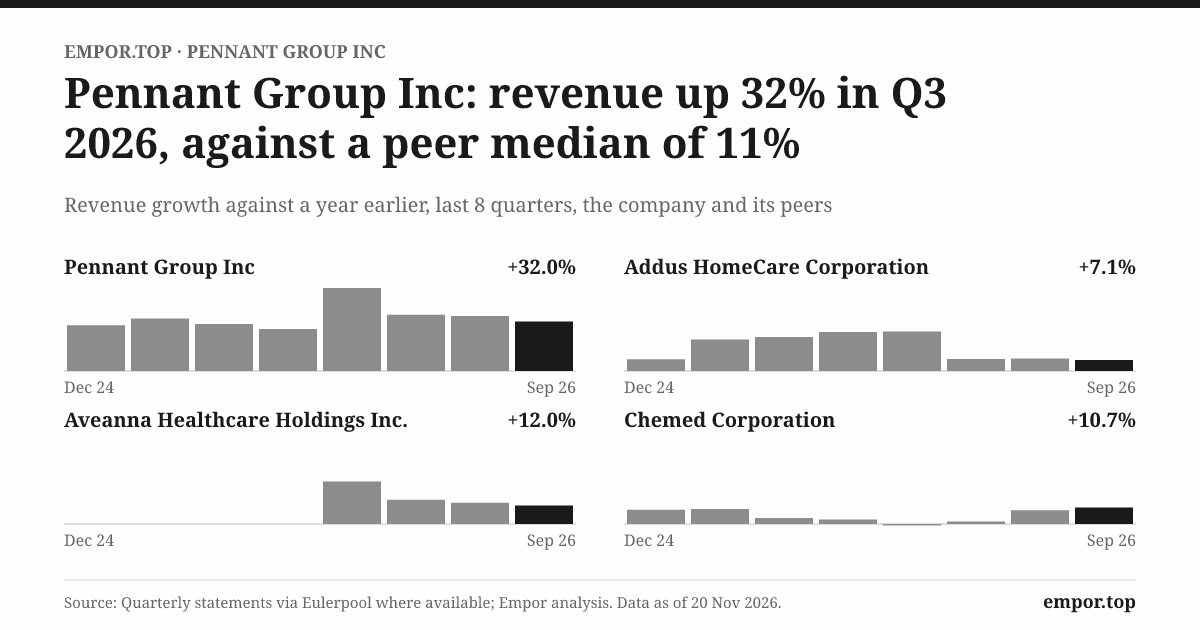
Seven years later that scorecard poses a puzzle. In the quarter to September 2026, Pennant's revenue grew about 32% on the year before, to roughly $302 million.[^4] Few care-services companies of any size grow that fast. But in the same period Pennant was absorbing dozens of newly purchased agencies and communities, so the headline cannot answer the question an owner most needs answered: how much of that growth came from the businesses Pennant already ran, and how much it bought?
That question sits at the front of four that run through this story. The first is whether growth is organic or acquired. The second is whether newly bought operations can be brought up to the margins of the established base, which is the promise every roll-up makes and few keep. The third is whether a company that collects most of its money from government health programs, and spends most of it on nurses, aides and caregivers, can keep both sides of that ledger under control as it gets bigger. The fourth decides the other three: do the returns justify the debt, the leases and the price the market puts on the shares?
Start with what the listed company actually is, because it is less obvious than the ticker suggests. The Pennant Group, Inc. is a holding company. It owns no care operations directly and employs no caregivers. Its independent operating subsidiaries hold the licenses, employ about 9,700 people and deliver the care, and the parent supplies capital, systems and support.3 That is not just legal tidiness. The structure is built to keep accountability local: each agency and each community is meant to be run by its own leader, almost as if it were a small business, with the corporate centre in the background. It is also, as the later chapters show, the structure Pennant uses to absorb acquisitions, so the parent's real product is a way of running other people's former businesses.
The spin-off matters for two more reasons. The first is that it set the reporting boundary. Financial series that run back to 2016 describe businesses that were then inside Ensign, run under Ensign's capital, systems and overhead.2 Revenue grew from about $217 million in 2016 to about $947 million in 2025, but only the stretch from 2019 onwards belongs to Pennant as a public company.3 The earlier years are context, a sketch of the operation before it had to stand alone, not a track record a shareholder could have owned.
The second is that the separation did not cut every cord. Pennant still leases 32 senior-living communities from Ensign subsidiaries, pays Ensign for some shared services, pays room-and-board charges for hospice patients in Ensign facilities, and shares directors with its former parent.3 Those ties are modest in dollars and large in what they say about how the company was born. A spin-off is a divorce in which the two parties often keep living on the same street.
Why separate at all? The usual logic of a spin-off is that two businesses with different economics are worth more apart than together, because each can be judged, financed and managed on its own terms. Skilled nursing, Ensign's core, is a facility business with heavy real-estate exposure and its own reimbursement regime. Home health and hospice are asset-light by comparison: the "facility" is the patient's living room, and the main assets are clinicians and referral relationships. Senior living sits between the two. Inside Ensign, the home-based businesses competed for attention and capital with a much larger nursing portfolio. Outside it, they could raise their own money, set their own acquisition pace and be valued against home-care peers rather than nursing operators.2 The cost of that freedom was that the new company had to carry its own overhead and its own balance sheet, at a much smaller scale than its former parent, and the early public years show how uncomfortable that could be.
They did. In the spin-off year itself, operating margin dropped to under 2%, as the business took on the costs of a standalone public company.3 It recovered in 2020, then slumped again in 2021 to about 1%, before climbing steadily to the mid-5s by 2024.3 For the first few years, in other words, independence looked less like liberation than like a test of whether a small operator could carry its own weight. The leadership change of 2022, when an operator from inside the system took the top job, came in the middle of that test.14
So the story begins with a small operator that had been incubated inside a larger one, handed public capital and told to grow. What it chose to grow into, and how it gets paid for doing so, starts at a hospital discharge desk.
 Subscribe on LinkedIn
Medicare pays for the visit; the local market decides who gets it
Picture the moment that drives almost all of Pennant's revenue. An eighty-year-old woman is about to be discharged after a hip replacement or a bout of heart failure. She is not sick enough to stay in hospital and not well enough to manage alone. Someone, usually a discharge planner, a physician or a family member, has to decide what comes next. She might go home with a nurse and a physical therapist visiting several times a week. If her illness is terminal, she might go into hospice, with a team focused on comfort rather than cure. If living alone is no longer safe, she might move into an assisted-living community. Each of those paths is a Pennant business, and none of them is paid the same way.
Home health and hospice are the core. Together they produced about 77% of Pennant's revenue in 2025, with senior living supplying the other 23% or so.3 The mix has tilted further towards the home since then: in the third quarter of 2026, home health and hospice brought in about $240 million, or roughly four of every five dollars, and senior living about $62 million.[^4] Taken together, Medicare and Medicaid accounted for about 61.5% of 2025 revenue.3 Pennant is therefore mostly a government-paid home-care company with a property-like business attached.
That mix shapes how risk travels through the business. A change in Medicare's home-health or hospice rates reaches roughly four-fifths of the company within a year. A soft local housing market or a new competing community reaches the other fifth. The two halves do not move together, which offers a little diversification, but they share one cost that dominates everything: people.
Home health is the most intricate of the three. Medicare pays for it under a system called the Patient-Driven Groupings Model, or PDGM, which divides care into 30-day periods. Each period carries a payment that depends on the patient's clinical profile, how they came to need care and how sick they are, with adjustments for very short episodes, transfers and other details.3 A useful way to picture it is a fixed-price repair contract. Medicare sets the price for a 30-day job based on the type of patient, and the agency profits if it delivers good outcomes with an efficient pattern of visits. It loses if the visits, the travel and the wages cost more than the fixed fee. Pennant's own levers are admissions, how many patients it takes on, and revenue per episode, which depends on patient mix and on rates it does not set.
Hospice works on a daily rate. Medicare pays a per diem that depends on the level of care, from routine care at home to more intensive levels.3 Its central operating measure is average daily census, the number of patients on service on an average day, multiplied by revenue per patient day. More patients for longer periods, cared for well, produce more revenue, though length of stay in hospice is a sensitive metric that regulators watch closely, because a business paid by the day has an obvious incentive to keep patients enrolled.
Senior living is the odd one out. It runs on residency agreements, so its economics look more like those of a hotel crossed with a care provider: occupancy and revenue per occupied unit drive the line, and the building costs, many of them leases, are there whether the rooms are full or not.3 Residents often pay privately, which makes the business less exposed to Medicare rate-setting but more exposed to local housing markets, competing communities and families' savings.
None of this is subscription revenue. There is no standard contract length, no minimum commitment, no backlog in the software sense.3 A patient discharged from home health generates no further revenue unless a new referral arrives. That is the bargain at the heart of the business. The demographic tailwind is real, because the number of Americans over 75 keeps rising and most would rather be cared for at home. But demographics only fill the top of the funnel. Referrals, staffing, admission decisions, census and occupancy decide how much of that demand becomes Pennant revenue, and at what margin.
The government side of the bargain cuts both ways. Medicare and Medicaid provide an enormous, stable pool of paying demand, and Pennant does not have to chase each patient's ability to pay. But the government is not a customer that negotiates. It writes the payment rules, updates them every year, audits claims, and can recoup payments it decides were improper. At the end of 2025, Medicare and Medicaid made up about 62% of Pennant's gross receivables, so they are not just the main source of revenue but the main source of money owed.3 Pennant's filings show no single customer above 10% of revenue, and the company publishes no top-customer list, because in a business like this the concentration that matters is not a corporate client. It is a federal agency.3
Then there is the competition. There is no single national home-health market in which Pennant holds a share. There are hundreds of local markets, each with its own hospitals, physician groups, referral habits and providers. In some, Pennant faces larger operators such as Amedisys, now part of UnitedHealth's Optum after a merger fight that shapes this story, along with Addus HomeCare and Enhabit.9 In most, it also competes with small independent agencies, nonprofits and hospital-owned services. Comparisons across those companies need care: a national operator backed by UnitedHealth has scale that Pennant cannot match, but scale in Ohio does not help win a referral in Idaho, and what matters to a discharge planner in Boise is whether the nurse shows up and the patient avoids readmission.
A simple piece of arithmetic shows why labor is the variable that matters most. In the third quarter of 2026, Pennant's home-health and hospice cost of services, which is mostly the wages and benefits of clinicians plus their travel and supplies, consumed about 84 cents of every segment revenue dollar.[^4] If those costs rose by just 1% more than revenue in a given year, the segment would lose close to a point of margin, in a company whose operating margin is around five and a half points. Medicare's annual rate updates are set by formula and rarely match local wage inflation in a tight nursing market, so the gap between what the government pays and what a nurse costs is the narrow strip on which the whole business stands. That is also why technology matters more for Pennant's administrative work than for its care. Software that speeds up clinical documentation, coding and scheduling, including the newer generation of AI tools, could take hours out of a clinician's week; it cannot replace the visit itself, so care delivery remains labor-intensive even if the paperwork shrinks.
Pennant does not publish a market-share series, and no reliable public source ranks it market by market, so any claim about its competitive position has to come from operating evidence rather than share charts. That evidence is the subject of the next chapter. The economic question it has to answer is already clear: can Pennant's local operators grow admissions and census fast enough to stay ahead of a payer that sets the price and a labor market that sets the cost?
The local-operator model gets its moat test
Walk into a Pennant agency and the company's pitch is that you are not walking into a branch office. Pennant presents each location as led by a local executive who is accountable for its clinical results, its culture and its profit, supported by a central "service center" that handles finance, IT, compliance and other back-office functions.[^7] The idea came from Ensign, which built its skilled-nursing business around the same principle: hire leaders who act like owners, push decisions down to the facility, and let the centre provide capital and support rather than direction. Pennant's investor materials describe the payoff as a repeatable way to take struggling agencies and communities and make them better.[^7]
The man now running that system grew up inside it. Brent Guerisoli had been a Pennant and Ensign-family operator before he was named president, and in June 2022 the board picked him to succeed Daniel Walker, the founding CEO since the spin-off, effective August 1, 2022.14 In January 2025 he also became chairman, with Scott Lamb as lead independent director.15 His style, judging from earnings calls, is that of an operator who talks about leaders before he talks about deals. On the most recent call he made a point that sounds like corporate culture but is really a statement about capacity: Pennant had more than 100 "CEOs in training" across the company, people being groomed to run a location.5 In a business built on local leaders, that pipeline is the inventory.
The model has some measurable proof points. At the end of 2025 Pennant operated 172 home-health and hospice agencies and 63 senior-living communities, and its home-health agencies averaged 4.2 out of 5 stars on Medicare's quality ratings.3 In the third quarter of 2026, its potentially preventable hospitalization rate, the share of home-health patients who end up back in hospital for reasons good care might have avoided, was 9.9%, against an industry average of 10.8%.5 Its hospice quality composite score was 98.3%, compared with 96.2% for the industry.5 Those are not trivial gaps. For a hospital trying to avoid readmission penalties, or a physician group taking financial risk on its patients, a home-health agency that keeps more patients out of the hospital is worth referring to.
So does Pennant have a moat? The honest answer is that it has an advantage that is plausible, partly measured and not yet proved to be durable.
Start with what supports it. Quality ratings are public, referral sources pay attention to them, and in a fragmented local market a provider with consistently better outcomes and a reliable local leader can become the default call for a discharge planner. That is a real mechanism. It is also cumulative: a reputation for quality helps recruit clinicians, who sustain the quality, which earns more referrals.
Now the pressure against it. Quality scores, however good, do not by themselves prove better economics. A star rating does not raise the Medicare rate, so the quality edge shows up, if anywhere, in volume rather than price. Patients and referral sources face little cost in switching: a hospital can send the next patient to a different agency tomorrow, and a family can change hospice providers. The work is intensely labor-dependent, so any advantage can be eroded by a competitor that pays nurses more or a local labor shortage. And the biggest buyer, the federal government, holds the pricing power. Pennant's model, in other words, is a way of competing well inside a market whose structure it cannot change.
There is one more point in the model's favor that is easy to miss. Pennant has three related businesses in many of the same markets, and a patient's path often runs from home health to hospice, or from assisted living to home-based services. A local team that already has a relationship with a family, a physician or a hospital can sometimes keep the patient within its own network as needs change. Pennant does not disclose how often that happens, so it cannot be measured from outside, but it is the kind of local density that a national operator with a thin presence in a town would struggle to replicate. Density also helps on cost, because clinicians spend less time driving between patients when there are more patients nearby, which is one reason the company prefers deals that fill in markets it already serves.
What would show the advantage is weaker than claimed? Four things, all observable. Same-store admissions that slow towards zero would suggest the referral advantage is fading. Declining quality measures would undercut the core pitch. Wage costs running ahead of revenue would show the model cannot protect margins. And acquired locations that fail to approach the margins of the established base would show the turnaround system is less repeatable than the deck implies.
That last test matters most, because Pennant's "why win" case is not only that it runs good agencies. It is that it can make other people's agencies good. The investor presentation shows selected acquired operations whose revenue and earnings grew sharply under Pennant ownership.[^7] Selected examples are how every acquirer tells its story, and they are not a cohort return series: they do not show the deals that did not work, or the average outcome across every purchase in a given year. Until Pennant shows results across complete groups of acquired operations, the turnaround claim remains a well-argued hypothesis with some supporting evidence. The place to test it is the numbers themselves, and in particular the gap between what Pennant's old business is doing and what its total business reports.
The numbers grow faster than the old business
Over the three years to 2025, Pennant's revenue rose from about $473 million to about $947 million, a compound rate of roughly 26% a year.3 Revenue grew about 36% in 2025 alone, and the quarterly growth rate stayed above 30% through the first three quarters of 2026.[^4] Net profit grew even faster over those three years, at about 69% a year, from roughly $6 million to $29 million.3 Read quickly, that looks like a business shifting into a higher gear. Read carefully, it is two different engines running at once.
The scale-up itself is easy to trace. Revenue was about $544 million in 2023, about $695 million in 2024 and about $947 million in 2025.3 What powers it is less obvious, and Pennant's own filings give the clue. Over the decade from 2016 to 2025, the company reported 15.9% annualized revenue growth, and it tied that growth both to organic operations and to an expansion of more than four times in its home-health and hospice agency count, alongside a roughly 39% rise in senior-living units.3 A business that has more than quadrupled its number of agencies is not mainly growing because each agency is seeing more patients. It is growing because it owns many more agencies.
The latest quarter makes the split visible. In the third quarter of 2026, same-agency home-health admissions, counting only agencies Pennant owned in both periods, rose 8%. Total home-health admissions, including newly acquired agencies, rose about 39%. In hospice, same-agency average daily census rose 13%, while total census rose about 35%.[^4]5 Same-store home-health revenue per episode rose 1.6%, while the total measure fell 2.2%, because the newly acquired Southeast agencies operate in markets where Medicare's wage adjustment lowers the rate.5
Those figures give the old business real credit. An 8% rise in admissions at existing agencies and a 13% rise in existing hospice census are healthy numbers in a mature service business, comfortably ahead of demographic growth and of the annual Medicare rate update. They are evidence that Pennant's established operations are winning referrals. But they also show that the 32% headline is mostly bought. Roughly speaking, the existing base is growing at around a third of the pace the consolidated numbers suggest, and the rest comes from acquisitions.
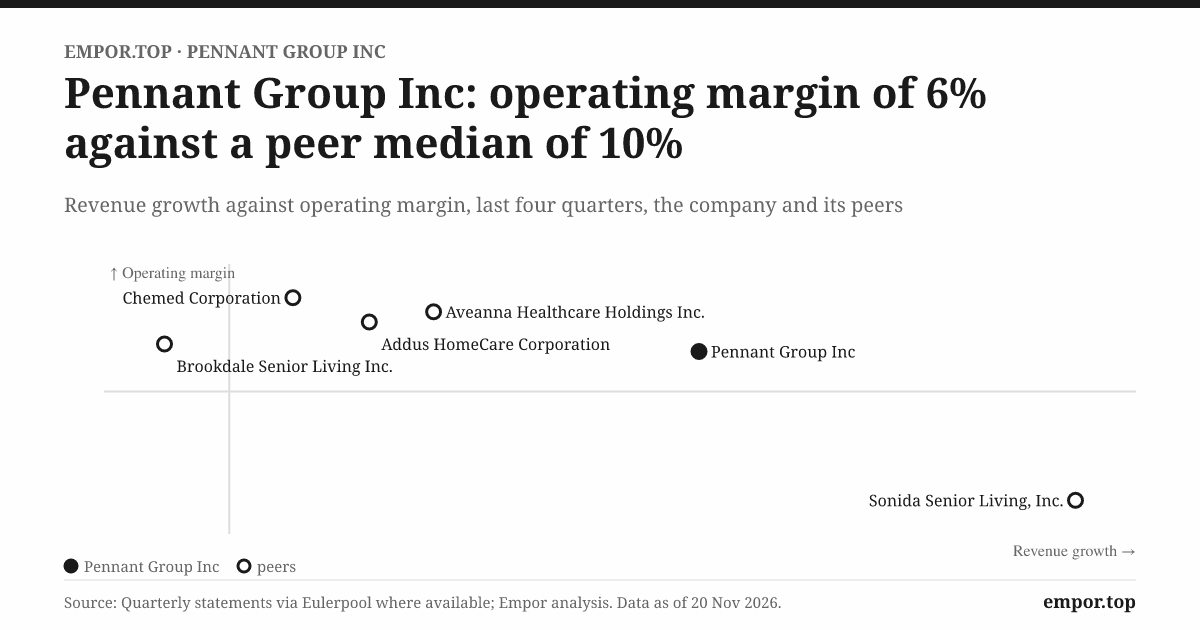
The margin path tells a similar story with more nuance. Operating margin was about 5.4% for 2025.3 In the third quarter of 2026 it was about 5.5%, a percentage point higher than a year earlier but below the 6.3% reached in the first quarter of 2026 and at the end of 2025.[^4] Operating profit grew about 61% year on year in the latest quarter, almost twice as fast as revenue, partly because overhead grew more slowly than the business: the central costs of running a company do not double when it buys more agencies.[^4] That operating leverage is a genuine advantage of scale. It is also not the same as the acquired operations themselves becoming as profitable as the old ones. Inside the segments, home-health and hospice cost of services rose to 84.0% of segment revenue from 83.5%, and senior living's rose to 75.0% from 73.0%, with management pointing to newly acquired operations and transition costs.[^4]
Put plainly, Pennant's corporate overhead is being spread more thinly while the field-level margins of the business are under some pressure from the deals. The net effect is positive for now. Whether it remains so depends on the acquired operations improving faster than the overhead benefit fades.
The longer record argues for caution in extrapolating any of this. Revenue growth has never translated smoothly into earnings at Pennant. Operating margins were above 6% in the Ensign years, collapsed to under 2% in the spin-off year of 2019, recovered to about 5% in 2020, fell to about 1% in 2021, and only climbed back to the mid-5s by 2024.3 The 2021 slump, when operating profit fell to under $5 million on revenue of about $439 million, was a reminder that a people business can lose its margin quickly when labor markets tighten or census falls.3 And returns remain modest against the capital employed: Pennant's return on invested capital was about 5% in 2025 and about 6.5% over the twelve months to September 2026, below the 6.1% weighted rate it paid on bank borrowings at the end of 2025.3
Why does that comparison matter so much? Return on invested capital is the cleanest test of whether growth creates value, because it asks how much after-tax operating profit each dollar of debt and equity in the business produces. A company that earns 6% on its capital while its lenders charge 6% and its shareholders expect more is growing without getting richer. Pennant's return has risen from about 1% in 2021 to the mid-single digits, which is real progress, but it has not yet cleared the bar that would make each new acquisition dollar obviously accretive.3 The improvement since 2021 is the most encouraging trend in the long record. The level is the most sobering one.
That sets the discipline the rest of the story needs. Track same-agency revenue and margins beside total revenue, and never credit acquired growth to the existing base. Pennant publishes enough to do the first half of that comparison, through same-store admissions and census. It does not publish acquired-operation margins in a comparable series. That gap matters most for the biggest deal Pennant has ever made, which came out of one of the larger antitrust fights in American health care.
The 54-location deal came out of a merger remedy
In November 2024, the U.S. Justice Department sued to block UnitedHealth Group's purchase of Amedisys, one of the largest home-health and hospice operators in the country.9 UnitedHealth already owned a major home-health business through its Optum unit, and the government argued that combining it with Amedisys would reduce competition for home-health and hospice services in many local markets, hurting patients and the nurses whose employers would have fewer rivals bidding for them.9 The way out of such cases is usually a remedy: the merging companies agree to sell enough local operations to restore competition where it would otherwise be lost. Somebody has to buy them.
Pennant was one of the somebodies. It agreed to buy 54 home-health and hospice locations being divested by UnitedHealth and Amedisys, and it closed the purchase on October 1, 2025, six years to the day after its own spin-off.78 Amedisys as a whole went to Optum; Pennant bought a regional slice that the antitrust settlement required to go elsewhere.
The scale was unlike anything Pennant had done. The locations spread across Tennessee, Georgia and Alabama, with roughly two-thirds of revenue in home health and one-third in hospice, and they carried about $189 million of trailing annual revenue.86 Pennant paid about $146.5 million.8 At roughly 0.77 times trailing revenue, that is a price a home-health acquirer would usually be glad to pay, and on the third-quarter 2025 call Guerisoli described the valuation as "attractive" and of a kind "rarely seen on larger deals."6 Management said the trailing EBITDA multiple sat comfortably within its target range of four to seven times for home-health acquisitions.6
There are good reasons a divestiture can be cheap. A seller forced by a regulator to sell has a deadline and a limited pool of buyers acceptable to the government. The assets themselves are often in the middle of disruption, with staff unsure of their future and referral sources wondering who will answer the phone. Earlier in 2025 Pennant had also said it was seeing less competition for home-health and hospice acquisition targets, as buyers that had been active in prior years pulled back.10 A disciplined acquirer can use moments like that.
But the headline multiple cannot carry the weight that is sometimes put on it. A revenue multiple says nothing about profitability, and the deal's true value depends on what those locations earn under Pennant. Pennant has not disclosed enough transaction-level EBITDA detail to verify the multiple independently, or to compare it with the multiples at which public home-care companies trade.78 The statement that the deal fell within the 4-to-7-times range is management's characterization. It may well be right, but it is a claim, not a published number an outsider can check.
The first-year evidence is encouraging without being decisive. During the part of 2025 that Pennant owned them, the acquired operations contributed about $51 million of revenue and about $5.3 million of operating income.3 That works out to an operating margin of roughly 10% at the location level, before any allocation of Pennant's corporate overhead and before the hardest part of integration. Annualizing a single partial quarter is perilous, but the figure at least shows the locations arrived profitable rather than as a rescue case.
The deal also needs to be seen against Pennant's earlier, smaller ones, because they are the template it is following. In 2024 the company bought home-health and hospice operations from Signature, adding density in markets it already served, along with a steady flow of single-agency deals.3 On the Q3 2025 call, Guerisoli pointed to Signature as a model and said those acquired operations had "outpaced our financial expectations."6 That is a useful data point, but it is also management grading its own homework. The investor deck likewise highlights acquired agencies whose revenue and earnings grew strongly under Pennant.[^7] What the company has not published is a complete accounting of every acquisition cohort: what it paid, what each earned in years one, two and three, and how many fell short.
Integration is the stage where this kind of deal is won or lost, and it is still under way. Moving 54 locations onto Pennant's systems meant changing their electronic medical records, billing, branding and leadership. On the Q3 2026 call, John Gochnour, Pennant's president and chief operating officer, said the electronic medical record transition had been completed on October 31, with the two largest and final waves of locations moved during the third quarter, and that the work was ahead of the progress originally projected.5 He also acknowledged "ordinary disruption" that "may modestly impact results through the end of the year," with the collection of receivables from the prior owner's system and patient-portal transitions still to finish.5 When a Wells Fargo analyst asked why disruption was only now being discussed, Gochnour said more than half of the acquired population had been integrated in the previous 120 days, and that the disruption was not more significant than in earlier waves.5
Integration also shows up in the revenue line in a less obvious way. Same-store revenue per home-health episode rose in the quarter, but total revenue per episode fell 2.2%, because the Southeast markets carry lower Medicare wage adjustments.5 When a Jefferies analyst asked about renegotiating Medicare Advantage rates in those markets, Gochnour said there was "an opportunity" on managed-care rates, without sizing it.5 That is an honest answer and an open one: part of the value of the deal depends on improving private-plan pricing that the company does not yet control.
So the verdict is narrower than the deal's headline. Pennant bought real scale at a price that looks reasonable on revenue, in markets where it can build density. The figure that will settle whether it bought value is the acquired operations' margin and cash return once integration is complete, measured against the $146.5 million paid and against the margins of Pennant's established base. That figure is not yet public.
A rough calculation shows what is at stake. If the roughly $5.3 million of operating income the acquired locations earned in their first partial year were simply run at the same pace for a full year, it would come to something above $20 million, a pre-tax return in the mid-teens on the $146.5 million purchase price, comfortably above the roughly 6% Pennant pays on bank debt.3 That is the bull case for the deal in one sentence. The bear case lives in the assumptions. A single quarter is a thin base for annualizing; the acquired operations bore none of Pennant's corporate overhead in that figure; and the lower Medicare wage adjustments in the Southeast mean the same visit earns less revenue there than in Pennant's western markets. If the locations settle at a mid-single-digit margin after overhead, the return falls to roughly the cost of the debt used to buy them, and the deal adds revenue without adding much value. The difference between those two outcomes is a few points of margin, which is exactly the kind of difference Pennant's operating model claims to deliver.
And the strain of absorbing so much so quickly was already visible elsewhere in the company.
The growth machine meets its own capacity limit
The most revealing sentence on Pennant's November 2026 call was not about Medicare or the Southeast. It was an admission. Guerisoli said that in several senior-living markets, growth had "temporarily outpaced leadership capacity."5 For a company whose entire model rests on local leaders, that is the equivalent of a restaurant chain saying it opened kitchens faster than it trained chefs.
The numbers behind it were plain. Senior-living revenue grew about 12.6% in the third quarter of 2026, to about $62 million, but the segment's adjusted EBITDA rose only about 3%, to about $5.7 million, which management itself called roughly flat.[^4]5 Pennant had acquired 16 senior-living communities since the start of 2025, seven of them in 2026.5 Senior living is the smaller of Pennant's two businesses, about a fifth of quarterly revenue, but it is a meaningful one, and its economics are less forgiving than home health's, because building costs are largely fixed and empty units earn nothing.
Andy Rider, who runs the senior-living business, and Gochnour gave a fairly specific account. Transitions in two markets, which they did not name, had not gone as expected, and same-store operations in those markets had also underperformed, with same-store occupancy falling year on year in the same two places.5 Many of the acquired communities had come in at low occupancy, which was part of the reason they were available at an attractive price, and filling them takes time.5 Rider said the segment was through "that initial phase of pressure" and expected the fourth quarter "to be a step in the right direction," with the two markets expected to "bounce back" as transitions finished.5 He framed Pennant's usual expectation as a "nine-quarter optimization period" for acquisitions, with significantly distressed assets taking three to four quarters to become accretive.5
One detail in Guerisoli's account deserved more attention than it received. He said that much of the stretch on leadership fell not on the new operators but on "the existing leaders."5 That is precisely the risk in a model that uses established leaders to mentor and stabilize acquired operations. When the company buys quickly, its best people are pulled away from the businesses they built, and the old business can soften at the same time the new one is struggling. The same-store occupancy decline in the two affected markets is consistent with exactly that.
Home health and hospice faced a milder version of the same tension. Same-agency growth stayed positive, as the admissions and census figures showed, but the purchased agencies brought transition costs and pushed up cost of services as a share of revenue.[^4] Here the integration was more structured, with a defined systems migration and a central team, but the principle was the same: every acquired location borrows management attention from somewhere.
Then there was an unexpected cost line. In his prepared remarks, Guerisoli flagged "higher-than-anticipated employee benefits costs," including at newly acquired operations, and said Pennant was taking steps to manage them more predictably, without explaining what those steps were.5 It took an analyst's question to size the problem. Asked by William Blair for a dollar figure, CFO Lynette Walbom said the extra benefits cost in the third quarter amounted to about 50 basis points of revenue, roughly $1.5 million on the quarter's revenue, and that she expected a similar effect in the fourth quarter, already reflected in guidance.5 She explained it as a year-end pattern in which employees reach their deductibles and use more of their benefits. When Wells Fargo asked whether the issue was confined to acquired employees, Guerisoli said Pennant's plans were self-funded and the effect was organization-wide.5
That exchange is worth dwelling on, because it shows the difference between prepared remarks and the Q&A. The prepared remarks called the cost "higher than anticipated." The answer under questioning described a seasonal pattern that a self-insured employer would normally expect. Both can be true, if the seasonal pattern was steeper than planned, but management did not reconcile the two framings, and an investor is left to decide whether this is a one-quarter surprise or a structural cost of a workforce that has grown quickly through acquisition. To management's credit, the answer was the most concrete one on the call. Elsewhere, questions about the pipeline of senior-living administrators and about Medicaid waiver pressure drew general or no answers.5
A year earlier, the tone was different. On the Q3 2025 call, just after the 54-location deal closed, management raised its full-year guidance and described a "very robust pipeline," driven by market forces and Pennant's reputation as a quality buyer.6 Guerisoli also said, even then, that the constraint on growth was leaders, not deal flow.6 That is consistent with what happened, which counts in management's favor: the limit it named in 2025 is the one that bit in 2026. It also raises the obvious question of why the company kept buying senior-living communities at a pace that, by its own account, stretched its leaders. On the November 2026 call, management reaffirmed that it expected to meet its annual guidance.5
Pennant's answer to the capacity problem is the same as its answer to everything: more leaders. It runs a training programme in which aspiring executives work inside an operation under an experienced leader before taking one of their own, and Guerisoli said more than 30 senior-living trainees had graduated during 2026.5 That is a sensible remedy, and it is also slow by design. A trainee who graduates this year still has to learn a specific community, its staff and its families. The model's strength, that it refuses to run a location from head office, is also why it cannot be scaled simply by hiring regional managers. Growth is capped by the rate at which the company can make operators, and the 2026 results show what happens when deal-making runs ahead of that rate.
The test is now explicit and measurable. If senior-living margins and occupancy in the acquired and affected markets improve over the next four quarters, as Rider expects, the "temporary transition" explanation will have held. If they do not, the problem will look less like a timing issue and more like a limit on how fast Pennant's model can scale. And either way, growth at this pace has to be paid for, which brings the story to cash.
Cash arrives, but it is already spoken for
At the end of 2025 Pennant's cash-flow statement told a simple story in three numbers. The business generated about $48 million of cash from operations. It spent about $227 million on investing, mostly acquisitions. And it borrowed heavily to make up the difference, with financing inflows of about $172 million.3 Cash on hand ended the year at about $17 million.3 For a company of nearly $1 billion in revenue, that is a thin cushion, and it reflects a deliberate choice: every spare dollar, and many borrowed ones, went into buying more business.
Look further back and the picture is more flattering. Over the decade from 2016 to 2025, cumulative cash from operations was about $226 million, against cumulative net profit of about $120 million, nearly twice as much.3 For a business often suspected of booking revenue it has not yet collected, that is reassuring. But the gap needs explaining rather than celebrating. Part of it comes from noncash charges such as depreciation and amortization, share-based compensation and self-insurance accruals, which reduce reported profit without consuming cash in the same year.3 Part comes from the timing of working capital, which can swing in either direction. The swings can be violent: in 2020 operating cash flow of about $50 million was more than three times net profit, and in 2021 it turned into an outflow of about $18 million even though the company still reported a small profit.3 Two years like that, side by side, are a reminder that a decade-long total can hide a great deal of timing. The $106 million difference over the decade is therefore not all recurring, and it would be a mistake to treat it as a measure of hidden earning power.
The more recent trend is steadier. In the first nine months of 2026, Pennant's operating cash flow rose about $16 million year on year, with about $9 million of that coming from higher net income and about $10 million from higher noncash adjustments, partly offset by a smaller contribution from working capital.4 Third-quarter operating cash flow was about $25 million, bringing the year-to-date total to about $43.5 million.5 Free cash flow, after capital spending, was about $26 million in 2025, and dividends have been essentially nil since the spin-off year.3 Pennant says it expects to retain its earnings, and it has no buyback programme.3
What changed in 2025 was not cash generation but cash need. Investing outflows had run between about $20 million and $40 million a year for most of Pennant's public life, rose to about $70 million in 2024, and then more than tripled to about $227 million in 2025.3 Internally generated cash covered a fraction of that.
To fill the gap, Pennant has used both equity and debt. In October 2024 it sold about 4 million new shares, raising about $118 million after costs, and used most of it to repay its revolving credit line.3 Then in November 2025, after the 54-location close, it added a $100 million term loan at the same rate and maturity as the revolver, due in July 2029.3 At the end of 2025, long-term debt including the current portion was about $174 million, with about $172 million of revolver capacity unused and a weighted average interest rate of about 6.1%.3 By September 2026 the company had $103 million drawn on its line of credit, $18.4 million in cash, and net debt of about 1.95 times adjusted EBITDA, by management's measure.5 The share count has also kept creeping up through equity compensation, from about 34.9 million at the end of 2025 to about 35.1 million in November 2026.34
That leverage multiple looks moderate, but it measures only the bank debt. Pennant's bigger fixed obligation is its leases. At the end of 2025 the balance sheet carried about $279 million of lease liabilities, much of it for senior-living buildings, including the 32 communities leased from Ensign subsidiaries.3 Leases are not borrowings under the credit facility, and they do not trip the same covenants. But they are contractual payments that come due whether a community is full or half-empty. Add them to the debt and Pennant's fixed claims at the end of 2025 were about $453 million, more than its equity of about $333 million.3 In a business where the rent is fixed and occupancy is not, that is the real leverage.
A simple way to see it is to imagine a senior-living community as a hotel with a long lease. When it is 90% full, the rent is a manageable share of revenue and the community throws off cash. When an acquired community arrives at, say, 70% occupancy, the rent is the same and the margin is thin or negative until the rooms fill. That is why the low-occupancy acquisitions management described carry more risk than their purchase prices suggest: the price may be cheap, but the lease clock starts on the first day. Pennant's bankers look at net debt to EBITDA. A tenant's landlord looks at whether the rent gets paid. Both are claims on the same cash.
Collections add a quieter risk. Debtor days, the number of days of revenue sitting in receivables, rose from about 32 in 2017 to about 47 in 2025.3 Net receivables were about $123 million at the end of 2025 and about $131 million at September 2026, against bad-debt allowances of under $1 million.34 Some of the lengthening reflects the mix of acquired businesses and the paperwork of moving acquired agencies onto new billing systems; the Q3 2026 call specifically mentioned collecting receivables still sitting on the previous owner's system.5 Pennant describes much of its receivable as billed and unbilled amounts arising from the timing of revenue recognition and collection, and Medicare and Medicaid made up about 62% of gross receivables at the end of 2025, down from about 74% a year earlier.3 What the company does not disclose is a detailed aging schedule, write-off history or denial rate by payer. A rising collection period with a government payer is not alarming in itself, but it is the kind of drift that turns into a cash problem if a payer tightens audits or a billing migration goes wrong.
The cash story, then, is that Pennant's operations do produce cash, but nowhere near enough to fund its acquisition pace, so the company has leaned on lenders, an equity raise and a heavy load of leases. The tests for the next few quarters are simple: whether operating cash keeps rising, whether net leverage stays near 2 times, whether debtor days stop climbing, and whether acquisition spending stays within what the business generates plus a prudent amount of borrowing. Those decisions belong to management and the board, and the people making them deserve a closer look.
A familiar parent still sits across the table
Pennant's 2026 annual meeting produced the kind of result that rarely makes headlines but tells investors something. Shareholders voted on say-on-pay, the advisory vote on executive compensation, and about 21.6 million votes were cast in favor against about 6 million opposed, so roughly 22% of votes cast for or against rejected the package.12 In a world where most companies pass say-on-pay with more than 90% support, a fifth voting no is a noticeable signal.
The package in question had grown quickly. Guerisoli's reported compensation for 2025 was about $3.74 million, up from about $2.59 million in 2024 and about $1.87 million in 2023.11 Most of that is not salary. Pennant's executives are paid through a mix of base pay, annual cash incentives tied to performance, and equity awards including options and restricted stock, and the proxy argues that the structure links pay to growth and to shareholder value.11 Revenue and reported profit did rise substantially over the same period, which is the company's case. The counter-case, implicit in the dissent, is that pay rose almost twice as fast as revenue in 2025, at a company whose returns on capital remain modest and whose growth was largely bought.
Context matters here. A 22% dissent is a warning, not proof of misconduct, and a single vote does not show a trend. Pennant's proxy describes an independent-majority board, and no shareholder is disclosed as controlling the company.11 The largest reported holders include Van Berkom & Associates at about 9% as of September 2025, Wasatch Advisors at about 5.4% as of mid-2026, and Vanguard at just under 5% as of September 2026, all institutional investors rather than founders or a strategic parent.1713 That broad ownership means there is no single holder who can force change, but also no single holder whose interests might diverge from minority shareholders.
The leadership team is compact and long-tenured in the Ensign tradition. Guerisoli, as CEO and chairman, sets strategy; Gochnour, as president and COO, runs operations and integration; Walbom, as CFO, handles the balance sheet and guidance.511 On the earnings calls they divide the work cleanly, and their tone is operational rather than promotional. Combining the CEO and chairman roles, with a lead independent director as counterweight, is common in the United States but means the board's independent voice runs through one person.15
The Ensign relationships are the other governance thread, and they are worth spelling out because they are easy to underrate. In 2025 Pennant paid Ensign about $589,000 for shared services, a small figure, and about $7.15 million in room-and-board charges for hospice patients living in Ensign facilities, roughly 0.75% of Pennant's revenue.3 More significantly, Pennant's subsidiaries leased 32 senior-living communities from Ensign subsidiaries, a large share of the senior-living portfolio and of the lease obligations discussed earlier.3 Two of Pennant's directors also serve on Ensign's board.3 Pennant does not disclose transaction-level pricing benchmarks for these arrangements, so investors cannot tell whether the rents and charges are above, below or at market.3 There is no evidence they are unfair, and there are commercial reasons for them: hospice patients in skilled-nursing facilities need care, and leases inherited at the spin-off were part of how the business was separated. But when the landlord of roughly half your senior-living communities shares directors with your board, every renewal is a negotiation with an interested party on both sides.
The audit record is clean. Deloitte issued an unqualified opinion on the 2025 financial statements and found internal controls effective.3 Its critical audit matter, the area requiring the most judgment, was the estimate of self-insurance reserves for general and professional liability and workers' compensation, for which it used actuarial specialists.3 That is not a red flag, but it points to a real risk: Pennant self-insures much of its exposure to claims of injury, elder abuse or wrongful death, which are an ordinary part of caring for frail patients, and the adequacy of those reserves rests on estimates.3 The same self-insurance logic, applied to employee health plans, is what produced the benefits surprise on the latest call.
A skeptical investor would ask one question here, and it belongs to the governance chapter rather than the operating one. If acquisitions are the strategy, what return hurdle does Pennant set for a deal, and what reporting will let shareholders judge afterwards whether management bought value or simply bought growth? The company publishes a target multiple range, a nine-quarter optimization expectation and selected success stories. It does not publish post-deal returns by cohort. Until it does, shareholders are asked to trust the operators' judgment, and their pay rises as the company grows. That is the question the valuation ultimately turns on.
The case turns on returns after the acquisition
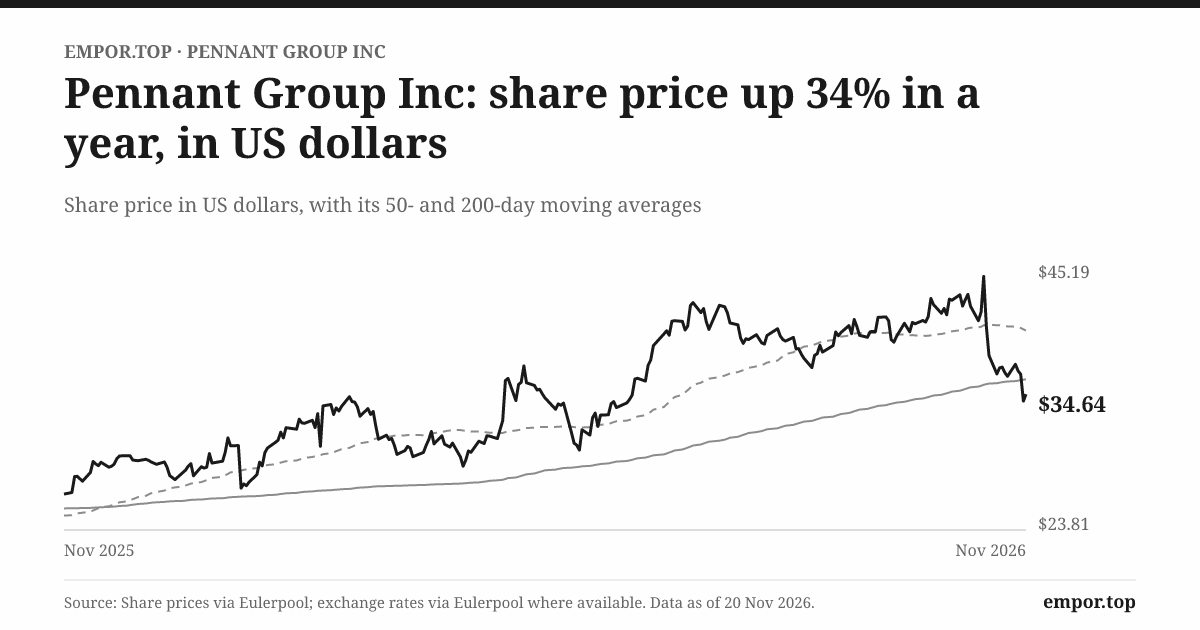
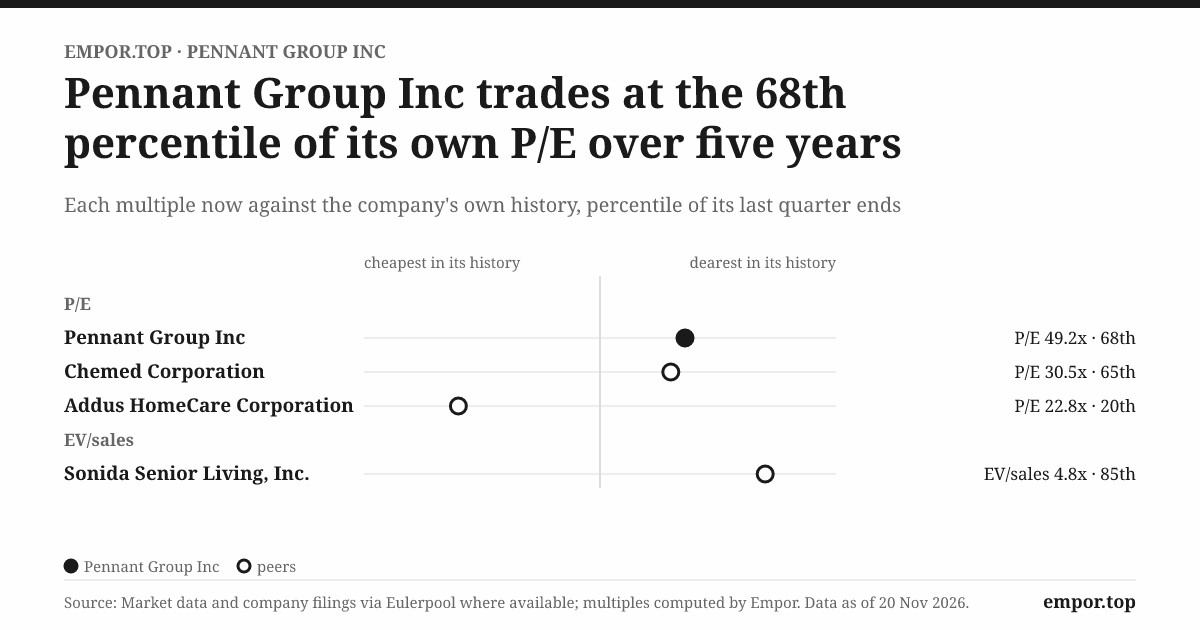
On November 20, 2026, Pennant's shares closed at about $34.64, roughly 21% below their 52-week high of about $44.[^20] The pullback might suggest the market has turned skeptical. The multiples say otherwise. At that price the stock traded at about 49 times trailing earnings, above its own five-year median of about 44, at about 27 times enterprise value to EBITDA and with a free-cash-flow yield of under 2%.[^20]3 For comparison, Addus HomeCare, a larger home-based-care operator, was trading at about 14 times EV/EBITDA in early November 2026, although the data sources and periods differ.16 Investors, in other words, still pay roughly twice what they pay for a close peer's earnings, and the price assumes that Pennant's growth continues and becomes more profitable. Against that, its return on invested capital was about 5% in 2025 and about 6.5% over the latest twelve months.3
The bull case is not hard to make. Same-agency home-health admissions and hospice census are growing at healthy rates, which suggests the established business is winning referrals rather than just riding acquisitions. Operating profit has grown faster than revenue in recent quarters, as overhead spreads across a bigger base. Clinical quality measures beat industry averages. The 54-location deal closed at what appears to be a reasonable price and arrived profitable. And management's local-operator model has, by its own selected examples, turned around acquired agencies.5[^7] If Pennant can repeat that across the Southeast and in its senior-living markets, margins could rise towards the levels of its best operations while revenue keeps compounding.
The bear case is equally concrete. Acquired growth dominates the headline. The latest senior-living results showed a leadership-capacity limit that management itself acknowledged. Medicare and Medicaid dominate revenue and receivables, so a single rule change can reset economics. Debtor days have lengthened. Returns on capital sit below the company's own borrowing cost, and the company carries both bank debt and a substantial lease load. A business priced at nearly 50 times earnings has very little room for a quarter in which integration slips.
Industry structure helps frame the contest. Consider first the five forces. Buyer power is high: the federal government sets home-health and hospice rates, and Medicare Advantage plans negotiate hard, as the managed-care question about the Southeast showed. Supplier power, in the form of clinical labor, is also high, because nurses and therapists are scarce and can move between employers; the benefits cost surprise is a small reminder of how labor costs can move. The threat of new entrants is moderate: licensing, certificate-of-need rules in some states and Medicare certification raise barriers, but small local agencies keep forming. Substitutes exist at the margins, from family caregiving to skilled-nursing stays, though the long-term trend favors care at home. Rivalry is intense locally and fragmented nationally, with larger operators such as Addus and Enhabit, and Amedisys under Optum, holding greater scale in parts of the market.9
Now Hamilton Helmer's seven powers, the sources of durable advantage a business can have. Scale economies are limited: home health is a local business, and the national scale that matters is mostly in overhead and systems, where Pennant is smaller than its biggest rivals. Network effects are absent. Switching costs are low for patients and referral sources. Counter-positioning is partly present, since the decentralized model is something a large, centralized operator would find hard to copy without dismantling its own structure. Cornered resources do not exist in the usual sense, though Pennant's pipeline of trained local leaders is the closest thing it has. Brand matters locally, in a referral source's trust, more than nationally. Process power, the hard-to-replicate operating system that improves acquired businesses, is the power Pennant claims most strongly.
That leaves the moat conclusion. Clinical quality and local operating teams may well help Pennant win referrals and improve the businesses it buys, and there is evidence of both. But the public record offers little support for pricing power, which the government holds; for a retention advantage, since switching is easy; or for a defensible cost position, given labor's bargaining power. Process power is the claim, and it is only partially proved, because the company has not shown complete acquisition cohorts. The history narrows the moat claim to this: Pennant operates good local care businesses and has a plausible, partially demonstrated ability to improve acquired ones. It does not reject the claim, but it does not yet support a premium multiple on its own.
Three measures will settle which way the claim goes. The first is same-agency home-health admissions and hospice census, now growing about 8% and 13% respectively; if they hold up once acquired volumes are annualized, the established franchise is healthy. The second is the margin progression of acquired operations, which Pennant does not publish in a comparable series; the senior-living segment's flat EBITDA on rising revenue is the current warning sign. The third is the balance sheet pair of net leverage and debtor days, at about 1.95 times and 47 days respectively, both drifting up as the company grows.53
An activist looking at Pennant would not need to invent an argument. The pressure points are in plain view. Returns on capital sit around the cost of debt, yet the company keeps deploying capital into acquisitions at an accelerating pace. Executive pay rose sharply in the year the company made its biggest purchase, and more than a fifth of voting shareholders objected. The company's largest landlord in senior living is its former parent, which shares directors with its board. And the company publishes target multiples and anecdotes, but not the cohort returns that would let owners grade its deal-making. The activist's demand would be simple and hard to refuse: publish acquired-operation margins and returns by deal vintage, tie a meaningful part of executive pay to return on invested capital rather than growth in earnings, and slow the acquisition pace until the 2025 cohort proves itself. None of that implies the strategy is wrong. It implies that the strategy is currently being judged mostly on faith.
The valuation is context, not a forecast. A premium multiple requires profitable growth and successful integration to continue. It does not establish that they will. What it does establish is that the market has already given Pennant credit for the turnaround it has promised, which is why the lessons of how such companies succeed or fail matter so much here.
Lessons from a company that buys unfinished businesses
Every acquisition Pennant makes begins with a building, a staff and a set of patients who did not choose the new owner. A home-health agency in rural Tennessee arrives in the system with its own nurses, its own referral relationships and an operating history that may need repair. Someone has to keep the care going while the logo, the software and the leadership change around it. That is the moment the whole model rests on, and Pennant's record so far teaches three lessons.
The first comes from the October morning in 2019 when the company became independent. It walked out of Ensign with its own ticker but also with 32 leased senior-living communities, shared directors, a services agreement and an operating philosophy borrowed whole from its former parent.13 Seven years later those ties still shape its costs and its governance. Investors in spin-offs tend to focus on the clean break; Pennant's history shows how much the parent leaves behind. A clean listing boundary does not erase the relationships it inherited.
The second comes from the 54-location deal. Pennant bought it at a price management called rare for a deal of that size, and it arrived profitable.63 But a year later the company was still moving its final waves onto new systems, collecting old receivables and finding that Medicare paid less per episode in the new markets.5 The purchase price was the start of the argument, not the end. For founders and investors in any roll-up, the lesson is that the multiple paid is a forecast, and only post-integration margins and cash returns confirm it. A bargain is only a bargain after the new operation earns its place.
The third comes from the senior-living markets where the strain showed. Pennant had promised that its local leaders were its edge, and when it bought communities faster than it could staff them with seasoned leaders, both the new and the existing operations weakened.5 Over the decade the business generated far more cash from operations than it reported as profit, yet in 2025 its investing outflow ran to roughly five times what operations produced.3 Capital was never Pennant's tightest constraint. People were. In a labor business, leadership capacity is part of the asset.
There is a fourth lesson, and it comes from the hospitalization numbers. Pennant's home-health patients were readmitted less often than the industry average, and its hospice scores beat the benchmark.5 Those results matter to a discharge planner choosing where to send the next patient, and they may be why same-store admissions keep growing. They do not change what Medicare pays for the episode. In a market where the government sets the price, quality buys volume, not margin, and volume only pays if the cost of delivering it is controlled. Quality is a referral magnet, not a price tag.
Those lessons point to a wider truth about acquisition-led service businesses. The deal count, the quality stars and the success stories in an investor deck are inputs. The output is a repeated, cohort-level record showing that bought businesses become better ones. Pennant has some of that record, and the next year will add more.
The next year is the real integration report
Tonight Pennant stands at a hinge. The Southeast systems migration is essentially done, the senior-living team says the worst of its transitions is behind it, and management has reaffirmed its 2026 guidance.5 But the fourth-quarter results, due early in 2027, will still carry the integration disruption and the elevated benefits costs that management flagged, so the clean read on the new Pennant will not come until the quarters after.5
Four things will tell the story. First, whether the acquired Southeast agencies regain margins close to the established base once the disruption fades; if their operating margin rises from the roughly 10% they showed in their first partial year, the deal will look like value, and if it stalls, like a revenue purchase.3 Second, whether same-agency growth stays healthy once the acquired volumes are folded into the comparable base, which will remove the flattering year-on-year jump in total admissions. Third, whether receivables and leverage stay in check while the next wave of deals arrives, because a pipeline that management calls robust will keep tempting it.6 Fourth, whether the senior-living markets that stretched their leaders recover within the three to four quarters Rider described.5
There is also a calendar that Pennant does not control. Medicare updates its home-health and hospice payment rules every year, and those rate decisions land on roughly four-fifths of Pennant's revenue. Wage pressure in clinical labor does not pause for integration schedules. And the acquisition pipeline that management described as robust a year ago will keep presenting tempting deals, each of which competes for the same scarce leaders the senior-living markets just showed are stretched. The discipline to pass on deals while the 2025 cohort settles would be a signal in its own right; so would a decision to keep buying at the 2025 pace.
Each outcome maps onto one of the four questions this story began with. If acquired margins rise and same-store growth holds, the premium multiple will look less like a leap of faith. If they do not, the market will be left owning a fast-growing, thinly profitable roll-up at a growth-stock price. Either way, the decisive evidence would be a published, comparable return series for acquired cohorts, and Pennant has not yet provided one.
Back to the local care team
Somewhere tonight a Pennant nurse is driving between visits in Georgia, carrying a laptop that a month ago ran another company's software. The patient she is about to see was discharged from hospital last week. The agency she works for answers to a local leader who is trying, at the same time, to hit admissions targets, contain overtime and keep the referral sources who stayed loyal through a change of ownership. None of that care can be centralized. All of its consequences, the margins, the leverage, the share price, are.
That is the tension inside the model, and it is what makes Pennant unlike a simple roll-up. A roll-up buys businesses to add their earnings. Pennant buys businesses to change how they are run, and it bets that the change comes from a person, not a process manual. Pennant is betting that the best way to scale care is to keep the operator close—and the investor close enough to check the results.
References
-
2019 spin-off Form 8-K — The Pennant Group, Inc. (SEC), 2019-09-12 ↩↩
-
2019 information statement — The Pennant Group, Inc. (SEC), 2019 ↩↩↩
-
2025 Form 10-K — The Pennant Group, Inc. (SEC), 2026-02-26 ↩↩↩↩↩↩↩↩↩↩↩↩↩↩↩↩↩↩↩↩↩↩↩↩↩↩↩↩↩↩↩↩↩↩↩↩↩↩↩↩↩↩↩↩↩↩↩↩↩↩↩↩↩↩↩↩↩
-
Q3 2026 Form 10-Q — The Pennant Group, Inc. (SEC), 2026-11-04 ↩↩↩
-
Q3 2026 earnings call transcript — Stock Analysis, 2026-11-05 ↩↩↩↩↩↩↩↩↩↩↩↩↩↩↩↩↩↩↩↩↩↩↩↩↩↩↩↩↩↩↩↩↩↩↩↩
-
Q3 2025 earnings call transcript — Investing.com, 2025-11-06 ↩↩↩↩↩↩↩↩
-
Acquisition completion, Form 8-K — The Pennant Group, Inc. (SEC), 2025-10-02 ↩↩
-
Pennant completes purchase of UnitedHealth and Amedisys operations — SEC exhibit, 2025-10-02 ↩↩↩↩
-
Justice Department sues to block UnitedHealth's purchase of Amedisys — Associated Press, 2024-11-12 ↩↩↩↩
-
The Pennant Group sees less competition for hospice, home health acquisition targets — Hospice News, 2025-03-18 ↩
-
2026 DEF 14A proxy statement — The Pennant Group, Inc. (SEC), 2026-03-31 ↩↩↩↩
-
Annual meeting voting results, Form 8-K — The Pennant Group, Inc. (SEC), 2026-05-20 ↩
-
Vanguard Schedule 13G/A — The Pennant Group, Inc., 2026-10-30 ↩
-
Pennant Group announces new CEO, changes to leadership structure — Senior Housing News, 2022-06-07 ↩↩
-
The Pennant Group appoints Brent Guerisoli as Chairman and Scott Lamb as Lead Independent Director — Yahoo Finance, 2025 ↩↩
-
Van Berkom Schedule 13G/A — The Pennant Group, Inc., 2026-01-20 ↩
 LinkedIn
 WhatsApp
 Reddit
 Hacker News
 Email
 Kindle
 RSS Feed
 Spotify
 Apple Podcasts
 Amazon Music
 Audible
 YouTube