Brookdale Senior Living: The Debt Wall Behind the Grey Tsunami
I. The Bed at the End of the Hall
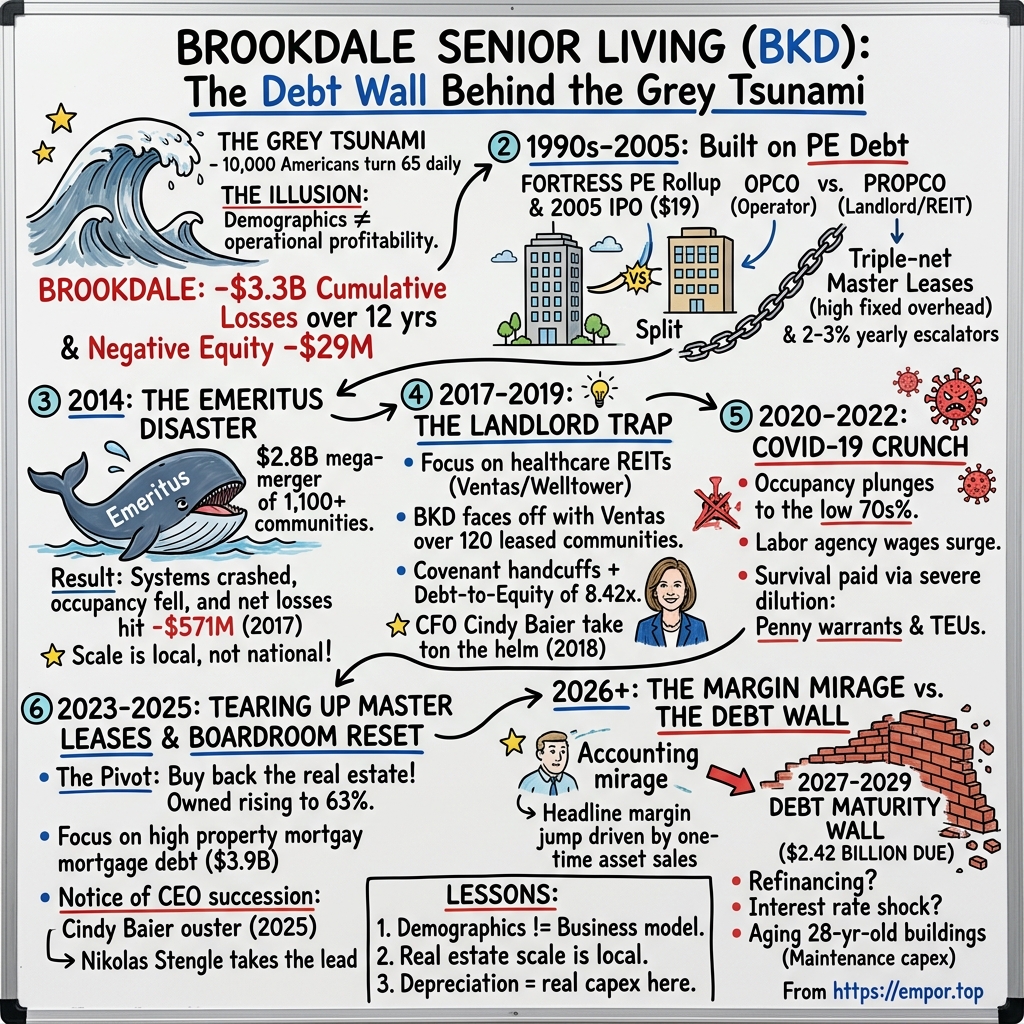
In the summer of 2014, in the low-slung office parks of Brentwood, Tennessee, Brookdale Senior Living's executives finished the deal they believed would define the next generation of American elder care. Brookdale had agreed in February to combine with Emeritus Corporation, the Seattle-based assisted-living chain, in an all-stock transaction that the companies valued at about $2.8 billion including debt and leases.1 When it closed that July, Brookdale became something the industry had never seen: a single operator running more than eleven hundred communities across forty-six states, housing well over a hundred thousand residents.1 The timing looked perfect. The oldest Baby Boomers were turning sixty-eight. The industry's trade groups and every senior-housing pitch deck repeated the same statistic: roughly ten thousand Americans were turning sixty-five every single day, and would keep doing so for nearly two decades.2
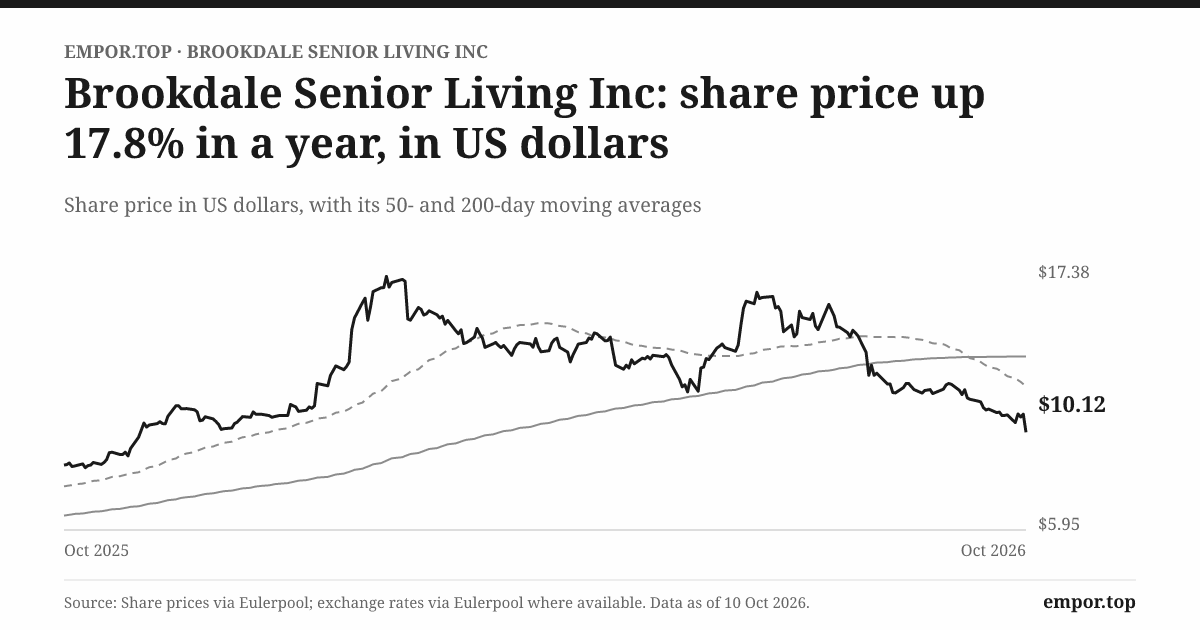
Twelve years later, the picture is very different. Between fiscal 2014 and fiscal 2025, Brookdale reported a cumulative net loss of about $3.3 billion, losing money in eleven of those twelve years.34 The one profitable year, 2020, was profitable only because government pandemic relief arrived during the worst year the industry had ever lived through.3 By the end of 2025, shareholders' equity had gone negative, at minus $45 million, and it was still slightly below zero, at minus $29 million, in June 2026.45 The colossus of 2014 had shrunk to 535 communities and about 42,800 units.5 Its stock traded at $10.12 on October 10, 2026, giving the company a market value of about $2.4 billion and an enterprise value of about $3.3 billion.5
That raises the puzzle at the heart of this story. If demographic destiny is real, and the number of Americans over eighty really is growing faster than almost any other cohort, how did the largest company built to serve them destroy so much capital? The comfortable answer is "the pandemic." The record says otherwise. Brookdale lost money in every year between the Emeritus deal and COVID, and its worst operating year, 2018, came two years before the virus arrived.3
The deeper answer is that Wall Street spent the 2010s confusing two things. One was gross population growth, which is undeniable. The other was operating profit for whoever owns the hallway, the nurse's station and the dining room, which depends on local supply, labor costs, rent and debt. Senior housing turned out to be a hybrid of a hotel and a clinic, staffed around the clock, with the cost structure of both and the pricing freedom of neither. When the building belongs to a landlord who is owed a rising rent no matter what, or to a lender who is owed interest no matter what, a demographic tailwind can blow straight past the operator and into someone else's pocket.
Three questions run through Brookdale's story and will decide its next chapter. The first is whether operating cash flow can carry the roughly $2.42 billion of debt that matures between 2027 and 2029 without forcing the company to sell communities or issue more stock.4 The second is whether the recent jump in profit, with operating margin reaching 11.9% in the second quarter of 2026, is a real turnaround or mostly the product of exiting bad leases and booking gains on property sales.5 The third is whether Brookdale's pivot from renting its buildings to owning them improves returns on capital, or simply ties the company to an aging portfolio that needs constant capital spending.
Brookdale enters this chapter with a new chief executive, Nikolas Stengle, appointed in October 2025 after the board removed his predecessor.6 It is the company's third attempt at reinvention since the Emeritus merger. To understand why the first two fell short, the story has to start before the merger, with the financiers who built the company and the architecture they chose.
 Subscribe on LinkedIn
II. Fortress and the Financial Engineering of Care
Senior living in America did not begin as a real estate trade. For most of the twentieth century, older Americans who could no longer live alone went to family or to a nursing home, an institutional, medically regulated setting paid for largely by Medicaid and Medicare. In the 1980s and 1990s, a new idea took hold: a residential community, closer to an apartment building with a dining room than to a hospital ward, where independent residents could live with hospitality services and, as they aged, buy help with bathing, dressing and medication. Assisted living and memory care grew from that idea. Crucially, they were largely private-pay. Families funded them with savings, pensions and the proceeds of selling the family home.
That private-pay model attracted capital, and capital brought consolidation. The industry was fragmented into hundreds of regional chains and single-site operators, which made it a natural target for a roll-up. Fortress Investment Group, the New York alternative-asset manager co-founded by Wesley Edens, gathered several senior-living operators under one roof in the early 2000s and combined them as Brookdale Senior Living.7 Edens, a former Lehman Brothers and BlackRock financier, was known for buying asset-heavy businesses where clever financing could unlock value. Fortress's approach to senior housing fit that pattern: buy portfolios, finance them with mortgages or sell the real estate to landlords, and run the operations with a centralized team.
Brookdale went public on the New York Stock Exchange in November 2005, filing its registration statement on Form S-1.7 The prospectus pitched the company as a consolidator in a fragmented industry, arguing that scale would bring advantages in purchasing, food service, marketing, insurance and corporate overhead.7 It was a reasonable-sounding argument. Large hotel chains and restaurant groups had shown that centralized procurement and branding could produce margins that independents could not match. Investors were invited to believe senior living would follow the same curve.
What the prospectus also described, in the language of leases and mortgages, was an architectural choice that would shape the next twenty years. A large share of the communities Brookdale operated were not owned outright. They were leased from real estate owners under long-term agreements, or they were owned but heavily mortgaged.7 Splitting the building from the business is a standard private-equity move, because selling property to a landlord frees up cash immediately and lets the operating company report a lighter balance sheet. The trade-off is that the operator takes on a fixed obligation, rent, that must be paid in good years and bad.
The economics of that split are worth spelling out. Under the kind of lease common in this industry, the operator pays the rent and also covers property taxes, insurance and building maintenance. The landlord's income usually rises every year by a contractual escalator, often between 2% and 3%. The operator, meanwhile, carries all of the business risk: wage inflation for caregivers, utility bills, insurance spikes and, as the world would learn in 2020, the risk of an epidemic emptying the building. The landlord gets something close to a bond. The operator gets the volatility.
In Brookdale's case, that structure meant a business that could look healthy at the level of resident revenue while producing very little for shareholders. Over the twelve years from 2014 to 2025, its free cash flow, meaning cash from operations after capital spending, added up to about minus $2.0 billion.34 The company never paid a dividend in that period.3 Whatever the scale advantages were, they were not reaching shareholders in cash.
So the founding question has a clear answer. Brookdale was born less as a care company than as a financing structure that happened to deliver care. That does not mean its communities delivered poor care; it means that the claims on its cash were set before the first resident moved in. The company's leaders spent the following decade testing whether size could overwhelm that problem. Their biggest test arrived in 2014.
III. Swallowing the Whale: The Emeritus Disaster
On February 20, 2014, Brookdale's chief executive, Andy Smith, announced the merger with Emeritus.1 Smith, a lawyer by training who had served as Brookdale's general counsel before becoming CEO in 2013, framed the deal as the creation of a national platform. Brookdale's portfolio leaned toward larger independent-living campuses and continuing-care retirement communities, often in affluent suburbs. Emeritus, built by founder Dan Baty over two decades, brought a huge network of mid-market assisted-living and memory-care buildings. Together, the companies argued, they could offer every level of care in nearly every major market, buy food and supplies at unmatched volume, and spread corporate costs over a vastly larger base.1
The pitch rested on a single proposition: that national scale produces operating leverage in senior living. If that were true, revenue should grow faster than overhead, and margins should widen as the company grew. It is the most testable claim in Brookdale's history, and the company's own numbers tested it.
The scale that never arrived
Revenue did jump. Brookdale reported about $3.3 billion in 2014, a year that included only five months of Emeritus, and about $4.2 billion in 2015, the first full year of the combined company.3 Operating profit moved the other way, from a loss of about $85 million to a loss of about $165 million.3 Net losses widened from about $148 million to about $457 million in 2015, and reached about $571 million in 2017.3 By 2018, revenue had fallen back to about $3.5 billion as the company shed communities, and the operating loss had ballooned to about $594 million, an operating margin of minus 16.9%.3 Compare that with the minus 2.5% margin of 2014 on similar revenue.3 The company was roughly the same size by sales, and its operating margin was nearly seven times worse. Much of the 2018 loss reflected impairment charges, write-downs of the value of buildings and goodwill paid in the merger, but those write-downs were the accounting system's admission that the assets had been bought at prices their earnings could not justify.
Why did scale fail? Part of the answer lies in how families choose a community. An adult daughter looking for memory care for her mother does not search for the biggest brand in America. She searches within a few miles of her own home, visits three or four buildings, reads the online reviews, and pays close attention to whether the staff at the front desk know residents by name. The decision is local, personal and heavily dependent on the people who work there. A national brand adds little to that choice. A purchasing department in Tennessee can save a few cents on food, but it cannot make a caregiver in Phoenix stay in the job.
The integration made things worse. Folding two large operators together meant merging payroll, billing and clinical systems, consolidating regional management and harmonizing pricing across hundreds of buildings. Industry observers and the company's own later commentary described a period of heavy disruption, executive turnover and weakened regional oversight in the years after the deal.3 In a business where a building's reputation depends on its executive director and its nursing lead, losing those people is not a transitional inconvenience. Occupancy falls, and every empty unit is pure lost margin, because the building's staff, heating and insurance cost the same whether it is full or not.
The building boom next door
The second blow came from outside. In the low-interest-rate years of the mid-2010s, private developers and their financiers saw the same demographic charts Wall Street did, and they built. New assisted-living and memory-care communities opened in many of the metropolitan markets where Brookdale operated, according to industry occupancy tracking.2 A new building, with modern finishes and a fresh marketing budget, is a formidable competitor to a twenty-year-old community, and it tends to win the residents who are moving in for the first time. Brookdale was trying to stabilize an enormous merger exactly when its local markets were flooding with fresh supply.
That combination is why the Emeritus deal stands as the defining capital-allocation decision in Brookdale's history. The company issued shares, took on leases and debt, and paid a premium for scale, and the scale delivered higher overhead rather than lower. Shareholders' equity fell from about $2.9 billion at the end of 2014 to about $1.0 billion at the end of 2018.3 The verdict from the record is not ambiguous. The merger did not merely underperform; it rejected the thesis that national scale produces operating leverage in assisted living. Whatever scale advantages exist in purchasing and insurance were swamped by local competition, labor and rent.
The bitterest part was that much of the cost was not Brookdale's to cut. A large share of the combined portfolio was leased, and the landlords had no interest in renegotiating simply because the tenant was struggling. To understand why Brookdale could not simply close its worst buildings, the story moves from the operator's offices to the landlords'.
IV. The Landlord Trap and the Ventas Standoff
By 2017, the most important relationship in Brookdale's life was not with residents or employees. It was with its landlords, and above all with Ventas, the Chicago-based healthcare real estate investment trust led by Debra Cafaro.8 Cafaro, a lawyer who had run Ventas since 1999, had built the REIT into one of the largest owners of senior housing in the country, and she was known as a tough negotiator who protected the cash flows her shareholders relied on. Ventas had become Brookdale's largest landlord, leasing it more than a hundred communities under a single master lease, 120 at the peak.4
To understand why that mattered, it helps to understand what a triple-net master lease is. "Triple-net" means the tenant pays the three big property costs, taxes, insurance and maintenance, on top of the rent. "Master lease" means many buildings are bundled into one contract with one rent check. The bundling protects the landlord. If a tenant could pick and choose, it would hand back its weakest buildings and keep its best. A master lease, usually backed by cross-default provisions, says that failing to pay on one building is a default on all of them. The tenant cannot cherry-pick. It must carry the losers to keep the winners.
For Brookdale, this was a trap with many layers. Its leases with Ventas, Welltower and other landlords carried annual rent escalators, so rent rose every year regardless of how occupancy or wages moved.4 When operating margins in a given building fell toward zero, the rent did not. Brookdale could not close those buildings without risking default across the whole package, and it could not sell them, because it did not own them. In practical terms, the landlords had become senior claimants on Brookdale's operating cash flow, standing ahead of shareholders and, to some degree, ahead of reinvestment in the communities themselves.
Investors at the gates
Brookdale's shareholders were not passive about the falling stock price. In 2017, activist investors pressed the company to consider separating its real estate from its operations or to sell itself, and Brookdale disclosed that it was reviewing strategic alternatives, including the possible sale of the company.3 No transaction emerged. Any buyer would have had to take on the master leases, the debt, and a portfolio of aging buildings needing investment, and the arithmetic never produced a deal that the board accepted. The episode demonstrated something important about Brookdale's structure: the financial engineering that had made the company easy to assemble also made it hard to take apart.
In early 2018, Andy Smith stepped down as chief executive, and the board turned to the company's chief financial officer, Lucinda "Cindy" Baier.3 Baier was a finance professional through and through, with a background in accounting and corporate finance roles at large companies before joining Brookdale. Her appointment signaled what the board thought the problem was: not a lack of vision, but a balance sheet and lease structure that needed relentless, patient renegotiation.
She inherited a business in retreat. By the end of 2019, borrowings stood at about $5.9 billion, a figure that included lease obligations after an accounting change that put most leases on the balance sheet, and shareholders' equity had fallen to about $696 million.3 Debt was more than eight times equity.3 Brookdale paid Ventas alone roughly $100 million a year in cash rent, a level it was still paying in 2025.4 The lesson of these years is mechanical rather than moral: in a volatile, labor-heavy business, fixed rent escalators and cross-default clauses convert every bad year into a permanent transfer from the operator to the landlord. Brookdale entered 2020 with little room to absorb a shock. Then the largest shock in the industry's history arrived.
V. Empty Corridors: COVID-19, Penny Warrants, and Survival
In March 2020, the doors closed. Senior-living communities across the country locked out visitors, suspended group dining and activities, and stopped most new move-ins. Families who had been touring buildings for a parent postponed the decision. Residents who were already living there faced isolation and, in too many buildings across the industry, illness and death. Senior housing became the front line of the pandemic, because it concentrated the people most vulnerable to the virus in shared spaces.
For an operator like Brookdale, the economics broke in both directions at once. Revenue depends on occupancy, and occupancy depends on move-ins outpacing move-outs. With move-ins frozen and resident mortality elevated, occupancy fell sharply. Brookdale's occupancy dropped from the mid-80s before the pandemic into the low 70s by 2021, according to the company's reporting at the time.3 Meanwhile, costs surged. Protective equipment, testing and cleaning became major expenses. Caregivers fell ill, quit, or left healthcare altogether, and operators filled shifts with nurses and aides from staffing agencies, paying premium hourly rates far above employee wages.
The cash flow statement shows how violent the swing was. Cash from operations was about $205 million in 2020, held up by federal relief grants under the CARES Act, then turned negative, about minus $94 million, in 2021 as relief faded and agency labor costs peaked.3 Free cash flow in 2020 was about minus $452 million.3 Revenue fell from about $4.1 billion in 2019 to about $2.7 billion in 2021, partly because of the pandemic and partly because Brookdale exited a large part of its healthcare services business and other communities.3 Debt barely moved: borrowings, including leases, were still above $5.2 billion at the end of 2021.3 The company had a smaller business carrying almost the same obligations.
The price of a landlord's patience
Brookdale's survival depended partly on Ventas. In July 2020, Ventas and Brookdale restructured their master lease, giving Brookdale relief on near-term rent payments. In exchange, Ventas received a warrant to buy 16.3 million Brookdale shares at $3.00 each.4 A warrant is a right to buy stock at a fixed price in the future. At $3.00, it was a bet that Brookdale would survive and recover, and it gave the landlord a share of that recovery on top of the rent. Ventas exercised the warrant in early 2025, receiving about 5.7 million net shares after a cashless settlement, and it was treated as a related party until March 2025 because of that holding.4 The warrant is a precise illustration of the operator-landlord relationship: when things went badly, Ventas was protected by the lease; when they went well, the warrant let it share the upside.
Brookdale also raised equity in a more roundabout form. In 2022, it sold about 2.9 million tangible equity units at $50 each, raising about $144 million.4 A tangible equity unit is a hybrid: part prepaid contract to buy common shares at a future date, part short-term note that pays interest. It allowed the company to raise money that behaved like equity without selling plain common stock at a depressed price, but the shares still arrived later. Settlement of the units delivered about 37 million new shares over 2024 and 2025.4
Brookdale survived COVID without a bankruptcy filing, and that should not be dismissed. Many smaller operators handed buildings back to lenders or restructured in court. But survival was purchased with dilution and landlord concessions, and it left the debt structure intact. Once the crisis passed, Baier faced a choice that would define her final years: keep renting, or try to take the buildings back.
VI. Tearing Up the Leases: The REIT Pivot
From late 2024 into 2025, Brookdale signed a sequence of transactions that reversed the logic of its founding. It agreed to buy 25 communities it had been leasing from Diversified Healthcare Trust for about $135 million, and 11 communities from Welltower for about $300 million, followed by five more from Welltower for about $175 million in early 2025.4 All told, about 41 communities costing roughly $610 million moved from landlords' balance sheets to Brookdale's. Owned communities rose to about 63% of the portfolio, 370 of 584 at the end of 2025.4
The thesis behind the shift was straightforward. Baier and her team argued that Brookdale should become an owner-operator rather than a tenant, capturing the value of the real estate and escaping the rent escalators that had squeezed its margins for a decade.4 Owning a building means no landlord collects a rising rent. It also means the company can sell, refinance or redevelop the property as it chooses, and that the property can serve as collateral.
Unwinding Ventas
The largest piece of the unwind involved Ventas. In late 2024 and again in October 2025, Brookdale restructured the master lease that had governed 120 communities.49 It handed back 55 communities during 2025, paying a $5.0 million termination fee and recording a modest net loss on the exit.4 The remaining 65 "Renewal Communities," the stronger performers, were extended through December 31, 2035 at a reset initial annual rent of $64.0 million, with 3.0% annual escalators.49 Ventas also committed up to $37.5 million for capital improvements over 2025 to 2027, though that money is not free: every dollar Ventas spends raises the rent by at least 8% of the amount, or by the ten-year Treasury yield plus 3.5% if that is higher.4
This is real progress, and it is worth being precise about why. The 55 communities that went back to Ventas were, by management's description, buildings that were not earning their rent. Handing them back removed a guaranteed source of losses. The reset of the remaining lease aligned rent more closely with what those buildings could support. But the escalator remains 3% a year for a decade, which means the operating improvements at those 65 communities must outrun that pace to widen margins.
Swapping rent for mortgages
The acquisitions had to be paid for, and Brookdale paid largely with borrowed money. It financed purchases mostly with non-recourse mortgage debt, including agency loans from Fannie Mae and Freddie Mac, the government-sponsored enterprises that lend against apartment and senior-housing properties.4 "Non-recourse" means a lender can seize the building if the loan goes bad but cannot pursue Brookdale's other assets, which caps the damage from any single property. At the end of 2025, Brookdale's fixed-rate mortgages carried a weighted average rate of about 4.9% and its variable-rate mortgages about 6.2%.4 Property-level mortgage debt totaled about $3.9 billion, almost 90% of the company's total debt.4
That raises the falsification test. The claim was that owning communities creates equity value for shareholders. The record so far narrows the claim significantly. Rent expense fell, but interest replaced much of it: Brookdale paid about $227.5 million of interest in 2025.4 Ownership also brought responsibility for every roof, boiler and air-handling unit across 370 owned buildings averaging about 28 years old.4 In 2025, Brookdale's net capital spending was about $171 million, after $32.6 million of landlord reimbursements, roughly 5% of revenue.4 And shareholders' equity, the very thing ownership was supposed to rebuild, went negative in 2025.4 Part of that reflects accounting, since buildings are carried at depreciated historical cost, not market value. But no evidence yet shows that the pivot has improved the return on Brookdale's capital: return on capital employed was about 0.3% in 2025.3
The pivot is therefore intact but unproven. The test is whether free cash flow after capital spending rises in 2026 and 2027 as the owned portfolio matures. Management's own preferred measure, adjusted free cash flow, was about $22.8 million in 2025, a thin margin for a company of this size.4 Before that test could be scored, though, Brookdale's board decided the person who designed the pivot would not be the one to finish it.
VII. The Boardroom Coup and the 2025 Reset
On April 13, 2025, Brookdale announced that Lucinda Baier had ceased serving as president and chief executive.10 The board installed one of its own directors, Denise Warren, as interim CEO and began a search for a permanent leader. The announcement gave little explanation. That silence is itself informative: boards that want to celebrate a planned succession write long press releases. Boards that have run out of patience write short ones.
Why did the board act after seven years? Baier had kept the company out of bankruptcy through the pandemic and had started to unwind the leases. But the stock had spent years going nowhere, and shareholders had been diluted along the way. Common shares outstanding rose from about 200 million at the end of 2024 to about 238 million at the end of 2025, an increase of nearly a fifth in a single year, as the equity units converted and Ventas exercised its warrant.4 By June 2026, the count was about 238.8 million.5 Each of those transactions solved a real problem, but together they meant that any recovery in the company's value would be spread across far more shares.
The transition was expensive. Baier's 2025 compensation totaled about $10.4 million, including about $3.7 million of cash severance and about $5.1 million from accelerated vesting of stock awards.11 Warren received about $1.7 million for her interim service.11 On October 6, 2025, the board named Nikolas Stengle chief executive, and his 2025 package was about $5.3 million, most of it new-hire equity grants.611 Stengle came from outside Brookdale's management ranks, with a background in running healthcare and senior-care operations, and the board presented him as an operator focused on execution.6 H. Todd Kaestner, a longtime executive who ran corporate development and the company's continuing-care communities, also left at the end of September 2025.11 Dawn Kussow, chief financial officer since early 2023, provided continuity.11
What shareholders signed off on
Shareholders appeared to accept the reset. At the annual meeting on June 22, 2026, all nine director nominees were elected with more than 95% support, and the advisory vote on executive pay passed with about 97% of votes cast in favor.12 After the meeting, Warren stepped down as non-executive chairman and director Mark Fioravanti took the chair.12 The governance signal is clean: a new CEO, a new chair and a board with the support of its largest holders.
The alignment signal is weaker. All of Brookdale's executive officers and directors together held about 1.75 million shares in April 2026, less than 1% of the company.11 The largest owners are index and institutional funds: Vanguard with about 7.6%, BlackRock with about 6.1% and WCM Investment Management with about 5.4%.11 Fortress, which built the company, left long ago, and Ventas sold out after its warrant exercise.11 No owner holds enough stock to discipline management through anything other than votes.
The incentive design deserves attention too. Executive bonuses depend substantially on same-community revenue and adjusted EBITDA targets.11 Those measures reward pricing, occupancy and operating cost control, all of which matter. They do not directly reward reducing interest expense, lowering capital spending per unit, or improving free cash flow per share, which are the measures that will decide whether the equity is worth anything after the debt wall. A skeptical shareholder would ask whether management is paid to grow the part of the business lenders care about or the part shareholders own. Stengle's mandate, then, is clear in principle and untested in practice. His first results were about to make the company look far healthier than it is.
VIII. The Margin Mirage: The Real Unit Economics of Senior Living
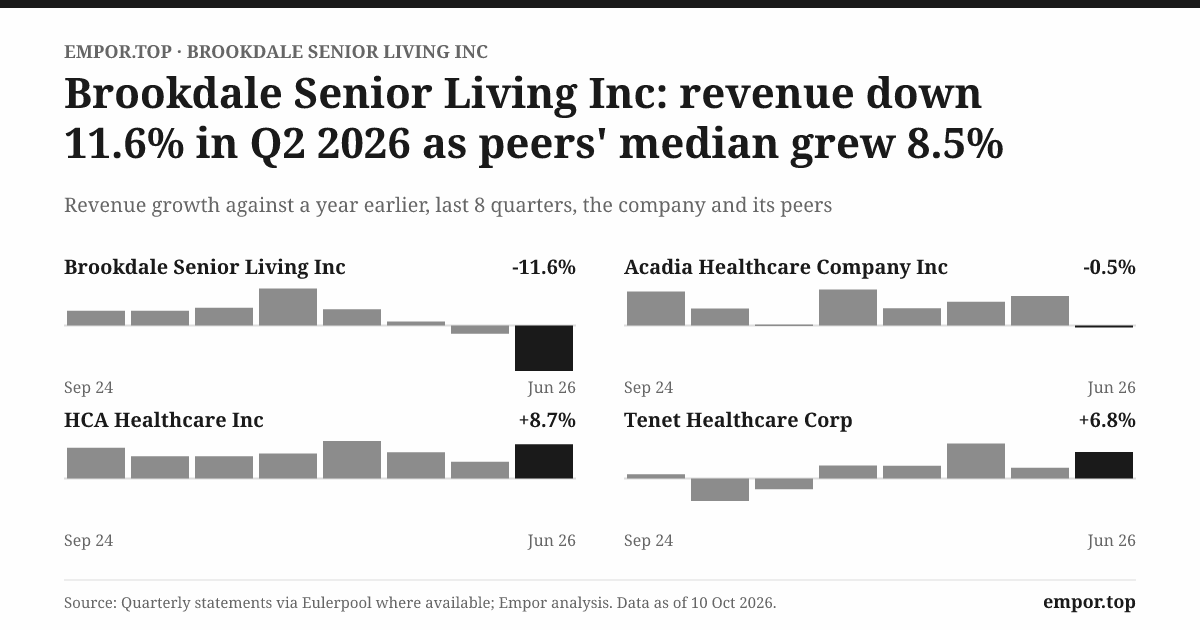
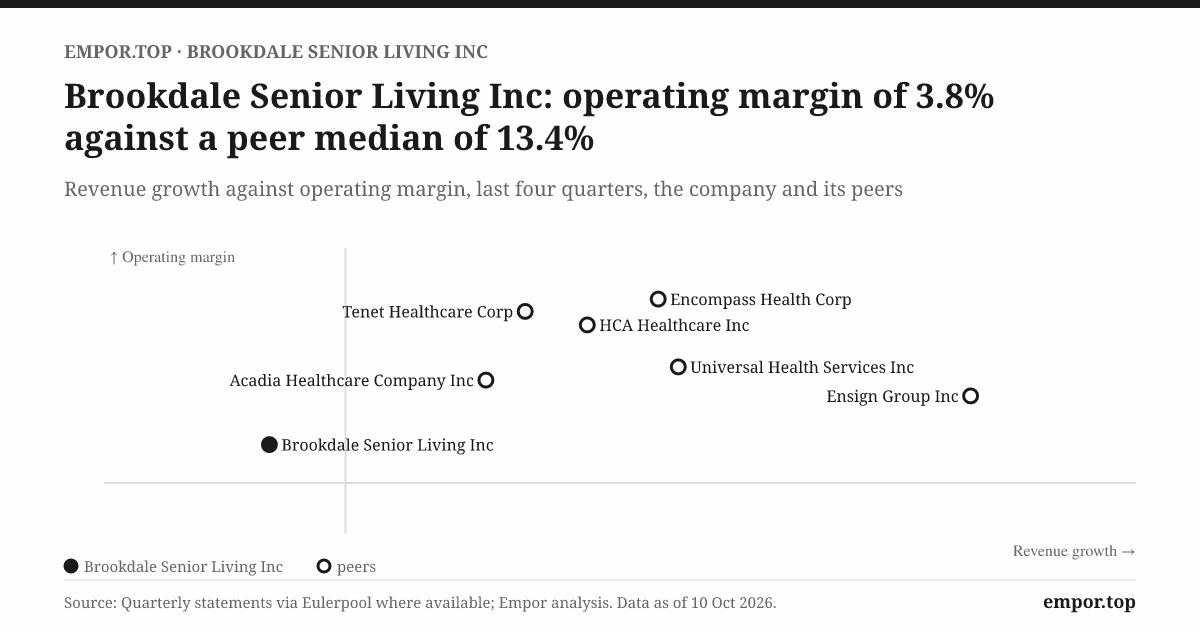
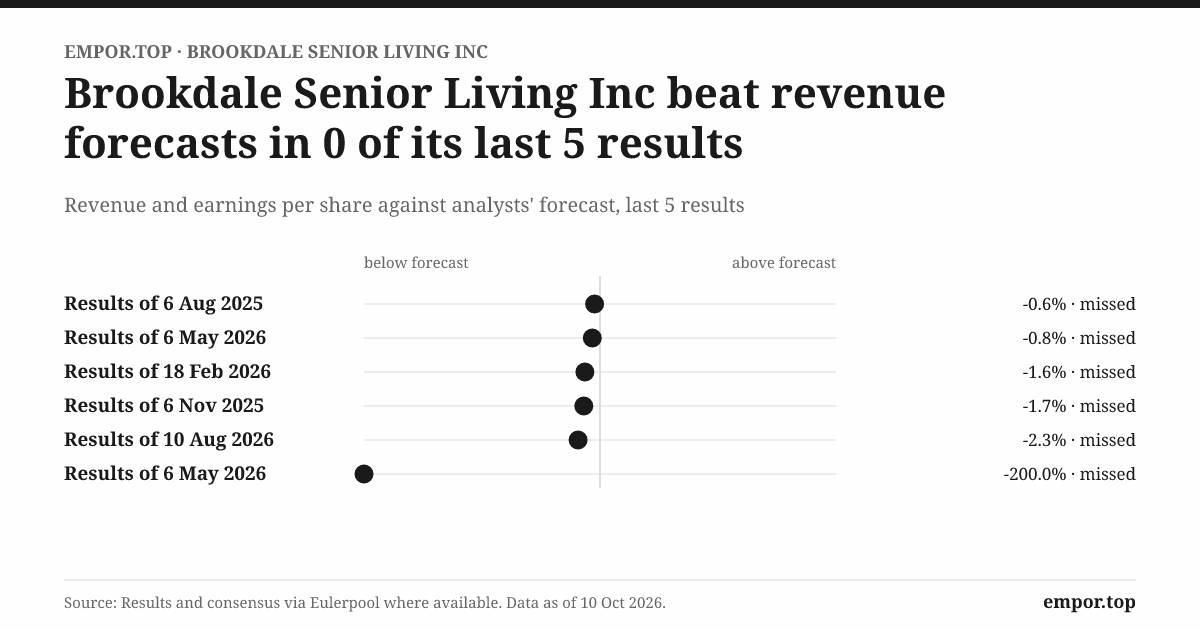
In August 2026, Brookdale reported its second-quarter results, and the headline numbers looked like a different company. Operating profit was about $85 million, up from about $15 million a year earlier, and the operating margin reached 11.9%.513 Net income was positive at about $23 million, after years of quarterly losses.5 For a stock that had lost more than two-thirds of its value at one point over five years, a positive quarter was news.3
The more important number sat further down. The quarter included a pre-tax gain of about $45.4 million from selling 13 communities for about $147.4 million in net proceeds.5 Remove that gain, and operating profit falls to about $40 million, a margin of roughly 5.5%. That is still a real improvement over the low single-digit margins of recent years, but it is half the headline figure. The positive net income disappears entirely without the sale gain. Over the last twelve months, Brookdale still lost about $136 million.3
How the money comes in
To judge which version of the company is real, start with how it earns revenue. About 94.7% of resident fee revenue in the second quarter of 2026 came from private payers, residents and families paying from savings, pensions, insurance and home sales.5 Government programs, mostly Medicaid and Medicare in the company's continuing-care communities with skilled nursing, contributed about 4%.5 That mix insulates Brookdale from reimbursement cuts in Washington, but it ties demand to household wealth and especially to home prices, since selling a house often funds a move-in.
Residents typically sign monthly or one-year agreements and pay at the start of each month.4 The base rent covers the apartment, meals and basic services; personal care, such as help with medication, bathing and dressing, is billed in tiers on top. Rates go up every January, typically by 4% to 8%.4 That annual increase is the clearest sign of pricing power in the business. Average monthly revenue per occupied unit on a same-community basis reached about $6,714 in the second quarter of 2026, up about 4.1% from a year earlier.5 Once a frail eighty-five-year-old has settled into a community, moving them is so disruptive that families generally absorb the increase.
Collection risk is low. Because rent is paid in advance, receivables represented only about eight days of revenue at the end of 2025, and bad-debt expense ran at about $21 million a year, roughly 0.7% of resident revenue.4 Brookdale's customers are not its problem.
Occupancy is the lever
The business's real sensitivity is occupancy. A community needs staff on duty around the clock, a kitchen, heating and cooling, and insurance whether it is 70% full or 95% full. Those costs barely change when a new resident moves in, so each additional occupied unit contributes most of its revenue to profit. Same-community occupancy rose from about 80.2% in 2024 to about 82.9% in the second quarter of 2026.5 That improvement, alongside reduced reliance on agency nurses, is the genuine operational story behind the better margins.
Total revenue, meanwhile, fell about 11.6% in the second quarter compared with a year earlier, to about $718 million.5 That decline is not resident flight; it reflects the communities that were sold or returned to Ventas. The company operated about 42,800 units across 535 communities, down from about 50,800 units across 617 communities a year before.5 Smaller and better is a legitimate strategy, but it means headline margin improvement partly reflects removing the worst buildings from the denominator rather than making the remaining ones better.
Where the cash goes
The final step is turning profit into cash. Brookdale's accounting losses over the years have been driven mostly by non-cash charges: depreciation of around $370 million a year, impairments and losses on refinancing debt.4 That is why the company generated about $2.4 billion of operating cash over twelve years while reporting about $3.3 billion of cumulative losses.3 It would be easy to conclude that the losses are merely an accounting artifact.
They are not, because the depreciation is real. In 2025, operating cash flow was about $218 million and net capital spending was about $171 million.4 Management has guided to net capital spending of $175 million to $195 million in 2026.4 In buildings averaging nearly three decades old, that money goes to roofs, heating and cooling systems, kitchens and refurbished apartments needed to compete against newer communities. What remains after that spending is a sliver, before any repayment of the debt that funds the whole structure. The verdict is that Brookdale's core operations are improving on the metrics that matter, but the 2026 profit headline is largely produced by asset sales, and normalized free cash flow remains thin. The question is what that means for anyone who owns the stock.
IX. Playbook: Business & Investing Lessons
Somewhere in Brentwood, there is a filing cabinet's worth of investor presentations that promised the demographic windfall was coming. Next to them sit financial statements showing an accumulated deficit of about $4.3 billion, buildings averaging 28 years old, and a return on capital employed of about 2.1% over the latest twelve months.43 The distance between those two stacks of paper is the education Brookdale offers.
The first lesson is that demographics are not a business model. The aging of America was always real, and it remains real. But the same charts that persuaded Brookdale to buy Emeritus persuaded developers to build new communities across its markets, and the tailwind arrived as competition before it arrived as profit. A forecast that everyone can see is priced into the supply side of the industry. For investors, the question is never whether demand will grow, but who captures it after rent, wages, interest and new supply. Brookdale's version of the line is simple: ten thousand birthdays a day do not fill a single empty unit.
The second lesson concerns the landlord-operator divide. When Ventas negotiated its 2020 rent relief, it walked away with a warrant at $3.00 a share; when Brookdale needed to shed losing buildings, it had to pay a fee to do so.4 Triple-net leases privatize the downside for the operator and protect the landlord's upside. In a business where labor costs and occupancy swing hard, a fixed and rising rent guarantees that the next bad year becomes a crisis. Founders who sell their real estate to fund growth are buying a bond on the way in and selling an option on the way out.
The third lesson is that scale in senior housing is local, not national. The Emeritus merger created the biggest operator in the country, and its operating margin got worse.3 A company with fifty communities concentrated in a few metropolitan areas can share caregivers, recruit locally and build a referral reputation with hospitals and doctors. A company with five hundred communities spread across dozens of states mostly shares a logo. Brookdale has drawn its own conclusion, concentrating more heavily in places like Texas and Florida while pruning far-flung buildings.4
The fourth lesson is that in physical care, depreciation is not a paper charge. It is the bill for next decade's roof. Brookdale's cash flow statement looks far better than its income statement, and many investors have used that gap to argue the company is cheaper than it seems. The 2025 numbers show how little of that cash survives the capital spending needed to keep old buildings competitive.4
The fifth lesson is that dilution is the stealth cost of avoiding restructuring. Brookdale never filed for bankruptcy, and that preserved its equity. But between warrants and equity units, its share count rose by nearly a fifth over eighteen months.45 The company got through its crisis by giving away a meaningful slice of the recovery. Survival without Chapter 11 is not free; it is paid for in shares. That leaves the question of what those shares are worth now.
X. Analysis & Bear vs. Bull Case
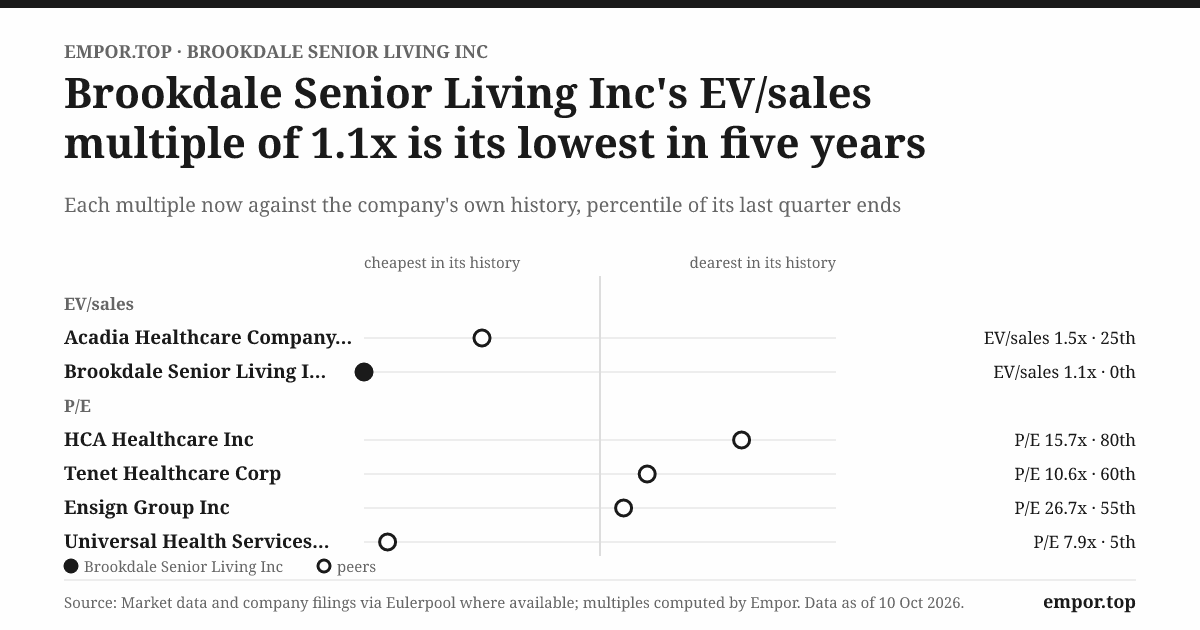
In October 2026, Brookdale's stock trades at $10.12, about 40% below its 52-week high of $16.77.5 The market values the whole enterprise, debt included, at about $3.3 billion, or about 8.4 times EBITDA.5 Healthcare landlords like Welltower and Ventas trade at roughly 18 to 22 times EBITDA, and Sonida Senior Living, a smaller operator that went through its own restructuring, trades at around 20 times or more.141516 On these comparisons, Brookdale is cheap. The question is whether it is cheap for a reason.
Testing the moat
The best place to start is the structure of the industry. Buyers have little power. Brookdale's residents are tens of thousands of individual families, none accounting for even 1% of revenue, and they typically make decisions in an emotional crisis rather than as negotiators.4 That supports pricing. Suppliers, on the other hand, hold real power. Landlords such as Ventas and Welltower set rent and escalators, and the labor market for caregivers sets wages, which during the pandemic surged as agency staffing filled gaps. The threat of substitutes is moderate and growing: home-care aides, remote monitoring and adult day programs allow many seniors to stay at home longer, so that when they move into assisted living they arrive older and frailer. New entrants are deterred mainly by the cost of capital; when rates were low in the 2010s, a wave of new construction showed how quickly they could arrive.
Through Hamilton Helmer's seven powers, Brookdale has one real advantage: switching costs. Moving an eighty-five-year-old with cognitive decline out of a familiar community is traumatic and risky, which is why annual price increases of 4% to 8% stick.4 But that advantage protects existing residents, not new ones; every family choosing a first community can shop freely. Brookdale has no network effects. The Emeritus merger falsified any claim to scale economies. It has no counter-positioning against newer operators, no cornered resource, and no process power evident in its margins. Its brand helps marginally in referrals but has not commanded a price premium visible in the numbers. On the evidence, the moat is real only at the bedside, which means it limits churn but does not protect growth or returns.
The case for recovery
The bull case begins with supply and demand. Americans over eighty are a fast-growing group, and new senior-housing construction has slowed sharply since interest rates rose, according to industry tracking.2 If demand keeps growing while few new buildings open, occupancy and pricing should rise across the industry. Brookdale has the most units to fill. Its occupancy, at about 82.9%, sits several points below historical highs in the mid-to-upper 80s.5 Because each additional occupied unit carries mostly fixed costs, every point of occupancy should translate into tens of millions of dollars in additional cash flow at today's rates, though Brookdale does not publish a precise sensitivity.
The bull case also argues that the balance sheet is less dangerous than it looks. Nearly 90% of the debt is non-recourse property mortgages, many with government-sponsored agency lenders that have continued to finance senior housing.4 No single loan can bring down the company, and the buildings themselves carry value that may well exceed their depreciated carrying amounts. The company also held about $370 million of cash in June 2026, plus investments and restricted cash, for liquidity of around $460 million.5
The case against
The bear case starts with the calendar. Brookdale has about $668 million of debt maturing in 2027, about $929 million in 2028 and about $824 million in 2029, for roughly $2.42 billion in three years.4 Some of the 2028 total has extension options.4 Against that, the company generates operating cash flow of about $200 million a year and spends nearly all of it on capital projects.4 There is no organic cash to repay principal. Every maturity must be refinanced or met with asset sales.
Refinancing carries a second risk: price. Much of the fixed-rate debt carries rates below 5%.4 If it rolls over at higher prevailing rates, interest costs could rise by tens of millions of dollars a year, eating the operating gains the company has worked to achieve. And the third risk is physical: an aging portfolio requires rising capital spending to stay competitive. If Brookdale under-invests to conserve cash, residents will gradually choose newer competitors. If it invests fully, little cash will remain for debt reduction.
Three numbers to watch
Weighed together, the evidence puts the investment case in a narrow channel. Brookdale has switching costs but no structural moat, and its return on capital, about 2.1%, is far below its cost of borrowing.3 Its book value is slightly negative, at about minus $0.12 a share.3 The stock's low multiple reflects the debt wall, and the outcome rests on two things the company can only partly control: refinancing terms and industry occupancy.
Three numbers will decide it. The first is same-community occupancy, now about 82.9% and rising; the company likely needs to reach the mid-80s before free cash flow becomes meaningful.5 The second is the spread between growth in revenue per occupied unit, about 4.1% in the second quarter, and growth in operating cost per unit, especially wages.5 The third is the interest rate Brookdale achieves on the $668 million maturing in 2027.4 Those first refinancings will tell investors what the next three years will cost, and that is where the story turns to the future.
XI. Epilogue
Over the coming months, Nikolas Stengle and Dawn Kussow will spend much of their time with lenders: Fannie Mae, Freddie Mac and the banks and insurers that hold Brookdale's mortgages. The company's debt due in 2026 is small, about $71 million, and the convertible notes due in October are minor.4 The meetings that matter are about 2027 and beyond.
Tonight, the company stands in a better position than at any time since before the pandemic. Same-community occupancy is about 83% and rising, revenue per occupied unit is growing about 4% a year, the worst leases are gone, and quarterly operating profit is positive even without the gains from asset sales.5 Investors have noticed, cautiously. The stock has rebounded from its 52-week low of $8.59 but remains well below its high.5
The next moments will decide the story. The first is the 2026 annual report, which will show whether full-year operating margin stays above about 5% once gains on property sales are removed. If it does, the improvement in the second quarter will look like the start of a trend. If it slips back to the low single digits, the market will conclude that the quarter was mostly a property transaction. The second is the announcement of 2027 refinancings. A smooth extension at rates near current levels would ease the most immediate pressure on the equity; a deal that requires paying down principal with asset sales or new shares, or that costs significantly more, would show that the debt wall still controls the company. The third is labor. If caregiver wage inflation stays within the range of resident rate increases, roughly 4% to 5%, margins can continue to widen. If wages run ahead, the gains disappear.
The tension that remains is the one that has followed Brookdale since its IPO. The company has negative book equity of about minus $0.12 a share and more than $4 billion of debt.34 It now owns most of its buildings and has improved its operations. But until its cash flow outruns its capital spending and interest by a wide margin, the first claim on every dollar it earns belongs to someone other than shareholders. Whether that ever changes is a question the next three years will answer.
XII. Outro
Picture a sixty-bed memory-care community in suburban Dallas at sunrise. A caregiver sets out breakfast. A nurse moves from room to room with the medication cart. A daughter signs in at the front desk to visit her father before work. Nothing about the morning shows the mortgage, the escalator in the lease, or the refinancing schedule. Yet those documents determine whether the community will be repainted next year, whether its staff will get raises, and whether the company that runs it will still own it in 2030.
Twelve years after the Emeritus merger promised a national empire, Brookdale has cut its footprint roughly in half to survive. It still employs about 33,000 people and houses tens of thousands of residents in about 42,800 units.45 The work they do requires patience, high staffing and continuous reinvestment, which are almost the exact opposite of what financial engineering is designed to deliver. Brookdale's story is what happens when a vital human service is built inside a capital structure that treats demographic need as an easy trade.
Brookdale proved that America could add ten thousand sixty-five-year-olds every day and still build a business where nearly every dollar of operating cash flow belonged to the building's lender.
References
-
Brookdale Senior Living Inc. Form 8-K: Agreement and Plan of Merger with Emeritus Corporation — U.S. Securities and Exchange Commission, 2014-02-20 ↩↩↩↩
-
National Investment Center for Seniors Housing & Care (NIC) MAP Data Service Research — NIC Research ↩↩↩
-
Brookdale Senior Living Inc. Investor Relations Landing Page — Brookdale Senior Living Inc. ↩↩↩↩↩↩↩↩↩↩↩↩↩↩↩↩↩↩↩↩↩↩↩↩↩↩↩↩↩↩
-
Brookdale Senior Living Inc. Annual Report on Form 10-K for the Year Ended December 31, 2025 — U.S. Securities and Exchange Commission, 2026-02-19 ↩↩↩↩↩↩↩↩↩↩↩↩↩↩↩↩↩↩↩↩↩↩↩↩↩↩↩↩↩↩↩↩↩↩↩↩↩↩↩↩↩↩↩↩↩↩↩↩↩
-
Brookdale Senior Living Inc. Quarterly Report on Form 10-Q for the Period Ended June 30, 2026 — U.S. Securities and Exchange Commission, 2026-08-10 ↩↩↩↩↩↩↩↩↩↩↩↩↩↩↩↩↩↩↩↩↩↩↩↩
-
Brookdale Senior Living Inc. Current Report on Form 8-K: CEO Succession and Nikolas Stengle Appointment — U.S. Securities and Exchange Commission, 2025-10-06 ↩↩↩
-
Brookdale Senior Living Inc. Registration Statement on Form S-1/A — U.S. Securities and Exchange Commission, 2005-11-07 ↩↩↩↩
-
Ventas Inc. SEC Filings Landing Page — U.S. Securities and Exchange Commission ↩
-
Brookdale Senior Living Inc. Current Report on Form 8-K: Ventas Master Lease Restructuring and Renewal — U.S. Securities and Exchange Commission, 2025-10-20 ↩↩
-
Brookdale Senior Living Inc. Annual Report on Form 10-K for the Year Ended December 31, 2024 — U.S. Securities and Exchange Commission, 2025-02-19 ↩
-
Brookdale Senior Living Inc. Definitive Proxy Statement on Schedule 14A for 2026 Annual Meeting — U.S. Securities and Exchange Commission, 2026-04-30 ↩↩↩↩↩↩↩↩↩
-
Brookdale Senior Living Inc. Current Report on Form 8-K: 2026 Annual Meeting Voting Results — U.S. Securities and Exchange Commission, 2026-06-24 ↩↩
-
Brookdale Reports Second Quarter 2026 Results — Brookdale Senior Living Investor Relations, 2026-08-10 ↩
-
Welltower Inc. SEC Filings Landing Page — U.S. Securities and Exchange Commission ↩
-
Ventas Inc. SEC Filings Landing Page — U.S. Securities and Exchange Commission ↩
-
Sonida Senior Living Corporation SEC Filings Landing Page — U.S. Securities and Exchange Commission ↩
 LinkedIn
 WhatsApp
 Reddit
 Hacker News
 Email
Email Kindle
 RSS Feed
 Spotify
 Apple Podcasts
 Amazon Music
 Audible
 YouTube