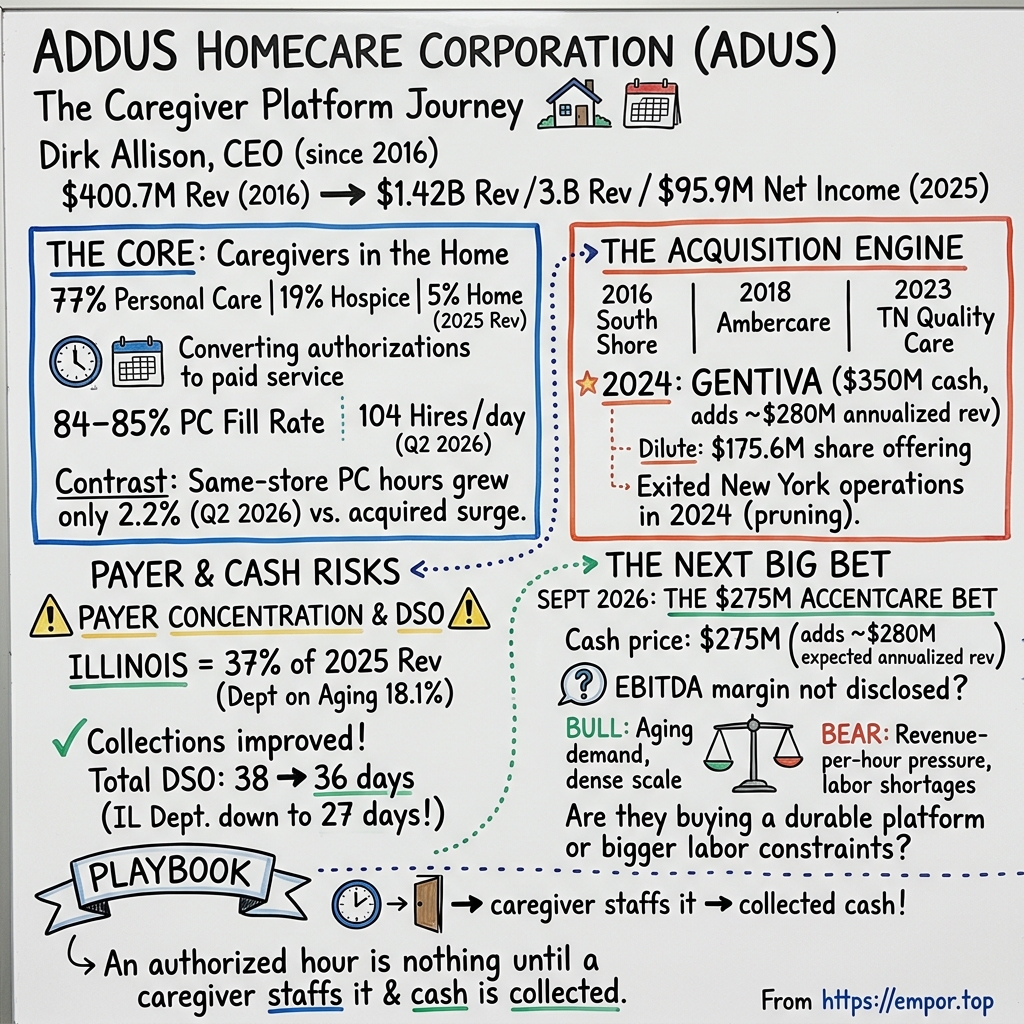
Addus HomeCare Corporation: The Caregiver Platform
I. The $275 Million Bet on Care at Home
On September 12, 2026, a subsidiary of Addus HomeCare signed an agreement to buy something most investors never see: the people who show up at the door. The seller was AccentCare, a Dallas-based provider of home health, hospice and personal care. The buyer was its neighbour up the road in Frisco, Texas. Two days later the deal was public. Addus would pay $275 million in cash for AccentCare's personal-care and community-care business outside New York.1
What Addus was buying had no factory, no patent and almost no inventory. On a typical day it served about 13,700 clients across ten states. Addus said it expected roughly $280 million of annualized revenue from it, which would enlarge its own revenue base by about a fifth.2 AccentCare was keeping its hospice and home-health operations. Laura Tortorella, AccentCare's chief executive, called Addus "the ideal home" for the people she was handing over.2 For AccentCare the logic was focus. For Addus it was density: more clients, more caregivers, more counties where one company could be the provider a state program or health plan calls first.
Addus is not a subsidiary of anyone. It is the listed parent, on the NASDAQ Global Select Market, and its accounts consolidate wholly owned operating companies such as Addus HealthCare, Inc., which signed the AccentCare agreement.13 No controlling family, sponsor or multinational sits above it. So when Addus spends $275 million, the risk lands on public shareholders and nobody else.
The timing made the bet interesting. In 2025 Addus grew revenue 23.2%, to about $1.42 billion, but most of that came from absorbing Gentiva's personal-care operations the December before.3 In the first half of 2026, once that deal stopped flattering the comparison, growth slowed to 7.8%.4 The second quarter looked healthy enough: revenue of $377.4 million, up 8%, and an adjusted EBITDA margin of 13.0%.5 Still, the AccentCare announcement came just as the company's own engine was showing its natural speed, and that speed was a lot slower than the acquisition years made it look.
That slower speed is the first stake in this story. When a company buys its growth, investors have to separate two machines: the one that wins new hours in markets it already serves, and the one that adds markets by writing cheques. The second machine is easy to see in a press release. The first only shows up in quarterly operating data, and it is the one that decides whether the deals were worth doing.
The second stake is labor. Addus had 50,659 employees at the end of 2025, and 49,948 of them were caregivers and agency staff. Only 711 worked in the support centre.3 Care at home costs far less than a nursing facility, so state Medicaid programs and managed-care plans want more of it. But every hour Addus bills depends on a person who could just as easily work for a rival agency, a hospital or a warehouse, and whose wage the company does not fully control. Payors set the price, workers set the supply, and Addus earns its margin in the gap between them.
The third stake is the deal itself. AccentCare's purchase price is public. Its margins, its client-retention record and the cost of integrating it are not.1 The agreement has no financing condition and no termination fee in either direction. It still needs regulatory approvals and the end of the federal antitrust waiting period before it can close.1 As of late October 2026, the deal was signed but not done.
So the question hanging over Addus is simple to state and hard to answer. Is the company buying a durable national platform, where each new market makes the next one cheaper to serve? Or is it buying a bigger version of the same constraints: state budgets, managed-care bargaining, and a workforce that has to be rehired again and again? To answer it, start with what actually happens when a family calls for help.
 Subscribe on LinkedIn
II. The Business Has to Put a Caregiver in the Home
Picture an elderly woman in suburban Illinois who can no longer bathe safely or cook for herself. She does not hire Addus the way she would hire a plumber. More often a state program, in Illinois usually the Department on Aging, or a Medicaid managed-care plan, assesses her and authorizes a set number of hours of help each week. Addus is then responsible for finding a caregiver, scheduling the visits, sending someone through her door, recording that the visit happened, and billing the payor.3 The authorization is a promise of revenue. It becomes revenue only when a caregiver actually works the hours.
That chain is the heart of personal care, the biggest of Addus's three businesses. Personal care is paid mostly by the hour, at rates set by contract or by law, and the company describes it as long-term, continuous care.3 It is not clinical medicine. It is help with bathing, dressing, meals and getting through the day, the things that let a frail person keep living at home instead of moving into a facility. Contracts with state and local agencies usually run for one to two years, can be ended on 60 days' notice, and are typically renewed for one to five years if the provider meets program requirements.3
Hospice runs on a different meter. Medicare and other payors pay a daily rate that depends on the level of care, so a hospice patient is worth a set amount per day rather than per hour of a caregiver's time.3 Home health, the third business, is episodic: skilled nurses and therapists treat a patient after a hospital stay or during an acute illness, and the work is short-term and intermittent rather than continuous.3
The revenue mix shows where the economics sit. In 2025 personal care brought in about $1.09 billion, roughly three-quarters of the company's revenue. Hospice contributed about $263 million, nearly a fifth. Home health was about $71 million, around 5%.3 Addus is mainly a personal-care company with a meaningful hospice business attached and a small home-health operation beside it. The second quarter of 2026 looked much the same, with personal care at about 78% of revenue.5
The two big businesses earn very differently. Personal care's segment operating margin was 19.0% in 2025, down from 20.4% a year earlier.3 Hospice carries far higher gross margins, 45.2% in the first half of 2026, though that was down from 47.7% a year earlier, partly because of a roughly $3 million accrual under Medicare's hospice payment cap, mostly in Ohio.45 Hospice margins are attractive and closely regulated. Personal-care margins are thinner, but personal care supplies the volume, the payor relationships and most of the workforce.
The hospice cap deserves a plain-English explanation, because it shows how Medicare limits a profitable business. Medicare pays a hospice a daily rate for every day a patient is enrolled, but caps the average total it will pay per patient in a year. A hospice that admits patients too early, or keeps them too long, can find that it owes money back. So hospice growth is good only if the mix of patients and lengths of stay stays within the federal formula. In the second quarter of 2026, Addus's same-store hospice average daily census rose 6.5% to 3,964 patients, and the median length of stay lengthened from 22 to 24 days.5 That is healthy volume, and it is also the reason a cap accrual appeared. Management said it expected no further cap exposure for the rest of 2026.5 Hospice, in short, is a high-margin business whose margin depends on a regulator's arithmetic.
The constraint is staffing, and management says so directly. On the second-quarter 2026 call, CEO Dirk Allison said the company's "biggest issue of growth, organic growth, in most markets relates to the caregivers," not patient demand.5 Addus hired about 104 caregivers per business day that quarter, roughly the same pace as a year earlier. The consolidated personal-care fill rate, the share of authorized hours the company actually staffed, was about 84% to 85%, up from the low 80s.5 In other words, about one authorized hour in seven still went unstaffed.
Management's own ceiling is revealing. The finance team called a consolidated fill rate in the upper 80s a reasonable near-term target, and said that once "you start thinking about 90%+, that probably gets to be pretty difficult."5 Demand is not the bottleneck. The supply of people willing to do demanding, modestly paid work in strangers' homes is. That supply is also partly organized: about 34.5% of Addus's workforce is unionized, mainly under agreements with the Service Employees International Union that are renegotiated periodically.3
A crowded field with powerful buyers
Addus competes in a fragmented market. Every metropolitan area has local agencies, and there are a handful of larger multi-service operators. The public peers investors usually compare it with, Aveanna, BrightSpring and Pennant, all have different business mixes. Aveanna leans on private-duty nursing, BrightSpring combines pharmacy with provider services, and Pennant pairs home health and hospice with senior living.6 Addus's roughly $1.4 billion of revenue makes it a scaled personal-care operator, but comparing segment mixes across those companies does not tell you who has the better personal-care business.
The industry's structure sets the bargaining terms. On one side are buyers that hold most of the leverage: state agencies that set rates in their budgets and managed-care plans that negotiate them, and both can contract with several providers at once. On the other side is a workforce that can choose among employers, often for similar pay. Between them, Addus gains from scale in recruiting, compliance and billing, and from the local relationships that come with being an established provider. What the company does not publish is the kind of data that would prove a hard moat: client retention, switching rates between agencies, or win rates when a plan reassigns members.
Addus describes itself as a one-stop home-care partner, and the claim deserves a closer look. The company offers all three levels of care, personal care, home health and hospice, in Ohio, Tennessee, Illinois and New Mexico.3 Elsewhere it mostly offers personal care alone. Being able to serve a client as she moves from daily help to skilled care to end-of-life care is a real advantage with managed-care plans that want fewer vendors. But the proof would show up in referrals between segments, same-store hours and payor relationships, and Addus does not report cross-segment referrals. For now, "one-stop" describes a footprint in four states, not a measured advantage across 23.
Software matters here, but not in the way it does in most industries. No app can bathe a client. What technology can do is make the work around the visit cheaper and more reliable. Electronic visit verification, which states now require, records when a caregiver arrives and leaves, much like a digital timecard checked against the client's address. Addus's caregiver app lets workers pick up open shifts and see their schedules. By mid-2026 more than 90% of Illinois caregivers had downloaded and were using it, and management credited the Texas rollout with lifting that state's fill rate into the upper 80s, ahead of schedule.5 That is the right test for any technology claim at Addus: does it fill more hours, keep caregivers longer, or cut administrative cost? On the first, the early evidence is encouraging. On the others, it is still mostly anecdote.
What Addus sells, then, is coordination: turning a government authorization into a staffed hour and a staffed hour into a paid claim. Its edge is the reach and operating machinery to do that across many markets and more than one level of care. That machinery was largely built, and bought, under one chief executive.
III. The Allison Era Turns a $400 Million Company into a Buyer
The company Dirk Allison took over in January 2016 was already old. Addus began in 1979 as a home-care provider in Illinois and went public in 2009.7 Allison was not new to it either: he had joined the board in 2010, and he moved into the chief executive's office after a career that read like a tour of American healthcare services.8
He was a certified public accountant by training. Before Addus he was chief financial officer of Odyssey HealthCare, a hospice operator, and of Omniflight, an air-medical company, and held senior finance roles at Ardent Health Services and Renal Care Group. He then ran CCS Medical and Correctional Healthcare Companies as chief executive.8 He also sat on the board of Curo Health Services from 2013 to 2015.8 Remember that name, because Curo's personal-care business would later become the largest acquisition of his tenure. Four months after he arrived, Brian Poff became chief financial officer, a role he still held a decade later.8 Poff's résumé had its own foreshadowing: earlier finance and controller roles at AccentCare and Gentiva.8 The two people who would negotiate Addus's biggest deals had spent years inside the companies they would buy from.
The starting point was modest. In 2016 Addus reported about $400.7 million of revenue and $12.0 million of net income, about three cents of profit per dollar of sales.[^9] It was a regional personal-care business, heavily dependent on Illinois, with thin margins and a narrow service line.
Allison's turn was to make Addus a buyer. In 2016 it acquired South Shore Home Health Services in New York, adding personal-care density in a large Medicaid market.9 Then came the move that defined the strategy. In early 2018 Addus agreed to buy Ambercare, an Albuquerque-based provider with about $57 million of revenue, 15 locations across New Mexico and about 2,600 clients, for $40 million, which the company put at seven to eight times trailing EBITDA.10 Ambercare offered personal care, hospice and home health. Combined with an earlier New Mexico acquisition, Allison said it would make Addus "New Mexico's leading provider of both personal care and hospice."10 For the first time, Addus had all three levels of care in one state.
Ambercare is worth pausing on because it is the cleanest early test of the strategy. Addus paid about seventy cents per dollar of Ambercare's revenue, and it funded the deal from a delayed-draw term loan rather than new shares.10 New Mexico later became Addus's third-largest state, at about 13% of 2025 revenue, and one of the four states where it offers personal care, hospice and home health together.3 Its census was growing again by 2026.5 Eight years on, that is about as close to a visible success as a consolidator's record allows: a moderately priced deal in a state where the company stayed, grew and built the multi-service model it now describes as its advantage. It is also a small deal by today's standards, and its success does not automatically carry over to purchases many times larger.
That deal became the template: build personal-care scale, add hospice and home health where the payor relationships justify it, and buy rather than build. By 2023 the price of that template had gone up. When Addus acquired Tennessee Quality Care, a home-health and hospice business, the deal was reported at about 14.8 times EBITDA. That was roughly double the Ambercare multiple and above the 11.3-times median that the advisory firm Stout found for platform deals in the sector over a decade.6 Clinical businesses cost more than personal care, and buyers paid up for them.
Then came Gentiva. In December 2024 Addus closed its purchase of the personal-care business of Curo Health Services, the company Allison had once helped govern, which operated under the Gentiva name.3 It was the largest deal in Addus's history, and the next part of this story is devoted to it.
The arc that results is striking. Revenue rose from about $400 million in 2016 to $1.423 billion in 2025, roughly three and a half times. Net income rose about eightfold, to $95.9 million.[^9]3 Margins widened as overhead was spread across a much bigger base. Nearly all of that record belongs to the current chief executive.
What the record proves, and what it does not
The record has a caveat built into it, because acquisitions change what the numbers mean. The fairest version of the claim that Addus is a disciplined consolidator is that it has bought many businesses without obvious accidents. The 2025 annual report records no goodwill impairment for 2023 through 2025.3 But that window is short, and goodwill on the balance sheet stood at about $997 million at the end of 2025, against total assets of about $1.44 billion.3 More than two-thirds of everything Addus owns is the accounting residue of prices paid above the book value of acquired businesses. A clean impairment record says those businesses have not visibly failed. It does not say they earned their cost of capital, and Addus does not publish return on invested capital by acquisition.
The best counterexample to an unbroken expansion story is New York. The state where Allison made his first acquisition became the one Addus left. In May 2024 the company agreed to sell its New York operations for up to $23 million, half of it contingent, after concluding they "no longer fit its growth strategy" amid uncertainty over the state's consumer-directed personal assistance program.3 Addus deconsolidated the business in October 2024 after more than half its clients and caregivers had moved to the buyer, and booked a $3.7 million gain.3 On the second-quarter 2026 call, management called New York the hardest state in which to operate profitably.5 Leaving was arguably sound judgment. It was also a reminder that a market bought for density can be undone by a single state's policy.
So the Allison record supports a narrower claim than "disciplined consolidator." It shows a team that can find, close and integrate deals, that will walk away when a market turns hostile, and that has turned a regional business into a national one. What it has not yet shown, in data investors can check, is that each deal earned an attractive return. As the deals get bigger, the question shifts from whether Addus can close them to whether the hours inside them grow after closing.
IV. The Care Hours That Make Growth Real
Every personal-care hour Addus bills passes through five gates. A caregiver has to be recruited, screened and trained, then scheduled against a client's authorized hours, then show up and deliver the care. The visit then has to be recorded electronically. Only then can Addus bill the payor and, eventually, get paid.3 A failure at any gate means an authorized hour goes unbilled. At Addus's scale, a single point of fill rate is worth millions of dollars a year.
Management's second-quarter 2026 figures offered some good news. Hiring and fill rates remained strong, and turnover was slightly lower, which management partly credited to the caregiver app.5 On a sequential basis, census, the number of clients served, rose 1.2%, and management said it was aiming for year-over-year same-store census growth in the second half.5
Then the sobering number. Same-store personal-care hours, from operations Addus has owned for more than a year, grew only 2.2% year over year in the second quarter. That sat within management's own 2% to 2.5% target range.5 In other words, the company's own target for organic volume growth is a low single-digit rate. Anyone who looked only at the 23.2% revenue growth of 2025 and assumed the engine ran that fast was looking at the acquisition machine, not the operating one.
The arithmetic of a lower rate
The 2025 numbers make the point plainly. Personal-care billable hours rose 36.3% for the year, but revenue per billable hour fell 6.4%.3 Addus attributed much of the lower rate to the Gentiva and Helping Hands acquisitions, which came with lower reimbursement rates than the legacy business.3 Hours went up by more than a third, the price of each hour went down, and revenue grew by less than volume. In plain terms, Addus bought a lot more hours at a lower average price.
The same-store figures show the other side of that mix effect. In the first half of 2026, same-store personal-care revenue grew 6.8% while same-store hours grew 2.2%.5 The gap, roughly four to five points, is the rate the company earned per hour in markets it already served. That came from state rate increases such as a 9.9% reimbursement enhancement in Texas that took effect in late 2025, and from mix.5 So the rate decline was mostly a consolidation effect. On a like-for-like basis, Addus was getting paid more per hour, not less.
The question is whether those higher rates stay with the company or pass through to wages. Payors often raise rates precisely so providers can pay caregivers more, which means a rate increase can be margin-neutral by design. Addus says inflation has raised its operating costs, "particularly as the result of increased wages we have paid and may continue to pay our caregivers."3 And personal care's segment operating margin fell from 20.4% to 19.0% in 2025.3 Some of that decline is mix, because acquired businesses with lower rates dilute the average. But Addus does not disclose wage cost per hour or rate per hour by state, so the full margin bridge cannot be rebuilt from its public numbers. Investors are left with endpoints and management's explanation.
State by state, the rate story is uneven, and that unevenness is the real texture of the business. Texas gave a large increase but its census was holding steady rather than growing. Because the Texas legislature did not meet in 2026, any further rate increase would have to come from the 2027 session and would take effect no earlier than September 1, 2027.5 In New Mexico, census turned positive about a year earlier, and management expected a rate increase of roughly 4%, though the final terms were still being negotiated with the managed-care plans that pass state money through to providers.5 On the call, management named Texas as the last major market still working toward year-over-year census growth.5 So each of Addus's three largest states runs on its own budget calendar, its own political process and its own intermediaries. For a company whose revenue is mostly set by government, a rate increase is not a pricing decision. It is a legislative event, and it arrives on the legislature's schedule, not the company's.
There is a policy wrinkle here too. A federal Medicaid access rule includes an "80/20" provision that would require 80% of Medicaid payments for certain home-care services to go to worker compensation. For a business like Addus, that would effectively cap the share of each dollar left for administration and profit. On the second-quarter call Allison said he thought it likely that the provision would be eliminated during 2026, and that implementation was years away in any case.5 That is management's forecast, not settled policy, but it shows how directly a single rule can reach into the personal-care margin.
What would prove that scale is improving the economics rather than just enlarging them? Three things moving together: same-store hours growing, revenue per hour holding or rising on a like-for-like basis, and the personal-care segment margin stabilizing as acquired businesses are integrated. The second-quarter call offered evidence on the first two. The margin has not yet turned. If hours keep growing while revenue per hour and segment margin keep sliding, the scale argument would be in trouble. The test applies first in Illinois, where Addus's dependence on one state agency is greatest.
V. Illinois Sends the Receivable—and the Warning
For a company that operates in more than twenty states, Addus is remarkably dependent on one of them. In 2025 Illinois generated 37.0% of company revenue, down from 43.7% a year earlier as acquisitions elsewhere diluted it. Texas, the next largest, was about 15%, and New Mexico about 13%.3 The single largest payor, the Illinois Department on Aging, accounted for 18.1% of 2025 revenue, down from 21.0%, and 17.8% in the first half of 2026.34
This concentration matters because of who pays. The person receiving care rarely pays for it. Roughly 39% of Addus's 2025 revenue came from state and local government agencies, mainly Medicaid programs, and about 20% from Medicare.3 Much of the rest flows through managed-care plans that administer Medicaid on a state's behalf. The client chooses, or accepts, an agency. The government or its plan sets the price, authorizes the hours, and decides when the cheque goes out.
Illinois has historically paid slowly, and Addus has had to wait. At the end of 2025 the Department on Aging made up about a quarter of the company's receivables, more than its share of revenue, which meant its bills were sitting longer than average.3 Then, in the first half of 2026, Illinois paid down. The department's days sales outstanding, the average number of days between billing and collection, fell from 55 to 27, and its receivable balance dropped by $18.6 million.4 Company-wide DSO improved from 38 days to 36.4 On the call, management put the second-quarter figure at 35.5 days.5 Most of the Illinois improvement came late: management said the state's DSO fell to 26.8 days in the second quarter from 47.4 days in the first.5 One quarter of fast payment is welcome. It is not yet a pattern, and the state's payment speed has always followed the rhythm of its own budget rather than any promise to providers.
That is a clearly favourable outcome. Late payment by a state is not the same as non-payment, and when Illinois caught up, Addus's cash position improved sharply. The allowance for credit losses at the end of 2025 was only $3.3 million, against more than $150 million of receivables.3 Bad debts in the conventional sense are small. Addus does not publish a receivable-ageing table or payor-level collections after the balance-sheet date, so investors cannot see the full distribution of how old the bills are. But the disclosed direction is good, and nothing in the record suggests it is worse than reported.
The more subtle accounting risk lies elsewhere, and the auditor flagged it. The sole critical audit matter in the 2025 audit was the valuation of receivables, net of what accountants call implicit price concessions.3 The idea is this: Addus records revenue at the amount it expects to collect, not the amount it bills. Some claims will be cut or denied because a client's eligibility lapsed, documentation was incomplete, or the service exceeded what was authorized. Estimating that haircut requires judgment about eligibility, documentation, authorized services, historical collections and reimbursement terms.3 A material change in those estimates would flow straight to revenue. The auditor's attention does not mean anything is wrong. It means this is where the judgment sits.
The budget behind the bill
The bigger Illinois risk is the rate, not the collection. On the second-quarter call management noted that Illinois had passed no rate increase in its current budget cycle.5 In a state that supplies more than a third of revenue, a flat rate while caregiver wages rise is a margin squeeze in slow motion. Management said most other state budgets held rates flat or raised them, and that Oregon and Michigan gave increases, but Pennsylvania remained difficult.5
Above the states sits Washington. Stout estimated that the federal budget law known as the One Big Beautiful Bill Act would reduce Medicaid spending by about $900 billion over ten years, and expected that to put pressure on personal-care rates, authorized hours and eligibility.6 Those cuts phase in gradually and will reach states unevenly, but the direction is clear: the main source of Addus's revenue faces tighter funding. When an analyst asked about federal withholding of Medicaid payments from certain states, management said Addus's exposure was limited, since Minnesota was not one of its markets and its California business was mostly Veterans Affairs and private pay.5 The AccentCare deal will change that answer, because it brings operations in both Minnesota and California.2
Managed care adds a second layer of bargaining. A plan that covers Medicaid members in a state can direct volume toward providers it prefers and negotiate rates. Allison said the AccentCare assets would help Addus work with managed-care and value-based care partners.2 Scale makes Addus more relevant to those buyers. It does not make it less dependent on them.
Cybersecurity deserves a brief mention. Electronic visit records, care plans and Medicaid identifiers are sensitive data, and an outage in scheduling or billing systems would stop the five-gate process cold. But for Addus the main near-term risks are less exotic: what states pay, whether caregivers show up, and whether payors pay on time. The Illinois turnaround on receivables was the company's best news of 2026. Its biggest strategic bet, though, was made two years earlier, and the next thing to understand is what Gentiva changed.
VI. Gentiva Made the Acquisition Strategy Bigger
In the spring of 2024, Addus was getting ready for the biggest purchase it had ever made. In June it sold 1.725 million new shares at $108 each, raising $175.6 million after costs.3 It used about $81.4 million to repay debt and kept the rest for general purposes, including acquisitions.3 Five months later it had a use for the money.
On December 2, 2024, Addus closed its acquisition of the personal-care business of Curo Health Services, which operated under the Gentiva name, for about $353.6 million after adjustments to a headline price of roughly $350 million.3 It funded the deal mainly by drawing on its revolving credit facility, along with part of the offering proceeds.3 The board Allison had once sat on was now the seller, and the business he had watched from the board became the largest piece of his own company.
The fit was geographic. Gentiva deepened Addus's personal care in Arizona, Arkansas, California and North Carolina, gave it entry into Missouri and Texas, and added home health in Tennessee.3 Addus bought only the personal-care platform and left Gentiva's hospice and home-health operations with the seller, the same perimeter it would later draw around AccentCare. That says something about the strategy. Addus treats personal care as its core and adds clinical services selectively, not across the board.
What $350 million bought
The first valuation check is simple and easily misused. Gentiva was expected to add about $280 million of annualized revenue, so the price was about 1.25 times revenue.11 But revenue is not profit. A personal-care business with low margins can be expensive at one times revenue, and one with good margins can be cheap at two. Addus did not disclose Gentiva's EBITDA, so the revenue multiple cannot be turned into a profit multiple without guessing.
The sector benchmarks give a sense of the range without settling it. Tennessee Quality Care was reported at about 14.8 times EBITDA, and Stout's decade-long platform median was 11.3 times.6 Those were mostly clinical businesses in different years, so they are a demanding benchmark rather than a verdict. Addus's finance chief has described personal-care multiples as low as four or five times EBITDA for small businesses and perhaps seven to eight times for larger ones, and said that range "really hasn't moved much."6 If Gentiva fell anywhere near that range, the price implied a business earning somewhere in the mid-teens percent margin before overhead, which is plausible but unconfirmed.
The financing had a price too. The share sale increased the share count, so existing owners gave up part of their claim on future profits in exchange for a bigger business with less debt. Whether that trade paid off depends on whether earnings per share grew faster than they would have without the deal, and that is hard to judge two years after closing because Gentiva is now blended into the personal-care segment.
The evidence after closing is mixed. Revenue arrived: personal-care revenue rose by about $233 million in 2025, mostly from acquired operations.3 But revenue per billable hour fell, because Gentiva's markets paid less per hour, and the segment's operating margin dropped by more than a point.3 The integration is still being finished. Management said Gentiva's electronic medical-record system was due to be retired in 2027, yielding about $1 million of savings from eliminating duplicate costs.5 Against a $350 million purchase, that is a small number. The value case for Gentiva never rested on systems savings. It rests on whether those markets grow, whether rates rise, and whether overhead per hour falls as the acquired business is fully absorbed.
The smaller deals since then put Gentiva in proportion. Addus made four acquisitions in 2025, including Helping Hands in Pennsylvania and Gold Horses in Texas. Together they contributed $11.8 million of revenue that year.3 In 2026 it closed HomeCourt Home Care in Fort Wayne, Indiana, and agreed to buy a similar-sized provider near Indianapolis.5 Those are tuck-ins, the kind of deal a company does to fill gaps in a map. Gentiva was the kind that redraws the map.
The New York exit came in the same year Addus bought Gentiva.3 Expansion and pruning happened side by side, which is a sign of a management team willing to exit when the economics break. It is also a sign that the map can shrink when a state decides to change the rules.
By May 2026, management said it was considering two or three deals similar in size to Gentiva.2 Four months later it signed one. Gentiva had not yet given investors a clean answer on returns, and Addus was already asking the same question at nearly the same size.
VII. AccentCare Raises the Price of the Same Question
The AccentCare agreement reads like a list of addresses. Addus HealthCare agreed to buy all of the equity in ten operating entities, including companies called Guardian Personal Care Services, Texas Home Health of America and Nurses Unlimited, along with AccentCare's operations in Arizona, California, Washington, Minnesota and Pennsylvania, plus selected assets of a Colorado business.1 AccentCare's New York personal-care business stayed with the seller. So did its hospice, home health and palliative care, which AccentCare runs from more than 280 locations in 30 states and the District of Columbia.21
By Addus's count, the deal deepens four existing markets, Texas, Illinois, California and Arizona, and adds six new states: Colorado, Georgia, Minnesota, Pennsylvania, Tennessee and Washington.2 Some of those "new" states are not completely new to Addus, which already had home health in Tennessee and had bought a Pennsylvania personal-care business in 2025. They are new to its personal-care footprint at meaningful scale.3 The strategic claim is density with managed-care partners, not diversification. This is Addus doing more of what it already does, in more places.
The price, and what it does not tell you
At $275 million for about $280 million of expected annualized revenue, the price is about 0.98 times revenue, cheaper on that measure than Gentiva's 1.25 times.12 That is not proof of a bargain. A lower revenue multiple can mean a better deal, or a business with lower margins, or both. Addus has not disclosed AccentCare's EBITDA or margins, so it is unclear whether the price sits above or below the four-to-eight-times range management uses for personal-care deals.6 What can be said is that the headline price is not obviously excessive for a business of that size, and that its return case is unproven.
Addus will pay in cash, from cash on hand and its revolving credit facility.1 At the end of June 2026 it had $99.6 million of cash, $64.3 million of bank borrowings, and $577.8 million available under a $650 million revolver that matures on July 30, 2028.4 The company was in compliance with the facility's maximum net-leverage covenant of 3.75 times.4 Management said about $10 million more of revolver debt had been repaid early in the third quarter.5
A rough sketch shows the deal is manageable. If Addus funded nearly all of the price with borrowing, bank debt would end up somewhere around $300 million to $340 million. Against adjusted EBITDA that had been running at about $180 million or more a year, that implies leverage of roughly two times or less, well inside the covenant, before counting any EBITDA from AccentCare itself.34 The balance sheet can carry the purchase.
The cost is flexibility. Every dollar of the revolver is floating-rate, and Addus does not hedge. A one-point rise in rates would have reduced first-half 2026 net income by about $0.4 million on the borrowings then outstanding.4 After AccentCare, the same rate move would cost several million dollars a year in pre-tax interest. More important, capacity used for AccentCare is capacity not available for the shocks this business faces: a state that freezes rates, a managed-care plan that redirects members, or an integration that stumbles.
The agreement's mechanics reduce some risks and leave others in place. There is no financing condition, no termination fee in either direction, and Addus has bound a representations-and-warranties insurance policy that would cover certain undisclosed liabilities.1 Closing depends on regulatory approvals, including the expiry of the federal Hart-Scott-Rodino antitrust waiting period, and other customary conditions, and the agreement did not specify a closing date.1 As of October 24, 2026, the transaction had not closed. Integration will come on top of a systems conversion still in progress: Addus planned to finish moving its legacy personal-care operations onto the Homecare Homebase platform by the end of the first quarter of 2027.5
Management's appetite was not limited to AccentCare. On the second-quarter call, three months before the announcement, Allison said more personal-care sellers were coming to market, and that there was "more optimism around potential deals in skilled home health care," because owners were "now comfortable in considering putting their business up for sale."5 Management also said it wanted to stay disciplined and keep leverage low while pursuing both small and large deals.5 Those two goals pull against each other. Each large cash deal uses capacity that the next one, or the next shock, might need. Allison framed AccentCare as part of a strategy of using the company's personal-care experience to build scale in existing markets and enter select new ones.2 The words are consistent with what Addus has done for a decade. What changes with each deal is the size of the cheque and the amount of integration happening at once.
The timing also lands on a thinner operating bench. In August 2026 Heather Dixon left the company less than a year after becoming president and chief operating officer, and former COO Brad Bickham returned as interim COO for one year.[^13] The person running daily operations during the largest integration in Addus's history is a returning veteran on a temporary assignment.
So a skeptical investor would want four things once the deal closes: AccentCare's revenue and margin as reported inside the personal-care segment, client retention in the first year, integration costs, and net leverage. "Expected annualized revenue" is a starting point, not a result. And since AccentCare will be paid for in cash, it is worth asking how much cash Addus's own business actually produces.
VIII. Profit Arrives as Cash—Then Working Capital Moves It Around
In 2025 Addus reported its best year of profit and a weaker year of cash. Net income rose to $95.9 million, but operating cash flow slipped to $111.5 million from $116.4 million a year earlier.3 For a business with a reputation for converting earnings into cash, that looked odd, and the explanation sits in the timing of money moving in and out.
Over three years the picture is steadier. From 2023 to 2025 net income climbed from about $63 million to about $96 million, while operating cash flow stayed roughly flat at $111 million to $116 million.3 Cash has consistently exceeded profit, but the gap has narrowed as earnings rose.
Where the 2025 cash went
The 2025 cash bridge shows why. Some charges reduce reported profit without using cash, and these added cash back: about $16 million each in depreciation and amortization and in stock-based compensation, and about $18 million of deferred taxes.3 Against that, receivables grew by about $27 million as revenue rose and Illinois paid slowly, and Addus paid down about $13 million of accounts payable.3 More revenue means more bills waiting to be paid, and in a business where payroll goes out every week or two while states pay on their own schedule, growth eats cash before it produces it.
The first half of 2026 reversed that. Operating cash flow reached $92.4 million, more than double the $41.5 million of a year earlier, mostly because of the timing of receipts and payroll payments and the drop in DSO.4 Management was careful not to promise a repeat. It said the first half included about $20 million of working-capital benefit unlikely to recur at the same pace, expected cash flow to moderate in the second half, and guided DSO to stay in the mid-30s.5 That candour is useful. It tells investors the first-half number is partly a catch-up, not a new normal. The second quarter alone produced $40 million of operating cash, up from $22.5 million a year earlier, which shows how much a few weeks of state payment timing can move the figure.5
Taxes are a smaller but real drag on what reaches shareholders. Addus's second-quarter tax rate was 26.9%, and management expected it to stay in the upper 20s because the federal Work Opportunity Tax Credit, which rewards employers for hiring from certain disadvantaged groups and had mattered for a business that hires tens of thousands of entry-level workers, lapsed at the end of 2025.5 Losing a hiring credit is a quiet reminder of how closely this business is tied to federal policy, even beyond Medicaid.
Where the cash goes is just as revealing. Addus spends very little on physical assets. Technology-related property and equipment purchases were $7.7 million in 2025, and internally developed software was $1.3 million.3 Addus does not report research and development separately, so there is no basis for a technology-investment story built on capex alone. Against roughly $1.4 billion of revenue, that capital spending is small. The real investments are caregivers, recruiting and acquisitions. The filings show cash used to pay down debt and buy businesses, and disclose no share buybacks.34
The interest line shows the cost of the acquisition path. Interest expense rose from $7.7 million in 2024 to $13.6 million in 2025 as borrowings increased, while interest income fell from $4.4 million to $2.4 million once offering proceeds were spent on Gentiva.3 Before Gentiva, Addus earned interest on idle cash. After it, Addus paid interest on borrowed money. That swing is the price of growth made visible.
Two smaller items complete the picture. Addus's cash sits with financial institutions and may exceed federally insured limits, and the company does not publish a detailed breakdown of where it holds that cash.3 And the company leases its offices: lease liabilities were $47.2 million at June 2026, down from $50.4 million at year-end.4 Those are real fixed obligations, about three-quarters of the revolver balance at mid-year, but they are rent on a network of around 260 branch offices, not bank debt.
The verdict on cash is positive with an asterisk. Addus does generate cash, and in good periods more than its reported profit. But working-capital timing can move a year's figure by tens of millions of dollars, and much of what the company produces goes back into acquisitions. With so much capital riding on management's choices, the incentives of the people making those choices matter.
IX. The CEO Owns a Stake, but the Board Still Has to Ask Hard Questions
By the spring of 2026, Dirk Allison was 70 years old, had been chief executive for ten years, and had also chaired the board since March 2021.8 He beneficially owned 307,069 shares, about 1.6% of the company, including exercisable options and unvested restricted stock.8 At an October 2026 share price of about $122, that stake is worth tens of millions of dollars.12 He has real money riding on the outcome.
Combining the chair and chief executive roles concentrates authority in one person. The board's counterweight is structure. Every director except Allison is independent under Nasdaq rules, and Mark First has served as lead independent director since October 2022, presiding over executive sessions without management.8 First also chairs the compensation committee.8
The pay plan is built around one number. Annual cash bonuses depend on adjusted EBITDA. For 2025, the target was about $174.5 million. Addus reported about $181.8 million, or 104% of target, including about $1.9 million of New York receivable settlements, and Allison earned a cash bonus of 120% of his base salary.8 Adjusted EBITDA is a reasonable gauge of operating profit, but it has a blind spot that matters for this company: it grows when Addus buys businesses, whether or not the price was good and whether or not new shares were issued to pay for them. A metric that rewards scale cannot by itself tell the board whether acquisitions are creating value per share.
Allison's reported pay jumped to about $12.2 million in 2025 from about $5.5 million in 2024.8 Most of that was stock, not cash: about $9.8 million of the total was the grant-date value of stock awards, including a retention grant of 63,500 restricted shares in March 2025 that vests on its third anniversary.8 A retention grant ties the chief executive to the company through 2028, which happens to span the AccentCare integration. It is also, by design, paid for staying rather than for a specific result.
The same pattern ran through the finance office. CFO Brian Poff's reported pay rose to about $5.7 million in 2025 from about $2.5 million a year earlier, and he too received a retention grant, of 31,750 restricted shares on the same March day.8 The board had evidently decided that keeping the team that built the acquisition machine was worth paying for, ahead of the next large deal. That is a defensible choice. It also means the people who will negotiate and integrate AccentCare are paid heavily in stock whose value depends on that integration going well, which is the alignment shareholders want, as long as the stock reflects returns rather than just size.
Two figures from the same proxy put the pay in context. Addus's median employee was a part-time home-care aide paid about $16,200 a year, and the chief executive's pay was 753 times that.8 And on the proxy's pay-versus-performance measure, $100 invested in Addus at the start of the five-year window was worth about $92 at the end of 2025, compared with about $106 for the peer group.8 Revenue and profit grew substantially over those years, but the share price did not keep pace, so shareholders did not share fully in the operating gains.
Shareholders approved the pay plan comfortably, with some dissent. At the June 2026 annual meeting, say-on-pay received about 15.6 million votes in favour and 1.3 million against, roughly 92% support.13 Director Michael Earley received about 1.44 million withheld votes.13 Those are governance signals worth watching, not signs of a proxy fight. No activist is visible on the register, where the largest holders are index and institutional managers such as BlackRock, at about 15% as of mid-2026.[^16]
The smaller things a diligent board watches
Related-party dealings are small but worth noting. In 2025 Addus paid about $2.0 million to HHAeXchange, a home-care software company whose board includes Addus director Darin Gordon, and about $0.4 million to MetaSource, whose board includes Mark First.3 Together that is roughly 0.17% of revenue, for ordinary-course services. Addus does not disclose how those prices compare with market rates or what balances were outstanding at year-end. The amounts are immaterial. But the lead independent director, who also sets executive pay, sits on the board of a vendor, and that is the kind of overlap a careful governance committee should keep in plain view.
The leadership bench matters more. Heather Dixon, a former chief financial officer of Acadia Healthcare and former chief accounting officer at Walgreens Boots Alliance and Aetna, moved from Addus's board to become president and chief operating officer in September 2025, with a $3.1 million restricted-stock grant.8 By August 2026 she had left, and Brad Bickham, whose earlier retirement had accelerated his unvested awards that March, returned as interim COO for a year.[^13]8 A high-profile succession hire leaving within a year, just before the largest integration in the company's history, is a real execution risk. It also leaves open who will eventually succeed a 70-year-old chief executive.
The audit record, by contrast, is clean. The 2025 auditor issued unqualified opinions on both the financial statements and internal controls, with no material weakness, and receivable valuation was the only critical audit matter.3 Management described pending legal and administrative matters as incidental and not expected to have a material effect, and repeated that in the second quarter of 2026.34 The filings identify no material tax demand. All of Addus's income is domestic, so currency risk does not apply. The market exposures that matter are floating-rate debt and Medicaid reimbursement.3
Put together, management's incentives are real but incomplete. Allison has a meaningful stake, the board has independent structure, and the auditors have no concerns. What the pay plan does not do is measure whether each acquisition earns more than it cost per share, and that is the question the AccentCare deal puts most sharply. It is also the question the stock price is trying to answer.
X. Analysis & Bear vs. Bull Case
At the close on October 23, 2026, Addus shares traded at $121.81, giving the company a market value of about $2.2 billion. Bank debt, net of cash, was close to zero.12 The stock traded at about 21.3 times trailing earnings and about 16.9 times expected forward earnings.12 On reported EBITDA, the enterprise value was about 14 times trailing.12 Stout's July 2026 snapshot, measured on a different basis and at a lower share price, put Addus at about 9.5 times trailing and 8.5 times forward EBITDA, compared with about 8 times for Aveanna and more than 20 times for both BrightSpring and Pennant.6 Kinderhook Industries' take-private of Enhabit earlier in 2026 was priced at about 10.7 times EBITDA.6
Those numbers say the market is not paying for a high-growth story. Investors are pricing Addus well below the multi-service operators it is often compared with and roughly in line with the private-equity value of a home-health business. The forward multiple assumes earnings keep growing, through organic gains, rate increases and acquisitions. It does not assume a big jump in margins or a premium for any special advantage. Put simply, the market is paying for a well-run consolidator, not a platform with a moat.
The gap between the trailing and forward earnings multiples is itself a clue. A move from about 21 times to about 17 times implies that the market expects earnings per share to rise by roughly a quarter over the coming year.12 Management's own guidance pointed to a full-year adjusted EBITDA margin toward the high end of a 12% to 13% range.5 The organic business alone is growing in the high single digits, so part of the expected growth has to come from margin gains, from AccentCare, or from both. In other words, the current price already assumes that the next deal works. That does not make the price high or low. It means the stock is sensitive to exactly the numbers Addus has not yet disclosed.
The case for Addus
The bull case starts with demographics and cost. Addus serves about 62,500 people through about 264 locations in 24 states.2 Recent operating gains support the case: same-store personal-care revenue grew 6.8% in the first half of 2026, fill rates rose, and Illinois and New Mexico census was growing again.5 Hospice same-store revenue grew 11.1%, with average daily census topping 4,000 patients in July.5 Receivables improved and leverage was low before AccentCare.4 If AccentCare adds density in managed-care markets at about one times revenue, the bulls argue, Addus becomes the default personal-care partner for more plans in more states, and margins expand as overhead spreads.
The case against
The bear case turns on the constraints already visible: low-single-digit organic volume growth5, acquired hours diluting revenue per hour and margin3, Illinois concentration and rate pressure35, coming Medicaid cuts and caregiver supply65, the COO departure and pending integration[^13], and shareholder underperformance over five years despite operating growth.8 In that reading, the payors and the workforce capture most of the value Addus creates, and acquisitions add revenue faster than per-share value.
Weighing the forces
Michael Porter's five forces help sort these arguments. Buyer power is the dominant force: states and managed-care plans set or negotiate rates and authorize hours, as Illinois's revenue share and payment history illustrate.34 Supplier power, here the power of labor, is high too: caregivers are scarce, partly unionized, and free to work elsewhere.35 Rivalry is fragmented, which favours a scaled operator in recruiting and compliance, but local agencies remain numerous and plans can play them against one another.6 Substitutes include family caregivers, institutional care and consumer-directed programs, where the client hires a caregiver directly; New York's program shows how policy can shift that balance.3 A newer substitute is growing at the clinical end: Stout counted 370 hospitals across 139 health systems in 37 states approved to deliver hospital-level care at home, under a federal waiver extended through 2030.6 That model competes more with home health than with personal care, and technology has spread slowly in the field, since only 14% of home-health agencies reported offering any telehealth.6 The threat to Addus is less that software replaces a caregiver than that hospitals and payors decide to own more of the care that happens in the home. Barriers to entry come mostly from licensing and payor contracting. A new federal moratorium on enrolling new home-health and hospice agencies, effective May 2026, raised those barriers for clinical services and made existing licences more valuable.6
Hamilton Helmer's seven powers set a stricter test. Addus has scale economies in a modest form: spreading recruiting, technology, compliance and billing over more hours lowers cost per hour, and G&A fell as a share of revenue in 2025 and again in the second quarter of 2026.34 It has process power in its recruiting and scheduling machinery, but rivals can copy that with enough effort. Evidence for switching costs is thin, since clients and plans can change providers and Addus discloses no retention data. Network effects, counter-positioning, branding and a cornered resource are not visible in the public record. The honest description of Addus's moat is operating density and relevance to payors, which is real but still has to be proven in retention figures and unit economics.
The competitive landscape is also changing above Addus. UnitedHealth's Optum completed its $3.3 billion acquisition of Amedisys in August 2025, after agreeing with the Justice Department to divest 164 home-health and hospice locations.14 Optum competes mainly in clinical home health and hospice rather than personal care, but it shows that the largest payors are also building their own providers. Addus does not report its market share in personal care, so the claim of leadership rests on footprint rather than share.
Three numbers will decide which case wins. The first is same-store personal-care hours: 2.2% growth in the second quarter, at the low end of the 2% to 2.5% target, with fill rates improving.5 The second is personal-care revenue per hour against caregiver cost, best seen through the personal-care segment margin, which fell from 20.4% to 19.0% in 2025 even as same-store revenue per hour rose.35 The third is DSO and receivable quality, now about 36 days and improving, especially in Illinois.4 After AccentCare closes, acquired-business margins and net leverage will join that list.
A skeptical long-term investor would put one question to the board. If the largest payor relationships are only partly visible, and the returns on acquisitions are not disclosed, should the next dollar go to raising fill rates in existing markets, to another large deal, or to keeping balance-sheet capacity in reserve? Addus has chosen deals. The burden is on management to show that choice paid off, and the answers will shape the lessons this story leaves behind.
XI. Playbook: Business & Investing Lessons
The first lesson is about the empty shift. Addus's fill rate still leaves authorized hours unworked, despite its hiring pace.5 Demand was never the constraint. People are. For anyone building a service business on government authorizations, the market is not the number of authorized hours. It is the number of hours you can staff. A home-care platform is only as large as the hours it can actually staff.
The second lesson is about what averages hide. The mix effect was visible in 2025: acquired markets pulled down average revenue per hour while same-store rates were rising.3 Both facts were true at once. A consolidator can report record revenue while its typical hour gets cheaper, and only a mix analysis tells you whether the business is getting better or simply bigger. A bigger revenue base can hide a lower rate per hour.
The third lesson is about the word "accretive." Addus said AccentCare would add earnings, and at about one times revenue the arithmetic may well work.12 But adding earnings is easy when you buy a profitable business with cheap debt. Whether the deal creates value depends on margins, retention and integration costs that will only appear after closing. Gentiva still has not given a clean answer. Acquisition accretion is a beginning, not a return.
The fourth lesson is about the money behind the growth. Addus's cash generation has swung with working-capital timing, especially Illinois collections.34 It has also used share sales and debt to fund expansion.3 In a business where payroll is weekly and states pay when their budgets allow, every year of growth borrows working capital, and every big acquisition borrows from the balance sheet or from shareholders. Cash has a memory: every hour you grow today is a payroll you fund before the state pays you back.
XII. Epilogue
On the night of October 24, 2026, Addus stands between two reports. Its third-quarter results are due on November 3, 2026, and the AccentCare deal has not yet closed.[^18] That call will be the first chance to see whether the summer's gains held: whether fill rates stayed in the mid-80s, whether same-store hours kept growing at the target rate, and whether management's goal of year-over-year same-store census growth in the second half is on track.5
The first thing to watch is the oldest equation in the business: same-store personal-care hours and revenue per hour against wage and benefit costs. If hours grow, rates hold and the personal-care margin steadies, the integration of Gentiva is working and the operating engine is real. If hours grow while the margin keeps slipping, the payors and the workforce are taking the gains.
The second is the clinical side. Hospice entered the second half with record census but a hit from the Medicare cap, and the final hospice rate for fiscal 2027 came in at 2.3%, slightly below the proposal.5 Home health was still shrinking on a same-store basis, down 2.8% in the second quarter, though admissions were rising under new leadership.5 Medicare's final 2027 home-health payment rule, expected in late October 2026, will set the tone for that business.5
The third is Illinois. The first-half collection surge brought the Department on Aging's DSO down to 27 days.4 If it stays there, Addus's cash flow has a sturdier base. If it drifts back toward the mid-50s, the 2026 rebound will look like a one-time catch-up, as management itself hinted.5
The fourth is AccentCare: regulatory approval, the closing date, and then the numbers that will settle the bet. Those are acquired revenue retained, integration cost, the margin inside the personal-care segment, and leverage after the cash goes out. Addus has said what it expects AccentCare to add in revenue.2 Investors will want to see what it adds in profit per share.
The last is leadership. An interim COO runs operations for a year while a 70-year-old chief executive leads the largest integration of his tenure.[^13]8 Who runs Addus after that period, and how the board plans succession, matters as much as any deal.
The central question of this story remains open. Addus has shown that it can buy scale. What it has not yet shown is that scale makes each hour more valuable, whether through better rates, lower overhead or stronger ties to payors. The next few quarters will start to answer that.
XIII. Outro
Somewhere tonight, on a schedule screen in Frisco or Chicago or Albuquerque, an authorized hour is still unfilled. A state has approved it, and a client is waiting for it. Until a caregiver accepts the shift and walks through the front door, that hour is worth nothing to anyone.
Addus's $275 million bet on AccentCare would buy thousands more of those hours across ten states.1 It does not buy the caregivers to fill them, or the payor who settles the bill on time, or the rate increase that keeps the margin intact. Those still have to be earned, one staffed hour, one authorization and one collected claim at a time. Measured by acquisitions and revenue, Addus is a growth story. Its real progress is measured in a caregiver arriving on time, and the cash arriving after.
References
-
AccentCare Personal-Care Acquisition Form 8-K — SEC, 2026-09-14 ↩↩↩↩↩↩↩↩↩↩↩↩
-
Addus To Acquire AccentCare's Personal Care Division For $275M — Home Health Care News, 2026-09 ↩↩↩↩↩↩↩↩↩↩↩↩
-
2025 Form 10-K — SEC, 2026-02-24 ↩↩↩↩↩↩↩↩↩↩↩↩↩↩↩↩↩↩↩↩↩↩↩↩↩↩↩↩↩↩↩↩↩↩↩↩↩↩↩↩↩↩↩↩↩↩↩↩↩↩↩↩↩↩↩↩↩↩↩↩↩↩↩↩
-
Q2 2026 Earnings Call Transcript — Stock Analysis, 2026-08-04 ↩↩↩↩↩↩↩↩↩↩↩↩↩↩↩↩↩↩↩↩↩↩↩↩↩↩↩↩↩↩↩↩↩↩↩↩↩↩↩↩↩↩↩↩↩↩↩↩↩
-
Home Health, Hospice, and Personal Care Industry Update — Stout, 2026-07-22 ↩↩↩↩↩↩↩↩↩↩↩↩↩
-
Addus to Buy New Mexico Home Health Provider for $40M — Home Health Care News, 2018-02-28 ↩↩↩
-
Addus HomeCare Statistics — Stock Analysis, 2026-10-23 ↩↩↩↩↩
-
2026 Annual Meeting Voting Results, Form 8-K — SEC, 2026-06-10 ↩↩
-
Amedisys Completes Sale to UnitedHealth Group's Optum — Paul, Weiss, 2025-08-14 ↩
 LinkedIn
 WhatsApp
 Reddit
 Hacker News
 Email
 Kindle
 RSS Feed
 Spotify
 Apple Podcasts
 Amazon Music
 Audible
 YouTube