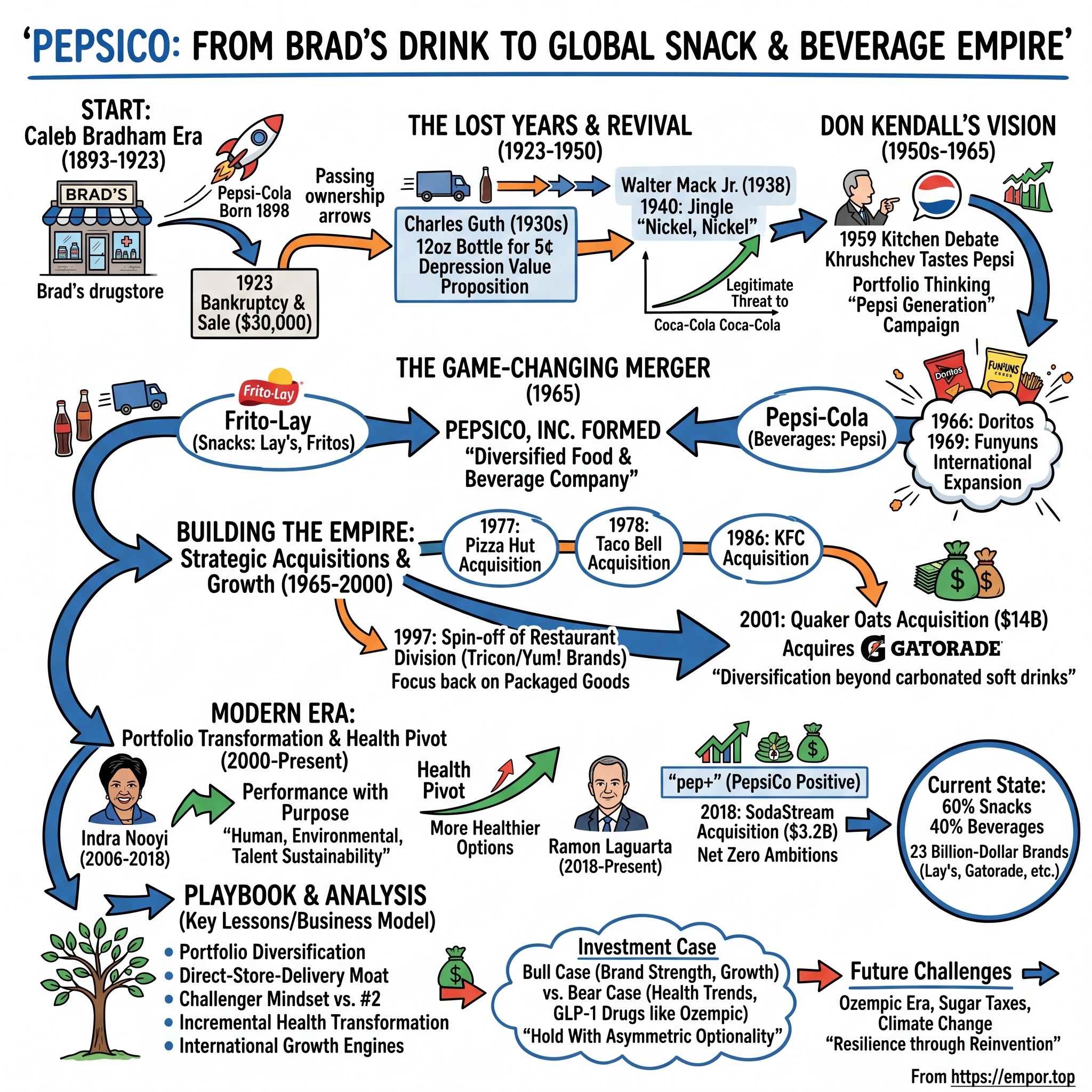
PepsiCo, Inc.: The Snack Empire That Has to Win Back the Checkout
The quarter the sales beat came with a forecast cut
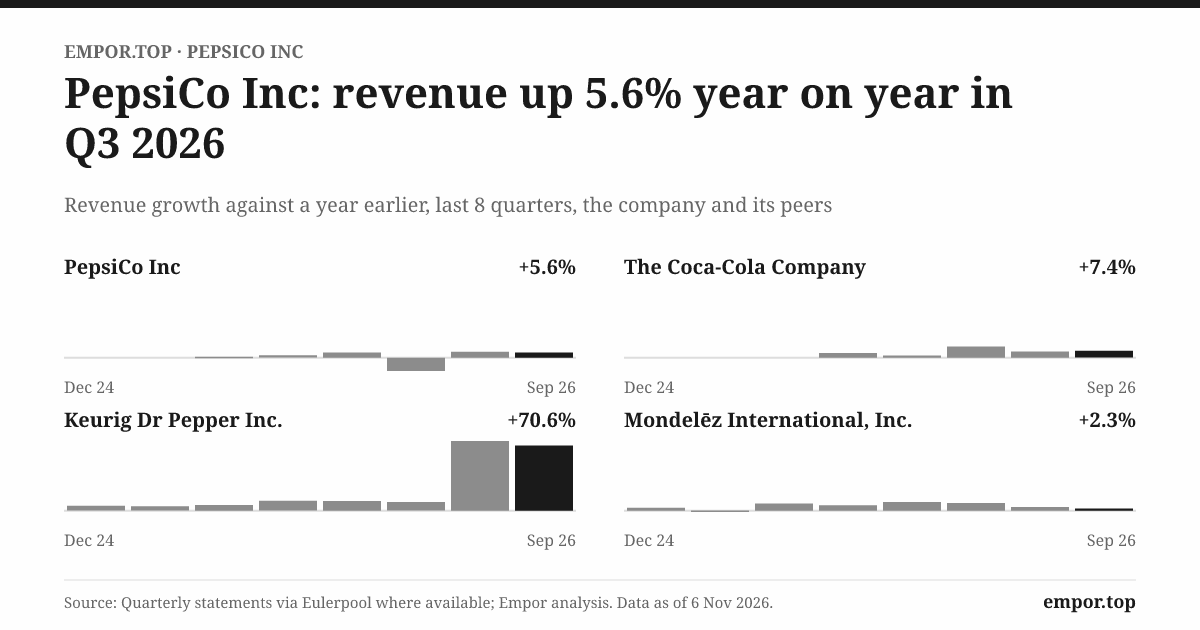
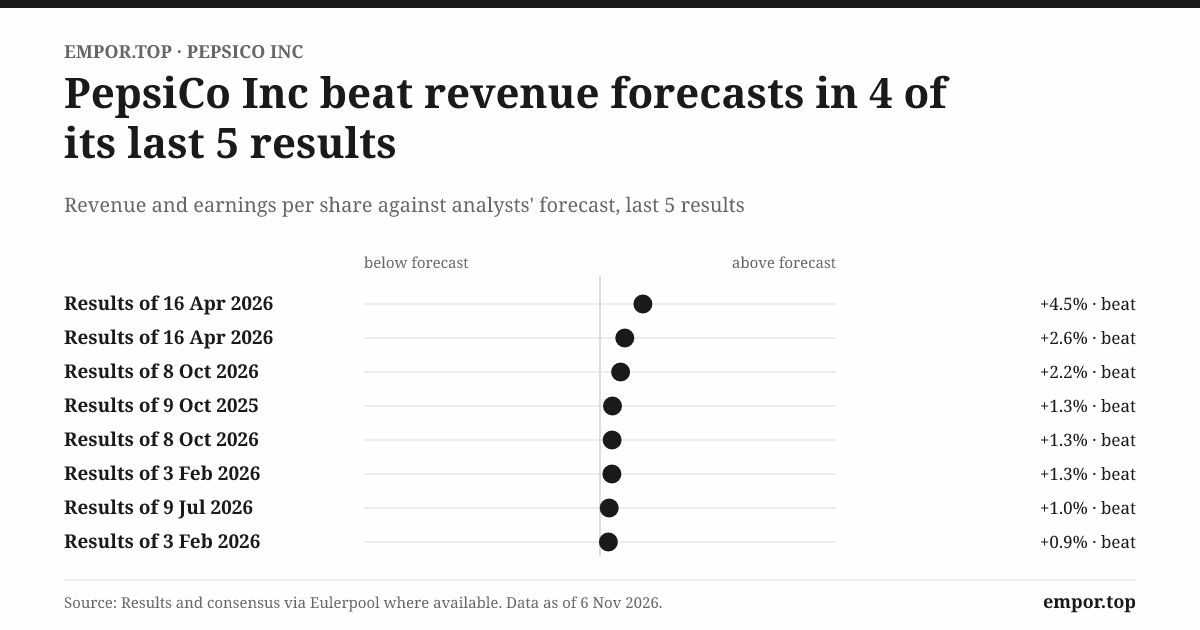
On the morning of October 8, 2026, PepsiCo put out a set of numbers that, read quickly, looked like a company getting back on its feet. Third-quarter net revenue had risen 5.6% to about $25.3 billion. Organic revenue, which strips out currency swings and acquisitions, had grown 3.1%, the fastest pace of the year. Reported operating profit was up 19%, and reported earnings per share up 17%.1 Ramon Laguarta, the company's chairman and chief executive, called it "an acceleration in organic revenue growth with organic volume growth across both global beverages and convenient foods."1
Then came the paragraph that investors actually traded on. PepsiCo cut its full-year forecast for core earnings per share. It had previously guided to the low end of a 5% to 7% growth range. Now it expected 2.5% to 3.5%.1 In the same release, it nudged its revenue outlook up, to about 3% organic growth and about 6% reported growth. More sales, less profit growth. For a company whose entire investment case rests on turning steady consumer demand into steady earnings, that combination is the whole puzzle in one line.
The gap between the two sets of numbers is where this story begins. Reported operating profit rose 19% in the quarter, but core operating profit, the company's own measure that removes impairments, restructuring and acquisition-related items, rose only 3%.1 The difference was mostly the absence of something bad: a year earlier, PepsiCo had taken write-downs on its Rockstar energy brand and its Be & Cheery snack business in China, so the comparison flattered this year's reported figures.1 The same effect ran through the year to date. Reported earnings per share for the first 36 weeks of 2026 were up 47%, to $6.10. Core earnings per share were up 5%.1 Anyone reading the 47% as a picture of the business would be reading an accounting echo of 2025's impairments.
Even the 3% core figure needed an asterisk. PepsiCo said tariff refunds had contributed about four percentage points to core operating profit growth in the quarter.1 Take those refunds away and core operating profit would have been roughly flat. The core operating margin, meanwhile, slipped from 17.3% to 16.9%, a decline of 35 basis points, which means that for every $100 of sales PepsiCo kept about 35 cents less in core profit than a year before.1 Revenue growth was also partly bought: of the 5.6% increase, 1.7 points came from acquisitions net of divestitures and 0.7 points from currency translation.1
So the honest reading of the quarter is mixed rather than triumphant. Internationally, the business was strong, with organic revenue in Europe, the Middle East and Africa up about 9%, Asia Pacific foods up about 9% and the international beverage franchise up about 7%.1 In North America, which is where most of PepsiCo's profit lives, the picture split in two. The snack business, after a year of price cuts, was growing volume again: PepsiCo Foods North America posted a 0.5% organic volume gain, offset by about 1% lower effective pricing, for roughly flat organic sales.1 The North American beverage business went the other way, with organic volume down 3%, propped up by higher prices and by acquisitions.1 On the call, Laguarta did not dress it up. "We do not feel good about the beverage business," he said, and "We are not competing well in soft drinks."2
That is the question running through this episode. Can PepsiCo restore volume-led growth, meaning more bags and bottles sold, rather than growth that comes from raising prices on fewer of them, without giving back the pricing and margin it built in the inflation years? And beneath that sits an older question that goes back sixty years: does a company that sells both Doritos and Pepsi deliver steadier growth than either business could on its own, or does one half increasingly carry the other?
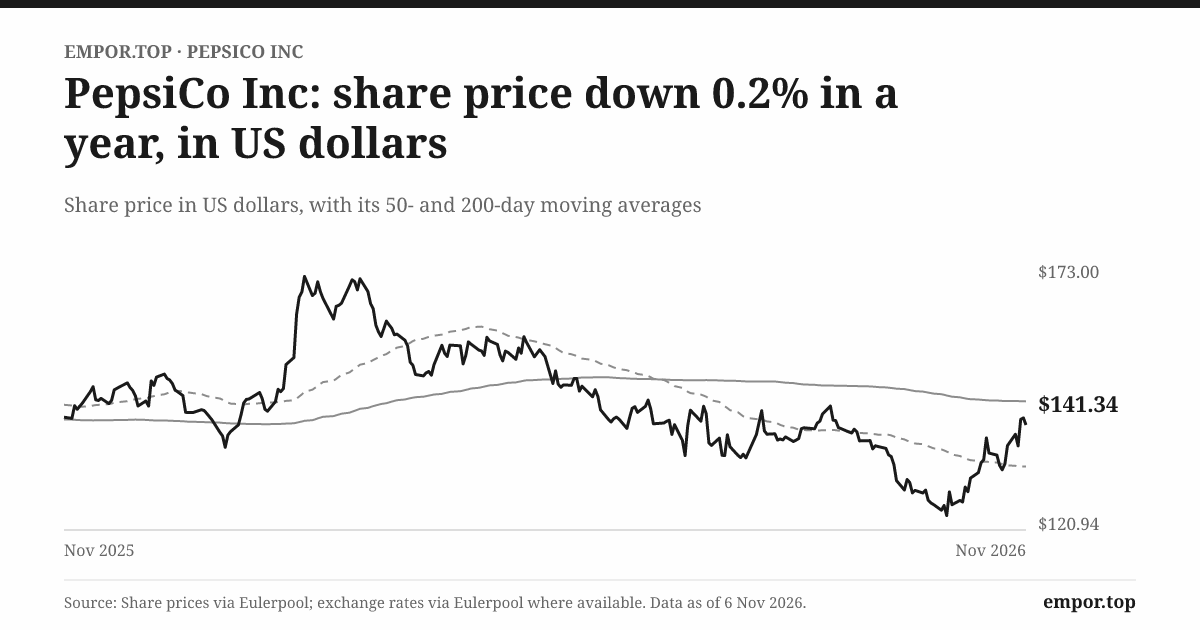
The scale of what is at stake is easy to forget because PepsiCo is so familiar. The company booked $93.9 billion of revenue in fiscal 2025.3 On November 5, 2026, its shares closed at $142.71, giving it a market value of about $196 billion, 16% below its 52-week high, at about 23.8 times its fiscal 2025 reported earnings per share of $6.01.43 That multiple is built on a depressed 2025 earnings base, and it moves sharply depending on which earnings figure one uses, a subtlety that returns when the story reaches valuation.
What follows is a story about a strategic marriage that became an operating system. A soda brand that nearly died in a sugar crash, a chip company built from a $100 recipe, a merger that put both onto the same trucks and shelves, and then a decade in which PepsiCo learned exactly how far a famous brand can push a shopper on price. The test of 2026 is whether that system, built for availability and repetition, can win back the checkout.
 Subscribe on LinkedIn
A pharmacist's tonic runs out of sugar
Caleb Bradham never meant to start a beverage empire. He meant to be a doctor. Born in Duplin County, North Carolina, in 1867, he studied at the University of North Carolina and then went to the University of Maryland to study medicine, until his father's bankruptcy ended the money for tuition.5 He finished instead at Maryland's school of pharmacy and opened a drugstore in New Bern, a river town in eastern North Carolina.5
Like many pharmacists of the era, Bradham ran a soda fountain, and from 1893 he served a carbonated drink of his own making from the counter of his store at the corner of Pollock and Middle Streets.6 Customers called it "Brad's Drink." It was pitched, as fountain drinks often were, as something good for you, built around the digestive enzyme pepsin and the kola nut.6 On August 28, 1898, Bradham gave it a name with more ambition: Pepsi-Cola.6 He incorporated the Pepsi-Cola Company in 1902 and soon registered a patent for the formula.6
What turned a fountain drink into a business was bottling. A drugstore can serve only the people who walk in. A bottler can put the drink on a wagon and in a general store a hundred miles away. Bradham franchised the model aggressively, and by 1910 Pepsi-Cola was being bottled by more than 300 companies across 24 states.6 The local tonic had become a regional brand, and the system that made it so, a branded concentrate owner supplying a web of independent bottlers, would shape the company for the next century.
Then came sugar. When the United States entered the First World War in 1917, sugar was rationed and its price controlled at about three cents a pound.5 After the war, controls lifted, and the price soared to about 28 cents a pound, an increase of roughly 830%.5 Bradham's customers still expected a five-cent bottle.5 He had a cost that had multiplied nearly tenfold and a selling price the market had fixed by habit. The squeeze was lethal, compounded, according to the state's historians, by imperfect bottling technology and weak marketing.6 Pepsi-Cola declared bankruptcy in 1923, and its assets were sold to Craven Holding Corporation for $30,000.5 A Wall Street broker bought the business soon after, and even that version of the company went bankrupt again in 1931.5
The detail worth carrying forward is not the bankruptcy itself but its shape. Bradham's product was popular. His distribution network was growing. Neither protected him, because the economics underneath, the cost of what went into the bottle against what a shopper would pay for it, had moved against him faster than he could adjust. A beverage brand can win the consumer's attention and still lose control of its economics. A century later, PepsiCo faced the same equation from the other side: costs surged again, and this time the company could raise prices. The open question of 2026 is what happens when the shopper pushes back.
The 1965 merger put chips beside the cola
The second half of PepsiCo's DNA began in the Depression, with two men who never met Caleb Bradham. In 1932, Charles Elmer Doolin, who managed a confectionery in San Antonio, bought a corn chip recipe, a potato ricer and 19 retail accounts from a local manufacturer for $100, borrowed from his mother.7 He started the Frito Company in her kitchen, making about ten pounds of chips a day and selling them in nickel bags.7 That same year, Herman Lay began a potato chip business in Nashville, and by 1956 his H.W. Lay & Company was the largest potato chip and snack maker in the United States.7 In September 1961, the two companies merged into Frito-Lay, Inc., with about $127 million of annual revenue.7
The man who saw what Frito-Lay could become alongside a cola was Donald Kendall. Kendall was no headquarters strategist by background. He had flown Catalina seaplanes for the Navy in the Second World War, earning a Distinguished Flying Cross, and joined Pepsi-Cola in 1947 at a bottling plant in New Rochelle, New York, before working as a delivery driver and salesman.8 He rose through marketing and international operations and became chief executive in 1963.8 He understood the product from the truck up.
In February 1965 the boards of Pepsi-Cola and Frito-Lay announced a plan to merge, and on June 8, 1965, shareholders of both companies approved it, creating PepsiCo, Inc.7 Herman Lay and Donald Kendall became the two faces of the new company. The logic Kendall offered was almost comically simple: "Potato chips make you thirsty; Pepsi satisfies thirst."7 The more serious logic was distribution. Pepsi-Cola already reached 108 countries, and the merger offered a way to carry Frito-Lay's snacks far beyond the United States and Canada.7
It is worth being precise about why this fit and where it did not. Salty snacks and soft drinks share the same retail doors, the same shopping occasions and, often, the same cash register. A company that sells both can bring a grocer a bigger promotion, coordinate displays for the Super Bowl, and spread marketing across a larger basket. But snacks and drinks also compete for shelf space, for a household's weekly budget and, inside PepsiCo, for capital and management attention. A portfolio does not create value by existing. It creates value only when owning both businesses makes each easier to sell or cheaper to run.
Six decades later, the strongest evidence for the merger is the shape of PepsiCo's profit. In fiscal 2025, PepsiCo Foods North America, the descendant of Doolin's kitchen and Lay's Nashville operation, generated about $27.5 billion of revenue and about $6.2 billion of operating profit.3 PepsiCo Beverages North America, the descendant of Bradham's tonic, produced slightly more revenue, about $28.2 billion, but only about $1.1 billion of operating profit.3 Put plainly, North American snacks earn more than five times as much profit as North American drinks on less revenue. The snack business keeps about 22 cents of operating profit from every dollar of sales; the beverage business keeps about 4 cents.
That contrast rewrites the popular image of the company. Most people think of PepsiCo as the Pepsi company that also sells chips. The economics say the reverse: in its home market it is a snack company with a beverage business attached. The merger did not merely add a second franchise. It added the stronger one, a branded snack business whose dominant position in American salty snacks and whose direct-to-store delivery system made it the profit engine of the whole group.
That leaves the tension that drives the rest of this story. If snacks are the engine, then the beverage business needs either to earn its keep or to justify the capital and attention it absorbs. The question Kendall's merger raised in 1965 has never fully gone away: is the beverage half a partner, or a passenger? And when PepsiCo has tried to answer it, the company has repeatedly reached for one lever above all others, which is how much of the route to the customer it should own.
Restaurants, bottlers and the price of owning the route
PepsiCo's history contains a recurring pattern: expand ownership along the chain from factory to customer, then discover what that ownership costs. The first big version of the pattern was restaurants. Over the 1970s and 1980s, PepsiCo bought Pizza Hut, Taco Bell and KFC, turning a packaged-goods company into one of the world's largest restaurant operators.9 The appeal was obvious. Every restaurant poured Pepsi, and the chains gave PepsiCo guaranteed fountain volume and growth. The problem was equally obvious in hindsight. Restaurants are capital-hungry, operationally intense businesses with their own economics, and rival restaurant chains had little reason to serve the soda of a company that competed with them. In 1997, PepsiCo spun its restaurants off into a new company, Tricon Global Restaurants, later renamed Yum! Brands.9 The lesson was that owning more of the customer's experience is not the same as earning more from it.
The bottling question is subtler, because bottling is not an adjacent business. It is the route by which the drink reaches the shelf. Since Bradham's day, the Pepsi system had depended on bottlers who bought concentrate, added water, sweetener and carbonation, and handled the heavy, low-margin work of packaging and delivering the finished product. By the late 2000s, the two largest of those bottlers were public companies in which PepsiCo held minority stakes: about 40% of Pepsi Bottling Group and about 43% of PepsiAmericas.10
On August 3, 2009, PepsiCo agreed to buy the rest of both companies for about $7.8 billion.10 The reasoning was about control. Independent bottlers had their own shareholders and their own priorities, and coordinating launches, pricing, packaging and shelf execution across that system was slow. With soft-drink volumes under pressure and competitors launching new drinks constantly, PepsiCo wanted one set of decisions from the concentrate to the cooler. The deal also came with a regulatory knot. The bottlers distributed rival Dr Pepper Snapple brands, and in December 2009 PepsiCo agreed to pay $900 million over 20 years for the right to keep bottling and distributing Dr Pepper, Crush and Schweppes in those territories.10 The Federal Trade Commission, in a 4–0 vote announced on February 26, 2010, allowed the deal on the condition that PepsiCo build a firewall to prevent certain employees from seeing Dr Pepper Snapple's confidential marketing and brand plans, an order set to last 20 years.10 Owning the route, it turned out, meant owning a competitor's secrets too, and promising not to look.
Coca-Cola followed within months. In February 2010, it agreed to acquire Coca-Cola Enterprises' North American business for a total value of about $12.3 billion, a figure made up of roughly $3.4 billion for its existing 34% stake and about $8.88 billion of assumed debt.11 Coca-Cola said it expected the combination to yield at least $350 million a year of operating synergies, phased in over four years.11 The two rivals had, briefly, made the same bet. It is tempting to compare the two prices and declare a winner, but the comparison establishes scale and strategic scope, not value. The deals covered different territories, debt loads and operations, and the public record does not support a judgment that either company overpaid.
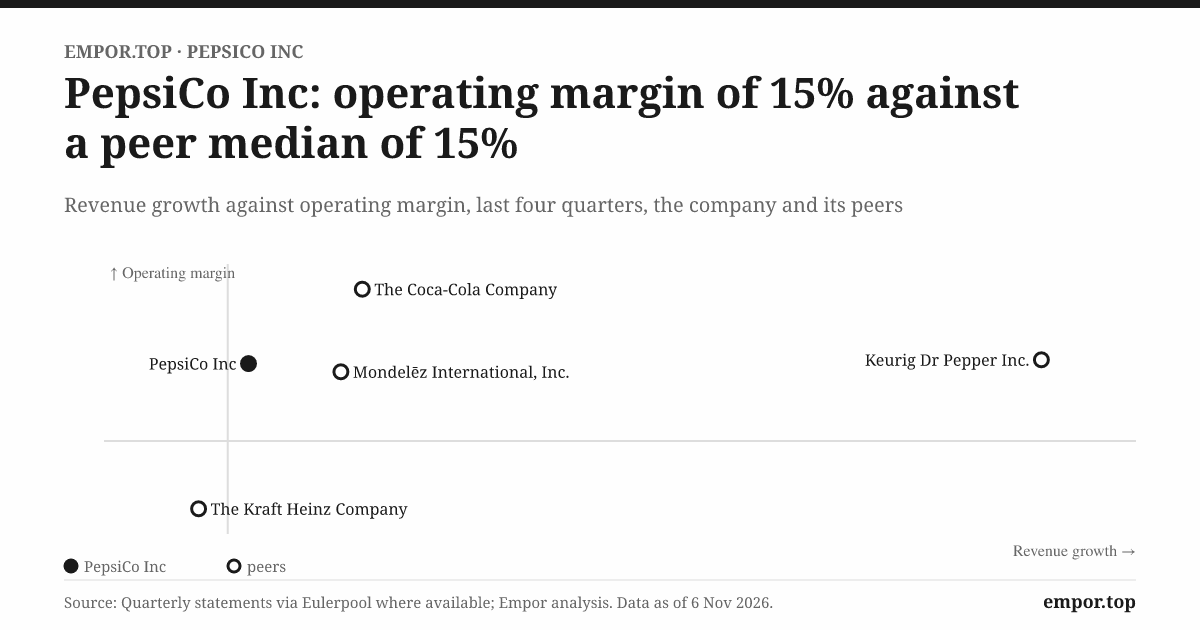
What happened next is the more telling comparison. Coca-Cola treated its bottler purchase as a temporary repair. It restructured the system and then sold the territories back to independent bottlers, a refranchising effort that took more than five years and temporarily depressed sales and profit.12 PepsiCo kept its bottling. That choice is why PepsiCo's North American beverage segment looks so different from Coca-Cola's concentrate-heavy model: PepsiCo books the full revenue of bottled drinks but also carries the trucks, warehouses, plants and labor behind them. By 2024, PepsiCo's consolidated operating margin was about 14%, while Coca-Cola's was about 21%.12 Some of that gap is mix, since PepsiCo is half a food company, but some is the cost of owning the route.
In September 2025, that choice became the center of an activist campaign. Elliott Management disclosed a stake worth about $4 billion, roughly 2% of the company, and wrote to the board that North American beverages were underperforming, with margins trailing Coca-Cola's by as much as ten percentage points.1312 Among its proposals, Elliott urged PepsiCo to evaluate refranchising its bottling network, either by selling distribution rights to regional bottlers while keeping stakes or by spinning off North American bottling.13 Not every investor liked the idea. Three long-term holders told Reuters that separating bottling would be costly and could take years, weighing on margins in the meantime, and one, Kai Lehmann of Flossbach von Storch, doubted the management team's "readiness to refranchise."12
As of November 2026, refranchising remains a debated option, not a decision. PepsiCo has instead launched a review of its North American supply chain, and on the Q3 call management signaled openness to structural options, including pilots that combine food and beverage logistics in Texas.142 The investor's question is narrower than the headlines make it. Owning bottling is not good or bad in itself. It is worth keeping only if the control it buys, over pricing, launches and shelf execution, produces enough extra profit to pay for the capital it ties up. The beverage segment has not yet made that case. Which raises the deeper question of what, exactly, PepsiCo's routes and brands are defending.
The shelf is the moat—and Walmart has leverage
Picture the start of a PepsiCo delivery day. A truck pulls up behind a supermarket before the morning rush, loaded with Lay's, Doritos, Cheetos, Tostitos and Smartfood, and in many markets a separate truck brings Pepsi, Mountain Dew and Gatorade. A driver-merchandiser wheels the product in, restocks the aisle, rotates older bags forward, builds an end-cap display for the weekend promotion and checks that every slot in the planogram, the store's agreed map of where each product sits, is full. It is a ballet of availability that PepsiCo has practiced for decades. And yet the person who decides how much shelf the truck gets, where the display goes and what the price tag says is not on the truck. The retailer controls the checkout, the shelf and the shopper's alternatives, including a store-brand chip a few feet away.
That scene captures both halves of PepsiCo's competitive position. To understand it, start with how the company makes money. PepsiCo sells physical products: beverages and what it calls convenient foods. It recognizes revenue when products ship or are delivered.3 In some businesses it makes and distributes finished goods itself; in others it sells beverage concentrate to authorized bottlers who do the rest.3 Sales recur because people buy chips and soda every week, not because anyone signs a contract. Customers can stop buying at any time, and PepsiCo negotiates many retailer incentives and bottler funding arrangements annually.3 The business runs on four levers: physical demand, price, promotion and distribution execution.
The map of where those levers produce profit is lopsided. The two North American segments together make up more than half of revenue, but they behave very differently, as the snack-versus-soda gap in the merger story showed. Outside North America, the largest segment is Europe, the Middle East and Africa, which generated about $18.0 billion of revenue and about $2.1 billion of operating profit in fiscal 2025, a margin of roughly 12%.3 International operations overall produced 44% of fiscal 2025 revenue, and PepsiCo sells into more than 200 countries and territories.3 That breadth spreads risk across many economies, though it also exposes the company to currency swings, a point the cash story returns to.
What the trucks really buy
The heart of the moat is direct-store delivery in snacks. Think of it like a milk route. A truck that visits fifty stores on one street map has a much lower cost per stop than a truck that visits five. Frito-Lay's route density in North America means it can afford to visit stores often, keep shelves full and put its own people in the aisle. That matters disproportionately for chips, which are light, bulky, fragile and fast-turning: a bag of crisps that runs out on Saturday is a sale lost to whatever is next to it. Route density also makes launches cheap. When PepsiCo introduces a new flavor or an acquired brand, it can place it in tens of thousands of stores quickly, because the trucks are already going there. A smaller snack maker shipping through a retailer's warehouse cannot match that frequency or that control of the shelf.
Beverages work differently. In North America, PepsiCo's own bottling system delivers drinks directly, but in much of the world the brand is carried by franchise bottlers, and the economics resemble a licensing business more than a trucking one. That is why the international beverage franchise grows on modest capital, and why the North American beverage segment, carrying plants and fleets, earns so much less per dollar of revenue.
Now look at it from the other side of the loading dock. Walmart and its affiliates, including Sam's Club, accounted for about 14% of PepsiCo's consolidated revenue in 2025, and PepsiCo warns that losing this customer would materially affect its North American food and beverage businesses.3 One buyer controlling one-seventh of revenue is a powerful negotiator. It decides promotional calendars, demands price investment, and can give store brands more space. Retailer power is not hypothetical. In early 2024, after a long run of PepsiCo price increases, Carrefour said it would stop selling PepsiCo products in France, Belgium, Spain and Italy over pricing.15 A brand that most shoppers know by sight was pulled from shelves across four countries because a retailer decided the price was too high.
The competitive field is narrower than "food and beverage" suggests. In drinks, PepsiCo's central rival is Coca-Cola's system, which leads in carbonated soft drinks and earns higher margins on a lighter, franchise-heavy model.12 In snacks, PepsiCo faces branded rivals and store brands but has no rival of equivalent scale in American salty snacks. Comparing consolidated revenue between PepsiCo and Coca-Cola says little, since PepsiCo is half a snack company and books bottling revenue that Coca-Cola largely does not. The more useful comparison is business by business: PepsiCo's snack economics stand on their own, while its North American beverage economics trail.
Seen through Michael Porter's five forces, the evidence lines up clearly. Consumer switching costs are close to zero; there is no contract to break when a shopper picks a different chip or a cheaper cola. Buyer power is high, as Walmart's 14% share and Carrefour's delisting show. Supplier power is moderate: PepsiCo buys commodities such as potatoes, corn, oils, sweeteners, aluminum and plastics, and it says some raw materials come from limited or sole suppliers.3 The threat of new entrants at PepsiCo's scale is low, because building national brands and a delivery network takes decades and billions, though small brands can and do enter niches, which is precisely why PepsiCo buys them. Substitutes, from private labels to healthier snacks and functional drinks, are the most active force, and the newest twist is technological: PepsiCo itself flags e-commerce, digital tools and AI shopping agents as possible influences on how consumers discover products and choose channels.3 If a shopping agent picks the best-value salty snack for a household, brand familiarity may matter less than price per ounce.
Regulation is beginning to act on the substitutes force too, in a way that touches PepsiCo's least profitable segment first. In the first quarter of 2026, eight American states began restricting what can be bought with federal food-assistance benefits under the Supplemental Nutrition Assistance Program, and Schmitt told analysts the restrictions applied "mainly" to beverages and candy.16 He called it "too early to come to any definitive conclusions" about the effect.16 The mechanism matters more than the first-quarter data. Lower-income households are the shoppers most sensitive to price, and if public policy narrows what they can buy with benefits, sugary drinks lose some of their most reliable volume regardless of how sharp the marketing is. It is one more reason the beverage business cannot lean on its legacy colas to grow.
Put the forces together and the verdict on the moat is clear, with one hedge. PepsiCo's strongest advantages are brand familiarity, broad distribution and the ability to coordinate products across retail channels. Those advantages secure availability: the product is on the shelf, fresh and well placed, almost everywhere. They do not eliminate buyer power, and they do not make consumers immune to price. The difference between those two things, being on the shelf and being chosen from it, is where the last four years of PepsiCo's story have played out.
When the shopper said no
The true test of a consumer moat is pricing. In the inflation of 2022 and 2023, PepsiCo raised prices hard, and for a while it looked like proof of brand power. The fourth quarter of 2023 was the company's eighth straight quarter of double-digit percentage price increases.17 Revenue rose, and profit held up. But volume tells the other half of the story. In that fourth quarter, Frito-Lay North America volume fell 2% and North American beverage volume fell 6%.15 PepsiCo kept raising prices into 2024, by about 5% at the start of the year and another 5% in the second quarter, and Frito-Lay North America volume fell 4% in that quarter, part of an eighth straight quarter of declining global volumes.17 PepsiCo argued some of the decline was strategic, because it had been shrinking package sizes.17 Laguarta acknowledged the limit: "There is some value to be given back to consumers after three or four years of a lot of inflation."17
That sentence is the moat's boundary, stated by the man who runs it. PepsiCo's brands gave it the ability to raise prices without losing most of its customers. They did not give it the ability to raise prices without losing some. The 2026 reset, in which PepsiCo cut prices and built cheaper price tiers in snacks, is a live experiment in reversing that effect: if volume returns as price falls, the brands are still preferred at the right price; if it returns only through heavy promotion that permanently erodes margin, the pricing power of the inflation years was partly borrowed from future demand. So far, the snack business has shown volume growth again, with Laguarta saying in October that snack volume had moved from low-single-digit declines the year before to low-single-digit growth.2 Whether that persists without further margin give-back is the moat question for 2027. And it is inseparable from the much sharper contrast inside PepsiCo's own profit pools.
The snack engine and the drink business diverge
Lay out PepsiCo's six reported segments side by side and the company's character becomes plain. There is PepsiCo Beverages North America, PepsiCo Foods North America, Europe-Middle East-Africa, Latin America Foods, International Beverage Franchise and Asia Pacific Foods.3 Each tells a different story, but the profit concentrates in one place. North American foods alone generated roughly half of group operating profit, nearly three times what the entire Europe, Middle East and Africa segment earned.3
The long view of growth explains why investors began to worry. Over the decade from fiscal 2015 to fiscal 2025, PepsiCo's revenue grew about 4.1% a year, a respectable pace for a giant consumer company.3 But the most recent three years ran at only about 2.8% a year, and net profit actually fell about 2.6% a year over that stretch.3 The five-year rate looks better, near 6% for revenue, because it includes the inflation surge when prices climbed in double digits. The arc, then, is a company whose growth in the early 2020s came disproportionately from price, and whose growth faded once price stopped doing the work.
Fiscal 2025 was the low point. Operating margin fell from about 14.0% to about 12.2%, reported operating profit fell about 11%, and net profit fell about 14% to roughly $8.2 billion.3 No single cause explains that drop, and blaming any one would mislead. The company cited higher commodity costs, tariffs, and rising operating costs, alongside lower organic volume, charges tied to acquisitions and divestitures, and impairment charges, including the write-downs on Rockstar and Be & Cheery.31 Some of that was cyclical and some was self-inflicted. The impairments, in particular, are noncash charges that reflect past capital decisions coming due rather than a deterioration in 2025 sales.
That is why the third-quarter 2026 numbers have to be peeled apart layer by layer. The quarter's 3.1% organic growth was led by international businesses.1 In North American foods, volume again rose slightly while effective pricing fell. In North American beverages, prices rose about 3% while volume fell about 3%, and the segment's reported revenue growth of about 5% came mainly from acquisitions made in 2025.1 On the profit side, the four points of tariff-refund benefit sat on top of productivity savings, partly offset by higher operating costs and more spending on advertising and marketing.1 Strip it all back and the underlying picture is a company whose North American snack volumes have turned positive at lower prices, whose international business is genuinely growing, and whose North American drink business is still losing volume.
The international growth deserves its own look, because it is both the most encouraging part of the story and the part most easily overstated. In the third quarter, Asia Pacific foods grew organic volume about 11% even while cutting prices about 2%, which is what genuine demand growth looks like.1 Latin America foods grew about 6% organically on a mix of modest volume and price, and the international beverage franchise grew about 7% with volume up more than 5%.1 Europe, the Middle East and Africa is different: its roughly 9% organic growth came mostly from pricing of about 7%, with volume up only about 1%.1 In some of those markets, high local inflation means price increases are partly a currency story in disguise. And currency itself cuts both ways. In 2025, translation into dollars hurt results, led by the Mexican peso and the Turkish lira, partly offset by the Russian ruble; in the first 36 weeks of 2026, a weaker dollar flipped that, adding about two points to reported revenue growth.31 A reader comparing reported growth across years is partly reading the dollar.
There is also a cost below operating profit that has been rising quietly. Net interest expense and other charges were about $1.1 billion in 2025, up from about $0.9 billion in 2024, equal to roughly 11% of pretax income.3 That is the cost of a balance sheet that has added debt to fund acquisitions and distributions, and it is a drag that no amount of snack volume removes.
The CFO's explanation of the guidance cut adds the cost side. "Input costs are trending higher, and mix has been a headwind in particular," Steve Schmitt said, adding that "It's the margin piece that's driving the guide down in EPS."2 PepsiCo typically hedges six to twelve months of commodity exposure, as he had explained in April, and those hedges begin rolling off in the fourth quarter, just as input costs ramp.162 He also warned that the tariff benefit in beverages "goes away" after the third quarter, putting more underlying pressure on North American beverages.2 That is the disconfirming evidence that sits right beside management's call for sequential improvement: the temporary help is ending exactly when the cost tailwind reverses.
The cash that pays for everything
The case for PepsiCo has always leaned on cash, and here the long record is genuinely strong. Over the twelve years from fiscal 2014 to fiscal 2025, the company generated about $132 billion of operating cash flow against about $93.5 billion of net profit, so cash ran about 40% ahead of reported earnings.3 Much of that gap is the ordinary arithmetic of a capital-heavy business, since depreciation reduces profit without consuming cash, and part reflects PepsiCo's habit of paying suppliers more slowly than it collects from customers. In fiscal 2025, it took about 99 days to pay suppliers while collecting from customers in about 45 days and holding about 50 days of inventory, which means suppliers effectively financed part of the business.3
But that conversion is not a law of nature. Both receivable days and inventory days have crept up over the decade, and in the first 36 weeks of 2026, rising receivables consumed about $2.1 billion of cash and inventory another roughly $0.6 billion.18 Some of that is seasonal timing and some reflects acquisitions, but it is a reminder that the 141% cumulative conversion figure was built in better years. Reinvestment, meanwhile, has been trimmed. PepsiCo spent about $4.4 billion on capital projects in 2025, roughly 4.7% of revenue, down from about $5.5 billion in 2023, and spent about $839 million on research and development, under 1% of sales.3 That is not a harvest profile, because the plant base is still growing and the company is still buying brands, but it is a company now being asked to do more with less capital.
For an investor tracking whether the reset is working, three measures matter more than the dozens of others. The first is North American volume and market share, especially in snacks, where the price reset should show up first. The latest reading showed snack volume growth and claimed share gains, while beverage volume was still falling.1 The second is core operating margin, which fell 35 basis points in the quarter despite the tariff refund.1 The third is free cash flow after capital spending and shareholder distributions, which in fiscal 2025 was about $7.7 billion before dividends of about $7.6 billion.3 Those three readings frame the question that the next section turns to: whether the people now running PepsiCo can move all three in the right direction at once.
Ramon Laguarta's reset meets an activist's test
Ramon Laguarta is not a product of the American route-sales culture that produced Donald Kendall. A Spaniard who worked at the confectioner Chupa Chups before joining PepsiCo in 1996, he spent much of his career running businesses in Europe and other international markets before becoming chief executive in 2018 and chairman in 2019.19 He built his reputation in markets where PepsiCo had to grow through local adaptation, as a challenger, rather than through the domestic dominance Frito-Lay enjoyed at home. That background shows in his strategy. Under his leadership, international operations have become a growth engine, with management saying in July that international revenue was on track to pass $40 billion.20 The question has been what happened at home.
The current team has changed in an important seat. Jamie Caulfield left the chief financial officer role in November 2025, and Steve Schmitt took over on November 10, 2025.19 Laguarta remains both chair and chief executive, with an independent presiding director, Ian Cook, the former Colgate-Palmolive chief executive, on a board that is otherwise independent.19 Schmitt has therefore spent his first full year as CFO explaining tariff refunds, hedges and a guidance cut.
The pressure that shaped that year arrived on September 2, 2025, when Elliott disclosed its roughly $4 billion stake.13 Elliott's letter went beyond bottling. It said the North American food business "has begun to falter," urged PepsiCo to "defend its core franchises in carbonated soft drinks," argued that a proliferation of new brands and products had "strained focus and execution," and suggested selling non-core assets, with industry observers pointing to Quaker Foods.13 The Quaker point carried history: PepsiCo had bought Quaker, along with Gatorade, in 2001 for $13.4 billion in stock, and one investor estimated Quaker alone might now fetch about $6 billion.12
PepsiCo's response, announced on December 8, 2025, was a settlement in substance if not in form. It said it would cut nearly 20% of its product lines in the United States by early 2026, close several manufacturing lines, introduce more affordable price tiers in snacks, and use automation and digitization to deliver at least 100 basis points of core operating margin expansion in aggregate over the next three fiscal years.14 It also launched a North American supply chain review, with an update promised in late 2026, while Elliott received no board seats and planned no proxy fight.14 Elliott partner Marc Steinberg said he was "confident that PepsiCo will create substantial value for shareholders."14 The price reductions and supply-chain review are observable responses. Whether they repair the business is a performance question that 2026 has only begun to answer.
Three calls, one narrative under strain
The three earnings calls of 2026 trace that answer in real time, and the change in tone is instructive. In April, the mood was confident. Laguarta told analysts that PepsiCo had added "300 million occasions in Q1 in the food business" and that the company now had "positive share in value as well."16 He said zero-sugar Pepsi was growing ahead of competitors and that poppi was "starting to accelerate."16 When Barclays' Lauren Lieberman pushed back that Lay's volumes still looked weak, Laguarta pointed to volume growth in Lay's that quarter.16 Schmitt kept full-year guidance unchanged and said cost inflation would come, but the magnitude was still being worked out.16
By July, the language had shifted. Schmitt said North America would improve "a more moderate pace than we thought coming into Q2," and that full-year earnings might land toward the low end of guidance.20 Laguarta explained the snack volume miss with factors outside the company: "the consumer is worse than what we had anticipated and it's driven mainly by gas prices," a consequence, he said, of the Iran war's effect on fuel costs, which hit impulse purchases at convenience stores especially hard.20 He also admitted an execution problem, saying "the execution of the price investment in some customers have had some delays."20 And he rejected the idea of a reset: "We don't think we need any sort of reset because we have a very strong productivity, record productivity in the first half of the year."20 Schmitt flagged that the tariff refunds would add about one point of EPS growth for the year, landing mostly in the third quarter, and would be used "to help offset some commodity inflation."20
In October, the guidance cut arrived, and the candor about beverages arrived with it. Laguarta's admission that PepsiCo was "not competing well in soft drinks" was the sharpest statement of the year.2 His remedy was more investment behind poppi, Pepsi and Mountain Dew, funded by cost cuts, with the release adding that "additional structural cost reduction actions are being identified."12 Asked about margins, he said "any cost that is not linked to growth is not there."2 Asked about the future, he promised "sequential improvement as we go into Q4 and especially as we go into next year," while Schmitt deferred 2027 targets to February.2 At the same time, PepsiCo moved to raise some prices again, including on Doritos, after a weak North American quarter.21
The beverage plan Laguarta described is worth parsing, because it shows how PepsiCo is trying to grow around its weakest franchise rather than through it. Hydration, led by Gatorade and water brands, had accelerated in both volume and revenue, he said, and he expected the energy drinks Alani Nu and Celsius, distributed through PepsiCo's system, to be "an important source of growth."2 That is a sensible bet on where American drinking habits are moving, but it carries a margin cost. In July, management had explained a 90-basis-point decline in the North American beverage operating margin partly by the economics of the Alani arrangement and partly by weak convenience-store traffic.20 Distributing someone else's fast-growing brand fills the trucks; it does not necessarily fill the profit pool. On marketing, Laguarta pointed to a new partnership with the advertising group Publicis, presented as a way to get more effective brand-building from every marketing dollar.2 Even the soft first-quarter beverage volume came with an operational explanation: PepsiCo had moved case-pack water to a third party, and Laguarta said volume excluding that transition was "almost flat."16 Each explanation is plausible on its own. Taken together they describe a beverage business whose reported growth depends on acquisitions, partners and portfolio moves, while its biggest brands still need repair.
Read across the year, the narrative held its shape but its explanations rotated: first share gains, then gas prices and delayed retailer execution, then input costs and mix. None of those explanations is false, and management deserves credit for the plainness of the October beverage admission. But the pattern of guidance moving from reaffirmed, to the low end, to cut, inside six months, is evidence that management's visibility into its own home market has been weaker than its confident April tone implied. The price increases announced alongside the guidance cut also pose an awkward question: if the 2025–26 price cuts were meant to rebuild volume, does raising prices again now risk repeating the cycle the company just spent a year unwinding?
Pay tells a partly reassuring story. Laguarta's reported total compensation fell from about $33.9 million in 2023 to about $28.8 million in 2024 and about $23.9 million in 2025, a decline that tracked weaker profit; his 2025 annual cash bonus was about $3.1 million.19 His 2026 long-term award, with a grant-date value of about $19 million, depends on earnings per share, organic revenue growth and shareholder returns relative to peers.19 That structure rewards precisely the volume-led recovery investors want, though a long-term award tied partly to relative returns can still pay out in a sector where every peer is struggling.
Shareholders sent a measured signal at the May 2026 annual meeting. The advisory vote on executive pay passed comfortably, but Laguarta's own re-election as a director drew about 49.8 million votes against, more dissent than most nominees received.22 That is not a rejection of his leadership; he was elected easily. It is a notable expression of discontent with the combined chair-and-CEO role at a company under activist pressure. On the accounting side, there is no comparable warning: KPMG gave unqualified opinions on PepsiCo's fiscal 2025 financial statements and internal controls, identifying no material weakness.3 The management concern here is operating delivery and guidance, not the integrity of the books.
The final test of the reset is whether cost cuts fund reinvestment or merely fill the hole left by price concessions. The December promise of at least 100 basis points of margin expansion over three years was made before the 2026 cost ramp; the third quarter's 35-basis-point core margin decline, even with the tariff help, shows how much ground remains.141 That is where PepsiCo's acquired brands come in, because management's answer to weak soda has increasingly been to buy what shoppers seem to want next.
Poppi, Siete and the write-downs behind the portfolio story
Allison and Stephen Ellsworth are the kind of founders big consumer companies love to buy. The husband-and-wife team built poppi in Austin, Texas, around a "prebiotic soda" with no more than five grams of sugar per serving, and got their big break on the television show Shark Tank, where investor Rohan Oza backed the brand.23 By early 2025, poppi's retail sales were growing 122% year over year, and analysts at BNP Paribas estimated it held about 1% of the American carbonated soft drink category.24 On March 17, 2025, PepsiCo agreed to buy it for $1.95 billion, a figure that included about $300 million of anticipated cash tax benefits, for a net price of about $1.65 billion, plus potential earnout payments tied to performance.23
Two months earlier, on January 17, 2025, PepsiCo had closed a $1.2 billion acquisition of Siete Foods, the Austin grain-free tortilla and chip brand founded in 2014 by the seven-member Garza family and sold in more than 40,000 retailers.25 Both deals have the same logic. Poppi gives PepsiCo a credible entry into "modern soda," the fast-growing segment of drinks with less sugar and a wellness halo, where its flagship colas struggle. Siete gives it a culturally resonant, better-for-you snack brand that Lay's and Tostitos do not naturally reach. Laguarta called poppi "a great complement to our portfolio transformation efforts."23
Size these bets against the parent, though, and they shrink. Against $93.9 billion of revenue, even a fast-growing brand worth a couple of billion dollars is currently immaterial to group results. Their importance depends entirely on what PepsiCo's distribution can do for them: whether placing poppi and Siete on more shelves turns into sustained repeat purchase. The early record is bumpy. In July, management said poppi had returned to growth after a distributor transition, and that Siete had resolved ingredient supply problems that hurt it in April and May.20 Those are normal integration hiccups, but they illustrate that the route to market is not automatic even for a company that owns the trucks.
Buying small brands and scaling them is not new for PepsiCo. When it closed the Siete deal, the company pointed to a lineage of earlier tuck-ins, among them PopCorners, Bare, Stacy's Pita Chips and its interest in Sabra hummus.25 On the October call, Laguarta described the posture plainly: these are "smaller tuck-in opportunities that we never say no if it has strategic value."2 The strategic case is coherent. A company whose biggest brands were built for a different era of eating can either try to reformulate those brands or buy the ones younger shoppers already chose, and buying is faster. The risk is that it is also more expensive, and that the acquired brand's appeal depended partly on not being owned by a giant.
Was poppi overpriced? It was certainly expensive in absolute terms for a brand of its scale. But "expensive" and "overpaid" are different claims. PepsiCo did not disclose poppi's revenue or earnings, and the public record offers no comparable target economics, so there is no sound basis to judge the multiple paid. The defensible conclusion is that PepsiCo paid a premium price for growth and optionality, and that only poppi's repeat sales through PepsiCo's channels over the next several years will reveal whether the premium was earned.
The record of past deployments argues against assuming the best. Rockstar Energy, bought as PepsiCo's answer to the energy-drink leaders, and Be & Cheery were both written down in 2025.13 Tropicana is a cautionary tale of a different kind. PepsiCo bought the juice company in 1998 and in 2021 sold a majority stake in Tropicana and other juice brands to private equity firm PAI Partners for about $3.3 billion, retaining a minority interest.9 By 2024, the resulting Tropicana Brands Group was struggling with operating losses and tight liquidity, and PepsiCo wrote off its remaining investment with a $498 million impairment and set aside a $193 million allowance against money TBG owed it.3 None of this proves that poppi or Siete will fail. It does show that PepsiCo's acquisition record is not uniformly disciplined, and that brand purchases can become write-downs years later.
The acquisitions also compete for cash with the dividend, and the dividend is a large claimant. From fiscal 2014 to fiscal 2025, PepsiCo paid about $65.7 billion of dividends, roughly 79% of its cumulative free cash flow.3 In fiscal 2025 alone, dividends absorbed about 93% of net profit.3 PepsiCo also bought back $1 billion of stock in each of the last three years and, in February 2026, approved a new authorization for up to $10 billion of repurchases through February 2030.318 For 2026, the company plans $8.9 billion of total cash returns, $7.9 billion in dividends and $1.0 billion in buybacks.1 Every dollar of that is a dollar not spent on plants, marketing or debt reduction, which is why the next question is whether PepsiCo's valuation and balance sheet can support the generosity.
Analysis & Bear vs. Bull Case
Start with how the market prices PepsiCo today. At $142.71 a share on November 5, 2026, the stock offers a dividend yield of about 4.1% and a free cash flow yield of about 5.4%, trading at about 23.8 times fiscal 2025 reported earnings and about 15.2 times enterprise value to EBITDA.43 The operating margin behind those multiples was 12.2% in 2025, and the balance sheet carries debt of about 2.45 times shareholders' equity.3 That P/E deserves care. It rests on a 2025 earnings base depressed by impairments; on the trailing twelve months, with 2026's stronger reported quarters, earnings per share are nearer $8, and FinanceCharts' series puts PepsiCo at about 16.8 times earnings against a five-year average of about 24.5 times, with Coca-Cola at about 28 times and Mondelez at about 23.5 times.26 Those figures are not interchangeable with the 23.8x, and a consistent five-year median on the same basis is unavailable. What the comparison does suggest is that the market now prices PepsiCo at a discount to Coca-Cola, its own recent history and, on trailing earnings, its snack peer, a price that assumes modest growth and some risk to margins rather than a full recovery.
Why PepsiCo wins
The bull case begins with the strongest economics in the building. North American snacks earn about 22 cents of operating profit per dollar of sales and gained volume and share in 2026 after the price reset.31 Hamilton Helmer's seven powers framework helps identify why that endures. The clearest power is scale economies: route density in direct-store delivery lowers the cost per stop and per bag in ways a smaller rival cannot copy. A second is branding, the accumulated familiarity that lets Lay's and Doritos command a premium over store brands. A third, partial, is a cornered resource in the delivery system and shelf relationships themselves, the decades of planogram positions and retailer trust that a newcomer cannot buy. Counter-positioning and switching costs are weak; network effects do not apply. Process power exists in PepsiCo's productivity programs, which management credits with "record productivity" in the first half of 2026, but it is not unique.20
The second pillar is international growth. Outside North America, organic revenue rose about 8% in the third quarter, with operating margin up about 105 basis points, and Asia Pacific foods grew volume about 11%.21 International operations already produce 44% of revenue.3 A third pillar is cash: twelve years of operating cash flow comfortably exceeding profit, and a credit rating that grants cheap access to debt. S&P affirmed PepsiCo's A+ rating with a stable outlook in February 2026, citing its scale and productivity savings, and Moody's rates it A1.27
Why the case could break
The bear case starts with the forces analysis. Shoppers face no switching costs, and the inflation years proved they will trade down when prices rise far enough. Retailers hold real power, as Walmart's share and Carrefour's delisting show. The beverage business in North America is losing volume, and management itself has said it is not competing well in soft drinks.2 Elliott's estimate that PepsiCo's North American beverage margins trail Coca-Cola's by up to ten percentage points frames the scale of the repair job.12
Second, earnings recovery is flattered. The 47% rise in year-to-date reported EPS is mostly an echo of 2025's impairments, the third quarter's core operating profit leaned on tariff refunds that now fade, and hedges roll off just as input costs rise.12 Third, the balance sheet is less roomy than the rating implies. Borrowings rose from about $49.9 billion at the end of fiscal 2025 to about $51.9 billion by September 2026, and S&P put adjusted leverage at about 2.5 times EBITDA at the end of 2025, expecting it to fall toward 2 times only if acquisition spending normalizes.31827 S&P's rationale also cited muted organic sales growth of roughly 2% to 3% in 2026, volume weakness in Europe and North American beverages, and cost and tariff pressure.27 The rating is a constraint, not a verdict: it says PepsiCo can borrow cheaply, not that it should borrow to pay dividends. PepsiCo had no borrowings outstanding under its two $5 billion revolving credit facilities in September 2026.18 It has also kept tapping the bond market, raising about $3.0 billion of long-term debt in the first 36 weeks of 2026, and the cited filings disclose no covenant breach or refinancing strain.18 Debt is not the problem. The problem is that debt has become a routine part of how the dividend, the buybacks and the acquisitions are paid for at the same time.
Two further exposures belong in the risk ledger. Currency is the first: a 10% adverse move in exchange rates, PepsiCo estimates, would raise net unrealized losses on its currency hedges by about $308 million before offsets.3 Russia, where PepsiCo still operates, held about 20% of the company's cash and cash equivalents at both the end of fiscal 2025 and September 2026, cash that may not be easy to move.318 Ownership is the second, though more reassuring than risky: the two largest holders are index giants, Vanguard with about 10.1% and BlackRock with about 8.2%, with no controlling shareholder.19
Stress-test the dividend directly. The record of annual increases is long and meaningful, and PepsiCo has never had to choose publicly between its dividend and its balance sheet. But in fiscal 2025, dividends of about $7.6 billion roughly equaled free cash flow of about $7.7 billion, leaving about $100 million for buybacks, acquisitions and debt reduction.3 Buybacks and the poppi and Siete purchases were therefore effectively funded by borrowing. If operating cash flow stalls, the dividend becomes the claim that crowds out everything else.
A skeptical long-short investor would press on four points, and each has a specific answer the company has not yet given. The first is portfolio complexity: a company that cut nearly a fifth of its American product lines still sells snacks, colas, energy drinks, juices through a minority stake, oats and hummus, and must explain why each earns a place in one corporate structure. The second is the beverage margin: if North American drinks cannot close a meaningful part of the gap to Coca-Cola under integrated ownership, the case for some form of refranchising grows regardless of how disruptive it would be. The third is capital allocation: a payout ratio above 90%, a fresh $10 billion buyback authorization and a habit of buying growth brands at premium prices add up to a balance sheet run for distribution rather than for flexibility. The fourth is accountability: a combined chair and chief executive whose company earned less net profit in fiscal 2025 than in fiscal 2022, cut guidance within six months of reaffirming it, and received the most director dissent at the annual meeting. None of these is a crisis. Together they describe the agenda any serious activist would bring back if the 2027 numbers disappoint.
Weighing the two sides, the history narrows rather than rejects the bull case. The snack moat is real but bounded: it survived the inflation years with share, yet the volume losses of 2023 and 2024 show it does not survive unlimited pricing. The beverage case is unproven and currently losing. The cash case is intact but tighter than the twelve-year averages imply. The single figure that would most clearly confirm or falsify the revised thesis is North American volume over the next four quarters at stable or rising core margins. If both move up together, the reset is working. If volume holds only while margins keep slipping, PepsiCo has bought shoppers back rather than won them back.
Playbook: Business & Investing Lessons
Put three moments side by side. June 1965, when Pepsi-Cola and Frito-Lay merged on the theory that chips make people thirsty. February 2010, when the FTC approved a $7.8 billion bottler buyback on the condition that PepsiCo not peek at Dr Pepper's plans. And the winter of 2025–26, when a company that had raised prices for eight straight quarters started cutting them. Each moment carries a lesson that belongs to PepsiCo and no other company.
The first comes from Donald Kendall's merger and the distribution system it created. For founders and investors, the warning sits in the other half of the sentence. When a conglomerate's divisions stop helping each other, as the restaurants stopped helping the soda business, breadth becomes a cost center wearing a strategy's clothes.
The second comes from the bottlers. The 2010 buyback and a 2025 activist challenge showed that owning the route is valuable only when control pays for its capital. Vertical integration is not a virtue or a vice. It is a bet that coordination will earn more than the plants and trucks it ties up, and the bet must be re-underwritten every few years against the returns it actually produced.
The third comes from the price tag on a bag of Doritos. After two years of double-digit price increases, shoppers bought fewer bags, and the chief executive conceded that value had to be given back. Brand power is the freedom to price, until the shopper says no. The investor lesson is that pricing power shows up in profits immediately and in lost volume only later, so the true test of a moat is what happens to volume two years after the price increase, not two quarters.
The fourth comes from poppi, Rockstar and Tropicana. An acquisition is a promise; repeat sales and returns are the proof. PepsiCo's distribution can put any brand on 100,000 shelves. It cannot make shoppers come back for a second can.
Taken together, these lessons point to a single proof for the present case. Revenue growth alone will not settle it, because acquisitions and currency can supply revenue. The next proof is whether that recovery can hold.
Epilogue
Tonight, PepsiCo stands in an uncomfortable middle. Its snack business is growing volume again at lower prices. Its international business is growing faster than its home market. Its North American beverage business is shrinking in volume, its chief executive says it is not competing well in soft drinks, and its full-year earnings guidance has just been cut. The company expects about 3% organic revenue growth and about 6% reported revenue growth for 2026, with core earnings per share up 2.5% to 3.5%; core EPS grew 2% in the third quarter and 5% for the year to date.1 The arithmetic implies a soft fourth quarter.
The next moments arrive in a tight sequence. The first is the late-2026 update on the North American supply chain review that PepsiCo promised when it reached its understanding with Elliott.14 That update will show whether the company is willing to restructure its route to market or only to optimize it, and whether the "One North America" logistics pilots in Texas, which combine food and beverage inventory to lower delivery costs, become a national plan.202 The second is the full-year 2026 results and the 2027 outlook, which Schmitt said would come in February.2 That is when investors will see fourth-quarter volume by segment, core margin after the tariff refunds have faded and the hedges have rolled off, and free cash flow after capital spending against an $8.9 billion shareholder return plan.1
Each outcome means something specific. If North American snack volume keeps growing even as PepsiCo raises some prices again, the reset will have shown that the brands still hold at the right price point, and the 2022–24 volume losses will look like a cyclical overreach rather than a structural crack. If beverages improve beyond acquisition-led sales, through Pepsi, Mountain Dew and poppi rather than through purchased revenue, the refranchising debate will soften. If instead volume slips back as prices rise, and margins compress anyway, the activist's case will return with more force, and the conversation will shift from how to fix the beverage business to who should own it.
Then there is the cash. PepsiCo's dividend is a promise to shareholders made every year since long before Laguarta took charge, and its new $10 billion buyback authorization sits on top of it. With borrowings near $52 billion and leverage that S&P wants to see falling, the company has to fund the dividend, the reinvestment in brands and plants, and the debt reduction all from a business that is currently growing earnings in the low single digits. The tension that remains is the one Caleb Bradham met in 1920 in miniature: whether the price a shopper will pay can keep pace with what it costs to put the product in front of them.
Outro
Go back to that October morning. A company reported a beat on sales and a cut to its forecast, and the segment table offered a reminder of where the profits are concentrated.3
That is what makes PepsiCo unusual among consumer giants. It owns the brands, it owns much of the route, and it fills the shelf every morning with a precision few companies can match. But the truck still stops at someone else's loading dock, and the shopper still stands in someone else's aisle, choosing. In its home market, snacks remain the stronger half. Its future depends on making both halves earn their place at the shelf, one bag and one bottle at a time.
References
-
PepsiCo Reports Third Quarter 2026 Results (Exhibit 99.1) — SEC, 2026-10-08 ↩↩↩↩↩↩↩↩↩↩↩↩↩↩↩↩↩↩↩↩↩↩↩↩↩↩↩↩↩↩↩
-
PepsiCo (PEP) Q3 2026 Earnings Call Transcript — The Motley Fool, 2026-10-08 ↩↩↩↩↩↩↩↩↩↩↩↩↩↩↩↩↩↩
-
PepsiCo FY2025 Form 10-K — SEC, 2026-02-03 ↩↩↩↩↩↩↩↩↩↩↩↩↩↩↩↩↩↩↩↩↩↩↩↩↩↩↩↩↩↩↩↩↩↩↩↩↩↩↩
-
Caleb Bradham (1867–1934) — North Carolina History Project ↩↩↩↩↩↩↩
-
“Brad’s Drink” Becomes Pepsi-Cola, 1898 — North Carolina Department of Natural and Cultural Resources, 2016-08-28 ↩↩↩↩↩↩
-
FTC Puts Conditions on PepsiCo’s $7.8 Billion Acquisition of Two Largest Bottlers and Distributors — FTC, 2010-02-26 ↩↩↩↩
-
The Coca-Cola Company Completes Acquisition of Coca-Cola Enterprises’ North American Business (Exhibit 99.1) — SEC, 2010-10-03 ↩↩
-
Some PepsiCo Investors Cautious of Elliott’s Plan to Spin Out Bottling — Reuters, 2025-09-23 ↩↩↩↩↩↩↩
-
Elliott Calls for Turnaround at PepsiCo After Building $4 Billion Stake — Reuters, 2025-09-02 ↩↩↩↩
-
PepsiCo to Review Supply Chain, Lower Prices Amid Talks With Elliott — Reuters, 2025-12-08 ↩↩↩↩↩↩
-
PepsiCo Profit Gets Bump but Sales Slip — Associated Press, 2024-02-10 ↩↩
-
PepsiCo (PEP) Q1 2026 Earnings Call Transcript — The Motley Fool, 2026-04-16 ↩↩↩↩↩↩↩↩
-
PepsiCo Second Quarter Profits Jump but Demand Continues to Slip With Prices Higher — Associated Press, 2024-07-11 ↩↩↩↩
-
PepsiCo Form 10-Q for the 36 Weeks Ended September 5, 2026 — SEC, 2026-10-08 ↩↩↩↩↩↩
-
PepsiCo (PEP) Q2 2026 Earnings Call Transcript — The Motley Fool, 2026-07-09 ↩↩↩↩↩↩↩↩↩↩
-
PepsiCo Raises Prices on Doritos and More After a Weak Quarter in North America — Associated Press, 2026-10-08 ↩
-
2026 Annual Meeting Voting Results, Form 8-K — PepsiCo, 2026-05-08 ↩
-
PepsiCo Buys Prebiotic Soda Brand Poppi for Nearly $2 Billion — Reuters, 2025-03-17 ↩
-
PepsiCo Completes Acquisition of Siete Foods — PepsiCo, 2025-01-17 ↩↩
-
PEP, KO and MDLZ P/E Ratio Comparison — FinanceCharts, 2026-10-20 ↩
-
PepsiCo’s Senior Unsecured Notes Rated A+ — S&P Global Ratings, 2026-02-04 ↩↩↩
 LinkedIn
 WhatsApp
 Reddit
 Hacker News
 Email
 Kindle
 RSS Feed
 Spotify
 Apple Podcasts
 Amazon Music
 Audible
 YouTube