Keurig Dr Pepper: The Soda Company That Bought the World's Coffee
I. Introduction & Episode Roadmap
On 1 April 2026, a company best known for a cherry-tinged Texas soda and a plastic coffee pod became one of the largest coffee businesses in the world. That day Keurig Dr Pepper closed its tender for roughly 97.75% of JDE Peet's, the Amsterdam-listed owner of Jacobs, Douwe Egberts and Peet's.1 The price was about $17.9 billion.1 It was funded almost entirely with other people's money: bank loans, new bonds, a joint venture that sold off half of KDP's own pod factories, and a block of preferred stock placed with three of the largest private-capital firms on Wall Street.1
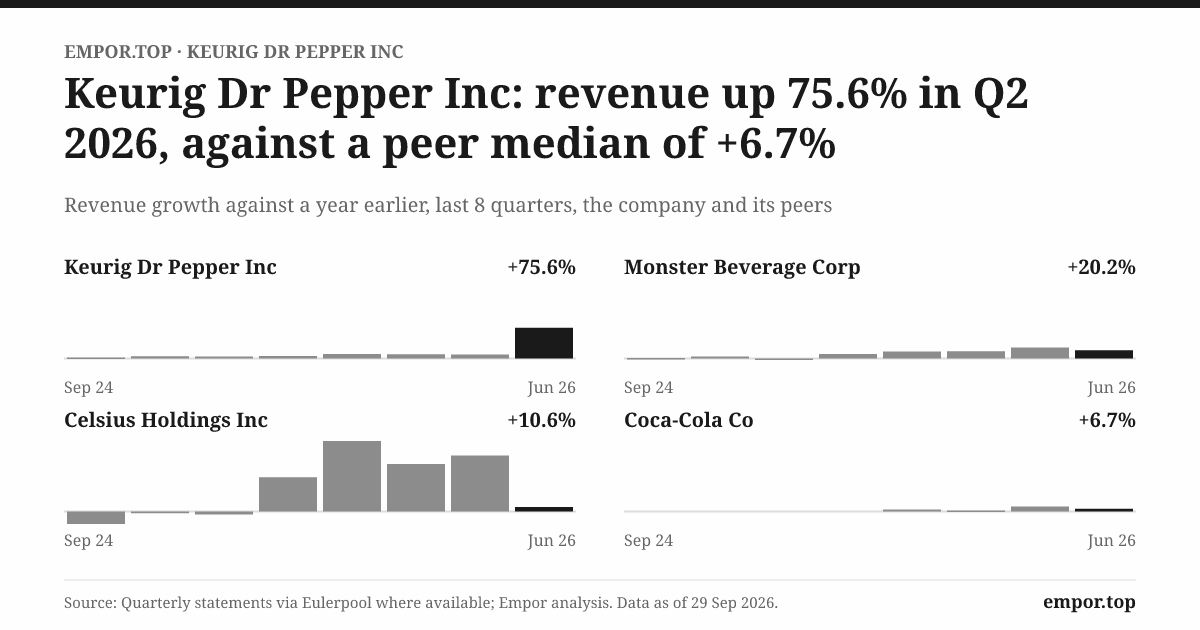
Four months later the first combined quarter arrived, and it looked like two different companies had filed the same report. Revenue for the three months to June jumped to about $7.3 billion, up roughly three quarters on a year earlier.1 Net profit attributable to shareholders fell to $142 million, down about 74%.1 A business that had spent a decade telling investors it was a steady, mid-single-digit compounder had, in one quarter, produced the fastest revenue growth and the weakest profit in its modern history.
Neither of those numbers is the real story. The growth was bought, not earned: JDE Peet's alone contributed about $2.8 billion of sales in the quarter.1 The profit collapse was mostly accounting for the purchase itself: inventory marked up to fair value and then flushed through cost of sales, integration bills, and a much larger interest charge.1 What matters is quieter and harder to see. Underneath sits a legacy American beverage engine that is either durable or quietly maturing. On top sits a balance sheet that the rating agencies now place one notch above junk, at Baa3 from Moody's and BBB− from S&P,2 with management's own leverage measure at about 4.4 times earnings on a pro forma basis.1
This story is organised around four questions that the deal forces on any long-term owner.
First, can the combined coffee business earn its cost of capital after paying nearly $18 billion for JDE Peet's? Second, is the balance sheet now a constraint on the dividend, on the planned split of the company into two, or on both? Third, is the legacy US growth durable, or is price and mix flattering a mature category? Fourth, are reported earnings a fair measure of this business at all, given how large and persistent the "adjusted" items have become?
A few ground rules before the story begins. Almost every trend line for KDP runs straight through a structural break. Everything before the June 2026 quarter is the legacy company: Dr Pepper, Canada Dry, Snapple, the Keurig brewer and its K-Cup pods. Everything after includes a European coffee roaster with a very different margin profile. Comparing the two without adjustment is like comparing a man's weight before and after he picks up a sofa.
The second rule concerns which numbers to trust. Third-party data services compute KDP's operating profit slightly differently from the company. For the full year 2025 the company reported operating income of $3,575 million;3 for the June 2026 quarter it reported $628 million.2 Those are the figures used here whenever the filings are the subject.
The story starts much earlier, with two brands that each carry a lesson KDP is still living out.
 Subscribe on LinkedIn
II. Two Old Brands, Briefly: Dr Pepper and the Green Mountain Pod (1885–2015)
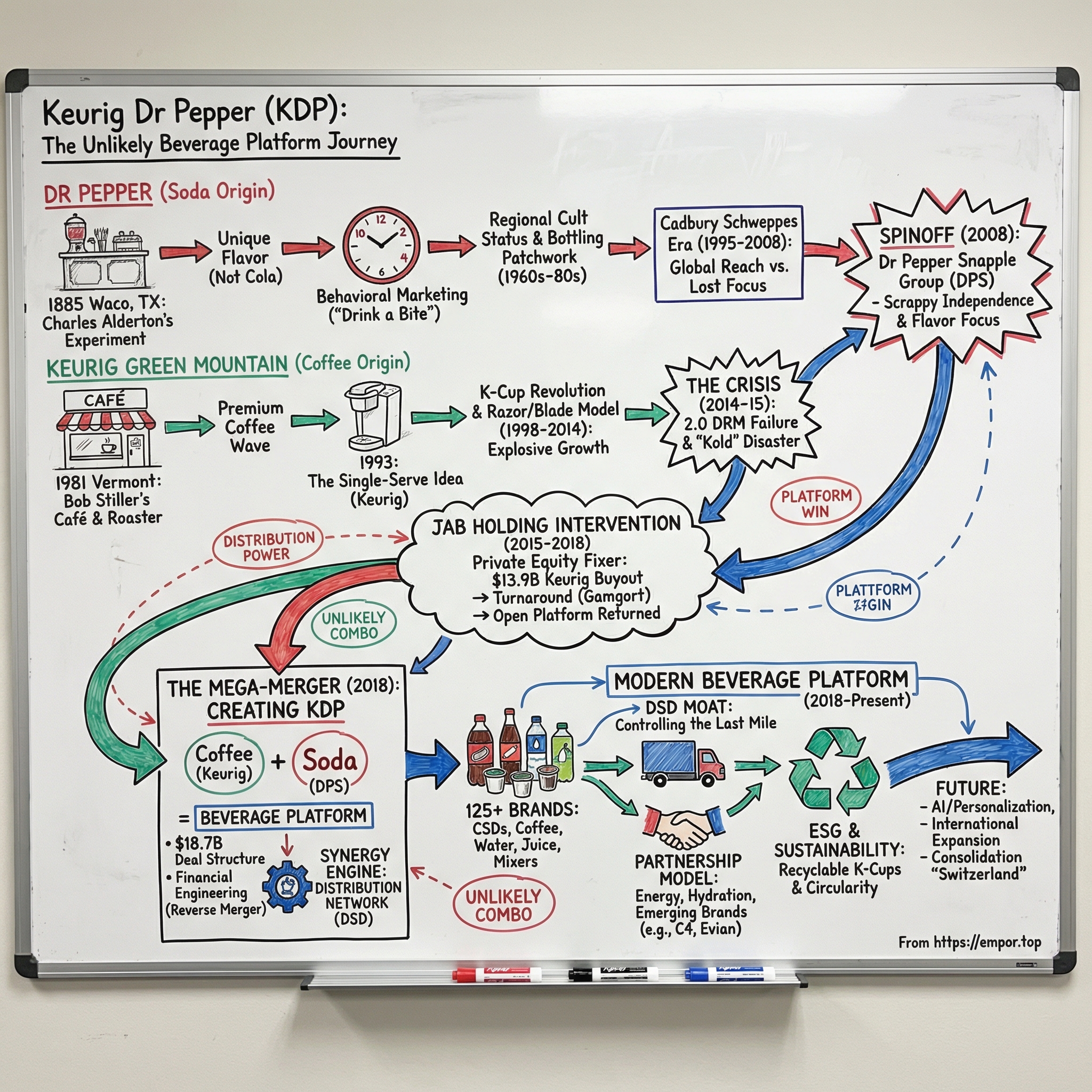
Picture a drugstore soda fountain in Waco, Texas, in the 1880s. A young pharmacist mixes fruit syrups until he lands on a flavour nobody can quite name, which is still the best marketing line the brand has. Dr Pepper spent most of the next century as a regional oddity that kept refusing to die: not a cola, not a root beer, sold through whatever bottlers the giants did not lock up.
That independence shaped everything that followed. Dr Pepper eventually ended up inside Cadbury Schweppes, which bundled it with Snapple, 7UP, Canada Dry and a collection of other brands that were orphans in a Coca-Cola and Pepsi world. In May 2008 Cadbury spun the American drinks arm out as Dr Pepper Snapple Group, and it went public as the scrappy number three.3 Its founding problem was distribution. A soft-drink brand is only as good as the truck that puts it in the cooler, and the biggest trucks belonged to Coke and Pepsi bottlers. So the new company bought bottlers and built its own direct-store-delivery network: the salespeople and trucks that deliver cases straight to supermarket shelves and stock them. That network became its edge, and it is still the most durable asset in the building.
The second brand came from Vermont. Keurig began as a single-serve brewer designed for offices. Green Mountain Coffee Roasters, a speciality roaster, became its biggest partner, then its owner, and then turned the machine into a household product. The genius was in the economics. Sell the brewer cheaply and earn money on every pod, forever. It is the razor-and-blade model that made Gillette rich, applied to the morning coffee habit of tens of millions of American households. Licensing deals put Starbucks, Dunkin' and Folgers inside K-Cups, so the platform owned the kitchen counter no matter which brand the consumer preferred.
The pod business also showed a tendency to overreach. When the original K-Cup patents expired, Keurig tried to protect the franchise with a new brewer that rejected unlicensed pods, a "lock-out" that angered customers and invited lawsuits. A cold-drink machine built with Coca-Cola was a costly flop. Competitors and customers sued over Keurig's conduct in the pod market, and that K-Cup antitrust litigation is still listed as a live matter in KDP's filings a decade later.2
By late 2015 the market had lost patience. On 7 December 2015, JAB Holding, the investment vehicle of Germany's Reimann family, agreed to take Keurig Green Mountain private for $92 a share in cash, about $13.9 billion of equity value.5 The price was a premium of about 78% to where the stock had closed the previous Friday,5 which tells you how far the shares had fallen from their days as a growth-stock darling. Among JAB's co-investors were existing partners in Jacobs Douwe Egberts,5 the European coffee company that would, ten years later, become the target of this story.
JAB installed Bob Gamgort, a consumer-goods operator with a reputation for cost discipline, to run Keurig. The playbook was unglamorous: fix the relationship with pod partners, drop the lock-out mindset, take cost out of manufacturing, and let the installed base of brewers do the compounding. It worked well enough that JAB decided Keurig could be the anchor for something much bigger. The team that ran KDP until 2024, and much of the thinking that still runs it, was formed in that turnaround.
For investors, the two origins carry two different lessons. Dr Pepper teaches that distribution is the moat: a brand without a truck is a rumour. Keurig teaches that a razor-and-blade franchise has real pricing power, and that it also has a history of testing its customers' patience and finding the limit. Both lessons bear directly on the coffee bet of 2026. The first explains why the soda side prints money. The second is the base rate for how this business behaves when it thinks it controls the customer. The next move was to bolt the two together.
III. The 2018 Merger: The Financial Engineering That Built the Platform
On 9 July 2018 the merger of Keurig Green Mountain and Dr Pepper Snapple Group closed.6 The next day the combined company began trading under the ticker KDP,6 and a special cash dividend of $103.75 a share landed in the accounts of Dr Pepper Snapple's old shareholders.7 That payment was the whole deal in one number. Technically Dr Pepper Snapple was the surviving listed company. Economically, Keurig had bought it, with JAB ending up owning the large majority of the combined shares and public holders taking a cash payout plus a minority stake. The press release described a company with about $11 billion of annual revenue, the third-largest beverage business in North America.6
Why put soda and coffee in the same company? The strategic pitch had two halves. Dr Pepper Snapple brought the trucks, the retail relationships and the shelf space. Keurig brought a pod platform with recurring purchases attached to every brewer in a kitchen. The merged company could, in theory, push coffee through soda distribution and push cold drinks toward coffee households. Put more simply, JAB wanted to own "the beverage occasion" from morning to evening.
The investor's version of the question is less romantic. Did the merger create value, or did it mainly create a very large balance sheet?
Start with what clearly worked. Revenue went from about $7.4 billion in 2018, a year that included only half a year of the combined business, to about $11.1 billion in 2019, and then kept growing to about $16.6 billion by 2025.3 Operating margin settled at 21–22% from 2019 onward, higher than Dr Pepper Snapple had typically earned alone.3 The combination scaled and it did not dilute margins. On an income-statement basis, the merger delivered.
Now look at the other side of the ledger. Shareholders' equity went from about $2.5 billion at the end of 2017 to about $22.5 billion at the end of 2018.3 Total assets went from about $10 billion to about $49 billion.3 Most of that new capital was not factories or trucks. It was goodwill and brand intangibles, the accounting residue of paying far more than book value for Keurig and Dr Pepper Snapple.
That is where the returns went. In 2017 the old Dr Pepper Snapple earned a return on invested capital of about 18.6%.3 In 2018 the combined company earned about 2.4%, and even in its best recent year, 2025, the figure was about 7%.3 On a trailing basis to June 2026, before the full effect of JDE Peet's, it was about 4.4%.3 Return on equity tells the same story more dramatically, collapsing from over 40% to single digits.
A careful reader should not over-interpret that collapse. Part of it is optics: the pre-merger Dr Pepper Snapple had a tiny equity base after years of buybacks, so its return on equity looked spectacular. Any ten-year comparison that starts before 2018 is distorted by the merger. But the underlying point survives the adjustment. The combined company earns high margins on a capital base that is enormous relative to the cash it generates. At roughly 7% at its peak, return on capital was still below what most investors would consider a comfortable margin over the cost of that capital. The merger built scale. It never rebuilt returns.
There was a second, less visible engine inside the 2018 combination: supplier float. Keurig's model paid suppliers slowly. After the merger, KDP's days payable, the average time it takes to pay suppliers, ballooned to about 276 days by 2021.3 For a period, suppliers were effectively lending KDP working capital for free, and the cash conversion cycle went deeply negative, to about −182 days.3 That meant KDP got paid by customers roughly half a year before it paid for the ingredients.
That float has been leaking away. By 2025, days payable had fallen to about 144 and the cash conversion cycle had risen to about −24 days.3 Part of the story is on the other side of the ledger: inventory days rose from about 57 to about 83 over the same span,3 as the company carried more stock of coffee, packaging and finished goods through a period of supply-chain stress and tariffs. The reason payables fell is not spelled out as a single line in the filings, but the direction matters more than the cause. A tailwind that once flattered operating cash flow has become a headwind, and it explains part of why cash conversion weakened in recent years, a thread picked up in Section VI.
Then there is the owner who designed all this. JAB ran KDP as a controlled company for years. It then sold down, first in large block trades in 2025, and by the time of the 2026 proxy it was no longer listed as a holder of more than 5% of the stock, a threshold it crossed in May 2025.4 The architect of the platform has largely left the building, and the company that remains is run by professional managers for a dispersed shareholder base.
The investor takeaway from 2018 is a template. KDP's managers learned that you could combine two good franchises, finance the deal heavily, keep margins high, and still end up with mediocre returns on the capital you paid. The legacy engine that deal created is the next thing to examine, because it has to carry everything that came after.
IV. The US Beverage Engine: How Strong Is It Really?
Walk down the soda aisle of a Walmart in suburban Texas. A two-litre Dr Pepper sits at eye level. Below it, in plainer packaging, the store's own brand costs noticeably less. At the end of the aisle, in a cooler of brightly coloured cans, sits GHOST, an energy drink KDP bought into so recently that it had to pay other distributors to hand back the delivery rights. Everything interesting about the US business is in that aisle: the brand premium, the private-label threat, the retailer's power and the growth bets.
The profit engine
KDP reports its legacy US business in two segments, and they could hardly be more different in 2025.
US Refreshment Beverages, which is Dr Pepper, Canada Dry, Snapple, the energy brands and the rest of the cold-drink portfolio, grew net sales by about 11.9% to about $10.4 billion in 2025.[^4] Its adjusted segment margin was about 29.8%.[^4] That is not a mature soft-drink business drifting along with population growth. It is a large franchise growing at double digits with margins near 30%.
Momentum continued into 2026. In the June quarter US Refreshment Beverages grew about 10% with an adjusted margin of about 29.9%.1 Management's guidance for the legacy group as a whole is only 4–6% constant-currency growth,[^4] so the refreshment segment has been running well ahead of what the company itself promises.
The analyst's job is to ask why. Some of the growth is price: beverage companies across the US pushed through repeated increases as input costs rose. Some is mix, the shift toward higher-priced energy drinks and premium brands. Some is acquired, since GHOST's sales flow through this segment once the brand is consolidated. The company does not break out a clean organic volume figure for refreshment in the material summarised here, so the honest reading is that growth is strong but that its composition, how much is more cans versus pricier cans, remains to be proven.
The coffee half that stalled
US Coffee is the other half of the legacy business, the K-Cup pods and Keurig brewers. In 2025 its net sales rose only about 0.6% to about $4.0 billion, and its adjusted operating income fell about 4.4% to roughly $1.2 billion.[^4] In the June 2026 quarter sales fell about 3.2%.1
This matters more than its size suggests. The coffee pod was supposed to be the recurring, high-return annuity at the heart of the 2018 merger. Instead it is flat, with shrinking profit, while KDP was spending almost $18 billion to double down on coffee. KDP manufactures all of its owned and licensed pods itself,3 which gives it cost control. It does not give it pricing power against cheaper store-brand pods that fit the same brewer.
The moat, argued once
It is worth arguing the moat properly here, because the rest of the story leans on it.
Start with Hamilton Helmer's "7 Powers" framework. KDP's most credible power is scale economies in distribution. Its direct-store-delivery network and its licensed bottler system mean each additional brand it pushes through the system costs little to deliver. This is why KDP can take a small brand like GHOST and plug it into thousands of stores quickly. The second power is branding. Dr Pepper has a loyal, century-old flavour franchise that no private label copies well, and it has held its place as the leading "third" soda in America. Switching costs exist on the coffee side: a household that owns a Keurig brewer is locked into K-Cup-compatible pods. The weakness is that the lock is on the format, not the brand, so private-label pods capture the recurring purchase without owning the machine. Counter-positioning, the power of a business model incumbents cannot copy without hurting themselves, is thin. Coca-Cola and PepsiCo can match nearly anything KDP does in cold drinks.
Now Michael Porter's five forces. Buyer power is real and concentrated. Walmart alone accounted for about 16% of KDP's consolidated net sales in 2025.3 One buyer with that share has enormous leverage on price, promotion and shelf placement. Supplier power shows up in input costs: ingredients and packaging such as green coffee, aluminium cans, PET bottles and sweeteners make up roughly 55% of cost of sales.3 In 2025 net sales growth added about 9 points to gross profit growth, but ingredient, material and productivity effects, including tariffs on aluminium, took away about 4 points.[^4] Rivalry is intense and asymmetric: Coca-Cola and PepsiCo are much larger in carbonated soft drinks, and Monster dominates energy. Substitutes range from store-brand pods to changes in consumption habits, from sugar reduction to appetite-suppressing weight-loss drugs, which are plausible risks but not yet visible in KDP's reported numbers. New entrants are a constant in energy drinks and a minor factor in core soda.
Put it together and the verdict is two-sided. The refreshment moat, built on distribution scale and brand, is real and currently strengthening, as the double-digit growth and near-30% margins show. The coffee-pod moat has weakened. The historical record rejects the idea that the K-Cup is an untouchable annuity; the evidence narrows it to a real installed-base advantage that is being slowly taxed by private label and by the business's own past overreach.
GHOST and the price of owning the truck
GHOST is the clearest example of how KDP thinks about distribution. When KDP took control of the energy brand's route to market, it paid about $225 million in one-off distribution termination payments to unwind the existing arrangements.[^4] That is the price of moving a brand from someone else's trucks to your own. It hit 2025 operating cash flow directly.[^4]
The logic is sound in principle. Energy drinks are the fastest-growing part of the cold-drink aisle, and owning distribution means capturing the full margin rather than sharing it. But GHOST is a component of the refreshment segment, not a headline. Its success will show up in segment growth and margin, and investors should resist treating a young, fast-growing brand as proof that KDP has cracked the energy category that Monster has owned for two decades.
Harvest or reinvest?
One more clue deserves attention. Capital spending fell from about 3.7% of revenue in 2024 to about 2.9% in 2025, roughly $486 million.[^4] Net property, plant and equipment fell from about $3.8 billion to about $3.2 billion.3 Those are the signatures of a business being run for cash, not one being built out.
Some of the decline has a specific explanation that arrives in Section V: KDP carved its pod factories into a joint venture as part of the JDE Peet's financing. And there is a counter-signal. KDP is launching a new brewer system, Keurig Alta, in the fall of 2026,1 a bet that a new machine can reignite the coffee installed base. The company employed about 30,600 people at the end of 2025, roughly 23,200 of them in the US.3 The reading is a business that is invested in at a moderate rate, with cash flowing mainly to dividends and deals.
The two KPIs that will settle whether US growth is durable are refreshment volume and mix, and US Coffee pod volumes. Until the first shows growth that is not mostly price, and the second stops shrinking, the claim of durable growth is intact but unproven.
The oddity that frames the next section is plain from all this. The soda business earns about twice the margin of the coffee business, the domestic coffee business is stalling, and management chose this moment to spend nearly $18 billion on more coffee.
V. The $17.9bn Coffee Bet: Did They Overpay for JDE Peet's?
The offer was €31.85 a share.2 For a Dutch coffee company that had spent years as a JAB-controlled listed vehicle, trading at a discount and fighting cost inflation in green coffee, it was a clean exit. For KDP, it was the most consequential decision since the 2018 merger. Total consideration came to about $17.93 billion, including about $402 million set aside for the remaining 2.25% of shares not tendered.2
The financing is where the story gets interesting, because KDP did not issue a single new common share to the public to pay for it.2
Following the money
Picture the funding as four buckets.
The first bucket was ordinary debt. KDP drew a delayed-draw term loan of about $3.6 billion and issued senior notes of roughly $6.1 billion.2
The second bucket was the pod factories. On 30 March 2026, two days before the tender closed, KDP sold 49% of a newly created joint venture holding its pod-manufacturing assets to a group of investors for about $4.0 billion.2 The investors are promised a targeted internal rate of return of 6.375% for five years. KDP has the right to buy them out between years 8 and 15, and around year 15 the investors gain a conversion right.2 By 30 June, the non-controlling interest on KDP's balance sheet stood at about $4.2 billion.2
The third bucket was preferred stock: 4.5 million shares of Series A convertible perpetual preferred with a $4.5 billion liquidation preference, placed with Apollo, KKR and Goldman Sachs Asset Management.2 The same names sit behind the joint venture.2
The fourth bucket was the company's existing cash and short-term borrowing.
Translate that into plain English. KDP took the manufacturing heart of its own K-Cup business, the factories that make every owned and licensed pod, and rented half of it to private-capital firms in exchange for cash. Those investors get a steady, bond-like return first, and a path to ownership later if KDP does not buy them back. KDP then sold a second layer of claims, the preferred, to the same firms. Neither layer counts as debt in the headline borrowing figures. Both rank ahead of or alongside the common shareholder when it comes to cash.
That is not free money. A 6.375% target return on equity-like capital is expensive in a world where KDP's investment-grade bonds cost less. What the coffee business gave up to fund this was a share of the future cash flow from its best asset, the pod factories, and a degree of control over them. Buying JDE Peet's was, in effect, partly paid for by selling a stake in Keurig.
What KDP bought
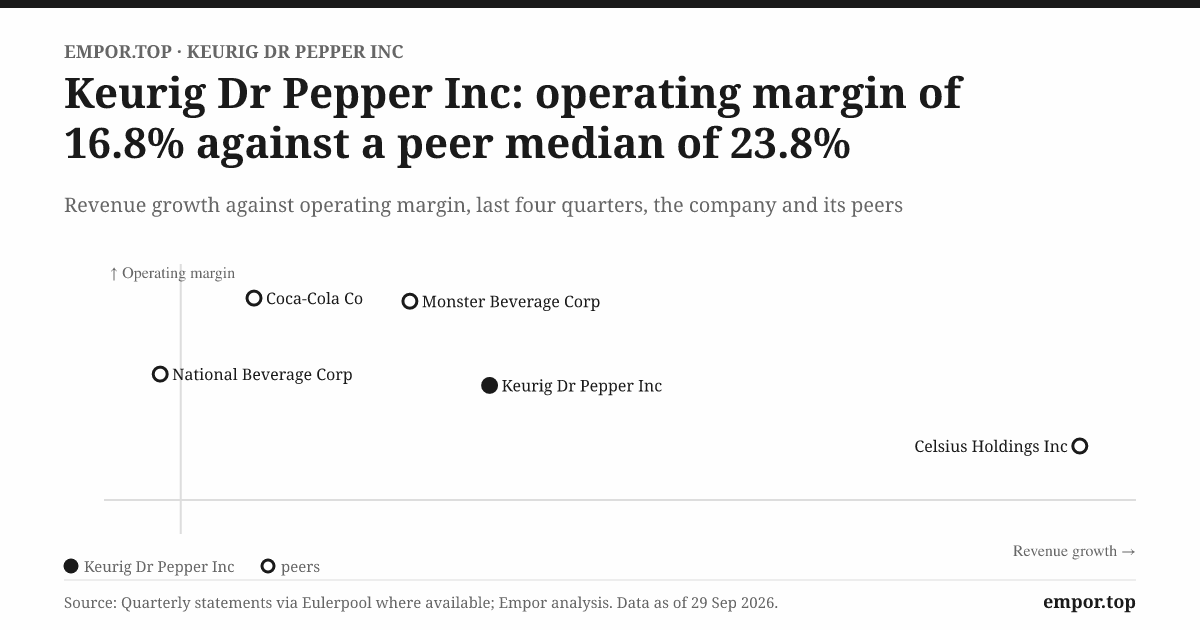
JDE Peet's is a global coffee company with some of Europe's oldest brands and supermarket shelves from Amsterdam to Jakarta. In the June quarter it produced about $2.8 billion of net sales at an adjusted segment operating margin of about 14.8%.1 Set that beside the 29.9% earned by US Refreshment Beverages in the same quarter,1 and the problem is plain. KDP paid a large sum for a business earning half the margin of its best division.
The accounting confirms how much of the price was paid for things you cannot touch. KDP booked about $9.7 billion of goodwill and $14.8 billion of other intangible assets from the deal.2 Those numbers are provisional, and the purchase price allocation will be one of the key areas auditors examine in the 2026 annual report.
The return arithmetic
Here is the simplest way to frame whether the deal can earn its cost of capital.
Before the deal, KDP earned roughly 4.4% on invested capital on a trailing basis.3 It then added about $18 billion of new capital to buy a business whose margin is about half that of its best division. For the deal to raise consolidated returns, JDE Peet's would need to earn well above 4.4% on $18 billion, after tax, from year one. At a 14.8% margin on its current revenue run-rate, JDE Peet's operating profit is substantial, but after tax, and set against $18 billion, it produces a return in the mid-single digits at best.
Then add the funding cost. Net interest expense in the June quarter was about $336 million, against about $180 million a year earlier.1 That extra $150-odd million a quarter points to something like $600 million more interest a year, before counting the preferred dividends and the joint venture's promised return. Stack those three layers and the total annual cost of the capital raised for this deal plausibly approaches $1.5–2 billion.
On the evidence available today, the deal dilutes returns for years. The claim that it creates value rests on three things arriving together: cost synergies from combining two coffee businesses, revenue synergies from selling JDE Peet's brands through KDP channels, and a re-rating of the separated coffee company once it trades on its own.
Did they overpay?
The honest answer is that "overpaid" needs a benchmark. The comparison that matters is how the tender premium, the multiple of earnings paid and JDE Peet's own trading history stack up against other coffee and beverage transactions, and KDP's disclosures do not give that comparison in a way that settles it. What can be said is that the price looks full against a business earning about half of KDP's own margin. That will prove justified only if synergies and separation-driven repricing both arrive.
The figure that confirms or falsifies it is simple: JDE Peet's adjusted segment margin and consolidated return on invested capital in fiscal 2027, the first full year of ownership, together with any goodwill impairment.
The record on deals
Management's deal record is the best predictor of how this one will be treated. It includes the 2018 merger, which built scale but crushed returns, and the GHOST transaction, which needed $225 million to unwind someone else's distribution.[^4] It also includes a painful moment in the fourth quarter of 2024, when KDP booked about $718 million of goodwill and intangible impairments.[^4] That wiped out the quarter's profit and pushed it to a loss.3 Impairments are an admission that an asset is worth less than the company paid or carried it for. They do not prove this deal will go wrong. They do prove this management has overpaid, or overcarried, before.
Currency, and the quarter's clean-up bill
Buying a European company brought a new risk: the euro. KDP now carries about €5.75 billion of euro-denominated notes and about €2.8 billion outstanding on its euro term loan.2 It uses forwards, cross-currency swaps and net investment hedges to align its euro debt with JDE Peet's euro earnings.2 That helps, but currency still moves the accounts: in the first quarter of 2026 translation adjustments reduced accumulated other comprehensive income by about $242 million.2
Finally, the June quarter itself carried roughly $800 million of items that management adjusts out of its headline earnings. The two largest were an inventory step-up of about $314 million and integration costs of about $318 million.2 The inventory step-up is pure acquisition accounting. KDP had to value JDE Peet's coffee stocks at fair value on the day of purchase, which means the profit on that inventory vanishes when it is sold. That will fade. Integration costs are more ambiguous: they are real cash, and on deals of this size they usually persist longer than the first year.
The deal puts heavy weight on how far investors can trust the people who designed it, and on how they report their own results.
VI. Management on the Record: Credibility Under Pressure
Picture an earnings call. A slide shows adjusted diluted earnings per share for 2025 of $2.05, up 7.3%.[^4] A few pages later, in the reconciliation tables, the GAAP number sits at $1.53.[^4] On a trailing twelve-month basis to June 2026, GAAP earnings per share were only about $1.05.3 The analyst community mostly quotes the first number. The balance sheet ultimately answers to the last one.
The people
Tim Cofer became chief executive on 26 April 2024, with Bob Gamgort moving to executive chair.4 Cofer came up through big-food companies and had been KDP's chief operating officer before taking the top job. His profile is that of an operator, not a dealmaker. It is therefore striking that his defining decision as chief executive is one of the largest deals in the beverage industry for years.
The finance seat changed hands at a sensitive moment. Anthony DiSilvestro, previously finance chief at Mattel and Campbell Soup, became chief financial officer in late 2025, replacing Sudhanshu Priyadarshi.4 That change came between the announcement of the coffee deal and its close. It is not evidence of a problem, but it is a fact any skeptical investor should note: the finance chief who helped design the financing did not stay to see it through.
The board has also changed shape. Pamela Patsley became independent chair on 1 April 2026, the same day the JDE Peet's deal closed.4 Nine directors stood for election in 2026, eight of them independent, and the audit, compensation and nominating committees are entirely independent.4 With JAB gone, governance has moved from a controlled-company model to a conventional independent board. That is an improvement in principle. It also means no single large owner is watching management on shareholders' behalf.
Consistency of the story
The strategic narrative has shifted meaningfully. For most of the post-2018 era, KDP described itself as a steady compounder: mid-single-digit sales growth, high-single-digit earnings growth, rising dividends, falling leverage. In August 2025 the company announced both the JDE Peet's acquisition and the plan to separate into two listed companies, a global coffee company and a North American beverage company.4 Management framed the two moves as one idea: create a coffee champion with scale and a focused beverage company with better growth.
That framing contains a tension worth naming. If coffee is to be spun off, why buy more of it using the consolidated balance sheet, including a financing structure secured partly on the US pod business? The answer management offers is scale and synergy. The skeptic's answer is that the combined company needed a big balance sheet to fund the purchase, and a split lets each half be valued separately afterward. Both can be true. But the shift from "steady compounder" to "transformative deal plus breakup" is a strategic pivot, and one that investors did not sign up for when they bought a low-risk dividend stock.
On the other hand, guidance for the legacy business has held. Management reaffirmed 2026 guidance with the second-quarter results,1 and legacy growth has come in at or above the 4–6% range. On near-term promises, the record is good. On capital allocation, the record includes both the 2024 impairments and a sudden move from deleveraging to re-leveraging.
Adjusted versus real
KDP's adjusted earnings strip out a long list of items: amortisation of acquired intangibles, mark-to-market swings on commodity hedges, impairments, restructuring, and deal and integration costs. Each can be defended individually. The pattern is the problem. Impairments occurred in 2024, deal costs across 2025 and 2026, and integration costs will continue through the separation. Items that recur every year are, economically, part of the cost of running this business.
The cash flow tells the same story more quietly. Over the twelve years from 2014 to 2025, cumulative operating cash flow was about 138% of net profit.3 That looks excellent, but it is helped by the large non-cash amortisation of merger intangibles. Recent years are weaker. Operating cash flow as a share of EBITDA fell to about 33.5% in 2023 and was about 47.5% in 2025.3 The 2025 figure was held back by the $225 million GHOST payment,[^4] and operating cash flow fell to about $2.0 billion from about $2.2 billion.[^4] The 2023 slump is harder to explain from the headline numbers and coincides with the unwinding of supplier float described in Section III.
The first half of 2026 offers a positive datapoint. Operating cash flow was about $1.18 billion, against $640 million a year earlier, with free cash flow of about $898 million.2 Part of that is JDE Peet's cash flow for one quarter. It is still the right direction.
Pay and incentives
Chief executive pay for 2025 was reported at around $8.2 million on the summary compensation table.4 Shareholders approved the say-on-pay resolution at the June 2026 meeting with roughly 96% support,4 and also voted on a new Omnibus Stock Incentive Plan of 2026.4 The key question for investors is which earnings measure drives those incentives. Where bonuses and stock awards are tied to adjusted earnings per share, management is paid on the number that excludes the costs of its own deals.
The auditor
Deloitte & Touche audits KDP.4 The single largest audit judgement in 2026 will be the purchase price allocation for JDE Peet's: how much of the $18 billion is booked as goodwill, how much as brands with indefinite lives, and how much as intangibles that must be amortised. Those choices will shape reported earnings for a decade. Receivables are not a concern: debtor days were about 37 in 2025, the same as in 2014.3
The verdict on management is mixed but not damaged. They have delivered on near-term guidance, and governance has improved. But the adjusted-to-GAAP gap is large and recurring, cash conversion has weakened, and the strategic narrative pivoted sharply. Credibility now rests on the balance sheet, which is where the next section goes.
VII. The Balance Sheet, the Dividend and the Split
In September 2026 a $400 million note carrying a 2.55% coupon fell due.2 On its own that is a routine event for a company of KDP's size. The detail that matters is the neighbourhood. At the end of June, KDP carried about $8.4 billion of short-term borrowings.1 That note sat inside a much larger pile of debt that needs rolling over, at interest rates well above what KDP paid when it originally borrowed.
How big the pile got
Total borrowings were about $16.1 billion at the end of 2025.3 By 30 June 2026, short-term borrowings of about $8.4 billion and long-term debt of about $21.6 billion put the total near $30.4 billion.1 Debt nearly doubled in six months. Senior notes alone totalled about $24.8 billion, with commercial paper of about $2.0 billion.2 On top of that sit the $4.5 billion of preferred and the $4.2 billion joint venture minority interest,2 neither of which appears in the debt total.
Management's leverage measure, net debt against earnings before interest, tax, depreciation and amortisation, rose from about 3.1 times at the end of 2025 to about 4.4 times on a pro forma basis at 30 June.1 The company targets about 4.1 times by the end of 2026.1
For historical context, before the 2018 merger Dr Pepper Snapple ran debt at roughly one to two times its small equity base.3 The merger added about $16 billion of borrowings in one year.3 KDP then spent seven years paying down debt, only to double it again in one step.
The ratings
Both main agencies now rate KDP at the lowest investment-grade notch, Baa3 at Moody's and BBB− at S&P, after downgrades tied to the JDE Peet's deal.2 One more notch down and KDP would be "junk". That would not be catastrophic, since the company is not near covenant trouble. But it would raise the cost of every refinancing, reduce the pool of investors able to hold KDP bonds, and make the commercial paper programme, which depends on strong short-term ratings, far less reliable.
The mitigants are real. KDP says it is in compliance with all covenants.2 Its $4.3 billion revolving credit facility was undrawn at the end of June,2 a backstop for commercial paper and near-term maturities. Cash stood at about $1.5 billion.1 Near-term liquidity is not the problem. The trajectory is.
The dividend
KDP paid about $1.25 billion in dividends in 2025, against free cash flow of about $1.5 billion.[^4] That is roughly 60% of net profit,3 which sounds comfortable until you notice that the payout was about 83% in 2024.3 Measured against free cash, the dividend absorbs more than four-fifths of what is left after capital spending. Over the twelve years to 2025 KDP paid out about half of its cumulative free cash flow as dividends,3 and most of the rest went to debt and deals rather than to buybacks, which were about $9 million in 2025.[^4]
That leaves the dividend reliant on two things: the new coffee business adding cash faster than the new interest bill consumes it, and management keeping deleveraging on schedule. If both happen, the dividend is safe. If the coffee business disappoints and interest costs rise on refinancing, the dividend becomes the most obvious source of cash to protect the credit rating. A dividend yield of about 2.9%3 is not generous enough to justify taking that risk lightly.
The split
The plan is to separate into two listed companies in early 2027: a global coffee company and a North American beverage company.1 The design questions are where the value will be decided.
Which company takes which debt? The euro debt belongs logically with the coffee company, which has euro earnings. The preferred stock and the joint venture sit on the coffee side of the balance sheet, because the joint venture owns the pod factories. That suggests the coffee company would start life heavily burdened by layered claims. The beverage company, holding US Refreshment Beverages with its roughly 30% margins, would be the cleaner, higher-return business.
Which company can afford a dividend? The beverage company, almost certainly. The coffee company, with lower margins, euro exposure, expensive equity-like claims and integration costs, would struggle to pay a meaningful dividend while deleveraging.
Now apply an activist's lens. A skeptical investor would ask why the beverage company should carry any coffee debt at all, and why management should not simply sell the coffee business to a strategic buyer rather than spin it off with a stretched balance sheet. The counterargument is that selling would crystallise a lower price than a separate listing might achieve. The test is simple: if the coffee company trades at a discount to what was paid for it once separated, the deal's sceptics will have been right.
Valuation as data
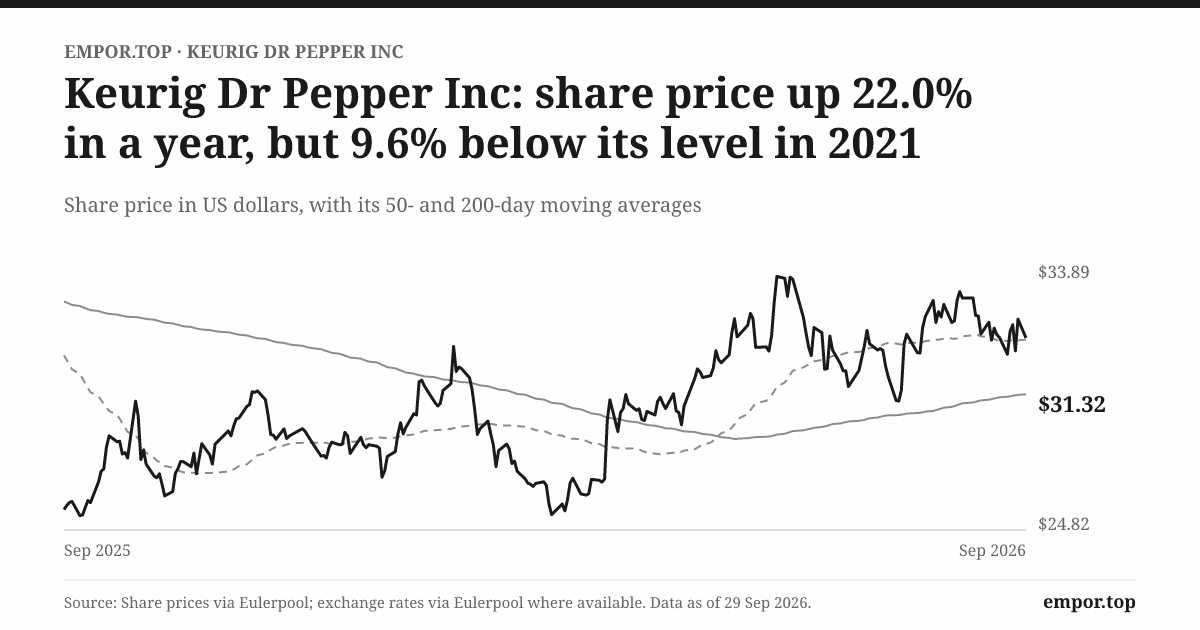
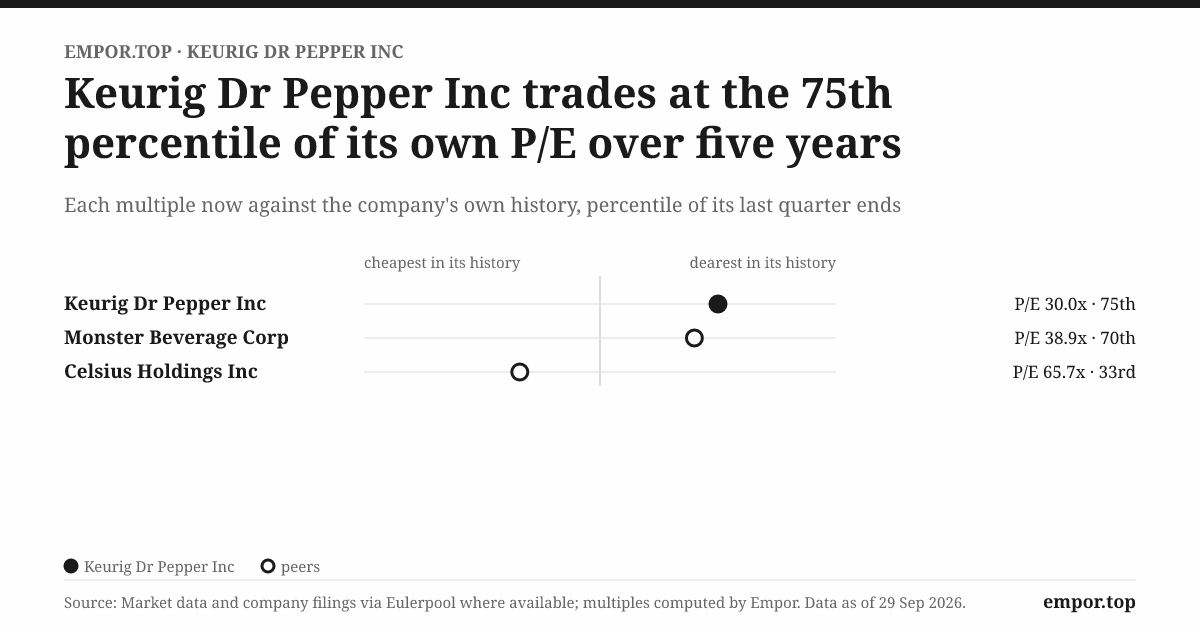
At $31.32 on 29 September 2026, KDP's market value was about $42.8 billion and its enterprise value, including debt, about $75.7 billion.3 The trailing price-to-earnings ratio is about 30 times, against a five-year median of about 23 times.3 Enterprise value is about 20.9 times trailing EBITDA.3 Free cash flow yield is about 4.6%.3
Those multiples are distorted. Enterprise value includes all the new debt, while trailing earnings include only one quarter of JDE Peet's, and that quarter was loaded with acquisition costs. On adjusted earnings per share of about $2.05 for 2025,[^4] the stock trades at roughly 15 times. The truth sits somewhere in between, and depends on whether the adjusted items keep recurring. What the price appears to assume is that the adjustments fade, the separation unlocks value, and leverage comes down on schedule. It does not look like a price that assumes the deal fails.
So what does KDP's history actually teach? The following lessons belong to this company and no other.
VIII. Playbook: Lessons From KDP
Buy the moat, then rent it back to fund the next one. In March 2026, KDP sold 49% of its pod factories to private capital for $4 billion to help pay for JDE Peet's. The factories that make every K-Cup were Keurig's crown jewels, the physical embodiment of the razor-and-blade model. Renting them out to fund a lower-margin acquisition turns a moat into collateral. The broader lesson for founders and investors: when a company finances growth by selling claims on its best asset, count the new owners of that asset before counting the new revenue. A moat you've rented out is a moat that pays two landlords.
Adjusted is a story; cash is a fact. Adjusted EPS of $2.05, GAAP of $1.53, trailing GAAP of $1.05. Three numbers for one company in one year, and management's pay is anchored to the highest. Every adjustment has a reason, and together they add up to a business that looks steadier than it is. Investors should build their own "recurring adjustments" column and treat it as a cost. When the exceptions happen every year, they are the rule.
Distribution is the moat the bottler bought. Dr Pepper was a regional oddity for a century until it owned its own trucks. Two decades later, the direct-store-delivery network is still the reason US Refreshment Beverages earns near-30% margins and can take a young brand like GHOST national in months, even at a $225 million price to take back the route. Brands get the attention. Trucks get the returns. In soda, the flavour wins the customer; the truck wins the shelf.
A razor-and-blade franchise is only as strong as its customers' patience. Keurig's lock-out brewer, the antitrust suits that followed, and the flat pod business of 2025 are one story told over a decade. Owning the machine gives you a customer; it does not give you permission to squeeze them. Private-label pods now capture much of the recurring purchase Keurig built. The blade is only yours until the customer finds a cheaper one that fits.
Financial engineering can buy scale, not returns. Return on invested capital was about 18.6% before the 2018 merger and about 4.4% on the eve of the 2026 deal. Twice now, KDP has used a large, leveraged transaction to double its size. Twice, the income statement has looked better and the return on capital worse. Leverage can make a company bigger overnight; only the business can make it better.
Those lessons frame the final argument: bull versus bear.
IX. Bull vs. Bear and What to Track
Imagine two analyst notes landing on the same morning. The first values the future beverage company on its own, a near-30% margin US business growing faster than its peers, and argues that the market is ignoring a premium asset trapped inside a messy conglomerate. The second subtracts the coffee company's share of the debt, the preferred and the joint venture claims, and concludes that the coffee business is worth less than KDP paid. Both are reading the same filings. They are disagreeing about which half of the company the next five years belong to.
The bull case
The bull case starts with the refreshment engine. US Refreshment Beverages grew about 12% in 2025 and about 10% in the June 2026 quarter at a margin near 30%,[^4]1 numbers that most mature consumer-staples businesses would envy. The distribution moat described in Section IV is real and has been tested over decades. GHOST gives KDP a growth vehicle in the most dynamic part of the cold-drink aisle.
Cash flow is improving. First-half 2026 operating cash flow nearly doubled.2 If management hits its leverage target of 4.1 times by year-end and continues to deleverage in 2027, the credit ratings stabilise and refinancing costs become manageable.
The split could unlock value. A standalone beverage company with high margins and strong growth could command a premium multiple. A global coffee company with scale could attract investors specifically seeking coffee exposure, or eventually a strategic buyer. Separations often create value precisely because they let different investors own different businesses.
The bear case
The bear case starts with returns. KDP earned about 4.4% on invested capital before the JDE Peet's deal,3 then added about $18 billion of capital to buy a business earning roughly half the margin of its best division. The deal dilutes returns for years, and the cost of the preferred and joint venture layers is high.
The balance sheet is stretched. Leverage near 4.4 times, ratings one notch above junk, about $8.4 billion of short-term borrowings, and new equity-like claims all constrain flexibility.12 The dividend absorbs most of free cash flow.
Coffee is the weak link. US Coffee is flat and declining, and the company's answer, a new brewer system, has not yet been tested. JDE Peet's integration is just beginning, and euro exposure adds volatility.
Management has pivoted from a steady compounder narrative to a transformative, leveraged deal, while also changing chief financial officers. Its prior record includes impairments of about $718 million in 2024.
Weighing it
Legacy refreshment has strong evidence behind it: sustained double-digit growth, high margins, and a distribution moat tested over decades. Coffee does not yet have proof of why it wins from here. The domestic pod business is losing ground, and JDE Peet's must still show that it can earn more than its cost of capital under KDP ownership. The overall verdict is neutral: a high-quality beverage franchise attached to an unproven, heavily financed coffee bet.
The three numbers that matter
Pro forma net leverage against the 4.1x target. The latest reading is about 4.4 times at 30 June 2026, up from 3.1 times at the end of 2025.1 The direction since the deal is up. Whether it falls to 4.1 times by the end of 2026 determines the rating outlook, the dividend's safety and the terms of the split.
US Refreshment Beverages volume/mix growth. Segment sales grew about 10% in the June 2026 quarter.1 The question is how much of that growth comes from volume and mix rather than price. That split decides whether the growth is durable.
JDE Peet's adjusted operating margin. The first reading was about 14.8% in the June 2026 quarter.1 Rising margins would support the synergy thesis. Flat or falling margins would support the case that KDP overpaid.
The risk radar
A few risks deserve a line each, framed by mechanism. Refinancing and cost of capital: a large short-term debt stack at the lowest investment-grade rating means every rate move and every rating action flows directly into interest cost. Input costs and tariffs: with ingredients and packaging near 55% of cost of sales, aluminium tariffs and coffee price swings hit gross margin before pricing can respond. Consumer shifts and private label: store-brand pods and changing drink habits put pressure on price realisation, especially in coffee. Integration execution: combining two coffee companies across continents while simultaneously planning a separation is operationally demanding. Euro currency: translation effects move reported earnings and equity. Litigation: the K-Cup antitrust matter remains open.2
Those numbers and risks set up the moments that will decide the story over the next year.
X. Epilogue
As of late September 2026, KDP is a company in transition between two identities. The stock trades about 6% below its 52-week high.3 The balance sheet is at its most stretched in the company's history. The first combined quarter looked ugly on a GAAP basis and encouraging on a cash basis. The next few months will turn the uncertainty into evidence.
The first moment has already arrived: the September 2026 debt maturity. Repaying a $400 million note is routine. The real signal is the cost and form of the refinancing: whether KDP rolls it into commercial paper, pays it from cash, or issues new long-term bonds at higher rates. That will reveal what the bond market now charges this company.
The second is the fall launch of Keurig Alta. If the new brewer revives the installed base, US Coffee stabilises and the coffee thesis gains a domestic leg. If Alta follows the Keurig 2.0 pattern of charging customers for a closed ecosystem, the coffee business will keep losing ground to private label.
The third is the 2026 annual report, and within it the auditor's view of the JDE Peet's purchase price allocation. How much of the price becomes goodwill, how much is amortised, and whether the auditor flags it as a critical audit matter will reveal how much judgement sits behind the accounts.
The fourth is the rating agencies. Moody's and S&P will assess the separation's capital structure before it happens. A downgrade of either company to junk would force a rethink of the design. A stable outlook would validate the plan.
The fifth is the separation itself, and the first standalone dividends. The beverage company will very likely keep paying. Whether the coffee company pays anything, and how much, will be the market's cleanest read on how burdened it is.
Map those against the four questions. If leverage falls to 4.1 times, Alta works and JDE Peet's margin rises, the answer to the first two questions tilts toward yes: the coffee business can earn its keep and the balance sheet does not bind. If refreshment keeps growing on volume rather than price, the third is settled. If adjusted items shrink after 2026, the fourth is too. If any of those break, particularly leverage and JDE Peet's margin, the questions tilt the other way, and the split becomes a way to put a disappointing asset in its own box.
The tension that remains is almost poetic. A beverage company whose best asset is the truck, and whose most admired invention was the pod, borrowed against its own pod factories to buy a European coffee roaster, and plans to split into two before anyone knows whether the deal worked.
XI. Outro
Somewhere in Waco, a pharmacist once mixed a soda nobody could categorise. Somewhere in Vermont, a small roaster once bet the future on a plastic cup that fits in a machine. Nearly 140 years separate those two moments. For eight years they have lived inside one company, merged by a German family's investment vehicle, run by operators who made the combination profitable without ever making it return what it cost.
Now they are headed apart again, one carrying the trucks and the flavour, the other carrying the pods, the Dutch roaster and most of the debt. The story of Keurig Dr Pepper is not really about soda or coffee. It is about what happens when a company decides that the fastest way to become two better companies is first to become one much larger, much more indebted one.
KDP bought the world's coffee to make itself two companies. Whether that was brilliance or a bill will show up in the next year's cash, not this year's adjusted earnings.
References
-
Keurig Dr Pepper Reports Q2 Results and Reaffirms Guidance for 2026 — KDP Investor Relations, 2026-08-06 ↩↩↩↩↩↩↩↩↩↩↩↩↩↩↩↩↩↩↩↩↩↩↩↩↩↩
-
Keurig Dr Pepper Form 10-Q for the quarter ended 30 Jun 2026 — SEC EDGAR ↩↩↩↩↩↩↩↩↩↩↩↩↩↩↩↩↩↩↩↩↩↩↩↩↩↩↩
-
Keurig Dr Pepper Form 10-K FY2025 — SEC EDGAR, 2026-02-24 ↩↩↩↩↩↩↩↩↩↩↩↩↩↩↩↩↩↩↩↩↩↩↩↩↩↩↩↩↩↩↩↩↩↩↩↩↩
-
Keurig Dr Pepper Definitive Proxy Statement (DEF 14A) 2026 — SEC EDGAR ↩↩↩↩↩↩↩↩↩↩
-
Keurig Green Mountain to be acquired by JAB-led investor group, Form 8-K exhibit — SEC EDGAR, 2015-12-07 ↩↩↩
-
Keurig Dr Pepper Announces Successful Completion of the Merger between Keurig Green Mountain and Dr Pepper Snapple Group — Keurig Dr Pepper, 2018-07-09 ↩↩↩
-
Dr Pepper Issues Updates on Keurig Merger & Special Dividend — Nasdaq, 2018-06-29 ↩
 LinkedIn
 WhatsApp
 Reddit
 Hacker News
 Email
 Kindle
 RSS Feed
 Spotify
 Apple Podcasts
 Amazon Music
 Audible
 YouTube