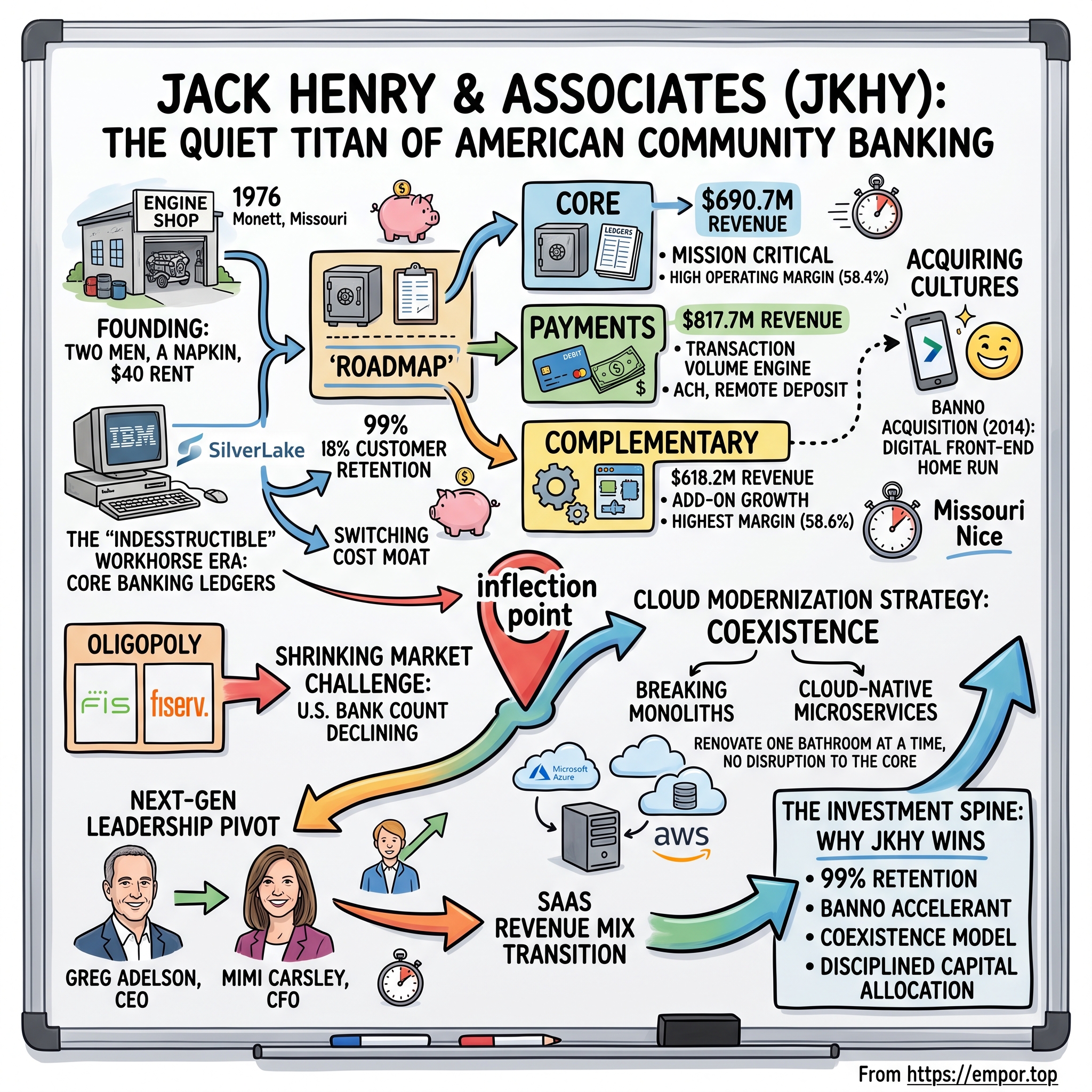
Jack Henry & Associates, Inc. (JKHY): The Quiet Titan of American Community Banking
I. Introduction & Episode Roadmap
Drive south from Springfield, Missouri, through the rolling Ozark scrubland, and you will eventually reach Monett — a town of roughly 9,000 people best known historically for railroads, poultry processing, and a very good high school football team. It is not a place anyone would go looking for the technological nervous system of American banking. And yet, on any given Tuesday, when a schoolteacher in Ohio taps her debit card at a gas station, when a small-business owner in Oregon originates payroll through an ACH file, when a credit-union member in Texas checks a mobile app balance at midnight, there is a meaningful chance the transaction is quietly routed, ledgered, and settled through software written and maintained in this small Missouri town.
That is the first surprise of Jack Henry & Associates. The second is the durability. This is a company that has grown revenue for decades with almost no debt on its balance sheet, that generates operating margins many pure software companies would envy, and that loses well under 1% of its customers in a typical year.1 In fiscal 2024, Jack Henry reported total revenue of $2.22 billion and net income of $381.8 million, all built on the unglamorous business of running the "core" systems of more than 7,000 banks and credit unions.1
The core question of this story is a good one for any long-term investor: in an era of flashy fintech disruptors, Silicon Valley "neo-cores," and enormous Wall Street consolidators, how does a company founded in a rented engine-rebuilding shop in 1976 still hold a near-monopoly grip on community banking technology? Is the moat as deep as the retention numbers suggest — or is it a slowly draining reservoir, protected by inertia rather than genuine advantage, with a shrinking count of customer logos and a difficult technology transition ahead?
Because there is a transition. Jack Henry sits at a genuine inflection point. Its crown-jewel core platforms were architected on IBM's midrange hardware — the legendary AS/400 lineage now known as IBM i — a technology so reliable it became a punchline for being un-killable and un-modern at the same time. The company is now in the middle of a multi-year effort to break those monoliths into cloud-native microservices running on Microsoft Azure and Amazon Web Services.[^2][^3] It is doing so under new leadership: Greg Adelson became President and CEO on July 1, 2024, succeeding the long-serving David Foss in one of the most heavily choreographed succession plans in the industry.2 And in a symbolic closing of a chapter, Foss stepped down from his final board role as Executive Chair effective July 15, 2026 — one day before this writing — handing the chairmanship to lead independent director Matt Flanigan.3
Here is the roadmap for how we will interrogate this business:
- The Monett origins and the AS/400 workhorse era (1976–1990s).
- The core-banking oligopoly: FIS, Fiserv, and Jack Henry.
- Segment financials and the "deconversion fee" double-edged sword.
- M&A masterstrokes: the Banno acquisition and payment integrations.
- The next-generation leadership pivot: Adelson, Carsley, and the modern culture.
- The cloud modernization strategy and hybrid architecture.
- The investment spine: Hamilton Helmer's 7 Powers and Porter's 5 Forces.
- The bull versus bear case and a skeptical investor's stress test.
Throughout, the posture here is neutral. Jack Henry's own marketing describes an idyllic, customer-first culture and an elegantly de-risked modernization. Some of that is demonstrably true and shows up in the numbers. Some of it is a story management would like investors to believe. The job here is to separate the two — to ask what evidence supports the claim that Jack Henry keeps winning, and what would prove the thesis wrong. Let us start where every good origin story starts: with two men, a napkin, and forty dollars a month in rent.
 Subscribe on LinkedIn
II. The Origins: Monett, Missouri and the AS/400 Foundation (1976–1990s)
The founding legend of Jack Henry & Associates is almost too on-the-nose for a company that would become synonymous with Midwestern reliability. In 1976, two men — Jack Henry and Jerry Hall — sketched a business plan on the back of a napkin in a Monett coffee shop, and then rented space in a local engine-rebuilding shop for roughly $40 a month to start writing software.4 The company was incorporated that June. Their first product was pragmatic and narrow: software to help a community bank process its own customer data in-house, at a time when small banks either ran their books by hand or paid a distant service bureau for the privilege.4
To understand why this small beginning mattered, you have to understand the hardware wave the two founders chose to ride. In the late 1970s and 1980s, IBM was rolling out a family of "midrange" computers — the System/34, System/36, and System/38 — machines sized for a mid-tier business rather than a Fortune 500 data center. In 1988, IBM introduced the machine that would define the category and, arguably, define Jack Henry: the AS/400.4 Rebranded over the decades to the iSeries and then IBM i, the AS/400 became legendary for a single quality that matters more than anything else to a bank: it did not fall over. The operating system, the database, and the security model were fused into one integrated stack, engineered for transaction integrity and uptime rather than flash. In banking folklore, AS/400 systems were the machines you booted up, locked in a closet, and did not think about again for a decade.
Jack Henry built its high-end core banking product, SilverLake, on this foundation. SilverLake was — and remains — a workhorse: reliable, secure, deeply auditable, and practically indestructible. For a community bank whose entire existence depends on the general ledger being correct every single night, "indestructible" is not a boring adjective. It is the whole value proposition. A bank does not want its core system to be innovative. It wants it to be right, and to be right at 2 a.m. during a batch run when no human is watching. That conservative, reliability-first DNA is the thing to hold onto, because it explains both Jack Henry's durability and, later, its modernization dilemma. The very architecture that made the company un-killable also made it hard to modernize.
There is a cultural layer here too, and it is easy to be cynical about — so let us treat it as a claim to be tested rather than a fact to be celebrated. Jack Henry cultivated an ethos it summarizes as "Do the right thing, do whatever it takes, and have fun," with a customer-service reputation sometimes described, half-jokingly, as "Missouri nice." The independent evidence for this being economically real, rather than a poster in a break room, is the retention data: community banks and credit unions, notoriously conservative buyers, renew with Jack Henry at rates approaching 99%.1 That kind of stickiness is partly switching costs — we will get to those — but partly reputation. When a $400 million-asset bank's entire operation depends on a vendor answering the phone at midnight, a five-decade reputation for actually answering the phone becomes an asset that no feature list can replicate overnight.
The financial character of the company was set early and has barely wavered. Jack Henry went public in 1985, listing on NASDAQ under the ticker JKHY and selling roughly 3.1 million shares to fund organic growth.4 From the beginning, management ran the balance sheet like the conservative bankers they served — minimal debt, heavy free cash flow, and steady dividends. This is not a company that ever bet its existence on a leveraged mega-deal. It compounded quietly, acquiring narrow capabilities and cross-selling them into a captive base. By 2000, it had made its single most important early strategic move outside the bank market: the acquisition of San Diego-based Symitar, the leading core platform for credit unions, which gave Jack Henry a commanding position in a second, structurally similar market.5
By the close of the 1990s, then, the shape of the modern company was already visible: a reliability-obsessed core-software vendor, embedded in the operations of thousands of small financial institutions, throwing off cash and rarely losing a customer. What it did not yet face was the question that would come to define the next quarter-century — what happens to that fortress when the number of banks in America starts shrinking, and when two much larger rivals decide the same customers are worth fighting for? To answer that, we have to zoom out to the strange, three-sided structure of the entire industry.
III. The Core Banking Oligopoly & Industry Structure
Picture the plumbing behind the American banking system, and you will find that almost all of it runs through three companies. It is one of the more remarkable oligopolies in American business — a market where thousands of independent financial institutions, fiercely proud of their local autonomy, nonetheless outsource their most critical function to one of just three vendors. Those three are Fiserv, Fidelity National Information Services (FIS), and Jack Henry & Associates. Between them, they process the accounts of the overwhelming majority of U.S. banks and credit unions.
The three are not carbon copies. They occupy distinct territory, and understanding the geography is essential to understanding why Jack Henry has been able to hold its ground. Fiserv is the broad-market volume leader, the largest of the three by institution count, serving a wide swath of banks and credit unions across the size spectrum. FIS, the product of decades of acquisitions, skews toward the enterprise — the Tier 1 banks with more than $10 billion in assets, where a single client relationship can be enormous but the total number of logos is small. Jack Henry sits deliberately in the middle-and-below: the community champion, focused on banks and credit unions under roughly $10 billion in assets, with its Symitar platform holding a particularly strong position in the credit-union segment. Industry estimates of core-processing share typically place Fiserv first by count, Jack Henry a strong second among community institutions, and FIS concentrated at the top end.
Why do these institutions outsource at all? Because a modern financial institution cannot build its own core. The core system is not a piece of software in the way a website is a piece of software. It is the ledger of record — the single authoritative account of who has how much money, which loans are current, and what the bank's own general ledger says at the end of the day. It must be always correct, always available, endlessly audited by regulators, and integrated with dozens of external rails: the card networks, the Federal Reserve's ACH system, wire networks, and now instant-payment rails. For a bank with a few hundred million dollars in assets and a two-person IT department, building and maintaining that in-house is not merely expensive; it is impossible. Outsourcing to Jack Henry is not a convenience. It is a precondition of existing.
This is where the moat gets its teeth. Replacing a core system is often described, not entirely in jest, as "open-heart surgery while the patient runs a marathon." A core conversion is a multi-million-dollar, multi-year project in which the bank must migrate every account, every historical transaction, and every integration onto a new platform without a single customer losing access to their money. Conversions are risky, expensive, and career-threatening for the executives who champion them. The rational default for a bank CEO is to never, ever do it. That is why contract cycles run five to seven years with automatic renewals, and why annual customer churn sits below 1%.1 The result is a revenue base with visibility that most software companies can only dream about: management can forecast the bulk of next year's revenue with high confidence because next year's customers are, overwhelmingly, this year's customers.
There is a subtlety worth flagging for the skeptic. High retention is not the same as pricing freedom. Banks are locked in, but they are also sophisticated, cost-conscious buyers who negotiate hard at renewal, and industry consolidation is steadily creating larger, more powerful counterparties. When two $2 billion banks merge into a $4 billion bank, the survivor has more leverage than either predecessor did. So the moat protects against defection more than it guarantees ever-rising prices. Retention is the floor, not the ceiling.
And then there is the secular headwind that hangs over the entire thesis: the American banking system is shrinking. The United States had well over 14,000 banks in the mid-1980s; today the number of FDIC-insured commercial banks is closer to 4,000, with credit unions consolidating on a similar trajectory. Every year, mergers erase several percent of the independent institutions that make up Jack Henry's addressable market. On its face, that is an existential problem: how do you grow when your customer count is structurally declining? The answer — which we will test rather than assume — is that Jack Henry has grown revenue per remaining customer faster than it has lost logos, by selling more software modules and processing more transactions for the survivors. Whether that arithmetic keeps working is the central empirical question of the whole investment. It runs directly into the way the company actually makes money, which is where we turn next.
IV. Inside the Machine: Segment Financials & Materiality
If you want to understand where Jack Henry earns its keep, you have to open the machine and look at the three engines inside. The company reports in three revenue segments, and using fiscal 2024 as a clean baseline reveals a business that is both more balanced and more nuanced than the "boring core-software company" caricature suggests.
Start with the largest by revenue: Payments. In fiscal 2024, the Payments segment generated $817.7 million, roughly 37% of total revenue, with segment operating income of $375.6 million — a 45.9% margin.1 This is the transaction-volume engine: debit and credit card processing, online and mobile bill pay, ACH origination, and remote deposit capture. Every swipe, tap, and scheduled payment throws off a small fee, and those fees aggregate into an enormous, recurring, and reassuringly diversified revenue stream that grows with the economy and with the digitization of money itself. The margin here is lower than the other two segments because payments carry real cost of goods — network fees, processing infrastructure — but the volume and stickiness more than compensate.
Then comes the crown jewel: Core. At $690.7 million of fiscal 2024 revenue, about 31% of the total, Core is smaller than Payments in dollars but the most profitable engine in the company, with segment income of $403.4 million and a 58.4% operating margin.1 This is the mission-critical ledger software — SilverLake, Symitar, and the smaller-bank platform Core Director — plus the maintenance and support that surround it. The reason the margin is so high is precisely the moat described earlier: once a core is installed, the incremental cost of collecting another year of maintenance revenue is minimal, and the customer almost never leaves. Core is where the switching-cost economics turn into pure profit.
The third engine is Complementary, at $618.2 million, roughly 28% of revenue, with segment income of $362.2 million and the highest margin of the three at 58.6%.1 Complementary is the growth story management most wants investors to watch. It is the collection of add-on modules that bolt onto the core: the Banno digital banking front-end, fraud and anti-money-laundering tools, commercial and treasury services, online account opening, and lending workflows. The strategic beauty of Complementary is that every module is sold into a customer who is already locked in. The hard, expensive work of winning the relationship is already done; each additional module is nearly pure incremental margin on an existing account. This is the mechanism by which Jack Henry grows revenue even as the number of banks shrinks — it sells more to each survivor.
The three engines together produced fiscal 2024 revenue of $2.22 billion and diluted EPS of $5.23, and the momentum has continued: fiscal 2025 revenue rose 7.2% to roughly $2.38 billion, with GAAP EPS climbing to $6.24, while the company carried zero drawn debt on its credit facilities at year-end.16 For a company facing a "shrinking market," that is not the growth profile of a business in decline. It is the profile of a business quietly getting more valuable per customer.
Now for the genuinely fascinating accounting wrinkle — the one that separates people who understand Jack Henry from people who merely read its headline EPS. It is called the deconversion fee, and it is a paradox baked into the business model.
Here is the mechanism. When a Jack Henry bank gets acquired by a larger bank that runs on Fiserv or FIS, Jack Henry loses the customer. But the contract contains liquidated-damages provisions: the departing bank must pay a substantial one-time fee to have its data extracted, packaged, and handed over. These deconversion fees are almost pure profit — there is little incremental cost to collecting them — and in a heavy bank-M&A year they can meaningfully inflate reported revenue and earnings. In fiscal 2024, deconversion revenue was $16.6 million, down from $31.8 million the prior year.1 The swing between those two numbers alone can move a quarter's growth rate.
Now sit with the paradox. A deconversion fee is a cash windfall today and a permanent wound tomorrow. Every dollar of deconversion revenue marks the loss of a recurring, high-margin customer that would otherwise have paid Jack Henry for years or decades. The fee is real money, but it is the sound of a customer leaving — the financial equivalent of a going-away party you get paid to host. This is why management and analysts obsess over non-GAAP adjusted revenue, which strips out deconversion fees (and a few other items) to reveal the organic health of the software platform. In fiscal 2024, adjusted revenue was $2.20 billion, up 7.4%.1 The discipline of watching the adjusted line matters: a naive investor could mistake a wave of deconversion fees for strength, when it may actually signal that the customer base is being consolidated away. The right way to read Jack Henry's quarter is to look past the windfall and ask whether the underlying, recurring engine is still growing. Usually it has been — but the deconversion line is the canary, and it deserves watching.
Understanding how the engines earn their margins naturally raises the next question: how has Jack Henry deployed the enormous cash those engines throw off? The answer is a story of disciplined, unglamorous acquisitions — and one quiet home run.
V. Strategic M&A Benchmarking & The Banno Home Run
There is a temptation, when a software company generates as much cash as Jack Henry, to do something dramatic with it. The fintech-and-payments landscape of the last fifteen years is littered with the wreckage of companies that gave in to that temptation. FIS spent roughly $35 billion to acquire the merchant-acquiring giant Worldpay in 2019, only to write down billions and spin most of it back out a few years later at a fraction of the price — a value-destroying round trip that became a cautionary tale for the entire sector. Jack Henry's acquisition philosophy has been almost the opposite: buy small, buy narrow, buy things you can immediately sell to a customer base you already own, and never bet the company. It is capital allocation as risk management.
The clearest expression of that philosophy — and the single best deal in company history — was almost invisible when it happened. In 2014, Jack Henry acquired Banno, a small, mobile-first digital-banking startup out of Iowa, for approximately $27.9 million.78 By the standards of fintech M&A, this was a rounding error. But the strategic logic was sharp. Jack Henry's legacy digital platform, NetTeller, was aging into irrelevance just as consumer expectations for banking apps were being reset by the likes of Chime and the big national banks. Community banks faced a terrifying prospect: their reliable back-end was fine, but their customer-facing app looked a decade out of date next to a neobank's, and younger customers were noticing.
What made the Banno deal a masterstroke was not the price but the restraint. Rather than absorbing the startup into the Monett machine and grinding its culture into dust — the fate of most acquired tech teams — Jack Henry deliberately preserved Banno's agile, product-obsessed, design-forward engineering culture as a semi-distinct unit. It let the acquired team keep building the way modern software teams build. Over the following decade, Banno grew into the standard digital front-end across Jack Henry's entire client base, giving a $500 million community bank the ability to offer an app that a customer could genuinely mistake for a Chase or a Chime product. In competitive terms, Banno neutralized the single most dangerous threat to community banks — the fear that digital-only rivals would render them obsolete — and it did so from inside the fortress. It is the cornered resource we will return to when we get to Helmer's framework.
Banno was not an isolated move; it fit a pattern of niche payment and processing tuck-ins that thickened the transaction engine. In 2010, Jack Henry paid roughly $300 million in cash for iPay Technologies, then a leading independent online bill-payment provider, instantly capturing enormous bill-pay transaction scale and cementing the Payments segment.910 A year earlier, in 2009, it had acquired Goldleaf Financial Solutions in a deal valued at roughly $60.5 million — about $19 million of equity plus the assumption of some $41 million of debt — strengthening its remote deposit capture and ACH capabilities for regional banks.1112 (The point of citing the exact structure is to note the discipline: even the "debt-laden" target was small enough that the assumption of its obligations barely registered on Jack Henry's balance sheet.)
More recently, in 2022, Jack Henry closed its acquisition of Payrailz for an undisclosed sum, extending the payments portfolio into modern, cloud-native, "smart" payments — real-time person-to-person transfers and support for the emerging faster-payment rails, the Federal Reserve's FedNow service and The Clearing House's RTP network.13 The strategic read on Payrailz is forward-looking: as instant payments move from novelty to expectation, Jack Henry wanted native capability rather than a bolt-on, and it wanted to be able to sell that capability into its captive base the moment banks needed it.
Step back and the pattern is unmistakable, and it is worth stating as an analytical conclusion rather than a compliment: Jack Henry's returns on acquired capital have been strong not because management is brilliant at picking moonshots, but because it has systematically refused to make the kind of large, transformative, ego-driven acquisition that destroys value elsewhere in the sector. Every deal has been small enough to absorb, narrow enough to integrate, and — critically — sellable into an existing, locked-in customer base where the cost of distribution is essentially zero. That is a repeatable, low-variance capital-allocation machine. The open question for the future is whether a company this cash-generative can stay disciplined as it gets larger and as the pressure to "do something big" grows — a question that lands squarely on the shoulders of new management.
VI. Current Management: The Next-Gen Leadership Pivot
Succession is where good companies quietly go to die, and Jack Henry seems to have known it. The handoff at the top over the past two years was not a surprise announcement or a boardroom coup; it was a years-long, publicly telegraphed relay race, the corporate equivalent of a pilot handing over controls mid-flight while narrating every step.
The new man in the left seat is Greg Adelson, who became President and CEO on July 1, 2024.2 Adelson is not an outside change agent parachuted in to shake things up; he is a company insider who earned the role through operational execution. He joined Jack Henry in 2011 through the iPay acquisition, running that bill-pay business, then rose through the payments organization, became Chief Operating Officer in 2019, and added the President title in 2022 — a sequence that made him the obvious heir well before the announcement.2 His mandate is unusual for an insider succession: not to preserve the legacy safe-haven, but to convert it into an agile, cloud-native platform without breaking the thing that makes it valuable. That is a genuinely hard assignment — the person asked to modernize the fortress is the same organization that built its reputation on never changing the fortress.
Adelson succeeded David Foss, who deserves his place in the story as the executive who ran Jack Henry through its most successful modern decade. Foss stepped down as CEO on June 30, 2024, moved to Executive Chair, and then — in the event that gives this article its "yesterday" — retired from the board entirely effective July 15, 2026, with lead independent director Matt Flanigan stepping up as the new Board Chair.3 Flanigan, a longtime director with deep financial and banking-adjacent experience, represents continuity rather than rupture; the board chose an insider steward over an outside voice, consistent with the company's temperament. For a skeptic, that continuity cuts both ways: it lowers the risk of a strategic lurch, but it also means the board that oversees the modernization is not exactly staffed with disruptors.
The financial discipline seat is held by Mimi Carsley, who became Chief Financial Officer and Treasurer in 2022, bringing an enterprise-SaaS sensibility to a company still partly wired for the old license-and-maintenance world. Her central financial project is the revenue-mix transition: shifting the model from legacy on-premise licenses and private-cloud maintenance toward recurring, multi-tenant, public-cloud SaaS subscriptions. That transition is easy to cheer and hard to execute, because — as we will see — moving customers from high-upfront private cloud to lower-upfront public cloud can compress margins before scale economics kick back in.
So how credible is this management team? The right way to judge, for a fundamental investor, is behavior over time — target-setting, guidance discipline, and whether they explain themselves when things wobble. On that test, the recent record is strong. In the third quarter of fiscal 2026, reported in early May 2026, Jack Henry posted GAAP EPS of $1.71, well above the roughly $1.45 consensus, on revenue of about $636 million, up nearly 9% year over year on a GAAP basis.1415 Management raised full-year guidance — for the third consecutive time that fiscal year — to GAAP EPS of $6.78 to $6.87, and pointed to 17 competitive core wins in the quarter with an expectation of more than 51 for the full year.14 On the earnings call, management framed the beat as broad-based execution rather than a one-off, and analysts pressed, as they should, on how much of the strength was durable versus timing.15
The pattern of setting conservative guidance and then beating and raising is, on the surface, exactly what you want. But it deserves a skeptic's asterisk. A company that beats consensus every quarter and raises guidance three times in a year is either executing exceptionally or guiding conservatively enough that the "beats" are partly manufactured expectation management. Both can be true at once, and neither is a scandal — but an investor should not mistake a well-run expectations treadmill for accelerating underlying growth. The honest read is that Jack Henry's management has earned credibility through consistency, and the core-win count and organic revenue growth are real, verifiable proof points. The thing to watch is whether the same discipline holds as the far harder work — the technology modernization — moves from PowerPoint to production.
VII. The Cloud Transition & Technology Modernization Strategy
Every fortress eventually faces the same problem: the walls that kept the enemy out also keep the defenders in. For Jack Henry, the walls are made of decades of tightly integrated code running on IBM i hardware, and the modernization of that code is simultaneously the biggest opportunity and the biggest execution risk in the entire story.
Start with the challenge, explained plainly. The traditional cores — SilverLake, Symitar — were built as monoliths. Imagine a single, enormous, beautifully engineered building where the plumbing, wiring, elevators, and structural beams are all fused together. It is incredibly sturdy. But if you want to renovate one bathroom, you risk the whole structure, because everything touches everything else. That is a monolithic core: deposits, loans, general ledger, and dozens of functions welded into one deeply interdependent codebase. It is reliable precisely because it is integrated — and it is slow to change for exactly the same reason. In a world where fintech partners expect to plug in via modern APIs in weeks, a monolith that takes a year and a careful regression test to modify is a competitive liability.
The threat this creates is real and named. A generation of cloud-native, API-first core engines — Thought Machine out of London, Mambu out of Germany, and Finxact, which Fiserv acquired precisely to own a modern core — have set out to win the greenfield digital-bank projects and, eventually, to bypass the Big Three entirely. These challengers do not carry decades of legacy code; they were born in the cloud, composable and API-first from day one. Their pitch to a forward-leaning bank is seductive: why renovate the old building when you can move into a modern one built for the way software works now?
Jack Henry's answer is a strategy it calls Technology Modernization, and its cleverness is in refusing the false choice. The most dangerous thing Jack Henry could do is tell 7,000 risk-averse banks that they must undergo a "big bang" core conversion — the exact open-heart surgery those banks spend their lives avoiding. So it isn't doing that. Instead, the company is decomposing its monolithic core into independent, core-agnostic, cloud-native microservices — small, self-contained software components that each do one job (process a wire, open an account, run a fraud check) and talk to everything else through standard APIs.[^2][^3]
The organizing idea is coexistence. A community bank can keep its trusted, bulletproof SilverLake ledger running the deposits and general ledger — the parts it never wants to touch — while swapping out, say, its wire-processing or digital-onboarding function for a shiny new cloud microservice, with no disruption to the core.[^2][^3] Renovate one bathroom at a time, without touching the load-bearing walls. If the strategy works, it lets clients modernize gradually and at their own pace, which is exactly the risk profile a community banker can say yes to.
The technical stack behind this is a deliberate break from the IBM-i past: workloads run on Microsoft Azure and AWS, components are packaged in containers and orchestrated with Kubernetes, new code is written in modern languages like .NET/C# and Go, and high-scale data lives in cloud databases such as Azure Cosmos DB.[^18] Microsoft has publicly showcased Jack Henry's use of Cosmos DB to build cloud-native banking services, which is at least third-party confirmation that the architecture is real and in production, not merely a roadmap slide.[^18]
The economic payoff management points to is genuinely compelling on paper. Because these microservices are built to be core-agnostic — to work across SilverLake, Symitar, and Core Director alike — Jack Henry can build a capability once and sell it to every customer regardless of which core they run, instead of maintaining three separate versions of everything. Eliminating that redundant engineering is a long-term margin-expansion argument, and it is the single most important reason to believe the next decade could be more profitable than the last.
But independence requires naming what could go wrong, and here the skeptic has real ammunition. First, refactoring decades of battle-tested IBM i logic into distributed microservices is genuinely hard; distributed systems introduce new failure modes — network partitions, data-consistency puzzles — that a self-contained monolith simply does not have. Second, and more pointedly, the entire company rests on a single asset: trust. A high-profile outage, a data-consistency error that corrupts a ledger, or a cloud security breach during this transition would damage the one thing that has taken fifty years to build. Third, the transition itself is not free — moving customers from high-upfront private-cloud arrangements to multi-tenant public cloud can pressure margins in the near term before scale kicks in, a drag Carsley's finance organization has to manage in full view of investors. Management's "low-risk coexistence" framing is strategically smart, but investors should treat "low-risk" as the company's claim, not a settled fact. The proof will be in years of uneventful production, not in the elegance of the architecture diagram. Which brings us to the central act of any investment analysis: weighing why this company wins from here against what could break it.
VIII. The Investment-Story Spine: Why Win / Why Not
Every durable investment thesis has a spine — a clear statement of why the company wins from here, tested against an equally clear statement of what would prove it wrong. For Jack Henry, both sides are unusually well-defined, which is itself a sign of a comprehensible business.
Why Jack Henry wins from here — the bull case.
The foundation is the switching-cost economics already described: retention approaching 99% means the cash-flow floor is extraordinarily stable, and stability compounds.1 A business that keeps 99 of every 100 customers, and sells each survivor more every year, does not need heroics to grow — it needs only to not break. The Banno platform is the growth accelerant on top of that floor: as Banno expands from consumer digital banking into business and commercial banking, it opens the lucrative mid-market corporate relationships that community banks have long struggled to serve, giving Jack Henry's clients a way to punch above their weight and giving Jack Henry a larger share of each client's technology spend.
The coexistence modernization strategy, if it delivers, converts the company's biggest liability — legacy architecture — into a durable advantage, letting clients modernize without the conversion risk that would otherwise be the one event capable of dislodging them. And there is a cleaner-story argument that matters to investors: Jack Henry is a relative pure-play. Fiserv and FIS carry large, volatile, lower-margin merchant-acquiring and global enterprise segments — the very businesses that produced FIS's Worldpay debacle. Jack Henry is a more concentrated bet on high-margin, sticky financial software sold to a resilient customer base. Less optionality, but also less that can blow up.
Why Jack Henry may not — the bear case and activist stress test.
The most important bear argument is the one no strategy can fully solve: the addressable market is shrinking by an estimated 3–4% a year as banks consolidate. Jack Henry's whole model depends on selling enough new modules and transactions to the survivors to outrun the disappearance of logos. That arithmetic has worked so far — but it is a race, not a guarantee. If the community-bank sector hit severe distress — a repeat of the 2023 regional-banking panic, say, but worse — deconversion losses could outpace new wins, and the organic growth engine could stall in a way that no amount of expense discipline would mask.
The second bear argument is execution risk in the modernization, discussed above: the refactoring is technically hard, and the downside of a trust-destroying failure is asymmetric. A skeptical long/short investor would also press on the margin math of the SaaS transition — whether the promised long-term margin expansion materializes or whether public-cloud costs and perpetual reinvestment keep margins flatter than the bull case assumes.
An activist looking for a lever would find Jack Henry a frustrating target, which is itself informative. The balance sheet carries little debt, the capital allocation has been disciplined, disclosure is clean, and there is no sprawling conglomerate to break up — none of the classic activist openings. The sharpest critique available is almost the opposite of the usual one: that Jack Henry is too conservative — that a company generating this much cash, with this stable a base, could be more aggressive in returning capital or pursuing growth, and that its cultural caution, so valuable operationally, could leave it a step slow if the industry's technology paradigm shifts faster than the coexistence model can accommodate. That is a real debate, but it is a high-class problem, and it is a very different risk profile from a company drowning in leverage or complexity.
The honest synthesis is this: Jack Henry's near-term thesis is unusually well-protected, and its long-term thesis rests on two things it does not fully control — the pace of bank consolidation and its own execution on a hard technology transition. The bull and bear cases do not so much contradict each other as operate on different timescales. To sharpen which forces actually govern the outcome, it helps to run the business through two rigorous analytical lenses.
IX. Strategic Analysis: Helmer's 7 Powers & Porter's 5 Forces
Frameworks are only useful if they are applied honestly, so let us apply two of them — Hamilton Helmer's 7 Powers and Michael Porter's Five Forces — and be candid about where Jack Henry's advantages are strong and where they are merely adequate.
Hamilton Helmer's 7 Powers.
Of Helmer's seven, Jack Henry clearly possesses three, and it is worth being disciplined about not over-claiming the rest.
The primary power is Switching Costs, and it is close to a textbook case. The core ledger, once installed and integrated, is bound to the customer by conversion risk, cost, regulatory friction, and organizational memory. This is the deepest and most durable source of Jack Henry's advantage, and it is why the retention numbers look the way they do. Nearly everything valuable about the company flows from this single power.
The second is a Cornered Resource, and here Banno is the honest example — not the software alone, which competitors can in principle replicate, but the distinct, design-led product and engineering culture that Jack Henry acquired in 2014 and, crucially, chose not to destroy. That intact digital-first culture, embedded inside a Missouri core-processing company, is genuinely hard for a rival to reproduce, because culture cannot be bought off a shelf; it has to be preserved, and most acquirers fail to preserve it.
The third is Scale Economies, though with a nuance. Jack Henry can spread its very large annual R&D and modernization spend across a base of more than 7,000 institutions, and the core-agnostic microservices strategy sharpens this further by letting one investment serve every customer. But note that Fiserv and FIS are larger still, so within the oligopoly Jack Henry is not the scale leader — its scale advantage is against would-be new entrants and niche challengers, not against its two established rivals. Claiming scale economies as an edge over Fiserv would be over-reaching.
What Jack Henry largely lacks is worth stating too: it has no meaningful network economies in the classic sense, limited branding power in the consumer sense, and no process power or counter-positioning that would let it do something structurally impossible for rivals to copy. The moat is real but it is concentrated in switching costs, not diversified across all seven powers.
Porter's Five Forces.
The threat of new entrants is very low. To enter core banking, a startup must clear bank-grade security certification, satisfy regulatory examiners, achieve fault-tolerant reliability, and integrate with decades-old rails like FedACH and the card networks — a wall of compliance and integration that has kept the market a three-player oligopoly for a generation. The cloud-native challengers are real, but they have mostly attacked greenfield digital banks rather than dislodging incumbents, precisely because the entry barrier for the established base is so high.
The bargaining power of buyers is low to moderate, and it is trending the wrong way. Individually, a locked-in community bank has little leverage. But consolidation is manufacturing larger institutions with more negotiating muscle, so the buyer power that matters is not any single bank's — it is the rising power of the merged survivors to demand volume discounts at renewal. This is the quiet pressure on Jack Henry's pricing that never makes headlines.
The threat of substitutes is moderate, and it is more subtle than a competing core. The real substitution risk is not that a bank swaps Jack Henry for a rival vendor; it is that the bank's own customers abandon community financial institutions altogether — decamping to a JPMorgan Chase or a digital-only player — such that the institution Jack Henry serves slowly shrinks into irrelevance. Jack Henry's answer, ironically, is Banno: the better it makes its clients' apps, the more it slows the substitution of megabanks for Main Street banks. Rivalry among the three incumbents, meanwhile, is intense but disciplined — they compete hard on core wins but rarely start destructive price wars, because all three understand the value of the recurring base they are protecting.
The framework verdict is coherent: Jack Henry sits inside a structurally attractive industry, protected mainly by switching costs and entry barriers, pressured mainly by consolidation-driven buyer power and the slow erosion of its clients' end markets. That is a good position — not an impregnable one. The lessons an investor should carry away from all this are worth naming explicitly.
X. Playbook & Key Investing Lessons
Strip away the segment tables and the framework diagrams, and Jack Henry offers three transferable lessons for how durable value gets built — each of them visible in the company's own history rather than asserted in the abstract.
Lesson 1: Culture can be an economic moat, but only when it shows up in the numbers. It is fashionable to be cynical about corporate culture, and rightly so — most "culture" is a poster in a lobby. Jack Henry's claim to a customer-first, "Missouri nice" ethos is only worth taking seriously because it is corroborated by a retention rate approaching 99% among conservative buyers who have every incentive to leave if they were unhappy.1 Software features can be copied in a quarter; a fifty-year reputation for actually answering the phone at 2 a.m. cannot. The lesson is not "culture matters" in the greeting-card sense — it is that when a soft asset produces a hard, measurable outcome like near-total retention, it deserves to be underwritten as a real competitive advantage.
Lesson 2: In mission-critical systems, modernize by coexistence, not by "big bang." The instinct of ambitious management teams is to rip out the old and install the new in one dramatic project. In enterprise software that touches people's money, that instinct is often fatal — the conversion failure, not the competitor, is what kills the relationship. Jack Henry's decision to decompose its monolith into swappable microservices that coexist with the trusted legacy core is a case study in modernizing without betting the franchise. The broader lesson: when your greatest asset is reliability, the right pace of change is the fastest pace that does not put reliability at risk — which is usually slower than the market wants and exactly as slow as the customer needs.
Lesson 3: Disciplined niche capital allocation beats transformative dealmaking. The most instructive contrast in this entire story is Banno versus Worldpay — a $27.9 million tuck-in that became the company's most valuable acquisition, set against a $35 billion mega-deal at a rival that had to be substantially written down and unwound. Jack Henry's willingness to buy small, buy narrow, and sell into a captive base — while refusing the ego-driven blockbuster — is not timidity; it is a repeatable, low-variance engine for compounding returns on capital.79 The lesson for investors is to prize management teams that treat their cash flow as a scarce resource to be deployed at high, reliable returns, rather than as ammunition for the transformative deal that will make headlines and, often, destroy value.
None of this makes Jack Henry a sure thing — the shrinking market and the unproven modernization see to that. But it does make the company an unusually clear illustration of how boring, disciplined, reliability-obsessed businesses can compound value for decades in plain sight. Which is a fitting note on which to close the loop.
XI. Epilogue & Outro
There is a pleasing symmetry to the Jack Henry story. It began in 1976 with two men, a napkin, a rented engine shop, and a bet on IBM's minicomputers to run one small bank's books. Half a century later, it is a $13-billion-plus enterprise re-architecting itself around Azure and AWS microservices, run by an insider CEO steering a fortress through the most significant technology change in its history — while the founder-era chairman quietly retired from the board just this week.3 The through-line across those fifty years is not any particular technology; it is a temperament. Reliability first. Sell to the customer you already own. Never bet the company. Answer the phone.
For a long-term fundamental investor, the entire Jack Henry thesis can be compressed into a small number of things worth watching — because in a business this stable, the marginal information is not in the headline EPS but in a few specific signals. The first is the growth rate of the Complementary and SaaS revenue lines relative to legacy license and maintenance: that ratio is the single clearest measure of whether the company is genuinely selling more to each surviving customer fast enough to outrun consolidation, and whether the cloud transition is compounding or merely rearranging revenue. The second is the pace of competitive core wins — the count management now reports each quarter — because net new logos are the truest evidence that the moat is still winning battles rather than merely holding ground. And the third, quieter signal is the deconversion line, the canary that tells you whether the customer base is being consolidated away faster than it is being replenished.
Watch those three, and you will understand Jack Henry better than any single quarter's earnings beat could tell you. The rest — the Missouri-nice culture, the indestructible AS/400 heritage, the coexistence architecture — is the story behind the numbers. Whether it remains a quiet titan or slowly becomes a legacy caretaker depends on execution the company has not yet finished proving. That, in the end, is what makes it worth watching.
References
-
Jack Henry & Associates, Inc. Reports Fourth Quarter and Full Year Fiscal 2024 Results — PR Newswire, 2024-08-20 ↩↩↩↩↩↩↩↩↩↩↩↩
-
Jack Henry & Associates to Elevate Greg Adelson to CEO in July 2024 — PR Newswire, 2024-01-23 ↩↩↩
-
Jack Henry & Associates Announces Retirement of David Foss as Board Chair — PR Newswire, 2026-06-04 ↩↩↩
-
History of Jack Henry and Associates, Inc. — FundingUniverse ↩↩↩↩
-
Jack Henry & Associates, Inc. Reports Fourth Quarter and Full Year Fiscal 2025 Results — PR Newswire, 2025-08-19 ↩
-
Jack Henry & Associates Inc. acquired Banno, LLC for $27.9 million — MarketScreener, 2014-03-03 ↩↩
-
Jack Henry Acquires Bank Tech Startup Banno — American Banker, 2014-03 ↩
-
A $300 Million iPay Deal Is a 'Strong Fit' for Processor Jack Henry — Digital Transactions, 2010 ↩↩
-
Jack Henry & Associates and iPay Technologies Complete Acquisition Transaction — Jack Henry & Associates ↩
-
FT Partners Advises on $60,500,000 Acquisition of Goldleaf Financial Solutions — FT Partners ↩
-
Jack Henry & Associates to Acquire Goldleaf Financial Solutions — GlobeNewswire, 2009-08-17 ↩
-
Jack Henry & Associates Closes Payrailz Acquisition — PR Newswire, 2022-09 ↩
-
Jack Henry Q3 EPS Up 12.2%, Raises 2026 Outlook — StockTitan, 2026-05 ↩↩
-
Earnings Call Transcript: Jack Henry Q3 2026 Beats Expectations — Investing.com, 2026-05 ↩↩
 LinkedIn
 WhatsApp
 Reddit
 Hacker News
 Email
Email Kindle
 RSS Feed
 Spotify
 Apple Podcasts
 Amazon Music
 Audible
 YouTube