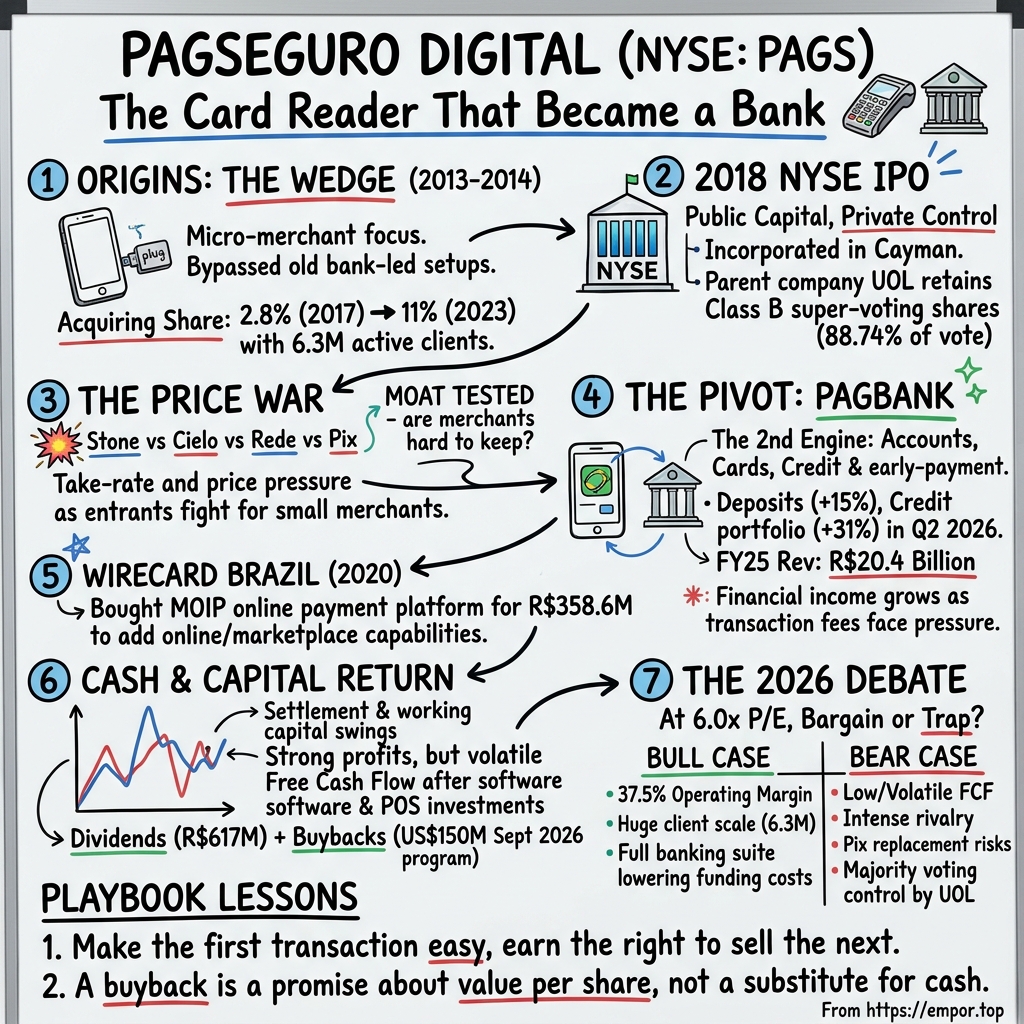
PagSeguro Digital: The Card Reader That Became a Bank
I. A Cheap Reader, a Six-Times-Earnings Stock
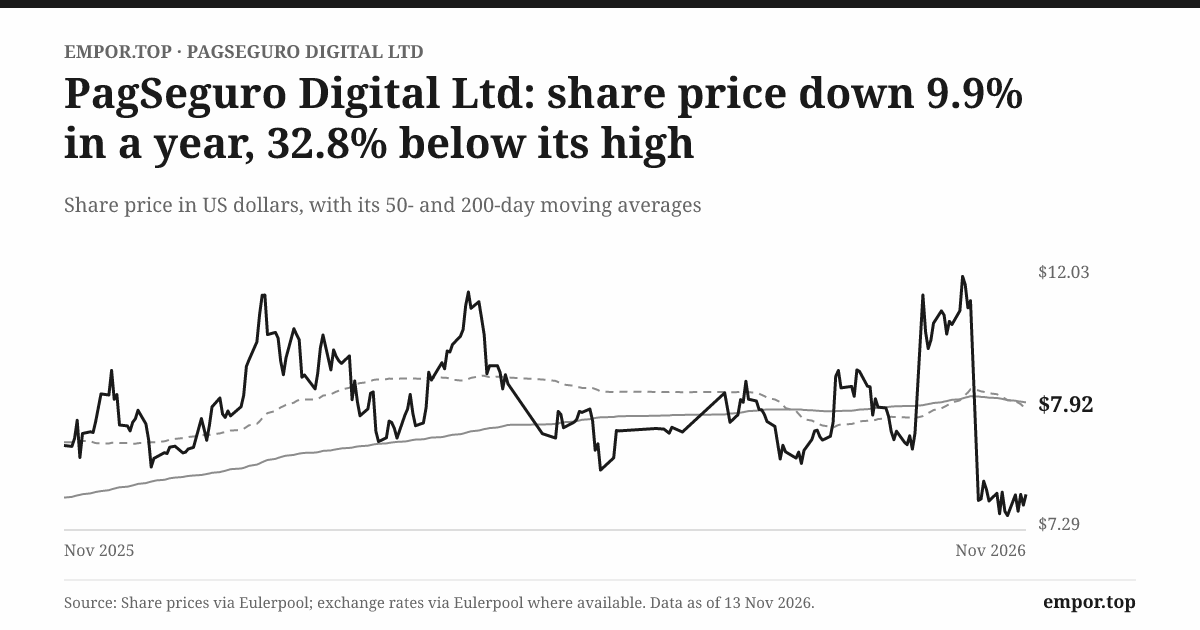
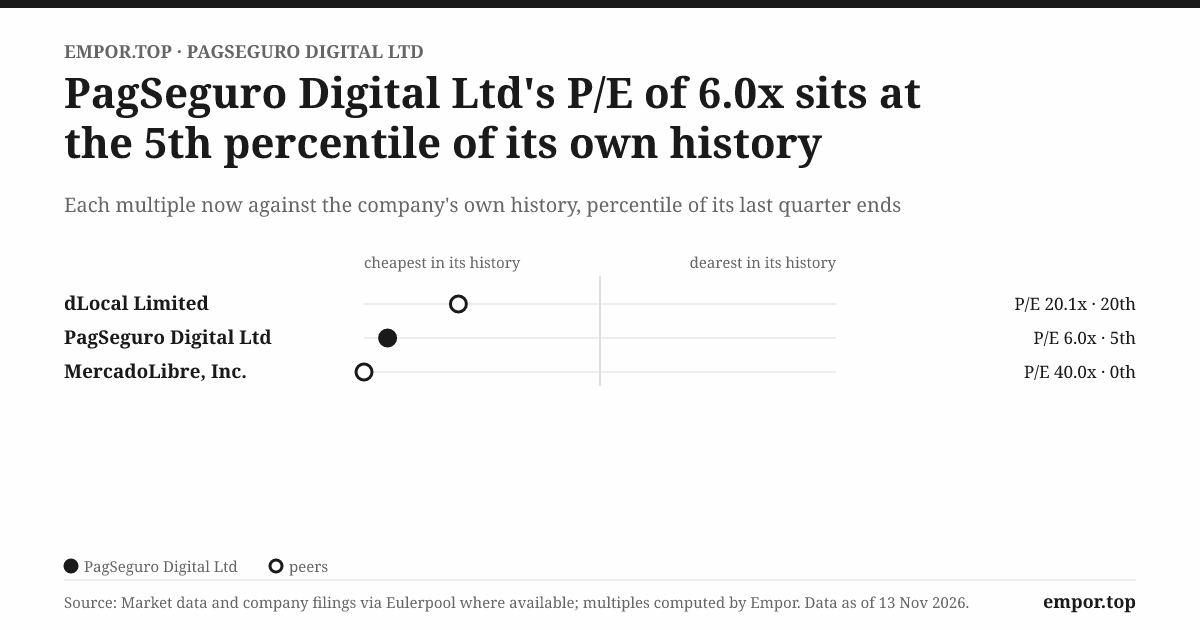
On a Friday in mid-November 2026, a share of PagSeguro Digital closed at about $7.92 on the New York Stock Exchange. At that price the whole company was worth roughly $2.3 billion, or about 12.8 billion Brazilian reais. That is a modest sum for a business that sits behind millions of card machines across Brazil, runs a digital bank used by roughly 17 million active clients, and earned about R$2.1 billion of net profit in 2025.12 Investors were paying about six times the last twelve months of earnings. Over the previous five years the stock's median multiple had been about 9.4 times. The shares sat near the bottom of their 52-week range, nearly a quarter below the high.
Cheap stocks come in two kinds. Some are cheap because the market has panicked over a temporary problem: a bad quarter, a rate spike, a currency wobble. Others are cheap because the market has noticed, before the income statement admits it, that the business has become more challenging. The whole investment debate about PagSeguro comes down to which kind this is.
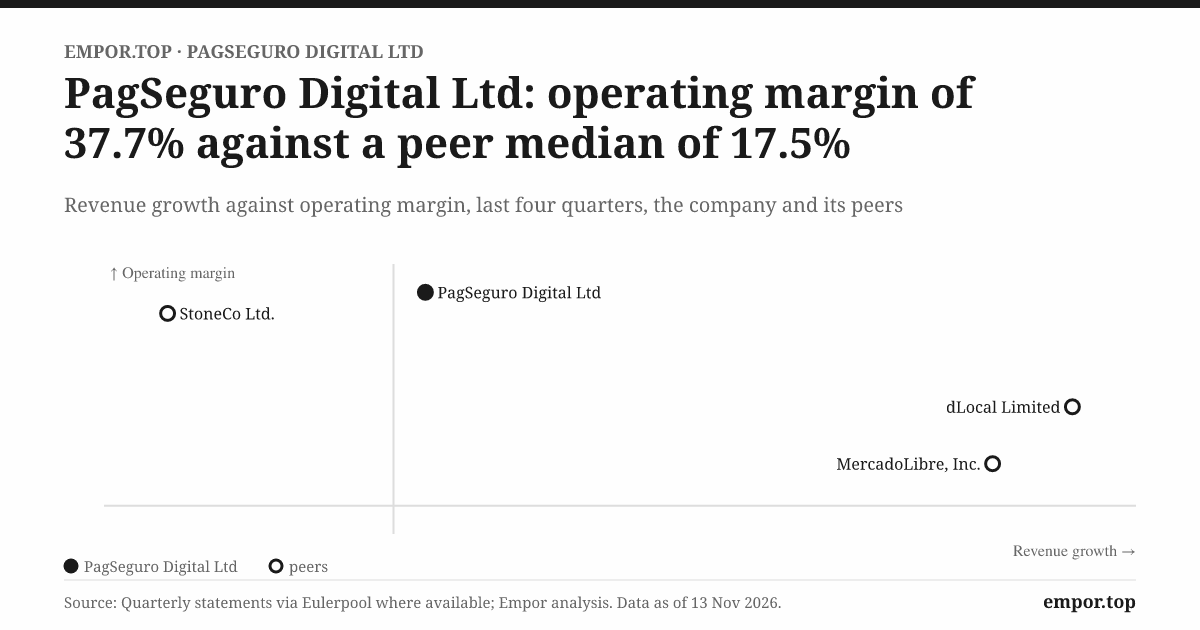
The case for a pause starts with a profitable company. PagSeguro converted about 37.5 cents of every real of revenue into operating profit in 2025, and over the last twelve months it earned about 14% on its shareholders' equity.1 Its book value per share was above the share price, so the market valued the whole enterprise at less than the accountants' figure for its equity. A buyer at that price was getting an earnings yield of almost 17%.
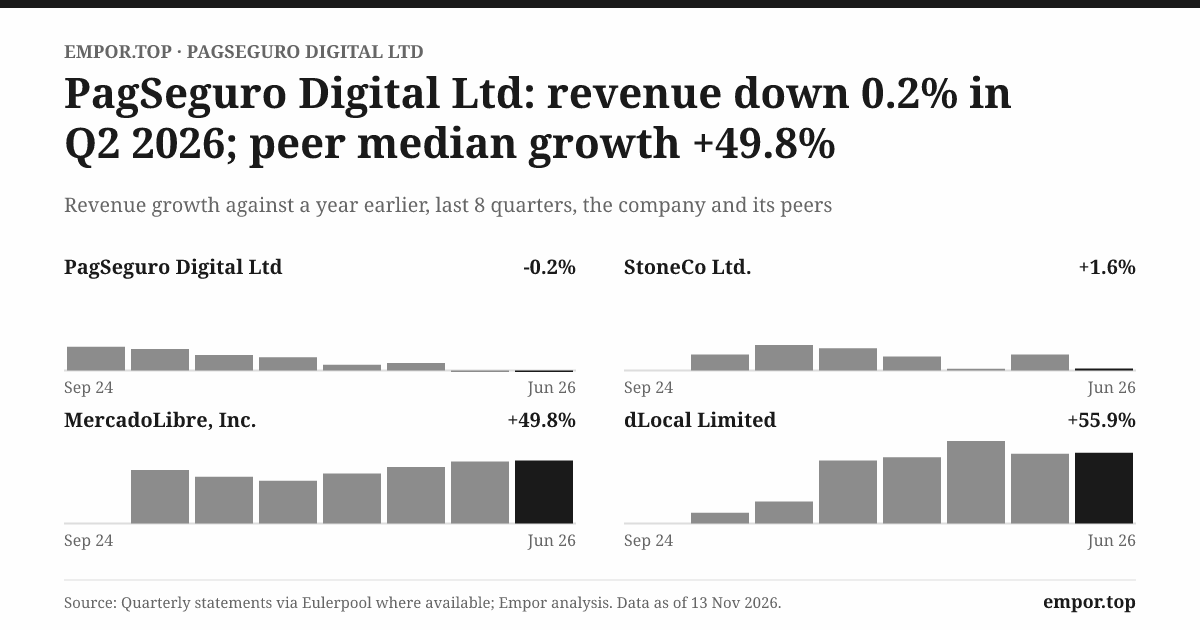
The case for something worse starts with growth. Over the decade to 2025, PagSeguro's revenue in reais compounded at about 40% a year. Over the five years to 2025 the rate fell to about 24%, and over the last three years to about 8.5%.1 The most recent reported quarter, the three months to June 2026, came in roughly flat. Total revenue and income was R$5.08 billion, up 0.4% on the company's own measure; one standardized revenue line showed a slight decline.2 Payment volume, the money flowing through PagSeguro's machines and links, grew only 3%.2 The cash flow statement adds another warning. Measured against the share price, free cash flow over the last twelve months was negative, at about minus 4.4%. Accounting profit and cash had moved apart.
Before going further, it helps to say what is being bought. The stock listed in New York is PagSeguro Digital Ltd., a Cayman Islands holding company whose consolidated results cover the PagSeguro Group and its PagBank operations in Brazil.1 It is not Universo Online, the internet group known as UOL that founded the business, still controls the vote and owns other companies outside PagBank. When this story describes revenue, deposits, credit or market share, it means the listed company's figures, never UOL's.
Four questions decide the case. First, has the payments engine that powered the decade of 40% growth stalled, or is it only resting? Second, is the shift toward banking, with deposits, cards and loans layered on top of the card machine, building a richer customer relationship, or is it partly a change of labels that hides pressure on payment prices? Third, can the loan book grow without making cash generation and shareholder returns fragile, in a company whose free cash flow has been thin and volatile? Fourth, does UOL's control, backed by ten-vote shares that give it close to nine-tenths of the vote, help the business at a fair cost to outside shareholders, or leave them as passengers?
The next answer is near. Results for the September 2026 quarter are due after this snapshot, so the June quarter is the latest evidence on the table. Before that evidence can be weighed, the story has to go back to the device that built the company: a small reader, a merchant who had never accepted a card, and a payments market that had been closed to people like them.
 Subscribe on LinkedIn
II. The Reader That Let a Small Merchant Take a Card
Picture a manicurist in São Paulo's outer neighborhoods, or a man selling coconut water from a cart in Recife, around 2013. Their customers carried debit and credit cards. Brazil had a deep habit of buying on installments, and a card in a wallet often meant a purchase spread over months. But accepting a card meant dealing with a bank-linked acquirer, signing a rental contract for a terminal, paying a monthly fee whether the machine was used or not, and often meeting volume thresholds that a one-person business could never reach. So these merchants took cash, or they lost the sale.
PagSeguro's opening move was to make that problem disappear into a small piece of plastic. The company had begun life inside UOL, a Brazilian internet portal founded in 1996, and launched PagSeguro in 2006 as an online payment platform, the kind of checkout button small web stores could add without negotiating with a bank.3 In 2013 it moved into physical, point-of-sale payments.3 Its first device was a mobile reader that had to be plugged into a mobile phone to work.4 Two years later came the Moderninha, a low-cost machine with no monthly fee, aimed at what the industry calls the long tail: the millions of micro-merchants and individual entrepreneurs the incumbents had served badly or not at all, because their fees and charges were too high.4
The business model was simple to explain and hard for incumbents to copy at first. The merchant bought the device outright, and could pay for it in twelve monthly installments, instead of renting it.3 Setup happened through an app, without a branch visit. After that, PagSeguro earned a fee on each transaction. The proof that this was new demand rather than stolen demand came in a June 2017 survey cited in the IPO prospectus: 75% of buyers of the Minizinha mobile reader said they had not accepted card payments before signing up.3 PagSeguro was not mainly taking merchants from Cielo. It was bringing merchants into card commerce for the first time.
It helps to see where PagSeguro sat in the chain. A card payment in Brazil passes through several hands. The card brand, such as Visa or Mastercard, sets the rules. The issuer, usually the shopper's bank, approves the purchase and later pays. The acquirer, the company behind the merchant's machine, captures the transaction, routes it, and makes sure the merchant gets paid. Think of the acquirer as the merchant's side of a toll road: it does not own the car or the road, but it collects a small fee on every trip that starts at its gate. Before PagSeguro, the gates were owned by bank-linked giants who saw little point in building them on side streets. PagSeguro built cheap gates everywhere.
The timing mattered as much as the product. For years Brazil's card market had run on closed arrangements, in which the main card brands were tied to particular acquirers and the business was effectively a duopoly. Brazil's central bank pushed to end that arrangement.4 Once a merchant acquirer could process all the main brands, a newcomer with a better distribution idea could compete. PagSeguro arrived just as that door was opening.
The growth that followed looks like a startup's, even though it happened inside a listed internet group's subsidiary. Active merchants rose from about half a million at the end of 2014 to 2.5 million by September 2017.3 Total payment volume roughly doubled from R$7.4 billion in 2015 to R$14.1 billion in 2016, and then grew at a similar pace into 2017, when nine-month volume reached R$24.8 billion against R$9.3 billion a year earlier.3 One administrative wrinkle is worth knowing: the Brazilian operating company that now carries the business only began running it in August 2015, and earlier activity sat in other UOL entities.1 The ten-year growth record therefore mostly tracks the business after that reorganization.
The share gains in industry data tell the same story from the outside. According to the card industry association's figures, compiled in a 2024 valuation report on Cielo, PagSeguro held about 2.8% of Brazilian acquiring volume in 2017. By the twelve months to September 2023 it was around 10%, in a market whose total card volume had grown from about R$1.4 trillion to about R$3.6 trillion.5 Moody's Local Brasil now puts PagBank at about 11% of acquiring volume and calls it one of Brazil's five largest acquirers.4 For a company that started with a dongle, that is a remarkable climb.
A remarkable climb is not the same as a durable advantage, though. Share gains in a fast-growing market show that a company built something people wanted and could distribute it. They do not show that merchants would stay if a rival offered a cheaper rate, or that PagSeguro could hold its prices. The company does not publish a merchant-retention series, does not name large customers or say how concentrated its revenue is, and does not provide a long-run measure of price realization that would show whether its fees held.1 A manicurist who was happy to buy a cheap reader in 2015 could be equally happy to buy someone else's cheap reader in 2020.
That is the question the reader left behind. If the device was the wedge, what happened when everyone else learned to make one?
III. The Price War That Changed the Reader Business
In February 2018, a few weeks after PagSeguro's shares began trading in New York, Brazil's largest acquirer reported its results, and the tone was defensive. Cielo's net revenue for 2017 fell 5.7% from the year before. Its market share by its own count had slipped to about 53%, and its chief executive, Eduardo Gouveia, told analysts Cielo "may lose market share in 2018" to newcomers. Reuters named two: Stone Pagamentos and PagSeguro.6
That is the competitive map of the decade. On one side stood the incumbents, Cielo, Rede and Getnet, each tied to a big bank and able to bundle card acceptance with the merchant's account, loans and branch relationship. On the other side were the challengers. Stone went after small and medium merchants with field salespeople and fast service. PagSeguro went to the long tail through mass marketing and devices sold off the shelf. Later came Mercado Pago, the payments arm of e-commerce giant Mercado Libre, and the big digital banks, which wrapped payments into broader apps. And from November 2020, the central bank's own instant-payment system, Pix, gave Brazilians a free way to pay each other with a QR code.5
The industry data show who paid for the challengers' rise. On the card association's numbers, Cielo's share of acquiring volume fell from about 46% in 2017 to about 23% in the twelve months to September 2023. Rede also lost ground. Stone climbed to about 11%, and PagSeguro to about 10%.5 The total market grew so quickly over those years, nearly tripling in reais, that several firms could grow volume at once.5 That point matters for what happened next. While the market was booming, the challengers did not have to win every merchant away from someone else. When growth slowed, they would.
PagSeguro's management in those years described a market with room for everyone. On the call for the fourth quarter of 2019, then-CEO Ricardo Dutra da Silva and finance chief Eduardo Alcaro presented a year in which payment volume had grown 51% to about R$115 billion and active merchants had reached 5.3 million.7 The net take rate, the share of each transaction PagSeguro kept, was a steady 2.97%, and management guided to "stable net take rates" for 2020. Asked about competition, Dutra called it "not a zero-sum game at all at this point here in Brazil," and management said the company had not changed its prices in the previous two years.7 It was a confident description, and at the time the numbers backed it.
By November 2023, Bloomberg reported that Stone and PagSeguro, once worth about US$50 billion together, were valued at about a tenth of that.8 A Getnet executive told Bloomberg that competition had grown and margins had fallen while Pix was eating into debit-card use, and an Itaú BBA analyst described a sector where everyone was "fighting over a smaller slice of the pie."8 Brazil had roughly 300 acquirers and sub-acquirers by then.8 Not all of the decline was competition. Brazil's interest rates rose sharply in 2021 and 2022, and a payments company that pays merchants early has to borrow to do it. But the market had clearly stopped behaving like the one Dutra described.
The recent record is the strongest test of whether PagSeguro's position is a moat. Payment volume did not collapse. On the figures PagBank supplied to Moody's Local, volume was about R$518 billion in 2024 and grew about 4% in the first nine months of 2025.4 In the second quarter of 2026 it grew 3%, to about R$133 billion.2 Share has stayed around 11%.4 So the challenger did not lose its seat. But volume growth fell from 51% in 2019 to low single digits, and revenue from payments in the June 2026 quarter fell almost 5% from a year earlier.2 In 2024, PagSeguro repriced; its finance chief described the move as "essential to offset higher financial cost."9 On the second-quarter 2026 call, the new CEO acknowledged a "small dilution" of the take rate, blamed it on product mix during the World Cup and a tough comparison, and said "there is nothing that really worries us."10
Put together, the history narrows the claim rather than rejecting it. PagSeguro helped break up an old concentration and became one of the five largest acquirers. It held its share through a punishing decade. That is real. What the record does not show is the ability to set price independently of rivals and funding costs. Prices moved when rates moved, volume growth slowed when the market slowed, and the take rate is now drifting rather than steady. Volume, share and take rate have to be read together, and on that combined reading the reader business looks like a strong position in a commoditizing market.
Investors also have to accept what the company does not show. It publishes no merchant-retention rate, no merchant-level profitability, no named-client concentration and no consistent, multi-year bridge from volume to take rate to revenue.1 Without those, nobody outside can measure how sticky the base really is.
PagSeguro's answer to a slower payments market was to build something around the machine, a bank. But before the bank, there was the listing that paid for it, and a structure that shaped everything outside shareholders would later be able to do.
IV. The IPO Put New York Shares Above a UOL-Controlled Company
In January 2018, PagSeguro became the biggest Brazilian company to come to New York in years. The preliminary prospectus, filed on January 9, offered about 92 million Class A shares at between $17.50 and $20.50 each, less than half of them new and the rest sold by UOL.3 Demand was strong enough that the deal grew. In the final offering PagSeguro sold about 50.9 million new shares and UOL sold about 70.3 million of its own.11 The stock began trading on the NYSE on January 24, 2018.1 Moody's Local estimates the offering raised about US$2.7 billion in total, which counts both the company's share and UOL's.4
The split between new and existing shares is the first thing to understand. Money from new shares went into the company. It funded the working capital that a card business devours, because merchants who want to be paid early must be paid with someone's cash, and it gave the group the capital cushion it later used to build a bank.4 Money from the shares UOL sold went to UOL. Public investors were partly financing PagSeguro's growth and partly buying out some of the parent's economic stake.
The second thing to understand is what public investors did not buy: control. The structure is a classic dual-class setup. PagSeguro Digital, the Cayman Islands holding company that sits on top, has Class A shares with one vote each and Class B shares with ten votes each. UOL held, and still holds, every Class B share.1 Even at listing, the preliminary prospectus showed UOL keeping about 69% of the share capital and roughly 96% of the voting power.3
Over the years since, UOL's economic stake has shrunk while its control has stayed put. In 2021 and 2022, when a minority shareholder exited UOL, UOL converted and distributed PagSeguro shares as part of that exit. By 2022 it reported about 37% of total share capital but still 85% of the votes.12 At March 31, 2026, UOL owned 100% of the Class B shares and just 2.18% of the Class A shares, which together gave it 88.74% of total voting power.1 BlackRock held about 9.9% of the Class A shares, management about 6.4%, and the company itself held about 7.7% in treasury after years of buybacks.1 Because Class B shares convert one-for-one into Class A, the structure lets the controller turn economic exposure into cash over time while keeping the vote.
There is a small trap for anyone reading the shareholder register. The annual report counts 237 holders of record of Class A shares in the United States at March 2026.1 That is not a count of investors. Most public shares are held through brokers and custodians that each appear as one record holder, so the true number of beneficial owners is far larger and is not disclosed.
None of this is unusual in Latin American listings, and it does not imply mistreatment. It does change what an outside shareholder is buying. A Class A holder owns a claim on PagSeguro's profits and dividends. They do not own a meaningful say over who runs the company, how much it pays its parent for shared services, or whether it buys back shares or makes acquisitions. If execution is excellent, that may not matter. If execution deteriorates, there is no path for an activist or a coalition of funds to force a change through the ballot box.
That is the governance test that returns later in this story. For now, the capital raised in New York had a job to do. The question was what PagSeguro would build with it once the reader alone could no longer carry the growth.
V. The Banking App Became the Second Engine
In 2019 PagSeguro bought a small bank and renamed it BancoSeguro.4 It sounds like a dull regulatory step. It was the most important strategic move the company made after the listing. With a bank license, the group could offer a free digital account and a credit card, attract individual customers as well as merchants, and, crucially, take deposits to fund its core business of paying merchants early.4 In 2023 the whole ecosystem took the name PagBank.4
To see why the bank matters, start with how a card payment actually makes money. When a customer pays a merchant R$100 on a credit card, PagSeguro earns a fee for capturing, processing and settling the transaction. But in Brazil, card purchases are often paid in installments, and the money from the card issuer arrives over weeks or months. Most small merchants cannot wait. So PagSeguro offers to pay them now, minus a discount. That early-payment service is a loan in all but name. PagSeguro is advancing cash today against money the card issuers will pay tomorrow. Its profit on that service depends on the discount it charges and on what it costs PagSeguro to borrow the money it advances. When Brazil's benchmark interest rate rises, that funding cost rises with it.
That is where the bank comes in. A pawnshop that funds itself with the deposits of the people who walk in has an advantage over one that borrows from a bigger bank. If merchants and consumers keep their balances in PagBank accounts, PagSeguro can fund early payments more cheaply than by borrowing in the wholesale market. In the June 2026 quarter, total deposits were about R$43 billion, up 15% from a year earlier, and more than 90% came from PagBank's own platform rather than third-party distributors.2 The average cost of those deposits fell to about 83% of Brazil's interbank rate, from about 89% a year earlier.2 Moody's Local names lower funding costs from the banking offer as one of PagBank's strengths.4 That is the clearest economic proof that the bank is doing real work.
Now the reported numbers, which are where this gets tricky. In 2025 PagSeguro's total revenue and income rose about 8.5% to R$20.4 billion. Inside that total, financial income jumped about 27% to R$11.6 billion, while revenue from transaction activities and other services fell about 11% to R$8.2 billion.1 At first glance it looks like a payments company turning into a bank in a single year. It is not. Management explained that a pricing change that began in 2024 moved more of the money merchants pay for early settlement out of transaction fees and into financial income.1 In plain English, part of the shift is a change in where the same merchant's payment is booked, not a new stream of banking revenue. The same real could be called a fee one year and interest the next.
The company's own management split is cleaner. It divides revenue net of interchange, the slice paid back to card issuers, into payments and banking. In 2025 that revenue was about R$13.4 billion, up 16%, with banking revenue up about 51% and payments up about 9%.9 By the June 2026 quarter, banking revenue was R$824 million, up 29%, against R$2.56 billion from payments, which fell almost 5%.2 Banking produced about R$574 million of gross profit, up about 26%.2 On those numbers, banking is now roughly a quarter of PagSeguro's revenue net of interchange and close to three-tenths of its gross profit.
It is worth setting that against a promise. On the call for the fourth quarter of 2019, management said it wanted 30% of revenue to come from services beyond acquiring "in up to five years."7 Six and a half years later, banking is around a quarter of revenue on the company's current definition. The ambition was not met on time, though it was not far off, and definitions have changed in between. The record supports a company that builds what it says it will build, more slowly than it says.
The activity measures point the same way. In the June 2026 quarter, money flowing into PagBank accounts, which the company calls cash-in, rose about 23% to roughly R$97 billion, and the credit portfolio grew about 31% to R$5.1 billion.2 On the call, CEO Carlos Mauad said cash-in was driven mainly by Pix, and that the share of clients using PagBank's investment products had risen from 23% to 28%, with insurance up from 11% to 16%.10 Those are signs of deeper engagement.
The counterevidence sits right beside them. Total payment volume grew only 3% in the same quarter.2 Active clients fell about 3% to 17.1 million, which management blamed on a new administrative fee on inactive accounts, and active merchants were flat at about 6.2 million.2 The company does not disclose contract lengths, minimum merchant commitments or what share of revenue recurs under contract.1 And a growing share of the banking story runs through Pix, which is free for individuals: a bank built on free transfers needs to earn its living somewhere else.
Analysts pressed on exactly that tension on the August 2026 call. Asked about take-rate pressure, Mauad pointed to World Cup product mix and a hard comparison with the repricing a year earlier, and said management was "being very careful about pricing."10 Finance chief Gustavo Sechin said the company was keeping its 2026 guidance, but that gross profit growth would probably land at the bottom of its 6% to 9% range rather than the top.10 The prepared remarks emphasized consistency; the Q&A showed a company whose payments engine was slowing faster than its banking engine was accelerating.
So the verdict is measured. Banking is real, growing and economically useful, mainly because it lowers funding costs and gives merchants a reason to keep money inside the ecosystem. But the reported shift toward financial income is partly a matter of classification, and the engagement data do not yet prove that cross-selling makes merchants stay longer or pay more. The deciding evidence would be a consistent, multi-year bridge from volume and take rate through funding cost to gross profit, on a single classification basis. PagSeguro does not publish one.
Building a bank took years of organic work. Once, in the middle of a crisis, PagSeguro tried a shortcut.
VI. The Wirecard Deal Bought a Channel, Not a New Company
In 2020, Wirecard, the German payments company once celebrated as one of Europe's technology champions, collapsed in one of the continent's largest accounting scandals. Scattered around the world were subsidiaries that had done nothing wrong but suddenly had no parent. One of them was Wirecard Brazil, a São Paulo online-payments business better known by its original name, MOIP. PagSeguro agreed to buy it that year, and the deal was later accounted for at a total consideration of about R$358.6 million.13
The strategic logic was clear. PagSeguro's heart was offline, with card machines in shops. Its banking push was building accounts and cards for those same merchants. MOIP brought an online payment-processing platform with marketplace capabilities, the plumbing that lets a platform split one customer payment among several sellers and pay each of them. For a company whose roots were in online checkout, buying an established marketplace processor was a way to rebuild strength in e-commerce payments without writing the software again.
The scale is what keeps the deal in proportion. In its first year inside the group, Wirecard Brazil represented about 1% of PagSeguro's 2020 revenue and net income and about 2% of its assets.13 Against a listed company that had raised billions of dollars in its IPO and would later spend far more on buybacks, R$358.6 million was a meaningful but not transformative use of capital. It was a bolt-on, not a bet-the-company move.
Was the price fair? That is harder to say than the headline makes it sound. PagSeguro did not disclose a standalone revenue run rate, an earnings figure or a transaction multiple for MOIP at the time of purchase that would allow a clean comparison with similar deals. A distressed seller usually means a lower price, but a distressed seller can also mean a business whose customers are nervous and whose staff are looking for the exit. Without those figures, calling it either a bargain or an overpayment would be a guess.
The better test is what the business did afterwards, and here PagSeguro's disclosure is thin, because MOIP was folded into the group's online-payments offer rather than reported as a separate line. There is no sign in the filings of a large write-off tied to the acquisition, and no sign that it changed the growth curve. It looks like what it was: a reasonably priced capability purchase, small enough that it neither made nor broke the investment case.
The episode also says something about how PagSeguro thinks about growth. It could have tried to buy its way into banking, or into new countries, with the IPO money. Instead, apart from the small bank it bought in 2019 and this online-payments purchase, it built most of what it now sells in-house: the terminals' software, the PagBank app, the credit models and the deposit franchise.4 That choice kept the acquisition ledger clean. It also meant the bank grew at the speed of internal execution.
That is useful in its own way. When investors ask whether a management team allocates capital with discipline, they usually look at acquisitions first. At PagSeguro, the acquisition record is short and modest. The large decisions about capital lie elsewhere, in the buybacks and dividends this story reaches later, and in the competitive position those returns depend on.
VII. Eleven Percent Share, Five Forces and the Limits of the Moat
Imagine the owner of a small bakery in Belo Horizonte deciding which card machine to keep on her counter. A representative from her bank's acquirer has offered a terminal bundled with a lower rate on her business overdraft. A Stone salesperson has visited twice and promised a human on the phone when something breaks. Mercado Pago's machine is cheap and connects to the app she already uses to sell online. Half her regulars now pay by Pix, scanning a QR code taped to the till, which costs her little or nothing. Her PagSeguro Moderninha still works fine. What keeps her using it?
That question is the moat question, and Michael Porter's five forces are a good way to organize the answer, because each force maps to a kind of evidence.
Start with rivalry, which is intense. Cielo, Rede and Getnet bring bank-backed distribution and scale. Stone competes head-on for small merchants. Mercado Pago and the large digital banks treat payments as one feature among many and can price them aggressively to win the broader relationship. In acquiring, Moody's Local estimates the five largest companies hold about 70% to 80% of industry volume, with PagBank at about 11%.4 The industry data put Cielo at about 23% in the twelve months to September 2023.5 PagSeguro is a scaled player, but not a dominant one, in a market with several scaled players.
Buyer power is high. Merchants can compare providers easily, many keep more than one machine, and switching mostly requires a new device and an app download. The company does not disclose how concentrated its revenue is among top customers, and given a base of millions of micro-merchants, concentration is probably low. Low concentration protects PagSeguro from any single big client walking away. It does not protect it from millions of small clients each shopping around. The decisive figure here would be merchant retention, and PagSeguro does not publish it.1
Substitutes are credible. Pix has turned instant bank transfers into something Brazilians use for everyday purchases. A Getnet executive said in 2023 that Pix was reducing debit-card use.8 PagBank's own position is more nuanced: it said in 2023 that it handled about 10% of all Pix volume and saw Pix as "a tool, not a threat."8 Pix does not yet replace the credit card's core feature in Brazil, the installment purchase, and the company says it plans to launch its own installment product on top of Pix.10 The sensible reading is that Pix erodes the lowest-value card transactions, particularly debit, while the installment and credit business is safer for now. The thing to watch is the mix of transactions, not a dramatic replacement.
New entry is possible but expensive to scale. Brazil has hundreds of acquirers and sub-acquirers, yet Moody's Local argues that the concentration shows significant barriers to scaling for entrants with limited budgets, because real scale demands heavy investment in technology, marketing, logistics and compliance.4 It also notes that the central bank began tightening regulation of payment institutions in 2025, which favors larger players with stronger controls.4 That is a genuine, if modest, protection.
Supplier and counterparty exposure is concentrated in the payment chain itself. At the end of 2025, PagSeguro had about R$56 billion of settlement receivables due mainly from card issuers and acquirers.1 These are big banks legally obliged to pay, and management's own stress test found no material impact from possible issuer liquidity problems.1 On the physical side, PagSeguro buys its terminals abroad. Management said on the August 2026 call that a global memory-chip shortage was pushing device prices up "a little bit," partly offset by a stronger real.10
Now Hamilton Helmer's framework, which asks a narrower question: what gives a business the power to earn above-normal returns for a long time? Of his seven powers, three deserve a hearing at PagSeguro. Scale economies are the strongest candidate. A larger acquirer spreads technology, marketing and compliance costs across more volume, and a larger deposit base lowers the cost of funding early payments. PagSeguro has both. Switching costs are the second candidate, and the bank is meant to create them: a merchant whose sales settle into a PagBank account, whose suppliers are paid from it and whose working-capital loan comes from it has more reasons to stay than one with only a machine. But this is a theory until retention data prove it. Counter-positioning, the advantage of a model incumbents cannot copy without hurting themselves, was real in 2013, when bank-tied acquirers could not easily sell cheap devices without a monthly fee. It has faded, because every incumbent has since copied the offer. Network effects, cornered resources, process power and brand play smaller roles; the PagBank name is well known, but brand rarely beats price in merchant acquiring.
The positive case deserves its best evidence. PagSeguro can combine payment acceptance with deposits and early settlement in a single relationship.14 Its earlier share gains remain meaningful.5
The limitation sits right beside it. Through 2025 and into 2026, share was broadly flat and growth slowed to low single digits; in the June quarter, volume grew 3% and active merchants were flat.2 PagSeguro does not publish the retention, price or per-merchant profit data that would show a switching-cost moat at work. On the evidence, the moat is plausible but unproven: PagSeguro has a scale position and a bundling strategy, not demonstrated pricing power.
Three numbers would confirm or falsify the moat over time. The first is payment volume and market share together, which shows whether PagSeguro keeps pace with the market. The second is take rate on a consistent classification, which shows whether it keeps its price. The third is active-merchant retention, or another engagement measure the company chooses to disclose, which shows whether the bank is actually making merchants stay.
The bakery owner's choice shapes revenue. But a payments-and-banking company's real stress test is not on the income statement. It is in the cash flow statement.
VIII. The Cash Flow That Swings with Settlement
Look at PagSeguro's cash flow statements across two consecutive years and they read like two different companies. In 2024 the business reported a profit of more than R$2 billion, yet its operating activities consumed cash, a net outflow equivalent to about $633 million. In 2025 profit was again about R$2.1 billion, and operating cash flow swung to an inflow of about R$1.4 billion.1 Nothing about the card machines or the bank changed that much between December 2024 and December 2025. What changed was timing.
To understand why, go back to the early-payment business. When PagSeguro pays a merchant today for card sales that the issuer will settle over coming months, it records a receivable. Those receivables are enormous: about R$56 billion at the end of 2025, against R$56.7 billion a year earlier.1 Measured against revenue, receivables run to about 1,100 days. For an industrial company that would mean customers paying three years late. Here it means nothing of the kind. These balances are card-settlement flows with contractual payment dates, and the maturity table in the annual report shows most of them due within four months.1 The same logic applies on the other side of the balance sheet, where PagSeguro owes merchants money and holds customer deposits. Small changes in how much merchants ask to be paid early, how fast the money moves, or how much PagSeguro funds from deposits rather than borrowing can swing operating cash flow by billions of reais in either direction.
The 2025 filing shows the mechanics. About R$4.8 billion of items on the income statement did not involve cash, including about R$1.8 billion of depreciation and amortization and about R$2.2 billion of accrued interest. Changes in working capital then used about R$2.9 billion.1 The result is that one year's operating cash flow says little about the next.
The long view is more reassuring. From 2014 through 2025, PagSeguro's cumulative operating cash flow came to about R$14.1 billion, against about R$12.7 billion of cumulative net profit.1 Over a full cycle, profit did turn into operating cash. The accounting profits are not an illusion.
The trouble comes after the business pays for its tools. A card-machine company has to keep buying card machines, and a digital bank has to keep building software. In 2025 alone PagSeguro spent about R$1.04 billion on property and equipment, mainly terminals, and about R$1.24 billion on capitalized software and other intangible assets.1 That spending is not optional. Terminals break, are lost or are replaced by newer models; in 2025 the company booked about R$156 million of provisions on POS devices.1 Software that falls behind loses merchants to competitors. Subtract that investment from operating cash flow and the twelve-year total of free cash flow shrinks to only about R$343 million. Over the same period, the company paid about R$617 million in dividends, all of it in 2025, the first year it paid a dividend.1 The cash returned to shareholders through dividends alone was almost twice the free cash flow the business generated over twelve years, before counting a single buyback.
There are two ways to read that. The generous reading says the twelve-year sum understates the business, because it includes heavy investment years when PagSeguro was building its terminal base and its bank from scratch, and because settlement swings distort any single endpoint. The skeptical reading says that a company whose machines and software must be constantly replaced has a structurally high reinvestment bill, and that cash after that bill has been thin. Both are partly right. The fair conclusion is that PagSeguro's free cash flow is real in some years and absent in others, and that shareholder returns have been funded partly by balance-sheet capacity rather than by a long record of surplus cash.
Credit adds a separate risk, and it is important to keep it apart from the settlement receivables. The card-settlement balances are owed by big banks. The credit portfolio is money PagSeguro has lent to individuals and businesses. At the end of 2025 that portfolio was about R$4.2 billion net, with about R$357 million of expected credit losses set aside and about R$349 million past due.1 The auditor named expected-credit-loss measurement as a critical audit matter, because it depends on judgments about default probabilities and losses.1 Most of the book is low-risk: Moody's Local noted that about R$3 billion of the September 2025 portfolio was payroll-deductible loans and advances against workers' severance funds, where repayment comes directly from salaries or government-held accounts.4
The growth is now in riskier corners. By June 2026, about three-quarters of the portfolio was secured, and working-capital lending to merchants had roughly tripled from a year earlier.2 Loans more than 90 days overdue rose to 3.4% of the portfolio, from 2.5% a year earlier.2 Management compares that with a Brazilian market average of 6.2%, and Sechin told analysts "we are not seeing any kind of deterioration."10 Both statements can be true at once: PagSeguro's book is cleaner than the market's, and its delinquency rate has risen by about a third in a year as the mix moved toward unsecured merchant loans. Mauad also said loan production had slowed in the second quarter because a new credit model was rolled out.10 A company that slows lending to tighten its models is behaving sensibly. A company that has to do so in the same year its delinquency rate jumps is telling investors that credit growth carries real risk.
That is the setting for the decision that now dominates PagSeguro's capital story. With thin free cash flow behind it and a growing loan book in front of it, the company chose to accelerate how much it returns to shareholders.
IX. The Buyback Became the Capital-Allocation Test
On September 1, 2026, PagSeguro filed a short announcement signed by its new finance chief, Gustavo Sechin. The board had authorized a fourth share-repurchase program, of up to US$150 million of Class A shares, effective immediately and with no fixed expiration. In the same filing the company set a target of paying at least R$2 billion in dividends over 2027 and 2028, about R$1 billion a year, subject to market conditions and the board's discretion.14 With the stock near six times earnings, the message was easy to read: management thought its own shares were cheap.
The record behind that announcement is large. The first buyback, announced in 2018, ended up repurchasing US$250 million of shares by August 2024. The second, announced in August 2024, bought US$200 million by May 2025, and a third US$200 million program followed.1 By the June 2026 quarter the third program was complete, and over the previous twelve months the company had repurchased more than 19 million shares for about R$1 billion.2 In 2025 alone it spent about R$1.33 billion on buybacks and paid about R$617 million in dividends.1 For 2026 it planned about R$1.4 billion of dividends.2 For a company worth about R$12.8 billion on the stock market, that is a heavy return of capital.
There is an obvious case for it. Buying back shares at six times earnings means every real spent retires about 17 centavos of annual profit, a far better return than many uses of capital. Fewer shares means more profit per share. Diluted earnings per share in the June 2026 quarter grew about 10%, even though net income grew only about 2%.2 That gap is the buyback at work.
And there is an obvious tension. Free cash flow after investment has been thin. The money returned to shareholders in 2025 alone was several times that. How can a company return more cash than it has generated after investment? The answer lies in the balance sheet. Some of the capital that sat in the business, including the cushion built from the IPO and retained profits, was more than the regulators and the business needed. In the third quarter of 2025, management announced a policy of running its capital ratio between 18% and 22%, down from 28.6% in September 2025.4 Returning the excess is reasonable in principle. But a capital surplus is a one-time pool, not a recurring stream. Once the ratio reaches the target, which it effectively had by June 2026, at 22.5%, future returns have to come from future profits net of loan growth.2
Currency adds one more wrinkle for the dollar-based investor. PagSeguro earns in reais, but it buys its terminals abroad and declares some dividends in dollars, which the company identifies as its main foreign-currency exposures. At the end of 2025 it estimated about US$183 million of such payments over the following twelve months, and hedged some of the terminal purchases with a forward contract.1 A weaker real makes each new terminal more expensive and each real of profit worth fewer dollars to a holder in New York. That is part of why a stock that looks cheap in reais can keep getting cheaper in dollars.
Debt needs to be read in that light. A conventional leverage measure puts PagSeguro's debt at about three times its equity, which would look alarming in a manufacturer. It is not the right lens here. Borrowings were about R$2.4 billion at the end of 2025, down from about R$4.5 billion a year earlier, and mainly funded merchant prepayment and credit underwriting, with short maturities.1 Deposits and the obligations of PagSeguro's receivables funds are separate financial liabilities, as they would be at any bank. The company reports no covenant breach or refinancing strain.1 The balance sheet is a bank's balance sheet, and its main risk is the quality of what it funds, not the size of the debt.
The leadership making these calls is new. Chief executive Alexandre Magnani and finance chief Artur Schunck stepped down from their executive roles effective January 1, 2026, and joined the board. Carlos Mauad became CEO and Gustavo Sechin became CFO and chief accounting officer.1516 Ricardo Dutra, the CEO who led the company to its IPO and through the fourth-quarter 2019 call, now appears on calls as principal executive officer alongside them.10 So the new team inherited both the capital-return program and the 2029 ambitions: a credit portfolio of about R$25 billion, gross profit growth above 10% a year, and earnings per share growing above 16% a year from 2025 to 2029.92 Their first full guidance year called for gross profit growth of 6% to 9%, which Sechin himself described as "a little bit below the long-term ambition."9 By August they were pointing to the bottom of that range.10
Here is the most interesting signal from the August call. Asked why the company favored dividends, Sechin said dividends offered "a much more regular and predictable stream," while buybacks had had "limited effect, and without the predictability."10 Three weeks later, the board authorized another US$150 million buyback.14 The two positions are not contradictory, since a company can do both, but they show a management still working out what kind of capital return it believes in. Investors should judge the result by value per share and cash after investment, not by the size of the authorization.
Ownership and pay round out the picture. Management held about 6.35% of the Class A shares at March 2026, which is a meaningful personal stake.1 The long-term incentive plan, ratified at the 2026 annual meeting, allows grants of up to 1% of outstanding Class A shares in any financial year.17 Aggregate pay for the executive officers of the Brazilian operating company rose from about R$37.9 million in 2024 to about R$53.5 million in 2025, an increase of roughly 40%, in a year when net profit was flat at about R$2.12 billion.1 A leadership transition with departing and incoming officers may explain part of that rise, and the filing does not give a named pay series for the chief executive. But it is the kind of mismatch an activist would raise first.
The governance safeguards are thin. The company says it does not believe a majority of its board meets the NYSE's independence test, and it relies on Cayman Islands home-country practice instead. Three directors are identified as independent.1 The minutes of the 2026 annual meeting record which resolutions were approved but give no vote counts and no measure of dissent.17 For a company controlled by one shareholder, that is the vote count that matters least, because the outcome is known in advance.
Which brings the story to the controller itself, and to what it charges.
X. The Controller's Services Come With a Measurable Price
Deep in PagSeguro's annual report, past the strategy and the risk factors, sits Note 12, the related-party note. It is where a family resemblance becomes a line item. PagSeguro was born inside UOL, still shares people and infrastructure with it, and pays for the privilege. The question for outside shareholders is simple: how much, for what, and who checks the price?
There are two answers to "how much," and they must not be blended. The audited Note 12 table reports related-party expenses of about R$433 million in 2025, up from about R$338 million in 2023.1 A broader measure the company reports elsewhere, covering shared services, other services and deposits, came to about R$561 million in 2025, up from about R$475 million in 2024.1 Measured against 2025 total revenue and income of R$20.4 billion, the narrower figure is about 2.1% and the broader one about 2.7%. The company itself presents the broader figure as about 3.1% of total expenses.1 Of that broader total, about half went to UOL, about 31% to Compass, a UOL subsidiary outside PagBank, and the rest to other related parties.1
What the money buys is mostly people. Shared-service charges are mainly payroll costs that UOL bills to PagSeguro, and the other charges include advertising, data-center colocation, software development and cloud services.1 The filing describes ordinary-course transactions as being on arm's-length terms, but the actual price-setting varies by contract. Advertising on UOL's own media is priced at market rates, while third-party media bought through UOL is passed through at UOL's cost.1 There is no royalty stream for the PagSeguro brand, and the related-party loan on the books was tiny, about R$3.8 million.1 PagSeguro also earned about R$8.4 million of revenue from related parties in 2025.1
Is that value extraction? On the figures, no. Two or three percent of revenue, paid largely for staff and infrastructure that a standalone company would also need, is not evidence that the controller is draining the subsidiary. Some of it may even be cheaper than buying the same services from outsiders. There is a plausible operating advantage in being part of a larger internet group with its own data centers, advertising reach and engineering pool.
But the sums have grown steadily, and the shareholders who bear them have no means of testing them. The filing does not disclose service-by-service pricing benchmarks, independent reviews of the cost allocations, or how specific contracts were approved. The audit committee members meet NYSE independence requirements, which is a real safeguard.1 Yet shareholders cannot see the comparison they would want: what PagSeguro would pay for the same payroll, cloud capacity and advertising in the open market. And there is no separate shareholder vote on related-party arrangements.
A skeptical investor would push on three points. First, publish an annual benchmark of related-party pricing against market alternatives, reviewed by the independent directors. Second, report the related-party figures on one consistent basis, so investors do not have to reconcile two numbers covering different scopes. Third, disclose vote counts at general meetings, so that if the minority ever does object, the objection is visible.
None of this is evidence of misconduct. Control is a structural feature, not an accusation. Minority shareholders have little recourse if execution deteriorates. That fact, along with everything else in this story, is part of what the market price is weighing.
XI. Analysis & Bear vs. Bull Case
The valuation tension is familiar: earnings imply an almost 17% yield, while trailing free cash flow remains negative. One number says the market is giving away a profitable company. The other says that, for now, the profits are not arriving as spare cash. Which cash flow is the share price actually buying?
Start with the bull case, told without salesmanship. PagSeguro is one of Brazil's five largest acquirers, with about 11% of acquiring volume, in a market where scaling is expensive.4 Its 2025 operating margin was high and had risen over the previous three years despite slower growth.1 Deposits are growing faster than payment volume and cost less relative to the benchmark rate than a year earlier.2 Moody's Local rates BancoSeguro AAA.br with a stable outlook, citing stable profitability, comfortable liquidity and robust capital on PagBank's consolidated figures.4 That is a credit rating, not an endorsement of the stock, but it is an independent view that the balance sheet is sound. Buybacks at this price also lift per-share earnings.
Now put the bear case beside each claim. Market share is not retention, and the company does not disclose churn. Reclassified financial income complicates the banking growth story, since part of the 2025 jump reflected a change in how early-payment fees are booked.1 Operating cash flow is not free cash flow: after terminals and software, twelve years produced only about R$343 million. Capital returns are drawing down a surplus, with the capital ratio slightly above the top of its target range.2 The loan book is also growing fastest in riskier parts, while delinquencies have risen by about a third in a year.2
The competitive evidence points to a scale position and bundling strategy, without demonstrated pricing power. Pix and bank-backed rivals keep the pressure on. The bull case does not need a wide moat. It needs a moat wide enough to stop payments revenue from shrinking while banking grows.
The closest listed comparison is StoneCo, the other challenger from the 2018 class. Stone reported about 9.3% of Brazilian acquiring volume in its micro, small and medium merchant segment in 2025, while PagSeguro's 11% is a share of the broader market, so the two numbers are not measured on the same base.18 They show two companies of similar scale fighting for similar customers. On the same November 13 snapshot, StoneCo traded at about 3.2 times trailing earnings, 0.66 times sales and 2.7 times EBITDA, even cheaper than PagSeguro on those measures.19 Business mix, accounting and one-off items differ, so this is a scale check, not a like-for-like valuation. It does suggest that the discount is not unique to PagSeguro. The market is pricing Brazilian payments challengers as a group as mature, rate-sensitive businesses rather than growth platforms.
Several pressures help explain the discount: slower growth and 2026 guidance below management's long-term ambition; Brazil's interest rates, which affect both funding and consumer spending, with management raising its year-end benchmark-rate assumption to about 13.75% to 14% on the August call;10 currency exposure; Pix; credit growth; and limited minority influence over capital allocation and related-party costs.
At year-end 2025, the company carried about R$209 million of provisions for probable civil and labor losses, and disclosed about R$1.19 billion of possible-loss tax and civil proceedings with no provision, including an IOF tax assessment of about R$344 million.1 The auditor gave an unmodified opinion and found internal controls effective.1
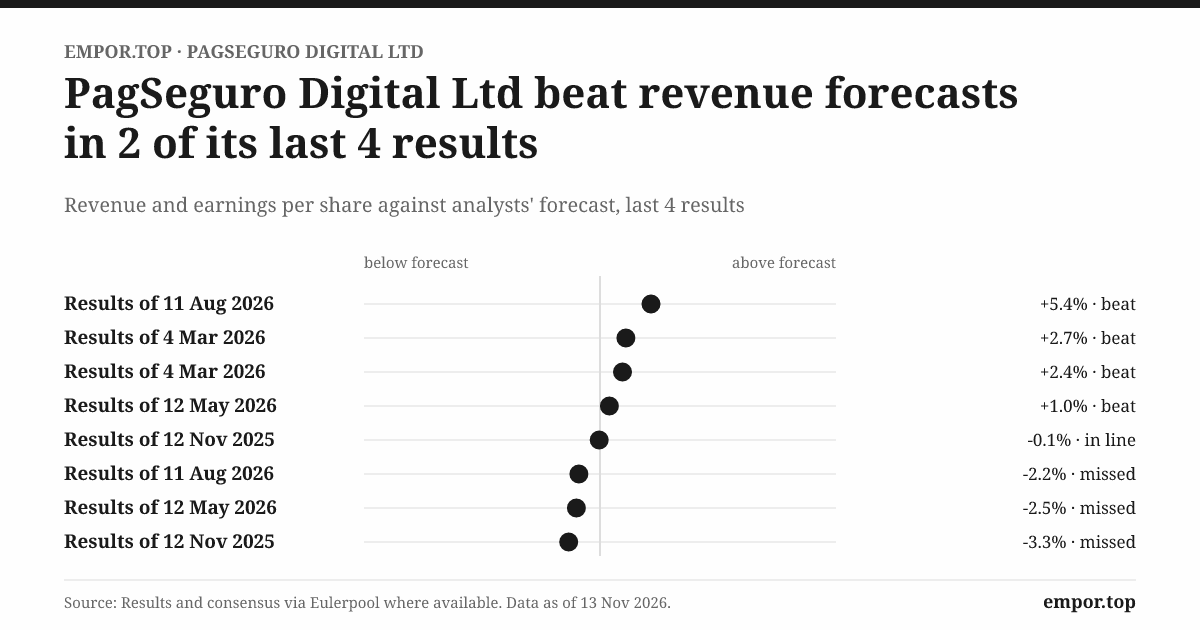
The clearest change emerges across management's own descriptions. In February 2020, management cited stable take rates, unchanged prices and a market that was "not a zero-sum game."7 By March 2026, it called the 2024 repricing "essential to offset higher financial cost."9 In August, management described take-rate dilution as "nothing that really worries us," while steering gross profit toward the bottom of its range.10 The tone remains consistent even as the business changes. Management deserves credit for explaining the mix shift and keeping guidance rather than abandoning it; the analysts on the August call, from Safra on take rate to Goldman Sachs on deposit costs, were probing where the story is weakest.10
Three indicators matter most. Gross profit growth captures payments, banking and funding costs: the company guided to 6% to 9% for 2026, while second-quarter gross profit rose about 3%.2 Payment volume alongside take rate tests the core: volume grew about 3% in June, and management acknowledged slight dilution.210 Credit quality as lending expands is reflected in loans more than 90 days overdue, which rose from 2.5% to 3.4% over the year to June 2026.2
So the low multiple is a clue, not a verdict. If gross profit growth returns toward 10% while delinquency stays contained, the market is pricing PagSeguro for a permanently tougher business that it is not. If payments keep shrinking, banking growth slows and credit losses rise, the multiple is fair compensation for a business that has become a mid-sized Brazilian bank with a card-machine habit.
XII. Playbook: Business & Investing Lessons
Go back to the Minizinha, the little reader that plugged into a phone. Most Minizinha buyers were new to card acceptance.3 Everything that followed — the share gains, the bank, the deposits, the loans — grew from that moment of first acceptance. The first lesson lives there: make the first transaction easy, and you earn the right to sell the next service. PagSeguro did not win by out-processing Cielo. It won by selling something a merchant could buy without a meeting. For founders, the point is that distribution to the overlooked customer can matter more than any feature. For investors, the corollary is that a wedge which is easy to buy is also easy to copy, so the story must quickly move beyond the wedge.
The second lesson comes from PagSeguro's share gains: taking share in a growing market proves execution; keeping price proves power. PagSeguro's climb was real and hard-won, but it did not prove pricing power. Investors who mistook the first for the second paid for it when the challengers' combined value collapsed to about a tenth.8 The test of any challenger is not how fast it grows in a boom but what it can charge when the boom ends.
The third lesson is about the bank, and it is a warning against reading income statements by their labels: a new revenue name matters only when the economics underneath improve. The reported mix shift partly reflected reclassification; the genuine economic gain was cheaper deposits funding early payments. Founders who build platforms on top of a core product should know where the new money really comes from. Investors should demand the bridge from volume to gross profit, not the headline mix.
The fourth lesson belongs to the buybacks: a buyback is a promise about value per share, not a substitute for cash the business has not generated. That can be smart at six times earnings, but only while surplus capital remains; after that, every real of dividend has to be earned after paying for the next generation of terminals and the next turn of the loan book.
The fifth lesson comes from the January 2018 listing in New York: a public float can fund a public story while the decisive vote stays private. Outside investors bore the economics while UOL kept the vote. That is not a scandal. It is a price, paid in influence rather than reais, and it belongs in the valuation of every controlled company, however well run.
XIII. Epilogue
Tonight, PagSeguro sits in an uncomfortable middle. Its payments engine is growing in single digits and losing a little on price. Its bank is growing faster, funding itself more cheaply and lending more. Its shares trade at about six times earnings, and its board has promised at least R$2 billion of dividends over the next two years and a fresh buyback on top.14 The September 2026 quarter closed, and its results will be the first evidence on whether the June slowdown was a pause or a trend.
The first thing to watch is whether payment volume and revenue recover together. If volume growth returns toward mid-single digits while payments revenue stops falling, the 2026 dip will look like a comparison problem, as management argued. If volume stays near flat and payments revenue keeps shrinking, the market's lower-growth view will be confirmed.
The second is whether the growth in financial income produces more gross profit after funding costs. Management guided to 6% to 9% gross profit growth for 2026 and has pointed to the bottom of that range.10 A full year near 6% would hold the line. Anything below would mean the bank is growing without yet offsetting the pressure on payments, and would make the company's long-term goal of more than 10% a year through 2029 harder to believe.9
The third is the loan book. The company says its credit portfolio is supposed to reach about R$25 billion by 2029, roughly five times its June 2026 size.2 Each quarter's delinquency rate, loss charge and recovery rate will show whether that growth comes from careful underwriting or from lending into riskier merchants at a bad point in the rate cycle. The rise in 90-day delinquencies over the year to June is the number to beat.
The fourth is cash after everything: after terminals and software, after dividends and buybacks. One strong operating-cash year, as 2025 was, is not a trend. Two or three years in which free cash flow covers the dividend would answer the most serious question in this story. Years in which it does not would mean the capital-return program is running ahead of the business.
Some questions the next few quarters will not settle, because PagSeguro does not publish what would settle them: merchant retention, a take-rate history on a consistent basis, and cohort-level credit performance. The control question also stays where it is unless the company chooses to disclose more: comparable related-party pricing, and vote counts that show whether minority shareholders agree with what the controller decides.
That is the tension that remains. A business that once grew 40% a year is now asking investors to believe it can grow about 10% a year in gross profit while returning most of its earnings. The low price says the market doubts it. The next few results will show which side was right.
XIV. Outro
The small device that brought card payments to millions of Brazilians has become a gateway to a wider financial relationship. PagSeguro won by making payments fit in a merchant's hand; now it has to prove the whole bank fits there too.
References
-
PagSeguro Digital Form 20-F for fiscal year 2025 — SEC, 2026-04-29 ↩↩↩↩↩↩↩↩↩↩↩↩↩↩↩↩↩↩↩↩↩↩↩↩↩↩↩↩↩↩↩↩↩↩↩↩↩↩↩↩↩↩↩↩↩↩↩↩↩↩
-
PagSeguro Digital Q2 2026 earnings release — SEC, 2026-08-11 ↩↩↩↩↩↩↩↩↩↩↩↩↩↩↩↩↩↩↩↩↩↩↩↩↩↩↩
-
PagSeguro Digital IPO registration statement, Form F-1/A — SEC, 2018-01-09 ↩↩↩↩↩↩↩↩↩
-
BancoSeguro S.A. credit report — Moody’s Local Brasil, 2026-01-19 ↩↩↩↩↩↩↩↩↩↩↩↩↩↩↩↩↩↩↩↩↩
-
Laudo de Avaliação da Cielo S.A., including acquiring market shares — Cielo / Bank of America, 2024-02-05 ↩↩↩↩↩↩
-
Brazil’s Cielo revenue falls as competition increases — Reuters via Yahoo Finance, 2018-02-01 ↩
-
PagSeguro Digital Q4 2019 earnings call transcript — The Motley Fool, 2020-02-28 ↩↩↩↩
-
Stone e PagSeguro valem 90% menos após Pix e maior concorrência — Bloomberg Línea, 2023-11-08 ↩↩↩↩↩↩
-
PagSeguro Digital Q4 2025 earnings call transcript — Stock Analysis, 2026-03-04 ↩↩↩↩↩↩
-
PagSeguro Digital Q2 2026 earnings call transcript — Stock Analysis, 2026-08-11 ↩↩↩↩↩↩↩↩↩↩↩↩↩↩↩↩
-
PagSeguro Digital Form F-1 registration statement, effective January 19, 2018 — SEC, 2018-01-23 ↩
-
PagSeguro Digital Form 20-F for fiscal year 2022 — SEC, 2023-04-28 ↩
-
PagSeguro Digital 2020 financial statements, Wirecard Brazil acquisition accounting — SEC, 2021-02-17 ↩↩
-
Dividend targets and fourth share repurchase program — SEC, 2026-09-01 ↩↩↩
-
Minutes of December 2025 extraordinary general meeting — SEC, 2025-12-22 ↩
-
StoneCo statistics and valuation — Stock Analysis, 2026-11-13 ↩
 LinkedIn
 WhatsApp
 Reddit
 Hacker News
 Email
 Kindle
 RSS Feed
 Spotify
 Apple Podcasts
 Amazon Music
 Audible
 YouTube