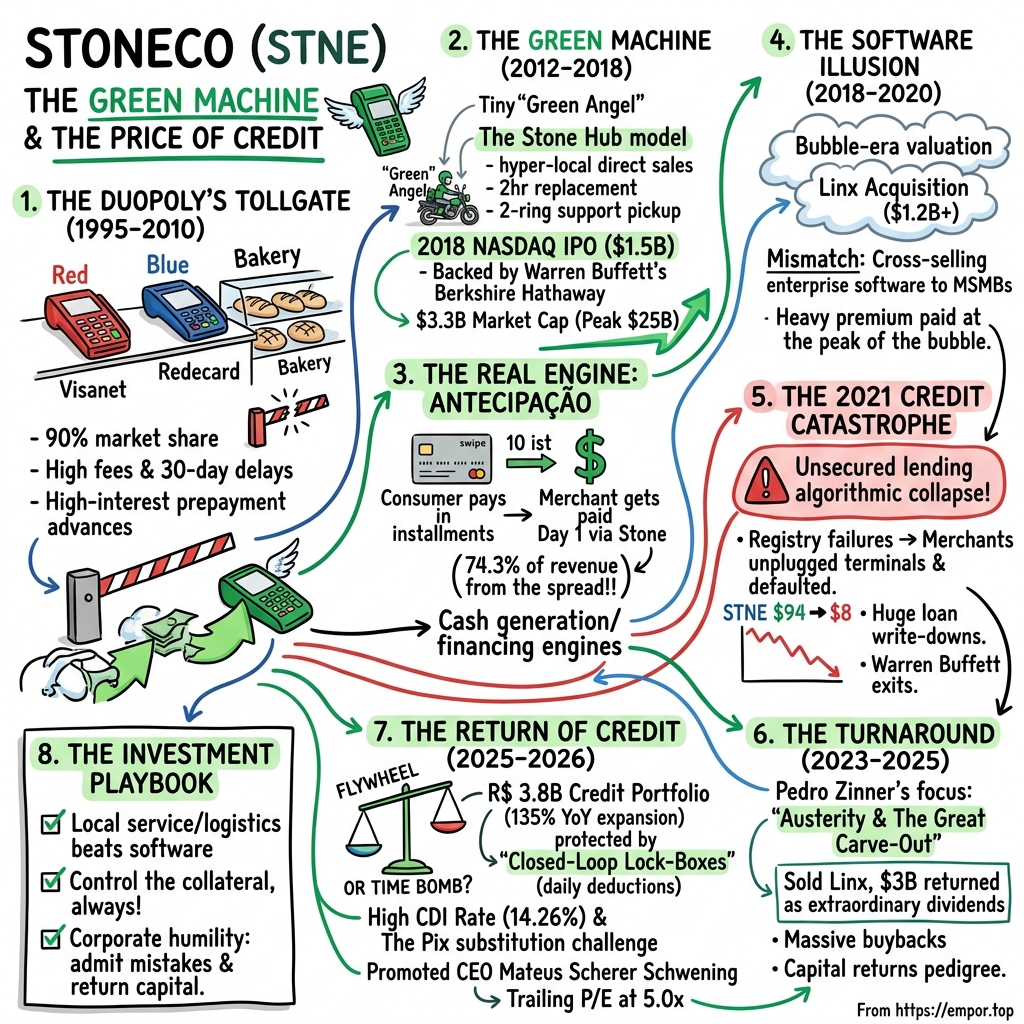
StoneCo: The Green Machine and the Price of Credit
I. The Disrupted Disruptor
On October 25, 2018, a Brazilian payments company that most American investors had never heard of opened for trading on NASDAQ under the ticker STNE.1 Its shares were priced at $24, and the offering raised roughly $1.5 billion, one of the largest technology listings out of Latin America to that point.12 The man at the centre of it, co-founder André Street, was in his mid-thirties, already on his second payments company, and was selling the market a simple, almost cheeky idea: that a handful of giant Brazilian banks had treated small merchants badly for decades, and that a company with green card machines and obsessive customer service could take that business away from them.
What made the listing more than a regional curiosity was the shareholder list. Berkshire Hathaway, a firm famous for avoiding young technology companies and emerging-market fintech in particular, had bought into the deal and ended up with a stake of roughly 8%.23 Ant Financial, the payments affiliate of Alibaba, was also an early backer.1 For a company whose entire pitch was that it could out-execute the incumbents, it is hard to imagine a better endorsement than Omaha.
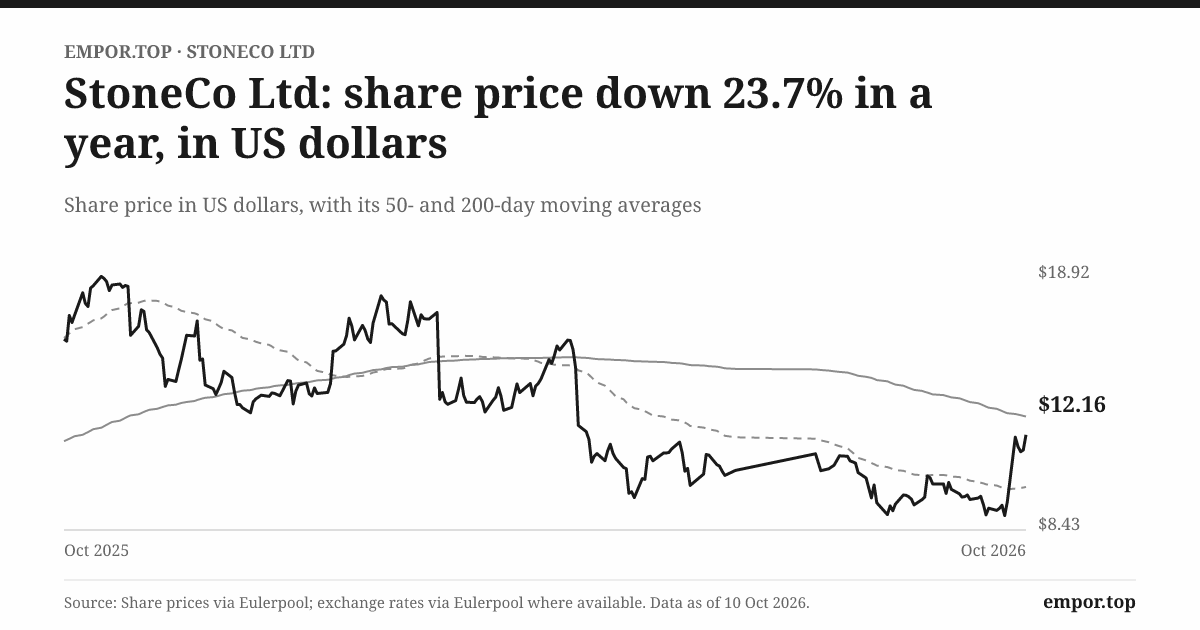
For a while, the market agreed with the pitch. During the pandemic, when digital payments stocks around the world were bid up as if every swipe were a software subscription, StoneCo's shares climbed above $90.4 Then the company tried to become a lender to the merchants it served, and the experiment went badly wrong. Defaults surged, credit was frozen, losses appeared, and the stock fell below $9.4 Berkshire eventually sold out entirely.3
Tonight, in October 2026, StoneCo is a very different animal. It sold the enterprise software business it once bought to become an "ecosystem," it paid an extraordinary dividend with the proceeds, and it changed almost its entire leadership team in the first months of the year.256 Its market value is about $3.3 billion, a fraction of the more than $25 billion it reached at its peak.2 The stock trades at about five times trailing earnings, against a five-year median of almost twelve.2 That is the kind of multiple the market reserves for businesses it expects to shrink.
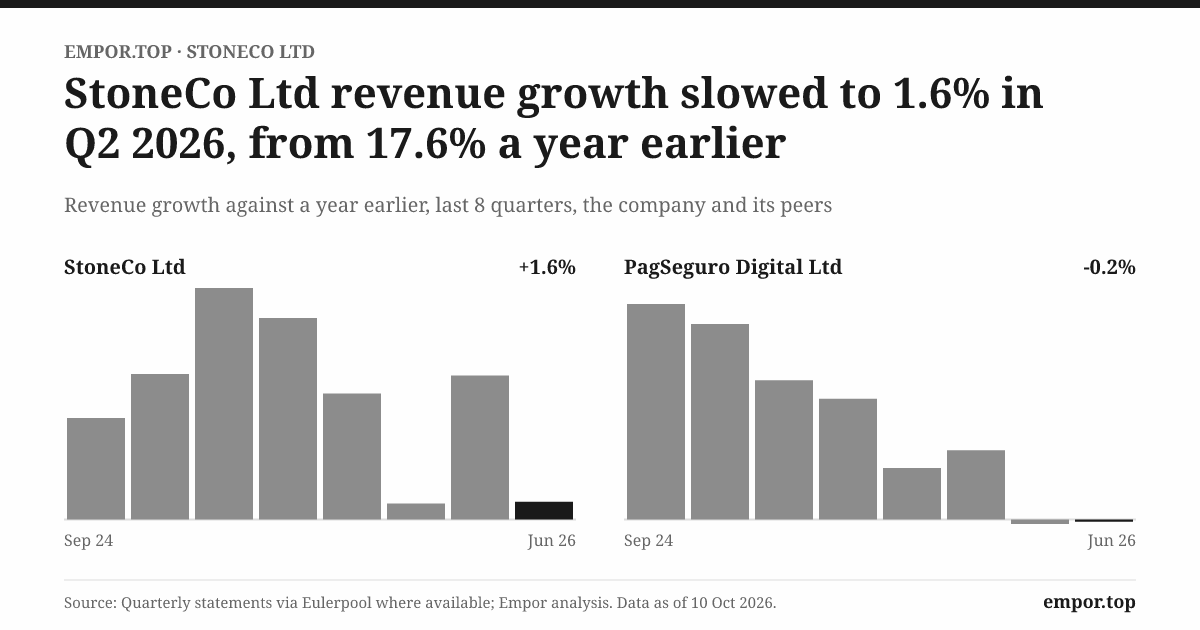
The reason is not that StoneCo is unprofitable. It is, by most measures, more profitable than it has ever been: operating margin in 2025 was about 51%.2 The reason is that growth has gone missing. In the second quarter of 2026, revenue from continuing operations grew just 1.6% from a year earlier.7 And the one part of the business that is growing fast is the part that nearly killed the company five years ago: lending to small merchants.
So this story has three questions running through it. The first is whether the revived working-capital loan book, about R$ 3.8 billion by mid-2026 and expanding at a pace well above 100% a year, is a disciplined, high-return engine or the opening act of a 2021 replay.7 The second is whether StoneCo can grow again now that it has sold Linx and its core acquiring business has slowed to a crawl. The third is about control: whether the early-2026 C-suite overhaul was a clean victory lap for turnaround CEO Pedro Zinner, or whether André Street's roughly 39.5% grip on the votes, built on a small economic stake, leaves the company more fragile than it looks.2
StoneCo today is a pure-play Brazilian financial platform serving more than four million merchants, free of software distractions and returning cash to shareholders.7 The market prices it like a sleepy regional bank. To understand whether that is wrong, the story has to start with what StoneCo was built to destroy: one of the most profitable tollbooths in global finance.
 Subscribe on LinkedIn
II. The Duopoly's Tollgate (1995–2010)
Picture a small bakery in São Paulo in the mid-2000s. On the counter, next to the register and the bread, sit two card machines. One is blue, from Redecard. One is red, from Visanet. The baker needs both, because for most of this period a Visa card could only be processed on one network and a Mastercard on the other.1 Each machine carries its own monthly rental fee. Each takes a slice of every sale. And when a customer pays by credit card, the baker does not see the money for about a month.2
That bakery is the whole economics of Brazilian merchant payments in one image. Visanet, later renamed Cielo, held the exclusive right to acquire Visa transactions; Redecard, later Rede, held the equivalent position for Mastercard.1 Between them they controlled the overwhelming majority of the market. And behind them stood the country's dominant universal banks: Banco do Brasil and Bradesco on the Cielo side, Itaú on the Rede side, with Santander also active in the system.1
The genius of the arrangement, from the banks' point of view, was that it was a double tollgate. The first toll was the obvious one: the merchant discount rate charged on each card transaction plus the rental fee for the terminal. The second toll was subtler and bigger. Because Brazilian card settlements were slow, especially for credit cards, a merchant who needed cash to pay suppliers or staff could get it sooner only by selling those future card receipts back to the acquirer at a discount. That service is called antecipação de recebíveis, receivables prepayment, and it was priced like credit in a country where credit has always been expensive.2 The same bank that processed the sale lent the merchant its own money back.
So the duopoly was not just a payments business. It was a distribution channel for some of the most lucrative short-term lending in the Brazilian financial system, wrapped around a captive customer who could not easily leave. A merchant unhappy with the blue machine could not switch to a different blue machine. There wasn't one.
In 2010, regulators finally moved. The Central Bank of Brazil and the antitrust authority CADE pushed the industry to end network exclusivity, so that any acquirer could process any major card brand and a single terminal could handle them all.18 On paper, the cartel was dismantled. The bakery could throw out one of its two machines.
But paper is not practice. The incumbents still owned the bank branches, the relationships, the deposit accounts and the brand recognition. More importantly, they still thought about acquiring the way a bank thinks about a product line: as a way to keep the merchant's money inside the bank, not as a technology service with customers who deserved fast support. The opening created in 2010 was real, but it was an opening for someone who would treat the baker as a customer rather than a deposit. The incumbents were slow, bureaucratic and expensive, and their machines broke and took days to replace.
For an investor, the lesson of this era is that the profit pool StoneCo would later chase was never primarily about moving transactions. It was about financing them. That point matters enormously later, because it means StoneCo was always going to be, at heart, a credit business. The only question was who would build the challenger that could get onto the bakery counter in the first place.
III. The Green Machine: André Street and the Hub Model (2012–2018)
André Street did not arrive in physical payments as a newcomer. Before Stone, he and his partner Eduardo Pontes had built Braspag, an online payment gateway, which they sold to Cielo, the very incumbent they would later attack.1 Selling to the market leader gave them two things: capital and a front-row view of how the incumbents actually worked. Street, by the accounts of people who have watched him for years, is restless, intense and allergic to slow organizations, and he came away convinced that the incumbents' weakness was not their technology. It was their indifference.
Stone was founded in 2012 to go after physical retail.1 The obvious way to sell card machines in a country the size of Brazil was the way PagSeguro, its great rival, chose: cheap terminals sold online and through retailers, marketed with television advertising to micro-entrepreneurs and street vendors who could set themselves up without speaking to anyone. That model scales with marketing budgets. Stone deliberately chose a harder path aimed at a different customer: the micro, small and medium-sized business, the clinic, the auto-parts store, the neighbourhood restaurant, merchants who were too big to be served by a self-service app and too small to get attention from a bank's corporate desk.1
The answer Stone built was the Stone Hub. A hub was a small local team responsible for a tight patch of a city: a leader, field salespeople who walked into stores and closed deals, and logistics technicians, the so-called Green Angels, who delivered and serviced terminals.1 If a machine failed on a Friday evening during the dinner rush, the merchant did not wait a week for a courier. Someone on a motorcycle arrived, often within a couple of hours, and swapped it. Support calls were answered by people, quickly, instead of being trapped in automated phone menus.1
This sounds like customer service trivia. It was actually the competitive weapon. For a merchant, a dead card machine means lost sales that day, and lost sales are far more expensive than a few basis points of fee. A challenger that never let the machine stay dead could charge reasonable prices and still win, because it was solving the merchant's most painful problem. The incumbents, structured around branch networks and centralized call centres, could not easily copy a culture built on speed.
The financial results, as the company grew into the IPO, were striking. Revenue rose from about $120 million in 2016 to about $418 million in 2018, more than doubling in the final year alone.12 Operating margin climbed from about 32% to about 46%.1 By the time of the listing, the company was earning a net margin of about 20%.1 This was not a cash-burning startup buying growth. It was a growth company that already made money.
Why did the economics work? Because the hub's high-touch service kept merchants loyal, and loyalty let Stone recover the cost of the terminal quickly and then earn three streams from the same merchant: rental fees, transaction fees, and, most importantly, the prepayment spread when the merchant wanted its card money early. Retention was the hinge. A merchant who stays five years is a very different asset from one who leaves after six months.
There is a caveat worth stating plainly. The hub model was a process advantage, not a legal or technological monopoly. Anybody with enough capital and patience could, in principle, build field teams. What Stone had was a head start, a culture and density in the cities it entered first. Those are real advantages, but they erode if competitors copy them or if growth requires moving into regions and segments where density is harder to build. The early edge was distribution, not code.
And that distinction raises the question the IPO prospectus quietly answered for anyone who read the revenue lines carefully: what, exactly, was StoneCo selling?
IV. The Real Engine: Unpacking Antecipação and the Float
Take an ordinary R$ 100 purchase on a Brazilian credit card. In most countries the story ends with the swipe. In Brazil it often begins there, because consumers routinely split purchases into interest-free instalments, parcelado sem juros, spread over anything from three to twelve months. The shopper pays R$ 10 a month for ten months and pays no interest. The interest, in effect, has not disappeared. It has been shifted onto the merchant, who now has to wait for those ten slices to arrive.
A clinic or a furniture shop cannot run payroll on money that arrives in ten monthly slices. So the merchant asks its acquirer to pay it now. StoneCo pays the cash upfront, discounted at a monthly rate, and then collects the full amount from the card issuers as the instalments settle.2 The difference between the discount it charges the merchant and its own cost of funding, which in Brazil tracks the interbank rate known as the CDI, is StoneCo's profit. With the CDI at about 14.3% at the end of 2025, those spreads are applied to large numbers.2
Here is the fact that reframes the entire company. In the second quarter of 2026, financial income from prepayment and credit made up about 74% of StoneCo's total revenue and income, roughly R$ 2.7 billion out of R$ 3.6 billion.7 For the full year 2025, the same line was about R$ 10 billion.2 Net transaction fees, the thing most people imagine a payments company lives on, were under 12% of revenue in the quarter, and terminal subscription and rental fees about 7%.7
The popular image of StoneCo is a technology company that takes a cut of every swipe. The record says something else. StoneCo is primarily a short-duration, asset-backed lender whose collateral is card receivables owed by regulated card issuers. The green machine is the origination channel. The money is made on the float.
That explains why some of StoneCo's reported numbers look bizarre when run through tools designed for industrial companies. On a standard calculation, StoneCo's customers would appear to take more than 1,100 days to pay it, and StoneCo would appear to take more than 2,000 days to pay its suppliers.2 Neither number means what it means at a factory. The "receivables" are about R$ 38.6 billion owed by card issuers on scheme rails, and the "payables" are about R$ 26.8 billion owed to merchants awaiting settlement.2 These are balances flowing through the payment system, not overdue invoices.
It also explains one of the stranger facts in StoneCo's history. Over the ten years from 2016 to 2025, the company reported about BRL 2.3 billion of cumulative net profit, yet its cash from operations over the same decade was about negative BRL 2.8 billion.2 For an industrial company that gap would be a red flag. Here it is the business model. Under IFRS, cash paid out to merchants in advance of collecting from issuers counts as an operating outflow; in 2025 alone, the build-up of card receivables consumed about R$ 10.6 billion of operating cash.2 The money to fund those advances comes from debentures, receivables securitization funds called FIDCs, bank lines and deposits, which sit in the financing section of the cash-flow statement.2 Before those working-capital swings, operating cash flow in 2025 was about R$ 5.1 billion.2
So the right question about StoneCo is never "does it convert profit to cash" in the usual sense. It is "how cheaply can it fund the receivables it buys, and how safely can it collect them." When the collateral is a card issuer's obligation, that risk is tiny. When the collateral is a small merchant's promise to repay a loan, the risk is of a different order entirely.
That distinction was about to become very expensive. But first, the company went shopping.
V. The Wall Street Darling and the Software Illusion (2018–2020)
The first two years as a public company were a honeymoon. Revenue grew by more than half in 2019, operating margin reached about 55%, and net profit roughly doubled to around $203 million.2 Then the pandemic arrived, and with it a global stampede into anything that looked like digital commerce. StoneCo raised about $1.5 billion more in an equity follow-on in August 2020, alongside convertible debt, and its shares kept climbing toward the peak above $90 they would hit in early 2021.24
With a rich stock price and a full cash register, management reached for a bigger idea. The argument went like this. Card acquiring, on its own, would commoditize: fees would fall, terminals would become interchangeable, and merchants would switch for a few basis points. The way to build switching costs was to own the software merchants used to run their stores, so that payments, inventory, invoicing and credit all lived inside one system. Payments would become a feature of the ecosystem rather than a product to be shopped on price.
The target was Linx, Brazil's leading retail management software company, serving apparel chains, pharmacies, fuel stations and other retailers. StoneCo agreed to buy it in August 2020 in a deal reported at about $1.1 billion.9 Then Totvs, Brazil's largest enterprise software company, entered with a rival bid, and StoneCo raised its offer, ending at a valuation of roughly R$ 6.7 billion.9 The fight was public and messy. Part of the package included payments to Linx's founders that Brazilian asset managers criticized as treating some shareholders better than others.9
StoneCo won. In hindsight, it is worth asking what it won. Linx's best customers were large, multi-store retailers. Those customers process enormous card volume and negotiate acquiring fees down to razor-thin levels, because for them a few basis points add up to real money and they have bargaining power to match. StoneCo's profit engine, by contrast, was built on regional small and medium merchants who valued service and needed prepayment, and who paid accordingly. Cross-selling cheap acquiring to big retailers was never going to look like the economics of the bakery or the clinic.
The two businesses also ran on different clocks. Software is sold through long implementations, consultants and enterprise contracts. The hub model is a motorcycle and a phone answered in two rings. Integrating them meant asking an organization optimized for speed with small merchants to sell into slow, complex enterprise accounts, and asking a software company to become a payments distribution channel.
None of this was invisible in 2020. But in a market that rewarded "ecosystem" stories with ever-higher multiples, the logic of paying up for strategic optionality was easy to accept. The deal was financed partly with stock, and StoneCo's stock was expensive, which softened the apparent cost.
The verdict here is not hard to reach, because the company itself reached it later: the Linx thesis did not work. The asset ended up written down by about R$ 3.6 billion and sold for roughly half of what StoneCo had agreed to pay.26 The broader lesson is that "vertical integration" only creates switching costs when the customer you integrate is the customer you monetize. StoneCo integrated the wrong customer.
Yet Linx, painful as it was, would not be the thing that nearly broke StoneCo. While the software deal was being digested, the company had begun a far riskier experiment much closer to its core.
VI. The 2021 Credit Catastrophe: Registry Flaws and the Near-Death Experience
By 2020, StoneCo could see something no bank could: the daily card sales of hundreds of thousands of small businesses flowing through its terminals. It knew which clinic was busy, which restaurant was slowing, which shop sold more on Saturdays. To an ambitious management team, it seemed absurd to watch that data and leave the lending to someone else. Why let a bank collect the interest on a working-capital loan to a merchant whose cash flow Stone understood better than anyone?
So StoneCo built a credit product: working-capital loans to its merchants, to be repaid out of their future card receipts. In theory the collateral was the receivables themselves. And in mid-2021, a new national framework went live that was supposed to make that collateral secure: a system of registries, the registradoras, where card receivables would be recorded so that a lender could lay claim to a merchant's future card sales regardless of which acquirer processed them.104
The theory had a hole, and merchants found it quickly. The registry system suffered from implementation problems, and in practice StoneCo could not reliably lock receivables flowing through competitors' terminals.104 A merchant who borrowed from Stone could, in effect, unplug the green machine, plug in a terminal from Cielo or PagSeguro, and route its sales elsewhere. The loan was suddenly much closer to unsecured credit to a small business, in the middle of a tightening economy.
What happened next is the textbook definition of adverse selection. The merchants most likely to switch terminals and stop paying were exactly those in the most financial trouble. Non-performing loans surged. In August 2021, StoneCo halted new credit disbursements as bad debt rose.4 The company took heavy provisions and write-downs, and the bill showed up everywhere.4 StoneCo reported a net loss of about $251 million for 2021 and another loss of about $100 million in 2022.2 Operating profit fell from about $333 million in 2019 to about $171 million in 2021, even as revenue kept rising.2 The shares fell from the mid-$90s to below $9.4
Investors who had bought StoneCo as a disciplined operator sued. A U.S. securities class action alleged that the company had misled them about the credit product and its risks.11 Berkshire Hathaway began reducing its position and was fully out by the first quarter of 2024.3
It is tempting to blame the registry, and the infrastructure flaws were real. But the honest verdict is harsher. StoneCo scaled an algorithmic lending book quickly without first proving that its claim on collateral worked in practice. It assumed a new piece of national plumbing would function as designed, and it lent as if it did. Lenders do not get paid for assuming. The failure was in risk management, and it was a management choice, not bad luck.
This matters for the present because the same company is lending again today. Whether it learned the right lesson is the single most important question in the investment case. The 2021 record does not prove StoneCo cannot underwrite. It proves that it once confused data about a merchant's sales with control over a merchant's cash. Those are very different things.
The crisis left the company with a broken stock, a lawsuit, an expensive software subsidiary and a credibility problem with the investors it had dazzled three years earlier. It needed a different kind of leader.
VII. The Turnaround Doctor: Pedro Zinner's Great Carve-Out (2023–2025)
In 2023, StoneCo handed the CEO job to Pedro Zinner, replacing co-founder-era leadership under Thiago Piau.2 Zinner was an outsider to the founders' circle and an unusual choice for a fintech: his background was in running large Brazilian industrial and energy businesses, including utility-style companies where capital discipline, not product velocity, determines who survives.2 He arrived with a turnaround mandate: cut overhead, impose discipline on capital spending, rebuild trust with investors in New York and São Paulo, clean up legacy legal problems and decide what to do about Linx.
He started with the parts that were cheap and visible. Capital spending, which had run at double-digit percentages of revenue during the terminal build-out, came down; by 2025 total capex was about R$ 1.2 billion, about 8% of revenue.2 Headcount drifted down from about 17,100 at the end of 2023 to about 16,400 at the end of 2025, before the Linx staff left with the sale.2 Pay for the board and executive team fell from about R$ 151 million in 2023 to about R$ 116 million in 2025.2
Then came the legacy liabilities. StoneCo settled the U.S. securities class action for a gross R$ 145.3 million, with about R$ 97 million covered by directors-and-officers insurance, and a court approved the settlement in February 2026.211 A small group of plaintiffs who opted out remains pending, so the matter is narrowed rather than entirely closed.2
The biggest call was Linx. In the fourth quarter of 2024, StoneCo recognized a goodwill impairment of about R$ 3.6 billion on the software business.2 That single non-cash charge turned the year into a net loss of about R$ 1.5 billion, roughly negative $281 million, with the fourth quarter alone showing a loss of about $500 million.2 It was an admission, in accounting form, that the 2020 purchase had been worth far less than StoneCo paid. In 2025, software was reclassified as discontinued operations, and in February 2026 the sale closed for about R$ 3.3 billion.26 The auditor, Ernst & Young, flagged both the accounting for that disposal and the credit-loss allowances as critical audit matters, though it issued a clean opinion.2
Then the cash went back to shareholders. In April 2026, the board approved an extraordinary dividend of $2.53 per share, about R$ 3.1 billion, paid in May.212 That came on top of buybacks that had shrunk the diluted share count from more than 315 million to about 249 million between 2022 and 2025.2 Put together, StoneCo returned essentially all of the Linx proceeds instead of looking for the next acquisition.
It is easy to call this exemplary, and in important ways it was. Zinner admitted a mistake, wrote it off, sold the asset and refused to redeploy the proceeds into a new empire. That behaviour is rarer than it should be. But a fair account also has to price the mistake. StoneCo paid roughly R$ 6.7 billion for Linx and recovered about half; the turnaround was a clean exit from a loss, not a gain.69 And the buybacks, executed at prices far below the 2020 follow-on, were in part repurchasing stock the company had issued much more expensively. Discipline after the fact is valuable; it does not undo the original capital destroyed.
There is also a second-order question. Zinner's era did not only cut. It also restarted the thing that caused the 2021 crisis. Credit, relaunched through StoneCo's own regulated lender, became the fastest-growing line in the business. To judge the turnaround properly, one has to judge that decision.
VIII. The Return of Credit: Flywheel or Time Bomb?
Inside Stone SCFI, the group's regulated credit, financing and investment company, the rules of lending were rewritten after 2021. The central change is mechanical. Borrowers now repay through automatic daily deductions from the card receivables processed on Stone's own terminals, a closed-loop "lock-box" in which StoneCo captures the repayment before the merchant ever sees the cash.2 The lender no longer depends on a national registry functioning perfectly. If the merchant keeps using the green machine, the loan pays itself down a little every day.
The book has grown fast under that design. The gross credit portfolio rose from about R$ 1.2 billion at the end of 2024 to about R$ 2.8 billion at the end of 2025, and to roughly R$ 3.8 billion by mid-2026.27 The allowance for expected losses climbed from about R$ 145 million to about R$ 390 million over 2025, covering about 13.7% of the gross book.2
Now set that growth against the rest of the company. In the second quarter of 2026, continuing revenue grew just 1.6%, while financial income grew about 10.7%.7 Translation: almost all of the incremental top line is coming from lending and prepayment. The transaction fee line is shrinking. If credit stopped growing tomorrow, StoneCo's revenue would likely be going backwards.
That is the tension. Credit is now both the growth engine and the risk. And the timing is uncomfortable. With the CDI at about 14.3%, Brazilian small businesses are paying among the highest borrowing costs in the major economies.2 A merchant borrowing at a spread above that rate needs healthy sales just to service the loan, and the lock-box only works as long as sales keep flowing through the terminal. In a downturn, the borrower's sales fall at the same moment its debt service becomes harder, and a merchant in real distress can still switch acquirers or simply go out of business.
The early warning signs are already visible. Provision expenses in the second quarter of 2026 jumped about 128% from a year earlier, to roughly R$ 188 million.7 Some of that is mechanical: a bigger book needs bigger provisions, and IFRS 9 forces lenders to book expected losses upfront when loans are originated. But provisions rising nearly as fast as the book is exactly the pattern that precedes trouble if newer loans season worse than older ones. StoneCo's track record says a loan book can look fine while it is growing quickly and deteriorate abruptly once growth slows and cohorts age. A loss rate above roughly 6.5% of gross loans would begin to eat seriously into the spread.
StoneCo's defence is funding. It holds about R$ 11.1 billion in merchant deposits and payment-account balances, plus about R$ 3 billion in institutional time deposits.2 Deposits from merchants who keep working capital in their Stone accounts are cheaper than debentures priced at a spread over CDI, so they widen the margin on every loan.2 Rating agencies cite that deposit growth as a credit strength; Moody's rates StoneCo Ba2 with a positive outlook, and S&P rates it BB globally and brAAA locally, while both flag the seasoning of the new loan book as a key risk.1314
The verdict is narrower than either bulls or bears usually allow. The 2026 architecture is genuinely better than the 2021 one, because it fixes the specific mechanism that failed: collateral control. But it does not fix credit risk in general. A lock-box protects against a merchant redirecting sales; it does not protect against a merchant whose sales collapse. The claim "StoneCo has solved credit" is unproven. The claim "StoneCo has solved the 2021 problem" is largely supported. Investors are being asked to underwrite the first while the evidence covers only the second.
Whether that bet is worth taking depends heavily on how durable the rest of the franchise is, which means looking at who else wants the bakery counter.
IX. Competitive Moat and Strategic Position
Stand at a checkout in Brazil today and watch how people pay. Some still tap a Visa or Mastercard credit card, or a card from the domestic Elo network. A growing number scan a QR code and pay with Pix, the Central Bank's instant payment system, which moves money between accounts in seconds, around the clock, at little or no cost to the payer.8 Pix has become one of the most successful payment rails in the world, and it was designed by a regulator that explicitly wanted to lower the cost of payments in Brazil.8
For StoneCo, Pix is both an opportunity and a threat. StoneCo terminals accept Pix through dynamic QR codes, so the company still sits at the counter.2 But a Pix payment carries much less economic value than a credit card swipe, and, critically, it settles instantly, which means no prepayment is needed. Pix substitutes most directly for debit cards, and it eats into the float on which StoneCo's best profits depend. Transaction revenue fell about 35% from a year earlier in the second quarter of 2026, a decline the company ties to interchange pressure and payment mix.7
That is where any honest assessment of StoneCo's moat has to start. Using Hamilton Helmer's framework of seven sources of durable power, the picture is mixed.
StoneCo has a genuine form of process power and local scale in its hub network. Density in a city lowers the cost of deploying and servicing each terminal and supports the service levels that won merchants in the first place.1 Operating margin recovering to about 51% in 2025 suggests the cost machine is efficient.2 But process power that rests on field teams can be copied by a well-funded competitor willing to accept low returns for years, which is exactly what banks and PagBank have done.
Switching costs are where the record is most revealing. Pure card acquiring has almost none: a merchant can swap a terminal in an afternoon, and the 2021 crisis proved it at scale when borrowers did precisely that.4 What creates friction today is banking. A merchant whose payroll, supplier payments, deposits and loan all run through a Stone account faces a real cost to move. That is a moderate switching cost, and growing, but it is a banking moat, not a payments moat.
Network effects are absent. One more merchant on StoneCo does not make the service more valuable to the next merchant or to consumers; card and Pix acceptance is universal. Brand matters in the small-business segment, but it is not powerful enough to sustain premium pricing against banks. There is no cornered resource: no patent, licence or exclusive asset rivals cannot obtain.
Michael Porter's five forces sharpen the picture. Buyers are fragmented across more than four million merchants, with none above 10% of revenue, so no single customer can dictate terms.27 But collectively they are extremely price-sensitive on terminal rental and prepayment rates. Suppliers are concentrated: Visa, Mastercard, Elo and the regulator set the rules, and changes to interchange caps or settlement terms can shift economics overnight.2 The threat of substitutes is Pix, already visible in the numbers. Rivalry is intense. PagBank, the former PagSeguro, competes head-to-head and trades at roughly 7.5 to 9 times earnings.2 Cielo, taken private by its bank owners Banco do Brasil and Bradesco, can price without public-market scrutiny.2 Nubank, priced above 20 times earnings, is expanding from consumer banking into small-business accounts.2 New entrants face lower barriers than in the old duopoly era.
The resulting verdict is that StoneCo's moat is real but modest. It is a well-run distributor with growing banking switching costs, operating in an industry where the regulator actively pushes prices down. The balance sheet now carries more leverage to fund lending, with debt at about 1.5 times equity at the end of 2025.2 None of that is fatal. But it means the business has to be run well forever, because structure alone will not protect it.
And running it well now falls to a team that was mostly assembled in 2026.
X. The New Guard: Governance, André Street, and the 2026 Leadership Hand-off
At the April 2026 annual meeting, power at StoneCo changed hands in a way that looked tidy from the outside. Pedro Zinner, having stepped down as CEO in March, became chairman of the board, replacing Mauricio Luchetti.25 Mateus Scherer Schwening, the CFO and investor relations officer throughout the turnaround, became CEO.25 Diego Ventura Salgado, the chief treasury officer, became CFO.2 Sandro Bassili took over as COO and Thomas Gregor Ilg as chief risk officer, while chief growth officer Mateus Biselli and chief sales and marketing officer Lia Matos left.2 All proposals at the meeting passed without a significant revolt.2
There are two readings of this. The charitable one is succession done right: the leader who completed the clean-up moves to oversight, and the CFO who lived through every step takes the operational job. The new top team is drawn from finance, treasury and risk, which is exactly the profile one would want for a company whose economics are now mostly about credit and funding.
The more skeptical reading notes that the two executives who left were the ones most associated with growth, at the very moment growth has stalled. A team of finance professionals may be ideal for protecting a balance sheet; whether it can reignite a slowing franchise is another question. Five senior roles changing in roughly ninety days is not a crisis, but it is a lot of institutional memory to rotate at once.
Behind all of it sits André Street. As of March 2026, StoneCo had about 229 million Class A shares with one vote each and about 14.1 million Class B shares with ten votes each.2 Street, through his holding vehicles, owns essentially all of the Class B shares and about 2.3% of the Class A shares, which gives him about 39.5% of the total vote.2 Under the shareholders' agreement, as long as founder vehicles hold more than 15% of the vote, they hold veto rights over major transactions such as a change of control or significant debt.2 The largest outside holders, BlackRock-affiliated entities with about 9% of the vote and Madrone Partners with about 7%, have influence but cannot outvote him.2
Eduardo Pontes and Thiago Piau have stepped back from daily operations.2 So the governance arrangement today is unusual: the founder controls the key votes but does not run the company, and the people running it are professional managers. That can work very well, as long as the founder and managers want the same things. It can also mean that accountability is blurred, because the person with the most power has the least day-to-day responsibility for results.
Compensation has at least moved in the right direction. Pay for directors and officers fell from about R$ 151 million in 2023 to about R$ 116 million in 2025, roughly half of it in share-based awards.2 After the extraordinary dividend, the company added about 3.8 million shares to its long-term incentive pool to adjust awards for the payout, a reasonable mechanical fix, though it is dilution investors should notice.2
The verdict: Zinner institutionalized controls and the hand-off preserved continuity, but StoneCo remains a founder-controlled, dual-class company with a brand-new management team that has not yet run a full year. That is not instability. It is untested stability. And it is one of the reasons the market is unwilling to pay much for the earnings this team inherited.
XI. The Skeptic's Stress Test: Bull vs. Bear Case
Imagine the investment committee meeting in October 2026. On the screen, StoneCo at about $12.16 a share, almost 39% below its 52-week high.2 Trailing earnings of about five times. A free-cash-flow yield above 24%, inflated by the timing of cash movements after the Linx sale but striking all the same.2 Return on invested capital of about 41% and return on equity of about 37% over the last twelve months.2 Revenue growth of 1.6%.7 Everyone in the room agrees on the numbers. The argument is about what they mean.
The bear speaks first. Growth has effectively stopped, the bear says, and it has stopped for structural reasons. Card acquiring in Brazil is saturated, Pix is eroding the most valuable transactions, and the regulator wants payments cheaper. The company sold its only diversification and is now entirely exposed to Brazilian banking risk, interchange rules and tax disputes, including municipal service-tax claims of about R$ 266 million that the company has assessed as possible but not provided for.2 And in that context, the one thing growing rapidly is the loan book, expanding at more than 100% a year at the late stage of a high-rate cycle. The bear's worst case is not a rerun of 2021 in mechanism but in outcome: provisions rising faster than credit revenue through 2027, wiping out the earnings that make the multiple look cheap.
The bull answers with arithmetic. At five times earnings, roughly 1.7 times book value and about 3.5 times enterprise value to operating profit, StoneCo is priced as if earnings will shrink substantially.2 Its peers trade far higher: PagBank around eight times, Nubank above twenty.2 The company earns high returns on capital, has demonstrated it will return cash instead of hoarding it, and funds itself increasingly with cheap deposits.2 The bull does not need StoneCo to become a compounder again. The bull needs earnings not to collapse.
Which argument does the evidence favour? Each side is partly right, and the history allows a calibrated verdict. The bear is right that StoneCo is no longer a growth company and should not be valued like one; the top line confirms it. The bull is right that the current price assumes something closer to structural decline than to stagnation. The swing factor is credit. If provisions stabilize, say below roughly 35% of credit revenue, the multiple has room to move toward peers. If they do not, the cheap multiple is a correct forecast, not a mispricing.
An activist looking at the company would push in three places. First, disclosure: with credit now the growth engine, investors deserve consistent, cohort-level data on delinquency and losses every quarter, not just aggregate provisions. Second, governance: veto rights tied to a 2.3% economic stake are a governance discount the company could narrow. Third, capital allocation: with leverage rising to fund loans, the board should be explicit about how much capital the loan book may absorb before returns to shareholders take priority again.
Three numbers will decide which side wins. The first is credit quality: the 90-day non-performing loan ratio and cost of risk on the Stone SCFI book, where provisions are currently rising about as fast as the portfolio itself.7 The second is organic revenue growth from continuing operations, currently 1.6% and falling; a credible recovery needs high single digits without looser underwriting.7 The third is the banking franchise: active banking clients and deposits, about R$ 11.1 billion at the end of 2025, which determine both switching costs and funding costs.2
XII. Business & Investing Playbook
Put two StoneCo investor presentations side by side. The 2020-era pitch was about an integrated commerce ecosystem: software, payments, credit and banking welded together for every kind of retailer.9 The later materials, including the 2023 investor day, are about something narrower: unit economics in banking, credit provisioning and capital returns.15 The distance between those decks is the decade's tuition. Four lessons belong to StoneCo and no other company.
The first is that, when the customer is a physical merchant, distribution beats software. The moment that captures it is a Green Angel on a motorcycle arriving with a replacement terminal before the dinner rush, while a bank's call centre keeps another shopkeeper on hold for days.1 StoneCo won its first war not because its terminals were smarter but because they were never dead for long. In emerging-market small business, the rule is: logistics density and human responsiveness beat software elegance.
The second is that a lender is only as good as its grip on the collateral. The defining image is 2021: merchants unplugging the green terminal, plugging in a rival's, and walking away from loans the registry was supposed to secure.4 StoneCo had more data about those merchants than any bank, and it still lost. Data told it who would want a loan. It did not tell it who would repay. The quotable version: underwriting speed is vanity; settlement custody is sanity.
The third is that buying a company in a bubble to sell to a different customer is a category error. StoneCo fought Totvs for Linx at the 2020 peak, then wrote it down by about R$ 3.6 billion four years later.29 The mistake was not only price. It was assuming that big retailers on enterprise software would behave like the clinic down the street. For founders, the lesson is to integrate the customer you already monetize, not the one that makes the slide deck bigger.
The fourth is about what discipline looks like after a mistake. Pedro Zinner's team sold Linx for about R$ 3.3 billion and sent essentially all of it back as a $2.53 per-share dividend.26 It did not undo the loss. It refused to compound it. The rarest virtue in corporate leadership is not vision. It is the humility to return capital you cannot productively deploy, and the test of whether StoneCo truly learned is whether that same humility governs the loan book now that it is growing again.
XIII. Epilogue
Somewhere in StoneCo's offices this autumn, Mateus Scherer Schwening is preparing for the moments that will define his first year as CEO. He spent the turnaround as the person explaining the numbers to investors. Now he owns them. And analysts will be reading one table before any other: the one that shows how the credit book is behaving.
Three tests lie ahead. The first is the credit seasoning test, through the fourth quarter of 2026 and the first half of 2027. The R$ 3.8 billion book will by then have lived through a full year of high interest rates.7 If provisions stay contained and losses remain well below roughly 6.5% of gross loans, StoneCo will have shown that its lock-box design works through stress, not just through growth. If write-offs surge, the market's five-times multiple will look prescient.
The second is the growth baseline, which arrives with the full-year 2026 results. Schwening will need to show that continuing revenues can move back toward 8% to 10% a year without leaning on reckless loan growth or price cuts that hollow out margins. If the only growth is credit, the market will continue to value StoneCo as a lender. If the banking franchise begins to grow on its own, through deposits, accounts and payments, the story changes.
The third is about people. The new C-suite has to hold together through 2027, with a chairman who was until recently the CEO and a controlling founder who holds the decisive votes.25 Any further high-level departures would sharpen the question of who really sets direction.
Tonight StoneCo stands as a company that survived the crises that should have defined it. It broke into a market built for incumbents, overreached into software, nearly died in credit, purged its balance sheet and handed the proceeds back. It is a R$ 16.5 billion financial company, by market value, earning high returns on capital.2 What it has not yet done is prove it can grow safely without software. Until it does, Wall Street will price it as a bank, not a technology leader, and the burden of proof sits with the loan book.
XIV. Outro
Walk into a café in Belo Horizonte or a clinic in Rio, and there it often is: a bright green card machine by the register, humming as a customer pays for coffee. It survived the bank cartel that once owned every counter in Brazil. It outlasted the software empire it was supposed to anchor. It weathered the credit storm that nearly destroyed the company behind it.
André Street set out to build an empire of software and finance. In the end, StoneCo's superpower turned out to be something plainer: moving money for small merchants quickly, answering the phone when they call, and collecting the spread on the cash they need tomorrow morning. Every chapter of its history has been a test of whether it remembered that, and the next chapter, written in the loan book, will be another.
References
-
StoneCo Ltd. Form F-1/A IPO Registration Statement — SEC EDGAR, 2018-10-22 ↩↩↩↩↩↩↩↩↩↩↩↩↩↩↩↩↩
-
StoneCo Ltd. Form 20-F Annual Report for the Fiscal Year Ended December 31, 2025 — SEC EDGAR, 2026-04-23 ↩↩↩↩↩↩↩↩↩↩↩↩↩↩↩↩↩↩↩↩↩↩↩↩↩↩↩↩↩↩↩↩↩↩↩↩↩↩↩↩↩↩↩↩↩↩↩↩↩↩↩↩↩↩↩↩↩↩↩↩↩↩↩↩↩↩↩↩↩↩↩↩↩↩↩
-
Berkshire Hathaway Sells Complete Stake in Brazilian Fintech StoneCo — Bloomberg, 2024-02-14 ↩↩↩
-
Brazilian Fintech StoneCo Halts Credit Offering Amid Bad Debt Surge — Reuters, 2021-08-31 ↩↩↩↩↩↩↩↩↩↩
-
StoneCo Ltd. Form 6-K Transition of Executive Leadership and Board Appointments — SEC EDGAR, 2026-03-02 ↩↩↩↩
-
StoneCo Completes Sale of Linx Software Operations — StoneCo IR, 2026-02-18 ↩↩↩↩↩
-
StoneCo Ltd. Form 6-K Earnings Release for the Second Quarter 2026 — SEC EDGAR, 2026-08-13 ↩↩↩↩↩↩↩↩↩↩↩↩↩↩
-
Pix and the Evolution of the Brazilian Payments Landscape — Banco Central do Brasil ↩↩↩
-
StoneCo Agrees to Buy Retail Software Firm Linx in $1.1B Deal — Bloomberg, 2020-08-11 ↩↩↩↩↩↩
-
StoneCo Ltd. Form 6-K Report of Foreign Issuer (2Q26 Financial Presentation) — SEC EDGAR, 2026-08-13 ↩↩
-
In re StoneCo Ltd. Securities Litigation, Settlement Approval Order — SEC Filings, 2026-02-27 ↩↩
-
StoneCo Ltd. Form 6-K Notice of Extraordinary Cash Dividend Approval — SEC EDGAR, 2026-04-15 ↩
-
Moody's Ratings Credit Opinion: StoneCo Ltd. Corporate Family Rating Ba2 Positive — Moody's / Investing.com, 2025-11-20 ↩
-
S&P Global Ratings Research Update: StoneCo Ltd. and Operating Subsidiaries — S&P Global, 2025-12-15 ↩
-
StoneCo Ltd. Investor Day 2023 Presentation & Webcast — StoneCo IR, 2023-11-15 ↩
 LinkedIn
 WhatsApp
 Reddit
 Hacker News
 Email
Email Kindle
 RSS Feed
 Spotify
 Apple Podcasts
 Amazon Music
 Audible
 YouTube