O'Reilly Automotive: The Parts Counter That Became a Distribution Machine
I. The Next CSK—or a Different Kind of Bet?
On the afternoon of July 2, 2026, a Bloomberg News story landed in the inboxes of every auto-parts analyst in America. O'Reilly Automotive, the Springfield, Missouri, parts retailer that had spent half a century turning itself into one of the most admired compounders in U.S. retail, had reportedly made a cash bid for the automotive business of Genuine Parts Company, the arm that includes NAPA.1 People familiar with the matter said the unit could be valued at $10 billion or more, that an announcement could come by the end of the summer, and that Genuine Parts might yet decide to keep the business or spin it off instead.1 By the next morning the same reporting was running across Bloomberg's legal and deals services.2 Genuine Parts declined to comment. O'Reilly did not respond.1
The timing was not random. In February, Genuine Parts had said it was working with JPMorgan and Guggenheim to separate its automotive business from its industrial distribution business, after reaching a cooperation agreement with the activist investor Elliott.1 A company that had already put its own auto unit in play was, in effect, inviting the question of who might want it. And the obvious buyer, at least on paper, was the competitor with the most cash flow, the best margins and the longest record of absorbing other people's stores.
Then the story went quiet. On its second-quarter results call on July 21, Genuine Parts denied that it was in discussions with any competitor.3 Nine days later, on O'Reilly's own call, UBS analyst Michael Lasser asked chief executive Brad Beckham directly about the speculation. Beckham declined to comment on rumors, but he went further than a standard non-answer: the company, he said, had "no expectation or intention of executing a large transformative acquisition in the foreseeable future."4 As of late October 2026, no deal has been announced, no terms have been disclosed, and the most authoritative statements from both sides point away from a transaction. The NAPA approach is therefore not a fact about O'Reilly's strategy. It is a reported event, denied in substance by the target and played down by the would-be buyer.
So why open a story about O'Reilly with a deal that may never happen? Because the reported price tag forces the right question. O'Reilly's market value is about $73 billion.5 In 2025 it generated about $1.6 billion of free cash flow, meaning the cash left after paying for new stores, distribution centers and equipment.5 A $10 billion purchase would consume more than six years of that cash, and because O'Reilly pays no dividend and has spent more than $2 billion a year buying back its own stock, almost all of it would have to be borrowed or redirected from repurchases.5 The deal would be about one-seventh of O'Reilly's own market value. That is not a bolt-on. It would be the biggest strategic decision the company had made since 2008.
To understand whether that kind of bet would strengthen O'Reilly or strain it, it helps to know what O'Reilly actually is today. It is a single-segment retailer of aftermarket automotive parts, tools, supplies and accessories. At the end of 2025 it operated 6,585 stores: 6,447 across 48 U.S. states and Puerto Rico, 112 in Mexico and 26 in Canada.5 It reports one operating segment, and it splits its sales almost exactly in half: roughly 50% to do-it-yourself customers who walk in for a battery or a set of wiper blades, and roughly 50% to professional repair shops that call in orders all day long.5 O'Reilly estimates its addressable U.S. market at about $165 billion to $175 billion, and its management told investors in September 2026 that "we have 10% of the market."56 Which means that after 69 years and more than 6,500 stores, nine out of ten dollars in its home market still go somewhere else.
That fragmentation is the opportunity. It is also the warning. O'Reilly's competitors are not mom-and-pop shops alone. They include AutoZone, Advance Auto Parts, NAPA and CARQUEST, plus Walmart, Amazon, regional chains, independent jobbers and car dealers.5 A fragmented market can be a long runway for the best operator. It can also be a market where nobody has enough power to set prices, and where the best operator's edge is only as durable as its execution next quarter.
Four questions run through the rest of this story. The first is whether O'Reilly's real product, the ability to get the right part to the right counter or the right repair bay faster than anybody else, is a durable advantage or a well-run habit that rivals can copy. The second is whether the company's recent growth, which has slowed from its long-run pace, is a pause or a new normal. The third is whether its capital allocation, built around enormous share repurchases funded partly with debt, still fits the cash its stores throw off. And the fourth is whether expansion abroad, or a big acquisition at home, would add value or simply add size.
The NAPA reports matter because they sit at the intersection of the last two. Without disclosed terms or audited earnings for the unit, nobody outside the negotiating room can say whether $10 billion would have been cheap or expensive. What can be said is that the price would be large beside the cash O'Reilly actually generates. To see why the company might be tempted anyway, and why its history argues for caution, the story has to go back to a single store on Sherman Avenue in Springfield, and a father and son who had just been told their jobs were changing.
 Subscribe on LinkedIn
II. The Family Business Learns the Parts Trade
In 1957, Charles Francis O'Reilly was 72 years old. He had been in the auto-parts business since 1914, first in St. Louis and then in Springfield, Missouri, where by 1932 he was managing a parts house called Link Motor Supply.7 His son, Charles H. "Chub" O'Reilly, worked there too. That year Link planned a reorganization that would have retired the elder O'Reilly and moved Chub to Kansas City.7 Neither man liked the plan. So instead of accepting it, they did what people with forty years of supplier relationships and a deep knowledge of their local customers sometimes do. They left and started a competitor.
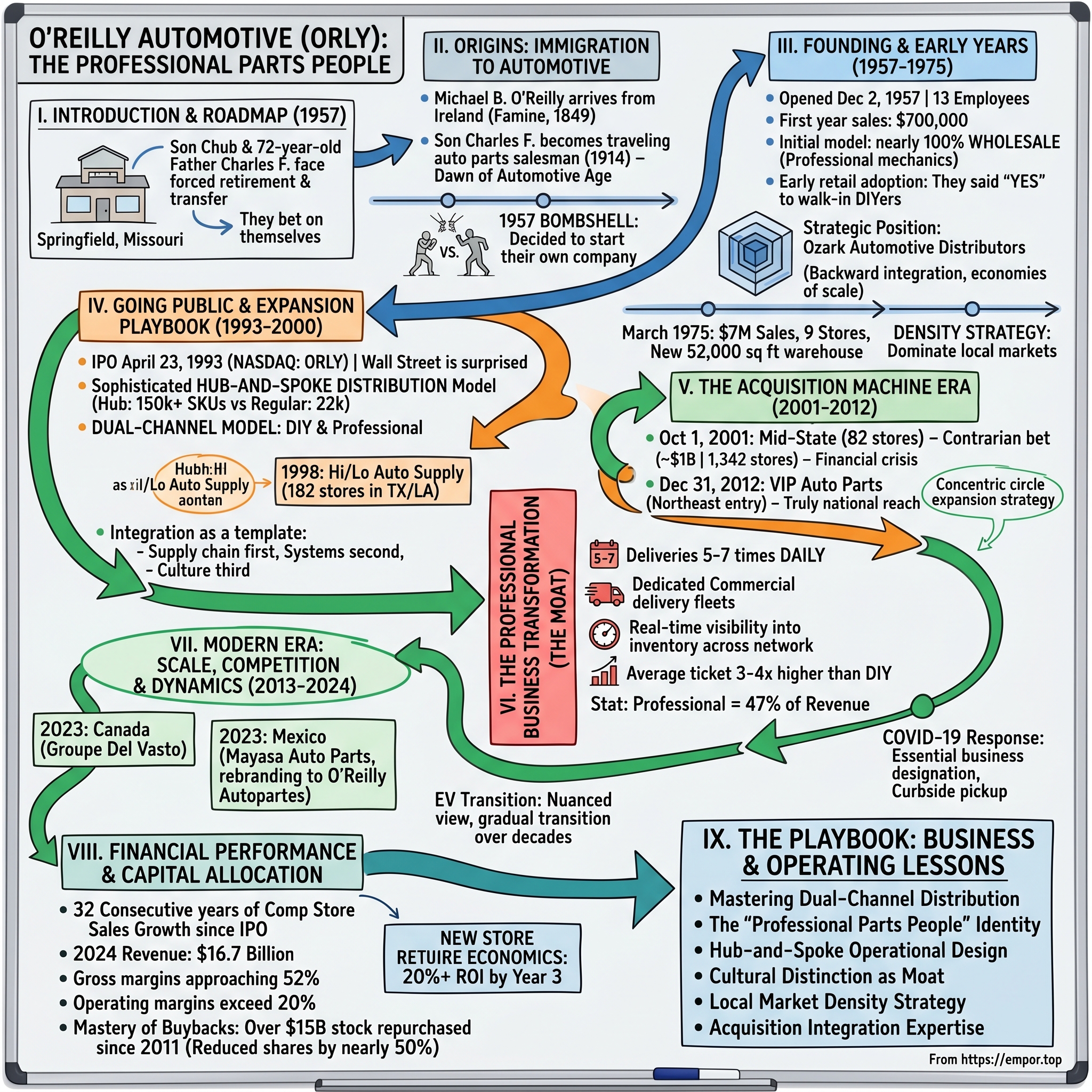
O'Reilly Automotive opened for business on December 2, 1957, with one store and 13 employees at 403 Sherman in Springfield, with 11 employee-owners joining the father and son.7 The setup tells you a lot about what kind of company it was going to be. This was not a retail concept dreamed up by a merchandiser. It was a wholesale parts house started by men who knew which manufacturers made which parts, which garages bought them, and which local jobbers resold them. In 1958, its first full year, the business sold $700,000 worth of parts.7
The father's role was relationships. C.F. O'Reilly had been buying from manufacturers for more than four decades, and a new parts house lives or dies on whether suppliers will extend it credit and ship it stock. The son's role was operations: running the counter, the warehouse and the people. That division of labor, one partner facing suppliers and one facing the store, would echo through the company's history. O'Reilly has always been, at heart, a buying operation married to a service operation.
The early years established a second idea that still defines the company. Most parts houses of that era served either the professional trade, meaning garages, dealers and service stations, or the growing number of car owners who wanted to fix their own vehicles. O'Reilly started on the wholesale side. Over time, it learned to serve both. Its history describes the formal articulation of a "dual-market" strategy in 1978, aimed at both the "do-it-for-me" professional market and the "do-it-yourself" retail market.7 The insight was that both customers need the same physical thing, a part in stock nearby, and that the inventory and logistics required to serve one could, with the right store design and staffing, serve the other.
That idea sounds obvious now. It was not at the time, and it is not entirely obvious even today. Professional customers want speed, credit accounts, delivery and staff who understand repair work. DIY customers want convenience, advice, competitive shelf prices and a store that feels approachable. One customer group buys more often but demands lower prices. The other pays more per item but comes in less frequently. Running both through one building is like running a wholesale club and a convenience store from the same shelves. O'Reilly's founders bet that the shared inventory was worth the complexity.
The other early decision mattered more than it looked. The founders formed a distribution business to supply independent jobbers in the region, the small parts wholesalers that serviced local garages. By 1961, the combined volume of the stores and that jobber-supply division had reached $1.3 million.7 The division, which became known as Ozark Automotive Distributors, gave the family something its single counter could not: experience buying directly from manufacturers in volume and moving stock out to many points of sale. In other words, before O'Reilly was a chain, it was already a distributor.
By 1975, sales had reached about $7 million, and the company had nine stores, all in southwest Missouri.7 That year it built a 52,000-square-foot warehouse at 233 South Patterson in Springfield for the O'Reilly and Ozark operations.7 The family also reorganized: Chub became president of Ozark, his son Charlie ran the store division, David O'Reilly took over warehousing while overseeing finance and computers, and Larry O'Reilly led sales and acquisitions.7 Those role names are worth noticing. One brother ran the warehouse and the computers. Another ran acquisitions. The company's two great levers for the next fifty years, logistics and buying other chains, were assigned to family members before the business had ten stores.
The warehouse was the crucial asset. A small parts store faces a brutal arithmetic problem. There are tens of thousands of possible parts across the makes, models and years of cars on the road, and any single store can stock only a fraction of them. Stock too little and the mechanic goes elsewhere. Stock too much and the cash sits on a shelf for years. A central warehouse changes that arithmetic, because it lets each store carry the fast-moving parts while drawing slower-moving items from a shared pool overnight. Nine stores feeding off a 52,000-square-foot warehouse is, in miniature, the entire O'Reilly model.
David O'Reilly, who would later chair the company and remains on its board as executive vice chairman, became the family member most associated with that systems-and-warehousing side.8 It is fitting that the generation that built the warehouse also built the company's later identity as a logistics business wearing a retail storefront.
For investors, the founding chapter is not nostalgia. It explains why O'Reilly thinks about growth the way it does. The company's first advantage was not a brand, a patent or a low price. It was knowledge of suppliers and mechanics, applied through a warehouse that made local stores look bigger than they were. That was a powerful model in southwest Missouri, where the family knew every garage owner by name. The open question by the late 1970s was whether a service model built on local relationships could travel to Texas, Georgia or Minnesota, where nobody had heard of the O'Reillys at all.
III. From Springfield to the National Map
On April 22, 1993, O'Reilly priced an initial public offering of 2,333,332 shares at $17.50 each.7 The stock began trading on Nasdaq the next day under the ticker ORLY and closed its first session at $19.28.7 By then the company had already passed its 100th store, opened in Barling, Arkansas, in 1989.7 But a hundred-odd stores in the Ozarks was still a regional business. The listing gave the family something it had never had before: access to public-market capital for a longer, faster expansion run, and a currency, its own stock, that could be used to buy other chains.
The bet O'Reilly made with that currency arrived on January 30, 1998, when it completed the acquisition of Hi/LO Auto Supply.7 Hi/LO brought 182 stores in Texas and Louisiana and a distribution center in Houston, and it nearly doubled O'Reilly in size overnight.7 For a company that had grown store by store for forty years, this was a different kind of risk. Hi/LO was a retail-oriented chain, not a dual-market operator, and O'Reilly would have to retrain staff, rebuild the professional business and plug the Houston distribution center into its own systems.
What made the deal strategically interesting was not just the store count. It was the distribution center. O'Reilly's model depended on having a warehouse close enough to resupply stores daily. Buying stores without a warehouse would have left them starved of inventory; building a warehouse in a market without stores would have meant years of losses waiting for volume. Hi/LO delivered both at once. That became a pattern.
The next large step came on October 1, 2001, when O'Reilly acquired Mid-State Automotive Distributors, adding 82 stores in Alabama, Florida, Georgia, Indiana and Kentucky, along with two distribution centers in Nashville and Knoxville, Tennessee.7 On May 31, 2005, it bought Midwest Auto Parts Distributors, adding 72 stores and distribution centers in Minneapolis and Billings, Montana, and taking the company into six more states for a total of 25.7 Each time, the logic was the same: buy enough local density and enough warehouse capacity to make the O'Reilly service model work in a new region, then fill in the map with new stores.
It helps to picture what that service model looks like on an ordinary weekday. A mechanic in a two-bay shop outside Nashville has a customer's car on the lift. He needs a specific sensor for a twelve-year-old sedan, and the parts store down the road does not have it on the shelf. In a traditional parts business, that is the end of the conversation. The mechanic calls another supplier, or tells the customer the car will be ready tomorrow. In O'Reilly's model, the store checks the system, sees that a larger "hub" store across town has the sensor, and gets it to the shop within hours. If the hub doesn't have it either, the regional distribution center ships it overnight on the regular delivery truck. The local store's shelf is not the limit of what it can sell. It is the front window of a much bigger warehouse.
That hub-and-spoke design is the backbone of the business today. O'Reilly now operates 32 distribution centers and 399 hub stores; its distribution centers typically give stores same-day or overnight access to more than 156,000 stock-keeping units, and more than 95% of its stores receive multiple same-day deliveries, including weekend deliveries of hard-to-find parts.5 Hubs themselves carry around 63,000 SKUs on average, with select hubs stocking up to about 115,000.5 The numbers are large, but the idea is simple: put an enormous catalogue within a few hours of every counter.
The acquisitions kept coming in smaller sizes. Over the next two decades O'Reilly bought regional chains such as VIP in New England, Bond Auto Parts in the Northeast and Bennett Auto Supply in the Southeast, each adding a few dozen stores.7 By the end of 2007, O'Reilly operated 1,830 stores.9 It had become one of the best-run regional chains in the country. It had not yet become a national one.
There is a subtle point here that matters for anyone trying to understand O'Reilly's financial statements. The company reports one operating segment.5 Geography, customer type and store vintage are useful lenses for understanding the business, but they are not separately reported businesses with their own profit lines. When analysts talk about "the professional business" or "Mexico," they are usually piecing together sales disclosures, not reading a segment report. That limits how precisely outsiders can measure the returns on any particular expansion move.
What the record does show is a company that learned to integrate. Hi/LO, Mid-State and Midwest were not glamorous deals, but each one added stores and distribution capacity in roughly the right proportions, and each was followed by years of steady organic expansion. The pattern suggests that management understood its own constraint: the binding limit on growth was not money or real estate, but the ability to extend a dense, reliable supply chain into new territory.
Then came a different kind of deal. In 2008, O'Reilly agreed to buy a chain nearly as large as itself, headquartered half a continent away, built around a different customer, and carrying the stain of an accounting scandal. If the earlier deals tested whether the O'Reilly model could travel, this one tested whether it could survive a much heavier load.
IV. The CSK Deal: Scale, Synergies and Baggage
On the morning of April 1, 2008, O'Reilly's chief executive Greg Henslee got on a conference call with analysts to explain why his company was about to swallow a chain based in Phoenix. "This transaction is strategically compelling," he told them.10 O'Reilly had agreed to acquire CSK Auto Corporation in a deal valued at about $1.0 billion, including roughly $500 million of CSK's existing debt.9 CSK shareholders would receive $11.00 of O'Reilly stock, subject to a collar, plus $1.00 in cash for each share.9
CSK was a big, tired regional empire. It operated 1,349 stores in 22 states under four banners: Checker Auto Parts in the Southwest and Rockies, Schuck's Auto Supply in the Pacific Northwest, Kragen Auto Parts in California and Murray's Discount Auto Stores in the Upper Midwest.9 O'Reilly, with 1,830 stores concentrated in the Midwest and Southeast, would roughly double its store count to about 3,200 and become the third-largest auto-parts retailer in the United States, with combined 2007 pro forma revenue of about $4.4 billion.9 The geographic fit was almost perfect, because the two maps barely overlapped.
The customer fit was not. On the same call, Henslee noted that CSK reported only about 18% of its sales from "do it for me" professional customers.10 O'Reilly's own stores ran closer to a 50/50 split, and Henslee said that balance was the ideal he wanted the CSK stores to reach over time.10 That gap was both the risk and the prize. CSK's stores had been designed and stocked for walk-in DIY shoppers, and its distribution system had been built to match. Converting them to serve repair shops meant changing what was on the shelves, who stood behind the counter, how often trucks arrived and how quickly a part could reach a waiting mechanic.
O'Reilly said it expected cost savings of about $100 million a year beginning in fiscal 2010, mostly from better buying terms with suppliers and from streamlining CSK's overhead.9 Management also said the deal would be modestly accretive to earnings in fiscal 2009.9 To finance it, the company arranged a $1.2 billion asset-based revolving credit facility with Bank of America and Lehman Brothers, a lender that collapsed within months of closing.9
How should an investor judge the price? Measured against the stores acquired, O'Reilly paid roughly $740,000 per CSK location including debt, a fraction of what it would cost to build, stock and staff that many stores from scratch in the West. Measured against the promised savings, $100 million a year on a $1 billion outlay would have been a 10% pre-tax return before any sales growth at all. Those are back-of-the-envelope figures, and they depend on the synergies actually arriving. But they show why management could plausibly argue it was buying an undervalued platform rather than a collection of earnings. CSK was not a highly profitable business at the time, which is precisely why it was cheap. The test was never the entry multiple. It was whether O'Reilly could make CSK's stores perform like its own.
And then there was the baggage. Between 2001 and 2006, according to the Department of Justice, certain former CSK employees, including senior executives, conspired to manipulate the company's earnings.11 The scheme concealed about $52 million in uncollectible receivables across fiscal 2002 to 2004, and in July 2005 employees billed vendors for roughly $30 million in allowances, about $15 million of which they knew was not owed.11 Three former executives, including the former chief financial officer, later pleaded guilty.11 In 2011, CSK entered a two-year non-prosecution agreement and agreed to pay a $20.9 million penalty; O'Reilly became party to that agreement through its ownership of CSK.11 The Justice Department explicitly cited O'Reilly's acquisition after the conduct was discovered, together with voluntary disclosure, cooperation and remediation, among its reasons for not prosecuting.11
The point deserves precision. The misconduct was CSK's, carried out by CSK people before O'Reilly owned the company. But the episode is part of O'Reilly's record in two ways. It shows that the company was willing to buy a business whose historical numbers could not be fully trusted, which is a bold call for an acquirer that prides itself on discipline. And it means any simple before-and-after comparison of CSK's profitability is suspect, because the "before" was partly fiction. The DOJ penalty itself was small relative to the combined company. The more meaningful cost was the uncertainty about what O'Reilly was really buying.
The deal closed on July 11, 2008, just as the financial crisis was gathering force.12 Each CSK share converted into 0.4285 of an O'Reilly share and $1.00 in cash, the bottom end of the collar, reflecting O'Reilly's own falling share price.12 What followed was less a merger than a renovation.
The heaviest lifting happened in distribution. CSK had run its business through just four main distribution centers, replenished stores weekly and was set up to pick goods in bulk.13 O'Reilly's warehouses picked individual pieces and replenished stores daily.13 "It was a given from the start that O'Reilly would convert the CSK network over to its distribution model," DC Velocity reported in 2009.13 The man running that conversion was Greg Johnson, then senior vice president of distribution operations, who put the logic bluntly: "We cannot grow the wholesale model to its fullest extent until distribution is in place."13 O'Reilly added distribution centers in Seattle, Denver, Salt Lake City and Moreno Valley, California, closed CSK's Minnesota facility, moved its Dixon, California operation into a larger site in Stockton and automated CSK's Michigan and Arizona warehouses.13 Johnson noted that before CSK, O'Reilly had been on pace to open a new distribution center about every eighteen months.13 The integration compressed several years of that pace into one.
At the store level, the work was just as detailed. Conversion of CSK stores to O'Reilly systems and branding began in October 2008 and was scheduled to continue into 2011.12 By the end of 2009, O'Reilly had converted 405 CSK stores, merged 41 into existing O'Reilly locations, closed 13 and opened five new stores in CSK's historic markets.12 For converted stores, the goal was same-day or overnight access to an average of 118,000 SKUs.12 That last number is the real story of the deal. CSK's shoppers had been served by stores that were, in effect, islands. O'Reilly's job was to connect each island to a supply chain.
Did it work? The fairest reading is that the integration mattered more than the price, and that the integration largely succeeded. From the combined company's pro forma base of about $4.4 billion in 2007, O'Reilly's revenue roughly quadrupled to about $17.8 billion by 2025, and its operating margin settled in the high teens and low twenties, levels that would have been unthinkable for CSK on its own.95 But that improvement cannot be cleanly attributed to CSK, because O'Reilly also opened thousands of new stores and benefited from industry tailwinds during the same period. What can be said is that the company absorbed a chain nearly its own size, rebuilt its distribution network and emerged with a national footprint and no repeat of the kind of acquisition stumble that sinks retailers.
There is also a personnel thread worth noticing. Greg Johnson, the distribution executive who rebuilt CSK's warehouses, became chief executive in 2018.7 Brad Beckham, who succeeded Johnson in 2024 when Johnson retired to the board, was promoted from inside the company as well.7 The leadership bench is homegrown and operationally trained. That is a strength in running the network, and a reason to ask whether that bench has ever had to integrate something bigger than CSK.
It hasn't. Since 2008, O'Reilly's acquisitions have been small: regional chains of a few dozen stores, plus small entries into Mexico and Canada.7 Whatever lessons the company learned about converting acquired stores into a functioning network were learned on CSK and have not been tested at that scale since. A NAPA-sized deal would be bigger, more complex and more overlapping than anything the current management team has run. Before getting there, though, it is worth understanding exactly what the network does for a customer, because that is what any acquisition would ultimately have to protect.
V. The Parts Have to Be There Before the Mechanic Calls
It is 10:30 on a Tuesday morning at an independent repair shop. A minivan is on the lift with its front wheel off, the old wheel-hub assembly sitting on the bench. The technician has two more cars waiting. Every hour that van occupies the lift is an hour the shop cannot bill for something else. He opens an ordering screen, types in the vehicle, and finds the part. The nearest O'Reilly store doesn't have it. But a hub store twenty minutes away does, and the van will have its part before lunch.
That ordinary scene is the whole business. The repair shop isn't buying a wheel hub. It is buying the lift time it gets back. The cheapest part delivered tomorrow is worth less than a slightly more expensive part delivered in two hours, because the shop's real constraint is not parts cost. It is bay capacity and labor hours. Whoever reliably gets the part there fastest earns the next call.
The transaction itself is simple. A customer, whether a DIY driver at the counter or a shop on the phone or a web portal, identifies the vehicle and the part. The store checks availability in its own inventory, then in nearby hubs and the regional distribution center. Then O'Reilly either sells the part across the counter or dispatches it to the professional account, usually on its own trucks.5 Most customers take possession at checkout or through same-day delivery, and the company describes no subscription contracts or term commitments.5 Every sale has to be won again.
That is the first thing to understand about O'Reilly's two customer groups. In 2025, their share of sales remained roughly even.5 Professional sales carry a lower gross margin than DIY sales, according to the company, because shops buy in volume and negotiate prices.5 But professional accounts can raise volume and visit frequency, and they spread the fixed costs of the stores, inventory and delivery fleet across more transactions.5 To win them, O'Reilly employs about 825 full-time sales staff whose only job is calling on and servicing professional customers.5
It is tempting to rank one customer group above the other. DIY carries the better gross margin; professional carries the growth. The truth is that the two depend on each other. The DIY customer helps pay for a store's rent and inventory, and the professional customer uses that same inventory more intensively. A store with only DIY traffic leaves inventory idle on weekdays. A store with only professional traffic would earn thin margins on parts that had to be stocked anyway. The dual-market strategy is, in modern terms, a way to raise the utilization of an expensive asset.
The asset is the network, and it is expensive. O'Reilly's inventory turns slowly by retail standards: in 2025, its inventory sat for about 243 days on average before being sold, which reflects the long tail of parts a parts store has to carry to be useful.5 A grocery store turns its stock in weeks. A parts store holds a sensor for a twelve-year-old sedan for months because the one day a mechanic needs it, the store that has it wins the account. That is the cost of availability.
Here the financial model gets interesting. O'Reilly pays its suppliers, on average, about 301 days after receiving goods, while collecting from its own customers in about 11.5 Add up those three numbers, receivables plus inventory minus payables, and you get a cash conversion cycle of about minus 47 days in 2025.5 In plain English, O'Reilly's suppliers finance its entire inventory and then some. The company sells the part and collects the cash, on average, well before it has to pay for it. That negative cycle is an extraordinary piece of financial engineering for a retailer that holds eight months of stock, and it has been built over a decade: in 2014, the cycle was about 25 days positive.5
How did that happen? Mostly through supplier financing programs and extended payment terms that O'Reilly's scale has allowed it to negotiate. A small parts store asking for 300-day payment terms would be laughed out of the room. A buyer purchasing from more than 655 suppliers, with the five largest accounting for about 23% of its purchases and the single largest about 8%, can negotiate from a position of strength.5 O'Reilly says it has no long-term material purchase commitments and has not had difficulty finding alternative supply sources.5
Those terms are a real advantage, but they come with a catch. Supplier financing does not eliminate the need to buy inventory; it just shifts the timing. Every new store needs a fresh load of stock, and as each new location's inventory is put in place, the company relies on its suppliers' willingness to keep extending terms. In 2025, for example, inventory consumed about $605 million of cash while accounts payable supplied about $576 million.5 The two roughly offset. If supplier terms ever tightened, because of rising interest rates or supplier stress, O'Reilly's cash flow would feel it quickly. The negative cash cycle is a privilege earned through scale, not a law of nature.
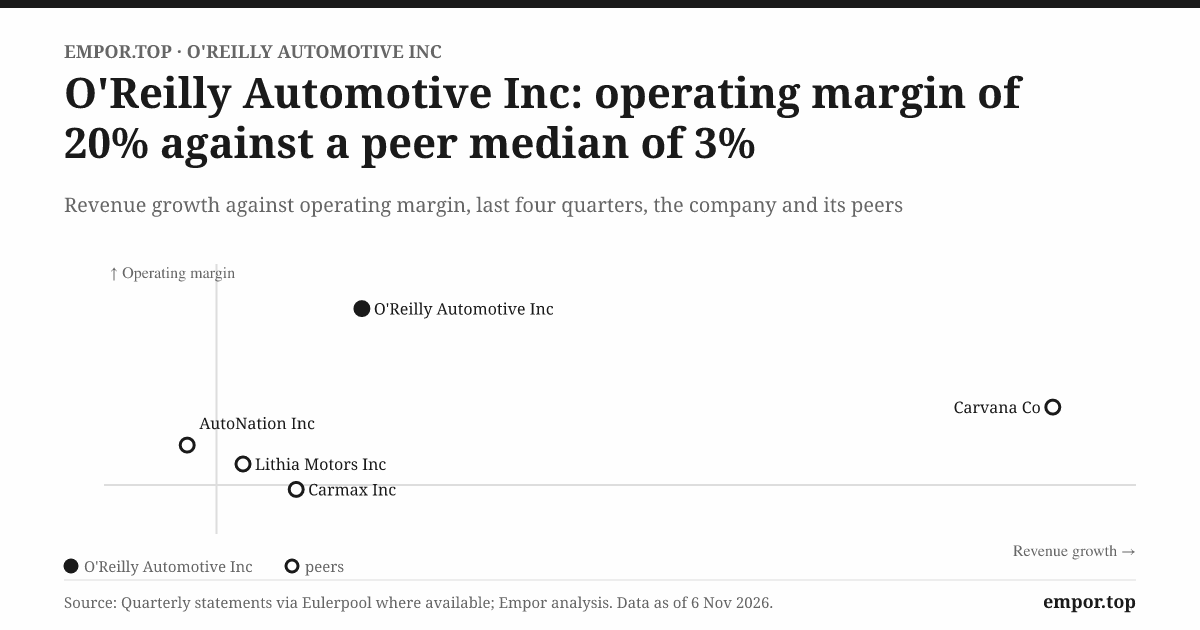
This is where the outcome of all that buying and distribution shows up. In 2025, O'Reilly kept about 51.6 cents of gross profit from every dollar of sales, after paying for the parts and the distribution costs of getting them there.5 After paying for store staff, rent, trucks and everything else, it kept about 19.5 cents as operating profit.5 For a retailer, those are exceptional numbers. They are the clearest evidence that O'Reilly's network produces economics most retailers can only envy.
But a sophisticated investor has to ask what kind of advantage those margins reflect. Is it customer lock-in, the kind that would survive a rival opening a better-stocked store across the street? Or is it superior execution, which is valuable but must be renewed every day?
The evidence leans toward execution and scale rather than lock-in. Start with the customers. O'Reilly reports no customer above 10% of revenue, which means no single shop or chain can hold it hostage.5 But it also publishes no customer retention rates, no figures on how many professional accounts it loses each year, and no data on how often a shop splits its orders among several suppliers. Those are the numbers that would prove or disprove lock-in, and the company does not disclose them. The anecdotal reality of the repair business is that most shops use more than one parts supplier, calling whoever has the part fastest. That is exactly why speed and availability matter so much, and why they are not the same as switching costs. A shop that calls O'Reilly first today because O'Reilly is fastest will call someone else first tomorrow if someone else gets faster.
Seen through Michael Porter's lens of competitive forces, the picture is mixed. The threat of new entrants is low at national scale, because replicating 32 distribution centers, roughly 400 hubs and thousands of stores would take a decade and billions of dollars. Supplier power is limited, because O'Reilly buys from hundreds of vendors. Buyer power is fragmented across millions of DIY shoppers and tens of thousands of shops. The threat of substitutes, from online retailers to dealer parts departments, is real but bounded by the urgency of most repairs. And rivalry among existing competitors is intense, because AutoZone, NAPA and Advance all chase the same professional customer with similar promises.
Hamilton Helmer's 7 Powers framework sharpens the point. O'Reilly's clearest power is scale economies: the fixed cost of a distribution center and its trucks is spread over more stores and more sales than most rivals can match in each region. A second is process power, the accumulated operating know-how in how stores are stocked, how hubs are positioned and how deliveries are routed, which took decades to build and is hard to copy quickly. What O'Reilly does not clearly have is switching costs or network effects in the strict sense. A mechanic does not become more locked in as other mechanics use O'Reilly. And while its brand is well known, there is little evidence that a shop will pay more for an O'Reilly part than for an identical one available faster from a rival. The full competitive war-game comes later in this story; the essential verdict belongs here. O'Reilly's moat is real, but it is a moat of capability, not captivity.
That distinction matters because a capability moat depends on continuous investment and good execution. It can widen when a competitor stumbles, as Advance Auto Parts did in recent years, and it can narrow if a rival invests more aggressively. The best way to test whether O'Reilly's service is actually winning is not to read its descriptions of its own culture. It is to watch professional comparable-store sales and professional transaction counts over time. If shops are choosing O'Reilly more often, those numbers rise even when the overall market is flat. If they fall while the market grows, the moat is eroding. The service advantage is a plausible mechanism, strongly supported by margins, but not a fully quantified moat.
There is one more nuance in the margin story. O'Reilly's professional business is the faster-growing half, and it carries the lower gross margin. Every extra dollar of professional sales nudges overall gross margin down, unless purchasing and distribution gains offset it. That tension is the subject of the next chapter, because it is where O'Reilly's strategy meets its arithmetic.
VI. The Professional Channel Meets Its Margin Trade-Off
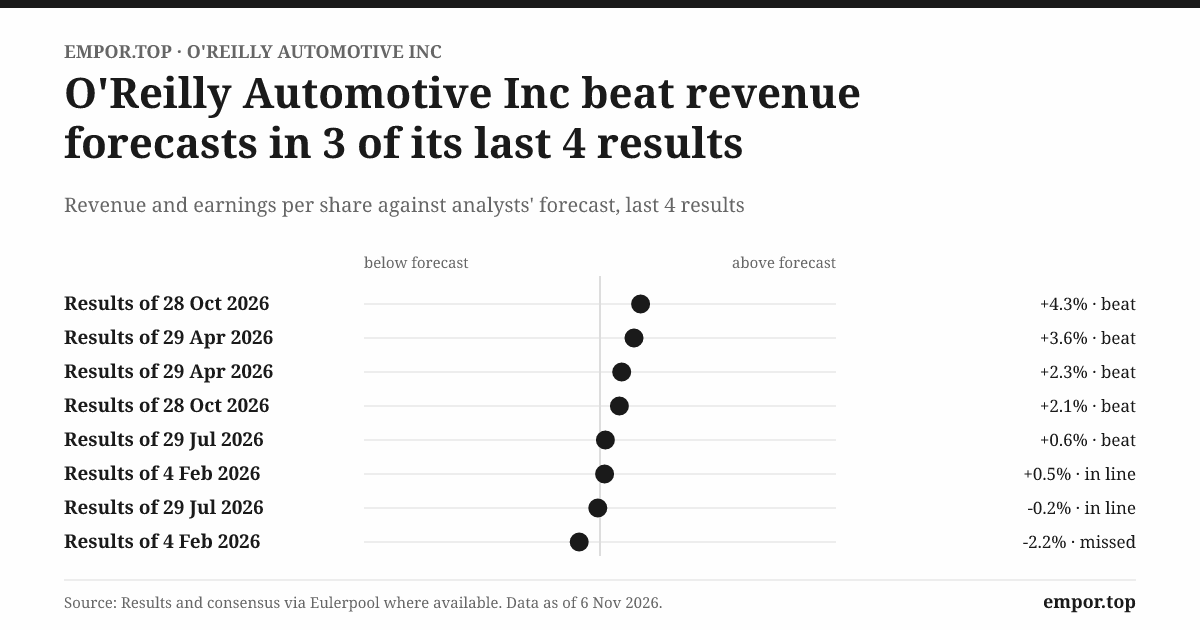
On April 25, 2024, O'Reilly's management team had an awkward quarter to explain. Comparable-store sales had grown 3.4% in the first quarter, a respectable figure for most retailers but a sharp slowdown from the 10.8% the company had posted a year earlier.14 Earnings per share came in slightly below what analysts expected, and the company's full-year earnings guidance landed below the consensus forecast.15 Shares fell more than 3% after the report.15
Management's explanation on the call was layered. The quarter had been choppy, they said, with harsh winter weather in January, delayed tax refunds in February and cool, wet conditions in March that pressured DIY demand.14 More importantly, professional sales were facing a brutal comparison: a year earlier, professional comps had grown more than 20%.14 Against that hurdle, professional sales still grew at a mid-single-digit rate, while DIY grew at a low-single-digit rate, and management described the professional business as "the larger driver of our results."14 Reuters, reporting on the same quarter, pointed to a different pressure: investments in store expansion had driven up expenses.15
Both explanations were accurate, and together they reveal how the business works. Weather is a real driver in auto parts: cold snaps kill batteries, heat waves kill them too, and rain delays the spring tune-ups that drive DIY traffic. But weather is also the explanation every retailer reaches for in a soft quarter, and it is worth noticing that O'Reilly's own guidance for the year stayed at 3% to 5% comparable growth, suggesting management did not see the slowdown as structural.14 The more revealing data point was the professional moderation. A 20%-plus comparison does not repeat itself. Some of that earlier surge reflected pandemic-era conditions, when used-car prices soared, people kept older vehicles longer and shops were swamped with deferred repairs. As those conditions normalized, the professional channel was always going to slow.
The trade-off between the two channels is clear: professional sales bring volume and frequency, while DIY sales carry higher margins. The question is whether purchasing scale and distribution efficiency can offset the pressure on gross margin.
So far, they mostly have. In 2025, gross margin rose to 51.6% from 51.2% in 2024, even as the professional share grew, because better acquisition costs and distribution efficiency more than offset the mix.5 That is a meaningful result. It suggests O'Reilly's buying power was still increasing faster than its mix was diluting margins. But it is one year, and the offset depends on factors, such as supplier terms and tariff pass-through, that O'Reilly does not fully control.
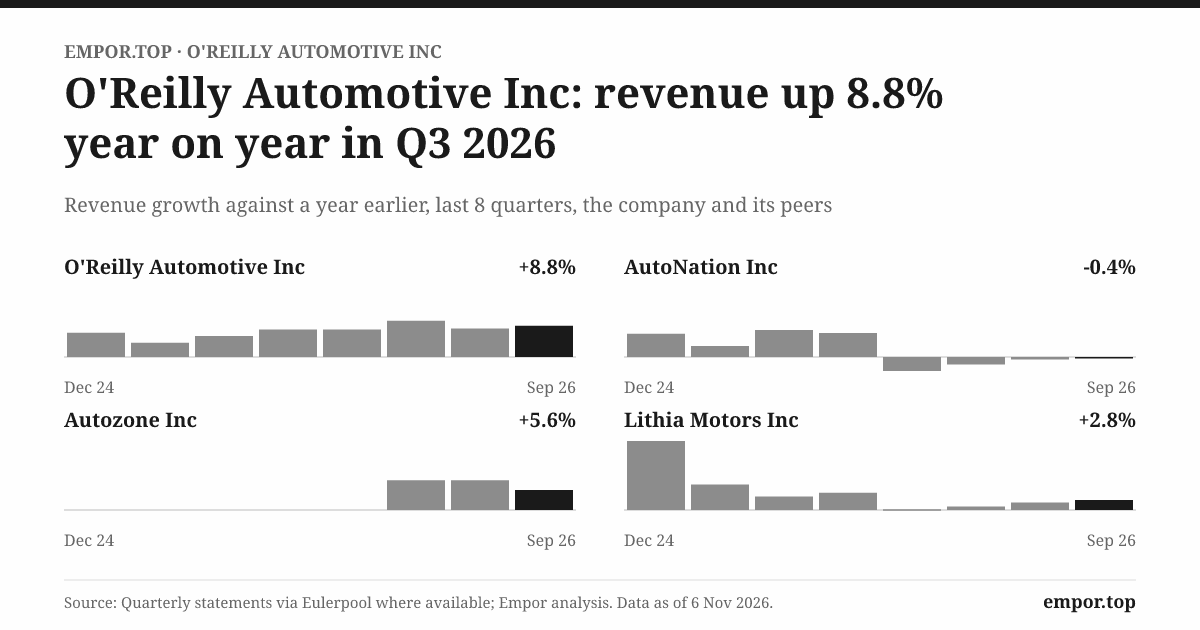
Fast forward to the second quarter of 2026, and the tone had changed completely. Comparable-store sales grew 6.0%, on top of 4.1% a year earlier.16 Total sales rose 8% to about $4.9 billion, and diluted earnings per share rose 10%.16 On the call, management said professional comparable sales had grown "right at 10%," the fourth consecutive quarter of double-digit professional comps, and that professional ticket counts, meaning the number of transactions, had grown at a mid-single-digit rate.4 DIY comparable sales grew at a low-single-digit rate, but that growth came entirely from bigger average tickets; DIY transaction counts actually fell at a low-single-digit rate.4
That sales bridge deserves a careful read, because it tells three different stories at once. The first is the encouraging one: shops are placing more orders with O'Reilly, not just paying more per order. Rising professional transaction counts offer the clearest evidence of share gains. The second story is about price. Management said same-SKU inflation, meaning the price increase on identical items, ran about 5.5% across the business in the quarter.4 A good chunk of the higher average ticket in both channels was simply higher prices, partly reflecting tariffs and supplier cost increases being passed through. Management expected that inflation benefit to moderate to 1% to 2% in the second half of 2026.4 The third story is the warning: fewer DIY customers came through the doors. Average-ticket growth disguised a shrinking DIY transaction base.
Why would DIY traffic fall while professional orders rose? Several explanations fit. Higher prices may have pushed some DIY customers to defer maintenance, or to buy online. Consumers under financial pressure might have handed more repairs to shops rather than doing them themselves, or delayed them altogether. Management noted that June had been softer than expected because demand in certain hot-weather categories did not ramp normally.4 Without more granular data, it is impossible to separate these effects. What can be said is that O'Reilly's 2026 growth was driven by professional customers and by price, not by more DIY customers.
Gross margin in the second quarter held at 51.4%, flat with a year earlier, and operating margin held at 20.2%.16 In other words, a faster-growing professional business, which on its own would push margins down, was offset by pricing and purchasing gains. That is a solid result, but it rests partly on an inflation tailwind management itself expects to fade.
Analysts on the July call pushed on exactly that point. JPMorgan's Christopher Horvers asked about the DIY slowdown between the first and second quarters and the risk that consumers would defer repairs in the second half.4 Wells Fargo's Zach Fadem asked whether recent expense growth was a new run rate, and chief financial officer Jeremy Fletcher cautioned against extrapolating it.4 Beckham pushed back on the idea that industry demand would slow.4 The tone was confident. But confidence is not evidence, and the key evidence is still to come.
So what should an investor actually watch? Three things. First, whether professional transaction counts keep rising once same-SKU inflation fades; if they do, O'Reilly is taking share, and if they don't, the 2026 professional surge was mostly price. Second, whether DIY transaction counts stabilize. And third, whether O'Reilly can keep its service promise, multiple daily deliveries and hub availability, as it adds roughly 230 new stores a year, because the professional business depends on that promise more than on anything else.5 Professional growth is strategically valuable. It is not free. And the question of whether it reflects share gains, price increases or a broad repair market tailwind brings the story to the larger debate about O'Reilly's overall growth rate.
VII. Growth Slows, Then the Map Expands Again
In January 2024, O'Reilly entered Canada for the first time. It acquired Groupe Del Vasto, a Montreal-based parts distributor, bringing 23 stores and two distribution centers in Canada.7 The stores were later rebranded under the Parts City Pièces d'Auto banner.7 It was a modest deal, small enough that it barely registered in the company's financial statements, but it signaled that O'Reilly was looking beyond its home market for growth. The question was why it needed to.
The answer lies in a pattern visible across a decade of results. From 2015 to 2025, O'Reilly's revenue compounded at about 8.4% a year, and its net profit at about 10.5%.5 Those are excellent numbers for a mature retailer, and the profit line grew faster than sales because margins expanded and, crucially, because a lower U.S. corporate tax rate after 2017 cut O'Reilly's tax bill from more than 36% of pretax profit to about 22%.5 But look at the most recent three years, from 2022 to 2025, and the pace slowed: revenue grew about 7.3% a year and net profit about 5.3%.5 In 2025 alone, revenue grew 6.4% to about $17.8 billion, and net profit grew 6.3%.5
Why the slowdown? Part of it is simple arithmetic about the pandemic years. In 2020 and 2021, O'Reilly's revenue grew about 14% a year, extraordinary for a company of its size.5 People drove less in the early pandemic but kept older cars longer, did more of their own repairs and had stimulus money to spend. Used-vehicle prices soared, which encouraged owners to maintain rather than replace their vehicles. All of that pulled demand forward. When conditions normalized, growth inevitably slowed relative to that inflated base. Measured over a five-year window that includes the surge, revenue grew about 8.9% a year, which looks healthy; measured over the three years after it, the business looks more ordinary.5
The honest verdict is that O'Reilly remains a growing business, but the most recent comparison deserves scrutiny rather than easy extrapolation. A business growing net profit at 5% a year is a different investment from one growing it at 10%, especially at the valuation the market currently places on O'Reilly. The early 2026 numbers suggest some reacceleration: revenue grew about 10% in the first quarter and 8% in the second, and management raised its full-year comparable-sales outlook to 4% to 6%.16 But part of that improvement came from price inflation that management itself expects to fade, so it is too early to declare the slowdown over.
To understand where O'Reilly's growth actually comes from, it helps to separate two engines. The first is comparable-store sales, meaning sales growth at stores open for more than a year. In 2025, comparable sales grew 4.7%.5 The second is new stores. O'Reilly opened 207 net new stores in 2025, and it plans 225 to 235 in 2026.5 Those new stores add revenue immediately, though they typically take years to reach full maturity. Combine a mid-single-digit comparable-sales rate with store growth of around 3% a year, and you get the roughly 6% to 8% revenue growth O'Reilly has delivered recently. That is the realistic baseline. The company's long-run double-digit profit growth was assisted by a tax cut and by enormous share buybacks, neither of which is a repeatable operating driver.
Store openings remain the main visible lever, and management has leaned on them hard. At the September 2026 analyst day, executives described the 2026 opening pace as the highest in decades and detailed new distribution capacity, including expansion of the Lakeland, Florida distribution center and a new facility under construction in Fort Worth.6 Every new distribution center lets O'Reilly push stores into areas it couldn't previously serve well. But every new store also adds inventory, rent and staffing costs before it reaches maturity, which is why capital spending has risen from about $1.0 billion in 2023 and 2024 to about $1.17 billion in 2025, with guidance of $1.3 billion to $1.4 billion for 2026.516
Now to the international story, which deserves proportion rather than excitement. O'Reilly entered Mexico in November 2019 by acquiring Mayasa, a distributor that brought 21 stores and six distribution centers.7 The Canadian move followed in early 2024. By the end of 2025, those markets accounted for about 2% of its total store count.5 By mid-2026, those numbers had grown to 126 and 28.16 At the analyst day, Beckham estimated the Mexican addressable market at about $15 billion and said there was "probably a potential of a terminal number well over 1,000" stores in Mexico.6
That is a long-term ambition, not a current earnings engine. A thousand stores in Mexico would be meaningful, but at the current pace of roughly 20 to 25 openings a year, reaching that number would take decades. There is a reason for caution beyond pace. AutoZone has operated in Mexico for many years and had 883 stores there by the end of its 2025 fiscal year, giving it a large head start.17 O'Reilly is entering a market where a well-funded American rival already has scale. Canada is even smaller, with plans for only a handful of new stores a year.6
Foreign expansion also brings currency exposure. O'Reilly's Mexican and Canadian operations earn in pesos and Canadian dollars, so their contribution in U.S. dollars swings with exchange rates. Management estimated that a 10% adverse move in exchange rates would reduce the value of its net assets by about $46 million in Mexico and $16 million in Canada, and that a 10% shift in average rates would not have materially affected operating results.5 For now, the exposure is limited. It will grow as the international business does.
For investors, the proof points are clear. Watch comparable sales split between professional and DIY, to see whether growth reflects share gains or price. Watch net new store openings, to see whether the company is hitting its targets. And watch whether stores in newer markets, including Mexico, mature at attractive returns, because O'Reilly does not report store-level returns by geography. If the company can sustain mid-single-digit comps on top of 3% to 4% store growth, it can keep compounding at a healthy rate without a big acquisition. If comps fade toward low single digits as inflation eases, the pressure to find growth elsewhere will rise. That is where the question of capital allocation, and of NAPA, comes in.
VIII. The Buyback Machine Meets the NAPA Question
Every quarter, O'Reilly's finance team makes the same quiet decision. Once the stores are stocked, the trucks are bought and the new distribution centers are funded, what should happen to the cash left over? For most of the past fifteen years, the answer has been the same: buy back stock. O'Reilly pays no dividend and has not paid one in any year of the past decade.5 Instead, since its repurchase program began in 2011, it had spent about $27.8 billion buying its own shares through late February 2026.5
In 2025 alone, O'Reilly repurchased about $2.1 billion of stock, after $2.08 billion in 2024.5 In the same year, it spent about $1.17 billion on capital investment in stores and distribution, and generated about $1.6 billion of free cash flow.5 Put those numbers side by side and the tension is plain. The company spent roughly half a billion dollars more on buybacks than it had left after investing in the business. The gap was funded with borrowed money.
That was not a one-year anomaly. Over the twelve years from 2014 to 2025, O'Reilly generated about $26.9 billion of operating cash flow against about $20.0 billion of reported net profit, meaning every dollar of accounting profit turned into about $1.35 of operating cash.5 That is the sign of a high-quality business. Depreciation, a non-cash charge, accounts for much of the difference, and supplier financing of inventory does the rest.5 But operating cash flow is before capital spending. After paying for new stores and warehouses, O'Reilly's cumulative free cash flow over the period was about $19.3 billion.5 Its cash balance barely changed. And its total borrowings, including lease liabilities, rose from about $1.4 billion to about $8.5 billion.5 The simple version of the story is that O'Reilly has spent more on buybacks than its operations produced in spare cash, and has filled the difference with debt.
That has left a striking mark on the balance sheet. O'Reilly's shareholders' equity, the accounting value of what shareholders own after subtracting all liabilities, turned negative in 2021 and stood at about minus $763 million at the end of 2025.5 When a company buys back more stock than its accumulated retained earnings, equity goes below zero. This makes the conventional return on equity meaningless; it shows up as a large negative number that tells you nothing about how well the business performs. The more useful measure is return on invested capital, which compares operating profit after tax to the debt and equity actually funding the business. On that basis, O'Reilly earned about 36% in 2025, down from a peak of about 43% in 2022 and 2023, but still exceptional.5
The buyback strategy has a logic. If a business earns returns that high, and the stock is priced reasonably, buying it back can be an excellent use of cash. Fewer shares mean each remaining share owns more of the earnings. O'Reilly's basic weighted share count fell from about 915 million in 2023 to about 856 million in 2025.5 That shrinkage is a large part of why earnings per share have grown faster than net profit over the past decade.
But a buyback is only as good as the price paid. In the second quarter of 2026, O'Reilly repurchased about 16.7 million shares at an average of $90.40.16 With the stock trading at about 28.5 times earnings, well above its five-year median of about 24.4 times, each dollar of buyback now purchases fewer dollars of earnings than it did a few years ago.5 The earnings yield on the repurchases, the inverse of the P/E, is about 3.5%, which is barely above the roughly 4% the company was paying on its commercial paper at the end of 2025.5 When a company borrows at around 4% to buy its own stock at an earnings yield of 3.5%, the arithmetic becomes thin.
There is an accounting wrinkle in the 2025 cash flow that deserves a clear explanation. Operating cash flow fell to about $2.76 billion in 2025 from about $3.05 billion in 2024.5 Management attributed much of the decline to the timing of payments for transferable federal renewable-energy tax credits.5 O'Reilly buys these credits from renewable-energy developers at a discount and uses them to reduce its own tax bill; the company purchased about $453 million of such credits in 2025.5 In 2024, it had deferred some payments, which flattered that year's cash flow; in 2025, it paid down most of that liability, from $347 million to $18 million.5 So part of the 2025 decline was a timing shift, not a deterioration in the business. That is a fair point. It is also a reminder that cash flow can be shaped by financial decisions that have nothing to do with selling parts. Over the long run, these credits lower the company's tax rate. Year to year, they move cash around.
The first half of 2026 showed both sides of the story. Operating cash flow recovered to about $2.04 billion, capital spending was about $552 million, and free cash flow came to about $1.48 billion.16 O'Reilly spent about $2.43 billion on repurchases in those six months, and bought another $632 million worth of stock in July.16 Once again, buybacks exceeded free cash flow, by nearly a billion dollars in just half a year. Management's guidance for full-year 2026 free cash flow is $1.8 billion to $2.1 billion.16
How is the gap financed? Through debt. At the end of 2025, O'Reilly had about $6.04 billion of debt principal, including $690 million of short-term commercial paper.5 Separately, it carried about $2.47 billion of operating lease liabilities on its stores.5 About $1.94 billion of debt was scheduled to mature in 2026.5 In August 2026, O'Reilly issued $1.6 billion of new senior notes maturing in 2029, 2031 and 2037, with expected ratings of Baa1 from Moody's and BBB from S&P, both with stable outlooks.18 Those ratings sit in the middle of the investment-grade range: comfortable, but not pristine.
Management describes its approach as deliberate. On the second-quarter call, Fletcher said the company's adjusted leverage, measured as debt plus capitalized leases divided by earnings before interest, taxes, depreciation, amortization and rent, had risen to 2.17 times from 2.06 times a year earlier, and that this was "consistent with our intention to prudently approach our optimal leverage target of 2.5 x."416 Under the narrower definitions in its credit agreement, leverage was 1.92 times at the end of 2025 against a covenant maximum of 3.5 times, and fixed-charge coverage was 6.08 times against a minimum of 2.5 times.5 There is real headroom. But the company is openly steering toward higher leverage, not lower, and a 2.5 times target leaves less room to absorb a large debt-funded acquisition without either pausing buybacks or accepting a weaker credit profile.
Which brings the story back to NAPA. The reported price, $10 billion or more, needs to be set against O'Reilly's financial capacity.1 It is more than six times O'Reilly's 2025 free cash flow and about one-seventh of its current market value. It is roughly five times what the company has spent on buybacks in a typical recent year. NAPA's automotive business generated more than $15 billion of sales in 2025, according to Bloomberg.1 That means a $10 billion price would value it at about two-thirds of a dollar per dollar of sales, while the market values O'Reilly itself at about $4.40 of enterprise value per dollar of sales.5 On that crude comparison, NAPA looks cheap. But the comparison is close to meaningless. NAPA's business mix and margins differ from O'Reilly's, and Genuine Parts does not publish standalone automotive earnings that would let outsiders judge the price against profits. Without those earnings, nobody can say whether $10 billion would have been a bargain or an overpayment.
What can be said is how such a deal would change O'Reilly. Integrating NAPA would be a far bigger project than CSK, for several reasons. NAPA's footprint would overlap with O'Reilly's own across much of the country, which means many locations would compete with each other or need to be merged, closed or rebranded, just as 41 CSK stores were folded into O'Reilly locations, but on a far larger scale. And financing $10 billion would almost certainly require pausing buybacks, issuing significant new debt, or both. That would push leverage well above the 2.5 times target, at least temporarily, and could put the company's credit ratings under pressure.
A skeptic would ask why a company that has insisted on organic growth and small tuck-ins would suddenly want a deal this size. One answer is that the market for parts distribution is consolidating, and that whoever controls NAPA's purchasing volume and professional relationships would gain real scale. Another answer is less flattering: if organic growth is slowing and buybacks at today's valuation are yielding less, a big acquisition might look like the easiest way to keep the growth story alive. That is precisely the moment when acquisition discipline matters most.
The record offers some reassurance and some caution. O'Reilly has not made a deal of NAPA's size, but CSK shows the company can integrate a large, troubled chain over several years. On the other hand, Beckham's statement on the July call, that the company had no expectation or intention of executing a large transformative acquisition in the foreseeable future, directly contradicts the idea that a NAPA deal was imminent.4 At the September 2026 analyst day, management emphasized store growth, distribution investment and small tuck-ins, citing an eight-store Mid-Atlantic chain called Salvo as a recent example.6 If those statements are taken at face value, the NAPA reports describe an approach that went nowhere, or never got as far as reported. If they are not, the gap between management's words and its actions would itself become a governance question.
For now, the more pressing issue is closer to home. The company has spent more than its free cash flow on buybacks for several years, financed with steadily rising debt, at a time when its shares trade above their historical valuation. That is a choice, not a necessity, and its wisdom depends on whether the business can keep growing fast enough to justify the price. That is the question the market is now asking.
IX. Analysis & Bear vs. Bull Case
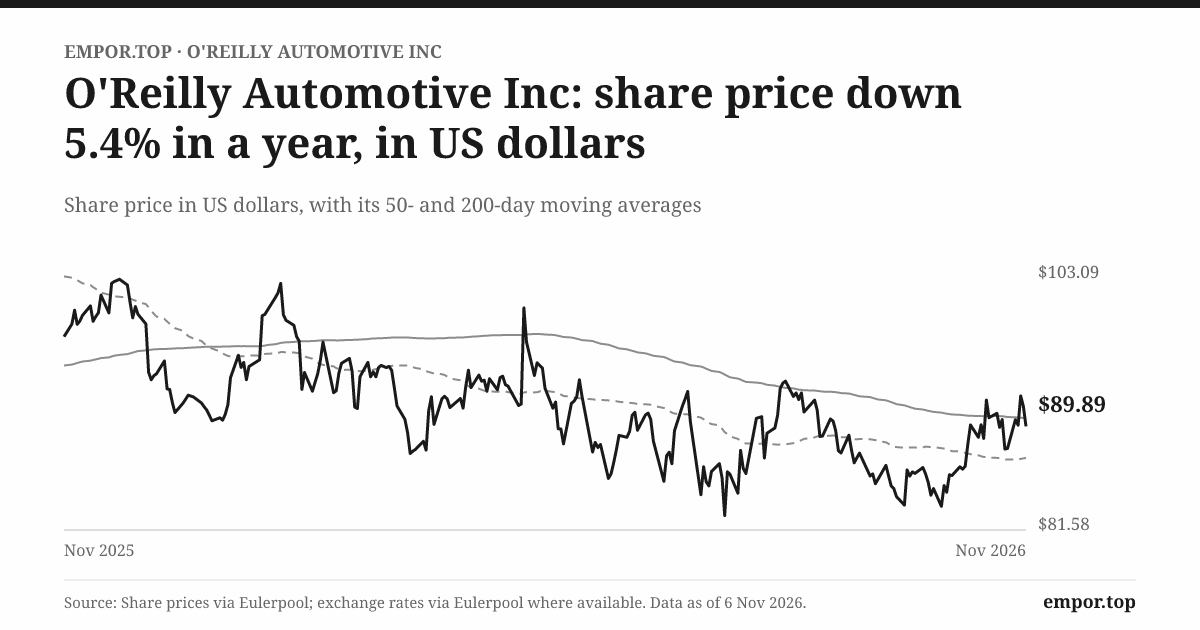
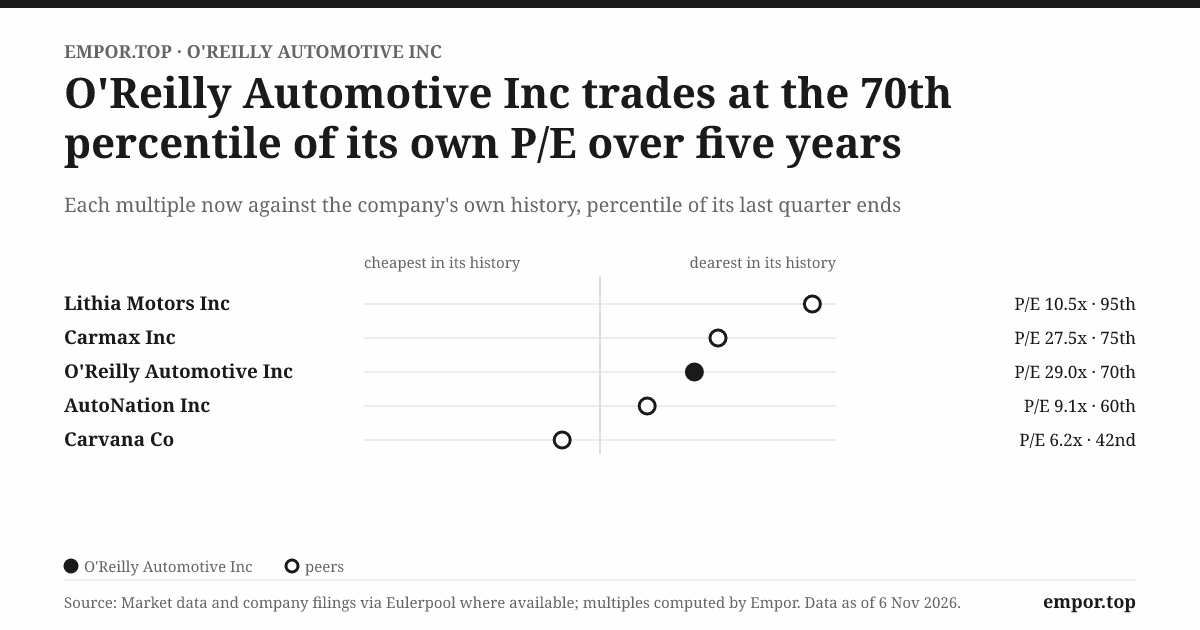
On October 27, 2026, the stock market valued O'Reilly Automotive at about $73 billion.5 Add its debt and subtract its cash, and the enterprise value, the price of buying the whole business, was about $82.3 billion.5 Investors were paying about 28.5 times the company's earnings over the past twelve months, well above its own five-year median of about 24.4 times.5 Its free cash flow yield, the cash it generated after investment as a share of its market value, was about 3.0%.5
Those numbers tell a clear story about expectations. The market is not pricing O'Reilly as a slowing retailer. It is pricing it as a business that will keep compounding earnings at a high rate for years. Compare it with its closest peers. AutoZone, its largest rival and in many ways its most similar business, traded at about 20.9 times trailing earnings.19 LKQ, a distributor of alternative and recycled parts with a different business mix, traded at about 9.5 times.20 Advance Auto Parts traded at about 33.4 times, but that figure reflects severely depressed earnings after a period of restructuring rather than optimism about its prospects.21 O'Reilly carries a meaningful premium over AutoZone, a company with similar economics.
What does the premium assume? Roughly, that O'Reilly will grow earnings per share faster than AutoZone, keep its operating margin near 20% and continue its record of steady execution. The PEG ratio, a crude measure comparing the P/E to expected growth, stood at about 3.4, which suggests the market is paying a high price for each point of growth.5 None of that means the shares are mispriced. It means the bar is high.
Why the network may keep winning
The bull case starts with the scale of the opportunity. O'Reilly estimates its U.S. addressable market at up to about $175 billion, and with roughly 10% of it, the company argues it has plenty of room to grow.6 The vehicle fleet supports that case. At the analyst day, management cited about 293 million light vehicles on U.S. roads, an average fleet age of nearly 13 years and more than 3.3 trillion miles driven in 2025.6 Older cars need more repairs, and more miles mean more wear. Rising vehicle complexity means more of those repairs go to professional shops rather than DIY customers, which plays to O'Reilly's professional growth.
The second pillar is execution. O'Reilly's network of stores, hubs and distribution centers, described earlier, gives it a structural cost and availability advantage in the regions where it is dense. The second quarter of 2026 showed that network working: 6.0% comparable sales growth, double-digit professional comps and rising professional transaction counts.164 Operating margin held at 20.2% even as the lower-margin professional business grew faster.16
The third pillar is the competitive landscape. Advance Auto Parts, whose earnings have been depressed through a long restructuring, has given O'Reilly and AutoZone an opening to win professional accounts.21 Independent parts stores and small chains continue to lose share to the national players, according to management, which estimated that independents still control a large share of the professional market.6 If O'Reilly can continue to take share from weaker competitors, its growth could stay well above the industry average for years.
Why the premium may be hard to earn
The bear case does not argue that O'Reilly's business has stopped working. It argues that the price leaves little room for disappointment, and that several trends could slow the company down.
Start with competition. AutoZone operated 7,657 stores at the end of its 2025 fiscal year, including 6,627 in the United States, 883 in Mexico and 147 in Brazil, compared with O'Reilly's 6,585.175 AutoZone chases the same repair-shop customer with its own store and hub network, and in Mexico it has a large head start. National scale does not guarantee local service superiority, and O'Reilly's filings do not quantify its share gains or retention rates. If AutoZone or a revitalized Advance matched O'Reilly's service in key markets, the professional growth that justifies the premium could slow.
Then there is the vehicle fleet itself. Modern vehicles have longer maintenance intervals and, in the case of electric vehicles, far fewer routine maintenance parts: no oil changes, no spark plugs, no exhaust systems. EVs remain a small share of the U.S. fleet, and the average age of cars on the road means the transition will take many years to affect demand. But the direction is not favorable. Weather, miles driven, consumer spending pressure, online price comparison and supplier cost inflation can all affect demand or margins in any given year.
Here the competitive war-game picks up where the moat analysis left off. Through Porter's lens, rivalry is the strongest force acting on O'Reilly, because its three national competitors pursue the same professional customer with similar promises, and nothing in the company's disclosures shows a shop paying a premium to stay with O'Reilly. Through Helmer's lens, its powers, scale economies in each dense region and the process power of decades of distribution know-how, are real but contestable. They rest on continued investment, not on a legal barrier or a network effect. That argues for a moat that is wide but must be maintained, and it is the reason the bear case focuses on execution and price rather than on disruption.
The financial stress test is less comfortable than the operating one. O'Reilly's long-run cash conversion has been strong, but in 2025, operating cash flow fell to about 69% of EBITDA, the lowest ratio in at least twelve years, partly because of the tax-credit timing.5 Free cash flow has drifted down for four years, from a peak of about $2.8 billion in 2021 to about $1.6 billion in 2025.5 Some of that decline reflects deliberate investment in stores and distribution, and some reflects the tax-credit timing. But it means the cash available for buybacks has shrunk while buybacks themselves have not. An activist reading the cash flow statement would ask a pointed question: why borrow to buy back stock at 28 times earnings when the business itself has slowing free cash flow and rising capital needs?
There are also smaller liabilities to watch. Self-insurance reserves, covering workers' compensation, vehicle and general liability and employee health claims, rose to about $443 million at the end of 2025 from about $268 million a year earlier.5 That is a meaningful increase in an estimate-sensitive liability, and it deserves monitoring, though the company's auditor issued a clean opinion and found no material weaknesses in internal controls.5
The governance picture is mostly reassuring but not spotless. The company's board has nine members, three of them affiliated with the company and six independent.8 O'Reilly family members remain represented in leadership, with David O'Reilly serving as executive vice chairman.8 At the May 2026 annual meeting, some directors drew notable opposition: about 78 million shares voted against John Murphy and about 50 million against Thomas Hendrickson, while about 54 million shares opposed the advisory vote on executive pay.22 Those were minorities, but significant ones. Beckham's reported total compensation rose to about $4.2 million in 2025 from about $2.8 million in 2024, driven mainly by option awards and incentive pay, while operating income rose 6%.8
Related-party leases are the other governance item. O'Reilly leased 66 stores from entities affiliated with directors or their families, paying about $4.6 million of rent in 2025.5 That is about 0.03% of sales, small enough to be economically trivial, but it is the kind of arrangement that deserves independent review. The company says its audit committee reviews these transactions.8
The credit view is stable. Moody's and S&P rated the August 2026 notes Baa1 and BBB, with stable outlooks.18 Those ratings leave room for the company's planned move toward 2.5 times leverage, but probably not much room for a large debt-funded acquisition without a downgrade.
Three measures will decide most of this debate. The first is comparable-store sales, split between professional and DIY customers. In the second quarter of 2026, professional comps grew about 10% and DIY comps grew at a low-single-digit rate, with DIY transactions falling.4 If professional growth holds as inflation fades, O'Reilly is winning share. If it fades with inflation, the growth was mostly price.
The second is free cash flow after capital spending, compared with buybacks. In the first half of 2026, free cash flow was about $1.48 billion while repurchases were about $2.43 billion.16 The direction of that gap tells you whether buybacks are being funded by the business or by the balance sheet.
The third is operating margin. It was about 19.5% in 2025 and over the past twelve months, and it held flat at 20.2% in the second quarter of 2026.516 If it holds near 20% as the professional mix rises, the network's purchasing and distribution efficiencies are doing their job. If it slips, the trade-off between growth and profitability is tilting the wrong way.
The next checkpoint is the third-quarter report. The questions that matter are easy to frame: whether professional transactions kept rising after the inflation tailwind faded, whether DIY traffic stabilized, whether margins held and whether management says anything more about its appetite for acquisitions.
X. Playbook: Business & Operating Lessons
In 1975, a family with nine stores built a 52,000-square-foot warehouse in Springfield. It was, by any normal reckoning, too much warehouse for nine stores. Fifty years later, that decision looks like the most important one the O'Reilly family ever made. The company grew from those nine stores to 6,585, and from $700,000 in first-year sales to about $17.8 billion in 2025.75 The lessons of that journey belong to this company, but they travel.
The first lesson is to win the part before the customer needs it. The warehouse came before the chain, and the hub came before the call. O'Reilly's whole edge is that the part is already close enough to arrive quickly when the mechanic needs it. Every competitor can promise speed. Only the one that has invested years ahead of demand can deliver it. Availability is not a marketing slogan. It is inventory, trucks and warehouses paid for before anyone walks in the door. In auto parts, the sale is made in the warehouse months before the customer calls.
The second lesson is to serve two customers with one system. The family's dual-market idea from 1978 still underpins the business: DIY and professional customers draw from the same inventory, which means the same shelves earn money all week. But the lesson has a sharp edge. The lower-margin professional customer must earn its place through frequency and volume, or it simply dilutes the business. Growth in the wrong customer is not growth. It is mix.
The third lesson is to buy geography, then build the capability. CSK gave O'Reilly a national footprint, but the real work came after the deal closed, when Greg Johnson's team spent two years rebuilding warehouses and converting stores. An acquisition is a set of keys, not a business. O'Reilly's acquisition record is strong because it treated integration, not the purchase, as the main event. Any future deal, NAPA or otherwise, should be judged by the integration plan, not the headline price.
The fourth lesson is that a buyback is an investment too. O'Reilly has spent more than $27 billion repurchasing stock, and in good years at good prices that was an excellent use of capital. But a buyback funded by debt at a premium valuation is a different decision from one funded by surplus cash at a fair price. The same discipline O'Reilly applies to choosing store sites should apply to choosing its own share price. A buyback that costs more than the earnings it buys is not returning capital. It is spending it.
The fifth lesson is that the family name is not the moat. The O'Reilly name on the sign carries history, but no mechanic chooses a supplier because of its founding story. The durable edge has to show up every day in availability, repeat professional orders, growth and margins. A company that mistakes its heritage for its advantage stops investing in the thing that actually matters. O'Reilly's moat is the morning delivery, not the family photograph.
XI. Epilogue
Tonight, O'Reilly Automotive stands at an interesting moment. The NAPA headlines have faded. Genuine Parts has denied talking to any competitor, and O'Reilly's chief executive has said he has no intention of making a large, transformative acquisition.34 The stock trades at a premium to its own history, the business is growing faster than it was a year ago, and the company is opening more stores than at any point in decades.
The coming months will test the story on several fronts. The first is the third-quarter report and the rest of 2026. Management guided to comparable sales growth of 4% to 6%, revenue of about $18.9 billion to $19.2 billion, earnings of $3.20 to $3.30 per share and 225 to 235 net new stores for the year.16 Hitting those numbers would confirm that the 2026 reacceleration was real. Missing them, especially if the miss came from professional sales slowing as inflation faded, would suggest the slowdown of 2022 to 2025 was the new normal after all.
The second test is Genuine Parts itself. Its planned separation of automotive and industrial businesses is still under way, and NAPA's future, whether as a standalone company, a spinoff or an acquisition target, remains unsettled.1 If the business is spun off, the question of an O'Reilly bid could return. If another buyer emerges, O'Reilly may face a stronger competitor. The story is not finished, but the rumor is not a strategy, and investors should not treat it as one.
The third test is the cash. Free cash flow guidance for 2026 is $1.8 billion to $2.1 billion, while buybacks are running well above that pace.16 Watch whether management slows repurchases, raises leverage further toward its 2.5 times target or finds another way to close the gap. Watch the returns on new stores and distribution centers, which the company does not disclose directly but which show up over time in margins and returns on capital.
The tension that remains is the one this story began with. The same network that made O'Reilly one of the great compounders in American retail could tempt it to buy more scale than its cash engine can comfortably absorb. The company that built a warehouse too big for nine stores knows the value of investing ahead of demand. The question is whether it also knows when to stop.
XII. Outro
Go back to the counter on Sherman Avenue in Springfield, December 1957. A mechanic walked in. He needed a part. The man behind the counter was Chub O'Reilly, and he knew that if the part was on the shelf, or in the warehouse out back, the mechanic would come back the next day. If it wasn't, the mechanic would find someone else.
Almost seventy years later, that counter was part of a nationwide network. The scale was unrecognizable. The promise was the same. The right part had to arrive before the lift came down. That promise became the business.
References
-
Genuine Parts Draws O'Reilly Cash Bid for Auto Unit NAPA — Transport Topics/Bloomberg, 2026-07-02 ↩↩↩↩↩↩↩
-
Genuine Parts Is Said to Receive O'Reilly Interest for Auto Unit — Bloomberg Law, 2026-07-03 ↩
-
Genuine Parts Co. Denies Talks with Any Competitor; Posts 6% YoY Growth in Q2 2026 Revenue — S&P Global AftermarketInsight, 2026-07-27 ↩↩
-
Q2 2026 Earnings Call Transcript — Stock Analysis, 2026-07-30 ↩↩↩↩↩↩↩↩↩↩↩↩↩↩
-
Annual Report on Form 10-K for 2025 — O'Reilly Automotive, SEC, 2026-02-27 ↩↩↩↩↩↩↩↩↩↩↩↩↩↩↩↩↩↩↩↩↩↩↩↩↩↩↩↩↩↩↩↩↩↩↩↩↩↩↩↩↩↩↩↩↩↩↩↩↩↩↩↩↩↩↩↩↩↩↩↩↩↩↩↩↩↩↩↩↩↩↩↩↩↩↩
-
2026 Analyst Day Transcript — Stock Analysis, 2026-09-17 ↩↩↩↩↩↩↩↩
-
O'Reilly History — O'Reilly Automotive ↩↩↩↩↩↩↩↩↩↩↩↩↩↩↩↩↩↩↩↩↩↩↩↩
-
O'Reilly Automotive to Acquire CSK Auto, Press Release (Form 8-K Exhibit 99.1) — O'Reilly Automotive, SEC, 2008-04-01 ↩↩↩↩↩↩↩↩↩
-
CSK Acquisition Conference Call Transcript (Form 8-K Exhibit 99.2) — O'Reilly Automotive, SEC, 2008-04-01 ↩↩↩
-
United States v. CSK Auto Corporation — U.S. Department of Justice ↩↩↩↩↩
-
Annual Report on Form 10-K for 2009 — O'Reilly Automotive, SEC, 2010 ↩↩↩↩↩
-
Under the Hood of the O'Reilly-CSK Network Merger — DC Velocity, 2009-09-24 ↩↩↩↩↩↩
-
Q1 2024 Earnings Call Transcript — O'Reilly Automotive, 2024-04-25 ↩↩↩↩↩
-
O'Reilly Automotive's Profit Misses on Higher Costs — Reuters via Investing.com, 2024-04-26 ↩↩↩
-
Second Quarter 2026 Results, Exhibit 99.1 — O'Reilly Automotive, SEC, 2026-07-29 ↩↩↩↩↩↩↩↩↩↩↩↩↩↩↩↩↩
-
AutoZone Fourth Quarter Fiscal 2025 Results, Exhibit 99.1 — AutoZone, SEC, 2025-09-23 ↩↩
-
Senior Notes Term Sheet, Form FWP — O'Reilly Automotive, SEC, 2026-08-10 ↩↩
-
Advance Auto Parts Statistics and Valuation — Stock Analysis, 2026-10-27 ↩↩
-
2026 Annual Meeting Results, Form 8-K — O'Reilly Automotive, SEC, 2026-05-14 ↩
 LinkedIn
 WhatsApp
 Reddit
 Hacker News
 Email
 Kindle
 RSS Feed
 Spotify
 Apple Podcasts
 Amazon Music
 Audible
 YouTube