Owens Corning: From Accidental Discovery to Building Materials Titan
I. Introduction & Episode Roadmap
Picture an attic in an American suburb on a hot afternoon. A contractor climbs the ladder, pushes up the hatch, and looks out across a sea of fluffy pink. Nobody up there is thinking about glass chemistry, antitrust law, junk bonds or the Bankruptcy Code. The homeowner downstairs may not even know the name of the company that made the stuff. But they know the color, and they probably know the cartoon cat that sold it. That pink blanket is one of the strangest success stories in American industry: a product made of glass, spun finer than hair, that became one of the most recognizable consumer brands in a category consumers almost never shop for.
Owens Corning, the company behind it, was founded in 1938 and is still based in Toledo, Ohio.1 Today it makes roofing shingles, insulation and, since 2024, residential doors, and it reported about $10.1 billion of net sales from continuing operations in 2025.1 It has appeared on the Fortune 500 every year since the list began in 1955, a record of corporate endurance that few American industrial companies can match.2
Yet endurance is not the same as smooth sailing. This is a company that was born from a lab accident, was carved out of its two parents by the federal government, borrowed billions to fight off a corporate raider, was named in hundreds of thousands of asbestos lawsuits, spent six years in Chapter 11, and then rebuilt itself into one of the most profitable building-products businesses in North America.
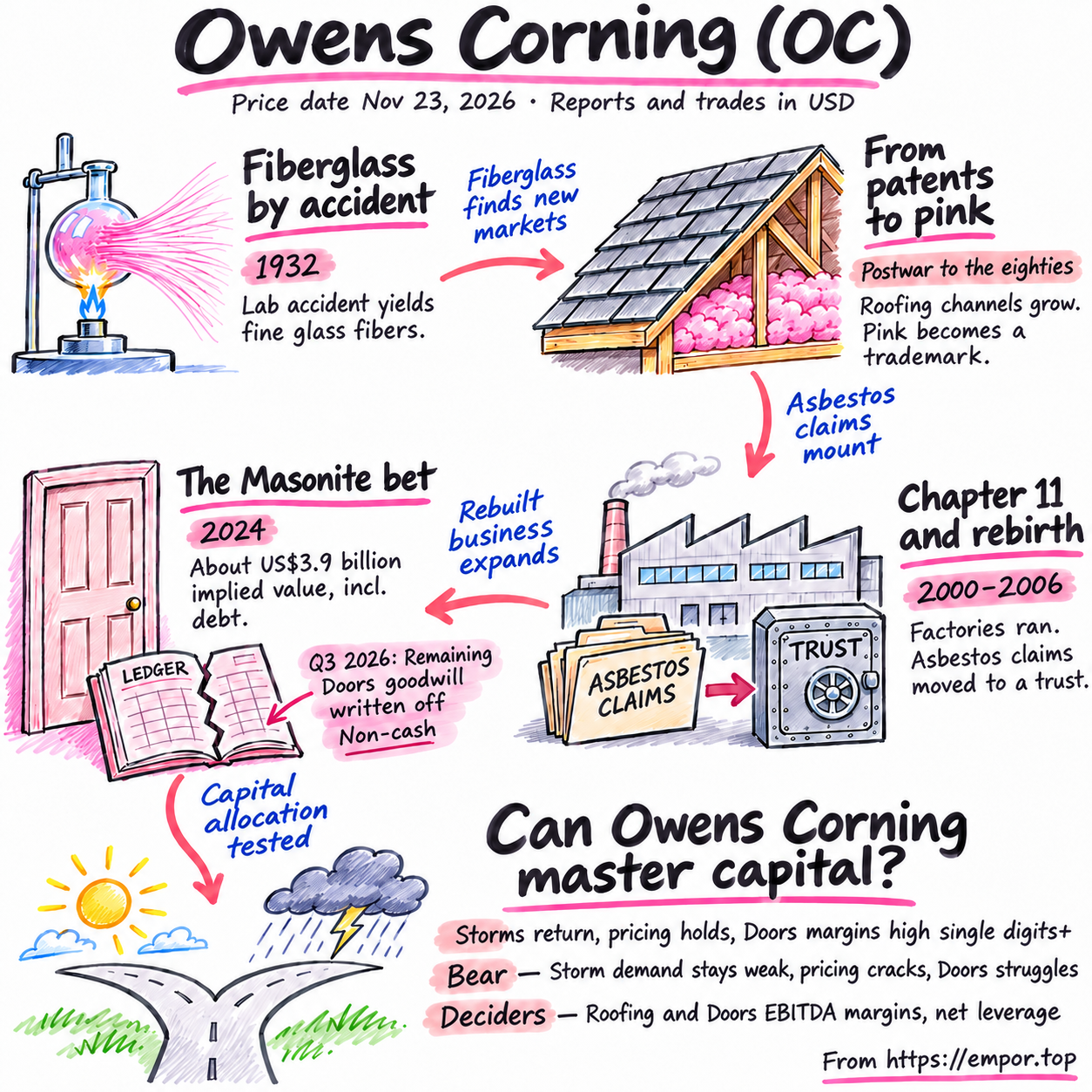
The central question of this story is how an accidental discovery became a company that survived the asbestos catastrophe and emerged, on most measures, stronger than before. But there is a second question that matters more to anyone looking at the business tonight, in November 2026. Having spent two decades proving that it could run a disciplined, high-margin roofing and insulation franchise, Owens Corning made the largest bet of its modern history in 2024 when it bought the door maker Masonite for an implied value of about $3.9 billion.3
Within roughly two years it had written off essentially all of the goodwill from that deal.4 At the same moment, its crown jewel, roofing, ran into a second straight year of weak storm activity and a distribution channel cutting its stock of shingles.5
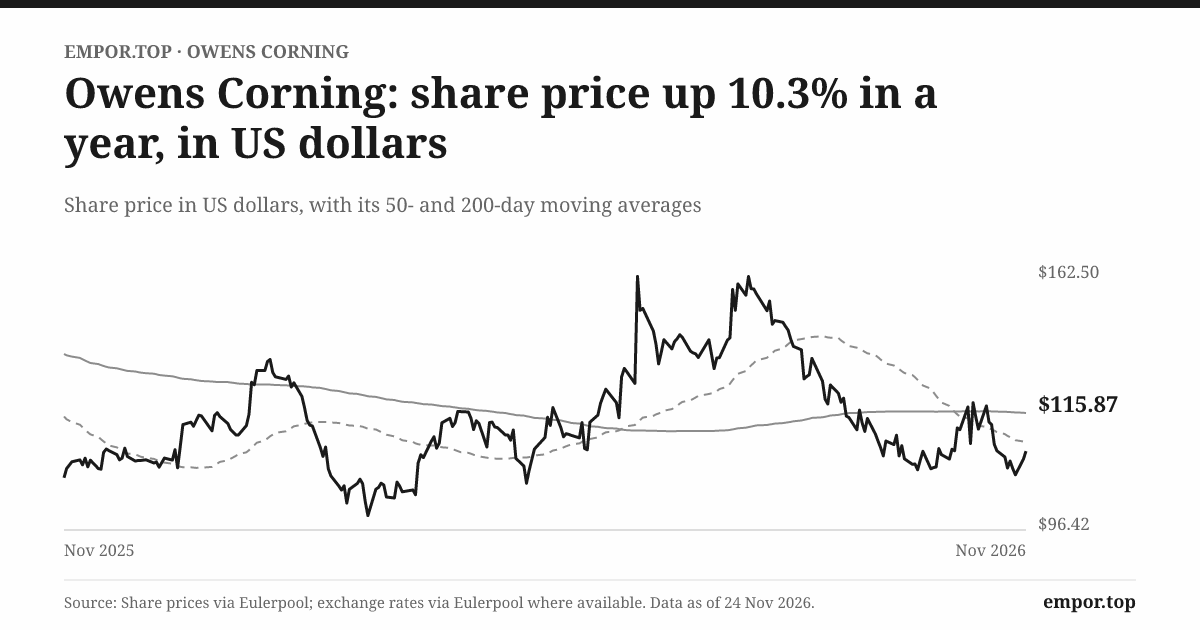
So the share price sits at about $114, roughly 28% below its 52-week high, and the market value is about $10 billion. The company that survived asbestos is now being asked a quieter but sharper question: can it allocate capital as well as it runs factories?
To answer it, the story moves through five eras. First comes the origin: the accident in an Ohio laboratory and the two glass giants that turned it into an industry. Then the long postwar boom, when fiberglass went from warships to attics to the body of the Chevrolet Corvette. Then the 1980s, when a pink cartoon panther and a court ruling on a color gave the company a brand, while a hostile raider and a growing pile of asbestos suits loaded it with risk. Then the collapse into bankruptcy and the six-year climb out. And finally the modern company: the roofing machine, the European insulation deals, the Masonite gamble, and the balance sheet that now carries the consequences.
The themes run through every era. Material science gave Owens Corning its first moat, but patents expire and the government made sure this one was shared early. Brand, unusually for a building-products maker, became a second moat. Crisis management became a third skill, learned the hard way. And capital allocation, the subject that bankrupted the company once through a fateful acquisition, has returned as the issue that will define the next chapter. The story begins, as so many industrial stories do, with someone trying to do something else entirely.
 Subscribe on LinkedIn
II. The Accidental Discovery & Founding Context (1930s)
In 1932, in a small Owens-Illinois laboratory in Columbus, Ohio, a young researcher named Dale Kleist was trying to solve a mundane problem. He wanted to melt glass to form a seal between glass blocks, and he was experimenting with a jet of compressed air directed at molten glass.6 The experiment did not produce a seal. It produced something no one had asked for: a shower of very fine glass fibers.6 Most people would have cleaned up the mess. The Owens-Illinois team saw a material.
The moment mattered because of the man already running the research. Games Slayter, a Purdue-trained engineer from Argos, Indiana, had joined Owens-Illinois in Toledo and persuaded its executives to fund work on producing glass fibers commercially.7 Slayter was the kind of inventor who did not stop at the lab bench. He streamlined the steam-blown process so that glass fibers could be made in volume, and he pushed the material into applications, starting with wool insulation for homes.7
Over his career he held more than 90 patents, and he was later inducted into the National Inventors Hall of Fame.7 Along with John Thomas, another Owens-Illinois researcher, Slayter urged the company to look for a partner, and that search led to the most famous glass company in America.6
Why would two rivals join forces? Because the Great Depression had flattened demand for ordinary glass containers and windows, and both companies were hunting for new uses for their furnaces and their know-how. Owens-Illinois was a Toledo bottle and container giant. Corning Glass Works was the upstate New York glassmaker with the deepest bench of glass scientists in the country. Rather than fight a patent war over an unproven material, they began cooperating in 1935.6 It was a joint venture built on a simple insight: the science was too promising, and the market too uncertain, for either company to go it alone.
On October 31, 1938, the partnership became a separate company, Owens-Corning Fiberglas Corporation, headquartered in Toledo.2 The name itself told a story. Owens-Illinois had trademarked "Fiberglas", with a single "s", in 1936, and that odd spelling would mark the company's products for decades.6 The first president was Harold Boeschenstein, a World War I second lieutenant from Edwardsville, Illinois, who had been a glass executive in Toledo since 1929 and had risen to vice president and general manager at Owens-Illinois.2 Boeschenstein recruited Slayter to oversee research, and Slayter became the new company's head of research and development.6
Boeschenstein deserves more than a footnote, because he shaped the company's personality for three decades. A Toledo Blade editorial written after his death in 1972 called him "a dynamic, driving, intensely competitive man."2 He served on President Roosevelt's War Production Board, which put him at the center of American industrial mobilization, and in 1957 Forbes included him on its list of the 50 foremost business leaders in the country.6 2
During his 29 years at the helm, annual sales grew from about $4 million to hundreds of millions of dollars.2 His son, William Boeschenstein, would later run the company through its most dangerous decade, which gives the Owens Corning story an unusual dynastic thread for a company owned by the public.8
The first great product was simple. Fiberglass wool trapped air in millions of tiny pockets between glass strands, and trapped air is a poor conductor of heat. So a blanket of glass wool in an attic slowed the escape of heat in winter and the entry of heat in summer. Glass does not burn, does not rot and does not feed mold or insects. Compared with the alternatives of the era, it was a better product that could be made cheaply at scale once Slayter's process worked. That combination of a superior material with a manufacturing process that was hard to copy is the original Owens Corning moat.
It is worth noticing, though, how fragile that moat was at birth. The company had a breakthrough product but very little demand, because the American housing market was still recovering from the Depression. It needed a customer large enough and urgent enough to justify building plants. Within a year of its founding, it found one.
III. Early Growth & Innovation (1938-1960s)
In 1939, as war spread across Europe, the U.S. Navy Bureau of Ships made a decision that would carry Owens-Corning through its infancy. The Navy decided that the company's fireproof insulation should be installed in all new warships.2 A fire aboard a steel ship is a nightmare, and older insulation materials could burn or smolder. Glass fiber could not. One historian of the company later said that the Navy business "carried the company for the first seven years."2 When the United States entered the war, the company's products spread across the war effort, into fireproof parachutes for flares, reinforced plastic parts for warplanes and life jackets.2
The war did something more valuable than fill order books. It forced the company to learn how many things glass fiber could do. A material that started as attic wool turned out to be a reinforcement that could be woven, molded and combined with plastic resins to make parts that were light, strong and resistant to corrosion. That discovery would become the composites business, and it set up the postwar boom.
When soldiers came home and the suburbs exploded, Owens-Corning was in exactly the right place. Millions of new houses needed insulation, and the company made an effective, affordable product that builders and homeowners adopted quickly.6 At the same time, reinforced plastics found their most glamorous showcase. The company played a leading role in the first glass-fiber-reinforced automobile body, the Chevrolet Corvette of 1953.6 Fiberglass let General Motors build a sports car body without the expensive steel stamping dies a metal body required, which made a low-volume, high-style car economically possible. For a company whose main product sat unseen in attics, a sports car on the cover of magazines was priceless proof of what the material could do.
Success brought the government. In 1949 Owens-Illinois and Corning Glass Works were accused of illegally monopolizing the fiberglass industry.6 Under a court-mandated consent decree that year, Owens-Corning had to license its patents to competitors, and its two parents had to relinquish control.6 William Boeschenstein later recalled that the decree also barred the company from buying competitors that used or made fiberglass products, a restriction that would shape its acquisition strategy for decades.8 Then, as a separate entity, Owens-Corning went public in 1952, putting one-third of its shares on the New York Stock Exchange.6
Pause on what that means for the moat. The company's early dominance came from patents and process know-how. The consent decree deliberately handed the patents to rivals. From the 1950s onward, then, Owens-Corning could not rely on legal exclusivity. It had to win through manufacturing scale, cost, distribution and brand, which is exactly the set of advantages the company relies on today. In a sense, the government forced Owens-Corning to become a better business by taking away its easiest advantage.
The restriction on buying fiberglass competitors also explains one of the most consequential deals in the company's history. In 1977, Owens-Corning bought Lloyd A. Fry Roofing and its subsidiary, Trumbull Asphalt.6 Fry did not use fiberglass at all, which was precisely why the deal fit within the decree.8 The logic was to take an established asphalt shingle maker and convert it.
Traditional shingles used a felt or paper mat soaked in asphalt. A mat made of glass fiber was stronger, more fire resistant and less prone to rot. Owens-Corning could supply that mat from its own technology and sell the finished shingle through Fry's established channels. William Boeschenstein later said the conversion of the shingle business took "probably 10 years."8
That decade-long conversion is easy to skip past, but it may be the single most important strategic decision in this story. Roofing became the company's most profitable business. In 2025, Roofing generated about $4.4 billion of sales and about $1.4 billion of segment EBITDA, a margin of about 32%, and it accounted for well over half of the profit earned across the three operating segments.1 A deal done in the 1970s, constrained by an antitrust decree from the 1940s, created the profit engine that pays for nearly everything Owens Corning does in the 2020s.
There was one other product line acquired in this era that would matter even more, for darker reasons. In the 1950s, Owens-Corning became involved with Kaylo, a high-temperature calcium silicate insulation for pipes and industrial equipment that contained asbestos. The company used asbestos in insulation and other products from the 1950s until 1972.9 At the time, it looked like a sensible extension into industrial insulation. It became the liability that nearly destroyed the company. Before that bill arrived, though, Owens-Corning had a brand to build.
IV. The Pink Panther Era: Brand Building Mastery (1980s)
How do you get a homeowner to care which company made the insulation in their attic? It is a product they buy once, rarely see, and usually let a contractor choose. In 1980, Owens-Corning's answer arrived in the form of a cartoon cat. The company approved the use of United Artists' Pink Panther character to promote its pink Fiberglas insulation.8 William Boeschenstein, by then chief executive, later admitted with some amusement that when the idea was presented he "didn't even know who the Pink Panther was."8
The choice was clever because the product was already pink, and the Panther turned a manufacturing quirk into a personality. Advertising could make a dry technical claim about thermal resistance into a memorable image: a slinky pink cat lounging on a pink blanket. The cat gave consumers a name to ask for, and gave contractors a reason to stock the product a homeowner might recognize.
Owens-Corning then went one step further. In the mid-1980s, a U.S. federal appeals court ruled that the company could hold a trademark on the color pink for fiberglass insulation.6 The court accepted that years of advertising and commercial success had taught buyers to associate the color with a single source.
That ruling is a landmark in brand protection, and it is why the pink in this story is more than decoration. The 1949 decree had opened the field to competitors. It could not make it pink. In a category where products are often close substitutes, a protected color is a rare thing: a piece of differentiation that rivals cannot copy, attached to a product they otherwise can.
The limits are just as important. A color does not change the physics of the insulation, and builders choosing between roughly equivalent products on price will not pay much extra for a cartoon. The brand is real, but it works best as a tie-breaker and a shelf presence rather than a licence for large price premiums.
While the marketing team built the Panther, the finance side of the company walked into a fight it had not expected. Corning had held 25% of Owens-Corning until it sold those shares in 1983.2 With no anchor shareholder left, the company was exposed in the takeover boom of the mid-1980s. Its advisers had judged it an unlikely target, and the board adopted a "poison pill" defense in June 1986.8 Two months later, Wickes Companies, whose chairman Sanford Sigoloff had already built a stake of almost 10%, announced a tender offer at $74 a share.6
Owens-Corning's response was a classic of the era's financial engineering, and it reshaped the company. Rather than sell, it borrowed heavily, about $2.5 billion from Drexel Burnham Lambert and others by one account, and recapitalized.6 Shareholders received $52 a share in cash, a junior subordinated debenture with a face value of $35, and one share of new stock.6 In effect, the company handed its owners most of the value a raider was offering, financed with debt, and kept its independence. Wickes walked away, but not empty-handed: it sold its stake and made a profit of more than $30 million.6
The cost of winning was enormous. To service the new debt, Owens-Corning sold 10 companies, including its aerospace and strategic-materials group, and businesses that accounted for roughly $1 billion of annual sales.6 Employment fell from about 29,000 in mid-1986 to about 17,000 in 1987.6 Research and development spending, the lifeblood of a company built on material science, fell from $63 million in 1986 to $29 million in 1987.6 The company had defended itself by becoming smaller, more focused and far more indebted.
There is a bull's reading of that episode. Focusing on core building materials made the company leaner and more profitable, and the stock did well after the recapitalization, at least for a while, as William Boeschenstein recalled.8 Profits reached $477 million in 1988 and $430 million in 1989, and debt had been cut to less than $1.5 billion by early 1990.6 But there is a bear's reading too, and it proved more important. The company emerged from the 1980s with less financial flexibility just as a liability from its industrial past was compounding. A balance sheet built to repel a raider was not built to absorb a mass tort.
The juxtaposition is worth stating plainly. In the same decade that Owens-Corning was winning a trademark on a color, it was losing the argument about what it had known regarding the material it had stopped using in 1972. The pink blanket and the asbestos dockets grew up side by side.
V. The Asbestos Crisis & Road to Bankruptcy (1978-2000)
In 1978, two shipyard workers, Edward Scruggs and Donald Kaiser, both suffering from asbestosis, filed a lawsuit on behalf of themselves and 5,000 other workers.9 They sued Owens-Corning and 14 other asbestos manufacturers, arguing that the companies had known asbestos was dangerous as early as 1938 and had failed to warn the people handling it.9 The irony was cruel. The same Navy shipbuilding program that had carried the young company through its first years had put asbestos-containing insulation into the shipyards, where workers cut and fitted it, breathing the dust.
Asbestos disease is slow. Mesothelioma, asbestosis and asbestos-related lung cancers can take decades to appear after exposure. That long latency is what turned asbestos from a product-liability problem into an existential one. Products sold in the 1950s and 1960s generated claims in the 1980s and 1990s, and every year brought new plaintiffs whose exposure had happened a generation earlier. The company could not cap the liability by stopping production, because the injuries had already been set in motion.
The numbers climbed relentlessly. By 1990, Owens-Corning was a defendant in about 84,500 asbestos-related lawsuits.6 The company tried to get ahead of the wave. In 1998, it grouped about 176,000 claims into a National Settlement Program, agreeing to pay roughly $1.2 billion to resolve them.9 The idea was to settle the bulk of the existing docket at negotiated rates and make the future predictable. Instead, the claims kept coming, and the docket grew rather than shrank.
Then came the decision that turned a heavy burden into a fatal one. In 1997 Owens Corning, which by then had dropped "Fiberglas" from its name to reflect a broader business,6 bought Fibreboard Corporation.9 Fibreboard had made asbestos-containing products, including insulation, before 1972, and buying it made Owens Corning responsible for those liabilities as well.9 For a company already carrying the largest asbestos docket in its own history, buying a second asbestos estate was a bet that the liability could be measured and contained.
That bet rested on estimates, and estimates were the weakest link in the whole asbestos system. Asbestos liabilities across American industry were proving larger than almost anyone had modelled, as more defendants went bankrupt and the remaining solvent companies drew a larger share of each claim. By the time Owens Corning filed for bankruptcy, it had been named in about 243,000 asbestos claims.9 The National Settlement Program had not ended the problem, and Fibreboard had added a second stream of claims to the first.
On October 5, 2000, Owens Corning and 17 of its U.S. subsidiaries, including Fibreboard, filed for Chapter 11 protection.9 The filing froze the pending claims. Existing shareholders eventually saw their equity wiped out entirely under the reorganization plan.10
It is worth being precise about the lesson, because it is often told too simply. The consensus narrative says that Owens Corning was destroyed by asbestos, full stop. The record suggests a more uncomfortable version. The asbestos exposure was inherited from decisions made in the 1950s, but the decisions that converted it into bankruptcy were made in the 1980s and 1990s: a debt-funded defense against a raider that left the balance sheet thin, a settlement program that underestimated the inflow of future claims, and an acquisition that imported a second asbestos estate on the strength of liability estimates. Each step looked reasonable in isolation. Together, they left no margin for error when the liability estimate proved wrong.
That history matters for anyone judging the company today, because it is the clearest evidence in the record that acquisitions can carry risks the buyer fails to price. The Fibreboard deal is a cautionary tale about inherited liabilities. A quarter-century later, the Masonite deal would become a cautionary tale about inherited economics. The kinds of mistake differ, but both came down to how much the buyer paid for what it believed it was getting.
The bankruptcy, though, did not end the story. It began the strangest chapter of all, in which a company in Chapter 11 kept running some of the best factories in its industry.
VI. INFLECTION POINT #1: Bankruptcy & Rebirth (2000-2006)
Walk into an Owens Corning shingle plant in 2003 and you would have struggled to tell that the company was bankrupt. The lines ran. The trucks left for distributors. Homeowners still bought shingles after hailstorms and builders still insulated new houses. Chapter 11 is often imagined as a business in its death throes, but in Owens Corning's case it was closer to a legal quarantine. The company's assets and operations were sound. Its problem was a liability on the right-hand side of the balance sheet so large and so uncertain that no one could agree what the equity was worth.
That disagreement explains why the case took six years. The fight was not about whether Owens Corning could make money. It was about who would own the company once the asbestos claimants, the banks and the bondholders were paid. Every billion dollars assigned to the asbestos trust was a billion dollars not available to financial creditors, and vice versa. The estimates of total asbestos liability, the value of the enterprise and the treatment of the Fibreboard estate all became battlegrounds, presided over by Bankruptcy Judge Judith K. Fitzgerald.10
The settlement came together in May 2006. Owens Corning agreed with its key creditor groups on a plan that would move about $7 billion of asbestos liabilities off its books and into a trust.10 The company would pay cash and shares worth more than $5.2 billion into that trust, which the Associated Press described at the time as one of the biggest asbestos settlements in U.S. history, while holders of about $1.5 billion of bank debt would receive up to $2.27 billion including interest.10
The plan assumed an exit value of about $5.86 billion for the reorganized company.10 Norman Pernick, a lawyer for the company, summed up what the plan meant for its future in a single phrase: once approved, "we're asbestos-free."10
The mechanics are worth explaining, because they are the heart of the rebirth. Section 524(g) of the U.S. Bankruptcy Code allows a company facing mass asbestos claims to fund a trust that takes over all present and future asbestos claims. Once the trust is established, a court order channels every claim to it, and claimants can no longer sue the company. It is a bargain: claimants get a large, funded pool of assets, including a large slice of the reorganized company's equity, and the company gets protection from future suits. For Owens Corning, the trust received about $4.29 billion in cash plus 28.6 million shares of the new company's stock, according to the AP's reporting on the plan.10
The cost to old shareholders was total. The existing equity was cancelled and about 131.4 million new shares were issued, with old shareholders receiving only warrants for 5% of the company exercisable at $45.25 a share.10 Bondholders received new shares plus warrants.10 This is the brutal arithmetic of a mass tort bankruptcy: the people who owned the company when the liability was incurred, or when it was misjudged, lose everything, and the claimants and creditors become the new owners.
On October 31, 2006, sixty-eight years to the day after its founding, Owens Corning's plan of reorganization took effect and the company emerged from Chapter 11.11 Dave Brown, the president and chief executive who led the company out of court, called it "an exciting day for Owens Corning" and said the company had met its commitments to creditors and to asbestos claimants.11 Distributions began to financial creditors and to the 524(g) trust that, in the company's words, would "forever resolve" its current and future asbestos liability.11 The new shares began when-issued trading on the New York Stock Exchange under the old ticker, OC.11
Was this a triumph? For the company as an operating business, yes. It came out with its plants, its brands and its customer relationships intact, and with the single greatest risk to its existence removed by court order. For the old shareholders and for the victims, the verdict is harsher. Shareholders who held on through the 1990s were wiped out. Claimants received payment through a trust, but many waited years. The trust, once established, became a long-running claims-paying institution in its own right, funded with about $5 billion.9
The lasting lesson for investors is the separation of operations from capital structure. Owens Corning's plants never stopped being valuable; what failed was the claim on them. That distinction explains why the company could emerge in strong operating shape, and it frames everything that follows. From 2006, the question was no longer whether Owens Corning could survive. It was what a clean, asbestos-free Owens Corning would do with its freedom.
VII. INFLECTION POINT #2: Post-Bankruptcy Transformation (2006-2020)
Mike Thaman had a front-row seat for the bankruptcy. He had served as chairman since 2002, through the darkest years of the Chapter 11 case, and became chief executive in 2007, just as the American housing market was about to collapse.12 It is hard to imagine a worse welcome for a newly reorganized building-materials company. Within months of emerging from one existential crisis, Owens Corning faced the worst housing downturn since the Depression, with new construction collapsing and the demand for insulation going with it.
The company survived that second test, and in a sense it was the first proof that the rebirth was real. A business freed from asbestos liability could live through a cyclical trough that would have finished off the pre-bankruptcy company. The years after the financial crisis were less about dramatic transformation than about steady repair: rebuilding margins, investing in plants, and reshaping a portfolio that still carried the breadth of the old Fiberglas empire, from residential insulation to roofing to glass reinforcements for wind blades, boats and pipes.
The portfolio moves of this era tell a story about where management saw advantage. In June 2017, Owens Corning completed the acquisition of Pittsburgh Corning, the world's leading producer of cellular glass insulation, sold under the FOAMGLAS brand, for about $560 million in cash.13 The deal had a pleasing symmetry. Julian Francis, then president of the Owens Corning Insulation business, noted that Owens Corning and Pittsburgh Corning "have shared a common heritage," a nod to the Corning name both carried.13
Pittsburgh Corning employed more than 1,100 people in 17 countries and had sales of more than $240 million in 2016.13 Cellular glass is a rigid, waterproof, fireproof insulation used in demanding industrial and commercial settings, and the deal pushed Owens Corning further into higher-specification commercial insulation.
Months later, in February 2018, it completed the purchase of Paroc Group, one of Europe's leading makers of fireproof stone wool insulation, for an enterprise value of about €900 million.14 Francis said the deal gave Owens Corning "a leading position in Europe and in the global mineral wool business."14 Mineral wool, made by spinning molten rock rather than glass, is prized for fire resistance, and European building codes favor it. These were deliberate moves into categories adjacent to fiberglass insulation, where Owens Corning's process know-how and distribution could transfer.
How did those deals age? Mixed, but not disastrous, which is itself information. Paroc delivered the European scale that management wanted, and the Insulation business generated about $3.7 billion of sales and a 23% EBITDA margin in 2025.1 But Paroc also brought headaches. In 2023 the company initiated a recall of Paroc marine insulation that may not have met fire-safety certification requirements, and it recorded $33 million of related charges in the first nine months of 2026.15
Paroc also operated plants in Russia, a footprint that became awkward after 2022.14 The point is not that these were bad acquisitions. It is that even well-reasoned adjacent deals carried liabilities and complications that were not visible at signing, an early hint of the pattern that would recur at much larger scale.
The other major development of this era was a change of leader. On January 3, 2019, the board chose Brian Chambers, then president and chief operating officer, to succeed Thaman as chief executive, effective April 18, 2019, while Thaman became executive chairman.12 Chambers, then 52, had spent 15 years in management at the company, with roles in Composites and Building Materials, and had run the Roofing business as president since 2014.12
His résumé contained an unusual chapter: after Owens Corning divested a business he had led, he spent more than three years as president of Saint-Gobain's North American distribution business before returning.12 That gave him something rare among building-products executives: years on the other side of the counter, as the distributor buying from manufacturers.
The Roofing background matters for understanding the company he went on to build. Roofing is the business where Owens Corning's brand, contractor network and price discipline translated most directly into margin. Chambers came up through it, and under his leadership the company leaned into a strategy of focusing on businesses where it could earn premium returns. Operating margin roughly doubled from about 11% in 2015 to almost 20% by 2023.16 Return on invested capital, which had hovered in the high single digits for years, climbed above 20% in 2022 and 2023.16
The company also kept spending on its own plants, which is the less glamorous half of the post-bankruptcy story. Science and technology spending, mostly research and development, rose to about $150 million in 2025, about 1.5% of sales, a modest figure for a company that began as a laboratory discovery but typical of a mature building-products maker.16 Capital additions were far larger, climbing from about $526 million in 2023 to about $824 million in 2025, or roughly 8% of sales, as the company rebuilt furnaces, added capacity and modernized lines.16
That is the price of staying the low-cost producer in a heavy industry: glass melters and shingle lines wear out, and a manufacturer that stops reinvesting is quietly harvesting its moat. On the latest call, management said capital spending would trend back towards about 4% of sales after this elevated period, which, if delivered, would free up a meaningful slice of cash for debt reduction and shareholder returns.5
Those returns were the strongest evidence that the post-bankruptcy company had become a better business, not merely a cleaner one. A company that converts a cyclical, heavy-industry product into returns above 20% on invested capital is doing something right, whether through pricing, cost or mix. The question that followed was what to do with all the cash that a business like that throws off. By 2024, Chambers had an answer, and it was the boldest one in the company's modern history.
VIII. INFLECTION POINT #3: The Masonite Acquisition (2024)
On February 9, 2024, Owens Corning announced that it would buy Masonite International, a door maker founded in 1925, for $133 a share in cash.3 The price was a premium of about 38% to Masonite's closing price the day before and about 46% to its 20-day average.3 Including debt, the implied transaction value was about $3.9 billion, or roughly 8.6 times Masonite's expected 2023 adjusted EBITDA, falling to about 6.8 times once $125 million of expected annual cost synergies were counted.3 Owens Corning lined up $3 billion of committed debt financing from Morgan Stanley to pay for it.3
On the same day, the company announced a strategic review of its Glass Reinforcements business, the composites unit that sold glass fiber to makers of wind blades, pipes and industrial products.3 The two announcements were halves of a single idea. Owens Corning was going to become a pure building-products company, focused on residential and commercial construction in North America and Europe, and step back from the more cyclical, more globally competitive industrial glass fiber markets where it had started.
The deal closed on May 15, 2024, and all of Masonite's shares were acquired at $133.17 The company said the combination lifted its annual revenue to about $12.5 billion, with adjusted EBITDA of $2.9 billion on a synergized basis.17 Masonite brought 64 manufacturing and distribution facilities in North America and more than 10,000 employees.17 In the announcement, management argued that the deal expanded Owens Corning's addressable market by about $27 billion and gave it a platform to grow in adjacent product categories.3
The deal also changed the shape of the balance sheet overnight. Total borrowings rose from about $3.3 billion at the end of 2023 to about $5.6 billion at the end of 2024, and cash and short-term investments fell from about $1.6 billion to about $360 million, because the company spent its cash pile and borrowed the rest.16 Debt relative to shareholders' equity nearly doubled in a single year, from about 0.6 to about 1.1.16
At signing, management said it expected to bring net debt back to about two times EBITDA by the end of 2024.3 That was a reasonable target for a company whose continuing businesses earned close to $2.5 billion of adjusted EBITDA in 2024,1 and it rested on the assumption that the combined company would keep earning at that level. That assumption was tested over the next two years.
What was the strategic logic? Doors share the same customers and channels as Owens Corning's existing products: builders, remodelers, distributors and home centers. A door is also a branded product, often specified by the homeowner, where a well-known name can matter. Management's bet was that the playbook that had worked in roofing, combining brand, channel relationships and manufacturing excellence to earn premium margins, could be transferred to doors. The financial logic was that a multiple under nine times EBITDA, paid with cheap debt, would earn a solid return if that playbook worked.
Now test the claim against what happened. In 2025, the first full year of ownership, the Doors segment generated about $2.1 billion of sales but only about $232 million of EBITDA, a margin of about 11%, compared with 16% in the partial 2024 period.1 Housing turnover stayed weak, and door demand followed. By the third quarter of 2026, Doors sales were down 11% from a year earlier and the segment's EBITDA had fallen to $25 million, a margin of about 5%.4
Over the first nine months of 2026, Doors earned about $116 million of EBITDA on $1.5 billion of sales.4 Owens Corning had paid around $3.9 billion for a business earning, at the current pace, a fraction of the profit that justified the price.
The accounting followed the economics. In 2025, Owens Corning recorded a $1.135 billion non-cash impairment of the Doors reporting unit's goodwill, the accounting premium paid over the value of identifiable assets.16 It warned at the time that the remaining Doors goodwill continued to be at risk.16 That warning proved accurate. In the third quarter of 2026, the company recorded a further $476 million of non-cash impairment charges for Doors, which fully wrote off the remaining goodwill and impaired a tradename.4 On the earnings call, Jonathan Collins, the new chief financial officer, said Doors performance "contributed to the impairment of the balance of the goodwill from the Masonite acquisition."5
Put those charges together and the verdict is stark. Roughly $1.6 billion of impairments in about two years equates to around 40% of the deal's implied value. Impairments are non-cash, and they do not by themselves mean the business is worthless, because the plants and products remain. But they are the company's own admission that the future cash flows it expected from Masonite are well below the level that justified what it paid. The $125 million synergy target was supposed to cushion the deal; instead, the business has needed restructuring, including the divestiture of a distribution business in early 2026 and an Oregon components operation in late 2025, plus a further $75 million cost-reduction target.5
Management's defense is that this is a cyclical trough, not a broken thesis. Doors demand is tied to housing transactions and remodeling, which are depressed by high mortgage rates, and the company is simplifying the business and pushing through an interior door price increase planned for January 2027.5 That argument has some merit, because door demand will not stay at trough levels forever.
But the timing does not fully rescue the decision. The deal was signed in early 2024, when mortgage rates were already high and the housing market was already sluggish, so the cyclical risk was visible at signing. And a 5% margin is not merely cyclical weakness; it is far below the 16% margin the business was earning in the months after the deal closed.
The verdict, hedged once: the Masonite deal has not yet earned back its cost, and on the evidence so far it narrows the claim that Owens Corning's roofing playbook transfers easily to adjacent categories. It does not refute the possibility that doors recover, but the burden of proof has shifted to management. The KPI that would confirm or falsify the revised thesis is the Doors EBITDA margin through a full year after restructuring, without further impairments. And the question of what the deal did to the rest of the company, its balance sheet and its shareholder returns, leads directly to where Owens Corning stands now.
IX. Current State & Financial Performance (2024-Present)
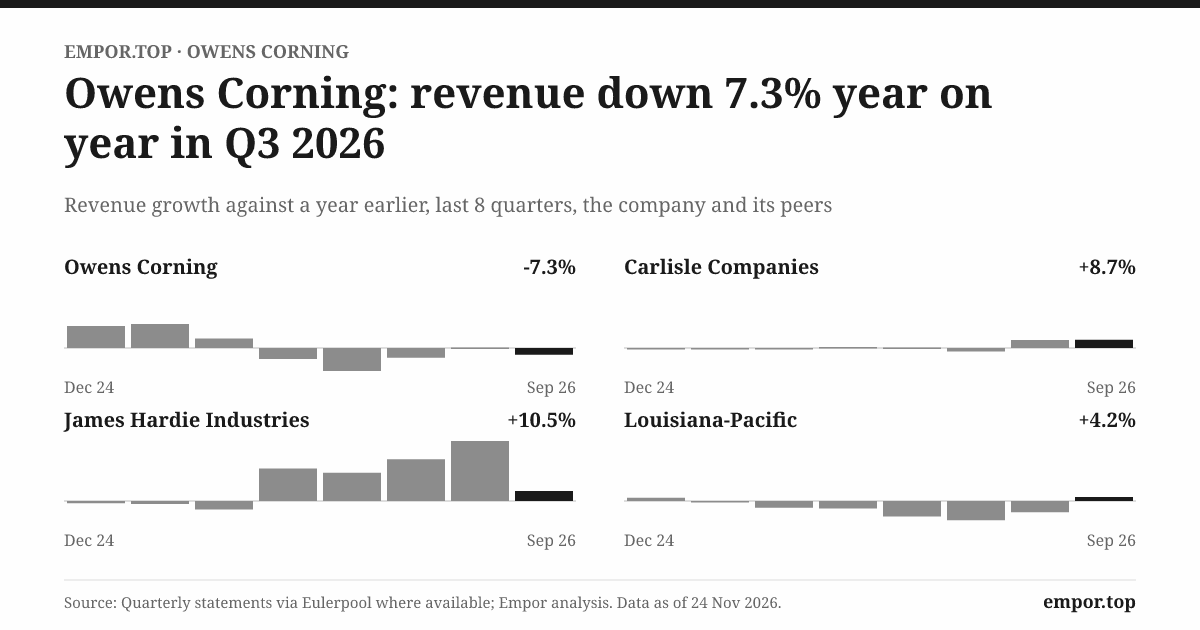
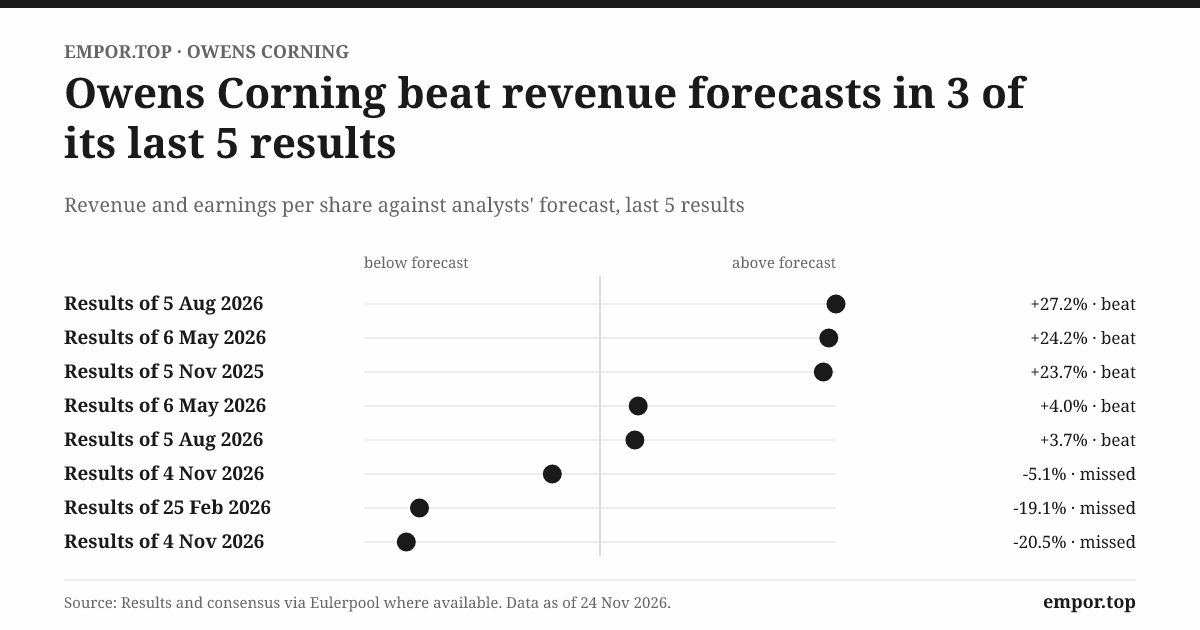
On November 4, 2026, Owens Corning reported a third quarter that showed both sides of the company in a single page. Net sales fell 7% to about $2.5 billion.4 Adjusted EBITDA fell to $489 million, a 20% margin, down from 24% a year earlier.4 The company reported a net loss of about $250 million, driven by the Doors impairment.15 And yet the same quarter produced $813 million of operating cash flow and $622 million of free cash flow.4 A company that loses money on paper while generating hundreds of millions in cash is not a contradiction; it is the signature of a business whose accounting is being dominated by write-downs of past acquisitions, while its factories still produce cash.
Start with the reshaped portfolio. The Glass Reinforcements sale, after a long and difficult process, closed on May 1, 2026, when Owens Corning sold the business to Praana Group for an enterprise value of about $645 million, with about $280 million of cash proceeds at closing.18 The terms had been reworked along the way, with the originally contemplated price reduced by $110 million and planned seller financing eliminated, and the sale produced a pre-tax loss of $183 million in the first nine months of 2026.15
Earlier, the company had sold its building materials business in China and Korea, a business with about $130 million of annual revenue, to a member of that business's management team, completing the transaction in July 2025 at a $28 million pre-tax loss.15 The net effect is a simpler company: three segments, Roofing, Insulation and Doors, focused on North America and Europe.
Now the scorecard. In 2024, the first year with Masonite inside, total net sales reached about $11.0 billion.16 Recast for the Glass Reinforcements sale, continuing sales rose to about $10.1 billion in 2025, but continuing adjusted EBITDA fell about 8% to roughly $2.27 billion, and the margin slipped from 25% to 22%.1 Under GAAP, the company reported a full-year net loss of $522 million, mostly reflecting the Doors goodwill impairment and losses in discontinued operations.16
Roofing remains the engine. It generated about $4.4 billion of sales in 2025 at a 32% EBITDA margin.1 But 2026 has been hard. Third-quarter Roofing sales fell 16%, and the margin dropped from 34% to 29%.4 On the call, Collins explained that U.S. industry shipments of asphalt shingles fell 13%, "driven largely by lower storm demand and channel destocking," and noted that no Atlantic hurricane had made landfall in the quarter.5 Chambers called the weather and demand declines temporary, but guided to a Roofing margin of only 18% to 20% in the fourth quarter.5
This deserves explanation, because it reveals how the roofing business really works. Most re-roofing demand is not discretionary; a roof is replaced when it fails or is damaged, often by hail, wind or hurricanes. A year with severe storms creates a surge of insurance-funded replacements. Two quiet years in a row reduce that surge just as distributors, who had stocked up for expected storm demand, cut their inventories. The manufacturer feels both effects at once: lower sell-through and a pause in restocking. That is why Roofing's margins, which have looked structurally high, can swing sharply on the weather.
Insulation has been the steadier performer. Third-quarter Insulation sales rose 6% to about $1 billion, helped by North American non-residential and European demand, while North American residential was "essentially flat."5 Todd Fister, now president and chief operating officer, described channel inventories as "fairly normal" and said mineral wool and fiberglass pipe insulation were "sold out."5 Insulation's margin slipped from 23% to 21%, but it held up far better than Roofing or Doors.4
The most sobering line is the guidance. For the fourth quarter, the company expects revenue of $2.0 billion to $2.2 billion and an adjusted EBITDA margin of roughly 10% to 12%, citing inflation, transport costs, seasonality and production downtime.4 That is a sharp break with the company's own narrative. Owens Corning had spent years presenting adjusted EBITDA margins above 20% as a hallmark of the new company.
The fourth quarter of 2025 came in at 17%, and the coming quarter is guided to roughly half of the 20% threshold.1 4 At its 2025 Investor Day, management set a long-term target of a mid-20s adjusted EBITDA margin and $5 billion of cumulative free cash flow by 2028.1 On the third-quarter call, when an analyst asked about those targets for 2027, Fister acknowledged that the ranges had assumed better markets.5
Why does a company that reports losses keep generating cash? Because the biggest charges are not cash at all. In 2025, cash from operations was about $1.8 billion despite the $522 million net loss, and the reconciliation shows why: the $1.135 billion goodwill write-down and about $694 million of depreciation and amortization were added back, and the company collected about $235 million more from customers than it billed.16 The pattern holds over a longer span.
Across the twelve years from 2014 to 2025, Owens Corning reported about $5.4 billion of cumulative net profit but about $14.8 billion of operating cash flow.16 Part of that gap is the ordinary depreciation of a capital-heavy business, which is a real cost that must eventually be reinvested, so cash from operations is not the same as distributable profit. But it does mean the GAAP losses of 2025 and 2026 overstate the damage to the company's cash-generating ability, while understating the damage to the value of the capital it deployed.
The capital allocation story has also changed tone. In 2025, Owens Corning returned about $1.0 billion to shareholders, including about $232 million in dividends and about $770 million of share repurchases, and committed to returning $2.0 billion by the end of 2026.1 In December 2025 the board raised the quarterly dividend by 15% to $0.79 a share, the 12th consecutive year of dividend growth.1 But on the third-quarter call, Collins said the company was "prioritizing the strength of our balance sheet," and the remainder of the $2.0 billion commitment is now expected in 2027.5 Net leverage stood at 2.5 times EBITDA, within the company's target range of two to three times.5
That deferral is the right decision for a company in a downturn, and it is also a sign that the plan was set too aggressively. A commitment made when roofing margins were in the 30s has collided with a year in which storm demand, destocking and the Doors write-down all hit at once. The question it raises, and the one the next chapter must answer, is which parts of the Owens Corning playbook have proven durable and which have proven to depend on good weather and good markets.
X. Playbook: Business & Strategy Lessons
Return to the laboratory in Columbus in 1932, and the shower of glass fibers that nobody had planned. The first lesson of Owens Corning is that material science creates an opening, not a fortress. What endured was everything built around the material: plants that could make it cheaply, channels that could sell it, and the habit of finding new uses for it.
The Fry acquisition proves the point: Owens Corning used a technology its rivals could license to transform asphalt roofing, where the advantage came from scale and channel rather than chemistry. For founders, the lesson is that a breakthrough buys time, and the moat is what you build during that time. For Owens Corning, an invention became a franchise only when it stopped being an invention and became a factory and a distribution network.
The second lesson belongs to the pink cat. In a market where products look alike, Owens Corning made its insulation memorable to people who almost never buy it. But the limit of the lesson is as important as the lesson.
Brand works as a tie-breaker in a commodity category, not as a license for large premiums, and it cannot stop a competitor from undercutting on price. Roofing margins depend more on industry structure, channel relationships and the rhythm of storms than on a cartoon. The quotable version: in building products, a brand wins the tie; it does not win the war.
The third lesson comes from Chapter 11. Owens Corning learned, at a terrible cost to its old shareholders, that a company's operations and its capital structure are two different things, and that the second can destroy the first's owners even while the first keeps working. The asbestos liability came from the past, but later decisions turned it into bankruptcy.
Each was defensible when made. Together they left no room for an estimate to be wrong. The lesson for investors is that the balance sheet is where operating risk turns into ownership risk, and an inherited liability is the cheapest thing a buyer can underestimate.
The fourth lesson is the newest and the least settled. Owens Corning built a reputation, under Brian Chambers, as a company that had mastered capital allocation: high returns on invested capital, rising dividends and heavy share repurchases. Over the five years to 2025, it bought back about 29 million shares for about $3.2 billion, an average price of roughly $110 a share.1 In 2025 alone, it spent about $770 million to buy about 5.9 million shares, an average of about $130.1 The share price on November 23, 2026 was about $114. The buybacks of the past five years, in other words, were done at roughly today's price, and the most recent year's at a level above it.
At the same time, the Masonite deal has called that capital-allocation record into question. A skeptical activist would not accuse the company of reckless capital allocation, but they would question the narrative of exceptional capital discipline. The record shows a company that runs factories superbly and has been less consistently excellent at deciding where to put the cash those factories produce. The line to remember: Owens Corning can make a great product; the question is whether it can make a great purchase.
The fifth lesson is the one the next two years will test: in a cyclical business, the best quarter is not the new normal. Owens Corning's adjusted EBITDA margin record ended in the fourth quarter of 2025, and the company now guides to roughly 10% to 12% for the coming quarter.1 4
That does not mean the business is broken. Investors in building products should demand that a company's targets survive a quiet hurricane season.
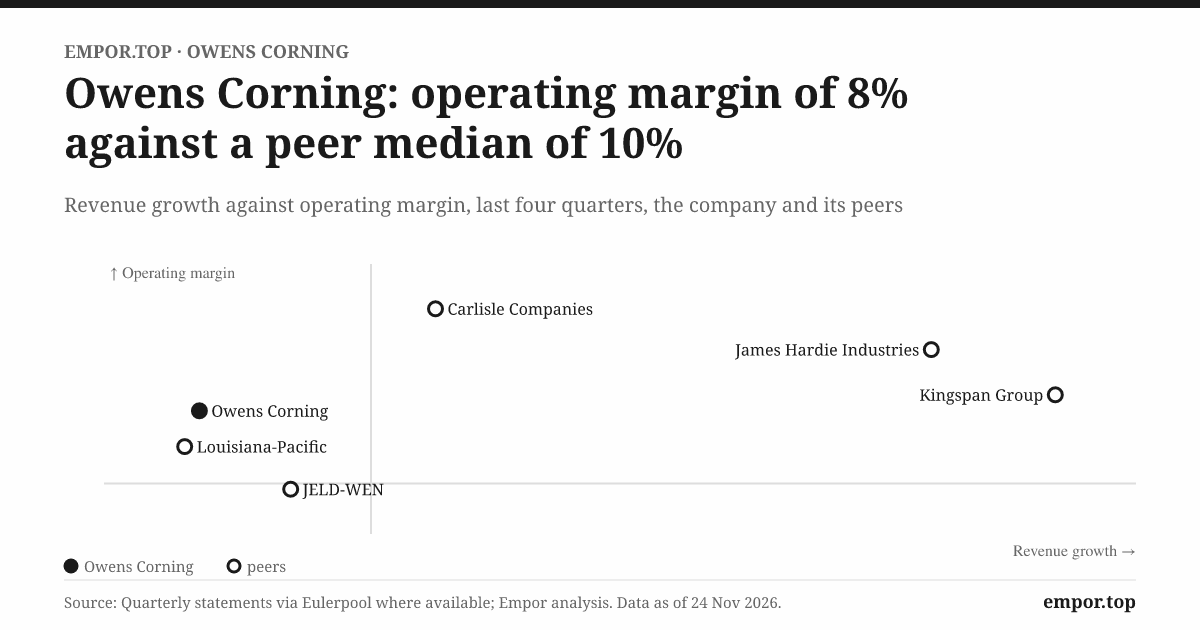
Taken together, these lessons describe a company with two very different skills. It is excellent at running a manufacturing franchise in a consolidated industry, and it has a mixed record when it reaches beyond that franchise through large acquisitions. The next section tests which of those skills the market is paying for, and where the competitive moat really lies.
XI. Porter's 5 Forces & Hamilton's 7 Powers Analysis
Imagine the war room of a rival shingle maker. On the wall is a map of North American roofing distribution, with every major distributor, every home-center chain and every contractor network marked. The question on the table is simple: can anyone take share from Owens Corning, and at what cost? Working through that question, force by force, is the best way to understand both the strength of the franchise and the limits that 2026 has exposed.
Start with the threat of new entrants, which is low. A new asphalt shingle or fiberglass insulation plant costs hundreds of millions of dollars, takes years to permit and build, and must then win shelf space from distributors who already carry the incumbents. Owens Corning's capital spending alone was about $824 million in 2025, and the company guided to about $800 million in 2026, which shows the scale of investment needed simply to maintain and modernize an existing network.16 4
In shingles, a new entrant must also earn the trust of contractors who stake their warranties and reputations on the product. The North American roofing market is dominated by a handful of producers, including GAF, CertainTeed and Owens Corning, which is the main reason pricing in the industry has generally been rational.
Supplier power is moderate. The key inputs are asphalt, glass raw materials, energy and chemicals, and their prices can swing sharply. Owens Corning reduces its exposure by processing asphalt in its own facilities, but it cannot escape commodity cycles; inflation and transport costs are among the reasons it cites for its weak fourth-quarter margin guidance.4 One related-party detail is worth noting: the company buys raw materials from a supplier connected through one of its directors, purchases of about $79 million in 2025, or less than 1% of sales.16 It is small, disclosed, and not a material concern, but it is the kind of detail a careful investor keeps an eye on.
Buyer power is where the evidence is most interesting, and it is more serious than the company's brand story suggests. Two customers, which Owens Corning does not name, accounted for about 16% and 12% of its 2025 net sales, together more than a quarter of the company's revenue.16 The largest of them has grown from 12% of sales in 2023 to 16% in 2025.16 The same two customers represented 25% and 11% of receivables at the end of 2025.16
These are almost certainly large distributors or home-center chains, and their concentration means they have significant leverage over pricing, payment terms and inventory levels. The 2026 destocking is a vivid example: when large distributors decide to hold less inventory, the manufacturer's volumes fall regardless of end demand. Debtor days improved from 48 in 2015 to 34 in 2025, so the customers are paying promptly, but the concentration remains a structural constraint on pricing power.16
The threat of substitutes is moderate. Metal roofing, tile and solar shingles compete at the premium end, and spray foam, cellulose and mineral wool compete with fiberglass insulation. But asphalt shingles remain the cost-effective default for most American homes, and Owens Corning sells mineral wool itself, through Paroc in Europe. Substitution is a slow, long-term force, not an immediate threat.
Competitive rivalry is high in principle but disciplined in practice. GAF, CertainTeed and Owens Corning compete fiercely for contractor loyalty and distributor shelf space, yet the consolidated structure of the industry has allowed price increases to stick in most years. The test of that discipline is now. On the third-quarter call, Chambers said pricing would not improve materially in the fourth quarter but should improve in 2027.5 If price realization holds through a weak volume year, it is strong evidence that the industry's pricing discipline is real; if it cracks, the margins of 2021 to 2024 will look like a product of tight markets rather than durable power.
The powers that remain
Hamilton Helmer's framework asks a sharper question: which of seven sources of durable advantage does the company actually possess? Owens Corning has three, in descending order of strength.
The first is scale economies. A national network of plants, with logistics optimized over decades, lets Owens Corning deliver shingles and insulation at lower cost per unit than a smaller rival. That advantage is real and durable, but it is not unique: GAF and CertainTeed also have national scale. It protects the incumbents as a group more than it protects Owens Corning against them.
The second is branding. The Pink Panther, the protected pink color and the Owens Corning name give the company recognition with contractors and homeowners that few building-products makers enjoy. But as the lessons from the pink cat suggest, branding in this category is a tie-breaker. It supports share and some pricing, but the 2026 volume declines show that it cannot defend against weak storm demand or destocking.
The third is modest switching costs in the contractor channel, built around the company's network of certified contractors, who commit to its products in exchange for marketing support and warranty programs. Those costs exist because contractors are reluctant to retrain crews and change warranties. It is not an unbreakable lock-in, and the company does not disclose contractor retention.
What Owens Corning does not have is meaningful network effects, proprietary process power beyond what competitors can match, or a cornered resource. Its patents were opened up in 1949, and its manufacturing know-how is shared, in broad terms, by its main rivals. The moat, in short, is the moat of a strong incumbent in a consolidated industry: scale, brand and channel relationships. It is real, but it is not as wide as the margins of 2022 to 2024 implied, and the Doors business, where none of these powers has yet produced premium economics, has not inherited it.
How does the market price all of this? At about $114 a share, the company's market value is about $10 billion, and its enterprise value, including debt, is about $15.2 billion. The headline valuation multiples are distorted by the impairments: the trailing price-to-earnings ratio is meaningless while earnings are negative, and the enterprise value is about 16 times trailing EBITDA on a GAAP basis. On the company's adjusted EBITDA for the most recent four quarters, roughly $1.9 billion, the multiple is closer to eight times.1 4
For context, PPG, a coatings company, traded at about 11 times EBITDA in November 2026, and Carlisle, a commercial roofing peer, at about 14 times, though definitions differ across providers.19 20 The free cash flow yield is about 7.7%. On this evidence, the market is not paying a premium for Owens Corning's franchise. It appears to be pricing in some combination of a prolonged housing downturn, lower margins than the company's targets, and lingering doubt about the Doors business.
The balance sheet is the hinge. Total debt was about $4.9 billion at the end of September 2026, with net debt of about $4.7 billion and net leverage of 2.5 times.15 4 Fitch affirmed the company at BBB+ with a stable outlook in April 2026, but listed sustained leverage above 2.3 times and debt-funded share repurchases among the triggers for a downgrade.21 Owens Corning is now above that threshold, which helps explain why management has deferred the remainder of its shareholder return commitment. There is no near-term refinancing cliff; the next large senior note, about $499 million, is due in 2027.15 But the cushion that allowed both the Masonite purchase and the buyback program is thinner than it was.
Fitch's own forecast shows how quickly the outlook moved. When it affirmed the rating in April 2026, the agency's base case assumed lower volumes in 2026 but an EBITDA margin of roughly 19.5% to 20.5% for the year, with leverage rising to about 2.6 times by year-end and a partial recovery in 2027.21 It also projected that cash flow after capital spending would fall below 20% of debt in 2026 and 2027, one of its own negative sensitivities.21
Seven months later, the company is guiding to a fourth-quarter margin of about half that range.4 Fitch's strengths for the company—leading market positions, brands, diversification and free cash flow—remain intact, but the agency's tolerance is already being tested, and a downgrade would raise the cost of the debt that financed Masonite as its notes come due for refinancing.
Governance offers no red flags, but some notable signals. The company's auditor, PwC, issued unqualified opinions on the 2025 financial statements and on internal controls.16 Shareholders approved executive pay by a margin of roughly ten to one in 2026.22 Chambers' reported 2025 compensation was about $12.2 million, but the SEC's measure of "compensation actually paid", which reflects changes in the value of equity awards, was negative, because the share price fell.23
The chief financial officer changed in August 2026, when Jonathan Collins took over and Todd Fister moved to president and chief operating officer.24 The largest shareholders are index and quantitative managers, with Vanguard holding about 12%, BlackRock about 10% and AQR about 6%.23 25 26 There is no controlling shareholder, and the large holders that filed beneficial-ownership reports in 2026 are passive or quantitative managers rather than activists.
Three numbers will tell the story from here. The first is the Roofing EBITDA margin, the measure of whether the company's crown jewel retains its pricing power through a weak year; it fell in the third quarter and is guided lower in the fourth.4 5 The second is the Doors EBITDA margin, the measure of whether the Masonite bet can be salvaged; it fell to 5% in the third quarter.4 The third is net leverage, the measure of how much freedom management has to return capital; it stood at 2.5 times in September, above the level Fitch flagged as a downgrade risk.4 21
Where the story goes next
Tonight, Owens Corning stands at a familiar crossroads. It has a business that throws off cash, a brand that consumers recognize, and an industry structure that has historically rewarded discipline. It also has a balance sheet stretched by an acquisition that has not worked, a crown jewel exposed to the weather, and a fourth-quarter margin guide that would have seemed unthinkable two years ago.
The next moments that will decide the story are clear. The fourth-quarter results, due early in 2027, will show whether the guided collapse in margins was a trough or the start of a longer slide. The 2027 storm season will determine whether Roofing volumes snap back or whether the company faces a third quiet year. The January 2027 price increase in interior doors will test whether the Doors business can recover margin without losing volume. And the pace at which the company resumes the deferred shareholder returns will reveal how confident management really is about the cash flow outlook.
If storms return, pricing holds and Doors stabilizes with margins in the high single digits or better, Owens Corning will look like a great franchise that bought a mediocre business at the wrong time and survived it. If storm demand stays weak, pricing cracks and Doors needs further restructuring, it will look like a company whose margins were borrowed from a cycle and whose capital allocation record is weaker than its reputation. The central question of this story, whether the company that mastered factories can master capital, remains open.
There is a strange symmetry in where Owens Corning finds itself: the accidental discovery that built it, and the Masonite purchase that has so far fallen short. The company has survived worse; it survived a takeover fight, a housing crash and a bankruptcy that wiped out its shareholders.
The pink blanket is still in millions of attics, and the shingles are still on millions of roofs. What remains to be proven is whether the next generation of investors will remember this era as the company's discipline faltering, or as the moment it learned, once again, that the hardest thing in business is not making the product. It is knowing what to do with the money the product makes.
References
-
Owens Corning Reports Fourth-Quarter and Full-Year 2025 Results — Owens Corning, 2026-02-25 ↩↩↩↩↩↩↩↩↩↩↩↩↩↩↩↩
-
Owens Corning: A Toledo mainstay for 75 years — The Blade, 2013-10-27 ↩↩↩↩↩↩↩↩↩↩
-
Owens Corning Announces $3.9 Billion Acquisition of Masonite to Strengthen Position in Building and Construction Materials — Owens Corning, 2024-02-09 ↩↩↩↩↩↩↩↩
-
Owens Corning Announces Third-Quarter 2026 Results, Form 8-K Exhibit 99.1 — SEC, 2026-11-04 ↩↩↩↩↩↩↩↩↩↩↩↩↩↩↩↩↩↩↩↩
-
Owens Corning (OC) Q3 2026 Earnings Call Transcript — The Motley Fool, 2026-11-04 ↩↩↩↩↩↩↩↩↩↩↩↩↩↩
-
Owens Corning Corporation History — FundingUniverse ↩↩↩↩↩↩↩↩↩↩↩↩↩↩↩↩↩↩↩↩↩↩↩↩
-
Longtime Owens Corning leader William Boeschenstein reflects on firm's successes, challenges — The Blade, 2013-10-27 ↩↩↩↩↩↩↩↩
-
Owens Corning Bankruptcy Plan Includes $5 Billion Asbestos Fund — Insurance Journal (Associated Press), 2006-05-12 ↩↩↩↩↩↩↩↩↩
-
Owens Corning Emerges From Chapter 11, Form 8-K Exhibit 99.1 — SEC, 2006-10-31 ↩↩↩↩
-
Owens Corning Announces CEO Retirement and Succession Plan — Owens Corning, 2019-01-03 ↩↩↩↩
-
Owens Corning Completes Acquisition of FOAMGLAS Insulation Manufacturer Pittsburgh Corning — Owens Corning, 2017-06-27 ↩↩↩
-
Owens Corning's Paroc Group acquisition now completed — Paroc via Cision, 2018-02-05 ↩↩↩
-
2025 Annual Report / Form 10-K — Owens Corning, 2026-02-25 ↩↩↩↩↩↩↩↩↩↩↩↩↩↩↩↩↩↩↩
-
Owens Corning Completes Acquisition of Masonite, Form 8-K Exhibit 99.1 — SEC, 2024-05-15 ↩↩↩
-
Owens Corning Completes Sale of Glass Reinforcements Business to Praana Group — Owens Corning, 2026-05-01 ↩
-
Fitch Affirms Owens Corning at BBB+; Outlook Stable — Fitch Ratings via MarketScreener, 2026-04-09 ↩↩↩↩
-
Owens Corning Appoints Jonathan Collins as Chief Financial Officer — Owens Corning, 2026-07-29 ↩
 LinkedIn
 WhatsApp
 Reddit
 Hacker News
 Email
 Kindle
 RSS Feed
 Spotify
 Apple Podcasts
 Amazon Music
 Audible
 YouTube