Nextracker: How a Solar Pioneer Built the World's Leading Tracker Company
I. Introduction & Episode Roadmap
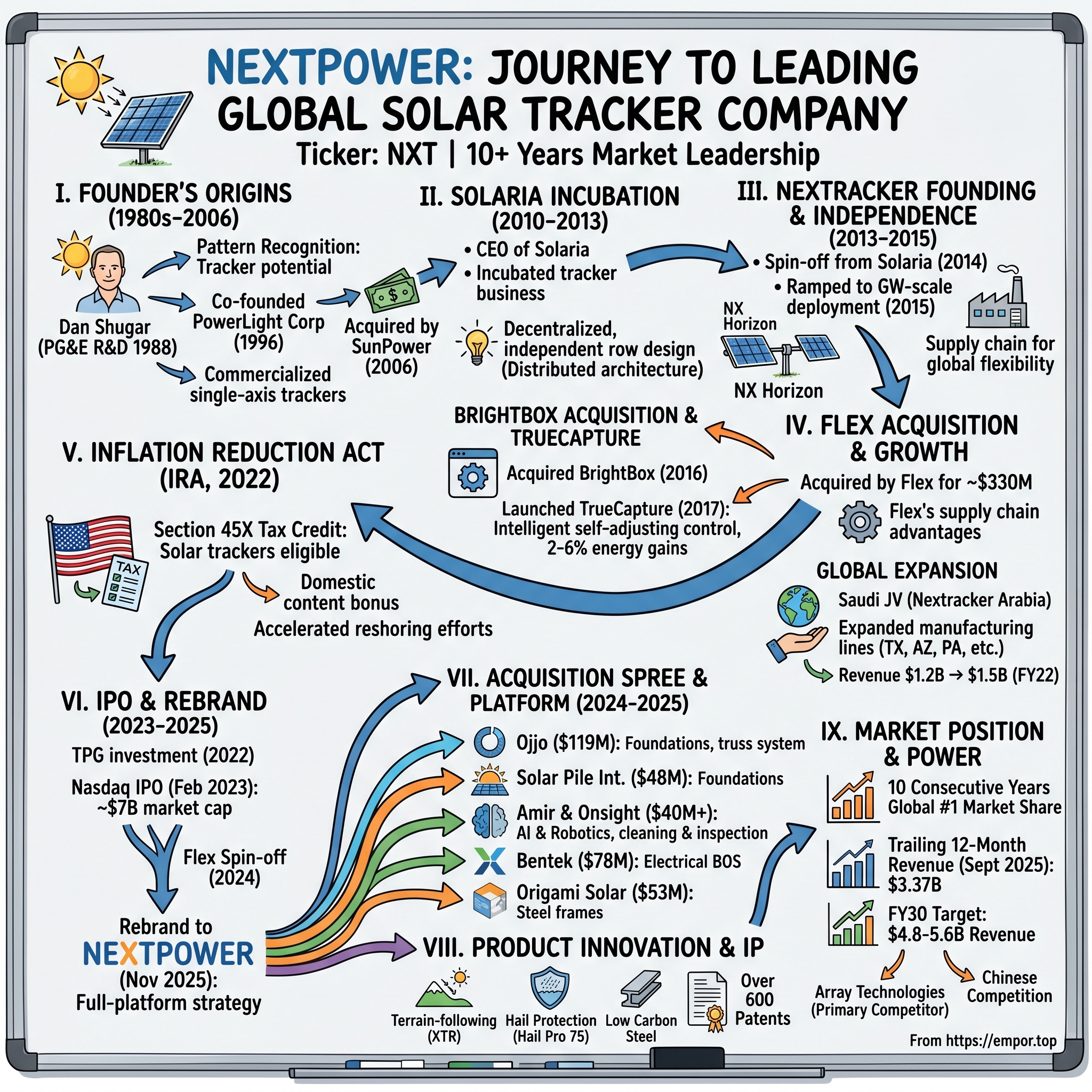
In Fremont, California, at a sprawling industrial campus that once housed semiconductor fabs and auto parts suppliers, a company with an unusual name is quietly powering the global clean energy revolution. Nextracker—now rebranded as Nextpower—doesn't make the gleaming blue solar panels that have become synonymous with renewable energy. Instead, it manufactures something far less visible but equally critical: the mechanical systems that allow those panels to chase the sun across the sky, squeezing every last electron from photons that have traveled 93 million miles to reach Earth.
As of late 2025, Nextracker has a trailing twelve-month revenue of $3.37 billion and a market capitalization that has fluctuated between $8 billion and $13 billion. The company's trajectory from a scrappy startup spun out of a solar panel maker to the undisputed global leader in solar tracking systems is a masterclass in founder-market fit, strategic timing, and the compounding power of software in what appears to be a hardware business.
Nextracker remained the top global supplier for the tenth year in a row, shipping 28.5 GW in 2024, representing about 26% of global market share. The company experienced 39% year-over-year growth in 2024. This dominance in a market that barely existed fifteen years ago raises a deceptively simple question: How did a startup spun out of a solar panel company become the undisputed global leader in a critical—but largely invisible—piece of solar infrastructure?
The answer involves a founder who has been obsessed with solar energy since the Reagan administration, a strategic acquisition by a contract manufacturer that sounds counterintuitive until you understand the supply chain dynamics, and a piece of U.S. legislation that transformed the economics of domestic manufacturing. It's a story about the power of network effects in industries where you wouldn't expect to find them, about vertical integration strategies that echo the playbooks of tech giants, and about how a company can build durable competitive advantages in what looks like a commodity hardware business.
On November 12, 2025, the company rebranded as Nextpower, marking its transformation into a full-platform company delivering an integrated portfolio of advanced technologies and services for utility-scale and distributed generation solar power plants. This rebrand represents not just a naming change but a fundamental strategic pivot—one that will determine whether Nextracker can maintain its leadership position as the solar industry matures and consolidates.
For investors seeking to understand the clean energy transition, Nextracker offers something increasingly rare: a pure-play on utility-scale solar with genuine technology differentiation, pricing power, and a domestic manufacturing footprint positioned to benefit from the reshoring trend. But the company also faces real questions about the durability of its competitive moat, the sustainability of its margins, and whether policy tailwinds can offset intensifying competition from Chinese manufacturers.
 Subscribe on LinkedIn
II. The Founder's Journey: Dan Shugar & the Origins of Solar Tracking
The story of Nextracker begins not in a Silicon Valley garage but in the unglamorous cubicles of Pacific Gas & Electric's research and development department in the late 1980s. Dan Shugar, an American business executive who would become a renewable energy pioneer, began his career in the solar industry in 1988 in the research and development department at Pacific Gas and Electric Company.
Shugar, who grew up in New Jersey, graduated from Rensselaer Polytechnic Institute with a Bachelor of Science degree in electrical engineering and later received an MBA from Golden Gate University. But his formal credentials only hint at what would become a defining characteristic: an almost religious conviction that solar energy represented not just a viable alternative but the inevitable future of electricity generation.
Working as a transmission planner at California's largest utility, Shugar witnessed firsthand the complexity of managing grid infrastructure—the daily dance of matching supply and demand, the challenge of integrating variable generation sources, the economics that governed which power plants ran and when. This utility-side perspective would prove invaluable. While many solar entrepreneurs came from technology or manufacturing backgrounds, Shugar understood the system his products would ultimately serve.
His transition to PG&E's R&D department ignited what colleagues would later describe as an obsession. Shugar was fascinated by a counterintuitive truth about photovoltaics: something with no moving parts could produce energy from nothing but sunlight. He led research demonstrating how solar could offer benefits to the electric grid—work that contributed to the development of net metering policies that would later enable the rooftop solar boom.
In 1996, Shugar joined Tom Dinwoodie, who invented a lightweight solar roof system, as co-founder of PowerLight Corporation. Shugar and Dinwoodie worked together on existing intellectual property to commercialize single-axis solar trackers and received certification for their use in the U.S. and Europe. Other innovations included a "solar inverter in a container" for use at solar power plants, an integrated residential solar roof system, and carport solutions.
The partnership between Shugar and Dinwoodie combined complementary skills in a way that would become a template for Shugar's later ventures. Dinwoodie built his Berkeley-based PowerLight Corporation from a one-man shop into a profitable multi-million-dollar company that merged with solar giant SunPower, where he served as both CTO of the acquired subsidiary and CEO.
Having pioneered and commercialized the first solar tracker in the mid-1990s, Dan Shugar has devoted his career to advancing solar technologies for the utility-scale solar power sector. This early work on tracking systems planted the seed for what would become Nextracker two decades later. The core insight was already there: solar panels that follow the sun produce significantly more electricity than fixed installations, and as panel costs continued to drop, the incremental investment in tracking hardware would increasingly pay for itself.
In November 2006, SunPower Corporation announced a definitive agreement to acquire PowerLight Corp. PowerLight was a leading global provider of large-scale solar power systems, having designed and deployed hundreds of large-scale solar systems with a total capacity of more than 100 megawatts over the past ten years. The PowerLight acquisition was expected to be immediately accretive to SunPower's non-GAAP earnings.
The total consideration for the acquisition was $265 million upfront plus a retention carve-out of $67.5 million vesting over 2 to 4 years. The aggregate consideration consisted of approximately $130 million in cash and $202.5 million in stock. This represented a significant validation of the solar systems integration business that Shugar and Dinwoodie had built.
Under Shugar's leadership at the combined PowerLight/SunPower entity, the company grew from less than $1 million to $830 million in annual revenues, with Shugar overseeing the completion of more than 500 commercial, industrial, and utility solar projects worldwide. Shugar saw the costs of solar power production drop more than eightfold since he was at solar pioneer PowerLight. That firm built the world's first 10-megawatt solar project in 2004 and was acquired by SunPower in 2007.
Prior to Nextracker, Shugar served as Chief Executive Officer of Solaria Corporation, a solar panel manufacturing company, from January 2010 to June 2013. This stint at Solaria would prove to be the incubator for his most ambitious venture yet.
What set Shugar apart from other solar industry executives wasn't just technical expertise or business acumen—it was pattern recognition honed over three decades of industry immersion. He understood that as solar panel costs plummeted toward commodity territory, the real value creation would shift to balance-of-systems components: the trackers, inverters, and software that determined how efficiently those commoditized panels performed in the field. This insight would inform everything about how he built Nextracker.
III. The Founding of Nextracker (2013-2015)
The genesis of Nextracker reads like a case study in corporate spin-offs and founder determination. In 2013, Shugar co-founded Nextracker while working at Solaria to develop a new generation of solar-tracking systems for utility-scale solar power plants. The following year, the company was spun off from Solaria after which Shugar became its CEO.
The decision to incubate a tracker business within a solar panel company might seem unusual, but it reflected Shugar's conviction that tracking systems—not panels—represented the next frontier of innovation and margin opportunity. Shugar left the CEO position at Solaria to spin out the tracker firm in 2013 after a year of incubation within the PV module maker.
What emerged from that incubation period was a radically different approach to solar tracking. The company pioneered decentralized, single-axis trackers that connect each row of solar panels to its own motor and control system. This design allows each solar panel row to move independently to position the panels toward the sun, maximizing energy yield for the entire fleet.
This independent-row architecture represented a fundamental departure from the centralized tracking systems that dominated the market. Traditional trackers used a single motor to drive multiple rows of panels through mechanical linkages—simpler in concept but vulnerable to single points of failure. If the central motor failed or a linkage broke, entire sections of a solar plant could stop tracking.
Nextracker's distributed approach was more complex but offered crucial advantages. The company's product design relied on a more distributed architecture that allowed it to more fully take advantage of price drops in motor and control technology. As motors and microcontrollers became cheaper thanks to automation and consumer electronics volume, Nextracker's per-row approach captured those cost reductions in ways that centralized systems couldn't match.
Shugar told industry observers: "I don't know anyone who has ramped a company as fast as we have." The company delivered about 275 megawatts in 2014 but was tracking well north of 1 gigawatt for the following year. The acceleration was remarkable even by Silicon Valley standards—a clean energy startup moving from concept to gigawatt-scale deployment in under two years.
The trackers could be built in the U.S., Asia, and Europe, with multiple suppliers in each product category. That manufacturing structure made Flex a common-sense choice for acquirer. From the beginning, Shugar designed Nextracker's supply chain for global flexibility, avoiding the single-source dependencies that would hamstring many clean energy hardware companies.
The NX Horizon system, which would become Nextracker's flagship product, embodied several engineering insights that competitors would spend years attempting to replicate. The base features of NX Horizon provide significant advantages, including uninterruptible power supply (UPS) for each tracker row to ensure performance during grid outages, as well as the rapid stowing capabilities of its mechanically-balanced design. This design stows up to four times faster than conventional trackers—a critical consideration given the speed at which hailstorms develop.
The balanced design meant the motors required less power to move panels because they weren't fighting gravity. The integrated UPS meant tracking continued even during grid outages—not a trivial consideration for solar plants in regions with unreliable electricity supply. And the speed of movement would later prove crucial as extreme weather events became more frequent and insurers demanded protection against hail damage.
Nancy Pfund, a partner at DBL Investors and a board member at Nextracker, observed: "As we've seen over the past year or two, solar hardware is having an investment moment. Any companies that drive down costs and/or increase performance are in a position to be attractive as the industry grows."
Pfund added: "Everyone knows that the global PV industry is growing fast, but many people don't know that utility-scale systems are growing fastest, and that trackers are one of the fastest-growing PV applications, with 17 percent of global PV installed on trackers in 2013, projected to grow to 27 percent for 2017." This observation captured the market timing that would make Nextracker's growth possible.
By the time the company was ready for its next phase of growth, it had established several key elements that would define its competitive position: a differentiated product architecture, a scalable manufacturing model, and a founder with three decades of industry relationships. The question was how to capitalize on all three.
IV. The Flex Acquisition & Growth Phase (2015-2022)
The September 2015 announcement that Flextronics—the global contract manufacturing giant—would acquire Nextracker for $330 million surprised many industry observers. Why would a company known for manufacturing smartphones and consumer electronics want a solar tracker startup?
Flex entered into a definitive agreement to acquire Nextracker, a leader in smart solar tracking solutions. Nextracker designs and manufactures one of the world's most advanced single-axis photovoltaic trackers that orients PV panels to maximize energy output. The acquisition augmented the Flex Energy business and contributed to its more than $1 billion in sales, and was expected to be accretive to Flex's growth, margin, EPS and cash flow generation.
"This acquisition aligns well with our strategy of acquiring technologies that deliver innovative, value-added solutions to our customers in industries with strong growth rates and higher margins," said Mike McNamara, CEO of Flex. "Together with our existing Energy capabilities, the NEXTracker solutions will enable Flex to further enhance our sketch-to-scale solar offerings."
Under the terms of the deal, Flex paid some $245 million initially with potential for an additional $85 million if certain performance-based milestones were achieved. The buyer also assumed an equity incentive plan.
The strategic logic became clearer once you understood Flex's supply chain advantages. The company had factories on multiple continents, established relationships with component suppliers, and deep expertise in ramping manufacturing quickly. For a tracker company facing exploding demand, these capabilities were more valuable than capital.
"The addition of the leading-edge NEXTracker business, along with its Chairman and CEO, Dan Shugar, and his team, will further expand Flex's solar capabilities in commercializing smart and connected energy technologies," said Doug Britt, president of Industrial and Emerging Industries at Flex.
"Joining Flex will enable NEXTracker to accelerate its growth while leveraging our best-in-class, innovative technologies, and a shared passion for advancing the future of renewable energy," said Nextracker's Shugar. "Flex has a solid global infrastructure, an experienced team, and world-class capabilities that will allow us to scale our solar solutions and help take our business to the next level."
Crucially, Nextracker maintained operational independence within Flex's corporate structure. Shugar remained CEO, the engineering team stayed intact, and the company continued its aggressive product development roadmap. This arrangement—autonomous subsidiary rather than absorbed division—would prove critical to maintaining the entrepreneurial culture that had fueled Nextracker's early success.
The BrightBox Acquisition and TrueCapture Launch
The year after the Flex acquisition, Nextracker made a move that would fundamentally transform its competitive positioning. In 2016, Nextracker acquired BrightBox Technologies Inc., a predictive modeling software and machine-learning technologies company. Located in Berkeley, California, BrightBox develops technologies that increase the energy yield of solar projects.
U.S. tracker manufacturer Nextracker purchased software firm BrightBox Technologies in a move it said would augment its predictive modeling capabilities and expedite the commissioning process.
"This acquisition furthers our strategy to enable smart and connected solutions for the renewable energy market," Shugar said. "By integrating the Intelligence of Things in our services and solutions, we will transition the dialogue from kilowatts to kilowatt hours and solar power plant cash flow gains."
This was more than typical acquisition-speak. The integration of BrightBox's machine learning capabilities with Nextracker's hardware platform led to something unprecedented in the industry.
This acquisition led to the development and 2017 launch of TrueCapture, an intelligent, self-adjusting tracker control system that continuously refines the tracking algorithm of each individual solar array in response to existing site and weather conditions, delivering 2% to 6% energy gains.
In July 2017, Nextracker launched TrueCapture, a first-of-its-kind intelligent, self-adjusting tracker control system for solar power plants. TrueCapture's technology continuously refines the tracking algorithm of each individual solar array.
After more than a year of stealth R&D efforts and pilot programs with select customers, Nextracker brought TrueCapture to market. The response to TrueCapture has been phenomenal. Asset owners and operators have benefited from enhanced production and maximized revenues from their power plants, while Nextracker has created an additional revenue stream and business development engine based on this highly differentiated technology.
The 2-6% yield improvement might sound modest, but in the context of utility-scale solar economics, it was transformative. Solar power purchase agreements typically lock in prices for 20-25 years. A 4% increase in annual production translates directly to 4% higher revenue for the project's entire lifetime—without any additional capital investment. For a 200-megawatt project, that could mean millions of dollars in additional value.
TrueCapture also addressed a fundamental problem with traditional tracking algorithms: they assumed ideal conditions that rarely existed in the field. Standard trackers followed the sun's theoretical position, but atmospheric conditions—clouds, haze, dust—constantly altered where the brightest light actually was. TrueCapture used real-time data from the panels themselves to optimize positioning for actual conditions rather than theoretical ones.
Part of how that was accomplished was by optimizing yield on cloudy days, when plants can actually produce 15 to 20% more energy by orienting the panels upward instead of tracking conventionally. This counterintuitive insight—that sometimes the best way to follow the sun is not to follow it at all—could only be discovered through machine learning analysis of actual plant performance data.
Global Expansion
The Flex years saw Nextracker expand far beyond its U.S. base. The company and Abunayyan Holding, a Saudi energy company, established a joint venture, Nextracker Arabia, to manufacture and supply solar trackers and control systems for utility-scale and distributed solar projects in Saudi Arabia and the Middle East and North Africa region. Headquartered in Riyadh, the venture was formed to support Saudi Arabia's target of installing 130 gigawatts of renewable-energy capacity by 2030.
Shugar noted a large system on public land in Dubai that was part of a 5 GW solar project. By comparison, that project was six times the size of the largest solar project planned in the U.S., a project called Gemini on BLM-managed land in Nevada.
The company's revenue trajectory during this period told the story of a market leader pulling away from competitors. Nextracker generated revenue of $1.2 billion in fiscal year 2020, $1.2 billion in fiscal year 2021, and $1.5 billion in fiscal year 2022. The company shipped 15 gigawatts' worth of trackers in 2022 alone.
Nextracker expanded to more than 20 U.S. manufacturing lines in Texas, Arizona, Pennsylvania, Illinois, Tennessee, and Nevada between January 2021 and August 2024. This domestic manufacturing footprint would prove prescient when U.S. energy policy shifted decisively toward reshoring.
For investors evaluating this period, the key insight is how Nextracker used the Flex umbrella to achieve scale advantages while preserving the technical and cultural elements that drove innovation. The company wasn't acquired in the traditional sense—it was accelerated. The question was whether it could maintain that momentum as an independent public company.
V. The Inflation Reduction Act (2022)
On August 16, 2022, President Biden signed into law the Inflation Reduction Act—the most consequential piece of climate legislation in American history. For Nextracker, it represented a game-changing policy tailwind that would reshape the competitive landscape.
The Inflation Reduction Act is the most significant legislation to combat climate change in our nation's history, and one of the largest investments in the American economy in a generation. Since President Biden took office, companies have announced more than $115 billion in manufacturing investments to build our clean energy economy.
Section 13502 of the IRA inserts a new section 45X into the IRC, providing a tax credit for U.S.-made wind, solar, and battery power components produced and sold after December 31, 2022, known as the Advanced Manufacturing Production Credit. To qualify for the credit, an eligible component must be produced and sold in the trade or business of the taxpayer. An eligible component is defined as any solar energy component, any wind energy component, an inverter, any qualifying battery, and any applicable critical mineral.
The solar tracker mechanical system that moves and rotates the solar modules according to the position of the sun to increase energy output is explicitly included in eligible components. This was the specific provision that transformed Nextracker's economics.
"Nextracker strongly supports the Inflation Reduction Act, which will immediately increase hiring at our U.S. factories. Together with our colleagues in the clean energy industry, this action will add over 500,000 jobs. Accelerating solar's use in the grid will lower bills for electricity customers while reducing emissions 40%."
The IRA didn't just provide manufacturing credits—it created a domestic content bonus that fundamentally altered procurement decisions. After Covid, Shugar led efforts to reshore solar tracker manufacturing to the U.S. following disruption of global supply chains. In December 2024, the company shipped the first U.S.-manufactured solar trackers with 100% domestic content.
The company achieved record revenue of approximately $3 billion and increased backlog again in Q4 to significantly above $4.5 billion. The IRA created a virtuous cycle: domestic manufacturing credits improved margins, which funded capacity expansion, which enabled more domestic content, which unlocked additional tax credits for customers.
The Company accounts for IRA 45X credits as a reduction of the purchase price of parts acquired from vendors and therefore a reduction of inventory until the part is sold. During the fourth quarter of fiscal 2024, the Company recognized a cumulative reduction to cost of sales of $121.4 million related to 45X Credit vendor rebates earned on production of eligible components shipped to projects starting on January 1, 2023 through March 31, 2024.
The financial impact was substantial: roughly $75 million per quarter in 45X credits by late fiscal year 2025, flowing directly to gross margin improvement. For a company with $700-800 million in quarterly revenue, this represented a meaningful boost to profitability.
But the IRA's impact went beyond direct tax benefits. By creating incentives for domestic manufacturing across the solar supply chain, it made the entire U.S. market more attractive for project development. More projects meant more demand for trackers. And Nextracker's established domestic manufacturing footprint—built during the Flex years—meant it was positioned to capture that demand faster than competitors scrambling to establish U.S. operations.
The policy timing aligned with Nextracker's existing reshoring strategy, creating what looked like prescient positioning but was actually a combination of conviction and fortune. Shugar had been advocating for domestic manufacturing long before it became politically fashionable—now policy was catching up with his vision.
VI. IPO & Independence (2023-2024)
The path to Nextracker's public market debut began in early 2022, when Flex sold $500 million of preferred equity to TPG Rise Climate. Flex sold $500 million of preferred equity in Nextracker to TPG Rise Climate, the climate investing platform of the global private equity firm TPG. At the time of the investment, Nextracker had an implied enterprise value of $3 billion.
Private equity firm TPG invested $500 million in Nextracker in preparation for it going public as a separate company. Nextracker shipped 15 gigawatts' worth of trackers in 2022.
The TPG investment served multiple purposes: it validated Nextracker's standalone value, provided growth capital, and established the infrastructure for a public offering. TPG Rise Climate, focused specifically on climate-related investments, brought credibility with ESG-focused investors who would be crucial to a successful IPO.
The stock began trading February 9, 2023 on the NASDAQ under the ticker symbol "NXT." TPG-backed Nextracker raised $638 million for the IPO.
Nextracker filed a registration statement with the U.S. Securities and Exchange Commission for a proposed initial public offering of shares of common stock in January 2023. In February 2023, Nextracker announced its initial public offering of 23,255,814 shares of its common stock. Flex announced that the underwriters fully exercised their option to buy 3,990,000 additional shares of Common Stock at the public offering price of $24 per share.
Eschewing the SPAC siren song, the tracker manufacturer went public in an old-school IPO that exceeded analysts' expectations. Nextracker, a company that makes solar trackers, launched its initial public offering and did it the old-fashioned way—by growing revenue and profits in a manufacturing business.
It traded on the Nasdaq with a fully diluted market value north of $3.4 billion. The company was carved out of Flex via a $500 million investment from TPG Rise Climate.
The IPO was notable for what it wasn't: not a SPAC merger, not a pre-revenue company promising future technology, not a money-losing growth story hoping for eventual profitability. Nextracker came to market as a profitable company with seven consecutive years of global market share leadership and a demonstrated ability to scale manufacturing.
The IPO closed on February 13, 2023. Sidley also represented Flex Ltd. in its sale of $500 million of convertible preferred equity in Nextracker to TPG Rise Climate in February 2022.
The Spin-Off
Less than a year after the IPO, Flex completed its exit. Founded in 2013, Nextracker was acquired in 2015 by Flex for $330 million, and it has become a leader in the U.S. solar tracker market with its integrated solar tracker and software solutions used in utility-scale and distributed generation solar power plants around the world. Under the previously disclosed terms of the transactions, Flex shareholders received approximately 0.17 shares of Nextracker Class A common stock for every Flex ordinary share held as of the record date of December 29, 2023.
"We are appreciative of our time with Flex, and are excited about our future as an independent company and the growth prospects in the solar power industry," said Dan Shugar, Nextracker founder and CEO. "Solar comprises the largest share of new power generation capacity globally, and Nextracker is well positioned to continue driving utility-scale and distributed generation solar power."
The spin-off marked the end of an eight-year relationship that had transformed Nextracker from a startup into a multi-billion-dollar market leader. For Flex, the investment had been extraordinarily successful: $330 million in 2015 became billions in shareholder value by 2024. For Nextracker, independence brought both freedom and responsibility—no more corporate parent to provide backup manufacturing capacity or balance sheet support.
In its tenth year, Dan Shugar together with the Company's original founding members, brought Nextracker to a successful IPO on February 9, 2023. With a market cap that grew to around $7 billion, Dan Shugar became responsible for leading with fiscal responsibility, market technology foresight, and a thriving and diverse global staff in the clean economy sector.
In December 2023, Nextracker announced that its founder and CEO Dan Shugar was named Chief Trailblazer of the Year at S&P Global's 25th Annual Platts Global Energy Awards. Judges selected Mr. Shugar for his leadership and contributions to industry-critical solar technology innovation supporting the global energy transition to more reliable, secure, and cleaner energy.
The recognition capped a remarkable journey: from R&D engineer at a utility to CEO of a publicly traded clean energy leader. But for Shugar, the award was less validation than fuel for the next phase of growth.
VII. Product Innovation & Competitive Moat
Understanding Nextracker's competitive position requires understanding what solar trackers actually do and why software increasingly differentiates hardware products.
At its core, a solar tracker is deceptively simple: a mechanical system that rotates solar panels to follow the sun. Horizontal single-axis trackers increase energy output by 12-25% and dual-axis trackers by 30-45% compared to fixed-tilt systems. Humid and cloudy regions were in the lowest of that range, while arid regions were in the highest range.
Scientists from the Solar Energy Research Institute of Singapore showed that combining bifacial panels and single-axis trackers is the best way to achieve the lowest levelized cost of energy in solar power projects. The tests showed that this combination can ensure a yield that is up to 35% higher than conventional systems.
Tracker structures create higher power generation as they keep panels at the optimal angle to receive the most sun rays during the day—meaning that for the same peak power an installation can generate more energy. They also have an overall lower levelized cost of electricity despite requiring higher capital expenditure, as the increased efficiency reduces the cost of electricity produced.
Solar energy projects using trackers typically generate 10% to 25% more energy and deliver around 5% lower Levelized Cost of Energy (LCOE) than projects that use fixed-tilt mounting systems. This economic advantage has driven tracker adoption in utility-scale solar, where the marginal cost improvements compound over decades-long project lifetimes.
Product Portfolio Evolution
The company offers tracking solutions, including NX Horizon, a solar tracking solution; NX Horizon-XTR, a terrain-following tracker to expand the addressable market for trackers on sites with sloped, uneven, and challenging terrain; NX Horizon Hail Pro adds automatic stowing using weather service information; and NX Horizon Low Carbon, a solar tracker solution with a reduced carbon footprint. It also provides TrueCapture, an energy yield management system; NX Anchor, a solar tracker foundation system; and NX Navigator, which assists solar power plant owners and operators in monitoring and controlling systems.
The company's terrain-following trackers adapt to a site's natural contours, reducing grading requirements, minimizing environmental impact, and expanding the viability of solar projects on landscapes with extreme terrain.
The NX Horizon XTR represented a particularly important product extension. Traditional trackers required relatively flat, graded land—which meant developers often passed on otherwise suitable sites because earthwork costs made them uneconomic. XTR's terrain-following capability expanded the addressable market by making hilly and uneven sites viable for tracked solar.
Nextracker said the XTR can save many tons of steel with shorter piles and thousands of cubic yards of cut and fill. This comes with the benefit of shortened construction schedules, minimized environmental impact, and reduced project risk.
NX Horizon Hail Pro is the comprehensive hail solution the solar industry has been waiting for, offering new stowing capabilities as well as the operator flexibility required to address the unique dangers of hailstorms. Building on the inherent hail stowing strengths of the NX Horizon tracker platform, Hail Pro adds 360° wind engineering, enhanced speed of stowing commands, expanded software tools, and tailored support services. Projects in regions facing especially severe hail risks can enhance their protection with optional features including Hail Pro-75—the industry's first tracker capable of 75° stow angles.
Projects facing severe hail risks can opt for Hail Pro 75, which boosts NX Horizon's maximum hail stow angle from 60° to 75°—shown to increase panel glass survival to greater than 90% against 3" ice balls in lab tests.
The Hail Pro product emerged directly from customer pain points. As utility-scale solar expanded into Texas and other hail-prone regions, insurers began demanding mitigation measures. Nextracker's integrated hardware-software approach—combining rapid stowing capability with weather service integration—addressed a real market need rather than engineering for its own sake.
Intellectual Property
As of March 31, 2024, Nextracker had more than 600 patents related to solar tracking hardware systems, including innovations that increase energy yields, reduce costs, and expand tracking system applications.
The patent portfolio spans multiple domains: 132 mechanical patents protecting the physical tracker designs, 52 electronics and controls patents covering the motor and sensor systems, and 171 software-driven yield improvement patents protecting TrueCapture and related optimization technologies. This breadth makes it difficult for competitors to replicate Nextracker's integrated solution without running into IP barriers.
In April 2024, the company introduced a solar tracker system with a carbon footprint that is up to 35% lower than traditional trackers. The low-carbon tracker system, which is produced with an electric arc furnace manufacturing process and uses recycled steel, received the Carbon Trust Product Carbon Footprint Label certification.
The low-carbon product reflects growing customer focus on embedded carbon in infrastructure. As utilities and corporations face pressure to reduce Scope 3 emissions, being able to specify lower-carbon trackers becomes a differentiating factor that competitors using conventional steel processes can't match.
VIII. Acquisition Spree & Platform Evolution (2024-2025)
The transformation from solar tracker company to integrated energy technology platform accelerated dramatically through a series of strategic acquisitions. The company invested over $40 million to bring robotics and AI under its belt with OnSight Technology, SenseHawk IP and Amir Robotics. It brought a foundation system provider on board when it acquired Ojjo for $119 million. Two months ago it acquired steel frame specialist, Origami Solar for $53 million.
Ojjo: Foundations
In June 2024, Nextracker acquired Ojjo in an all-cash transaction for approximately $119 million. Ojjo is a U.S.-based renewable energy company specializing in foundation technology and services used in utility-scale ground-mount applications for solar power generation.
Ojjo makes a unique truss system that reportedly uses half the steel of a conventional foundation and a design that minimizes grading requirements. Ojjo is a California-based renewable energy company specializing in unique truss systems that use half the steel of a conventional foundation. The foundation company was founded by Jack West, who also founded Zep Solar.
Ojjo is a U.S.-based renewable energy company specializing in foundation technology and services used in utility-scale ground-mount applications for solar power generation. Combining Nextracker's industry-leading smart solar tracker system with Ojjo's foundation technology will enable EPCs and solar power plant developers to benefit from a more complete, integrated solution for various soil conditions.
Ojjo has delivered more than 2 GW of truss foundations and has 600 total patents issued and pending. One of Ojjo's notable projects is Gemini, a 690 MW standalone solar and battery storage project in Nevada on Bureau of Land Management land in the Mojave Desert.
Solar Pile International
In 2024, Nextracker acquired solar PV foundations supplier Solar Pile International, located in Leetsdale, Pennsylvania, for US$48 million. The acquisition supports Nextracker's plans to provide integrated solutions for a broad range of soil conditions at utility-scale projects.
AI and Robotics
In early 2025, Nextracker expanded its artificial intelligence and robotics capabilities through the acquisitions of Amir Robotics, which provides intelligent, water-free robotic cleaning systems, and Onsight Technology, which develops AI-powered visual recognition systems for automated inspection and fire detection at solar plants. These transactions followed the company's 2024 acquisition of SenseHawk IP. Together, the acquisitions broadened Nextracker's smart operations and maintenance and modeling capabilities.
In 2025, the company established an artificial intelligence and robotics division following three acquisitions in the sector and appointed Francesco Borrelli as its first Chief AI and Robotics Officer.
Bentek: Electrical Balance of Systems
In May 2025, Nextracker acquired Bentek Corporation, a San Jose–based manufacturer of pre-assembled electrical balance-of-system (eBOS) systems, in a US$78 million cash transaction. Bentek's products, which collect and transport electricity from solar panels to power-conditioning systems, broadened Nextracker's technology platform.
Origami Solar: Steel Frames
In September 2025, Nextracker acquired Origami Solar, a Bend, Oregon–based manufacturer of roll-formed steel-frame technology, for $53 million. The acquisition allows Nextracker to shift production of certain solar panel frames from aluminum to steel, which is stronger and more durable.
The Rebrand
Today, Nextracker announced that it is changing its corporate name to Nextpower Inc. Nextpower will retain its Nasdaq ticker symbol NXT and continue operating under the same executive leadership team. The company announced its corporate rebranding to Nextpower, marking its transformation into a global supplier of fully integrated energy technology solutions.
"Our customers want coherent, integrated solutions that install faster, perform better, and operate more reliably over their lifetime," said Dan Shugar, founder and CEO of Nextpower. Shugar said the new name reflects this transformation.
"The world is in an electricity super-cycle, and solar is the primary driver, adding more capacity than any other source, at lower cost. As we expand into power conversion systems, robotics, and AI, we're enabling customer solutions engineered for the scale, reliability, and complexity of today's solar power plants." In conjunction with Capital Markets Day, Nextpower announced long-term financial targets, including $4.8 billion to $5.6 billion in revenue by FY30, with approximately one-third of revenue expected to come from sales of non-tracker products and services.
As part of its expanding technology platform, Nextpower announced the development of a new line of utility-scale power conversion systems with first shipments expected in 2026.
The company's complete product portfolio including trackers, foundations, eBOS, advanced module frames, robotics, software, yield management and control systems, and services will continue under the Nextpower brand architecture. With over 150 GW of Nextpower systems shipped capacity worldwide, the company has maintained the number one global tracker market share for 10 consecutive years. Revenue has grown from $1.9 billion (FY23) to $3.4 billion TTM through September 2025.
The acquisition spree and rebrand represent a deliberate strategic evolution. Rather than remaining a single-product company vulnerable to commoditization, Nextpower is assembling the building blocks of an integrated platform that can capture more value from each project. The bet is that customers will pay a premium for coherent, pre-integrated systems that reduce complexity and accelerate construction timelines.
IX. Market Dynamics & Competitive Landscape
The global solar tracker market is expanding rapidly but remains intensely competitive. The global solar tracker market is projected to reach USD 22.87 billion by 2029, growing at a CAGR of 17.3% from 2024 to 2029.
Nextracker remained the top global supplier for the tenth year in a row, shipping 28.5 GW, or about 26% of global market share. The company had 39% year-over-year growth in 2024. Other global market share leaders included Arctech Solar, Gamechange Solar, PV Hardware and Array Technologies. Arctech Solar, the largest Chinese-headquartered tracker supplier, jumped up market share rankings, overtaking Array, GameChange and PV Hardware.
The top three suppliers Nextracker, Gamechange and Array combined for over 90% of the U.S. domestic market. This concentration reflects the capital-intensive nature of utility-scale solar development, where developers prefer working with established suppliers who can deliver at scale.
In less than ten years, Dan founded a solar start-up in the Balance of Systems solar manufacturing category, maintained worldwide market share leadership for eight consecutive years and has shipped over 85 gigawatts of smart solar trackers to over 30 countries.
Array Technologies: The Primary Competitor
Nextracker has a much broader international presence compared to Array with significant market share in Latin America, Australia, the Middle East, and Asia in addition to North America.
Nextracker and Array Technologies dominate the solar tracking market, with Nextracker showing superior financial performance and innovation, despite Array's broader technology offerings including dual-axis systems. Both companies face increasing competition and pricing pressures, but the growing solar industry and declining costs of materials like steel offer potential for recovery. Nextracker's better capital allocation and manufacturing efficiencies position it favorably, while Array's cheaper valuation and strong FCF make it a potential value play.
Array experienced steady revenue growth through 2022, followed by a slight decline in 2023 and a more significant drop in 2024. The company attributed this downturn to project delays, supply chain challenges, permitting issues, and IRA uncertainty. However, part of the revenue decline may also reflect a loss of market share to competitors like GameChange Solar and Nextracker, which have pursued more aggressive growth strategies.
The U.S. tracker market retracted for the first time in eight years with 33 GW of shipments, down 9% from the record year in 2023. GameChange Solar ranked second among U.S. suppliers, surpassing Array Technologies, which had over a 35% drop in domestic shipments in 2024.
Chinese Competition
Arctech Solar, the largest Chinese-headquartered tracker supplier, jumped up market share rankings, overtaking Array, GameChange and PV Hardware. The company held a second-place ranking in the Saudi and Indian markets, which together combined for 28 GW of tracker demand, exceeding the demand of all of Europe in 2024. Chinese suppliers increased focus in overseas supply as domestic tracker demand declined for a second straight year.
The rise of Chinese tracker suppliers represents both a competitive threat and a market dynamic that could benefit Nextracker in certain regions. The IRA's domestic content requirements create a protected U.S. market where Chinese manufacturers face significant disadvantages. Meanwhile, Chinese competition in Asia and the Middle East is putting pressure on pricing globally.
X. Porter's Five Forces Analysis
Threat of New Entrants: MODERATE-LOW
Nextracker's portfolio of more than 600 patents creates significant IP barriers for new entrants. Capital requirements for establishing global manufacturing and distribution are substantial, and existing relationships with EPCs and developers create switching costs that protect incumbents. However, Chinese manufacturers are expanding globally, demonstrating that deep-pocketed players can enter if they're willing to compete on price.
Bargaining Power of Suppliers: MODERATE
Key inputs—steel, motors, electronics—are relatively commoditized, limiting supplier power. The Flex heritage provided Nextracker with supply chain expertise that reduces dependency on any single source. IRA-driven domestic content requirements actually strengthen integrated players like Nextracker who have established U.S. supplier relationships.
Bargaining Power of Buyers: MODERATE-HIGH
Large utility-scale project developers and EPCs have significant negotiating leverage. Projects are large and buyers are sophisticated—they understand tracker economics and can compare competing offers. Cost-sensitive EPCs, which account for 75% of Nextracker's customers, exhibit limited stickiness with tracker companies. However, customer demand for integrated solutions increases switching costs over time.
Threat of Substitutes: LOW
Fixed-tilt systems are the primary alternative, but economics increasingly favor trackers. In general, a single-axis tracking system could be about 20% more efficient than a fixed-tilt system. Combining bifacial panels and single-axis trackers delivers the lowest levelized cost of energy in most project scenarios. As panel costs continue declining, the incremental investment in tracking becomes easier to justify.
Competitive Rivalry: HIGH
Competition between Nextracker, Array Technologies, Arctech Solar, GameChange, and others is intense. Price competition is real, particularly in international markets where Chinese suppliers compete aggressively. However, Array Technologies has experienced declining revenues from their peak while Nextracker has experienced fairly consistent growth—suggesting the leading players may be diverging in performance.
XI. Hamilton's 7 Powers Analysis
Scale Economies: STRONG
With 28.5 GW shipped in 2024, Nextracker achieves massive procurement leverage on steel and components. Fixed R&D costs—including major investments in TrueCapture and new product development—spread over enormous volume provide cost advantages that smaller competitors can't match. The global manufacturing footprint inherited from Flex enables geographic optimization of production.
Network Economies: MODERATE
TrueCapture benefits from data collected across installations. The more solar plants running Nextracker systems, the more data feeds the machine learning algorithms that optimize tracking. This data advantage compounds over time—each new installation makes the optimization software marginally better for all installations. It's not quite the same as a consumer network effect, but it's meaningful in an industrial context.
Counter-Positioning: STRONG
Under Dan's leadership, Nextracker successfully pioneered and commercialized the industry's first independent-row, single-axis solar tracker systems and software solutions. This distributed architecture represented a fundamental bet that competitors organized around centralized designs were slow to match. The software-centric approach also positions Nextracker differently than competitors who view trackers primarily as mechanical hardware.
Switching Costs: MODERATE
Once developers standardize on Nextracker systems, there are training costs, process integration costs, and relationship costs associated with switching. The TrueCapture software platform creates additional stickiness—switching means abandoning optimized tracking algorithms trained on site-specific data. However, for individual projects, switching costs are relatively modest.
Branding: WEAK
In a B2B industrial context, brand matters less than demonstrated performance and total cost of ownership. Nextracker's market share leadership and track record do create preference, but projects are ultimately won on economics and technical fit rather than brand loyalty.
Cornered Resource: MODERATE
For over 30 years, Dan Shugar has led world-class solar companies. As founder and CEO of Nextracker, Dan brings together solar expertise and technology innovation in a way few cleantech leaders have. Shugar's experience and relationships represent a unique resource, though the company has built institutional capabilities that would survive his departure.
Process Power: STRONG
The combination of manufacturing efficiency (Flex heritage), software optimization (TrueCapture), and integrated product development creates process advantages that are difficult to observe and replicate. Competitors can see Nextracker's products but can't easily copy the organizational systems that produce them.
XII. Investment Considerations
Bull Case
Policy Tailwinds: Q4 FY25 and Q3 FY25 results include approximately $75 million and $52 million, respectively, of IRA 45X advanced manufacturing tax credit vendor rebates. These credits flow directly to margins and are legislatively protected through at least 2032.
Platform Expansion: Revenue targets of $4.8 billion to $5.6 billion by FY30, with approximately one-third from non-tracker products and services, suggest multiple vectors for growth beyond core tracking.
Market Leadership: Ten consecutive years of global market share leadership creates compounding advantages in customer relationships, manufacturing efficiency, and data collection for software optimization.
Demand Drivers: "The world is in an electricity super-cycle, and solar is the primary driver, adding more capacity than any other source, at lower cost." AI data center buildout is accelerating power demand while utility-scale solar remains the cheapest form of new generation.
Bear Case
Customer Concentration: Cost-sensitive EPCs account for 75% of customers and exhibit limited stickiness. This makes market share vulnerable to price competition.
Chinese Competition: Chinese suppliers are expanding aggressively in international markets as domestic demand declines. In markets without domestic content protections, pricing pressure could intensify.
Acquisition Integration Risk: The aggressive acquisition pace creates execution risk. Integrating eight acquisitions in eighteen months while maintaining product quality and customer relationships is challenging.
Policy Uncertainty: Section 70514 of the One Big Beautiful Bill Act restricts the availability of the section 45X credit, increases domestic content requirements, and phases out availability for wind by December 31, 2027. Future policy changes could reduce or eliminate manufacturing credits.
Key Metrics to Monitor
Backlog: Backlog significantly above $4.5 billion provides visibility into future revenue. Trend direction matters more than absolute level.
Gross Margin: Monitor for pricing pressure from competition and changes in 45X credit contribution. Excluding IRA credits provides the underlying operating margin trajectory.
Non-Tracker Revenue Mix: Progress toward the one-third target by 2030 indicates successful platform diversification and reduced single-product dependency.
XIII. Conclusion: The Next Phase
From a transmission planner's curiosity about photovoltaics in 1988 to a $13 billion public company reshaping how the world generates electricity, Dan Shugar's journey embodies the patient optimism required to build transformational clean energy businesses. Nextracker's evolution—from Solaria spinoff to Flex subsidiary to independent public company to newly-rebranded Nextpower—reflects an industry maturing from science experiment to infrastructure backbone.
As of March 31, 2024, the company had shipped solar tracking systems for more than 100 gigawatts of capacity to 40 countries across six continents. That's roughly equivalent to 100 nuclear power plants worth of generation capacity—built not over decades but in barely a decade.
"Nextracker completed a very strong financial year with record revenue and earnings, generating $622 million in free cash flow and ending the year with over $766 million in cash and no debt," said CFO Chuck Boynton. "Our ability to generate strong free cash flow enables the company to invest in both organic and inorganic growth initiatives to expand our platform."
The strategic question for the company—and for investors—is whether Nextpower can translate its solar tracking dominance into broader energy technology leadership. The platform expansion strategy makes sense conceptually: capture more value from each project, create switching costs through integration, and build data advantages through software that spans the entire plant lifecycle.
But platform strategies are easier to articulate than execute. Each acquisition brings integration challenges. Each new product line demands management attention. Each market expansion tests organizational capabilities. The next five years will determine whether Nextpower becomes the Salesforce of solar—a platform company commanding premium valuations—or remains a very successful but ultimately commodity-constrained hardware business.
For now, the fundamentals remain compelling: market leadership in a rapidly growing industry, policy tailwinds that protect domestic manufacturing, and a founder-CEO with three decades of pattern recognition guiding strategic decisions. The sun continues to rise each morning, and somewhere, millions of Nextracker systems are already in motion, chasing it across the sky.
 LinkedIn
 WhatsApp
 Reddit
 Hacker News
 Email
Email Kindle
 RSS Feed
 Spotify
 Apple Podcasts
 Amazon Music
 Audible
 YouTube