Novavax: The Vaccine That Arrived Late—and the Company That Had to Change
I. The $125 Million Milestone
Somewhere in Europe, in the autumn of 2026, a clinical-trial site began enrolling adults aged sixty and older and giving them a single shot that combined two vaccines. One half was Sanofi's Fluzone High-Dose, an influenza vaccine for older adults that Novavax's chief executive called market-leading. The other half was a COVID-19 vaccine invented in Gaithersburg, Maryland, by a company that had spent most of its history trying to prove it could make something the world would pay for.1 Nobody in Gaithersburg had to manufacture a dose for that trial or sell one to a pharmacy. And yet, when the Phase 3 study started, Sanofi owed Novavax $125 million.1
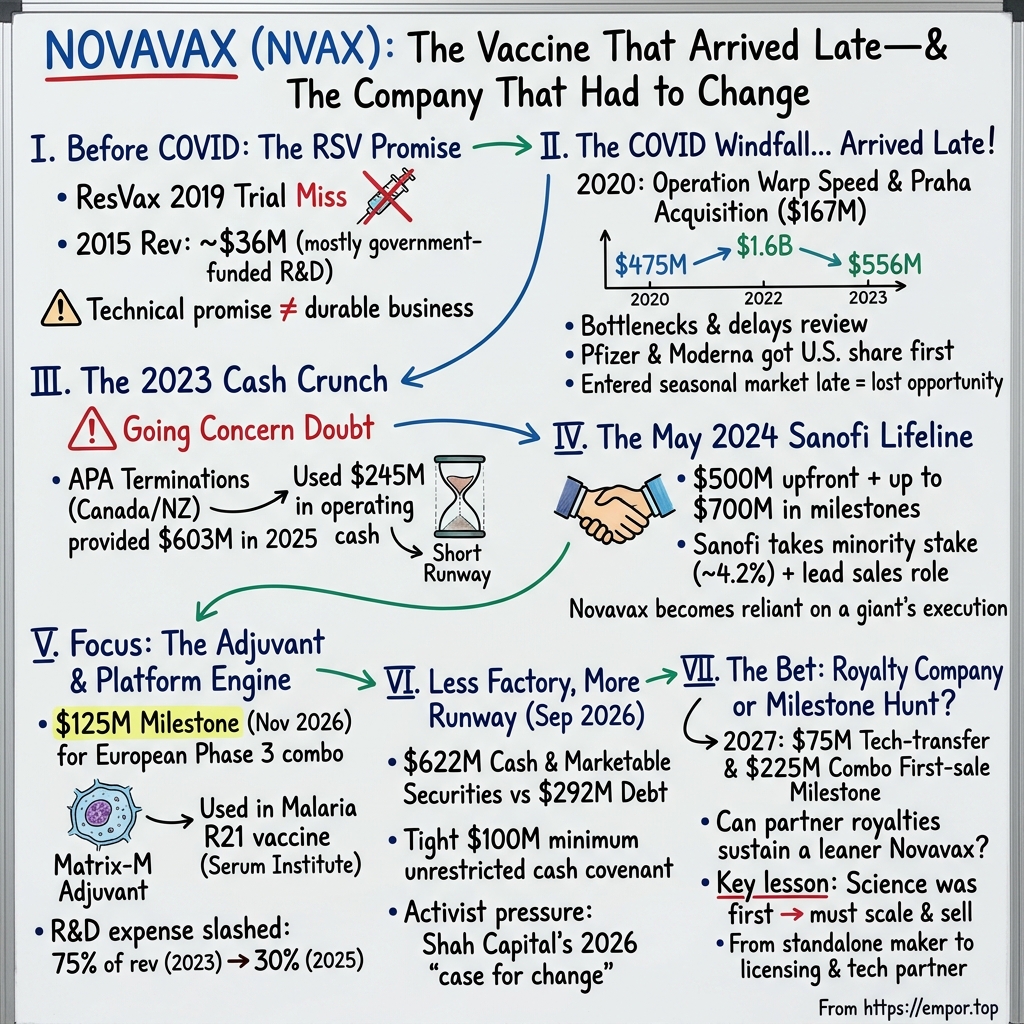
On November 5, 2026, chief executive John Jacobs opened the third-quarter call by saying the trial's initiation "triggered a one-time $125 million milestone to Novavax."1 It was a single contractual payment, and it arrived at a useful moment. In that same quarter, Novavax reported total revenue of about $68 million.2 The milestone, in other words, was worth almost two quarters of everything else the company did.
That contrast is the whole story in miniature. Novavax now earns money when someone else advances a program. A partner starts a trial, finishes a technology transfer or makes a first commercial sale, and a contractual payment drops into Novavax's account. That is real cash, and it costs Novavax very little to earn. But a trial start is an event, not a business. It does not tell anyone how many people will want the combination shot, what price Sanofi will get, or how many dollars of royalty will flow back to Maryland each winter for the next decade. The milestone is a payoff and a test at the same time.
The company's own guidance makes the point plainly. After the milestone, Novavax raised its 2026 adjusted total revenue outlook to a range of $385 million to $415 million, with $400 million at the midpoint, up from $235 million to $275 million only three months earlier.2 Almost all of that increase was the milestone itself. Strip the $125 million out, and the remaining business looks much as it did in August: some Nuvaxovid product sales, some supply sales of its adjuvant to partners, and a licensing and royalty line that includes reimbursements for work Novavax performed on Sanofi's behalf.2
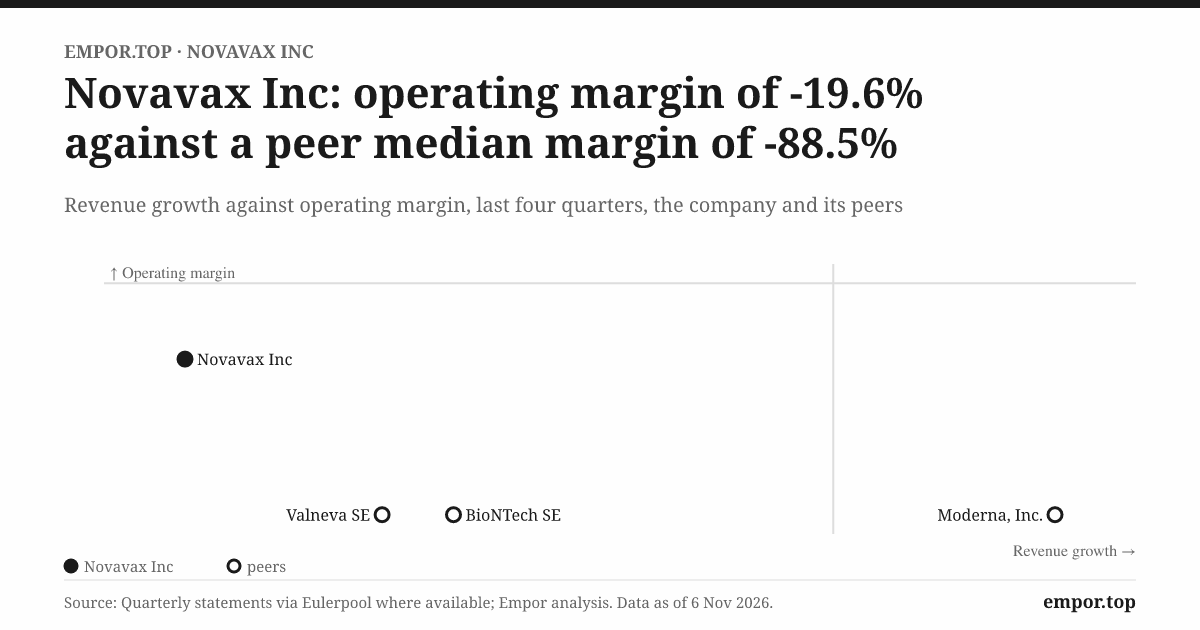
Then there is the bottom line. Over the twelve months to September 2026, Novavax lost about $76 million.3 That number would be unremarkable for a small biotech, except that only a year earlier the company had reported its first full-year profit in its history, $440 million for 2025.4 The profit was not what it looked like.
It was built largely on $603 million of revenue recognized when Canada and New Zealand terminated their pandemic-era advance purchase agreements for the vaccine, releasing money that had been paid in advance for doses that would never be delivered.4 That was a settlement of the past, not a preview of the future, and once it passed through the income statement the losses returned.
So the questions this story has to answer are not abstract. Can Sanofi and Novavax's other partners replace the scale the company had during the pandemic, when it booked well over a billion dollars a year? Can the technology Novavax owns, a protein-based vaccine design and an adjuvant called Matrix-M that makes vaccines work harder, become a source of revenue that recurs without Novavax building factories and sales forces? And, most practically, does the company have enough cash and enough time to find out before the clock runs down?
To answer them, a listener needs a map of the current company, because it is very different from the one that made headlines in 2020. Today Novavax rests on four legs. The first is a marketed COVID-19 vaccine, Nuvaxovid, which won full U.S. approval in 2025 after years under emergency authorization.4 The second is partner-led commercial sales: Sanofi now leads sales of that vaccine in most of the world and pays royalties, while Takeda, SK bioscience and the Serum Institute of India hold regional rights.54
The third is licensing Matrix-M to others who want to put it in their own vaccines. The fourth is a much smaller research engine, cut by more than half in two years, that is supposed to generate the next assets worth licensing.4
None of those legs is new as an idea. What is new is that Novavax has stopped trying to be everything at once. For most of its history, it was a company that believed in its science more than the market did. Before COVID made it famous, it spent a decade trying to prove that belief with a different virus, and the way that effort ended is the best place to start testing the claims it makes today.
 Subscribe on LinkedIn
II. Before COVID, the RSV Promise
For a long time, Novavax was a company defined by a single, stubborn idea. Most of the vaccines of the twentieth century worked by showing the immune system a killed or weakened virus. Novavax took a different approach. It built recombinant proteins, copies of the key surface proteins of a virus grown in insect cells, and assembled them into tiny particles that look to the immune system like the real thing without being infectious.6 Think of it as a mugshot rather than a captured suspect: the body learns what the enemy looks like without ever meeting it.
The second half of the idea came from Sweden. Protein vaccines often need help to provoke a strong immune response, so Novavax bought a small Swedish adjuvant company called Isconova, whose technology became Matrix-M.7 An adjuvant is an ingredient that acts like an alarm bell, telling the immune system that the protein it is seeing deserves attention. Matrix-M is made of particles about 40 nanometers across, built from saponin extracted from the bark of the Chilean soapbark tree, Quillaja saponaria.6 Together, the insect-cell protein and the tree-bark adjuvant were the platform Novavax pitched for the next decade.
A platform, however, does not pay salaries. In 2015, Novavax reported revenue of about $36 million, most of it from government-funded research contracts rather than products, and lost about $156 million.8 That pattern repeated year after year. The company raised money, ran trials, collected grants and lost more than it earned, under the leadership of chief executive Stanley Erck, who would steer it through the long pre-pandemic years and into COVID.8
Living that way shapes a company. A biotech without products survives by persuading investors, again and again, that the next trial will be the one. Novavax did it with equity and with debt: by the end of 2019 it carried about $322 million of borrowings, most of it convertible notes, against shareholders' equity that had turned negative.6 That meant the company owed more than its accounting assets were worth, and every year without a product made the next financing more expensive. The habit of funding science with the capital markets, rather than with customers, was set long before COVID, and it returned when the pandemic money ran out.
The product that was supposed to change that was ResVax, a vaccine against respiratory syncytial virus, or RSV, given to pregnant women so that their newborns would be protected in the first, most dangerous months of life. RSV is one of the leading causes of hospitalization in infants, and no vaccine had yet cleared the bar. It was a big, important target, and it attracted serious backing: the Bill & Melinda Gates Foundation financially supported the Phase 3 trial, called Prepare.9
On February 28, 2019, the results came in. The trial failed to meet its primary objective, the prevention of medically significant RSV lower respiratory tract infection through the first 90 days of life.9 Novavax pointed to encouraging secondary results, including a reduction in RSV-related hospitalizations, and argued that the vaccine still protected against the most serious outcomes. The market did not wait for the argument to be settled. Novavax shares fell about two-thirds in morning trading.9 By the end of 2019, revenue had shrunk to about $18 million and the company had lost about $130 million that year.6
The ResVax failure matters today for a specific reason. Novavax's current pitch rests heavily on the claim that it owns a reusable platform, a way of making vaccines that can be pointed at new diseases and licensed to new partners. ResVax is the cleanest test of that claim from the company's own record. The science produced a candidate, the candidate reached a late-stage trial with major funders behind it, and the trial generated signals worth talking about. What it did not produce was an approved product or a dollar of commercial revenue. A platform can generate candidates and trial milestones for years without ever producing the products that pay for the platform.
It would be unfair to stop there, because the story did not end with RSV. The same protein-plus-Matrix-M design later produced a COVID-19 vaccine that worked, won authorization around the world and sold in volume. And Matrix-M itself ended up inside a malaria vaccine that the World Health Organization prequalified. So the RSV miss does not prove the platform is worthless. It proves something narrower and more useful: technical promise and commercial proof are two different things, and Novavax has historically been far better at the first.
That distinction also explains why the pandemic cannot by itself validate the broad claim of pipeline productivity. COVID was a once-in-a-century market in which governments wrote checks before trials finished, regulators moved at emergency speed, and demand for any working vaccine was effectively unlimited for a time. Succeeding in that market says a great deal about whether Novavax could make a vaccine that worked. It says much less about whether the platform reliably turns ideas into products when the world is not on fire.
The long revenue arc from 2015 to 2025 sharpens the point. Revenue went from about $36 million to about $1.12 billion over the decade, which works out to about 41% a year on paper.84 But the starting point was a research contractor living on grants, and the ending point was a company whose 2025 revenue was swollen by contract terminations. Those are not two snapshots of one business growing steadily. They are snapshots of two different businesses, connected by a pandemic.
In early 2020, then, Novavax was a company with a credible protein vaccine design, an adjuvant it believed was special, a late-stage RSV failure on its record, and very little money. Then a new coronavirus arrived, and suddenly the world needed exactly what Novavax said it could build, at a scale nothing in its history had prepared it for.
III. A COVID Vaccine, After the Window Had Shifted
In the summer of 2020, the U.S. government made one of the largest bets in the history of the vaccine business on a company that had never brought a product to market. Under Operation Warp Speed, Novavax was entitled to up to $1.75 billion in federal funding to develop, manufacture and deliver its COVID-19 vaccine candidate.6 For a company whose annual revenue a year earlier had been less than $20 million, the number was almost surreal. Around the same time, governments across the world lined up to sign advance purchase agreements, committing to buy doses that did not yet exist.
The logic was sound. The mRNA vaccines being developed by Pfizer with BioNTech and by Moderna were brilliant but brand new; no mRNA vaccine had ever been approved. Novavax offered something more familiar: a protein vaccine built on the same broad principles as long-established shots for hepatitis B and shingles, which could be stored in an ordinary refrigerator rather than an ultra-cold freezer. If mRNA stumbled, or if some patients preferred a traditional technology, Novavax looked like the natural second source. Investors agreed. The company's revenue jumped from about $18 million in 2019 to about $475 million in 2020, nearly all of it from government development funding and partner agreements.6
To deliver, Novavax had to become a manufacturing company almost overnight. In May 2020 it announced the purchase of Praha Vaccines, a Czech vaccine facility, in an all-cash deal worth about $167 million.6 It also contracted with manufacturers in North Carolina, in Billingham in northern England, with capacity of up to 180 million doses a year, and with partners including the Serum Institute of India, Takeda in Japan and SK bioscience in South Korea.6 Praha was a bet on speed and control: own a plant, and you do not have to wait in line behind every other vaccine maker on earth.
The clinical results were good. In a UK Phase 3 trial, the vaccine showed interim efficacy of 89.3%, and Novavax completed enrollment of more than 30,000 adults in its U.S. and Mexico Phase 3 study, called PREVENT-19, in February 2021.6 When the FDA eventually reviewed that larger trial, it reported that the vaccine was 90.4% effective at preventing mild, moderate or severe COVID-19.10 On the science, Novavax had delivered.
The problem was everything after the science.
The factory that kept changing
A vaccine is not only a molecule. It is a manufacturing process, and regulators approve the process as much as the product, because a vaccine made in a slightly different way, in a different plant, with a different purification step, may not behave like the one tested in the trial. Novavax was scaling up across multiple sites and multiple partners at once, and its process kept changing as it went.
The FDA spelled out the consequences in the presentation it gave to its advisory committee on June 7, 2022. Novavax had requested emergency use authorization on February 1, 2022, more than a year after its trials had finished enrolling. The agency told its advisers that the manufacturing process "has changed over time," and that the submission of complete manufacturing and product information "is ongoing."11
More strikingly, the FDA said the available manufacturing information did not allow it to determine whether the vaccine used in the UK, South African and early-stage studies was comparable to the product intended for American arms, so it limited its review of those studies to safety.11 Novavax's process changes had, in effect, made some of its own evidence harder to use.
Authorization finally came on July 13, 2022.10 By then, COVID vaccines had been rolling out in the United States since December 2020.12 Pfizer and Moderna had a year and a half head start. They had shipped hundreds of millions of doses, built relationships with every pharmacy chain, and become the default answer when a doctor or pharmacist was asked which vaccine to give.
The regulatory road did not get much shorter after that. The FDA extended the authorization to adolescents aged twelve to seventeen in August 2022.12 Full approval, which would let Novavax sell like any ordinary vaccine rather than under emergency rules, took far longer. The FDA received Novavax's biologics license application on April 1, 2024, with a target action date of April 1, 2025.12 That date came and went before the approval arrived later in 2025.124
Each delay mattered less in isolation than in sequence. Shah Capital, an activist shareholder, later listed what it saw as a pattern of commercial and manufacturing missteps: a five-dose vial in 2023 that Shah called a mistake, a three-month shelf life in 2024 when six months was standard, and a late license application that Shah attributed to quality-control problems.7 Those are an activist's characterizations, not findings by the FDA. But they describe the same weakness the FDA flagged in 2022: Novavax was repeatedly slower than its rivals at turning a working vaccine into a convenient product.
Why late was expensive
It is tempting to treat Novavax's delay as a cosmetic problem: late, but eventually there. In vaccines, it was an economic problem. Vaccination works through habit, logistics and trust. Once pharmacies stock one brand, once electronic ordering systems default to it, once patients come back for their booster at the same counter, displacing that brand requires a reason strong enough to change behavior. Novavax's reason, that it was a protein rather than mRNA, appealed to a minority of patients.
It was not enough to reshuffle a market that had already formed. The FDA later recorded that only about one million doses of Novavax's COVID vaccine had been administered in the United States as of January 31, 2025, more than two and a half years after authorization.12 Against a market measured in hundreds of millions of doses, that is a rounding error.
The revenue arc tells the same story from a different angle. Revenue rose from about $475 million in 2020 to a peak of about $1.6 billion in 2022, as advance purchase agreements were fulfilled around the world.4 It then collapsed to about $556 million in 2023.4 And even at the peak, the company was not profitable: it lost about $1.7 billion in 2021 and about $657 million in 2022.4
Those were years in which Novavax was paying for global manufacturing capacity, large clinical programs and a commercial build-out while collecting revenue only when doses shipped or contracts settled. The top line turned out to be exquisitely sensitive to the things Novavax did not control: when governments wanted doses, how many they still wanted after the mRNA vaccines had saturated demand, and whether they would cancel.
Cancellations, in turn, created disputes. Gavi, the global vaccine alliance, fought Novavax over an advance purchase agreement until the matter was settled and dismissed with prejudice in February 2024; the settlement left Novavax with deferred payments to Gavi secured by its receivables from the Serum Institute of India.4 The UK terminated its supply agreement, and a disputed $112.5 million upfront payment was settled in 2024.4 Government procurement, it turned out, came with an exit door that governments were willing to use.
There was one consolation in the U.S. market, and Novavax leaned on it. By early 2024, its updated shot was the only protein-based, non-mRNA COVID-19 vaccine available in the United States, and Novavax was one of just three manufacturers with an FDA-authorized vaccine for that season.13 A niche of patients wary of mRNA, or who had reacted badly to an earlier shot, wanted exactly what Novavax sold. A niche, however, is not a mass market, and the company's cost base had been built for the mass market.
That brings the story back to Praha. Novavax paid about $167 million for the Czech plant to secure speed and control.6 When the pandemic market shrank, the plant became a cost the company could no longer justify. Novavax sold the Czech facility in 2024 and recorded a gain of about $52 million on the sale.4 A gain sounds like a happy ending, but it is measured against the plant's depreciated book value, not against everything Novavax spent buying, equipping and running it, and in 2025 the company booked a further $98 million impairment on assets held for sale as it retreated from manufacturing.4
Property, plant and equipment on the balance sheet, which had peaked at about $491 million at the end of 2023, was down to about $68 million two years later.4 Whatever Praha delivered in speed, it is hard to argue that the manufacturing build-out as a whole earned an attractive return.
So for an investor, the COVID chapter establishes two things at once. Novavax proved it could develop a vaccine that worked and sell it at scale, which the RSV years had never shown. But it also proved that manufacturing and regulatory execution, not science, was the binding constraint, and that the company paid dearly for being late to a market that rewarded being first. By early 2023, Novavax was a business built for a pandemic that had moved on, and it could no longer afford the footprint it had built.
IV. The 2023 Cash Warning—and the Sanofi Lifeline
On February 28, 2023, Novavax published its annual results and included a sentence that biotech investors dread. The company said there was substantial doubt about its ability to continue as a going concern.14 It had ended 2022 with about $1.3 billion in cash, which sounds like a lot, until one remembers what the company was spending and what it owed.14 It faced significant uncertainty about its 2023 revenue, about funding from the U.S. government and about its pending arbitration with Gavi.14 The shares fell more than 25% in extended trading, and management said it would cut costs, likely including jobs.14
The going-concern warning did not mean Novavax was about to shut its doors. It meant management could not see enough secured cash to cover its commitments over the following year without assuming things that had not yet happened. In practical terms, it turned the question from "how big can Novavax become?" into "who will fund Novavax?" Customers and partners notice that kind of language. So do suppliers and employees.
The man who had to answer was John Jacobs, who became chief executive in January 2023, weeks before the warning.157 Jacobs was not a vaccine scientist. He was a commercial executive who had previously run Harmony Biosciences, a company built around a single sleep-disorder drug, and his background was in selling products rather than inventing them.15 Novavax's chair, Margaret McGlynn, had run Merck's vaccines business.15 The new leadership's instinct was clear from the start: stop trying to be a fully integrated vaccine company and find a bigger partner with the commercial reach Novavax lacked.
The bind was real. COVID demand was falling every season, and the U.S. market was dominated by mRNA. Novavax was carrying manufacturing capacity, a commercial organization and a research budget sized for a much larger company. In 2023, research and development alone cost about $738 million, more than the roughly $556 million in revenue.4 And the company kept funding itself the way struggling biotechs do: by selling shares. In 2023 it issued about 53 million new shares for net proceeds of about $367 million.4 At the end of 2022, Novavax had about 87 million shares outstanding; by the end of 2025 it had about 165 million.4 Existing shareholders were being diluted to keep the lights on.
The deal
On May 10, 2024, Novavax announced the agreement that changed its shape. Sanofi, one of the world's largest vaccine makers, would pay $500 million upfront, with up to $700 million more in development, regulatory and launch milestones.5 Sanofi received a co-exclusive license to commercialize Novavax's COVID-19 vaccine worldwide, except in countries with existing advance purchase agreements and in India, Japan and South Korea, where Novavax's earlier partners held rights.5 Sanofi would book sales starting in 2025, and pay Novavax tiered double-digit royalties.5 Novavax now describes those royalties on Nuvaxovid sales as in the high teens to low twenties percent.2
Sanofi also took a sole license to combine Novavax's COVID vaccine with its own influenza vaccines, which is the program now in the European Phase 3 trial, and a non-exclusive license to use Matrix-M in its own vaccine products. For each new Matrix-M vaccine, Novavax is eligible for up to $200 million in launch and sales milestones and mid-single-digit royalties.52 On top of that, Sanofi bought about 6.9 million Novavax shares for about $68.8 million, a stake of roughly 4%.4
On the call that morning, Jacobs was expansive. "Today we enter a new and exciting chapter in the history of Novavax," he said, calling the agreement "both material and strategically important" and describing it as "a multi-billion dollar opportunity over time."16 He went further, predicting that "our royalties and milestones from Sanofi's efforts with Nuvaxovid" would "exceed the value of what our own efforts might have yielded."16 He also set a cost target: research plus selling, general and administrative expenses, net of Sanofi reimbursement, below $500 million in 2025.16
The numbers in that pitch deserve a careful read, because they show how deal headlines get built. Jacobs spoke of approximately $1.3 billion in cash, of which about $650 million was expected within ten days of signing.16 His CFO was more precise: about $570 million in cash payments in the second quarter of 2024, made up of the $500 million upfront and the roughly $70 million equity investment.16 The rest of the headline was contingent: milestones that depended on Sanofi hitting development and launch events, and other contract items. The upfront money was real and immediate. The larger figure was a map of possible payments, each with its own trigger.
In economic terms, the deal was a trade. Novavax gave up the commercial upside of selling its own vaccine in most of the world, and in exchange received cash now, a partner with distribution it could never afford to build, reimbursement for work it did to transfer manufacturing and support Sanofi, and a stream of potential milestones and royalties. It was a material strategic reset. For the first time since the warning, the company's survival stopped being the main question.
Partner, shareholder and largest customer
The deal also created a dependence that is easy to miss. Sanofi became Novavax's partner, a shareholder and its largest customer all at once. In 2024 it accounted for 68% of Novavax's revenue; in 2025, 36% of revenue and 76% of year-end receivables.4 That last figure means three of every four dollars owed to Novavax at the end of 2025 were owed by one company. Sanofi is a creditworthy counterparty, and there is no sign it is a payment risk. But the concentration means Novavax's revenue rises and falls with one partner's priorities. Sanofi has many vaccines to sell, and Nuvaxovid is a small one in its portfolio.
Novavax booked $440 million of net income in 2025, its first annual profit, but used about $245 million of cash in its operations.4 The gap reflected the recognition of previously paid contract-termination revenue, which reduced deferred revenue by about $623 million that year.4 Meanwhile, Novavax paid down about $323 million of payables and accrued liabilities, much of it legacy obligations from the pandemic era.4 Accounting profit and cash went in opposite directions because the accounting was catching up with the past.
Canada alone accounted for 51% of Novavax's 2025 revenue.4 A customer that accounts for half of revenue in a year because it is terminating its contract is the opposite of a recurring customer. Anyone reading 2025 as proof that the new Novavax had found a dependable earnings base was reading the wrong signal.
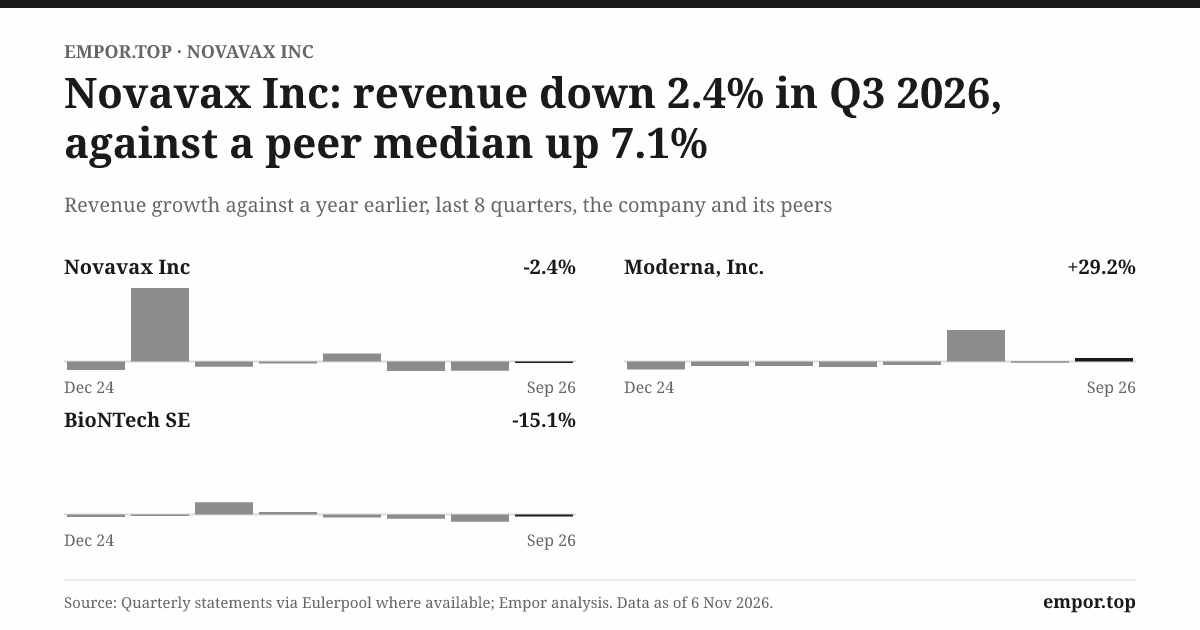
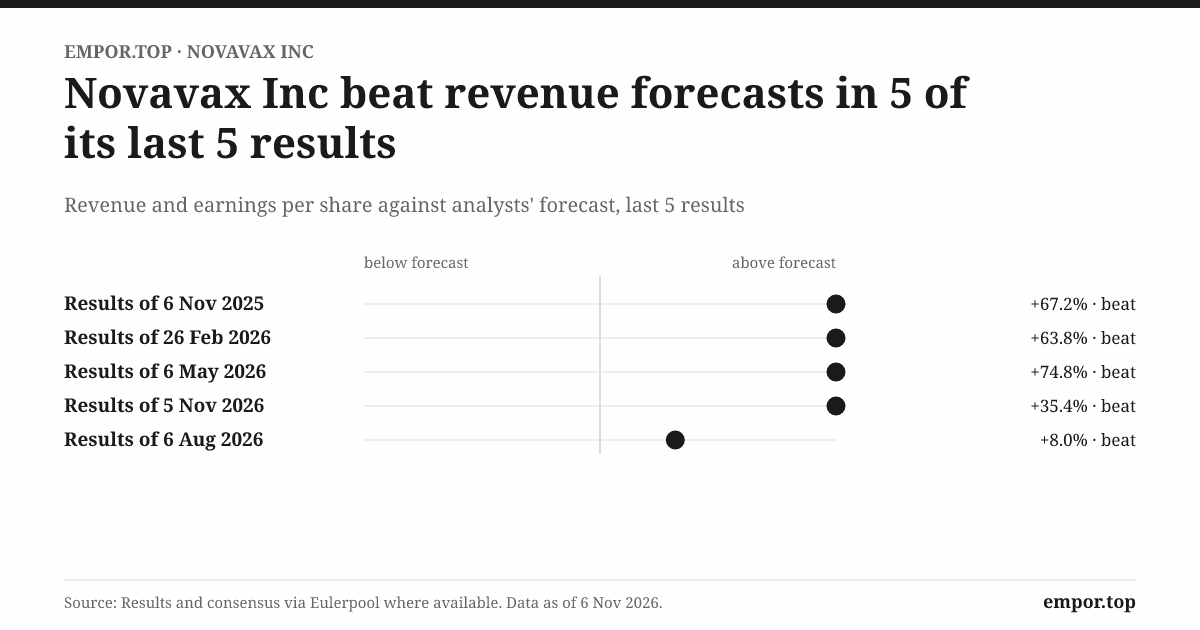
The more recent quarters show the new business more clearly, and it is smaller. Third-quarter 2026 revenue of about $68 million broke down into about $43 million of licensing, royalties and other revenue and about $26 million of product sales.2 The licensing line, down about a quarter from a year earlier, included reimbursements for work Novavax did for Sanofi, and those reimbursements are winding down as the support work nears completion. Management expects R&D reimbursement of about $60 million in 2026 and only about $5 million in 2027.2 A meaningful slice of the revenue that has been holding up the top line is scheduled to disappear.
Management's own language has evolved accordingly. In August 2026, CFO Jim Kelly said the company could reach non-GAAP profitability as early as 2028, while noting that the timing of Sanofi's combination-vaccine launch was "a primary contributor."17 By November, after Sanofi had settled on a European trial first and a U.S. Phase 3 start in 2027, management said it was updating its profitability timing to align with Sanofi's schedule.1
The U.S. combination launch, management explained, was the main path to profitability, although not the only one.1 Set that beside the "new and exciting chapter" of May 2024 and the change in tone is noticeable. In 2024, the deal was a multi-billion-dollar opportunity. In late 2026, the timing of Novavax's own profitability depends on when a trial that has not yet begun in the United States finishes, and when Sanofi's regulatory pathway with the FDA allows a launch.
That is the unresolved dependency this section leaves behind. Novavax traded the crushing cost of building its own commercial machine for reliance on a larger company's execution. Sanofi's reach is a genuine asset. But Novavax can no longer make its own fortune happen faster. What it can do is make sure that the technology it still owns is valuable enough that partners keep paying for it, which raises the question of what exactly that technology is worth.
V. What Novavax Owns—and What It Can Make Others Pay For
Consider the malaria vaccine called R21. It was designed at the University of Oxford, developed with the Serum Institute of India, and tested in a Phase 3 trial of about 4,800 children aged five to thirty-six months in four African countries.18 On December 21, 2023, the World Health Organization granted it prequalification, the seal that lets United Nations agencies buy it for eligible countries.18 Novavax did not invent the antigen, did not run the trial and does not sell the vaccine. But inside every dose is Novavax's Matrix-M adjuvant.18
That is the less visible unit of Novavax's strategy, and the one its admirers find most exciting. Shah Capital, which owns about 9% of the company, calls Matrix-M the "crown jewel" and "Intel Inside" for vaccines.7 The analogy captures the hope: a component that other companies put into their own products, paying the supplier every time they sell one. Whether the analogy holds is the central question of this section.
To answer it, it helps to follow the revenue model as a chain of events, because Novavax's income now arrives through five different doors, each opening on a different schedule. The first door is product sales: Novavax still sells Nuvaxovid in some markets, and it sells Matrix-M and vaccine supply to partners. The second is licensing revenue, booked when partners pay for rights. The third is royalties, which depend on how many doses partners sell.
The fourth is reimbursement for services, such as transferring manufacturing know-how to Sanofi, recognized over time based on costs incurred against the company's estimate of total costs.4 The fifth is milestones, triggered when partners hit development or commercial events. None of these is a subscription. Seasonality, trial timing and the judgment calls built into percentage-of-completion accounting can all make revenue lumpy.4 The auditor, Ernst & Young, flagged that last point directly: its critical audit matter for 2025 was revenue recognition on the Sanofi transition services, because it rests on management's estimates of cost to complete.4
What Novavax keeps, after all the licensing, is the underlying vaccine and adjuvant technology, some product sales and supply relationships, and development rights outside the Sanofi combination-vaccine arrangement, including its own internal programs.5 It also keeps a balance of relationships with regional partners. Takeda, SK bioscience and the Serum Institute all bought supply or rights at various points. In the third quarter of 2026, about $11 million of Novavax's revenue was the non-cash recognition of deferred royalties tied to earlier SK bioscience sales.2 That is a small but telling detail: a sixth of the quarter's revenue was an accounting release from the past rather than new money.
The contract terms themselves point to a subtle problem in the growth story. Novavax's royalty on Sanofi's sales of the standalone COVID vaccine is in the high teens to low twenties percent. Its royalty on the combination COVID-and-flu vaccine, the product that management now ties to its path to profitability, is only in the high single digits to sub-teens.2 That makes sense from Sanofi's side: the flu half of the shot is Sanofi's own blockbuster, and Sanofi is not going to pay Novavax a COVID-sized royalty on flu revenue.
But it means that every patient who switches from a standalone Nuvaxovid shot to the combination earns Novavax a smaller percentage, even if the combination expands the total market. For the combination to be a win, it has to reach far more arms than Nuvaxovid alone ever did.
The malaria proof, weighed honestly
R21 is the strongest proof point Novavax has that Matrix-M is not just a clever lab ingredient. An adjuvant that regulators and the WHO accepted in a vaccine for millions of children is commercialization evidence of a kind ResVax never produced. It shows that a third party, with its own money and its own regulatory risk, chose Matrix-M and made it work.
But the global health impact of a malaria vaccine and its economic value to Novavax are two very different numbers. R21 is meant to be bought through UN agencies for countries where malaria is endemic, and the Serum Institute, not Novavax, makes and sells it.18 What matters for Novavax shareholders is the supply revenue and royalties that actually come back, and those flow through the Serum Institute line in the company's revenue tables, which is small.
Management itself has cautioned on this front. On the November 2026 call, Kelly said the company's expected 2026 Matrix-M demand, at a midpoint of about 55 million units, "is likely up to 15 million higher than our expected future run rate."1 In other words, this year's adjuvant volumes include some catch-up or stocking that the company does not expect to repeat.
Then there are the experiments. Novavax has signed material transfer agreements, in effect arrangements that let other companies test Matrix-M in their own vaccine candidates, with several pharmaceutical and biotechnology companies, including Pfizer and Sanofi.1 Some of these experiments are in infectious disease; some are in cancer vaccines, where an adjuvant could help the immune system recognize tumors. Management said on the call that not every one of these agreements will become a deal.1 Shah Capital put it more bluntly: beyond an initial $30 million upfront payment, the scope of the Pfizer partnership "remains unclear," and the conversion of these test agreements into paying partnerships has been "lower than what shareholders would reasonably expect."7
Novavax also has its own programs. The most advanced is a vaccine against C. difficile, a gut bacterium that causes severe, often recurrent infections in hospitals. Robert Walker, who leads research and development, described it as the first candidate selected under the new strategy, adjuvanted with Matrix-M and designed to cover over 90% of circulating strains, with clinical trials expected to begin as early as 2027.1
But Elaine O'Hara, the chief strategy officer, made the intent plain: the company's "primary intent is to out-license our internal candidates."1 The new Novavax wants to create assets and hand them off. These programs are possible growth vectors, not current businesses. A C. difficile vaccine that enters the clinic in 2027 is, at best, years from commercial revenue, and on the call analysts pressed management on how its design compares with Pfizer's.1
Does Matrix-M give Novavax bargaining power?
Here the moat question has to be faced, once and honestly. Novavax's protection comes from patents on Matrix-M and its protein technology, from manufacturing know-how, from the regulatory track record that comes with the adjuvant appearing in approved vaccines, and from relationships with partners who have already built Matrix-M into their programs. Those are real. Switching adjuvants mid-development is costly, because a vaccine is approved as a whole, and a partner that has run trials with Matrix-M would have to start over to replace it.
The weaknesses are just as real. The Matrix-M license to Sanofi is non-exclusive, which means Novavax is selling a component, not a franchise.5 Its customers are among the most powerful buyers in the industry: Sanofi, Pfizer, the Serum Institute. They have alternatives, including their own adjuvants, and they can walk away from experiments that do not pay off.
Nothing in Novavax's filings shows durable pricing power, demonstrated switching costs at commercial scale, or a diversified base of royalty income. The economics Novavax has disclosed are milestone-heavy and concentrated in a handful of counterparties. What the record supports is a narrower claim than "Intel Inside": Matrix-M is a validated, differentiated ingredient with genuine optionality, whose commercial value has yet to be demonstrated beyond a few partners.
The competitive frame matters too. Pfizer and Moderna set the commercial scale of the COVID market. Sanofi brings an established vaccine franchise and a distribution machine. Novavax's potential edge is not cost, not channel and not brand. It is the protein platform and the adjuvant. That edge has to be strong enough that bigger companies want to rent it.
What, then, actually differentiates the product? Shah Capital's presentation, which is an advocate's document, pointed mostly to tolerability studies: work in Japan, Taiwan, Singapore, South Korea and Utah suggesting that recipients of Novavax's shot reported fewer side effects, and a 2026 study comparing it with Moderna's newer mRNA vaccine.7 The pitch is that Nuvaxovid causes less fever, soreness and fatigue, and that some patients would choose it for that reason.
That may be true, and it is a reasonable basis for a niche. But tolerability has not, so far, been enough to move a large share of a market in which convenience and habit sit with mRNA. A differentiated product that patients rarely ask for by name is a weaker moat than a differentiated product they demand.
Meanwhile, the engine that is supposed to create new assets has shrunk sharply. R&D spending fell from about $738 million in 2023 to about $342 million in 2025, or from roughly three-quarters of revenue to about 30%.4 In the third quarter of 2026, R&D was about $52 million, down from about $98 million a year earlier, partly because work Novavax did to support Sanofi was finishing and partly because of cost cuts.2 The company employed about 749 people at the end of 2025, down from about 1,543 in February 2024.413 Some of that reduction is simply the end of pandemic-scale manufacturing and commercial work. Some of it is research capacity that will not come back.
That leaves the core uncertainty of the licensing strategy. A leaner Novavax has to create assets that partners value enough to pay for the next wave, and it has to do so with half the people and a fraction of the research budget it once had. The last time Novavax tried to turn a late-stage vaccine candidate into a product on its own, outside the pandemic, it was ResVax, and the trial missed. The company's argument today is that partners will carry the expensive late stages. That may well be the smarter model. It also means Novavax needs time, and time, for a company that is still burning cash, is measured on the balance sheet.
VI. Less Factory, More Runway—But for How Long?
At September 30, 2026, Novavax had about $222 million in cash and equivalents and about $400 million in marketable securities, roughly $622 million in total.3 Against that, it owed about $292 million in borrowings.3 In the first nine months of the year, it had used about $200 million of cash in its operations.3 Those three numbers frame the practical question: is $622 million enough time?
Before answering, it is worth reconciling profit and cash over the long run, because Novavax's history shows how different the two can be. From 2014 through 2025, the company's cumulative net losses came to about $4.1 billion, while cumulative cash used in operations was about $2.1 billion.48 The gap is partly non-cash charges such as stock compensation and impairments, and partly the pandemic years, when governments paid cash upfront for doses before Novavax recognized revenue.
In 2021, for instance, the company lost about $1.7 billion yet generated about $322 million of operating cash, because prepayments flooded in.4 Then the process ran in reverse: those prepayments became revenue in later years without new cash, which is how 2025 produced reported profit and a cash drain in the same twelve months. The lesson for reading Novavax's statements is simple. Over this decade, neither profit nor cash has been a reliable signal on its own. They have to be read together.
What changed by late 2026 is that the cash pile is sizable and the debt is more manageable than it was. The borrowings break into three pieces. About $26.5 million of convertible notes come due in 2027, the remnant of older debt.3 About $225 million of convertible notes come due in 2031, issued in an August 2025 refinancing that cost the company a $28.7 million loss on extinguishing the old notes.347 And there is a $50 million secured term loan from MidCap Financial.3
That term loan is small, but it shapes how the company operates. It carries a first-priority lien over substantially all of Novavax's assets, which means the lender stands first in line if things go wrong.3 It bears interest at the secured overnight financing rate plus 5%, and after issuance costs the effective rate is about 11%.3 It requires Novavax to keep at least $100 million of unrestricted cash at all times.3
And it offers additional tranches the company can draw, but if unrestricted cash falls below $225 million, those tranches come with tests tied to royalty revenue.3 Novavax reported that it was in compliance at September 30, 2026.3 The structure is telling: a lender willing to provide more money only if the royalty business is performing has priced exactly the uncertainty this story is about.
Management says the runway reaches into 2029. On the November call, Kelly cited about $676 million in cash and accounts receivable and said near-term Sanofi milestones totaling $200 million, the $125 million already triggered and $75 million expected on completion of the manufacturing technology transfer in mid-2027, "support our expected cash runway into 2029."1 In August, the company had said that the $75 million milestone would extend runway from 2028 into 2029, and it set a target of maintaining at least two years of cash runway.17 The milestone payments are doing exactly what they were designed to do: buy time.
The company is also cutting. Kelly said that by 2028 Novavax expects to reduce non-GAAP research and administrative expenses by over $200 million, a decrease of more than 50% from 2025, with headcount falling to under half its early-2026 level, its physical footprint shrinking by more than half, and up to $35 million of non-cash write-offs in 2027 as facilities are consolidated.1
Those are big numbers for a company already much smaller than it was. They extend the runway. They also shrink the research engine meant to produce assets that keep partners paying. Cost cuts and capability are pulling in opposite directions, and the company has not shown where the floor is.
Pay, votes and a 9% holder
That tension is where Shah Capital's campaign comes in. Himanshu Shah, who founded the firm in 2005, presented himself as a long-term, conviction-driven investor practicing what he called "soft" activism.7 In the run-up to Novavax's June 18, 2026 annual meeting, Shah published a presentation titled "Elevating Novavax" that was anything but soft. It argued that Sanofi had underwhelmed, that the combination vaccine had been allowed to "wither with continued delays," and that the company's capital-markets moves, including the 2025 convertible refinancing, had been "costly and dilutive."7
It claimed that Nuvaxovid had won only about 1% of the U.S. COVID vaccine market in the 2025–26 season, down from 2.3% the year before.7 Those share figures are Shah's estimates, not company disclosures, but they align with the FDA's count.12
Shah's sharpest charge concerned pay. It pointed out that the board paid executives bonuses at roughly 100% of target for 2025, even though the company only partially met its objective to close additional business development deals; the compensation committee lifted a blended score of 93% to 95% by applying what it called "limited discretion."7 The proxy shows that Jacobs' reported total compensation rose from about $3.8 million in 2023 to about $5.1 million in 2024 and about $8.9 million in 2025, most of it stock and option awards.15
Jacobs beneficially owned about 1.05 million shares, according to the proxy.15 Shah's demands followed from its critique: profitability in 2026 through deeper spending cuts, a share buyback, an immediate start of the combination Phase 3, a smaller board with shareholder representation, and pay tied to "meaningful market share gains and financially meaningful partnership progress."7
How should the governance evidence be weighed? Equity-heavy pay is standard for biotech chief executives, and the value of options granted to a CEO whose share price languishes may never be realized. The strongest point in Shah's favor is not the pay level but the shareholder response. At the 2025 annual meeting, only 72.3% of votes cast supported executive pay, a meaningful level of dissent for a vote that most companies pass comfortably.15
In June 2026, the say-on-pay resolution passed with about 35.8 million votes for and 34.9 million against, a margin of barely 51%.19 Jacobs was re-elected to the board with about 27 million votes against him, roughly 38% of those cast for or against, and the other two directors on the ballot drew even more opposition.19 The amendment adding shares to the stock incentive plan, which Shah opposed, passed with about 38 million for and about 33 million against.19 Nobody lost, but the board went into the second half of 2026 knowing that close to half its voting shareholders disagreed with how executives were paid.
The ownership picture explains why the votes were close. As of April 2026, Vanguard held about 9.4%, Shah 9.0%, BlackRock 8.2%, State Street 5.8% and Bank of America 5.1%, with no controlling shareholder.15 A dedicated, concentrated holder like Shah can move a register dominated by index funds.
There are smaller financial threads worth knowing about, because they move reported results. Novavax earns interest on its cash and securities, which it invests in money-market funds, asset-backed securities and high-grade corporate debt under maturity and concentration limits.34 It also carries currency exposure, mainly to the euro and the Swedish krona, a legacy of its European operations including the Swedish adjuvant business, and it did not hedge that exposure as of its 2025 annual report.4
Foreign-exchange transaction losses were about $17 million in 2025.4 None of this changes the investment case, but in a company whose quarterly operating losses now run in the tens of millions, a currency swing or a debt-extinguishment charge can decide whether a quarter looks better or worse than it really was.
So the liquidity test going forward has three parts, all observable. The first is unrestricted cash burn each quarter after stripping out milestone receipts, which shows what the business consumes when Sanofi is not writing a special check. The second is whether Novavax draws on the additional MidCap tranches, and on what terms, since a draw would signal that cash has fallen toward the royalty-test threshold.
The third is how the 2027 convertible notes are handled: small enough to repay from cash, but a reminder of Novavax's history of dilution. The runway is real, but it is not proof that the business can fund itself. It is a deadline, and the question is what has to happen before it arrives.
VII. The Bet: A Royalty Company in the Making—or a Run of Milestones?
Imagine a pharmacy in Ohio in October 2028. A seventy-year-old walks in for a flu shot and leaves with a single injection that also protects against COVID. Sanofi's sales representatives have been pitching it to clinics for months; it carries the Fluzone name that older patients already trust. Each dose sold earns Novavax a royalty. That is the bull case in one scene, and it is not fantasy: it is the scenario the contracts were written to produce.
But not one element of it has happened yet. Sanofi has started a Phase 3 trial in Europe and says it is targeting a U.S. Phase 3 start in 2027.1 A first U.S. commercial sale would trigger a $225 million milestone, and Sanofi's timelines are, in the company's words, "preliminary."1
The test of the new Novavax, then, is not another milestone announcement. It is a season's sales.
The bull case runs through four specific mechanisms. First, Sanofi gets a combination vaccine to market. A shot that combines COVID with a leading high-dose flu vaccine solves a real problem for older adults, who need both every year, and for pharmacies, which would rather give one injection than two. Novavax would earn royalties on those combination sales, plus the $225 million first-sale milestone in the United States.2
Second, Sanofi's standalone Nuvaxovid sales continue to generate royalties.2 Third, Matrix-M could generate more partner products and associated milestone and royalty income.2 Fourth, cost reductions bring Novavax's expenses close to a royalty-scale revenue base, so that a modest stream of royalty income becomes profit rather than a down payment on losses.
Each mechanism is plausible. Together, they describe a company that looks less like a vaccine manufacturer and more like an intellectual-property holder with a small research arm, a model that can be very profitable once the royalties arrive, because royalties come with almost no cost of goods.
The bear case runs through the same four mechanisms in reverse. Seasonal COVID vaccination demand keeps shrinking, so royalties on the standalone vaccine stay small. Shah's estimate of a 1% U.S. market share for 2025–26 suggests how far that may already have gone, and Shah's complaint that Sanofi did not promote Nuvaxovid that season suggests the partner may not be pushing hard.7 Sanofi's combination launch or technology transfer slips, pushing back both milestones and royalties.
Moderna, which an analyst asked about on the November call, is developing its own combination vaccine, and if a competing combination reaches the market first, the Novavax story would repeat its oldest wound: being right on the science and late to the market.17 And the Matrix-M experiments fail to convert into commercial products, leaving the adjuvant as a source of small supply sales and occasional upfront fees.
This is not generic biotech risk. Novavax's own history raises the proof threshold for each mechanism. Its commercialization record includes the ResVax miss, the delayed U.S. authorization and a U.S. launch that never captured meaningful share. Its revenue has been concentrated in a few customers, most recently Sanofi and Canada. And its cash burn has been funded by dilution as often as by revenue. A company with that record does not get the benefit of the doubt on its own timelines.
Who holds the power
Looking at Novavax through the lens of industry structure makes the asymmetry clearer. Buyer power is the dominant force. Novavax's customers are Sanofi, governments and large manufacturers; Sanofi's concentration in receivables and government contract terminations show the leverage those customers hold.4 Supplier power is moderate: the company has said that the loss of a key supplier could delay or prevent customer orders, though it does not quantify its supplier concentration.4
The threat of substitutes is high, because mRNA vaccines already dominate COVID and other adjuvants exist. Rivalry is intense among a handful of giants, Pfizer, Moderna, Sanofi, GSK and Merck, each with far larger commercial infrastructure. The threat of new entrants into vaccines is low, because manufacturing and regulatory approval are so hard, but that barrier protects incumbents with factories and channels more than it protects a licensor.
Hamilton Helmer's framework for durable advantage gives a similar answer. Of his seven powers, the one Novavax can most plausibly claim is a cornered resource: patented technology, Matrix-M, with regulatory validation and a manufacturing process others cannot easily copy. There is a modest case for switching costs, because partners who build Matrix-M into an approved vaccine would have to rerun trials to change it.
There is no evidence of scale economies, network effects, brand power, counter-positioning or process power that would give Novavax an edge over its partners. And a cornered resource is only as powerful as the price it can command. The non-exclusive licensing terms and the concentration of revenue in a few large buyers do not yet show that Novavax can name its price. The resource is real, but it is not yet cornered.
What the market is pricing
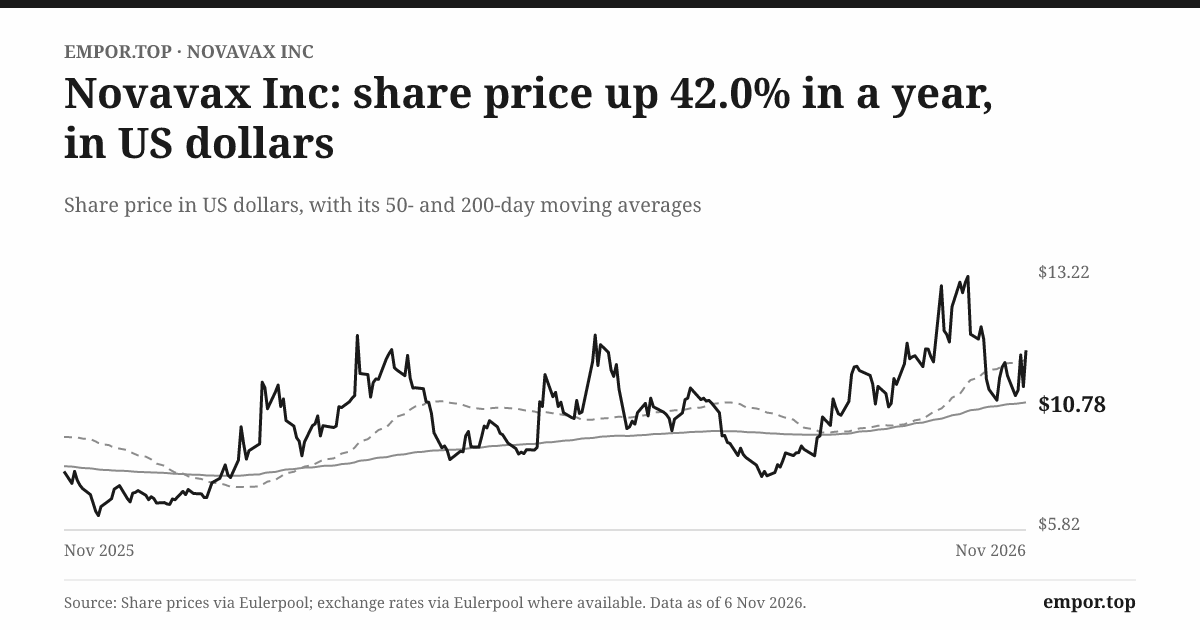
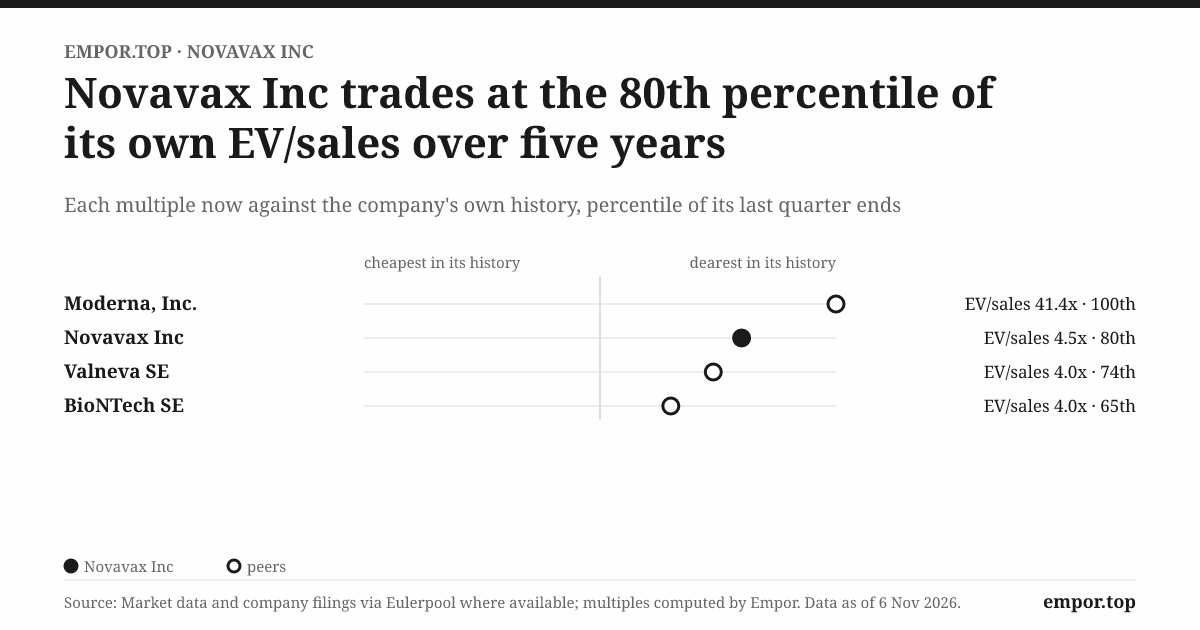
On November 6, 2026, Novavax shares closed at $10.78, valuing the company at about $1.6 billion, toward the top of a 52-week range that ran from about $6 to about $13. Its enterprise value, which subtracts net cash, was about $1.3 billion. Investors were paying about four times trailing sales on either measure. The headline price-to-earnings ratio of about 2.3 is a mirage: it uses 2025 earnings that were inflated by the Canada and New Zealand settlements, and trailing twelve-month earnings per share are negative, about minus $0.47.34
Neither multiple settles the royalty question. Four times sales would be cheap for a company with a growing, high-margin royalty stream and expensive for one whose revenue is a series of one-time payments. The price implies the market gives partial credit to the bull case, and the shares remain extraordinarily volatile, having fallen about 98% from their pandemic-era peak at their worst point over the past five years.
Three indicators will tell investors which version of Novavax is emerging. The first is realized Sanofi royalty dollars per season, the plainest measure of whether partner-led commercialization works. The company does not separately report a royalty figure, so it has to be read from the licensing and royalty line and from Sanofi's own disclosures; that line was about $43 million in the latest quarter and still included reimbursement work that is winding down.2
The second is partner and Matrix-M revenue excluding milestones, deferred amounts and reimbursements, which strips out the one-offs and shows what recurs. The third is unrestricted cash burn after milestone receipts.3
The direction of each is already visible, even if the destination is not. Licensing, royalty and other revenue fell about a quarter year on year in the latest quarter, as reimbursement work faded.2 Operating cash outflow over the first nine months of 2026 was smaller than the full-year outflow of 2025, helped by lower spending.34 And the clean, recurring partner number that would settle the debate is still buried inside lines that mix it with one-offs. Until Novavax reports a quarter in which the recurring part stands alone, investors will be inferring the most important number in the story rather than reading it.
Comparing the calls over time shows how the story has shifted. In May 2024, the emphasis was on the size of the opportunity, with Jacobs insisting the deal was worth far more than its headline of up to $1.2 billion.165 In August 2026, it was on profitability "as early as 2028" and on a two-year runway target.17 By November 2026, management had tied profitability timing to Sanofi's U.S. launch and cited milestones, cost cuts through 2028 and runway into 2029.1 Management has not hidden from the dependency. But each step has moved the decisive moment further out, and each has made the company's fate more contingent on a partner's schedule.
The investment spine, then, is this. Novavax may well be worth more as a technology and royalty partner than it ever was as a standalone vaccine manufacturer. That is the right strategic direction for a company that has repeatedly struggled to manufacture and sell. But the company has not yet demonstrated that those partner economics can sustain it, and until the royalty stream appears in the numbers, the bull case is a contract, not a business.
VIII. Playbook: Business & Investing Lessons
Go back to June 2022, to the FDA's advisory committee meeting. The FDA was telling its advisers that Novavax's manufacturing process had changed over time and that information needed to approve it was still arriving.11 That moment contains most of what Novavax has to teach.
The first lesson is that, in vaccines, being right on the science is only the first delivery. Novavax was right about protein vaccines and its adjuvant. It still lost the market to Pfizer and Moderna, which delivered doses first, and in a business where a pharmacy's default becomes a patient's habit, the second arrival inherits only what the first leaves behind. Founders in any field where regulators approve processes, not just products, should take the point to heart: the factory is part of the invention. Investors should price the manufacturing plan with the same skepticism they apply to trial data, because Novavax's trial worked and its timetable did not.
The second lesson is that a factory is an option until customers and regulators make it an asset. Novavax's $167 million Praha bet was meant to buy speed.6 The speed never fully arrived in the U.S. market that mattered, and the demand that justified the plant evaporated. Novavax later sold it and retreated from manufacturing.4 Owning capacity felt like control. In practice, it was a bet that customers would show up on time, and it paid off only if they did. In a fast-moving market, capacity bought at peak urgency is the most expensive capacity there is.
The third lesson is that a milestone can rescue a balance sheet without proving a business model. The Sanofi deal ended the going-concern scare. Then 2025 showed the trick from the other direction: termination revenue produced the company's first annual profit while the business used cash.4 Novavax's financial statements teach readers to separate money that arrives because someone is ending a relationship from money that arrives because someone is choosing to buy again. Only the second builds a company. For a royalty business, the headline payments are the trailer; the recurring checks are the film.
The fourth lesson is that partnership can shrink the cost base and move the bottleneck at the same time. By handing commercial execution to Sanofi, Novavax escaped the cost of competing with Pfizer and Moderna pharmacy by pharmacy. The bottleneck moved to Sanofi's priorities and schedule, leaving Novavax dependent on a partner's execution.4 A licensor that depends on one licensee has traded an execution problem it controlled for one it can only watch. For founders tempted by a big partner's upfront check, the question is not only what the partner pays now, but what the partner will want to sell later.
The fifth lesson is that when the share count doubles, the shareholder is the one paying for the runway. Novavax's share count nearly doubled as it funded itself through the post-pandemic collapse.4 The business survived. But survival financed by issuance hands the gains of any recovery to a much larger number of shares. Shareholders also nearly rejected executive pay in June 2026.19 For a company with no customers to fund it, the capital markets are the customer, and they charge in dilution.
Taken together, the Novavax playbook draws a line between three things that are easy to confuse: a product that works, a product that can be made at scale, and a business that earns recurring cash from it. Novavax achieved the first in COVID, struggled with the second, and is still trying to prove the third.
IX. Epilogue
Tonight, in early November 2026, Novavax is a smaller, quieter company than the one that made the news during the pandemic. It has roughly $622 million in cash and securities, about 165 million shares outstanding, a $125 million milestone booked and another $75 million expected next year.31 Its shares closed near $11. It is waiting.
The next moments that will decide its fate are already on the calendar, and each will speak to the central questions differently. The first is Sanofi's combination vaccine program. The European Phase 3 trial is running; the U.S. Phase 3 is targeted for 2027.1 A trial start is not an approval, and an approval is not a commercial sale. If the U.S. trial begins on schedule and succeeds, the $225 million first-sale milestone and the royalty stream behind it come into view. If the schedule slips, the profitability date Novavax has tied to Sanofi's launch slips with it, and the runway that stretches into 2029 starts to look shorter.
The second is the technology transfer. Novavax expects to complete the transfer of Nuvaxovid manufacturing to Sanofi by mid-2027 and to book the $75 million milestone in the third quarter of 2027, as it consolidates its facilities and takes up to $35 million of write-offs.1 That milestone is a contractual event. It proves that Sanofi can make the vaccine itself. It says nothing about how many doses Sanofi will sell.
The third is the next seasonal sales report, the one that arrives after the transition-service revenue and the pandemic settlements have faded further from the numbers. That report will show, more clearly than any before it, what Nuvaxovid royalties and partner supply are worth on their own. The company itself expects to exclude Nuvaxovid product sales from its 2027 revenue framework, a sign that it is preparing investors for a business where its own vaccine sales are no longer the point.2
The fourth is Matrix-M. The material transfer agreements with Pfizer, Sanofi and others are experiments. What would change the story is a disclosed repeat order, a signed license with a meaningful upfront payment, or a new product reaching approval with Matrix-M inside it. The C. difficile candidate entering the clinic in 2027 would be a different kind of signal: evidence that the slimmed-down research engine can still produce something partners want to buy.
It helps to picture how the outcomes would read. If Sanofi starts its U.S. trial in 2027, the technology transfer completes on schedule and the first clean royalty season shows partner revenue holding up without reimbursements, Novavax will look like what management says it is becoming: a lean licensor with a long tail of income. If the U.S. trial slips into a later year, the reimbursements vanish as planned and royalties stay small, the company will be back where it has so often been, using its cash to wait for someone else's timetable while its share count invites another round of questions from shareholders.
And if Matrix-M lands a significant new license, the story changes character entirely, because it would be further evidence that the adjuvant can create value without Sanofi at the center of it.
Set against the questions posed at the start, the evidence so far is observable but not decisive. The Sanofi deal has delivered cash and milestones. It has not yet delivered a royalty stream large enough to replace pandemic-era scale. The research engine has been cut in half and is about to be cut further. The cash buys time, and the time is finite. The open test is whether a smaller Novavax can keep enough scientific capacity to create assets while its partner network pays for that work, or whether the cost cuts that extend the runway are quietly removing the engine that was supposed to fly the plane.
X. Outro
Back in Europe, the combination-vaccine trial is still enrolling its older adults, one shot at a time. The $125 million is already in the bank,1 but the payment that matters more, and the royalties behind it, depend on everything that happens after the announcement.
Novavax has traded building and selling vaccines for a bet on licensing its science. The company that arrived late to the biggest vaccine market in history is now waiting for a trial and a winter season to turn that technology into a business.
References
-
Novavax (NVAX) Q3 2026 Earnings Call Transcript — The Motley Fool, 2026-11-05 ↩↩↩↩↩↩↩↩↩↩↩↩↩↩↩↩↩↩↩↩↩
-
Novavax Reports Third Quarter 2026 Financial Results and Operational Highlights — Novavax, 2026-11-05 ↩↩↩↩↩↩↩↩↩↩↩↩↩↩↩↩
-
Quarterly Report on Form 10-Q for the period ended September 30, 2026 — Novavax, Inc., 2026-11-05 ↩↩↩↩↩↩↩↩↩↩↩↩↩↩↩↩↩
-
Annual Report on Form 10-K for 2025 — Novavax, Inc., 2026-02-26 ↩↩↩↩↩↩↩↩↩↩↩↩↩↩↩↩↩↩↩↩↩↩↩↩↩↩↩↩↩↩↩↩↩↩↩↩↩↩↩↩↩↩↩
-
Novavax and Sanofi Announce Co-exclusive Licensing Agreement to Co-commercialize COVID-19 Vaccine and Develop Novel COVID-19-Influenza Combination Vaccines — Novavax, 2024-05-10 ↩↩↩↩↩↩↩↩
-
Annual Report on Form 10-K for 2020 — Novavax, Inc., 2021-03-01 ↩↩↩↩↩↩↩↩↩↩↩
-
Elevating Novavax: The Case for Accountability, Stronger Leadership, and Better Shareholder Value — Shah Capital, SEC filing, 2026 ↩↩↩↩↩↩↩↩↩↩↩↩↩↩
-
Annual Report on Form 10-K for 2015 — Novavax, Inc., 2016-02-26 ↩↩↩↩
-
Novavax RSV Vaccine Fails to Hit Primary Endpoint in Phase III Trial — BioSpace, 2019-02-28 ↩↩↩
-
FDA Authorizes Emergency Use of Novavax COVID-19 Vaccine, Adjuvanted — U.S. Food and Drug Administration, 2022-07-13 ↩↩
-
VRBPAC Presentation: Novavax COVID-19 Vaccine, Adjuvanted EUA Request — U.S. Food and Drug Administration, 2022-06-07 ↩↩↩
-
BLA Clinical Review Memorandum: Nuvaxovid (COVID-19 Vaccine, Adjuvanted) — U.S. Food and Drug Administration, 2025 ↩↩↩↩↩↩
-
Annual Report on Form 10-K for 2023 — Novavax, Inc., 2024-02-28 ↩↩
-
Novavax Raises Doubts About Its Ability to Remain in Business — Reuters via Investing.com, 2023-02-28 ↩↩↩↩
-
Novavax Q1 2024 Earnings Call Transcript — Stock Analysis, 2024-05-10 ↩↩↩↩↩↩
-
Novavax Q2 2026 Earnings Call Transcript — Stock Analysis, 2026-08-06 ↩↩↩
-
R21/Matrix-M Malaria Vaccine Granted Prequalification by World Health Organization — Novavax, 2023-12-21 ↩↩↩↩
-
Current Report on Form 8-K: 2026 Annual Meeting Voting Results — Novavax, Inc., 2026-06-23 ↩↩↩↩
 LinkedIn
 WhatsApp
 Reddit
 Hacker News
 Email
 Kindle
 RSS Feed
 Spotify
 Apple Podcasts
 Amazon Music
 Audible
 YouTube