Vaxcyte: Engineering the Cell-Free Vaccine Revolution
I. Introduction & Episode Roadmap
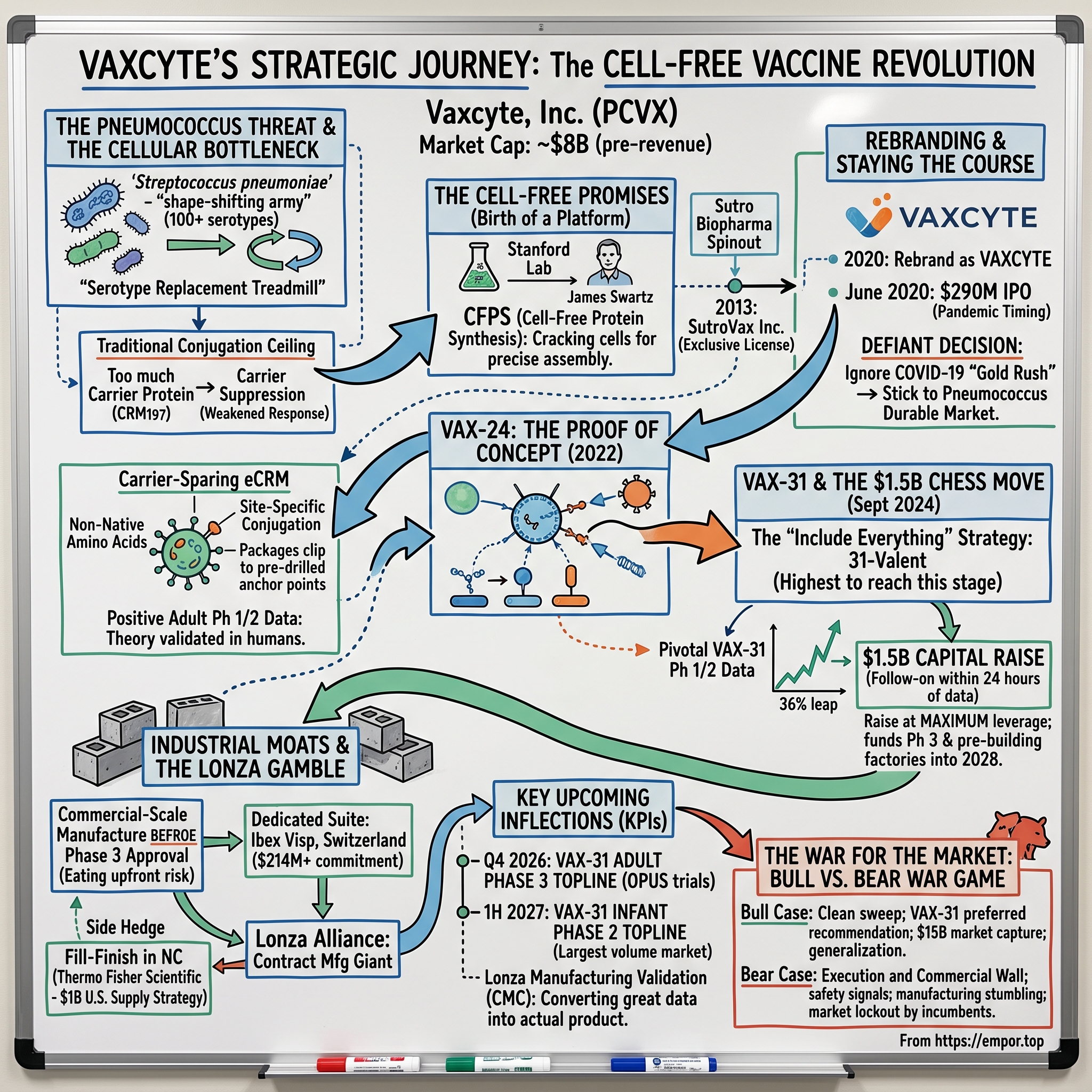
Consider a company that has never sold a single product, has never booked a dollar of revenue, and yet commands a market value of roughly $8 billion. In mid-July 2026, Vaxcyte, Inc. traded on the Nasdaq under the ticker PCVX at around $56 a share, giving it a market capitalization in the neighborhood of $8.1 billion.16 Sitting inside that valuation was one of the largest cash piles in clinical-stage biotech: $2,741.2 million in cash, cash equivalents, and investments as of March 31, 2026.[^1] In other words, roughly a third of the company's entire equity value was simply money in the bank. The other two-thirds was a bet — a very specific, very expensive bet — that a small team of protein chemists could do something the pharmaceutical industry has spent decades treating as effectively impossible.
The bet is this: that a company most people have never heard of can walk into the most lucrative vaccine market on earth and take share from Pfizer, the incumbent that essentially invented it. The pneumococcal conjugate vaccine — Pfizer's Prevnar franchise — has been for years one of the best-selling vaccine families in the world, a multi-billion-dollar annuity protected by decades of manufacturing know-how, patent thickets, and entrenched relationships with pediatricians and national immunization programs. This is the definition of a fortified position. And Vaxcyte's entire thesis is that the fortress has a structural crack in its chemistry.
Here is the technological heart of the story, stated plainly. Traditional vaccine manufacturing uses living cells as tiny factories: you engineer bacteria or other cells, feed them, and let their internal machinery build the proteins you need. It works, but it is messy, slow, and — crucially — imprecise. Vaxcyte throws the living cell out entirely. It cracks the cell open, harvests the protein-building machinery, and runs the reaction in a tank, like a controlled industrial chemistry process rather than a biological one. The claim is that this "cell-free" approach lets Vaxcyte build a better carrier protein and attach far more bacterial targets to it than a cell-based process ever could — and that this precision is exactly what the incumbent's technology cannot replicate without tearing up its own factories.
That is the pitch. This article's job is to test it, not to sell it. Vaxcyte tells an unusually clean, coherent story about itself, and much of that story appears to hold up. But an $8 billion valuation on zero revenue is a claim about a future that has not happened yet, and claims about the future deserve interrogation rather than applause.
The roadmap for what follows:
- Why the conjugate-vaccine gold rush hit a wall — the immunological bottleneck that limits how many bacterial strains you can cram into one shot.
- The Stanford laboratory and the Sutro Biopharma spinout that gave Vaxcyte its founding technology.
- The rebranding, the 2020 IPO, and the road-not-taken decision to ignore the COVID-19 gold rush.
- VAX-24: the proof-of-concept that turned a theory into a stock-moving reality.
- VAX-31: the "include everything" strategy and the $1.5 billion capital raise that followed the data by a single day.
- The Lonza manufacturing gamble, the leadership and governance record, the speculative pipeline, and finally the full bull-versus-bear war game — Porter, Helmer, and the handful of numbers that will actually decide who is right.
 Subscribe on LinkedIn
II. The Gold Rush of Conjugate Vaccines & The Cellular Bottleneck
Start with the villain of the story, because it is genuinely frightening. Streptococcus pneumoniae — the pneumococcus — is not one enemy but a shape-shifting army. It is a leading cause of pneumonia, meningitis, bloodstream infections, and ear infections, and it kills disproportionately at the two ends of life: the very young and the old. What makes it so hard to defeat is that it does not present a single face to the immune system. Each pneumococcal strain wraps itself in a distinctive outer coat of sugar — a polysaccharide capsule — and there are more than 100 of these coats, called serotypes. Beat one serotype and the others keep circulating, and worse, the ones you beat can be replaced in the population by the ones you did not. This "serotype replacement" is not a hypothetical; it is the central strategic fact of the entire market.
For most of the twentieth century, vaccines against the pneumococcus had a fatal flaw: they did not work in the people who needed them most. A vaccine made purely of the sugar coats could rouse an adult immune system, but it left infants almost unprotected, because a baby's immune system does not respond well to naked polysaccharides. The sugar alone simply does not register as a serious threat.
The breakthrough — and it is one of the great achievements of modern vaccinology — was conjugation. Chemists learned to chemically bolt the sugar coat onto a carrier protein. Think of the polysaccharide as a face the immune system struggles to remember, and the carrier protein as a name tag stapled to it that the immune system already knows how to read. The protein recruits a much more powerful, memory-forming arm of immunity, and suddenly the infant immune system learns to recognize and destroy the sugar-coated bacterium. The workhorse carrier the industry settled on is a genetically detoxified variant of diphtheria toxin called CRM197. Bolt pneumococcal sugars to CRM197, and you get a pediatric pneumococcal conjugate vaccine.
This is the chemistry that created Prevnar, and Prevnar became one of the most valuable franchises in the history of medicine — a broadly recommended childhood vaccine, given on a schedule to essentially every infant in the developed world and to hundreds of millions more through global immunization programs, later extended into the enormous adult market as well. Pfizer's Prevnar 20 won U.S. approval for adults in 2021, cementing a duopoly-style grip on both ends of the age curve.[^9] For a neutral observer, the lesson is not that Prevnar is a good product — it is that the pneumococcal vaccine is one of the stickiest, most defensible recurring-revenue machines in all of pharma, because it is baked into national vaccination schedules that change slowly and reward incumbency.
It helps to see that the market is really two markets stapled together, with very different economics. The pediatric market is about volume and permanence: essentially every infant in the developed world receives a pneumococcal conjugate vaccine on a multi-dose schedule, and once a product is written into that schedule and recommended by national committees, it enjoys near-automatic recurring demand for years. That is the crown jewel — high volume, low churn, government-anchored. The adult market is about breadth and price: older adults and those with certain conditions are vaccinated less universally, but the per-dose economics can be attractive and the addressable population is enormous and aging. Understanding this split matters because it explains why the competitive battle has different rules in each arena, and why a challenger might win one while losing the other.
Serotype replacement is the engine that keeps this whole market in motion, and it is worth dwelling on because it is counterintuitive. When a vaccine wipes out the specific strains it targets, it does not leave a vacuum — the ecological niche those strains occupied gets colonized by other, non-vaccine serotypes, which then rise to cause disease. This is why the industry has marched steadily upward in valency over the decades, from 7 serotypes to 13 to 20 and beyond: each generation knocks down a set of strains, replacement pushes new ones up, and the next vaccine has to chase them. It is a treadmill, not a finish line. For a company like Vaxcyte, that treadmill is the entire opportunity — because if the market permanently rewards covering more serotypes, then whoever can pack the most strains into a single well-tolerated shot has a structural claim to the future of the category.
So why doesn't Pfizer simply keep adding serotypes forever until it covers all hundred-plus? Here is the bottleneck, and it is the crux of Vaxcyte's entire reason to exist. Every time you add another sugar serotype to the vaccine, you have to add more carrier protein to bolt it to. Pile in enough carrier protein and the immune system starts doing something perverse: it fixates on the carrier itself instead of on the bacterial sugars you actually care about. This phenomenon — "carrier suppression" — means that beyond a certain valency, adding more strains can actually weaken the protective response to the strains already there. You are fighting your own vaccine.
Compounding the problem, traditional cell-based conjugation is chemically sloppy. When you attach sugars to a protein made inside a living cell, the linkages form more or less at random, wherever the chemistry happens to grab. That randomness can bury or destroy the very parts of the carrier protein — the T-cell "help" epitopes — that make conjugation work in the first place. So the incumbent technology faces a double ceiling: too much carrier triggers suppression, and imprecise chemistry wastes the carrier you do use. To break past roughly 20-something serotypes, the industry did not need more of the same. It needed a fundamentally more precise way to build the carrier and attach the sugars. That need is the door Vaxcyte was built to walk through — and the key had been quietly forged in a Stanford laboratory years earlier.
III. Stanford Lab to SutroVax: The Birth of Cell-Free
Every platform-technology story has a professor, and this one is James Swartz. A chemical-engineering and bioengineering professor at Stanford who had earlier spent years at Genentech, Swartz spent much of his academic career on a heretical-sounding question: what if you didn't need the living cell at all? For decades, industrial protein production meant coddling colonies of living E. coli or mammalian cells — feeding them, keeping them alive, and coaxing them to manufacture your protein internally, on their own terms. Swartz's insight was that the useful part of the cell is not the cell. It is the machinery inside it — the ribosomes, transfer RNAs, enzymes, and energy systems that actually read genetic instructions and stitch amino acids into proteins.12
So his lab did something that sounds almost violent: they lysed the cells — broke them open — and harvested that internal machinery as a liquid extract. Then they ran the whole process of transcription and translation in an open reaction vessel, adding the genetic template and the raw materials directly, with no living organism anywhere in sight. This is cell-free protein synthesis, or CFPS. The analogy that helps: conventional biomanufacturing is like hiring a live chicken and hoping it lays the egg you want, on its schedule, inside a shell you cannot open. Cell-free synthesis is like taking the egg-making machinery out onto a bench where you control every input and can watch the reaction happen in real time. The reward for that control is precision — and, critically, the ability to build proteins the living cell would never tolerate, including proteins studded with unnatural, engineered building blocks.
Swartz's technology first spun into a company called Sutro Biopharma, founded in the early 2000s to commercialize the platform — branded XpressCF — initially for complex cancer drugs, especially antibody-drug conjugates, where the same trick of precisely placing chemical attachment points on a protein is enormously valuable.12 For years, that oncology focus was the whole plan. But sitting inside the technology was a second, less obvious application that two people recognized.
Those two were Jeff Fairman, a biochemist steeped in the science, and Grant Pickering, a veteran biotech operator. Their realization was elegant: the hardest problem in next-generation conjugate vaccines is building a better carrier protein with attachment points in precisely chosen locations — and precise placement of engineered building blocks is exactly what cell-free synthesis does better than any living cell. If carrier suppression and sloppy chemistry were the ceiling, cell-free synthesis was the ladder over it.
In November 2013, that idea was carved out as a separate company: SutroVax, Inc. It secured an exclusive worldwide license to use the XpressCF platform specifically to discover and develop vaccines against infectious disease — a clean division of the territory, with Sutro keeping oncology and other non-infectious applications.13 The arrangement left Sutro with an economic tail: a royalty on future human vaccine net sales from the technology it had licensed out.
Two features of this founding structure deserve a diligence flag, because they persist to this day. The first is dependency. Vaxcyte's entire technological edge is built on a platform it licenses rather than owns outright — a foundation invented in a Stanford lab and controlled through an agreement with Sutro. Licensed-in core technology is common in biotech and not inherently a problem, but it does mean the company's crown-jewel capability rests on contractual terms and a relationship with a third party, which is a different risk profile than owning the intellectual property free and clear. The second is that cell-free protein synthesis was, for most of its history, treated by the mainstream of biomanufacturing as a fringe curiosity — clever, academically elegant, but unproven at the scale and reproducibility that regulated vaccine production demands. Betting a company on a modality the establishment had largely dismissed is precisely the kind of contrarian, high-variance wager that produces either a genuine platform breakthrough or an expensive cul-de-sac. Which one it is has been, and remains, the central empirical question.
The value of that royalty tail is worth pausing on, because the market later put a hard number on it. In June 2023, Sutro Biopharma sold its 4% royalty interest in Vaxcyte's future product sales to Blackstone. Blackstone paid $140 million upfront and agreed to pay up to an additional $250 million upon hitting return thresholds — a deal worth up to $390 million in total.3 Sit with that. Institutional capital was willing to pay nine figures, up front, for a slice of revenue from products that did not yet exist and might never be approved. That is a striking external vote of confidence in the platform — but it is also exactly the kind of signal a skeptic should treat carefully, because a royalty buyer is making a probabilistic bet across a portfolio, not certifying that any single vaccine will reach the market. What the Blackstone deal really proved was that the option had value. Whether the option would pay off still rested entirely on the clinic. First, though, the company built on that Stanford chemistry needed a new name and a war chest.
IV. Rebranding, The 2020 IPO, & Staying the Course
By 2020, SutroVax had a problem that is enviable in hindsight but nerve-wracking in the moment: it had a maturing pipeline, a platform ready for prime time, and a name that permanently tethered it to its former parent. So in May 2020, the company rebranded as Vaxcyte, Inc. — a clean identity for a company about to ask public markets to fund the most expensive phase of its life.
The timing was, to put it mildly, strange. Vaxcyte went public in June 2020, priced its shares at $16.00, and raised $287.5 million in gross proceeds after the underwriters exercised their option in full.2 Read that date again: June 2020. The world was three months into a pandemic. Capital markets were convulsing. And the entire investment universe was suddenly obsessed with one thing — COVID-19 vaccines — while a small pneumococcal-vaccine company slipped through the IPO window to raise money for a boring, decades-old bacterial disease.
The rebranding itself was more than cosmetic. Shedding the "Sutro" in the name was a deliberate act of independence — a signal to investors that this was no longer a subsidiary-minded offshoot but a standalone clinical-stage company with its own identity, its own pipeline, and its own claim on capital. Names carry information in public markets, and a company about to ask for hundreds of millions of dollars had a reason to present itself as a principal rather than a spinout. At the time of the offering, Vaxcyte was still pre-clinical-inflection: its lead pneumococcal candidate had yet to deliver the human proof-of-concept data that would come two years later, which meant public investors in June 2020 were underwriting a platform and a plan, not a validated product. Raising nearly $290 million on that basis, in the teeth of a pandemic, was itself a vote that the story was compelling enough to fund ahead of proof.
That contrast defines the most revealing strategic decision of Vaxcyte's early public life. As Moderna and BioNTech vaulted from mid-cap curiosities to household names on the back of mRNA COVID vaccines, the pressure on every adjacent biotech to pivot toward the pandemic was intense. Investors were rewarding COVID exposure with eye-watering multiples. It would have been the easy applause line. Vaxcyte, under Pickering, declined. The company kept its resources pointed at the pneumococcus.
Why does this choice matter analytically, beyond making for a good origin story? Because it tells you something durable about how management thinks, and that behavioral evidence is more valuable than any mission statement. The COVID vaccine market turned out to be a boom-and-bust commodity: enormous initial demand followed by a brutal cliff as the acute phase faded, pricing collapsed, and a crowd of entrants fought over shrinking volumes. The pneumococcal market has the opposite shape — a stable, high-margin, recommendation-driven franchise embedded in permanent childhood and adult immunization schedules. A vaccine on the pediatric schedule is close to an annuity; a pandemic vaccine is closer to a fad with a fuse on it. Refusing the fashionable market to stay in the durable one was, in retrospect, a disciplined reading of where long-term value actually lived.
There is a temptation to over-romanticize this as visionary genius. The neutral framing is more modest but more useful: Vaxcyte stuck to the thing it was actually good at, in a market whose economics it understood, and avoided diluting focus into a hyper-competitive arena where it had no structural edge. That is not clairvoyance. It is discipline — and discipline, demonstrated repeatedly, is the trait that separates biotechs that survive their own ambition from those that don't. The COVID abstention was the first data point in a pattern that would define the company: pick the durable prize, then execute against it relentlessly. The question the market still needed answered was whether the underlying science actually worked in a human body. That answer arrived in the fall of 2022.
V. The Carrier-Sparing Breakthrough: VAX-24 & The Proof of Concept
For eight years, Vaxcyte's entire thesis had lived on slides and in test tubes. The elegant argument about carrier suppression, precise chemistry, and a better protein was compelling — and completely unproven in people. In science as in markets, a beautiful theory is a liability until data either confirms or kills it. On October 24, 2022, Vaxcyte's theory met its first real test.
To understand what was being tested, you have to understand the "secret sauce," which the company calls eCRM — an enhanced version of that industry-standard CRM197 carrier protein. Using the cell-free system, Vaxcyte can insert non-native amino acids — synthetic building blocks that do not exist in nature's standard 20-letter alphabet — at precise, predetermined positions along the carrier protein. Those engineered positions become clean, exclusive "docking ports" for attaching the sugar coats. The payoff is site-specific conjugation: instead of sugars bolting on randomly and blindly, they attach only where the chemist decided, leaving the protein's critical immune-activating regions intact. The pitch is that this lets you attach more serotypes to less carrier without triggering the suppression wall — "carrier-sparing," in the company's language.
A fuller analogy makes the innovation concrete. Imagine the carrier protein as a shipping pallet, and each sugar serotype as a package you need to strap onto it. In the old cell-based process, workers throw straps over the pallet more or less blindly, wherever they land — sometimes lashing a package right across the pallet's forklift slots, the very features that let the whole thing be picked up and moved. Attach too many packages this way and you have both wasted straps and a pallet the forklift (the immune system's helper cells) can no longer lift properly. Vaxcyte's cell-free approach installs pre-drilled, labeled anchor points at exact coordinates on the pallet before anything is loaded, so every package clips into a designated spot and the forklift slots stay clear. That is the difference between random and site-specific conjugation, and it is why the company argues it can load more packages onto fewer, better-organized pallets. The distinction between ordinary CRM197 and Vaxcyte's eCRM is precisely those engineered anchor points; nature's protein-building machinery inside a living cell cannot install them, because the unnatural amino acids that form the anchors are not part of the standard genetic vocabulary a living cell knows how to use.
The proof vehicle was VAX-24, a 24-valent candidate. The proof-of-concept study in adults was designed to answer the only question that mattered: could Vaxcyte's precision-built vaccine actually match the incumbent? The topline results reported that October said yes. VAX-24 met or exceeded the established regulatory immunogenicity standards for all 24 serotypes at the conventional dose, and it did so with a safety and tolerability profile similar to Pfizer's Prevnar 20.[^3] Crucially, it matched Prevnar 20 on the serotypes the two vaccines share while adding coverage for strains Prevnar 20 lacks — the whole point of a higher-valency design.
The market reaction was violent in the way biotech reactions are when a binary de-risks. A platform that had been a theory became, overnight, a platform with human clinical validation. And that is the correct way to read the moment: the value created was not really about VAX-24 the specific product. It was about the platform — proof that cell-free synthesis and site-specific conjugation could produce a competitive multivalent conjugate vaccine in humans. Every downstream candidate, from a higher-valency pneumococcal shot to entirely different diseases, suddenly carried a much higher probability of technical success.
A neutral observer should register both the significance and its limits. Matching immunogenicity criteria in an early-stage trial is a genuine de-risking event, and it validated the mechanism at the center of the thesis. It is not the same as proving efficacy against disease in a pivotal Phase 3, nor does it prove the manufacturing will scale, nor that regulators and immunization committees will prefer the product commercially. Immunogenicity is a bridge, and the industry accepts it as a reasonable predictor for conjugate vaccines — but it is a predictor, not a guarantee. Still, the VAX-24 readout did something specific and important: it converted Vaxcyte from a "does the science work at all?" story into a "how far can we push it?" story. And almost immediately, the company decided the answer to how far was: all the way. Rather than betting the company on the 24-valent candidate, Vaxcyte made an aggressive strategic pivot to a bigger, bolder number.
VI. The $1.5 Billion Chess Move: VAX-31 & The September 2024 Inflection
While Vaxcyte proved its platform, the incumbents were not standing still, and watching how they moved reveals the strategic logic of the whole market. Two competitive responses framed the board. Pfizer drove Prevnar 20 (a 20-valent vaccine, PCV20) deeper into both pediatric and adult use, defending the franchise on volume and incumbency. Merck took a cleverer, more surgical route. In June 2024, the FDA approved Merck's Capvaxive, a 21-valent conjugate vaccine — PCV21 — designed specifically for adults.5 Merck's insight was that adults and infants get sick from somewhat different sets of serotypes, so Capvaxive deliberately dropped some pediatric-relevant strains that already enjoy herd protection and swapped in strains that disproportionately cause adult disease. The result: Merck claimed Capvaxive covered the serotypes responsible for roughly 84% of invasive pneumococcal disease in adults 50 and older, versus about 52% for PCV20 — a targeted, adult-first counter-position.5
Vaxcyte's answer was to refuse the trade-off entirely. Why agonize over which serotypes to include or drop when your carrier-sparing chemistry lets you include far more of them at once? Enter VAX-31 — a 31-valent candidate, the highest-valency pneumococcal conjugate vaccine to reach this stage. The design ambition was to cover all 20 Prevnar 20 strains, the adult-oriented strains Capvaxive targets, and additional unique serotypes — collectively, in the company's framing, around 95% of the serotypes causing adult invasive pneumococcal disease. If the whole market had been a contest over which subset of serotypes to pick, VAX-31's strategy was to make the picking obsolete. Importantly, Vaxcyte did not simply discard VAX-24 when it elevated VAX-31 to lead the franchise. The 24-valent candidate continued forward, notably in the infant setting, giving the company a layered portfolio — a lead high-valency asset backed by a proven lower-valency one — rather than a single all-or-nothing shot. That is a subtle but meaningful risk-management choice for a company betting its future on one disease.
On September 3, 2024, the pivotal data arrived. In the Phase 1/2 study in adults aged 50 and older, VAX-31 met or exceeded regulatory immunogenicity criteria for all 31 serotypes at the high and middle doses (and 29 of 31 at the low dose).1 More pointedly, at the high dose, VAX-31's immune responses were greater than PCV20's for 18 of the 20 shared serotypes — with seven of those reaching statistical superiority — and all three doses cleared the superiority bar for the 11 incremental serotypes VAX-31 adds beyond Prevnar 20. Tolerability and safety through the full six-month evaluation looked broadly similar to Prevnar 20.1 The FDA underscored the stakes by granting VAX-31 Breakthrough Therapy designation for the prevention of invasive pneumococcal disease in adults in November 2024, a status that opens more intensive regulatory engagement.[^12]
The market's reaction quantified the moment. On the September 3 announcement, Vaxcyte shares leapt more than 36% in a single session and touched an all-time high of $119.27.19 That spike is worth remembering for two reasons. First, it shows how binary and violent biotech repricings are when a high-valency Phase 3 program de-risks against a monopoly incumbent — the market was pricing in a materially higher probability that Vaxcyte would reach the market and take share. Second, and more soberly, it marks a peak the stock has not revisited; by mid-2026 the shares traded less than half that level. The gap between the euphoria of that day and the more skeptical valuation eighteen months later is, in a sense, the entire live debate about this company compressed into a price chart.
There is also a subtle strategic signal buried in the competitive setup that OPUS would eventually test. Vaxcyte deliberately designed its pivotal OPUS-1 trial as a three-way, head-to-head comparison against both Prevnar 20 and Capvaxive — not merely a non-inferiority checkbox against a single comparator. That is an aggressive, confident choice: it invites a direct read on whether VAX-31 can beat the best of both incumbent strategies at once. It also raises the stakes, because a head-to-head that fails to clearly differentiate would be far more damaging than a quietly passed non-inferiority study. Management chose to fight on the most visible possible battlefield, which tells you something about its conviction — and about how much it is willing to wager on that conviction being right.
Then came the part that belongs in a capital-allocation textbook. Vaxcyte did not wait, savor the data, and raise money later at a leisurely pace. Within roughly a day of the topline, it launched a follow-on equity offering — and it priced at $103.00 per share, closing on September 6, 2024, with gross proceeds of about $1.5 billion after the underwriters' option was exercised in full.6 Management sold equity into the exact moment of maximum enthusiasm, at a price the stock has not seen since. That is textbook opportunistic financing: raise when your narrative is strongest and your cost of capital is lowest, not when your bank balance forces you to.
The company then did it again on the way into 2026, closing a $632.5 million offering in February 2026 at $50.00 per share.7 That second raise is analytically more complicated, and honesty requires naming it: the $50.00 price was less than half the $103.00 investors paid seventeen months earlier. Vaxcyte was still raising opportunistically relative to its cash needs, but the sharply lower price is a reminder that "raise at moments of maximum leverage" cuts both ways — the leverage in early 2026 was far weaker than in the euphoria of September 2024. The combined effect, though, was a fortress balance sheet: the $2.7 billion cash position that, on management's guidance, funds the pivotal adult and infant programs well into 2028.[^1] For a pre-revenue biotech, eliminating "going concern" anxiety for years is itself a competitive weapon — it lets the company run expensive trials and pre-build factories without a financing gun to its head. But it was financed by real, substantial dilution, and shareholders who bought the story at its peak are underwater. The balance sheet is a fortress; the people who paid for the bricks did not all get the same price. That fortress, as it happens, was being poured in concrete in Switzerland.
VII. Industrial Moats & The Lonza Alliance
There is an unglamorous truth in vaccines that every investor eventually learns the hard way: inventing the vaccine is maybe a third of the battle. Manufacturing it — reproducibly, at massive scale, at pharmaceutical purity, batch after batch after batch — is the other two-thirds, and it is where ambitious biotechs go to die. A multivalent conjugate vaccine is one of the most complex biological products to make. You are producing dozens of distinct polysaccharides, producing the engineered carrier protein, running dozens of separate conjugation reactions, and then combining everything into a single sterile dose that must be identical every time. Scale-up is not a formality. It is a gauntlet.
Vaxcyte's answer was to partner rather than build from scratch, and to do so early. It aligned with Lonza, the Swiss contract-manufacturing giant that is one of the most respected names in biologics production. The two first struck a manufacturing agreement in 2020, and in October 2023 they expanded it into a commercial-scale collaboration.4 The centerpiece is a custom-built, dedicated manufacturing suite inside Lonza's Ibex Dedicate biopark in Visp, Switzerland — bespoke capacity carved out to make the drug substances for Vaxcyte's pneumococcal franchise across both adult and pediatric products. Vaxcyte has been pouring capital into it: the company reported committing $127.8 million to the suite in 2024 alone, bringing its total investment in the project to roughly $214.3 million.14
The structure of the Lonza deal is itself instructive. Rather than renting generic capacity in a shared plant — the default for most clinical-stage biotechs — Vaxcyte contracted for a dedicated suite carved out of Lonza's Ibex campus and purpose-built for its process, with Lonza expected to add hundreds of jobs at the site at peak. Dedicated capacity is more expensive and less flexible than shared capacity, and choosing it signals a company planning for sustained, high-volume commercial production rather than hedging its bets. It also concentrates operational risk: a dedicated line built around one company's novel process cannot easily be swapped out or repurposed if something goes wrong. The rising spend tells the same story — the roughly $214 million committed to the project through 2024 is not the footprint of a company keeping its options open; it is the footprint of a company that has decided, and is paying to be ready.
Here is the genuinely aggressive part, and it is the strategic core of this section. Vaxcyte is spending hundreds of millions of dollars on commercial-scale manufacturing before it has Phase 3 approval — before it even has pivotal efficacy-equivalent data in hand. In conventional corporate finance, that is heresy: you do not build the factory until you know you have a product to sell. Most companies wait, get approved, and then spend two or three years building and validating commercial manufacturing — a lag during which an incumbent keeps every dollar of the market. Vaxcyte is deliberately eating that risk up front. The logic is that in a market defined by immunization schedules and first-mover contracting, being able to supply at scale on day one of approval is worth far more than the capital saved by waiting. Build ahead, and you can hit the market at full commercial volume while incumbents assume you'll be capacity-constrained for years.
Layered on top is a supply-chain hedge that reads very much like a product of the 2020s. In September 2025, Vaxcyte announced it would establish high-volume fill-finish manufacturing in Greenville, North Carolina, through a partnership with Thermo Fisher Scientific — a long-term U.S. commercial-supply commitment the company valued at up to $1 billion in manufacturing and related services.17 In a world of vaccine nationalism, pandemic-era export controls, and political scrutiny of foreign drug dependence, a secured domestic fill-finish line is both operational insurance and a commercial talking point with government purchasers.
The neutral read: this is a real, expensive, hard-to-replicate industrial commitment, and it plausibly constitutes a durable advantage — but it is also the single largest execution risk in the entire story. Pre-building bespoke capacity for a product not yet approved means that any stumble in scale-up, tech transfer, contamination control, or regulatory validation of the manufacturing process (the "CMC" package) could delay a launch by years, or worse, arrive alongside disappointing trial data and become a very expensive monument to overconfidence. The moat and the landmine are the same object. Which it turns out to be depends heavily on the people making the call — and Vaxcyte's leadership has staked its credibility on exactly this kind of build-ahead conviction.
VIII. Leadership, Incentives, and Corporate Credibility
Clinical-stage biotech is an industry drowning in superlatives. Every early molecule is "potentially best-in-class," every readout is "transformational," and management teams routinely set timelines they have no realistic hope of meeting. Against that backdrop, the most useful way to judge a leadership team is not by what it promises but by whether it has historically done what it said it would do. On that behavioral test, Vaxcyte's management has built a reputation for an unusually plain-spoken, on-schedule cadence.
Grant Pickering, the co-founder and CEO, is the operator who spotted the vaccine application of cell-free chemistry back at Sutro and has run the company since its 2013 founding. His background is commercial as much as scientific — earlier roles at GlaxoSmithKline and Johnson & Johnson, including consumer-health and pharmaceutical launches, and a prior stint as a biotech CEO — which matters for a company now trying to build a sales organization from scratch.15 His public style leans toward the measured — guiding to specific timelines and then hitting them, rather than dangling perpetually receding catalysts. That matters more than it sounds, because a management team's track record of meeting its own clinical timelines is one of the few honest predictors of future execution in a field where delays are the norm. The credibility is earned in the boring way: readout when you said you would, raise capital when you said you might, advance the programs on the schedule you laid out.
His financial counterpart is Andrew Guggenhime, President and CFO, who has served as CFO since 2020 and previously ran finance at Dermira until its acquisition by Eli Lilly.9 Guggenhime's fingerprints are all over the defining financial pattern of this company: hoard liquidity, and raise dilutive equity aggressively when the stock is strong. That $1.5 billion raised at $103.00 within a day of the VAX-31 data, followed by another $632.5 million as the pivotal programs ramped, is the visible expression of a philosophy that treats a bulletproof balance sheet as a strategic asset in its own right. The R&D line tells the same story from the spending side: research and development expense hit $312.8 million in a single quarter (Q1 2026), more than double the $148.1 million of a year earlier, driven by the commercial-scale manufacturing build-out at Lonza and the enrollment of the massive VAX-31 Phase 3 program.[^1] This is a company deliberately spending like it is already a commercial enterprise, years before it is one.
The more telling credibility test is consistency across time, and here the record is a genuine asset. Across successive quarterly updates, management has laid out specific, dated milestones — proof-of-concept readouts, dose selections, Phase 3 initiation, enrollment completion, and topline timing — and has generally hit them on or near schedule rather than quietly letting them slip. In a sector where "the readout is coming next half" is a phrase investors learn to distrust, a team that says Q4 2026 and holds to Q4 2026 earns a different kind of listening. Just as important is what management has not done: it has avoided the hyper-promotional register that pervades clinical-stage biotech, has been willing to describe its data with the specific serotype-by-serotype granularity that lets analysts check the work, and has framed its manufacturing bet as a calculated risk rather than a sure thing. None of that guarantees the pivotal trials succeed — narrative discipline is not the same as clinical success — but it does mean that when this team describes a plan, the base rate of that plan happening as described has been reassuringly high. For a company whose valuation depends heavily on believing forward guidance about events that have not occurred, that track record is itself a form of collateral.
On governance, the alignment mechanics are above average for the sector. Vaxcyte's stock-ownership guidelines require the CEO to hold common stock worth 6x base salary and other named officers 3x, tying leadership's personal wealth to the long-term share price rather than to short-term milestones.15 The board has been stacked with commercial and pharma heavyweights — chaired by Carlos Paya, with the 2025 addition of Olivier Brandicourt, the former CEO of Sanofi and, earlier, of Bayer HealthCare — a signal that the company is deliberately importing large-cap commercial-launch experience ahead of a potential product launch.8
An independent read has to flag the tension, though. Executive pay in the sector has drawn scrutiny, and Vaxcyte's CEO compensation rose steeply in recent years, boosted by large performance-based equity awards granted as the stock climbed.15 Big equity awards struck near peak valuations can look generous in hindsight if the shares later fall — as they have from the 2024 highs — and a skeptical shareholder is entitled to ask whether the incentive structure rewards stock-price momentum around clinical catalysts as much as durable value creation. The honest counterpoint is that performance-based equity is exactly what long-term investors usually ask for, and awards that only pay out if the stock and the science deliver are a defensible way to run a pre-revenue company where cash compensation must stay lean. The concern is narrower and more specific: whether the timing and sizing of grants around discrete, stock-moving catalysts can let executives capture outsized value from a single good day of data rather than from a durable franchise. It is not a scandal; it is a normal governance question about a normal biotech compensation model, and it belongs in the ledger alongside the genuinely strong ownership-alignment guidelines. The people, in short, look credible and appropriately incentivized — but the whole edifice still rests almost entirely on two clinical programs. Everything else in the pipeline is, for now, a rounding error.
IX. Sizing the Speculative Non-Core Portfolio
It is worth being blunt about proportion, because a common analytical error is to value a biotech's pipeline as if every program carries equal weight. It does not. For Vaxcyte, the overwhelming majority of the economic case — comfortably north of 95% of the reasonable present value — sits in the pneumococcal franchise, VAX-24 and above all VAX-31. Everything else is optionality: real, potentially valuable, but small, early, and speculative. Sizing it correctly means resisting the temptation to let a lottery ticket masquerade as a thesis.
The most strategically interesting of the side bets is VAX-A1, a vaccine candidate against Group A Streptococcus — the bacterium behind strep throat, scarlet fever, and, far more seriously, rheumatic heart disease, a leading cause of cardiovascular death in the developing world. Group A Strep is a staggering global killer, implicated in hundreds of thousands of deaths a year, and yet there has never been a licensed vaccine against it. The reason is a genuine scientific landmine: part of the bacterium's cell-wall carbohydrate resembles human heart tissue closely enough that a naive vaccine could, in theory, train the immune system to attack the patient's own heart — the very autoimmune mechanism that makes rheumatic heart disease so dangerous. Vaxcyte's approach is to use its engineered carrier to present a modified Group A carbohydrate, deliberately stripped of the side chain associated with that cross-reactivity, alongside conserved protein antigens.11
The scale of the unmet need here is genuinely staggering and under-appreciated by generalist investors, who tend to think of Group A Strep as merely the cause of a sore throat treated with a few days of antibiotics. Globally, the pathogen is responsible for a vast burden of disease — hundreds of millions of infections and, through downstream rheumatic heart disease, hundreds of thousands of deaths a year, concentrated in lower-income countries where the sequelae of untreated strep infection scar heart valves over a lifetime. That no licensed vaccine has ever existed is not for lack of trying; it is because the autoimmune landmine has repeatedly stopped programs cold. Vaxcyte's wager is that the same precision it brings to pneumococcal carriers lets it engineer around that landmine — presenting the bacterial carbohydrate in a deliberately modified form that keeps the protective signal while removing the piece that looks like human tissue. If that engineering premise is validated, it would be both a major public-health event and, commercially, proof that the platform generalizes.
In June 2026, Vaxcyte dosed the first participant in a Phase 1 trial of VAX-A1 in healthy adults, with topline data expected in the second half of 2027.11 The significance here is not near-term revenue — it is validation breadth. VAX-A1 is the first serious test of the cell-free platform outside the pneumococcus. If it works, it reframes Vaxcyte from a one-disease company into a genuine vaccine-platform company, which is a categorically different and more valuable thing. If it fails, the core pneumococcal thesis is untouched, which is exactly why it belongs in the "optionality" bucket rather than the "thesis" bucket.
Further out still sits VAX-PG, a preclinical therapeutic vaccine concept targeting Porphyromonas gingivalis, the keystone pathogen implicated in chronic periodontitis — gum disease that afflicts tens of millions of American adults and has been linked to broader systemic inflammation. It is worth noting, in the spirit of independence, that VAX-PG no longer appears as a highlighted program on Vaxcyte's current pipeline disclosures, consistent with a deliberate streamlining of the early-stage portfolio to concentrate capital on the pneumococcal franchise; the reshaped early pipeline instead features candidates such as a third-generation higher-valency PCV and a preclinical vaccine against Shigella. The disciplined framing is the honest one: appreciate the optionality, but refuse to pay for any of these lottery tickets as if it were probable, and watch which ones the company itself chooses to fund. With the side bets sized appropriately, the analysis can return to the only contest that decides the company's fate — the head-to-head war for the pneumococcal market.
X. Strategic Playbook & Competitive Analysis
To war-game this properly, use two lenses that cut through the noise: Hamilton Helmer's 7 Powers, which asks what durable advantage actually protects a business, and Michael Porter's Five Forces, which maps the structural pressures of the industry. Applied honestly — with an eye to where the advantage is real versus merely asserted — they explain both why Vaxcyte could win and why winning is far from assured.
Begin with Helmer, and the two Powers most relevant here. The first is Cornered Resource: Vaxcyte holds an exclusive worldwide license to use the XpressCF cell-free platform specifically for infectious-disease vaccines, and around it has built proprietary know-how in producing eCRM — a carrier protein with engineered, non-native amino-acid attachment sites — at scale.13 Traditional cell-culture manufacturing simply cannot produce that protein with that precision; the ability to place unnatural building blocks at chosen sites is intrinsic to the cell-free method. If that technical claim holds through commercial scale-up, it is a genuine cornered resource: an input competitors cannot easily obtain. The caveat a skeptic must keep in view is that a cornered resource in the lab only becomes an economic moat once it survives manufacturing at commercial scale and clears regulatory validation — which, as of mid-2026, it has not yet done.
The second Power is Counter-Positioning, and it is the most elegant part of the thesis. Pfizer and Merck have poured billions into cell-based conjugation infrastructure — plants, processes, and institutional expertise optimized around the living-cell paradigm. For an incumbent to match a carrier-sparing, cell-free, high-valency design head-on, it would arguably have to write down or work around that installed base, license external technology, and re-engineer core processes. The classic incumbent's dilemma is that the rational short-term move — defend the existing franchise with the existing factories — is precisely what leaves the flank exposed. That said, counter-positioning is strongest when the incumbent genuinely cannot or will not respond. Pfizer and Merck are not incapable of pursuing higher-valency or next-generation conjugation themselves, and both have deep vaccine R&D. The counter-position is real but it is a head start, not an impregnable wall.
Now Porter, force by force. Threat of new entrants: low. The combined clinical, manufacturing, and capital barriers to compete in high-valency pneumococcal vaccines are enormous — realistically billions of dollars and the better part of a decade. That barrier protects Vaxcyte as much as it protects the incumbents. Rivalry: extremely high. This is the crux. Vaxcyte is not entering an empty field; it is challenging Pfizer's deeply entrenched Prevnar franchise and Merck's freshly launched, adult-optimized Capvaxive. Pfizer's commercial machine — its sales force, its contracting relationships with pediatrician networks, hospitals, and national programs, its ability to bundle across a broad vaccine portfolio — is one of the most formidable distribution moats in medicine, and it belongs to the other side. Bargaining power of buyers: high, and concentrated in an unusual gatekeeper. In the United States, commercial destiny runs through the CDC's Advisory Committee on Immunization Practices, ACIP. A vaccine's real-world uptake depends heavily on whether ACIP recommends it, and how strongly. A merely "permitted" recommendation is worth a fraction of a "preferred" one. If ACIP does not position VAX-31 as a preferred choice over the incumbents, the commercial runway narrows sharply regardless of how good the immunogenicity data looks — a reminder that in vaccines, the regulator and the recommending committee are as decisive as the customer.
It is worth pausing here to fact-check three narratives that tend to harden into consensus around a story like this. Myth one: "a superior vaccine automatically wins." In most consumer or enterprise markets, a better product with a clear data advantage takes share more or less mechanically. Vaccines do not work that way. Uptake is mediated by recommending committees, national contracts, and bundled purchasing, so "better" is necessary but nowhere near sufficient — the graveyard of pharma is full of superior products that lost on distribution and reimbursement. Myth two: "the incumbents can't respond because they're locked into cell-based factories." This overstates the counter-position. Pfizer and Merck have formidable R&D and could pursue their own higher-valency or next-generation conjugation programs; Vaxcyte's edge is best understood as a head start of a few years, not a permanent moat, and head starts erode. Myth three: "the huge cash pile means the thesis is de-risked." Cash de-risks the timeline, letting the company run trials and pre-build factories without financing panic. It does nothing to de-risk the biology of a Phase 3 readout, the validation of a novel manufacturing process, or the verdict of an immunization committee. Conflating balance-sheet strength with scientific and commercial certainty is the most common analytical error made about Vaxcyte, and it is worth naming explicitly.
The supplier and substitute forces round it out but bind less tightly: Vaxcyte's most critical "supplier" is effectively its own dedicated Lonza capacity, and the substitutes are the very competitor vaccines already captured under rivalry. The synthesis of both frameworks points to the same conclusion. Vaxcyte's edge is concentrated in technology and product design — a plausible cornered resource and a clever counter-position — while the incumbents' edge is concentrated in commercialization and installed scale. Vaxcyte can very likely build a better vaccine. Whether a better vaccine wins a market governed by schedules, committees, and entrenched contracting is a genuinely open question, and it is the exact fault line along which the bull and bear cases divide.
XI. Bull vs. Bear Case & Key KPIs
Lay the two cases side by side, because the honest position is that both are internally coherent and the evidence to settle them does not yet exist. This is not a company where the answer is knowable today; it is one where a small number of upcoming events will move the answer decisively in one direction.
The bull case is a clean sweep. VAX-31's pivotal adult Phase 3 program — the OPUS trials — reads out with the non-inferiority and superiority data the Phase 1/2 foreshadowed. The optimized infant Phase 2 study then does the same in pediatrics, opening the door to the larger, stickier childhood market where the bulk of pneumococcal vaccine volume ultimately sits. ACIP, faced with a vaccine covering roughly 95% of adult invasive disease serotypes, issues a broad preferred recommendation, and Vaxcyte's pre-built Lonza and North Carolina capacity lets it supply at commercial scale from day one while incumbents scramble. In that world, Vaxcyte captures a large share of a global pneumococcal market that industry participants expect to keep expanding as adult indications broaden — — some industry forecasts put the global pneumococcal vaccine market near $15 billion within the next several years18 — and it does so either as a highly profitable standalone launch or as an irresistible acquisition target for a large-cap vaccine player that would rather buy the disruptor than be disrupted by it. The cell-free platform, validated by VAX-A1, then becomes a second engine entirely.
The bear case is an execution and commercial wall, and it does not require the science to be wrong. First, safety: the adult and infant Phase 3 programs enroll thousands of participants, and a large trial is exactly where a rare safety signal invisible in a small study can surface — and a single serious signal could halt the program and vaporize the thesis. Second, manufacturing: the build-ahead Lonza bet means a scale-up failure, contamination event, or CMC validation delay could push a launch out by years, potentially arriving alongside the very moment the company needs to capitalize on good data. Third, and most underappreciated, commercial lock-out: even a superior vaccine can be strangled at the point of sale. Pfizer and Merck can price defensively, bundle pneumococcal vaccines with their broad portfolios of flu, RSV, and other adult and pediatric vaccines, and lean on entrenched contracting to keep a single-product newcomer's sales force out of the pediatrician offices and hospital systems that control uptake. A better mousetrap does not sell itself when the incumbent owns the store.
The activist-style stress test sharpens the bear view without needing melodrama. A skeptical long/short investor would note that the entire enterprise value rests on essentially one franchise; that management raised $1.5 billion at $103.00 and the stock now trades near $56, so the "raise at maximum leverage" discipline has coincided with substantial dilution and underwater peak buyers; that hundreds of millions are being spent on factories for an unapproved product; and that executive compensation has ballooned on performance awards struck near the highs. A short-seller would push further on a few second-layer points. The entire immunogenicity case rests on OPA antibody titers as a surrogate for real-world protection — a surrogate the field broadly accepts for conjugate vaccines, but a surrogate nonetheless, which means a beautiful antibody profile is not yet proof of fewer pneumonia cases in the messy real world. The company is also introducing a genuinely novel manufacturing modality — cell-free synthesis with engineered amino acids — at commercial scale for the first time in a licensed vaccine, so there is no prior regulatory precedent to lean on if the FDA's chemistry-and-manufacturing reviewers raise questions late in the process. And the valuation itself embeds a large helping of the bull case already: with roughly two-thirds of the market capitalization sitting above the cash, the market is pricing in meaningful probability of pivotal success, broad recommendation, and share capture — which means even good-but-not-flawless outcomes could disappoint a stock that is not priced for merely good.
None of these is disqualifying, and each has a reasonable rebuttal — but together they describe a high-conviction, high-concentration, high-spend bet whose margin for error is thinner than the fortress balance sheet makes it look. The cash cushions the timeline; it does not de-risk the biology, the factory, or the sales floor.
Which is why the analysis should collapse to a very small number of things worth actually tracking. Ignore the noise and watch three KPIs:
- VAX-31 adult Phase 3 (OPUS) topline data, beginning in Q4 2026. This is the single most important event on the calendar. The adult program spans three fully enrolled pivotal trials — OPUS-1, OPUS-2, and OPUS-3 — with several thousand participants dosed; OPUS-1, the head-to-head non-inferiority study run against both Prevnar 20 and Capvaxive, is expected to read out topline in the fourth quarter of 2026, with OPUS-2 and OPUS-3 following in the first half of 2027.10 The data must confirm non-inferiority to the incumbents on shared serotypes and superiority on the unique ones. Everything downstream — approval, ACIP, launch, valuation — hinges here first.
- VAX-31 infant Phase 2 topline data, expected in the first half of 2027. Pediatrics is where the largest, most durable volume lives, and infants are the most demanding population for tolerability. Clean safety and immunogenicity here is what turns an adult product into a franchise.[^1]
- Lonza manufacturing validation (CMC). The least glamorous and most underrated. The transition from clinical-batch to FDA-validated commercial-scale manufacturing is the gate between a great trial result and an actual product on the market — and it is precisely where pre-revenue vaccine companies most often stumble.
These three, in sequence, will resolve most of the uncertainty that the $8 billion valuation is currently papering over. The rest is commentary.
XII. Epilogue & Outro
Strip away the tickers and the offerings and what remains is a single, clarifying idea: Vaxcyte is an attempt to turn a biological bottleneck into a chemistry equation. For decades, the ceiling on pneumococcal vaccines was set by the messy, living-cell process used to build them — carrier suppression here, imprecise conjugation there, all of it imposing a hard limit on how many strains one shot could carry. By removing the living cell from the synthesis and running the reaction as controlled industrial chemistry, Vaxcyte has bet that it can raise that ceiling, precisely and reproducibly, and in doing so pry open the most consolidated franchise in vaccines. That is the meaning of "biology as engineering": not a metaphor, but a manufacturing philosophy that treats a protein as something to be built to specification rather than grown and hoped for.
The longer-term lesson, for the sophisticated investor, is really about the interaction of two disciplines. One is technological: a genuine platform, if it survives the clinic and the factory, can attack incumbents whose advantages are locked into an older paradigm. The other is financial: Vaxcyte raised money in enormous size at the precise moments its story was strongest, converting narrative momentum into a multi-year cash runway that buys it the time to be patient. Combine a platform with a war chest and you get the freedom to challenge a monopoly on your own timeline. That combination is genuinely rare, and it is why the company deserves to be taken seriously rather than dismissed as another pre-revenue dreamer.
There is a broader lesson here for how to think about platform biotech as an investment category, and Vaxcyte is an unusually clean specimen of it. Platform companies present a peculiar asymmetry: the same technology that could unlock disease after disease also concentrates enormous value into a small number of binary events, because the whole edifice stands or falls on whether the platform actually does what it claims when tested at commercial stakes. That makes the valuation less like a discounted stream of predictable cash flows and more like a series of nested options — an option on the pivotal readouts, an option on the manufacturing scale-up, an option on the recommendation, and, further out, an option on the platform generalizing beyond its first disease. Each option that pays out re-rates the others upward; each that fails cascades downward. Investors who are comfortable holding through that kind of lumpy, event-driven distribution of outcomes see Vaxcyte one way; those who need steadier footing see the same facts and recoil. Neither is wrong. They are simply pricing the same asymmetry with different tolerances for it.
But the story is unfinished, and its ending is not written. Everything that makes Vaxcyte compelling — the platform, the high-valency ambition, the build-ahead factories, the fortress balance sheet — is a bet that has not yet paid out. The de-risking events are real and dated: a pivotal adult readout, an infant readout, a manufacturing validation, and, hovering over all of it, the judgment of an immunization committee that has quietly become one of the most powerful buyers in medicine. If those break the company's way, Vaxcyte may be remembered as the outfit that engineered its way through a legendary monopoly. If they do not, it will be a case study in how much conviction, and how much capital, can be marshaled behind a thesis that the human body, the assembly line, or the market ultimately declined to ratify. The next several quarters will begin to tell which story it is.
References
-
Vaxcyte Reports Positive Topline Data from Phase 1/2 Study of VAX-31 in Adults Aged 50 and Older — Vaxcyte, Inc., 2024-09-03 ↩↩
-
Vaxcyte Announces Closing of Initial Public Offering and Full Exercise of Underwriters' Option — Vaxcyte, Inc. / GlobeNewswire, 2020-06-16 ↩
-
Sutro Biopharma and Blackstone Announce Royalty Financing Collaboration — Sutro Biopharma, Inc. / GlobeNewswire, 2023-06-26 ↩
-
Vaxcyte and Lonza Announce Agreement for Commercial Manufacture of PCV Candidates — Lonza Group, 2020-06-18 ↩
-
U.S. FDA Approves CAPVAXIVE (Pneumococcal 21-valent Conjugate Vaccine) for Adults — Merck & Co., Inc., 2024-06-17 ↩↩
-
Vaxcyte Announces Closing of $1.5 Billion Public Offering Including Full Exercise of Underwriters' Option — Vaxcyte, Inc. / GlobeNewswire, 2024-09-06 ↩
-
Vaxcyte Announces Closing of $632.5 Million Public Offering Including Full Exercise of Underwriters' Option — Vaxcyte, Inc. / GlobeNewswire, 2026-02-02 ↩
-
Vaxcyte Appoints Dr. Olivier Brandicourt to Board of Directors — Vaxcyte, Inc. / GlobeNewswire, 2025-05-01 ↩
-
Vaxcyte Promotes Andrew Guggenhime to President and Chief Financial Officer — Vaxcyte, Inc. ↩
-
Vaxcyte Completes Enrollment of OPUS-1 and OPUS-2 Phase 3 Trials Evaluating VAX-31 in Adults — Vaxcyte, Inc., 2026-03-23 ↩
-
Vaxcyte Doses First Participant in Phase 1 Study Evaluating VAX-A1 for the Prevention of Disease Caused by Group A Streptococcus — Vaxcyte, Inc. / GlobeNewswire, 2026-06-02 ↩↩
-
James Swartz — Stanford Bioengineering Faculty Profile — Stanford University ↩↩
-
Vaxcyte, Inc. IPO Prospectus (Form S-1) — SEC, 2020-05-22 ↩↩
-
Vaxcyte, Inc. Annual Report on Form 10-K for Fiscal Year Ended December 31, 2024 — SEC, 2025-02-25 ↩
-
Vaxcyte, Inc. Definitive Proxy Statement (Form DEF 14A) — SEC, 2024-04-04 ↩↩↩
-
Vaxcyte (PCVX) Market Cap Today: Live Data & Historical Trends — Public.com, 2026-07 ↩
-
Vaxcyte to Establish Fill-Finish Manufacturing in North Carolina as Key Element of Long-Term U.S. Commercial Supply Strategy — Vaxcyte, Inc. / GlobeNewswire, 2025-09-30 ↩
-
Pneumococcal Vaccine Research Report 2025: A $14.9 Billion Market by 2033 — Research and Markets / GlobeNewswire, 2025-11-03 ↩
-
Vaxcyte Stock Hits Record High After VAX-31 Data — Yahoo Finance, 2024-09-04 ↩
 LinkedIn
 WhatsApp
 Reddit
 Hacker News
 Email
Email Kindle
 RSS Feed
 Spotify
 Apple Podcasts
 Amazon Music
 Audible
 YouTube