Nutanix: The Software Bet Behind the Box
I. The $1.2 Billion Question
On August 26, 2026, Nutanix closed the books on its fiscal year and put out a number its shareholders had never seen. For seventeen years the company from San Jose had been a loss-making machine, a business Wall Street valued for its growth while it spent more than it earned. Now the income statement for the year to July 2026 showed net income of about $1.51 billion on revenue of roughly $2.85 billion.1 More than half of every dollar of revenue seemed to have dropped straight to the bottom line. For a company that had lost close to a billion dollars in a single year only five years earlier, it looked like a resurrection.
It was not quite that. Read one line further up the income statement and the picture changes. Operating profit, the money the business made by selling software and paying its engineers, salespeople and landlords, was about $279 million.1 That is a fine number, and a historic one for Nutanix, but it is not $1.51 billion. The gap was filled almost entirely by tax accounting. Over years of losses Nutanix had built up a mountain of tax credits it could use to shelter future profits, and accountants had held the related deferred tax assets off the balance sheet because nobody could be sure the company would ever earn enough to use them. Once Nutanix had a record of real profits, the company decided it was now more likely than not to use them, released the valuation allowance against its U.S. federal deferred tax assets, and booked the result as a gain. Management rounded the total one-time tax benefit to $1.2 billion on its fourth-quarter call; the filing puts the federal release at about $1.09 billion.1[^2]
So the headline profit is a confession of past losses, not a forecast of future earnings. A tax asset worth more than a billion dollars exists only because Nutanix lost billions of dollars getting here. The accounting gain is real in the sense that those credits will shelter real future profits, which means future cash tax bills will be lower. But it will not happen again next year, and anyone who multiplies $1.51 billion by a price-to-earnings ratio has priced a one-time event as a recurring one.
The more interesting number is the third one. In the same year, Nutanix generated about $841 million of free cash flow: cash from operations minus what it spent on equipment.1 That is three times its operating profit. Part of the explanation is how customers pay, often for several years of software at once and in advance, and part is the large share of employee pay that comes in stock rather than cash. Both matter, and both will come back in this story. But even after the caveats, a company converting nearly 30 cents of every revenue dollar into free cash has crossed from promise into evidence.
That is where the real questions begin. Nutanix started life as a box, a pre-built server stuffed with clever software that let enterprises run their data centers with less fuss. Today it describes itself as a cloud platform company with more than 32,000 end customers, roughly 95% of whose spending arrives as subscriptions.1[^2] The journey from one to the other took a disruptive product, a costly change of business model, years of losses and a long fight with the most entrenched vendor in the data center: VMware.
Three questions run through the rest of this story. The first is whether Nutanix can turn its foothold in a category called hyperconverged infrastructure, or HCI, into a durable platform that customers keep adding workloads to. The second is whether the customers leaving VMware after Broadcom bought it will turn into lasting Nutanix contracts, or just a burst of interest. The third is whether subscription economics can keep lifting margins while server shortages delay deployments and competitors from Microsoft to the hyperscalers circle the same customers.
The stakes are not abstract. On November 4, 2026, the market values Nutanix at about $17.9 billion, with an enterprise value, after subtracting net cash, of about $17.1 billion.2 That is roughly six times annual revenue for a company whose sales grew about 12.5% last year and whose management has guided to around 12% for the year ahead.1[^2] The market is not paying for a turnaround that already happened. It is paying for the one that is supposed to come next. To understand whether that is reasonable, it helps to go back to a much smaller idea, born in 2009, about why data centers were so hard to run.
 Subscribe on LinkedIn
II. Three Engineers See a Simpler Data Center
Picture an enterprise data center in 2009. In one row of racks sit the servers, the computers that actually run applications. In another row sit the storage arrays, refrigerator-sized cabinets of disks sold by companies like EMC and NetApp. Between them runs a dedicated network, often Fibre Channel, so the servers can reach their data. On top of the servers runs virtualization software, almost always VMware, which slices each physical machine into many virtual ones. Each layer came from a different vendor, carried its own support contract, needed its own specialist and broke in its own way. When an application slowed down, the server team blamed the storage team, the storage team blamed the network team, and everyone blamed VMware.
Three engineers at a database startup called Aster Data thought this was absurd. Dheeraj Pandey had been a vice president of engineering there after years at Oracle; Mohit Aron had been an architect at Aster after helping build the Google File System, the distributed storage layer that let Google run its search engine on huge numbers of cheap machines; Ajeet Singh worked on product management.34 The three left Aster in September 2009 and founded Nutanix.34
Their insight came from watching how Google, Facebook and Amazon ran their own infrastructure. The web giants did not buy expensive storage arrays. They wrote software that spread data across the disks inside thousands of ordinary servers, kept copies so any single machine could fail without losing anything, and treated the whole fleet as one pool. Engineers called this web-scale architecture. The founders asked a simple question: why should a hospital, a bank or a state government not have the same thing, packaged so they did not need Google's engineering team to run it?
The answer they built was software that turned a cluster of ordinary servers into a single system. Each server, or node, carried its own processors and its own disks. Nutanix's software ran on every node and pooled all the disks together, so to the virtual machines above it the cluster looked like one big, fast storage array. Need more capacity? Slide another node into the rack and the software absorbed it. Lose a node? The copies elsewhere kept everything running. The separate storage array, and much of the dedicated storage network, simply disappeared. The industry would eventually call the category hyperconverged infrastructure: compute, storage and virtualization converged into one building block.
An analogy helps. The old data center was like a restaurant where the kitchen, the pantry and the dining room were run by three different companies with three different managers. Hyperconvergence was a food truck: everything in one vehicle, run by one crew. A food truck cannot serve every banquet, but for most meals it is cheaper, faster to set up and much easier to manage.
The first HCI-specific product, the Complete Cluster, went on sale in 2011.4 Crucially, Nutanix did not sell customers a piece of software and a theory. It sold them an appliance: a branded box with the servers, disks and software already installed and tested, which an IT team could rack, plug in and have running in an afternoon. That choice is the hinge of everything that follows. Enterprise infrastructure buyers are conservative for good reasons. If a storage array fails, payroll does not run. A startup asking a bank to replace its EMC arrays with software running on generic servers would have been laughed out of the room. A startup offering a single box, with a single support number to call, was offering something buyers understood.
The founders were an unusual trio, and only one stayed for the long haul. Singh left in 2012 and went on to co-found ThoughtSpot; Aron left in 2013 and started Cohesity, a data-protection company that applied a similar web-scale idea to backups.3 Pandey stayed as chief executive for more than a decade, an intense, philosophical engineer who wrote long internal memos and liked to talk about the company in terms of design principles rather than quarterly targets.4 He would lead it through its public listing and its painful change of business model before retiring in 2020.5
The box gave Nutanix a way in. It also created a question the company could not avoid. Its real invention was software; the hardware was commodity, the kind any server maker could build. If Nutanix stayed a box company, it would be priced like one, with thin margins and a fight with Dell and HPE over every server. If it became a pure software company, it would have to win on other people's hardware, in competition with whatever those hardware makers and VMware decided to build. Nutanix's next decade was spent trying to cross from the first world into the second without falling into the gap between them.
III. The Box Became a Route to Market
In June 2014, Nutanix did something that looked, at first glance, like inviting the fox into the henhouse. It signed a global OEM agreement with Dell, the world's biggest server maker, under which Dell would sell a family of appliances called the XC Series: Nutanix software running on Dell PowerEdge servers, sold by Dell's enormous sales force and its channel partners around the world, with joint marketing, support and product roadmaps.6
To understand why a five-year-old startup would hand its crown jewels to a giant, remember the problem of trust. Nutanix's own appliance got it into adventurous accounts. But the largest enterprises bought their servers from Dell, HP or Cisco under master agreements negotiated years earlier, and their procurement teams did not want a new hardware vendor. If Nutanix's software arrived on a Dell box, with a Dell part number and a Dell support contract, it could slip through the procurement process as an extension of a relationship the customer already had. Dell, in turn, got a modern product to sell against storage rivals and against VMware's own push into software-defined storage.
The deal worked as a distribution engine. Revenue grew from about $127 million in fiscal 2014 to roughly $500 million in fiscal 2016, quadrupling in two years.47 Those were the years when HCI went from a curiosity to a category that every analyst firm tracked, and Nutanix was the company most closely identified with it.
But distribution through a giant comes with a price, and Nutanix's filings show both sides. Dell accounted for about 11% of Nutanix's revenue in fiscal 2016, and its share had fallen to about 9% by fiscal 2018.7 On the surface that looks like reduced dependence. Underneath, the relationship had become strategically awkward. In 2016 Dell agreed to buy EMC, which owned a controlling stake in VMware. The partner that sold Nutanix software on its servers now also owned the company whose virtualization software Nutanix most wanted to displace, and which had its own HCI product, vSAN, along with a Dell EMC appliance called VxRail built to sell it. Nutanix's partner and its main competitor had become, financially speaking, the same family.
That is the competitive field Nutanix had to navigate. VMware owned the virtualization layer inside the vast majority of enterprise data centers, which meant it could bolt storage pooling onto software customers already ran. Dell owned the hardware relationship and, after the EMC deal, a stake in VMware's fortunes. HPE, Cisco and the established storage vendors could build or buy their own HCI products, and several did. Nutanix had popularized the idea, but ideas in infrastructure do not stay proprietary for long.
Nutanix's answer was to make its software indifferent to whose metal it ran on. It added support for servers from Lenovo, HPE, Cisco and others, signed further OEM and channel agreements, and built its own hypervisor, AHV, so customers did not have to pay for VMware licenses to run virtual machines on a Nutanix cluster.7[^9] Each move pushed the company further from being an appliance vendor and closer to being a software platform. Each also made its partners slightly more nervous, because the software that made their servers valuable could now run on a competitor's.
The filings from that era reveal the tension in plain terms. Nutanix's reported revenue still included the value of hardware passing through its hands, especially on its own branded NX appliances. Hardware carried lower gross margins than software, so the more hardware Nutanix sold, the worse its income statement looked relative to a pure software company. Investors paying software multiples wanted software economics. Customers, many of them, still wanted to buy a box.
Today Nutanix does not manufacture hardware at all. Supermicro assembles the NX appliances on its behalf, and distributors fulfill orders without holding hardware inventory.1 But even the shift away from selling hardware did not fully free the company from hardware's problems. As of July 2026, Nutanix carried about $248 million of non-cancelable purchase obligations, principally guarantees to its contract manufacturer and other commitments, and those guarantees had more than doubled from the year before.1 When the server supply chain tightens, as it has during the AI buildout, Nutanix's customers wait for boxes, and Nutanix's revenue waits with them.
So the box did its job. It opened doors that a pure software startup could not have opened. It also tied Nutanix's growth to the economics and the supply chains of hardware it did not want to be selling. The obvious next move was to raise capital, stop selling the box and let customers buy the software on its own. The problem was that doing so would make the company look like it was shrinking, at precisely the moment it was asking public investors for money.
IV. The IPO Arrived as the Business Model Was Changing
On September 29, 2016, Nutanix priced its initial public offering at $16 a share. Demand had been strong enough that bankers raised the marketed range from $11–$13 to $13–$15, then priced above even that, selling about 14.9 million Class A shares for roughly $238 million in gross proceeds.8 The next morning the stock opened on Nasdaq under the ticker NTNX at $26.50 and closed its first day at about $37, more than double the offer price.8 It was one of the hottest technology listings of the year.
Nutanix was growing at a startling rate and losing money at one. Revenue had roughly doubled in fiscal 2016, and operating losses ran at about a fifth of revenue.4 The prospectus also described a dual-class structure in which Class B shares, held by founders, early employees and venture investors, carried ten votes each, giving insiders outsized control in the early public years.4 That structure has since fallen away: today only Class A stock is listed.1
The IPO is usually told as the end of the startup story. For Nutanix it was the beginning of the most dangerous chapter. Within two years, the company would begin dismantling the very revenue model that had impressed IPO investors.
The logic was simple to state and painful to execute. Nutanix wanted to stop recording revenue from hardware and sell only its software, which customers could run on servers bought from anyone. It then wanted to sell that software as a subscription, a fee paid over time, rather than as a perpetual license bundled with an appliance. In its fiscal 2018 filing the company was explicit about the risk: as it shifted to software-only sales, it would need to replace hardware revenue with software sales or face slower growth and weaker operating results.7
Here is why a subscription can produce less revenue upfront even when it may be the better business. Imagine a customer who in the old world bought a $100,000 appliance. Nutanix recorded most of that as revenue the day the box shipped, even though perhaps a third of the price was the server it had bought from someone else. In the new world, the customer buys the server directly from Dell or HPE, and Nutanix sells only the software, perhaps $60,000 worth. Nutanix's revenue shrinks by the hardware portion, even though its gross profit is roughly unchanged. Now change the software from a perpetual license to a subscription. Instead of recognizing $60,000 at once, the company recognizes it in slices over the life of the contract. In the first year, reported revenue can fall dramatically, though the customer relationship is now recurring and, if the customer renews, potentially more valuable in total.
Revenue grew about 68% in fiscal 2017. Then growth almost stopped, reaching about 6% in fiscal 2020.1[^9] Operating losses did not shrink while growth stalled; they ballooned. The operating loss reached about $598 million in fiscal 2019 and about $829 million in fiscal 2020, close to two-thirds of revenue.[^9]9 The company was building a sales force for a subscription model while the subscription revenue was still small. Shareholders' equity, positive after the IPO, turned negative again by fiscal 2020, and cumulative reported losses kept mounting.1
There is a version of this period that management's later success makes tempting to tell: a brave pivot, inevitably vindicated. The record supports a more sober version. The pivot was necessary, because hardware revenue would always have dragged the company toward hardware margins. But it was also expensive and slow. In its fiscal 2019 filing the company was still warning that the shift could hold back reported revenue and operating results while it rebuilt its sales motion around software.[^9] Investors who had bought the growth story at the IPO now owned a company whose growth had nearly stopped. In August 2020, at one of the weakest points in its finances, Nutanix took $750 million from Bain Capital in the form of 2.5% convertible notes.1 It was a lifeline priced like one: Bain received the right to convert into shares at a price that, in hindsight, gave it a large stake in the recovery. By the time those notes converted in 2024, about $818 million of principal had become equity.1
Leadership changed too. In December 2020 Pandey stepped aside, and the board appointed Rajiv Ramaswami, a veteran of Cisco, Broadcom and most recently VMware, where he had been chief operating officer for products and cloud services.5 Nutanix hired its new chief executive from its principal rival, a choice whose significance would grow when Broadcom, Ramaswami's former employer, bought VMware.
So the test of the pivot was clear by the start of the new decade. Nutanix had paid for its transition with years of slow growth, heavy losses and expensive outside capital. The promise was that the recurring revenue would eventually show up where it counts: in renewals, in margins and, above all, in cash.
V. Subscription Revenue Finally Shows Up in the Cash
Walk into a Nutanix customer today and the thing they bought is not a box. It is a multiyear software subscription, often running across three to five years, that includes support and maintenance and entitles them to run Nutanix's software across a set number of processor cores or servers, wherever they choose to put them. Subscriptions accounted for about 95% of Nutanix's revenue in fiscal 2026.1 Most customers pay upfront, often for the entire multiyear term, on 30- to 45-day terms, although some contracts use installment billing.1
That single fact, the upfront invoice, explains much of the gap between Nutanix's earnings and its cash. Three different numbers describe the same relationship, and it is worth separating them. Annual recurring revenue, or ARR, is management's measure of how much the subscription base is worth per year at a moment in time; it reached about $2.55 billion at the end of fiscal 2026, up 16%.[^2] Recognized revenue, the number on the income statement, records each year's slice of each contract, which is why it moves more slowly. And cash collected arrives in lumps when invoices are paid, often years ahead of the revenue.
Between the cash and the revenue sits a reservoir. As of July 2026 Nutanix had about $2.42 billion of deferred revenue, money already billed, often already collected, for software it has yet to deliver over time.1 Beyond that, remaining performance obligations, a broader measure that includes contracted business not yet billed, stood at about $3.44 billion, with about half expected to be recognized within a year.1 That is unusual visibility for a company with annual revenue of $2.85 billion. It is not ironclad: some contracted but unbilled obligations carry cancellation terms.1 But it means that a large part of next year's revenue has already been signed.
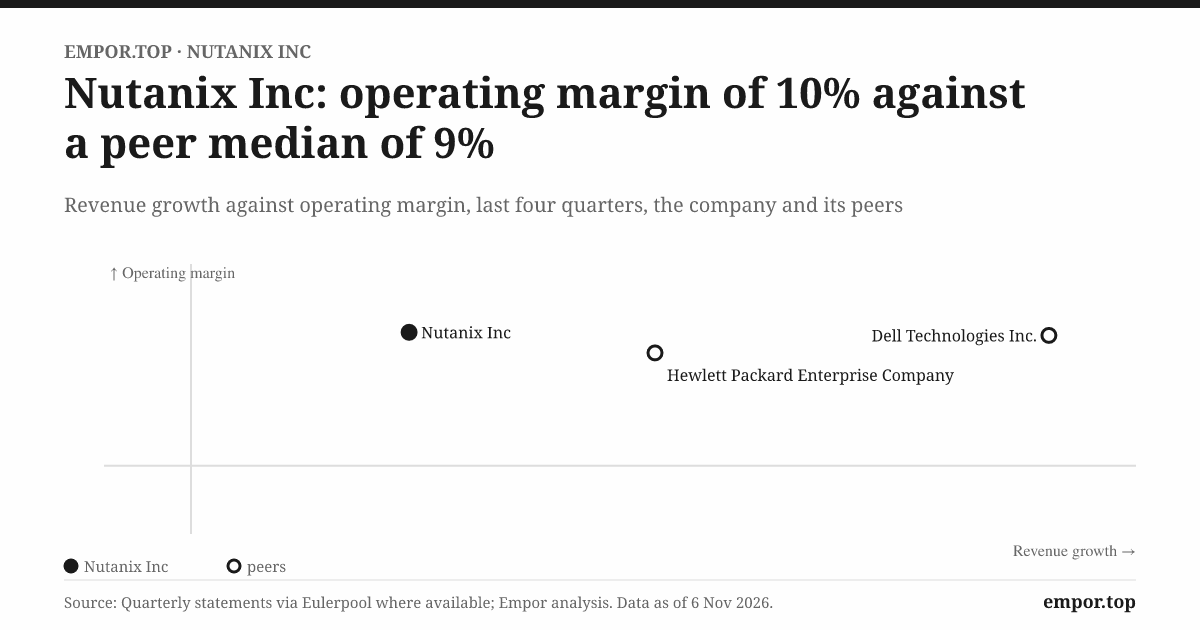
The margin recovery is the story of the past three years. In fiscal 2023, Nutanix lost about $207 million at the operating line, or about 11 cents on each revenue dollar. By fiscal 2024 it was roughly breaking even; in fiscal 2026 it earned about $279 million, a margin near 10%.19 Revenue over the same stretch rose from about $1.9 billion to $2.85 billion.1
Where did the improvement come from? Decompose it through the cost lines and the answer is mostly scale, not cuts. Research and development spending kept rising in dollars, from about $638 million in fiscal 2024 to about $791 million in fiscal 2026, but fell as a share of revenue from about 30% to about 28%.1 Sales and marketing behaved similarly: headcount still grew, but more slowly than revenue.1 Nutanix did not starve the business to make a profit. It let revenue outrun its costs. That is the healthier form of margin expansion, though it depends on revenue continuing to grow faster than the expense base.
Cash tells an even stronger story, and one that needs the most careful reading. In fiscal 2026 cash from operations was about $917 million, and free cash flow about $841 million.1 Two ingredients flattered that number relative to profit. Deferred revenue rose by about $315 million, which means customers paid in advance for software Nutanix will deliver later; that is real cash, but it reflects growth in prepaid contracts rather than profit earned. And about $358 million of employee pay came as stock compensation, which costs shareholders through dilution but costs the company no cash.1 Strip out the stock compensation as if it were cash wages and free cash flow would fall by roughly 40%. Nutanix generates cash, and plenty of it. A meaningful part of that cash is customers' money arriving early and employees being paid in shares.
The long view sharpens the point. From fiscal 2015 to fiscal 2026, Nutanix reported cumulative net losses of about $2.9 billion, yet generated about $2.6 billion in cumulative cash from operations.1 A business that lost money on paper for a decade still produced cash, because customers prepaid and employees took stock. The subscription model did not just change how revenue is recognized; it changed who funded the company.
Now the harder question: is the installed base actually expanding? The number that answers it is net dollar retention, or NRR. It measures how much this year's subscription revenue from a cohort of existing customers is worth compared with the same customers a year earlier, after expansions, price changes, shrinkage and departures. An NRR of 106% at the end of fiscal 2026 means existing customers, collectively, spent about 6% more than they had a year before.[^2] That is positive. It is also down from about 109% a year earlier.[^2] For comparison, the infrastructure software companies investors prize most have often posted NRR well above 110% in their best years. Nutanix's customers are renewing and expanding, but not explosively. Each customer is not becoming dramatically more valuable each year.
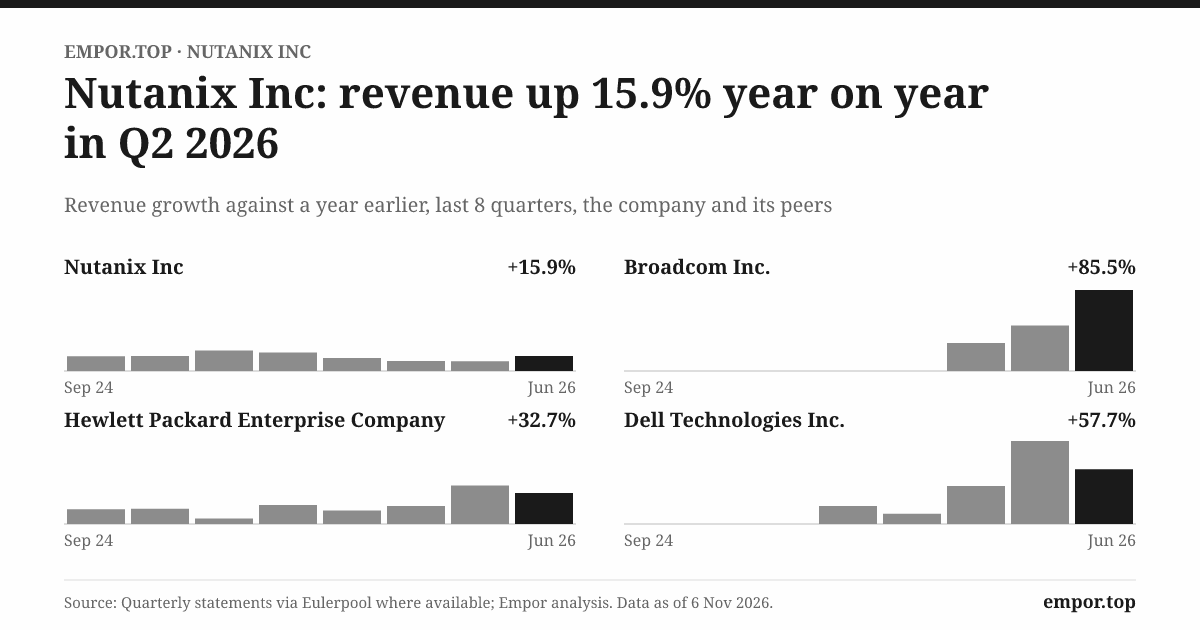
Put that next to the longer growth record. Over ten years, from fiscal 2016 to fiscal 2026, revenue compounded at about 19% a year; over the last three, at about 15%.1 Last year it grew about 12.5%, and the company's guidance for fiscal 2027 implies about 12% at the midpoint.1[^2] The business is far larger and far more profitable than at any point in its history. Its growth rate has moderated, as large businesses' growth rates do.
The verdict on the subscription model is clear enough to state plainly. It has moved from transition to measurable profitability and strong cash generation, and the contracted backlog gives real visibility. But the model's growth engine, existing customers buying more, is running at a modest pace, which means new customers have to carry more of the load. For that, Nutanix needed something to change in the market. In late 2023, something did.
VI. Broadcom's VMware Reset Opens a Door
In November 2023, Broadcom completed its acquisition of VMware.10 Broadcom's chief executive, Hock Tan, had a reputation for buying mature software franchises and running them hard for cash. Within months, VMware's customers felt it. Broadcom ended the sale of perpetual licenses, moved customers to subscriptions, collapsed thousands of product SKUs into a handful of large bundles, and reorganized partner programs so that many smaller resellers lost direct access.10 Customers who had paid for a few products now found themselves pushed into buying a larger suite. Some reported price increases they described as several times their prior bills.10
For a data-center manager who had run VMware for fifteen years, this was a jolt. VMware was not a product you swapped out casually. It ran the virtual machines underneath payroll, trading systems, electronic health records and factory controls. But Broadcom had done something no competitor ever managed: it made customers seriously ask what else was out there.
Nutanix had the most obvious answer. Its AHV hypervisor, bundled into its platform at no separate charge, was the virtualization layer most enterprises were likely to consider as a direct VMware replacement on premises. It had built a migration tool, Nutanix Move, designed to shift virtual machines from VMware to AHV, and partners and professional services to handle the messy parts.1 And its chief executive had spent years inside VMware. Ramaswami described the Broadcom takeover as a multi-year opportunity rather than a single wave, saying customers would move in stages as their VMware contracts came up for renewal and their hardware came due for refresh.11
That framing is important, and it is worth stating what the evidence supports. Start with the scale of the two companies. In IDC's tally of hyperconverged software revenue for 2022, VMware held about 41% of the market and Nutanix about 25%.12 VMware's broader virtualization base, which included customers that never bought HCI at all, was far larger still. So the opportunity for Nutanix was not simply to win HCI share; it was to win virtualization workloads that had never run on HCI.
Market-share figures in this category also deserve suspicion. In 2019, Gartner and IDC published rankings of the same HCI market that placed VMware and Nutanix in different orders, because the two firms counted different things: one measured software revenue regardless of hardware, the other credited systems revenue to whoever branded the box.13 These are dated snapshots, not a current series, and HCI software is a slice of infrastructure spending, not the whole of it. No source today gives a clean, comparable answer to how much VMware share Nutanix has taken.
What the company does disclose is suggestive. In fiscal 2026, Nutanix added roughly 3,080 new customer logos, bringing its end-customer count above 32,000.[^2] On its fourth-quarter call, management linked part of that new-logo momentum to customers moving off VMware, and described large deals in which customers were migrating substantial virtualization estates.[^2] On the second- and third-quarter calls earlier in the year, management returned repeatedly to the same pattern: strong customer interest, large deals, and longer sales cycles as customers planned migrations carefully.[^16][^17]
Now the counterweights, because they belong right here. First, discontent is not migration. Many VMware customers signed new Broadcom contracts, swallowed the increases and deferred decisions; others are running parallel evaluations that may never conclude. Second, migrations take time. Moving thousands of virtual machines involves retesting applications, retraining staff and often refreshing hardware. That last requirement has collided with a server market strained by AI demand. Management told investors on its fourth-quarter call that server supply constraints and rising component prices were delaying customer projects and that it expected those constraints to persist into fiscal 2027.[^2] A VMware customer who decides to move but cannot get servers is a delayed customer, not a won one. Third, Nutanix is not the only destination. Customers can move workloads to public clouds; stay on Microsoft's Hyper-V and Azure Local; choose open-source alternatives built on KVM; adopt HPE's new virtualization offerings; or simply stay where they are.
So is Nutanix winning because customers prefer its platform, or because VMware's new terms made alternatives look better? The honest answer is both, and the evidence cannot yet separate them. The way to tell will come from the metrics. If Nutanix is merely a refuge from Broadcom's pricing, the customers it wins will arrive, land, and expand slowly, and NRR will drift. If customers genuinely prefer the platform, those new logos will turn into broader deployments, lifting NRR back toward or above its earlier levels. The decline in NRR from 109% to 106% during the very period Nutanix was adding VMware refugees does not settle the question, but it does mean that the second scenario is not yet visible in the numbers.
The VMware disruption is a real opening, and Nutanix is better positioned than anyone else to walk customers through it on premises. But an open door is not a completed sale. To keep the customers it wins, Nutanix has to be more than the place people go when they are angry with Broadcom. It has to be a platform customers want to put their next workloads on.
VII. The Platform Has to Earn More Than an HCI Label
Open Nutanix's annual report and you no longer find the word "hyperconverged" doing most of the work. You find a cloud platform. It runs traditional virtual machines on AHV, manages Kubernetes containers for modern applications, offers database management and file, object and unified storage services, and, most recently, an enterprise AI stack meant to let companies run generative AI models and agents inside their own data centers rather than sending sensitive data to public clouds.1 In fiscal 2026 the company announced or expanded partnerships with AMD, Lenovo, NetApp and NVIDIA, among others, including work to let Nutanix's software manage external storage arrays rather than only the disks inside its own nodes.1[^2]
That last point is a striking reversal. The founding idea was to eliminate the external storage array. Now Nutanix is building software to coexist with it, because large VMware customers often have years of investment in arrays from NetApp, Dell or Pure Storage and will not throw them away to switch hypervisors. Meeting customers where they are is pragmatic. It also shows that the company's growth now depends on being a virtualization and management platform first and an HCI pioneer second.
Nutanix spent about $791 million on research and development in fiscal 2026, roughly 28% of revenue.1 That is a heavy commitment, comparable to the intensity of serious enterprise software companies. Yet Nutanix reports a single operating segment and does not disclose revenue or profit by product line.1 There is no public number for how much revenue AI, Kubernetes, databases or storage services bring in. What the investor can see is the aggregate: revenue growth around 12%, NRR of 106% and more than 32,000 customers.1[^2] If the new products were driving material additional spending from existing customers, retention is where it would show up first. So far, it does not show up as acceleration.
That is the right way to frame the AI story. Nutanix is building real products, including an enterprise AI platform and tools for managing AI agents, and it has signed real partnerships.1[^2] But product releases and partnerships are not revenue. The company's own history offers a caution here: earlier expansions beyond the core, including cloud-management tools from its acquisitions of Calm and Minjar in 2016 and 2018 and the application-monitoring startup Netsil, did not become separately visible businesses in its financial statements.714 AI is future-material optionality, not a disclosed profit pool, and should be valued that way.
Who Holds the Leverage
To understand how much of the platform's value Nutanix can keep, it helps to look at the forces surrounding it.
Start with buyers. End-customer concentration is low: no single customer accounted for 10% of revenue in fiscal 2024 through fiscal 2026.1 But Nutanix sells largely through channel partners, and those partners are concentrated. One distributor, identified in the filings only as Partner E, accounted for about 22% of revenue in fiscal 2026, down from about 31% two years earlier; another, Partner D, about 15%; Partners A and B about 13% and 10%.1 These partners are mostly conduits rather than end buyers, so their bargaining power is narrower than the percentages suggest, but they influence which products their resellers push and they hold meaningful receivables.
Suppliers are the server makers and component vendors. Because Nutanix runs on hardware from Dell, HPE, Lenovo, Cisco, Supermicro and others, no single supplier can choke it, which is a real advantage over a captive appliance model. But suppliers collectively can, as the current memory and server shortages show: when hardware is scarce and expensive, Nutanix's deals wait.[^2]
Rivalry is intense and comes from several directions at once. VMware under Broadcom remains the incumbent with the largest installed base. Microsoft offers Hyper-V and Azure Local, often bundled into licensing agreements customers already have. HPE and Dell sell their own integrated systems. And the hyperscalers, Amazon, Microsoft and Google, compete for the workloads themselves, offering to run them in the public cloud so the customer never needs a hypervisor at all. Interestingly, Nutanix also partners with several of these rivals, running its software on bare-metal servers in AWS and Azure so customers can extend their environments into the public cloud. Competitor and partner are the same names in this market.
The threat of substitutes is the deepest of these forces. The long-term substitute for on-premises virtualization is not another hypervisor; it is moving the application to the cloud or rebuilding it as containers. Nutanix's push into Kubernetes and hybrid cloud is a hedge against that substitute. The threat of new entrants is lower: building an enterprise-grade hypervisor and distributed storage layer with a worldwide support organization takes years and billions of dollars, which is why VMware's disruption benefited established alternatives rather than startups.
What Actually Keeps a Customer
Hamilton Helmer's 7 Powers framework asks a sharper question: what lets a company earn persistently higher returns than competitors? Test Nutanix against the candidates that might apply.
Switching costs are the strongest case. Once a customer runs its applications on AHV, trains its staff on Nutanix's management console and builds automation around it, moving away is as painful as moving away from VMware was. That is precisely the power VMware enjoyed for two decades, and the power Broadcom is now monetizing. But the test of switching costs is retention and pricing. Nutanix's retention is solid but its NRR of 106% indicates customers are not paying meaningfully more each year. The switching costs are real enough to keep customers; they have not yet been shown to grant pricing power.
Scale economies cut against Nutanix. VMware, inside Broadcom, and Microsoft spread their R&D over far larger revenue bases. Nutanix spends a larger share of revenue on R&D precisely because it is smaller. Counter-positioning is more interesting: Nutanix's hardware-neutral, subscription-priced model is something Broadcom could replicate in principle but has chosen not to, because its strategy rests on extracting more from the installed base. That is a temporary edge that depends on a rival's choices, not a durable power. Cornered resources, network effects and brand power are thin in this market; Nutanix's brand matters to infrastructure buyers, but it is no more powerful than Dell's or Microsoft's. Process power, the accumulated know-how of migrating complex VMware estates with minimal disruption, may be developing, but it is hard to measure from outside.
The calibrated verdict: the record supports one genuine power, switching costs, plus a temporary counter-positioning advantage created by Broadcom's strategy. It does not establish a dominant moat. The absence of any current, comparable market-share series means no one can say with confidence that Nutanix is taking share at a pace that will last. What would change that conclusion is evidence that rising R&D is turning into broader workloads per customer: NRR moving back above 110%, or disclosure that a material share of revenue comes from products beyond core virtualization. Until then, the platform is a promise that has not been tested by customer spending patterns. Paying for that promise required capital, and how Nutanix managed its capital is the next part of the story.
VIII. The Cash Pile, the Notes and the Buybacks
In December 2024, Nutanix did something that would have been unthinkable during its years of losses: it went to the bond market as a company that did not need the money. It sold $862.5 million of convertible senior notes due in 2029, carrying an interest rate of just 0.50%.1 Part of the proceeds went to buy back $75 million of older notes due in 2027, and about $200 million went to repurchasing shares at the same time.1
To see why this looked like financial engineering rather than distress, remember where the balance sheet had been. In fiscal 2020 Nutanix had negative shareholders' equity, an operating loss approaching $830 million and a fresh $750 million loan from Bain.19 By July 2026 the company held about $2.36 billion in cash and short-term investments, about $777 million in cash and $1.58 billion in short-term holdings, mostly bank deposits, money-market funds and high-grade government and corporate debt.1 Including longer-dated investments, the cash pile was closer to $2.4 billion.1 Shareholders' equity had turned positive again, helped substantially by the one-time tax benefit.1
The debt that sits against that cash is unusual. Almost all of Nutanix's roughly $1.44 billion of borrowings consists of convertible notes: $575 million of 0.25% notes due in 2027 and the $862.5 million of 0.50% notes due in 2029.1 The interest cost is tiny, a fraction of what a speculative-grade company would pay on ordinary bonds, because investors accepted low coupons in exchange for the option to convert into shares if the stock rises. There are no required principal payments before maturity, and a $500 million revolving credit facility due in 2030 was undrawn, with the company in compliance with its covenants.1 Meanwhile the cash pile earned about $77 million of net interest income in fiscal 2026.1 In effect, Nutanix borrows at under 1% and invests at money-market rates, a positive carry that will not last forever but helps today.
That is the bull reading. The skeptic's reading starts with the word "convertible." Convertible notes are cheap because they contain an option that can turn into shares. If the stock rises above the conversion price, noteholders can receive equity, and existing shareholders are diluted. The Bain notes show how expensive this can be in hindsight: a 2020 rescue loan became more than $800 million of shares in 2024.1 The 2029 notes carry the same logic.1
The buybacks need the same dilution-aware reading. Nutanix's board has authorized cumulative repurchases of $1.45 billion, with about $729 million remaining at July 2026.1 But in the same year the company paid about $358 million in stock compensation.1 Repurchases that merely soak up shares issued to employees transfer cash from shareholders to employees through a roundabout route. They are not a return of capital in the way a shrinking share count would be. Nutanix has never paid a dividend, so buybacks are the only cash returned to shareholders, and their value depends on whether they shrink the share count net of grants.1
The acquisition record is short and cheap. Nutanix bought PernixData, a storage-acceleration company, for about $23 million in 2016, and Minjar, the Bengaluru-based cloud-optimization startup behind Botmetric, for about $23.8 million in 2018.714 Calm, a cloud-application automation company, and Netsil, an application-monitoring startup, were also acquired, though their deal economics were less fully disclosed.7 These deals were small relative to the business, and none was a transformative bet. But the public information does not support a clean purchase-multiple comparison or any claim that Nutanix overpaid or showed unusual discipline. What can be said is that Nutanix has built rather than bought its platform, which is consistent with its heavy R&D spending.
The financing risks are real, though not acute. Nutanix's credit ratings sit below investment grade: Moody's cut it to Ba2 with a negative outlook in February 2026, while S&P rates it BB and Fitch BB+, both also with negative outlooks.91 The company itself warned that the downgrades had raised borrowing costs and reduced access to some financing.9 With $2.36 billion of cash and short-term investments against $1.44 billion of notes, Nutanix could repay its debt from cash today. But the 2027 notes come due next year, and refinancing them in a stressed market at speculative-grade ratings would cost more than the 0.25% the company pays now.
The capital allocation story, then, is one of repair and modest return. Liquidity is substantial, operating cash flow covers the business comfortably, and the low-coupon notes stagger maturities. The quality of the shareholder return depends on dilution: whether buybacks outpace stock issuance and whether notes convert at prices that justify the dilution. And the company's balance-sheet transformation is partly an accounting event, which is where the most important footnote in the story lives.
IX. The Profit Figure Has a Tax Footnote
Back to that $1.51 billion. Imagine a reader who sees only Nutanix's reported earnings: diluted earnings per share of $5.17 for fiscal 2026, against a share price around $65.[^2]2 On that basis the stock trades at about 12 times earnings, cheaper than many industrial companies with no growth at all. Now imagine the same reader sees the company's non-GAAP diluted EPS: $2.04.[^2] The contrast shows how much the one-time tax benefit boosts reported earnings, though non-GAAP EPS also excludes other items.
Years of losses had left Nutanix with deferred tax assets reserved against uncertainty. In the fourth quarter of fiscal 2026, after enough consecutive profitable years, the company concluded that it would probably use the U.S. federal credits and released the reserve. That produced a tax benefit of about $1.09 billion on the federal portion, which management rounded together with related items to about $1.2 billion of nonrecurring benefit.1[^2] In the final quarter alone, Nutanix's reported tax rate was negative by more than 1,400%, which tells you something unusual happened.1
What does the release mean economically? It is a judgment, not cash. It reflects management's and the auditor's view that Nutanix will remain profitable. Its practical consequence is that, for some years, Nutanix's cash tax bill will be lower than its accounting tax charge, which supports future free cash flow. But from fiscal 2027, Nutanix's income statement will show a normal tax charge again, so reported net income will look much lower than this year's figure even if the business performs well. Investors who anchor on the fiscal 2026 EPS will be disappointed by arithmetic, not by operations.
The better earnings measures are operating income and free cash flow. On those measures, Nutanix's progress is genuine: operating income climbed from roughly break-even in fiscal 2024 to about $279 million in fiscal 2026, and free cash flow reached about $841 million.1 The fiscal 2026 operating margin also absorbed about $24 million of restructuring charges and about $15 million of litigation settlement accruals and legal fees, items management treats as one-offs.1 Other income, mostly interest earned on the cash pile, added about $53 million, about 16% of pre-tax profit.1 That interest income is real but depends on rates and on the cash balance staying high.
Revenue quality deserves its own look, because subscription companies have ways of bringing revenue forward. Nutanix's net receivables at July 2026 were about $289 million against annual revenue of $2.85 billion, which works out to about five weeks of sales, a modest level for a company that bills upfront.1 The allowance for doubtful accounts was tiny, about $3.3 million, though it had quadrupled from about $0.8 million two years earlier; write-offs in fiscal 2026 were only about $0.2 million.1 Nutanix does not publish an aging table showing how much of its receivables are overdue, so outsiders cannot see whether payment is slowing among particular partners.
The number that deserves the most attention is contract assets. These represent revenue that Nutanix has recognized before it has the right to bill the customer, which happens when contracts use installment payments or other alternative arrangements. Contract assets rose to about $193 million at July 2026, about $97 million current and $96 million longer-term, from immaterial levels a year earlier.1 That is not a red flag on its own: as Nutanix offers more flexible payment terms to win large VMware migrations, some contracts will bill in installments while revenue for delivered software licenses is recognized up front. But it is a meaningful shift. Revenue that has been recognized but not yet billed depends on future collections, and the more of it there is, the more the income statement leans on judgments rather than invoices.
The auditor flagged the same area. Nutanix's independent auditor gave an unqualified opinion on the fiscal 2026 financial statements and internal controls, and named revenue recognition in material contracts with alternative payment arrangements as its critical audit matter, the area requiring the most difficult judgments.1 That is an audit focus, not a qualification. But it points to exactly where an investor should look.
Concentration links back to these balances. No end customer accounted for more than 10% of revenue or receivables, but the anonymized channel partners did: Partner A held about 16% of receivables, Partner C about 12% and Partner D about 10%.1 Nutanix does not name them, which limits outsiders' ability to assess their credit quality. A distributor that runs into trouble would not destroy Nutanix's revenue, since end customers could buy through other channels, but it could delay collections.
And the risk that ties all of this to growth is physical. Nutanix sells software, increasingly as software-only transactions where the customer buys hardware elsewhere. Yet the software has to run on servers, and in fiscal 2026 servers became scarce and expensive as AI buildouts absorbed memory and components. Server constraints have already delayed customer deployments, and the company expects them to continue into fiscal 2027.[^2] A software company with no inventory still has a supply chain problem. Navigating that problem is now, more directly than before, the chief executive's job.
X. Rajiv Ramaswami Inherits the Sales Organization
On September 24, 2026, Nutanix filed a short notice with the Securities and Exchange Commission. Tarkan Maner, its president and chief commercial officer and one of the company's most visible executives, would step down.15 Maner had run Nutanix's go-to-market organization, its sales, marketing and customer experience teams, since before Ramaswami arrived. After his departure, Ramaswami took direct oversight of those functions himself.15
A chief executive taking over the sales organization is a statement, and an ambiguous one. It can mean the board and CEO want closer control of execution at a crucial moment, and the VMware migration opportunity certainly qualifies. It can also signal frustration that commercial execution has not matched the opportunity. The timing coincided with a fourth quarter in which revenue grew about 16% year over year but full-year guidance for fiscal 2027 implied a slowdown to about 12%, and with an August restructuring that cut about 5% of the workforce.1[^2] Management said most of the savings would be reinvested in growth areas.[^2] Neither the 8-K nor the calls give a detailed explanation for Maner's departure.
Ramaswami's career gives context to how he leads. An engineer by training who built his career in networking, he held senior roles at Cisco, ran infrastructure and networking at Broadcom and then became chief operating officer of products and cloud services at VMware.5 He arrived at Nutanix in December 2020 as an operator rather than a visionary founder, and his tenure reflects that style: fewer grand pronouncements, a steady push to finish the subscription transition, and a focus on margins and cash. His record is clearest in the numbers. When he took over, Nutanix was losing more than a third of its revenue at the operating line. By fiscal 2024 the company had reached operating profitability for the first time, and in fiscal 2026 its operating margin was about 10%.1 Free cash flow went from negative to about $841 million.1 That is a substantial turnaround, though it was aided by the subscription transition's maturing and by Broadcom's disruption of VMware, neither of which he controlled.
Growth is the weaker part of the record. Revenue growth under Ramaswami has ranged roughly between 13% and 18% annually, respectable for a company of this size but not the acceleration a VMware windfall might have suggested.1 Guidance has generally been conservative, and management's explanation of the current slowdown, server supply constraints, is external and specific. The question for the next year is whether that explanation proves correct: if supply eases and deployments recover, management's credibility rises; if growth stays near 12% even as supply normalizes, the problem lies in demand or execution.
CFO Rukmini Sivaraman has held her role since 2022 and has overseen the capital structure changes, including the 2029 notes and buybacks.116 Neither she nor Ramaswami has changed role through fiscal 2026, and continuity in the finance function has coincided with the improvement in guidance credibility.
Pay is heavily tied to the stock. Ramaswami's reported compensation was about $29.5 million in fiscal 2026, up from about $22.6 million in fiscal 2025 but well below about $51.1 million in fiscal 2024, almost entirely stock awards.16 His fiscal 2026 target equity award of $19.5 million was split evenly between time-based restricted stock units and performance-based awards tied to Nutanix's total shareholder return relative to other companies.16 The proxy's pay-versus-performance table, which measures how much the value of a CEO's equity actually moved, showed compensation actually paid of about negative $21.7 million in fiscal 2026, against about $73.4 million in fiscal 2025, because the value of his unvested equity fell during the year.16 That is the system working as intended: when shareholders lose, so does he.
But his direct ownership is small. Ramaswami beneficially owned about 414,000 shares as of the proxy date, less than 1% of the company.16 His wealth depends on Nutanix's stock price mainly through future grants rather than an owner's stake. The board has also asked shareholders to approve 7 million more shares for the equity plan, a request that adds to the dilution that buybacks are working to offset.16
Shareholders have been skeptical before. Support for say-on-pay fell to about 73% in 2024, a weak result for a large company, before recovering to about 92% in 2025 after compensation changes.16 The 2026 vote, along with the equity-plan request, is scheduled for the annual meeting on December 11, 2026.16
The board itself is mostly independent. The 2026 proxy put forward eight director nominees, seven of them independent, under independent chair Virginia Gambale; director Craig Conway, a former PeopleSoft chief executive, will not stand for reelection.16 Ownership is diffuse: Fidelity-affiliated funds held about 13.4%, BlackRock about 10.2%, AQR about 5.6% and Vanguard Capital Management about 5.2% as of October 2026, while Bain-affiliated BCPE Nucleon held about 5.4 million shares, represented on the board by partner Max de Groen.16 No holder controls the company.
The prepared remarks and the Q&A on the recent calls told slightly different stories. In prepared remarks, management emphasized record new logos, VMware migrations and platform expansion.[^2] In Q&A, analysts pressed on the slower guidance, the supply constraints, rising hardware prices and whether customers were pausing projects; management's answers focused on the timing of deployments rather than lost demand.[^2][^17] That distinction, timing versus demand, is exactly what fiscal 2027 will test. Ramaswami now owns the answer more personally than before, because the sales organization reports to him.
XI. Playbook: Business & Investing Lessons
Every company story contains lessons, but Nutanix's are unusually sharp because the company ran an experiment in public: it sold a new architecture, then dismantled its own business model, then waited years for the economics to arrive. Four lessons belong to this company and no other.
The first product gets you into the room; the renewal decides whether you belong there. Nutanix's appliance was a brilliant wedge. It let a startup sell a radical idea to conservative buyers by packaging it as something familiar, a box with a support number. But the box's success masked a weak economic model, and when the company dismantled it, revenue growth collapsed from about 68% in fiscal 2017 to about 6% in fiscal 2020.1 What rebuilt the company was not the next box, but the renewal: subscriptions that customers paid for again and again, eventually turning an operating margin of about negative 11% in fiscal 2023 into about positive 10% in fiscal 2026.1 The lesson for founders is that the first sale proves you can solve a problem, but only renewals prove the business. For investors, the corollary is that a hardware-driven growth rate can look like a software business until the hardware leaves.
A platform is a promise until customers put another workload on it. Nutanix now describes itself as a hybrid cloud, Kubernetes and AI platform, backed by nearly $800 million of annual R&D.1 Yet net dollar retention of 106% says existing customers are expanding only modestly.[^2] The difference between a platform and a product catalogue is whether customers buy the second and third thing. Every infrastructure company eventually says it is a platform. The ones that are can show it in their retention rate.
Cash can tell a better story than GAAP earnings, but only if you know who paid for it. For a decade Nutanix lost money on paper while generating cash, because customers paid upfront and employees took stock. In fiscal 2026 the gap reversed: reported profit leapt far above cash because of a tax-accounting release.1 Neither number was a lie, and neither told the whole story. The lesson is to ask where the money came from. A prepayment is a customer's promise, a stock grant is a shareholder's cost, and a tax release is a judgment about the future.
A rival's mistake can open a door; it cannot make the customer walk through. Broadcom's reset of VMware gave Nutanix the best opening in its history: angry customers, a credible alternative and a CEO who knew the other side. Yet growth has moderated, not accelerated, and server shortages have shown how many steps lie between a customer's frustration and a recognized subscription.[^2] Competitive windfalls are perishable. They reward the company that has already done the work of making switching easy, and they expire when the rival's customers sign their next contract.
XII. Bull and Bear Case: A Migration Wave or a Mature Category?
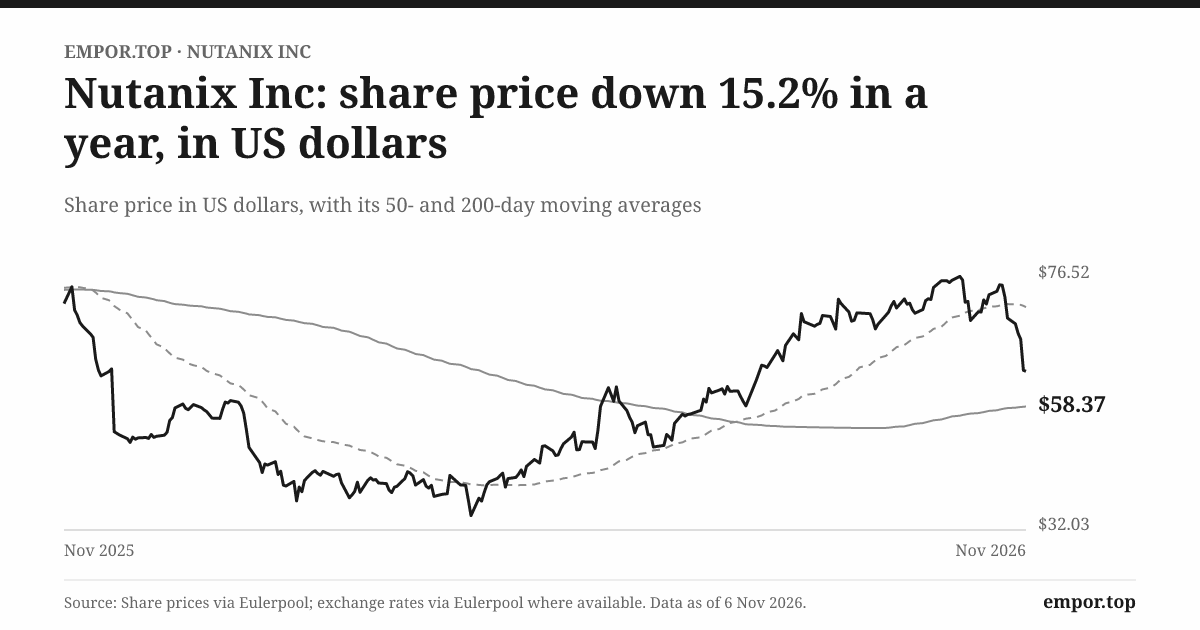
On November 4, 2026, Nutanix shares closed around $64.68, about 13% below their 52-week high and nearly double their 52-week low.2 The company was worth about $17.9 billion. Its enterprise value of about $17.1 billion was roughly 6.4 times trailing revenue.2 Over the past four years, that multiple has typically ranged around a median of about 5.9 times, so the stock is priced modestly above its own history, roughly in the middle of its range.2 The headline P/E of about 12 times reflects the one-time tax release; on non-GAAP earnings of $2.04, the multiple is closer to 32 times.[^2]2 On free cash flow, the stock yields about 4.7%.2
What does that price assume? Roughly, that Nutanix keeps growing in the low-to-mid teens for several years while expanding its margins, so that a company with a 10% operating margin today becomes one with a much higher margin. That is not an outlandish assumption for a subscription business with this cash generation. Nor is it a cheap one.
Why Nutanix may win
The bull case rests on four pieces of evidence, each of which is real. First, the recurring base: ARR is growing faster than revenue, with substantial contracted backlog.1[^2] That suggests revenue growth should catch up as contracts mature, unless something else changes. Second, strong cash generation and liquidity give Nutanix the ability to invest, buy back shares and absorb shocks without depending on capital markets.1 Third, Broadcom's strategy keeps pushing VMware customers to reconsider. A multi-year migration cycle, aligned with hardware refreshes, could sustain new-logo growth for years. Fourth, Nutanix has a credible hypervisor and migration tool, while its hardware neutrality and support for external storage reduce the cost of switching.1 Those are the elements a customer leaving VMware actually needs.
The latest quarter provided the most direct evidence for the bull case: revenue grew about 16% from a year earlier, faster than the full year.1 If supply normalizes and delayed projects close, that rate could hold.
Why it may not
The bear case is just as specific. Growth is moderating rather than accelerating, even with the VMware tailwind.1[^2] Net dollar retention has declined, suggesting Nutanix is adding customers but not deepening relationships at the pace a platform story requires.[^2] VMware remains the larger incumbent and Broadcom's pricing, though resented, has not caused the mass exodus some predicted; many customers renewed. The cloud remains the long-run substitute for on-premises virtualization. Partner concentration means a few distributors handle a large share of revenue. Server shortages may persist longer than expected as AI demand absorbs components.
Recall the customer weighing Nutanix against Broadcom's new bundle: the only power the record clearly supports is switching costs, with a temporary counter-positioning advantage created by Broadcom; neither has yet produced pricing power or accelerating retention. That means the valuation rests more on execution than on a structural moat.
Server scarcity, refinancing costs and the possibility that AI spending flows to public clouds or specialized stacks remain further risks.[^2]19
A skeptical investor or activist would focus on dilution. Stock compensation, buybacks that have only partly offset it, the requested increase to the equity plan and convertible notes all affect shareholders' claim on the business.116 The question is whether Nutanix can sustain growth, fund product expansion, buy back shares and keep dilution in check all at once. So far it has managed growth and cash; it has not yet shown that it can deliver per-share growth at the pace the business is growing.
Three measures will decide which case wins. The first is ARR growth: if it holds above revenue growth, the bull case is intact. The second is net dollar retention: stabilization or improvement would support the platform thesis, while further decline would suggest Nutanix is winning customers but not workloads. The third is free cash flow and operating margin; both need to keep rising after stock compensation is accounted for. Neither the market-share evidence nor the company's disclosed economics proves that the platform has decisively won. Those three numbers will tell the market whether it does.
XIII. Epilogue
Tonight, Nutanix stands at an unusual point. Its fiscal 2027 began on August 1 with a new commercial organization reporting directly to the chief executive, persistent hardware constraints, and guidance implying about 12% revenue growth at the midpoint.[^2]15 ARR grew 16% last year, and NRR stands at 106%.[^2] The company has more cash than debt, profitable operations and a market valuation that already assumes several more years of steady growth.
The first decisive moment is close. On December 11, 2026, shareholders will vote at the annual meeting on executive pay and on the proposal to add 7 million shares to the equity plan.16 A strong vote would signal that investors accept the compensation design and the dilution it implies. A weak one, after the 73% support of 2024, would tell the board that shareholders want more discipline on equity issuance.
The next decisive moments will be the quarterly results. If revenue tracks guidance while ARR keeps growing at about 16%, the delayed hardware deployments will have proved to be a timing problem, and management's explanation will have held. If revenue misses because supply constraints persist, the question becomes whether customers wait for Nutanix or turn to alternatives. Watch whether NRR stabilizes at 106% or recovers; a further fall would undercut the platform thesis no matter how many new logos arrive. Watch, too, whether Partner E's share of revenue continues to fall, and whether contract assets keep rising faster than revenue.
There is a product question as well. Nutanix has made claims about AI, Kubernetes and external storage. The proof will come when it can point to customer adoption numbers or revenue attached to them, not just partnerships and launches. And there is an organizational question: whether the August workforce reduction and the departure of Nutanix's top commercial executive improve execution or disrupt it during the busiest migration period the company has seen.
Each outcome maps onto one of the story's central questions. If ARR growth holds and NRR improves, Nutanix is becoming a platform. If ARR holds but NRR keeps slipping, it is becoming a successful, steady infrastructure specialist, a perfectly good business priced like something more. If supply constraints persist and VMware customers settle into Broadcom contracts, the door that opened in 2023 will begin to close. The next proof is commercial, not rhetorical: renewals, new deployments and expanding margins, measured quarter by quarter.
XIV. Outro
In 2011, Nutanix shipped a box, turning its web-scale data-center idea into an appliance a hospital or a bank could plug in.
Fifteen years later the box barely matters. Nutanix sells software subscriptions to more than 32,000 customers. The company has proved it can keep those customers and turn them into cash. It has not yet proved how much of each one it can own.
That is the unfinished part of the story. The box opened the door. Everything that matters now happens after the customer is inside.
References
-
Form 10-K for FY2026 — Nutanix, Inc., 2026-09-18 ↩↩↩↩↩↩↩↩↩↩↩↩↩↩↩↩↩↩↩↩↩↩↩↩↩↩↩↩↩↩↩↩↩↩↩↩↩↩↩↩↩↩↩↩↩↩↩↩↩↩↩↩↩↩↩↩↩↩↩↩↩↩↩↩↩↩↩↩↩↩↩↩↩↩↩↩↩
-
Nutanix Valuation History — StockResearch, updated 2026-11-04 ↩↩↩↩↩↩↩
-
Nutanix Appoints Rajiv Ramaswami as Chief Executive Officer — Nutanix, 2020-12-09 ↩↩↩
-
Nutanix Announces Global Agreement with Dell — Nutanix, 2014-06-24 ↩
-
Nutanix Announces Pricing of Initial Public Offering — Nutanix, 2016-09-29 ↩↩
-
Roundtable: Why Did Customers Sail Away from VMware? — Computer Weekly, 2025-05-14 ↩↩↩
-
Nutanix CEO Sees Multi-Year Opportunity After Broadcom's VMware Acquisition — Nutanix, 2024 ↩
-
VMware Retains No. 1 HCI Software Vendor Title in IDC Report — StorageReview, 2023-04-22 ↩
-
Nutanix, VMware Battle for HCI Revenue and Market Share — SDxCentral, 2019-05-06 ↩
-
Nutanix Announces Intent to Acquire Minjar — Nutanix, 2018-03-01 ↩↩
-
Form 8-K: Tarkan Maner Steps Down as President and Chief Commercial Officer — SEC, 2026-09-24 ↩↩↩
-
2026 Annual Report and Proxy Statement — Nutanix, Inc., 2026-10-20 ↩↩↩↩↩↩↩↩↩↩↩↩
 LinkedIn
 WhatsApp
 Reddit
 Hacker News
 Email
 Kindle
 RSS Feed
 Spotify
 Apple Podcasts
 Amazon Music
 Audible
 YouTube