Netflix: The Story of How the Algorithm Ate Hollywood
I. Introduction & Episode Roadmap
On February 27, 2026, $2.80 billion in cash arrived in Netflix's treasury. Netflix had not sold a show, licensed a film or signed up a single subscriber to earn it. The money was a termination fee. Paramount Skydance paid it on behalf of Warner Bros. Discovery after WBD walked away from its merger agreement with Netflix.12 It was the last move in a bidding war that, for a few weeks that winter, looked set to make the world's most disciplined streaming company the owner of a century-old Hollywood studio, a sprawling cable network portfolio and HBO.14 Netflix had lined up up to $42.2 billion in bridge financing to do it. The facilities expired undrawn.1
That fee works as a punchline for the whole story, because Netflix spent a quarter of a century refusing to be what the legacy studios were. It began in 1997 as a plan to mail DVDs in envelopes. It became a streaming service, then a studio, then a global broadcaster of live wrestling and NFL games, and through all of it the company stayed away from buying legacy assets. In FY2025 it booked $45.2 billion of revenue and turned about $9.5 billion of that into free cash flow.1 At the end of 2025 more than 325 million paid memberships across over 190 countries were paying for it.1 No company built in the DVD era has an operating machine that compares.
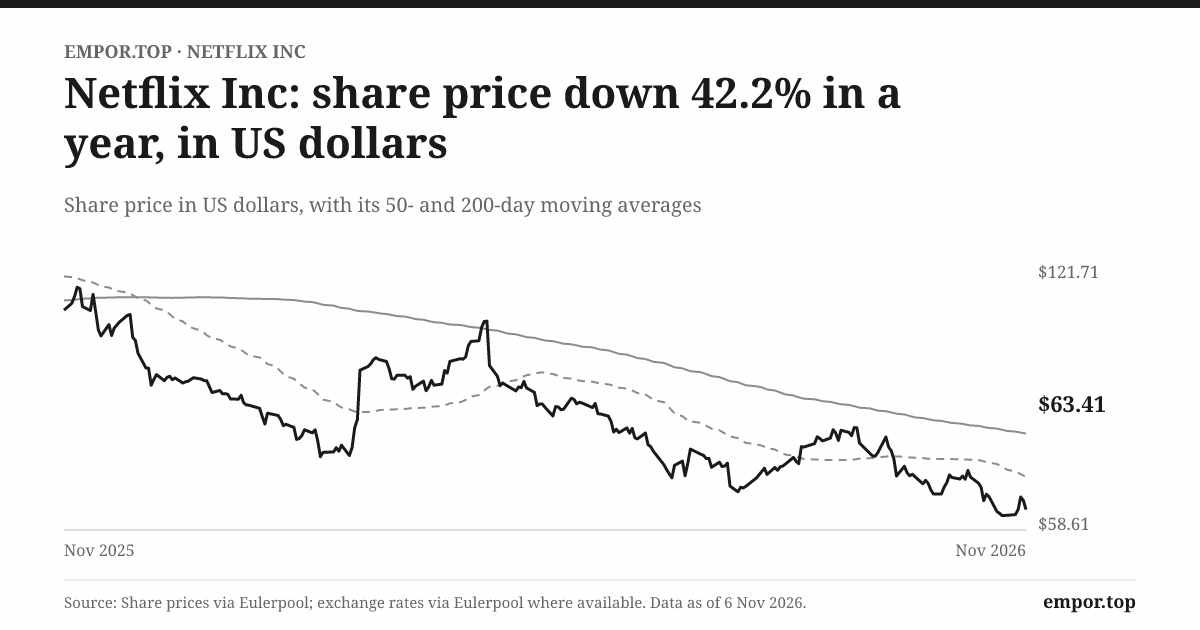
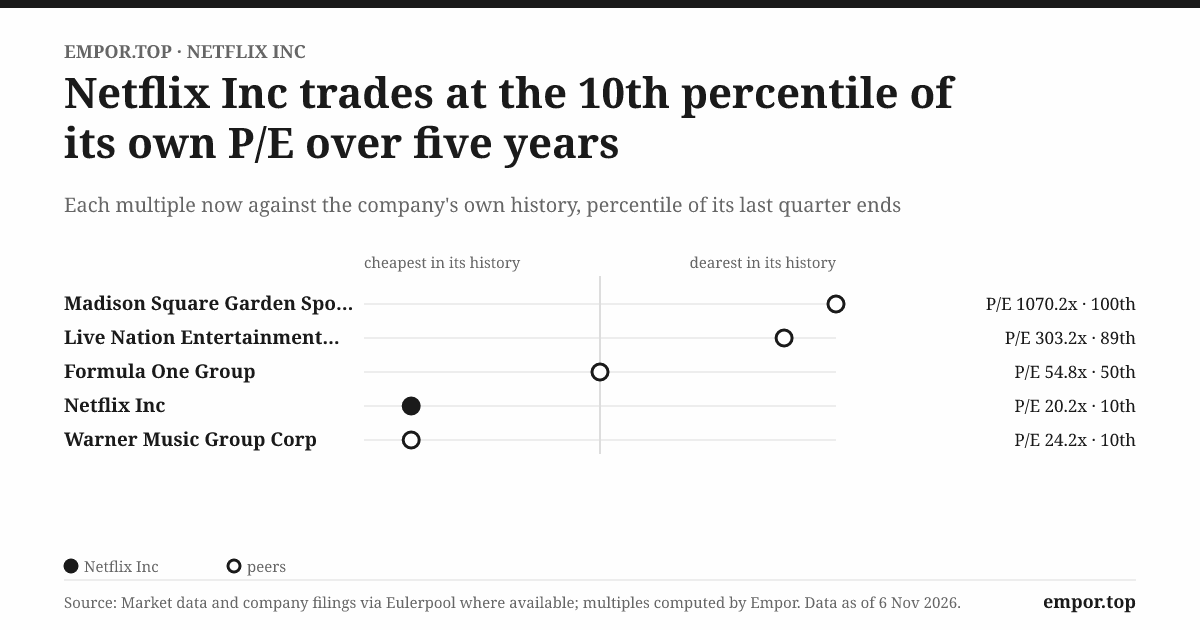
The stock tells a moodier story. On October 15, 2026 the shares closed at $70.57, giving Netflix a market value of about $307 billion. That is 43% below the 52-week high of $124.14, set in the weeks around the November 2025 ten-for-one split.1 The shares trade at about 22.5 times trailing earnings, against a five-year median near 39 times. In other words, the market now prices Netflix less like a growth company and more like a superb but maturing utility of entertainment.
So the story has to carry four questions. The first is whether Netflix can keep growing revenue at double digits on its own, through advertising and price increases, or whether slowing member growth will push management back toward debt-financed mega-mergers like the one it nearly signed. The second is whether a 33% operating margin is real cash economics or partly an accounting choice about how fast a TV show wears out. The third is whether a board that spent more than $21 billion on buybacks near peak prices, and then got rescued by a rival's cheque, has allocated capital well. The fourth is whether tax collectors in Brasília and Brussels can quietly eat the margin that global scale was supposed to deliver.
To answer them, the story runs from commutes over a California mountain highway to a Dallas boardroom where Blockbuster declined to buy Netflix, through the House of Cards gamble and a decade of borrowed money, into the 2022 subscriber shock, the ad-tier reinvention, the Warner Bros. fight, and the less glamorous problems of tax courts and currency hedges that now decide how much of the revenue reaches shareholders.
 Subscribe on LinkedIn
II. The DVD-by-Mail Crucible: Atoms, Envelopes, and the Amazon Offer (1997–2000)
In the summer of 1997, Reed Hastings and Marc Randolph shared a car over Highway 17, the twisting road that climbs out of Santa Cruz and drops into Silicon Valley. Hastings was waiting for the merger of his software company, Pure Atria, to close. Randolph, a marketer who had worked under him, was pitching e-commerce ideas on almost every drive, and most of them died before they reached Sunnyvale. Movies by mail survived, because DVDs had just appeared: thin, light and cheap enough to post for the price of a stamp. The legend says they tested the idea by mailing a bare compact disc in a greeting-card envelope to Hastings' house in Santa Cruz. It arrived intact, and the idea outlived the commute.
Their backgrounds explain the company they built. Hastings came from a well-connected Boston family. He taught high-school mathematics in rural Swaziland with the Peace Corps, then studied computer science at Stanford and founded Pure Software, a maker of debugging tools. He thinks like a systems engineer: find the constraint, then build a machine that removes it. Randolph was a direct-mail marketer by temperament, someone who believed you could test your way to product-market fit one postcard at a time. Hastings supplied rigour and capital. Randolph supplied an instinct for the customer. The IPO prospectus would later describe Hastings as the company's founder, chief executive and largest shareholder.3
Netflix launched its website in April 1998 as a DVD rental and sales shop, with a catalogue of under a thousand titles and a staff of a few dozen.3 Before long it ran into the commodity trap. Selling DVDs meant competing on price with every retailer in America, and later that year Amazon moved into DVD sales itself. According to the founders' later accounts, Jeff Bezos invited them to Seattle in 1998 and floated an acquisition in the low eight figures. They declined. Hastings, who had funded most of the start-up himself, controlled the decision. He bet that owning the future of online video was worth more than a quick exit to the company that would soon compete with him. Plenty of founders have turned down early bids and been wrong. This one aged unusually well.
The breakthrough of 1999 was a business model, not a technology. Netflix dropped per-rental pricing and late fees in favour of a flat monthly subscription, with a "queue" of films that would ship automatically as each disc came back.3 The prospectus shows how deliberate the choice was: it frames the subscription as the way to turn a once-a-month transaction into a habit, and the queue as the way to keep warehouse discs moving.3 Late fees were the core of the video-store business. Netflix made their absence the core of its pitch.
Then came the software. Netflix built a recommendation engine, later named Cinematch, and its real job was inventory economics rather than taste. A new-release blockbuster is costly to stock and quickly scarce, while a ten-year-old thriller sits on the shelf for free. Steer a subscriber's queue toward the long tail and you need fewer copies of the hits, your discs spend less time idle, and the customer still feels well looked after. That is the algorithm's first appearance in this story, as a tool for squeezing value out of physical atoms rather than as a creative force.
The money was a real problem. The prospectus records years of net losses and an accumulated deficit in the hundreds of millions of dollars by 2001.3 The early years were less a triumph of software than a fight with the post office, disc damage and capital that ran out faster than subscribers arrived. Whatever genius came later, the 1999 business only worked if it reached scale before the money ran out. That race put the company in front of the only competitor that could have ended it.
III. The $50 Million Blockbuster Laugh and the IPO Crucible (2000–2006)
In September 2000, Hastings and Randolph flew to Dallas to meet John Antioco, the chief executive of Blockbuster, at the company's headquarters. By the founders' account, they proposed that Blockbuster buy Netflix for about $50 million and let Netflix run Blockbuster's online business. Blockbuster had thousands of stores, billions in revenue and a brand in every suburban strip mall. Netflix had a loss-making website and a warehouse. Both sides agree the meeting went badly for Netflix, and Randolph later described the Blockbuster team struggling not to laugh. It is now the most famous non-deal in American business, but it was not stupid at the time. Blockbuster's profits leaned heavily on late fees and its stores were bound by long leases. A subscription model with no late fees was not a product it could adopt without attacking its own income statement. That is the textbook innovator's dilemma: the incumbent is not lazy, it is rational about the wrong time horizon.
The next eighteen months nearly proved Blockbuster right. The dot-com crash shut the venture market, and in late 2001 Netflix laid off roughly a third of its staff.3 Then the 2001 holiday season put cheap DVD players under millions of Christmas trees, demand jumped, and the company that had been cutting jobs in the autumn was struggling to keep up by the spring. On May 23, 2002, Netflix listed on NASDAQ at $15 a share and raised about $82.5 million.3 After three later stock splits, that IPO price works out to about eleven cents a share today.1
The IPO money went into logistics. Netflix built regional distribution centres near major postal sorting facilities, so that a disc mailed back on Monday could be checked in and a new one sent out the same day. The prospectus describes the goal as next-day delivery for most subscribers.3 The infrastructure was physical, but it was run like software. Proprietary systems decided which hub held which disc, which queue it went to next and how to cut the time a disc spent in an envelope rather than a player. Anyone looking for the asset-light streaming company of today can find it here first, in the obsession with utilisation.
Blockbuster did eventually fight back, and harder than the legend admits. Blockbuster Online launched, and in late 2006 its Total Access programme let customers return mailed discs to a store for a free in-store rental. That was something Netflix, with no stores, could not match. The offer was costly for Blockbuster, but it worked well enough to slow Netflix's subscriber growth. Then the incumbent's governance gave way. Carl Icahn won board seats in a proxy fight over pay and capital allocation, Antioco left in 2007, and his successor Jim Keyes cut back the digital push in favour of the stores. Blockbuster filed for bankruptcy in 2010.
The popular version, in which the giant shrugs and dies, is too tidy. The record suggests Netflix's lead in the late 2000s was much narrower than hindsight implies, and that a better-funded Total Access, sustained for another year or two, could have forced the company into a dilutive raise or a fire sale. The lesson for investors is not that incumbents always lose. It is that incumbents lose when their own governance takes the counterattack away from them. Netflix won the mail war, and then Hastings decided the mail business was not worth defending.
IV. Scrapping the Box: The Leap from Atoms to Bits (2007–2012)
By late 2006, a small team inside Netflix led by engineer Anthony Wood had built a set-top box that could stream films straight to a television. It was nearly ready to ship. Hastings killed it. His reasoning, as later recounted, was that if Netflix sold its own hardware, every TV maker, games console and phone maker would see it as a competitor rather than a partner. The box was spun out and became Roku. It was an expensive decision to throw away a finished product, and it set the strategic shape of everything that followed: Netflix would be an app that lived on every screen, not a device that fought for space on one.
Streaming launched in January 2007 as "Watch Now", a free extra for DVD subscribers that offered a modest catalogue of films playable on a PC. Picture quality was poor and the library was thin, but making it free was a good move. Netflix did not need streaming to make money yet. It needed customers to form the habit while broadband caught up.
The library problem was solved by a deal more than a technology. In 2008, Ted Sarandos, a former video-store clerk turned content chief with an encyclopaedic memory for what people actually watched, signed a licensing agreement with Starz. It reportedly cost around $30 million a year and brought in thousands of Disney and Sony films through the Starz pay-TV window. For the studios it looked like found money from a small buyer. For Netflix it was the catalogue that made streaming worth paying for. Sarandos would spend the next fifteen years being underestimated by studio executives who saw him as a customer rather than a rival.
Underneath, the engineering was rebuilt. After a database corruption in 2008 stopped DVD shipments for days, Netflix began moving its computing to Amazon Web Services, a dependence that continues: the company still names AWS as the host of most of its computing and data operations.1 It then built Open Connect, its own content delivery network. Netflix put storage appliances full of its most popular shows inside internet providers' networks, so a stream travels a few miles from a nearby server instead of across the continent.1 The simplest way to picture it is a newspaper printing local editions instead of trucking every copy from one central plant. The result was faster streams, lower bandwidth costs and a quality advantage that rivals took years to match.
Then, in 2011, Netflix nearly destroyed itself. In July it split DVD and streaming into separate plans, which meant a price rise of about 60% for customers who wanted both. In September Hastings announced that the DVD business would be spun off under a new brand, Qwikster, with its own website. Customers revolted, partly at the price and partly at being told to manage two accounts for one service. Netflix lost around 800,000 US subscribers in a quarter, and the stock fell by roughly three-quarters from its summer peak. Within weeks Hastings apologised publicly and scrapped Qwikster, though he kept the price increase.
The episode undercuts the myth of Netflix as an infallible strategist. The direction was right: streaming was the future and DVD was a melting ice cube. The execution was badly wrong, and the cost came from customers and shareholders. Still, the mistake established a pattern. Netflix would rather overreach and reverse quickly than move slowly, and it kept the economically important part of the decision, separate pricing, while dropping the cosmetic part. The bigger danger was outside. The studios had now seen what Netflix was doing with their films.
V. "House of Cards" and the Studio Cash-Bleeding Era (2011–2019)
In March 2011, Sarandos made a bid that sounded mad to anyone in television. Netflix committed about $100 million for two seasons of House of Cards, a political drama with David Fincher directing and Kevin Spacey starring, and skipped the pilot entirely. HBO and AMC wanted to see a pilot first. Netflix wanted to see the data: its subscribers liked Fincher's films, liked Spacey, and liked the original British series. In effect it was buying an audience it had already measured.
The reasoning was defensive as well as creative. Starz had declined to renew its streaming deal, and the studios had realised that every film they licensed to Netflix strengthened a competitor that would one day replace their cable channels. Licensed content was rented content, and the landlords were raising the rent or leaving. Original programming was the only shelf Netflix could own. When House of Cards premiered all at once on February 1, 2013, it made "binge-watching" part of everyday speech and won Netflix its first major Emmys. A technology company had shown it could make prestige television.
Global expansion followed: Latin America in 2011, parts of Europe in 2012, and in January 2016 a launch at the Consumer Electronics Show in Las Vegas that added some 130 countries at once. Netflix now reaches more than 190.1 Expansion and original content fed each other. A show made once could be dubbed into thirty languages and amortised over subscribers on six continents, an economic structure that no national broadcaster could copy.
This is where the investigation gets serious, because those years produced a gap between the profits Netflix reported and the cash it actually had. The mechanism matters. When Netflix pays to produce a series, the cost does not go straight to the income statement. It goes on the balance sheet as a content asset and is expensed gradually, mostly over about four years, weighted toward early viewing.1 Think of a family that buys a $40,000 car and tells its budget it spent $10,000 a year. The accounting is defensible, but the money left the bank account on day one. If Netflix is making more shows every year than the year before, the cash going out always runs ahead of the amortisation charge, and reported profit flatters the cash position.
The numbers show how wide the gap got. From FY2015 to FY2019, Netflix reported a cumulative net profit of roughly $4 billion while cash from operations totalled about minus $9.6 billion, including outflows of around $2.7 billion in 2018 and $2.9 billion in 2019.61 The difference was borrowed. Total borrowings rose from under $1 billion in 2014 to about $16.4 billion by the end of 2019, much of it high-yield bonds in dollars and euros, and debt reached more than twice shareholders' equity.6 Growth investors bought the shares anyway, because subscribers kept growing. Credit investors bought the bonds because the subscriber base looked like a recurring cash stream that would eventually be harvested.
Was the profit real? It was not fiction, but it was not cash either. The honest verdict is that Netflix's accounting matched the business's economics only on the assumption that the shows kept earning their keep for about four years. Some of the expensive bets of the era, such as the costly historical drama Marco Polo, which was cancelled after two seasons, suggest that assumption did not hold for every title. That subjectivity has never gone away. Ernst & Young still names content amortisation as Netflix's only critical audit matter, because the estimate of how quickly viewing falls off sets the shape of reported margins.1 The bet would be judged on whether cash eventually caught up with profit. In 2020 that started to happen, though not for a reason anyone had planned.
VI. Peak Streaming, The Churn Shock, and the Dual Pivot: Ads and Passwords (2020–2024)
On the evening of April 19, 2022, Netflix reported that it had lost about 200,000 paid memberships in the first quarter, its first quarterly decline in more than a decade, and warned that it expected to lose around two million more in the second.7 The next day the stock fell by about 35%, erasing tens of billions of dollars of market value in one session. A company valued for years as a perpetual growth machine was suddenly being asked whether streaming was a good business at all.
The fall was steeper because the climb had been so steep. In 2020 lockdowns turned the world's living rooms into Netflix's showroom. Members grew by tens of millions in a year, and free cash flow turned positive at about $1.9 billion as production stopped while subscription revenue kept arriving.6 Much of that was demand borrowed from the future. When the world reopened, Disney+, HBO Max, Paramount+ and Peacock were all spending to buy subscribers, and Netflix also suspended service in Russia after the invasion of Ukraine.7 Revenue growth fell from about 19% in 2021 to under 7% in 2022 and stayed there in 2023.6
Management's response is the most important strategic move of the modern era, and it involved two reversals of long-held positions. For two decades Hastings had argued in public that advertising did not belong on Netflix. Within days of the April 2022 results, he told the company that an ad-supported tier was coming. It launched that November at a lower price than the basic ad-free plan. Netflix first used Microsoft as its ad-tech partner, then built its own platform so that it would control targeting, measurement and the advertiser relationship.12 By FY2025, advertising revenue had grown roughly two-and-a-half times in a year to more than $1.5 billion.110
The second reversal was on password sharing. Netflix estimated that more than 100 million households were watching on borrowed logins, and began charging for "extra members" outside the account holder's home.7 Many on Wall Street expected a consumer revolt that would echo Qwikster. It did not happen. Revenue growth climbed back to about 16% in 2024 and 2025, and operating margin rose from about 21% to almost 30% over the same period.61
So did management fix the unit economics or just pull a lever? The record says both. Paid sharing was largely a one-off harvest: you can only convert the freeloaders once. Advertising and pricing are repeatable levers, but neither has proven its ceiling yet. What clearly changed is the business model's centre of gravity. Netflix used to sell a growing number of subscriptions. It now sells more revenue per subscription: price tiers, ads and extra members layered onto a base that has matured in its richest markets. The company made that shift explicit when it stopped reporting quarterly subscriber numbers from 2025 and asked investors to judge it on revenue and margin instead.1 That is defensible, since membership counts treat a $7 ad-tier household and a $25 premium household as equal. It also leaves outside investors with less visibility just as volume growth slows.
The leadership changed too. Sarandos had been named co-CEO in 2020, and in January 2023 Hastings stepped back to executive chairman, leaving Sarandos to run content and Greg Peters, the product and engineering chief who designed the paid-sharing rollout, to run monetisation and technology.4 Hastings moved to non-executive chairman in April 2025.4 The founder's era was ending just as the new managers faced the biggest capital allocation decision in the company's history.
VII. The $2.8 Billion Escape: The Warner Bros. Bidding War and Capital Allocation (2025–2026)
In the winter of 2025–26, Netflix did the one thing its own history warned against. It agreed to buy Warner Bros. Discovery's studio and streaming business, putting a value of roughly $83 billion on the deal, and arranged up to $42.2 billion of bridge loans plus about $25 billion of term loans and credit lines to pay for it.1 Paramount Skydance, the newly merged company backed by the Ellison family, came in with a hostile counter-bid for the whole of WBD. Netflix chose not to raise its offer. WBD terminated the Netflix agreement, Paramount paid the $2.80 billion fee on February 27, 2026, and Paramount then closed its takeover of Warner Bros. Discovery.214
Why would Netflix bid at all? The context helps. Revenue growth was still in the mid-teens in late 2025, but subscriber growth in mature markets had slowed, and Warner's assets offered a century of film library, the HBO brand and franchises such as Harry Potter and DC. For a company that spends about $17 billion a year in cash on content, buying a library looked like a way to own intellectual property rather than rebuild it.1 The board also accepted a reverse termination fee reported at about $5.8 billion. If regulators had blocked the deal, Netflix would have paid WBD rather than the other way round.1
The credit markets saw the risk plainly. Netflix had worked its way back to investment grade: S&P upgraded it to A in July 2024, and Moody's raised it to A3 in May 2025.89 Its net debt at mid-2026 was only about $5 billion against about $30 billion of annual EBITDA.2 A debt-funded Warner deal would have reversed years of deleveraging in one quarter and taken on a declining cable business with it. After the bid was dropped, Moody's argued that Netflix came out of the contest stronger and kept its A3 rating with a stable outlook.9 The fee then appeared in the accounts: Q1 2026 pre-tax profit reached about $6.5 billion against operating profit of about $4.0 billion, the difference being almost entirely the cheque from Paramount.2
Neutral investors should hold two conclusions together. Walking away was disciplined. Agreeing in the first place to a deal of that size, with that leverage and that reverse fee, shows that the anti-M&A discipline management often cited was a habit rather than a law. Under pressure it could be suspended. The question an investor should keep asking is whether the next pressure, say a stalled ad business in 2027, produces the same temptation.
The buyback record raises the same issue from another angle. Netflix spent about $6.0 billion on repurchases in 2023, $6.3 billion in 2024 and $9.1 billion in 2025, and another $6.0 billion in the first half of 2026, for $28.4 billion of treasury stock in total.12 Much of the 2025 spending happened when the shares traded, on a split-adjusted basis, between roughly $100 and $124. They now trade near $70. Buybacks are a bet that the price paid is below intrinsic value, and by the market's own scorecard those bets are currently under water. The fair defence is that cash came from operations rather than debt, share count has fallen, and timing judgments are easy in hindsight. The fair criticism is that a company that says it prices content off data has shown no evident price discipline about its own stock.
Two governance events closed the chapter. Hastings left the board altogether at the June 2026 annual meeting, so no founder remains in any role.45 At the same meeting, shareholders approved executive pay with about 16% voting against.5 Sarandos and Peters were each paid about $53 to $54 million for 2025, down from about $60 to $62 million in 2024, under a structure that since late 2023 ties performance stock units to currency-neutral operating margin.4 One in six votes against is not a revolt, but it is a clear message from investors who watched the shares fall by four-tenths. A board without its founder will now have to show that it can say no to its chief executives as easily as Hastings once said no to Bezos.
Capital allocation is one side of the margin story. The other side is earned and lost far from Los Gatos, in places where Netflix has much less control.
VIII. The Brazilian Tax Trap and the Global Margin Reality
In the third quarter of 2025, a Brazilian court ruling on how digital services should be taxed turned a long-running dispute into a bill. Netflix recorded a $619 million operating expense for non-income tax assessments in Brazil, covering years of state and municipal levies on services.1 Operating margin for the quarter fell to about 28%, from 34% in the quarter before, a drop of more than five points caused almost entirely by one country's tax ruling.1 Netflix also expects to place about $700 million in judicial deposits with Brazilian courts while it appeals: cash that leaves the bank account now and may or may not come back.1
The episode matters less for its size, which is roughly two weeks of free cash flow, than for what it shows. Netflix's margin promise rests on the idea that a show made once can be sold everywhere at almost no extra cost. Governments have noticed that this model collects revenue in their countries while booking costs and profit elsewhere. Brazil applied old consumption taxes to a new service. Several European countries have imposed digital service taxes or levies that require streaming platforms to invest a share of local revenue in local production. Netflix's gross unrecognised tax benefits, meaning positions it has taken that tax authorities might reject, stood at $566 million at the end of 2025.1 None of this breaks the model. All of it puts a ceiling on how much of the next dollar of international revenue reaches the bottom line.
Currency is the second friction. About 58% of Netflix's revenue comes from outside the United States, collected in dozens of local currencies, while its large productions are paid for mostly in dollars, pounds and euros.1 When the real or the peso falls, Brazilians and Mexicans pay the same local price for something that costs Netflix the same dollars to make. Netflix raises local prices over time and hedges in the meantime. At the end of 2025 the notional value of its derivatives was about $25.5 billion.1 Hedging smooths the timing, but it cannot change the economic fact that a strong dollar makes the foreign subscriber base less valuable. That is why management pays executives on currency-neutral margins: it removes something they cannot control, but it also removes something shareholders still bear.
Then there is the commitment behind the content. At the end of 2025, Netflix had about $24 billion of total content obligations, of which roughly $18.4 billion were off-balance-sheet commitments for titles not yet delivered and about $11.5 billion fell due within a year.1 This is the treadmill that keeps the library fresh. It also means that if revenue slowed sharply, Netflix could not cut cash spending as quickly as an investor might like, because a large share of the next year's spending is already contracted. Combine that with the auditor's focus on amortisation assumptions, and the margin looks less like a fixed asset and more like the output of three moving parts: viewing curves, tax rulings and exchange rates.
The verdict here narrows the bull case rather than rejecting it. International scale is still Netflix's greatest economic advantage, but the margins it supports are a negotiation with governments, not a law of nature. To see which habits made Netflix capable of absorbing such shocks, it helps to step back from the ledgers and look at the culture that built the machine.
IX. Playbook: Business & Investing Lessons
In 2009, Reed Hastings posted a deck of more than 120 slides online describing how Netflix ran itself. It said that "adequate performance gets a generous severance package", that the company was a team, not a family, and that it valued freedom and responsibility over process.15 Sheryl Sandberg would later call it one of the most important documents to come out of Silicon Valley. It reads like a management manifesto, but its real content is a set of operating habits that show up again and again in this story. Five of them belong to Netflix and no one else.
The first is that a business you are afraid to kill is already dying. Netflix ran a profitable, low-capex DVD business and starved it to fund streaming before streaming was proven, at the cost of Qwikster and an 80% fall in the share price. A decade later it gave up the purity of an ad-free product it had defended for twenty-five years. Each time the company abandoned what worked before a competitor forced it to. Most companies say they will do this. Netflix's record shows it actually did, twice, at a real cost.
The second is that talent density is a financial ratio, not a slogan. Netflix generated about $2.8 million of revenue per employee in 2025, from a workforce of about 16,000 running a $45 billion business.1 Hollywood studios run on large overhead and long relationships. Netflix runs on a small group of well-paid people who are expected to leave when they stop being exceptional. That has costs, in morale and in public criticism, but it explains how a company of that size can still make decisions as fast as it did with ads and passwords.
The third is that fixed costs, spread wide enough, become a moat. Spending about $17 billion in cash on content in 2025 costs Netflix roughly $50 per member per year across 325 million members.1 A rival with 50 million subscribers spending the same amount would need more than $300 per subscriber. That is not a theory about brand or algorithms. It is division, and division is very hard to compete against.
The fourth is that a breakup fee is a reward for discipline, not a strategy. The Warner episode will be remembered as Netflix walking away with $2.8 billion. It should also be remembered as Netflix agreeing to borrow more than $40 billion to buy a cable network portfolio. The lesson for founders and investors is that discipline is shown by the deals a company refuses to sign, not by the fees it collects when someone else outbids it.
The fifth is that cash tells you when an investment cycle is over, and profit does not. For five years Netflix reported growing profits while burning billions. The cycle ended not when margins reached a target, but when content amortisation, about $16.4 billion in 2025, finally caught up with cash content spending of about $17.1 billion.1 Investors in any company that capitalises its growth spending should watch for the same convergence, because until it arrives, the profit is a promise rather than a fact.
These habits describe how Netflix got here. Whether they justify the price today is a separate question, and it needs the investor's harder tools.
X. Analysis & Bear vs. Bull Case
At the Upfronts in New York each spring, the old networks have always sold their autumn schedules to Madison Avenue. Netflix now joins them, selling ads alongside NFL games on Christmas Day and a ten-year deal for WWE's Raw, reported at about $5 billion.13 The image says a lot. The company that put the broadcast networks out of business is now competing with them for the same advertising budgets, and at a valuation that has fallen from its peak to 22.5 times trailing earnings, about 8.9 times EV/EBITDA and a free cash flow yield of about 3.6%.1 The market is no longer paying for unlimited growth. It is paying for a very good business that it doubts can grow much faster than the economy plus pricing.
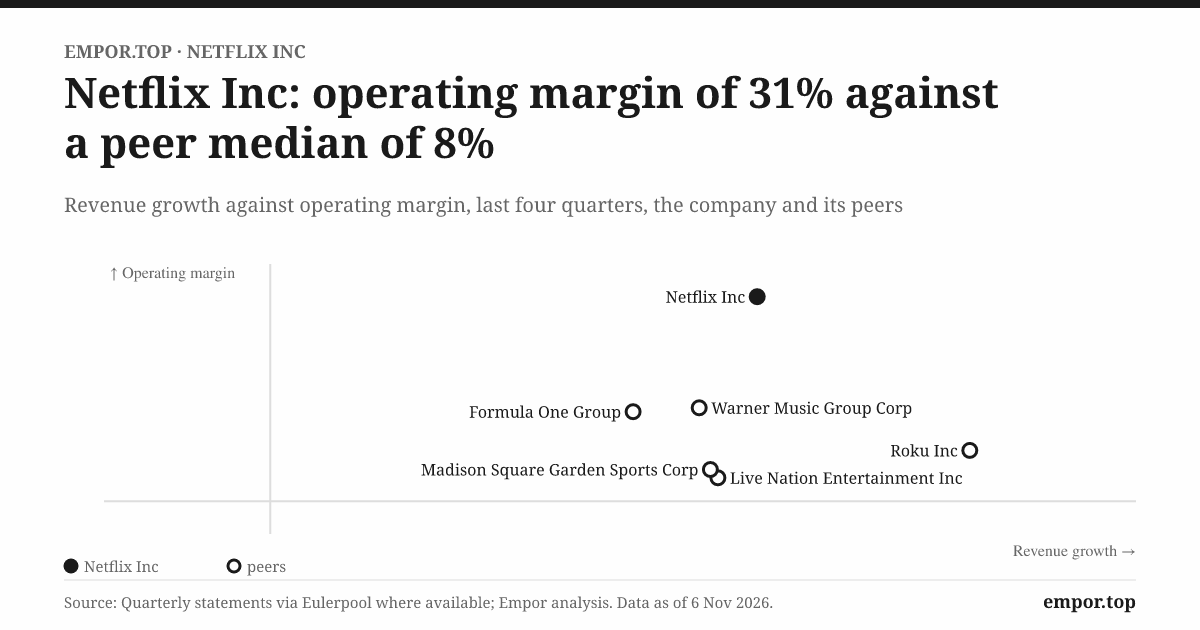
The moat is best tested with Hamilton Helmer's seven powers and Michael Porter's five forces, and Netflix holds two powers firmly. The first is scale economies, the division problem described above. Content is a fixed cost, Netflix spreads it over more paying members than any pure-play rival, and the advantage grows as each competitor's subscriber count falls short. The evidence is in the margins: Netflix runs at about 30% operating margin while most legacy streaming units have only recently reached break-even. The second is counter-positioning, which explains the 2010s. Disney, Comcast and Warner could not go all-in on streaming without damaging cable carriage fees that funded their businesses, so they waited, and Netflix had nearly a decade with no serious opposition. That power has now largely run out. The incumbents have accepted the damage and built streaming services of their own, so counter-positioning explains how Netflix got its lead rather than why it will keep it.
The other powers are weaker than fans believe. Switching costs are low in theory, since a subscriber can cancel any month with no contract. In practice, viewing history, personal recommendations and the cultural pull of shows everyone is discussing keep churn low, and the uneventful reception of paid sharing and repeated price rises is the best evidence of real pricing power. Brand is meaningful but does not stop a subscriber cancelling after a show finishes. Network effects are modest: one person's viewing improves recommendations for others only at the margin.
On Porter's forces, buyer power is high in principle because consumers face no lock-in, but it is fragmented across hundreds of millions of households, so no single buyer can bargain. Supplier power is moderate. Talent guilds showed in the 2023 WGA and SAG-AFTRA strikes that they can halt production, and AWS is a concentrated dependency.1 Netflix's commissioning scale makes it the largest buyer of scripted content in the world, which limits how much any one producer can extract. The threat of substitutes is the real long-run force: YouTube's share of TV-set viewing is the single largest, and short-form video and AI-made content compete for the same hours.
The bull case rests on three proofs still to come. The first is advertising scaling well beyond today's roughly $1.5 billion, as the in-house ad stack matures and ad-tier pricing gets closer to the revenue per member of ad-free tiers.112 The second is live events such as NFL games, WWE and boxing turning Netflix into the default destination for the shared moments that sustained cable television. The third is margins moving above 35% as amortisation stabilises and price rises flow to the bottom line. Q2 2026 already showed a 33.4% operating margin, up from about 21% for the full year 2023.21
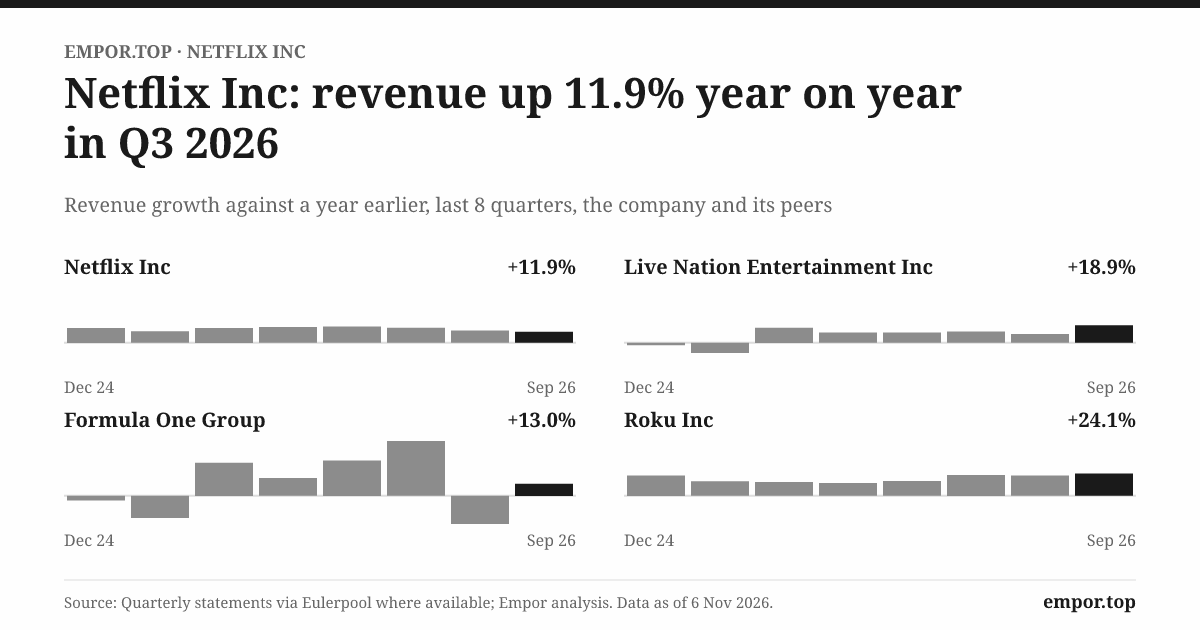
The bear case is equally concrete. Revenue growth slowed from about 17.6% in Q4 2025 to 13.4% in Q2 2026, and investors can no longer see the subscriber numbers behind it.2 Future member growth in Asia, Africa and Latin America comes at lower revenue per member and with the tax frictions described above. The $18 billion of content commitments works as a treadmill that cannot easily slow down. And the Warner bid, not just the walkaway, suggests management itself doubted that organic growth was enough.
The verdict is that the moat is real and narrower than it was. Scale economies remain intact and are the strongest in the industry. Counter-positioning is exhausted. Pricing power is proven so far but has not been tested in a recession with an ad business that is now sensitive to the cycle. The current multiple appears to assume growth near low double digits with stable margins, which is less than the bull case and more than the bear case.
Three numbers will settle it, and none needs a forecast. First, revenue growth on a currency-neutral basis, which was about 13.4% reported in the latest quarter and on a slowing trend.2 Second, the ratio of cash content spending to content amortisation, about 1.04 times in 2025, near the convergence that makes profit equal to cash.1 Third, advertising revenue, above $1.5 billion in 2025 and growing quickly from a small base.110 If the first holds in double digits, the second stays near one and the third keeps compounding, the bull case is gaining ground. If any of them fails, the bear case is.
XI. Epilogue
Tonight, the production trucks that once lined up outside soundstages park outside stadiums. Netflix now runs live sports, wrestling and award-show broadcasts, all of which require an infrastructure different from its on-demand roots. A film can be prepared for weeks before it is streamed. A Christmas Day NFL game can fail in front of tens of millions of viewers in real time, as early live boxing events showed when streams buffered and broke.11 Live programming is how Netflix intends to win advertising budgets and replace the last reasons people keep cable. It is also the most operationally exposed bet the company has made since Qwikster.
The money question is just as pressing. Netflix has about $9.1 billion of cash and short-term investments, about $14.3 billion of senior notes, and roughly $2.5 billion of that debt due within the next year.2 The breakup fee is now just part of the cash pile, but it has given Peters and Sarandos a choice that will define their era. They can keep buying back shares at roughly $70, well below the prices they paid in 2025, which would test whether their buyback judgment has improved. Or they can bid for top-tier sports rights such as the NBA or Premier League, which would test whether the discipline that ended the Warner talks holds when the prize is live sport rather than a studio. The next earnings release will show some of the answer. The FY2026 10-K in early 2027 will show more, including the first full year of ad revenue under the new platform and any update on the Brazilian appeal.1116
The governance test runs alongside. For the first time since the company was founded, no founder sits on the board. The 16% vote against pay was a warning but not a rebellion.5 Whether the independent directors can restrain empire-building, from either co-CEO, is a question only the next big auction can answer.
So the central tensions remain. Netflix has proved that its machine generates cash. It has not yet proved that the machine can grow at double digits without a bigger engine bolted on, and it has shown, once, that management is willing to buy one.
XII. Outro
The story began with a disc in a greeting-card envelope, posted across Santa Cruz to see if it would survive the mail. Hastings liked to say the idea came from a $40 late fee on a rented copy of Apollo 13. Whether or not the anecdote is exactly true, it captures the company's founding instinct: find the thing the incumbent depends on that customers hate, and build a business without it. Late fees, cable bundles, ad breaks, password policing: Netflix has spent its life deciding which of the old rules to break and, more recently, which to bring back on its own terms.
Its rivals had more money, more stores, more studios and more years. What they lacked was a willingness to burn their own business to own the next one. Hollywood thought Netflix was just another buyer for its catalogue. By the time it realised Netflix was the theatre, the cable network and the printing press combined, the red envelope had already devoured the town.
References
-
Form 10-K Annual Report for the Fiscal Year Ended December 31, 2025 — Netflix, Inc. via U.S. SEC EDGAR, 2026-01-23 ↩↩↩↩↩↩↩↩↩↩↩↩↩↩↩↩↩↩↩↩↩↩↩↩↩↩↩↩↩↩↩↩↩↩↩
-
Form 10-Q Quarterly Report for the Period Ended June 30, 2026 — Netflix, Inc. via U.S. SEC EDGAR, 2026-07-17 ↩↩↩↩↩↩↩↩↩
-
Form 424B4 Prospectus for Initial Public Offering — Netflix, Inc. via U.S. SEC EDGAR, 2002-05-23 ↩↩↩↩↩↩↩↩
-
Form DEF 14A Definitive Proxy Statement for 2026 Annual Meeting — Netflix, Inc. via U.S. SEC EDGAR, 2026-04-16 ↩↩↩↩
-
Form 8-K Current Report on Annual Stockholder Meeting Voting Results — Netflix, Inc. via U.S. SEC EDGAR, 2026-06-05 ↩↩↩
-
Form 10-K Annual Report for the Fiscal Year Ended December 31, 2024 — Netflix, Inc. via U.S. SEC EDGAR, 2025-01-27 ↩↩↩↩↩
-
Form 10-Q Quarterly Report for the Period Ended March 31, 2022 — Netflix, Inc. via U.S. SEC EDGAR, 2022-04-21 ↩↩↩
-
Research Update: Netflix Inc. Upgraded To 'A' From 'BBB+' On Solid Performance — S&P Global Ratings, 2024-07-22 ↩
-
Credit Currents: Why Netflix is Still a Winner After Bidding War with Paramount — Moody's Ratings, 2026-03-05 ↩↩
-
Netflix Q4 2025 Earnings Interview and Management Remarks — Netflix Investor Relations, 2026-01-20 ↩↩
-
Netflix Q2 2026 Earnings Interview and Financial Results — Netflix Investor Relations, 2026-07-16 ↩↩
-
Netflix to Build In-House Ad Tech Platform and Expand Global Advertising Tier — Reuters, 2024-05-15 ↩↩
-
Netflix Strikes Ten-Year Rights Deal for WWE Raw in Live Entertainment Push — Bloomberg, 2024-01-23 ↩
-
Paramount Skydance Closes Deal to Acquire Warner Bros Discovery After Netflix Exits — The Wall Street Journal, 2026-02-28 ↩↩
-
The Netflix Culture Deck: Freedom & Responsibility — Slideshare / Netflix Media Center, 2009-08-01 ↩
-
Netflix Investor Relations Landing Page — Netflix, Inc., Official Portal ↩
 LinkedIn
 WhatsApp
 Reddit
 Hacker News
 Email
 Kindle
 RSS Feed
 Spotify
 Apple Podcasts
 Amazon Music
 Audible
 YouTube