National Bank Holdings Corporation: The Bank Built to Buy Its Way West
The $8.8 Million Quarter
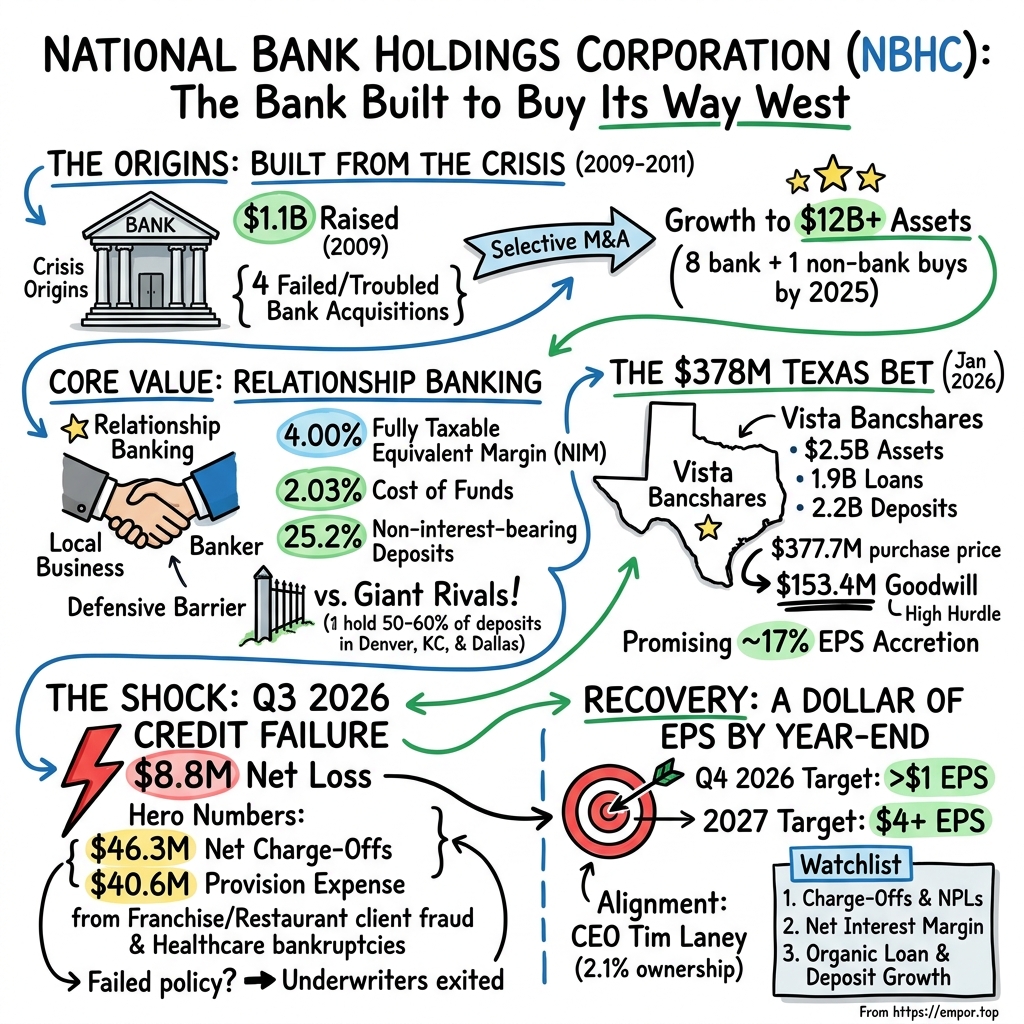
The word Tim Laney chose was "disappointing." It was late October 2026, and the chairman and chief executive of National Bank Holdings Corporation was on the third-quarter earnings call explaining how a bank that had just finished swallowing the largest acquisition in its history had also managed to lose money. For the three months to September, NBHC reported a net loss of nearly $9 million, or 20 cents a diluted share.12 A year earlier, the same quarter had produced about $35 million of profit and 92 cents a share.2
Then, in almost the same breath, Laney did something that most chief executives avoid in the quarter after a miss. He kept the target. Management told analysts it still expected to earn more than $1 a share in the fourth quarter of 2026, the goal it had been talking about since the spring.13 From a loss of 20 cents to a profit of more than a dollar in one quarter is a swing of well over a dollar a share. That is either a statement of deep confidence in the bank's underlying engine, or a promise that will define how investors judge this management team for years.
The arithmetic of the loss is simple enough to hold in your head. Before credit costs, the quarter was profitable. What broke it was a provision for credit losses of $40.6 million, the money a bank sets aside when it expects loans to go bad, and net charge-offs of $46.3 million, the loans it actually wrote off during the quarter, net of recoveries.2 The charge-offs were bigger than the new provision because some of those losses had already been reserved for in earlier quarters. Either way, a bank that typically wrote off a few million dollars of loans a quarter had written off more than $46 million in one, and most of it traced to a handful of borrowers in two industries: restaurant franchise operators and healthcare.12
That collision, between a fresh loss and a confident recovery target, is the cleanest way into the National Bank Holdings story, because it puts four questions on the table at once. The first is whether Vista Bancshares, the Texas bank NBHC closed on in January 2026, can earn back the price paid for it. The second is whether the credit shock is truly isolated, as management argues, or whether it is the first visible crack in how the bank underwrites loans. The third is whether relationship banking, the idea that a local banker who knows a business owner can win and keep that customer, creates a real advantage against national banks many times NBHC's size. And the fourth is whether the share price, which at $37.23 on November 5 sat almost exactly at the bank's stated book value, reflects what this franchise can earn once the noise clears.42
It helps to know what kind of company this is before testing it. National Bank Holdings is a listed bank holding company based in Greenwood Village, a suburb south of Denver.5 Its main operating company is NBH Bank, which runs under brands including Community Banks of Colorado, Bank Midwest in Kansas City and, since January, Vista Bank in Texas. It also owns Bank of Jackson Hole Trust, a wealth and trust business in Wyoming, and 2UniFi, a digital platform for small-business owners that is still young.56 With Vista added, the company described itself as a bank of more than $12 billion in assets.67 That is large enough to matter in Denver, Kansas City and Dallas, and small enough that each of those markets is dominated by banks that dwarf it.
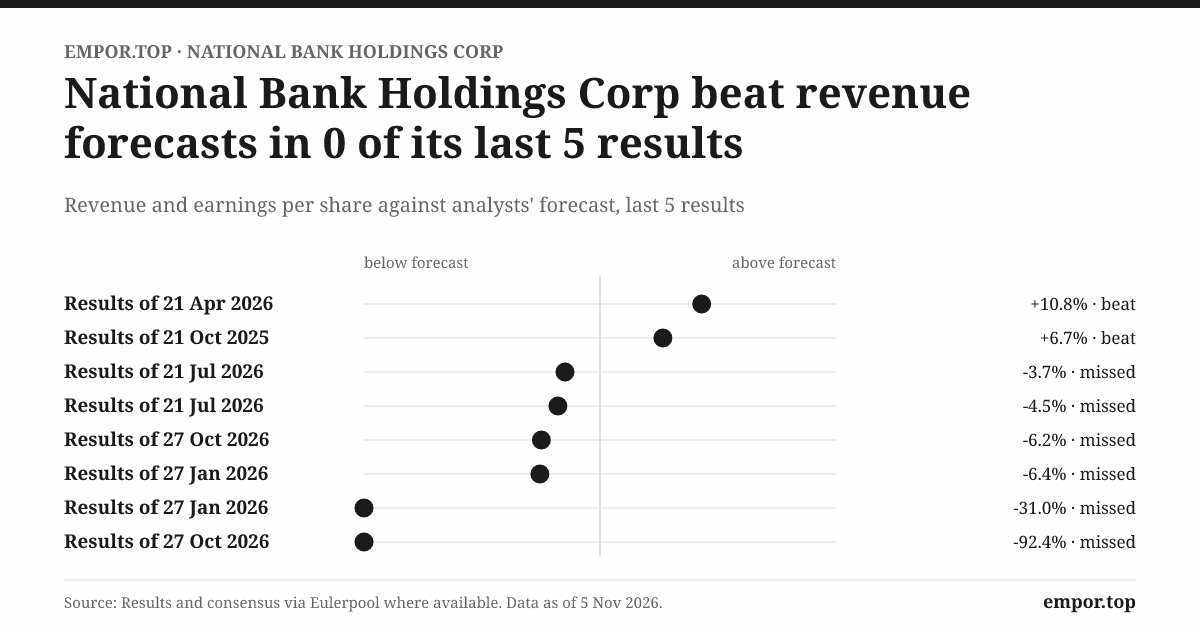
The shape of 2026 so far explains why investors are confused. Revenue jumped once Vista's loans and deposits arrived, so the third quarter's reported revenue was about a fifth higher than a year earlier.2 Yet profit moved the other way all year. Diluted earnings were 54 cents a share in the first quarter and 69 cents in the second, both weighed down by merger costs, before the loss in the third.28 A bigger bank was producing smaller per-share earnings. Management's explanation for each step was different: integration charges in the spring, conversion costs in the summer, credit in the autumn. Each explanation was plausible on its own. Together they leave an investor with a franchise that has not yet shown what a clean quarter looks like at its new size, which is precisely why the fourth-quarter target carries so much weight.
The fact that NBHC is a bank changes how the numbers should be read. A bank does not sell widgets and count inventory. It borrows money from depositors, lends it to businesses and households, and keeps the difference, minus what it loses on loans that are never repaid. The best year in the world can be erased by a few bad credits, and a bank's reported earnings in any one quarter depend on judgments about future losses that no one can know for certain. That is why the third quarter matters so much. It was not a revenue problem. It was a judgment problem.
The irony is that this company was born to profit from other banks' bad judgment. It was formed in the wreckage of the 2008 financial crisis, with a pile of private money and a plan to buy banks that had failed. To understand whether NBHC can absorb its own credit mistakes now, it helps to go back to the moment when absorbing other people's credit mistakes was the entire business model.
 Subscribe on LinkedIn
Built from Four Banks in the Crisis
In the autumn of 2009, the American banking system was still counting its dead. Regulators were closing banks almost every Friday, and the Federal Deposit Insurance Corporation was looking for buyers who could take over failed lenders' branches, deposits and loans before the weekend ended. Into that market walked a company that did not yet own a single branch. National Bank Holdings was organized in 2009 and, in a private placement that October, raised about $1.1 billion from institutional investors.9 It was, in effect, a blank cheque for buying banks.
The man running it was G. Timothy Laney, who has led the company since its formation.95 Laney was a career commercial banker who had spent many years at Bank of America and then served as a senior executive at Regions Financial, where he ran business services, before leaving to start NBHC.9 His background mattered to the model. He was not a private-equity dealmaker who saw banks as a trade. He was an operator who believed that if you could buy the deposits and customer relationships of a failed bank cheaply enough, and then run those relationships properly, you could build a durable regional franchise from parts that the market had written off.
The building happened fast. Between 2010 and 2011, NBHC completed four bank acquisitions.910 In October 2010 it took over Hillcrest Bank in Kansas City in an FDIC-assisted transaction. In December 2010 it bought Bank Midwest from its private owner, giving it a larger Kansas City deposit base. In 2011 came two more FDIC-assisted deals in Colorado: Bank of Choice, based in Greeley, and Community Banks of Colorado.910 Within roughly a year, a company with no branches had become a bank with operations stretching from the Missouri River to the Rocky Mountains.
The FDIC-assisted structure is worth understanding because it shaped the company's early economics. When the FDIC sells a failed bank, it often agrees to share in future losses on the loans the buyer inherits, which is called a loss-sharing agreement. The buyer gets the deposits and branches, takes the loans at a discount, and has a government partner absorbing much of the downside on the worst credits.9 For a buyer with capital at a time when capital was scarce, this was an extraordinary opportunity. The catch was that the acquired loan books were often impaired, and the acquired customers had just watched their bank collapse. Buying the franchise was the easy part. Keeping the customers, and building a bank culture out of four different institutions, was the hard part.
The financial record of the early years shows how long that hard part took. Through the mid-2010s, NBHC's profits were thin. Net income was around $9 million in 2014 and $4 million in 2015, on revenue of more than $200 million a year, which meant a return on equity of about 1% or less.11 The company was carrying far more capital than it needed, running off troubled acquired loans and absorbing the cost of integrating and rebranding. Shareholders' equity actually shrank from about $795 million at the end of 2014 to about $532 million by 2017, as the company returned capital through buybacks and dividends rather than finding enough good loans to deploy it into.115 That is an underappreciated chapter: the blank-cheque company that raised $1.1 billion discovered that buying cheap failed banks did not automatically produce a profitable bank.
Why did it take so long? Part of the answer is mechanical. Loans bought from the FDIC were booked at a discount, and as the troubled ones were resolved, the bank's earning assets shrank faster than new lending could replace them. Part of it was the cost of stitching together separate institutions, each with its own systems, branches and habits, under one roof. And part of it was simply that 2010s interest rates were near zero, which compressed the spread every bank earned on its deposits. Even the profit line wobbled for reasons outside the bank's control: in 2017, the federal tax overhaul forced banks to revalue their deferred tax assets, and NBHC's effective tax rate that year spiked to about 60%, cutting reported profit to around $14 million.5 The early record, in short, was a long apprenticeship in which the bank was learning to be a bank, not just a buyer of banks.
The public listing came in 2012, when NBHC registered shares on the New York Stock Exchange. The listing was principally about giving the private-placement investors a way to sell, rather than raising new money for the company.9 After that, the strategy changed shape. The supply of failed banks dried up as the economy recovered, so NBHC moved from distressed purchases to conventional franchise deals, buying healthy banks from willing sellers at negotiated prices. It acquired Peoples, Inc., with branches in Colorado and Kansas, in 2018, and Bank of Jackson Hole in Wyoming in 2022, among others.5 By the end of 2025, NBHC reported that it had completed eight bank acquisitions and one non-bank acquisition over its life.5
Those later years were when the model finally began to earn. Net income climbed from about $61 million in 2018 to a peak of about $142 million in 2023, and return on equity rose from the low single digits to around 11% to 12% in the best years.5 That is respectable for a regional bank, not spectacular. Since that 2023 peak, the line has turned down: net income fell to about $118.8 million in 2024 and $109.6 million in 2025, even before the Vista deal and the 2026 credit problems.5 Return on equity in 2025 was about 8%.5
So the founding myth needs a correction. The popular story of crisis-era bank buyers is that they bought at the bottom and minted money. NBHC's record says something more measured. It used crisis assets to build a franchise, it spent most of a decade digesting them at low returns, and it reached decent profitability only after shifting to organic growth and conventional deals. Acquisitions were the original construction method, not a recent swerve in strategy. But a record of bank deals is evidence of experience, not proof that each deal earned its cost. The harder test now is whether the company can keep growing through acquisitions without letting deal accounting, integration charges and adjustments obscure the underlying returns.
And what, exactly, did all those deals buy? Branches and loan books, yes. The relationship question remains.
Relationship Banking Is the Product
Picture the owner of a mid-sized business in suburban Denver: a contractor, say, with forty employees, a fleet of trucks and a payroll that has to clear every other Friday. A commercial banker from NBH Bank sits across the table and asks for the company's operating account, the main checking account through which revenue arrives and payroll goes out. If the banker wins it, the next conversation is about a line of credit for equipment, then about treasury management services that help the owner move money and fight payment fraud, then perhaps about the owner's personal wealth. That sequence, from operating account to loan to fees to trust, is the business model NBHC describes. Its relationship bankers serve small and midsize businesses with loans, deposits and treasury management, and the company presents that combination as its strategy.5
To see why the operating account matters so much, it helps to walk through how a bank makes money. Most of NBHC's revenue is net interest income: the interest it earns on loans and securities, minus the interest it pays depositors and other lenders.5 The ratio that captures this is the net interest margin, essentially the spread a bank earns on its interest-earning assets. In the third quarter of 2026, NBHC's net interest margin was about 4% on a fully taxable equivalent basis, and its cost of funds was about 2%.2 Put plainly, for every $100 of loans and securities, the bank was earning about $4 a year more than it paid to fund them.
That is a good margin for a bank of this kind, and the reason is visible in the deposit mix. About a quarter of NBHC's deposits, 25.2% at the end of the third quarter, were non-interest-bearing.2 These are mostly business operating accounts, money that sits in checking to cover payroll and bills and earns the customer nothing. To the bank, that money is free funding. Every dollar of it can be lent out at full loan rates with no interest cost attached. The contractor's operating account is not glamorous, but it is the cheapest raw material a bank can get, and it is why winning the account comes before winning the loan.
The second, smaller revenue stream is fees. NBHC earns non-interest income from account service charges, debit and credit card interchange, merchant services, trust and wealth management, mortgage banking and interest-rate swaps it sells to commercial borrowers.5 In 2025, total non-interest income was $67.6 million, of which $47.2 million came from customer-contract fees such as account and bank-card charges.5 That is a meaningful but secondary contributor; fees were roughly a ninth of total revenue. The rest of non-interest income is a mix that includes bank-owned life insurance, gains on property sales and marks on partnership investments, which can swing from year to year and should not be mistaken for recurring customer revenue.5
The spread has been moving in NBHC's favour, though modestly. Over the first nine months of 2026, the net interest margin was five basis points higher than a year earlier, helped by an eight-basis-point fall in the cost of funds.2 A basis point is a hundredth of a percentage point, so those are small moves, but on a balance sheet of more than $12 billion, a few basis points of spread is worth millions of dollars a year. More importantly, the direction says something: as rates eased, NBHC was able to pay depositors less without visibly losing them. That is the kind of evidence a relationship franchise ought to produce, and it is the opposite of what happened to many regional banks in 2023, when depositors demanded higher rates and margins compressed.
Relationships are also a cost line. NBHC employed about 1,250 full-time and 52 part-time associates at the end of 2025.5 Its premises, equipment and software at cost had grown to about $338.6 million from $311.6 million a year earlier, and it spent money on building 2UniFi and on the technology needed to absorb acquisitions.5 The company does not report a technology budget as a share of revenue, so investors cannot benchmark its digital spending against larger rivals. What can be said is that a bank of this size has to keep investing simply to stay level with customers' expectations of online and mobile service, and every dollar spent on that reduces the room left to underprice the giants on loans or outpay them on deposits.
What the bank does not have is a subscription. There is no company-wide contract term, no minimum commitment and no recurring-revenue percentage in its disclosures.5 A depositor can move money with a few clicks. A borrower whose loan matures can refinance at another bank. The customer's choice is made and remade on rates, fees, service quality, the range of products and digital convenience. Relationship banking is an attempt to make the service part of that equation weigh more than the price part.
Now set that pitch against the market NBHC actually competes in. In its own annual report, the company says that in several of its major markets the three largest competitors together hold a majority of deposits: about 50% in Denver, 51% in Kansas City and 60% in Dallas.5 In Kansas City, NBHC names UMB and Commerce as local competitors, two well-capitalized family-influenced banks with deep roots in the city.5 In Denver and Dallas, the dominant players are national and super-regional banks with marketing budgets, branch networks and technology spending NBHC cannot match. The September 2025 news that PNC would buy FirstBank, Colorado's largest locally headquartered bank, put an even larger national player into NBHC's home market.12
This is where the war-game analysis begins. A bank like NBHC is caught between two kinds of rival. Above it are the giants, which can offer every product, a mobile app polished by hundreds of engineers and the comfort of size. Below and beside it are online banks and fintech firms, which compete on convenience and rate for deposits and on speed for small-business loans and payments. The middle position works only if the local relationship, the banker who answers the phone, knows the business and can make a credit decision locally, is worth more to the customer than the giant's breadth or the fintech's slickness.
There are reasons to think it can be. Regulatory capital requirements and the trust that comes with an insured, supervised bank keep many fintechs from taking over lending outright. Small and midsize business owners often value a banker who will structure a loan around their circumstances, and large banks are not always eager to serve a forty-employee contractor with the same attention. The about 4% margin and the quarter of deposits in non-interest-bearing accounts suggest the model works in practice: those are not the numbers of a bank buying all its deposits at market rates.2
But the counterevidence is in the same numbers. A cost of funds above 2% means a large share of NBHC's deposits does earn interest, and those depositors are pricing their money.2 The 2022–2023 rate cycle taught every regional bank that "sticky" deposits are only as sticky as the rate on offer elsewhere. NBHC's own non-interest-bearing share is well below what many relationship banks reported before rates rose. And the company publishes no customer retention rate, no average relationship length and no data on how many customers use several products. Without that, the claim that NBHC's relationships are unusually sticky rests on strategy language rather than measurement.
So the verdict on the moat, tested once and in full here, is this. The local relationship model is credible, and the margin and deposit mix show it can work at NBHC's scale. A durable advantage is less proven. Deposits remain price-sensitive, national and super-regional banks command most of the deposits in the core markets, and there is no published evidence that NBHC's customers switch less often than a peer's. The evidence that would confirm the claim is observable: growth in low-cost transaction deposits, a cost of funds that rises less than peers' when rates move, and organic loan growth that does not depend on buying another bank. The evidence that would falsify it is equally observable: deposit outflows or rising funding costs whenever a competitor raises rates.
If relationship banking is the product, the logical next step is to buy more relationships in a faster-growing market. That is exactly what NBHC did in September 2025, when it went to Texas.
Vista: The $378 Million Bet on Texas
On September 15, 2025, NBHC announced that it had agreed to buy Vista Bancshares, a privately held Texas bank holding company, in a cash-and-stock deal that Reuters valued at roughly $369 million at announcement.13 Vista was a relationship-focused commercial bank with branches in Dallas–Fort Worth, Austin and Lubbock, plus a single outpost in Palm Beach, Florida.76 The Federal Reserve approved the deal on December 23, 2025, and it closed on January 7, 2026.146 From that day, Vista Bank became a division of NBH Bank.5
The strategic logic was not complicated. Texas has some of the fastest population and business growth in the country, and NBHC already had a foothold there. Vista brought a bigger presence in the Dallas metro area and Austin, a team of relationship bankers, and a business model that management described as similar to its own.7 Rather than spending years hiring bankers one by one in Texas, NBHC would buy a ready-made franchise and plug it into its systems.
The price was the part that mattered to shareholders. By the final accounting, the stated consideration was $377.7 million, made up of $89.0 million in cash and $288.7 million in NBHC stock.2 The stock portion meant issuing about 7.3 million new shares to Vista's owners.2 At closing, NBHC also paid off $45 million of Vista's debt, which belongs in any honest picture of total transaction economics but is separate from the purchase price.62 In exchange, NBHC got about $2.5 billion of assets, $1.9 billion of loans and $2.2 billion of deposits.62
When one company buys another, accounting requires the buyer to put a fair value on everything it acquired, the loans, the deposits, the intangible value of the customer relationships, and then book whatever it paid above that as goodwill. Goodwill is the premium for the things a balance sheet cannot measure: the franchise, the team, the future. In the Vista deal, identifiable net assets came to $269.3 million, and goodwill came to $153.4 million.2 That means NBHC paid about 1.4 times the fair value of what it could identify, and about 41% of the stated price was goodwill.
The capital ratios tell the same story from another angle. Before the deal, using September 2025 figures, NBHC's common equity tier 1 ratio, the core measure of a bank's loss-absorbing capital against its risk-weighted assets, was about 14.7%. Pro forma for Vista, it fell to about 13.1%.15 Goodwill does not count as regulatory capital, so buying a franchise at a premium consumes capital in a way that buying loans at book value does not. NBHC had plenty to spare, and 13.1% remains well above what regulators require. But the decline shows what Vista cost in the currency banks care about most: the buffer that protects shareholders when loans go bad. Within a year, that buffer was tested.
That 41% is the burden of proof. Goodwill does not earn interest. It sits on the balance sheet as a claim that the acquired franchise will generate returns above what its identifiable assets alone would. If Vista's bankers leave, if its customers drift, or if its loan growth disappoints, that premium was overpaid, and tangible book value per share, the measure most bank investors watch, absorbs the hit. When management pitched the deal in September 2025, it projected roughly 17% accretion to earnings per share, an internal rate of return above 20% and an earnback of about three years for the dilution to tangible book value.7 Those were the promises that Vista would have to keep.
A size check helps frame the price, though it should be read carefully. Earlier in the same month, PNC agreed to buy FirstBank, the Colorado bank with $26.8 billion of assets, for about $4.1 billion.1216 Measured simply by headline price against assets acquired, both deals came out at roughly 15%. That suggests NBHC did not pay wildly out of line with what a much larger buyer paid in a comparable region at the same moment. But the comparison is only a size check. Asset size says nothing about book value, loan quality, deposit costs or the earnings each franchise produces, and those are what determine whether a price is fair. Without comparable price-to-tangible-book and price-to-earnings multiples, and without the realized returns that only time reveals, there is no basis for saying NBHC overpaid. There is also no basis yet for saying it got a bargain.
What can be measured is execution against the plan. The core systems conversion, the moment when Vista's customers moved onto NBHC's technology, finished in July 2026.217 That is the riskiest operational step in any bank merger, because it is where customers lose access to online banking, cards stop working, or statements look strange, and it is where acquired customers are most likely to walk. NBHC got through it without a reported disruption. But the costs were substantial. Acquisition and restructuring expenses came to $25.2 million before tax in the first half of 2026 and another $15.2 million in the third quarter.2 Those charges are part of why reported earnings looked so weak in 2026 even before the credit losses.
There was friction in the footprint too. NBHC closed nine banking centers during the first half of 2026 as it consolidated overlapping locations, and the company said it planned to sell the Palm Beach branch, which never fit a Texas-and-Mountain-West strategy.21 Management said the Vista integration was substantially complete by the third quarter.1 Substantially complete is not the same as paying off. The cost savings that were supposed to make the deal accretive still need to show up as lower recurring expenses in reported results, not just in adjusted figures that exclude the cost of getting there.
For Vista's customers, the change was meant to be invisible except where it helped: a larger lending limit, because a bigger bank can make bigger loans to a single borrower, along with NBHC's treasury, wealth and card products. For Vista's bankers, the calculus is more delicate. In any bank merger, the people who matter most are the relationship managers who carry the customers, and they are also the people rival banks call first. NBHC does not disclose how many Vista bankers have stayed, or how Vista's loan and deposit balances have moved since closing as a separate division. That disclosure gap is significant, because the goodwill is, in large part, a bet on precisely those people and those balances.
The early per-share evidence is not yet flattering. On the company's own adjusted measure, which strips out acquisition costs, nine-month diluted earnings per share were $1.56 in 2026 against $2.47 a year earlier.2 Some of that decline is the credit losses, which have nothing to do with Vista, and some of it is a larger share count. But the direction is the opposite of 17% accretion, and the case for the deal now rests on the quarters after integration rather than the quarters during it.
So the Vista verdict is open, and fairly so. The deal added real Texas scale at a price that, on the only simple comparison available, looks broadly in line with the market. But a large goodwill balance raises the hurdle, the integration costs were material, and the promised accretion has not yet appeared in per-share results. The confirming evidence will be quarterly adjusted EPS trending toward the original targets, tangible book value per share growing again, and Vista's loan and deposit balances holding up after conversion. Just as the integration was reaching its finish line, though, a different problem arrived, one that had nothing to do with Texas and everything to do with how the bank decides whom to lend to.
The Loan Officers Who Missed the Warning Signs
The prepared remarks on the third-quarter call were measured. It was in the analyst questions that the story came out. Management explained that the largest franchise problem had first emerged in July 2026. It involved restaurant franchise operators, borrowers who run multiple locations of a national chain and depend on thin restaurant margins to service their loans. Management said it suspected client fraud and had filed suspicious activity reports, the confidential filings banks make to federal authorities when they believe a crime may have occurred.1
The second case had a longer fuse. A healthcare borrower had been in workout, the bank's term for a troubled loan under special management, since late 2025. NBHC had restructured the credit and brought in a third-party consultant to help the business recover. The restructuring ran out of options, and the borrower ended in bankruptcy.1 Between the two clusters, management described about $65 million of identified credit principal, of which about $47 million was charged off.1
The third quarter's $46.3 million in net charge-offs exceeded its $40.6 million provision for credit losses.2 For the first nine months of 2026, net charge-offs totaled $60.4 million, an annualized rate of 0.85% of average loans.2 The way banks reserve today makes those numbers worth a moment of explanation. Under the current expected credit loss standard, a bank must estimate, on the day it makes a loan, the losses it expects over that loan's entire life, and update the estimate every quarter. When a borrower's situation deteriorates, the bank raises the reserve for that specific loan; when the loss becomes certain, it charges the loan off against the reserve. So a quarter's provision is the bank refilling the tank, and a charge-off is fuel actually burned. In the third quarter, NBHC burned more than it refilled, partly because some of these loans had been reserved in earlier quarters. Even so, $15.9 million of identified healthcare and franchise relationships were newly placed on non-accrual, meaning the bank stopped counting interest on them as income because it no longer expected to collect it in full.2 Not all of the trouble, in other words, had been written off by September 30.
For context, a well-run commercial bank in a normal economy might expect annual net charge-offs somewhere in the range of a few tenths of a percent of loans. NBHC's nine-month rate was well above that, and nearly all of the excess came from one quarter and two industries.
Management's explanation was candid in one respect. It acknowledged that certain bankers had failed to follow the bank's established credit policies and said that those bankers, and some of the credit officers who supervised them, were no longer with the bank.1 That is more accountability than many banks offer in a bad quarter. It is also an admission with uncomfortable implications. If the policies were right and individual bankers bypassed them, then the controls that are supposed to catch bankers bypassing policy did not work in time.
Management also pointed out that it had been actively shrinking these exposures. Over the course of 2026, it said, NBHC had exited roughly $150 million of franchise loans and $150 million of healthcare loans.1 That is meant to show the bank had seen the risk and was acting on it. But it cuts both ways. If $300 million of exposure was being worked out of the book during the year, and the remaining problem loans still produced the steepest loss quarter in the bank's modern history, then the risk in those portfolios was larger than the bank's earlier reserves implied. And the healthcare credit had been a known problem since late 2025, which means it sat in workout for most of a year before the loss crystallized.
One analyst asked the obvious question: had the bank brought in a third-party review of the loan book? Management described internal portfolio reviews and said it felt comfortable with the remaining book.1 It did not describe an outside review. That matters because the recovery case now rests on the same internal credit process that missed the warning signs. An independent loan review would not guarantee anything, but its absence leaves investors relying on management's own assessment of a portfolio that management's own process had just misjudged.
It is important to keep the problem in proportion, because the bank is not a commercial real estate time bomb. At September 30, 2026, non-owner-occupied commercial real estate, the category that worries bank investors most, was 27.5% of loans, with no single property type above 6%.2 Office loans, the most feared segment since remote work emptied downtown towers, were just 2.4% of loans, and retail 4.5%.2 No reported industry exceeded 15% of the loan book, and franchise and healthcare lending were 5.3% and 2.8% of loans respectively.2 Non-performing loans, those no longer paying as agreed, were $43.9 million, or 0.44% of loans, and the allowance for credit losses covered 1.11% of loans.2 Those are not the figures of a bank in distress. They are the figures of a bank that took a concentrated hit in two niches and still has a reasonably clean book elsewhere.
There is a second-layer detail that deserves a sentence of explanation, because it can be misread. When KPMG audited NBHC's 2025 financial statements, it gave an unqualified opinion, the clean bill of health, on both the accounts and the internal controls.5 It also flagged the collective allowance for credit losses as a critical audit matter.5 A critical audit matter is not a warning about misconduct or an audit qualification. It is the auditor's way of saying that a particular estimate required especially complex and subjective judgment, in this case the bank's model for predicting future loan losses across its portfolio. It is a reminder that a bank's reserves are an estimate, not a fact, and that the third quarter was a demonstration of how quickly an estimate can change.
So were these losses exceptional credits, or evidence of a control failure that could recur? The honest answer is that the losses were clearly concentrated, but "isolated" is not yet established. Concentration is proven by the portfolio data. Isolation can only be proven by time: by the absence of a new cluster of losses in other industries, by the identified franchise and healthcare relationships resolving without further surprises, and by criticized and classified loans, the bank's internal watch list, trending down. The settling evidence is the path of net charge-offs and non-performing loans over the next several quarters. One clean quarter would help. Three would begin to make the case.
Which brings the story back to the promise Laney made on that call, and to the question of how much a promise from this management team is worth.
A Dollar of EPS by Year-End
The dollar-a-share target did not start in October. On the first-quarter 2026 call in April, management said it was on track to earn more than $1 a share in the fourth quarter, by which time Vista's systems would be converted and its cost savings flowing through.3 On subsequent calls, the ambition stretched further, to earnings above $4 a share in 2027.1718 At the time, the reported numbers made those goals look like a steep but plausible climb: diluted EPS was 54 cents in the first quarter and 69 cents in the second, both depressed by merger costs.28
Then came the third quarter's loss, and on the October call, Laney reaffirmed the fourth-quarter target anyway.1 The question for investors is what changed in the assumptions between April and October. The credit losses were not in anyone's plan, yet the target survived them. That can only be true if management believes the losses were truly one-time, that the expense savings are now locked in, and that the fourth quarter will be clean. Put the Q3 loss and the Q4 target side by side and the target looks less like guidance and more like a bet that nothing else goes wrong.
Credibility is built by behavior over time, so the first thing worth weighing is how management handled the miss. On the call, it named the industries, described the borrowers in general terms, admitted that bankers had failed to follow policy, said those bankers and some supervising credit officers had left, and described a portfolio review.1 That is a specific explanation with personnel consequences, not a vague reference to a challenging environment. But corrective action is not the same as proof that controls now work. The proof will be in the next set of credit numbers.
The second thing worth weighing is incentives. Laney beneficially owned about 2.1% of the company as reported in the 2026 proxy, a figure that includes unvested shares and exercisable options.19 At a market value of about $1.7 billion, that stake is worth tens of millions of dollars, far more than his annual pay. His reported total compensation was $3.73 million in 2025, down from $3.95 million in 2024, while the company's net income fell from $118.8 million to $109.6 million.195 His 2025 equity awards were split evenly between performance stock units, which pay out only if targets are met, and time-based restricted stock, which vests simply by staying.19
The short-term incentive is where a skeptic would look harder. For 2025, the annual bonus paid out at 123.9% of target, above the planned level, in a year when net income declined.19 The scorecard behind that payout included measures beyond reported profit, which is common, but a bonus above target in a year of falling earnings raises the question of whether the plan rewards sustainable, risk-adjusted results or simply milestones such as completing a deal. The 2026 scorecard will be the more telling one, because it covers a year with a reported loss quarter and a credit miss attributed to people the bank has since let go. If that year still pays above target, the incentive design deserves scrutiny.
Shareholders broadly supported the pay program at the May 2026 annual meeting: about 34.9 million votes for say-on-pay, against 1.6 million votes against and 0.7 million abstentions.20 Laney himself received about 715,620 withheld votes in his re-election as a director.20 Those are small dissenting minorities, not a revolt. Governance structure is conventional for a bank of this size: Laney combines the roles of chair and chief executive, and the board appoints an independent lead director, Ralph Clermont, with all other directors deemed independent.19 A combined chair and CEO is not unusual, but it does mean that when the board evaluates management's handling of a credit miss, the person being evaluated is also the person running the board meeting.
The finance chair is newer than the chief executive. Nicole Van Denabeele was appointed chief financial officer in September 2024, which means the Vista deal, its accounting and the 2026 guidance were all framed during her first full years in the role.5 That is not a criticism; it means the team now being judged on Vista's earnback is the team that set the targets, and there is no predecessor to whom a miss could be attributed.
The dividend is the other commitment management has kept making. NBHC paid about $46.1 million in dividends in 2025, about 42% of that year's net income, compared with a median payout of roughly a third over the previous decade.5 The yield of about 3.4% at the November share price is part of what supports the stock at book value. But a rising payout ratio on falling earnings is a squeeze: in a year when nine-month net income was only $38.5 million, dividends at a similar run rate would consume most of reported profit.2 The bank's capital can absorb that for a while. It cannot absorb it indefinitely if earnings do not recover.
Ownership adds a layer. NBHC has no controlling shareholder. BlackRock reported holding about 6.33 million shares, about 14.1% of the company, as of June 30, 2026.21 Large index-oriented holders like that rarely agitate, which means management faces less direct activist pressure than a bank with a concentrated value investor on the register.
Then there is capital allocation, which is where an activist would focus if one appeared. In 2026, NBHC issued about 7.3 million new shares to buy Vista.2 In the same nine months, it bought back 955,504 shares for $39.1 million, and in September its board authorized a further $40.1 million of repurchases.2 It also issued $100 million of subordinated notes due 2036, which Moody's rated Baa2 with a negative outlook.15 So during a year of integration costs and credit losses, the bank was issuing equity with one hand, buying it back with the other and adding long-dated debt. The defense is that capital was ample, with a pro forma common equity tier 1 ratio of about 13.1% after Vista, well above regulatory minimums, and that buying stock near book value is a good use of excess capital.15 The critique is that repurchases during a quarter when the bank was writing off $46 million of loans signal confidence before the loss cycle has been proven over, and that the negative outlook from Moody's is a reminder that outside observers saw constraints even before the third quarter.15
Finally, the digital bet deserves a sentence in proportion to its size. NBHC says it is shifting 2UniFi from building its systems toward generating deposits, but it does not report standalone revenue, users or losses for the platform.21 In the third quarter, the bank also took a $4 million impairment on a separate investment in a third-party fintech company.2 Until 2UniFi produces measurable deposits or fees, it is optionality, not an earnings engine, and the fintech write-down is a small but real reminder that the company's technology investments have not all held their value.
So how much confidence should investors place in the recovery targets? Laney's ownership and the equity-linked pay create meaningful alignment, and management did give a specific, falsifiable target rather than retreating into generalities. But the target was set before the credit losses and was simply reaffirmed after them. Credibility now depends on delivery and on whether the account of the credit miss holds up, not on repeating the number. And whether the number is met or missed, the market has already rendered a provisional verdict in the share price.
Analysis & Bear vs. Bull Case
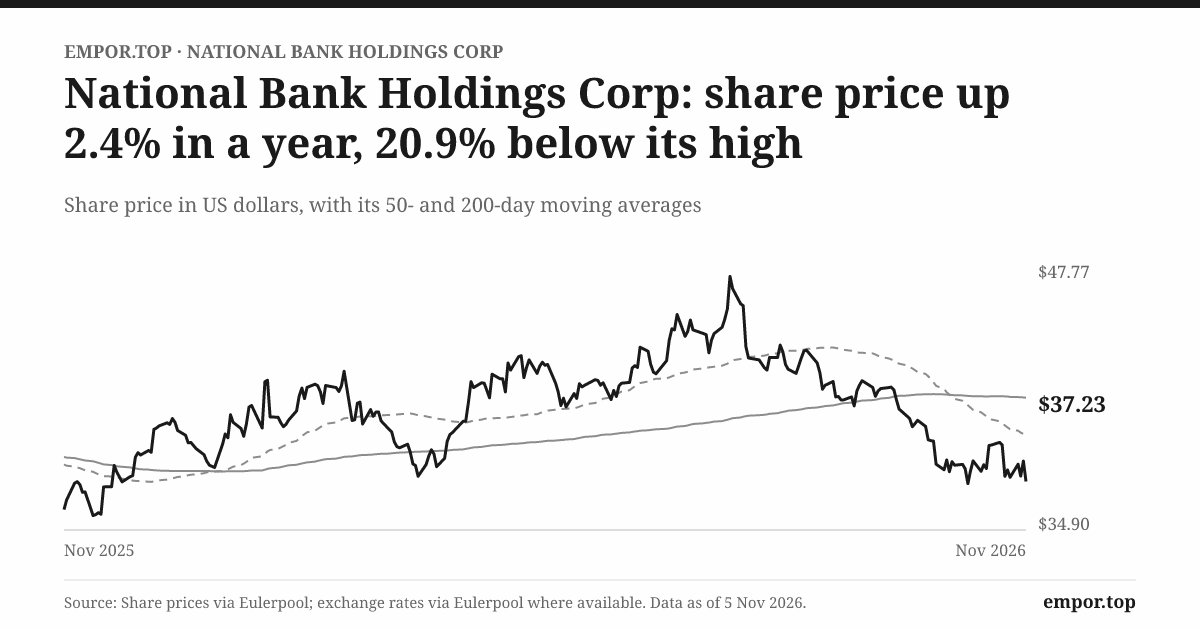
On November 5, 2026, NBHC's shares closed at $37.23.4 That was about 21% below their 52-week high of roughly $47 and just above the 52-week low of about $35.60.4 At that price, the market valued the company at about $1.7 billion, and the shares traded at almost exactly their stated book value of $36.00 a share, a price-to-book ratio of 1.0 times.42 The dividend yield was about 3.4%.4
Book value is the cleanest anchor for a bank, because it is roughly what shareholders would get if the bank's assets and liabilities were marked at their carrying values. A bank trading at book is, in effect, being valued as if it will earn about its cost of equity, no more and no less. It is worth noting that book value includes the Vista goodwill and other intangibles, so the price relative to tangible book value is higher than 1.0 times. A market that believed NBHC could reliably earn a return on equity well above its cost of capital would pay a premium to book. A market that feared further losses would pay a discount. At 1.0 times, the market is not making a strong call either way.
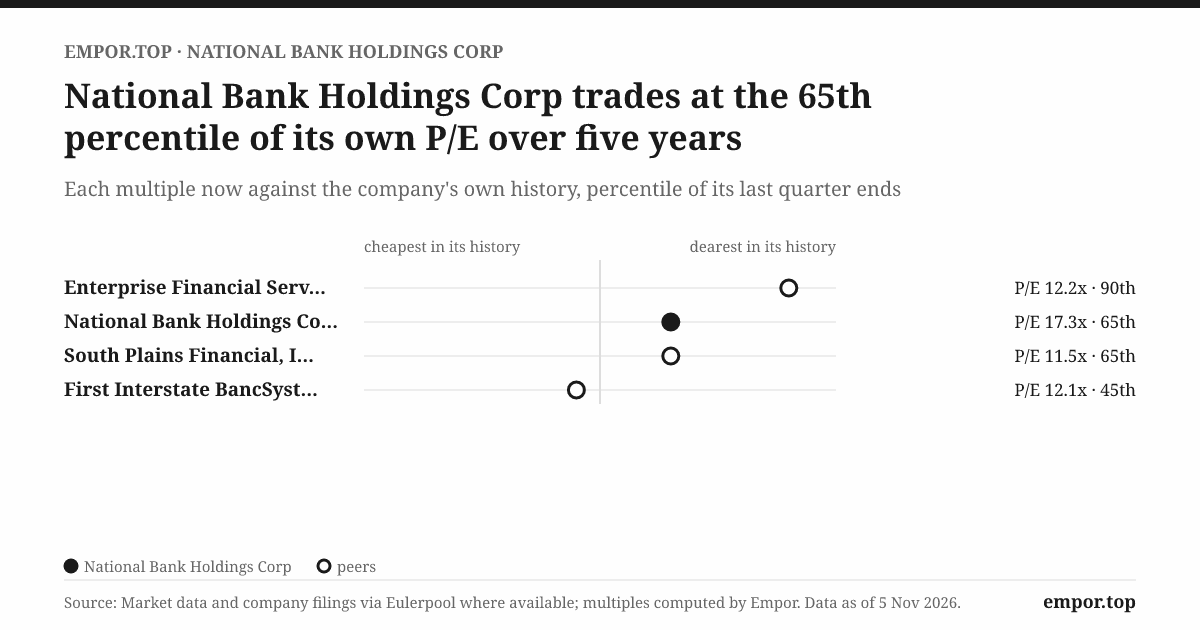
The earnings multiples need more care. Market-data screens showed a price-to-earnings ratio of 17.3 times, compared with a five-year median of 16.1 times.4 But trailing twelve-month diluted earnings per share were $1.46, and $37.23 divided by $1.46 is about 25.5 times, not 17.3.42 The 17.3 figure appears to rest on a different earnings measure, perhaps adjusted or forward estimates, so it is not the multiple on reported trailing profit. The deeper point is that the earnings denominator is unstable. Trailing EPS includes the Vista integration costs and the third-quarter credit losses, both of which management describes as non-recurring. If the $4-a-share 2027 ambition were met, the stock would be at a little over 9 times those earnings. If the trailing $1.46 is closer to the truth, it is expensive. The multiple is not a settled verdict on value. It is a range of outcomes waiting to be narrowed by the next few quarters.
The bull case, stated without endorsing it, runs like this. NBHC has added scale in some of the fastest-growing markets in the country. Before the third quarter, it was reporting organic loan growth at an annualized rate of 9.7% through June, meaning growth beyond what Vista added.178 It completed the Vista systems conversion, the riskiest step of the integration, and held its net interest margin at 4.00% in the third quarter.2 Its capital ratios were comfortably above requirements after the acquisition.15 And the credit losses, painful as they were, came from two industries representing less than a tenth of the loan book, with commercial real estate exposure modest and diversified.2 In this telling, the third quarter was a cleanup, the cost base is about to drop, and a bank priced at book will soon be earning a double-digit return on tangible equity.
The bear case deserves equal force. The third-quarter credit losses erased a quarter of reported earnings and raised real questions about underwriting controls, questions management's internal review has not fully answered. The Vista deal added a large goodwill balance and required tens of millions in integration costs, raising the return hurdle at the same moment that adjusted per-share earnings were falling. Deposit competition from banks many times NBHC's size constrains how much margin it can keep if rates fall or competitors bid for funds. Earnings were already declining before Vista, from about $142 million in 2023 to about $110 million in 2025.5 And management's recovery target is, so far, a target.
A more structured way to weigh these cases is to look at the forces shaping the industry and the sources of durable advantage. Start with buyers. In banking, the buyers are depositors and borrowers, and both have considerable power. Depositors can compare rates across online banks in minutes, and business borrowers with good credit are courted by every bank in town. NBHC's cost of funds above 2% shows that much of its funding is priced competitively rather than captive.2 Suppliers, in a bank's case, are mainly the providers of funding and the core technology vendors; funding suppliers are the same depositors, and the technology market is concentrated among a few large processors, which gives them pricing leverage over smaller banks. The threat of substitutes is real at the edges: fintech firms offer substitutes for payments, small-business lending and treasury tools, though few can replicate a full commercial lending relationship. New entrants face high barriers because bank charters, capital requirements and regulatory supervision are costly to obtain and maintain, which protects incumbents of all sizes. And rivalry is intense, because in Denver, Kansas City and Dallas the three largest banks hold between half and three-fifths of deposits, with UMB and Commerce entrenched in Kansas City and national giants dominating the rest.5
Through the lens of Hamilton Helmer's seven powers, the sources of durable advantage, the picture is thinner. Scale economies favor NBHC's larger rivals, not NBHC; a $12 billion bank spreads technology and compliance costs over a much smaller base than a $500 billion one. Network effects are minimal in commercial banking. Switching costs are the power NBHC most plausibly has: moving a business's operating account, payroll, treasury services and loans is a genuine hassle, and that friction is what relationship banking tries to amplify. But the company publishes no retention data to prove its switching costs are higher than a peer's. Counter-positioning, a business model incumbents cannot copy without hurting themselves, might apply in a limited way, since big banks sometimes standardize small-business service in ways that leave room for a local banker. Brand matters locally but is not a pricing advantage NBHC can demonstrate. There is no cornered resource, such as a unique license or asset. Process power, the ability to execute better through embedded practices, is exactly what the third quarter called into question on the credit side, though the Vista conversion is a point in its favor on the operational side. The conclusion is that NBHC's edge, where it exists, is a modest switching-cost advantage in business relationships, real but unproven in its durability, and it does not amount to a structural moat.
Stress-testing the Vista thesis means comparing its outcomes with the original promises. The pitch was roughly 17% EPS accretion, a 20%-plus internal rate of return and a three-year earnback on tangible book dilution.7 The test is whether quarterly adjusted EPS rises toward those targets after the integration costs end, whether tangible book value per share resumes growing, and whether the post-integration expense run rate appears in reported results. So far, none of those three has been demonstrated, because the integration only finished in July and the third quarter was dominated by credit.
Out of everything that could be tracked, three measures carry the most information. The first is credit: net charge-offs and non-performing loans. The latest readings were a nine-month annualized net charge-off rate of 0.85% and non-performing loans at 0.44% of loans, with charge-offs sharply higher in the third quarter.2 The second is the spread engine: net interest margin alongside deposit costs, which stood at 4.00% and a 2.03% cost of funds in the third quarter, with the margin modestly improved from a year earlier.2 The third is growth that compounds: organic loan and deposit growth together with tangible book value per share, which will reveal whether Vista and the relationship model are building value per share rather than just size.
The risks that could move the economics are specific. Credit deterioration beyond the two identified industries is the largest. Deposit repricing, if competitors pay up for funds or rates move sharply, would squeeze the margin. Interest-rate movements also affect the securities portfolio, which at September 30 carried $64.2 million of net unrealized losses on available-for-sale securities and $61.5 million on held-to-maturity securities, a reminder that the bank's treasury balances are not spare cash but a rate-sensitive book.2 Liquidity, by contrast, looks like a strength rather than a risk. At June 30, 2026, NBH Bank had just $125 million of Federal Home Loan Bank advances outstanding and about $2.0 billion of unused FHLB capacity, with $6.1 billion of loans pledged to the FHLB and the Federal Reserve's discount window as backup collateral.8 There is no near-term refinancing wall in the filings and no covenant breach. The constraint on this bank is not whether it can fund itself, but what it costs to do so. One more caution on earnings quality belongs here: non-interest income in 2025 equalled roughly half of pretax income, and that total included unrealized partnership gains and property-sale gains that will not necessarily repeat.5 A recovery built on recurring spread and fee income is worth more than one helped along by one-time marks. Acquisition execution, including the Palm Beach sale and post-integration optimization, carries its own risk. Cyber and fraud controls matter more for a bank that just suspected client fraud in a major credit and is building a digital platform. And regulatory costs rise for banks approaching larger asset thresholds. Ordinary litigation, which the company says is not expected to be material, and foreign exchange, to which a domestic dollar-reporting bank has no meaningful exposure, are not where the risk lies.5
What would have to be true for NBHC to deserve more than book value? Credit would have to normalize quickly, Vista would have to produce the promised accretion, and the relationship model would have to keep low-cost deposits growing even as rivals compete for them. What would have to be true for it to deserve less? The third quarter would have to be the first of several, rather than the last. The market has priced the shares as if it does not yet know which story it is in. The company's own history, from crisis-era bank buyer to Texas acquirer, offers some lessons about which way such stories tend to break.
Playbook: Business & Investing Lessons
Go back to Kansas City in October 2010, when NBHC's new owners walked into a failed Hillcrest Bank with the FDIC holding the door open. They had bought a franchise cheaply and with a government partner on the worst loans, and then they spent much of the following decade earning returns that barely cleared 1%.11 The lesson that moment leaves is the first one: buying a bank cheaply is only the first half of the job; the second half is keeping the customers and the controls. The FDIC deals proved NBHC could acquire. The long, low-return digestion proved that acquisition is the beginning of the work, not the end. For any company that grows by buying, the price paid is visible on the day of the deal, while the cost of integration, retention and culture is paid quietly for years afterward.
Now go to September 2025, when management stood up with a presentation promising 17% accretion, a return above 20% and a three-year earnback on Vista.7 Texas was the right market by almost any measure of growth. Yet nine months of 2026 produced adjusted per-share earnings well below the prior year, and $153.4 million of goodwill now sits on the balance sheet as a promise waiting to be honored.2 The lesson: a growth market does not make an acquisition accretive; the earnback has to appear in per-share results. Investors who hear "attractive market" in a deal pitch should ask the next question every time: attractive for whom, at what price and measured how? Market growth flows to the customers and the banks that win them. It flows to the acquirer's shareholders only if the price left room for it.
Then go to July 2026, when a franchise restaurant credit started to unravel, and to the healthcare borrower that had been in workout since late 2025, the one whose restructuring ran out of road. Both were in a bank that had written credit policies and had been exiting the very industries involved. Both still produced the worst loss quarter in the company's modern history.12 The lesson: credit discipline is measured by the loans that fail, not by the policies written for the loans that succeed. Every bank's credit manual looks sound in a good year. The test of a lender is how early it sees trouble, how fast it acts and how honestly it reserves. NBHC's admission that bankers bypassed its policies is a reminder that a policy no one enforces is just a document.
There is a fourth lesson, one that sits across the whole story. NBHC is an unusual case of a bank whose entire identity is acquisition, from the $1.1 billion blank cheque in 2009 to Vista in 2026, and whose biggest conventional integration arrived at precisely the moment its credit process faltered.96 That collision is not a coincidence of timing so much as a predictable strain: integration absorbs management attention, credit officers and systems teams at the same time, and loan problems tend to surface where attention is thinnest. The lesson: scale is an input to returns, not proof of them. Size makes a bank more relevant to its customers and more visible to its investors. It does not, by itself, make each share worth more. Only the earnings that size enables, after the losses it can hide, can do that.
Those lessons point at a set of near-term moments that will decide which of them NBHC has learned.
Epilogue
Tonight, National Bank Holdings stands at a peculiar resting point. The Vista systems conversion is behind it, the third-quarter credit cleanup has been booked, and management has reaffirmed its fourth-quarter earnings target.1 Alongside that target, it guided to core operating expenses of $75 million to $77 million for the quarter and fee income of $17 million to $18 million.1 Those three figures form the first real exam of the post-Vista bank, and the results will arrive in the new year.
The expense guidance is the quietest number and possibly the most important. If the fourth quarter shows core expenses in the guided range, it will be the first clear evidence that the cost savings promised in the Vista deal have reached the reported income statement, not just the adjusted one. If expenses come in higher, the accretion math that justified the purchase price starts to look stretched. And if the fourth quarter delivers more than $1 a share, it will do much to restore the credibility the third quarter dented. If it falls short, the 2027 ambition of more than $4 a share will be hard to hear without skepticism.
But the credit numbers will tell the deeper story, and they will take longer to settle. Management expects net charge-offs and non-performing loans to normalize now that the identified franchise and healthcare credits have been addressed.1 A fourth quarter with charge-offs back near historical levels would support the claim that the losses were isolated. A fourth quarter with a new problem credit, in a new industry, would suggest that the third quarter was not a cleanup but a turning point. Even a clean fourth quarter cannot by itself establish a durable trend. One good quarter after a bad one is a relief, not a proof. Three or four would begin to be evidence.
Beyond credit, the questions are about the engine. Will loan growth and lower-cost deposits continue now that Vista's customers are fully on NBHC's systems, or will some of them quietly drift to competitors after the conversion? Will those gains show up in tangible book value per share and in return on tangible common equity, the measures that capture whether the deal is creating value per share rather than just adding size? And will the planned sale of the Palm Beach branch, and the continuing post-integration optimization, signal genuine strategic focus or just tidying at the edges?
There is also an outside referee to watch. When Moody's rated the subordinated notes in early 2026, it attached a negative outlook, before the third-quarter losses had happened.15 A negative outlook means the agency sees a meaningful chance of a downgrade over the coming period. The next rating action will be an independent read on whether the combination of Vista goodwill, buybacks, a generous dividend and a credit-loss quarter has eroded the bank's cushion more than management's capital ratios suggest. A stable outlook would be a quiet vote of confidence. A downgrade would make the bank's own debt more expensive and add an outside voice to the skeptics' case. Alongside it, the year-end capital ratios, the first full year-end measured after both the acquisition and the losses, will show how much of the original buffer remains for the next surprise.
Each of those moments will help settle the questions this story opened with. The tension that remains is that management has already told investors what the answer will be, and the bank's loan book has not yet agreed.
Outro
Return to that October call one last time. A chief executive who built his company by buying banks that had made bad loans stood in front of analysts and explained that his own bank had just made some bad loans, that the bankers responsible were gone, and that the quarter ahead would earn more than a dollar a share anyway.1 A net loss of nearly $9 million on one side; a promise of more than $1 a share on the other.21
That gap is the whole story of National Bank Holdings in miniature. It is a bank built by buying other banks, one that has spent seventeen years turning acquired branches into a regional franchise, and its defining test is no longer whether it can buy. It is whether it can make the scale pay without letting credit risk write the ending. The next set of results will not finish that story. But it will tell investors whether the dollar was a forecast or a hope.
References
-
National Bank Holdings Corporation Q3 2026 Earnings Call Transcript — The Motley Fool, 2026-10-28 ↩↩↩↩↩↩↩↩↩↩↩↩↩↩↩↩↩↩↩↩
-
National Bank Holdings Corporation Q3 2026 Form 10-Q — SEC, 2026-10-27 ↩↩↩↩↩↩↩↩↩↩↩↩↩↩↩↩↩↩↩↩↩↩↩↩↩↩↩↩↩↩↩↩↩↩↩↩↩↩↩↩↩↩↩↩↩
-
National Bank Holdings Corporation Q1 2026 Earnings Call Transcript — Stock Analysis, 2026-04 ↩↩
-
National Bank Holdings Corporation — Investor Relations ↩↩↩↩↩↩↩
-
National Bank Holdings Corporation 2025 Form 10-K — SEC, 2026-02-24 ↩↩↩↩↩↩↩↩↩↩↩↩↩↩↩↩↩↩↩↩↩↩↩↩↩↩↩↩↩↩
-
National Bank Holdings Corporation Vista Acquisition Closing, Form 8-K — SEC, 2026-01-07 ↩↩↩↩↩↩↩
-
Q3 2025 Investor Presentation — National Bank Holdings Corporation, 2025 ↩↩↩↩↩↩
-
National Bank Holdings Corporation Q2 2026 Form 10-Q — SEC, 2026-07-21 ↩↩↩↩
-
National Bank Holdings Corporation 2012 Form S-1 — SEC, 2012-03-30 ↩↩↩↩↩↩↩↩
-
National Bank Holdings Corporation 2013 Form 10-K — SEC, 2014 ↩↩
-
National Bank Holdings Corporation 2015 Form 10-K — SEC, 2016 ↩↩↩
-
PNC Announces Agreement to Acquire FirstBank — PNC, 2025-09-08 ↩↩
-
National Bank Agrees to Buy Vista in $369 Million Deal — Reuters, 2025-09-15 ↩
-
Federal Reserve Order Approving NBHC's Vista Acquisition — Federal Reserve, 2025-12-23 ↩
-
National Bank Holdings Corporation Subordinated Debt Investor Presentation — SEC Rule 433 filing, 2026-02 ↩↩↩↩↩↩
-
PNC to Buy Colorado-Based FirstBank for $4.1 Billion — Associated Press, 2025-09-08 ↩
-
National Bank Holdings Corporation Q2 2026 Earnings Call Transcript — Investing.com, 2026-08 ↩↩↩
-
National Bank Holdings Corporation Q4 2025 Earnings Call Transcript — Stock Analysis, 2026-01 ↩
-
National Bank Holdings Corporation 2026 Proxy Statement — SEC, 2026-04-03 ↩↩↩↩↩
-
National Bank Holdings Corporation Annual Meeting Results, Form 8-K — SEC, 2026-05-12 ↩↩
 LinkedIn
 WhatsApp
 Reddit
 Hacker News
 Email
 Kindle
 RSS Feed
 Spotify
 Apple Podcasts
 Amazon Music
 Audible
 YouTube