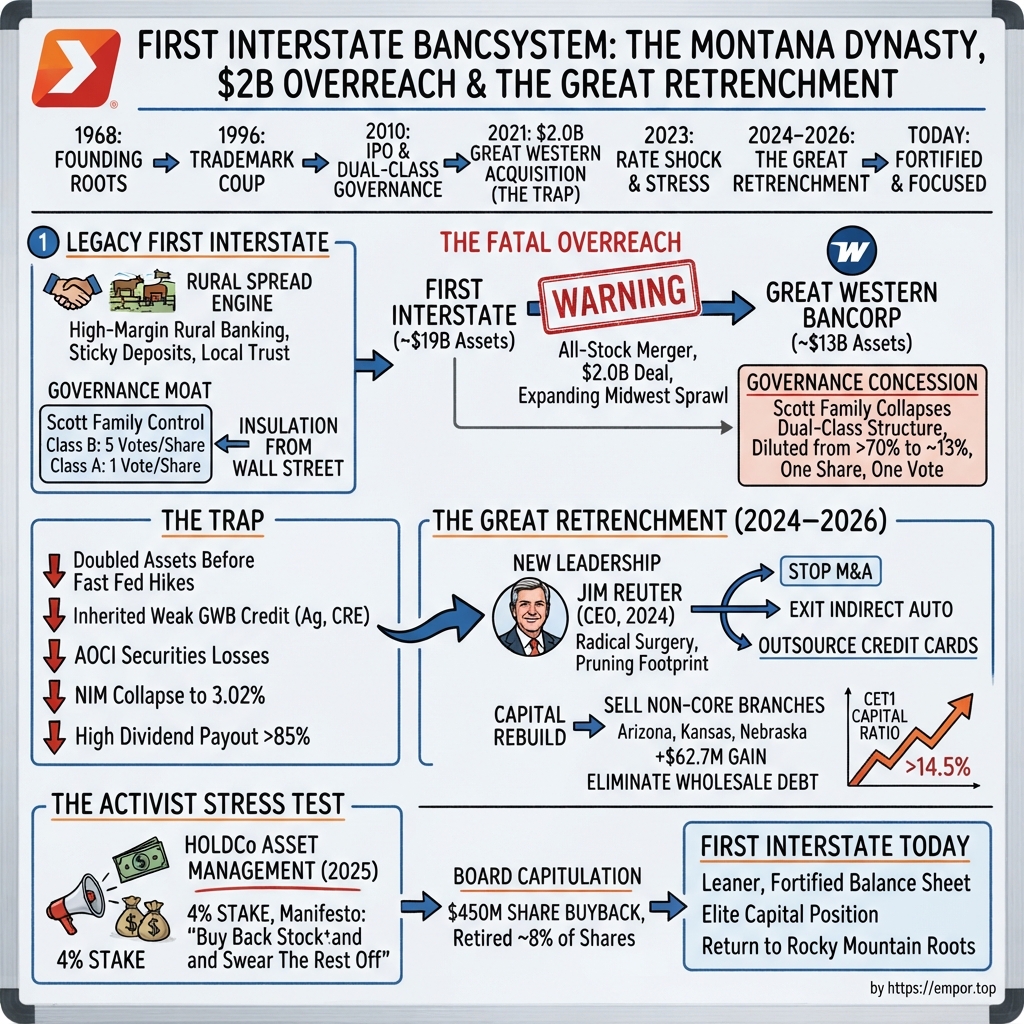
First Interstate BancSystem, Inc.: The Montana Dynasty, The $2 Billion Overreach, and The Great Regional Bank Retrenchment
I. Cold Open & Episode Roadmap
Across the small towns of the American West — Sheridan, Wyoming; Miles City, Montana; Coeur d'Alene, Idaho — stands a familiar roadside fixture: an orange and red chevron set above the name "First Interstate Bank." To anyone who remembers Southern California in the 1980s, that emblem carried a distinct meaning. It was the mark of a Los Angeles banking empire, First Interstate Bancorp, one of the most aggressive multi-bank holding companies of its era. That empire no longer exists. Wells Fargo acquired it in a hostile takeover in January 1996 for $11.6 billion, then the richest banking transaction in American history.9
Yet the chevron survived — twelve hundred miles inland on the plains of Montana, affixed to branches owned by a Sheridan ranching and construction family named Scott. That distinction anchors the First Interstate BancSystem story: the brand was inherited from a fallen corporate empire, but the bank carrying it spent five decades doing the exact opposite of what its namesake did. It stayed small, stayed local, and stayed family-controlled.
That discipline lasted until late 2021.
In September 2021, with interest rates anchored near zero and bank valuations elevated, First Interstate agreed to acquire Great Western Bancorp of Sioux Falls, South Dakota, in an all-stock transaction valued at roughly $2.0 billion.11 The combination nearly doubled the bank's size, pushing it past $32 billion in assets across more than 300 branches spanning the Rockies, the Pacific Northwest, and the Great Plains.28 The deal closed on February 1, 2022. Six weeks later, the Federal Reserve initiated the fastest monetary tightening campaign in four decades.
What followed became a textbook study in balance-sheet and integration risk. A massive securities portfolio purchased at depressed 2021 yields suffered hundreds of millions of dollars in paper losses. A core deposit base proved far more rate-sensitive than the mountain-town franchise management had spent half a century cultivating. Meanwhile, the newly acquired Plains loan book decayed, first quietly, then visibly.
Diluted earnings per share fell from $2.48 in 2023 to $2.19 in 2024, yet the board held the annual dividend steady at $1.88 — consuming nearly 86 cents of every dollar earned.261 First Interstate's stock price tumbled to roughly $21.68 by October 2023, down nearly half from approximately $40 at the beginning of that year.27 At the same time, the governance architecture that had preserved Scott family control for fifty years dissolved almost by accident: the sheer volume of shares issued to fund the Great Western purchase breached a sunset threshold buried in the company's articles of incorporation.12
Then came the retrenchment. In June 2024, the chief executive who had expanded the bank through eight successive acquisitions announced his retirement.14 In November 2024, an outsider took the helm: Jim Reuter, a Colorado banker who had spent his career running a large privately held institution. Reuter promptly pursued a course regional bank executives rarely choose voluntarily: he shrank the balance sheet. First Interstate divested branches in Arizona, Kansas, and Nebraska. It shut down indirect auto lending, transferred the consumer credit card portfolio to a third-party issuer, and eliminated every dollar of wholesale borrowings. By mid-2026, total assets had contracted to $25.9 billion, the common equity Tier 1 capital ratio had climbed to 14.54%, and the board had authorized $450 million in share repurchases — representing roughly an eighth of the company's total equity value.3
That buyback program did not materialize in a vacuum. In the autumn of 2025, HoldCo Asset Management, a Fort Lauderdale hedge fund specializing in activist pressure on underperforming regional lenders, disclosed a 3.8% ownership stake and published a presentation titled as an explicit directive: Buy Back Stock and Swear The Rest Off.1816
The broader story unfolds in three movements. First is the assembly of an exceptional, low-cost deposit franchise across a rural expanse that money-center institutions ignored. Second is the decision to swap geographic concentration for rapid scale at the absolute top of the rate cycle. Third is the ongoing effort to reverse that expansion by shedding non-core assets, repurchasing stock, and clawing back net interest margin basis point by basis point. Whether this turnaround yields a sustainably restored business or merely a smaller one remains the central question.
Before turning to the history, one framing point deserves emphasis. It is tempting to cast this narrative as a conventional morality tale of a conservative family bank undone by hubris and rescued by an outsider. The regulatory filings point to a more complex reality. The Great Western merger was approved by a board that had overseen six successful acquisitions under the same leadership team; the underwater securities portfolio was constructed using the same reinvestment playbook adopted across the banking industry in 2020 and 2021; and the chief executive who executed the transaction had generated significant shareholder value over the preceding decade. The central question is not who erred, but which characteristics of a community banking franchise are fundamentally non-transferable — and why certain types of scale destroy value even when financial models suggest otherwise.
The record points to a specific conclusion: what cannot be transferred or easily replicated is local deposit dominance and the underwriting edge derived from operating inside a community a bank already knows intimately. Physical branches, core systems, branding, and even commercial lending teams can all be bought. Those two foundational assets cannot — and they remain the decisive variables separating a defensible banking franchise from a commoditized spread business.
The story begins with a highway contractor from Wyoming.
 Subscribe on LinkedIn
II. Founding Roots: Homer Scott, Sheridan Coal, and the Montana Empire
Homer Scott Sr. did not enter banking as a financier. He arrived as a heavy-construction contractor who had spent decades moving earth, building highways across the northern Rockies, and grazing cattle on Wyoming pasture. In 1968, at an age when many contractors consider retirement, Scott purchased the Bank of Commerce in Sheridan, Wyoming.7
The rationale was straightforward rather than engineered. Having spent decades borrowing capital for machinery, payroll, and the working capital construction demands, Scott understood community banking from the borrower's vantage point. In rural commercial lending, the essential offering was not an off-the-shelf financial product.
It was an underwriting judgment: assessing whether the person across the desk would make good on the debt when a highway project ran over schedule or winter calves weighed light. Making that call was manageable for an institution rooted in the community, but prohibitively difficult for an outsider. Money-center institutions in New York and Chicago could rarely evaluate local borrowers from a thousand miles away, leading them either to bypass the intermountain West or to misprice its credit risks.
The family's ancillary enterprises reinforced that operating culture. The Scotts held, and continue to hold, interests in the Padlock Ranch Company — one of the larger cattle operations in the northern Rockies — alongside family charitable foundations carrying Homer and Mildred Scott's names.13 A bank whose controlling family operates working ranches evaluates agricultural credit differently than a lender relying on macro research. When drought strikes, management understands the cash-flow squeeze firsthand because the family's own operations are enduring the same weather.
In 1970, Scott acquired Security Trust and Savings Bank in Billings, Montana, shifting the franchise's center of gravity north into the state that would anchor its identity.7 In 1971, he formed a Montana holding company, added two additional banks, and opened six de novo branches across Montana and Wyoming.72 The early expansion model proved durable: acquire the community bank, retain its local staff, and preserve decentralized loan approvals at the branch level.
Surviving the 1980s. By 1981, the network had grown to ten branches.7 That modest footprint proved fortunate, as the ensuing farm crisis devastated agricultural lenders throughout the Great Plains. When Paul Volcker's Federal Reserve drove the prime rate above 20%, crashing land values triggered hundreds of bank failures. First Interstate survived.
The historical record warrants nuance. Regulatory filings from that period do not offer a granular, loan-by-loan accounting of the bank's vulnerability, and surviving severe macro shocks inevitably involves geographic fortune alongside credit discipline. Nonetheless, the institution withstood a rigorous trial in agricultural and livestock credit — the same portfolio concentration that would trigger distress forty years later — and emerged intact under family ownership.
The 1984 franchise agreement. The First Interstate brand originated through an unconventional licensing arrangement. In 1984, the Scott family entered into a franchise agreement with Los Angeles-based First Interstate Bancorp, then led by Joseph Pinola, granting rights to use the First Interstate name across Montana and Wyoming.7 For an independent regional lender in Billings, the arrangement offered compelling economics.
First Interstate Bancorp was an early architect of interstate banking networks, seeking to establish a multistate presence before federal deregulation permitted direct interstate acquisitions. The company licensed its common brand, centralized credit card operations, and electronic clearing infrastructure to independent regional banks. The Scott family gained modern clearing rails, payment technology, and national brand recognition without surrendering equity or local control.
The 1996 windfall. The parent empire ultimately unraveled. In late 1995, First Interstate Bancorp agreed to an acquisition by Minneapolis-based First Bank System at $130.65 per share. Wells Fargo launched a hostile takeover, winning shareholder approval on January 24, 1996, with an offer valued at $152.33 per share, or $11.6 billion — forcing First Interstate to terminate the First Bank System pact and pay $125 million in breakup fees plus $75 million at closing.9 The resulting merger created the eighth-largest bank in the nation, with $108.4 billion in assets, and led to the planned closure of roughly 350 California branches.9
Wells Fargo focused on retail density, California market share, and operational overlap. It had little strategic interest in running a localized brand in northern Wyoming. Consequently, the Scott family secured what became the transaction's most valuable asset: exclusive territorial licensing rights to the First Interstate name and chevron logo across eight states — Montana, Wyoming, Idaho, Utah, Colorado, Nebraska, South Dakota, and North Dakota.7 The bank operated 27 branches at the time; by 1999, the branch network had expanded to 42.7
The Plains beachhead nobody remembers. One historical milestone from this era proved critical in light of later events. In 2008 — thirteen years before the Great Western acquisition — First Interstate expanded into South Dakota by acquiring First Western Bank, adding eighteen branch offices.7 The bank's eventual push into the upper Midwest was not an unprecedented pivot in 2021.
Rather, it extended a geographic corridor management had tested on a smaller scale and deemed viable enough to replicate later at forty times the size. Strategic corporate expansions often encounter this hazard: when an initial, small-scale acquisition succeeds or avoids distress, leadership can mistake manageable risk for a validated, scalable formula, overlooking that the pilot was simply too small to reveal the systemic weaknesses of the broader market.
The scope of those brand rights warrants clear perspective. Calling the arrangement an impenetrable moat overstates its legal and commercial nature. The company holds licensing rights rather than direct trademark ownership, and regulatory filings treat brand defense as an ongoing operational cost: the 2025 annual report explicitly notes that protecting the "First Interstate Bank" name and related marks, including through litigation, can generate material legal expenses.2 What the franchise rights provided was half a century of national brand recognition paired with local branch underwriting. In a business anchored in depositor trust and customer friction, that positioning provided an operational edge. Yet branding alone did not generate the bank's core profitability.
That profitability stemmed from its deposit franchise — an advantage rooted directly in local geography.
III. The Rural Banking Spread Engine & The Public Debut
To understand why a regional lender in Billings could reliably out-earn commercial banks in major metropolitan centers for much of the past half-century, one has to examine the mechanics of spread banking.
A commercial bank generates earnings on the spread between what it yields on assets and what it pays to fund them. Market commentary often focuses on the asset side — loan yields, credit underwriting, and securities portfolios. Yet the asset side is largely commoditized: a commercial real estate loan in Montana and one in Massachusetts are priced against the same benchmark interest-rate curves. The enduring differentiation lies on the liability side, centered on a single operational question: when the Federal Reserve raises benchmark interest rates, how much of that increase must the bank pass through to its depositors to keep them from moving their cash elsewhere?
That pass-through rate — the deposit beta — governs regional banking economics. An institution with a 20% cumulative deposit beta passes along just 20 cents of every dollar in policy rate hikes, retaining the remaining 80 cents in expanded net interest margin. A lender with a 60% beta retains only 40 cents. Across a full monetary cycle, that divergence marks the entire distance between an exceptional commercial franchise and a commoditized balance-sheet utility.
The arithmetic is substantial. For an institution funding a $20 billion deposit base, each one-percentage-point increase in the average cost of deposits translates into $200 million in annual interest expense. Two lenders with identical loan books, identical credit performance, and identical overhead — but separated by 60 basis points in funding costs — face a $120 million divergence in annual pre-tax earnings. That spread explains much of the valuation dispersion across the American regional banking sector, and it explains why acquiring institutions consistently justify transaction premiums by pointing to deposit franchises rather than loan portfolios.
Why the Rockies produced low betas. Rural and small-metro deposits across Montana and Wyoming were historically among the stickiest in the country for structural reasons. National money-center banks never established dense branch networks across secondary intermountain markets, leaving competitive pressure on deposit pricing muted.
The depositors themselves — ranchers, small-town contractors, county governments, and farm-equipment dealers — held working balances in operating accounts because their enterprises required day-to-day liquidity rather than yield on idle cash. Furthermore, First Interstate often operated the only full-service commercial branch in a county seat, meaning the practical alternative to accepting modest yields required driving fifty miles to the next town.
The durable foundation of that footprint remains evident in regulatory disclosures. As of mid-2025 data, First Interstate held the second-largest deposit share in Montana at 16.6% and the largest in Wyoming at 13.3% — establishing dominant local density across both states.2 That density, far more than the inherited chevron logo, was the franchise's real asset.
There was, however, a critical corollary that management would later rediscover under duress. The structural advantage was never generic "rural banking"; it was dominant market share within a specific rural territory. A branch holding 16% of a state's deposit base commands fundamentally different pricing leverage than an outpost holding 1.6%, even if both sit along a Main Street in a town of eight thousand people. Deposit betas reflect localized competitive concentration rather than rural geography — a distinction that would later emerge as the central vulnerability in the Great Western acquisition thesis.
The 2010 IPO. By 2010, the company had expanded well beyond the capital resources private family ownership could comfortably provide. On March 23, 2010, First Interstate priced an initial public offering of 10 million shares of Class A common stock at $14.50 per share, with trading commencing on the NASDAQ the following day under the ticker symbol FIBK.8 The market window was notable: barely twelve months past the trough of the global financial crisis, public offerings for depository institutions were virtually nonexistent.
The governance structure mattered even more. First Interstate came to market with a dual-class equity architecture: Class A common shares carrying one vote each were sold to the public, while Class B shares carrying five votes each were reserved for the Scott family and affiliated trusts, convertible one-for-one into Class A shares at any time.12 This classic founder-control framework achieved its intended purpose. It rendered the bank effectively immune to hostile takeovers and insulated executive leadership from the quarterly earnings pressures of institutional investors for more than a decade. A controlling family that had navigated the 1980s farm crisis through conservative underwriting could maintain that risk profile without pressure from activist shareholders demanding higher balance-sheet leverage.
The timing underscored that standing. In the spring of 2010, the market for financial equity remained severely impaired after two years of widespread depository failures, dilutive recapitalizations, and regulatory seizures. That First Interstate could successfully complete an offering while disclosing more than twenty consecutive years of profitability testified to the quality of its pre-crisis franchise. The transaction was not a distressed recapitalization, but a deliberate move by the family to monetize a minority stake in an enterprise it had spent four decades building, executed largely on its own terms.
Yet governance insulation carries a well-documented trade-off: super-voting structures that protect management from short-term market noise can also shield executives from external discipline when strategic assumptions falter. That vulnerability would come due a decade later.
The Riley era and the bolt-on blueprint. Kevin Riley joined First Interstate as chief financial officer in 2013 and assumed the role of chief executive officer in 2015. Over his eleven-year tenure, the bank executed an aggressive expansion strategy spanning eight transactions that expanded total assets from roughly $7 billion to $30.5 billion.14 The initial wave of acquisitions closely adhered to the bank's core geographic footprint.
In November 2016, First Interstate agreed to acquire Cascade Bancorp, the Bend, Oregon-based parent of Bank of the Cascades, for approximately $589 million, or $7.60 per share in cash and stock.21 The transaction added $3.2 billion in assets and 50 banking offices across Oregon, Idaho, and Washington, elevating the combined institution past $12 billion in total assets and 131 branch locations.21 In April 2018, First Interstate followed with an agreement to acquire Spokane-based Northwest Bancorporation, parent of Inland Northwest Bank, for $160.9 million in stock, adding 20 branches and more than $800 million in assets across the Pacific Northwest.22 Further bolt-on acquisitions in Idaho and Washington soon followed.
These transactions shared a clear strategic rationale: they were geographically contiguous, with each acquired branch located within driving distance of the existing network; they served culturally compatible Mountain West communities exhibiting familiar, sticky deposit behaviors; and they deepened First Interstate's established franchise rather than grafting on an unfamiliar operating model. Inland Northwest chief executive Russ Lee articulated the cultural fit when explaining his board's decision to sell, noting that while his bank needed scale to fund technology investments, "we weren't interested in becoming part of a large bank. First Interstate was like-minded."22
That integration track record provided compelling evidence of management's capacity to absorb smaller community lenders; none of those early transactions disrupted the balance sheet. Yet that very success contained the seeds of a strategic trap. After executing a series of contiguous, low-risk bolt-ons, leadership concluded that acquisition integration had become an organizational core competency. The flaw in that reasoning — and the mistake First Interstate would commit in 2021 — was assuming that the ability to absorb familiar community banks in adjacent mountain valleys could seamlessly transfer to a transformational, multibillion-dollar acquisition across the Great Plains.
IV. The Fatal Overreach: The $2.0B Great Western Bancorp Merger
By late summer 2021, conditions across the banking sector aligned to encourage aggressive expansion.
Pandemic fiscal stimulus had flooded bank balance sheets with low-cost deposits. Because commercial and consumer loan demand remained sluggish, institutions routinely funneled that liquidity into fixed-income securities. The Federal Reserve had kept the federal funds rate near zero for eighteen months while signaling that rate hikes remained distant. Meanwhile, bank equity valuations had rebounded sharply from their early-pandemic troughs, providing lenders with high-priced stock to deploy as an acquisition currency. For a First Interstate management team that had spent six years rolling up smaller lenders across the Pacific Northwest, looking eastward across the map seemed a natural next step.
The target was Great Western Bancorp, headquartered in Sioux Falls, South Dakota. With roughly $13 billion in assets, Great Western operated a branch network spanning the Great Plains and Upper Midwest — including South Dakota, Nebraska, Iowa, Minnesota, Kansas, Missouri, Colorado, and Arizona.
On September 15, 2021, the two lenders entered into a definitive merger agreement. Under the terms, Great Western merged into First Interstate, with Great Western shareholders receiving 0.8425 shares of First Interstate Class A common stock for each share held, representing an implied transaction value of approximately $2.0 billion.1110 Following regulatory approvals on December 22, 2021, and shareholder votes on January 19, 2022, the transaction closed on February 1, 2022, creating an institution with more than 300 branches and over $32 billion in total assets.2811 Five Great Western directors joined the First Interstate board, acquired branches continued operating under the Great Western banner until a core systems conversion in May 2022, and chief executive Kevin Riley proclaimed that the combined entity had become "the premier community banking franchise in the West."11
The governance sunset. A common interpretation of the transaction suggests that the Scott family deliberately surrendered its super-voting control to pursue regional scale. The regulatory record reveals a far more mechanical shift.
The family never voted to relinquish its Class B shares. Instead, the governance architecture unwound automatically. Under First Interstate's articles of incorporation, all Class B shares automatically converted into Class A common stock on a one-for-one basis if the Class B block fell below 20% of total shares outstanding. Funding the purchase of a $13 billion institution required issuing so many new Class A shares to Great Western equity holders that the Scott family's ownership was diluted beneath that critical threshold.
The conversion took effect before the market opened on March 25, 2022, pegged to the record date for that year's annual meeting. The change required no formal shareholder vote, altered no economic rights, and simply unified the voting power of the two share classes. First Interstate lost its status as a "controlled company" under NASDAQ listing rules on the same day.12
The fifty-three-year voting redoubt was not relinquished by choice; it was diluted away as a structural byproduct of the share issuance needed to fund the merger. The family preserved governance standing through a Scott Family Stockholder Agreement signed on September 15, 2021 — concurrent with the merger agreement — which granted the family the right to nominate up to three board directors as long as aggregate family ownership remained at or above 5%.13 Three directors serve as Scott family designees.13 Yet board representation is distinct from outright voting control, a division that would become increasingly consequential over the subsequent four years.
Great Western's credit record. The crucial diligence question was not how Great Western's balance sheet appeared in the liquidity-rich environment of 2021, but how its underlying credit portfolio had performed across the prior decade. The public record had already flashed warning signs.
In July 2019 — barely two years before the merger was struck — Great Western issued an earnings warning, disclosing that quarterly net income would drop at least 38% due to severe deterioration across its dairy and cattle lending books. The bank projected agricultural charge-offs of $31 million to $33.5 million, a loan-loss provision of $26 million to $27.5 million, and an 84% surge in substandard loans to $476 million. Approximately $4 million in net charge-offs was linked to suspected borrower fraud by a cattle feed operator. At the time, Great Western chief executive Ken Karels reassured investors that the distress was "not believed to be reflective of the remainder of our loan portfolio."23
That episode reflected Great Western's underlying credit profile: an Upper Midwest agricultural and commercial loan book susceptible to lumpy, concentrated losses, overseen by a management team inclined to treat systemic credit weaknesses as isolated events. First Interstate paid a premium to tangible book value to absorb that balance sheet.
Testing the scale thesis. Management justified the acquisition through a conventional regional consolidation thesis: larger scale would unlock operational cost synergies, broad geographic diversification would insulate the loan book, and the combined bank would stand as a dominant regional player. Each claim can be evaluated against subsequent results under the same operating umbrella.
Diversification imported credit risk rather than dispersing it. By December 2024, criticized loans — assets showing signs of borrower weakness before outright default — stood at $773.3 million.1 Throughout 2025, as incoming management carried out a comprehensive portfolio re-grading, criticized loans expanded to $1.16 billion by September before finishing the year at $1.05 billion, an increase of $278.5 million over the twelve-month period.1 The single largest criticized exposure, which was paid off in October 2025, exceeded $50 million.5 For full-year 2024, net charge-offs totaled $104.5 million, or 0.57% of average loans, with the fourth quarter running at an annualized loss rate of 1.22%.21 This was not the historical credit performance of First Interstate's legacy Northern Rockies footprint; it was the imported risk profile of the Great Western portfolio.
Deposit quality eroded rather than expanded. The consolidated bank's total cost of funds, including non-interest-bearing deposits, climbed to 1.83% for full-year 2024.1 For an institution whose competitive advantage had long rested on cheap, stable rural deposits, that metric captured the dilution of its funding edge.
Tangible capital absorbed a double blow. The transaction created substantial goodwill, which stood at $1,100.9 million at year-end 2025 — representing 31.9% of total stockholders' equity and a dollar-for-dollar deduction from regulatory and tangible capital.2 Concurrently, as interest rates surged, accumulated other comprehensive loss from underwater available-for-sale securities widened to $356.5 million by the end of 2023.2
The operational record shows that the transaction's scale thesis failed to hold up. While back-office redundancies yielded overhead savings, those gains were overwhelmed by elevated credit provisions and rising deposit funding costs. In commercial banking, scale yields pricing power only when supported by local branch density. Spreading roughly a hundred branches across eight disparate states diluted operational focus without securing competitive dominance in any single market.
The Federal Reserve would underscore that vulnerability with stark clarity, beginning just six weeks after the merger closed.
V. The Crucible: Rate Shock, AOCI Collapse, and the 2023 Bank Run Era
On March 16, 2022, the Federal Open Market Committee raised its policy rate for the first time in three years. Over the following seventeen months, the central bank lifted its target range from effectively zero to between 5.25% and 5.50%. For a regional lender that had just absorbed $13 billion in assets funded largely by deposits gathered at zero-rate pricing, the timing proved exceptionally adverse.
The securities trap, explained simply. When deposits surge and loan demand remains subdued, banks buy bonds. Between 2020 and 2021, First Interstate — following the broader regional banking sector — channeled billions of dollars into mortgage-backed securities and U.S. Treasuries yielding in the low 2% range. Because government agencies or the U.S. Treasury backed the vast majority of those holdings, they carried negligible credit risk. They carried immense duration risk.
The underlying mechanism is worth clarifying because it inflicted far more damage on bank equity in 2022 and 2023 than loan losses did. A bond paying 2% for the next seven years trades at par value when prevailing market rates sit at 2%. When benchmark yields surge to 5%, buyers demand a steep discount before accepting that below-market cash flow, causing the bond's market price to drop. The resulting decline does not stem from borrower default; it represents opportunity cost crystallized into an asset price. Under standard accounting rules, unrealized losses on securities classified as available-for-sale flow through accumulated other comprehensive income, or AOCI. This entry directly reduces reported book equity, even though no cash has been lost and the securities are scheduled to mature at par.
The resulting balance-sheet damage was substantial. Accumulated other comprehensive loss stood at $356.5 million at year-end 2023 and $321.9 million at year-end 2024, recovering to $178.1 million by the end of 2025 as interest rates eased and bonds moved closer to maturity.2 Even as of December 31, 2025, First Interstate held $5.65 billion in securities that had remained in a continuous unrealized loss position for more than twelve consecutive months, representing gross unrealized losses of $443.2 million, which regulatory filings attributed to broader interest-rate shifts rather than credit deterioration.2
Two accounting conventions shaped how those losses appeared on regulatory scorecards. First, First Interstate exercised the standard regulatory opt-out that excludes accumulated other comprehensive income from Common Equity Tier 1 capital — meaning mark-to-market securities losses eroded reported book equity while leaving the regulatory capital ratios governing dividend distributions and buybacks technically undisturbed.2 Second, the bank classified a portion of its portfolio as held-to-maturity, carrying those bonds at amortized cost rather than fair market value. While the economic drag matched that of available-for-sale holdings, the accounting designation shielded them from flowing through reported equity.
Neither treatment was unusual or improper under federal banking guidelines. Both conventions meant that headline regulatory capital ratios throughout 2022 and 2023 understated the institution's true economic vulnerability, while reported tangible book value overstated the permanent loss relative to what the bank would ultimately recover as its portfolio matured at par.
Spring 2023. On March 10, 2023, Silicon Valley Bank collapsed, followed two days later by Signature Bank. Both institutions succumbed to an identical vulnerability: an outsized portfolio of underwater securities paired with a heavy concentration of uninsured deposits that could leave via digital transfers in an afternoon. In the aftermath, financial markets abruptly re-underwrote every regional bank across the country against those two variables.
First Interstate's first-quarter 2023 earnings conference call on April 27 provided an instructive window into executive decision-making, capturing management's perspective at the height of regional banking distress. Chief executive Kevin Riley opened the discussion by emphasizing "stability in our insured deposit base" and stating that the institution had avoided extraordinary liquidity measures.
Management disclosed that total deposits had declined 3.9% during the quarter, attributing roughly two-thirds of the outflow to seasonal patterns and the remainder to uninsured commercial accounts following the March bank runs. First Interstate reported approximately $6.2 billion in uncollateralized, uninsured deposits against roughly $11 billion in immediately available liquidity — a coverage buffer of over 1.7 times. The quarter also included a $23.4 million realized loss on securities sales executed to pay down higher-cost wholesale borrowings.6
Across that discussion, leadership articulated three specific forward-looking assumptions. Each can be evaluated directly against subsequent operating disclosures.
Claim one: the margin had bottomed. When questioned directly by analysts, Riley stated that First Interstate expected March 2023 to represent the trough for net interest margin: "we really believe March is a trough."6 That forecast proved premature. Reported net interest margin contracted for another four consecutive quarters, hitting a low of 2.91% in the first quarter of 2024 — roughly 45 basis points below what management had framed as the cycle floor — before edging back up to 2.97% in the second quarter of 2024.19 For the full year 2024, net interest margin on a fully taxable-equivalent basis reached 3.04%.1
Claim two: deposit beta would settle around 30%. During the same call, management adjusted its cumulative deposit beta expectation from roughly 18% to "plus or minus 30%" and characterized the revised assumption as conservative.6 Yet deposit repricing pressure persisted across 2024, pushing the consolidated cost of funds to 1.83% as depositors continued seeking higher yields.
Claim three: the dividend was safe at a roughly 65% payout ratio. Riley assured analysts that the dividend payout ratio would track "around 65%" and emphasized that management saw "nothing that would concern us in cutting the dividend."6 The board did maintain the quarterly dividend at $0.47 per share throughout the crisis. Yet the earnings cushion proved far narrower than projected: with 2024 diluted earnings falling to $2.19 per share against $1.88 in annual dividends declared, First Interstate paid out roughly 86% of its net income, while 2023 diluted earnings of $2.48 per share had already pushed the payout ratio into the mid-70% range.126 The dividend remained intact not because margins held steady, but because the bank absorbed the shortfall directly through compressed earnings retention.
Equity markets priced that vulnerability in real time. Having traded near $40 in early January 2023, First Interstate shares dropped into the low $30s during the March panic before sliding to approximately $21.68 by late October 2023 — pushing the yield on its steady $1.88 dividend above 8%.27 In regional banking, an 8% dividend yield rarely signals an attractive entry point; it indicates that the market is assigning substantial probability to a dividend cut.
Federal regulators compounded the financial pressure. To replenish the Deposit Insurance Fund after guaranteeing uninsured depositors at Silicon Valley Bank and Signature Bank, the Federal Deposit Insurance Corporation levied a special assessment on institutions with uninsured deposits exceeding $5 billion. First Interstate recorded an expense of $10.5 million for the assessment in the fourth quarter of 2023, followed by an additional $1.5 million in the first quarter of 2024.2 While manageable against the bank's total asset base, the levy highlighted an enduring reality of commercial banking: when competing lenders fail, surviving institutions absorb the bill.
The central takeaway from this sequence is not simply that management miscalculated the margin trough; predicting net interest spreads through the fastest Federal Reserve tightening cycle in forty years challenged executive teams across the sector. Rather, it is that First Interstate's forward guidance remained consistently optimistic, delivered with firm assurance, and focused on the exact balance-sheet variables that the Great Western Bancorp acquisition had made far more complex to manage. For institutional shareholders, this dynamic created a persistent credibility discount that was reflected directly in the stock price.
By the summer of 2024, the board of directors arrived at the same conclusion.
VI. The Leadership Transition & The Great Retrenchment
On June 18, 2024, Kevin Riley announced he would step down. He was candid about what he had been hired to do and what he had delivered. "Growth and acquisition is part of my DNA," he told American Banker. "I would say I'm pleased with what we've been able to accomplish over nine years."14
Analysts immediately understood the strategic pivot ahead. Timothy Coffey of Janney Montgomery Scott suggested that a successor would likely shift from growth-by-acquisition toward "integration and consolidation which could slow balance-sheet growth," and — presciently — raised the prospect of "a deep nosedive review of credit quality."14 Both predictions proved accurate within eighteen months.
The outsider. On October 9, 2024, the board named James A. Reuter president and chief executive, effective November 1.15 The selection was deliberate. Reuter had spent more than 37 years in banking, most recently serving seven years as president and chief executive of FirstBank Holding Company — one of the largest privately held banks in the country, where assets expanded from $17 billion when he took over in 2016 to more than $28 billion by 2023 before his retirement in March 2024.15 Board chair Stephen Bowman — the retired chief financial officer of Northern Trust who had joined the board in February 2021 and became chair in May 2024 — framed the appointment as the outcome of a thorough search.1513
The crucial detail in Reuter's background was not the asset growth, but the corporate environment: FirstBank was privately held. It was never managed to satisfy quarterly Wall Street estimates or to sustain a high-multiple acquisition currency. A leader shaped by that culture approached the basic functions of a bank with fundamentally different instincts.
The executive suite turned over alongside him. Marcy Mutch, chief financial officer throughout the Great Western era, departed. David Della Camera, who had joined as deputy chief financial officer in May 2024, was elevated to the top finance role in June 2025.13 Della Camera was 32 years old as of the 2026 proxy statement — an unusually young finance chief for a $26 billion institution, signaling a clean break with the prior regime while also meaning the company's chief financial spokesperson was navigating his first credit cycle in the seat.13 In August 2026, the company announced the appointment of Jeff Lee as chief operations officer, effective September 14, 2026, at a base salary of $480,000 — bringing in a digital banking and technology veteran who had spent a decade at Florida's Seacoast Banking Corporation as chief marketing, chief digital, and ultimately chief operations and technology officer.25
The subtraction strategy. What Reuter executed in 2025 bordered on heresy by conventional regional banking standards. Where most bank chief executives prioritize expanding their balance sheets, Reuter deliberately shrank his — reducing total assets from $29.1 billion at year-end 2024 to $26.6 billion a year later, and down to $25.9 billion by June 2026.13
The retrenchment proceeded methodically. Indirect lending origination — the business of buying auto, boat, and recreational vehicle paper from dealerships, an operation characterized by thin spreads and zero relationship deposits — was halted in early 2025 and left to run off; by year-end, the residual book had declined to 3.1% of loans.21 In June 2025, the bank outsourced its consumer credit card portfolio, selling $74.2 million of balances for a $4.3 million gain net of the associated rewards liability.2 On October 10, 2025, the bank closed the sale of twelve branches — ten in Arizona and two in Kansas — to Enterprise Bank & Trust, transferring $641.6 million of deposits and $291.5 million of loans while recognizing a $62.7 million pre-tax gain.21 Six days later, it agreed to sell eleven Nebraska branches to Security First Bank, with Reuter framing the rationale as an opportunity "to redeploy capital with the goal of accelerating growth in our strongest markets."20 That transaction closed on April 10, 2026, transferring $244.2 million of deposits and producing a $19.5 million gain.3 Four additional Nebraska branches alongside single locations in Minnesota and North Dakota were closed outright in February 2026.1
Alongside the asset sales came a systematic purge of wholesale borrowings. Other borrowed funds dropped from $1.57 billion at the end of 2024 to zero.1 The company redeemed $100 million of 5.25% subordinated notes in full on August 15, 2025, without prepayment penalty, and retired two legacy trust preferred vehicles inherited from earlier acquisitions that October.2 In the fourth quarter of 2025, the bank began restructuring internally, dismantling a layered regional and market hierarchy in favor of a flatter operational model built around state presidents — a redesign largely complete by the first quarter of 2026.24
This organizational overhaul was the least quantifiable of Reuter's moves, but potentially the most consequential. The stated objective was to shorten lines of communication and accelerate local decision-making, with a majority of state presidents promoted from within and a targeted minority recruited externally.2 In the context of the bank's history, this represented a deliberate attempt to rebuild the local underwriting advantage that years of rapid acquisition had diluted. Whether that model succeeds will be reflected not in overhead expense lines, but in sustained loan origination — precisely where the company has continued to lag, leaving the restructuring an open operational question rather than an established success.
Testing the 2025 recovery. Evaluating this turnaround requires careful analysis, because the headline figures can be seductive. Full-year 2025 net income reached $302.1 million, or $2.94 per diluted share, up from $226.0 million and $2.19 in 2024 — an apparent 34% surge in earnings per share.1 On the January 2026 earnings call, management characterized the results as "continued, meaningful progress" across each phase of its strategic plan.1
Stripping away one-time accounting gains reveals a different baseline. The gain on the Arizona and Kansas branch sales alone generated $62.7 million pre-tax; adjusted for taxes and share count, that single transaction contributed roughly $0.46 to $0.47 per diluted share, with the credit card sale adding a few cents more.1 Excluding those non-recurring items, 2025 operating earnings landed near $2.48 per share — essentially matching 2023 levels, and achieved across a balance sheet that had contracted by roughly a fifth. The 2025 earnings expansion was largely the accounting byproduct of selling corporate assets.
Yet that caution should not obscure the genuine structural progress underneath the headline results. Common equity Tier 1 capital climbed 222 basis points during 2025, rising from 12.16% to 14.38%.1 Net interest margin on a fully taxable-equivalent basis expanded from 3.04% to 3.32% for the year, reaching 3.48% by the second quarter of 2026 — marking nine consecutive quarters of expansion.14 Furthermore, eliminating every dollar of wholesale debt permanently excised a funding source that reprices instantly during rate spikes and can vanish in a liquidity crunch.
The distinction is critical: the claim that core earnings power has been fully restored is not supported by the data. The claim that the bank's funding profile, capital cushion, and net interest margin have materially strengthened is supported. Management has generally emphasized the latter rather than the former — a notable and disciplined shift in corporate tone.
That discipline extends to executive credibility. Where the previous leadership team repeatedly forecast a net interest margin trough that failed to materialize, the current team has consistently offered conservative guidance and met or exceeded it — producing nine straight quarters of margin gains against outlooks framed in prudent ranges rather than rigid promises.4
The counterweight is that this same leadership team has repeatedly missed its own loan-growth forecasts, pushing back the projected "inflection point" quarter after quarter.4 An executive team that executes reliably on variables within its operational control while struggling to predict broad market demand presents a recognizable and credible banking profile — but it also means that the revenue growth half of the turnaround remains unproven.
The capital those actions freed up became the subject of the next fight.
VII. The Activist Stress Test: HoldCo Asset Management Enters the Boardroom
HoldCo Asset Management is not a generalist fund that occasionally examines regional lenders. Run from Fort Lauderdale by co-chief investment officers Vik Ghei and Misha Zaitzeff, with approximately $2.6 billion in regulatory assets under management, the firm specializes in a single asset class and a single investment thesis: banks whose boards are, in HoldCo's view, sitting on capital that belongs to shareholders.17
Starting in March 2025, the fund began building a position. By the time Bloomberg reported the stake in October, HoldCo had accumulated $129 million of First Interstate common stock — roughly 3.8% of outstanding voting shares — and had delivered a private presentation to the board on September 3, 2025. The message, as reported by Bloomberg, was that management should swear off acquisitions and repurchase more stock than already planned, or the fund would push for an outright sale of the company. The shares climbed as much as 7.1% on the day the stake became public.18 On October 24, 2025, HoldCo published the presentation deck under the title Buy Back Stock and Swear The Rest Off.16
The indictment. The activist case distilled the balance-sheet record into a three-part critique. First, the board had destroyed shareholder value through acquisitions, with the Great Western transaction standing as the central exhibit. Second, capital had accumulated far past operational needs: the common equity Tier 1 ratio reached 13.90% at the end of the third quarter of 2025, well above peer levels, while the stock traded at a discount to the franchise's historical valuation multiples.5 Third, the proper response was not another transaction, but an aggressive buyback program paired with a public commitment to renounce bank mergers and acquisitions permanently.
The economic logic behind the buyback demand reflected clear balance-sheet mechanics. When a bank repurchases shares below tangible book value, remaining shareholders see their tangible book value per share rise automatically as the institution retires equity claims at a discount. At roughly 1.7 times tangible book value, First Interstate shares were not cheap by that absolute measure; however, relative to the bank's historical trading multiples and to regional peers like Montana-based Glacier Bancorp, the stock traded at a distinct discount.
At the same time, every incremental dollar of capital retained above regulatory minimums diluted return on equity without providing an offsetting benefit unless deployed into growing loan balances — and total loans were contracting. HoldCo's argument was not simply an impatient demand for cash; it was that leadership had no immediate productive use for that capital, and the alternative use historically chosen had impaired shareholder value.
What management conceded, and what it did not. The board's subsequent capital deployment unfolded in rapid succession. On August 28, 2025 — before HoldCo disclosed its stake, though while its private September presentation was in preparation — the board adopted a $150 million share repurchase authorization. Through year-end, the company repurchased 3.65 million shares, or roughly 3.5% of outstanding equity, for $117.6 million.113 On January 27, 2026, the board added a second $150 million tranche.
On July 22, 2026, directors authorized another $150 million, lifting the cumulative repurchase authorization to $450 million. Through June 30, 2026, First Interstate had repurchased approximately 7.98 million shares for $270.3 million, including 1.93 million shares retired for $68.7 million in the second quarter of 2026 alone.34
On the second demand — renouncing future acquisitions — the record proved far more guarded. During the third-quarter 2025 earnings call on October 30, six days after HoldCo made its deck public, an analyst asked Reuter directly whether the board would consider partnering with another institution. Reuter's response was carefully calibrated: "M&A is not something we're focused on. And absent near-term growth and given our current valuation, we're going to buy back stock." But he added that "our Board takes their fiduciary responsibility seriously. So anything that would come our way, they would certainly evaluate to look at what's best for shareholders."5 Chief financial officer Della Camera framed the target capital cushion in relative rather than absolute terms, aiming toward peer-level capital ratios, and stated: "we do not intend to hold excess capital."5
That posture constituted a clear commitment to return excess capital through share repurchases, but it pointedly stopped short of what HoldCo had sought: a binding, permanent renunciation of bank acquisitions.
The stand-down. On November 6, 2025, HoldCo published a second presentation titled Respect To The Board, announcing it would not pursue a proxy contest at the 2026 annual meeting in light of the board's buyback actions. Zaitzeff stated that the fund expected "to be long-term shareholders for the next several years, and will be actively monitoring the company's actions." Ghei sounded a sharper note: "If the Board pursues actions inconsistent with our expectations, we will not hesitate to take any action, including proxy contests."17
The episode offers a clean case study in how the dissolution of the dual-class voting structure altered corporate governance. For five decades, the Scott family's voting control made an activist campaign structurally impossible. Within four years of that super-voting protection dissolving, an outside fund owning less than 4% of outstanding shares shifted the company's capital allocation strategy. The 2026 annual meeting proceeded without a proxy fight; the say-on-pay proposal at the 2025 meeting had passed with over 96% support, underscoring that institutional pressure centered on capital deployment rather than executive compensation.13
The board itself underwent significant reconstitution during this window, complicating any narrative of a passive incumbent simply capitulating. Renu Agrawal, a former Wells Fargo executive vice president and chief operating officer of its financial institutions group, joined the board in 2025. She was joined by Michael Scudder, the retired executive chairman of Old National Bancorp, who brought direct experience steering a multistate Midwestern banking network through consolidation.
Two next-generation Scott family members, James R. Scott, Jr. and Jeremy P. Scott, also joined the board in 2025, the latter having served as a board observer since 2023.13 Adding a big-bank operating executive, a veteran Midwest regional bank chairman, and two family principals in a single year signaled an active governance overhaul rather than a routine entrenchment defense.
That reshuffled boardroom also oversaw a historic shift in ownership. As of March 23, 2026, the Scott Family FIBK Shareholder Group held 12,924,282 shares, representing 13.3% of the 97,516,219 common shares outstanding. BlackRock held 13,290,004 shares, or 13.6%.13 For the first time in the company's history, the largest single shareholder in First Interstate BancSystem was an institutional asset manager in New York, not a family in Montana.
What that restructured, activist-influenced institution actually owns is worth examining directly.
VIII. The Core Business Today: Anatomy of the Post-Sprawl Franchise
Behind the corporate restructuring and activist pressure, First Interstate operates as a straightforward commercial banking machine. As of February 20, 2026, the company operated 290 banking offices across twelve states: Colorado, Idaho, Iowa, Minnesota, Missouri, Montana, Nebraska, North Dakota, Oregon, South Dakota, Washington, and Wyoming.2 It reports its financial results as a single operating segment: community banking.2
The engine. Net interest income of $825.4 million in 2025 represented roughly 78% of net revenue, with all non-interest fee income together contributing $233.4 million — a total inflated by an $83.3 million "other income" line containing the branch sale gain.12 First Interstate remains an asset-liability spread lender rather than a diversified financial services enterprise, and its operating performance reflects that reality.
The underlying spread arithmetic in 2025 paired a loan portfolio yielding 5.65% with a securities portfolio yielding roughly 2.73%, funded at a total cost of 1.47% including non-interest-bearing deposits — down from 1.83% the prior year.1 By the second quarter of 2026, the total cost of funds had fallen to 1.23% while loan yields held steady at 5.62%, essentially flat against 5.65% a year earlier despite 75 basis points of Federal Reserve rate cuts during the intervening period.34 That divergence captures the bank's operational recovery: funding costs repricing lower faster than asset yields soften, buffered by an asset portfolio composed heavily of longer-dated, fixed-rate instruments.
What the bank lends against. At year-end 2025, loans held for investment totaled $15.2 billion. Commercial real estate stood as the largest asset class at $8.14 billion — representing roughly 54% of the total loan book — of which 33.4% was owner-occupied, meaning the borrower operates its own business from the property rather than leasing it to commercial tenants.12 Residential real estate accounted for $2.11 billion, commercial and industrial lending totaled $2.36 billion, construction financing represented $837 million, and agricultural credit — combining farm real estate and operating lines — totaled roughly $1.15 billion combined.1
Two analytical takeaways follow. First, commercial real estate concentration is elevated in absolute terms and represents the primary asset-side risk on the balance sheet, though a one-third owner-occupied share and minimal exposure to metropolitan office towers mitigate the immediate vulnerability. Second, balance-sheet contraction was concentrated in higher-risk and transactional categories: during 2025, commercial real estate balances contracted by 12.1%, construction loans dropped 32.7%, and the runoff indirect consumer portfolio fell 34.1%, while core savings deposits held essentially flat.1 Management deliberately prioritized shedding lower-margin and transactional assets while keeping core relationship deposits intact.
The deposit book, examined. At the close of 2025, First Interstate held $22.1 billion in total deposits, of which $5.29 billion — roughly 24% — were non-interest-bearing.1 That share serves as a key barometer of franchise durability. Non-interest-bearing balances represent commercial operating liquidity: operational payroll, trade receivables, and working capital accounts that do not migrate in search of incremental yield. While a 24% non-interest share reflects a healthy core funding base, it sits slightly below the mid-20% levels the institution maintained prior to the Federal Reserve's tightening cycle.
Savings deposits of $7.84 billion formed the next tier of the liability structure, holding essentially flat throughout 2025 even as total deposits contracted by 4%, while time deposits of $2.64 billion — the rate-sensitive money — declined.1 That compositional shift allowed the bank to shed more expensive, rate-seeking balances while preserving its relationship deposit base.
A footprint that is still, geographically, not what the story implies. Corporate commentary often frames the recent retrenchment as a complete return to the bank's Northern Rockies roots. The branch distribution reveals a more complex reality. As of the end of 2025, First Interstate operated 46 branches in South Dakota, 45 in Iowa, and 44 in Nebraska — against 42 in Montana and 15 in Wyoming.2 Even after divesting Arizona and Kansas entirely and agreeing to exit eleven Nebraska locations, the company still had more branches across the Great Western states than in the two Mountain West markets where it holds top-two deposit share.
The retrenchment trimmed geographic extremities rather than fully unwinding the 2022 merger. Nor has executive leadership signaled an intention to exit the Upper Midwest entirely. Yet holding the eleventh-largest deposit share in Iowa and the fifth-largest in South Dakota leaves First Interstate in a middling competitive position across both markets, without the pricing power that defines its legacy Montana and Wyoming networks.2
Fee businesses, sized honestly. Within non-interest revenues, wealth management represents the most stable relationship business: assets under management reached $8.7 billion at the end of 2025, up from $8.1 billion a year earlier, generating $40.6 million of revenue.2 Trust and fiduciary estate work offers durable, high-margin fee streams that deepen commercial ties across expanding Mountain West wealth corridors like Bozeman, Jackson Hole, and Coeur d'Alene.
However, generating under 4% of net revenue, wealth management remains too small to materially shift the company's consolidated earnings profile. Payment services generated $67.9 million in 2025 — down $5.7 million following the credit card outsourcing — and deposit service charges contributed $27.0 million.2 Mortgage banking, at $5.8 million, is nearly immaterial, and management flagged in mid-2026 that mortgage production had trailed expectations.24
The competitive frame. The most direct operational benchmark for First Interstate sits 250 miles northwest of Billings, in Kalispell, Montana.
Glacier Bancorp is First Interstate's structural twin and its most instructive rival: similar geography, similar community banking model, and a shared rural deposit heritage. Unlike First Interstate, Glacier avoided a transformative Midwest acquisition. In the second quarter of 2026, Glacier reported a net interest margin of 3.90% — its tenth consecutive quarterly increase — alongside an efficiency ratio of 56.65%, return on average assets of 1.25%, and diluted earnings of $0.75 per share on $31.6 billion of assets.24 First Interstate in the same quarter reported a 3.45% margin, 1.29% return on assets, and $0.87 per share — but the earnings figure included the $19.5 million Nebraska gain, without which it would have been roughly $0.72.3
On core operating fundamentals, the two institutions are closer than the narrative suggests, but the 45-basis-point spread in net interest margin marks the enduring financial scar of their divergent strategic paths. The market prices that gap directly. At recent trading levels near $46.83 for Glacier against tangible book value of $21.81, and $37.85 for First Interstate against tangible book of $22.47, Glacier commands roughly 2.1 times tangible book while First Interstate trades near 1.7 times.24327 That roughly 40% valuation premium between two lenders operating across the same mountain valleys reflects the market's assessment of what the Great Western decision cost.
Other regional competitors exert less direct pressure than headline branch counts suggest. While national institutions like U.S. Bancorp and Wells Fargo hold significant deposit share in larger metropolitan centers like Spokane, Boise, and Des Moines, their competitive posture in small towns like Sheridan or Miles City remains limited. Meanwhile, Enterprise Financial Services Corp, the buyer of the Arizona and Kansas branches, and Security First Bank, the buyer in Nebraska, are now operating former First Interstate franchises, illustrating how regional peers are realigning assets around markets where they hold distinct local scale.
The structural frameworks that follow make the underlying choices explicit.
IX. Strategic Frameworks: Helmer's 7 Powers & Porter's 5 Forces
Applying strategy frameworks to commercial banking requires a foundational adjustment: for a depository institution, the customer supplying deposits is structurally the supplier of raw capital. Money serves as the raw material, depositors act as the capital providers, and every evaluation of durable competitive advantage ultimately reduces to the bargaining power those depositors wield.
Hamilton Helmer's 7 Powers.
Cornered resource — moderate and geographically confined. The exclusive regional license to the First Interstate name and chevron emblem across eight states is legally non-replicable, and in rural markets where the bank has operated for half a century, it compounds with physical branch presence.7 Yet a brand license functions as a cornered resource only if it yields superior economic surplus. Glacier Bancorp offers an instructive counter-test: an operating peer with no comparable legacy brand has consistently generated materially higher net interest margins across overlapping Mountain West markets. The genuine cornered resource is not the licensed trademark, but local branch density in Montana and Wyoming — anchoring the second-largest and largest deposit shares in those respective states.2
Switching costs — moderate and sharply bifurcated. For commercial enterprises managing payroll, trade receivables, and automated treasury operations through the bank's clearing systems, moving accounts introduces substantial operational friction, administrative expense, and transitional risk. For retail depositors holding liquid savings balances, switching costs are negligible — a reality demonstrated throughout the 2022–2024 tightening cycle as depositors transferred balances into higher-yielding Treasury bills and money-market instruments.
Scale economies — the inversion. Industrial economic models assume larger depository institutions benefit from economies of scale by spreading core technology, regulatory, and administrative expenses across a broader asset base. Yet First Interstate's recent history highlights an offsetting dynamic in relationship banking: pursuing scale outside contiguous geography generates material diseconomies. Credit underwriting migrates away from local lenders who understand area businesses, corporate overhead expands, and acquired out-of-market balances behave like rate-sensitive commodity funding rather than core relationship deposits.
The post-merger escalation in deposit costs and criticized loans reflected that friction. The bank's subsequent operational restructuring — flattening corporate management around empowered state presidents, explicitly designed to "speed up local decision-making" — served as management's implicit acknowledgment that the layered hierarchy built to govern a $32 billion multi-state balance sheet had become an organizational handicap.2
Counter-positioning, network economies, process power, and branding — weak or absent. First Interstate delivers standard commercial and retail banking services without business-model innovations that national money-center institutions are structurally discouraged from copying. Commercial depository accounts exhibit no meaningful network effects, and public filings disclose no proprietary process efficiencies.
Nor does the franchise display branding power in Helmer's definition, which requires that customers accept an inferior price purely out of brand loyalty. Bank depositors systematically demand market yields when interest rates surge, as demonstrated by the rise in deposit betas across the industry. While the First Interstate brand reduces local customer acquisition friction and confers regional legitimacy, it does not command a durable pricing premium over competing community lenders.
Porter's Five Forces.
Bargaining power of depositors — the decisive industry force. Depositor leverage was historically negligible across the bank's core rural footprint, but it intensified sharply between 2022 and 2024 as money-market funds and government securities offered 5% yields accessible via digital banking. That leverage has since moderated as benchmark rates have eased and management has allowed expensive promotional time deposits to run off. Non-interest-bearing operating balances returned to year-over-year growth in the second quarter of 2026 when adjusted for divested branches — providing the clearest indication that relationship funding has stabilized.4
Bargaining power of borrowers — elevated. Executive leadership acknowledged intensifying loan-market competition through late 2025 and 2026, with Reuter citing "some instances of structures we were unwilling to match and in recent months, increased pricing competition," while noting that metropolitan markets proved far more competitive than mid-size and rural communities.5 The institution prioritized underwriting discipline over balance-sheet volume — a defensible credit posture that also explains why total loan balances have continued to contract.
Threat of new entrants — negligible. De novo commercial banking charters in the United States remain rare, and the regulatory oversight, capital obligations, and compliance infrastructure required to launch a depository establish formidable barriers to prospective entrants.
Threat of substitutes — persistent and structural. Money-market mutual funds compete directly for operating liquidity, private credit funds increasingly finance middle-market corporate borrowers outside the commercial banking system, and non-bank payment networks contest the interchange fees that generate a meaningful portion of fee revenue. The bank's 2025 decision to outsource its consumer credit card balances reflected this dynamic, as management opted to exit an increasingly commoditized product line rather than invest to compete with dedicated national card issuers.
Competitive rivalry — geographically bifurcated. Competitive rivalry remains fierce in primary metropolitan hubs such as Boise, Spokane, Denver, and Omaha, where national lenders and large regional peers compete aggressively for high-quality commercial credits. Conversely, rivalry is markedly subdued in rural county seats where First Interstate frequently operates as the primary or sole commercial branch — precisely the footprint where the current retrenchment strategy is concentrating capital.
The structural evaluation reveals an institution with genuine but localized competitive advantages, trading asset-side scale for balance-sheet safety in an environment where strategic differentiation has shifted decisively from asset expansion to deposit stability. That trade-off frames the underlying investment calculus.
X. The Investment Spine: Bull vs. Bear Case & What to Watch
Why it could win from here. The bull case does not require managerial genius. It relies on balance-sheet arithmetic already visible in regulatory disclosures.
The company holds roughly $7.6 billion in investment securities yielding under 3%, alongside a loan book with substantial fixed-rate exposure originated at low-rate-era coupons.2 On the second-quarter 2026 earnings call, management disclosed that approximately $2.2 billion in fixed- and adjustable-rate loans reprice through 2027, rolling off coupons in the mid-4% range into new production yielding in the low-to-mid 6% range; furthermore, roughly two-thirds of the investment portfolio, excluding collateralized loan obligation holdings, will generate cash flow through 2030 from securities currently yielding near 2.5%.45 Every dollar that turns over expands the net interest spread without requiring a single new customer, acquisition, or market-share gain. That dynamic forms the mechanical engine behind nine consecutive quarters of margin expansion, and that repricing cycle has years left to run.
That spread dynamic is reinforced by the bank's capital cushion. With a common equity Tier 1 ratio of 14.54%, the bank holds regulatory capital well above peer medians and statutory minimums, and executive leadership has stated it does not intend to retain that excess.35 Repurchasing shares near 1.7 times tangible book value compounds value per share for remaining owners, and the retirement pace to date — roughly 8 million shares, or about 8% of the company, in under twelve months — is swift enough to move the needle.3 Meanwhile, the quarterly dividend, held at $0.47 per share throughout the banking panic, yields over 5% at recent market prices.327
Why it might not. Three operational headwinds complicate that thesis, and each appears in reported financial results rather than hypothetical risk models.
The bank is shrinking faster than it is improving. This represents the sharpest critique on the record, raised by Wall Street analysts rather than short sellers. During the second-quarter 2026 earnings call, UBS analyst Timur Braziler pointed out that since the net interest margin troughed in the first quarter of 2024, the margin had expanded 55 basis points while net interest income remained essentially flat — because the balance sheet continued to contract underneath it.4 Total loans dropped $447 million in that quarter alone, with management guidance pointing to an additional decline of roughly $600 million across the second half of the year.4 Leadership responded that the vast majority of payoffs involved non-relationship credits, out-of-market accounts, and criticized borrowers — estimating the core commercial lending runoff at approximately $100 million — and argued that accelerating those exits improved earnings visibility for subsequent years.4 That explanation is strategically coherent, but it remains unfalsifiable in the short term. Margin expansion neutralized by asset contraction produces no net earnings growth, and the balance-sheet contraction must eventually bottom out.
Credit has improved but is not clean. Criticized loans declined to $937.4 million by the end of the second quarter of 2026, falling 9.3% sequentially and 22% year over year — marking genuine progress.3 Yet criticized assets still represent a substantial portion of a $14.3 billion loan book, non-performing assets totaled $165.0 million, and net charge-offs ran at an annualized 0.27% during the quarter, up from six basis points two quarters prior as previously reserved credits reached resolution.3 Management has reiterated long-term net charge-off guidance of 20 to 30 basis points, cautioning that quarterly loss rates will fluctuate given the small size of the consumer lending portfolio.5 With commercial real estate making up over half the loan portfolio and agricultural lending distributed across the Great Plains — the very sector that triggered Great Western's 2019 earnings warning — credit concentration remains an ongoing vulnerability.
The M&A question is unresolved. This represents the activist stress test in its purest form. Executive leadership has emphasized that its current focus centers on organic growth and share repurchases; however, the board has pointedly declined to renounce future acquisitions, explicitly maintaining its fiduciary mandate to evaluate strategic transactions as they arise.5 Regulatory capital continues to accumulate while organic loan growth continues to lag. In regional banking, that combination has historically incentivized acquisition-led growth. Announcing another bank merger would almost certainly reactivate the activist campaign HoldCo paused rather than abandoned, given Ghei's explicit warning that the fund would launch a proxy fight if directors strayed from capital return.17
A fourth risk cuts directly against the mechanics of the bull case: an aggressive monetary easing cycle by the Federal Reserve would blunt the asset repricing tailwind while deposit costs approach an effective floor. Chief financial officer Della Camera has quantified that sensitivity: with roughly 20% of the loan book tied to variable rates, each 25-basis-point policy cut reduces loan yields by approximately five basis points immediately, and the bank carries no interest-rate swaps to buffer floating-rate income.5 Consequently, the margin expansion thesis operates best under a regime of gradual, modest rate reductions rather than rapid central bank easing.
The second-layer items. Several secondary balance-sheet items warrant attention in a thorough underwriting review. First, goodwill totaling roughly a third of stockholders' equity remains subject to annual impairment testing, and regulatory filings acknowledge that this valuation depends heavily on public equity pricing, discounted cash flows, and peer trading multiples — meaning any sustained industry-wide de-rating could trigger a non-cash write-down.2 Second, the institution carries $149.8 million in trust preferred securities inherited from past acquisitions; while these instruments qualify as Tier 2 capital, they bear floating interest rates that elevate financing costs.2 Third, approximately 10% of the securities portfolio consists of AAA-rated collateralized loan obligations held to hedge fixed-rate lending; while structurally defensible, these instruments trade on credit spreads as well as interest rates, a dynamic highlighted when tightening spreads prompted heavy redemption calls in late 2025.5 Finally, outsourcing consumer credit card operations transferred direct customer touchpoints to an outside vendor, leaving the bank vulnerable to reputational and compliance exposure if that partner falters in its marketing, servicing, or customer data security practices.2
The KPIs that matter. Three key performance indicators warrant close tracking.
Net interest margin on a fully taxable-equivalent basis. This metric provides the direct readout of whether fixed-asset repricing is outrunning deposit-cost adjustments, serving as the decisive indicator of whether the franchise compounds like Glacier Bancorp or operates as a commoditized spread utility.
Criticized loans as a share of total loans. This ratio gauges whether credit problems inherited from Great Western have been genuinely resolved or merely deferred. While the trajectory has improved over four consecutive quarters, the crucial test is whether credit metrics continue to heal once the initial, obvious loan resolutions are completed.
Tangible book value per share, read alongside the share count. With First Interstate operating fundamentally as a capital-return story, the growth of tangible book value per share — which stood at $22.47 at the end of June 2026 — alongside share retirements executed under the $450 million buyback authorization offers the cleanest barometer of whether capital deployment is compounding equity value rather than merely returning it.3
Two supplemental metrics highlighted by management warrant measured skepticism. In the second quarter of 2026, the company introduced disclosures detailing deposits per share and deposits per branch, citing year-over-year gains of roughly 2% and 6%, respectively.4 The strategic intuition is sound: retiring shares concentrates each remaining shareholder's claim on the underlying deposit base, while divesting marginal branches lifts average branch productivity.
Yet both ratios increase automatically whenever the denominator contracts — and both denominators shrank markedly following extensive share repurchases and branch sales. While these metrics offer helpful secondary context, they should not obscure the central operational question facing the institution: whether total relationship deposits and loan balances can resume sustainable organic growth.
XI. Durable Business & Investing Lessons
The illusion of geographic diversification. To a portfolio theorist, adding eight states to a banking footprint concentrated in two reduces asset correlation and therefore systemic risk. To a commercial banker, it often does the exact opposite. The competitive advantage a community bank possesses is informational: a loan officer in Sheridan understands which local ranchers are dependable borrowers because the institution has observed their operations across decades of weather and cattle cycles.
That localized institutional knowledge does not travel. What travels instead is corporate credit policy, which is a fundamentally blunter instrument. First Interstate's own strategic reversal — divesting geographic extremities, then flattening its management structure to push lending authority back into local markets — amounts to a public admission that the diversification thesis inverted in practice.2
Governance moats can be spent without being sold. The most instructive detail in this history is that no shareholder or family council ever voted to dismantle the Scott family's voting control. The automatic conversion of Class B shares in March 2022 occurred simply because the volume of equity issued to fund an outsized acquisition diluted the family's voting block beneath a 20% threshold established in the articles of incorporation decades earlier.12 The takeaway is not that super-voting share structures are inherently beneficial — they impose tangible agency costs, and the insulation they provided during 2021 contributed directly to approving the transaction in the first place.
The deeper lesson is that boards evaluating stock-funded acquisitions must model the governance consequences with the same analytical rigor applied to earnings accretion. Governance shifts occur automatically under corporate charters and cannot be retroactively reversed once shares are distributed. Within four years of that dilution, an outside investment fund holding less than 4% of the bank's stock was actively influencing its capital allocation strategy.
New management re-grades credit; assume it before it happens. One of the most consistent patterns in commercial banking is that criticized and classified loan balances escalate following a chief executive transition — not necessarily because the underlying credits deteriorated during that specific quarter, but because an incoming executive team faces no incentive to defend prior underwriting classifications.
First Interstate's criticized balances climbed by more than a third during Reuter's first full year before beginning a sustained decline.13 An investor interpreting that 2025 surge as fresh credit decay would have misread the baseline; an investor assuming the 2024 disclosures captured the full extent of portfolio weakness would have made the opposite error. The practical investing takeaway is that credit metrics cannot be cleanly compared across executive transitions, because an outside leadership team inevitably resets the grading curve.
Cycle timing in banking is not a detail; it is the deal. An acquisition negotiated with policy interest rates anchored at zero, funded with equity trading at peak multiples, and absorbing a massive securities portfolio purchased at historic yield troughs represents three concentrated bets on a single macroeconomic variable. When that variable shifted — with benchmark rates rising 525 basis points across seventeen months — all three assumptions failed in unison. The transaction possessed no internal diversification. The mark-to-market losses on the bond portfolio, the funding pressure on acquired deposits, and the credit stress across acquired commercial credits were all correlated to monetary tightening, and all moved in the same damaging direction.
Retrenchment is a real strategy, with a real limit. Divesting non-core branches at a premium, running off low-margin product lines, eliminating wholesale borrowings, and repurchasing shares at an attractive multiple relative to historical valuations is a coherent, shareholder-friendly operational playbook. First Interstate executed the mechanics of that program with notable discipline over an eighteen-month span.
Yet capital discipline must not be confused with organic commercial growth, and the evidence cautions against declaring a completed turnaround prematurely. Operating earnings improvements across 2025 and early 2026 were driven significantly by asset sales, while total loan balances continued to contract. Retrenchment repairs and de-risks a balance sheet. It does not prove that the remaining franchise can sustainably expand its core customer relationships — and that proof remains outstanding.
Gains on sale are not earnings, but they are not meaningless. A reflexive critique often dismisses one-time transaction gains as low-quality accounting noise and ignores them entirely. A more rigorous approach separates the accounting classification from the economic signal. Selling twelve branches for a $62.7 million pre-tax gain demonstrates a tangible commercial reality: an acquiring institution with existing density in Arizona and Kansas valued those branch deposits more highly than First Interstate could, offering direct market proof that the franchise held greater economic value in another operator's hands.2 That dynamic provides the ultimate test of whether an asset divestiture creates value. The analytical mistake lies not in acknowledging the transaction gain, but in mistaking an episodic balance-sheet monetization for recurring earnings power.
The most expensive word in a bank's strategy deck is "transformative." Every operational factor that ultimately impaired First Interstate's performance was documented in public filings prior to closing: Great Western's agricultural credit volatility was part of the regulatory record, the duration of the securities portfolio was disclosed, the rate sensitivity of the deposit base was measurable, and the voting sunset was codified in the corporate charter.
Nothing was concealed. What faltered was an executive and board willingness to weigh disconfirming operational evidence as heavily as the prospective synergy models. That vulnerability is not unique to First Interstate; it represents the classic failure mode of large-scale depository consolidation. When evaluating financial mergers, an institution's historical record in executing smaller, contiguous transactions is rarely predictive of whether it can absorb a transformative acquisition across unfamiliar territory.
XII. Epilogue: The Billings Chevron in 2026 and Beyond
The corporate headquarters remains at 401 North 31st Street in Billings, Montana, where the bank convened its annual shareholder meeting on May 27, 2026.13 The orange and red chevron still marks the branches, though the company launched a refreshed brand campaign in the second quarter of 2026 — introducing new advertising and commercial positioning, a modest but telling operational commitment for an institution that had spent three years paring expenses.4
The enterprise those symbols identify is smaller than it was two years ago and considerably sturdier. Total assets stand at $25.9 billion, anchored by a conservative 66.6% loan-to-deposit ratio that leaves a full third of customer deposits parked in liquid securities and cash reserves. Common equity Tier 1 capital has rebuilt to 14.54%, and tangible book value per share has climbed to $22.47. Meanwhile, the board has held the annual dividend at $1.88 for a seventeenth consecutive year, yielding roughly 5% at a share price near $38 — marking a substantial recovery from the low-$20s trough of late 2023, though still trailing the levels commanded before the Great Western transaction was announced.3427
What remains unresolved is the core operational question that cannot be answered through divestitures alone. Loan balances have contracted for six consecutive quarters. Management has added fourteen commercial relationship managers, completed an internal restructuring around state presidents, opened new lending offices in Colorado and Billings, and pointed to expanding deal pipelines — while simultaneously guiding analysts to expect further balance-sheet contraction through the remainder of 2026.4 On the second-quarter earnings call, Reuter explained that leadership had "reset the inflection point" without diminishing its long-term confidence in growth.4 It was a candid admission that the growth timeline had slipped for a second time, and an implicit request for shareholder patience.
The Scott family continues to sit on the board through three designated directors, though the largest single shareholder is now an institutional asset manager in New York, and an activist hedge fund in Florida holding less than 4% proved to be the investor whose intervention reshaped capital allocation.1317 The dual-class voting redoubt is gone. The Great Plains periphery has been largely divested. What remains is recognizably the franchise Homer Scott acquired in 1968, scaled up a thousandfold: low-cost deposits gathered across communities where national money-center institutions rarely compete, deployed to local borrowers evaluated through direct relationships.
Whether that model is sufficient to close the valuation discount against Glacier Bancorp up the road in Kalispell remains the unresolved test. The balance-sheet arithmetic demonstrates that fixed-asset repricing will continue to lift net interest margins. The contracting loan balances confirm that the commercial franchise has not yet resumed organic growth. Both realities exist on the same balance sheet at the same time, and the coming quarters will determine which one the market decides to price.
References
-
Form 8-K Exhibit 99.1: Fourth Quarter and Full Year 2025 Earnings Release — First Interstate BancSystem / SEC EDGAR, 2026-01-28 ↩↩↩↩↩↩↩↩↩↩↩↩↩↩↩↩↩↩↩↩↩↩↩↩↩↩
-
Form 10-K Annual Report for the Fiscal Year Ended December 31, 2025 — First Interstate BancSystem / SEC EDGAR, 2026-02-26 ↩↩↩↩↩↩↩↩↩↩↩↩↩↩↩↩↩↩↩↩↩↩↩↩↩↩↩↩↩↩↩↩↩
-
Form 8-K Exhibit 99.1: Second Quarter 2026 Earnings Release — First Interstate BancSystem / SEC EDGAR, 2026-07-23 ↩↩↩↩↩↩↩↩↩↩↩↩↩↩↩
-
Earnings call transcript: First Interstate beats Q2 2026 estimates as margin widens — Investing.com, 2026-07-24 ↩↩↩↩↩↩↩↩↩↩↩↩↩↩↩↩↩
-
Earnings call transcript: First Interstate BancSystem Q3 2025 earnings beat expectations — Investing.com, 2025-10-30 ↩↩↩↩↩↩↩↩↩↩↩
-
First Interstate BancSystem, Inc. (FIBK) Q1 2023 Earnings Call Transcript — Seeking Alpha, 2023-04-27 ↩↩↩↩
-
Form 8-K Exhibit 99: First Interstate BancSystem Announces Pricing of Initial Public Offering — SEC EDGAR, 2010-03-23 ↩
-
Wells Fargo Wins Hostile Bid For First Interstate — The Spokesman-Review, 1996-01-25 ↩↩↩
-
Form 8-K: Merger Agreement Announcement, First Interstate BancSystem and Great Western Bancorp — SEC EDGAR, 2021-09-16 ↩
-
Form 8-K Exhibit 99.1: First Interstate BancSystem, Inc. Completes Merger with Great Western Bancorp, Inc. — SEC EDGAR, 2022-02-01 ↩↩↩↩
-
Form 8-K Press Release: Conversion of Class B Common Stock into Class A Common Stock — First Interstate BancSystem / SEC EDGAR, 2022-03-25 ↩↩↩↩
-
Form DEF 14A Definitive Proxy Statement for the 2026 Annual Meeting of Shareholders — First Interstate BancSystem / SEC EDGAR, 2026-04-16 ↩↩↩↩↩↩↩↩↩↩↩↩
-
First Interstate Bank's acquisitive CEO to step down — American Banker, 2024-06-18 ↩↩↩↩
-
First Interstate BancSystem, Inc. Announces Appointment of James A. Reuter as President and CEO — First Interstate Bank, 2024-10-09 ↩↩↩
-
HoldCo Asset Management Releases Presentation Previously Provided to the Board of Directors of First Interstate BancSystem, Inc. on September 3, 2025 — PR Newswire, 2025-10-24 ↩↩
-
HoldCo Asset Management Releases Presentation to First Interstate BancSystem, Inc. ("Respect To The Board") — PR Newswire, 2025-11-06 ↩↩↩↩
-
HoldCo Targets First Interstate in Latest Demand for Bank Revamp — Bloomberg Law, 2025-10-20 ↩↩
-
Form 8-K Exhibit 99.1: Second Quarter 2024 Earnings Release — First Interstate BancSystem / SEC EDGAR, 2024-07-23 ↩
-
Security First Bank to Expand in Nebraska Through Acquisition of 11 Banking Offices From First Interstate Bank — Security First Bank, 2025-10-16 ↩
-
Cascade Bancorp bought by Montana bank for $589 million — KTVZ, 2016-11-18 ↩↩
-
Inland Northwest Bank to be acquired by Montana company — The Spokesman-Review, 2018-04-26 ↩↩
-
Agricultural woes, borrower fraud to cut into Great Western's profit — American Banker, 2019-07-17 ↩
-
Form 8-K Exhibit 99.1: Glacier Bancorp, Inc. Announces Results for the Quarter and Period Ended June 30, 2026 — SEC EDGAR, 2026-07-23 ↩↩
-
Form 8-K: Appointment of Chief Operations Officer — First Interstate BancSystem / SEC EDGAR, 2026-08-21 ↩
-
Form 10-K Annual Report for the Fiscal Year Ended December 31, 2024 — First Interstate BancSystem / SEC EDGAR, 2025-02-28 ↩↩
-
First Interstate BancSystem, Inc. (FIBK) Stock Quote and Historical Performance — NASDAQ ↩↩↩↩↩
-
Form 8-K Exhibit 99.1: First Interstate BancSystem Receives Regulatory Approvals for Great Western Bancorp Merger — SEC EDGAR, 2021-12-22 ↩↩
 LinkedIn
 WhatsApp
 Reddit
 Hacker News
 Email
Email Kindle
 RSS Feed
 Spotify
 Apple Podcasts
 Amazon Music
 Audible
 YouTube